




Abstract
Drawing upon the DeleuzoGuattarian metaphor of the ‘rhizome’, this paper proposes a literature and evidence review methodology that complements data collection, analysis and reporting methods appropriate to new materialist and post-human ontologies. Rhizomatic review replicates the branching and multiplying, subterranean and subversive, endless flows of affect that produce the social world in these ontologies of becoming and difference. The paper situates rhizomatic review in relation to Deleuze and Guattari's understanding of ‘minor science’: an approach that rather than attempting to represent the social world ‘follows the action’. Rhizomatic review is open-ended, avoids setting inclusion or exclusion criteria, follows links that open up during the research process, explores a literature or evidence across disciplines, and engages in multiple iterations of searching and synthesis. An example of a rhizomatic review is presented, and the paper concludes with reflections on the opportunities afforded by rhizomatic review.
Introduction
This paper sets out to develop and describe an innovative rhizomatic approach to evidence and literature review. While primarily designed to complement the methodologies and methods of data collection, analysis and writing that have been devised within the so-called new materialist and post-human research approaches (see, for example, Fox and Alldred, 2022b; Masny, 2014; Ringrose, 2015), this rhizomatic review methodology is amenable to a range of applications by those uncomfortable with the residual positivism that underpins some other review methodologies (Bonache, 2021: 44). 1
Rhizomes are a form of underground plant root system that branch and multiply in all directions: a phenomenon all too well-known to gardeners grappling with ‘weeds’ such as couch grass, stinging nettles and horsetail. As a metaphor, the rhizome was introduced into philosophy and social theory by Deleuze and Guattari (1988: 10–11) as part of their effort to establish a non-hierarchical mode of thinking and acting that emphasised becoming (process) over being (form). A rhizome contrasts with arborescent and hierarchical systems: characterised in plant morphology by a singular tap root or radicle that extends vertically downwards (Deleuze and Guattari, 1988: 5), as is the case with other common ‘weeds’ such as dandelions and thistles. For Deleuze and Guattari (1988: 5), an arborescent mode of thought (and of scientific inquiry) imitates and seeks to represent or reflect the world it sets out to explore; furthermore, it is hierarchical, and operates along pre-established paths (Deleuze and Guattari, 1988: 16).
The rhizome has become a foundational part of a conceptual framework within the so-called ‘turn to matter’ and ‘affective turn’ in recent social theory, spawning a model of social inquiry known as rhizomatics (Amorim and Ryan, 2005; Grosz, 1993; Strom and Martin, 2013) or rhizoanalysis (Alvermann, 2000; Bangou, 2019; Masny, 2014). While mainstream social science has often modelled a hierarchical and highly structured or ordered socius, in this alternative perspective the world is continually becoming-other, mediated by rhizomatic flows of affective interactions between matter (Fox and Alldred, 2017: 24; Barlott et al., 2017: 529; Braidotti, 2022: 1234). Such a rhizomatic flow is subterranean and subversive, multiple and diverse, but more importantly has no beginning or end; it is always in the middle, between things, interbeing, intermezzo. …. The tree imposes the verb ‘to be’, but the fabric of the rhizome is the conjunction ‘and … and … and’ (Deleuze and Guattari 1988: 25).
However, alongside these new materialist and rhizomatic methods, one standard element in the research process – literature and evidence review – has not been addressed explicitly. This paper addresses this lacuna, suggesting how the rhizomatic social inquiry approaches of new materialist and post-human theory may be extended to address literature and evidence review methodologies.
To situate this objective within the broader ontological and epistemological commitments of the new materialisms, the paper first outlines the broader context of DeleuzoGuattarian rhizomatic theory – specifically the distinction they made (Deleuze and Guattari, 1988: 368) between a ‘major’ science that seeks immutable ‘laws’ or ‘truths’, and an alternative form of rhizomatic scientific inquiry which they termed ‘minor science’. In this latter minor science practice, Deleuze and Guattari (1988: 372) argued that the aim is not to represent or reproduce the world through axioms or mathematical equations, but to ‘follow the action’ in order to make sense of phenomena.
The paper then locates the development of rhizomatic review methodology against the backcloth of a range of common social science literature and evidence review methodologies. It outlines how a minor science ontology of social inquiry might inform some guidelines for how rhizomatic review can be used to ‘follow the action’ within a literature or body of evidence, though in the spirit of minor science and rhizomatics, it stops short of attempting to translate these guidelines into prescriptive or definitive methods for this approach to review. Instead, a general approach to rhizomatic review is then exemplified by means of an illustration: a description of how a rhizomatic review was applied by the author to inform a new materialist analysis of political economy. This paper concludes by considering the opportunities that rhizomatic review supplies, both within new materialist and post-human social inquiry, and more generally.
Minor (social) science and the rhizome
To fully apprehend the implications of a rhizomatic perspective on social research in general and review methodology in particular, it is important to locate Deleuze and Guattari's concept of the rhizome within the broader sweep of their social philosophy. Though neither were social scientists, this philosopher/psychoanalyst combination established ontology of the social world that has become highly influential within sociology and cognate disciplines: particularly amongst feminist materialist, vital materialist and post-human scholars (Fox and Alldred, 2017; Bennett, 2010; Connolly, 2019: 767 n.2; Grosz, 1993). It supplies a detailed microphysics of social production that is amenable to tasks in social and cultural analysis (Fox and Alldred, 2017; Bennett, 2010: 56–57; DeLanda, 2006, 2016; Massumi, 2015: 47ff.). This ontology considers human bodies and all other material, social and abstract entities as relational, gaining contingent capacities in their interactions with other similarly contingent and ephemeral bodies, things and ideas (Deleuze, 1988: 123; Deleuze and Guattari, 1988: 261). Social life is consequently dynamic and endlessly in flux, leading to an emphasis upon becoming rather than essences and ‘being’ (Deleuze and Guattari, 1988: 256).
Furthermore, this recognition of change and becoming in the events that comprise the social world (Deleuze and Guattari, 1988: 238) acknowledges what Deleuze and Guattari called minor or minoritarian strands in social life. This latter orientation, they argued (Deleuze and Guattari, 1988: 291–292), challenges the social, economic and political forces that constantly reaffirm majoritarian privilege and oppression (for instance, patriarchy, colonialism and anthropocentrism) in favour of the conventionally de-privileged, such as women, animal, child, person of colour. 2
This major/minor distinction extends to philosophy (Deleuze and Guattari, 1988: 375–377), the arts (Deleuze and Guattari, 1988: 105), and – importantly for this paper, science (Deleuze and Guattari, 1988: 372–374). The post-Enlightenment period has been claimed by some as an era in which rationality and rationalisation triumphed over superstition, religion and prejudice (Carroll, 1993: 117–119; Giddens, 1987: 17), with science as its handmaiden, ready and willing to reveal the ‘truth’ about the form and character of both the natural and social world (Foucault, 1970). This search for truth has been dependent on the proposition that science can supply a definitive representation or reproduction of the world through empirically derived theories and axioms (DeLanda, 2016: 87–88; Deleuze and Guattari, 1988: 372). Deleuze and Guattari (1988: 364) described this equation of truth with representation as the basis for what they called major science. This enterprise has the objective of creating universal explanatory ‘laws’ (Barlott et al., 2017: 526; DeLanda, 2016: 91; Deleuze and Guattari, 1988: 369), often rendered mathematically, as in Newtonian and Einsteinian physics (Deleuze and Guattari, 1988: 376). 3
However, Deleuze and Guattari (1988: 368) argue that a nomadic and rhizomatic ‘minor science’ has paralleled this formalised model of major scientific inquiry for much of the latter's history. Minor science, they suggested, applies an alternative model of inquiry to representation, which they described as ‘following’ (Deleuze and Guattari, 1988: 372). This approach is grounded firmly in observation of phenomena and using these to make sense of singular events. Minor sciences bear upon the practical problems of daily life and how to intervene in the natural or social world; often they were the proto-sciences of itinerant craftsfolk: engineers, architects and metallurgists (Deleuze and Guattari, 1988: 372) – solving practical problems such as how to forge iron or build a stable bridge or cathedral.
Deleuze and Guattari (1988: 372) offered this analogy for a minor science approach: rather than observing a river from the bank (the major science method of the ‘objective’ researcher), get into the boat yourself and become part of the action. For social research in general, this means active engagement with the dynamic and rhizomatic flows that produce the events that comprise daily life; for review, it entails an openness to and breadth of engagement with the evidence that documents and assesses these rhizomatic flows. A minor science effort to become part of the rhizome of social life thus underpins the development later in this paper of a rhizomatic process of reviewing/exploring literature and evidence.
New materialist scholars have embraced a nomadic and rhizomatic minor science tradition, challenging science's claims about its capacity to ‘represent’ the world accurately via its theories and models – in other words, science's efforts to make authoritative claims about the form and attributes of the objects being researched. 4 Consequently, new materialisms are generally ‘post-representational’ in their attitude to research methodology (Lorimer, 2005; St Pierre, 2014). Explicit examples of this are Barad's (2007: 73) quantum physics-inspired alternative to representation: ‘diffraction’, Patti Lather and Elizabeth St Pierre's (2013) ‘post-qualitative inquiry’, Nigel Thrift's (2008) non-representational theory and the analysis of research as a micropolitical assemblage that inevitably includes the researcher and tools of research and many other contingent circumstances (Fox and Alldred, 2015a, 2015b).
Broadly speaking, these diverse ontologies step away from both the claims of positivist scientists of an ability to supply understandings of the world that represent, reflect or reproduce the world accurately (Agger, 1991: 109) and the humanist and anthropocentric privileging of meaning (representation) in social constructionism (Anderson and Harrison, 2010: 5–6). Both of these epistemological efforts to represent the world are illusory conceits, according to new materialist and cognate theorists. Instead, Andrews et al. (2014: 219) suggest that non-representational thought and thinking must present the eventfulness and momentary nature of the world. It must also act ‘into it’, not treat it deferentially, overthink or over-theorize it, or hold it too far at arm's length.
However, Deleuze and Guattari's major/minor dualism has also been subject to constructive critique and revision. In his discussion of this dichotomy, DeLanda (2016: 87–88) argues that classical (Euclidean/Newtonian) physics is the only discipline that fully meets the criteria for a ‘major’ science, given its aim of describing mathematically the laws that physicists suggest govern the physical world. Even a natural science such as chemistry, says DeLanda (2016: 96–99), has ‘followed’ the materiality of chemical phenomena for much of its history, documenting the properties of, and interactions between, specific chemical compounds rather than interrogating their chemical reactions in terms of pre-existing laws (see also Deleuze and Guattari, 1988: 367–369).
Instead, DeLanda (2016: 100–101) suggests that within science (including the social sciences), there is a continuous dynamic between becoming-major (an emphasis upon representation) and becoming-minor (acknowledgment of contingency and flux), as methodologies develop and evolve (see also Correa and Correa, 2009). According to Andrews (2019), even within a critical and pre-paradigmatic discipline such as sociology it is possible to discern major and minor threads, and a dynamic between these strategies. Major sociology is reflected in a trajectory that may be traced from Durkheim's (2014 [1895]) Rules of Sociological Method via Parsons to Habermas to Luhmann and Giddens, as part of an effort to set up ‘an overarching and generalized theory of social life’ (Andrews, 2019: 385). Minor sociology, by contrast, embraces the speculative and playful, and the critical, radical and transgressive aspects of the subject, and represents an invitation to challenge, critique, and supplement sociology's well-worn conclusions and modes of inquiry, by looking at that which is been pushed to the side. … Minor sociology exploits rupture by building and creating in the spaces opened by rupture (Andrews, 2019: 390).
However, in tandem with this pillage of minor (social) science, I would suggest that ‘major’ themes within the social sciences are also continually subverted by minor science's innovative approaches and methodologies. Indeed, this minor/major dynamic has been played out endlessly in the continuous evolution of social research methodologies, some of which have sought a social science knowledge that can reproduce the social world accurately and generalisably, while others aimed to undermine such efforts and promote a social science that was contingent, inventive and reflexive (Clough, 2009: 45–47). Contemporary social sciences such as anthropology, political science, social geography and sociology increasingly eschew over-arching theory or axiomatic foundations, opening them to the minor science ‘following’ perspective.
These commentaries suggest a much more dynamic understanding of minor and major – particularly in relation to the contemporary social sciences. As already noted, within sociology, some scholars such as Durkheim, Parsons and Giddens endeavoured to axiomise the fuzzy insights of minor science to constitute a more systematic social science (Andrews, 2019: 385), while psychology embraced quantitative methods of data analysis to substantiate its propositions and test its hypotheses. Meanwhile, other social scientists have sought to undermine theoretically and/or methodologically the certainties of major social science and invite social inquiry that is post-representational, critical and transgressive. These latter have included much of recent social theory, including actor-network theory, critical theory, ethnomethodology, feminism, phenomenology, post/anti-colonial studies, post-structuralism, psychoanalysis, queer theory, social constructivism and more recently the new materialisms and post-human ontologies. This on-going dynamic suggests the complementarity of major and minor social science (Jensen, 2018: 39), with both contributing to the social sciences’ engagement with the world, though in differing ways. This dynamic model chimes with the assertion by Deleuze and Guattari (1988: 372) that minor science is ‘not better, just different’.
In summary, what the DeleuzoGuattarian promotion of minor science offers is an ontological and micropolitical basis for social science methodologies that eschew representational epistemologies, and instead are fully engaged with the phenomena they research. For those social scientists wished to pursue a model of social inquiry based in a rhizomatic ‘following’ engagement with the social world, and to subtly yet insistently undermine the representational hubris of the majoritarian (Correa and Correa, 2009: 20), it is consequently important to develop suitable methodologies and methods to operationalise this desire. This dual aspiration underpins the development of rhizomatic review, following a brief but critical assessment of current review methods.
Review methodologies, major science and representation
Reviews of literature or research evidence are a foundational element in the process of social scientific inquiry, and a rarely dispensable part of scholarly publication. A review of literature may be employed to serve a range of purposes: to familiarise a scholar (and subsequently their readers) with a body of research; to identify gaps in this corpus; to reveal weaknesses in existing studies of a topic (Alvesson and Sandberg, 2011); or to contextualise a research question (Knopf, 2006: 127). Such reviews range from those that are relatively unstructured (the ‘narrative review’) to the highly systematised, in which strict criteria govern whether pieces of work are included in the review process, and those that should be excluded for methodological or quality issues. Other research methodologies synthesise findings from related (social) scientific studies of a topic, with the aim of assessing or enhancing the quality or validity of conclusions. In all cases, an underpinning objective is to accurately and objectively represent the evidence reviewed.
Entire books have been devoted to descriptions of this review process, with typologies identifying up to 14 different review types, designed to achieve a variety of purposes (Grant and Booth, 2009; Paré et al., 2015; Samnani et al., 2017). In this short sub-section, there is little to be gained by attempting to replicate such comprehensive reviews of these review methodologies (in other words, to conduct a ‘major science’ representation of review methodologies). Rather, the more limited aim is to document the aims and ontologies of five of the most widely used review methodologies (see Table 1). This table and the following brief pen-pictures summarise these features, in advance of developing the rhizomatic review process in the next section.
A typology of social science research review methodologies.
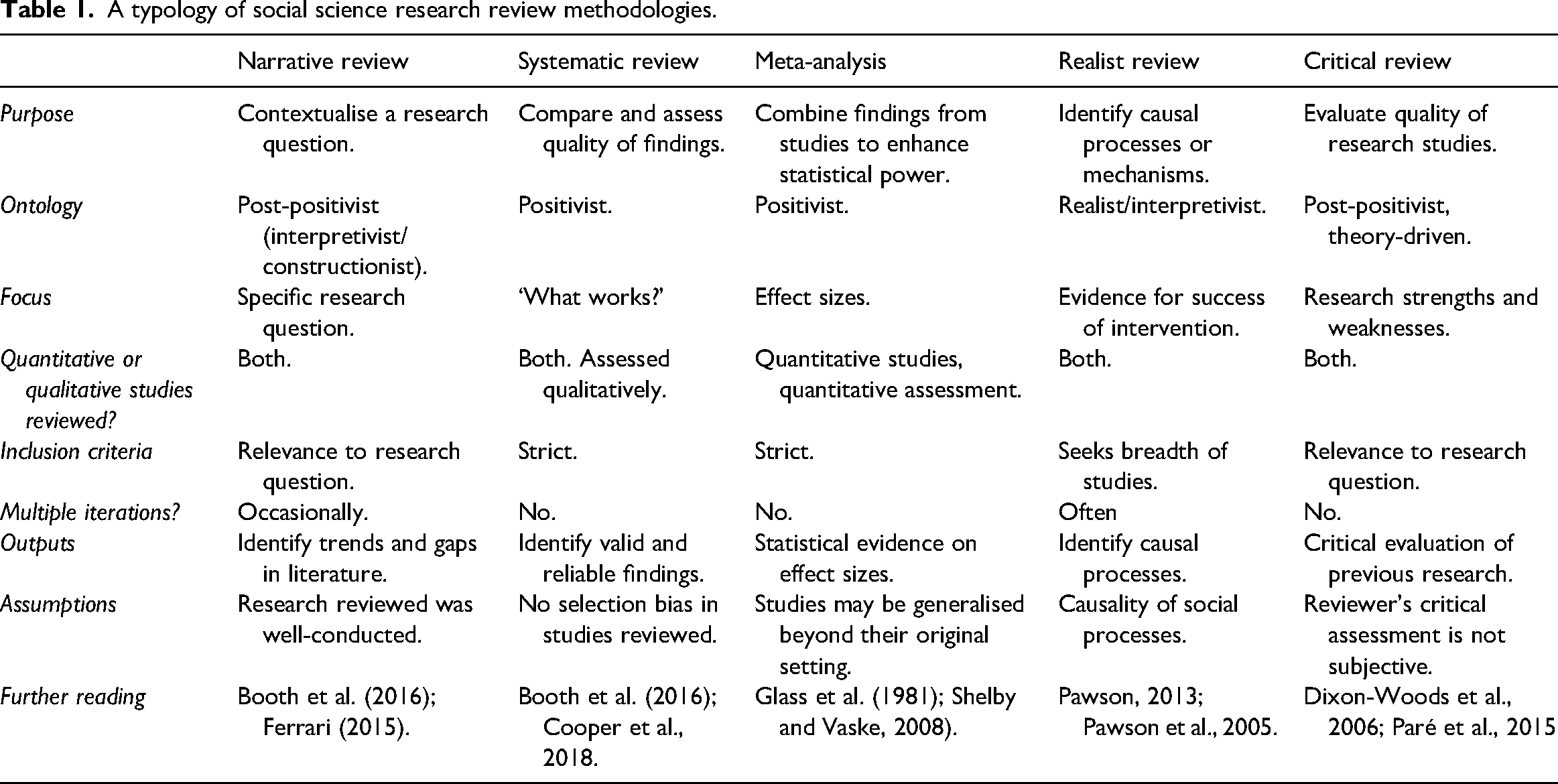
Narrative reviews aim to supply a more or less comprehensive summary of the key literature relevant to a research question, but may not attempt to evaluate the quality of the individual studies reviewed. By contrast, studies included in systematic reviews are rigorously evaluated in terms of strengths and weaknesses (Grant and Booth, 2009: 97, 99; Rother, 2007), to supply a social scientific assessment of what is known about a topic, what is unknown and potentially ‘what works’ when it comes to interventions. When included in a scholarly report of primary research, narrative and systematic reviews serve to contextualise the study, and to demonstrate to readers that the research being reported is novel or addresses a ‘gap’ in existing knowledge of a topic. They may review both qualitative and quantitative studies. Again, the aim is an accurate and objective summary of current knowledge on a topic.
When research is intended to inform policy or practice, meta-analytic review methodologies from the biomedical sciences have been appropriated, sometimes as stand-alone exercises rather than as pre-cursors to original research entailing empirical data collection and analysis (Glass et al., 1981). Meta-analyses use statistical methods to conduct systematic review of quantitative research studies, aggregating data from across the studies included in the review to calculate an ‘effect size’ and confidence interval (Paré et al., 2015: 187). Similar meta-analytic review methodologies have also been developed to synthesise qualitative studies (Bradbury-Jones et al., 2019; Garthwaite et al., 2022; Timulak, 2014). Both seek to supply a dependable knowledge synthesis, with the explicit objective of guiding practice or policy.
As an alternative to the positivism of meta-analysis, the so-called ‘realist review’ or ‘realist synthesis’ techniques have been developed (Pawson, 2013; Wong et al., 2013). This review methodology gathers and then synthesises findings from a range of studies (potentially both quantitative and qualitative), in an effort to identify and explain causal processes that link variables within settings. These can potentially then be used to identify effective interventions to address complex social problems (Pawson et al., 2005: 21). Like meta-analysis, realist synthesis is aimed at informing practice or policy, but with the additional objective of identifying causal mechanisms.
Typologies of reviews also identify what has been called a ‘critical review’ approach (Paré et al., 2015: 189; Samnani et al., 2017: 638). This approach may review both quantitative and qualitative studies, but unlike some of the methodologies already described, assess individual studies against a particular theoretical or quality criterion, with the aim of establishing or elaborating a model, theory or unique idea about a research topic (Samnani et al., 2017: 637). In these critical approaches, there is an acknowledgment that knowledge production is contingent rather than absolute, though still with the aim of assessing the validity of the findings of the studies reviewed. However, this approach has potential to be adapted to ‘follow the action’ if the aim is adjusted towards conceptual innovation rather than evaluating study quality.
In summary, these differing review methodologies have particular strengths and weaknesses, associated with their specific aims. However, in the context of the earlier discussion of major and minor science perspectives, what these approaches to review of literature or evidence share is an aim to accurately represent the material reviewed, with the added assumption that the studies reviewed also set out (adequately or inadequately) to represent or reflect the social phenomena that they studied. This major science emphasis is strongest in systematic reviews and meta-analysis that use statistical methods to provide a comprehensive representation of the subject under review, and in the efforts of realist review to establish a causal mechanism that can be applied to address a practical problem. It is weaker in narrative and critical reviews, which tend towards a post-positivist ontology (Fox, 2008) and consequently may explicitly or implicitly acknowledge the significance of interpretation in social research. The objective of this paper is to set out a radical alternative to this major science goal of representation and to offer in its place a review methodology that replaces this with the ‘minor science’ orientation of ‘following the action’ during the process of scholarly review. The rest of this paper is consequently devoted to developing and illustrating a rhizomatic review strategy founded in such an effort.
Towards a rhizomatic approach: Following the action
Unlike the review methodologies considered in the previous section, a rhizomatic minor science approach to research does not seek to create a one-to-one representation of the world, but instead to follow the action: to immerse itself in the very flow of events that are the topic of study, exploring connections, associations and divergences as research progresses. Elsewhere (Fox and Alldred, 2022b), the author has outlined some methodological approaches that operationalise such a ‘following’ strategy in the data gathering, analysis and reporting phases of social inquiry; what follows suggests a cognate review methodology appropriate to a minor (social) science research endeavour. The specific objective of this rhizomatic review methodology is to ‘follow’ flows: either within a literature or within a body of research evidence.
However, it would run counter to the spirit of the rhizome and ‘following the action’ to attempt to specify or otherwise delimit a static method for such rhizomatic review. Instead, it is more fitting to identify some general guidelines that might underpin a rhizomatic approach to reviewing evidence or literature. 5 An illustration of the application of these guidelines in the next section will then serve to further exemplify what is being suggested for rhizomatic review.
Review a topic rather than a specific research question
Rather than close down the rhizomatic flow that a review of evidence or literature might follow by constraining it within a specific research question, begin the review with a broad topic or area of interest as its focus. This will enable a more rhizomatic review that meanders like a river through the research on a topic, rather than constraining the review's scope and thereby potentially missing pertinent research findings within this broader topic area. For example, in place of a review focused on the question ‘are incidents of gendered hate crime in European cities increasing?’, start with a wider frame of interest such as ‘gender-related violence’ (GRV) as the review topic (see, for example, Fox and Alldred, 2022c).
No inclusion or exclusion criteria
As a corollary to the previous principle, avoid inclusion and exclusion criteria determining which research studies are reviewed (as applied in systematic reviews and meta-analysis), which place limitations on the capacity of the review to follow the action. For instance, in the previous example, exclusion of studies that researched GRV in the US or Asia (as opposed to Europe) or where men were the ‘victims’ could risk missing some valuable insights. Similarly, limiting reviews to either qualitative or quantitative studies may prevent reviewers from following a literature that offers additional insights.
Iterative process of review
Rhizomatic reviews may use multiple iterations of data gathering, review and assessment in order to stand back from the review process and identify promising directions or unanswered questions that need further exploration. Sometimes, successive iterations will enable narrowing of the review focus from a broad topic to a more specific research question, or might set up a hypothesis to assess in relation to the literature or evidence. Alternatively, an initial review iteration might reveal that the topic area is still too narrow, preventing review of potentially relevant literature or evidence. For instance, an initial review of material relating to GRV might indicate that also reviewing research evidence on racial violence, or violence more generally could supply relevant insights.
Multi- and inter-disciplinary reviews
Willingness to follow a literature into cognate social science disciplines, or into the humanities, arts or natural sciences can enhance the rhizomatic review process. If this approach strays into unfamiliar disciplines (for instance, economics, engineering or clinical medicine) that challenge a reviewer's capacity for understanding research findings, a review team can be built to enable a multi-disciplinary exploration, or advice sought from a specialist from an unfamiliar discipline. Thus, in relation to GRV, insights from criminology and legal studies or even zoology might open up new avenues of inquiry.
Cartography and modelling
Deleuze and Guattari (1988: 12) contrast two approaches to exploring a phenomenon: tracing and cartography. Tracing seeks to reveal some kind of deeper structure to that phenomenon, as in the branching super-structure of a tree or the linearity of a tap root. Deleuze and Guattari instead advocated a ‘cartographic’ methodology more appropriate to the notion of a rhizome (Deleuze and Guattari, 1988: 20). The only way to trace a subterranean rhizome is to excavate it, in the process destroying the phenomenon itself. Rather, the spreading and intersecting roots of a rhizomatous plant such as a stinging nettle or couch grass are revealed by the shoots that appear above ground. A cartography is not a representation (such as a satellite image of a landscape) but a theory-imbued, non-linear and dynamic following of the rhizome through space and time (cf. van der Tuin and Dolphijn, 2010: 168). Indeed, cartography it is itself part of the rhizome. The map is open and connectable in all of its dimensions: it is detachable, reversible, susceptible to constant modification. It can be torn, reversed, adapted to any kind of mounting, reworked by an individual, group or social formation. (Deleuze and Guattari, 1988: 12).
Avoid ‘gap-hunting’
A frequent objective of a review of to a literature or body of evidence is to find the ‘gap’: the un-researched aspect of a phenomenon ripe for scientific attention (Alvesson and Sandberg, 2011: 247). Such gap-spotting depends upon a representational logic, assuming that a review reveals the ‘current scientific wisdom’ on a field of study, and thereby that which is yet to be represented by scientific research. Alvesson and Sandberg (2011) suggest that gap-hunting distracts from a more important objective: to problematise research findings; as such it reinforces rather than challenging established ‘knowledge’. Instead of seeking a gap in the literature to be plugged by a new study, as a review progresses through its iterations, continually ask new questions of the literature or evidence, and use these questions to follow the rhizome deeper and deeper. For instance, in a rhizomatic review of GRV, question simplistic attributions of terms such as ‘perpetrator’, ‘victim’ and ‘survivor’ by researchers and explore the literature/evidence beyond these labels.
Decision to end rhizomatic reviews are always artificial
The rhizome of the social world goes ever onwards, so the decision to conclude the process of rhizomatic review should always be taken regretfully. Ending a rhizomatic review has to be a pragmatic decision, based on acknowledgment of limited time or resources. To reduce the effect of this artificial ending, the end-point can be used as an opportunity to set out a hypothesis or research question to subsequently be addressed by empirical data collection, or to report the findings of the review and draw conclusions. Acknowledging the artificiality of the ending can also be the starting point for a new review process. For instance, the insights from a rhizomatic review on GRV might be used to set the parameters for a research study; to draw out policy or practice implications; or to inform an application for future research funding.
Summarising: Some or all of these guidelines for rhizomatic review (such as eschewing inclusion criteria or using multiple iterations) may, from time to time, also have been applied within established review models, most particularly in qualitative/narrative reviews. However, when taken together, the guidelines suggested here have the overarching objective of replacing efforts at objective representation of the social and/or natural world (and the literature that reports it) with a following orientation towards the rhizomatic flow of events and happenings. They ensure that no assumptions are made about the material that is explored during the review process. Nor are there firm outputs: the outcome of the rhizomatic review will depend entirely upon the uses to which it is put in a particular study. The following illustration demonstrates how these principles have been put into practice in a recent rhizomatic review by the author (Fox, 2023). 6
Illustration: The affective life of capitalism
To establish a new research programme exploring the social relations (‘affects’) of neoliberal capitalism from a more-than-human, materialist perspective, the author conducted a rhizomatic ‘following’ review methodology. The review process comprised a number of iterations with various twists and turns, which eventually supplied novel insights into the more-than-human and affective life of capitalism. It has contributed to review sections in papers applying this ontological perspective upon capitalism to a range of topics including the coronavirus pandemic, green technologies, digital capitalism, and the political economy of health (Fox, 2022a, 2022b, 2022c, 2023; Fox and Alldred, 2022a). The following paragraphs describe the iterative process of the original exploratory rhizomatic review. (Sadly, this meticulous description of a rhizomatic review process does not rely capture the excitement of discovering literatures and achieving and break-throughs.)
Iteration #1
The starting point for this rhizomatic review was Lettow's (2017) critical assessment of the ‘turn to matter’ and the new materialisms when it comes to analysing capitalism. This negative critique suggested a need to (re-)read some of the classic Marxist texts on the social relations of capitalism, including sections of the first volume of Marx's Capital (2011 [1887]) and the Economic & Philosophic Manuscripts (Marx, 1959 [1844]). These seminal readings inspired review of some more recent critical political economy literature such as Coburn (2004) and Scambler (2007), and neo-Marxist texts including Poulantzas (1978) and Wright's (1984) overview of the Marxist analysis of class. At the same time, exploring the literature comparing and contrasting Marx's ‘historical’ materialism and new materialist theory disclosed texts including DeLanda's (2006) neo-Deleuzian analysis of markets as physical places, and Nail's (2020) re-reading of the early Marx in his book Marx in Motion, which offered further insights into new materialist perspectives on political economy.
Together, these rhizomatic readings of this disparate literature provided a basis within which to develop cartographic models of the different human and non-human materialities involved in capitalist production and exchange. Thus, a production-assemblage can be cartographically summarised as comprising (in no particular order): workers; raw materials; means of production (buildings, tools, technology, energy, knowledge); wages; managers; owner or shareholders
commodity; trader; customer; competitor traders; competitor customers; money/material resources; market environment
Iteration #2
Using Deleuzian ethological ontology (Deleuze, 1988: 125–126) to analyse these cartographies of capitalist assemblages led to the first major insight into the capitalist rhizome. Ethological analysis revealed the affective flows in production and market assemblages that transform raw materials and human labour into a product and exchange material goods for money or other resources. However, it also disclosed previously-unremarked affects associated with ‘supply and demand’, which, as DeLanda (2006: 36) notes, operate beyond the intentionality and immediate control of human actors. This insight fuelled a second iteration of rhizomatic review, sometimes well beyond the author's comfort zone, to make sense of how supply and demand have been considered in classical economics. These texts included Moore's (1925) original statement on the ‘laws of supply and demand’, various contemporary economic discussions of supply and demand, and also Marx's short commentary in Value, Price and Profit (Marx, 2000 [1865]: 11–12). This iteration substantiated DeLanda's insight and led to a third iteration of rhizomatic review.
Iteration #3
This began with a hypothesis: that more-than-human affects associated with supply and demand were not adequately addressed in either classical or Marxist political economy, and may themselves be responsible for some of the unintended consequences of capitalism. To explore this hypothesis, the rhizomatic review now focused on an empirical case study: the development of microcomputing in the 1980s. This case was chosen because the information and communication technologies that constitute the digital economy (including the personal computer [PC], the internet, e-mail, mobile phones, digital broadcasting and streaming services) has been achieved principally through entrepreneurial activity within a competitive market, but after 50 years is now dominated by a handful of global players such as Amazon, Apple, Microsoft, Google and social media companies.
This phase of the review began by researching the development and marketing by IBM of its ‘open architecture’ PC in 1981, charting both its remarkable commercial success and IBM's failure to adequately protect its intellectual property from competitors. As these competitors proliferated, IBM consistently lost market share until in 2005 they finally quit the PC market entirely. Once again, the review took the author into the unknown territory of computer technology and required researching a ‘grey literature’ of trade magazines and technical evaluations of hardware and software. This rhizome has carried the author into exploration of other digital economy technologies including the mobile phone market and the fluctuating fortunes of social media corporations, and eventually to a further case study of the development of electric vehicle technologies. Together these reviews revealed how supply and demand affects worked in both innovation and consolidation phases of capitalist enterprise.
Conclusions emerging from this rhizomatic review
The case study in the third iteration of the rhizomatic review enabled further insights into the unintended consequences of the more-than-human supply and demand affects in capitalist assemblages. These consequences were uncertainty, waste and the production of social inequalities. This rhizomatic review and the further case study of electric car innovation (Fox, 2022b) have been used to argue that capitalism should be seen as a ‘black hole’ that sucks workers, entrepreneurs and shareholders into assemblages from which it is impossible to escape. This assessment fundamentally challenges previous interpretations of capitalism in both classical and Marxist political economy, with profound and unexpected implications for policy and activism (Fox, 2023).
Though these three review iterations were sufficient to underpin current work on new materialist approaches to critical political economy, the rhizome goes ever on. Subsequent iterations are currently informing further work in this area, in particular addressing the relationship between capitalism and the state in contemporary neoliberal economies and a project to disseminate these insights into neoliberal capitalism.
Discussion
As the brief summary of review methodologies earlier in the paper (see Table 1) indicated, reviews of literature or evidence serve a range of purposes. There is no suggestion here that rhizomatic review can substitute for the specialised objectives aims of, say, a meta-analysis that aggregates quantitative data to inform policy or practice, or a realist synthesis that seeks to disclose causal processes within phenomena. Instead, what the rhizomatic approach offers is a review methodology that sits comfortably within the ‘following the action’ model of scientific inquiry designated by Deleuze and Guattari as ‘minor science’. Moreover, it has the potential to reveal insights not possible with a more constrained and regimented review methodology.
The rhizomatic approach to reviewing literature or evidence diverges foundationally from the objectives of ‘major’ (social) scientific research. As discussed earlier, ‘minor science’ is an approach to research that seeks not to stand back and gain an ‘objective’ representation of the world, but to become part of the action and see where it leads. When it comes to the ‘review’ element of such a minor science research project, this means following the rhizome that is the ‘literature’ or other evidence deriving from past scholarship, policy or practice. Unlike many of the review methodologies outlined earlier, rhizomatic review does not place early limitations upon the scope of a research project; does not regard reviewed literature or evidence as supplying a ‘context’ for a study; it does not place artificial disciplinary boundaries upon what may be reviewed and what directions such a review might lead social inquiry into a topic; nor – as is the case with realist synthesis – does it attempt to discern and link ‘independent’ and ‘dependent’ variables within a neat causal sequence.
As such, rhizomatic review is an appropriate choice for researchers applying a model of research that ‘follows the action’, in line with choices of research designs and methods of data gathering and analysis that similarly enable such a minor science approach. It thereby supplies a hitherto missing element within a minor science or post-representational research process. This is not to argue that rhizomatic review is a required review methodology for all new materialist or post-human studies: rather it is an additional tool that has the advantage of complementing other ‘following’ research methods (Fox and Alldred, 2023). It is also a review methodology suitable for social science research that – while not explicitly new materialist or post-human, wishes to apply a ‘following’ perspective that distances itself explicitly from the axiom-seeking, cause-and-effect positivism of the natural sciences.
Rhizomatic review may be used to address a range of social inquiry objectives. First, as the illustration of the new materialist analysis of capitalist affects demonstrated, a rhizomatic review methodology can be particularly helpful for scoping or developing an innovative or ground-breaking research project. The rhizomatic process of literature review can generate novel research questions that move beyond the initial ideas or beliefs of researchers that were based upon partial or limited immersion in a topic or upon assumptions or theoretical and political biases.
Second, the interdisciplinary and iterative methodology of rhizomatic review and its foundation in a minor science ontology can generate insights that may not previously have been identified by researchers within a discipline. The illustration of a rhizomatic review of literature on supply and demand in capitalist economies also demonstrated this capacity, despite this topic having been previously picked over for two centuries by social scientists working within a variety of theoretical frameworks.
Third, when used to scope potential research, the process of rhizomatic review may expose researchers to innovative methods for data collection and analysis, while also possibly promoting a ‘following’ or minor science sensibility during subsequent phases of the social inquiry process. Possible minor science research methodologies include ‘diffraction’ (Barad, 2007: 73), ethology (Fox and Alldred, 2022c; McLeod, 2014), affective methodologies (Potts, 2004; Warfield, 2017) and post-qualitative inquiry (Lather and St Pierre, 2013; St Pierre, 2020, 2021).
Finally, the open-ended, iterative and cartographic methodology of rhizomatic review can be applied when seeking to inform policy or practice recommendations from a disparate and multi-disciplinary body of evidence. For example, a rhizomatic review of social, economic, political and natural science evidence bearing upon environmental sustainability was used to generate cartographies of different policy options, ranging from liberal environmentalism to no-growth economics. This revealed limitations in all policy positions and suggested novel policy options (Fox and Alldred, 2020).
Earlier in the paper, the continuous interplay between minor and major sciences was noted, as disciplines veer between the alternative perspectives of representation and following the subject matter of social science research (Andrews, 2019: 385). Over the past half century, innovative approaches in the social sciences from feminism and critical theory to the new materialisms have often adopted ‘following’ approaches to knowledge production. Meanwhile, the expectations of research funding bodies and research assessment exercises (with their emphases on reproducible knowledge and policy or practice ‘impact’) draw social scientific research towards major or ‘state’ science methodologies (Bonache, 2021). This back-and-forth is dynamic and continuous, while, as Deleuze and Guattari (1988: 485) suggested Minor science is continually enriching major science, communicating its intuitions to it, its ways of proceeding, its itinerancy … Major science has a perpetual need for the inspiration of the minor; but the minor would be nothing if it did not confront and conform to the highest scientific requirements (Deleuze and Guattari, 1988: 485–486).
Footnotes
Funding
The author received no financial support for the research, authorship, and/or publication of this article.

Notes
Author biography
Nick J Fox is Professor of sociology at the University of Huddersfield. Recent work using new materialist and post-human approaches includes studies of sustainable development, climate change policy, social disadvantage and health and materialist research methodology. He is the author of many papers and five books, including (with Pam Alldred) Sociology and the New Materialism (Sage, 2017).