



Abstract
This paper proposes a multi-method olfactory inquiry to document the rich ways in which children's sense of smell is embodied and embedded in an interplay of senses and socio-spatial relationships. I approach olfaction as a conceptual strategy and connect it to socio-material and socio-spatial theories to illustrate the ways in which close empirical attention to olfaction can provide new insights into children's sensory experiences. An olfactory research inquiry rests on traditional (e.g. SmellMaps and SmellLogs) and speculative (e.g. Ododata and Olfactoscapes) olfactory techniques that invite adults’ and children's agentic responses to odours through relational, dynamic, and non-linguistic modes. As a critical sub-methodology of sensory inquiries, olfactory inquiry can help us re-think normative, homogenizing, mind-body relations in early childhood research and practice.
Introduction
I arrived fifteen minutes earlier than I had agreed with the kindergarten teacher, but most staff were already in. They sat in the open-plan kitchen area with a table in the middle, four chairs and a red sofa in the corner. Freshly boiled filter coffee stood on the kitchen table, next to an open pack of plain biscuits. One staff member began peeling a tangerine. The coffee-biscuit-tangerine smell blended into a Christmas-like aroma and made me feel warm and welcome. The first child arrived at 8AM. The smell of hand sanitiser as the parents entered the kindergarten got mixed with petrichor and earthy smell from the rain outside and the child's muddy shoes. I moved to the nursery area that caters for the youngest children in the kindergarten. One of the babies must had had wet diapers left on too long; the odour made me sneeze. I crossed the toilet area, I smelled fragranced baby wipes with rose blossoms and calendula orange barrier cream first, then the smell of liquid soap, probably made of geranium. I moved to the breakfast area and got a whiff of a strong banana aroma, slightly mixed with a nutty and sweet aroma of milk and faint aroma of oats. I sat down on a chair in the back of the room and began filling out the Nursery SmellsLog. The nursery manager told me they never thought of “an olfactory audit” of their nursery before and was keen to see my results.
This vignette is a snapshot from my data collection of children's experiences of smells, scents, and odours in a Norwegian kindergarten. My focus on olfaction has been motivated by the theoretical proposition that children learn through multisensory, embodied ways and my contention that olfaction brings to the centre social justice in early childhood inquiries in that it challenges homogenizing representations of children's experiences. Thus far, detailed analyses and detection methods of various odours and aromas have been the domain of urban and community research (e.g. Henshaw, 2013; Powell, 2010), tourism geographers (e.g. Abd Rahman et al., 2016) and numerous artistic projects (e.g. olfactory exhibitions by Sissel Tolaas, Maki Ueda, Peter de Cupere). Collectively, this work has evoked the ‘multisensory, affectual and embodied ways we make for connections with spaces’ (p.171, Huijbens and Müller, 2022). In this article, I expand the literature with a specific focus on children's olfactory experiences. I synthesize the tools and techniques available for olfactory inquiries with young children and provide conceptual directions for their use with the aim of advancing spatial perspectives in qualitative research.
Following my experience as a researcher-designer, I discuss olfactory inquiry as a ‘speculative method’ that ‘may tend to blur boundaries between research, design and teaching’ (Ross, 2017). I explore some of the implications and challenges of olfactory inquiry from a social justice perspective that directly links speculative methods with the concern of under- and mis-representation of children's sensations and multisensory experiences. Reflecting on the potentialities of an olfactory inquiry, I present a reflexive case that aims to answer the following questions:
How can olfactory inquiries tangibly respond to the insights from socio-material theories into children's sensoria?
How can qualitative researchers represent the spectrum of children's olfactory sensorium in ways that does justice to the complex ways in which children negotiate their place in classrooms and communities?
How can I, as an olfactory researcher in early childhood, stay true to the callings of spatial theories and the ethics of conducting research with children?
The article combines insights from a conceptual review and empirical studies of children's olfactory experiences to make methodological and theoretical contributions to olfactory inquiries. In the first section, I introduce an eclectic collection of olfactory methods and procedures, which could usefully supplement the fluidity of current sensory methods in early childhood. I then highlight ‘olfactoscapes’ as an example of discursive speculative methods that bear on the shift in critical perspectives in early childhood inquiries. In the third section, I align the critical theoretical advancements in olfactory research with the ethical principles of qualitative early childhood research. My aim is to open new methodological and conceptual avenues in qualitative research concerned with the kaleidoscope of odours that children encounter on a daily basis.
The sensory turn
The sensory turn, which olfaction is part of, takes as its central argument the roles senses play in learning and socializing (see Sand et al., 2022), particularly the significant role of senses in configurating identity (e.g. Biswas, 2021; Curtis, 2008; Green, 2022), memories (e.g. Van Campen, 2014; Verbeek and van Campen, 2013) and moral, ethical and socio-political relationships (Classen et al., 1994, Synnott, 1991). I place my work within the tradition of critical approaches to sensory studies, informed by new materialism theories.
New materialism opposes the sensory hierarchy reminiscent of cognitive and ocular-centric conceptualization of learning, which, since enlightenment and Kantian rationalism, have dominated not only early childhood studies, but also social studies more broadly (Spencer, 2014). Recognizing the rich sensory ways in which children experience and know the world, critical literacy scholars have documented and emphasized the interrelatedness of socio-material and sensory literacies (Mills, 2015; Mills et al., 2022). The critical influences of new materialism have animated qualitative researchers to adopt methodologies that would be more fit for addressing the more-than-human relationality in children's experiences (Fairchild, 2019; Flint, 2021). These new critical theories move beyond anthropocentric and logocentric focus of traditional early childhood approaches and supplement extant highly visuocentric methods with multisensory inquiries (see e.g. Kuby and Rowsell, 2017; Wargo, 2018).
A leading approach in multisensory inquiries is sensory ethnography (Pink, 2015), which departs from linguistic, cognitive, or material representations, and encourages researchers to rethink traditional visual methods with a serious engagement of the senses. I place my inquiry within this tradition and expand it with attention to children's olfactory engagement. Similarly to Pink (2006, 2022), I am not positioning olfactory inquiries as a set of fixed techniques or prescribed procedures but rather as an intellectual effort to understand fine-grained and affective sensoria.
Early childhood studies and olfaction
The ‘multi’ in multisensory implies the influence of all six senses in children's meaning-making, including the sense of smell. In a typical interaction, some senses become muted and some more centrally involved (Howes, 2010), and this interplay offers an exciting but also challenging ground for qualitative research. The dominant canon of five senses and the elevation of the visual sense above other senses have been criticized for its restricted understanding of empirical documentation of children's experiences (Beery and Jørgensen, 2018) and impoverished early childhood practice (Hackett and Somerville, 2017).
In an effort to counteract this pattern, early childhood researchers have drawn on a combination of methods to document the deep sensory entanglements in children's play and literacies. Some research, for example that of Mills et al. (2013), reported children's sensory entanglements with visual and interview data. Thus far, however, qualitative early childhood research has not sufficiently engaged with children's olfactory experiences. I therefore foreground olfaction as a neglected sense in prior cross-modal/multi-sensory investigations (see Di Stefano et al., 2022), and consider its contribution to sensory research in early childhood. This is important given the central role smell plays in making sense of the environment and one's position within in.
Olfaction as a central meaning-making sense
The sense of smell is central to cognitive actions (e.g. memory; Aggleton and Waskett, 1999), and affective processing (e.g. emotional arousal; Bensafi et al., 2002). Some odours can be objectively perceived, and indeed preliminary data from cross-cultural researchers suggest some commonalities in olfactory discrimination across children from 18 countries (Oleszkiewicz et al., 2022) but other odours are highly individual and subjectively perceived (Stewart, 2022). The subjective quality of olfactory perception has been explained with the close link between memory and olfaction (Wilson and Stevenson, 2003) and memory and emotion (Willander and Larsson, 2007), particularly for neurological and neurodegenerative reasons (e.g. Bahuleyan and Singh, 2012).
Olfaction constitutes different social contexts as both an embodied and cultural category in that it mediates between the self and the world. As part of sensation (see Pink, 2020), olfaction not only influences but also configures socio-ethical and socio-political relationships, including gender, ethnicity, or social networks (Guru and Sarukkai, 2019). In critical embodiment studies, such as those that draw on poetic and baroque methods of inquiry (for example Borovica, 2019), affect and aesthetics are infused with a sensory inquiry into knowledge that resides in humans, non-humans, and post-humans. My interest in olfaction connects to this work on several levels but most acutely in terms of the critique and re-imagination of mainstreaming ways of representing children's contemporary experiences, which had morphed learning into linear, and highly visually and verbally dominated pedagogies.
Theoretically, the sensory turn in socio-cultural and historical studies (see Howes, 2010) has invigorated the scientific interest in the sense of smell as a factor that shapes wellbeing, behaviours, and learning across the lifespan (Spence, 2022). Pragmatically, the high incidence of coronavirus disease 2019 patients who lost their sense of smell during the global pandemic (Zeng et al., 2021) vindicated public interest in the “hidden” or “lower” sense of smell. Methodologically, however, both adult and children's studies, are missing guidance, frameworks, and tools for integrating sensory research interest with empirical analysis.
When I embarked on my olfactory research journey, I strived for a systematic way of turning the ephemeral, fleeting and often barely perceptible moments of children's olfactory experiences into meaningful empirical inquiries. Some methods worked better than others and my learnings along the way were instructive but also perplexing. For example, while the use of children's drawings is a highly valued qualitative method in early childhood research, I found it to be limiting and restricting children's reports of olfactory preferences. On the other hand, children's and their teachers’ enthusiastic engagement in smellwalks and smellmaps proved to be an important mediator for sustaining the practice after the project's end. In consolidating the methodological lessons that I had learnt in my work, I drew on the principles of the socio-material theory.
Theoretical framing: Socio-materiality
A number of conceptual frameworks have been applied to sensorial research, revealing embodied dimensions of children's experiences with for example digital technologies (e.g. Jewitt and Leder Mackley, 2019), or public spaces such as museums (e.g. Fletcher et al., 2018). The interest in the hidden senses of olfaction, gustation, and proprioception, is explicitly drawn on in phenomenological and embodied works, where texts, tools and technologies form and influence knowledge through socio-corporal networks that are phenomenologically experienced (Brinkmann, 2017) and fully embodied (Ellingson, 2017; Massey, 2004).
Socio-material scholars have since the turn of the century emphasized the bodily and material aspects of literacies (Burnett et al., 2020) and the ways in which literacies are entangled with the sensory landscape of everyday environments (Pacheco-Costa and Guzmán-Simón, 2021). Notably, socio-material education scholars reveal ‘the ways in which the sensorial and material aspects of educational practice, including experiences of time, relations with objects, influence of space, and the circulation of affect are entangled and co-productive of social and educational discourses’ (p.142, Clark/Keefe and Haines, 2019).
Socio-material scholars are attentive to micro-moments, or fragments of interactions that fuse socio-material, tangible and immaterial, properties of “things” and children's sensory practices. A challenge of this approach remains the lack of what Drobnick (2014: 187) terms an ‘olfactocentric discourse’, which would preserve ‘scent's intrinsic affectiveness and emotionality’ but also honour smell's non-phenomenological qualities. The development of an olfactocentric discourse in early childhood studies requires a focused attention to olfaction before, during and after data collection. Prior research has developed qualitative methods that foreground sound, movement and embodiment in children's experiences (Daza and Gershon, 2015) and indicated qualitative ways of capturing micro-moments focused on sound and movement (Hackett, 2021). To further advance early childhood studies, sensory inquiries require new systematic ways of thinking about the inter- and intra-play of all six senses (visual, hearing, touch, smell, taste, and proprioception, see Kucirkova, 2022). For example, mapping children's moves and environmental sounds has been used by sonic sensory research (see e.g. Gallagher et al., 2017; Gershon, 2017), and could be enriched with smell dynamics as children move around. Space-cartographing methods, such as Gowers’ (2022) diverse examples of textual, iconic, and image-based sensory mind-mapping and Cowan's (2020) space-making of children's outdoor play, could be easily extended with olfaction.
Qualitative research can benefit from olfactory methods that are nested in various disciplines and epistemologies, and my own toolkit of olfactory methods includes traditional assessments of children's olfactory abilities as well as exploratory examinations of olfactoscapes. In what follows, I outline the central methods through which olfactory researchers can capture odours propagated through complex spatial community dynamics and compile olfactory profiles of children's everyday experiences.
The methods of an olfactory inquiry
I divide up my methodological examples according to the main categories of capturing and decoding smells (Allen, 2021) or in the semiotic researchers’ language, according to smell ‘denotation’ (observing a sensation) and smell ‘connotation’ (giving meaning to a sensation). In each category, I outline the traditional as well as the more speculative types (Ross, 2017, 2022) of olfactory methods. It is my contention that an eclectic collection of olfactory methods and procedures can expand the diverse sensory understandings emerging from new materialist, affective and spatial theories and illustrate their possible adaptation in qualitative research. I followed Ross’ (2022) classification, who reflected on the transformative possibilities of new methods in digital technology research and proposed a judicious balance between traditional and new, ‘speculative’ methods to inform future pedagogies.
Traditional denotative olfactory methods
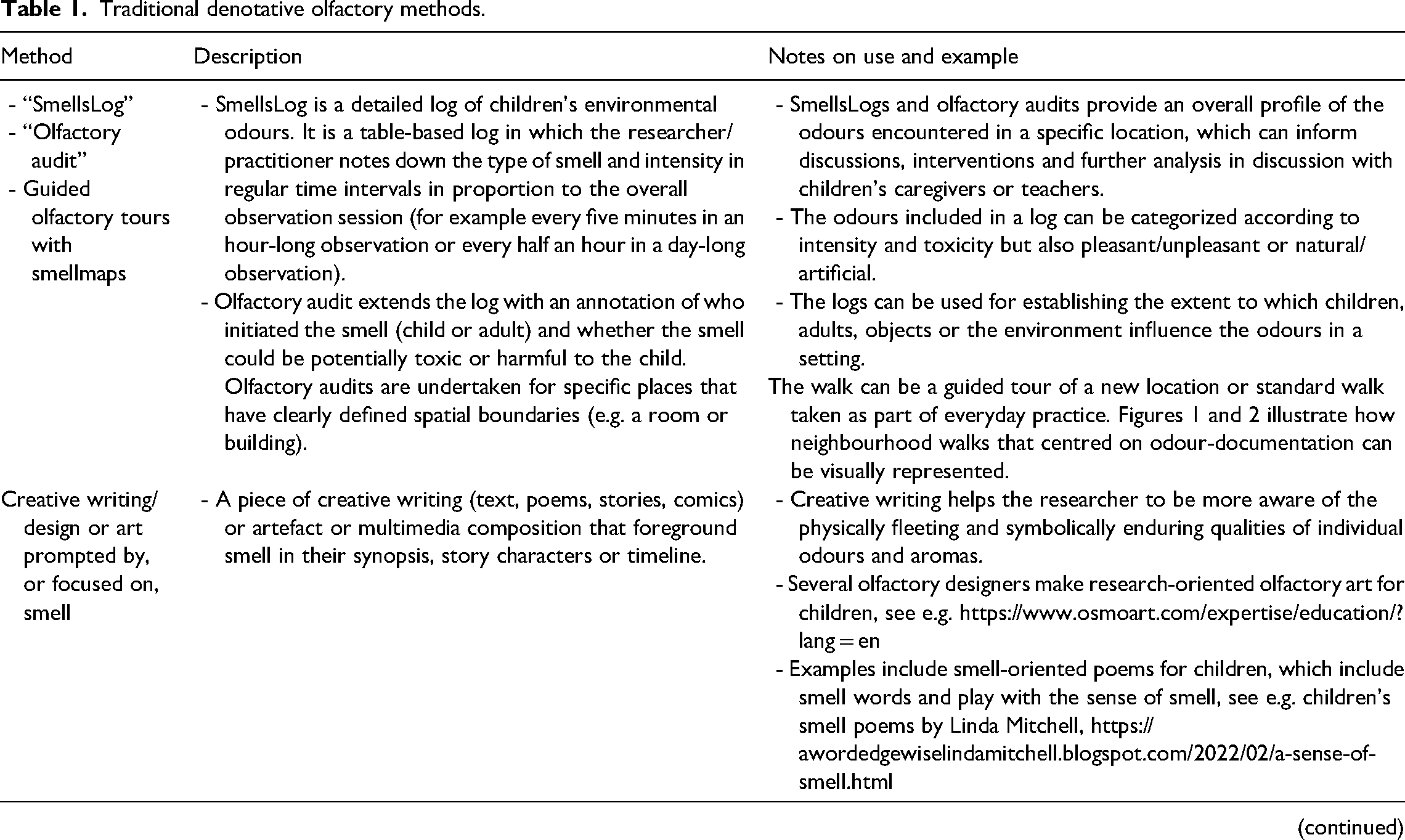
Sensory researchers in the group “Sensory Think Tank” have usefully synthesized the arsenal of methods available to olfactory researchers working with adults (see http://sensorythinktank.com/). The following methods can be adapted and added for work with children: The Sniffin’ Sticks Test, Olfactory Audits and Logs, creative writing, public exhibition, prompted interviews and focus groups, olfactory guided tours, smell maps, smell objects, smell walks. In Table 1, I detail each method with a short description of the methodological procedure and empirical examples, captured illustratively in Figures 1 and 2.
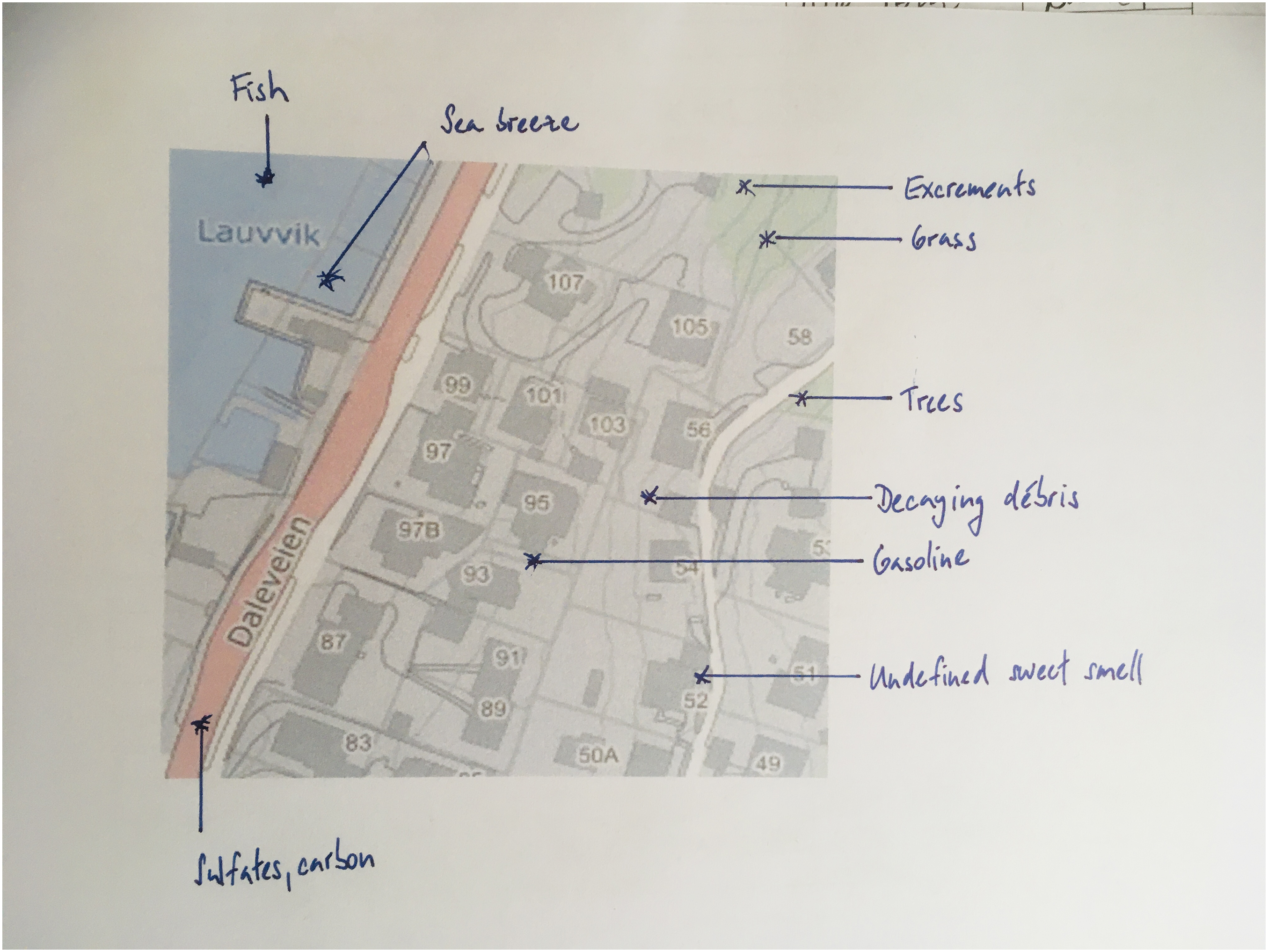
Example of olfactory guided neighbourhood tour and spots of intense odours.
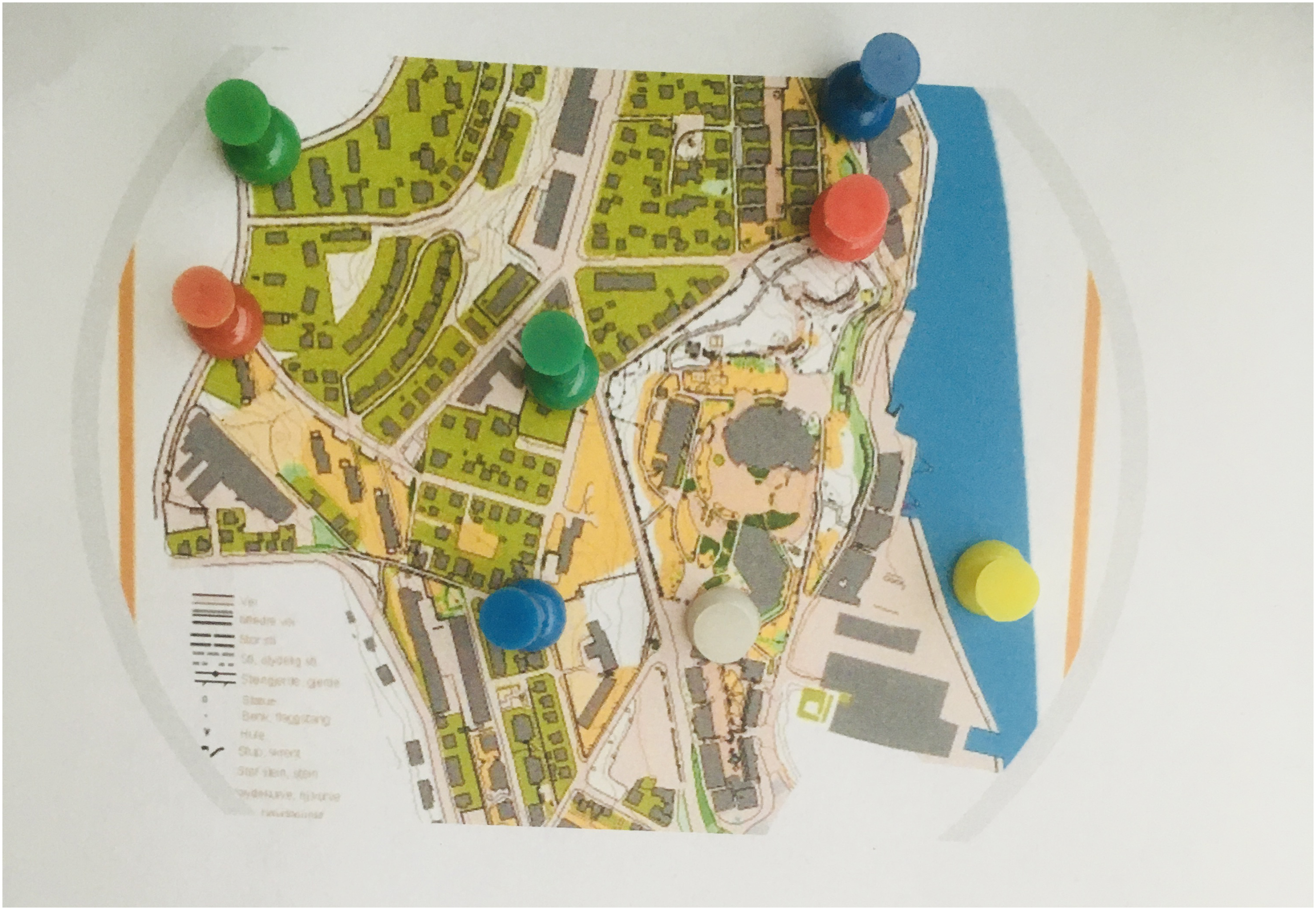
Example of olfactory guided neighbourhood tour and spots of intense odours.
Traditional denotative olfactory methods.
The methods described in Table 1 are child-oriented, but they are adult-led. This is a limitation in sensory education, which has been criticized for being adult-centric (Biswas, 2021). More inclusive and less representational methods that approximate researchers to children's inner worlds are in Table 2, where I summarize child-led olfactory methods with examples and short descriptions of how they can be applied in practice. Several of the methods in Table 2 are the staple of early childhood researchers (for example the use of drawings is an established method in many qualitative studies).
Child-led denotative olfactory methods.
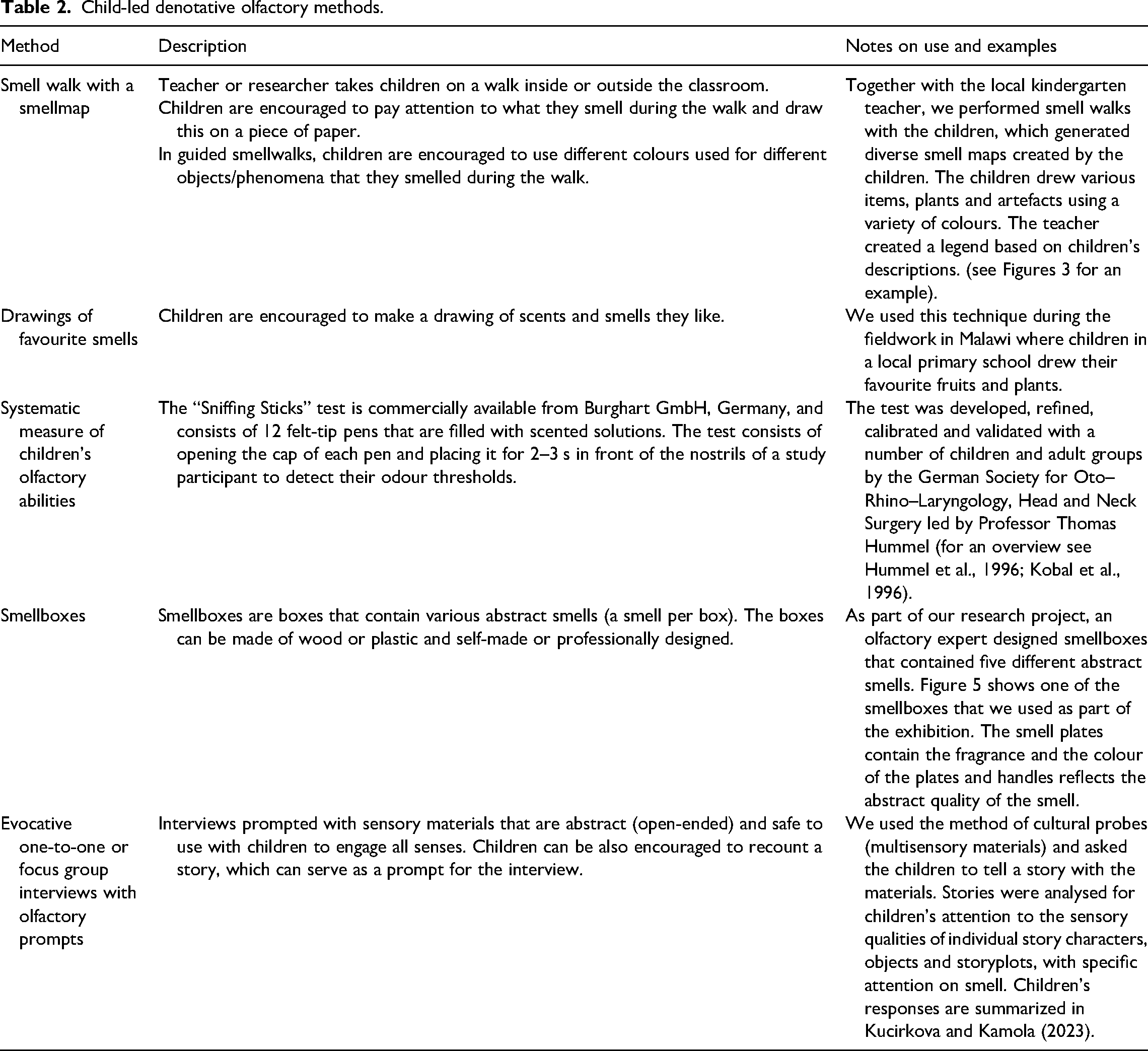
As highlighted in Table 2, SmellWalks and SmellMaps are visualizing methods for sensory walks, and a popular way of capturing children's embodied experiences. In designing the smellwalk that served as impetus for children's maps, the pre-school teacher and I adapted the templates designed by Kate McLean (https://sensorymaps.com/about/), which delineate the location of a smell and its intensity. The method allowed us to reflect on the diverse ways in which Norwegian kindergartners made their olfactory sensations visible in the choice of colours, shapes and colour intensities of their map drawings (see Figure 3 for an example). I used this technique not only with children but also during adult-led Olfactory Audits that aimed to visually represent the locations and intensities of odours in early years settings. Figures 4 illustrates the presence of various odours within the kindergarten place and the intensity of the individual odours on a scale of 1–6 (6 = most intense and 1 = barely perceptible).
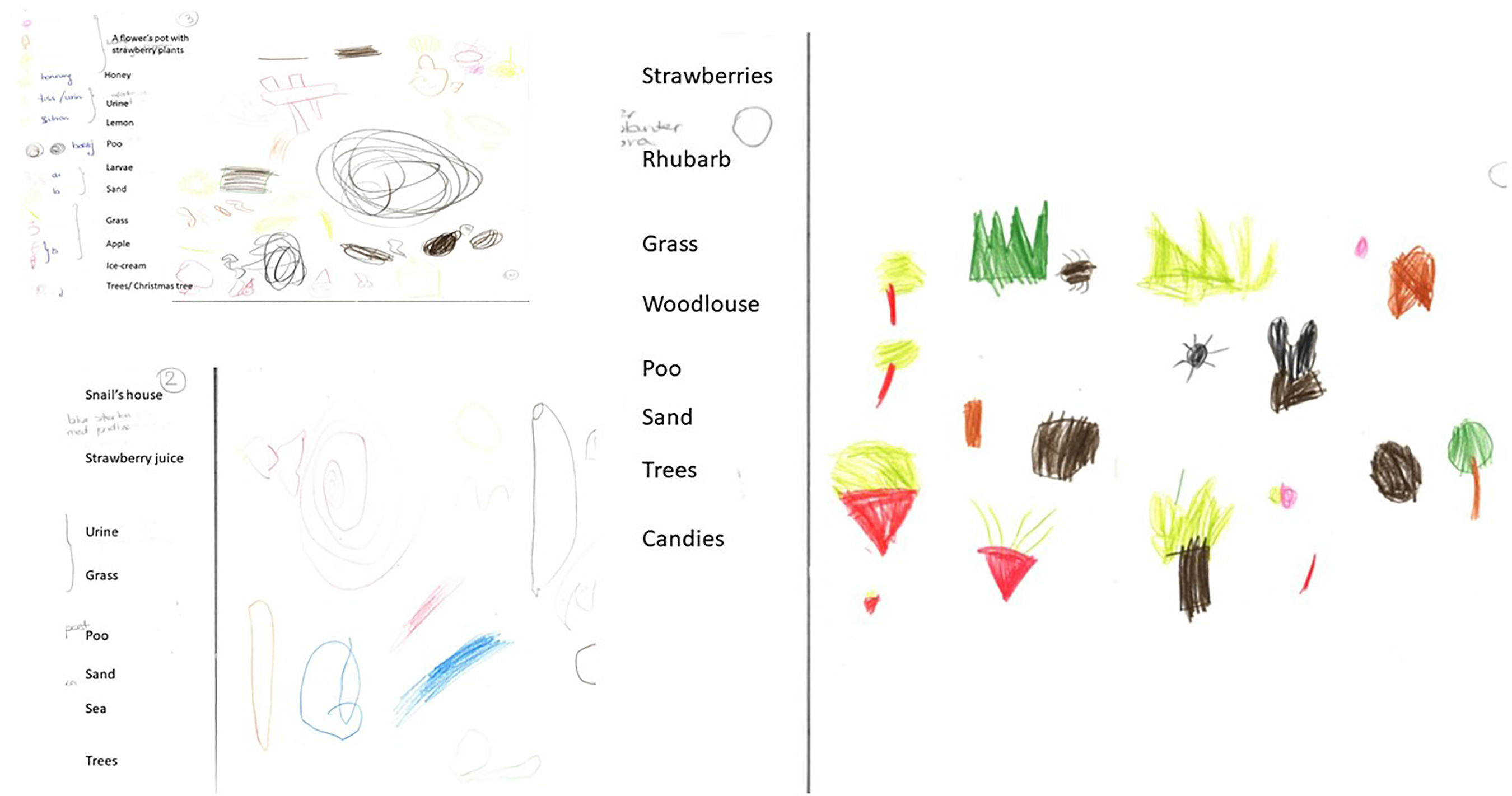
Child's smellmap after a smellwalk in a kindergarten.
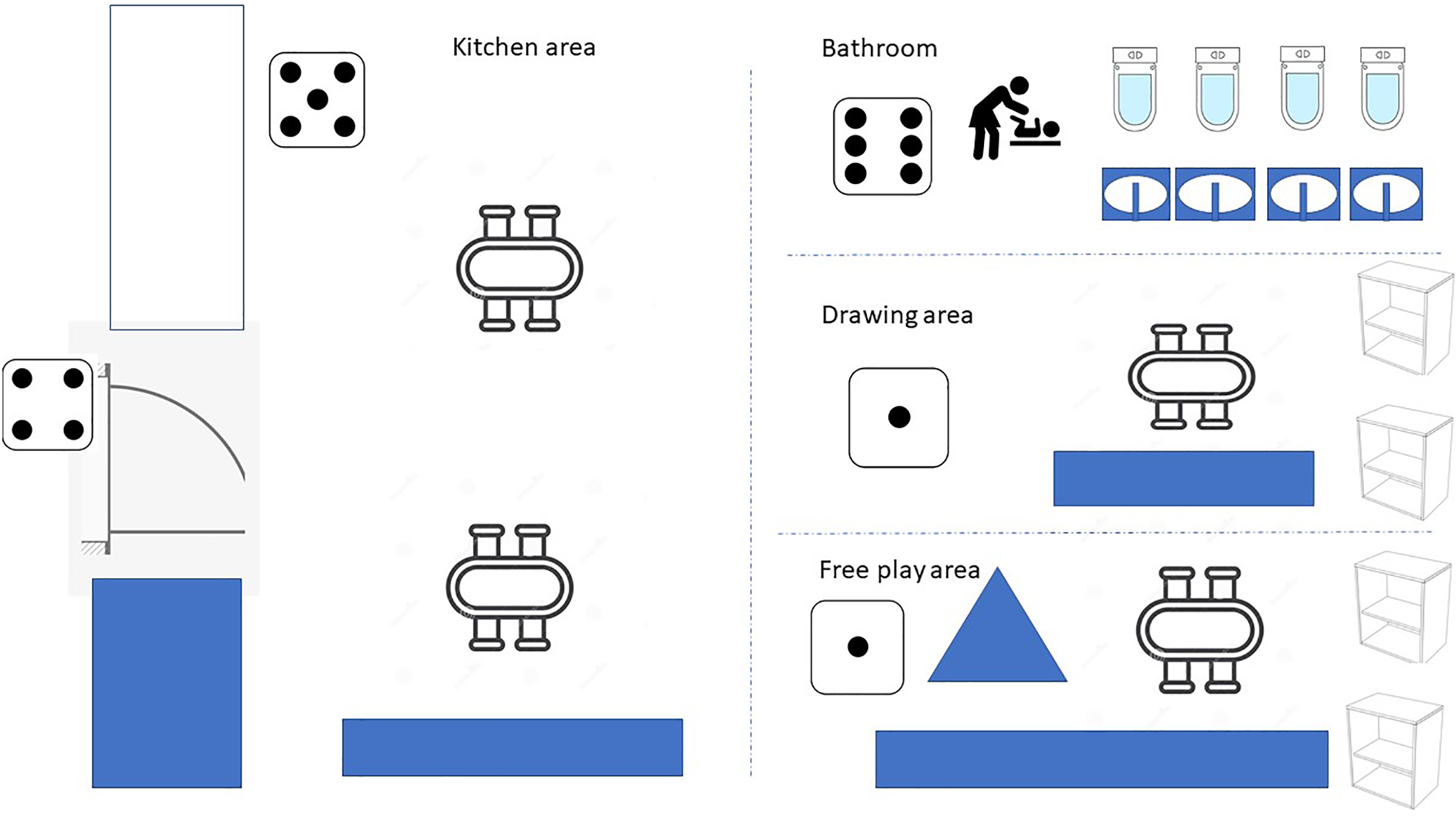
Olfactory map of a kindergarten.
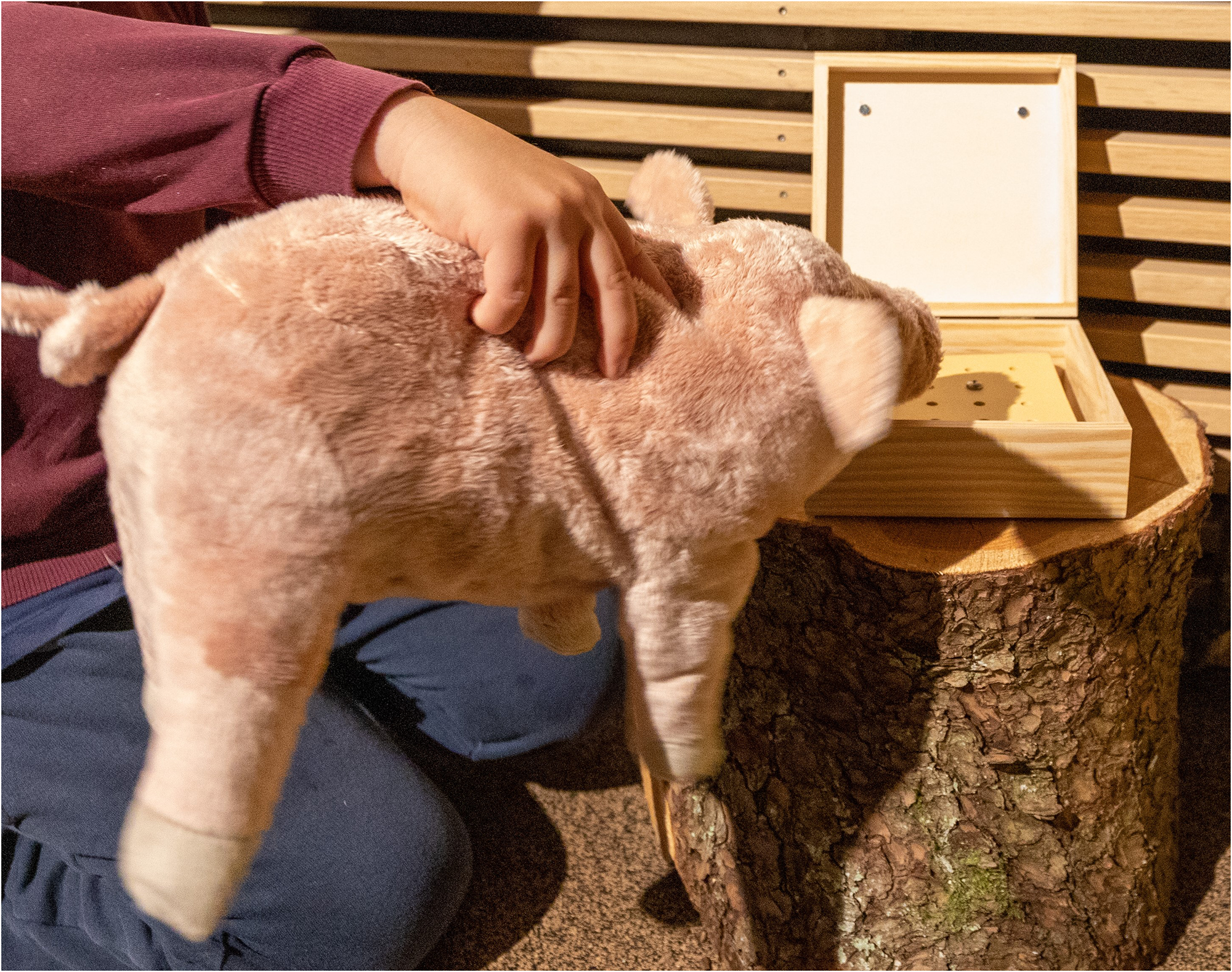
Smellbox used in the exhibition area.
The traditional methods I have presented could be criticized for neglecting the non-linguistic, abstract and deeply felt conceptualizations associated with smell. Furthermore, smellmaps are static representations but odours are highly changeable and ephemeral in nature. In the next section, I, therefore present more open-ended, dynamic and “speculative” olfactory methods that are allied with the concept of olfactoscapes and exemplify alternative ways of documenting children's vibrant, often ineffable and fragmented olfactory experiences.
Speculative denotative olfactory methods
Speculative methods can help qualitative researchers ‘visualise and critique the possible nature and consequences of particular kinds of complexity and boundaries’ (Ross, 2017). My speculative olfactory methods have been constructed out of encounter with the works of sensory scholars (e.g. Serres, 2014), but also conversations and practice observations with sensory cartographers (artists and designers who map, distil and exhibit smells). Engaging with olfactory exhibitions as both their creator and visitor and being part of art-research cross-sectoral encounters had inspired my thinking about expanding current spatial and sensory methodologies with smellscapes or “olfactoscapes”.
Olfactoscapes reconfigure olfaction from a place to an atmosphere with human, non-human and post-human bodies that ‘share in reproductive metabolisms crossing scales, species’ (p.367, Ahuja, 2015). Olfactoscapes are a form of “scapes”, i.e. ‘deeply perspectival constructs’ (p.76, Powell and Steel, 2011) that occur through junctures and disjunctures of imagined and historically situated contexts, people and their flows. Olfactoscapes are instable, they change in response to weather conditions and changing circumstances of people, animals and objects inhabiting them (Xiao, 2018). Rather than conceptualizing odours in dichotomous qualities of absence/presence and good/bad, olfactoscapes are an example of discursive, open-ended, speculative methods, which signal the shift in critical socio-material approaches to early childhood studies. The documentation of olfactoscapes is idiosyncratic in that it allows subjective interpretations of odours in a given ‘scape’ and relational in that the subjective interpretations are meshed with collective observations and creations of olfactory (land)scapes. As such, olfactoscapes move olfactory inquiries from the study of a place to dynamic, relational studies of spatial studies. This, as I argue next, brings a paradigmatic shift to early childhood inquires with the introduction of temporal and relational properties of odours, and offers conceptual directions for the implementation of olfactory inquiries.
Conceptual directions for implementing olfactory inquiries
Socio-spatial understandings of olfaction
In a classic view of olfaction, smell has both biologically functional and socially performative dimensions, thus aligning with the definition of a place that shapes identities from the inside or outside of a space (Relph, 1976). From more recent, human geography perspectives, the definition of a ‘place’ intersects with identities and citizens’ socio-cultural identifications with geographies (Holt-Jensen, 2022). Although olfaction is not a geographical place, it has unique spatial qualities that are socially constituted and socially contingent. In early childhood studies, places are the vibrant matter of critical and inclusive pedagogies (Comber, 2013) that assemble humans and non-human others in productive ways (Duhn, 2012). Places shape children's belonging in classrooms in ways that undo hegemonies in a dynamic and relational way, given that ‘places are never finished but produced through the reiteration of practices—the repetition of seemingly mundane activities on a daily basis’ (Cresswell, 2004: 82). Olfaction also has unique temporal qualities that come to the fore during social interactions (e.g. what I smell in this room now is not what my colleague smells in this room now or five minutes before). The socio-material theoretical framework does not consider the dynamism of temporal and spatial relationships that characterize the ephemeral and ambient nature of olfaction.
In my earlier work (Kucirkova and Bruheim Jensen, 2023a), I drew on socio-material theories to explain how olfactory behaviours such as sniffing, smelling and wafting, become embedded and embodied in parent-child relationships during home literacy experiences. While socio-materiality served as a valuable theoretical framework for explaining the interplay between books, parents, and children, it was the socio-spatial theory (Soja, 1980, 1996, 2013) that played a generative role in building my socio-ecological perspective on olfactory research. Soja (1996) developed the material-imaginative concept of space in early space theories (see Lefebvre, 1991) with a politically motivated focus on “thirdspaces” that are produced in cultural transactions between people and place. Aware of the devastating impact of discriminatory and exclusionary practices on the livelihoods of the underprivileged, Soja (1996) sought to challenge the role of humans as spatial beings who collectively construct thirdspaces that carry intimate and global consequences for millions and are thus site for achieving social justice. Soja's (1996, 2003) tenet to spatially connect to social justice resonated with my own ethical stance on olfactory research, particularly his assertion that ‘the spatial dimension has traditionally been treated as a kind of fixed background, a physically formed environment that to be sure, has some influence on our lives but remains external to the social world and to efforts to make the world more socially just’ (p. 2, Soja, 2013).
Based on these ideas, I formulate the concept of the olfactoscape's potential to activate both individual and collective agency, thereby reshaping individual-community socio-spatial connections. This builds also on Malnar and Vodvarka's (2014) concept of sensory enactments in space, which further moves my positioning of olfactory inquiries along the relational socio-spatial, rather than socio-material, dimensions. What are the implications of implementing smell inquiries under the umbrella of socio-spatial theories for qualitative researchers? First, it attunes them to the olfactory conditions of the environment that they inhabit as citizens, scholars and human beings. Consider the example of smellwalks: Smellmaps and smell-cartographing smell make odours significant by being named and marked (Burbules, 2004). Allen (2021) therefore argues that smellwalks require ‘a reorientation of the senses to temporarily emphasize information received from the nose’ (Allen, 2021, online). Engagement with the smell-mapping techniques raises researchers’ awareness of the socio-spatial qualities of places, including their own agency within the space.
More specifically, socio-spatial understanding of olfaction commits researchers to empowering collective agency in olfactoscape. Howes (2010) reminds us that humans do not pass through spaces leaving them intact; rather, each mapping exercise is an interaction with spatial qualities that become represented and changed through the interaction. In the case of smell-mapping, the presence of a smell in a space largely depends on the agency of the individual passing through the space – ‘smell is a prominent mode of perceiving the social’ (p.48, Guru and Sarukkai, 2019). If we understand social justice as the foundation in education and a relational impetus for achieving equity, then we need to position the shared and relational aspect of olfaction more prominently in olfactory inquiries.
Taken together, I argue that olfaction is a central sensory modality that is relative and relational to other senses and to the fully embodied olfactory experiences that we, as species, encounter on Earth. I endorse the view of critical theorists who make a serious case for sensory research, and position social justice as the ‘main staple of sensuous scholarship’ (p. 65, Vannini et al., 2013). Ethical olfactory inquiry compels qualitative researchers to examine children's sense of smell as a site of social justice where the relationality of smell allows for significant conceptual exploration of children's agency.
Children's agency in non-linguistic olfactory inquiries
The temporal dimension of smell imports non-linguistic and embodied qualities into qualitative methods of spatial research. SmellWalks, SmellMaps and smell tours encourage bodily inscriptions of olfactory impressions, but they do not allow for children's or adults’ communication of the felt olfactory dimensions in their experiences. Undeniably, capturing sensations in a two-dimensional map format does little justice to the rich bodily experience of moving across a space. This is because smell is immaterial; it is the very property of smell, and its difference with other senses, that it is not bound to objects or locations (Guru and Sarukkai, 2019). The immaterial quality of smell is not trivial, but highly consequential for the ethical dimension of olfactory inquiries.
Namely, smell is difficult to verbalize for both adults and children; the highly affective and abstract qualities of smell make odours particularly challenging to describe in words or linguistic forms. Impoverished olfactory vocabulary is universal (Yeshurun and Sobel, 2010), although some cultures have more words for specific odours prevalent in their local environments, for example in the Jahai speakers in Malaysia (Burenhult and Majid, 2011). The absence of olfactory vocabulary can be viewed as an opportunity to cultivate innovative qualitative research approaches with children.
While in cognitive psychology, the limitations of olfactory language are considered a methodological “problem” (p.325, Muniesa and Trébuchet-Breitwiller, 2010), in olfactory art, it is a strength. Indeed, several olfactory artists have come up with their own smell vocabularies; for example, Sissel Tolaas has developed an Alphabet for the Nose, or ‘Nasalo dictionary’, which consists of 2500 context-free, fantasy words that follow their own linguistic rules (Ip, 2018). Solaas’ creation of an entirely new set of words exemplifies the practical implementation of the idea that novel perceptions demand novel terminology. Given that odour is invisible and references to odours rely on visual and gustatory references (Marx, 2021), olfactory expressions lend themselves to ‘creative misuses of language’ that may include ‘familiar words that initially sound crazy’ (p. 204, Rorty, 1999). The creative agency of artists is inspirational for child-centric investigations, where children too can coin new terms.
In my studies, children did not invent their own olfactory words, but they made some associations that one might consider unusual. In one observational study with parents and children reading scratch-and-smell book together, a five-year-old girl described a sweet odour smelling “like a butterfly” (Kucirkova and Bruheim Jensen, 2023b) and in another study with Norwegian pre-schoolers, one of the children recounted a story where a spaceship had a scent (Kucirkova and Kamola, 2023). The examples illustrate that olfactory inquiry opens the possibility for mapping, signalling, embodying, signposting and emancipating olfactory sensations, wonders and imaginations. In this process, children's agency comes to fore and it is up to us, qualitative researchers, to do justice to the volitional choices children make in noticing, producing and visualizing the odours around them. How can we leverage these insights to promote ethical olfactory inquiries in the future?
Tolaas has critiqued the rigid and artificial borderlines imposed by logocentric approaches to smell in her 2022 exhibition “RE_” at Oslo's Astrup Fearnley Museet. In the exhibition, the artist catalogued smells made of tangible objects (e.g. the smell of money) and non-tangible emotions (e.g. the smell of fear and sweat) as well as the smell of ocean and melting ice. Tolaas’ intention was to appeal to our collective (human) agency in producing and destroying natural smells. In olfactoscapes, the sense of smell is not represented but felt and communicated in the body, it is part of “sniffing atmospheres” (Griffero, 2022), which incorporate both the subjective and external qualities of inhabiting and affecting a shared world of odours. The ethical obligations of an olfactory researcher therefore involve not only supporting children's agency and documenting smells, but also being reflexive of their own positionality in the olfactoscape they co-inhabit with children.
When olfactory researchers collect smells in a given neighbourhood or local place, they record “qualitatively-perceived spatial and temporal characteristics of the olfactory landscape” (McLean, 2020, online). Cooper's (2022: 6) concession that ‘that there is no one way to convey meaning but a number of expressive modes’ is pertinent to my argument that the ethical aspect relates to acknowledging both agency but also the provisional and relational character of olfactoscapes. I propose that researchers need to sketch but not solidify (or document but not determine) the spectrum of sense-making possibilities that are in play in children's olfactory experiences and honour the emerging and shifting nature of children's olfactory literacies that they too influence through their presence in the space. To do so, I recommend treating olfactoscapes as a “sensuous methodology” (Allen, 2021) that commits researchers to pay attention to their own olfactory contributions, including through their own body, the objects they carry and the actions they take.
Ethics of olfactory inquiries in early childhood
Traditional connotative olfactory methods
Reflexivity and transparent research “musings” can provide the necessary technique for processing and revealing the ways in which denotative olfactory methods interrelate with connotative olfactory methods (see Bott, 2010) and how my personal odours and olfactory abilities are woven, through complex spatial community dynamics, into the olfactory data I produce and synthesize.
Analytic and interpretative methods suffer from ‘interpersonal, emotional, institutional and pragmatic influences’ on research and the difficulty for researchers to be detached from the studies they collected and analysed data for (p.415, Mauthner and Doucet, 2003). Building on the notion of children's agency and researcher's role in olfactoscapes, I recognize the extent to which I am engaged and entangled in children's spatial experiences and my own influence on the odours in these experiences. I have attempted to train my nose for consistency in performing olfactory audits of pre-school spaces by following the methods of professional perfumer makers and daily sniff on a selection of sample fragrances. While I may recognize odours that other, less trained, noses might not, I recognize that my olfactory perception is biased and limited to the interpretation frameworks of a citizen of a WEIRD (Western, educated, industrialized, rich, and democratic, see Henrich, 2020) country. The traditional method of researcher reflexivity has taken my olfactory inquiries to posthumanist ethics of care where response-able researchers are attuned to emergent possibilities (Barad, 2012; Hackett, 2021). Furthermore, the evolving, emergent and ephemeral nature of olfaction raises some intriguing ethical and methodological questions for future studies. I therefore briefly discuss recent developments in the olfactory analysis of artifacts, which could be applied to future data collected for olfactory connotation.
Speculative connotative olfactory methods
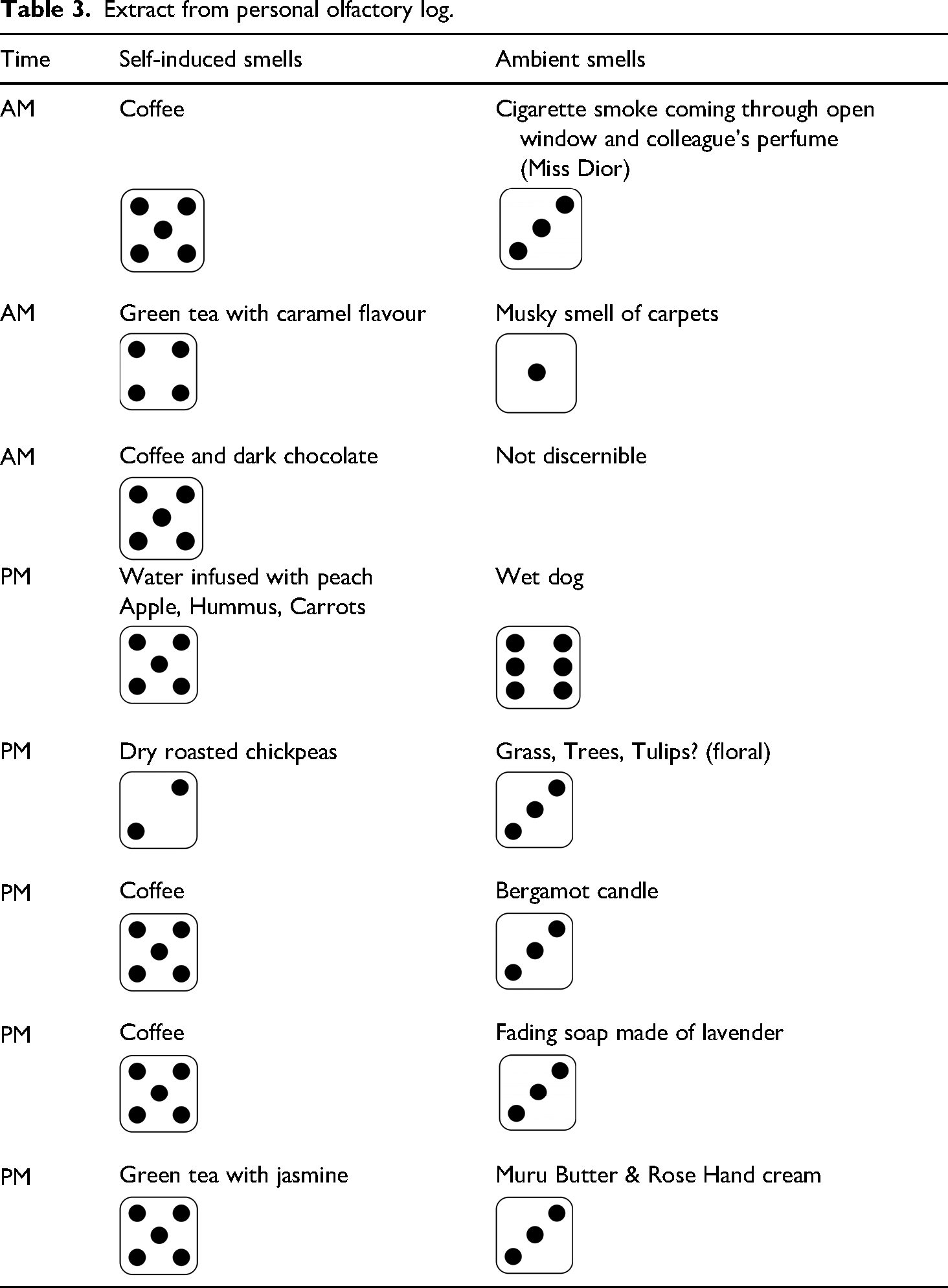
Raw qualitative data such as photos, scans of children's drawings, smellmaps or audio-recordings and video files, are processed in various digital and analogue formats and all these forms of data connotation have an olfactory quality. How could researchers “smell” their own data over time? To begin to answer this question, I began to systematize the olfactory footprint on my own data. This started with the use of odour-free deodorants and avoidance of any perfumes or scented body sprays during my data collection and data analysis days. To gauge the possible influence of the ambient odours around me on my odour analysis, I have developed the practice of olfactory journaling. The format of my olfactory journaling has proceeded from hand-written notes about for example, the perfume I was wearing on the day, to a digital log of odours and aromas available at the time of data connotation. An example of the latter is in Table 3. The individual rows in the Table 3 show the odours I subjectively perceive in my environment and those that I bring to the environment myself. I also rate the intensity of each odour with a simple 1–6 intensity scale. The example in Table 3 is an extract from the olfactory log I kept while writing this article and I share it for purely illustrative purposes. The example shows that I was exposed to the strong aroma of coffee at several moments of the article-writing process. As a case in point, the influence of coffee aroma on task performance and increased physiological arousal levels is well-documented (e.g. Madzharov et al., 2018). Even placebo studies with coffees containing no caffeine showed that the coffee smell changed participants’ moods (Ullrich et al., 2015). Aware of this research and of the strong presence of specific aromas during my olfactory connotation makes me question the bias in my olfactory inquiry and how this bias correlates with my personal characteristics (for example older people are particularly susceptible to react to caffeine effects with higher performance, Jarvis, 1993).
Extract from personal olfactory log.
In consumer research, the presence of ambient odours is strictly avoided so that aroma analysis can focus on the olfactory object in question (Mahmud et al., 2020). Consumer research has also shown that certain smells influence consumers’ perceptions of colours (Hagtvedt and Brasel, 2017) and textures (Demattè et al., 2006). Keeping a log helps me stay alert to the presence of odours around me, which could be used for later systematic evaluation of olfactory bias in my data interpretation. If more researchers kept olfactory data logs, they would generate “ododata”. The coding of such olfactory data would require a classification system that is yet to be developed. However, researchers at the European research project “Odeuropa” have begun a systematic coding system of ododata in digital texts and image collections. The group developed a taxonomy of visual olfactory phenomena with which they detect olfactory references in historical artworks and later deploy it for the training of computer vision algorithms. With a label information about the specific odour in an image, the future algorithms will be able to automatically detect and localize olfactory phenomena in historical artworks. Qualitative olfactory researchers could extrapolate this method to their own data. Namely, olfactory researchers could annotate data available in open-source databases with olfactory logs, which could establish the training basis for algorithmic models for qualitative data repositories. Both data in textual (e.g. interview transcripts) or visual (e.g. children's drawings) formats could be tagged for olfactory associations, and thus enable researchers to track olfactory biases, researchers’ affective response, environmental sensing and user-contributed information in diverse olfactory research contexts (Huber et al., 2022).
While researcher-generated ododata might seem at odds with the open-ended methods presented earlier, I propose that they open up exciting avenues for disrupting the
Reflecting on my research of the olfactory qualities of children's spaces, I have positioned my research within an ethical assemblage of ‘matters of care’, which as de la Bellacasa (2017) explains, are about negotiating the values, relations and engagements with all involved. I do not aim to arrive at an objective assessment of whether some odours are more intense or indeed present in a given environment but rather follow ethics of care that are ‘born out of material constraints and situated relationalities in the making with other people, living beings, and earth's ‘resources’ (p.145, de la Bellacasa, 2017). I recommend that early childhood researchers follow olfactory inquiries in this vein, honouring ‘relational ethics, power-in-relation, and the temporary nature of understandings’ (Cole and Knowles, 2001: 27).
In conclusion, I propose olfaction as a tangible way of implementing new socio-spatial theories and expanding multisensory inquiries in early childhood. I argue that a serious engagement with olfactory inquiries opens new scholarly imaginations and I attempted to provide accessible understandings of how to facilitate such understandings in qualitative early childhood research practice. Smellwalks could substantially contribute to the richness of qualitative research concerned with children's movements in space and multi-sensory engagements. Furthermore, speculative techniques of olfactoscapes point towards the dynamic methods required for critically expanding cognitive, linguistic and ocular-centric methods. There are no right or wrong answers in olfactory inquiries but rather, olfactory researchers need to be sensitive to ‘the conditions of possibility of response-ability [that] include accountability for the specific histories of particular practices of engagement’ (Barad, 2012: 81).
I outlined the tools that capture children's olfactory perceptions and preferences and thus disrupt the “somatic rules” that dictate the uneven sensory experiences of today's childhoods (Vannini et al., 2011: 19). I argue that a commitment to systematic olfactory inquiry requires connecting to questions around children's agency and researcher reflexivity, which commit researchers to ethically document and care for children's and our own temporary entanglements with the olfactoscapes we inhabit.
Footnotes
Acknowledgments
The author would like to thank project team members and collaborators in the Sensory Book project and all participants in the studies summarised in this article.
Declaration of conflicting interests
The author(s) declared no potential conflicts of interest with respect to the research, authorship, and/or publication of this article.
Funding
The author(s) disclosed receipt of the following financial support for the research, authorship, and/or publication of this article: The author would like to thank the Norwegian Research Council and The Jacobs Foundation for supporting this work.

Author biography
Natalia Ingebretsen Kucirkova is Professor of Early Childhood Education and Development at the University of Stavanger, Norway. Her work is concerned with social justice in children's literacy and innovative uses of technologies. Her latest research project uses participatory approaches and examines the value of children's sensory, and in particular, olfactory, engagement in stories.