



Abstract
This article addresses the sociology and practices of translation. The main argument is that translation work should be understood in ethnomethodological terms as an indexical, social, and interactive practice that produces an ongoing “third space” of difference. The article provides insights into the practice of ethnographic translation work in a multilingual and foreign research context. The study reveals that cooperation between locally involved translators and researchers is highly productive—even necessary—for translation, transcription, and interaction analyses. Moreover, the article argues that in order to make translation practice understandable, not only ethnographic research, linguistic knowledge and cooperation between translators and researchers is required but equally reflections on social theory and the production of scientific texts. Finally, a novel sociologically informed methodology of translation work for qualitative social research is offered using the concepts of “cooperation,” “indexicality,” “power,” “representation,” and “third space.”
Introduction
This article discusses the sociology and practice of translation by reflecting on ethnographic fieldwork experiences showing how and why translations are to be understood as an indexical, social, and interactive practice that produces an ongoing “third space” of difference. The focus is on practices of translation in “doing ethnography,” particularly in multi-language contexts and in conducting fieldwork and analysis. But to make translation practices understandable they need to be embedded in the larger context of language use and producing scientific knowledge.
From Linguistic to Translation Studies and Social Science, the topic of translation is not only discussed in terms of technical-grammatical, linguistic specialized knowledge of languages but also regarding broader theories of power, society, and culture. Sociological and postcolonial studies particularly highlight the fact that language is not equally available to members of a community or society (Bourdieu 1991: 50; Inghilleri, 2005). Language is embedded in power and hierarchical relations, with translation routines reproducing those relations (Bourdieu, 1990/2015: 41, Gentzler and Tymoczko, 2002: XXI). This perspective is to be distinguished from linguists such as Noam Chomsky and Ferdinand de Saussures who conceptualize language as a homogeneous and autonomous object suitable for linguistic analysis (Thompson, 1991: 5). They are accused of failing to recognize the sociohistorical nature of language’s production and reception (Bourdieu, 1991: 49–50). In contrast to the structuralist view, wherein decontextualized meaning seems possible (cf. Levi-Strauss, 1991), this form of translation is ruled out for post-colonialist, relativist, and sociological theorists. Similar arguments are made in Ethnology and Social Anthropology, two disciplines where researchers are expected to learn other (often non-European) languages (Clifford 1983: 119; Evans-Pritchard, 1951: 79; Geertz, 1983: 30). By extending the idea of translation to culture, as it is common in the Writing Culture debate, ethnography became understood metaphorically; namely, as a kind of cultural translation (Leavitt, 2014: 194).
In view of these discussions, scholars point out that any act of translation is a context-bound practice that goes far beyond the mere moving from one language to another (Tihanyi, 2004: 739ff., Wolf, 2007a). It is widely agreed that only an approximation of the meaning of words or sentences can occur, never resolving all ambiguities (Bhabha, 1994; Heeschen, 1998: 42–45; Temple and Edwards, 2002; Venuti 2008). An original idea or statement can never be reproduced verbatim. A carbon copy of the original speech act or document remains unattainable (Benjamin 1972: 18). 1 In this vein, postcolonial theorist Homi K. Bhaba (1994, 2016) refers to the “third space” that is established through translation works—in which alternative concepts, constructions or ways of thinking are produced and negotiated (Bhabha, 1994: 36; Wolf, 2007b: 113). He calls for breaking the binary logic between original and copy (Bhabha, 1990). In this process, neither the originals nor the translations are fixed; rather, they remain bound to changing temporal and spatial contexts (cf. Derrida, 2003: 44).
A consequence of these debates is that the concrete linguistic translation work mostly remains subordinate, auxiliary, and is not perceived as a scientific act (Gawlewicz, 2016: 28; Temple, 2005: 3.1). Therefore, the knowledge about how translations are exactly produced in ethnographic research remains rudimentary (Buzelin, 2005: 202). In particular, the interactive work between researchers and translators is unaddressed (Sturge, 1997: 24; Werner, 1994: 76).
In contrast to ethnographers who aspire to the ideal of making invisible “violent translations” (Venuti, 2008: 14), this article reconstructs and reflects on the practice of performing concrete acts of translation within an ethnographic research project. The article tackles the disinterest shown towards these acts of translation and connects to those studies that understand such “invisible” work as a central undertaking of scientific practice (cf. Edwards, 1998; Fernandez Castro, 2021; Sturge, 1997: 23; Temple and Young, 2004: 163). Therefore, the article is pointing out possible ways to resolve the concrete methodological and epistemological problems of translation in ethnographic fieldwork. Of key importance is the cooperation with translators (or analysts of languages) who are (inter)actively involved in the research process (Schröer, 2009; Temple and Edwards, 2002).
While the article presents an approach how to do translations in field research, it also emphasizes that the translation work does not stop there. I use the ethnomethodological notion of indexicality to grasp acts of translation as an inherent aspect of language, communication, and social order (Garfinkel, 1967). I argue that indexicality both establishes and resolves the problem of translation, being highly relevant to linguistic but also social/cultural and scientific acts of translation (cp. McHoul 1982: 7). By focussing on indexicality and relating it to cooperation, power, representation and “third space,” the article offers a new understanding of professional as well as everyday acts of translation.
First, the article provides a literature review of key debates on methods of translation and representation. Following on, ethnomethodological perspectives on translation are discussed with the phenomenon of indexicality taking center stage. I then reflect on phases and techniques of translation work in my own ethnography about refugee camps at the Thai–Burmese border. I trace translation processes in concrete situations of participant observation. Thereafter, I reflect about the interactive processes behind producing transcripts and translations. Building on this combination of theory and research practice, I conclude by formulating basic concepts and a methodology of the sociology of translation.
Translation as research method
The distinction between “instrumental” and “documentary” translation, common in Translation Studies (Nord, 2011: 20, 22; Venuti 2008), illustrates in a typical way the different tasks that ethnographers face (particularly when moving within foreign-language fields). Instrumental translation virtually reflects discussions occurring as part of the Writing Culture discussion (Clifford and Marcus, 1986; Zenker and Kumoll, 2010). This form of translation adapts to the language of the target culture, thereby allowing a coherent and cohesive text to emerge for one’s audience by substituting words or even omitting them altogether (Wettemann, 2012: 111). Instrumental translation considers communicative context integral, and explicitly calls for contextualization. Analog to that, scholars distinguish the practices of translation within ethnographic research from “ethnographic translation,” which equally includes textual production (Sturge, 1997: 22). This is because without the application of the categories and discourses of the target language, the text will be incomprehensible to the translator and thus impossible to translate (idem.: 25). Documentary translation, on the other hand, is oriented towards the source language; the form and content of the original should be translated as accurately as possible, without always prioritizing the linguistic conventions of the target language (Wettemann, 2012: 110). Although the distinction between documentary and instrumental translations is certainly difficult to maintain in translation practice, the distinction remains relevant, as I will show below.
The limits of translation have been widely discussed (Geertz, 1983; Maranhao and Streck, 2003; Wagner, 1975; Zenker and Kumoll, 2010). Yet when researchers enter foreign-language contexts, linguistic competence (even for rarely spoken languages) is expected and indeed taken for granted (Churchill, 2005: 6; Clifford 1983: 119; Evans-Pritchard, 1951: 79; Geertz, 1983: 30). Scholars then seem to ignore or neglect the possibility and necessity of careful, systematic (linguistic) translation in ethnographies (Leavitt, 2014; Sturge, 1997; Werner, 1994: 89). Answers to how ethnographers can manage the translation from one language to another and what methods are most useful for this are only sporadically provided (Leavitt, 2014: 194–195; Sturge, 1997: 23; Werner, 1994: 76). But there have been an increasing number of studies on translation work as of late.
In interview research, central aspects of translation work are discussed (Inhetveen, 2012; Schröer, 2009; Temple and Edwards, 2002). It is argued, for example, that interviews should be conducted by native speakers, as they not only solve language-comprehension problems but are also familiar with “cultural” frames of reference. Detractors argue that constructed, common-language culture is neither fair to the plurality of a given language nor to the social. This method ignores other socially relevant categories such as gender, age, class, educational level, political view, and religious inclination (Renn, 2005). Other scholars point out that translators’ process not only words but also concepts: “The solutions to many of the translator’s dilemmas are not to be found in dictionaries, but rather in an understanding of the way language is tied to local realities, to literary forms and to changing identities” (Simon, 1996: 137). The roles of interpreters and translators are, therefore, evaluated and portrayed differently. While some perceive translation work as auxiliary, others understand those engaged in it as “key informants” (Temple and Edwards, 2002: 6). My research experience can only support the latter, which I will reflect and demonstrate in the remainder of this paper. I do not understand the work of translators as a necessary evil (Mead 1939, 192; Spradley 1979: 19) 2 but rather as a productive necessity. But to understand translation work even more precisely and on a theoretical level, ethnomethodological perspectives and the concept of indexicality are enriching.
Understanding translations acts with indexicality
Translations are a central part of the social and interactive practices that members of society must employ in a wide variety of situations: “This continuous and pervasive form of translation is so mundane that we do not normally attend to it as such” (Roth, 2018: 6). Thus, translation can be understood as an act of the social in general (Callon, 2006: 170; Latour, 2007: 181, Wolf, 2007a: 6). When people interact with each other, they face epistemological translation challenges, regardless of how fluent their everyday communication appears to be (Garfinkel, 2002: 30, 99). Bar-Hillel states that “no linguistic expression is completely independent of the pragmatic context” (1954: 371).
Referring to Bar-Hillel’s article, Garfinkel points out that the meaning, the sense, of a given statement is only produced and indeed understandable through its use in a particular context (Garfinkel, 1967: 11, 40, 173). This means that descriptions but also translations are never complete; they can always be further differentiated. Garfinkel describes this as also regarding text production as the “impossible task of ‘repairing’ the essential incompleteness of any set of instruction no matter how carefully or elaborately written they might be” (1967: 30).
Everyday social practice, routinized, always involves non-understanding, blurring, and the possibility of the failure at and break with routine communication. In this case, interactants must negotiate and reach a mutual understanding or reinterpret. At the same time, however, non-understanding must be accepted by interactants if a successful course of action is to ensue (Bergmann, 1988: 40–41). This incurable indexicality and fuzziness of linguistic utterances and actions is understood in ethnomethodology as a productive characteristic of the local, ongoing accomplishment of society. According to Garfinkel, the indexicality problem—that is, the uncertainty, fuzziness, and ever-present room for interpretation existing within (inter)actions—evokes social reality: every statement requires dealing with this truth (1967: 11). Only through indexicality can linguistic and non-verbal utterances be applied in innumerable speech situations as well as by different speakers (Heritage, 1984: 150). Uncertainty or indeterminacy (Liberman 1985: 172) is the condition for certainty of meaning because the latter always lags a statement and only becomes comprehensible (or even corrected) via further interactive exchange.
Thus, those acting together must always deal with the vagueness of language and with foreign understanding, must publicly indicate meaning(s) to each other, and accept possible failure herein. Every next time also always remains the first (Garfinkel, 2002: 30; Garfinkel et al., 1970; Wolf, 2007a). This precarious and creative practice itself—and not routine (Butler, 1993) or habitus (Bourdieu, 1979)—is where the social is established for ethnomethodology. The interpretive translation methods of interactants take center stage—not regarding what was (actually) talked about, but rather how so (Garfinkel, 1967: 29–30).
Scholars show in their work that ethnomethodological and conversation-analytical approaches are not only useful but also particularly promising in foreign cultural contexts. Liberman for example highlights in his study on aboriginal people in Australia the particularities of the interaction setting (1985: 171). He suggests appreciating indeterminacy (idem.: 172) that occurs in intercultural settings to a high degree and recommends looking at the communicative solutions usually provided by the material environment of the conversation (idem.: 215). Moerman as well highlights in his study, which is set in the context of a Thai-Lue village, that every meaning is related to a multi-layered context relating, for example, to class or gender (Moerman 1988: 7) and that it is the task of the researcher to find out about those context sensitivities. For him, a “culturally contexed conversation analysis” provides tools to accomplish this task but is also able to show mistakes (idem.: 9).
Methodology and methods of ethnomethodological informed research
“Key policy” in ethnomethodology is the so called “unique adequacy requirement of methods” (Garfinkel, 2002: 175; Lynch, 2007: 510; Livingston, 1986; Sudnow, 2001). The idea is not to apply a particular method, but to require that the researcher must and should develop competencies to study the local uniqueness of the research field (Garfinkel 2002: 175ff.). This includes to develop methods to reconstruct “the in vivo lived local production and natural accountability of the phenomena” (Lynch 2007: 510). Garfinkel requires ethnomethodologists to completely engage with the perspective of the actors and makes scholars acquire the skills of participants in the field. That is why standard methods usually also include (but are not limited to) long-term field visits, participant observation as well as compiling audio and video recordings (Lynch, 2007: 499; Pollner and Emerson, 2001). According to ethnomethodology’s premises, appropriate methods are those closest to “documenting” or conserving social events according to their “natural” occurrence, reconstructing them on this basis (Liberman 1985; Moermann 1988). The recording of interactions and events is intended to break the hegemonic interpretive power of the ethnologist, even if only partially (Meyer and Schareicka, 2009: 127).
Taking these methodological requirements into consideration, my ethnography is based on extensive field research and observations in the Thai–Burmese borderland area that took place over 17 months between 2011 and 2018. I was also able to make (video) recordings and to interpret and analyze the data, not only the long-term and extensive field research periods were essential, but also the study of camp residents’ languages such as Burmese and Karen languages. Before my very first fieldwork phase in 2011, I took a language course in Burmese in Berlin (there are no Karen language courses in Germany), but it did not help me much on the ground. Even though many people in the camps could speak Burmese they spoke different dialects of Karen languages in everyday life. Since I was allowed to work at a college in the camp, I learned Sgaw Karen (a Karen language spoken a lot in the area where I lived) with the students and teachers there who had a good proficiency of English. However, learning the language turned difficult because in daily life, because I was confronted with different Sgaw Karen dialects as well as other languages. 3 The recordings but also the translation work that I was allowed to carry out together with the translators were part of my process through which I tried to reach closer and closer to fulfilling the ethnomethodological requirements. But the research process as well as the crafting of the translations, was bound by further ethnomethodological considerations, such as the exploration of relevant ethnomethods (Garfinkel, 1967: VII), the embracing of the notion that “there is order at all points” (Sacks, 1984: 22), the appreciation of context-sensitivity (Bergmann, 1988: 43) and sequential and categorization analyses (Lepper, 2000; Moermann, 1974).
The following empirical sections consists of two parts. The first introductory section demonstrates the extent to which translators in the field influenced the development of my research focus from the outset and then, accordingly, brought me to those sites and events that were later preserved in audio-visual recordings. When exactly it was possible to make recordings and how exactly I was able to do so depended on the research site. In general, I only made recordings in public places and of public life in the camp (Bochmann 2021), after I had already carried out extensive observations there. That means I already spent a lot of time at the sites where I made recordings and the local people involved knew me. In the second part, I show how the translators and I translated these recordings.
Language-, translation-, and power relations in situations of participatory observation
Translation access, situational translations, and their reconstructions
I worked as a teacher at a camp college, through which close relationships developed between my colleagues, who had good English-language skills, and myself. They were the ones who first explained and translated to me the daily routine in the camp and what was going on on-site. I was allowed to accompany especially two teachers and their family members in their lives and they automatically brought me to my observation sites at later points in time. For example, the distribution of rations (Bochmann 2021: 78, 2019) or meetings between section members (idem.: 106), events that I later classified as analytically relevant. During these events, they then translated interactions, things said, and spontaneous announcements, such as what the section leader had relayed in a meeting or what rules the distribution leader kept emphasizing during the distribution of rations.
This type of translator activity was primarily situational, and less pre-planned. Thus, translators not only automatically participated in the observations but also became informants/gatekeepers as well as ad hoc translators for the research. Occasionally, gate keepers were actively asked to act as translators, for example when informal interviews with camp authorities were arranged.
I noted down translated conversations in a field diary, either directly or I reconstructed, reflected, and documented the jointly observed situations later. I often conducted these ex-post reconstructions together with the translators involved in them. This enabled me to discuss open questions together with the latter. Occasionally, I recorded both the translation situations and their reconstructions (cf. Inhetveen, 2012; Temple, 2005: 3.3). This resulted in different data-collection methods for translations in concrete, participatory-observation situations.
Furthermore, I quickly understood that in public camp life, people sometimes did not understand each other (linguistically) either. Different dialects and accents of the Karen languages meant a certain communicative juggling in one’s everyday life. The longer I was in the field and the more I learned basic language skills, the more the need for initially indispensable ad hoc translation situations waned. I began to understand everyday conversations better and, in some cases, conducted them myself. Still, the translation dependencies remained, being also evident in the various stages of the translation processes, necessary for compiling the transcriptions. As already mentioned, I always returned to the same places and events to which the translators and gatekeepers led me to and when it was possible, I also made recordings of the situations. The recordings allowed me to analyze what happened in more detail. But these recordings first had to be transcribed.
Cooperative translations: The manufacturing of transcripts
Locally involved language and translation analysts as a foundation
To produce the transcripts, I worked together with different translators. Potential candidates, some of whom were trained translators (for aid organizations in the camps), were familiar with interview situations and recordings. However, they usually found the material difficult to transcribe, so that after initial meetings in which data was presented, no further cooperation came about.
Common obstacles in transcribing “natural” conversations and interactions were for example: overlapping conversation sequences (especially when more than two people were talking to each other); the regular interruption and restarting of conversations; a rapid change of topic; and the unintelligibility of what was said (not only because of the significant background noise in public places). However, another challenge was the switching within the course of conversations between Karen languages, Thai, and Burmese, relevant especially in the context of interactions in supermarkets. Not all translators were proficient in each language or simultaneously had adequate English skills. In addition, there were the different dialects spoken in the relevant regions, some of which the translators did not understand.
Out of the 15 translators I had contact with, two particularly not only devoted themselves to the material but also knew the necessary languages and dialects. The two individuals with whom I was eventually able to work intensively on the material had no prior experience in translation activities. Both were female, quite young (aged 20), educated and grew up in the camps where I primarily conducted the fieldwork. They had a local-expert knowledge that enabled them to understand the situations and the different dialects spoken on-site.
With these two dedicated translators, I was able to engage in long-term cooperative processes of translation. Translation work—and I also understand transcription as a form of translation—can roughly be divided into at least three phases: rough transcription, fine transcription, and detail transcription. I gave the translators preselected scenes (audio data of interactions or also audio-visual data of situations), which they then transcribed in the respective phonetics (not in the corresponding script) and translated into English. The translators focused on the source language rather than the target one (i.e., English)—that is, to pursue documentary translation (Wettemann, 2012: 110). The translators were to focus on what and how something was said, and less on how the latter could be best translated into English.
The reasoning behind the preselected scenes is difficult to answer on a general level. But I noticed already certain scenes during the participant observation (that I accompanied with the camera or the recording device), which I noted down. For example, when jokes were made, or when the routine was broken, or when practices had to be explained and justified to people who were new. However, we also completely transcribed and translated some recordings such as the interactions and talks given at the section meetings (Bochmann, 2021: 78) or loudspeaker announcements (idem.: 57).
The production processes from rough transcript to fine transcript
The following is an example of a very short section from a rough transcript of an interaction in a supermarket, produced by a translator as a first step.
After creating the rough transcripts, I scanned through them for analytically relevant scenes and interactions, in which, for example, deviations and fissures became visible or (life in) the camp was discussed. But I also looked for those scenes where the communication and thus the logic of the interaction was linguistically comprehensible to some extent to be able to present and use the transcripts in a scientific publication: that is, transparently showcase analytically relevant scenes to a scientific audience. Here, one can already see that documentary and instrumental translations cannot be distinguished.
With relevant scenes having been selected, fine transcripts were then created based on intensive, cooperative translation phases. This consisted of several joint face-to-face meetings regarding the ensuing transcripts. Here, ambiguities concerning analytically relevant scenes, sequences, and conversational segments were clarified. In the joint sessions, the video material was repeatedly consulted, viewed, or listened to. As a result, the accompanying comment boxes became more detailed, filled with offers of interpretation that were strongly tied to the situation and interaction as well as alternative translation possibilities and explanations of expressions and terms. The transcripts became more complex but also more accurate and more suitable to analysis. The phase of fine transcription made it possible to get closer and closer to the events, while already doing vital interpretation and analysis together with the translators. The following is a fine transcript of the same interaction that was already presented in the rough transcript above (Figures 1 and 2). Rough transcript. Fine transcript.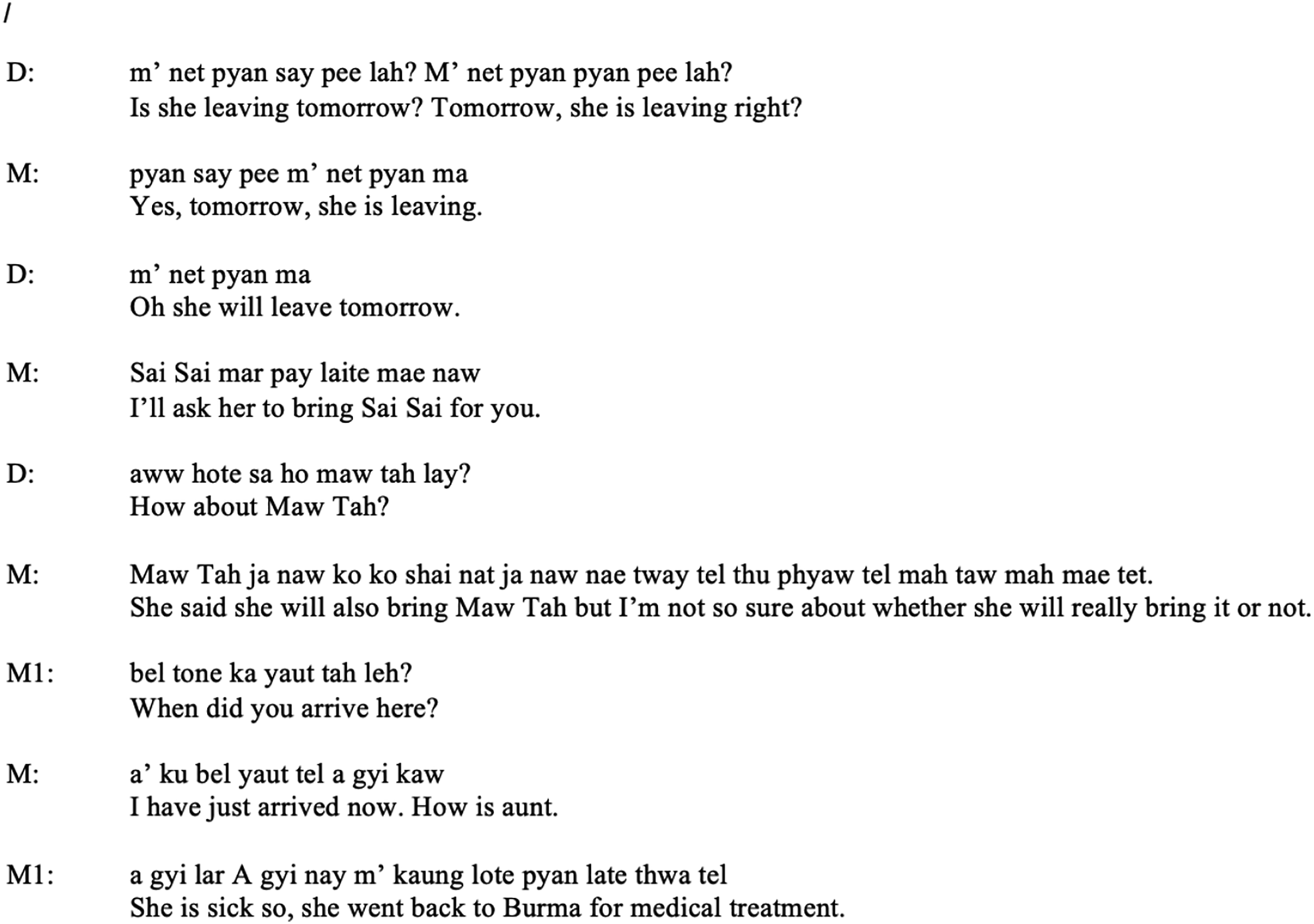
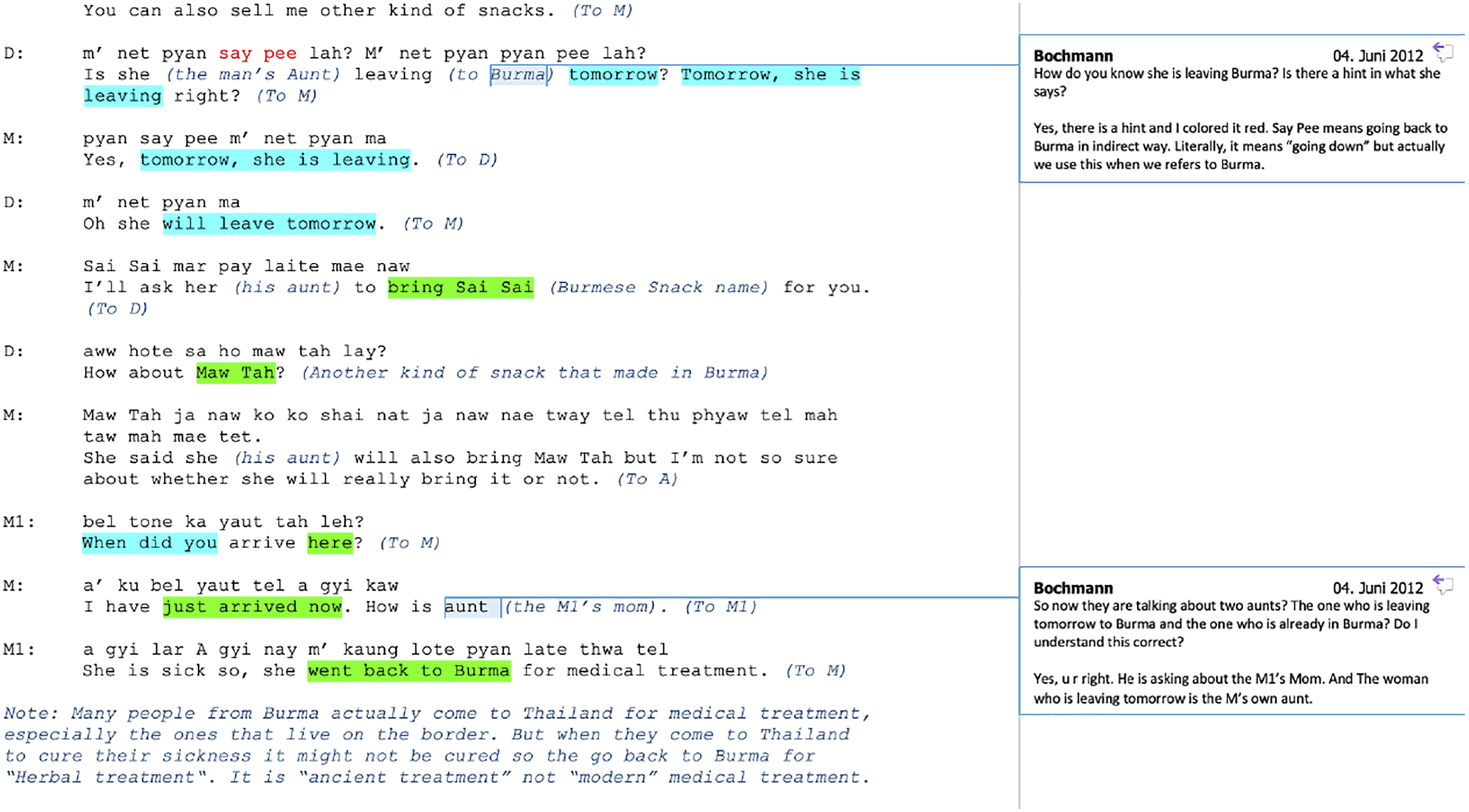
A fine transcript consists of four different areas: - Wording (Latin alphabet) in the original language
4
- English translations - Descriptions of the translations (in italics) - Comment box for additional information, in which explanations of conversations but also alternative translations were offered
For the fine transcript I also chose a uniform font and added additional line numbering. The descriptions and additional information were partly necessary to produce a comprehensible conversation flow. The contents of the descriptions (in italics) and/or additional information (in comment boxes) cannot be readily distinguished because the researcher and translator both worked on them, and the topic relevance of the explanations also differed depending on the interaction at hand. The descriptions tend to serve to make the specific interaction more comprehensible. The comment boxes clarify broader problems of understanding vis-à-vis a given situation. The fine transcript offers, in addition to the various descriptions and comments, an unedited English transcript. As mentioned earlier, translations were as close as possible to the Karen languages. The content was not translated in a meaningful way, even if that would have meant being closer to the grammatically correct English version. This would be revised for transcript publications appearing at a later stage. However, these processes were not always clearly distinguishable from each other. The terms color-coded here appeared (and were discussed) in other fine transcripts as well as for the purposes of comparison.
The production of transcript memos: Detail transcription
Only after these intensive cooperation phases I devoted myself to more detailed sequence analyses, during which ambiguities also emerged again and again. Individual scenes always had to be reviewed together with the video or audio material. Here, too, it was always necessary to revisit individual scenes with the translators. To maintain the clarity of the fine transcripts, a second document was often started for transcription memos during this phase. The documents and phases of the fine and detailed transcription cannot be easily distinguished from each other. In some cases, comments or descriptions were still added to the fine transcript even during the detailed transcription. Afterward, however, the on-site translation work in Thailand/Myanmar was complete.
But even at later points in time, questions about the material continued to arise. In some cases, I contacted the translators 3 years after the fieldwork’s completion to discuss the material and unresolved questions. We communicated mainly via email and/or videoconferencing. 5 I incorporated the results of these discussions into the fine transcripts and/or transcript memos or even in the text that I wanted to write.
Based on the specific data, the transcription and translation phases vary in intensity and how they were then ultimately carried out in concrete terms. This here is an ideal-type representation that has let me generalize. In “reality,” this work was full of contradictions, all mixed up, not linear; the individual phases were blurred and different in detail from material to material. Above all, the distinction between what I did and what the translators did is blurred. The documents are the result of an interactive interpretation of what was done and made in the recordings. Following the “unique adequacy requirement of methods,” it automatically means that not every scene, not every recording and video, not every interaction needs the same methods of translation but must be individually adapted. The interactions in the supermarket, for example, needed longer and lengthy transcription and translation work with more loops in it, since there were constant changes of language and speakers, and a larger number of people (not just two) were involved in each interaction (Bochmann, 2021: 128). The loudspeaker announcements in the camp, on the other hand, as well as the speeches of the local-government actors to camp residents were easier to translate, since usually only one person had the floor while also articulating themselves more clearly than in everyday life and only in one language (idem.: 57, 78). In other scenes, however, such as the distribution of aid rations, non-verbal interactions were central (idem.: 106). Nevertheless, as with all the material, the related time-consuming discussions with translators were both necessary and rewarding because the cooperative and interactive translation techniques enable a very precise understanding of the material. In addition, translations became an outcome of interpretations and analyses. The researcher’s dependence on the translators can therefore be understood as a productive endeavor.
Cooperative methodology of translation in qualitative social research
And yet, these very precise attempts to reconstruct what was said and done in a situation as accurately as possible is only one part of translation work. That is why in the concluding part, I will first formulate my methods of translation in general terms and make it adaptable for further research. Secondly, I will elaborate on the translation work that goes beyond that.
Uncertainty in an unfamiliar language and society can be productively harnessed, as it has the potential to make social phenomena more visible than in research undertaken in one’s own language. Nevertheless, basic language skills and competencies remain a prerequisite for successful research as well as long-term ethnographic field research. Moreover, based on my experiences and the interactive work with translators, I consider the following approaches to be particularly appropriate for ethnographic translation work conducted in multilingual and/or foreign-language contexts such as refugee camps: 1. Cooperation with locally involved translators is essential. Translators or “local-language analysts” are ideally present in the different fieldwork phases. Such translators may be preferred over professionals for good reason (e.g., their local expertise). 2. Translations should be as close as possible to the source language and should not aim to provide good renditions into the target language. A carefully prepared transcript that documents and marks linguistic subtleties as well as laughter, sighs, pauses, language, speaker changes, and interruptions is especially helpful in multilingual and foreign-language contexts. It simplifies further interpretation and analyses and makes transcripts and the research more transparent. 3. The collaborative and interactive phases of translation and transcript production between researchers and translators are necessary. The production of transcription and translation takes time and resources as the original data needs to be listened to and watched repeatedly. Interactive, dialogic translation work allows different interpretations and understandings, as well as potentially relevant context-specific knowledge, to be elicited. 4. Transcripts need explanations and comment boxes, in which sections, utterances, and sequences are both provided and enriched with interpretive material such as alternative translations, resolution of ambiguities, contextual and background knowledge. Herewith, relevant context-specific knowledge can potentially be obtained. 5. The collaborative production of translation and transcription are to be understood as central components of the analytical work because they reveal translation issues and enable reflection in a transparent manner.
However, the methodical, very precise, and time-consuming approach is only a first part in the translation work. In the introduction of the article, I already addressed further parts of the translation work formulated by different scholars to which I will return in the following. I conclude by discussing five core concepts for the sociology and practice of translation: cooperation; indexicality; power; representation; “third spaces”. These each refer to central methodological aspects of translational acts in research.
Cooperation
Translations depend on cooperative translation work with suitable translators who become speech and language analysts during the transcription work. Translators ideally are members of the research field, involved in the local context as well as able to speak and understand multiple languages. They should bring not only linguistic but above all local knowledge, ideally remaining involved in the research process that lasts for years. Scholarly inquiry is therefore strongly dependent on the long-term active participation and involvement of translators. In tandem, this dependence promotes exchange between science and the corresponding research field.
But how far can/should/must cooperative research go in the context of translation work and services? Is research assistance limited to “documentary translation,” even if translation activities are also to be understood as data analysis? Translators are not usually recognized as research colleagues (Kruse et al., 2012: 33; Spradley, 1979; Temple, 2005). The introduction of cooperative, collaborative, and participatory research, or “action research,” initially without value-based and political concerns (Hammersley, 2004: 252; Reason and Bradbury, 2001), is now emerging as a previously untapped potential for translation activities in multilingual and foreign-language contexts. Translators must thus be recognized and paid as language analysts and as colleagues in qualitative social research (cf. Temple, 2005).
Indexicality
The collaborative research phases, just like participatory research, cannot cancel out the vagueness or the innovation that arise through the original–translation transformation process. Translations must always be recognized as context-bound and open to interpretation. Indexicality highlights the significance of the social, situational, and institutional contexts of any given utterance or action. Through the indexicality of utterances it becomes apparent that reconstructive procedures are especially suitable when we conduct research in foreign-language contexts, because they consider the contextuality of communication (Liberman 1985: 172; Moermann 1988: 9).
Especially in multilingual fields, translation is not only the problem of the ethnographer but a general one that is constantly worked on and resolved by group members. Those involved in the field face the everyday problem of translatability, which can lead to misunderstandings and conflicts. However, my observations in refugee camps have shown that many misunderstandings and/or non-understandings are accepted and smiled over to successfully continue the course of conversation and to smooth communication and action. In a way, the researcher can also learn from these limitations by taking into consideration the everyday acceptance of translational openness and vagueness.
Power
Language, communication, and translation are embedded in relations of power and domination and are not neutral instruments that create a replica image of social realities (Clifford and Marcus, 1986; Gentzler and Tymoczko 2002: XVI). Translations are, then, bound to extra-situational, sociohistorical regimes of power and knowledge (Bourdieu, 1991; Foucault, 1972). Extra-situational components—such as historical, societal, or even cultural knowledge about language—are less recognizable in the situation at hand. For example, the very fact that the findings of my research were written in English is part of these wider power relations. We should understand and be aware of that the use of the English language as common vernacular “silences alternative ways of constructing the social world through language” (Temple, 2005: 2.3).
The collaborative work between researchers and translators is also embedded in power relations. But these are not to be seen as one-sided but reciprocal, being interactively produced. I have described how power-imbued translation work can be rendered productive. Even though I have emphasized the translator’s power of analysis, instrumental translation, interpretive sovereignty, the final scientific product, and the publication of these in the form of scientific articles remain the preserve of the researcher’s power and knowledge (cf. Kruse et al., 2012: 13). The translation and textual presentation thereof and the showcasing of results (in different formats), are sanitized and domesticated by the researcher. The many versions discussed with the translator are narrowed down by the researcher to a specific version for one single text.
The researcher, in turn, is bound by the rules of the scientific system. Researchers have to present their findings as if there is just one way of doing it lacking possible plural and complex alternatives. Alternative words and explanations of one’s conscious decisions are usually not presented to readers for discussion (see Temple, 2005: 5.9). Research papers tend to exclude the multiple ambivalences, contingencies, possibilities, and tendencies vis-à-vis “maybe,” “seemingly,” “possibly,” even though these descriptions are much more reflective of the social world (see McHoul 1982). As researchers, we must present what is deemed acceptable in the field. A “correct” and clean translation is important for publication as well as being subject to the established rules of sound scientific practice. Researchers must not only adequately represent their objects of inquiry but at the same time also the scientific system per se. The research field determines how we are obliged to describe something. Methodological debates (on translation) are often saved for another occasion, as this article here has shown (Temple, 2005: 6.2).
In ethnomethodology, however, explaining power relations within acts of translation requires a sequential, interactive perspective. We must therefore also involve the audience which read and also interactively translates and responds to the text (see Livingston 1995). Not only the participant, the researcher, and the translator exercise power over the text but likewise the reader and the audience, too (cf. Temple, 2005: 5.11). These considerations make clear that scholarly elaborated representations give rise to “third spaces,” which are dynamic, performative, not limited in time, and in which difference is negotiated (Bhabha, 2016).
Representation is the creation of “third spaces”
Understanding the unfamiliar and the representation of it are general problems of scholarship, ones which not only emerge in translation processes. Discussions of the crisis of ethnographic representation and Writing Culture debates point to challenges, limitations, but also to potentials (Clifford and Marcus, 1986). At best, translations produce approximations of the original (Benjamin, 1972: 18), and new, alternative discourses/representations emerge (Bhabha, 2016).
Researchers attempt to represent their objects of investigation as faithfully as possible. But answers to questions like “Who speaks on whose behalf?” “Who represents whom?” (Callon, 2006: 159) remain elusive—a difficult, barely resolvable undertaking that can even change (as we have learned from the concept of indexicality). Am I writing about aid distribution, governance, or economy? Is it camp life or the social dynamics of life in the Thai–Burmese border, among “Karen people” or refugees being explored? And, to which public or audience do I concretely convey my knowledge, observations, and translations? Is my text addressed to the German, English, European, United States society or yet at the culture of a particular journal or publisher? And then there is the audience who inscribes its own interpretations into the text, determining for whom and to whom it shall be addressed.
In summary, it can be stated that translations are produced not only interactively by a researcher in cooperation with translators and interlocutors, but also by the system from which their writing emerges as well as by the audience who reads it. Contrary to Leavitt, who suggests regarding translations to retain linguistic monstrosities and to “experiment with forms of experience-close transcription” (2014: 215), I believe that as social scientists and translators, we are compelled to produce sound and readable translations for an audiences. These translations should be based on what people in the research field themselves are concerned with and what is relevant for them in their daily “doings.” But no coherent “translate” can be delivered via translation work; at best, it lets the “original” shine through (Benjamin, 1972: 18). Both versions, the “original” and the “translate” remain forever bound to situational but also extra-situational contexts. The concrete translation methods, which were introduced in the article, the writing process as well as the audiences for which we produce texts and findings are all parts of the “translation-production machinery.” That is why translations are to be understood as an indexical, social, and interactive practice that produces an ongoing “third space” of difference.
Footnotes
Declaration of conflicting interests
The author(s) declared no potential conflicts of interest with respect to the research, authorship, and/or publication of this article.
Funding
The author(s) disclosed receipt of the following financial support for the research, authorship, and/or publication of this article: The author received financial support for the ethnographic field research in Thailand/Myanmar by the german research foundation (DFG) from 2011-1014.
