




Abstract
During a series of three 90-minute Choreographic Interviews, dance choreography became a way to theorize artfully about K-12 dance educators’ philosophical and practical understandings of the role of the body in learning. Choreography as part of an interview design helped to make visible dance educators’ relationship to movement and justice within the larger schooling system. This reciprocal process of artful inquiry created a space in which choreographing and performing dance were tools with which participants could imagine possible futures and ways of being. Positioning dance as enacting artful inquiry was generative and welcomed through this artful approach to qualitative interviewing. Using choreography as an artful inquiry method invited physical participation and built relationality through reciprocal exchange of movement and experience. Grounding the research experiences within our bodies through choreography during an interview informs the content and the ways in which researcher and participant co-construct knowledge and relate to one another during an interview context.
Keywords
Movement and the arts are central to building more just learning environments. As artists and educational researchers, we have a responsibility to re-imagine an educational system in which these practices are essential. This manuscript illuminates the ways in which choreography enacts artful inquiry using dance and qualitative interviewing. By making space for embodied, creative, and verbal utterances during an interview, choreography becomes both a creative practice and a mode of artful inquiry (Barry, 1996; Butler-Kisber, 2016). I describe the ways a choreographic experience within the data generation process can broaden participation in, and responses from, qualitative research, building collective knowledge between researcher and participant. Dance invites us to delve beneath literal representations and surface-level re-enactments and descriptions, and opens up a space of possibilities in the body as we imagine more equitable futures. Thus, there is a nuanced perspective and understanding that can be experienced by a dancer, a body, in motion. This perspective is often challenging to represent accurately to others using words, video, or visual media. Exploring ways to represent and recognize the powerful role dance plays in our experience of self, and experience of the world, is what drew me to artful inquiry, and to this research exploring the question, in what ways does dancing inform a qualitative interview?
Enacting Choreography as Artful Inquiry
There are many ways of understanding and approaching the use of art as a tool for educational research, and I used this interdisciplinary nature to my advantage when designing this study—weaving dance, visual art, reflective writing, and qualitative research methods together in my methods. Leavy (2009) states that Arts-Based Research (ABR) adopts the “tenets of the creative arts in order to address social research questions in holistic and engaged ways in which theory and practice are intertwined” (p. 3). Choreographic Interviews align with this tradition by attending to dance educators’ felt experiences, and their relationship to systemic structures in education more broadly. Importantly, this process positions dance as artful inquiry, by centering the movement and choreographic experience, and using dance making as a tool to explore embodied personal experience in relation to larger communities (e.g., a school and a community) and research methods.
Choreographic Interviews as a Context for Co-Creating Embodied Knowledge
The participants in this study were professional dancers and dance educators that have unique experiences of and with their bodies. Given this, I purposefully designed Choreographic Interviews in relation to the methodological trend toward innovating visual and mobile methods to better understand the nuanced contributions from dance educators. I posit that designing an interview space for dance educators to notice and reflect upon their own movement and philosophical conceptualizations of teaching practices, through artful practices including choreography, further develops theories of learning as an embodied practice. This design decision, centering dance during an interview, positions choreography as artful inquiry, and artful inquiry as foundational to the sensemaking of the dance educators and research participants in this study.
Dance is a mode of sensemaking and is one way to build community and trust (Aaker & Bagdonas, 2021; McNeill, 1995). Positioning multimodal methods of dance, written reflection, and choreographic mapping as relevant resources during the interview process helped to build a context within which participants and I could co-create embodied knowledge. In asking questions about dance educators’ routine teaching practices and how they see their role as dance teachers supporting equity in school and society more broadly, I provided an opportunity for educators to artfully generate ideas about more equitable futures both within their classroom, and beyond. Positioning dance as a legitimized form of participation in the interview context recognizes the richness and depth of insights we are able to access as dancers, within the artful context of a Choreographic Interview. Beyond contributing to methods for designing embodied interview interactions, asking participants to choreograph a short dance based on their own reflections and experiences recognizes and validates their role as artists in addition to educators.
One role that dance educators play in a school environment is to create a dynamic learning environment that can “transform the mundane traditions of school into something more meaningful, interesting, and relevant” (Graham, 2009, p. 86). Teachers’ “personal artistic activities can have a profound influence on how they interact with students, how they shape the learning environment and how they interpret their field of knowledge” (Graham, 2009, p. 93). In recognizing the role of choreography and dance as a tool for professional development and personal enrichment, including dance in an interview is methodologically sound to get a phenomenological understanding of movement in an interview. Additionally, dance and choreography contribute meaningfully to the personal and professional lives of the artist educators with whom I engaged.
Methods and Choreographic Interviews
Interested in the ways in which female dance educators understand and communicate their relationship to systems of power as full time educators in a K-12 environment, positioning dance and choreography as central tenets of the research process was essential to build embodied, artful knowledge together. This piece explores the ways in which, during the final interview, the researcher and participants created, performed, and reflected on choreographed dance pieces, and the ways this process was an embodiment of artful inquiry.
I designed a series of three, 90-min Choreographic Interviews which I used while interviewing ten dance educators teaching full time in K-12 schools in the United States. These interviews were conducted virtually, incorporate both dance and visual arts elements, and are rooted in artful inquiry (Butler-Kisber, 2016). Data collection yielded more than 45 hours of video data, a total of 30 interview transcripts, and documents such as choreographic movement maps created by the participants. The first interview began with a post-modern dance warm-up facilitated by the researcher, and the second interview began with the participant facilitating a dance warm-up they use with their K-12 students. During interview two, participants also created choreographic movement maps in which they visually depicted their school teaching context on a paper map, indicating their daily pathways through the hallways, parking lots, teacher lounges, and dance studios on campus. The third interview began with researcher and participant choreographing movement sequences inspired by the participant’s choreographic movement map. Using improvisational dance and choreographic tools, the participants and researcher each “translated” the participant’s choreographic movement map into an improvised dance phrase, iterated upon it briefly, and then performed the choreographed phrases for each other.
My video analysis of the dance practices from the interviews was rich and highly detailed. Throughout the in-depth microgenetic coding process, I engaged with multiple views of the 20 warm-up videos and 20 choreographic videos (one choreographic video from each of the 10 participants, and one generated by the researcher during each of the 10 interviews). I wrote analytic memos relating to both my own implicit theories about my personal pedagogy and the field of dance education at large, and connecting the observations I was making in the video with the themes and codes that stood out to me from cleaning and reading the full interview transcripts of the participants. After the close video analysis and memo writing, I returned to the written transcripts and began to triangulate the video data with the verbal participation.
Choreographic Interviews are both literal pieces of choreography with which we can learn from and think with, and are metaphoric choreographies communicating the ways in which the participants navigate through complex structures of schooling on a daily basis. The first two interviews begin with dance warm-ups, an essential opening to a creative, dance-based learning space through which the metaphorical choreographic process begins. The culminating third interview involves the participants and researcher engaging in improvisation and choreographic processes, resulting in a collaborative, three-part choreographic study. I use this term, Choreographic Interviews to describe either one of the interviews on their own, or the full series of interviews. The relationship between the series of three is integral to the experience of a Choreographic Interview.
Translated from Greek, “choreo-” means “dance” while “graphy-” means “writing.” This literal definition of “writing a dance” is generally understood by both dancers and non-dancers as the creative process that results in a completed, or to follow the writing metaphor, “published” piece. Susan Foster defined choreography as “the act of arranging patterns of movement” (Foster, 2009, p. 98). In the context of this exploration of artful inquiry, Foster’s definition of “arranging patterns of movement” is only partially illuminating. During the third interview both researcher and participants choreographed movement patterns, and shared them with each other. This relational element of arranging movements in sequential order in response to or in relation to something else (in this case, a written movement map document) is important in my multi-modal conceptualization of choreography, and of these artful research methods.
The act of choreographing a dance is not, on its own, an artful inquiry within the context of qualitative research. What makes this an artful inquiry, and not simply art, is the infiltration of dance with inquiry, and inquiry guiding the dance. The act of dancing can be very context dependent. In this study, choreographing and performing dance is used as a creative, open-ended process to explore, distinguish, and exchange ideas—a tool of artful inquiry.
Dance Warm-Ups (Interviews 1 and 2)
Beginning the interview process by leading a dance warm-up foregrounded dance as a meaningful form of experience, expression, and sense-making. It further served to center the primacy of dance, and the participants’ professional experiences, as the focus of the interview. Given that all cognition is embodied (Calvo & Gomila, 2008; Varela et al., 2017; Wilson, 2002), and our experience of the world is informed by our physical bodies, senses, and experiences (Goodwin, 2000; Haines, 2019), grounding a methodological practice in dance made sense as a design move. Additionally, it prepared both researcher and participant to engage with the content of the interview with an artful approach. This choice clearly positioned the phenomenon of dance and learning as the topic of interest and emphasized the important role of movement in sensemaking and experience.
Choreographic Movement Mapping (Interview 2)
Informed by Journey Mapping (Annamma, 2016; Crenshaw, 1991; Powell, 2010), and community mapping (Rambaldi, 2005; Ravitch & Carl, 2016), I designed a school-community choreographic movement mapping practice to provide participants with an opportunity to creatively and artfully reflect on and represent their daily experiences with moving through school spaces. In asking dance educators about their physical location and movements throughout the day, I aimed to understand the ways in which their movements and conceptualizations of learning might be informed by their physical location, and relationship to larger physical structures or barriers on campus. Researchers often note the important role that the physical environment plays as part of the learning process (Marin, 2013, 2020; Nespor, 1994; Taylor & Hall, 2013). Dance studios on school campuses are often separated from the main part of academic buildings on campus due either to space requirements, or driven by a philosophical demarcation between the humanities, the sciences, and the arts. Creating maps can “...shed light on the ways we traverse, encounter, and construct racial, ethnic, gendered, and political” experiences (Powell, 2010, p. 553).
The choreographic movement mapping practice was introduced to participants midway through the second interview when I asked them to walk me through a typical day on their school site. I asked them to narrate their movements and choices as they drew their physical pathway across their school campus, noting people they might see, gates they might pass through, things they might be thinking, or senses they might be engaging (e.g., what do you hear in this space? What do you see in this space?). Through this process of creatively, artfully, rendering a map of their daily movements and interactions on campus, participants were asked to reflect on how they feel in each context, how much time they spend and who they interact with in each location, and their physical bodily practices in each space (including what they wear, how they move, and how it feels).
Choreographing Together (Interview 3)
Recognizing that visual representations of networks, communities, and spaces are useful tools in gaining a more nuanced understanding of lived experiences and perspectives from participants (Ravitch & Carl, 2016), I began the third interview by sharing the choreographic movement map that the participant created during the second interview via screen-sharing technology on Zoom. This allowed both the researcher and participant to re-center the focus on the physical practices, movements, and environments of their teaching that the participant previously described. Interview 3 was intentionally designed to include choreography and performance because interactional phenomenon is a primary focus for this study.
Originating from the latin term improvisus, improvisation translates roughly to “unforeseen” (Montouri, 2003, p. 240). Improvisation has many definitions and has been used as both a metaphor and explicit definition for a set of practices across arts and teaching disciplines (Mæland & Espeland, 2017). I draw on Holland et al.’s definition of improvisation as deeply connected to a practice and conceptualize improvisation as “an inherent dimension of human activity—a constant interplay between the structures of social life and the improvisational agency that each moment presents for individuals” (Philip, 2019, p. 121). The practice of choreographic movement mapping provided an opportunity for me as a researcher, and the participants to engage with and analyze dance as both an artful, creative, physical practice, and as a tool for making sense of how systems of power are experienced in school environments. Drawing a map to follow from one location to another is quite distinct from artfully mapping one’s sensorial understandings through both visuals and dance choreography. The process of creating a rendering of one’s lived experiences at their school site by representing their phenomenological experiences both visually on paper and physically in choreography, further underscored the artful nature of this inquiry.
Maps often seem to implicitly communicate ideas of the best or correct way to travel from one place to another (e.g., by following a mountain trail rather than cutting across a sandy gulch, or by following a highway rather than meandering through a field). However, these choreographic movement maps were infused with an artful sensation by my interest in not only the destinations (e.g., the theater where a teacher holds class) and the pathways (e.g., across the field and down the hall), but the processes through which people explore their surroundings and interact with the built environment, the more-than-human world, and discern ideas about their inter- and intra-personal relationships to themselves and to others through artful inquiry.
Performing our choreography became a part of the analytic record and a shared representation that we used to think with, together (Hall, 1996). In short, both the choreographic movement map and the performance of the choreography became substrates (Goodwin, 2000) and evidence of and inspiration for our artful inquiry approach to both research and choreography. This multi-modal, multi-layered experience supported dance educators’ meaning making about their philosophical perspectives.
Choreography as Reflective Inquiry and Consensus Building
In order to demonstrate the ways choreography influenced the content and process of an interview, I present a focal case study (Yin, 2009) of my third interview with Willow (pseudonym), a high school dance educator. This case study analysis focuses on her choreographic process during interview 3 (i.e., analysis of video data of her choreographing and performing during the interview), her verbal reflection detailing her intentions behind the movement choices, and relevant sections of the interview transcripts from interviews 1, 2, and 3. I also studied the interactions between Willow and myself in response to my own performance during the interview. Through this case study, I present two primary findings as related to artful inquiry. First, choreographic interviews became a place for dance educators to creatively reflect on their teaching practices in relation to larger systems impacting their schools and teaching. Second, choreography within an interview provided a shared, tangible artifact from which to build consensus between participant and researcher.
Narrative Profile: Willow
Willow is a female, Black dance educator in her mid-thirties teaching middle and high school dance at a small independent school in a large urban area in the Western United States. She earned a Bachelor of Fine Arts degree in Dance, and has been teaching dance full time for less than 10 years. She understands dance education as “offering young people the opportunity to communicate, feel, and decipher” their experiences (Willow, interview 1). Our Zoom interviews took place in her home, a beautiful space filled with natural light and thriving plants—a stark contrast to her office on campus that was described as having no windows or natural light. She teaches most of the dance classes on the school’s stage inside the theater, with no access to natural light.
She sees herself as a “passionate, committed, multifaceted” educator who “exudes a lot of joy” in her teaching (Willow, interview 1). She also describes herself as “always learning” (Willow, interview 2) as a teacher, emphasizing the reciprocal nature of teaching and learning in her classroom. When asked how she thinks her colleagues see her, she described similar aspects, saying they think “I never stop, very passionate, multifaceted and multitalented, versatile” (Willow, interview 1). The alignment seen here between how she sees herself and how her colleagues see her is important, and contributes to feelings of belonging at her school site.
Reflective Choreographic Practice in Relation to Systems of Power
Choreographic Interviews became a place for dance educators to creatively reflect on their daily practices in relation to larger systems impacting their school and teaching. This analysis traces the process of one participant, Willow, as she watches a video of her choreography, and describes what she was thinking and noticing during the choreographic process and performance. This close microgenetic video analysis, paired with the close transcript analysis allows me to see the reflexive sensemaking through dance as she was experiencing it in the moment. Willow’s choreographic movement map shows where and how she moves around her school campus during a typical day (See Figure 1). We began our third and final interview together by using Willow’s movement map as a starting point for our independent choreographic explorations. After choreographing her piece, Willow performed it for me, I recorded it on my cell phone, and we then watched the video together as she described her intentions behind her movements. Choreographic movement map drawn by Willow, interview 2.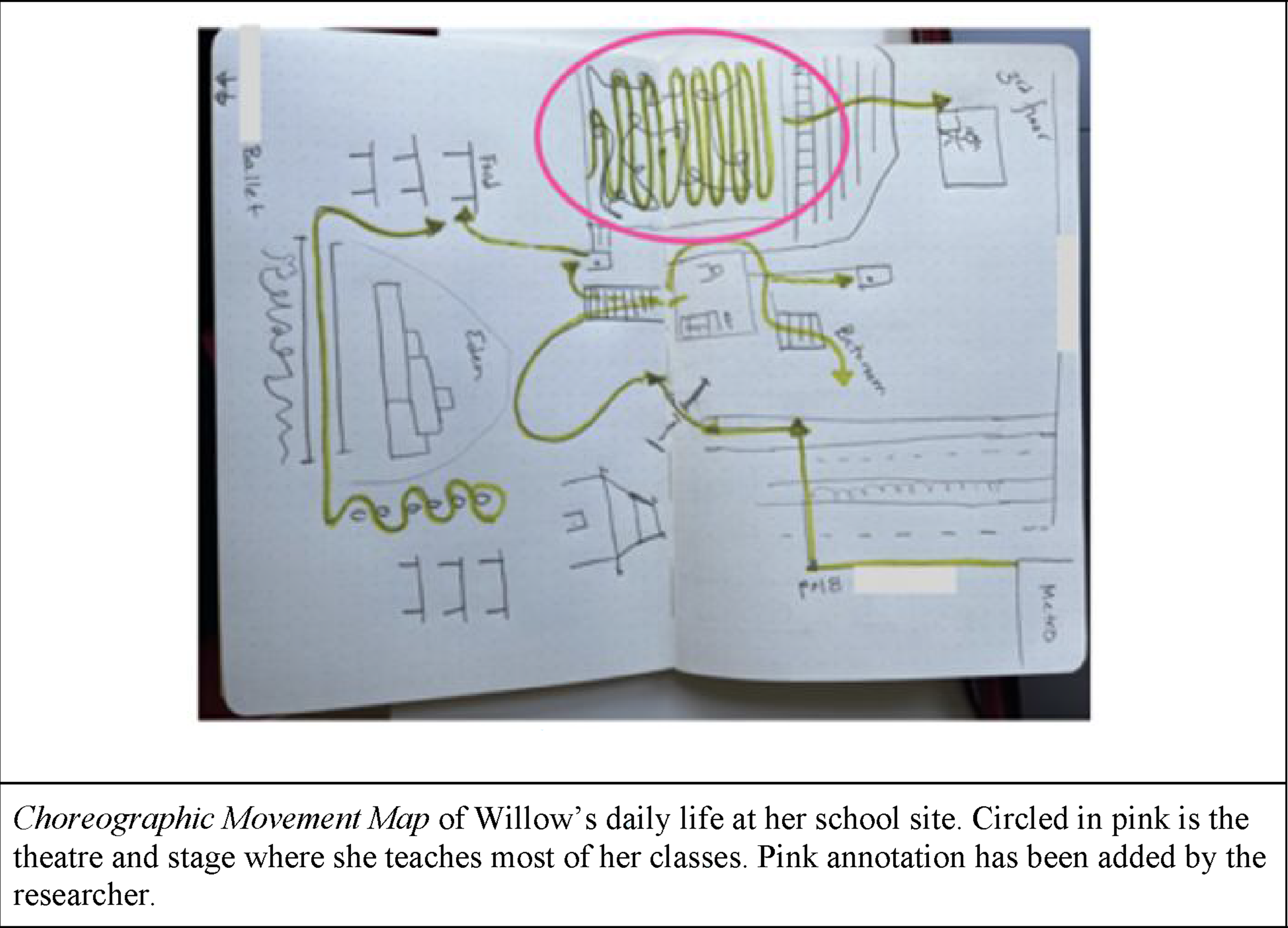
While watching a video of her performance, Willow said, “I’m starting pretty literal” (Willow, interview 3, Figure 2 (a) and (b)) and in her choreography I see her mimicking running up the stairs to her office (Figure 2(a)), before sitting down at a desk and doing some computer work (Figure 2(b)). These movements are recognizable, and in her own words, “literal” (Willow, interview 3). While there is interesting research on physical re-enactment and gestures (e.g., Johnson, 2017), choreography, dance, and artful inquiry moves us beyond a literal, physical retelling, and opens up a space of possibilities in the body, which we see in the next phrase. (a) and (b) Willow in performance, part 1.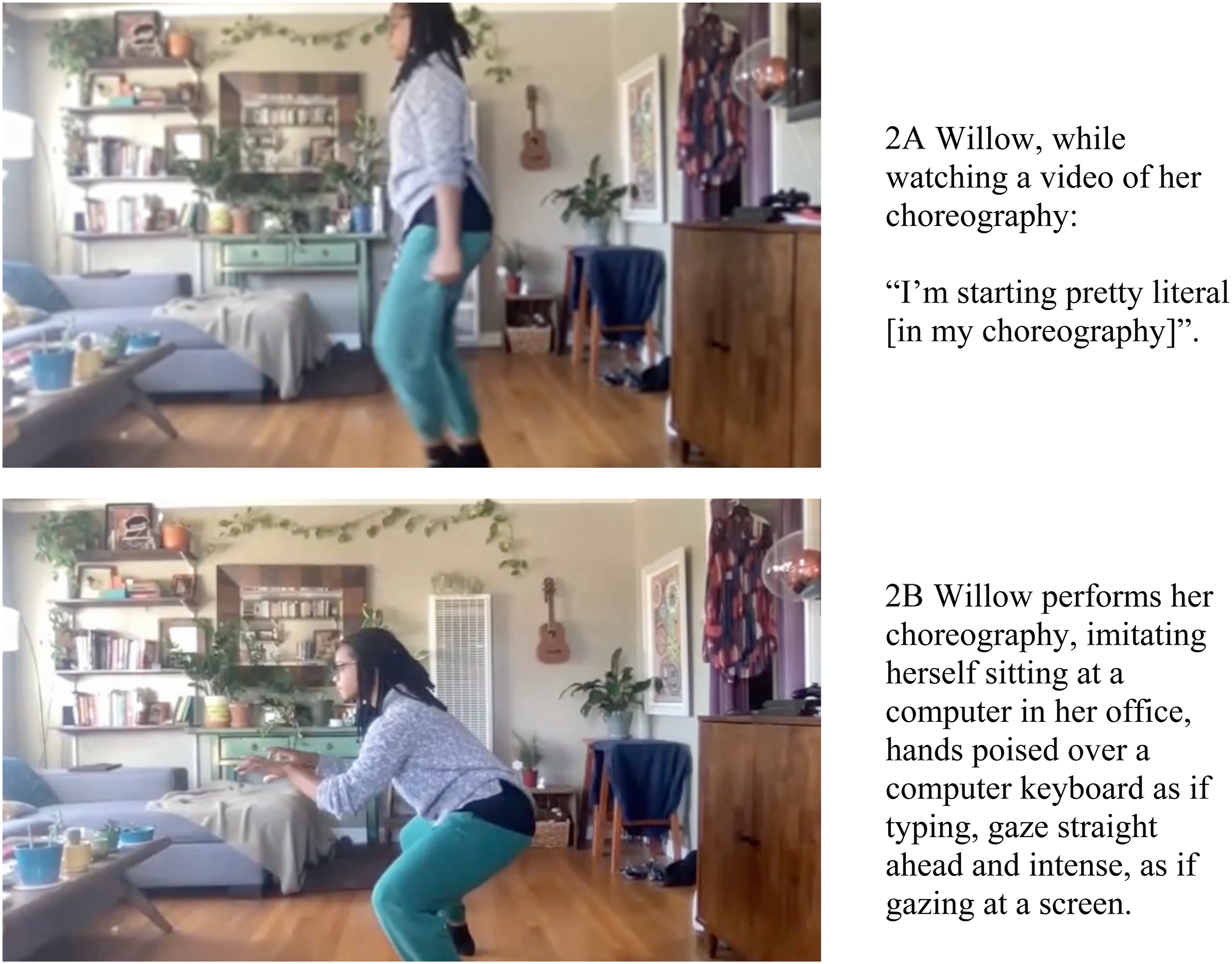
The video clip continues, and as she watches the clip she says, “As I went, my movement got more abstracted and more playful and I eased into that—that was fun” (Willow, interview 3, Figure 3). In Figure 3, we see Willow abstracting her movement, which she later explained to me was her entering the stage area (where she teaches her classes), mopping the floor to prepare the space, and then the students using the space and making it their own. Her movements represent her physical pathways throughout her day, in a new, creative way. Willow in performance, part 2.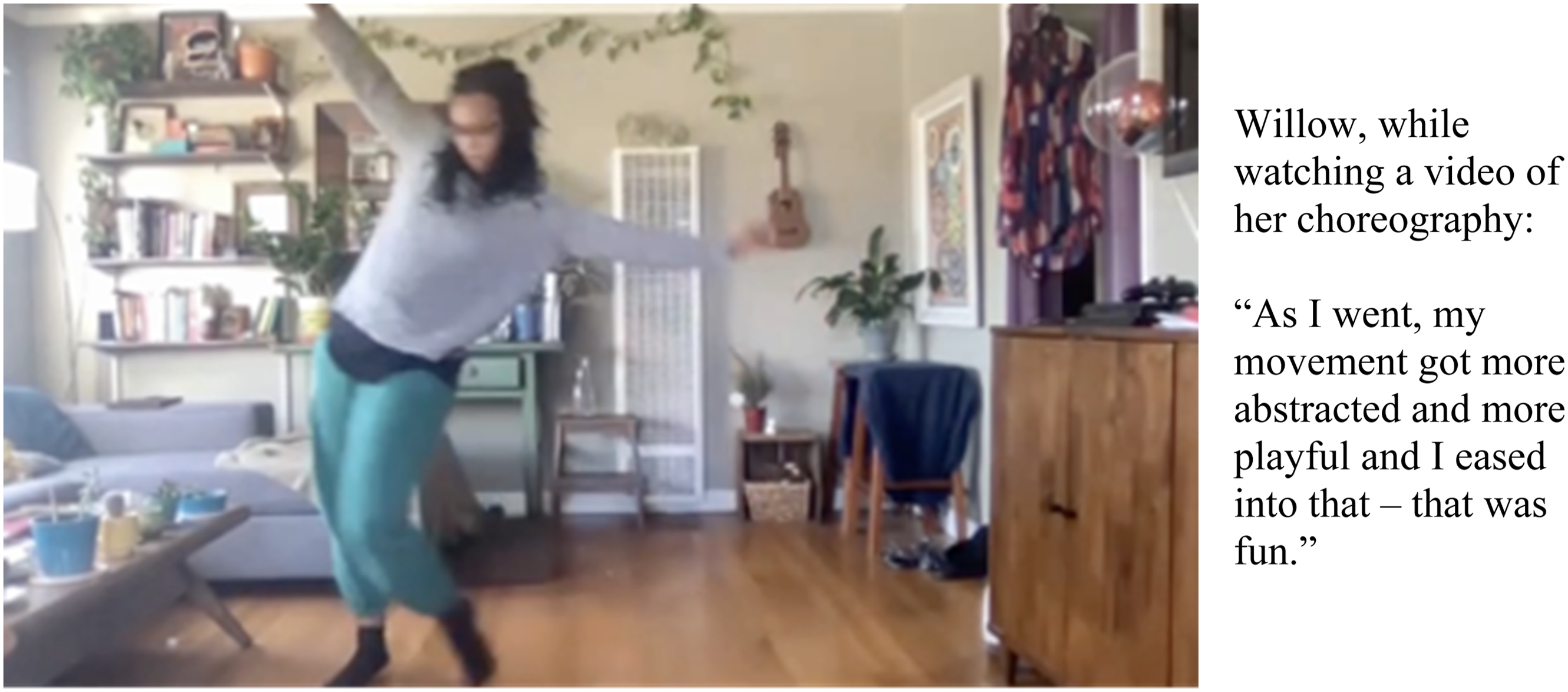
As she “eased into” (Willow, interview 3) this choreographic process, she was able to have “fun” (Willow, interview 3), enjoy the experience, and begin to possibly see new approaches to everyday tasks. Her movements during this section were relaxed, full-bodied, and resonant, which I interpreted as demonstrating feelings of creativity and freedom within the confines of her school site. Willow tells me that she sweeps the stage floor each day, always following a curving pathway, which is represented in her movement map (see Figure 1). Both she and I incorporated this curvy pathway in our choreography. In Figure 1, you can see the yellow line (circled by the researcher with a pink annotation) highlighted by Willow during the interview to show the pathway she takes when sweeping the floor. During this choreographic interview she used the dance making process as a place to find some freedom and enjoyment during the process, when representing a daily practice she has of sweeping the stage.
Finally, Willow said “I got less stuck in the map over time, because I was like, wait, I know this space! Like I actually, I can play with how I move through it, and what I imagine I’d like to do” (Willow, interview 3, Figure 4). Here Willow shares a reflection on her daily practices including mopping the floor and using the computer. She found the multimodal choreographic interview an opportunity to imagine new ways she would “like to” (Willow, interview 3) use her teaching space and the school. Through the mapping and choreographic processes, she reflected on her practices. This opened up a space to imagine possible futures for her actions at her school site. In this instance, she considered an outdoor courtyard space as a potential new performance venue. Willow in performance, part 4.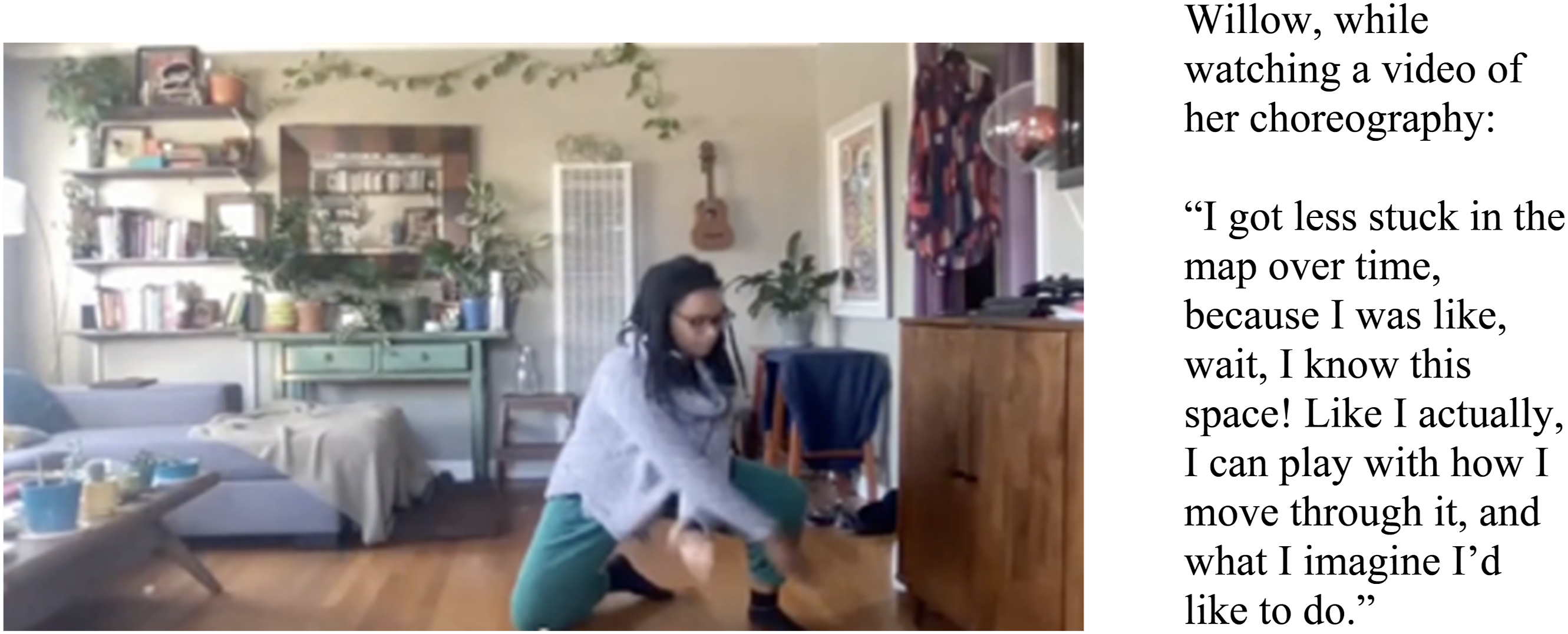
Willow shared that this choreographic interview was “a chance for me to reflect on a day at work…. Drawing inspiration from a feeling or a memory… I imagined the parts of campus I spend time in, the people I see, and how I feel moving through these spaces” (Willow, written reflection interview 3). The choreographic process made available new senses, reflections and experiences that Willow has had, that would not have been part of the data corpus if dance had not been included in the data collection. Within this case, I see choreographic interviews to be an opportunity to imagine new, more equitable teaching strategies in dance education. Positioning an artful, creative, choreographic activity as part of an interview allowed Willow to creatively reflect on and represent her daily practices in new ways, and see them from a new perspective.
Consensus Building through Choreography
Choreography as artful inquiry also provided a shared, tangible artifact from which to build consensus between participant and researcher. As the researcher, I also used Willow’s movement map to choreograph a dance phrase in response to it, and shared that piece with Willow during our third and final interview. I share an analysis of my own choreographic response to her movement map.
Throughout my choreographic study, I repeatedly returned to the center of my dance space, to literally represent what I observed from Willow’s map (Figure 1) and what I interpreted from our conversations. I understood the theater where she teaches her classes as being the center of her experience on campus. In Figure 5, I annotate the center or focal point of the choreography with a green circle. I emphasized the center of my space in various physical ways. I initially performed a tendu or extended one leg to the fullest extent, with my foot pointing toward the center of my dance space. I next drew the viewer’s attention to the center of the dance space by moving toward the center of the camera or audience perspective, with my hands pressed together, in the center of my chest, before retreating away from the camera. I completed this sequence with a second tendu pointing toward the center of the dance space with my other leg, creating symmetry and balance in my choreography, and underscoring for a third time the central nature of the theater for Willow’s daily life as a teacher. My dance movements were also choreographed to demonstrate the repeating patterns of students coming in and out of the theater where she teaches. Like the waves of an ocean, rushing in and out from the shore to engulf a sea wall, students come in and then leave, while Willow remains steadfast. Researcher in performance. 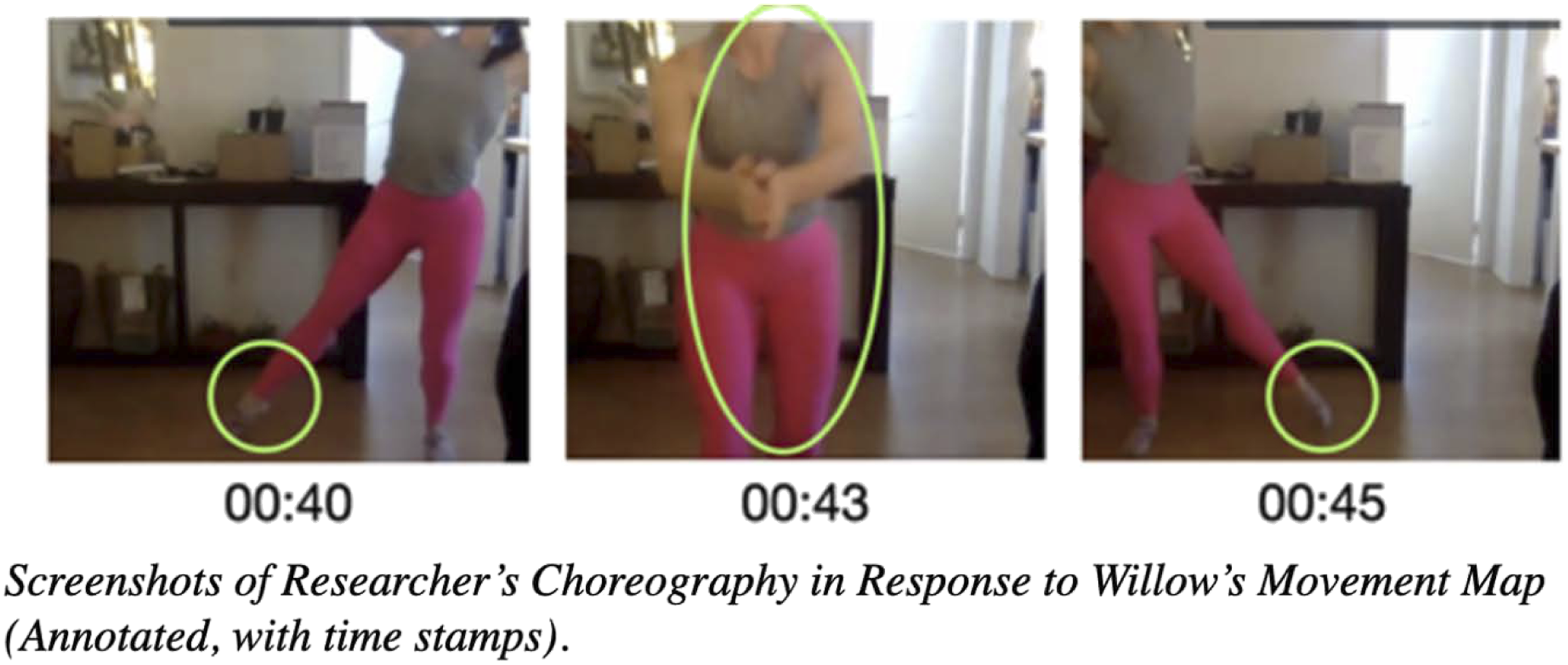
After watching my choreography and listening to my description of it, Willow shared that she was “surprised by the components of the map that you chose to express or investigate… I thought the movement effects really stood out as important to me as well” (Willow, interview 3). She felt that the choreography I made authentically represented her experiential feeling of being on her school campus. My choreography managed to capture and represent part of her experience as an educator and make her feel seen. This artful inquiry process was a validating experience for her. This demonstrates one of the ways that dance, and an artful approach to inquiry, can build consensus between participant and researcher.
Dance, as artful inquiry, can be a catalyst for the sensemaking process during an interview. Willow goes on to say, “you made me think of something that I do, that I didn’t include [in the map or choreography] which is, I actually [do] think the theater is like my kind of central, like, my whole day kind of revolves, going in and out and around it” (Willow, interview 3). This artful inquiry, the choreographic interview process, revealed details of her daily life that Willow had not explicitly shared with me about her experience as a dance teacher on campus during our previous interviews. The process of witnessing my choreographic piece, which was made as a tangible reflection on her movement map and interview responses, created a space for her to not only share more about her professional experiences, but to reflect in a way that allowed a revelation to come to light. The choreographic process, layered with viewing my own choreography, revealed new depths of her experience, and made it part of the analytic record. She observed my choreography and felt that her experiences had been validated through the process of our conversations and my choreographic representation of her experiences.
This choreography as artful inquiry takes seriously the dance teachers’ professionalism as artists and as educators. Taking their choreographic contributions seriously as part of the analytic record was meaningful to them, and to my analysis. Including dancemaking as part of the research process, this work broadens conceptualizations of what research and learning can and do look like. Positioning the dance educators as both choreographer and critic, this research honors and takes seriously the role of dance and dancers in the field of arts education.
Conclusion
Positioning dance as a focal component of the artful interview process situates research participants as professionals with valuable experiences and opinions. It respects the participants’ time as teachers, and as artists, by providing an opportunity to engage with the creative process. In this article I put forth an argument that grounding the choreographic research experiences within our bodies through dance—as artful inquiry—informs the content that we discuss and the ways in which we relate to one another. This design builds on the relational nature of dance warm-ups, and incorporates dance into a qualitative interview process. Using choreography as artful inquiry positions dance as a valued source of thinking and sense-making, and as critical to the interview process.
This analysis also illuminated some of the ways in which choreography is a multimodal tool for sensemaking within qualitative interviewing, by making space for embodied, creative, and verbal utterances during an artful interview. Dance, as part of this qualitative research design, can be a catalyst for and evidence of the participant’s and researcher’s sensemaking process during an interview. I described the ways a choreographic experience within the data generation process helped to broaden participation in, and responses from, qualitative research, making visible ideas and experiences that would not otherwise be included in the analytic record. Dance and choreographic practices invite us to delve beneath literal representations and surface level re-enactments and descriptions. In this case, dance opened up a space of possibilities through corporeal engagement, allowing us to imagine more equitable futures.
Through a reciprocal exchange of movement and experience during interviews, incorporating dance movement, and shared facilitation responsibilities between participant and researcher, this research design supported an environment in which the participant felt comfortable to co-create knowledge and share experiences from their personal and professional lives as dance educators. Including dance as part of the interview method also engendered dance as a process through which inquiry was engaged with and made visible. The choreography generated by both myself as the researcher and by the participant became part of the analytic record, and therefore part of the substrate from which we could build knowledge, find common ground, and better understand each other.
This study was designed for novel, creative, embodied interactions—dance experiences—through which phenomena and meaning are generated, explored, and inhabited by the participants during an interdisciplinary interview. The dance experiences were unique to the participants—the movements were not replicated for demonstration purposes but were generated in the moment. This use of dance within these interviews provided a unique opportunity to make meaning, build theory, and engage with ideas of justice in dance and education. Teaching is a political act (Ayers, 2004; hooks, 2014) and engaging with that idea using multiple artful modalities—mapping and dance making—allows for thoughtful engagement of lived experiences; provides a unique lens through which teachers can consider their own practices; and an opportunity to co-create theory of the body in learning.
Footnotes
Author’s Note
Lindsay Lindberg is a postdoctoral scholar at the University of California, Los Angeles.
Declaration of Conflicting Interests
The author declared no potential conflicts of interest with respect to the research, authorship, and/or publication of this article.
Funding
The author received no financial support for the research, authorship, and/or publication of this article.
