




Abstract
This article builds on the notions of thick and thin description elaborated by Geertz and looks at what descriptive methods have been used in the field of papyrology, a sub-discipline of classics that studies ancient manuscripts on papyrus fragments recovered through legal and illegal excavations in Egypt from the 19th century. Past generations of papyrologists have described papyri merely as resources to retrieve ancient ‘texts’. In the article I argue these descriptions have had negative effects in the way this ancient material has been studied, preserved, and also exchanged through the antiquities market. Through a series of case studies, I offer an alternative description of papyrus fragments as things, which have a power that can be activated under specific circumstances or entanglements. In demonstrating papyrus manuscripts’ unstable nature and shifting meanings, which are contingent on such entanglements, the article calls for a new politics and ethics concerning their preservation and exchange.
Introduction
In his 1973 essay ‘Thick Description: Toward an Interpretative Theory of Culture’, Clifford Geertz (1973: 9–10) famously compares the ethnographer to the decipherer of ancient texts: The point for now is only that ethnography is thick description. What the ethnographer is . . . faced with . . . is a multiplicity of complex conceptual structures, many of them superimposed upon or knotted into one another, which are at once strange, irregular, and inexplicit, and which he must contrive somehow first to grasp and to render. And this is true at the most down-to-earth, jungle field work levels of his activity: interviewing informants, observing rituals, eliciting kin terms, tracing property lines, censusing households . . . writing his journal. Doing ethnography is like trying to read (in the sense of ‘construct a reading of’) a manuscript – foreign, faded, full of ellipses, incoherencies, suspicious emendations, and tendentious commentaries, but written not in conventionalized graphs of sound but in transient examples of shaped behavior.
As is widely known, the problem of description in anthropology was elaborated by Geertz on the basis of a distinction between two types of descriptions, thin and thick, introduced by the British philosopher G. Ryle. In short, thin description would be a simple record of human behaviour, while thick description would concern itself with the context in which that behaviour acquires meaning. For Geertz, building on Ryle, culture can be seen as a complex web of symbols on which meaning is thickly layered through social practices which it is the anthropologist’s role to decipher. In linking together these aspects of everyday life, the anthropologist-ethnographer in Geertz’ eyes is like the decipherer of manuscripts, establishing an identification between human behaviours and texts: just as manuscripts are ‘foreign, faded, full of ellipses, incoherencies, suspicious emendations, and tendentious commentaries’ so are the social acts that the anthropologist attends to in their work.
In her work, Love (2013) points out the odd trajectory Geertz’s metaphor has traced. Here, she notes, we have an anthropologist who has turned to literary studies in order to develop his theory of culture. Yet, that theory has subsequently been absorbed into the work of literary critics and many other practitioners of the humanities who have gone on to interpret their objects of study in its light. The metaphor has gone full circle: where analysing manuscripts was the analogy for ethnography, ethnography now provides the analogy for analysing manuscripts. There is a lot to reflect on in this point and it certainly shows the interdisciplinary traffic in ideas is not as limited as we may sometimes think. However, that said, Geertz and Love in taking him up are both working with quite a narrow view of manuscripts and what goes into deciphering them. Based on my experiences, I have been struck by the metaphor of ancient manuscripts to talk about human societies used by Geertz for quite different reasons.
My academic field is papyrology, a sub-field of Classics, which means I study, decipher and edit ancient manuscripts, usually in very fragmentary form, from Egypt: to some extent I am the embodiment of the anthropological alter ego which appears in Geertz’s famous passage. As with Geertz’s approach to the analysis of culture, the reading of ancient manuscripts also involves continually working between thin and thick description. One might consider the provisional, plain transcription of the signs inscribed in the logged and indexed manuscripts that are the focus of the papyrologist’s work a thin description, and the proceeding work of filling gaps, connecting the text to others, compiling its translation and commentary and so on as belonging to the realm of thick description.
Taking the two concepts of thick and thin description as elaborated by Geertz and Love as my starting point, in this article I explore how descriptive methods have been employed in papyrology, my discipline, and the kinds of politics and ethics they have generated in the field. My intention is to show some of the shortcomings of a model of thin and thick description too narrowly centred on manuscripts as vehicles for textual content rather than ‘text’ as one aspect of more complex artefacts, particularly when it comes to my materials. My interest is in the way archaeological objects (i.e. the fragments of ancient writings at the centre of my discipline) have been described by past generations of papyrologists as ‘texts’, as this description has had transformative effects on the fragments we study. Pieces of paper thrown away by people who lived in antiquity have become cultural heritage items stored in collections and exchanged according to precise norms and rules at very high prices, with intricate symbolic meanings as well as financial capital invested in them because of the texts inscribed on them.
In a foundational study by Youtie (1963), papyrologists have been described as ‘artificers of facts’. The facts papyrologists produce are the modern editions of the manuscript they unlock. Over time, the editions of ancient manuscripts or ‘fact-texts’ have transformed papyri into key assets for the accumulation of academic power, capital and wealth. The prices they reach reflect the value of scholarly interpretations. At the same time, these objects were set apart from other archaeological objects such as statues, ceramics, jewels and so on, which are subject to the same scrutiny regarding their collection history. When ancient manuscripts with undocumented (and most probably illegal) provenance appeared on the market, academics argued that their special nature as texts allowed their publication, which in the case of ancient vases, for instance, would be more controversial. Ancient artefacts may be of great academic interest, but few would argue their scholarly value licences their procurement for analysis and circulation by any means possible. Yet when these artefacts are presented as texts, they have been subject to different assessments. In this article, my aim is to challenge what has become ‘normal’ practice in this area and show how the description of papyri has contributed to their unethical and illegal collection by setting these manuscripts apart from other types of antiquities (Rutz and Kersel, 2014: 1–13).
Drawing from recent scholarship in philosophy, archaeology and the social sciences (Bennet, 2010; Hodder, 2012; Latour, 2013), I call into question the descriptive effects of papyri as ‘fact-texts’ and offer an alternative description of papyrus fragments as things entangled into various networks. Discussing their unstable nature and shifting meanings, which are contingent on such entanglements, I argue that the concept of ‘fact-text’ and idea of papyrologists as ‘artificers of facts’ should be abandoned in favour of plural forms of description which treat papyri in terms of assemblages or entanglements rather than looking at them in isolation. In so doing I show that time is also an important consideration when looking at manuscript entanglements. Using my own case study which focuses on the Museum of the Bible of Washington D.C. and the restitution of ca. 5,000 trafficked papyrus fragments back to Egypt, I demonstrate that entangled descriptions are both transformative and political. Treating manuscripts as material artefacts entangled in various forms of network over time, I demonstrate how re-descriptions of papyri as assemblages were central to developing a successful campaign that exposed widespread international trade in trafficked ancient manuscripts involving academics.
The fact-text
In order to discuss the invention and development of the fact-text, it is necessary to briefly introduce what papyrology and papyri are, and what kind of texts can be found on these ancient manuscripts.
What are papyri? The most common writing material used in ancient times was obtained through processing the stems of a plant, the cyperus papyrus, which grew in large quantities along the shores of the Nile River and in a few other places in the Mediterranean. Modern paper is fabricated through methods imported from China via the Arabs in the Middle Ages. The English word ‘paper’ derives from the ancient Greek and Latin terms for the Nilotic plant. After harvesting, the stems of papyrus were sliced vertically in order to obtain long stripes that were placed one beneath the other in two overlapping layers, with the stripes perpendicular to one another. The sap of the plant and the pressure of weights made the fibres stick together so that a sheet was obtained. This made the fibres horizontal to the user on the one side, and vertical on the other. After being treated, sheets were finally glued one after the other in order to obtain rolls. We buy paper in reams. The ancients bought papyrus-paper in scrolls that were either used in their entirety, for instance to produce bookrolls (volumina) or were later cut again in sheets depending on needs (Lewis, 1974; Turner, 1968).
This leads to the question of content and what papyrologists find inscribed on papyri. What did the ancients write on their paper? Basically anything, from luxury copies of books to private letters, tax receipts, accounts, horoscopes, prayers, imperial edicts and laws, notes, agreements, and so forth so on. While papyrus was used everywhere in the Mediterranean, it has survived almost exclusively in Egypt due to the dryness of the soil and the climate. From the 19th century onwards, archaeologists started finding large quantities of fragments that were deciphered and published and provided new information about ancient societies. One of the first tasks that papyrologists were keen to achieve was that of organising the immense archive that was emerging from the sands of Egypt in categories. This organisation, however, was more reflective of modern than ancient ways of conceiving texts. The two most important categories constructed by the first generations of papyrologists were to classify papyri on the basis of their contents and so theological (biblical and early Christian material, canonical and extra-canonical) and classical texts (Greek and to a much lesser degree Latin authors, known and unknown) became organisational frames. After that, anything outside these frames was variously identified using the vague and overarching category of ‘documentary’ (everything except literature) or more specific labels such as ‘private letters’, ‘private agreements’, ‘census-returns’, ‘petitions’, ‘magical texts’, ‘amulets’ and so on. These papyri have been published and archived (since the 1980s also in digital format, see papyri.info and trismegistos.org) with the overall aim of facilitating the serial study of texts. These categorisations are indeed a way to describe papyrus manuscripts on the basis of their contents as recognised by modern interpreters (i.e. papyrologists).
So far, I have described the material and its contents. What about the job of papyrologists? As we have just seen, a lot of their activity has to do with the handling, interpretation, study and organisation of their sources. Papyrologists’ main role is that of reading what is written on manuscripts and publishing modern editions that could be consulted by readers who do not have enough skills in palaeography, ancient Greek, and other subjects to fully appreciate these objects. But compared to historians, sociologists, anthropologists and other practitioners of the human sciences, papyrologists have not been particularly interested in reflecting on the nature of their discipline and practices. Papyrologists have never, for instance, critically addressed the roots of their subject in European colonialism, nor have they engaged the problematic history of the manuscripts they study, which were part of a mass of ancient objects displaced from Egypt legally and illegally since the Napoleonic campaign of 1798. Apart from a few recent interventions (Bagnall, 1995; Keenan, 2009; Davoli 2015), the foundational reflection on papyrology is a paper delivered in 1962 as a distinguished lecture by a prominent practitioner of the discipline, Herbert C. Youtie, under the telling title of ‘The Papyrologist: Artificer of Fact’ (Youtie, 1963). This article, a core reading in university course syllabi, provides a description of papyrology and at the same time sheds light on the relationships between papyrologists and the objects of their study, papyrus manuscripts.
Youtie’s argument made a distinction between public and private papyrology. Public papyrology would be practiced by the wider circle of scholars who benefit from the publication of the fresh manuscripts coming from Egypt in order to write about history, philology, literature, religion and many other subjects; its practitioners are many and they simply make use of texts. Public papyrology is only possible because of another papyrology which Youtie calls ‘private’, practised by a restricted circle of specialists: the true papyrologists. While public papyrology makes use of texts, private papyrology produces those texts. In other words, true (private) papyrologists transform the papyrus manuscripts that land on their desks into editions that make them intelligible to the wider public. Youtie describes private papyrology as ‘self-consuming labor’ that ‘leaves little or no trace of itself in the editions. It is an activity thoroughly real only to the papyrologist whose experience it is’ (Youtie, 1963: 21).
The core task of real papyrologists and what sets them apart from the practitioners of public papyrology, according to Youtie, is the ability to read and transcribe what is written in ancient languages and scripts. This ability to read ancient manuscripts and transcribe them in a modern fashion renders papyrologists the artificers of texts. The full edition of an ancient papyrus provides commentaries, an introduction, a translation and an apparatus for modern readers to fully understand and appreciate that text (a thick description). But what really matters is the transcript (or the thin description): He [i.e. the papyrologist] knows that if he could guarantee the perfection of his transcription, he could hope to be forgiven even the total omission of the rest. This primary concern for the text is so much of the mental equipment of papyrologists that they have agreed on an elaborate system of signs – square brackets, curved brackets, angular brackets, double square brackets, braces, dots – all to be used by the editor to provide as graphic a picture as he can produce of what he sees or thinks he sees on the papyrus (Youtie, 1963: 23, my emphasis).
While the core of the papyrologist’s job involves an encounter with an object/thing (the papyrus manuscript), the job as conceptualised by Youtie is something that has to do with a single aspect of papyri. The papyrologist deciphers the ancient signs, which had been traced by someone in the past on a papyrus sheet with a reed pen dipped into an ink-pot in order to signify a text, and transcribes them into a new system of signs for the moderns to read. According to Youtie, the papyrologist is the artificer of facts because the texts he unlocks, and (re)-produces are facts.
It is clear that in the vision of Youtie, which has been and in part is still mainstream in the field, the artefacts at the centre of the discipline have one single aspect of interest: the text written on them. Youtie’s description of the encounter with these objects reveals a system of cultural values entrenched in the Western tradition, for which texts are prominent. The ability for people to express culture in a written format has been so valued in this tradition that it is taken as the beginning of civilisation (Goody, 1986, 2006). In this respect, Youtie’s article provides a meaningful description, as it shows papyri to be a by-product of the culture and values of his times; nevertheless, and more importantly, this is also a description that mutilates the object/thing as it considers one single aspect of it, the content of the inscribed text, and completely erases the materiality of the object and its relationship with other objects and beings, including human, who had come into contact with it in the course of time.
In order to explain the shortcomings of Youtie’s concept of the fact-text and his description of the papyrologist as an artificer of facts, I am going to use an example, which will also clarify what a fact-text looks like. The University of Manchester owns an extensive collection of papyrus manuscripts that were acquired on the antiquities market between ca. 1901 and 1920 (Choat, 2012; Mazza, 2012). They are kept in cupboards in the John Rylands Library’s storage rooms away from the public. All of them except one: if you visit the exhibit room of the library, you will see a tiny fragment of papyrus, just a bit larger than a postage-stamp, on prominent display in the central showcase (Figure 1). It is placed inside a special glass frame in a light and climate-controlled environment. Labels will inform you that the fragment is remains of the Gospel of John (chapter 18:31–34 on one side and 18:37–38 on the other). It was first recognised and published in 1935 by papyrologist Colin Roberts (1935). The volume with the academic edition of the fragment bears the fact-text as conceived by Youtie (Roberts, 1938: 1–3, Figure 2).
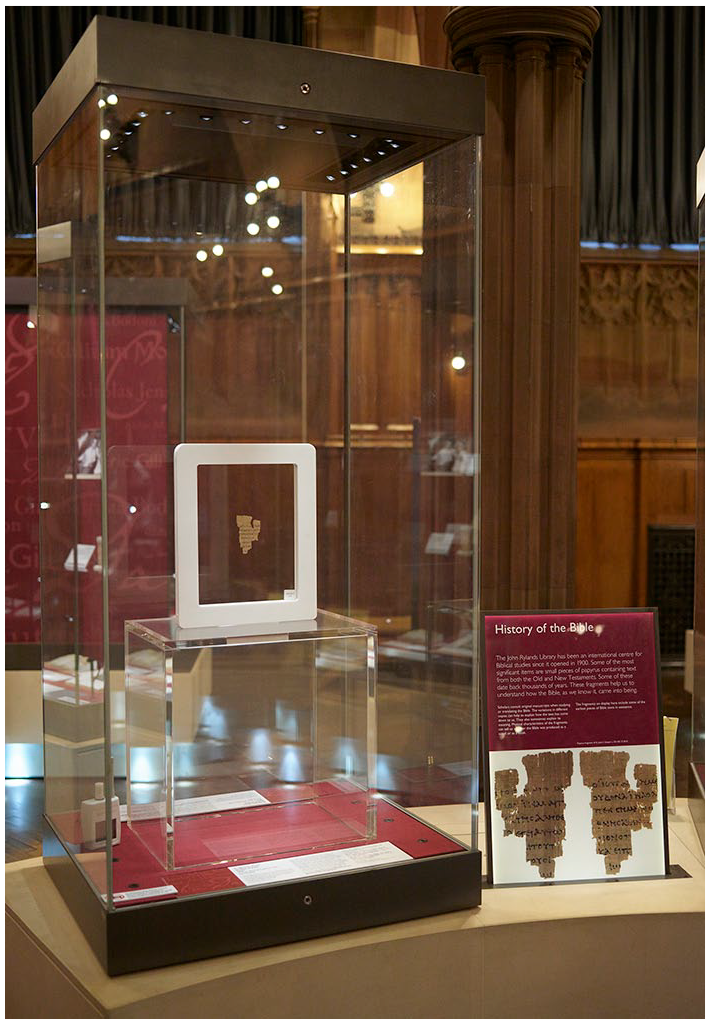
The Rylands fragment of the Gospel of John on display in the exhibition room. Courtesy of the John Rylands Library, copyright of the University of Manchester.
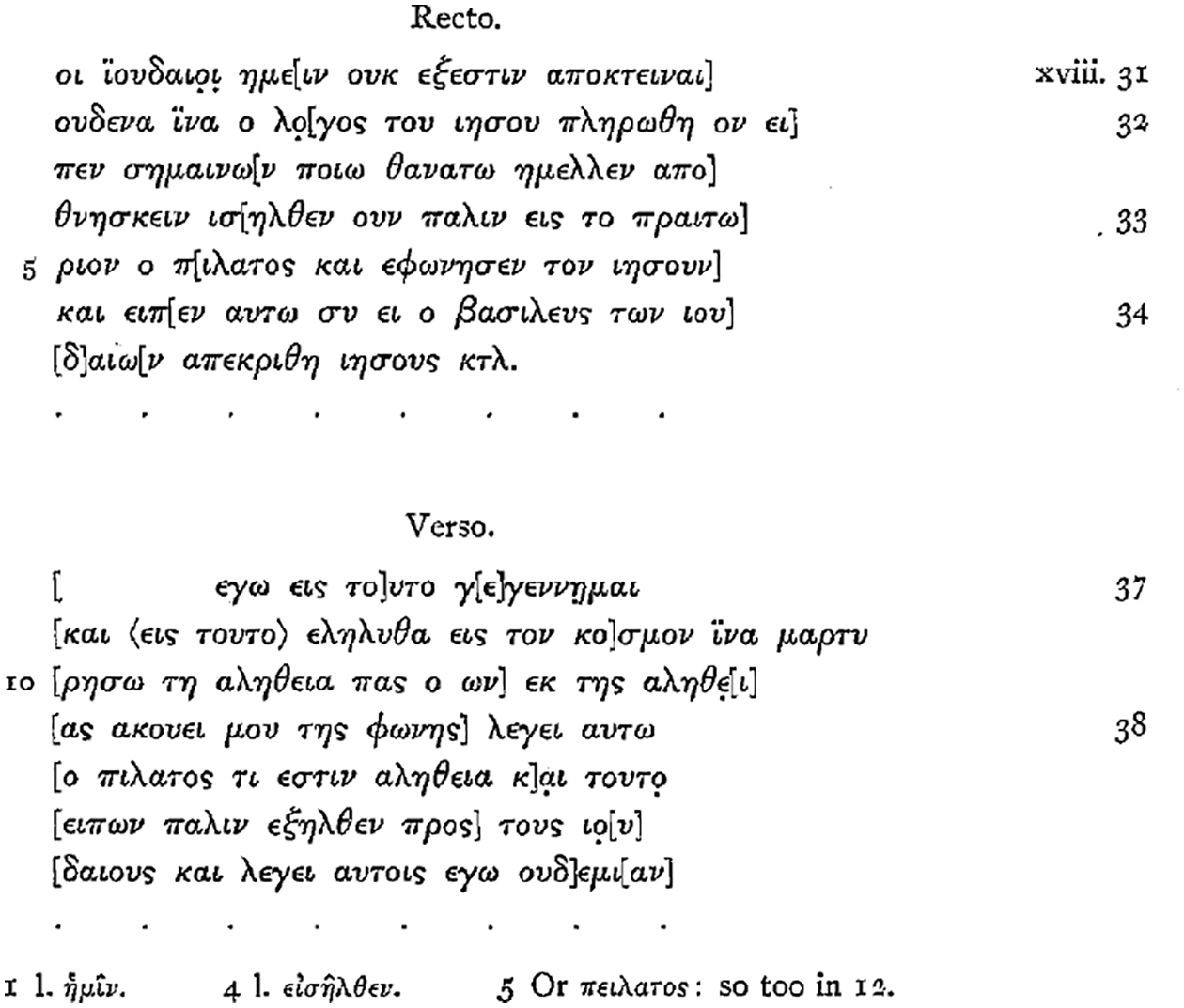
Greek text inscribed on the Rylands Gospel of John fragment (P.Ryl. 3 457) as provided by C. Roberts.
To an outsider, the transcript looks like an esoteric code-system, requiring explanation (Schubert, 2009). The central column reproduces the letters that ‘the artificer of facts’ (the papyrologist) can read on the extant fragment with some emendations provided in between squared brackets since the Gospel of John original ancient Greek text is known through a number of complete manuscripts. Recto and verso are technical terms to indicate the sides of a codex page. (The codex is an ancient papyrus or parchment book composed by quires stitched together; it is the precursor of the modern paper book and slowly replaced the bookroll.) Dots beneath letters flag that the reading is uncertain (remember Youtie’s description that the transcript reproduces what the papyrologist sees or thinks he sees on the papyrus); the final dot lines indicate that the papyrus breaks down at that point and the rest is missing. On the left side of the column, there are numbers indicating the text lines of the fragment, while numbers on the right give the breakdown of the pericopes of the Gospel’s chapter.
The fragment is known to papyrologists as P.Ryl. 3 457, which means papyrus belonging to the Rylands Library collection number 457, published in volume 3 of the papyri catalogue (its primary edition, Roberts, 1938: 1–3). Both the public display and the abbreviation that nominates the fragment show that this manuscript is in fact a far more complex object than the fact-text reproduced above. In order to consider how complex this tiny papyrus is, and to what extent the fact-text furnishes only a partial description of it, we need to address its life before reaching the Rylands exhibit room. Similar to its material shape, the cultural biography (Kopytoff, 1986; Mazza, 2015) of this object/thing is fragmentary and can only be sketched on the basis of little available data and some general historical knowledge. We can guess that sometime after the compilation of the Gospel of John (ca. 80–100 CE), a scribe in Egypt copied it (or part of it) in the form of a small codex either for self-consumption or to be delivered to a commissioner. The small book was used for some time, but then it went to waste for reasons unknown. It stayed underground for centuries; parts of it were mixed in the sebakh (a mixture of organic material and soil used as fertilizer by Egyptian peasants), others were eaten by worms or dissolved by damp.
The Rylands Library archives inform that in 1920 a British forefather of papyrology, B.P. Grenfell, travelled to Egypt with the aim of purchasing papyri, as it was normal at the time, and came back to Oxford with a number of them. As the John Rylands Library head librarian Henry Guppy had given him a mandate to acquire papyri on the institution’s behalf, Grenfell deposited the fragment to the Rylands lot, which he intended to publish once back to Britain. However, a few months later the papyrologist fell ill and never returned to work. He died in 1926. The Rylands papyri, including the John fragment, laid in boxes until Colin Roberts, a student of Grenfell, took over the publication. He identified the words inscribed on the papyrus were from John Chapter 18. From that moment, the biography of the tiny fragment took an interesting turn, not only for the biblical text it contained, but also for the date that Roberts and other scholars attributed to it on the basis of the style of writing: second century CE, that is to say very close to the drafting of the Gospel in question. This little shred became central to any discussion on the date of composition of the Gospel of John (Nongbri, 2005).
The fact-text’s commentary (or the thick description generated by papyrologists in interpreting the manuscript) had transformed this object into an icon for theologians and a wider group of Christian believers: the most ancient extant fragment of the New Testament. However, it is neither the fact-text nor the commentary that matters, but the object. The Rylands example reveals the shortcomings of Youtie’s descriptive approach. The allure of the object rests within it, in its material embodiment. The power exercised by the fragment is such that in 2007 the Library decided to put it on permanent display following the high number of requests from visitors to see it. It has since been widely reproduced in the form of postcards and other souvenirs (I even discovered a silk tie with graphic reproductions on sale online). Besides its academic significance, the manuscript has acquired a religious meaning connected with the theological, especially protestant idea that the Scripture is the word of God, and the closer a copy of it is to the first Christian generations, the closer it would also be to the embodiment of that word in history, Jesus Christ. Academic descriptions of the Rylands fragment have transformed it into something different: from a tiny piece of ancient rubbish, probably found by a peasant mixed to the sebakh, the papyrus has become a most treasured relic and manuscript of invaluable price.
However, the transformation of the papyrus also included the subject, that is, the papyrologist who provided the fact-text. The identification and following publication of the fragment was a defining point in the career of Roberts. In other words, the relationship between Roberts and the papyrus produced effects on both. The terms ‘subject’ and ‘object’, which respectively include an active and a passive entity, the papyrologist and the manuscript, do not adequately describe this transformation. The description of the papyrologist as an artificer of facts is a product of the 20th century. It describes the relationship between human beings and things in terms of activity-passivity. In this description the human being (usually male and white) has the power to transform things, and not the other way round. For Youtie the papyrologist through his transcript transforms an ancient tiny fragment of papyrus into a fact-text.
The cultural biography of the Rylands fragment, however, shows the life of papyrus manuscripts to be more complex and autonomous from the papyrologist-subject than Youtie claimed. If we look at the fragment as a thing, it was originally a piece from the stem of a plant that was treated to become writing material; it was made into the page of a book through the agency of various people and other materials; later on, it became a piece of ancient waste that laid underground for centuries going through other transformations; it became fertilizer and a commodity for an Egyptian peasant and through antiquities dealers it reached the papyrologist; it finally entered in a collection at Manchester going through other changes; in all these incarnations the papyrus fragment assumes very different meanings. We have also noticed that the fragment has produced effects on the career of the academic who identified its value and all those others who today see this as a sacred relic. If we move from the Rylands papyrus to the general, it could be argued that the corpus of fragments which have affected our knowledge of the ancient world have had the power to create an entire discipline, papyrology. In short, papyri are things with the power to produce effects.
In order to describe how power works, it is necessary to explain how it is related to an object, that is, a papyrus manuscript. The idea that things have power is theorised by Jane Bennett (2010) in her discussion on the relationship between human and non-human bodies. According to Bennett, non-human bodies not only have a force of resistance to human action as recognised by Foucault and structuralism, but also ‘the ability to make things happen, to produce effects’ (Bennett, 2010: 5). This ability to make things happen is due to a thing-power that can be activated by an operator (human or non-human) in determined situations, which Latour defines as networks, Deleuze and Guattari describe as the ontological category of assemblages and archaeologist Hodder has re-framed as entanglements (Deleuze and Guattari, 1987; Hodder, 2012; Latour, 2005, 2013). While archaeologists like Hodder have joined in discussions on the material turn, papyrologists have so far not been interested. Although ancient manuscripts are indeed archaeological objects, they are strictly defined by their textual nature. Ancient objects with ancient texts inscribed on them have been treated first and foremost as textual objects, disentangled from their material support. In the John Gospel fragment, for example, Roberts is the activator of the thing-power. But rather than being an artificer, as Youtie asserted in attributing a demiurgic power to scholars, Roberts is part of a specific assemblage in which he undertook a particular role that would not have produced anything without other parts of the assemblage, first and foremost the manuscript. Time is central, as that fragment was ontologically different before and after it had undergone the ‘fact-text’ transformation.
The effects of description
The way we describe things affects the ethics and policies that regulate our relationship with them. In the case of papyri, the concept of the fact-text has been the product of and at the same time has contributed to the foundational myth of texts as central to Western civilisation and secluded papyri from the rest of the archaeological material. As we have seen, in privileging their content, the materiality of papyrus fragments has been denied and almost erased. In what follows, I will show through the use of examples, the consequences of prioritising a disciplinary classification in which texts come first, tracing the negative impacts this has on archaeological and conservation practices and the transformation of papyrus fragments with specific contents (biblical and classical texts) into extremely expensive (and often trafficked) objects.
As I have mentioned, the precursor of the modern book is a Roman invention called codex. Codices were made by sheets of papyrus or parchments folded in the middle and bound together, sometimes with leather covers to protect them from damages. Few examples of ancient codices are still intact. This is not only due to the effects of time, but also human agency. Ancient codices have been systematically dismembered by academics and dealers for two reasons: in order to read more easily the inscribed texts on them, and to maximise their price on the antiquities market. As the binding prevented papyrologists reaching the lines of writing, quires were dismounted and mounted flat opened between glass panes. While this type of conservation method may make deciphering easier, once a codex is dismembered it becomes impossible to study and experience it as a book. The obsession with the fact-text has in some cases mutilated ancient objects and hampered the production of knowledge. Market forces too realised that what mattered most to buyers were the textual contents of these objects and that pages from codices were more profitable when sold separately in lots. The dismembering of ancient and medieval books in order to maximise profit is still practiced by unscrupulous dealers today. Covers, in particular, have been torn apart as they often were made using discarded documents and loose pages from thrown away books that might be interesting to papyrologists and profitable to dealers.
Other archaeological objects that have been broken in order to retrieve ancient writings are mummy masks and coverings. In 1825, a French archaeologist, Jean Antoine Letronne, realised that some Ptolemaic covering for mummies were made of a sort of papier-mâché made from recycling various materials, including discarded papyrus documents and books. With the intensification of archaeological campaigns in the late nineteenth century the dismembering of mummies to retrieve papyri became a common practice. The way in which papyrologists of the late Victorian period reported their findings shows that the violation of human remains and the destruction of mummy coverings were unproblematic because scholars valued the texts above all else. Papyrologists Grenfell and Hunt, for instance, reported with excitement that Flinders Petrie’s ‘discovery of early Ptolemaic mummies with papyrus cartonnage at Gurob reopened an avenue for obtaining Ptolemaic texts, which had been forgotten since the days of Letronne’ (Grenfell et al., 1900: 19). Both animal and human mummies went through systematic destruction, which often yielded little to their understanding (Frösén, 2009).
As indicated, papyri became highly requested objects and a flourishing trade developed as soon as Europeans arrived in Egypt. Like other archaeological objects, papyri went through processes of commoditisation and singularisation described by Kopytoff (1986). While the search for papyri started as part of the European imperial enterprise in the Middle East, a stream of objects, including manuscripts, left countries like Egypt to reach other countries, at first mainly in Europe and America, to be studied, displayed and stored in institutions created to exhibit the world, such as museums and libraries, and also in wealthy households of private collectors (Procter, 2020; Thompson, 2016). Despite there being laws protecting antiquities from illegal trade and export, the presence of colonial powers combined with economic and social instability created ideal conditions for these laws to be disregarded. Papyri, especially those with classical and biblical texts, were exchanged on the legal and illegal markets at ever increasing rates and prices, as the same papyrologists chasing them noted in their letters and reports. During the 1920 trip to Egypt that led to the acquisition of the Rylands John Gospel fragment, B.P. Grenfell wrote the following: There are a good many papyri around, owing to accumulations during the war, but prices of antiquities are high like those of everything else in this country, and papyri in particular by all accounts have gone up in value considerably since I was here 12 years ago. (John Rylands Library archives, Letters to H. Guppy, unpublished)
Academics and their institutions reacted to the market forces organising purchase cartels. In 1902/3 the Deutsches Papyruskartell was pulled together to coordinate acquisitions of Greek papyri from German Universities. In 1922 an international syndicate gathered together three American Universities (Princeton, Cornell, Michigan), the City and University libraries of Geneva and the British Museum with similar aims. Private players, that is, wealthy collectors, had a big role too in the formation of a flourishing market and in prices skyrocketing. For instance, Charles Lang Freer (1854–1919), an American magnate of the car industry, acquired papyri besides other artefacts later donated to the nation and now held in the National Freer Gallery in Washington. Similarly, Alfred Chester Beatty (1875–1968), nicknamed the ‘King of Copper’ from his main business, amassed an impressive collection, which is housed in the library he founded in Dublin, where he moved in 1950, that was later bequeathed to the Irish people and put under the care of the State. Other collections, for instance that of the Swiss millionaire Martin Bodmer (1899–1971), remained private. In their achievements, both institutions and private collectors were assisted by academics. Grenfell and Hunt established close relationship with wealthy patrons, including British aristocrats and magnates and American tycoons; classicist Francis W. Kelsey, who was the driving force behind the creation of the impressive papyrus collections of the University of Michigan, had ties with Freer (Pedley, 2012). Keenan (2009) and Nongbri (2018) highlight other examples of papyrologists involvement in the creation of collections.
It is clear then that academics have had an active role in the process of commoditisation of manuscripts and their exchange through the licit and illicit market. However, papyrologists have also been a driving force in the slow process of singularisation that invested papyrus fragments after they had been found, purchased, and reached the West. The accession of these objects in museums and libraries, their study and exhibition, changed their status into a specific category of things. In the course of the 1970s the process of singularisation intensified through the development of ideas of cultural and world heritage crystallized in the UNESCO convention of 1972 (Meskell, 2018). In 1970 another UNESCO convention invited State members to legislate and take action in order to curb the illicit trade of cultural property, including ancient manuscripts (The Convention on the Means of Prohibiting and Preventing the Illicit Import, Export and Transport of Ownership of Cultural Property, on which see O’Keefe, 2017). Other actions taken nationally and internationally have ‘culturally marked’ antiquities as ‘a certain kind of thing’ (Kopytoff, 1986: 68), belonging to the cultural patrimony of a nation and not to be exchanged or exported as other types of commodities. Egypt adopted a new law in 1983 (Law 117) that declared that antiquities were property of the State and forbade their trade. Dealers had a limited period to register their stocks to the authorities and private property of antiquities was restricted to very limited exceptions (Mazza, 2019b: 172–179).
Papyrologists have been slow at interiorising the post-1970 legislation. While archaeologists have actively contributed to the creation of ideas of cultural heritage, linking objects with living communities producing an understanding of the ties between their discipline and colonialism, papyrologists have joined this debate only recently. Our professional associations have struggled to find a common ground on the matter of illicit trade in particular (Mazza, 2019a). The cause of this delay rests on the core of the emic definition provided by Youtie: the description of papyrologists as artificers and that of the papyrus fragments as text-facts separated from the object. As Youtie put it, private papyrology (the real papyrology) was the realm of a small group: Since I shall be concerned throughout this lecture with papyrologists, we shall do well to keep in mind that they are a very small group of scholars, about half a dozen in the United States and Canada, another half dozen in Great Britain, two or three in the Scandinavian countries, a dozen or more dispersed over the continent of Europe, one or perhaps two in the Near East-shall we say a maximum of thirty? (Youtie, 1963: 21)
Youtie’s explanation meaningfully describes a sect of twelve Anglo-Saxons, two or three Scandinavians, twelve other Europeans and one or two people from the Middle East. Names are not mentioned because the readership knows who is being referred to. For the whole essay Youtie always uses male pronouns when referring to ‘the papyrologist’. As noted at a recent congress in the field (Blouin, 2019), the discipline has been dominated by white men: women have been a minority and Egyptians have been basically absent. During the 2016 papyrology congress, a discussion to introduce Arabic as one of the official languages of the International Association of Papyrologists became the source of harsh confrontations, which ended with a protraction of the status quo (official languages were and still are English, German, French and Italian because they are the languages of the founding fathers of the discipline). The point is that papyri have been the ‘belongings’ of these few professionals as only papyrologists were believed to be able to understand what these objects were (spoils of Greece and Rome, and testimony of the spread of Christianity) and so capable of providing transcripts to outsiders.
This entrenched idea lies at the root not only of mistakes in conservation and handling, as has been discussed, but also of criminal behaviour. Academics have published papyri without researching their provenance or have pretended to be unaware of their illegal provenance especially when their contents (i.e. the fact-text) was important to their scholarship and advancement. Libraries and museums worldwide have been purchasing papyri with undocumented and even illegal provenance for a long time; doubts on the source of important papyri have been repeatedly flagged (Mazza, 2018b). It is necessary to frame episodes of this kind in their historical context, with each case evaluated in the light of its cultural and legal background. I do so through the lens of three different phases in the history of papyrology and papyrus acquisitions. The first is that of origins embedded in the colonial period when Egypt was de facto ruled by Europeans; illegal purchases in this case must be understood in the wider context of power imbalances and exploitation. A second phase began with the 1970 UNESCO convention and the increasing awareness of the colonial distortions and wrongdoings that had impacted Egyptian cultural heritage (Colla, 2007; Mitchell, 1988; Reid, 2002, 2015; Said, 1978). We have now entered a third phase, with its inception in the Arab Spring of 2011, when episodes of looting, illegal excavations and smuggling dramatically increased. Although the political and historical landscapes have changed significantly over time, some collectors and academic practices continue to reflect the first colonial phase. I want to argue this is the case due to the long lasting and ramified impacts of the fact-text demiurgic description that we encounter in Youtie’s article.
To make my argument, I discuss the recent and ongoing case of the Green collection and their illegal purchase of ca. 5,000 papyrus fragments. In 2009, Steve Green and his family, owners of a successful American chain of arts and crafts stores called Hobby Lobby, decided to gather a collection of biblical artefacts to be exhibited in a museum that they planned to open to the public. The endeavour was moved by religious and political motivations driven by evangelical Christian values, and also economic considerations (Hicks-Keaton and Concannon, 2019). The American fiscal regime grants those who donate money or objects to charities, like museums and others, substantial tax deductions. These deductions are calculated on the fair market value of the object that must be documented by specialists. In the case of the Green family, the donors were also the funders of the charity in question, the Museum of the Bible (Mazza, 2019a, 2019b; Moss and Baden, 2017: 22–27). According to their own press releases, the Green family amassed around 60,000 items in a very short period of time, from 2009 to 2014 when a number of academics, including myself, started publicly questioning the provenance of this staggering number of objects in the context of a highly regulated antiquities market. I have been following and documenting this case focussing on the Green papyri and mummy mask and other cartonnage. My campaign, mainly conducted through my academic blog (https://facesandvoices.wordpress.com/) and articles commissioned by online magazine (e.g., Mazza, 2017, 2018a), has featured in international newspapers, from the Wall Street Journal to the Guardian and the Atlantic most recently (Crow, 2020; Higgins, 2020; Sabar, 2020).
Through my research I found the way the collector and his team, including academics, behaved in their interactions with the artefacts and the wider social context was mirroring that of the first generation of papyrologists and their patrons operating in the period of European colonial imperialism, which I have outlined in the previous section. In publicly raising these concerns, which were widely covered by the press, my repeated questions about the provenance of these Egyptian antiquities were not satisfactorily answered, except for a few documented pieces (sixteen out of ca. 5,000 fragments). The Greens also revived the practice of dismounting mummy cartonnage to retrieve papyri, which mainstream papyrology has replaced with less invasive techniques to avoid damage and preserve ethics. In many respects, researching this collection felt like returning to the Late Victorian period.
The situation started to change only when in the summer of 2017, right before the opening of the Museum, Hobby Lobby was found guilty of illegally importing ca. 450 cuneiform tablets and 3000 clay sealed bullae smuggled from Iraq. As recorded in the civil forfeiture complaint filed by the U.S. Attorney Office of New York Eastern District, 1 the items reached the United States in part via the United Arab Emirates and in part through Israel, following a pattern very well known to criminologists: antiquities are smuggled from their origin country, pass through transit countries, and then reach the market country to which they are destined (Mackenzie et al., 2019). The investigation, as the complaint illustrates, found Mr Green guilty of having consciously and repeatedly broken multiple laws.
In the case of the papyri, my research and that of other colleagues brought to light the existence of a ring of dealers based in different countries that relied on the help of academics and pseudo-academics to sell items to the American collector. A police investigation for fraud and theft is currently taking place as a papyrologist based at Oxford University, professor Dirk Obbink, allegedly pilfered papyrus manuscripts from the Egypt Exploration Society collection deposited at the Sackler Library and sold them to Mr Green (Higgins, 2020). The same academic, according to a piece of investigative journalism (Sabar, 2020), has sold ca. 150 items (including but not limited to papyri) to Hobby Lobby in the course of the years for a sum that has been estimated between $4 to $8 million. The ring included one of the Israeli dealers already involved in the Iraqi material case, and at least two Turkish sellers based in Istanbul who had a flat in London nearby Sotheby’s in which they exhibited merchandise, including papyri and cartonnage, to prospective buyers.
On 26 March 2020, Mr Green announced that Hobby Lobby and the Museum of the Bible are repatriating over 11,000 artefacts, including 5,000 papyrus fragments, because they were acquired through illicit channels. As I suspected all their collection of papyri, apart sixteen papyri, had come from illicit sources. The decision for repatriation should be framed into a wider plan to contain the damages to the image and the finances of the family and the Museum of the Bible. Public exposure of the legal cases has brought to light the questionable sources of the antiquities on exhibit; the family invested vast amounts of money in buying antiquities that had been seized or voluntarily repatriated, with considerable economic loss. (Repatriation took place while this article was in press, Marie, 2021).
This case is meaningful because similar to the collectors and scholars of the first colonial phase, Mr Green and his entourage had ignored or circumvented the laws for a sense of entitlement. They felt they were entitled to appropriate papyri with biblical texts on them in the name of their faith and their economic power, which, in their opinion, can ensure proper conservation and study of such artefacts. The reaction of most papyrologists, however, was indeed very different from the past, as I have shown. In other words, the field recognises that the cultural and legal background has dramatically changed and behaviours of this kind in collecting are unacceptable. It is therefore time also to reconceptualise the objects that we, papyrologists, study as things rather than fact-texts.
Conclusion
The metaphor of the faded manuscript to refer to human groups in the opening passage of this article is one example that reveals what manuscripts tell us about the world. In my field, papyrology, the focus on the texts as central – and more important than any other part of an artefact – has given birth to the cultural construct of the fact-text. The reading and transcription of the signs inscribed on ancient papyrus fragments produced by a sect of specialists is what mattered most to the old generations of papyrologists; this way of conceptualising, or if you like describing, papyrus fragments and the job of papyrologists (the artificers of facts) have had negative impacts on the way these fragile manuscripts have been curated and studied, and on the way they have circulated, very often illegally, through the antiquities market. As it has been shown through the case of the failed attempts of the Green family to continue collecting ancient manuscripts as if we were still living in the colonial past, a description of papyri as ‘fact-texts’ and of papyrologists as a small group of specialists whose only task would be producing reading and transcripts are indeed superseded. New descriptions of ancient manuscripts should consider the materiality of these things as far more complex than the signs inscribed on them. Papyri are first and foremost archaeological objects excavated in specific contexts, for instance the dumps of ancient towns in Egypt. They have been parts of multiple assemblages in the course of their long lives: the library of a scholar living in first century Egypt, the content of a box of archaeological findings that left Egypt to reach Europe in 1897, one of the many fragments that a scientific laboratory is analysing to the request of the papyrologist member of a team of researcher. The list can obviously go on.
The approach to papyri as things with inherent power that can be activated in specific circumstances (assemblages) helps us understand and describe the relationship between papyri and papyrologists in a much more penetrating way. The recognition that things have agency, and that our relationship with them cannot be interpreted in terms of subject and object, makes us more responsible in our dealings with them. If the manuscript thing becomes an active entity, it can call for rights. The right, for instance, to be accessed and studied by specialists in order not to disappear is paramount. This has serious implications for the descriptive practices of papyrologists as it means that public and private collections must ensure that their papyri will be curated in an appropriate way and made publicly available for study and inspection. The new ontology of papyrus manuscripts as things puts the objects rather than the needs of the ‘artificer of facts’ at the centre of ethical practices of descriptions; to come back to one of the examples discussed in the article, when taking decisions about the restoration and conservation of an ancient codex, the ability of reading and describing the text inscribed in it would become one of the factors to be considered rather the main aim as has happened in the past.
Footnotes
Declaration of Conflicting Interests
The author(s) declared no potential conflicts of interest with respect to the research, authorship, and/or publication of this article.
Funding
The author(s) received no financial support for the research, authorship, and/or publication of this article.
