




Abstract
This article illustrates the value of in-depth life history interviews using life mapping in qualitative research. We draw on our recent research into people’s experiences of homelessness, where all 39 participants were currently, or recently, homeless. Using the life mapping method, participants generated a visual representation of their transitions across housing and homelessness, beginning in childhood and ending in the present day. We critically discuss the potential for life mapping to move beyond rehearsed stories, briefly note further associated benefits, and acknowledge some potential drawbacks. We argue that the method can confer considerable depth and reflection, going beyond a traditional qualitative interview, and is especially valuable when examining sensitive topics.
Keywords
Introduction
At its simplest, the life history approach is one in which individuals tell the story of their lives, with the content, focus and way of telling chosen by the narrator (Atkinson, 2001). The technique is a sensitive and empowering research method which ‘offers us a way of seeing that originates from the individual and encourages us to overcome our ignorance of the lived experience of labelled groups’ (Goodley, 1996). This versatile method has been used to explore diverse topics, including decision-making in the careers of female teachers (Smith, 2012), adolescent sexual abstinence (Haglund, 2004) and women’s role in racist groups (Blee, 1996).
Following an established history of biographical qualitative research into homelessness (Fitzpatrick, 1999; May, 2000) and home-making more broadly (Vandenbeld Giles, 2020), our project took a life history approach to gain rich and detailed insights into people’s transitions across housing and homelessness experiences. Our key methodological motivation was to go beyond the ‘usual story’ of oft-repeated narratives throughout people’s homelessness journeys. Such narratives might necessarily be framed to access services and as such could underplay the complexity of people’s experiences, their resilience and networks. Responding to this challenge we used life mapping, a technique that combines biographical and visual approaches to create a pictorial account that represents a person’s life history on a certain topic or theme. Mapping also captures the multidimensionality and connectedness of people’s worlds in relation to their social networks and experiences of wider social structures.
This article explores our experience of undertaking life mapping in a research project examining people’s experiences of homelessness in Oxford, UK. We firstly discuss life history and life mapping methods before outlining the practicalities of the research process. We then critically examine the value of life mapping methods, focussing primarily on the potential to break through rehearsed stories.
Life history and life mapping methods
The lived experience of homelessness is often fluid, with transitions through different forms of homelessness interspersed with movements into and out of housing. Clapham (2003) firstly advocated for personal biographies in homelessness research, noting their potential to illuminate the factors that lead to initial homelessness, and that may facilitate exits from homelessness. Somerville (2013) later emphasised the importance of lifecourse perspectives to understand homelessness as ‘multidimensional and storied’ (2013: 384). Accordingly, the technique of recording the ‘homeless biography’ (Chamberlain and Johnson, 2013: 62) has been widely employed (Fitzpatrick, 1999; May, 2000; McCulloch, 2015; Ravenhill, 2008; Tomas and Dittmar, 1995). By adopting a life history perspective, we aimed to understand the events and experiences that participants identified as significant to their lives, and relevant to their situation of being currently or recently homeless. The project’s overarching objective was to provide a holistic understanding of the trajectories and transitions between (and exits from) different homelessness experiences, the risks within these transitions, and how these transitions are navigated, through a case study of Oxford, UK.
We supplemented the life history approach with the visual technique of life mapping. Visual methods offer a means of gaining insightful visual and verbal accounts of a given research topic. In our case, exploring journeys through housing and homelessness contributed to existing research using visual methods to explore both homelessness (Dean, 2015; McCarthy, 2018) and home-making (McCarthy, 2020). Visual methods have considerable value through their potential to elicit understandings that cannot be expressed verbally (Gauntlett, 2007), such as complex self-identities or emotions. Additionally, it is argued that the reflective process of creating an artefact that can be observed, considered and altered is, in itself, ‘different’ (Gauntlett and Holzwarth, 2006: 84). Others have likewise employed visual tasks with the aim of going beyond ‘a verbal mode of thinking’ in order to avoid stock answers (Bagnoli, 2009).
Incorporating life mapping within our study was influenced by one of the researcher’s experience of mobility mapping in family finding work. As a tool in social work practice, life mapping is used to explore individuals’ housing and relationship histories with the aim of uncovering social networks and thereby reconnecting people with family members to enhance collective support. Alongside this practical application, mapping methods have been employed in various ways by qualitative researchers across academic disciplines including psychology (Sheridan et al., 2011), health research (Gramling and Carr, 2004), human geography (Worth, 2011) and political science (Soderstrom, 2020). For example Worth (2011) used life maps to examine transitions to adulthood among visually impaired young people. These life maps were tactile, using string as a guiding line to facilitate expression. Sheridan et al. (2011) likewise used timelines to explore narratives of women’s memories about fatness and weight loss over time. Participants were directed to focus the timeline on the period of their lives where these issues were relevant to them, and were encouraged to bring objects to the interview, some of which were incorporated into their timelines. In contrast, Soderstrom (2020) took a graphical approach to explore the process of political mobilisation among former combatants. She asked participants to draw a timeline of the two dimensions of political activity and political interest (using different colours), resulting in a diagram similar to a graph that represented people’s political trajectories and facilitated comparison between participants. In the only example of life mapping research on homelessness, we are aware of, McCulloch (2015) 1 used life maps alongside autophotography to illustrate participants’ general life narratives.
In the current project, our emphasis was on participants’ often frequent transitions between different housing and homelessness experiences throughout the lifecourse. Prior life mapping research has taken a diverse approach, ranging from expansive, general life biographies (Gramling and Carr, 2004; McCulloch, 2015; Worth, 2011) to accounts oriented to a particular theme or dimension (Sheridan et al., 2011; Soderstrom, 2020). Our approach adds to this diversity by highlighting the previously untapped value of life mapping in capturing in-depth temporal information on a given theme – in our case, participants’ housing and homeless biographies, with a specific focus on the transitions between episodes. Asking people to draw their housing histories naturally oriented both the verbal interview and visual maps onto dynamic processes, with interview prompts (‘and where did you go next?’) focussing on the changes occurring at each housing transition. Like May’s ‘triple biographies’ that incorporated a triumvirate of personal, employment and housing circumstances (May, 2000: 618), our emphasis on transitions facilitated broad, multidimensional accounts of these changes that incorporated financial, relational, health and employment factors alongside housing considerations, thereby offering a unique contribution to the existing methodological and substantive literature.
The research process
We adapted the initial stage of family finding, which seeks to identify a person’s social networks by asking participants to draw where they have lived and the people they remember in their lives. We purposively recruited 39 currently or formerly homeless adults via staff and recruitment posters at relevant third sector organisations, advice centres, online adverts and through snowball sampling (see Garratt et al., 2021 for further details).
Initial mappings began with flipchart paper pinned to the wall and the interview was conducted with both the participant and interviewer standing. We soon adapted the process to a seated one after one participant was injured and unable to stand. Sitting to draw produced comparatively smaller drawings but still effectively captured the visual narratives, and may have allowed for longer interviews. Potential participants were informed about the nature and purpose of the research, provided with written information about the study, and gave informed consent via an oral consent process. The interviewer began by asking participants to choose a coloured pen and draw the first place they remembered living as a child. We deliberately did not use the word ‘home’ because it has connotations beyond a physical structure. Participants then recounted their life histories, through their housing history, from childhood to the current day. The interview was conversational in style. Where needed, we used a topic guide to probe for further detail about specific housing or homelessness experiences, the transitions between these, and reasons for these transitions. As noted above, whilst focussing specifically on housing and homelessness, the guided mapping also generated accompanying narratives about family dynamics, personal relationships, work, ‘good times’, addiction, health and accounts of traumatic events.
Although participants were made aware of the life mapping element prior to taking part and during the consent process, many still expressed surprise at being asked to draw their story. A typical initial reaction was to say they could not draw, before becoming engaged in the mapping and taking ownership of it: Esther: The start of my life? It was a one bedroom flat on the fifth floor, how do I draw that? I’m just going to draw flats.
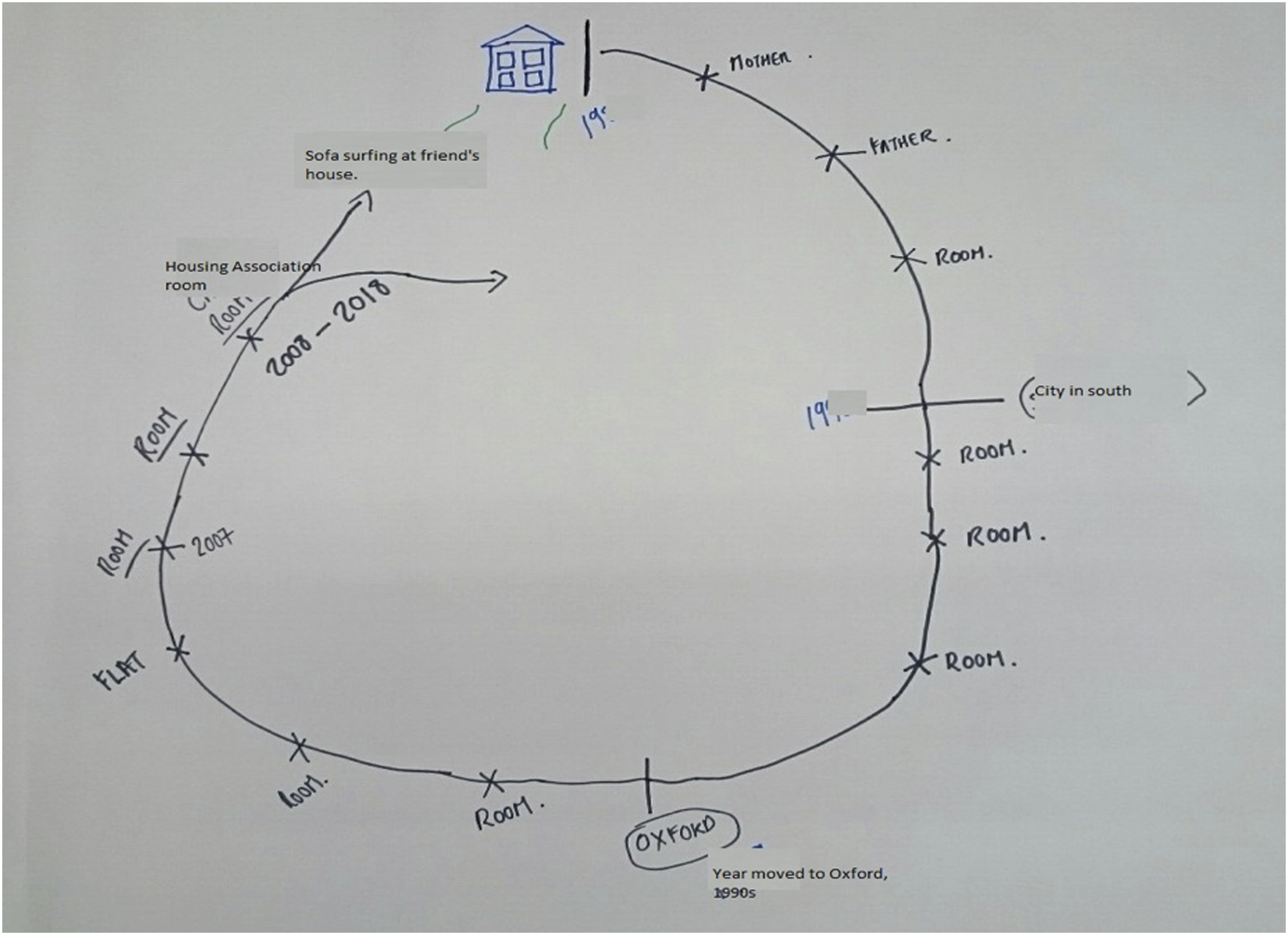
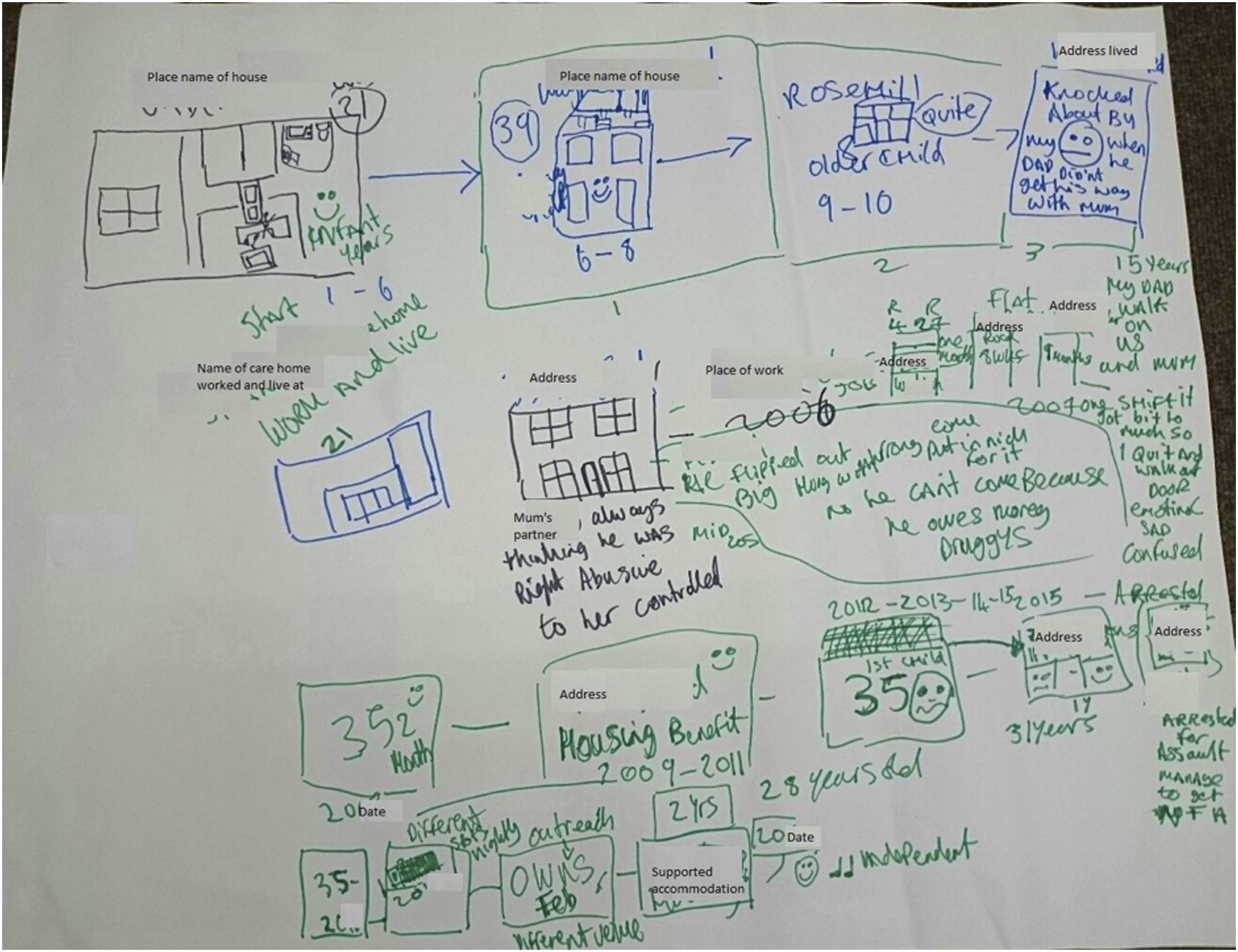
Alongside the housing biographies they captured, the diverse format and presentation of participants’ life maps also offered further insights into participants’ emotional experiences. Several wrote extensively on their mapping or drew detailed representations (Ryan, Figure 1) whilst others created more abstract mappings. Sam drew a graph, describing this as depicting the peaks and troughs of his biography, whilst Emma drew her housing history in a circle (Figure 2). Others mapped their housing narratives by year or their age, often emphasising significant events such as the birth of children (Daniel, Figure 3). Thomas symbolically changed colours to illustrate a dark time in his life: Thomas: Yeah, literally, yeah literally, I found myself in a council flat. It was another part of Swansea. Interviewer: Shall we draw that on there? Thomas: I’m going to draw it in black. Ryan’s life map shows detail in depicting different housing and homelessness transitions, including his tent in a local park (the dome), with a diagram to the right of this showing its position in the bushes, chosen for safety. Emma’s life map is an example of a more abstract interpretation. However, that she drew her childhood house (but not others) is probably significant to her life history and, in this way, mappings can feed into analysis. Daniel’s life map contains extensive writing to show his age at certain events, many traumatic. He includes pictorial representations of his emotional states, adding another layer to the mapping. He ends with a picture captioned ‘independent’ to show he is standing on his own ‘two feet’.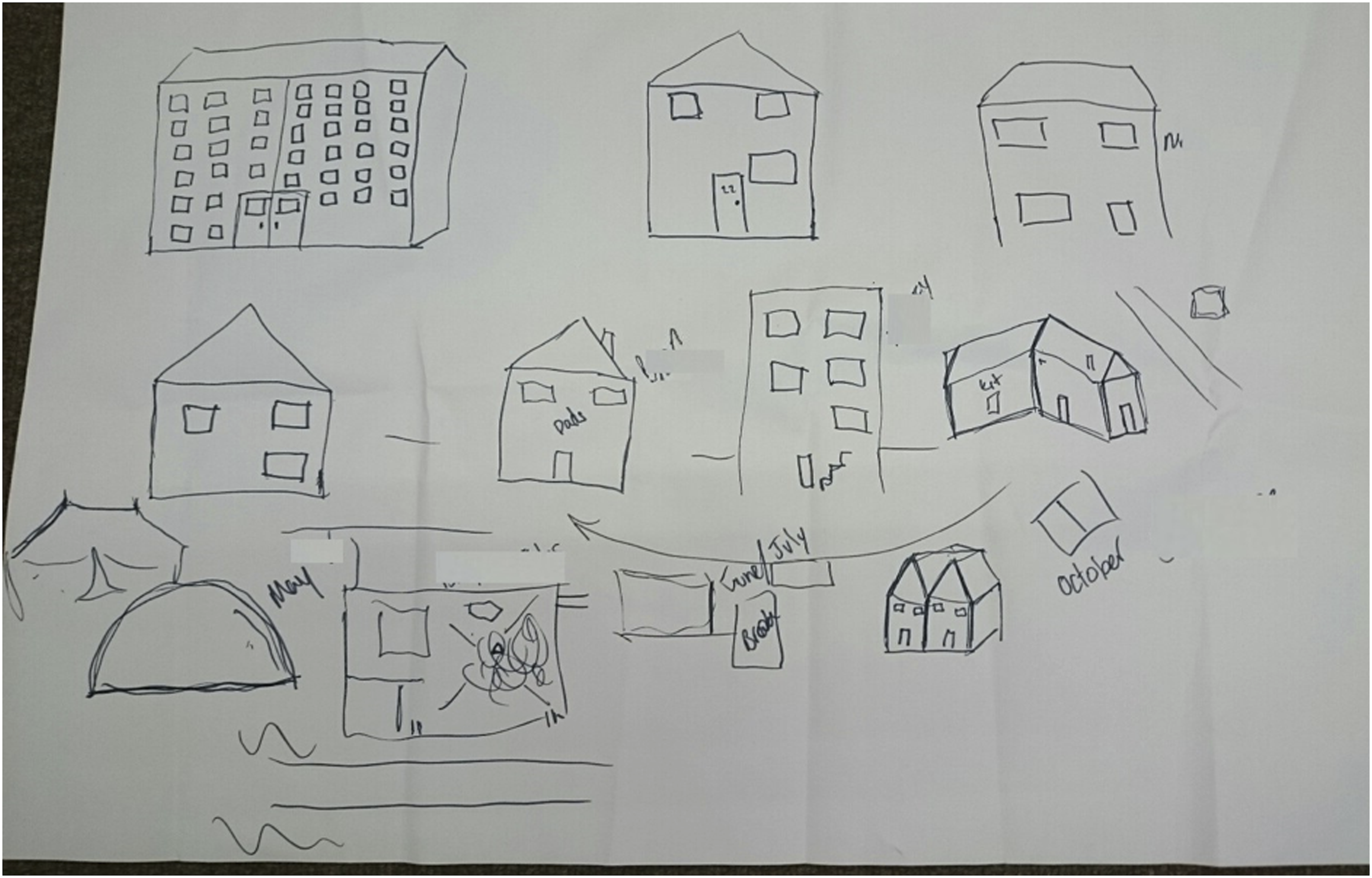
Reflections on (re)constructing housing and homeless histories:Moving beyond rehearsed stories
Our primary motivation for using life mapping techniques sought to move participants’ accounts beyond a rehearsed story, one often told out of necessity. Everyone has their life story, adapted – deliberately or otherwise – for the audience at hand. Peel (2003) noted how marginalised people are often required to repeat their ‘poor story’ in order to get what they need from services (Peel, 2003: 73). People experiencing homelessness are commonly obliged to relay details of their life and housing history when seeking to access statutory and non-statutory support services 2 , which can serve to create a ‘homelessness story’. Recognising the potential impact of these factors on participants’ accounts, we adopted a creative approach to elicit participants’ accounts in a non-confrontational way, moving beyond their habituated and potentially service-oriented stories to examine the complexity of their housing histories more directly. The novelty of the visual task disrupted the ‘usual’, purely verbal, accounts of homelessness given to services.
Going beyond the ‘usual’ story, however, does not mean accessing some unmediated reality. We recognise the contextualised nature of participants’ narratives and mappings as products generated by the interview process itself. Life histories are always partial tellings: accounts of past events and experiences are selected, not only by the framing of the research topic but also by more mundane practicalities such as the constraints of time (Breckner and Rupp, 2002; Miller and Glassner, 2011). Consequently, stories are ‘told in different ways at different times’ (Plummer, 2004: 566), with the telling differing depending on whether it takes place within a research context or a Jobcentre interview. However, different tellings by participants does not negate the veracity of the narrative itself. Maynes et al. (2008) refer to Spence’s (1982) distinction between ‘historical truth’ and ‘narrative truth’, with life histories offering both: ‘[P]ersonal narratives do not in any simple sense reveal the past ‘as it actually was’ […] the value of personal narratives is related precisely to their tendency to go beyond the simple facts: they tap into the realms of meaning, subjectivity, imagination and emotion’ (Maynes et al., 2008: 148).
Autobiographical histories therefore go beyond an elusive factual account of past events to offer the researcher insight into the participant’s lifeworld, and their reflections on that world. When seeking to move beyond these rehearsed stories, the researcher must bear in mind how such stories are constructed within the interview situation. For example Harding (2006) contends that imposing a chronology in life history interviews enforces a linear perspective that could reduce interviewees’ agency over their life story. We found, however, that participants were not constrained in this way and instead relayed narratives that moved back and forth in time, returning to and elaborating on areas previously discussed (see for example Jakob’s map; Figure 4). In this way the telling often became a re-telling as participants reformulated their histories throughout the interview, clarifying experiences or revealing new events. The telling of their narrative thereby became an act of remembering and reconstruction (Haglund, 2004). For example Caroline alluded to challenges of living in shared accommodation in her 20s but only later explained that when spending five years sofa surfing with a friend, she had never tidied the flat because it wasn’t her own. This later revelation offered insights into some of the earlier difficulties she experienced in shared housing. Jakob's life map includes arrows representing returns to the parental home and to his ex-partner’s house between unstable housing and homelessness situations.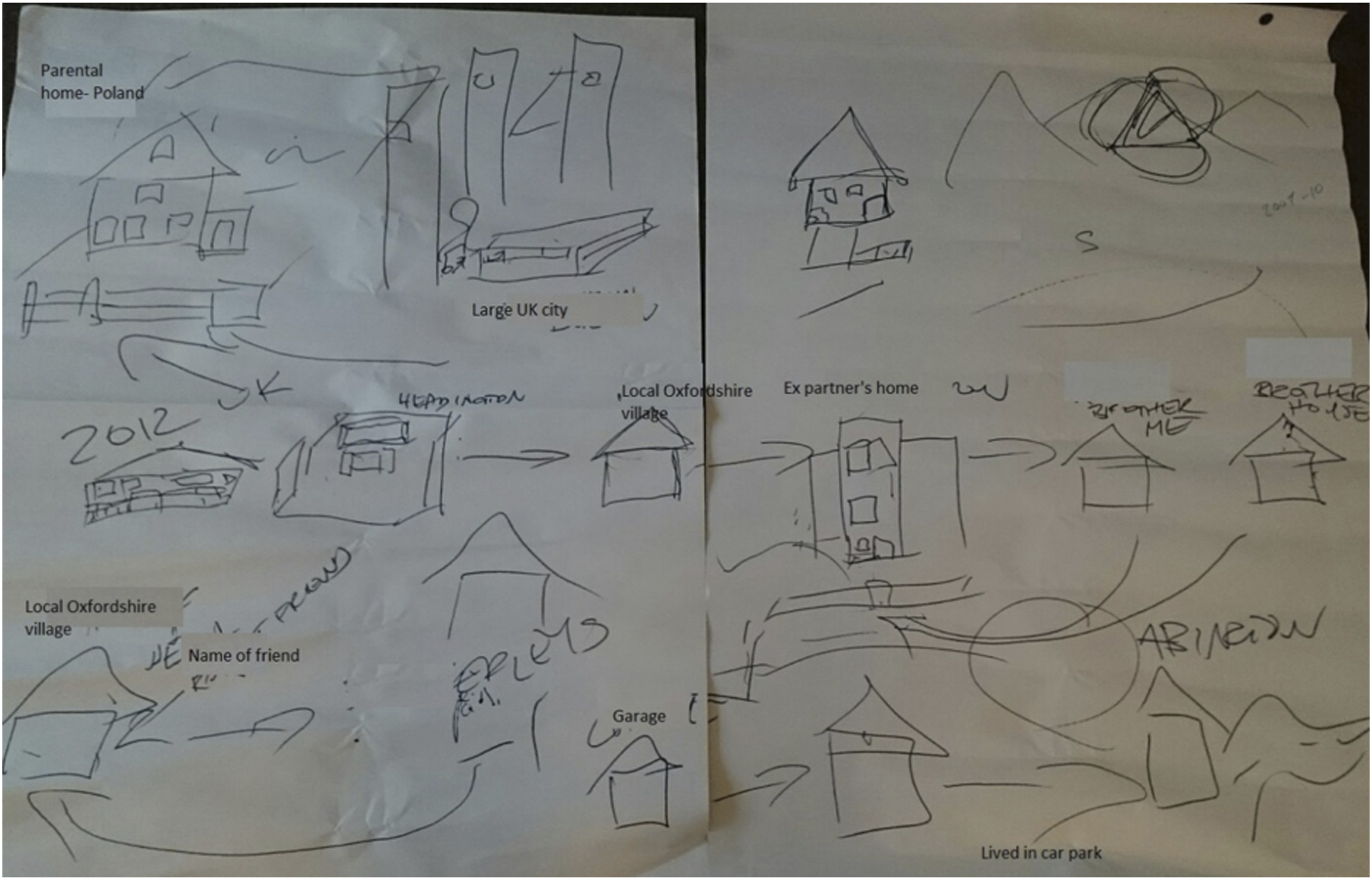
Mapping as encouraging memory and creating detail
Alongside the potential for life mapping techniques to move participants’ accounts beyond a rehearsed story, mapping also facilitated access to potentially untapped memories, a particularly valuable feature when taking a lifecourse approach. Within this study, the act of assembling participants’ life histories was not only through the telling but also the drawing of them. Like Sheridan et al. (2011), we found that mapping acted as an aide-mémoire for both researcher and participant. People experiencing homelessness may have additional challenges to recall due to the impact of trauma, substance use, or mental ill-health (May, 2000) and we anticipated that life mapping might enable participants to share their narratives more readily. Life mapping encouraged the production of rich, detailed narratives, which participants reflected on throughout the interview, generating greater depth than a traditional interview. Our emphasis on transitions may have further helped participants access the details of their housing histories by focussing their biographical narratives on this theme. In parallel, exploring changes over the lifetime also revealed participants’ understandings of their earlier life, relationships and life events, and how these may have impacted on their homelessness experiences. In this way, mapping was central to revealing the multilayered subtleties of those experiences (Sheridan et al., 2011). For example Angavu draw her early life, describing how: ‘So, during school times, I’ll stay with my…Muslim grandmother and then during the holidays, I would go spend with my Christian grandmother’. Her repeated movement between physical spaces, personal relationships and religious boundaries may have contributed to her transitory lifestyle in adulthood, one that included a two-year period of sofa surfing between four houses.
Whilst retrospective questioning can of course be achieved to develop narratives in an interview setting, the presence of a tangible framework to physically refer to can be practically very useful when clarifying a person’s life history and the transitions between episodes. When reviewing his history, Jason indicated on his map: ‘So, I’d gone from prison, to the bail hostel house, to here, to here, to here’, offering a summary both to himself and the researcher (Figure 5). Jason’s life map illustrating periods of housing, squatting, prison and rough sleeping. He wrote 2010 and circled this to record the time he identified as feeling homeless and wanted to be housed.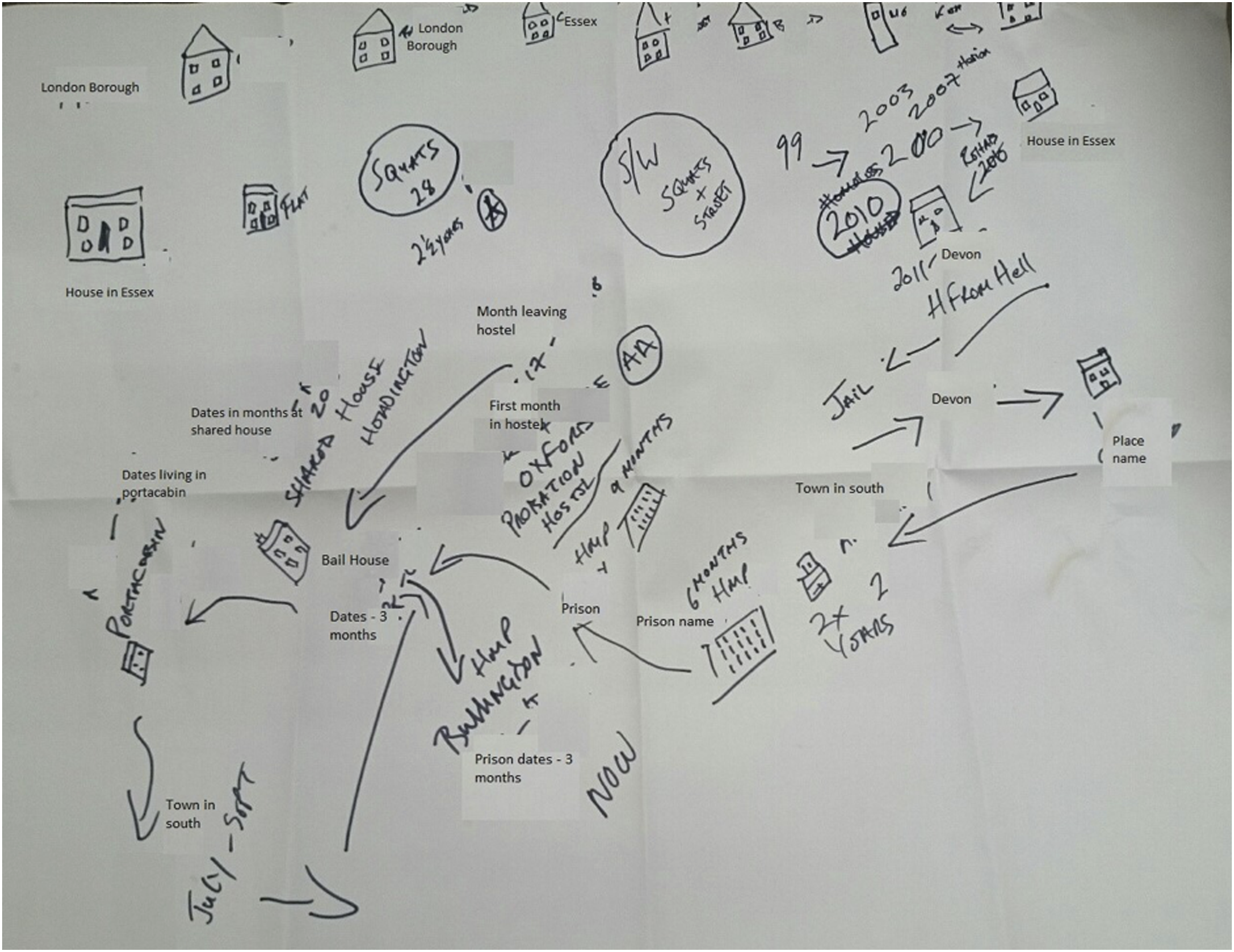
The possibility to move beyond typical accounts by referencing back to difficult subjects was particularly valuable when participants had experienced trauma. Whilst the experience of homelessness itself may be traumatic for some (Robinson, 2008), asking participants to recount their complete life histories through their housing experiences meant we inevitably encountered accounts of violence, abuse and bereavement. The act of visually representing their accounts evoked memories for some participants, who described events connected to place, pointing back to earlier drawings or embellishing them as they recalled stories about people and circumstances from that time. The lifecourse approach therefore offered insights into how participants’ recent experiences of homelessness related to earlier life events. If we had started interviewing from the onset of adult homelessness this may not have been revealed and significant insights would have been lost.
This feature is well illustrated by Sam’s account, where he self-reported ‘horrendous’ childhood abuse at the hands of his father: ‘And I was… my father was a complete and utter bastard to me and my mum’. Whilst this revelation may bring to mind familiar tropes about lifetime troubles that began in childhood, Sam’s reflection on the consequences of these experiences demonstrates greater nuance and depth: Sam: And I don’t get on with men very well… I… I feel much comfortable talking to women Interviewer: Okay. Sam: And I’m guessing it stems from there you know, I don’t trust men and don’t particularly have any… I do have male friends, I have a couple, but I would… much rather talk to a woman than I would a bloke.
Sam’s resulting absence of supportive friendship networks likely contributed to his later isolation whilst in an emotionally abusive relationship, drug use (and resultant job loss) and his consequent homelessness when the relationship ended. In this way, the life mapping technique offered a more contextualised, intricate and less typical account of the processes at play than simpler narratives linking childhood trauma with adulthood homelessness. The acknowledged impact of early life trauma on homelessness means that techniques such as life mapping have considerable methodological value in eliciting comprehensive life stories.
Encouraging reflection
By seeking to move beyond typical or rehearsed stories, the physical process of life mapping potentially promotes a deeper level of consideration. Many participants reflected on their past experiences, relating specific events – a death or traumatic relationship breakdown – as associated with their homelessness. In this way they self-evaluated causality and risk. For example Thomas identified his mother’s death, when he was 19, as a key factor in the difficulties he encountered in later life: ‘I mean there’s no denying, it’s, it’s, it’s shaped my entire existence, my entire adult life. I mean, I’m, I’m acutely aware of it’. Such self-evaluations are highly valuable, reducing the possibility that researchers (mis)interpret aspects of people’s life histories, potentially in line with dominant narratives of the being studied. Compared with verbal answers, asking participants to draw their housing history may also have fostered more detailed reflection on the project’s themes. The instruction for participants to begin their life maps with the first place they remembered living may additionally have oriented their thinking towards the early years and how these may have influenced later experiences. Participants located themselves as social actors within a nexus of personal, cultural, social and economic constraints and opportunities and drew (sometimes literally, using lines or arrows) relational connections between themselves and wider structural factors. For example Dan described how a lack of opportunities led to him moving into ‘alternative’ housing on protest sites and squatting: ‘Well, I… I think… I think it was a lot of the same for a lot of the people and people just became… disenfranchised with staring… staring at the same walls and living in a flat and having a bleak existence and… a dreary job or… some awful YTS
3
or something, you know.’
Living on a protest sites was a happy, and relatively stable, time in his life, which he was proud of and clearly wanted to convey in his visual mapping, drawing several treehouses on different sites, one for six years: Dan: What I’ll do for this really…[Drawing] Interviewer: Yeah. Dan: I’d quite like to put this in really… this is just rough, you know…[Draws a tree house]
The production of a tangible life map and the process of reflecting on their drawing and exploring their circumstances also appeared to foster conceptual self-definitions, where participants could narrate, define and reflect upon when and how they became homeless, and the experience, meaning and perspective they gave these definitions. For example Joe described the recurrence of housed and homeless experiences revealed in his drawing: Interviewer: Okay. And, that’s the house you lived in after the… after the tent? Joe: Yeah. So, drawing these pictures just goes round in circles [laughter].
By going back to the first place where participants remembered living, we avoided dominant narratives that began when they became (or recognised themselves as) homeless, offering an appreciation of the complexity of people’s transitions through different dimensions of homelessness. We were particularly struck that on several occasions when participants specified on their mapping when they first identified themselves as homeless, this followed earlier experiences – including episodes of rough sleeping – that would generally be recognised as homelessness. Others who presented with an isolated experience of homelessness then relayed previous homeless episodes. For example Jason (Figure 5) identified a period of squatting as his first homeless experience, then changed his mind, finally adding a date to his map denoting when he ‘wanted to be housed’, thereby revealing how he defined his experiences of homelessness. By providing an object for reflection and discussion, visual mapping helped both to reveal previous experiences not identified by participants as homelessness, and also enhanced our understandings about transitions and participants’ self-perceptions of homelessness. These insights offered elements of novelty and surprise to both participants and researchers that disrupted their service-oriented accounts, analogous to Peel’s so-called ‘poor stories’ (Peel, 2003: 73).
Similarly, others depicted and described ‘travelling’, ‘camping’ (often sleeping rough) or squatting using the language of choice, only later defining a situation as ‘homelessness’ when there was a perceived lack of alternatives for them: Ryan: So, yeah, to begin with it was almost like going on a camping holiday for the first month, probably. Interviewer: What, you felt a bit relaxed? Ryan: Yeah, bit of a holiday, no responsibilities, yeah, it was almost like being on holiday I suppose. But yeah, after a while, reality kicks in. Interviewer: What’s the reality? Ryan: Well, homeless. Hygiene starts to slip a little bit. Plus the stigma that goes with it, I suppose.
Such reformulations of ‘homeless’ situations could be an attempt by participants to discursively sidestep the stigmatised label of homelessness (Preece et al., 2020), and we recognise that their initial ‘choices’ were undoubtedly made within limited circumstances. Participants’ sense of agency was nonetheless central to identifying a situation as one of homelessness. The life mapping technique therefore altered our original understandings of how situations of homelessness are experienced and perceived by participants, and how these change over time.
Exploring social networks
One feature of people’s life histories that might be overlooked or downplayed in their rehearsed stories is the role played by social networks. Life mapping allowed particular depth to be attained in relation to people’s social networks – both formal and informal. Such in-depth explorations of participants’ relational experiences are more insightful than descriptions of homeless ‘subcultures’ (Ravenhill, 2008), which risk over-emphasising the influence of homeless networks and overlooking wider networks of housed family and friends.
Rather than explicitly instructing participants to focus upon social networks, we approached the life mapping in an open way to see which themes participants orientated themselves to. This approach proved valuable: for some participants, their family and friendship networks were clearly instrumental to their biographies (e.g. Jakob, Figure 4, discussed below), whilst for others, the scarcity of references to social networks was itself revealing (e.g. Emma, Figure 2, who noted ‘And, erm, so, no, there were no real friendships or, or relationships, just my work and my room’). To encourage participants to consider their social networks, we used prompts including ‘did you live with anyone else?’ and ‘was there anyone else that was important to you at that time?’.
By asking about social and familial relationships and services accessed, life mapping also enabled relational aspects of people’s lives and homelessness to be examined. Participants often located their narratives beyond personal events to reveal wider structural constraints, such as Jason’s recognition of social disadvantage experienced at an early age: ‘I’d always knocked about with a few black people and Asian people, you know what I mean, the schools I went to. It had single parent kids and, and mixed race. So, yeah, you know what I mean […].’
Exploring networks also offered insights into the poorly understood reasons behind particular transitions from one form of homelessness to another, insights that were facilitated by the life mapping technique. For example participants often juggled sofa surfing with friends to avoid rough sleeping, but not stay so long that they were ‘in the way’, a common refrain. For several years, Jakob repeatedly returned to his parent’s home in Poland at transitions that followed the termination of work or housing contracts, and relationship breakdowns, referring to his ‘base’ (represented with arrows – see Figure 4). When he became estranged from his parents, a more unstable period of hidden homelessness and rough sleeping followed. Without the focussed mapping, this pattern of returning to the parental home, and the significance of the loss of this familial resource in his drift into rough sleeping, may have gone unnoticed. In this way, our focus on transitions revealed these moments of change as times of heightened vulnerability. This reliance on social networks was also true for Clive, who sofa surfed in his brother’s housing association home until his brother died suddenly and his sister-in-law ‘fell to pieces’ and was subsequently evicted due to rent arrears.
Mapping as an effective means of conducting sensitive research
Alongside its value in eliciting detailed and potentially disruptive biographies, life mapping techniques also have procedural advantages that relate to the ethical challenges of conducting research on sensitive topics and with vulnerable groups. Sensitive research may relate to the subject matter, for example very personal or ‘deviant’ issues, or by being more generally invasive (Carroll, 2013). Our study was sensitive due to both its subject, of managing the stigmatised identity of homelessness, and its content, which included descriptions of traumatic events, incidences of drug taking, and criminal behaviour. We found that the ability to go beyond rehearsed stories enabled by the life mapping approach provided an ethically-sensitive and non-exploitative way of exploring participants’ biographies.
Allowing participants to focus on an action at the same time as telling their story – moving attention onto the task rather than the telling – seemed to enable participants to discuss sensitive information with greater ease. Prosser (2011) describes the value of working through a ‘material go-between’ as facilitating the expression of difficult memories and powerful emotions. Indeed, many participants appeared relaxed when drawing, demonstrated by their non-verbal actions: Sam: I’ll draw a house up here, at the top [humming] Tom: Um right okay, we will start with Dirty House [sings while drawing house da,da, da, da, da].
In addition, the action of giving participants the pen and paper sought to confer agency and control over the research exchange by actively encouraging them to construct their own story. Asking participants to draw their life experiences counters Kvale’s (2006) concern about interviewers ‘ruling’ the research exchange. Whilst this symbolic gesture does not of course preclude direct questions, it does seek to alter the power dynamic, encourage meaningful engagement in the research process, and contribute to the restoration of self-esteem. Indeed, participants’ motivations for their voices to be heard through research participation has been recognised previously (Bashir, 2018). Several participants displayed pride and ownership over their life maps and many photographed their map at the end of the interview. Others made positive unprompted comments about taking part and Daniel texted later, ‘I felt like I had a voice’. When exploring topics like homelessness where stereotypical views abound (Dean, 2015), offering participants a voice is a potentially empowering experience that may contrast with their routine experiences.
Life maps can also be effective when seeking to move beyond dominant accounts of stigmatised identities, such as that of being homeless. In their accounts of people with learning disabilities, Gray and Ridden (1999) recognised the potential for life maps to draw attention to multiple subjectivities, so that disability is not over-emphasised, a point echoed in Worth’s (2011) research with visually impaired young people. Although oriented primarily in relation to housing and homeless histories, our life maps allowed participants to explore and record diverse accounts of life events, identities – survivor, business owner, parent, worker, friend – and emotions. Narratives may be shaped to achieve what is needed at particular moments depending on the situation but may also reflect dominant stereotypes of ‘homeless’ people. Whilst we cannot know that the narratives offered might have been the same with a traditional life history interview, life mapping appeared to break through usual narratives by disrupting what was expected.
The map is not the territory: Limitations of life mapping
Issues of completeness
The life history method is comprehensive, meaning we gained broad yet detailed insights into transitions across a lifetime. However, this was distilled into one interview; consequently, the interviews were circumscribed by time and necessarily summarised. Thus, a fully comprehensive account could not be guaranteed. In a small number of cases – especially when interviewing older participants or those with complex mental health issues – fatigue emerged towards the end of the interview. We conducted single interviews as we expected that maintaining contact with homeless participants would make follow-up interviews difficult to secure, especially for rough sleepers, and we felt we would not be able to do justice to participants’ narratives if we attempted further interviews in a limited period. However, as most participants had mobile phones and remained local during the fieldwork period, maintaining communication was easier than we anticipated. If funds and time were available, multiple interviews could therefore have been possible, even with the most peripatetic population (noting, however, the challenge of sample retention within highly-mobile homeless populations (Williamson et al., 2014)). In future projects we would explore the possibility of conducting multiple interviews with each participant, which may enable participants to reflect more deeply on their life map, adjust it further and share analytical reflections, whilst offering us the opportunity to explore emerging themes within individual life maps and those appearing across multiple accounts.
Furthermore, the transient nature of participants’ lives meant they often had many housing and homelessness transitions, and even with the potential for visual methods to disrupt established or well-rehearsed housing histories, we may not have captured all these. For example it was only when the researcher probed a gap in his housing history that Barry mentioned living in a series of five bedsits between leaving the parental home at 16 and moving in with his girlfriend at 22: ‘well I had bedsits and all that, yeah a few bedsits until I was um, about, yeah that’s a good point actually I forgot about them’. Gaps in accounts could also result from deliberately selective tellings: Paul: ‘Oh, there have been others but it’s only been like, like night hostels where, where you stay there overnight and things like that, but I mean them sort of things they ain’t really worth mentioning.’
In cases such as Barry’s or Paul’s, we asked participants to use ‘dots’ to represent numerous moves over a short period. Whilst this approach may not create complete histories, we quickly learnt that absolute completeness of the narrative was not necessarily essential or, indeed, even possible. Participants’ accounts of their housing and homelessness journeys and transitions were just that, accounts. Indeed, the very observation that Barry and Paul did not remember all the places they had lived is itself telling. Nevertheless, the histories they told were extensive, revealing housing circumstances prior to homelessness, transitions through and exits from homelessness and more importantly, their assessments of causality and consequence. The narratives that accompanied historical accounts were integral to accurately understanding their homelessness journeys, rather than focussing on the accuracy of the history.
The potential for life mapping to exclude
As with Soderstrom’s (2020) research, not everyone was able to complete a life map. This risks creating an imbalance where researchers have greater potential to interrogate the accounts of more advantaged participants who were better able to engage, whilst potentially perpetuating stereotyped accounts of the most vulnerable and marginalised, who did not create maps. Due to substance use, Bohdan’s hand was shaking too much, whilst Helen had mobility problems that prevented her from drawing. A higher than expected number of our participants also displayed traits suggestive of autistic spectrum condition (ASC)(see Garratt and Flaherty, 2021 for a fuller discussion). Some participants with ASC did not engage with the life mapping, starting very basic drawings but soon abandoning these. Nathan explicitly stated that his autism made visualisation impossible. The challenges faced by people with ASC or other conditions were not however confined to these groups, and some participants with ASC did undertake the life mapping task, so researchers must respond flexibly and make decisions with participants on an individual basis.
A small number of participants were reluctant to undertake the life mapping task for other (undisclosed) reasons. After offering encouragement and reassurance, for the few participants that remained unwilling we conducted a standard qualitative interview instead. Other researchers (Sheridan et al., 2011) have also recognised the need to modify or abandon graphic elicitation tasks if they impede the research process. McCulloch (2015) allowed participants to choose whether to complete the map themselves or ask the researcher to draw, and life maps were not produced in all interviews. Soderstrom (2020) likewise warned against compelling participation, which would be both unethical and potentially counterproductive, due to the particular importance of retaining hard-to-reach participants. We therefore contend that life mapping is an especially valuable technique when working with marginalised or disempowered groups as it may offer an enhanced level of agency and control within the research process. Whilste we must of course remain alert to the potentially exclusionary nature of the life mapping task for certain groups, we should nevertheless bring it to the table for them to decide.
The visual nature of life mapping may conversely prove a more inclusive technique than the complete reliance on language inherent in traditional interviews. For example Daniel – a vulnerable adult living in supported accommodation – included pictorial representations of his emotional states throughout his life map, insights he may not have been able to express verbally (Figure 3). This feature consequently raises broader questions about potentially exclusionary practices inherent to standard interview formats, with Hollomotz (2017) noting that without a tangible reference tool, abstract thought can be challenging for individuals with intellectual disabilities. Whilst a detailed interrogation of such practices is beyond the scope of the current article, a critical exploration and comparison of the suitability of different methods for diverse groups is doubtless warranted.
Ethical considerations when undertaking life mapping
We encountered two main ethical considerations when undertaking research using life mapping techniques that needed to be managed carefully. The first relates to completeness: whilst acknowledging the potential for gaps in participants’ accounts, the converse – a comprehensive housing history – creates a different ethical question. By aiming to move beyond rehearsed stories, we sought more extensive accounts than might otherwise be the case. Structuring the narrative and visual depictions around each place lived and the transitions between these potentially made it harder for participants to sidestep difficult experiences. In practice, however, this concern was not borne out: many participants clearly articulated that they were glossing over certain events or transitions, thereby demonstrating their agency within the research process. Anil did not want to speak about his experiences of getting to England as an unaccompanied child migrant, whilst Phoebe named an event and then explicitly declared, ‘I’m not going to talk about that’. In this way, whilst the interviews were directive in terms of guiding participants through their housing and homeless history, participants did demonstrate agency over what they chose to share and highlight as significant, and in this way remained in control of their story.
By facilitating a deeper examination of people’s life histories, life mapping introduced the possibility of re-traumatising participants. Researchers must remain mindful of this possibility and proceed sensitively, balancing the motivation to seek a comprehensive account against the risk of inducing distress. We also note that when participants learnt about the project’s scope, some declined to participate due to the risk of distress, demonstrating self-awareness and agency. For example one woman was recruited through contact with her support worker but decided on the day of the interview that she did not feel ready to be interviewed, and did not take part. Conversely, Angavu had experienced significant trauma in her life, yet directly stated that she found the mapping process facilitated discussing distressing events: ‘You know, this [mapping task] is a very good idea because even when I’m doing this [mapping], it’s…it’s not very traumatic. Because there is a drawing and there is… rather than sitting down and speaking about what you have… what has gone through, it sort of drains you […] It’s sort of…it’s sort of you’re outside, you’re not inside, you know?’
The second ethical issue we encountered is the potentially therapeutic veneer of the research exchange. Participants allowed the researchers into their lives; often difficult lives, marked by trauma and abuse. By starting in childhood, the life history method entails a higher level of disclosure than other methods that begin at the onset of adult homelessness. In this respect, the interviews had echoes of psychological therapy, and others have acknowledged that participants may view it as such (Atkinson, 2001; Dickson-Swift et al., 2009; Ravenhill, 2008). This feature may be reinforced by the goal to move beyond rehearsed or accepted accounts. Several participants commented on the cathartic aspect of relaying their life stories, either in the interview itself or during the debrief and follow-up contact, with some explicitly using the term ‘therapy’: Interviewer: How old was Sally [daughter] at that point? Ashley: Sally was probably [pause] not very old because um, this is another bit of my life, which uh is blank until people bring it up. When she was five weeks premature when she was initially born in the year 2000. I can deal with it, this is my therapy for me to some degree and I enjoy doing this.
Comments ranged from the relief of unburdening, ‘It’s kind of nice to get that all off your chest’ (Amber), to positioning the research interview as a positive springboard for change, such as Daniel’s assessment: ‘Yeah so he [dad] said, “I never meant it [physical abuse as a child]”. But I said, “Dad it’s still very scary moment that I don’t like…” I don’t mind talking about it cos it’s good to get the past out so you can move on.’
Birch and Miller (2000) have cautioned researchers to be prepared for participants to interpret encounters as therapeutic exchanges. Although life history research is not therapy, telling the story of their life can help the narrator review and make sense of events (Atkinson, 2001) and in this way may have therapeutic consequences (Gramling and Carr, 2004). Enabling the narrator to reflect on their life can even be ‘a transformative experience’ (Smith, 2012). However, like Birch and Miller (2000), we felt conflicted by these statements: whilst they suggest that participants were constructing narratives they may not previously have voiced, at times we felt uneasy when participants denoted exchanges as therapeutic; this was neither our aim nor something we could provide 4 . On reflection, we found that such participants appeared pleased to have participated; none described taking part in a negative light and – as outlined above – in several cases participants expressed positive sentiments about their participation.
Conclusions
Life mapping goes beyond what is merely said. As an activity it prompts direct engagement with the research process whilst simultaneously allowing distance, shifting focus onto the mapping task and thus tempering the formality of a face-to-face interview. In this way it is particularly beneficial when undertaking sensitive research as participants may feel more comfortable discussing difficult topics.
Life mapping prompts ongoing dialogue and reflection, generating multilayered biographies guided by the research topic, and assisted by the visual process of creation. In our case, focussing on the frequent transitions between housing and homeless episodes sought to disrupt rehearsed stories and thereby access deeper and richer biographies. Consequently, participants’ life maps illuminated the structural, individual and social factors framing their housing and homelessness experiences, whilst also revealing patterns of risk. As such, the primary value of the life mapping approach lies in its potential to break through the ‘usual story’, producing narratives participants were less accustomed to telling.
By taking a lifecourse approach, life mapping has considerable value in exploring topics where early life experiences loom large. Starting in childhood meant that participants returned to a time before they had been defined through the lens of a homeless identity. This offered a fresh perspective as they shared their journey into, through, and – for some – out of homelessness. It also revealed previously unexplored patterns of disadvantage, dislocation and instability in early life that were significant to later experiences.
We recognise that the comprehensive accounts achieved using life mapping can be a double-edged sword, and were mindful of potential ethical challenges. However, these concerns were not borne out: participants demonstrated agency in the accounts they shared – or did not share – often stating this explicitly. Whilst some potentially (mis)identified the exchange as therapeutic, a number of participants declared taking part as enjoyable or beneficial.
Existing research has established some of the immediate triggers of homelessness, yet its cumulative risk factors are comparatively poorly understood. This situation is not unique to homelessness and might equally apply to other complex topics, from mental health to children in care. By moving beyond rehearsed stories and focussing on points of transition, life history techniques have considerable potential to unlock factors that might be shared across histories whilst being mindful of the ethical challenges of sensitive research.
Footnotes
Declaration of conflicting interests
The author(s) declared no potential conflicts of interest with respect to the research, authorship and/or publication of this article.
Funding
The author(s) disclosed receipt of the following financial support for the research, authorship and/or publication of this article: This study is supported by Lucy Group Ltd and John Fell Fund (0005185).
