




Abstract
Visual timelines have become an increasingly popular way of enhancing life history research. Most timeline-based studies have involved participants creating timelines “there and then,” usually in the presence of the researcher. This article proposes an alternative: the “take-home” timeline, which involved participants taking their timelines home and completing them in their own time. Seven English language teachers, who had participated in the take-home timeline method, were interviewed to explore their experiences of the process. Specifically, they were asked to consider whether the take-home element of the timeline method may have influenced the quality of the data. The teachers reported several benefits of producing their timelines at home, particularly in terms of helping them recall, organize and express complex ideas. Their experiences would appear to support cognitive science research on memory retrieval, as well as an increasing body of research on unconscious mental processes. The author concludes that increased time may be a key factor in enhancing the quality of data produced through qualitative approaches such as timeline-based life history studies, and suggests that the time element could be taken into account in a wider range of narrative studies. Key limitations of the study are recognized; in particular, that participants were only subjected to the “take-home” method and were not given the chance to take part in the “there and then” method.
Introduction
The University of San Martín, Mexico—4 pm
It had been a typically sweltering day in the Mexican city of San Martín. Despite living in Mexico for about four years at this point, the heat still got to me. So when I felt the air conditioning at the University of San Martín’s Independent Learning Centre, it felt wonderful. I greeted the receptionist, who now knew me as “the foreigner who kept popping in.” I asked for “Teacher Rebecca” and within a few minutes, a friendly and somewhat tired face emerged and greeted me with a kiss on the cheek.
About a week ago, I had interviewed Rebecca and she had told me all about her life and career as an English language teacher. She had worked exceptionally hard to establish herself at the University, and had recently been promoted to a supervisory role. The university had sent her to the UK to study a Master’s degree in Education, which had fundamentally changed her perspectives toward language teaching. She was now struggling to reconcile these new ideas within her real classroom contexts.
The next stage, as she was vaguely aware of from my earlier instructions, was a “timeline activity.” The idea was that we would build on the initial interview and explore Rebecca’s educational life history in a different way. We moved into a cubicle, which had even cooler air conditioning. I had recently gone to the local papelería and came armed with a large bag of A1 paper and several different colored marker pens, which I emptied onto the table. I proceeded to give Rebecca some instructions of how she might structure her timeline (key events—black; key belief changes—green; key practice changes—blue; obstacles—red, and so on). Rebecca was very polite and listened carefully to my instructions.
There was then an awkward pause in which I indicated to Rebecca that she should start the activity. I suggested that she might want to sketch a line across the page, and see how things proceeded from there. “I’m going to need a ruler” she said, and popped out to get one. It had not occurred to me that participants might need a ruler.
Rebecca came back with a pencil and a ruler. With incredible precision, she drew a line in the middle of the page with a pencil. She then drew over the line with the black marker. Perfect. We were about to start. Rebecca paused and thought for several seconds, but I could sense an increasing degree of anguish on her face. Then, after a few more seconds, she said: “I don’t think I can do this. So much has happened in my life. I need time to put it all together.” I suggested that it did not matter if the timeline looked perfect, it was just about getting her ideas out there, and we could take it from there. “Yes, but I need time to think about this. I need to get this right.”
We therefore agreed that Rebecca would have a think about it in her own time, and send her timeline to me in a week or so. “You can take the pens and paper with you”—Rebecca told me—“I’ll do it on the computer.” Somewhat dejected, I took my newly acquired stationary and we said goodbye. After some brief small talk with the receptionist, I emerged back into the scorching Mexican sun.
My first reaction, although I had not shown it to Rebecca, was of frustration. I was assuming that the timeline activity would be successful. It was going to be an interactive exploration of everything we had discussed in the first interview, and might even reveal insights that we had not thought of previously. This was what the literature, and my own instincts, had told me. Instead, all I had to show for my months of preparation was a massive piece of paper with a big black line in the middle.
As Rebecca was my first participant, I had little choice but to wait for her to produce her timeline. Every week or so I would send a gentle reminder via Facebook and I would receive a response that it was “nearly done.” After about a month, Rebecca emailed me to say it was ready and sent her timeline as an attachment. Slightly nervous, I opened the pdf.
My doubts were instantly transformed into relief and excitement. Rebecca had produced an impressive timeline. Using the computer, she had managed to squeeze in everything we had talked about onto one side of A4. She had different colors, boxes, arrows, and numbers (most of which would be unclear to anyone but me) to great effect. It had taken Rebecca time to get it right, but she had done it.
A few days later, we met up for an improvised “post-timeline” interview, and Rebecca explained her timeline in meticulous detail. She was able to embellish on its contents, and calmly explained her decision-making throughout. As the literature had promised, the timeline provided the stimulus for our discussion, and gave structure and focus to our conversation. Several times, I was able to query some parts of the timeline which I did not quite understand. On most occasions, Rebecca was able to clarify these points to me. On a few occasions, she decided to slightly alter her timeline in light of the emergent discussion.
Rebecca was the first participant in this study, and was therefore somewhat of a “pilot” case. I therefore proceeded to carry out timeline activities with three other Mexican English teachers. Given my experiences with Rebecca, I gave the other participants the option to take their timelines home. All chose to do so, although only two decided to use a computer. Around 2 months later, I had received four impressive timelines, each unique in their own way, but each full of rich data which informed my research questions.
It struck me that there must be something about the “take-home” element of the timeline that offered something different to a timeline which is produced straight away, in the presence of the researcher. I therefore begun to delve deeper into the role of time in qualitative research, as well as what had been written about memory in the cognitive science literature. I also decided to re-interview the participants and ask them about their experiences of the process of taking their timelines home.
This article reflects on the experiences of the participants of the aforementioned study, as well as another similar study I conducted more recently with a different group of teachers. The study contributes to the literature in two main ways. Firstly, by interviewing participants about their experiences of the take-home timeline method, it gathers data not only on the “content” of the study itself, but on participants’ experiences of the method, an aspect that is relatively underrepresented in the literature (Dennis, 2014). Secondly, and most significantly, it explores the role of time in narrative research, drawing links to key findings from the cognitive science literature.
The connections made to theories of cognitive science may be somewhat unusual in a journal of qualitative research, given that most of us are understandably sceptical of “absolute” answers. However, as I hope to make clear throughout this article, this study does not depart from the fundamental assumptions of qualitative research; if anything, it serves to reinforce them. Indeed, although this article by no means provides unequivocal answers, it makes the case that increasing the time available is unlikely to reduce the quality of what participants produce, and may, in some cases, lead to narratives that are more accurate, rich and multi-layered.
A Brief “Timeline” of Timeline-Based Life History Studies
Life history research has emerged as a popular option for qualitative studies in the social sciences. Indeed, the wide range of studies cited in the Routledge International Handbook on Narrative and Life History (edited by Goodson and colleagues, 2017) suggests that the life history approach is becoming increasingly common over a diverse range of subject areas. For example, within my field of language teacher education, life history studies have provided illuminating insights into the processes teachers go through as they experience change over time (Hayes, 2005, 2010; Liu & Xu, 2011; Ouyang, 2000; Tsui, 2007).
The methods typically used in life history research are extended interviews and/or written narratives (Goodson & Sikes, 2017). However, in the last couple of decades, researchers have begun to experiment with more visual elicitation methods (Bagnoli, 2009; Umoquit et al., 2008). One of these methods is timelines, a tool which invites participants to visually depict key events that have happened in their lives.
Although timelines have been used in quantitative studies for several years (Brown et al., 1998; Carey, 1997; Van der Vaart & Glasner, 2007), timeline-based qualitative studies, and particularly timeline-based life history studies, have only begun to emerge relatively recently (Adriansen, 2012; Nelson, 2010). An early qualitative study was a brief article published by Gramling and Carr (2004), in which the authors utilized “lifelines” (a term used in nursing research) to examine young women’s experiences of psychosocial developmental transitions over time. In addition to the “therapeutic” benefits of producing timelines, Gramling and Carr argued that the timelines helped facilitate memory recall and sequencing of events.
From a cognitive science perspective, this is noteworthy, as one of the key tenets of research into “episodic” memory (people’s memories of past events, as opposed to their memories of everyday concepts) is that people tend to recall events more accurately when they are provided with a structure to organize their ideas (Baddeley, 2014; Reisburg, 2016). An important reason for this is the way memory connections are established in the brain, creating retrieval paths. These retrieval paths “allow one memory to trigger another, and then that memory to trigger another, so that you are “led,” connection by connection, to the sought-after information” (Reisburg, 2016, p. 209). The human brain stores far more information than can be retrieved at any given point in time, but long-term memories, and especially those relating to particularly meaningful experiences, are unlikely to be forgotten. However, they may need particular prompts, or “retrieval cues” (Tulving & Pearlstone, 1966) before they are remembered (Baddeley, 2014).
It would seem that the “lifelines” adopted in Gramling and Carr’s study may have provided the structure in order to facilitate greater memory recall for the participants. In the same year, Van der Vaart (2004) conducted a quantitative experiment to compare participants’ recall in a timeline group and a non-timeline group. Van der Vaart found that the timelines “improved data quality in most conditions and never resulted in inferior data quality, supporting the assumption that [they] may enhance recall” (p. 301).
The findings of these two studies have been supported by several other case studies in a range of disciplines. For example, Guenette and Marshall (2009) employed “time line drawings” to examine women’s experiences of abuse, and found that timelines helped participants express their ideas in greater depth, as well as providing certain “therapeutic” benefits. Moreover, in her study on young people’s identities and relationships over time, Bagnoli (2009) found that timelines allowed both participants and the researcher to access more “layers of experience” (p. 548) than would have been possible through interviews alone. Similar findings were reported by Nelson (2010) when studying the educational trajectories of young Latinos in the United States. Among other findings, Nelson reported that the timelines also helped build rapport and gave participants more of a feeling of ownership over their narratives.
A common theme in the aforementioned studies was that they did not provide a great deal of information regarding how to actually go about conducting a timeline-based study. Adriansen (2012) attempted to address this gap with an article explaining how she had designed and implemented “timeline interviews.” Adriansen suggested that the basic ingredients for a timeline-based study are a large piece of paper and different colored pens, and that the researcher and participants should work together to co-construct the details on the timeline.
Unlike previous work, Adriansen examines the advantages of timelines in detail. First, she reinforces the findings of earlier studies in emphasizing that timelines may assist in the recollection and sequencing of events. Second, she supports authors such as Guenette and Marshall (2009) and Bagnoli (2009) when highlighting that the visual aspect of timelines may facilitate a deeper exploration into the complexities of people’s lives. Third, she suggests that timelines may help interviews run more effectively, as they provide a structure to help organize the interview. Finally, like Nelson (2010), she argues that timelines allow participants to share the analytical “power” with the researcher, thus giving them more ownership over the findings.
Adriansen also outlined some potential limitations of timelines. For example, she recognizes that timelines may be seen, by some, to assume a clear-cut linearity which may not do justice to the complexity of people’s lives. She responds to this by stressing that the intention of the timeline activity is not to assume linearity but “as a tool for untangling the story and for engaging the interview in constructing the story” (p. 50).
Despite highlighting some possible limitations, Adriansen’s work solidified the general positive reviews that timeline-based studies had received in the literature. More recent work has further strengthened these claims, for example:
Jackson’s (2012) research on the development of multiracial identity over time;
Kolar et al.’s (2015) investigation on resilience in marginalized groups;
Rimkeviciene et al.’s study (2016) on events leading up to a suicide attempt;
Chen’s (2018) work on chronic illness, which used social media posts as stimuli;
Söderström’s (2019) recent study on the political mobilization of former combatants.
A key similarity of all the aforementioned studies is that they were mostly produced within a set period of time, with data collection taking place in close proximity to the researcher. One example which does not follow this pattern is Sheridan et al.’s (2011) research on fatness and weight loss over time. In a collaborative process between participants and the researcher, this study took place over a period of several weeks, in a process the authors called “timelining.” Participants were allowed to take their timelines home, discuss them with others, and bring in a wide range of different items if they felt they might contribute to the timeline. Sheridan and her colleagues highlight many of the advantages cited by previously mentioned authors. However, they also make a convincing case that it was actually the process of “timelining,” which took place over several weeks, that helped “unravel the complexities” (p. 558) of people’s life histories. Time, and the role it may play in qualitative studies, is examined in more detail in the following section.
Time and Qualitative Research
There are several different ways in which time can be factored in to the design of qualitative studies (Sandelowski, 1999), but what is most relevant for this article is the idea that increased time may enhance the quality of people’s representations of their life histories.
At this point, it is important to remind ourselves of the core philosophical beliefs which underpin most qualitative studies, including life history research. As Sikes and Goodson (2017) highlight, life history research is clearly rooted in naturalistic (interpretivist, subjectivist, anti-positivist) epistemologies, which, among other considerations, stress that: Humans actively construct their own meanings of the world; Situations are unique to the individual; Multiple interpretations of the same phenomena are possible; and
Meanings evolve over time.
In fact, many would argue that these phenomena can never be “accessed.” Several researchers have argued that that interviews provide merely a “snapshot” of a person’s thinking at a particular point in time, with the representation being influenced by many factors such as emotions on the day, interaction with the researcher, and the narrative tools that frame participants’ forms of expression (Randall & Phoenix, 2009). Moreover, what is expressed during a life history interview is essentially a representation of people’s “selves” (McAdams, 1993; Polkinghorne, 1988). As Randall and Phoenix highlight, these “selves” are constantly changing: It is not just language, but time itself that plays a role in recollection. Our memories of the past are recalled amidst present agendas and present concerns, and always in the light of what we anticipate in the future. And since both—our experience of the past and our perception of the future—are continually changing, “the past” per se is a moving target. (Randall & Phoenix, 2009, p. 127)
There is an increasing view among scholars that time may increase—or at least unlikely to damage—the quality of participants’ responses. Sandelowski (1999), for example, suggests that time is a valuable resource, highlighting the importance of participants being able to process what they are asked to do: The quality of all interview data in qualitative research depends on the ability of participants to put into language the target events for which they were recruited into a study. And, this ability to articulate experience depends, in turn, on participants having had enough time from the target event to process it: that is, to transform the event-as-experienced into the event-as-told. […] Allowing sufficient time to enable retrospection will often enhance, not detract from, the validity of findings from these interview data. (Sandelowski, 1999, p. 82; emphasis mine)
At the very least, qualitative researchers conducting time-limited interviews may choose to include “member checking”; that is, when participants are given a chance to look at the data and identify any changes they would like to make. However, the “member checking” process has been critiqued in a number of ways, such as participants feeling embarrassed to answer accurately, adapting their answers to “please” the researcher (Goldblatt et al., 2011) or shifting their views over the course of the research (Koelsch, 2013).
Further support for the notion that time may enhance qualitative studies may be drawn from the cognitive science literature. Only a tiny proportion of people, that is, those diagnosed with “hyperthymesia,” remember every detail in their long-term memories (Reisburg, 2016). Indeed, the ability to forget, both permanently and temporarily, is an extremely important mechanism that, in the vast majority of cases, helps people rather than hinders them (Schacter et al., 2011).
Most of us, then, will forget things over time, either temporarily or permanently. There are several theories that attempt to explain why this occurs: brain cell decay, that connections must be “refreshed” over time, or even that newer memories “interfere” with older ones (Della Sala, 2010). However, it must be recognized that a considerable proportion of people’s memory connections are still physically present in the brain, and are simply not remembered because of failures in the retrieval process (Baddeley, 2014; Reisburg, 2016). As Baddeley comments: If all forgetting represents the destruction of the memory trace, then the sum total of our memories must be what we can recall at any given time. There is abundant evidence that this is not so. Obviously we know a great deal more than we can retrieve in any given instance. (Baddeley, 2014, p. 153)
Moreover, authors such as Baddeley (2014) have stressed that participants’ ability to recall events may depend on the precise time and place in which they are recalled. He cites examples such as “context-dependent memory”: memories that are more likely to be retrieved in particular contexts, as well as “state-dependent” and “mood congruent” memories: those memories which are more likely to be recalled during particular physical and emotional states. Although increasing the time available does not, in itself, guarantee recall, it may increase the likelihood of providing the conditions in order to facilitate memory retrieval.
One of the challenges with a life history interview is that, by its very essence, it relies on retrieving memories from the long-term memory, as opposed to the short-term memory, or the more readily accepted term “working memory.” Reisburg (2016) highlights that extracting information from the working memory is relatively easy, as it involves memories that are currently being thought about. Conversely, retrieving memories from the long-term memory can be much slower, and often involves considerably more effort. In an interview situation, participants have to juggle information between the long-term and working memories. The problem is that the working memory can be somewhat “fragile,” given that “if you shift your thoughts to a new topic, these new ideas will now occupy working memory, pushing out what was there a moment ago” (Reisburg, 2016, p. 190; emphasis mine). From a cognitive perspective, this may disrupt participants’ ability to access their long-term memories, especially if there is a time-limited period in which to do so.
Of course, life history research involves much more than just retrieving facts. Participants are asked to reflect about their lives in detail: they must consider complex issues, and make connections between concepts that they may not have considered previously. It would appear that many of these mental processes occur below the surface. For example, Baddeley (2014) makes reference to the “tip-of-the-tongue” phenomenon, in which people experience the sensation that they know something but are not immediately able to retrieve it. As most of us who have experienced this phenomenon will agree, ideas do, usually, reach the surface, but often not immediately, and rarely if we try to consciously “force” them. In my field of language learning, the notion of “restructuring” (McLaughlin, 1990), or more recently, “phase shifts” (Larsen-Freeman & Cameron, 2008) are often said to explain those sudden bursts of progress when several complex items suddenly seem to fit together. Notably, it would seem that unpressured, undeliberate thinking may be important in allowing these unconscious breakthroughs to occur.
The potential of the unconscious mind has received considerably more attention in recent years, but a relatively early advocate of it was Claxton (1997). Drawing on several key studies from cognitive science, Claxton makes a compelling case for people to develop their understanding of the unconscious mind, which he calls the “slow mind” or the “undermind.” He argues that conscious mind processes, which he refers to as the “deliberate mind” or “d-mode,” may actually limit the extent to which people are able to process complex phenomena. He argues that, under time pressure, the deliberate mind often resorts to simpler, “neater” solutions (p. 49), which may not do justice to the complexities of the phenomena at hand. Moreover, he suggests that trying to force immediate responses may lead to a certain degree of “tunnel vision” (p. 129), in which people are unable to think beyond current boundaries.
As Claxton recognizes, there are many places in which conscious, deliberate thinking is far more appropriate than relying on the “slow mind.” However, in relation to qualitative research, and especially when exploring complex phenomena such as people’s life histories, it would seem that more time for participants to spend time in relaxed, unpressured environments may provide better opportunities for them to grasp concepts, organize ideas, and make connections between experiences. Returning to the work of Sheridan et al. (2011), it would seem that the process of “timelining,” which took place over a period of several weeks, may have provided the conditions for this process of deep, unconscious reflection to take place.
It is important to emphasize that time in itself is not a “magic bullet.” Indeed, although a great deal of participants’ memories tend to be accurate (Reisburg, 2016), people still make mistakes, even when they are absolutely certain they have remembered correctly (Busey et al., 2000). For example, memory “intrusion” can occur, in which a large number of memory connections overlap and the exact links between them become blurry (Reisburg, 2016).
These intrusion errors can lead to significant errors, such as remembering something that did not occur (Jelicic et al., 2006). Usually, though, people’s episodic memory is prone to more subtle inaccuracies. People need schemata, that is, general knowledge of what is expected in certain situations, in order to function normally in society. However, schematic knowledge often leads people to “clean up” their memories in order to align with previously established schemata (Reisburg, 2016, p. 273). For this reason, the stories people tell tend to be a combination of genuinely recalled events and events which have been moulded or reconstructed to fit pre-existing schematic knowledge. The aforementioned arguments link back to the points made previous about narrative interviews only being an approximation of “truth” (Polkinghorne, 1988; Randall & Phoenix, 2009). However, it is unclear whether allowing participants increased time makes participants’ representations any less of an approximation than in a time-limited interview.
In the following section, I introduce two pieces of my current research, both of which used the “take-home” timeline methodology in order to give participants time to reflect upon their life histories. It explores their own experiences of the take-home timeline, and specifically examines the extent to which the increased time offered may have had an impact on the quality of the data.
The Studies
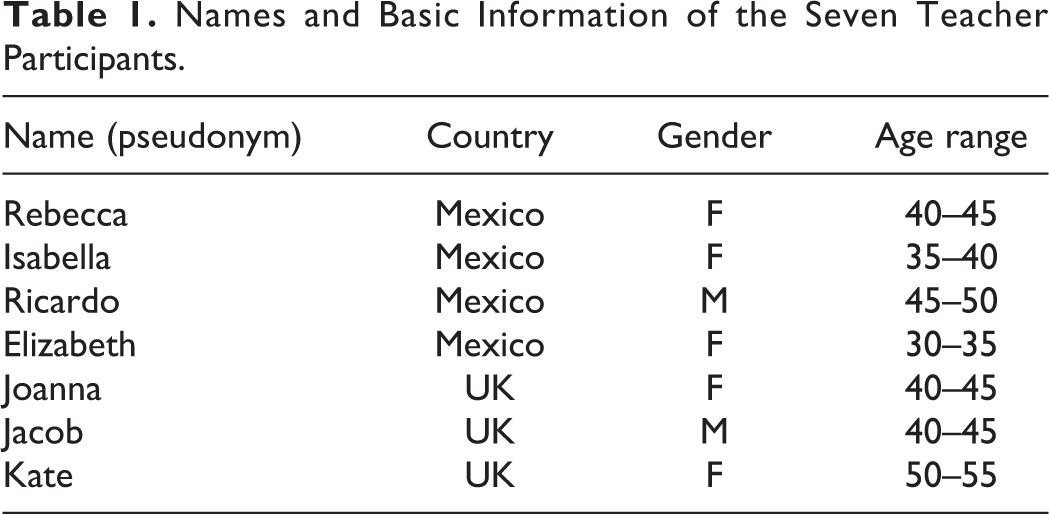
This article examines the experiences of seven English language teachers from two separate research studies. Four were Mexican university teachers, while the other three were UK teachers working in a private language institute. Some basic information about the participants is provided in Table 1 (real names have been replaced by pseudonyms).
Names and Basic Information of the Seven Teacher Participants.
The aim of both studies was to explore how these teachers’ beliefs about language teaching had evolved over time, and how they felt their beliefs related to their practices (see Bremner, 2017, for the Mexican study; the UK study is currently unpublished).
I had initially planned to ask participants to produce timelines “there and then,” using large sheets of paper and colored pens (as suggested by Adriansen, 2012). However, as mentioned in the Introduction, the reaction of Rebecca, the first participant in the Mexican study, made me seriously reconsider whether participants would be able to produce a detailed timeline in “one sitting.” With this in mind, I asked participants if they would like to take the timelines home and finish them in their own time; all agreed. In the UK study, which took place a year after the Mexican one, I did not give participants the option to do it “there and then,” given that, by this point, I was exploring the potential benefits of the “take-home” timeline in more detail.
The teachers certainly did “take their time” when producing their timelines; indeed, it took them three to eight weeks to complete them. However, I was pleasantly surprised with the detail and quality of the timelines; it was clear that they had dedicated a lot of time and effort toward them. Each timeline was different; some were longer and more detailed than others; four were produced by hand while three were produced using a computer. With the participant’s permission, I have provided an example of one of the timelines (that of Rebecca) in Figure 1. The specific details are not important for the purposes of this article, but I have included it to illustrate how organized and detailed the timelines were.

Rebecca's Timeline.
After receiving the timelines, I organized a second interview (45–75 minutes) with participants in order for them to talk me through what they had included on them. These interviews involved starting at the beginning at the timeline and proceeding chronologically onward, discussing certain key events and asking additional questions when they emerged. As highlighted by Adriansen (2012), Sheridan et al. (2011) and others, the timelines proved very useful in providing an order and structure to the interview. Indeed, when we did go off on certain tangents, we were always able to “jump back” into the story by focusing our attention toward key points on the timeline.
After completing the main process of data collection, I organized a final set of interviews (15–30 minutes) in order to explore the participants’ experiences of creating their timelines at home. The interviews were semi-structured, and I tried to keep them reasonably flexible in order to allow the possibility for new ideas to emerge. However, I made sure to cover the following key questions: What were your experiences of the timeline activity in general? What were the advantages and/or disadvantages of the timeline, as opposed to just the interview? What were the advantages and/or disadvantages of producing the timeline at home, as opposed to producing it “there and then” with the researcher?
Given my experiences and reading on the potential value of giving participants extra time to process their thoughts, I decided to send these three questions to the participants several days before the interview. It did not occur to me to ask participants whether they had, in fact, spent time reflecting on the questions, and this would have been useful information to gather, given the study’s focus on increased time.
A key limitation of the study was that participants were asked to evaluate methods that they had not personally been involved in. Indeed, one might argue that participants might struggle to answer questions 2 and 3 above, as they had not taken part in just an interview, and had not taken part in just a “there and then” timeline. Therefore, the perspectives gleaned from the research relied on participants a) predicting how an alternative method might have been; and b) drawing on their own experiences of methods they had been involved in (such as time-limited interviews they may have been involved in previously). This limitation was difficult to reconcile, as participants’ perspectives may be significantly altered by taking part in the research itself (Koelsch, 2013). Future research could explore the experiences of both the “there and then” and the “take-home” timelines using a larger sample of participants.
After collecting the data, each recording was transcribed and analyzed using the qualitative data analysis software NVivo. The data were analyzed thematically. The process used for analyzing the data was predominately inductive, given that I did not create any pre-established categories and instead allowed new themes to emerge from the data. Despite this, it would be naïve to suggest that the analysis was entirely inductive, as I was bound to have certain pre-conceived notions and expectations in my mind, given my reading around the subject and my personal interest in this area.
One way of maximizing the trustworthiness of the study was “member checking,” that is, to give each of the participants the chance to read the transcript and make changes or additions. No changes were reported by any of the seven participants. As with my previous research (Bremner, 2017), it was unclear whether this was due to genuine satisfaction with the quality of the data, or other factors such as lack of time or a reluctance to discuss potential issues with the researcher.
One of the difficulties with thematic analysis is that themes are rarely “neat” and unequivocal. Indeed, in this study, there was a great deal of overlap between themes. For this reason, in the following section, I present the findings in continuous “essay” form. I have included several direct quotations from the participants, in order to ensure that the participants’ voices are clearly represented. I also include excerpts of my own questions and interactions, so that my involvement in the interview process (including any possible biases or pre-conceived notions) are made as transparent as possible. However, given the limitations of space in this article, it has not always been possible to do justice to the specific nuances of each participant-researcher interaction.
Findings and Discussion
What Can a Timeline Offer, That an Interview May Not?
In this first sub-section of the findings, I discuss participants’ perceptions of what specifically the timelines offered that life history interviews may have not. As mentioned in the previous section, this may have been a difficult question for the participants to answer, given that they had not been involved directly in both methods. However, there was a clear overall consensus that the timelines were more effective than interviews would have been.
The main point highlighted by the participants was that the visual aspect of the timelines had helped them to organize and structure their ideas, even if, in the case of Elizabeth, they were not totally sure why this was the case:
What do you think it was about that activity that made it helpful?
I don’t know, maybe it was about writing, or drawing, this onto the years, and well I don’t know exactly, but how to explain to you? Maybe because I could write, like, in these periods, certain points, I could analyze the teaching process, the way it was in some years, and then how it was different in other ones
And the timeline, was it because on the timeline you could visually see those chronological periods?
Exactly, yeah, that’s what I wanted to say, I could see on the timeline, and I was like, having an image of the process
So maybe it helped you, to kind of compartmentalize the different stages into chronological [periods], and then talk about them separately?
Yes, it was helpful in that way, you can visualize it in that way […]
And why does the visual help you?
Why? I don’t know exactly why.
Isabella also highlighted that the visual aspect of the timelines had helped her remember key details:
What do you think the timelines give you that just an interview doesn’t?
[…] like you said, it’s a trajectory, you know, where we were, and how we’ve modified and improved through the years, through experience
And is that not possible with the interviews?
Maybe not as much. You know, in the interview, we talk about it, and that’s it, and maybe we forget, but actually writing it down kind of makes us remember it more, actually seeing it.
The idea of physically writing something down was also emphasized by Jacob:
The actual physical process of writing something down, I think, really encourages you to think more methodically I suppose.
Indeed, although recognizing that an interview may have been possible, Jacob emphasized that the written timelines had helped him “crystallize” some of his memories:
I think the timeline is very helpful to actually write down dates, to crystallize those dates. […] I think, of course it’s possible to do so [in an interview], but I think [a timeline] is more comprehensive, more thorough.
The idea of structure and organization to enhance memory recall is supported by the cognitive science literature. As discussed in the literature review, people store a much greater range of information than they can retrieve at any given point, but certain memories may be unlocked when participants encounter particular prompts or cues (Baddeley, 2014). Because of this, (re)establishing connections between memories is vital in memory recall (Reisberg, 2016). In the case of the timeline activity, it would seem that imposing a structure to the participants’ thought processes may have unlocked a series of retrieval cues, helping participants not only to recall key details, but also to help them make further links to different details. Kate, for example, suggested that the timeline may have helped her to unearth memories or ideas that may not have emerged in an interview:
What do you think the written aspect of the timeline contributes to this process?
I don’t know […] I mean I’ve written something down and I think “oh that’s quite interesting, I forgot I’d done that,” so maybe actual thinking about it I would have said it [in an interview], but actually, like you said, you’ve forced us to think about obstacles, think about this, so you give all different topics. I might have not talked about that if I was just chatting to you. […] I think [the timeline] just triggered another thought or another reflex or another memory; because you have to write this down, you get everything that’s superficial, and then you think, “hang on, what’s that?” and then if you think about it again, “oh, that’s that,” so it might add another layer to it perhaps.
As Jacob expressed, the notion of increasing potential memory connections may also be possible in an interview. However, as Rebecca expressed, an interview is an inherently “messy” affair:
So, from your perspective, do you think that the timelines were useful? Do you think they offered anything different from just the interview?
I think [timelines are] a very useful tool, when you’re trying to graphically see the process, that process of change. […] I think it’s different from the interview, because in the interview you go forwards and backward, you know, it’s more like messy, the process of the findings, the putting information there. And when you use a timeline it forces, well no, it guides you to work in periods of time. I find it easier to deal with the information, I think, when you do it like that.
The experiences of the seven participants add further support to the argument that timelines may enhance life history research. In particular, the notion that timelines may add extra “layers” of experience has been mentioned in several other timeline-based studies (Adriansen, 2012; Bagnoli, 2009; Sheridan et al., 2011; among others). In the following section, I focus more specifically on the take-home element; that is to say, the role that increased time may have played in participants producing their timelines.
What Can a Take-Home Timeline Offer, That a “There and Then” Timeline May Not?
Although the participants did not experience both a “there and then” and a “take-home” timeline, their overall opinion was that producing their timelines at home was more useful than would have been possible if they had created them immediately. Rebecca, for example, was adamant that she could not have produced her timeline straight away, as she needed time to “digest” the instructions:
I definitely couldn’t do it at that very moment […] I think I needed time to digest the questions, and then to actually write what I thought […] I couldn’t have done it there, definitely. And it wouldn’t have been the same thing.
Ricardo also felt that he benefited from being able to produce the timeline in his own time:
Personally, I think it was better the way we did it. […] If we had done this maybe on paper in that moment, I wouldn’t have done as much, or I wouldn’t have thought as deeply. […]
So do you think that it was really necessary for you to take it home and to have that time?
Yeah, I think that if we hadn’t had that opportunity, maybe we wouldn’t have had enough time to think and organize our ideas.
Isabella provided a similar response, expressing clearly that she needed time to do justice to her timeline:
What my own time did, it made me think, you know, I had the opportunity to think and pause and figure out what I wanted to write. […] You know, I’m very slow! So I was probably trying to remember everything and figure out what was going on […] I had to think before I typed it, it’s not like I had it all in my mind and I just typed it, you know?
The idea that Isabella’s ideas was not simply “all in her mind,” to be retrieved simply and easily, supports the evidence cited earlier from the cognitive science literature (Baddeley, 2014; Claxton, 1997). Indeed, Isabella’s case is a clear example of a life history which was not available “on demand,” but rather emerged over time as she engaged with the activity.
Joanna expressed similar experiences. Before embarking on the timeline activity, she felt that it was important to leave herself some “passive processing time” to reflect on her career. After around a week, she attempted to write a draft of her timeline. However, she then allowed herself a few spare days before returning to it to make sure she had included everything:
So the first briefing session was very much just me listening to what you wanted me to do, listening to instructions and then there was an awful lot of quite passive processing time. Every now and then this idea would flip up, “okay, I’ve got to do this timeline thing!,” but I sort of instantly accepted that I needed to process it. It wasn’t something that I could sit down and do there and then and I was very conscious of that. So I did a draft about a week before I sent you my finished timeline, because I wanted to sort of have a rough go, see how I felt about it, and I wanted to come back to it a week later and look at it again and think, “was that accurate?,” “do I still think that?,” “do I really think that?,” and then I was happy to send you the end product.
The fact that Joanna was able to go through this much more complex process of reflecting on her life history would seem to exemplify what the take-home element allows. In contrast, a “there and then” interview, while potentially more practical, misses the opportunity for this period of “passive processing time,” which, according to authors such as Claxton (1997), can be vital for complex understandings to come together in the unconscious mind.
Proponents of time-limited interviews may argue that researchers do have the opportunity to check participants’ interpretations through post-interview “member checking.” While this may be valuable (and was also used as part of the present study), it could be argued that member checking is a much more passive process, given that participants are simply given pre-prepared stimuli to comment on, as opposed to having total freedom to create their ideas. Moreover, as mentioned in the literature review, there are several reasons why participants would be reluctant to ask the researcher to change their interpretations (Goldblatt et al., 2011; Koelsch, 2013).
The specific issue of time and memory yielded some interesting perspectives from the participants. For example, Elizabeth expressed that taking the timeline home had been useful in helping her remember a wider range of details:
What do you think might be the benefits or the disadvantages of doing it the way you did it, when you took it home and did it in your own time?
Because I had the time to think about this process in the past, and make my own reflections, because maybe in front of you it would have been different. If I think I missed some details, maybe I would have missed way more, so I think it was good for my own reflection. I don’t think it would have been the same reflection in front of you.
Isabella provided a similar response, mentioning that being allowed to do the task at home helped her remember important details:
Do you think your timeline would have been as good, and as detailed, and you would have been as satisfied with it, if you had done it straight away, with me?
Probably not, because I wouldn’t have remembered everything. […] Like I said, I live day by day, I don’t even remember what I did yesterday, but if you asked me to sit down and write it down, then I’m going to think it through and jot it down.
Isabella particularly benefited from being able to look up key details from her past, many of which were retrievable from her computer:
I might have looked at my computer to look at pictures of schools and dates, because I’m terrible at dates <laughs>, I don’t even remember when I started working here <laughs> so I did that, I looked back through my files and things, to see the actual dates.
Again, findings from the cognitive science literature may explain why Isabella and others benefited from having increased time to retrieve the details. What Isabella was doing by searching for key dates in her past was essentially increasing the pool of retrieval cues that helped stimulate memory connections (Baddeley, 2014; Reisburg, 2016). While time in itself does not directly lead to the creation of such memory connections, it would appear to give participants a greater opportunity to search for them, both consciously and unconsciously.
Isabella’s computer searching was very much a conscious process, but it is to the more unconscious processes that I now turn. Several participants made reference, albeit indirectly, to unconscious thinking (such as Joanna’s “passive processing time”), but it was Kate who expressed this idea most explicitly:
The way I normally work, with anything in life, is I have an idea and think about it for a short time and then I kind of throw it away in to my subconscious, and I decide to forget about it; I don’t think about it. […] My brain cannot focus on that because it will either panic or over-think […]
After a period of around two weeks, Kate came back to the timeline (admittedly under a certain amount of pressure as we had agreed to meet a few days later), and produced her timeline in “one sitting” of around 40 minutes. However, she was quite confident with the final product, arguing that the unconscious “groundwork” had been laid:
if something’s too big, or I can’t cope, or I can’t make a decision, then I won’t make a decision until the last minute and then I will go with my gut, so it’s either throw it away and let it work it out, or go with my gut instinct. I need the time pressure. […] So then I did it, within about 40 minutes, but the groundwork was already there from the two weeks before.
Kate’s process would seem to support the arguments made by Claxton (1997), given that she left her unconscious mind to digest the task, but was able to produce her timeline after she had had time to process it. Given her tendency to work well under time pressure, it is unclear the extent to which she would have been able to produce the same timeline under time-limited conditions. Indeed, as mentioned earlier, a limitation of this research was that participants were only exposed to the take-home method and did not have the chance to compare the experiences of a time-limited interview.
Jacob’s perspectives are quite illuminating here. Jacob suggested that he could have produced a timeline “there and then,” given that he felt he had quite a good memory and was quite a self-analytical person. However, he highlighted that different people may need more time:
I think if you had said to us, I need you, under exam conditions, to present this by this time tomorrow, or by the end of the day, it would be possible to do so because it’s quite clear in my head. […] The interesting point is, of course, what does that additional amount of time give you? […] I think it would be a bit rushed in a day, to go back over your career in a day, because you do need the opportunity to mull over certain things, so perhaps it wouldn’t be so crystal clear. […] But I could have produced it in a day
And how different do you think it would have been?
Yes, that’s a good question, how different would it have been? […] I mean things did come up, […] little things came up which perhaps hadn’t come up immediately, so perhaps there would be aspects that you would add in a process of a few days. […] But I think it is a process which all depends on the sort of person you are, the way you think about your career, and the way you analyze things. I’m sure there are some people who don’t think so much about the way they do things and the way things can change and evolve, and I think people like that would probably need longer than that, certainly longer than a day.
As Jacob highlights, the effectiveness of the take-home aspect may very well depend on the individual personality of the participants. Rebecca, for example, highlighted that it was part of her individual “process”:
And did you talk to anyone else about it, or was it just kind of your own process?
No, no, it was only me, I mean, I didn’t talk about it to anyone. The thing is that I decided to do it like that because that’s the way I process things, I mean that’s the way I learn.
Personally, I found it particularly interesting that interaction was not considered important by the participants of the study; firstly, given that interaction between participants and the researcher had been emphasized several times in the literature (Adriansen, 2012; Sheridan et al., 2011), and secondly, because I felt that if I had been asked to carry out my own timeline, I may have preferred a more immediate, collaborative process. During our interview, I expressed these views to Rebecca:
That’s interesting that you say it’s the way you learn, because my original idea about having that on paper, and “there and then,” was probably related to the way I learn, because I’m very kind of a “there and then” person I think. So my idea was “ok, we’ll just kind of write something,” and through the actual writing, and maybe discussing with each other, we would come to a conclusion […]
Well, yeah, it’s just a different process. […] I don’t know what happened with your other participants in your study, but I couldn’t have done it right there, I mean I just couldn’t have done it.
While the experiences of the seven participants of this study may not be applicable to participants in other studies, their perspectives suggest that some people may be less positively inclined toward an interactive reflective process, and would benefit more from a more individual, introspective process.
Conclusion
The perspectives of the participants in this study provide further support to the argument that increased time (in this case through the “take-home” timeline) may help participants retrieve, organize and express complex ideas, thus potentially increasing the accuracy and richness of their narratives. This would seem especially relevant when asking participants to consider particularly extensive or complex life histories, as was the case with the seven teachers in this study.
It should be recognized that the take-home element will not appropriate for all studies. For example, although increased time may be important when exploring complex issues such as teachers’ beliefs and practices over time, less complex topics may achieve their aims through more time-limited methods. In addition, this method inevitably relies on the motivation and time available to the participants. In this study, participants chose to take part, were extremely motivated, and were allowed as much time as they needed. Clearly, this will not be possible in all studies. Moreover, the take-home timeline may not be for all personalities; some people (including, I dare say, myself) might prefer a more immediate, collaborative environment, in which timelines are constructed through real-time interaction with the researcher.
A criticism that may be aimed at this paper is that, by making links to the cognitive science literature, there may be seen to be an underlying assumption that life history research seeks an absolute “truth.” However, I have not argued that timelines “solve” issues of memory, of truth, of representation in narrative interviews. Research aiming to explore participants’ perceptions of their beliefs and identify are dynamic, subject processes, and the process of “extracting” or representing such reflections will always be an approximation of reality (Randall & Phoenix, 2009).
However, certain phenomena are less controversial. For example, the date in which one studied a course is factual information, which can be accessed by activating a greater number of memory connections in the brain. And it is the spreading, the “flowering,” if you like, of such memory connections that can lead to greater recall of key events, as well as the complex connections between ideas. The reflections produced in participants’ own time are still approximations, but they may be closer, richer approximations than those produced in time-limited environments.
The notion that “People produce richer accounts when they have more time” may seem like common sense. If this is the case, one might ask why so few timeline-based studies have taken this fundamental observation into account. Allowing participants time to create their timelines at home is certainly not a “magic bullet,” but the drawbacks of doing so would seem minimal, and the potential advantages quite compelling. Further research could use larger samples to compare the richness and accuracy of timelines created at home as opposed to those created “there and then,” in order to further support or challenge the arguments presented in this study.
Footnotes
Acknowledgments
I would like to thank Professor Linda La Velle for her support and guidance throughout the process of writing and editing this article. I would also like to thank the three anonymous reviewers, whose insightful comments helped me make significant improvements to earlier versions of this paper.
Declaration of Conflicting Interests
The author(s) declared no potential conflicts of interest with respect to the research, authorship, and/or publication of this article.
Funding
The author(s) received no financial support for the research, authorship, and/or publication of this article.
