




Abstract
This paper lies at the intersection of discussions surrounding digitally mediated research methods and transnational research projects. It contributes to the current methodological debate surrounding online interviewing by focusing on tensions and affordances involved in Skype-to-phone interviewing in a transnational research context. While the Skype-to-phone facility does indeed increase further access to global participants, complex power hierarchies and ethical concerns continue to exist in relation to technological access/infrastructure, research governance regimes in different places and interpersonal research relations. We, therefore, propose that online researchers involved in transnational research projects using Skype methods move towards consideration of multiple competing constituencies and diverse social and spatial connectivities and power hierarchies in which they are researching. These social differences and spatial registers are not swept away through research conducted in a uniform virtual digital environment; rather transnational researchers must make explicit the multiple place-based contexts of their digitally mediated research, as they shape the research process in distinct ways. Thus, specific consideration must be given to ethical concerns that emanate from transnational online research.
Introduction
There has been a recent growing body of work examining the use of online interviews in digitally mediated qualitative research (O’Connor and Madge, 2016; James and Busher, 2009), with a particular focus on Skype as a medium for synchronous interviewing (Adams-Hutcheson and Longhurst, 2017; Aupers et al., 2018; Deakin and Wakefield, 2014; Longhurst, 2016). While the many benefits and drawbacks of online interviews in general, and Skype in particular, have been debated, discussion tends to revolve around research undertaken between places in the global North (Madge, 2010) and focus on practicalities and technicalities (Weller, 2017). There is less critical appreciation of how the contours of Skype interviewing may alter (and remain the same) when working in a transnational context (i.e. between institutions, researchers and participants located across countries in both global North and global South). This is surprising given that Skype interviewing has the apparent ability to mitigate distance and enable communication with people from diverse geographic locations, of particular importance in Covid times (Nind et al., 2021). Similarly, although transnational research methodology has been investigated in relation to biographical research (Ruokonen-Engler and Siouti, 2016), meta-ethnography (Pilkington, 2018) and the role of the researcher in the field of ‘transnational knowledge production’ (Shinozaki, 2012), the complexities of engaging in transnational research via Skype interviewing has received little attention.
This paper, therefore, aims to shed light on the complex power dynamics and ethical issues arising from Skype interviewing during the ‘International Distance Education and African Students’ (IDEAS) project. This transnational research project examined International Distance Education (IDE) provided by the University of South Africa (UNISA) to students located throughout the African continent. It employed Skype interviewing as a methodological tool to understand the experiences of IDE students from Nigeria, Namibia, South Africa, and Zimbabwe studying with UNISA, South Africa (SA). There were four interviewers over the course of the project who conducted these interviews: two lived and interviewed from SA (one South-African and one Zimbabwean) and two who lived and interviewed from the UK (one Turkish and one Dutch/Norwegian, with some familiarity of the South African context). The interviews were predominately conducted via Skype-to-phone and lasted between 30 and 90 minutes. This paper draws on experiences and reflections from the IDEAS project to contribute to the methodological literature surrounding digitally mediated transnational research by focusing on the tensions and affordances involved in these Skype-to-phone interviews.
Skype interviewing and transnational research
Online interviews can be conducted synchronously (real-time) or asynchronously (non-real time). They may involve audio, textual exchanges via emails, discussion forums or bulletin boards or video conferencing, including Skype (James and Busher, 2015). Focusing on Skype interviewing in particular, three key issues have been highlighted in the literature. First, the ability of Skype interviewing to internationalise research. As Deakin and Wakefield (2014: 603) suggest, Skype interviewing can bridge the geographical divide that exists between researcher and participant, thus ‘facilitating access to global research participants’. Aupers et al. (2018: 6) concur, stating there are practical advantages of using Skype which include constructing ‘a diverse and international sample with relative ease’. Similarly, Lo Lacono et al. (2016: 1) argue that Voice over Internet Protocol (VoIP) technologies (such as Skype and FaceTime) provide the capacity to interview research participants using voice and video via a synchronous (real-time) connection, thus opening up ‘new possibilities by allowing us to contact participants worldwide in a time efficient and financially affordable manner, thus increasing the variety of our samples’. This ability to connect globally engenders a consciousness that time and space of everyday life in different cultures may impact the globalised space occupied by researchers and participants during an online interview.
The second issue concerns ethics and power dynamics. Quartiroli et al. (2017) argue that using Skype interviewing as a mediating tool disparages apparent power differentials that can exist between researchers and their participants. Their research suggests that interviewees’ ability to be interviewed from a space they are comfortable with encourages willingness to engage in a conversation that would otherwise be limited in an environment where structured hierarchies of power are embedded. Skype interviewing also makes it easier for participants to withdraw from the interview process at any time by simply signing out of the call (Janghorban et al., 2014). This arguably allows participants to feel more in control of the interview process than in a face-to-face situation, where withdrawal can potentially be more complicated. For instance, Weller (2017: 623) found that ‘the ordinariness’ of the online encounter also aided disclosure, with many of her participants believing they were just as likely to reveal details of their lives via internet interviews as in a face-to-face interview situation. Weller (2017: 623) also noted that the ‘informality’ of online communication nurtured a sense of ease during the interview, with the physical absence of the researcher reducing participants’ perceptions of risk of exposure or embarrassment. Such advantages all potentially ‘democratise’ the research process. Skype as a medium for interviewing can also potentially abate some ethical concerns around anonymity and confidentiality. For example, Sipes et al. (2019) suggest that interviewees are able to participate at will through creating fake profiles they may delete in future. That said, issues around gaining consent in an online environment can trigger complexities due to anonymity and the copyright of data (Barnes et al., 2015; Buchanan and Zimmer, 2012), as well as challenges of identity authenticity (James and Busher, 2015; Lo Lacono et al., 2016).
The third strand of literature focuses on rapport. Deakin and Wakefield (2014) and Seitz (2016) underscore prior exchange of emails and communication before the interview can build a more responsive interviewing process and foster better rapport whereas Barratt (2012) draws attention to participants’ comfort and ease with online communication and Hanna (2012) suggests that participants may open up more when they remain in a safe of environment of their own choice. However, Adams-Hutcheson and Longhurst (2017: 149–153) have discussed the emotional and affectual dimensions of Skype interviews, proposing that ‘moments of disjuncture’ can arise when researchers and participants are not able ‘to share a range of senses (touch, smell and taste)’, which can help ease interview interactions, as occurs in a face-to-face situation. This problem of lack of intimacy may be exacerbated when technical issues arise, such as a screen freezing, loss of connection, dropped calls or inability to read body language and nonverbal cues, which can further disrupt the flow of conversation (Seitz, 2016).
So far, however, the above examples cited predominately focus on research conducted via the Skype-to-Skype medium via laptops/computers. As yet there has been little discussion of the Skype-to-phone format, where the researcher contacts the participant via VoIP and the participant responds via a mobile phone. This is a noteworthy absence since Johnson (2013) views the relative global increase in mobile phone usage as having a positive influence on researchers’ ability to contact participants and conduct research. She proposes that the Skype-to-phone call option has the potential to expand interviews with participants who do not have access to fixed broadband connectivity, particularly in the African continent. Furthermore, most of the literature on Skype interviewing is based on research between participants and researchers in the global North (e.g. USA, UK, Italy, New Zealand). What happens when the interviewing vectors range transcontinentally, between researchers and participants located in nations of varying levels of ‘development’ and different degrees of access to internet connectivity and mobile phone ownership? (See Table 1 which summarises some of these differences for key countries discussed in this paper). What disjunctures arise when regular high- speed internet connectivity and ubiquitous access to internet-enabled mobile devices cannot be assumed or when ‘one’s place in the world’ in terms of location, (online/digital) culture, institutional bureaucracies, social status and geopolitical position vary greatly between researcher and participant? There is a need to explore whether the potentials and limitations of Skype interviewing noted above extend to research conducted across transnational boundaries via the Skype-to-phone facility, or whether any new issues may arise.
Internet connectivity and measures of ‘development’ in case study countries.
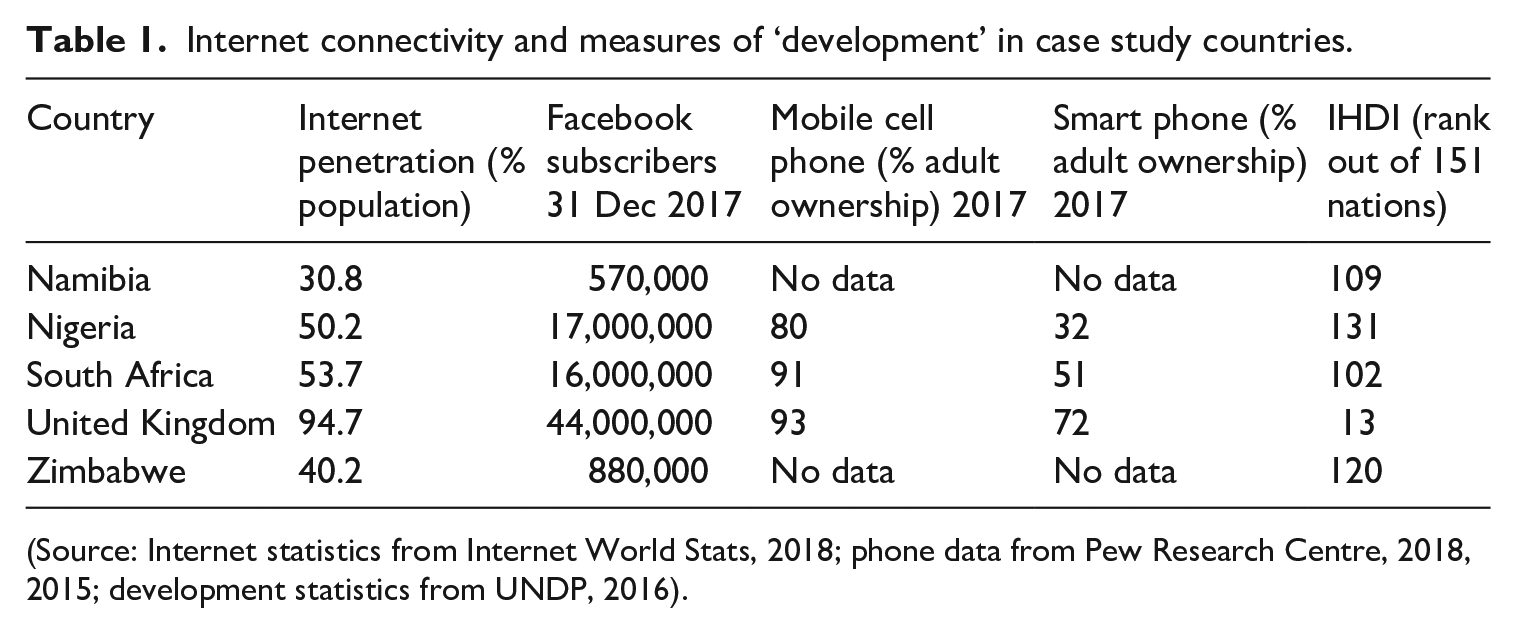
(Source: Internet statistics from Internet World Stats, 2018; phone data from Pew Research Centre, 2018, 2015; development statistics from UNDP, 2016).
This lack of discussion surrounding Skype-to-phone interviewing in a transnational context is surprising given there is wide recognition that transnational research is often multidimensional and multisited in terms of social and spatial categories (Barglowski et al., 2015). One stream of methodological discussion with respect to transnational research has focused on biographical work, particularly on discussions surrounding reflexivity, positionality and intersectionality (Osanami Törngren and Ngeh, 2018; Ruokonen-Engler and Siouti, 2016). This body of work underlines the importance of reflecting one’s own positionality involved in the entanglements of the transnational research situation involving multilingual and multiply positioned researchers and interviewees.
Other methodological discussion surrounding transnational research conducted between global North and global South has revolved around face-to-face qualitative interviewing, debating issues associated with cross-language research (Abdulai and Mohammed, 2017), elite interviews in different institutional settings (Morse, 2018), the conditions that might bring the development of intimacy to the fore during the interview process (Roer-Strier and Sands, 2015), the dilemmas of balancing consent requirements with culturally embedded responsibilities (Morrell et al., 2012) and the ethical concerns of working across vectors of marginality/privilege (Theron, 2016). These papers, in various ways, start to unpack the complexities of the transnational interview process. So far, however, there has been little discussion of how such issues of transnational research might be played out during digitally mediated research encounters such as the Skype-to-phone interviewing situation, where researchers and interviewees may belong to culturally and politically different geographical locations and varying social and technological contexts but are brought together through the shared digital environment. Such issues are investigated in this paper through the lens of the IDEAS project, which is outlined below.
The IDEAS project
The ‘International Distance Education and African Students’ (IDEAS) project examined International Distance Education (IDE) provided by the University of South Africa (UNISA) to students located throughout the African continent (Madge et al., 2019; Mittelmeier et al., 2020; Raghuram et al., 2020). UNISA has been described as ‘a mega university, and the only dedicated distance education provider in the African continent’ (Letseka et al., 2018: 122). The broad premise of the project was to investigate whether IDE from UNISA provided a vehicle for achieving sustainable development, particularly equitable access to quality education. IDEAS was a multi-institutional, transcontinental project (with 10 researchers, located at UNISA in SA and at the Open University and University of Leicester in the UK) involving an interdisciplinary team (covering the fields of education, geography and migration studies).
The IDEAS project aimed to understand the extent that UNISA, as an IDE Institution, provided quality and equitable access to IDE for students across Africa. Table 2 illustrates UNISA enrolments by nationality, indicating the numerical significance of international students from the Southern African Development Community (SADC) countries (20,726 students in 2016) and elsewhere in Africa (2956 students in 2016); thus, utilising Skype interviews pragmatically offered the opportunity to access the participants located in diverse countries across the continent.
UNISA student enrolments by nationality (2014–2016).
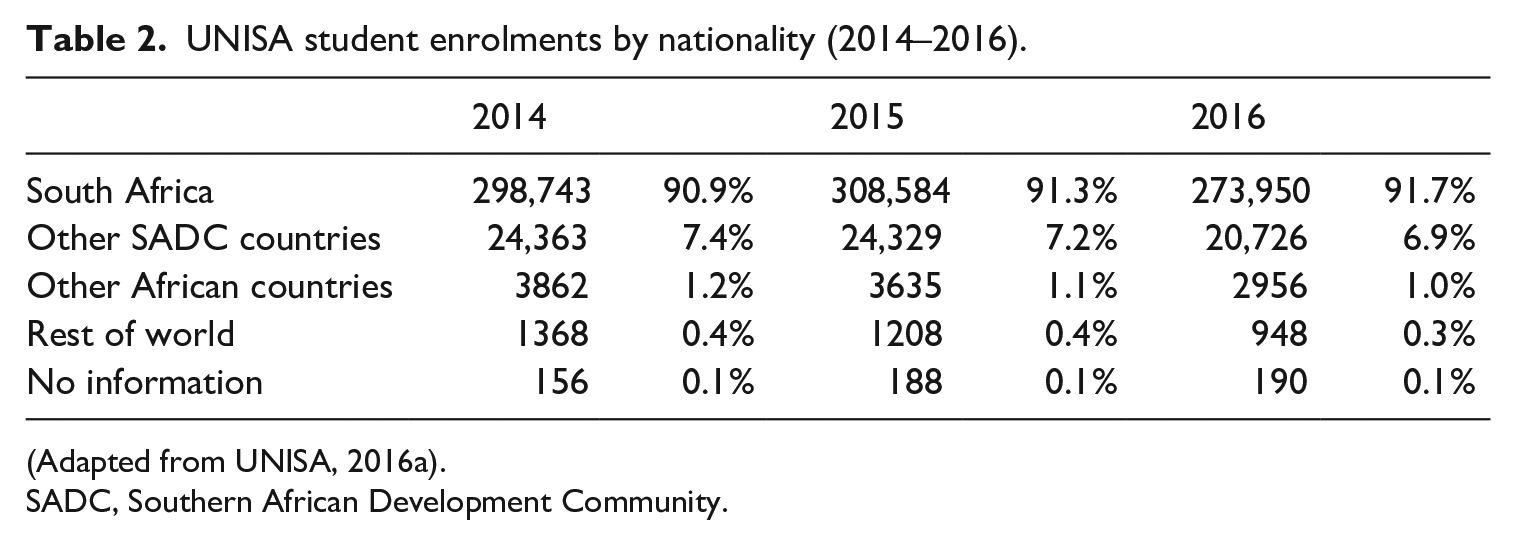
(Adapted from UNISA, 2016a).
SADC, Southern African Development Community.
The project design involved multiple mixed methods: large-scale data analytics of student data, an extensive online questionnaire survey with 1295 students and 160 one-to-one in-depth Skype interviews with IDE students. This paper analyses the 160 Skype interviews with students studying at UNISA but residing in different parts of Africa. Since the UNISA students were spread out across countries, the rationale for using Skype-to-phone interviews was to reach students regardless of their location and to ensure that the cost of participating would be carried by the researchers. The interview data were analyzed in NVivo through a combination of deductive codes based on the literature review and inductive codes emerging from the data.
The thrust of this paper is thus to examine transnational research through the lens of Skype-to-phone interviewing and discuss some of the methodological and ethical complexities of geographically dispersed digitally-mediated research. Below we outline three important issues that have arisen when using Skype-to-phone interviews in the IDEAS transnational research project, with an aim to move ‘beyond the recent empiricist emphasis on the pragmatic’ (Weller, 2017: 614). First, we discuss the decision to use the Skype-to-phone interview format and the benefits and limitations of this particular Skype method.
Technological affordances and limitations of Skype-to-phone interviews
Increased internet connectivity and access to mobile phones have enabled greater access to a wider pool of global research participants, thus increasing the geographical diversity of samples (Deakin and Wakefield, 2014; Johnson, 2013). However, disparity in the provision of, and access to, ubiquitous internet connection, stable broadband connectivity and up-to-date mobile devices may also lead to challenges when conducting Skype interviews in certain localities. One such difficulty is the heightened need to be sensitive to barriers such as access to the internet, computer devices, particular software or technological infrastructure, in order to avoid excluding some students from the research. For example, in terms of internet access, data reveal internet penetration as a percentage of the population to be 54% in SA, 50% in Nigeria, 40% in Zimbabwe and 31% in Namibia (Internet World Stats, 2018, see Table 1). There was, therefore, concern that some participants might be excluded from the research due to lack of technical infrastructure, the costs associated with broadband and phone packages or the inability to maintain a stable internet connection for the duration of a detailed Skype interview. To overcome this problem, we offered two different interview methods to participants: either Skype-to-Skype interviews (online interviews which would consume data on both sides) or Skype-to-phone interviews (the cost of which is carried by the researcher making the call). The aim of offering the Skype-to-phone option was to address issues arising from the high cost of data being borne by the participant during Skype internet interviews, particularly owing to difficulties in accessing fixed internet connectivity in some localities in some African nations (Friederici et al., 2017). By contrast, the rapid growth in access and use of mobile cell phones throughout Africa (Johnson, 2013) suggested that Skype-to-phone interviews would be a popular option. For example, ownership of cell phones in SA has increased to 91% of the adult population in 2017 (Pew Research Centre, 2015, 2018 and see Table 1). This was the case: of the 160 interviews conducted, 138 were Skype-to-phone interviews which provided the cost-free option to student participants.
Skype-to-phone interviews proved to be a very useful method to bridge the divide between the researchers’ access to ubiquitous internet infrastructure and resources and the more limited access of many of the participants. We were also able to contact participants living in rural areas with more limited fixed internet availability, via mobile cell phones. Skype-to-phone interviews also provided an inherently flexible means of interviewing participants with multiple commitments at a time and place of their choosing. This was important since most of the IDE student participants were in full-time/part-time employment and/or had familial/care responsibilities. Moreover, the instantaneous nature of the Skype-to-phone format also reduced travel and cost commitments that would have been required in a face-to-face interviewing situation. Thus, the flexibility and cost-free nature of the Skype-to-phone interview format provided affordances which aided access to a wide range of participants, as well as facilitating communication flows between interviewers located in the UK and SA, and participants located in SA, Namibia, Nigeria and Zimbabwe.
However, the Skype-to-phone interviews were not without problems. The question of whose experiences and whose voices were heard was still a pertinent issue as we were only able to interview those who were able to access their emails to read our initial invitation to participate in the research or those who had the necessary time and resources (such as mobile phones, internet access or a PC) to do the interview. Therefore, while the cost-free option of the Skype-to-phone interview format was certainly useful, we must concede that there may still have been potential student interviewees who could not participate in the study due to their limited access to mobile phone networks to accommodate the call, one major limitation of this research method. Moreover, the Skype-to-phone interviews were often hampered by glitches, lags, background noise and dropped connections. In some instances, the implication of these technological shortcomings extended beyond the interview. In one particular instance, in an interview between the UK and Zimbabwe, a great deal of white noise was experienced which made it difficult to elicit a meaningful flowing conversation. This challenge continued into transcribing the almost inaudible interview, resulting in some data loss. As Roberts and Allen (2015) argue, this can affect data quality, resulting in inaccurate conclusions being drawn. One of the strategies employed to bridge this ‘audible divide’ was to speak slowly with effective-turn taking, which helped both the interviewer and interviewee grasp what was being said, aiding transcription and data integrity.
Similarly, in a Skype-to-phone interview with a Namibian interviewee, the internet connection dropped three times and in another interview with a student from SA, due to poor network coverage, we experienced glitches, background noise and a dropped line. These concerns raise questions of whether an interview can continue with the same level of rapport and flow when such failures are experienced, which may lead to a loss of intimacy in the conversation (Seitz, 2016). For instance, in the Skype-to-phone interview with Namibia, the good rapport established between the researcher and participant in an interview that started with joking and laughter, later turned into a rush of asking and responding to questions as soon as possible to avoid another dropped-line. This created an environment in which both the researcher and participant were competing against the clock to pose and answer the questions, and this may have resulted in poorer quality data. No matter how rapport is established, the limitations of technological infrastructure may interrupt the development of a comfortable interviewing environment where the participant is willing to share their personal experiences.
Thus, while Skype-to-phone interviews did overcome problems of data costs being borne by participants and provided a flexible and cost-efficient means of interviewing a range of widely distributed participants, this digitally mediated method was still hampered with sampling and data quality issues. Limitations in the interviewing process did not, however, just revolve around technological issues; gaining informed consent also proved to be a complex process, as discussed next.
Gaining informed consent for Skype-to-phone interviews under GDPR
The General Data Protection Regulation (GDPR) was introduced in May 2018 across Europe for all individuals within the EU and EEA, the effect of which has been the introduction of more stringent rules and guidelines underlying the management of personal data collected for the purposes of research (ICO, 2018). Such legislation seeks to address concerns regarding the blurring of definitions between public versus private data in digital scenarios, which raises ethical issues around access to data and the techniques used to protect data (Lo Lacono et al., 2016). These changes in legislation have generated a range of important issues for transnational research projects (RGS, 2018), although here we focus on the implications of GDPR for obtaining informed consent for Skype-to-phone interviews. Such region-specific legislation warrants reflexivity in transnational research projects which operate across multiple locations and raises context-specific ethical dilemmas owing to the complex relations between places (Morrell et al., 2012).
In the IDEAS project, our concern regarding consent related to two distinct issues: protecting the interviewees through ensuring their understanding of the research, and their role and rights within it, and, second, abiding by legal and ethical requirements of research governance. Prior to the GDPR, informed consent for UK-based researchers was governed by the EU Directive, officially known as Directive 95/96/EC on the protection of individuals with regard to the processing of and the free movement personal data in the UK (Eur-Lex, 2019). In SA, informed consent is governed by the Protection of Personal Information (POPI) (De Bruyn, 2014). The Data Protection Directive was adopted in 1995 (Blackmer, 2016) and has since been superseded by the General Data Protection Regulation (GDPR), adopted in April 2016, becoming enforceable from 25 May 2018. Whereas Sleeboom-Faulkner and McMurray (2018) suggest that the GDPR provides social scientists an opportunity to reorganize how ethics reviews are organized in different disciplines, for our research the new GDPR requirements had more immediate implications for the process of recruiting interviewees and negotiating the process of obtaining informed consent for digitally-mediated research, as outlined below.
In the initial pre-GDPR phase of the IDEAS project, a consent form for the Skype interviews was devised that adhered to the ethical guidelines and legal regulations noted above for both the UK and SA. This consent form was then read out to each interviewee at the beginning of the interview and was recorded together with their confirmation of their understanding and agreement to participate in the research. However, once GDPR was introduced, a more comprehensive approach to consent for Skype interviews had to be developed. This included, among other adjustments, developing a more elaborate information sheet that satisfied new requirements regarding storing and sharing of data, as well as a more detailed consent form with each point stated in a separate sentence and a box to tick ‘yes’ or ‘no’ at the end (see Figure 1).
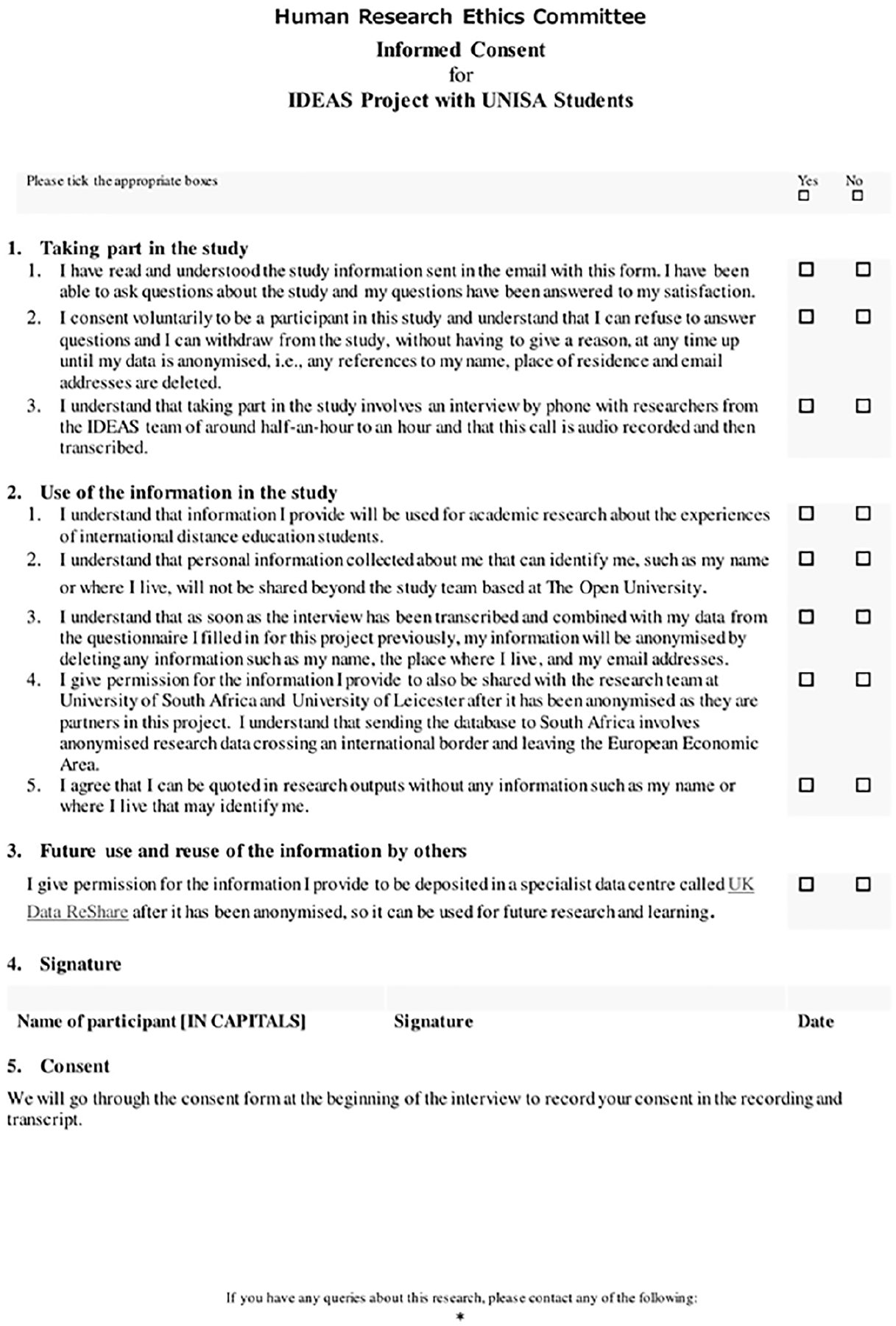
The consent form for Skype-to-phone interview (GDPR compliant).
We first sent out an email invitation to IDE students’ official university accounts inviting them to participate in Skype interviews and attaching the information sheet. Once an individual agreed to participate, we attached the new consent form and asked them to read through this document in advance of the interview. They then sent us their preferred phone number and we arranged a date to call them. When we actually undertook the Skype interview, we began with a brief introduction of ourselves to remind them about the arranged interview, which also helped us confirm that we were speaking to the correct person and to verify their identity. We then quickly moved on to start talking about the information sheet and consent form to ensure that the participants had read the attached documents and checked if they had any questions or concerns regarding the provided information. None of them had any concerns, but a few asked broader questions about the purpose of the research.
Subsequently, we explained that we needed to record the interview and their agreement to participate and moved on to read out the consent form and asked them to say ‘yes’ if they agreed and ‘no’ if they disagreed to each point. Although the interviewees complied and responded ‘yes’ to all the statements, the tone of their voices revealed that many found it tedious to listen to the lengthy form being read out over Skype after they had already agreed to participate. The challenges relating to obtaining and documenting participants’ consent at the start of the Skype interview impacted the formation of our relationship. The interviewers would often insert phrases in between the points on the consent form, such as ‘just a few more now’, ‘thank you for your patience’ after completing it, and briefly explain why the new GDPR regulations required us to spend so much time on formalities. The additional small talk after completing the consent form aimed to rekindle the relationship and counter the possible negative impacts of the mechanical reading of the form. The data from these interviews were stored on secure Open University servers, and it was explained to the participants that these data would eventually become accessible via UK data ReShare. For this reason, the researchers avoided overly sensitive issues and anonymized all data fully.
We are not contesting the value of a comprehensive process of ensuring that participants are protected and understand their rights with respect to participating in research projects. Still, the lengthy explanations and use of phrases that people in other contexts may struggle to grasp, for example, asking participants from SA to agree that the information they provide can be deposited in the UK Data ReShare data centre, is ethically problematic. The consent for the Skype-to-phone interviews that we obtained by following a rigid format developed to satisfy legal requirements in the European context did not necessarily facilitate a better understanding on our informants’ side. By asking them to agree to a more complex form of consent we may, paradoxically, have been reducing the participants’ understanding of what they were agreeing to and what the implications of their participation might have been. By implementing a European legal and sociopolitical framework that they might not have been in a position to easily grasp and certainly not contest, were we inadvertently compromising interviewees’ consent and trust in the sense that we were primarily seeking to ensure that we obtained a form of consent that fulfilled UK research governance requirements rather than placing the emphasis on an ethical responsibility to protect the interviewees?
Such power dynamics are clearly not new in the context of research in Africa (Morrell et al., 2012). Indeed, the implications of the recent GDPR legislation requiring participants to respond to a comprehensive but lengthy process of obtaining consent to fulfil the requirements of this EU legislation has made us question the power hierarchies we inevitably reproduce through the administrative practices of transnational research projects. The formal requirements surrounding GDPR-compliant informed consent suggest that global power relations continue to protect researchers in the global North rather than participants in the global South: GDPR did not effectively protect the actual data subjects in our project, as they were not EU citizens, while great efforts were made to ensure GDPR compliance which ensured our Northern-based institutions were covered in terms of legal liability. This thus demands that Southern nations involved in research partnerships must keep abreast with externally driven policy changes that may affect their citizens, especially where they are the data subjects. Furthermore, it calls for greater transparency and flexibility on the part of Northern institutions that institute such policies in cases where they affect Southern institutions and research subjects that are otherwise outside of the jurisdiction of their policies, such as was the case with the GDPR.
In addition to the complexities of gaining consent for these Skype interviews that were conducted transnationally, further difficulties arose in that the interviews were conducted via the Skype-to-phone format. For example, the process of obtaining consent became more complicated and reduced participants’ further understanding of consent, when they were conducting the interview while mobile or multitasking. In one incident, one South African participant wanted to do the interview while in taxi transit, although we offered him the opportunity to reschedule the interview. In addition to the glitches and white noise in the car, the participant was in a rush to agree to consent as he wanted to proceed with the interview questions immediately. In another case, one Namibian participant was at her workplace (a bank) and she was intermittently paying attention to the work-related tasks during the interview. This interview was interrupted by ringing phones and she was also eager to quickly proceed with the interview process and did not appear to fully engage with the consent process. These examples show that both participants were not able to concentrate on the intricacies of the consent process because they were engaging with the interview via their cell phone while ‘mobile’ and were combining the interview with other tasks. This added complications to the consent process for transnational Skype-to-phone interviews owing to the location and the interview context (Busher and James, 2015).
In a broader more topical sense, consent for Skype-to-phone interviews must require researchers involved in digitally mediated transnational research to question the potential ongoing colonial nature of research relations (Dalu et al., 2018; Morrell et al., 2012). If the participants are not given the opportunity of consent that is understood, informed and open to contest, then are we merely (re)colonising the data gathering process and enforcing colonial power structures unique to transnational research between a colonial power and a former colony (Raghuram and Madge, 2006)? Such ethical dilemmas inevitably emerge in any interview process, but take a different shape in transnational research relying on digital tools. Below we reflect on the bridges that were built, and the disruptions that occurred, during the Skype-to-phone interview conversations between the participants and the researchers, focusing in particular on issues relating to rapport and language.
Interviewer/interviewee relations: Bridges and disruptions in the interview conversation
Establishing rapport
One of the ways in which rapport can be established in transnational interviewing is through pre-engagement with participants via email, as this medium is well-suited to the task of rapport building (Hawkins, 2018). In such email exchanges during our research, some participants used emoticons, such as the monkey covering its face, when the participant was shy about English being a second language, or a smiley face after their name, or signed off using nicknames, which indicated that a sense of friendliness had been established. Emoticons were a ‘shorthand’ means of expressing emotions, helping to establish emotional connections ‘at a distance’ and therefore useful in the rapport-building process. However, such rapport-building via emails was limited where access to the internet for some participants was sporadic and costly. Therefore, the amount of pre-engagement that took place before the interview was determined by the participant’s circumstances, which did not provide a ‘level playing-field’ for the ensuing Skype interviews.
Where pre-engagement rapport building was not possible, the establishment of good rapport at the start of the Skype interview was essential in order to familiarise participant and interviewer with each other’s accents and begin to build trust with participants who might have been uneasy about being interviewed by a non-national. Since interviews were conducted via the phone, it was not possible for the interviewees to open their camera to contextualise the environment in which the interview was taking place, which might have strengthened initial rapport. Participants preferred to keep their cameras closed owing to the cost of data required for visual connectivity in the South African context. To mitigate this, connections with participants were fostered through the exchange of pleasantries such as the ‘greetings’ and ‘leavings’ at the start and end of the Skype interviews which created a sense of friendliness. Such sociality was fostered through the oral Skype-to-phone format, as the phone is an inherently sociable tool encouraging ordinary everyday conversations, arguably more so than the fixed computer/laptop screen often used for Skype-to-Skype interviews. Engaging in such ‘small talk’ or sharing insights and experiences were helpful in making a connection with interviewees. For instance, in an interview conducted by a Turkish team member, her non-African accent caught the attention of the interviewee who was interested in finding out where the interviewer was from. Upon understanding that the interviewer was Turkish, the interviewee explained issues that were peculiar to the South African context, such as writing the names of places on Skype chat in case the interviewer was not aware of them. Such exchanges were effective in beginning to build bridges between the researcher and the participant. To a certain extent, they also established ‘common ground’ that eased the interview conversation ‘at a distance’ and began to create a space for reciprocal understanding between different cultures (Lagesen, 2010). Overall, this kind of exchange and the emoticons shared through Skype text offered a flexible space where the researcher engaged with the participant in an online setting to explore and ‘write the story of their situated context’ (James and Busher, 2013: 198).
Although the aforementioned strategies were helpful in establishing some level of rapport during cross-cultural and transnational interviewing using Skype-to-phone technology, it was also vital that all interviewers (based in UK and South Africa) had had some previous familiarity with the research context. As Shah (2004) argues, familiarity with social structures and interviewee context is important to gain quality interview responses, and we would argue this is particularly the case when interviews are being conducted transnationally and digitally between spatially distant places. Cultural difference and power dynamics are not swept away in a uniform, placeless virtual Skype environment but rather cultural and political sensitivity arguably becomes even more salient in establishing rapport across distance for researchers using the Skype-to-phone interviews in a transnational research context.
An example of such power dynamics arose when some students felt adequate rapport had been established to ask for assistance from the researcher whom they saw as an ‘empowered agent’ of the university. Some students felt disempowered to deal with their own academic concerns and therefore saw the Skype interview as an opportunity to ask for assistance with course registration or administrative issues. The researchers were left with was a deep desire to help such students but with the ethical dilemma of whether they should? In the end, the researchers provided some signposting advice to appropriate services, highlighting ‘the need for “context sensitivity” and continual “reflexive adaptation” whereby educational researchers must constantly ask difficult questions about their online research practice and its legitimacy’ (Markham, 2003: 62, quoted in James and Busher, 2015: 93).
Negotiations around language
In addition to establishing rapport, negotiating transnational language issues are an important ethical consideration, especially during a Skype-to-phone interview situation, where the spoken word becomes paramount. Abdulai and Mohammed (2017) have argued that there can be difficulties for people who have English as an additional language to find shared meaning with others in that language. This is because the two parties can be speaking English, but from different cultural contexts, so meanings implied by the speaker may be lost in transmission, as the listener does not share the same contextual meaning of the words.
There was clear evidence of such language complexities playing a role in our transnational interviewing process and misunderstanding could be compounded by the synchronous nature of the Skype-to-phone interviews. For example, it is common in the South African context for locals to say ‘no’ when they in fact mean ‘yes’. An instance of this was a response a South African interviewee gave when asked if she could be recorded, ‘No, yeah’ was her response. The participant saying ‘no’ and ‘yeah’ was rather confusing for the non-African researchers (Turkish and Dutch/Norwegian), and clarification was required by asking the question a second time. Clearly, such issues can also emerge in face-to-face interviews, but researchers arguably learn much more quickly about local use of language when they are physically located in the same context as the participants, compared to when they are spatially distant and only connecting digitally through the Skype-to-phone format.
Participants in the IDEAS project were not immune to this challenge surrounding language. When conducting Skype-to-phone interviews with African students from a variety of nations, we selected English as the main language medium due to it being the language of instruction at the UNISA. This decision was made as the African continent has a very high linguistic diversity. SA, for example, has 11 official languages and a range of 31 languages other than English are the home language of UNISA students, the most numerically significant being Isizulu, North Sotho, Isixhosa, Setswana and Afrikaans English (UNISA, 2016b). Ideally, interviews would have been conducted in the first language of each participant, but this was not practically possible, so it was decided that since all programmes at UNISA are conducted in English, most of the participants would be able to converse in English. However, we concede that the use of English on the African continent is a colonial legacy the power of which was upheld through its use in this project. Participation may therefore have been limited to individuals who felt proficient to converse in English.
Second language anxiety was another issue for some participants who felt anxious about their proficiency in speaking their additional language. For instance, one of the interviewees asked in an email prior to the interview ‘Please tell the team member who's going to call to just bear with me, my English is not so good  ’. This apprehension may have been reduced if the interview had been conducted in isiZulu, the first language of the interviewee. That not being possible, the strategy we employed to try to ameliorate this difficulty was to simplify questions, speak slowly and do regular ‘concept checking’, where we repeated the answer to ensure that we had understood the interviewee’s response.
A further issue involving language in Skype-to-phone interviews revolved around accents. When both interviewer and interviewee were speaking English as a second language and were not accustomed to each other’s accents, this sometimes resulted in both asking each other to repeat their words, which interrupted the flow of the interview. Yet, not sharing the same language and culture and both speaking English as a second language was also sometimes advantageous in terms of not taking conversations for granted and often involved asking the interviewee to unpack responses in further detail that a local researcher might feel required no further explanation. However, when language issues were coupled with the skype-to-phone interviewing setting, the processes of sense-making became more complicated for the Turkish and Dutch/Norwegian researchers as non-verbal social cues are not present in audio only Skype-to-phone interviews. At this point, we consulted the African researchers in the team to double-check the tacit meanings of interview responses.
On the other hand, two of the interviewers were African researchers, thus to some extent sharing an identity, language and common experience with participants. Because these interviewers were familiar with the social context relating to racial and gender inequalities in the Southern African context, the way they ‘heard’ and ‘understood’ the experiences of the students and responded to them was not generic but place-specific and contextual. An example of this is an interview conversation, where the student used a phrase common in SA and both were able to laugh as they knew exactly what was implied and understood the joke:
[. . .] you find that if you go there in Pretoria, you ask the first person on the counter, person A says this and person B says something different
Oh, so you not getting a consensus on what’s troubling you?
exactly yes.
and how does that impact you?
I think, you know how it is in Africa, we tend to say ok ‘it is what it is’, so you kind of get used to it.
Both interviewer and interviewee laughed at this point.
This example illustrates the importance of having some shared knowledge and culture in order to understand the context in which participants are speaking. Thus, there were several ethical issues surrounding language that arose in our transnational Skype interviews. Overall, having a range of interviewees, some of whom spoke the same language as participants and could understand the local contextual meanings of that language, combined with other interviewees that were speaking English as a second language, offered a refreshing range of perspectives. As the interviewers were both located in the UK and SA, it meant that dialogue, compromise and reflection after each interview were essential in order to come up with a mediated understanding and interpretation of the interview context.
This sensitivity to context was vital during the interview process, particularly with respect to building rapport and negotiating language differences between participant and researcher. In the African continent, where the English language is a continuing legacy of colonialism, the selection of English as the language of conversation is not a politically neutral act. However, as Walcott asserts ‘The English language is nobody’s special property’: there is the ability to ‘stretch’ English beyond its spatial confines of ‘Englishness’ (c.f. Ramazani, 2001: 14–17), so different articulations of English at times acted to disrupt the flow of conversation, while at others also acted to bridge social and spatial differences between interviewer and interviewee involved in the online interviewing process.
Conclusions
This paper has explored some of the complexities of undertaking Skype-to-phone interviews in a transnational project. We have highlighted three main points. First, the importance of selecting a method that is most appropriate to suit the provision of, and access to, technical infrastructure (internet access, connectivity format, device availability) of the specific locality and the particular group of people being studied. In our research, the Skype-to-phone format was most useful as participating in an interview via a cell phone was much more affordable and more easily accessible for IDE students. We thus join Mare (2017: 659) in arguing that ‘context specific methodological dilemmas’ require ‘innovative flexibility. . . on the part of the qualitative researcher’. However, while methodological opportunities arising from mobile phone technologies require ‘innovative flexibility’, they also demand reconsideration of what constitutes ‘context’ and how political/legal powers (such as the GDPR), as well as transnational research collaboration (language issues/rapport), shape the opportunities to conduct ethically sensitive research because they themselves in turn generate new methodological dilemmas. This is precisely because technological affordances, legislative regimes, and everyday conversations are all different forms of communication (technical, political, everyday), which travel and get translated between different contexts.
Second, we have outlined how the new EU data protection regulations (GDPR) has implications for gaining informed consent for digitally mediated Skype-to-phone interviews, which can exacerbate (albeit sometimes inadvertently) global power hierarchies between researchers and participants located in different places. Roer-Strier and Sands (2015) have stressed the importance of taking account of historical and political contexts when undertaking qualitative interviewing. We would argue this is certainly the case when considering the implications of GDPR for gaining informed consent for Skype-to-phone interviews. Changing research governance regimes in Europe have implications for research conducted beyond European boundaries with participants located in various African nations. In transnational research projects, when places are relationally bound together through research partnerships, and particularly when interviews are conducted digitally across distance by VoIP, understanding and responding ethically to such differing research governance processes is paramount, but inherently complicated. Therefore, there is a need for co-production and co-development of ethical procedures with partners in such transnational projects.
Finally, we conclude that while the Skype-to-phone facility increases further access to global participants in transnational research projects, complex power hierarchies continue to exist in relation to technological access/infrastructure, research governance regimes in different places and interpersonal research relations relating to rapport and language choice. Online interviews are not conducted in uniform politically and socially ‘neutral’ digital space and, therefore, cannot be abstracted from the specific contexts in which they are employed. However, this meaning of context is complicated in the transnational Skype interviewing, due to the mismatch between the desire to select contextual specific methodologies that are attuned to place and the difficulties imposed when research is conducted across national boundaries and the wider research governance is often contextual to where the research is coming from, not going to, owing to the long-standing power hierarchies between countries and national academies in the global South and global North.
There are, therefore, tensions in adopting a methodological approach that ‘suits’ the ‘local’ place-based research context of participants (technological, language, rapport building), while having to comply with the political/legal research governance of the ‘partners’ involved in transnational research projects. While such regulatory regimes (especially those of Northern partners) are often universalised as ‘the global norm’, they too are ‘local’ and place based; European knowledge-making is just one way of knowing. So, navigating between these different contexts, especially in digitally mediated transnational research projects, raises complex ethical dilemmas for researchers. This is because in acknowledging multiple contexts in the process of creating knowledge, including variegated African contexts, it is not simply thinking about African/Western or local/global dichotomies. Rather, in order to navigate the tensions of knowledge creation, we have to move beyond simple dichotomies, as knowledge is mobile and there have been (and continue to be) multiple dynamic connections, fusions and resistances between different knowledge systems.
We, therefore, propose that researchers involved in transnational research projects using digital methods need to move towards consideration of the multiple competing constituencies and the diverse social and spatial connectivities and power hierarchies in which they are researching. These social differences and spatial registers are not swept away through research conducted in a uniform virtual environment; rather transnational researchers must make explicit the multiple place-based contexts of their digitally mediated research, as they shape the research process in distinct ways.
Footnotes
Acknowledgements
Many thanks to all the UNISA students who participated in the Skype interviews for the IDEAS study on which this paper is based. Your contribution is much appreciated. We hope we have reflected your views accurately. The IDEAS project involved an interdisciplinary international team of researchers. The authors would like to acknowledge the varied contributions of all the other team members involved in the wider project.
The data that supports the findings of this study are available via UK data ReShare
Funding
The author(s) disclosed receipt of the following financial support for the research, authorship, and/or publication of this article: The IDEAS project is funded by the Newton Grant and supported by the Economic and Social Research Council: (grant number ES/P002161/1); and the National Research Foundation of South Africa: (grant number UTSA160329161196).
Author biographies
 ).
).