




Abstract
There is a shift in university-based social research towards interdisciplinary working and collaboration with non-academic partners, which requires a reconsideration of methodological concepts and research practices. In this article, we draw on intensive collaborative action research (CAR) into public service reform to demonstrate how this ‘collaborative shift’ both challenges and creates new considerations for mainstream research approaches. We contend that the contemporary emphasis on research collaborations creates challenges for both social science researchers and non-academic partners, which require greater conceptual consideration. Researchers need to engage in distinctive, significant and ongoing relational, pragmatic and political work in multi-agency contexts. We present the concept of a ‘buffer zone’: a dynamic, contextual space and set of practices necessary to undertake participatory research within complex and changeable settings. This has implications for research management, design, funding and training.
Keywords
Introduction
Undertaking research in collaboration with others is a well-established approach in social research; however, the expectation that it should be standard practice for university-based researchers to collaborate with non-academic partners has recently taken centre stage in the UK (Flinders et al., 2016). This ‘collaborative shift’ reflects a number of pressures, including funding bodies’ preference for non-academic partners, as well as the UK Government’s objective to ‘hold universities to account for performance and value for money’ (Johnson, 2017). The Research Excellence Framework, a policy tool that governs UK research funding allocations, incentivises researchers to demonstrate the broader value of their work, notably via the inclusion of impact case studies evidencing the effect of research on society and non-academic beneficiaries (Smith et al., 2020). As such, researchers from a wide range of methodological and disciplinary backgrounds increasingly seek to collaborate with non-academic partners, many without the training of researchers grounded in participatory, community or collaborative methods. Key questions of how to create, sustain and maintain collaborations, alongside the appropriateness of traditional methodological concepts, need to move to the forefront of this transition.
A critical examination of research methods and approaches that prioritise collaboration is both necessary and timely as non-academic partners are also undergoing policy reforms, which promote collaboration and partnership working. Ansell and Gash (2008) identify a shift towards ‘collaborative governance’ in which narrow conceptions of the public sector are being superseded by a multi-actor ‘public services’ environment comprising public, private and third sector organisations, citizens, elected politicians, professional bodies and community groups. In practice therefore, potential non-academic partners operate in a dynamic environment and engage in a variety of complex collaborative and participatory arrangements subject to numerous organisational agendas. Combining the collaborative governance context and the aforementioned collaborative shift in academia generates a ‘contemporary pincer’ that reshapes academic researchers’ working context, practices, and research expectations.
Since 2011, one response to this contemporary pincer has been the creation of a set of What Works research centres. Their introduction sought to improve evidence-based decision-making during a period of national austerity with the view that ‘when finances are tight it is even more important to ensure that we invest public resources wisely’ (HM Government, 2013). By 2020 the What Works network included nine centres, covering issues such as crime, economic development, and early interventions. Some implement a positivist approach to evidence use, while others utilise interpretivist and participatory approaches (see Bristow et al., 2015). Adopting the latter approach and co-funded by the ESRC and Scottish government, What Works Scotland (WWS) committed to a collaborative action research (CAR) approach to co-research complex policy issues with multiple public service partners. This article critically examines this research to reflect on the research practicalities and methodological concepts required in the context of the ‘contemporary pincer.’
The article starts by distinguishing participatory research, action research, and collaborative research in order to clearly position the theoretical and methodological characteristics of the WWS CAR activities. A presentation of the empirical data follows, illustrating a range of research activities and themes. In the subsequent discussion section, we contend that there is a need to develop concepts that acknowledge the nature of collaborative work with multi-agency partners and present the concept of the ‘buffer zone’, a dynamic, contextual space and set of practices necessary to undertake collaborative research within contemporary, complex arrangements.
Situating collaborative action research
A range of research approaches are contained within the tradition of participatory research (Gaventa and Cornwall, 2008). In common, these seek to transform power relations by challenging conventional processes of knowledge production, while maintaining a standpoint of researching with, rather than researching on, communities (Boser, 2006). Participatory researchers always conduct research in collaboration with others, typically ‘non-academic partners’ (Bergold and Thomas, 2012), and there is increasing legitimacy for researching with public services partners (e.g. Vindrola-Padros et al., 2018). However, questions remain as to whether participatory approaches have led to more equitable power relations (Gaventa and Cornwall, 2008). Part of this participatory tradition, CAR is a form of collaborative research that foregrounds elements of action research methodology. CAR seeks to integrate collaboration, action and research to co-produce knowledge in pursuit of social change (Greenwood and Levin, 2007). We briefly unpack action research and collaborative research before outlining the approach to CAR taken in this study.
Early pioneers position action research as a participative approach to addressing real-world problems (Dickens and Watkins, 1999). Action research classically follows a reflective ‘action research cycle’, involving close exchanges with practitioners or citizens throughout the research process with an acknowledgement of experiential knowledge and reflexivity for creating change, and a close connection between objectivity and subjectivity (Cullen, 1998). Action researchers believe it is the undertaking of research that creates new social structures and relationships, and as such debate issues of positionality, ethics, influence and relational (as well as technical) research skills (e.g. Chambers, 1997; Avgitidou, 2009; Platteel et al., 2010; Locke et al., 2013). While action research raises situational challenges, such as that of asymmetrical power differentials within action research groups (Boser, 2006), much of the literature underplays the activities that enable action research cycles to begin, in the first instance, and can uphold assumptions of simple gatekeeping hierarchies (e.g. Denis and Lehoux, 2009; Dickens and Watkins, 1999).
A somewhat broader participatory tradition than action research, for Denis and Lomas (2003: S2:1), collaborative research is ‘a deliberate set of interactions and processes designed specifically to bring together those who study social problems and issues (researchers) and those who act on or within those societal problems, and issues (decision-makers, practitioners, and citizens and so on)’. Normative theories of empowerment and social change typically underpin collaborative research. Researchers often seek to bring together knowledge generation and evidence use for the purpose of social reform, whilet encouraging reflection and challenge to practitioners and researchers (e.g. Greenwood and Levin, 2007; Phillips et al., 2013).
A number of additional limitations to both collaborative and action research arise in the new context of the ‘contemporary pincer’. First, much of the literature involves researchers engaging in stable and singular organisational contexts (Jones, 2014; Silver, 2016), which is now challenged by contemporary collaborative governance contexts. Second, there are conflicts between the values of action research and traditional university value structures (Beebeejaun et al., 2015), university managerialism and understanding of research ownership and autonomy (Denis and Lehoux, 2009; Levin and Greenwood, 2008). Locke et al. (2013) pinpoint a mismatch between action research principles and standard university ethical processes, with Boser (2006) highlighting that the protocols utilised by most research institutions are inadequate for guiding the ethical challenges raised by participatory research. This range of issues beg the question of how to advance key concepts underpinning participatory approaches now that expectations of collaboration and participation are centre stage.
For WWS the answer was to adopt a CAR approach. There is no single definition or model of ‘collaborative action research’ in the literature, leaving much variation in how it is utilised and which elements feature most heavily (Dickens and Watkins, 1999). CAR aims to bring together researchers and non-academic partners to create shared understandings and actions. Variously known as a ‘collaborative learning process’ (Boezeman et al., 2014: 411) and even ‘collaborative research’ (Westling et al., 2014: 428), CAR approaches incorporate two elements: collaboration in a group and action research. Widely used as an improvement approach in educational research, the extent of collaboration in this context has been challenged (Waters-Adams, 1994) and typically educational CAR involves a solo researcher-practitioner or occurs in discrete educational settings, such as within a single school (see Bruce et al., 2011). However, collaborative governance arrangements differ considerably from these narrow contexts, and while Boezeman et al. (2014) describe the instrumentalisation of the collaborative learning process in a multi-agency environmental partnership by all parties, including the researchers, these discussions are limited to the context of a strongly institutionalised science–policy interface. As such, adopting a CAR approach in the context of multi-agency collaborations involving multiple professions and complex inter-organisational dynamics research, led us to Townsend’s (2014: 117) understanding that The ‘collaborative’ aspect of the phrase collaborative action research places an emphasis on the social, relational and interactive aspects of the conduct of action research. The distinctive features of this approach are in the mutual benefit of people, with differing but complementary knowledge, skills, responsibilities and sometimes social status, working together.
While there is a rich and varied literature on various participatory research approaches, these debates have traditionally sat at the margins of the academy (Beebeejaun et al., 2015). Furthermore, the existing literature is limited in regards to the complex issues that arise as researchers and non-academic partners operate within the context of collaborative governance. As the ‘contemporary pincer’ drives research collaborations and assumptions of participatory approaches into the mainstream, this empirical and conceptual gap needs addressing. Below we describe how CAR was operationalised in the WWS project which sought to engage with multiple agencies, professions and researchers.
Methodology: collaborative action research
Research context
Funded by the ESRC and Scottish government, What Works Scotland (WWS) was a £4 million, five-year, multi-disciplinary research collaboration between the Universities of Edinburgh and Glasgow (and nine public partners), exploring a public service reform agenda seeking to address social inequalities, improve outcomes and adapt to public spending constraints (Christie, 2011). Based on principles of partnership and cross-organisational working (see Christie, 2011), public service reform in Scotland acutely reflects the aforementioned international shift towards ‘collaborative governance’ (Ansell and Gash, 2008). This article draws specifically on the predominant research stream from the WWS programme, a range of CAR inquiries involving multiple public service partners in community planning partnerships (CPP) in four sites. Introduced in Scotland in 2003, CPPs are statutory partnerships whereby all key public (and third sector) partners must collaborate to develop and implement area plans and address local issues (see Sinclair, 2008). An integral part of CPPs is the requirement to work across traditional organisational boundaries and professional silos. This policy context, and the understanding that since 2010 ‘co-operation rather than competition has been the mantra’ (Watson, 2016: 4) for public service reform in Scotland, suggested fruitful ground for undertaking a multi-agency CAR approach.
In 2014, the initial WWS team members recruited partners via a broad open call asking senior level CPP officers to suggest inquiry topics. This call did not involve wide engagement of CPP partners or provide a detailed understanding of CAR. As such, researchers and budding practitioner-researchers in each of the four case sites subsequently explored initial topics and developed CAR activities from 2015 to 2019. There was no singular WWS CAR model, yet there were common characteristics across the 12 inquiry groups formed in the four localities, notably a shared aim to develop communicative spaces to engage with complex issues to support critical reflection and learning (see Wittmayer et al., 2014; Argyris, 2003). Congruent with Huxham (2003), the researchers worked flexibly in each locality taking account of pragmatic and contextual factors including different skills, relationships and priorities. In practice, the work involved creating and sustaining inquiry groups (combining practitioners from diverse service areas and professional backgrounds) to identify and examine ‘real-world’ questions. Each WWS researcher also conducted a range of complementary collaborative activities in each site such as workshops, methods training, bespoke research projects and evaluation support (see Brunner et al., 2018).
Data collection and analysis
Data drawn from two CPP sites provides the basis of this article. As outlined in Table 1, ‘Site One’ involved 87 practitioners engaged in three connected inquiry groups, workshops and seminars, within a structured CAR programme that sought to increase capacity, collaborative working and knowledge to tackle inequalities in a post-industrial town in East Scotland. ‘Site two’ involved over 50 practitioners participating in distinct and ‘opportunistic’ inquiry groups exploring participatory budgeting and area-based deprivation (‘Thriving Places’), in a large city in central Scotland and in complementary activities such as an evaluability assessment process (see Brunner et al., 2019). Each inquiry group incorporated public and third sector members from different organisations, departments, occupations and professional backgrounds.
Details on CAR activities in Sites One and Two.
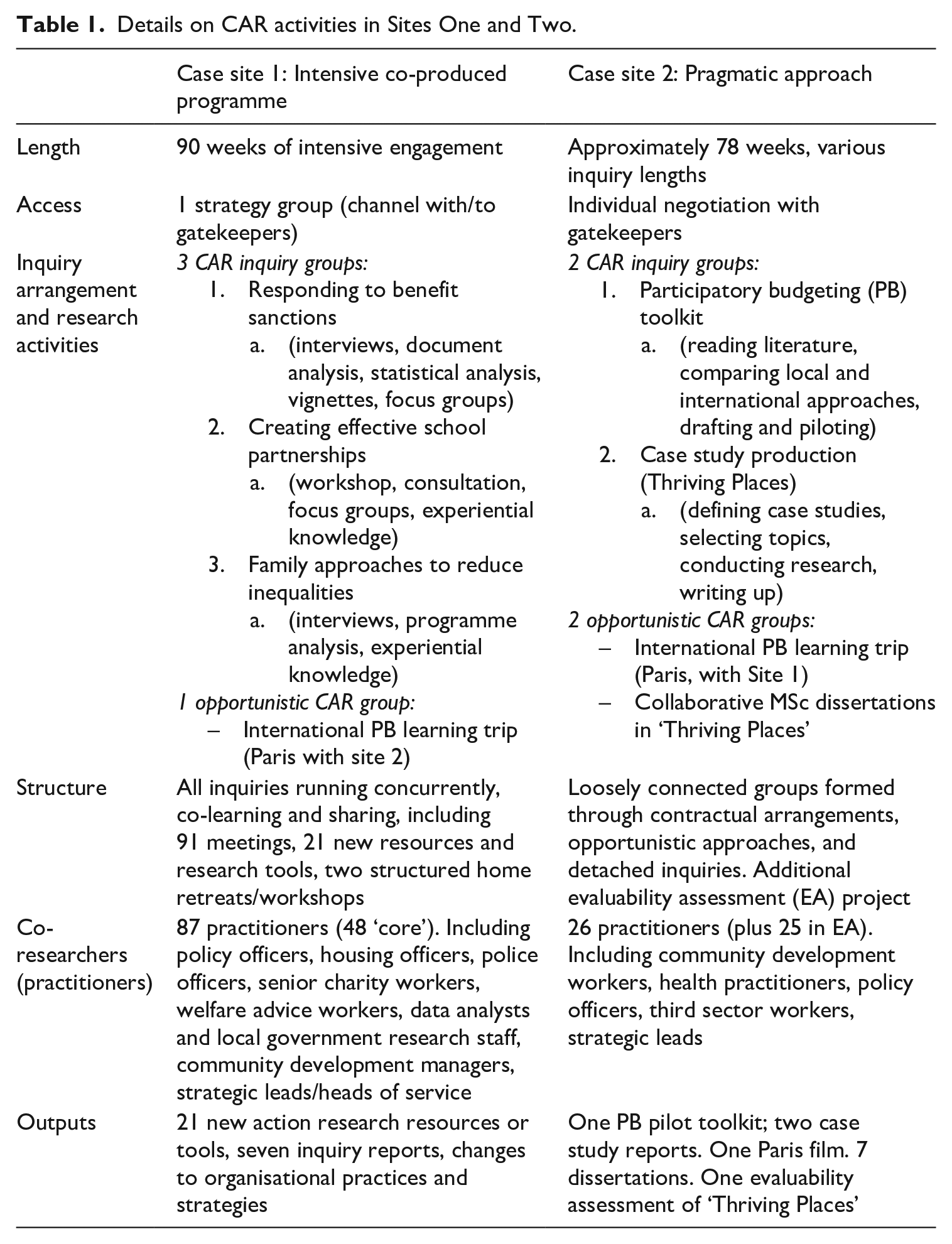
A data collection framework distinguishing ‘first order’ and ‘second order’ research enabled the researchers to co-produce situated inquiries (first order), while also collecting broader cross-site data on public service reform (second order). The second order data provided insights on the CAR approach and how practitioners operate in collaborative governance contexts. First-order data drawn on in this article includes formal materials produced in inquiry group sessions (e.g. learning materials, minutes) and formal outputs from these groups (published reports, blogs). Second order data includes reflexive data from within the inquiry groups (e.g. recordings of discussions, contemporaneous notes); communications with group members and others between sessions; formal data collection (reflective templates, interviews); desk research; and data from complementary collaborative events (e.g. home retreats).
As with much participatory research, there was tension between institutional ethics processes and the research approach (Manzo and Brightbill, 2007). Our situation echoed Guillemin and Gillam’s (2004) framing of two types of ethics in participatory research: procedural ethics and ethics-in-practice. The first requires pre-determined research design and identifiable risks, which may contradict the collaborative ethos and practice of CAR. In practice we considered the anticipated CAR activities in each site and framed institutional ethics applications accordingly but gave most consideration to ethics-in-practice. As research activities would be determined through negotiation and co-design with practitioners (Boser, 2006), we sought to go beyond a singularity of consent, instead viewing it as ‘always-in-process and unfinished’ (Renold et al., 2008: 427) and thus engaged in practices such as frequently revisiting discussions about ethics (Dewing, 2007), co-determining ground rules for inquiry groups, and co-writing research reports.
Analysis of the data was a two-step process. First, throughout the study the researchers met to explore the action research literature and reflect on in-site experiences. To prepare this article, the two authors further compared data and experiences across their two case sites, highlighting the complex political and relational processes of undertaking collaborative research including issues of gatekeeping and access, establishing and maintaining inquiry groups, contextual dynamics and researcher practices. These four dominant themes are described below.
Findings
Gatekeeping: never-ending gates and multiple gatekeepers
Existing research has long recognised how gaining access to research fields and collaborators is not a singular act at the start of a research process (McArdle, 2008; Reeves, 2010). Gatekeeping in our collaborative governance context was a complex ‘multi-level’ activity. There was no single ‘gate’ and no single ‘gatekeeper’, meaning researchers had to regularly adjust relational practices depending on the policy topic, collaborative history, intra-organisational relations and cultural behaviours. For example, in one locality, over a period of 90 weeks the researcher worked with 87 individual practitioners from 70 different departments, each with varying access and engagement processes. Sustaining access was also an ongoing activity requiring the researchers to continually nurture relationships with diverse gatekeepers, each with different and sometimes competing strategic and informational needs (see also Burgess, 1984; Beebeejaun et al., 2015).
Echoing Guillemin and Gillam (2004) on ethical choices in research practice, gaining access for collaborative inquiries went beyond a simple authorisation for a short extractive data collection process. Instead, it involved researchers sharing decision-making power by co-producing the research aims and remit. Undertaking action research also required space and time within existing complex governance systems to allow practitioner-researchers to cultivate inquiring positions and to question their working practices. WWS researchers initially held indeterminate outputs to enable the practitioner-researchers to co-determine the purpose (see Bartels and Wittmayer, 2014). However, for some this was unfamiliar work; practitioners and departments expected clear, pre-determined information to identify and commit scarce staff resources. Reflecting on the challenges of a CAR approach, one practitioner stated: In an era of budget cuts and a shrinking workforce, we found it difficult asking people to dedicate time to a process where the initial outcomes weren’t immediately clear (Policy Officer, site 2).
There are few discussions that problematise gatekeeping in the existing CAR literature (e.g. Bruce et al., 2011; Dickens and Watkins, 1999) despite Bondy (2013: 586) noting that ‘the ways in which one enters and remains in a field setting reflect the research setting as much as they do the research itself’. Diverse gatekeeping practices and understandings of inquiry work profoundly shaped the researchers’ ability to create the space for research and populate inquiry groups. For example, gatekeeping challenges underpinned the inquiry group exploring ‘Thriving Places’ (a ten-year CPP programme aiming to improve outcomes across nine localities of persistent, multiple deprivation in a large city), leading to a ‘contractual’ negotiation of formal access from a primary gatekeeper, plus the navigation of multiple further gatekeepers. In the initial CPP submission to the WWS call, a strategic decision-maker identified the ‘evaluation of Thriving Places’, thus offering a ‘window’ into the partnership. However, they did not identify an existing team or practitioners to co-research the topic, or commit to creating and leading a new inquiry group. In order to recruit six to nine members (spread across three existing Thriving Places localities) for an inquiry, the researcher agreed to provide the strategic decision-maker, acting as a primary gatekeeper, with a written ‘contract’. This set out the inquiry scope, likely activities, estimated time commitment and projected learning outcomes. Once agreed, the strategic decision-maker sent this to three regional Thriving Places managers, acting as second-tier gatekeepers, two of whom proposed two participants. The third could not gain agreement from local Thriving Places managers to release staff for the inquiry group, revealing a third layer of gatekeeper. After further discussion, the regional manager agreed to try another, newly emerging locality, whose manager had one potentially interested practitioner. The researcher met this practitioner to confirm their interest, and they themselves became a gatekeeper by suggesting a community activist to join the group. Having recruited six prospective group members, all working for different public services, the researcher then contacted each interested participant in order to fully inform their decisions to participate. Overall it took 15 weeks from gaining the contractual agreement to the first inquiry group meeting.
Gatekeeping was not a one-off activity nor autonomous from the research process; the primary gatekeeper’s ‘contractual’ approach set boundaries to the work of the inquiry group. Furthermore, throughout 15 months of group meetings, the researcher regularly reported to the primary gatekeeper in order to maintain legitimacy for the research process and saliency for potential outputs. As workplaces changes could quickly lead to drop-outs making the group unsustainable, between each inquiry group meeting the researcher also maintained contact with each group member in order to cultivate their involvement. Nevertheless, one member dropped out formally due to organisational restructuring, and two others became peripheral group members due to work priority conflicts. While none of the other inquiry groups required such a formal contractual process, experiences across all the collaborative inquiries demonstrate how the ‘sanctuary’ to conduct research (Dickens and Watkins, 1999) was never ‘achieved’ or settled in this context, but instead demanded active, ongoing cultivation.
Building and sustaining relationships
Like many collaborative researchers, Denis and Lehoux (2009: 364) note ‘a need for close interaction with practitioners through the research process’; however, they miss the necessary step of discussing how they secured or nurtured a close interaction and what type of interaction. In our research, this was a particularly important issue as practitioners needed to trust the WWS programme, the individual researcher, and the inquiry approach. O’Reilly (2009) argues that such rapport demands a long-term commitment on the part of both researcher and participants, reciprocal relationship-building, and needs sustaining when recruiting collaborators, conducting the research and ending the fieldwork relationship. The variety of practitioners and professional backgrounds in our multi-agency context made rapport-building activities multifaceted and continual, initially involving ‘drive-arounds,’ job shadowing, formal and informal meetings and encouragement to engage in wider WWS events. Building relationships with multiple professions involved learning about multiple worlds of work, exploring professional values and skills and understanding innumerable personal interests and organisational pressures. Some practitioners had previous experience of university research while others had little or none, leading to competing expectations about university partners. The differing levels of relationship-building also depended on whether practitioners recognised and trusted the CAR approach, or their skills and familiarity with aspects of group work. Introducing and normalising critical reflection and inquiry work took much time for researchers and practitioners and drew on relational skills such as empathy, communication and patience (see Manzo and Brightbill, 2007).
There is a tension facing researchers in collaborative governance contexts in which organisations seek to collaborate in response to organisational reforms and resource constraints. The instability of the public service context posed a major challenge to creating and maintaining relationships. Some public sector partners engaged in organisational restructuring more than once during the WWS project, reflecting years of public service financing restrictions; a UK austerity programme has led to a loss of 31,000 devolved public sector jobs in Scotland since 2008 (Watson, 2016). During our research, many practitioners changed jobs, were operating in smaller or reorganised teams, and some organisations completely withdrew their involvement. For example, despite early interest a senior police officer stated that it was not viable to commit police officers to inquiry meetings when there are shortages of ‘boots on the ground’.
It was also challenging to build and sustain relationships within a wider context of fixed-term employment contracts. While the third sector is central to Scottish government’s public service reform (Christie, 2011), in practice the sector also faces challenges from budget cuts and staff retention (Watson, 2016). Many third sector partners employed staff using fixed-term contracts aligned to specific initiatives, such as community development workers employed on annual contracts as part of the ten-year Thriving Places programme. This led to short-term working relationships, with researchers experiencing acutely how practitioners operating in the collaborative governance context must continually create new relationships across multiple service areas and organisations. As one community planning policy officer reflected: We also found that there is a range of challenges regarding getting to know people through a CAR process. These include the impact of colleagues employed on temporary contracts (which come to an end during the process) resulting in uncertainty or people moving on, lack of cover for frontline staff and part-time positions (Extract from a practitioner reflective document).
It was apparent that the public service context in Scotland, despite its emphasis on partnership working and collaboration, was an inherently unstable context in which to conduct CAR. This placed further pressure on academic researchers (also employed via fixed-term employment contracts) to cultivate sufficient stability for successful inquiry processes and outputs, demonstrating the complexity of creating the necessary close interactions in such work (O’Reilly, 2009).
Creating and holding the space: Legitimisation of activities
Finding the space and time to undertake critical inquiry work requires much labour (Bartels and Wittmayer, 2018). This labour increases where researchers straddle numerous worlds of work and, in order to gain legitimacy, need to ‘fit’ the inquiries into complex and dynamic environments. In site two, to ensure the inquiries corresponded with various agendas, the researcher co-created a strategy group (comprising WWS representatives, middle-managers from multiple departments and organisations, inquiry leads and other invested public service colleagues) responsible for authorising and supporting three concurrent inquiry groups. It offered space for representatives from different organisations to discuss access, resources and potential collaborators. However, the effective functioning of the strategy group was not automatic; the group needed nurturing, developing and co-shaping. This took much additional and ‘invisible work’ for the researcher and a selected practitioner, ranging from the practical organisation of meetings and recruiting potential members, to careful management of tensions between different individuals or departments. The researcher also had to work with a range of established and recognised ‘artefacts’ that practitioners used to shape their activities, such as committee timelines, reporting styles and scrutiny mechanisms. The extract below demonstrates the nature of the work involved in creating the inquiry teams and carving out and ‘holding’ space in multiple diaries and agendas.
…From our experience, it is clear that behind the scenes or invisible support is also important for supporting collaborative work and involves organisational skills and ensuring there are lines of responsibility for arranging meetings, chasing up, or co-ordinating action (Extract from learning document, case site two).
Another approach to gain traction for an inquiry group was to focus on a topic that was both salient and politically safe for all involved. In site one we co-created an inquiry group of practitioners from several public services to devise a participatory budgeting (PB) evaluation framework for the locality. Participatory budgeting was a salient topic in Scottish public policy, actively supported by local and national government (Escobar and Katz, 2018). As such, it had a strong fit with policy work at various levels of governance. A PB expert who was a member of the WWS team joined the researcher in the group, reinforcing the legitimacy of the project. Furthermore, the proposed output (an evaluation framework) is a legitimate and established product for public service practitioners. Seeking to avert instrumentalisation of the inquiry group process (Boezeman et al., 2014), the WWS duo was able to create space within the group for reflection and challenge, sourcing international literature for practitioner-researchers to discuss, and conceptualising PB as a social justice tool with the potential of changing citizen–state relations. However, even legitimate topics can bring political tensions; during the inquiry, the Scottish government announced new funds for CPPs to spend on PB with very short notice. As a result, the critical and reflexive nature of the group were at risk of instrumentalisation, which the WWS researchers and the lead practitioner-researcher in the group sought to hold at bay. While this example demonstrates one way of creating and maintaining an inquiry group by engaging with ‘safe’ policy topics and recognisable outputs, it continues to demonstrate the work involved in attaining ‘sanctuary’ from external agendas (see Dickens and Watkins, 1999).
Managing power relations
The examples so far touch upon some of the key issues for action researchers in this context; engaging with potential research collaborators, questioning and understanding existing norms and recurrent negotiation. Power relations underpinned much of this relational work. Not only is social research fraught with issues of power (Boser, 2006; Reeves, 2010) but complex power disputes are a key issue in collaborative governance (Ansell and Gash, 2008). The Community Planning context involves financial and professional tensions regarding power and control across departments and organisations (Escobar et al., 2018), as such creating the space for the inquiry groups either challenged existing power structures or created new spaces for different arrangements (Chambers, 1997). The research context was, therefore, never apolitical, identifying and potentially shaping power relations was a necessary element of the CAR process.
The action research literature has long highlighted the power imbalances between the professional researcher and their non-academic partners (e.g. Mannay, 2016). Boser (2006: 11) notes, ‘the very process of participating in constructing knowledge about one’s own context has the potential to redress power imbalance’. However, our multi-agency arrangement complicated considerations of power, even where there were partners strongly committed to partnership working, as the following three examples illustrate. First, in one site the simple existence of an external, university researcher offering a variety of practitioners and organisations direct link to research and evidence threatened a local government team who had developed a unique role as key conduits to university research. Second, within the schools inquiry group, a practitioner felt collaboration was difficult because of an assumed hierarchy based on pay grades and roles between teachers and non-teachers. Third, there were difficult encounters in which practitioners sought to ‘pull rank’ during decision-making based on grade or professional background. As such, the researchers had to adapt their practice in response to power imbalances (Boser, 2006) and carefully recognise and navigate various aspects of (inter and intra) organisational politics.
There were also accountability issues in these collaborative research spaces, raising questions regarding the role of researchers in shaping and policing the behaviour of non-academic partners (Bergold and Thomas, 2012). Towards the end of an inquiry process in site two, a number of practitioners raised concerns about the leader of an inquiry group and their contributions within the inquiry process. It became apparent that there were discrepancies between progress updates to the steering group and managers and the stage of the work. Other practitioners asked the WWS researcher to intervene as they felt that they did not have this power in their own structures or in the new collaborative research space. An inquiry member emailed the researcher: [redacted] was very reluctant to take on any of the work himself and actually said at one point that he was too busy to complete the final report. . .The rest of the group were clearly unhappy with his stance on this and he was somewhat taken to task by the other members – that they are not in a position to take over this (his) work. . .I can’t see this group meeting again and I’ve no idea if you will be able to do anything with the scant information that has/will be captured in the report template! I’m sorry if this is out of line but frankly I am exasperated with him (Extract from email 1 November 2016).
The tensions in this inquiry group regarding the division of labour emerged early and regularly throughout the group process, leading to high drop-out rates, and increasing demands for the researcher to intervene or report individuals in their established hierarchical structures. Supporting the group to produce their final report was challenging and resource intensive. These ethically important moments (Guillemin and Gillam, 2004) demonstrate the tensions between an idealised role of a facilitative and power-sharing action researcher working collaboratively and equally with various partners, and the realities of complex group work.
Changing and uneven power dynamics also affected the autonomy of inquiry groups. In the Thriving Places group the strategic decision-maker allowed some access for staff to engage in the work, but did not fully relinquish control of their activities. At the end of this inquiry process, three group members had completed case studies based on their own primary research. However, unlike participatory or action research with autonomous groups, in this research context the inquiry outputs needed to be ‘signed off’ by the senior strategic decision-maker. Despite the researcher’s work to maintain sanction and sanctuary (Dickens and Watkins, 1999) for the inquiry group, the strategic decision-maker argued that the findings of one case study could be politically damaging to the CPP. This gatekeeping ‘capture’ meant that WWS and the practitioners involved in this group could only officially publish two case studies. However, in a gatekeeping ‘twist’, a local manager working in a different public service to the CPP strategic decision-maker used the third case study locally without needing the ‘sign-off’. This indicates a new narrative of subversion of power (Gaventa and Cornwall, 2008) when conducting CAR: as linear hierarchies of traditional bureaucracies weaken via collaborative governance (Durose, 2007), alternative and unexpected opportunities for impact may emerge.
Discussion
Townsend’s (2014) definition of CAR advocates for greater collaboration in the construction of knowledge, while also presenting collaboration as a positive and harmonious process involving the alignment of complementary skills for mutual benefit. This idea, combined with a view that collaboration offers efficiencies, has permeated into mainstream academic practice through research funding requirements, audit processes and reward systems (Smith et al., 2020). Yet, collaborative, participatory, and action researchers have long reflected on the demanding and consuming nature of research collaborations (Bergold and Thomas, 2012). Indeed, nearly 15 years ago, Boser (2006: 10) noted that the ‘movement toward participatory research approaches brings new sets of social relations for research and, as such, presents a new set of ethical challenges.’ Our findings echo these debates and illustrate how distinctive, significant and ongoing relational and political work is required to create and sustain multi-agency and multi-professional research collaborations.
We specifically demonstrate how undertaking CAR in collaborative governance contexts requires researchers to, simultaneously and continuously, engage in practices of negotiating gatekeeping, building and sustaining relationships, seeking legitimacy and navigating power, alongside traditional and technical research skills. Such work has become a core feature of what we term the ‘contemporary pincer’ whereby academic institutions accentuate research collaborations with partners, who themselves are increasingly pressured to participate within their context of collaborative governance. However, understanding the complexities of the ethical, relational and political elements of such work continues to remain within the confines of those traditionally versed in the participatory research paradigm. Moreover, institutional conditions, competitive metrics and ‘narrowly constituted elitism’ create university cultures and practices that ‘separate knowledge from the conditions under and through which it is realized’ (May and Perry, 2011: 176–177). Do we have the appropriate concepts and research structures to reflect the complexity, skills, tempo, and realities of research collaborations?
Here we find tensions. In particular, institutions promote research collaborations while maintaining traditional expectations about research timelines and surety of outputs. The pressure on universities to realise social good creates an opportunity for action research (Levin and Greenwood, 2008), yet the volume of (traditionally understood) non-research tasks involved in participatory and collaborative approaches conflicts with pressures on researchers to achieve outputs with the greatest academic value such as high-ranking journal articles (Raynor, 2019). These tensions are particularly acute for action research, which metaphorically involves ‘building the plane while flying it’ (Smith et al., 2010) and takes a necessarily flexible approach to timelines and outputs. We therefore need a reframing of ‘non-research tasks’ intrinsic to collaborative and participatory research. Furthermore, such activities are not simply additional tasks on a research design checklist, but an explicit normative position that acknowledges (and rewards) the persistent labour and diverse skills researchers require to successfully cultivate space, time, and trust in such contexts.
To drive the development of concepts and practices suitable for the contemporary context into mainstream practice involves a process of translating, adapting, advancing and embedding long held debates from the participatory paradigm. These debates need to incorporate issues such as positionality, dynamics, and the politics of researchers when active in collaborative spaces. It will also need to integrate existing notions of gatekeeping, relationship-building, rapport and sanction and sanctuary (e.g. Bartels and Wittmayer, 2018; Bondy, 2013). To contribute to this transition, we propose the concept of the ‘buffer zone’ to capture the work of establishing and engaging in complex research collaborations. We define the buffer zone as: A created and nurtured area of critical and relational activity that lies between different ways of working – the established organisational and contextual practices and the new, created spaces for temporary, collaborative and critical research. It is a space, a border zone between multiple worlds of work within which new political and relational work occurs. When established, the buffer zone can protect or empower the activities within inquiry groups or collaborative research projects by negotiating with (or holding at bay) other, competing powerful actors or agendas within the wider operating context.
The buffer zone seeks to conceptualise the work involved in approaching, designing and practising social research in collaborative contexts. It places the necessary political, ethical, and relational work for research teams at its heart. Drawing on our intensive research with public service partners, utilising the buffer zone concept involves three core elements. First, ‘buffering purpose’: acknowledging the necessary work of holding and sustaining the research space in order to pursue critical collaborative research and avert ‘capture’ or instrumentalisation. This includes acknowledging the likelihood of pressures from the academy and from the non-academic partners, for example for narrowly defined ‘outputs’. Second, ‘buffering practices’: using a range of relational skills and activities in order to enter and sustain relations in the field. For example, using rapport in multiple, ongoing ways with a changing range of gatekeepers and power-holders. Third, ‘buffering dynamics’: understanding the necessity of engaging in ongoing political work inside and outside the research group in what is a persistently mutable research context. For example, the persistent need to renegotiate terms of engagement as research materialises within an ever-changing field. The examples and intensity of work within these three elements will vary depending on the collaborative arrangement, research approach and aims, and the character of ethically important moments (Guillemin and Gillam, 2004).
The buffer zone concept seeks to capture the continual, non-linear activities that take place throughout participatory and collaborative research within a context of intense relations and unstable structures. This work, as demonstrated in our findings, is necessary to protect key activities, such as engaging in reflective and critical thinking, holding the space required to collaborate, and managing competing agendas and power relations. By acknowledging that this can be both a collaborative and a contested space influenced by multiple unsettled organisational and political agendas, we seek to avoid a primary focus on researchers by emphasising multiple professions, influential individuals, and co-researchers who hold competing or complementary activities, knowledge and power. This is congruent with Christians’ (2011) stance that researchers need to be accountable to and with those we are researching, it is not sufficient for researchers to be responsible only to their institutions (i.e. universities).
The buffer zone is a created space and does not simply appear or exist. It is a temporary space created between worlds. In our study, the academic researchers played the central role in nurturing and facilitating the buffer zone in the quest to initiate, drive and complete a number of interconnected inquiries. However, it is not a simple extension of academia, defined and controlled by pre-determined institutional practices. It cannot exist without the collaborative partners who in turn manoeuvre, shape and continually co-produce the research space, activities and outcomes. As such, research teams should not seek to predict precise boundaries and dynamics in advance.
Reflecting participatory researchers’ long-standing ethical debates regarding power (e.g. Wilson et al., 2018) the question of ‘buffering from what, and for whom’ is posed. We construct the concept of the buffer zone around the notion of created space with some (often porous and amorphous) boundaries. It is never an empty space; all involved bring institutional pressures, normative practices, expectations and personal interests. As such, the reshaping of this space and attendance to boundaries become necessary practices throughout the collaboration. In our study, at times the researchers were buffering the practitioner-researchers from the power dynamics in their home institutions to provide the ‘sanctuary’ to engage in critical inquiry. Other times, the researchers were buffering the same practitioners from academic pressures (such as the pressure to finish inquiry reports to meet funding partners’ pre-determined timelines). In some instances, this involved contracts, formal meetings and difficult discussions between partners. At other times, it required co-producing ground rules and facilitating sessions to identify external pressures or professional expectations. Such work was necessary, often unpredictable, and ongoing through the life of the research programme.
In acknowledging these features, the buffer zone encourages us to replace the understanding of the collaborative context as an incidental feature of research work, with an understanding of the collaborative context as a central shaping component requiring persistent and skilled labour. This stance holds significant implications for research planning, funding decisions and reward systems, as well as for researcher recruitment, skills development, and academic job structures. Adopting the buffer zone as a conceptual frame enables us to highlight the work involved, and foregrounds that undertaking participatory and collaborative research is not ‘cost free’ or involves inconsequential tasks. It is these costs of collaborative work in the ‘contemporary pincer’ that require making explicit, and the buffer zone seeks to support this.
Conclusion
Collaborating to produce social research has increased in salience; favoured by funding bodies, research assessment processes and by some non-academic partners seeking additional or specialist resources. Critically reflecting on undertaking collaborative or participatory research in the current context is essential in order to better understand the nature and activities involved. By examining some of the collaborative action research activities in the What Works Scotland programme, this article demonstrates how research with multi-agency partnerships involves a range of relational, pragmatic and political activities. Researchers engaged in practices of negotiating gatekeeping, building and sustaining relationships, seeking legitimacy and navigating power. This article demonstrates that these ‘buffering practices’ are necessary to hold and sustain the research space (‘buffering purpose’) and to hold at bay and keep in play the politics of pursuing collaborative research (‘buffering dynamics’). This article proposes the concept of the buffer zone, to demonstrate and guide how researchers work when conducting such research. The buffer zone is not a list of linear, pre-determined, actions that researchers can identify in advance of entering the field. Instead, the buffer zone conceptualises the contested space that researchers need to persistently animate in order to successfully pursue collaborative or participatory research. It as a created and nurtured area of relational activity that bridges established organisational and contextual practices to foster new, created spaces for temporary, collaborative and critical research. Acknowledging the buffer zone has implications for the practice of social research in university settings where there is an increasing shift towards research projects that traverse organisational, disciplinary and professional boundaries, involving multiple partners in increasingly complex political environments.
Footnotes
Acknowledgements
Whilst the authors are responsible for the arguments made in this article, it forms just one output from a large collaborative research programme. As such, we would like to thank all CAR group participants and research partners in both sites, who committed time and effort to this collaborative work, and are anonymised in this paper. Thanks to the whole What Works Scotland team, in particular Dr Claire Bynner and Dr James Henderson who engaged in numerous discussions as part of the CAR workstream. Thoughtful feedback was also much appreciated from audiences in paper sessions at: Social Policy Association conference (2018), University of Glasgow sociology seminar (2018) and JUC Public Administration Committee Annual Conference (2019). Similar thanks to Prof. Beth Perry and participants at the Contested Knowledges for Just Urban Futures event (2019). Insights from three anonymous reviewers further contributed to improving this paper. Finally, thanks to the ESRC and Scottish government who funded the research that underpins our arguments.
Authors’ Note
Both authors (Hayley Bennett and Richard Brunner) agree to this submission. The article is not under consideration elsewhere and has never been submitted to any other journal (13 May 2019).
Funding
The author(s) disclosed receipt of the following financial support for the research, authorship, and/or publication of this article: This work was supported by the Economic and Social Research Council and Scottish Government, grant number ES/Moo3922/1.
