




Abstract
Sensory ethnographers deploy methods such as drawing, video and photography in order to examine the more ineffable and non-representational aspects of practices. Usually, these studies are conducted by individual researchers who deal only with their own material. What happens when a team of ethnographers explores questions of a sensory or non-representational nature? How do they share their findings not only with their audiences, but also with each other? Team ethnography is becoming increasingly common across the social sciences and humanities, yet to date there has been little attention paid to the important work of communicating findings within a group. To explore this further, we conducted a methodological ‘proof of concept’ study, observing and documenting people learning to make omelettes. We found that sensory methods have a role not only in studying practices but crucially, in also facilitating a form of immersion into the ethnographic practices and imaginations of others within the team. In the end, we suggest that experiments with sensory methods, such as through proof of concept methodological studies, are useful for thinking about how teams of social scientists work together, whether their research deals with sensory topics or not.
Introduction
From a methodology reserved for the lone social scientist embedding themselves into a specific cultural context, ethnography has now increasingly moved to being conducted in team-based settings (Fine and Hancock, 2017), with ethnographic collaboration occurring across multiple fieldsites. Unlike in individual projects, where the ethnographer collects and works with their own material, team-based ethnographic research requires careful attention to communication within the group about the material collected and shared. While there exists literature regarding the role of fieldnotes (Creese et al., 2008; May and Pattillo-McCoy, 2000), video (Pink and Leder Mackley, 2013), and digital software (Beneito-Montagut et al., 2017) in team ethnography, and discussions emerging from the field of science and technology studies (STS) examining methodological practices in comparison using team ethnography case studies (Deville et al., 2016), there is generally less attention paid in qualitative research literature to the important collaborative work of sharing findings within a group.
In this article we work towards addressing this gap by paying attention to collaborating as a team using material that is of a sensory, or non-representational nature. Sensory ethnography is a popular method for studying taken-for-granted practices that are otherwise difficult to articulate, such as the study of skilled practice. In such work, sensory ethnographers are asked to be attuned to their own learning, to learn with, not about, others (Ingold, 2013). Yet to date most studies of skilled practice and other embodied learning have attended to individual researcher’s experiences, drawing predominantly from phenomenological perspectives. The complexities of sharing sensory ethnographic material in order to communicate about each researcher’s own and others’ sensory experiences have yet to be fully explored.
This article draws together the growing body of work on team ethnography and sensory ethnography to offer new insights into the methodological challenges encountered when conducting qualitative team research. We ground our discussion empirically in a methodological ‘proof of concept’ study we conducted in preparation for a comparative ethnographic study about how doctors learn sensory skills of diagnosis. Our initial aim was twofold: to experiment with how different sensory methods may attend to skill learning, and to explore, as a team of three ethnographers, how these sensory methods might work in a collaborative research project. We found that sensory methods and their outcomes helped us to notice and notate skilled learning, and, crucially, that they facilitated sharing material within our group, allowing for an immersion into the ethnographic practices of others in the team. For our experiment, we chose to use drawing, video and photography, as these are all popular methods in sensory ethnography, particularly among those studying skills learning. Moreover, with our own fieldwork in mind, we chose to study a sensory skill, which, like making clinical diagnoses, demands finely tuned technique – making omelettes. We designed a three-day experiment that allowed us to test our chosen sensory methods while observing an omelette-making lesson, and then shared and discussed our material with each other.
In doing so, we follow other ethnographers who are experimenting with methodological approaches. Teams of researchers have conducted ethnographic experiments in collaborative data collection and writing (Mann et al., 2011), while conversations surrounding experimental forms of ethnographic fieldwork and methodological interventions into the field continue to take place, one instance of this being the European Association of Social Anthropology (EASA) network #colleex (the Collaboratory for Ethnographic Experimentation).
We offer with this article, in the spirit of ethnographic experimentation, a description and discussion of our methodological ‘proof of concept’ study. While we intended to experiment, as a group, with sensory methods, we soon realised that the potential of these methods extended well beyond observing sensory skills. From this ‘proof of concept’, we learned how we each worked individually as ethnographers, how we might be able to trace our own fieldwork practices better in order to share, how we might be more empathetic to each other’s observations and how we might be able to better conduct a comparative and collaborative project together that ignites fascination and helps us learn about the ethnographic imaginations of others in the team.
Underpinning these observations are several theoretical assumptions that we base our work on. First, we assume that sensing is integral to understandings of, and being in, the world (Ingold, 2013). We share Sarah Pink’s assertion that participant observation is a way of enacting an ‘empathetic engagement with the practices and places that are important to the people participating in the research’ (Pink, 2011: 271), that fieldwork offers bodily ways of seeking routes by which to share or imagine the actions of the people we study. With colleagues (Pink et al., 2017), Pink has delved further into this concept to consider the ways in which empathy is negotiated as a form of imagination that emerges in specific encounters, where imagination is an outcome rather than a condition (Sneath et al., 2009). We extend this understanding of imagination beyond the researcher–participant relationship to consider how imaginary effects can be shared within teams, and how, in the process, we can learn from each other. We also focus more in this article not on ‘being with’ interlocutors, but rather what it means to ‘be with’ each other in a research team, where understanding comes about in our encounters as collaborative researchers. We assume that the sensory methods we discuss allow for and support these processes of imaginative practice. Finally, an important theoretical starting point is that we do not assume a predefined sensing body that is affected by sensory inputs and engagements, but rather, following from recent theoretical work in anthropology and STS in particular, assume that sensing bodies, ours and our interlocutors, are made in and with sociomaterial environments, whether these be the learning environments we study or the research environments we operate within.
In the following sections we describe how each of the three methods we used in our experiment – drawing, video and photography – highlight one particular aspect of immersion into the ethnographic imaginations of other team members. Drawings highlighted our own observational practices and allowed us to trace these observations across team members. Video revealed embodied interactions beyond the transcript. And, photographs opened us up to shared fascination and wonder. While we draw attention to how each method facilitated immersion, we do not propose these aspects of immersion to be particular to any method. Instead of comparing methods, we argue that sensory methods, taken together, facilitate immersion. Before making this argument we first present some of the current work and thinking about team ethnography followed by a brief explanation of our experimental set-up.
Team ethnography and collaborative fieldwork
As discussed previously, sensory methods have so far been mainly used in individual projects. While many fields and disciplines have long embraced team-based research practices (for example, the biomedical sciences, or in the social sciences, the comparative work done in sociology), ethnographers have more often engaged in single, individual projects (Miller et al., 2016: 36). Ethnographies are written from the perspective of the solo participant observer who has established connections and links to the communities they study and learn from. Much of the ethnographic research on skilled learning is written from this perspective, with the ethnographer focusing on their own learning of sensory skills (see, for example, Downey, 2005; Grasseni, 2004; Rice, 2013). While there has been a move away from limiting ethnographic work to single geographical locations, through methodologies such as actor-network theory and multi-sited ethnography, this research often still assumes a single researcher as ethnographer.
These traditional arrangements are changing, however. Team-based ethnography is becoming more common now. Beneito-Montagut et al. (2017: 668) define team ethnography as ‘any ethnographic project involving more than one researcher in any of its phases’. True to this broad definition, it takes a number of forms, from meta-ethnographic projects – a revised form of the more traditional armchair style ethnography, where monographs are collated and reflected upon – to teams working together collaboratively. The latter can be characterised further as being either multi-sited team ethnographies or ‘being in the field together’ (Beneito-Montagut et al., 2017: 668). However team ethnography is defined, there are several reasons why the work of teams of ethnographers is becoming more visible, including technological infrastructures which facilitate multi-directional communication more easily via digital platforms (Beneito-Montagut et al., 2017) and funding schemes which encourage cross-national comparison (Akrich and Rabeharisoa, 2016).
Collaboration is a strong tenet of ethnographic work but has most often been discussed in the context of collaborative engagement with those in the field from whom, and with whom, ethnographers learn about local life. Examples include the para-ethnographies discussed by George Marcus (2013), or participant action research, where many stages of the research are driven by those in the field. Collaboration is less often discussed, however, as a practice within teams of ethnographers (Beneito-Montagut et al., 2017). There are several important exceptions from which we build upon however (see, for example, Beneito-Montagut et al., 2017; Clerke and Hopwood, 2014; Creese et al., 2008; May and Pattillo-McCoy, 2000).
With the exception of the recent examples listed above, to date there is still a relatively small amount of literature in qualitative research which discusses what it means to conduct collaborative ethnographic studies in teams. The previously mentioned work on fieldnotes and digital software, for example, offers insights and inspiration for teamwork of this kind but still leaves questions open with regard to how to communicate fieldwork experiences that are difficult to represent or put in words or numbers, as is the case with many sensory ethnographic projects, as well as other research which deals with the non-representational. An exception is the work of Sarah Pink and her collaborators; one example being Pink and Leder Mackley’s (2013) interdisciplinary energy research that utilised a video-based approach to sensory ethnography. Here, the authors discuss the importance of the ‘empathetic element of video viewing’ in the communication of experiences both across and beyond their team of researchers (2013: 343). Clerke and Hopwood (2014: 36, 80) also offer a brief discussion of visual data generation and analysis in their reflections of team ethnography and ‘seeing together’. They (2014) argue that assembling photographs and sketches in a team can generate innovative collaborative data analysis through an expanded visual vocabulary. We work in conversation with this literature, offering new methodological insights based on an experiment we designed in our own research project, to explore how using sensory methods and sharing our material may work in a team ethnography.
An omelette experiment
Our ethnographic experiment was designed in the context of a larger comparative ethnographic study about how doctors learn sensory skills of diagnosis. 1 We designed this ‘proof of concept’ study so that we could experiment with different methods of elicitation and notation that imaginatively attend to sensory learning, prior to beginning fieldwork at three different medical schools. Rather than taking diagnosis as our subject, which presents various practical and ethical complications for the simultaneous experimentation of three researchers, we applied these methods to another example of a sensory skill that demands finely tuned technique – making omelettes.
We are interested in the role of pedagogical technologies in learning. For this reason, we documented others learning how to make omelettes through the use of different technological arrangements including recipes, cooking shows and a cooking class. In doing so, we wanted to attempt to mimic the arrangements we expected to encounter in our individual fieldsites. Although not the focus of this article, we thought that the experimental design would not only allow us to experiment with methods but also start to think empirically, through the omelette example, about sociomaterial conditions of learning skills. We were especially interested in the role of instructional books and videos, and instructors, all materials and people we expected to find in the medical schools. In regards to the sensory methods, we ourselves chose to use drawing, video and photography to elicit and notate participants’ learning. As previously outlined, we selected these methods because they are discussed in sensory ethnography and embodiment literature as methods that help to explore sensory learning and experience, which is notoriously difficult to articulate (see, for example, Pink, 2009), but which have been limitedly explored in relation to team-based research.
The experiments were conducted over three consecutive days in July 2017 during which we invited 15 participants in total into kitchens to learn to cook an omelette. Each day, the composition of the group was different. While having the same group go through each of the experimental set-ups would have been one approach, we decided on this arrangement because we were not so much interested in how individuals performed and engaged differently in each class, but rather our methodologies for documenting our observations. We intended that our participants cooked in pairs, so that we could also listen to how they articulated their practices to each other. Mostly, this is what happened, although sometimes we observed individuals separately.
On all days we, as researchers, followed a set procedure with participants. Upon arrival we informed them of the ethical considerations of the study, confirmed their participation was voluntary, explained who we were and the procedure and allowed for questions. Then, one of us left the room while the other two each chose a method – drawing, video recording or photography – to document the cooking. After participants finished making their omelettes, they spoke to the researcher who had not been present while they cooked.
We decided upon one researcher leaving the room so that we were forced to explain what we had observed to someone who was not in the room, simulating the fieldwork we would soon experience with the three of us dispersed across three different countries. When it came to selecting which method we chose for documentation, it was done rather randomly, while assuring that each of us had experimented with the different methods over the course of the three days, and that the two observers were using different methods. Again, our goal here was not to control variables minutely but rather it was experimental in the sense that we considered, following from Mann et al. (2011) ‘that if you carefully organize an event, reality may be afforded to act (speak, smell, taste) in novel ways’. Thus, we ‘mixed the experimental organization of an event with the open attentiveness of fieldwork’ (Mann et al., 2011). By the end of the three-day experiment, all of us had drawn, video recorded, photographed and interviewed participants. The three days proceeded as follows.
On the first day of experimentation, participants met with us at Maastricht University’s Kitchen Lab to cook an omelette following M.F.K. Fisher’s recipe for the ‘Basic French Omelette’. 2 Some participants worked through the cooking instructions in pairs and others did so individually, but all participants were asked to work from the written instructions. They were allowed to consult the recipe as much or as little as they desired.
Day two of experimentation again took place in the Kitchen Lab. Participants learned to cook an omelette using a video recipe – Julia Child’s ‘The French Chef: The Omelette Show’. 3 Following Child, making the omelette was to take as little as 20 seconds and involved vigorous, skilled movements of the skillet. Here, participants were instructed by Child to manipulate the pan using swift jerking motions in order to cook and fold the eggs. Participants were given complete control over a tablet playing the video recipe while they cooked.
On day three the experiment took place in a home kitchen (one of the author’s homes). This time, the participants were instructed in how to make an omelette in person, by a cook. Donning aprons, the participants gathered around the cook in the kitchen as he first explained his method, and then demonstrated it to them once. Each participant then took turns making the recipe as instructed. The cook was close by, giving advice and asking questions about their method.
In the following sections we explore the sensory methods of drawing, video and photography, along with reflections on the drawings, videos, and photographs produced thoughout our experimentation, with a specific focus on their role in facilitating the sharing of ethnographic materials within teams. Here, we first introduce the literature upon which our experimentation builds; for example, outlining the work of scholars who engage with our chosen sensory methods in the exploration of difficult-to-articulate skilled practices. Moreover, we discuss our own insights into team ethnography, that is, the unexpected and crucial outcomes of our ethnographic experimentation. In this discussion we thus look at how the different sensory methods used had a role in both noticing practices and sharing ethnographic observations. Our goal is not to explicitly compare drawing, video and photography, but rather to consider ways in which sensory methods facilitate an immersion into the ethnographic imaginations of others.
Drawings: traces of observation
Though not currently as prominent as other visual and sensory methods (Heath et al., 2018: 713) drawing is increasingly becoming part of the contemporary qualitative researcher’s toolkit, particularly in relation to exploring difficult-to-articulate aspects of human experience. Though photography and video/film remain the most prevalent visual and sensory methods, ethnographers and other qualitative researchers are beginning to more widely employ the use of drawing as a method in numerous ways (Kuschnir, 2016). Examples of practice-based drawing include: as a route to subjective notation; a means of ‘sharing with others the imagery that flows in one’s mind’ (Azevedo and Ramos, 2016: 149), in the form of in situ observational sketching (Heath et al., 2018: 713–714); and as a way in which to communicate experiential knowledge both belonging to oneself (Roberts and Riley, 2014) and those one works with (Guillemin, 2004). Michael Taussig (2011), when reflecting upon fieldwork drawings, highlighted the ability of drawing and drawings to capture something ‘invisible and auratic’ asserting that ‘they [drawings] are intimate, they are sketchy, they are suggestive, and they are metaphysical’ (Taussig, 2011: 13 & 15). More recently, Andrew Causey (2017), in his book Drawn to See, has advocated for drawing as a qualitative method, a way to better ‘see’ our objects of ethnographic enquiry. Moreover, Causey (2017: 123–125), speaking in relation to learning Balinese dance, positions drawing – particularly the practice of drawing gesture and movement – as a way in which to develop renewed access to one’s ‘sensual body’. He states, ‘if I am to know how to make the moves, I must draw them. Here, the seeing part of seeing-drawing is perceived from the inside. . . through the sensual body’ (original italics) (Causey, 2017: 123).
Though intrigued by its potentials, at the time of this experiment, none of the researchers had used drawing in any substantial way as a technique of ethnographic enquiry. One of the main aims of incorporating this method was thus to experiment with the different ways in which drawing might be useful regarding skills learning and the translation of embodied, sensory knowledge. When we reflected together upon our material however, we also became particularly attentive to the manner in which our drawings could contribute to the work of ethnographic collaboration; specifically, the sharing of material within teams. Our drawings facilitated not only a particular way of looking, but also immersions into others’ imaginations within teams by imparting traces of subjective observation.
As observers, we each set ourselves the task of employing drawing to document technique in at least one omelette-making sequence (though, in the end, we explored the method more often). An initial, and strong, reaction we each shared in relation to this task was the discomfort found in attempting to limit ourselves to a prescriptive use of drawing. However, over time and across multiple attempts, we came to approach drawing with determination, with almost 50 pages of drawings collected in our shared sketchbook. These drawings consisted of efforts at translating gesture, bodily movements and technique, along with traces of participants’ gaze [see Figure 1(a)]. Beyond this, drawing was used differently by each researcher to recreate the layout of the kitchen and cooking set-up, catalogue the ingredients and materials involved in the making of an omelette and to map the positioning of participants at the kitchen bench and in relation to one another [see Figure 1(b)]. However, at the end of each omelette-making sequence, when reflecting upon the day’s practice, we were left with the same lingering question: what shared ethnographic richness could this method and its outcomes impart?
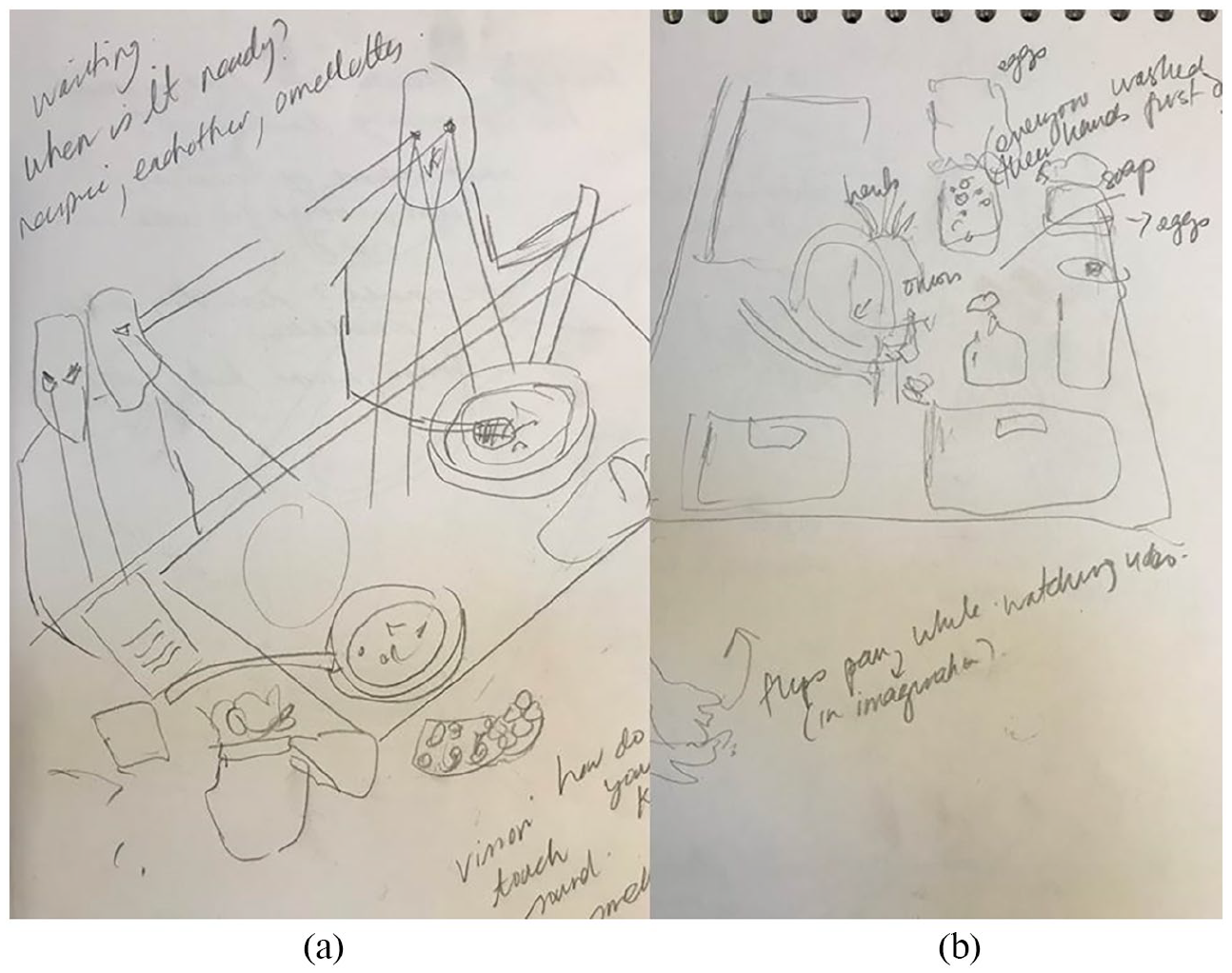
(a) and (b) Pencil drawings from our shared sketchbook.
When it came to observing participants’ learning, we discussed this quandary thoroughly, invoking methodological notions of the way in which drawing helped us to move away from a reliance on verbal forms of translation, allowing us space ‘to focus on non-verbal aspects of what was going on, especially the gestures and hand movements of the participants’ (excerpt from Anna’s fieldnotes). We also considered the way drawing fostered an environment in which observations could be notated in a non-representational manner. Here, we found ourselves sympathetic to Taussig’s (2011) discussion of drawing within fieldnotes wherein, referencing the work of John Berger, he highlights the ‘conversation’ that drawing fosters between the researcher and the thing drawn. Beyond this point, Taussig (2011: 22), here paraphrasing Berger, states that ‘a line drawn is important not for what it records as much as what it leads you to see’ (see also Berger (1953)). For us, this individual affordance of drawing as ethnographic method, indeed, rang true. However, the question of what the drawings themselves, beyond their methodological possibilities, could give us, remained.
When it came to sharing the material produced, we were struck by the way in which the drawings themselves had the ability to impart traces of subjective observation. Looking again at Figure 1(b) we see the set-up of the Kitchen Lab as experienced by Anna, who made the drawing. We had each been in the kitchen and witnessed the set-up ourselves, and also had photographs of the space for reference. Though, in reflecting upon the drawings, we noticed that we each had notated, through our drawings, different and partial material configurations, highlighting certain objects and practices, and dismissing others. The drawings themselves acted as ‘autobiographical record[s]’ of the event, ‘seen, remembered, or imagined’ (Berger, 2007: 3). That is, through sharing and looking at the drawing made by Anna, we were given a visual window into her particular and subjective imagination of, and personal immersion within, the field. We were able to witness, together, those things present in her experience of the experiment, her traces of observation. Beyond this, we found these windows into each other’s imaginations to be a useful starting point of the conversation, both a springboard to interrogations of each other’s perspectives and a helpful tool for reflecting upon our own observational practices. In this way, the drawings produced not only highlighted the potential absences and presences of the field (Deville et al., 2016), but also, and importantly, the absences and presences of the field as experienced by the individual researcher herself. Drawing and, crucially, the sharing of drawings produced, allowed us, as a team, ‘to gain the conscious experience of seeing as though through the [ethnographer’s] own eyes’ (Berger, 1953).
Video: sharing embodiments beyond the transcript
Video is often advocated as an important methodological tool for sensory ethnographic work. For instance, video helped Pink et al. (2016) to recognise hands, through their gestures and tactile encounters, as knowledgeable and affectively generative when it comes to private mobile media use. In his attempt to ‘get at sensory experience’, David Sutton (2014: 8) shot videos of his interlocutors explaining Kalymnian cooking and loaded them onto a YouTube channel. These examples of cooking techniques complemented his ethnographic monograph, and were intended to explore bodily habits through everyday practices, as traced over time. His video of Little Katerina Miha preparing a zucchini omelette for the first time shows how a novice, under the direction of her mother offscreen, cuts the vegetable, awkwardly, and how she turns the egg in the pan with a spoon, a technique common on Kalymnos. Sutton also discovered, through filming the video, how cooking shows had influenced Katerina’s ways of performing cooking, through her style of presentation for the camera. Later videos of Katerina showed greater confidence with using kitchen tools and an expanded kitchen vocabulary. Another example of sensory ethnographers using video to explore skill learning includes Tomie Hahn’s (2007: 17) videos of Japanese dance, intended as a way to ‘convey the experiential, ineffable aspects of fieldwork by inciting interactivity’. Video is also increasingly explored as a way to disseminate findings of sensory ethnographies, evident for example, in the increasing number of PhD dissertations with DVD accompaniments, in the establishment of research groups such as the Harvard Sensory Ethnography Lab, as well as through journals such as the Journal of Embodied Research, which accepts video submissions.
Drawing upon this literature, which shows that video offers a different way of observing in fieldwork, we used video in our experiment with a number of different devices over the three days, including: smartphone, camcorder, tablet and digital camera. To begin with, we kept the video recorders in the kitchen, filming the omelette lesson as it happened. In our early interviews with participants after the lesson, we found that they used their hands a lot when describing what they had learned. While drawing was helpful in tracing the material conditions of learning in the kitchen, initial attempts to trace the details of hand gestures through pen and paper proved difficult. Not only could we not record the gestures in words, but if we tried drawing, we just could not follow the gestures in time, and record words simultaneously. We decided then to introduce the video into the interview setting as well, alongside a prop, a saucepan. The purpose of the video was to examine more closely the gestures participants used in describing cooking an omelette, as we felt that they were in some ways inscribing, through these actions, a bodily memory of what they had learned.
Figure 2 is a still from one of our interviews. It shows two participants in the midst of re-watching the Julia Child video instructing them how to cook an omelette. There was one particular scene they wanted to watch again: how Child instructed on the movements of the saucepan during the crucial last moments of the omelette cooking. Here is a section of the fieldnotes taken by Rachel during the interview, which took place after the cooking. X and Y have just come to the part of the video with the saucepan movement: Both X and Y recognise the circular movement Child uses.
X: ‘There’s a lot of energy’
Both X and Y are watching the video and moving their hands (mimicking Child) at the same time trying to work out the movement that Child is making with the frying pan.
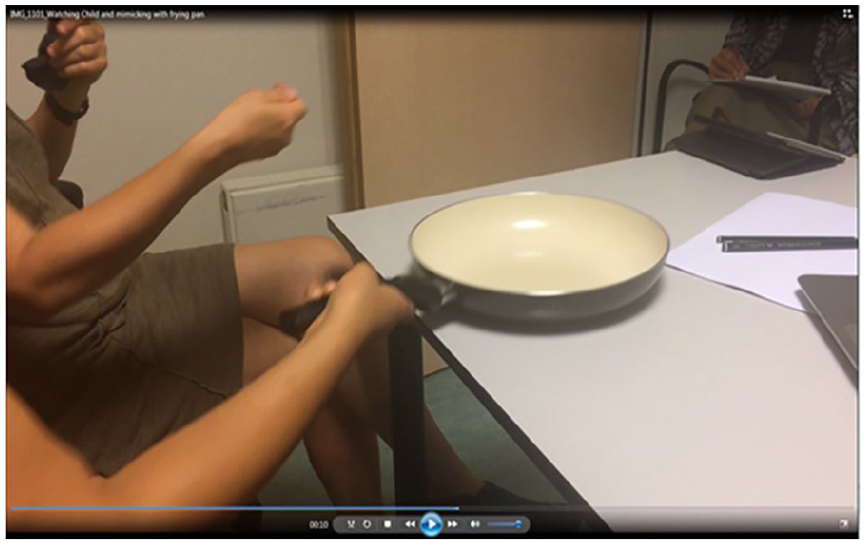
Still from video of two participants re-watching the Julia Child video during an interview after cooking an omelette (filmed using a smartphone).
This is where we found the richness of video in sharing field observations. When reading this section of Rachel’s fieldnotes, it was difficult for Anna and Andrea, not in the room, to imagine what the participants were doing. They had some sense of course of what was in the Julia Child video, but less of a sense of how the participants were mimicking and learning from it. The video helped to show the embodied dimension of the participants’ learning, and the ways in which they interacted with things, the frying pan and the video on the tablet, in a way in which reading fieldnotes, or interview transcripts, the most common practices of working together with material in qualitative research, would not. It facilitated, we suggest, an understanding of the interview encounter that moved beyond words on the transcript page, that encompassed the bodily movements of the interviewees, and thus a more empathetic immersion into the ethnographic encounter for those in our team who were not present in the scene.
In his discussion of the use of video in studying cooking techniques, David Sutton (2014: 10) describes how video used in interviews ‘created a richness of presence lacking in audio recordings’, as well as other insights he gained into the material, bodily and spatial dimensions of cooking. Video, for example, allowed him to look at kitchen organisation, and bodily movements and postures more closely. Video arguably allows for a certain kind of temporal tracing of embodied knowledge, as well as being a way of imparting knowledge, as was its purpose in the Julia Child experiment day. There is a rich discussion in dance literature, for example, about how video has transformed the transmission of dancing techniques, which previously relied on dance notation (Hahn, 2007).
To date, the sensory ethnography literature has largely focused on how video may trace sensory knowing, and less so on its use in discussing research findings with other researchers. Sutton (2014) does mention that videos allowed him to have lively discussions with his colleagues, presumably in a way that his fieldnotes did not, yet does not expand on this methodological point. Drawing insights from the growing field of video reflexive ethnography (Carroll and Mesman, 2018), we found discussing videos with each other an insightful way to learn about sensory practices that we did not observe firsthand. An important aspect of this was the analytical work of the video ethnographer, in choosing what elements of practice to video, in labelling the segment, in choosing what to share with the others in the group and the relation of this video to their fieldnotes. All of this work however became part of the richness of sharing videos, and in facilitating a window into how another ethnographer experienced fieldwork.
Photographs: engendering fascination
Photographs are widely recognised as an important tool in visual methodologies (Guillemin, 2004; Guillemin and Drew, 2010; Pink, 2001; Rose, 2001), and the rise of sensory ethnography has expanded their possible role in research. Pink (2009), for instance, drawing on the work of Laura Marks and David McDougall, argues that the interconnectedness of the senses invites viewers to draw on prior sensory experiences, including but not limited to the visual, to inform a photograph, for example. According to her, an image has the ability to recall the tactile, olfactory, auditory and gustatory as well as the visual, and therefore facilitates understandings of others’ sensory experiences. Other researchers indicate that using photo elicitation – that is, using photographs taken by the researcher, the research participant or someone else entirely as a prompt for discussion – to elicit the sensory can benefit research in another way. Harris and Guillemin (2012) suggest that the sensory awareness enabled via photo elicitation can lead to discussions about previously inaccessible information. Orr and Phoenix (2015) found that a prompt to describe the sensory experience of exercising accompanied by photographs of the participants’ exercise-routine-encouraged responses, which focused on the relationship of the body to materials and the environment, while interviews without photographs tended to describe relationships between people. Taken together, these researchers indicate that using photos to elicit the sensory can expand the topics of conversation in addition to facilitating sensory understanding. This potential of photos in regards to sensory ethnography prompted us to engage with photography during our ethnographic experiment, as a particular way of noticing and observing.
Photo elicitation, both within and beyond sensory ethnography, has been viewed as a collaborative exercise almost since its inception. At the very least, it inspires collaboration because ‘[when] two or more people discuss the meaning of photographs they try to figure out something together’ (Harper, 2002: 23). To our knowledge, the collaborative power of photo elicitation has focused on the researcher–participant dynamic rather than that of researcher–researcher. In our experiment, we recognised the relevance of Douglas Harper’s (2002) observation in that our photographs often prompted us to come to an understanding together, but we suggest that photos play another equally important role in team research; they engender fascination. Video and drawings likely also engender fascination, but we suggest that photographs, through the combination of stillness and the illusion of accurate representation, are particularly fascinating.
Marilyn Strathern (2013: 21) begins her first lecture in the series on ‘Learning to See in Melanesia’ with a consideration of the role of visual material in her research. She describes it as always having been ‘to the side’, and she goes on to say she will present her audience with ‘an accumulation of glimpses’: They [the glimpses] are not alien – they just catch things from the side, and continue to make Melanesian material fascinating. One of the most significant ways of paying ethnographic respect is for the anthropologist to create as ‘interesting’ other people’s concerns, other people’s agendas, so that they hold our attention. I don’t take lightly the task of making material fascinating: it is a form of engagement open to us as academics and scholars.
Presumably the importance of fascination for Strathern is in engaging an audience. This is indeed an essential part of research, but Strathern’s emphasis on fascination also resonated with us in our experience of communicating as a team. When together we viewed Figure 3, a photo of a participant using one hand to crack an egg, our faces lit up with excitement, and yet the analytical point this photo helps us to make about sensory learning remains unclear. For now we are left to draw on our own sensory experiences to notice and marvel at the skill it takes to crack an egg with one hand – the placement of fingers, the resistance of the middle and forefinger stretching away from each other, the balance struck between a simultaneously firm and delicate grip on the egg.
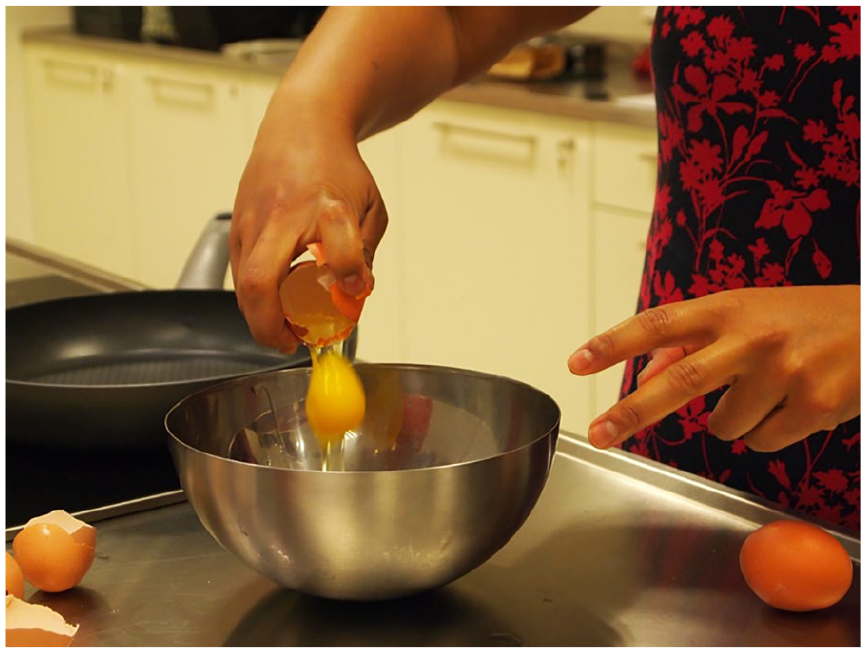
A participant using Julia Child’s technique of cracking an egg with one hand. Second attempt (taken with digital camera).
In the same lecture, Strathern (2013: 21) suggests that the power of photos is partially their ability to enable ‘lateral thought . . . the power of lateral thought,’ she says, ‘is its constancy. The sidelong image remains as it was first glimpsed, before it comes into focus’. Figure 3 fascinates us as a team, and as we continue puzzling about how bodily skills are learned, it lingers as a reference for all of us. Perhaps one day it will ‘come into focus’, and we will be able to draw on the photo to advance arguments about sensory learning. Or perhaps not. Perhaps it only serves as a point of mutual fascination, in which case it becomes a way of paying our ‘ethnographic respect’ as a team of ethnographers.
We agree with Strathern (2013) that we should keep material fascinating for our audiences; however, as team ethnography becomes more and more common, this duty extends to keeping each other engaged in the team. This fascination enables an immersion into one another’s ethnographic imaginations, and this mutual immersion partly encourages us to do justice to our material, that is to keep asking questions and to handle responsibly which our participants give to or generate with us. In the age of the lone ethnographer, fuelling such sustained interest was largely the task of the individual. Today, this task can be distributed amongst a team of researchers, and it is something photographs, and likely drawings and videos, can facilitate.
Conclusions
The initial aim of our ‘proof of concept’ study described in this article was to experiment with sensory methods within our research group, before starting fieldwork. We focused on three different sensory methods in particular – drawing, video and photography – to explore their potential. We found, however, that not only did these methods have a role to play in understanding sensory skill learning (each one offering particular insights we have highlighted in this article, but which could also be seen as running across all three methods), they also helped us in our team work by facilitating an immersion into the ethnographic imaginations of others in the team. We showed how drawing became a method by which we could trace each other’s lines of observation, providing us with a window of understanding into that which had been seen, and not seen, in the field. We described how video was used in the interview setting to share details of embodied learning that were missing from the interview transcripts that circulate among the group, and how photographs instigated moments of shared fascination, which is important for conducting responsible team ethnography.
Each of these different methods is increasingly used and being advocated for in sensory research, particularly sensory ethnography and interviewing. To date, the sensory methods literature has focused predominantly on individual researchers, exploring ways in which to learn with and about their informants’ lives and practices, in particular, the sensory, subjective details of their ways of being and navigating in the world. This literature draws from phenomenological frameworks that reinforce the individual approach to studying experience. When collaboration is addressed in ethnographic literature, it most often acknowledges the work of collaborating with participants rather than other researchers.
Yet, as we discussed, ethnographic research is increasingly conducted in teams. While some of the literature which deals with team ethnography inclines towards the importance of researchers’ sensory experience in comparative ethnographic work (Deville et al., 2016: 106), it has not explored the specificities of sharing difficult to articulate, sensory, subjective details of fieldwork experience, which are hard to share in fieldnotes or interview transcripts. In order to address these gaps we focused in this article on detailing how team ethnography ‘deals with distributing the sensory apparatus of researchers over the world, and brings it back together to exchange what was gathered’ (Deville et al., 2016: 106). We found that three specific sensory methods – drawing, video and photography – facilitated communication within our group of ethnographers.
We suggest therefore that sensory methods have an as yet unrealised potential in team ethnography. While our discussion concerns methods of sensory ethnography, not only do we believe that these insights are applicable to team ethnographic projects using other forms of sensory methods (for example, interviews, different kinds of visual and sound analysis), we would also go so far as to suggest that these insights are not limited to studies which concern the sensory. In fact, we suggest that sensory methods might even complement quantitative team research projects, where researchers may share working drawings, photographs of research sites or videos, alongside the other more numerical material they might collect, as a way of understanding the research imaginations of others in the team. We also strongly recommend to qualitative researches to engage in ‘proof of concept’ experiments of the kind which are more common in quantitative research, before heading off into larger material collection exercises. We believe that this has the potential not only to try out methods before fieldwork but also to open the research up in unexpected ways.
Given the increasing number of team-based research projects, these are timely insights for group research. Current funding schemes in many parts of the world, particularly Europe, increasingly are structured for team-based research project designs (Beneito-Montagut et al., 2017; Deville et al., 2016). Our focus in this paper has been on team ethnography, and as this kind of research becomes more common, we believe it becomes increasingly crucial to explore how researchers arrive at and communicate their research findings. This will not only enrich the collaborative projects but also attend more closely and carefully to how knowledge is formed within these projects. For those of us involved in such endeavours have a mutual obligation to trace our learning, to go beyond the easily shareable and to always remain, in whatever way we can be, fascinated.
Footnotes
Acknowledgements
This paper was greatly inspired by the probing questions and observations of Kristen Haring, who spent time with our research group during the running of the omelette experiments. We are also indebted to our colleagues (many of whom are part of the Maastricht University ethnography group), family and friends who participated in the experiments and for their wonderful comments on the methodologies throughout. We were able to conduct two days of experiments in a dedicated kitchen laboratory thanks to the generosity of the Faculty of Psychology and Neuroscience, Maastricht University. Thomas Fuller and Ido Holkamp kindly helped out with cooking lessons and catering. We were able to repeat the experiment at Marres House for Contemporary Culture, Maastricht, several times and thank Ilse van Lieshout, Valentijn Byvanck and the medical students who participated for thinking along with us. Rachel also re-enacted the experiment as part of a #collexx conference in Lisbon. The Maastricht University STS research group offered insightful feedback on an earlier version of the paper during our Summer Harvest (especially Simone Schleper, as discussant), and we received comments from other members of the Making Clinical Sense project team, especially Sally Wyatt, Harro van Lente and Carla Greubel. So in sum, this article would not have been possible if not for real teamwork, and the generosity of our fellow ethnographers and collaborators. Finally, we wish to thank the reviewers for their excellent comments and suggestions for revision, the new editorial team of this journal.
Disclosure
The authors report no conflict of interest. The authors alone are responsible for the content and writing of the paper.
Ethics approval
Ethical approval for this research was granted by Maastricht University’s Ethical Review Committee Inner City Faculties on 18 May 2017, reference number ERCIC_040_11_05_2017.
Funding
The authors disclosed receipt of the following financial support for the research, authorship and/or publication of this article: This work was supported by the European Research Council under the European Union’s Horizon 2020 research and innovation program (Grant Agreement No. 678390).
