



Abstract
This article addresses the methodological aspects of a multi-voiced, collaborative ethnographic research process, in particular how video can enhance and amplify this research endeavour. The authors illustrate and discuss how experimental filmic methodologies can help to capture processes of becoming in a collaborative research endeavour, both enabling the development and production of diverse empirical materials and enhancing the multivocality of research practices. Using explorations of the National Tourist Route towards Havøysund in northern Norway as our empirical context, we reflect on diverse engagements along the process, such as becoming aware how the camcorder becomes a member in the research team. The filmed material forms an entanglement where our explorations along the route, our cultural practices related to the northern landscape and diverse disciplinary practices come together. We address three main ways video contributed to our research process and the creation of research materials. First, we highlight how video enables the creation of empirical traces that can be used as research materials. Second, we explore how video can work for mobilisation of multivocal dialogues. Finally, we point out that video opens the way for integration of the sensual into the research process.
Introduction
This article addresses the methodological aspects of a multi-voiced, collaborative ethnographic research process, exploring in particular how video can enhance and amplify this research endeavour. The work is the outcome of an exploration conducted by an anthropological filmmaker (Beate), a communication scholar (Trine) and a posthumanist researcher (Outi) along a tourist route leading north to the village of Havøysund on the northern coast of Norway. The three of us had a shared interest in the modern architecture situated along the tourist route and wanted to explore and research it together. Beate was motivated by local discussions of the architectural installations along the route, in particular the locals’ attempts to initiate a dialogue about potential adjustments or alterations of such structures. Trine was intrigued by place development through the appearance of tourism-related infrastructures, such as a tourist route. Outi’s interest lay in the relationship between architectural design and nature, particularly in how the tourist is offered an experience or understanding of nature. We decided to apply an ethnographic research methodology to our inquiry along the route to both investigate the diverse embodied and materially mediated practices through which place is occupied and analyse the process of becoming through dwelt representations and practices (Cloke and Jones, 2001), whether touristic or mundane. We specifically brought with us a camcorder as part of our process. This paper is an outcome of our exploration. In it, we discuss how an ethnographic research process enabled us to explore the tourist route and its architectural structures – and struggles – together, revealing how the use of video in a collaborative research endeavour can enhance the multivocality of research practices. By emphasising the multivocality of the research process, we allow our different disciplinary and experiential backgrounds to enhance our exposure to various ways of being in the field, producing research materials and conducting analytical discussion (Lapadat, 2017).
The three of us share the understanding that places become meaningful through their inhabitation, and we are aware of the cultural processes and practices through which places become meaningful and are actively used (Feld and Basso, 1996: 7). Mobilising our diverse backgrounds, we encountered each other, the materiality and weather of the tourist route and its architectural elements, and (traces of) local people along it. When initiating the project, we were inspired by Simmel’s theorisation on the ‘stranger’ (1950). For Simmel, ‘distance and nearness – indifference and involvement’ come together in the concept of the stranger. Accordingly, architectural elements constructed along the national tourist route are simultaneously detached from the locality and involving us in it. We built on visual anthropology and brought in perspectives from communication, thinking that ‘mobility of humans, ideas and material things entails encounters and the production or reproduction of similarities and difference, as those who move or are moved tend to position themselves or be positioned in relation to those they meet and to one another’ (Nyamnjoh, 2016: 319). Finally, we also found literature on tourism to be an important source of inspiration, such as the way in which Veijola and Falin (2014) conceptualise mobile neighbouring, urging a dwelling-alongside – a sharing of space with unknowns.
Focusing especially on the use of video in the collaborative ethnographic research process, we discuss how multivocality of our research practices can be enhanced. Our use of video comes close in some ways to the (re)active documentary methodology described by Wolfe (2017): the role of film here is not to represent fixed alternative realities – alternative, that is, to those described for marketing purposes – but to enable a process of becoming. Furthermore, Wolfe highlights the importance of creating encounters through film, including sensory dialogue ‘as a movement with the participant and the virtual audience’ (2017: 431). In our research, we push the importance of film(ing) even further, pointing to the ways in which the actual camera is entangled in our group, itself a fourth group member, impacting how our research group relates to, acts with, and moves around in our surroundings when we are in the field.
Our research process consisted of three tours along the tourist route during spring 2016 and summer 2017, working with filmed materials in the editing stages and presenting audio-visual materials in different research forums. The engagement process also included bringing our children along on one tour, having field conversations with locals about the tourist route and following related media discussions.
Following this introduction, we briefly explain our ethnographic and multivocal positioning as researchers and the context of our research process, the national tourist route 1 towards Havøysund, before exploring the role of video in conducting collaborative ethnographic research. We address three main ways video contributed to our research process and the creation of our research materials. First, we highlight how video enabled the creation of empirical traces that could be used as research materials. Second, we explore how video mobilised our multivocal dialogues. Finally, we point out that video allowed for the integration of the sensual into the research process. Our reflection includes a video – in addition to this written paper – which is available at the following link: https://vimeo.com/552897174 (password: Strangers). We recommend watching it as a whole before continuing to read this paper. It participates in the creation of our empirical material – our ‘research footage’ – more than it presents a ‘monographic documentary’ (Omori, 2006: 119).
Collaborative ethnographic research
In order to reach for multivocality when conducting research together, we decided to apply an ethnographic research methodology to draw from our collective experiences engaging with the tourist route and experimenting with filming. With an ethnographic approach, being close to the research field is a resource (Baarts, 2010; Hastrup, 1999), since data production and analytical interpretations of ethnographic data constitute intertwined processes wherein bodily and sensory encounters form a vital part of knowledge production (Vannini, 2015). We felt that ethnographic methodology would allow us to draw from our diverse connections to the plave and to the route: Beate grew up in Havøysund and is still a frequent visitor, even though she has not lived there for more than 30 years. Trine grew up in similar landscapes on the other side of the county. Outi moved from Finland to northern Norway in 2014 and has experience in conducting fieldwork with modern wooden shelters built along another tourist route on the northeast coast of Norway.
We three researchers also have different academic roots and traditions – Beate from visual anthropology, Trine from cultural studies and Outi from tourism studies and environmental humanities – but we share the understanding that places become meaningful through inhabitation, and we are aware of the ‘cultural processes and practices through which places are rendered meaningful—through which, one might say, places are actively used’ (Feld and Basso, 1996: 7). Chang et al. highlight how collaboration across academic disciplines can enrich the research process by providing access to ‘the theoretical advances of various fields to the study of complex social phenomenon’ (2016: 25). One is here challenged to question one’s own understandings, conceptualisations and interpretations. This is close to what Kramvig (2007) describes as multivocality in research. Kramvig recommends multidisciplinarity and what she calls multivocal ethnographic fieldwork, in which research is concerned with adjusting oneself to the contexts of which one becomes a part. It means ‘tuning oneself in’ to the place, to the people, to nature and not least to the other knowledge providers with whom one is working (2007: 63).
In our ethnographic exploration along the road towards Havøysund, we strived for such a multivocality that would allow us to become sensitive to the ‘ongoingenss and sensuousness’ (Lury and Wakeford, 2012) of the tourist route, and to engage with this ongoingness collectively. Lury and Wakeford (2012: 7) highlight that experimenting and inventing in the field is something that cannot be given in advance, but require openness. In their edited book, Sánchez Criado and Estalella (2018: 20) encourage researchers to engage with inventive methods collectively by introducing examples of experimental collaboration – ‘a form of engagement that entails field interventions through material and spatial arrangements that enable the articulation of inventive ways of working together’. Here, our aim is to illustrate how working with video together enables openness towards the field and towards each other – inviting the research experimenting. This collaborative, multivocal process come also close to poshuman inquiry to ‘think-with’ objects, animals, theories and elements (e.g. Ulmer, 2017): a way of becoming together, entangled in collective processes.
Conducting research along the national tourist route
The National Tourist Route Project began in 1994 and today extends throughout Norway. The project is organised by the Scenic Route Department of the Norwegian Public Roads Administration, which has engaged more than 50 architects, landscapers, designers and artists in developing aesthetic stops along the 18 official tourist roads. 2 Our project is an exploration of the 67 km road that leads from the small village of Kokelv towards Havøysund, which is the centre of the municipality Måsøy. By car, the journey takes about an hour; the road mostly follows along the shoreline through a rocky landscape.
We – the three researchers and our camera – visited three architect-designed stops
3
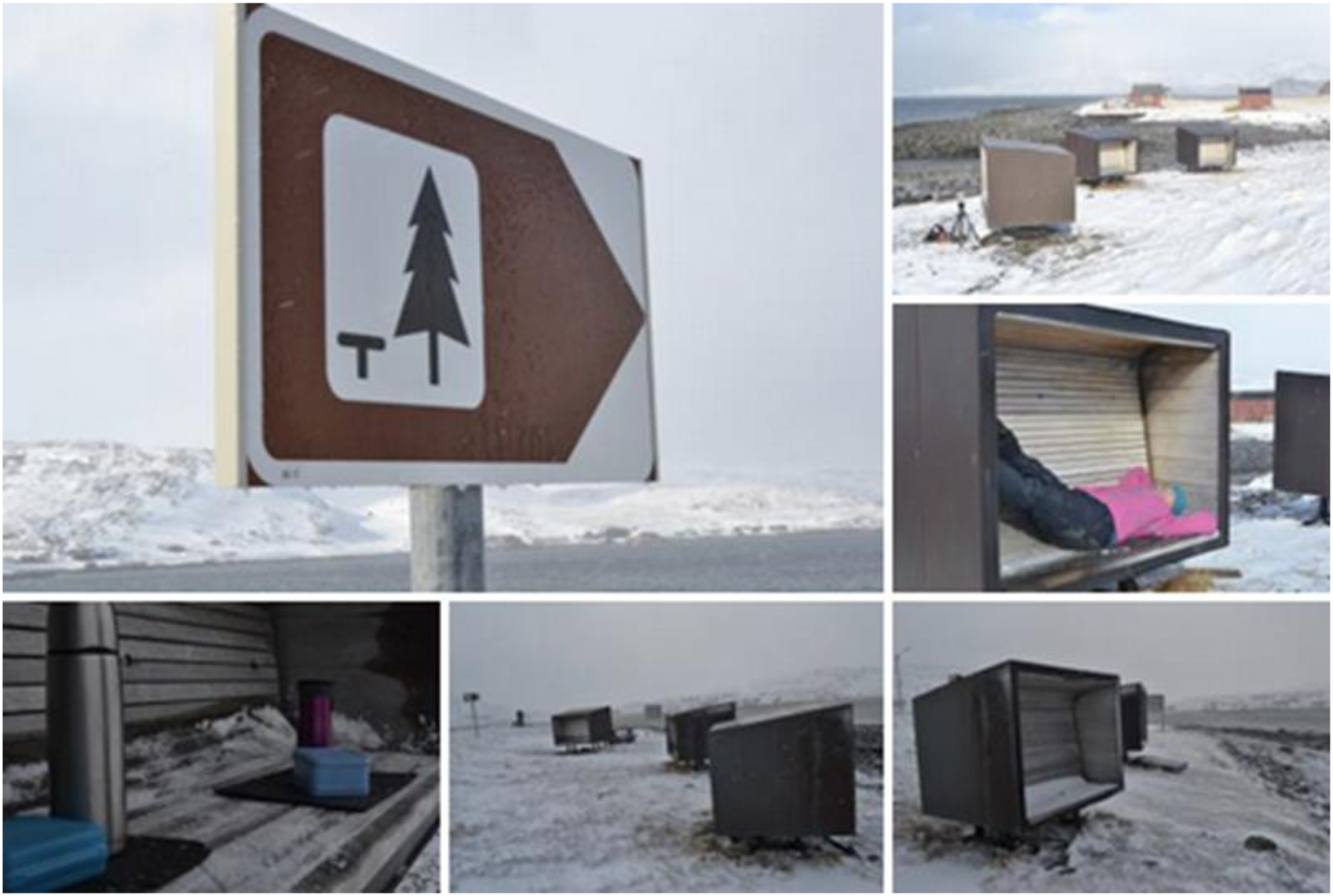
developed by National Tourist Route Project during spring 2016 and summer 2017. The first stop is located in the village of Lillefjord. Completed in 2006, it is designed as a bridge with a small wooden building that houses a toilet and a bench (see Figure 1). Following the trail that goes from the bridge up the hill, another bench appears at a scenic point near a small waterfall. The second stop, completed in 2005, is located in the village of Snefjord. This stop consists of three ‘boxes’ with integrated benches. The wooden boxes can act as sitting areas with roofs to provide shelter (see Figure 2). Locally, these installations are often referred to as the ‘starlings’ nest boxes’. The two first stops have a relatively modest expression compared to the third one. The first stop in Lillefjord. The second stop in Snefjord.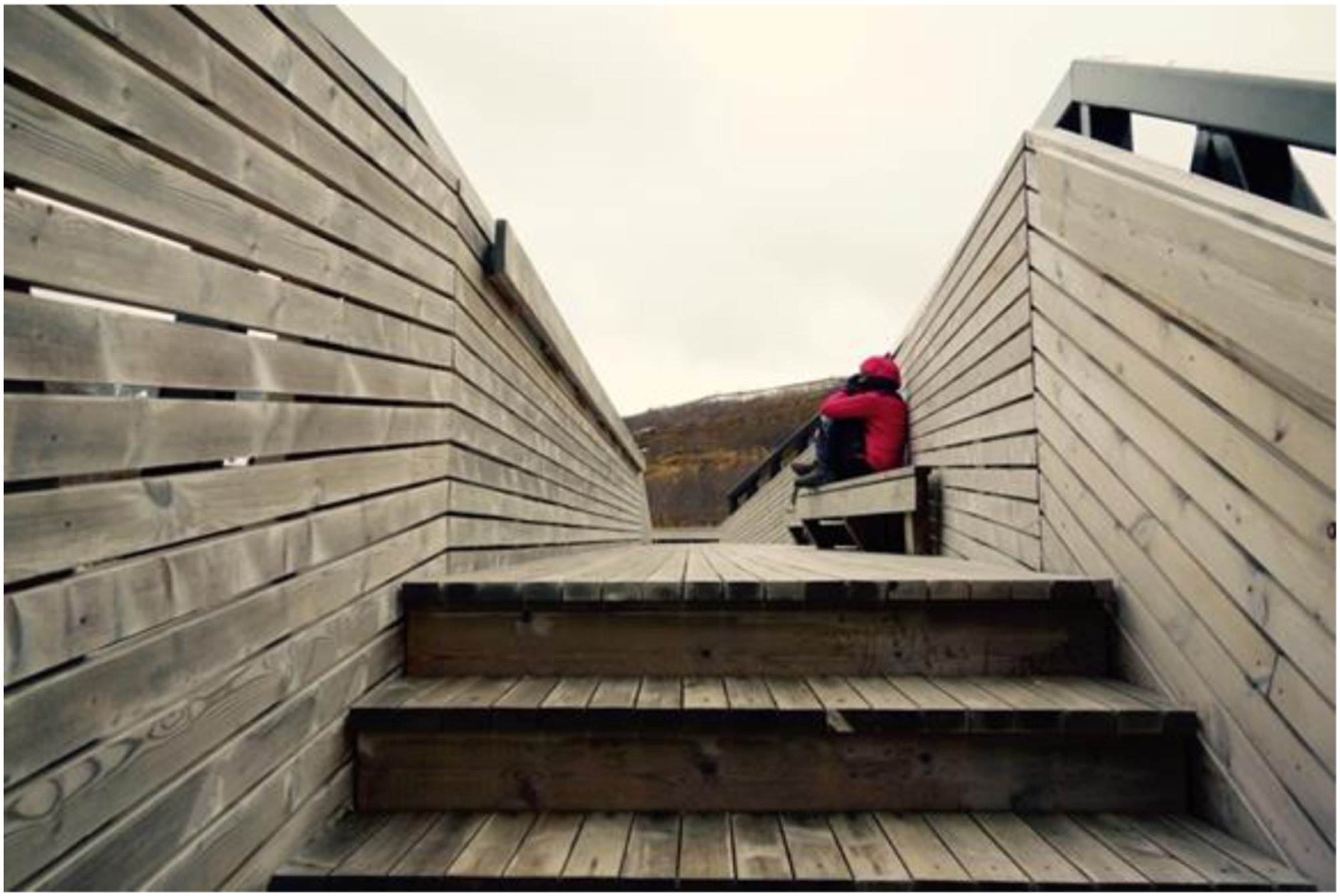
The third stop, located in Selvika on a beach about 10 min by car from Havøysund, was completed in 2013. It consists of a large concrete structure with an integrated bicycle rack and toilet (see Figure 3). The construction also includes a walkway that winds down to a fireplace and seating area located right on a large, white, sandy beach. The assemblage is very visible in the landscape, and local people refer to it as anything from a giant sandcastle to a huge octopus or even a big ‘beach worm’. The structure received the 2013 Concrete Award (Betongtavlen), a prize awarded by the Norwegian Concrete Association and the Norwegian Association of Architects. The third stop in Selvika.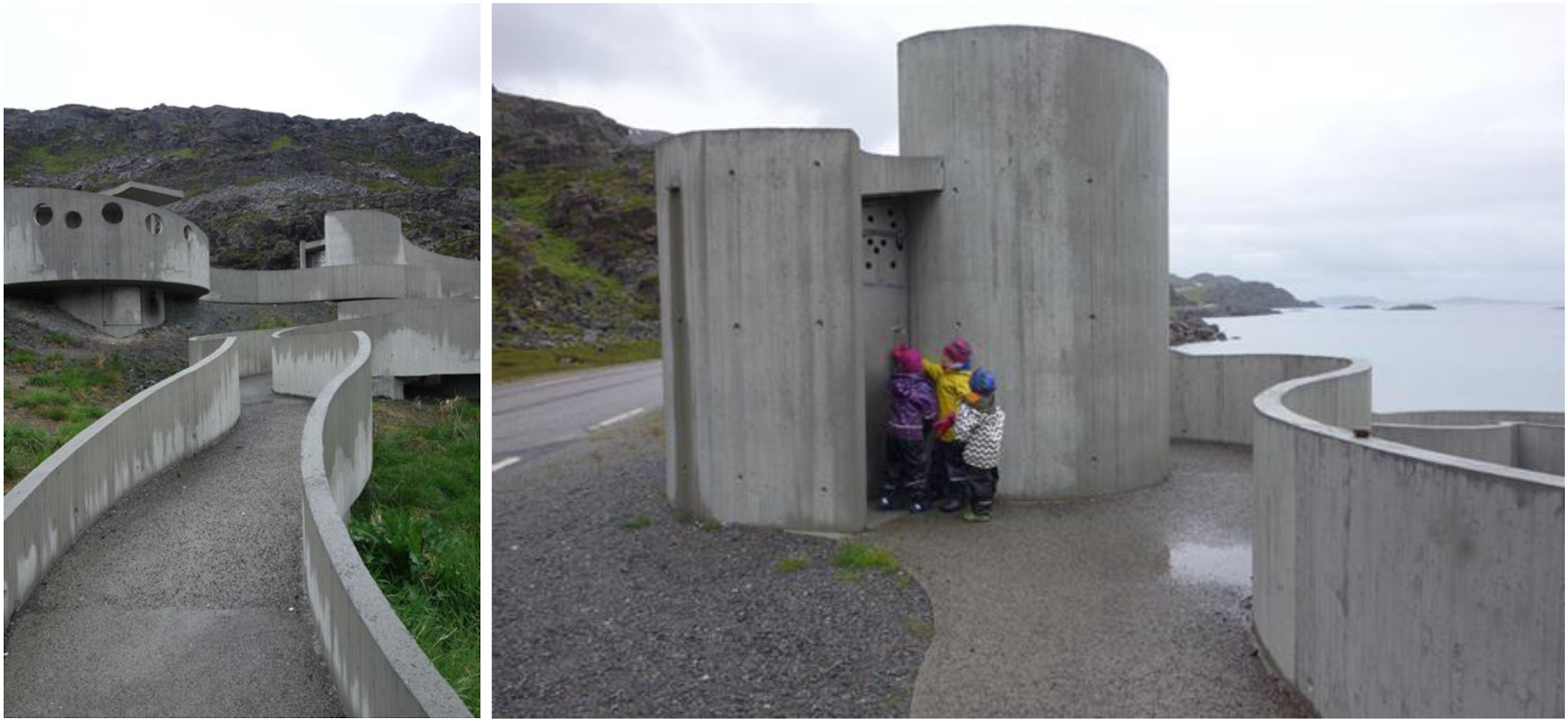
Beate is well acquainted with the environments we explored; Trine and Outi have both spent a lot of time in northern landscapes, but had never been to Havøysund when we initiated our joint project. We thus lacked Beate’s deep knowledge of the Havøysund environment. At the same time, we felt at home there because of its affiliation with the north, given our many experiences with other places comparable to Havøysund in, for example, their landscape, weather, buildings and infrastructure. For instance, after our first visit to the Havøysund installations, Trine wrote: Stepping out of the car by the bridge in Lillefjord, the icy wind kissed my cheeks and I felt it welcome me back to the ‘real Finnmark’. […] The wind lifted the smell of the wet and salty ocean and brought it from the beach, up the hill, across the road and over the parking lot before letting the scent dance around in my nose. I felt refreshed and at home. (Field notes, April 2016)
Our progress along the route took the form of three self-guided tours (April and May 2016 and July 2017). We always made sure to bring a camcorder, and while it was Beate who knew how to operate this equipment, we all shared an interest in making sure to incorporate and accommodate the camera. During each of these tours, we drove along the road together, filmed, and spent time at the three stops. We also visited the village of Havøysund, where we interviewed local people who were involved in construction or development along the route. These interviews helped us tune into the place, providing a backdrop for our own experiences, which was particularly helpful because we had met very few people at the specific sites we explored.
We went on walks in Lillefjord, following foot paths made by other human or non-human creatures. In Snefjord, Trine and Outi wandered around, sitting on and laying in the boxes, while Beate did the film work. At each site, we talked to each other, with Beate participating in the conversation from behind the camera. We spent the most time in Selvika. Here, too, we moved around the landscape and tried to use the concrete structure as a viewpoint, shelter and seating area. Beate filmed the structure from many different angles as well as Trine and Outi while they described and reflected on the appearance of the concrete structure. For our third visit, we brought our children with us and spent the night in Selvika. We set up a tent and a lavvu, a traditional Sami tent, and spent time cooking and organising our stay that night. By traveling with our children, we gained a different experience at the site and with the structures.
Bringing children into the research dialogue can act as the addition of a methodological dimension since visiting places with family members can highlight ways to experience architecture and structures differently (Rantala and Varley, 2019). For example, aspects that did not initially seem significant at a stopover emerged for us as more important, and new challenges in and opportunities for using the area became more evident through the children’s exploration of the site – such as closed toilet facilities. Also, our children seemed to have a special openness towards the material surrounding (see Rautio, 2013): they used the infrastructures in creative ways in their play, ignoring linguistic limitations (two of them speak Norwegian and two Finnish). For us, this change reinforced the multivocality that we strived for in our project; the children introduced different ways of moving and dwelling, and they altered our own experiences and movements in and on the sites. They thus helped point the camcorder toward elements we might otherwise not have noticed in the same way. In line with ethnographic methodology, throughout the process we created field notes that aimed to purposefully reflect on our practices along the route.
Using video to enhance multivocality
As explained at the outset, we want to focus here on the methodological incorporation of video into the research process and on video as a way to reinforce a multivocal ethnographic approach to place. Inspired by visual anthropologists’ use of film in research, Beate brought a camcorder on both our explorations of the stops along the way to Havøysund and our trips at and around the various sites. Beate filmed with a GoPro while driving to and between the stops and with a camcorder as we moved in and around the architectural structures at the stops, as well as when we moved in the landscape around the sites. Here Beate built on a tradition in visual anthropology of using audio-visual tools to conduct research. Trine was eager to take part in this development, being anchored in a discipline in which visual aspects of meaning-making have been central, and Outi was curious about the potential of video for exploring and enlarging sensuous place meetings. In this way, we placed ourselves close to the work of researchers concerned about how film(ing) can help to explore interactions and meaning production (see, for example, Sundsvold, 2018 – and in tourism studies Haanpää et al., 2019; Äijälä, 2021).
Like Pink and Leder Mackley (2012), we see the use of video as an aid in our understanding of place. For us, the camcorder served as a tool to enable, enact and redirect our engagement with the landscape and the constructed structures at the three stops. Patchett (2014: 76) describes video as a form of thinking, of moving images through material and affective logics to an exposure – instead of a capturing – that emphasises empirical involvement. Similarly, Vannini and Vannini (2019) highlight the capability of film to enlarge our sensuous and affective engagement with the material world instead of merely reproducing what is happening in the field. Furthermore, they relate the exposing and engaging uses film to the active presence of the researcher and the method of working with open minds, eyes and ears – working without a premade script, aiming to get a feel for the empirical world at hand, learning as you go and acknowledging the tactility of filming. Hence, framing filming as an open-minded, sensuous and material process can open opportunities for the creation of diverse research materials. For instance, the video material of the way we move around in Lillefjord and Snefjord powerfully suggest something about the smells, the winds, and the temperatures we felt on the days we were there, bringing the surfaces and sensory experiences up close to the viewer of the filmed materials. Furthermore, they invoke embodied reactions and offer an access to our own memories of moving around in those places. In the following sections, we discuss in more detail three dimensions of using video to enhance multivocality when creating research materials in a collaborative research process.
Creating traces
When conducting research on landscapes and places, we see materiality of place as foundational; our research endeavours are deeply embedded in the places studied (Vannini and Vannini, 2019). As Geertz states, it is difficult to separate places from ‘subjectivities and occasions, immediate perceptions and instant cases’, and the concept of place ‘makes a poor abstraction’ because ‘separate from its materialisations, it has little meaning’ (1996: 260). By extension, film has a lot to contribute. Using video allows us to take advantage of visual openness while also providing a foundation for meaning production. Like MacDougall (1998) and Torresan (2011), we see audio-visual materials as providing an opportunity to have an experience that goes beyond telling a story. Images can convey something more, something other than verbal texts: ‘they are chock-full of historical and cultural connections’ (Torresan, 2011: 121). Audio-visual material’s particular strength lies in its ability to augment empirical traces that mix the visual and the verbal – as well as the personal and the analytical. But this must not be understood as a proposal that filming is a separate – mediating – part of our research process. Instead, in line with Van de Port (2018), we argue that the camera and its audio-visual technology cannot be disentangled from what we are encountering in our exploration of the tourist route. Our experiences at the stops on the road to Havøysund – when Beate brings a camcorder along with her – then become close to what Pink describes: The process of walking with video is one of going forward through rather than mapping onto an environment; it offers a very particular way of creating a permanent trace of the routes we take through both the ground and the air. Moreover it provides a way of describing this trace and the experience of making it. (2011a: 146, our emphasis)
We have used video in our interaction with the three sites, also mobilising it as a tool to produce audio-visual tracings of our engagement with them. Similarly to Vannini and Vannini’s (2019) artisanal ethnography, we did not use any premade script related to our fieldwork or our filming; rather, we took an open approach, leaving room for things to develop as we proceeded. This tactic turned out to be fruitful, as the place was new to two of us and the method of collaborating was new to all of us. In this context, the camcorder indeed impacted and directed our method of exploring the places and making traces of that exploration. In the beginning, its presence made Trine and Outi more nervous, as we were not used to being filmed – it made us more aware of our ways of being in and encountering the place. It also helped us to pay attention to the different ways we experienced these places and described our experiences there, let alone the different languages, English, Norwegian and Finnish, we were using to think about and discuss our experiences. Later, the film materials helped us to recognise various traces and allowed others to comment and ask questions regarding our research.
To borrow Pink’s words (2011b: 270, emphasis original), the ethnographic research process involves ‘learning in and as part of the world and seeking routes through which to share or imaginatively empathise with the actions of people in it’ – or, as is more relevant in our research, the traces of those actions. As Sundsvold states regarding her own research, we also find that video recordings function ‘as a memory tool, a storage medium’ (2018: 187). Using video, we create audio-visual tracks and paths from the research process, which we can then review to relive the encounter with the site and reflect not only on the on-site experience and our material and sensuous engagements but also on our subjective attitudes and feelings and the research process we engage in. It was Beate who did the preliminary selection of which traces became integrated into the video through the editing process and which were left out. Trine and Outi supplemented Beate’s editing of the countless drafts of the video with continuous comments, suggestions and ideas on which traces best bring out the meanings we wished to discuss collaboratively, which traces should stay in the final video and which traces evoke feelings that might be too personal to share. In particular, when there were children involved, we were sensitive not to involve material that they could find embarrassing later. Through the engagement with the filmed materials, the three researchers were pulled closer together and we also began to develop a shared sense of place – providing a collaborative and collective understanding of the sites and structures we explored.
For us, there were several aspects of the establishment of a national tourist route in Havøysund that we thought should be explored and highlighted, and using video enabled our doing so. For example, we have been concerned with how broad national projects, such as national tourist routes, are anchored and linked to local processes; we seek to understand how local influence is ensured in such development processes. In many ways, the national tourist route project represents a national policy, and for us it was important that we develop local perspectives, which might include something as concrete as how the architect-designed structures set up along national tourist routes meet locals or visitors’ wants and needs (Westeng, 2018; Woltmann, 2018). While we did not directly encounter any other locals or visitors at our visits at the stops along the route, we had information from interviews with locals in Havøysund, as well as our own insights as both locals (Beate) and visitors (Outi and Trine). Accordingly, the narratives that we created through the audio-visual materials illustrate how the structures at the stops fall short of meeting the challenging weather and wind, while at the same time also showing the positive aesthetic aspects of the structures. When Trine had seen the concrete structures in Selvika both at a distance and close up, she exclaimed: ‘Nice from afar, but far from nice!’ The structure was a fascinating installation at a distance, with all its well-considered shapes and curves. Entering it, however, we found that the toilet was not open (and when it was open, the generator filled the landscape with noise), the holes made us exposed to freezing cold wind and the concrete was unfriendly and ‘untouchable’. In other words, from afar the visual aspects of this place were predominant, but upon zooming in, entering it and using it, the tactile (and pragmatic) elements come forward. Video is well suited to capturing such doubts and tensions in experiences of place.
Video as a facilitator of multivocal dialogue
Through our collaboration, we became aware that filming mobilises and stimulates a dialogue between researchers. Furthermore, film can become an analytical tool itself. Johansen (2013) describes how the writing process is part of the analysis: a process of writing for learning. We also use video to learn and to analyse: by being involved in the audio-visual process – both in front of and behind the camcorder – the creation of the empirical materials and the analysis are intertwined in a continuous dialogue that becomes itself an important tool for critical reflection. When we visited the stops along the road to Havøysund, Beate was behind the camcorder, pointing and framing, possessing in this way the ability to create different narratives. However, through dialogue conducted by the three of us and Trine’s and Outi’s movements in front of the camcorder, the power to create a narrative was dispersed among us. When the two people moving in front of the camcorder focused on something – a view, a smell, the wind, the birds, the holes in the concrete filled with stone and driftwood – the videographer was guided to direct the camcorder in their direction or according to their interests. This collaboration was illustrated especially well when we brought our children along and Beate followed their play.
When examining the dynamics of our group at the various stops, we can see that the camcorder was often guided by statements such as ‘Look at this!’ or ‘Check this out!’ Similarly, when the camcorder was aimed at something, the other two researchers became curious. The camcorder does not shout to the others ‘Come and see!’, but it acts as an index, a finger pointing at something or in a particular direction, and thus indicates to the others that there is something worth seeing. This pointing finger sometimes encourages the researchers to narrate, to talk to the camcorder or to the imagined audience. This tendency means that ‘a video camcorder can work as a probing device and a catalyst for relationships in the field, giving access to information one would otherwise not obtain’ (Torresan, 2011: 190). In this way, a lot of power lies with the person behind the camera. The camcorder’s movement can encourage or mute the researcher who is in front of it. Pointing it toward the researcher can function as encouragement to talk or to act. The action welcomed by the camcorder may be different than that performed without the camcorder present. Our video illustrates to us that we strive to speak clearly, completely and coherently when a camera is recording. Pointing the camcorder away astounds the researcher and shows her that her statements, actions or behaviours are less interesting or important. The camcorder is thus actively involved in the dialogue that takes place during the research process. This fact makes the videographer’s sensitivity extremely important: without it, the recordings will be random and solely coloured by the videographer’s interests and prior knowledge of, in our case, the field that shapes her gaze.
Torresan argues that ‘films are not merely objects that illustrate anthropological findings’ and that we should explore ‘the creative potential of the medium and test whether we can go beyond our preoccupations with the hierarchies between images and text to embrace the special kind of theoretical connections that we can re-create with ethnographic films’ (2011: 190). Like us, Torresan is passionate about what is generated by film(ing). She talks about ‘camera-provoked performances’ that are linked to the relationships between the filmmaker and the filmed person, arguing that a special knowledge base is created specific to the film process: ‘from this perspective, the role of the camera in ethnographic research exceeds that of a recording device; it is an instrument to explore and discover ethnographic realities’ (2011: 120). Furthermore: A film camera and the images we capture with it can work as instruments of investigation, giving us access to information we may not have even noticed had we not been filming and reviewing the material. Cameras are catalysts for performances, and performances work as a genre of self- representation and self-theorisation that can shed crucial light on our understanding of how people perceive their role in the social space they share with others. (Torresan, 2011: 126)
When we bring this understanding into the multivocal, collective ethnography process, something important happens. Sundsvold (2018) indicates that film(ing) can have an impact on the analyses she conducts as a researcher and not least on the experiences she has when using the camera. This influence is particularly relevant in light of our multifaceted approach. An example of dialogue emerging with the help of filming is seen during a visit to Lillefjord when Beate is filming Trine, who looks at the many different paths that lead from the rest area to the waterfall farther up. There are so many lines in the landscape, so many trails. Trine begins to reflect aloud on an article she has read, which analyses the material and symbolic aspects of landscape. This article, she says, describes how paths are part of a rhetoric that materially and symbolically shapes visitors’ experiences in the landscape (Senda-Cook, 2013). She continues to consider the arguments in the article, testing the article’s points against the specific landscape at hand. ‘Would it be possible to symbolically invite people to choose only one of the many trails in Lillefjord, in order to reduce use and wear in the landscape?’ she asks. The question is not directed to the camera lens, but knowing she is being filmed encourages her to speak what is on her mind. The filming process drives her to theorise out loud about the research field that she is a part of; she articulates her reflections and tests their applicability in light of the specific context of the tourist route to Havøysund. Finally, she ends her considerations by dismissing the opportunity she first put on the table, beginning to muse aloud that the animals, who make extensive use of the trails in this area, would probably not care about an ‘invitation’ to choose one special path over another. Using video allows us to include the dialogical paths of such brief reflections while simultaneously enabling the production of new narratives. Video provides space for the inclusion of the small detours of thought that are usually discarded from the final narrative. The medium leaves us with an openness to these rejected thoughts and theoretical tests that might be included less often in written texts. Making space for these thoughts is a valuable addition to the ethnographic research process because it encourages reflection in and on the research process, reinforcing a lingering in bodily and sensory encounters with place.
The way we integrate the camcorder into our group dialogue is also a relevant part of the multifaceted perspective we strive for. A key aspect of multivocal ethnographic work is the inclusion of several researchers with different academic backgrounds in the same field at the same time (Kramvig, 2007: 64). Kramvig points to examples wherein people then approach the researchers with different issues, stories and descriptions. Likewise, we approach the local structures differently, and the structures impact us in different ways because of our different professional roots. For example, during our explorations at each of the three stops, Trine pays special attention to the rhetoric governing the display of these places, whereas Outi focuses on materially mediated engagement with them. Inspired by Kramvig, our encounters with the stops along the national tourist route out to Havøysund becomes a trans-professional field of knowledge and experience that linked our various academic perspectives through our joint exploration.
We thus hold to Kramvig’s argument that we see better if we reflect collectively. Through our interdisciplinary approach, wherein each of us tests the perspectives we bring forth, we better achieve the multitude of voices that Kramvig talks about. In meetings, people will often instinctively strive to understand each other and to agree in some way. Video enables and encourages meetings in front of and in connection to the camera. However, we also try to give each other room for different perspectives, and we share an awareness of how important it is to be allowed to ‘disagree’. Audio-visual material and the process of making the video challenge us to speak these tensions aloud when, for example, we are editing the video and discussing which traces to include in the final product. Hence, film(ing) can help us to explore the collaborative processes of engaging and becoming.
Sensuality when using video in collaborative research
As discussed above, in our project, the camcorder has, in many ways, acted an extra member of the research team. It made demands of us and requested to be considered, for example, by requiring us to think differently about the meaning of weather and wind and become more conscious of (daytime) light and sound. It made us realise that even though we researchers were used to travelling in the north and were equipped with appropriate clothing for sudden changes in weather, filming required another type of sensuousness. Next, we focus our attention on using one’s body and senses in the research process. Casey highlights how ‘places belong to lived bodies and depend on them’ (1996: 24, emphasis original). By using an audio-visual approach, we give ourselves the opportunity to practice our sensory, embodied ‘ways of knowing’ (Pink and Leder Mackley, 2012). Video reinforces the sensory dimensions of experience. For example, from Beate’s point of view, filming along winding roads with a GoPro resulted in an imperfect video – but at the same time, articulating their curviness was essential for us, as it was an experience that was difficult to capture and reflect on. When editing the video, we realised that during our third trip Outi’s child demonstrated the value of such observation by connecting the curves of the third structure to the curves of the road. We had missed this connection earlier on, even though driving in this landscape is an embodied experience of curving repeated in the third structure.
Storaas (2012) argues that emotional experiences from fieldwork are often discarded because they do not have the desired ‘distance’ from what one is researching. Lately, however, interest in research that takes the sensory into account has intensified. Film has been instrumental in generating such interest as it allows ‘the viewer to be drawn into the senses of place’, according to Concha-Holmes (2015: 70). Concha-Holmes (2015) relates with Ingold (2000) and MacDougall (2006) in their quest for ways to encounter fluid transitions when approaching a place. The distinction between vision and hearing becomes blurred, the perspectives that are incorporated vary and there is greater room left for incorporating sensuality into the research process. Video can thus be described as ‘a route through which seeing and hearing can lead researchers and viewers to empathise with and imagine multisensory embodied experiences and not simply the aural and visual worlds of others’ (Pink and Leder Mackley, 2012: 95). Video provides a more detailed and thorough example of what Geertz (1973) refers to as ‘thick descriptions’. Hence, Storaas points out that even though empiricism is so vital to us in building knowledge, our empirical depictions are shallow, and therefore visual research methodologies and – we would suggest – experimental video methodologies can enable ‘empirical complexity’ (2009: 180).
For example, we may consider how the video medium compelled us to explicitly discuss the lack of other people in the sites we explored – or, rather, the seeming lack of other people at the sites. When others meet our video footage (for instance when reviewing our article and video), the lack of other people seems clear. That is, our video provides traces of the scarcity of people in the places we have visited. Importantly, it was not something our research team had discussed much and therefore did not evoke any dialogue from us until the referees pointed it out. For us, there was not a lack of people, because even though we did not meet them face to face, we met them in implicit ways by encountering their traces. Cars passing by, litter and items left behind, laundry being hung to dry in the bathroom and others’ makeshift additions to the structures were for us different indexical signs that pointed to the presence of others. In particular, in light of information gathered from our preliminary and preparatory conversations with locals, we could interpret the traces in the places in order to understand more thoroughly how locals were using the structures. Beate, with her local connections, made sure to remind us of these uses from behind the camera. Although these reminders are not directly visible in the video, they influence Trine and Outi’s actions in front of the camera and furthermore ensure the video camera directs its gaze toward these signs of use. In that sense, the local people were with us, even though they were not caught on film. When making conversation with the video footage during the editing phase and, later, when reflecting on the video, our audio-visual description of the places we visited also told a similar story to the one available in official marketing materials representing the route, in which it seems like an empty wilderness without the presence of people.
The video as a trace, as a product created through our exploration and as a process, has proven to be a fruitful tool for highlighting emotions and multi-sensory experiences when meeting (in) places. This development happens through the audio-visualising of emotions through film, but also because filming makes emotions a topic of dialogue and discussion. The visual and dialogic communication of emotions helps to make them objects of reflection. During one of our first visits to the stop in Lillefjord, we encountered a lot of cold wind. Snow was coming. We had dressed well, so the weather did not bother us very much. However, our camcorder – the extra member of the research team – was not happy with the whipping wind. We tried to laugh at our efforts to film, but it still became clear that the microphone and camera lens were not impressed. ‘We must come back here when the weather is better’, Beate concluded. We returned to the stop in better weather. With packed lunches and thermoses in our backpacks, we wandered up from the toilet building, the bridge and the bench at the entrance of the area toward the nearby waterfall. That day, the camcorder caught Outi looking up into the sky, pointing to a small hole in the cloud cover and urging the rest of the research team to turn their attention downwards to a campfire we had noted on the way up the mountainside earlier. ‘That’s our lunch break’, she said of the hole in the cloud. The audio-visual conveyance of this episode helps bring weather and wind into conversation with experience and movement on and around a place like Lillefjord. The editing process in turn extends our dialogue. It enables us to highlight the smaller coincidences and intertwine them into our narratives. In line with Van de Port (2018), we do not see editing as something separate from our research; rather, it is part of the sensuous exploration of the tourist route, yet another way the camcorder takes part in discussing the issues and experiences all of us encountered when at the three field sites on the route to Havøysund.
At the largest resting place in Selvika, we moved around the landscape, using the architectural structure as a viewpoint, shelter, and resting area. After spending some time there, Trine and Outi found that the structure falls short when it is put into use. It does not provide protection against the weather, since its concrete walls are broken up by round openings of various sizes that let the wind blow straight through. The holes provide nice windows through which to look out or photograph the beautiful surroundings, but they do not provide protection from the cold wind. We saw that people on previous occasions had tried to cover the holes with rocks and driftwood, and Trine wondered if we were observing traces of a conversation between the concrete structures and the local users, where people have tried to ‘make do’ in a De Certeauian (1984) way, to adapt the structures to the need for a protected stop by the road. When we visited Selvika together with our children, we found ourselves having to practice the same creativity, using rugs and cans to cover some of the holes to create shelter. Outi, for her part, became annoyed by the architectural structure when we were made to use the nearby hill as our toilet due to the actual toilet being closed. It is far from nice and practical, she noted while she shuddered in the wind. Afterwards, when editing and watching the video, Trine saw how nice it looked at a distance. Again, the camera became an extra member of our team, reminding us of alternative views and experiences, and we again included that experience in our discussions about the structures at the sites.
Trine and Outi have also, on several occasions, walked around, sat on, and laid in the boxes at the stop in Snefjord. We have used these so-called ‘nesting boxes’ as lunch spots, sun loungers and lookout benches. During our first visit, we brought packed lunches and thermoses to test how lunch-friendly the boxes are. The wind chilled our legs and we therefore curled them inside our chosen box. In the video, Trine and Outi reflect on the process of trying to fit ourselves, our lunches and our legs inside the box, laughing a bit as Outi points out that people have to be “a little bit acrobatic” to make it work. When we look at the video of ourselves in retrospect, we are reminded of how cold it was. Our faces are red and stiff. We have chosen to eat our bread slices with thick woollen mittens on our hands. The action seems impractical and thus speaks to the temperatures we experienced that day. At the same time, the video brings out the good feeling of joining in laughter and having lunch with a colleague who, during the research process, has become a close friend. As time goes on and we return to the audio-visual material, there may be new aspects of the video that become prominent – aspects that we did not reflect on immediately after the visit to Snefjord, but which we can access through the filmed material that has been produced. The video allows us to be tuned into place again and again, with a new layer of reflection emerging with every new encounter with the filmed materials and with our joint discussion of it.
Conclusions
In the paper, we have aimed to illustrate and discuss how experimental filmic methodologies (see Wolfe, 2017) can help to capture the processes of becoming in a collaborative research endeavour, both enabling the development and production of diverse empirical materials and enhancing the multivocality of our research practices. We have used our explorations of the national tourist route towards Havøysund in Norway as our empirical context. In accordance with experimental filmic methodologies, the aim has not been to create a documentary film of the tourist route or present alternative representations of it, but rather to reflect on the diverse engagements that emerge along the research process. Indeed, throughout this process we have become aware that the camcorder was a fourth member of our research team, redirecting our attention and making us even more aware of the sensuous aspects of the exploration. Hence, the filmed material – the research footage – forms an entanglement wherein our explorations along the route, our cultural practices related to the northern landscape, and our diverse disciplinary practices come together. At the same time, it offers a means to study the assorted gatherings and encounters that appear along the way.
There is no definite outcome for this research process – no authoritative account (Lapadat, 2017: 594) of the route or exploration – but there is an opening for a sensory dialogue that can continue with a virtual audience (Wolfe, 2017). Martínez et al. (2021) suggest that a certain looseness can be regarded as integral for ‘many-handed ethnography’. To enable reciprocal work, one cannot hold tightly to one’s habitual methods and to ideas about what the final outcome should look like. Accordingly, we have tried to make connections in our video in this paper, but in the end, these connections seem to remain loose.
The main motivation for the use of experimental filmic methodology was our willingness to tune ourselves into the place, people, nature, infrastructure and our co-researchers. The filming led us to, for example, transform moments and actions that seemed irrelevant or obscure into meaningful incidents and to develop them into audio-visual narratives through an interactive editing process. It directed our attention and gave us cause to reflect and explain our postures, actions, intentions and ideas. It also compelled us to stop and listen to each other.
Vannini and Vannini (2019) have pointed out that filming in the ethnographic process is tactile and postural – a material process. Throughout our collaborative exploration, our tactile, postural and material ways of tuning into the place became evident due to the filming. For example, we carefully considered the positions of the camcorder and the sensitivity of the camera lenses and microphone to the local weather. At the same time, these tactile, postural and material methods of tuning into the place connected both to the materiality of the architectural structures and our willingness to engage bodily with them and to our conceptual disciplinary backgrounds, which emphasise posthuman approaches. Hence, the collaborative exploration enabled multivocality not only by helping us to tune into place differently but also by enabling us to engage with our disciplinary knowledge bases in tactile and material ways – by enabling us to involve ourselves in each other’s research practices and film practices materially. The collaborative exploration indeed enabled a deep listening and witnessing of each other’s practices, providing a sensitive avenue for giving feedback and mentoring each other (Chang et al., 2016; Lapadat, 2017) and the video filming lubricates this collaborative exploration, but furthermore allows for a strengthening of the research process, allowing us to take part in process.
Vannini and Vannini suggest that ethnographic filmic research could not only be about the places but also of the places and embedded in the places (2019: 872, emphasis original). With this phrasing they refer, for example, to the presence of occasional imperfections, such as unstable camerawork, and to the styles of our ethnographic approaches. This reminds us of our imperfect GoPro video material caused by the winding roads. They call for ethnographic work that is sensitive to the place and to the ways its various aspects, such as its weather, impact the mood in created materials. For us, it became clear during the process that we would not produce a ‘monographic documentary’ but instead expand our explorations with ‘research footage’ (Omori, 2006: 119). This decision was based as much on the imperfections of the filmed materials from Beate’s GoPro as it was on the inability of Trine and Outi to participate in the practical editing process or on the open-endedness of local processes that were happening in relation to the route, such as the ongoing struggle with new installations being constructed along the route that made it difficult to say where our explorations started and ended. Our endeavour was an experimental one, and polishing it into a monographic documentary did not feel right. The research footage seems to better capture and illustrate the imperfection of our multivocal exploration and the exploratory mood we possessed. Hence, the outcome offers both insights into the collaborative exploration and a continuous source of multivocal discussions.
Footnotes
Declaration of conflicting interests
The author(s) declared no potential conflicts of interest with respect to the research, authorship, and/or publication of this article.
Funding
The author(s) disclosed receipt of the following financial support for the research, authorship, and/or publication of this article: This work was supported by the Academy of Finland no 326348.
