




Abstract
Current participatory research literature describes different approaches to involving service users in research, draws out lessons to be learned from the process and begins to address the difficult question of the impact of service user involvement on the research outcomes. However, very limited attention has been given to analysing in detail ‘what goes on’ in interviews carried out by service users or considering what difference their interactions make to the interview content and process. This article draws on principles of conversation analysis (CA) and member categorisation analysis (MCA) to examine how co-researchers and participants practically accomplish research interviews. Using Habermas’s distinction between communicative and strategic action as a framework, the article addresses the questions of whether and how co-researchers open communicative space in semi-structured interviews. Two dimensions are highlighted in the analysis: co-researchers’ interviewing skills and their ability to forge connections with participants. It is concluded that both components are necessary to open communicative space and generate co-produced knowledge. This detailed empirically-grounded analysis of co-researcher/participant interactions is both innovative and significant in enhancing understanding of co-researcher contributions to participatory research.
Keywords
Introduction
Research is political, entangled in questions about what counts as ‘truth’ and who can legitimately make knowledge claims (Humphries, 2005). Participatory research (PR) acknowledges the right of service users to contribute to defining ‘truth’ and generating ‘knowledge’ (Cornwall and Jewkes, 1995). ‘Service users’ here refers to people who define themselves as actual or potential users of the same or similar services to those being studied. In addition to moral arguments about the rights of service users to exercise power in relation to knowledge claims, the epistemological argument is that service user involvement in research enhances the knowledge produced through this process (Bergold and Thomas, 2012).
Many funders of health and social research now require the involvement of service users and it is increasingly common for this to be incorporated and costed in research bids. However, the nature and level of involvement vary widely, from acting in an advisory capacity or assisting with data collection to involvement in all stages of the process. The benefits and challenges of service user involvement in health and social care research are well-rehearsed, both in reports from individual studies (such as Miller et al., 2006) and wider reviews (Frankham, 2009). However, Flinders et al. (2016: 266) argue ‘the normative desirability of co-production as a buzzword often crowds out a balanced assessment of the risks and limits involved when it is “done” in practice’. Critics suggest that, far from increasing service user power and influence, PR may represent ‘a different – and most probably more sophisticated – type of exploitation’ (Carey, 2010: 17), co-opting service users into supporting dominant agendas whilst leaving oppressive policies and practices unchallenged (Cowden and Singh, 2007).
Even advocates of service user involvement acknowledge that to do it well, both ethically and practically, is costly of time and resources. From varied perspectives, there is therefore recognition that the nature and outcomes of PR need to be given closer and more critical attention (Aldridge, 2015; Flinders et al., 2016; McLaughlin, 2010). This article makes an innovative and significant contribution to the evidence base about the impact of PR through detailed empirical analysis of co-researchers’ interactions in research interviews. The term ‘co-research’ is used here to mean research ‘done with’ service users rather than ‘to’, ‘about’ or ‘for’ them (Fudge et al., 2007). Co-researchers are viewed as ‘co’ (that is, joint or mutual) in two senses: working in partnership with academic researchers to generate knowledge and sharing key characteristics with participants.
There is acknowledgement that determining the impact of service user involvement in research is problematic (Barber et al., 2011; Ennis and Wykes, 2013; Minogue et al., 2005; Staley, 2009). Most evaluations of the impact of service user involvement are based on retrospective interviews with co-researchers and/or academic researchers. A significant gap in existing literature is detailed examination of ‘what goes on’ in research encounters between co-researchers and participants using data collected at the time. This article’s originality resides in this focus. Although the co-researchers in this study were involved in other research phases and tasks, the focus here is confined to their involvement in interviews. The article is based on examination of audio recordings and written transcripts of research interviews with either older people or people with learning disabilities. The analysis focuses on co-researcher/participant interactions, though an academic researcher was also present. The audios and transcripts constitute an easily accessible version of ‘what went on’ in the interviews that can be analysed to address the question of how co-research influences the research role and relationships. Whilst principles of conversation analysis (CA) are used to analyse the interview interactions, CA is concerned with understanding the practical accomplishment of the interview, not with evaluating its quality or effectiveness (Hester and Francis, 1994). Habermas’s (1984) distinction between communicative and strategic action offers a normative framework for evaluating the impact and significance of co-research in interviews.
The article begins with a brief summary of the concepts of communicative and strategic action and a justification for using this framework. This is followed by a review of related research using CA and an account of the methods used in this study. The analysis is then presented using selected interview extracts. The article concludes with wider discussion of the findings and their implications.
Communicative action
The central concern of communicative action is how language is used to achieve mutual understanding (Fultner, 2014). Habermas (1984) sees all activity as directed at the attainment of goals, distinguishing between:
Strategic or instrumental action, oriented towards the efficient achievement of specific outcomes. The characteristic domain in which instrumental action takes place is ‘the system’, comprised of the sub-systems of money and power (Finlayson, 2005).
Communicative action, oriented towards achieving mutual understanding and enlightenment. Action is social in that individuals work collaboratively to reach a consensus; this builds social bonds and ‘opens communicative space’ between people (Fultner, 2014). It takes place in the ‘lifeworld’ domain, which is unregulated and based on common, informal understanding of ‘who we are’ (Finlayson, 2005).
Habermas argued that as the state and economy become increasingly concerned with the pursuit of efficiency, strategic action becomes dominant, supplanting communicative action.
Habermas’s (1984) theory of communicative action has been heralded as a useful conceptual framework for empirical research (Forester, 2003; Parkin, 1996). It has been applied to participatory action research (PAR), with PAR seen as opening communicative space between research participants and wider stakeholders (Godin et al., 2007; Kemmis and McTaggart, 2005; Wicks and Reason, 2009). Whereas in PAR service users are involved in ‘collaborative social action’ (Kemmis and McTaggart, 2009: 578), generating change through the research process, PR has a more limited focus on the generation of co-produced knowledge, rather than action (Bergold and Thomas, 2012). Communicative space has not previously been applied to PR using semi-structured interviews; communicative and strategic action may be more starkly opposed here than in PAR. Researchers are invariably subject to tension between ‘top down’ pressures, such as funder requirements, resource limitations and their own organisation’s performance concerns, and ‘bottom-up’ imperatives to give voice to marginalised groups (Aldridge, 2014). In this study, PR represented an attempt to bring together the ‘lifeworld’ concerns of achieving mutual exchange and consent between researchers and participants, and ‘system’ concerns with success, measured by the achievement of pre-defined objectives. We sought to answer the question ‘What role do co-researchers play in opening communicative space in semi-structured interviews with participants?’
Conversation analysis and member categorisation analysis
Whilst the concepts of communicative and strategic action provide the theoretical framework for considering ‘what’ the co-research approach achieved, principles of conversation analysis (CA) assist analysis of ‘how’ this was accomplished (Hester and Francis, 1994). The origins of CA reside in the work of Harvey Sacks (1995) and his interest in how conversations are structured to produce and reflect social order. Through close analysis of interactional talk, CA examines how parties to an interaction make sense of each other’s behaviour and orient themselves accordingly. Sacks and colleagues were particularly interested in how talk-in interaction is sequentially organised, for example, in relation to turn-taking – how a turn relates to the one preceding it, what is accomplished in the turn and how it relates to the turn that follows (Sacks et al., 1974). A related strand of Sacks’s work is concerned with how parties use member categories, that is, shared ‘commonsense’ categories to structure and make sense of their social world (Housely and Fitzgerald, 2002). Member categorisation analysis (MCA) does not import social and cultural understandings of categories from the ‘outside’, but analyses how categories are referenced and interpreted by the parties to the interaction (Watson, 2015). Thus, the meaning of a category can only be deduced from how it is used within a specific context, at a particular time (Francis and Hester, 2017). MCA, then, is not so much a method of analysis as, ‘a collection of observations and an analytic mentality towards observing the ways and methods people orient, invoke and negotiate social category based knowledge when engaged in social action’ (Housley and Fitzgerald, 2015: 6).
Although historically CA and MCA have had different analytical foci and developed at different paces, more recently there has been a ‘rapprochement’ (Stokoe and Attenborough, 2015), with recognition that the practices of sequence organisation and categorisation are reciprocal and inter-dependent (Watson, 2015). Categories are embedded in sequences of interaction, either explicitly or implicitly, as utterances designed for a specific audience; equally, the sequence in which categories are invoked is crucial to the meaning of the utterance (Housley and Fitzgerald, 2002).
The application of CA is wide-ranging but highlighted here are a few studies relevant to our research on experiences of social care organisations. Sacks analysed talk in calls to a suicide prevention helpline (see, for example, Sacks 1995) and a considerable body of subsequent work has focused on forms of helping talk. This research has highlighted: the forms of interaction between practitioners and service users (Chatwin 2014; Hepburn et al., 2014; Ulvik, 2015); how competing policy and practice objectives are managed in practice (Räsänen, 2015; van Nijnatten and van Elk, 2015); and how ‘client’ identities are constructed in professional talk (Messmer and Hitzler, 2011).
CA has also been applied to research interview data where it has assisted understanding of: the research methods employed (Halkier, 2010; Irvine et al., 2010); the behaviour of research participants (Rapley and Antaki, 1996); the actions of the researcher (Guimaraes, 2007); and research team interactions during the process of data analysis (Housley and Smith, 2015). More directly pertinent to this article, Roulston (2006) reviews research studies which focus on how descriptions are co-constructed in talk between participant and interviewer. She concludes that interviewers undertake significant ‘work’ in generating and co-constructing interview accounts and therefore much can be learned from examining the processes involved. In a later study, Roulston (2014) highlights the ‘category work’ undertaken by both speakers and the moral dimensions of ‘the ways in which versions of the world are talked into being in research interviews’ (2014: 290). This article shares a concern with how descriptions of experiences are co-constructed in research interviews, but it is novel in investigating how these parties of interest, namely service user co-researchers and service user participants, contribute to this co-construction.
Habermas’s (1984) concept of communicative space and CA are not easy bedfellows. Although they share a view of the social world as created by the interactions of social agents, realised through language (Bogen, 1999), Habermas’s analysis of communication is decontextualized and relies on formal pragmatics, whereas CA is deeply contextualised, embedded in how actors understand and respond to the structure of utterances in the specific situation. Whereas Habermas is concerned with how agency is exercised within formal structure, CA is concerned with how structure is created through the agency of individual actors (Beemer, 2006). However, Beemer argues that the two perspectives should be seen as complementary rather than oppositional:
The presuppositions of communicative action provide the mechanisms for action itself, not as isolated conditions apart from the acts themselves but in association with the contingent features of situations where meaning and order are produced interactively. Agency, on the other hand, is brought within the domain of structure through the shared competencies of speakers and hearers, which define the relational expectancies of action as a mutual orientation to reach an understanding. (2006: 102)
Whilst this article does not attempt to reconcile CA with Habermas’s theory of communicative action, Beemer’s argument has merit in relation to this particular study. The interactions are not naturally occurring talk, but research interviews for which all of the actors have been ‘prepared’ in some way in relation to the purpose and process (i.e. the participatory approach) of the encounter. These presuppositions provide a contextual frame for the interviews and the basis on which the PR approach was evaluated. The lifeworld and system are useful sensitising concepts, guiding analysis of features of social interaction that reflect, on the one hand, ‘bottom up’ shared understandings between participants and co-researchers, and, on the other, ‘top down’ concerns and priorities of the researchers.
Methods
The interviews discussed in this article formed part of a larger UK study funded by Economic and Social Research Council (ESRC) that compared services provided by micro-enterprises with those provided by small, medium and large providers in terms of the extent to which those services were: personalised, valued, innovative and cost-effective (see Needham et al., 2017). The empirical study took part in three locations in England, with nine organisations of differing sizes identified as case studies in each site (i.e. 27 in total). The organisations provided four main types of service to older people and/or adults with learning disabilities: domiciliary care; day support one-to-one support; or accommodation. Based on their previous research (Littlechild et al., 2015), the research team believed that a co-research approach would increase the validity and relevance of the findings and bring benefits to the co-researchers themselves. Service user views and experiences of micro and non-micro service provider organisations were gathered in face-to-face semi-structured interviews carried out jointly by co-researchers and academic researchers. Co-researchers led the interviews, with academic researchers offering support when necessary.
The co-researchers were either older people or people with autism or learning disabilities, reflecting the users of the case study organisations. Fifteen service user co-researchers carried out interviews; nine were older people and six had autism or learning disabilities. All were recruited via local organisations or networks, separate from the case study organisations. A total of 106 service users were interviewed for the project, although a third were not interviewed by co-researchers (see Needham et al., 2017). Ethical approval for the project was given by the national Social Care Research Ethics Committee.
The evaluation of the co-research approach was undertaken by two academics who, though employed by the same university as the lead researchers, had no involvement in other aspects of the study. The evaluation included: three focus group interviews, one in each site, with the co-researchers; individual face-to-face semi-structured interviews with the academic researchers; and analysis of a sample of transcripts and audio recordings of co-researcher interviews with participants. This article focuses only on the latter as interest is in analysis of co-researcher/participant interactions. Interviews where the participant was supported by a carer were excluded from analysis as this introduced different dynamics in relation to sequences and member categories. Interviews were categorised by four factors: the site; the co-researcher leading the interview; whether the interviewee was an older person or person with learning disabilities; and the nature of care and support the interviewee was receiving. Five interviews were purposively selected from each site, ensuring that these different criteria were represented in the sample analysed. The role of the academic researcher is considered only insofar as it directly relates to analysis of the co-researcher-participant interaction.
The 15 interview transcripts were read in full and notable points relating to key features, such as turn-taking, sequencing, repairs and categorisation were highlighted. The audio recordings of these extracts were then listened to repeatedly, enabling more detailed note-making.
The remainder of the article focuses on the central question: In what ways does the involvement of co-researchers open up communicative space in semi-structured interviews?
Interview analysis
Detailed examination of ‘talk-in-interaction’ between co-researchers and participants indicated that co-researchers engaged in two main types of activity when performing their role.
Deploying interview skills. Here the orientation was primarily to achieving the task of the interview. This form of communication was mainly strategic, geared to obtaining information of direct relevance to the interview schedule.
Establishing shared connections. These responses correspond to communicative action; they helped to build a rapport and were oriented to facilitating an empowering and constructive interview process.
The interviews could be located in one of the quadrants formed by the intersecting axes of Skills and Connections: high skills and high connections; low skills and high connections; low skills and low connections; and high skills and no connections. In practice, none of the interviews analysed fell within the latter quadrant (see Figure 1).
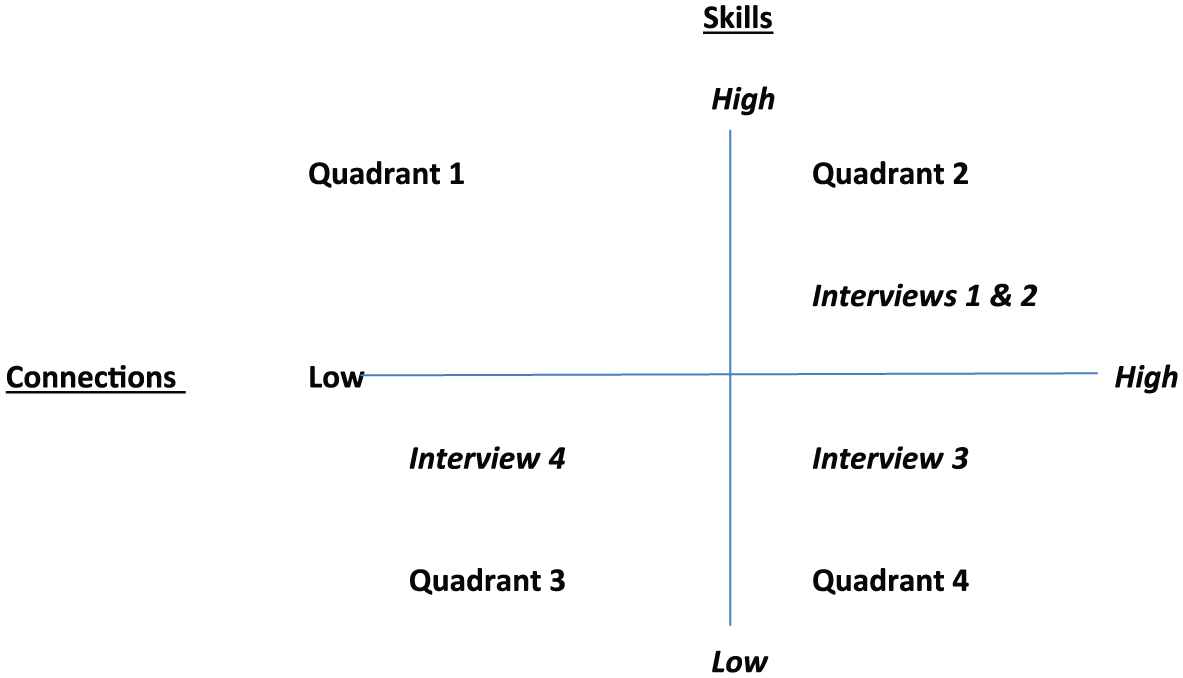
Interplay of skill and connections.
Interview extracts illustrating these dimensions are presented below. All names of people and places are pseudonyms. C denotes the co-researcher, P the participant; and A the academic researcher. Line numbers are given in brackets.
Quadrant 2: high connection, high skill
Interview 1
Here an older female co-researcher (C) is interviewing an older woman (P) who is resident in a care home about her experience of sessions provided by an activity worker (Lyn).
P We talked about local, like the goose fair, and lots of local things, and talked to the
other people who are with us, and we talked about each other and what we did, and
where we worked, and what our family were like.
C [Oh yes] [Oh lovely] [So that’s part] of the reminiscence thing that you do?
P [That’s] right.
C You do the watercolours and the reminiscence.
P [That’s right. Yes. Quite a lot of that]
C [Lovely.] Yeah and obviously sort of help you feel good about things I should
imagine, improved your life quite a bit.
P [Yeah.] Getting to know what other people do, yeah. Where they’ve been, and
some people have been all round the world in different places.
C [Yeah]
P Ever so interesting.
C [Yeah] Isn’t it, when you’re in a group like this you can find out so much more about
people. It’s such a lovely thing. It’s almost like reading a book, isn’t it, of someone’s
life. How lovely.
P [Yeah.] How other people’s lives are so different.
C [Yeah] So things have changed in a sense because it’s sort of brought you and
them out.
P [That’s right.]
C And encouraging each other in friendships and so on, isn’t it?
P [And] other people then start to talk about what they did, and that helps a lot
of people, because lots of people just actually are very shy and they don’t
want to talk.
C [Yeah] [Yeah of course]
In this opening sequence, P orients to her role as interviewee, describing her experience of the activity group. There is continual turn-taking between C and P, but rather than asking direct questions from the interview schedule, C uses techniques such as clarification (‘So that’s part of the reminiscence thing that you do’?, (4)), reflection (‘encouraging each other in friendships’, (21)) and empathy (‘help you feel good about things’, (8)), to encourage P to talk. C and P reinforce and encourage each other’s contributions with repeated overlapping talk, such as ‘Yeah’ and ‘lovely’. C compares P’s experience of the group within the care home to other groups (‘when you’re in a group like this’, (14)) and accepts and reinforces the predicate of the group as about ‘talking’ and group members as interesting (‘almost like reading a book’, (15)). C suggests that the group is a mechanism for ‘change’ through encouraging members’ interactions (‘it’s sort of brought you and them out’, (18–9)).
In this short extract, C and P co-construct a view of the activity group as a forum where members can share interesting experiences and where shy members are encouraged to participate. In relation to how the work of the interview is accomplished (Hester and Francis, 1994), C approves P’s descriptions of the activities (‘lovely’ is used six times). C and P create a positive evaluation of not only the activities, but also the activity group members, who are presented as interesting and diverse. Neither party recognises potential need and vulnerability of either older care home residents, activity group members or of P herself. The group is normalised and generalised and the possible need of members to be ‘brought out’ is acknowledged only in terms of the general characteristic of shyness.
Interview 2
An older male co-researcher is interviewing an older women about the care service she received on discharge from hospital.
P When I came out of the hospital I used to have them come in the morning and night
(.) That’s from the hospital.
C Oh yeah.
P Uh (.) but when they came out I’d already got dressed and everything like, you
know, and Wendy that run it from the hospital, she said to me “We’ve only got so
many weeks” apparently and the weeks were up. She said “Jean, we can get
somebody to come in but you’ve a bit to pay”. She said, “But you’re so
independent”. She said “I can’t see why you’d want to pay when you can
do it yourself, because you’re that independent”.
C [Mmm] You don’t want to put yourself at risk do you? You know what I mean? I
mean say with me, $ sometimes I fall down, you know what I mean. And, like, I
hope I reach your age. And how did you hear about the service, Jean?
P relays the suggestion made by Wendy, the care co-ordinator, that her status as ‘independent’ is threatened if, when the period of state-funded care ends, she decides to continue the service and fund it herself when she can manage the tasks unaided (6–9). C challenges Wendy’s view, suggesting that P may be putting herself at risk if she tries to manage without care (10). This counters the implication that P is accepting ‘dependency’ if she continues to receive care. Although C invokes the notion of P being ‘at risk’ (10), he normalises this by referring to his own experience of falling (11). He presents P and himself as sharing the characteristic of being ‘at risk’, whilst at the same time admiring and aspiring to P’s more advanced age (11–12).
Later, P talks about other work undertaken by the care worker.
P And she takes them down Norton. Don’t know whether you know
Norton? Yeah of course you know Norton.
C Yeah, yeah. My daughter lives at Norton.
P ↑Does she?
C Yeah, yeah.
P My daughter lives at Norton.
C $ Yeah, yeah.
P And err-
C [Small world.]
P relates to C on the basis of an assumption of shared geographical connection (‘of course you know Norton’ (2)). C’s volunteering of personal information that his daughter lives there (3) enables P and C to establish that they both have daughters living in the same part of town and share the same ‘small world’ (9).
Further on in the interview, P again talks about her daughter.
P And err (.) up by the Post Office, they were up Main Street there, says you never
hear anybody speaking English at all, it’s terrible. It’s getting worse down there.
C [Yeah] Well, it’s the way we are, ain’t it? I mean I always say let’s stick up for
ourselves; we’ve got to stick up for ourselves. I mean as older people, you know,
even. Is there anything else that you can think of or would like to tell us about? You
know, your care, what you’re having?
P orientates to C as a fellow resident of the local area and English-speaker, disadvantaged by ‘outsiders’ (2). C reinforces the view of them both as members of a group that is threatened and needs to ‘stick up for itself’ (4), though on the basis of age, rather than ethnicity.
In these short extracts, C combines forging connections with an orientation to the interviewer role. He establishes connection with P on the basis of shared physical vulnerability, geographical ties, a shared status as parents of daughters and a sense of unity as ‘insiders’. The delicate issue of P’s receipt of care services is managed by C constructing this as necessary to avoid risk; being ‘at risk’ is itself rendered acceptable by C’s acknowledgement of his own vulnerability and by his praising P’s achievement in living a long life. Belonging to shared member categories is emphasised by mutual acknowledgement of ‘difference’ from others and shared external threat. C takes time to attend to this ‘work’ of making the receipt of care acceptable before proceeding to the next question on the interview schedule, adapting the wording of the question to suit P (5–6).
Quadrant 4: high connections and low skills
Interview 3
In this interview, a young man with learning disabilities is being interviewed by a slightly older male co-researcher with learning disabilities about his attendance at a football group.
C What do you like about the service?
P It gets me out and it gets me to interact with people that, you know, that are
kind of similar age and people that have got disabilities and that.
C I’m doing something like that for Beacon. (1.2)
So what do, what don’t you like about the service?
P Uh, at times (.) there isn’t much, I don’t think there’s much control over it. I
think there’s always a lot of arguments and I think that’s the nature of it
because it’s a disability. I think they struggle with it, with their temper.
C [Yeah] How did you find out about it in the first place?
P identifies ‘similar age’ as a basis for relating to people and also invokes the category of ‘people that have got disabilities’ (3). Neither P nor C directly own membership of the category of disability themselves, though this is implied by P in his use of ‘and’ (3) and by C’s reply that he is doing ‘something like that’ himself (4). Conflict is a predicate of the disability service for P, who highlights the arguments – ‘because it’s a disability’, they struggle with their temper (8). However, C does not explore this but proceeds to the next question on the interview schedule. In giving his view about the service a few questions later, P refers again to the category of disability:
C Does the care service meet your needs and expectations?
P Uh yeah, except when they’re arguing. [That’s the only] thing. I think it’s just
because it’s the disability football team.
C [Yeah that’s usually the case.] Are they approachable you know, if you have a
problem?
P again attributes ‘arguing’ to ‘disability’, but distances himself from the category and from the attribute: ‘except when they’re arguing’ (2); ‘it’s the disability football team’ (3). Despite his earlier acknowledgement of being a user of a similar service, C again bypasses the disability category and its predicate invoked by P, instead adhering to the interview schedule and orienting to the omnirelevant organisational device of ‘interviewer’ (Rintel 2015).
The interview continues:
C So you said, do you need support to access the service, you, did you get it
yeah?
P Yeah.
C [You put yeah] So any specific –
P Um (1.2) Let me just read the question. Question – [which one is it?]
C [I’m not very good.]
P (reading) Do you need support to access the service? Do you get it?
C Yeah.
A Do you need support to access the service?
C Do you need support?
P Umm no not really (.) Sometimes I just go on, like, get a taxi or go from, like, when
I’ve been out.
C And well that’s fair, apart from just does it meet your needs and expectations uh (.)
Any specific details?
P For me?
C Yeah.
P Umm I just really go there more to interact and exercise. You know it’s better than
just sat on my computer all day. If I can go out and interact with people, you know,
it’s going to help me to go out in the future. Like I say if I get a job [or] I go back to
college again.
C [Yeah] Bit like me with Beacon.
P [Yeah], yeah.
C I go to interact, that’s where I’m going after.
P It gets a bit boring when you’re just sat at home and there’s no one to speak
to. You get a bit, don’t know, it just, it’s a bit sad, isn’t it?
C Yeah.
P does not understand the question posed by C (5) so reads from the interview schedule himself (7). C interprets this as a deficiency in his own performance as interviewer (‘I’m not very good’ (6)). P says that the function of the group for him is ‘to interact and exercise’ (17) and C responds from his shared position as user of a similar service (‘Bit like me’, (21)), attending for the same reason (‘I go to interact’, (23)). P then evaluates the experience of having no-one to speak as ‘a bit sad’ (25).
Wicks and Reason (2009: 249) argue that ‘a critical awareness of and attention to the obstacles that get in the way of dialogue’ are pivotal to opening communicative space. Here, the main obstacle appears to be C’s failure to adapt the questions, prompt, clarify or repair. C’s inability to enable P to understand the question at one point leads P to try to interpret the question for himself, prompting the academic researcher to intervene (9). C’s admission of ‘I’m not very good’ (6) appears to refer to his role as interviewer. However, C is learning skills as the interview proceeds. He starts to follow the academic’s lead by returning to previous questions to seek further detail (14) and to add prompts. Moreover, C shares his service user category membership with P, enabling P to acknowledge loneliness. However, although C at times orients himself to a shared lifeworld with P, at other times his lack of confidence and experience as a researcher lead him to adhere rigidly to the ordering and phrasing of questions in the interview schedule. The potential for their shared lifeworld to operate as a basis for communicative action is restricted by C’s reliance on the strategic function of the interview.
Quadrant 3: low skill, low connection
In this extract, a young woman with a learning disability is interviewing another young woman with a learning disability about her attendance at an activity centre.
Interview 4
A So, Amy, take it away.
C I’m confused now with what I have to do.
A Ah, you just um ask, um, Rachel, about Riverside. So we’re
going to talk about Riverside today and the things you enjoy.
C [So]What is Riverside like for you, Rachel, do you enjoy it? Do you like coming?
↑Yes?↑What sorts of things do ↑you do↑? What do you do? Do you have your
nails painted? ↑No?↑What about the computer, do you go on the computers?
P Yeah.
C ↑Yeah↑ and do you like doing that?
P Yeah.
C Oh good (.) it’s nice that, I like playing on computers. ↑Are you really good at it?
(.) ↑Yeah?
P Yeah.
C Um (1.2) uh, I’m trying to think what else. What do you like about the service that
they use? (.) Is it very ↑good↑?
P Yes.
C And you like coming? Oh I’m glad you like coming. (.) Um, I’m trying to think. Is
there anything you ↑don’t↑ like about it? (.) It’s very good? (1.2) And do they
support you with a lot of things, do they help ↑you↑?
P Yeah.
C Yeah, that’s good (1.2) and do you get a ↑choice↑, do you get a choice of what you
like to do? ↑Sometimes?↑
P Yeah.
C Sometimes.
Although A invites C to assume the interviewer role, C refuses the turn as she is unsure what to do (2). A takes the turn and models what C needs to say (3–4). C incorporates A’s words ‘Riverside’ and ‘enjoy’ into a question directed at P. She orientates to the role of ‘interviewer’ by proceeding to ask multiple questions without waiting for responses from P (5–7). There follow a series of adjacent pairings of questions and answers, but P’s turns are confined to single words which C accepts as transition relevant (Sacks et al, 1974), without further prompting of P to elaborate. It is not possible to see whether P gives any non-verbal cues that lead to C assuming a negative (7) or positive (11) answer. P’s responses do not reveal her understanding of C’s questions and C’s questions continue to suggest answers (14, 16–18, 21). C shares with P that she likes playing on computers (11), but it is C, not P, who suggests that P uses the computers (7) and likes doing this (9). C again acknowledges that she is struggling with the interviewer role (13 and 16). C orientates to being the ‘interviewer’, but not to being a young woman or someone with a learning disability. The interview fails to open communicative space in that C and P do not co-produce understanding of relevance to the research questions or establish connection based on shared identities or interests.
Discussion
The rationale for PR is to generate opportunities for marginalised groups to ‘come to voice’ and ‘talk back’ (Humphries, 2005: 314). Ours analysis of semi-structured interviews suggests that when co-researchers deploy interviewing skills alongside establishing shared connections with participants, communicative space is opened, generating mutual understanding and jointly constructed knowledge.
In interviews with a high level of connection (Quadrants 2 and 4, Figure 1), the bases for connection were broader than identities as older people or people with learning disabilities. In Interview 1, the co-researcher connects on the basis of experiences and interests and, through the rapport established, the co-researcher and participant co-construct a positive view of the activity group and its members. In Interview 2, the bases for connections include shared geographical ties, family roles, age-related vulnerability and ‘insider’ status. In Interview 3, ‘disability’ is a predominant category in the interview, but it is treated as troublesome and distanced by both the co-researcher and participant. However, sharing the more general member category of service users enables both parties to acknowledge loneliness.
In relation to skills, whilst ‘interviewer/interviewee’ is an omnirelevant device to which co-researchers and participants actors orientate by asking/answering questions (Fitzgerald and Housley, 2002), the frequency and length of turns and the degree of adherence to the order and wording of the interview schedule differentiate the interviews in Quadrants 3 and 4 from those in Quadrant 2. The co-researchers in Interviews 1 and 2 (Quadrant 2) continue the sequences of participants, developing a conversation, rather than shifting to the next question on the interview schedule. The sequential organisation of the interviews in Quadrants 3 and 4 indicate that the co-researchers are enacting their understanding of the member category of ‘interviewer’ with a predominance of questioning devices, but are uncertain or critical about their own performance in this role.
Co-researcher involvement in designing the interview questions aimed to embed lifeworld considerations in the interview structure and content; moreover, the interview schedule was intended to be used flexibly. However, orientation to omnirelevant devices can restrict as well as facilitate shared understanding (Rintel, 2015) and in Interviews 3 and 4, co-researchers’ lack of skill and confidence led to reliance on the omnirelevant device of interviewer and an overly strategic focus on the interview task, restricting the opportunity for co-produced understanding. The presence of co-researchers who implicitly or explicitly shared visible member categories such as age and gender or disability may have helped participants to feel comfortable. However, the value of co-researchers’ unique perspectives and influence is undermined if they are unable to influence the interview structure and process. In this situation, there is a danger that co-researchers function as little more than service user figureheads, leaving fundamental inequalities in the generation of knowledge unchallenged (Carey, 2010; Flinders et al., 2016). Moreover, co-researchers risk their own disempowerment if they conclude ‘I’m not very good’ (Interview 3) or ‘I’m confused’ (Interview 4). Whilst it behoves researchers to ensure that co-researchers have the requisite skills to undertake qualitative interviews (Miller et al., 2006), it is inappropriate to prepare for and evaluate the contribution of co-researchers on the basis of traditional research skills when the reason for their involvement is to bring a different, user-centred perspective (Reed et al., 2006).
Whilst interview skills assist achievement of the pre-defined purpose of the interview, shared connections may rebalance power relationships and extend opportunities for sharing of the lifeworld, enabling the voices of marginalised participants to be heard. In interviews where the co-researcher was able to use skills in conjunction with establishing connections, co-researchers engaged in conversation that addressed the required topics while leaving opportunity for participants to influence the content and direction of the interview. Strategic objectives were achieved within communicative action. Co-researchers who have the ability to use skills and establish connections may in this way reconcile strategic and communicative concerns and ease the challenge for academic researchers of ‘boundary crossing’ from academic to co-produced worlds (Flinders et al., 2016).
This study has a number of limitations. Our analysis indicates the need for greater attention to how connections are forged between co-researchers and participants. How member categories are oriented to in the opening of interviews seems particularly important, but we were unable to examine this as the audio recordings began after the introductions and negotiation of consent. Analysis was based only on written transcripts and audio recordings, precluding examination of the role of body language, such as eye contact, hand or head gestures. Social actors use embodied as well as verbal sources to produce and interpret social action (Mondada, 2016). The inclusion of video data could enrich, and possibly alter, interpretation of how interview parties orientated themselves to each other; for example, the participant in Interview 4 may have been nodding to indicate agreement with the co-researcher’s suggested answers.
Each interview was analysed in isolation, preventing consideration of how co-researchers’ contributions changed over time. It is important to recognise the development of co-researchers’ skills over the course of the PR process (Bergold and Thomas, 2012). Moreover, the interviews were analysed in relation to the local and situated accomplishment of the talk-in-interaction, without regard to how the members accomplish interaction with other parties and/or in other settings. For example, although the participant in Interview 4 gives single word utterances, this might be an increase in her usual verbal contributions because she feels comfortable with the co-researcher. It is not possible to evaluate the co-researcher’s role in opening communicative space without understanding this wider context.
More fundamentally, this analysis relates only to co-researcher involvement in interviews, even though involvement in the study extended to other stages of the research. An evaluation of the impact of co-researcher involvement is therefore incomplete if based on analysis of interview interactions alone.
Conclusion
CA assists understanding of how social action is practically accomplished; it is not concerned with assessing or evaluating interactions, but with examining ‘the “what” of how they actually are done’ (Hester and Francis 1994: 680). In this article principles of CA and MCA have been applied to explore how co-researchers and participants produce and understand social action in semi-structured interviews. However, the article departs from CA and MCA in invoking a normative standard to evaluate how co-production influenced the interview process, drawing on Habermas’s concept of communicative action. CA and MCA are used to examine the detail of interactional processes and understandings between co-researcher and participant; the concept of communicative action is applied to evaluate the impact this has on the knowledge generated through the process.
Earlier in this article, evidence was reviewed that indicates that PAR (as distinct from PR) can open communicative space internally within research teams and externally with wider stakeholders. The originality and significance of this article lie in examination of how co-research can open communicative space in semi-structured interviews, where strategic concerns may be more foregrounded than in PAR, especially when co-researchers have not been involved in designing the research proposal. Applying principles of CA and MCA has indicated that co-researchers can open communicative space in semi-structured interviews by using skills to achieve the strategic purpose of the interview in conjunction with forging connections with participants. Conversely, communicative action is constrained when co-researchers lack the skills or confidence to influence the content and direction of interviews. Participants may perceive power to be more equalised by virtue of shared connections with co-researchers, but unless co-researchers’ ability to make shared connections is combined with the skills and confidence to circumnavigate system preoccupations, the potential for a shared lifeworld orientation to generate service user-led knowledge is unrealised.
This study suggests possible future directions for PR practice. Attention to communication within the interviews has highlighted the ‘identity work’ undertaken by co-researchers and participants and the different ways in which this is manifested and operates. Training programmes tend to focus on methods of gathering data, but could usefully heighten attention to the significance of interactional processes between co-researchers and participants. In particular, there could be increased focus on how co-researchers and participants orientate to member categories and how this influences sequences of interaction. In this study, some co-researchers felt more comfortable adhering strictly to the interview schedule and their interactions were then strategic rather than communicative. Training programmes could build their confidence in departing from restricted notions of ‘interviewer’ and encourage them to share their own ‘selves’ with participants. Extracts from conversational analysis of interviews could be a useful training tool, identifying and developing skills pertinent to co-researcher interviewers (as distinct from traditional research interviewing skills) as well as ways of establishing connections.
The study is not presented as a ‘good practice’ example of PR and significant learning points were noted by the research team in the project evaluation. However, through detailed examination of ‘what went on’ in the interviews and consideration of the impact this had on the knowledge generated, the article contributes to enhancing the clarity, rigour and validity of PR. CA has illuminated how co-researchers and participants in interviews oriented themselves to each other in sequences of talk and used member categories. Habermas’s concept of communicative action has facilitated exploration of how this influenced the co-production of knowledge. Forester (2003: 62) argues that Habermas’s concept of communicative action ‘enables us to explore the continuing performance and practical accomplishment of relations of power’. There is scope in future research to extend this to analysis of ‘the practical accomplishment of relations of power’ in interviews between researchers and participants more generally, including comparison of co-researcher and academic researcher interactions with participants. Further examination of whether and how these processes open communicative space can augment the contribution of PR to health and social care research.
Footnotes
Acknowledgements
With special thanks to the co-researchers for their immense contribution to both the study and the evaluation, and also to the participants and the rest of the research team - Catherine Needham, Kelly Hall, Kerry Allen, Jon Glasby, Steve McKay and Rosemary Littlechild.
Funding
This research was funded by the Economic and Social Research Council (ESRC), as part of a project entitled Does Smaller mean Better? Evaluating Micro-enterprises in Adult Social Care (ESRC Standard Grant ES/ K002317/1).