




Abstract
A series of ceria promoted Ni2P catalysts were prepared and evaluated in dibenzothiophene hydrodesulfurization steam. These catalysts were characterized by X-ray diffraction, N2 adsorption–desorption, CO chemisorptions, and X-ray photoelectron spectroscopy. The results showed that the addition of ceria into the bulk Ni2P catalyst was conducive to the formation of the Ni2P phase and contributed to a higher surface area, leading to a better dispersion and smaller crystallite size of Ni2P particles. The CexNi2P catalysts showed higher dibenzothiophene hydrodesulfurization activity than Ni2P catalyst and the Ce0.09Ni2P catalyst showed the highest dibenzothiophene hydrodesulfurization activity. The Ce0.09Ni2P catalyst showed a dibenzothiophene hydrodesulfurization conversion of 94.5% at the reaction conditions of 320°C, 4.0 MPa, a H2/oil ratio of 500 (V/V), and a weight hourly space velocity of 8.0 h−1. The dibenzothiophene was mainly transformed through desulfurization pathway.
Introduction
High-performance catalysts are developed to meet the need to produce cleaner fuels for strict environmental regulations. 1 This has been the driving force to improve the performance of hydrodesulfurization (HDS) catalysts during the recent years. 2
Ni2P has been reported as an excellent HDS catalyst for its weak binding with hydrogen. 3 The investigation on more efficient Ni2P catalyst by combining promoted component, such as noble metal, Co, 4 Fe, Mo, W, 5 Zr, 6 B, 7 could be advantageous to enlarge the activity and optimize the textural properties as a result of the synergy achieved between the promoters and Ni2P catalyst. Rare earth metals, with unfilled 4f electron shell, showed excellent physical, chemical, optical, and electrical properties as promotions. 8 Accordingly, rare earth metals have been applied as electronic promoters for transition metal phosphides. 9 Yang et al. synthesized Ce-promoted Ni/SBA-15 catalysts. These Ni/Ce-SBA-15 catalysts exhibited higher catalytic activity. The superior performance of Ni/Ce-SBA-15 was probably attributed to better Ni dispersion and the specific Ni active sites created in contact with Ce-containing surface species. 10 Wu et al. 11 prepared a series of Ce-NiO catalysts and tested for glycerol transesterification with diethyl carbonate (DEC) to glycerol carbonate (GC). The investigation showed that the addition of Ce was beneficial to the dispersion of NiO particles and catalyst activity. These results suggested that Ce, as a kind of rare earth metals, could provide a notable reference to seek inexpensive promoted component for boosting correlating Ni2P HDS catalysts, which could serve as a new assistant for general HDS catalyst.
In this article, we attempted to modify Ni2P with Ce in an easily handled method and to obtain a series of CexNi2P catalysts. The effects of Ce on the structure and HDS catalytic performances over the bulk Ni2P catalysts were surveyed.
Experimental
Preparation of catalysts
The precursor of Ni2P was prepared from Ni(NO3)2 and (NH4)2·HPO4 with an initial P/Ni molar ratio of 1. Calculated Ni(NO3)2 and (NH4)2·HPO4 was dissolved and evaporated at 90°C for 12 h, then calcined at 500°C for 3 h obtained the oxidic precursor. The Ce was incorporated by impregnating oxidic precursor with cerium nitrate hexahydrate (Ce(NO3)3·6H2O) solution at different contents, which then dried and calcined as above. This precursors were reduced at 500°C for 2 h in a flow of H2 (180 mL/min) and passivated at room temperature for 2 h in an O2/N2 mixture (0.5 vol.% O2, 30 mL/min). The prepared catalysts are named as CexNi2P, where x represents the mole fraction of Ce with respect to Ni2P.
Characterization of catalysts
X-ray diffraction (XRD) analysis was carried out on a D/max-2200PC-X-ray diffractometer using CuKα radiation at 40 kV and 30 mA. The typical physico-chemical properties were analyzed using Quantachrome Autosorb-1-MP analyzer. CO uptake was analyzed using Micromeritics ASAP 2010 equipment. X-ray photoelectron spectroscopy (XPS) spectra used ESCALAB MKII spectrometer. XPS measurements performed with monochromatic MgKα radiation and hemi-spherical analyzer at pass energy of 40 eV.
Catalytic activities
The dibenzothiophene (DBT) HDS activity was tested with a fixed-bed stainless-steel tubular reactor. The concentrate of DBT was 0.5 wt% in decalin as the model feed. Prior to reaction, catalyst was re-activated in situ with flowing H2 (60 mL/min) at 500°C for 2 h. Reaction condition was 320°C, 4.0 MPa, H2/oil ratio of 500 (V/V), and weight hourly space velocities (WHSV) of 8.0 h–1. The product was analyzed every hour with an Agilent-6890N gas chromatograph.
Results and discussion
XRD
The XRD patterns of bulk Ni-P and CexNi2P catalysts are shown in Figure 1. As depicted in Figure 1, all the catalysts present diffraction peaks at 2θ = 40.6°, 44.5°, 47.1°, and 54.1° (PDF: 03–0953), which could be ascribed to Ni2P. Nevertheless, bulk Ni2P showed diffraction peaks at 2θ = 28.8°, 30.2°, 31.6°, 36.1°,53.0°, and 66.2° (PDF: 18–0883), which was belonged to Ni5P4 phase. The results manifested that the addition of Ce suppressed the formation of the Ni5P4 phase. The diffraction peaks of Ni2P phase become dwarf and broadened with Ce content increased from 0 to 0.09 wt%, which could be ascribed to the decrease in crystallite size of Ni2P. The crystallite sizes (Dc) of Ni2P phase calculated with Scherrer’s equation are listed in Table 1. The Dc of bulk Ni2P is 39 nm, and which for Ce0.09Ni2P has an obvious decrease of 15 nm reaching 24 nm. However, with continuing increase of the amount of Ce to 0.13 wt%, the Dc of Ce0.13Ni2P increased to 27 nm. This results indicated that the addition of 0.09 wt% of Ce is a suitable amount for the formation of smaller Ni2P phase. Song et al. 12 studied the effect of rare earth metal Nd on the particle size of the Ni2P, which may be caused by the strong interaction between nickel metals and NdO2 constrained the assemble of nickel and decreased the Ni2P particles.
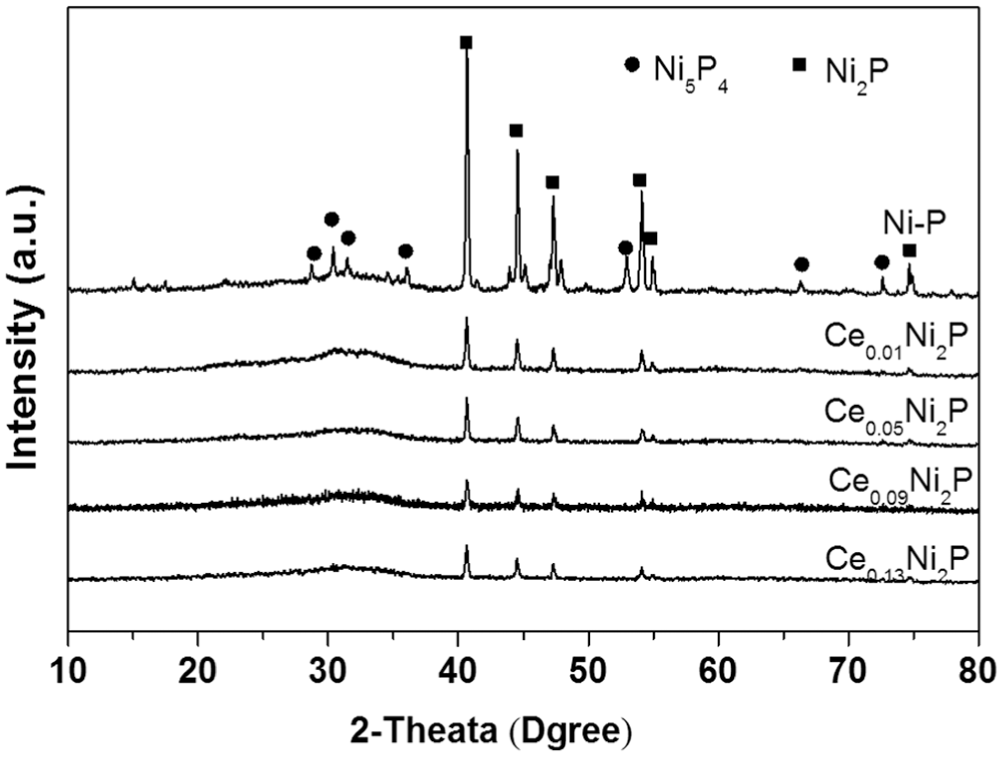
XRD patterns of the Ni2P and CexNi2P catalysts.
The textural characterization and HDS performance over the Ni-P and CexNi2P catalysts.
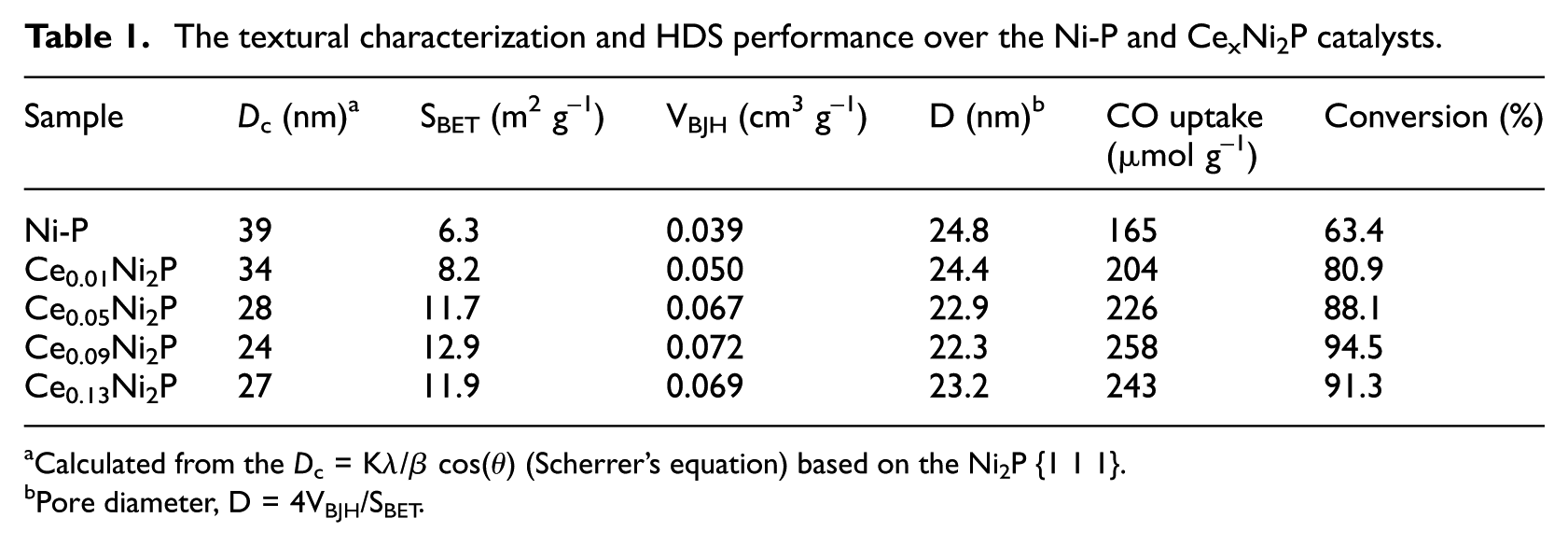
Calculated from the Dc = Kλ/β cos(θ) (Scherrer’s equation) based on the Ni2P {1 1 1}.
Pore diameter, D = 4VBJH/SBET.
BET
Table 1 summarizes the textural properties of Ni-P and CexNi2P. The surface area of Ni-P catalyst was 6.3 m2 g−1. After the addition of Ce, the surface area of CexNi2P catalysts has an obvious increase. With the increase of Ce, the surface area of CexNi2P exhibited a distinct increase initially and then decreased with further increases in the Ce. The highest surface area of CexNi2P was 12.9 m2 g−1at x = 0.09, which was more than twofold when compared with Ni2P. The results manifested that an appropriate amount addition of Ce was conducive to the increase of surface.
CO uptake
The CO uptakes of the catalysts were listed in column 6 of Table 1. According to the literature, 13 the CO molecule was mainly adsorbed at Ni active sites; therefore, the CO molecule was applied to “titrate” the Ni sites to measure their number and dispersion. The amount of CO uptake of Ni-P was 165 μmol g−1, which was lower than that of CexNi2P catalysts. The CO uptake of CexNi2P catalysts increased with the increasing of x when x ≤ 0.09. However, when x ≥ 0.09, the CO uptake decreased. The CO uptake of the Ce0.13Ni2P (243 μmol g−1) was lower than that found for the Ce0.09Ni2P (258 μmol g−1) sample. This result may be caused by the decrease in surface area in Ce0.13Ni2P. The surface area has significant effect on the dispersion of Ni sites. This result showed that the introduction of Ce to the Ni2P catalyst was beneficial to the dispersion of active sites.
XPS
The XPS spectra of Ni (2p) and P (2p) regions of the passivated catalysts were exhibited in Figure 2. The surface compositions and the corresponding binding energies were exhibited in Table 2. The binding energies of Ni 2p (856.5–856.8 eV) and P 2p (134.7–134.9 eV) were belonged to Ni2+ and P5+ species, respectively. The peaks at 852.4 and 129.9 eV were attributed to the Niδ+ (0 < δ < 2) and Pδ− (0 < δ < 1) species, respectively. What deserve our concern was that the peak intensity of Niδ+ and Pδ− increased first and then decreased with increasing Ce content. The Ce0.09Ni2P showed a biggest peak intensity, which may be caused by the maximum quantity of Ni2P particles exposed on catalyst surface (CO uptake).
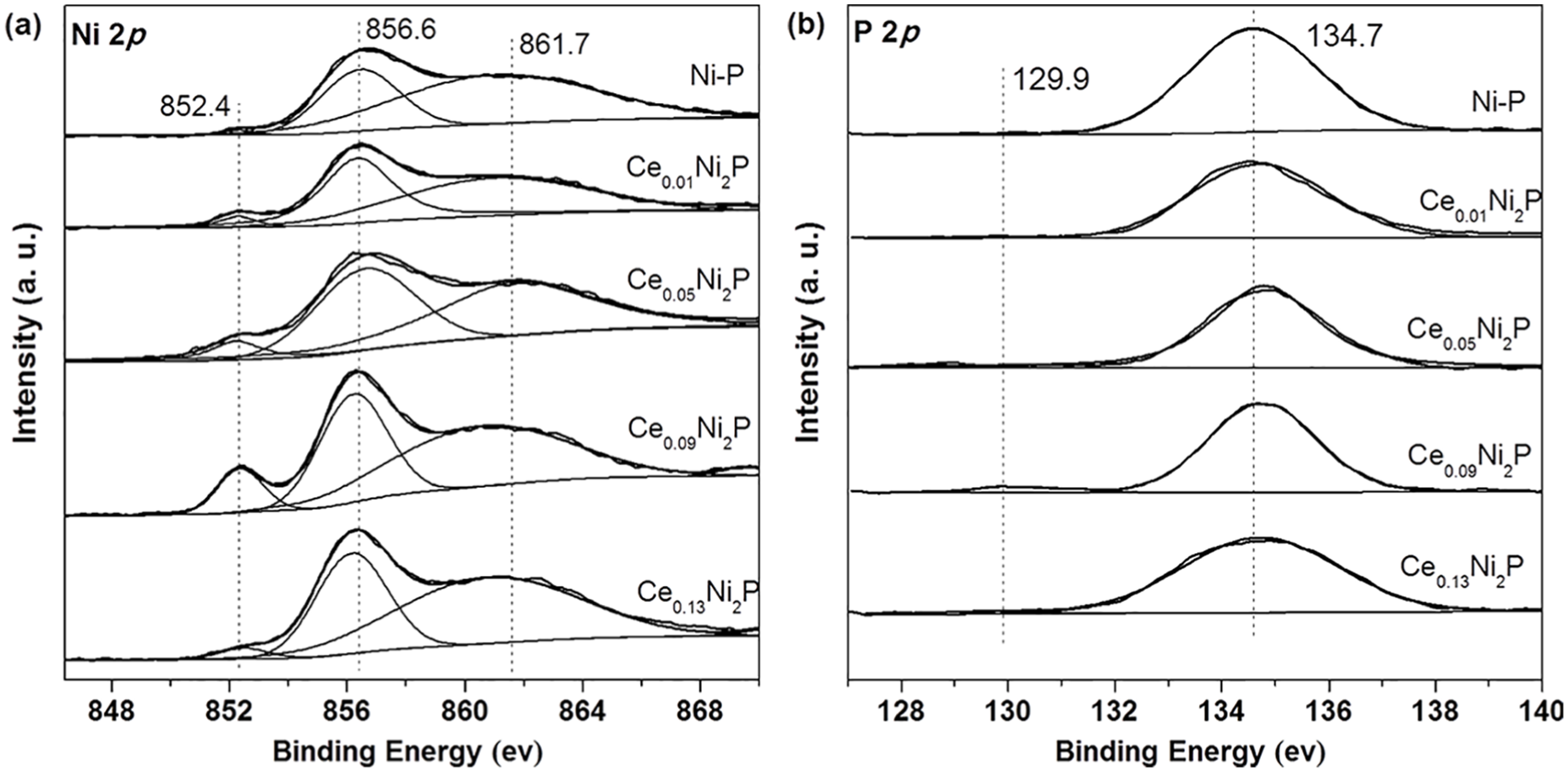
XPS spectra of the Ni2P and CexNi2P catalysts.
Spectral parameters obtained by XPS analysis.
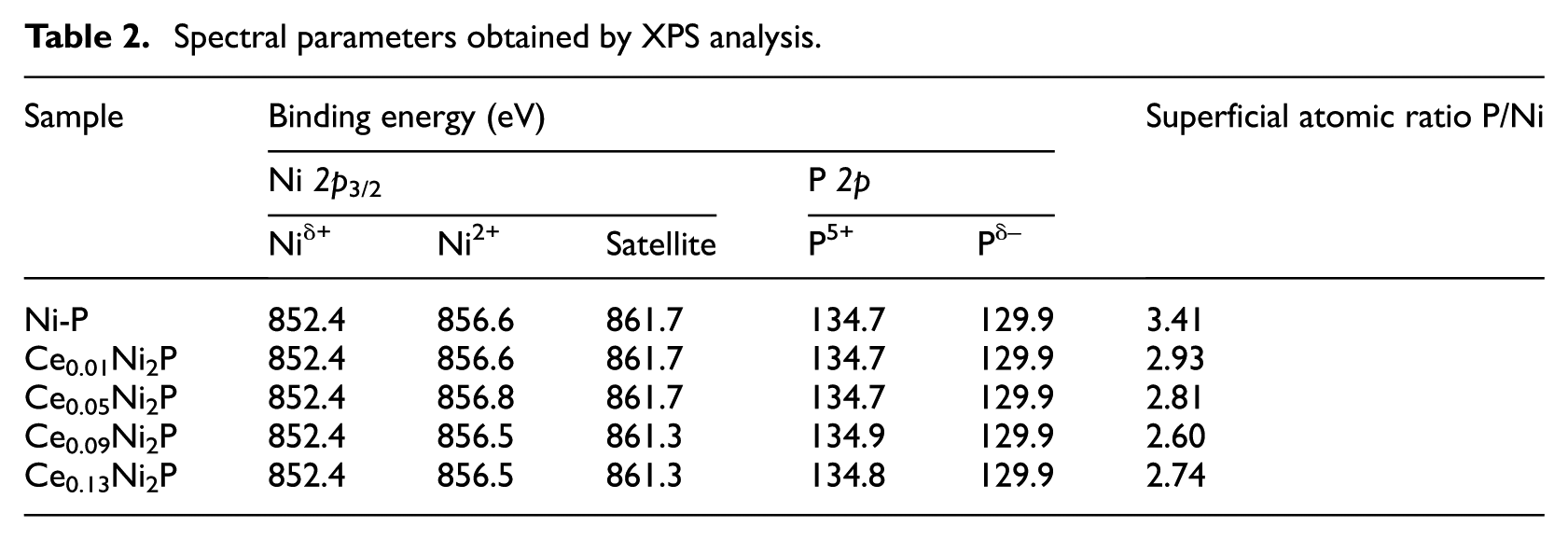
The surface P/Ni atomic ratios calculated from XPS analyses were showed in column 5 on Table 2. The initial P/Ni ratio was 1/2. However, all catalysts exhibited higher P/Ni than 2, which could be attributed to the P-rich on the catalyst surface. The superficial atomic ratio P/Ni of Ni-P catalyst was 3.41, which was decreased after the addition of Ce. The Ce0.09Ni2P catalyst showed a least superficial atomic ratio P/Ni of 2.60. This result was in accordance with the peak intensity analyze and CO uptake results.
HDS activity
The catalytic activity and stability of Ni-P and Ce x Ni2P were evaluated with the HDS of DBT, and the results were given in Figure 3. The DBT conversion over Ni-P was only 63.4% after steam stable. The DBT conversion over Ce x Ni2P was much higher than that for Ni-P, and which increased with increasing Ce content (x < 0.09). The highest DBT conversion of 94.5% was obtained over the Ce0.09Ni2P catalyst. On one hand, this result may be caused by the better dispersion and smaller size of Ni2P phase; on the other hand, the higher surface area and lower surface P-rich were also beneficial to the catalytic activity.
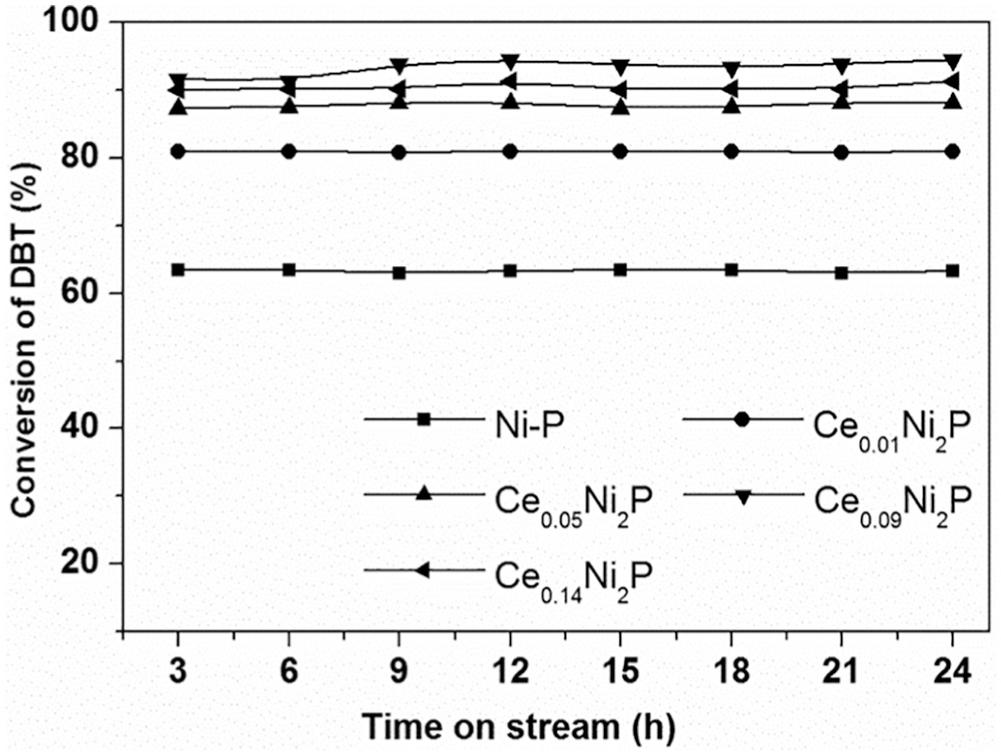
The HDS activity of the Ni2P and CexNi2P catalysts.
The HDS selectivities over the catalysts were showed in Figure 4. The products detected were BP and CHB. The selectivity for BP was higher than the selectivity for CHB. According to the literatures, the BP was converted from the DBT desulfurization (DDS) pathway in Ni(I) sites and CHB was converted from the DBT hydrogenation (HYD) pathway in Ni(II) sites. 14 In this experiment, the DBT was mainly transformed through the DDS pathway in Ni(I) sites over Ni-P and CexNi2P catalysts. For CexNi2P catalysts, the selectivity for BP slightly increased with increasing Ce content, which manifested more Ni(I) sites being exposed or generated on the catalyst surface.3,15,16
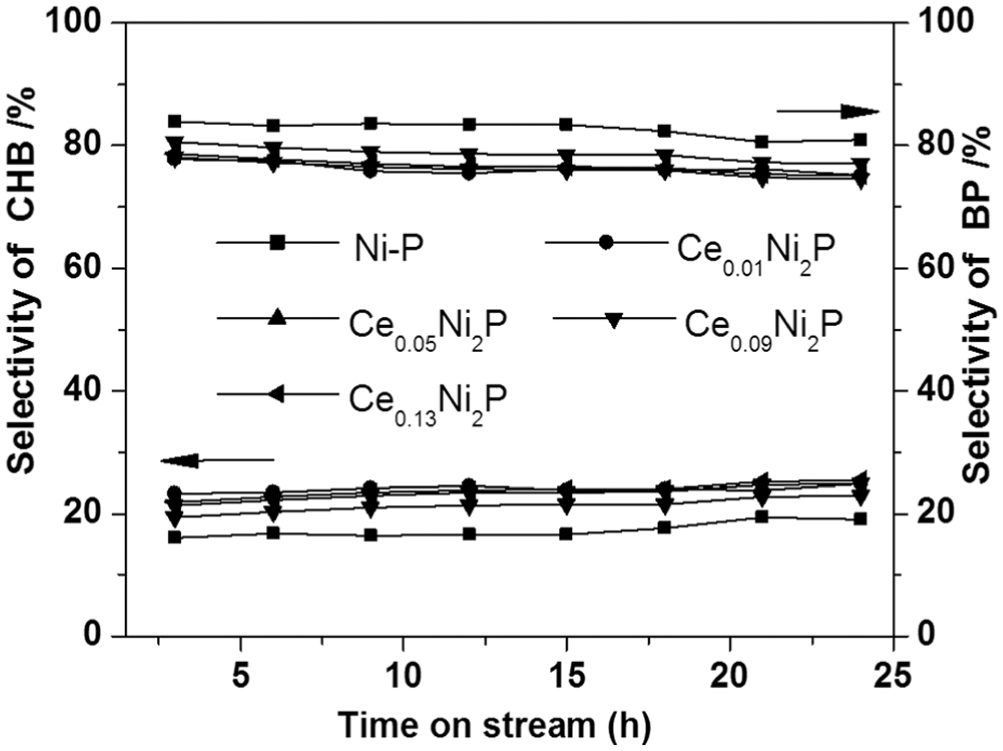
The HDS selectivity of the Ni2P and CexNi2P catalysts.
Conclusion
A series of Ce modified bulk Ni-P (CexNi2P) catalysts was prepared and investigated with a DBT HDS reaction. Characterization results shown that the addition of Ce could suppress the formation of the Ni5P4 phase to receive pure Ni2P phase and smaller Ni2P crystallite size. The Ni2P crystallite size decreased first and then increased with increasing Ce content according to Scherrer’s equation. BET results shown that the addition of Ce could obviously increase the catalyst surface area. XPS results indicated that the P-rich on the surface decreases, which exposed more Ni atoms, leading to a higher CO uptake. The CexNi2P catalysts exhibited higher active for DBT HDS than bulk Ni2P. The Ce0.09Ni2P catalyst showed highest activity for DBT HDS.
Footnotes
Acknowledgements
The authors acknowledge Education Department of Liaoning Province for financial support for this work (project nos LJZ2016002 and LJZ2016001).
Declaration of conflicting interests
The author(s) declared no potential conflicts of interest with respect to the research, authorship, and/or publication of this article.
Funding
The author(s) received no financial support for the research, authorship, and/or publication of this article.