




Abstract
Until 1945, Western countries were the only ones to have introduced unemployment insurance programs. Since their adoption was extremely controversial, almost all Western nations introduced income support for the unemployed only in the wake of national emergencies such as war and economic depression. This article examines the determinants of program adoption in the Global South, which commenced after the Second World War. With the exception of military conflict, we find that the introduction of unemployment insurance was shaped by factors deviating from the driving forces of program adoption in the Western world. More specifically, we provide evidence that international factors such as war, the activities of the ILO and policy diffusion were more important than domestic factors.
Introduction
This article examines the introduction and spread of unemployment insurance across the globe in the post-Second World War period. In contrast to other social security programs such as sickness and health care, workmen’s compensation and old age pensions, less countries actually adopted unemployment insurance and those who did generally implemented it later than other programs (Figure 1). Before 1950, only European countries and European settler societies in North America, South Africa and the Antipodes provided income support to the unemployed (Alber, 1981; Kuhnle and Sander, 2010; Obinger and Schmitt, 2020a; Perrin, 1969). Program adoption in the Global South commenced in the aftermath of the Second World War. Even today, however, only about half of the countries worldwide have introduced some kind of unemployment compensation scheme and the majority of the global labor force is not entitled to unemployment benefits due to a lack of programs or informal and segmented labor markets (International Labour Organization (ILO), 2017b).
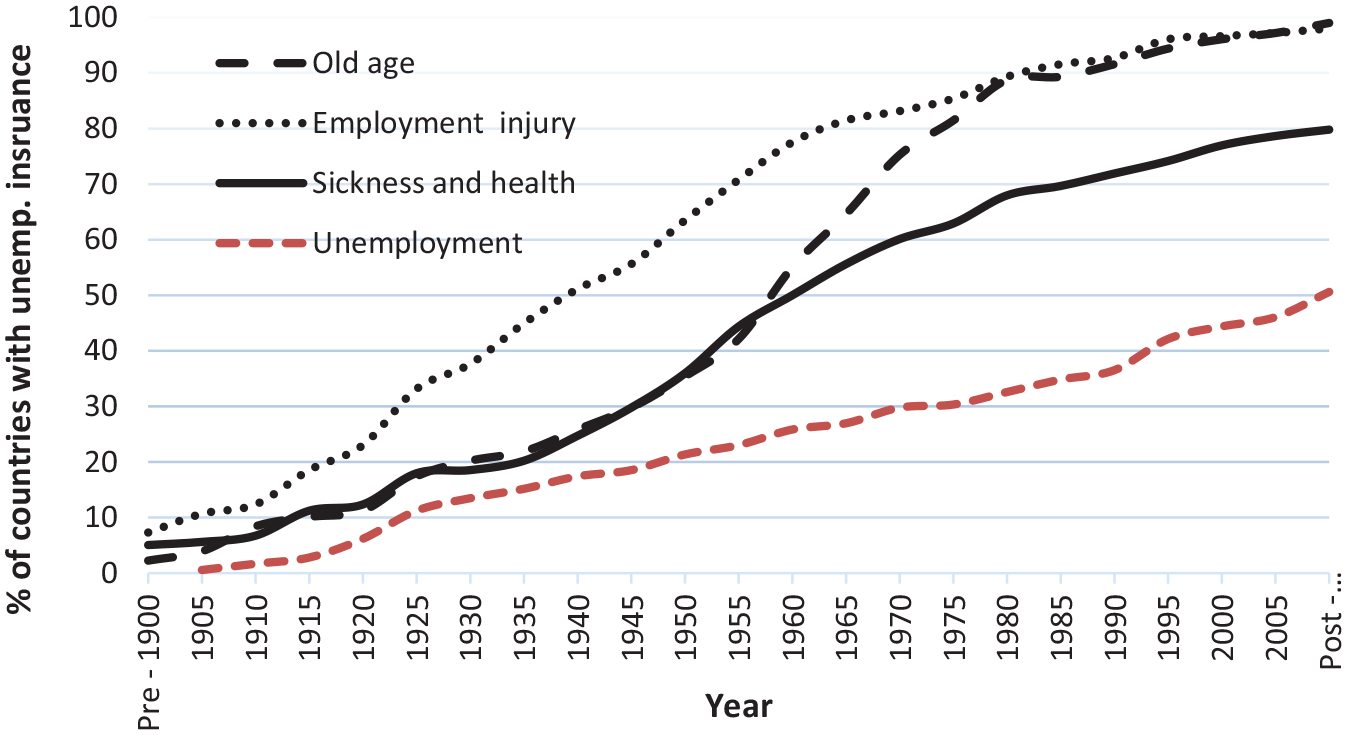
The introduction of unemployment compensation around the world.
Why was unemployment insurance adopted comparatively late and why did some countries introduce unemployment insurance 1 and others did not? What were the driving forces of the enactment of unemployment compensation schemes?
While we have some empirical evidence for the factors driving the introduction of unemployment insurance in Western countries 2 (e.g. Alber, 1981; Carroll, 1999; Obinger and Schmitt, 2020a; Rehm, 2016; Sjöberg et al., 2010), knowledge about the spread of unemployment insurance after the Second World War in countries beyond the Western world seen through a comparative large-N framework is almost completely lacking. 3 This article addresses this gap and examines the introduction of unemployment benefit schemes across the globe since 1950 by using quantitative statistical techniques. As comparative research on the introduction of unemployment insurance is rare for countries beyond the Western world, we consult existing explanations in the literature mainly referring to Western countries and study whether they can account for policy decisions made in the Global South. This literature has shown that the late adoption of unemployment compensation in Western countries is related to the program’s specific characteristics. Compared to other schemes of social protection, unemployment insurance is politically heavily contested and technically complex. Moreover, program adoption is tied to specific institutional preconditions that are typically only present in economically developed countries. In line with recent empirical inquiries on the emergence of unemployment insurance in affluent Western countries (Obinger and Schmitt, 2020a; Rehm, 2016), we start from the assumption that unemployment insurance was mainly introduced in the wake of national emergencies which opened a window of opportunity for policy reform. Our findings suggest that war did in fact matter for program adoption in other parts of the world. Beyond that, however, the Western pattern of program adoption has no explanatory power for the emergence of unemployment insurance in the Global South. Overall, our quantitative analysis reveals that international factors such as war, the activities of the International Labour Organization (ILO) and regional policy diffusion were of greater importance than domestic factors.
The article is divided into five sections. We start with a brief overview of the history of program adoption in Western countries, which has been studied much more comprehensively than that in the Global South. Between 1905 and 1945, all Western countries introduced unemployment benefits, mainly in response to national emergencies such as war and economic depression. Before testing this assumption for countries in the Global South, which adopted unemployment insurance in the post-war period of the Second World War, section ‘The struggle for unemployment insurance: lessons from program adoption in western countries’ discusses further possible determinants that might shape the timing of program adoption in the Global South. Next, we discuss our method applied and data used and section ‘Empirical findings’ presents our empirical results. The final section is made up of our conclusion and a discussion of avenues for future research.
The struggle for unemployment insurance: lessons from program adoption in Western countries
Compared to other branches of the welfare state, the introduction of unemployment insurance encountered the greatest resistance. This can be exemplified by the controversies and debates preceding program adoption in the Western world before 1950.
The critique against unemployment insurance focused on moral, political and technical issues, while mainstream economics denied the necessity of state intervention in the case of unemployment at all. Moral concerns were related to the fact that unemployment compensation, unlike health, work injury and pension schemes, provides income support to the able-bodied who were widely considered as undeserving beneficiaries. Moreover, unemployment was often attributed to individual characteristics such as idleness or moral misconduct so that any income support to the ‘work-shy’ was seen as a reward for indolence (Alber, 1981).
Politically, many employers feared that unemployment insurance could strengthen the labor movement by defining a ‘reservation wage’ (Väisänen, 1992) and would fill the unions’ strike funds. Agrarian interests also strongly opposed unemployment insurance because unemployment was considered an urban problem for which farmers refused to pay.
In addition, technical difficulties were voiced against program adoption. The debate essentially revolved around the problem whether ‘unemployment is insurable’ (Stewart, 1932: 36) at all. Critics such as the director of the Swiss Life Insurance and Pension Institute argued that unemployment, in contrast to accident insurance, ‘is not randomly in general, but is in the majority of cases caused willingly and deliberately by employees or employers’ (Schaertlin, 1904: 4–5, our translation). In addition to what today is called moral hazard, critiques argued that unemployment insurance is prone to adverse selection. If merely employees with higher risks take-out voluntary insurance, premiums will increase and good risks will leave or not enter the market. These fears were corroborated by the breakdown and the financial difficulties of the first public unemployment insurance schemes in Swiss cities such as Bern where a voluntary insurance against unemployment in wintertime had been established in 1893. 4 Mandatory insurance, the only solution to ensure effective risk-pooling, however, was politically contested because it was not only at odds with the then prevailing liberal principles but often rejected by high-skilled workers, who considered their risk of ever being unemployed as rather low. A third technical problem was related to financing. Critics argued that take-up rates of unemployment insurance would be strongly influenced by largely unforeseeable business-cycle fluctuations which would complicate sound funding and the smooth operation of this program (Alber, 1981).
And finally, in ideational terms, mainstream economic theory did not see any necessity for state intervention as (neo)classic doctrines claimed that unemployment is voluntary and mainly a result of excessive wages. If any, less state intervention was praised as the panacea to preserve the functioning of labor markets (Harris, 1996). 5
Given all these hurdles and objections, the question arises when and under which conditions unemployment compensation schemes were introduced at all. Recent comparative empirical studies show that most of the 27 countries that had introduced this program until 1950 did so in response to black swan events (Castles, 2010) such as the Great Depression (Rehm, 2016) and the two World Wars (Obinger and Schmitt, 2020a, 2020b) and their economic and political aftershocks (see Table 1). Moreover, dozens of case studies (e.g. Edling, 2006; Führer, 1990; Gruner, 1988 etc.) and quantitative inquiries have shown that the labor movement and liberal parties were important push factors behind program adoption (Alber, 1981; Carroll, 1999; Obinger and Schmitt, 2020a).
The introduction and types of unemployment compensation schemes until 1950.
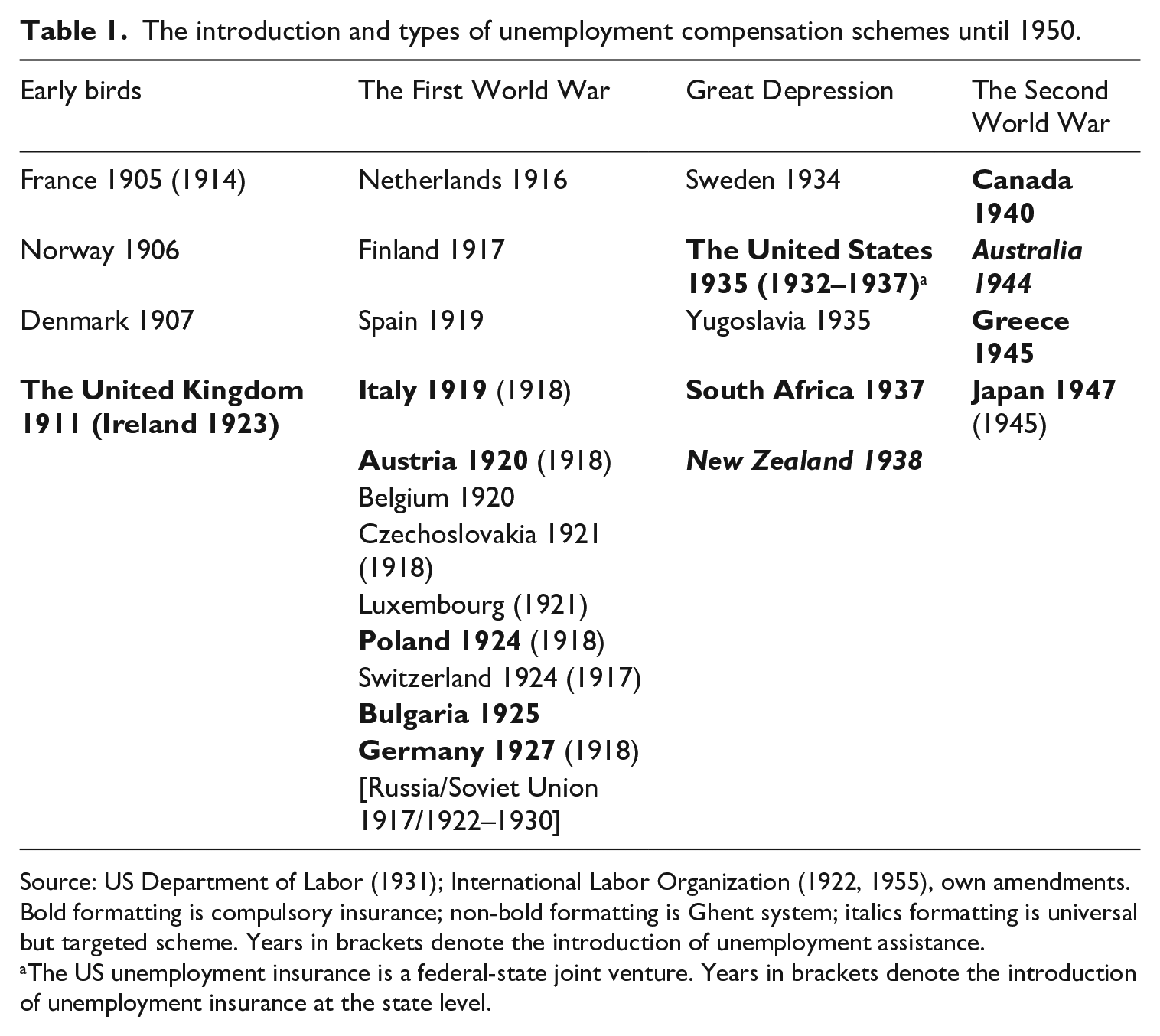
Source: US Department of Labor (1931); International Labor Organization (1922, 1955), own amendments.
Bold formatting is compulsory insurance; non-bold formatting is Ghent system; italics formatting is universal but targeted scheme. Years in brackets denote the introduction of unemployment assistance.
The US unemployment insurance is a federal-state joint venture. Years in brackets denote the introduction of unemployment insurance at the state level.
In structural terms, three systems of unemployment compensation emerged (ILO, 1955). The first national schemes were so-called Ghent systems, which provided subsidies to the voluntary unemployment funds operated by unions (Alber, 1981; Gibbon, 1911; ILO, 1922). These systems evolved out of the out-of-work benefit schemes set up by workers’ associations and friendly societies in several highly industrialized countries in the 19th century (Kumpmann, 1923). Since contributions of workers alone were insufficient to finance adequate benefits, municipalities started to provide subsidies to the voluntary unemployment funds operated by workers’ associations. One of the first examples was the system established by the Belgian city of Ghent in 1900. For most contemporary experts, it was the ‘first successful method of organizing social unemployment insurance’ (Rubinow, 1913: 422). Starting with the United Kingdom in 1911 (Foerster, 1912), many countries established mandatory unemployment insurance based on tripartite funding, whereas the Antipodes introduced universal but income-tested benefits in case of unemployment (Table 1).
With the exception of the Soviet Union, where the unemployment insurance introduced by the Bolsheviks on 11 December 1917 6 mainly remained a paper tiger and was eventually abolished by decree in 1930 (Duncan, 1935; Rimlinger, 1971: 270–271), all countries were capitalist countries with formal labor markets and at least embryonic levels of industrialization. Moreover, program adoption everywhere was predated or accompanied by the establishment of employment exchanges and labor statistics offices (see US Department of Labor, 1931). In other words, a well-established legal framework, administrative capacities and bureaucratic professionalization were crucial preconditions for the adoption of unemployment insurance in the Western world (Vodopivec, 2013).
Theory and hypotheses
We start from the assumption that the factors driving the emergence of unemployment insurance in the Western World provide a meaningful point of departure for explaining the introduction of unemployment compensation in other parts of the world after 1950. We therefore expect that unemployment insurance schemes were introduced in response to national emergencies such as wars or severe economic crises, which not only dramatically changed social needs but at the same time opened a window of opportunity that attenuated the political resistance against income support for the unemployed. Severe crises change risk patterns or even generate abundant uncertainty in society with important consequences for the demand for social protection (Dryzek and Goodin, 1986). Drawing on this seminal work, Rehm (2016) has convincingly argued that national emergencies and economic shocks can be conceptualized as ‘shocks to risk pools’ which cause a ‘risk-flip’ and reduce risk inequality in society (Rehm, 2016). Unemployment is a case in point as the risk of becoming unemployed is not equally distributed in society under normal circumstances. 7 This fundamentally changes in times of a severe crisis when many people, irrespective of income and skill level, are exposed to a higher risk of unemployment. Sudden shifts in unemployment, however, generate pressing needs and a higher demand for social protection which can hardly be ignored by policy-makers. At the same time, mass unemployment weakens the critics of unemployment compensation. Severe macro-economic crises and the prospect of large-scale, official unemployment fueled the discussion of introducing unemployment compensation schemes in many countries around the world. For example, in several Latin American and Asian countries such as Argentina, Brazil, Korea, Thailand and Barbados, unemployment insurance was enacted or expanded in the wake of economic and financial crises (ILO, 2013; Inter-America Development Bank, 2000).
Moreover, a severe crisis can act as a pressure cooker that highlights social problems and policy failures. Established policy routines cannot be continued and old problems require new solutions. For example, public works programs, a policy practiced by many countries such as Sweden and New Zealand up to the 1930s (Edling, 2006; Robertson, 1982), were shown to be ineffective in times of mass unemployment.
Significant shifts in unemployment risks may result from severe forms of violence such as wars and their economic aftershocks. Warfare often comes along with the destruction of production sites and infrastructure, market distortions and the influx of war refugees. In addition, military demobilization and massive lay-offs in munitions and war-related industries typically cause a sharp increase in unemployment after the war. Especially in war-torn economies, rapid reintegration of veterans into the labor market is difficult, and unemployment is often exacerbated and prolonged by a post-war depression. Facing mass unemployment, governments are forced to introduce transfer payments for the unemployed for economic and political reasons. Economically, the aim is to stabilize purchasing power and thus an already shaky economy; politically, the objective is to secure mass loyalty and prevent political upheaval, especially in defeated countries (Obinger and Schmitt, 2020a).
In addition, sudden and severe economic shocks may accelerate welfare reform. In times of economic depression and hyperinflation, the middle-class in medium and higher income countries, too, can suffer from unemployment or destitution. Similar to massive violent conflicts, sharp economic crises should therefore lead to a risk flip toward a more homogeneous risk distribution (i.e. more people are exposed to the risk of becoming unemployed) and, in consequence, to an increasing demand for public social protection (Rehm, 2016: 24).
However, the presence of emergencies is certainly not the only possible explanation for the adoption of unemployment insurance and we particularly have to pay attention to the specific socio-economic and political conditions prevalent in the Global South when it comes to the introduction of social protection schemes.
In line with socio-economic theories of the welfare state (Wilensky, 1975), we assume that unemployment insurance is more likely to be established in economically developed and industrialized countries. Unemployment is a phenomenon that is intimately related to the rise (and crisis) of modern capitalism with its contract-based formal labor markets, whereas in agrarian societies or societies with a large informal or highly segmented labor market, where employment frictions can be buffered by family networks and the prevalent subsistence economy, unemployment insurance tends to be of lesser importance. 8
Another possible factor influencing the introduction of unemployment insurance is the prevalence of national ethnical cleavages. Existing literature has shown that the support for social policies in ethnically divided countries is lower than in homogeneous ones (e.g. Alesina and Glaeser, 2004; Salter, 2004). This should especially apply to unemployment insurance which relies on risk-pooling and provides income support to the able-bodied. We therefore expect that ethnically fractionalized countries are less likely to introduce unemployment insurance schemes than ethnically homogeneous ones.
Moreover, institutional factors should matter. We hypothesize that the provision of income support to the unemployed requires a functioning public administration, an effective legal framework (a prerequisite of formal labor markets), and the existence of complementary institutions such as labor exchanges. A further institutional determinant that needs to be taken into account when examining global dynamics is the political regime type. For Western countries, research has shown that regime shifts toward democracy have tended to aid the introduction of unemployment insurance (Alber, 1981). The underlying causal mechanism is that democracies are more responsive to the social needs of their population. We therefore expect democratic countries to be more likely to introduce unemployment compensation schemes than their autocratic counterparts.
Agency and the distribution of power resources should also matter for welfare reform. Research on the Western experience suggests that the labor movement was a push factor for program adoption. This is true both for the reformist and communist left even though the program established by the Bolsheviks in Russia was short-lived. We therefore hypothesize that a left government will prove more willing to provide income support for workers (their core constituency) in case of lacking employment opportunities. However, official communist rhetoric and propaganda considered unemployment a capitalist scourge. This problem is non-existent in class-free socialist countries, they argued, so there is no need for adopting unemployment compensation. In fact, several communist countries have come to abolish their benefit schemes for symbolic reasons. We therefore also examine whether communism had an effect on unemployment insurance legislation.
In addition to the aforementioned domestic factors, we hypothesize that international influences, which in general play a major role in welfare provision in the Global South (Abu Sharkh and Gough, 2010), shaped program adoption. First, we assume that the activities of the ILO are of importance. Established under the Treaty of Versailles, the ILO recommended the establishment of unemployment compensation schemes at its founding conference in Washington in 1919 (League of Nations, 1919; ILO, 1922) and later provided member states with technical expertise and advise. In line with previous research (e.g. Kott and Droux, 2013; Schmitt et al., 2015; Usui, 1994), we assume that ILO-membership has accelerated the introduction of welfare legislation. Second, we hypothesize that the adoption of unemployment compensation schemes was triggered by diffusion processes (Abbot and DeViney, 1992; Collier and Messick, 1975). A country should be more likely to implement an unemployment insurance if neighboring countries have done so before. And finally, economic integration into the global market, meaning high-trade openness, should increase the vulnerability of a national economy. A useful strategy to counter the accompanying risk of becoming unemployed might be introducing unemployment benefits for workers in the exposed sectors.
Method and data
The sample includes all non-Western countries that did not have unemployment insurance in place before 1950. To analyze the determinants of (the timing of) program adoption, we estimate random effect logit models using a standard maximum likelihood procedure.
Our key dependent variable is the introduction of compulsory unemployment compensation (see Figure 2 and Table A1 of Appendix 1). Before coming to the regression analyses, Figure 2 illustrates the adoption of unemployment compensation schemes since 1950 in different regions beyond the Western world.
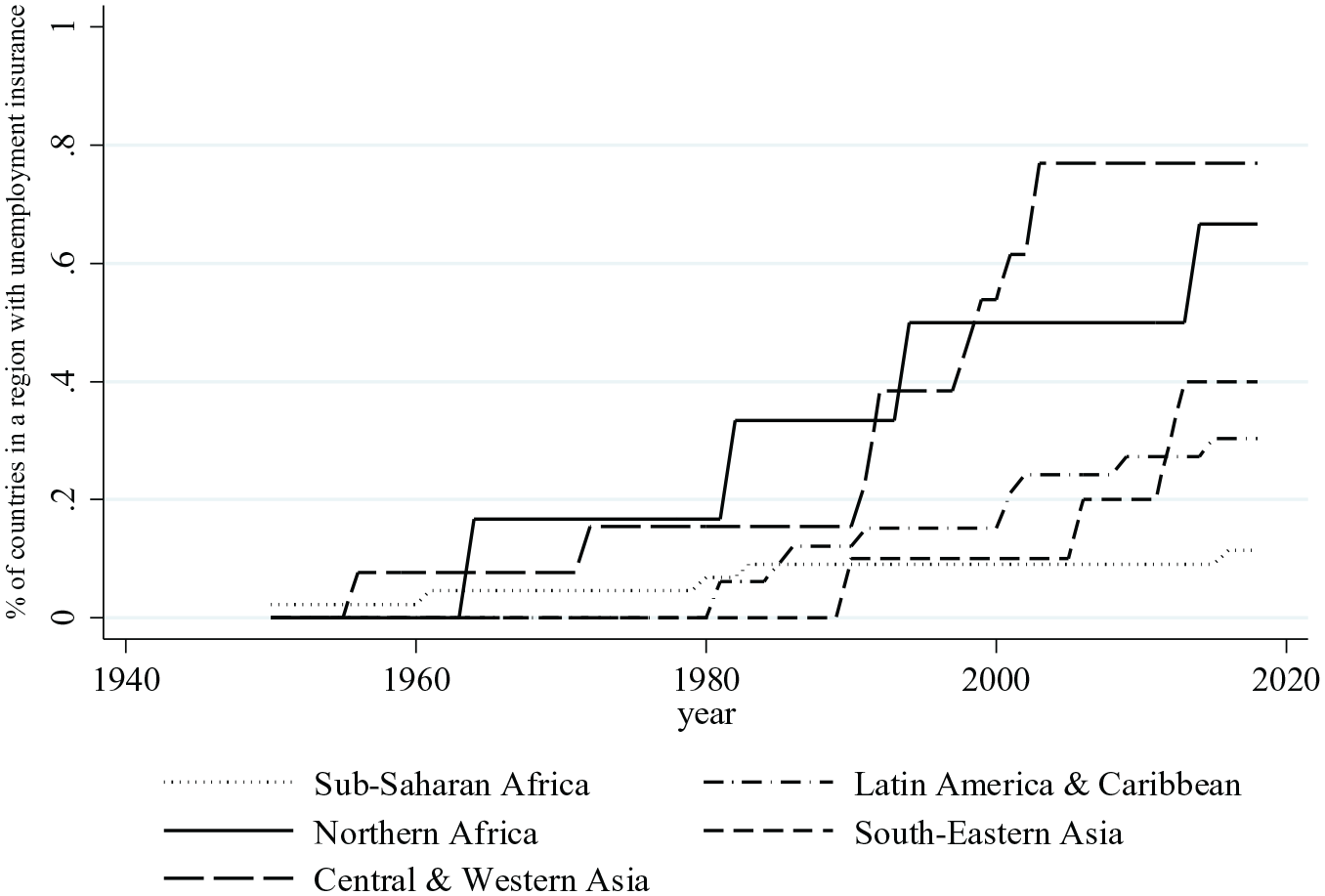
The introduction of unemployment compensation by region since 1950.
Figure 2 shows that the importance of unemployment insurance differs across regions. While it has been introduced in almost all countries of Central and Western Asia, it still plays a minor role in other regions such as Sub-Saharan Africa. But also in South Eastern Asia and, interestingly, in Latin America, unemployment insurance is not very common. Only in Northern Africa and Central and Western Asia have more than half of all countries adopted an unemployment compensation scheme. This regional variation in terms of program adoption is strongly correlated with differences in legal coverage. According to the ILO (2017b: 46), legal coverage ranges from 4.2% in sub-Saharan Africa, 15.9% in South-Eastern Asia, 33.8% in Latin America and the Caribbean, 38.4% in Northern Africa to 77.6% in Central and Western Asia.
In the regression analyses, the dependent variable is coded 1 when a country introduced a compulsory unemployment scheme in a given year and 0 otherwise. By unemployment insurance, we mean a special program that pays a cash benefit in the event of unemployment. Functional equivalents such as severance payments, job creation measures or rigid employment protection are not taken into account. Information on national legislation was compiled from various national and international sources. The countries are included in the analysis until the point of program adoption. Once this event has taken place, they are excluded from further analysis. Given the binary dependent variable, we apply logit regressions. Ordinary probit or logit regressions rest on the assumption that the observations are temporally independent. However, the probability of unemployment compensation legislation is not the same at every point in time. Therefore, ordinary logit would be misleading and the standard errors would be biased (Beck et al., 1998: 49). We follow the procedure suggested by Carter and Signorino (2010) who show that binary time-series cross-section data are identical to grouped duration data and use natural cubic splines to capture the time dependence.
Our independent variables included in the models are operationalized as follows: Military conflicts are captured with a dummy coded 1 if the country participated in an international armed conflict or a civil war in a given year and 0 otherwise (Vdem, 2019). Our key variable related to functionalist welfare state theory is the gross domestic product (GDP) per capita is (Wilensky, 1975). Data on GDP per capita (in 2011, US Dollar) is provided by the Maddison Project Database et al. (2018). Economic crises are measured by (1) the percentage change in GDP using data from the Maddison Project Database et al. (2018) and (2) the annual inflation rate, which is taken from Vdem (2019). Trade vulnerabilities are captured by trade per capita and measured by the sum of a country’s exports and imports (Cow Trade database Barbieri and Keshk, 2016) divided by the total population (Vdem, 2019). We controlled for the extent to which a country’s society is ethnically fractionalized using the index of ethnic fractionalization (Alesina et al., 2003).
The level of democracy is captured by an index provided by the ‘Polity IV Project’ (Marshall et al., 2014). This indicator ranges from –10 (autocracy) to +10 (full democracy). Political corruption is a proxy for weak state capacities and deficiencies in the rule of law and was measured by an index provided by the ‘Varieties of Democracy’-Database (Vdem) (Coppedge et al., 2019). The index is calculated as average of public sector, executive, legislative and judicial corruption (for further details, see Coppedge et al., 2019). Communism is measured by a dummy variable and equals 1 when the legal origin of the company law or commercial code of a country has been shaped by communist laws (LaPorta et al., 1999). Possible impacts the ILO might have had on the adoption of unemployment insurance is captured with a dummy variable that equals 1 if a country was a member of the ILO in a respective year. To control for transnational impacts on program adoption (Abbot and DeViney, 1992), we include a variable measuring the percentage of countries of a specific region having an unemployment compensation scheme in place. We expect a positive impact of policy diffusion on welfare legislation. A dummy variable captures government ideology and equals one in the case of a left-wing head of government and zero otherwise (left-wing government). The data are provided by Vdem (Coppedge et al., 2019) and we assume, in line with the power resources theory, that left-wing governments are more likely respond to the pressure of worker’s demands for unemployment compensation. All independent variables are 5-year moving averages to avoid biases by short-term outliers.
Empirical findings
Table 2 summarizes the results of the regression analyses. 9 While model 1 presents the results of the baseline specification, models 2–4 include further control variables.
Determinants of the introduction of unemployment insurance.
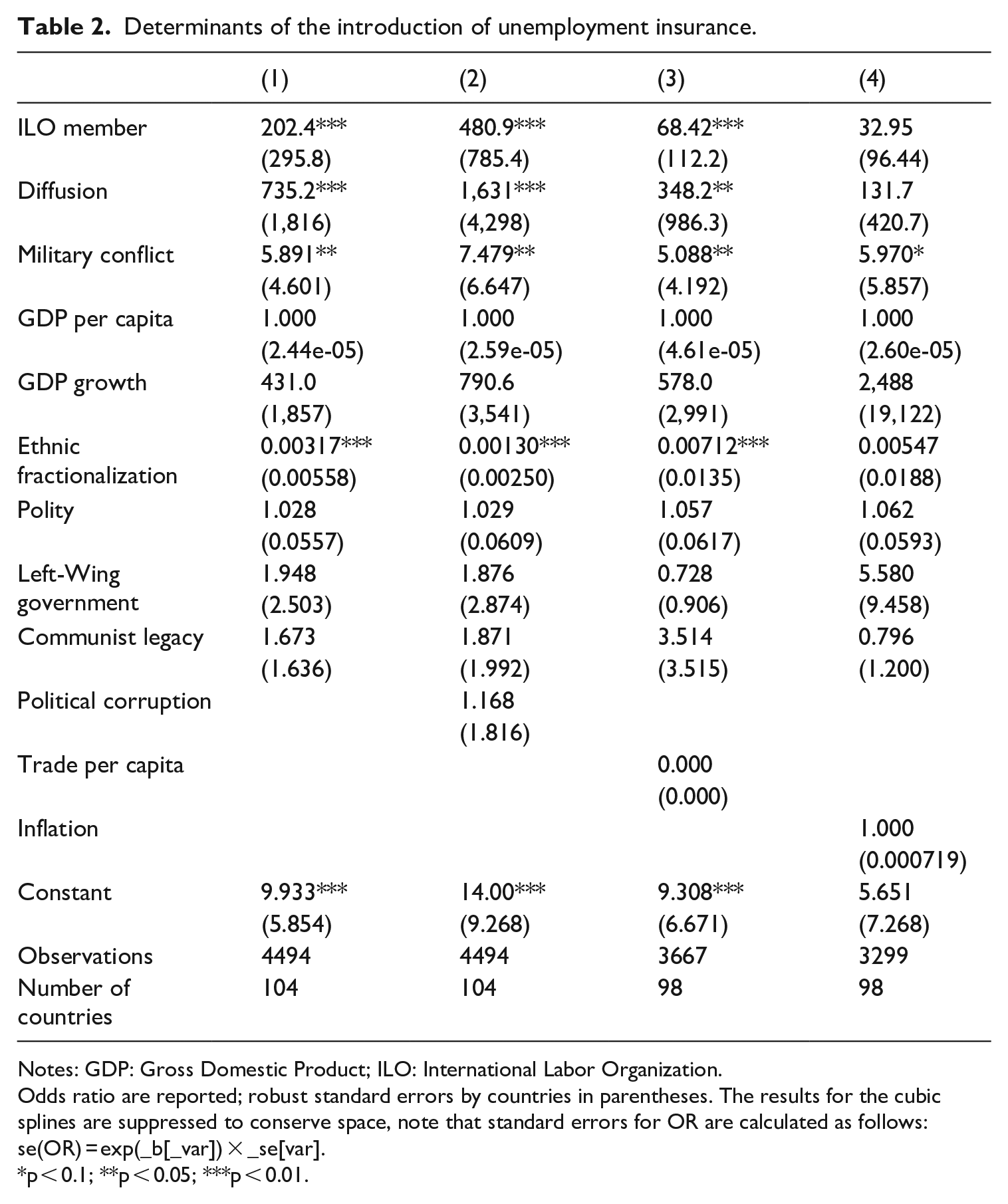
Notes: GDP: Gross Domestic Product; ILO: International Labor Organization.
Odds ratio are reported; robust standard errors by countries in parentheses. The results for the cubic splines are suppressed to conserve space, note that standard errors for OR are calculated as follows: se(OR) = exp(_b[_var]) × _se[var].
p < 0.1; **p < 0.05; ***p < 0.01.
The regression analyses yield some interesting results. In line with the findings for Western countries, military conflicts turn out to be one crucial factor driving the introduction of unemployment insurance. Due to tremendous social needs generated by the horrors of war as well as military demobilization, post-war economic crises and war-induced institutional transformations, wars were catalysts for the adoption of unemployment insurance. The chance of a country involved in armed conflict introducing an unemployment insurance scheme is six times higher than that of a peaceful country.
One further crucial factor is the ILO (2013, 2017a, 2017b, 2019), which strongly promoted the introduction of unemployment compensation schemes from early on. Being an ILO member state, in consequence, increases the likelihood to adopt a respective scheme. Compared to the introduction of unemployment insurance in Western countries in the first half of the century (Obinger and Schmitt, 2020a), the importance of the ILO seems to be much more pronounced for the adoption of this scheme at a later stage, that is, since 1950.
Moreover, diffusion is important for the spread of unemployment insurance. The more countries in a region adopt an unemployment compensation scheme, the more likely it is that other countries in the same region will follow this policy trend. This result also holds when controlling for the time dependence in the data, that is, including cubic splines, linear trends or cubic polynomial approximations.
Finally, we find strong support for our hypothesis that unemployment insurance is less likely to be adopted in ethnically divided countries. The chance that an ethnically very heterogeneous country (value close to 1) introduces an unemployment compensation scheme is only 0.005%. This supports evidence provided by the literature that ethnically divided societies employ redistribution measures to a lower extent than homogeneous ones.
Interestingly, the coefficients related to the political regime type, the government ideology, a communist legacy, political corruption as well as economic development are statistically insignificant, which indicates that these variables do not play a major role for the introduction of unemployment insurance in the Global South. The results presented in Table 2 are highly stable across different model specifications.
In sum, the adoption of unemployment insurance seems to be triggered primarily by international factors such as regional policy diffusion, the activities of the ILO and violent conflicts rather than by domestic political and economic conditions. Among the domestic variables included in the analysis, ethnic heterogeneity alone has turned out to be important; it significantly diminishes the probability of introducing unemployment compensation. Our overall evidence suggests that only a few factors that explain the emergence of unemployment insurance in Western countries can be transferred to the Global South, while many others are of lesser importance or not relevant at all. Before the Second World War, the adoption of unemployment compensation schemes was almost exclusively a response to national emergencies, while later on, introducing unemployment insurance was also highly influenced by international processes and agency. This finding is in line with previous studies providing evidence that the further spread of policies depends on their prior proliferation (e.g. Collier and Messick, 1975). To put it in more concrete terms, we find that in the Global South as well as in the Western world, war is a major catalyst for introducing unemployment insurance. The ILO and policy diffusion, however, played a stronger role for program adoption in the Global South. No impact was found for the level of economic development and the political regime type. However, to conclude from this evidence that domestic politics do not play a role for the introduction of unemployment insurance in single cases with specific historical, economic and socio-political histories and structures would be misleading. Policies adopted in specific countries are usually a reflection of specific circumstances and special historical considerations and compromises. However, as our main emphasis is on identifying general patterns and main driving factors across countries and over time, we do not aim at explaining specific and unique policy trajectories.
Discussion and conclusion
For various reasons, unemployment insurance was and still is a highly contested issue. In consequence, it was generally adopted much later and in fewer countries than other programs that provide income support in case of old age, sickness or work injury. Previous research has shown that the introduction of unemployment insurance in the Western world was furthered by left-wing and liberal parties and happened in the aftermath of political and economic emergencies such as war and economic depression. This article examined whether this explanation also holds for the countries in the Global South, where program adoption only started after the Second World War. Using a regression framework, we show that war also influenced the timing of program adoption in the Global South, whereas economic crises and political determinants are unrelated to program adoption. In general, international impacts such as the activities of the ILO or regional policy diffusion were more influential than domestic factors, with the notable exception of ethnic fragmentation.
However, our quantitative study also has limits. While we found evidence that program adoption was shaped by policy diffusion, a macro-quantitative analysis cannot detect the underlying causal mechanisms. For example, it remains unclear which mechanisms drive the results for our finding that diffusion matters, that is, whether program adoption was swayed by policy learning or emulation. Moreover, the lack of unemployment insurance in many countries might be related to the existence of functional equivalents, which either prevent unemployment or provide cash benefits in case of redundancy. The most important examples include severance payments (Holzmann et al., 2011; Vodopivec, 2013) or extensive job protection legislation. Unfortunately, for many of the countries examined in this article, historical data that may include this information does not exist yet. Compiling such data for a larger number of countries and examining the ways in which functional equivalents have swayed unemployment insurance legislation is therefore a promising avenue for future research.
Moreover, as case-specific national or regional contextual factors important for policy adoption in single cases cannot be adequately captured by a macro-quantitative large-N design, a promising avenue for future research is the combination of quantitative analyses with in-depth case studies. Using such a mixed methods design, uniform patterns and the underlying causal mechanisms, national and contextual factors as well as specific historical circumstances could be identified at the same time.
Finally, we want to emphasize that focusing on program adoption is not enough. The establishment of unemployment insurance is without a doubt a key piece of welfare legislation. But we also must take effective coverage, eligibility criteria and benefit generosity into account as these indicators provide information on the extent and quality of social protection. Particularly in many countries of the Global South, there are not only large differences between occupational groups due to widespread informal employment, but also implementation deficits that can be traced back to limited state capacity. We have adequate and comparable historical data for Western countries and we know much about the factors driving cross-national differences in benefit generosity and coverage. Nothing of the sort applies to large parts of the Global South.
Footnotes
Appendix 1
Introduction of unemployment insurance.
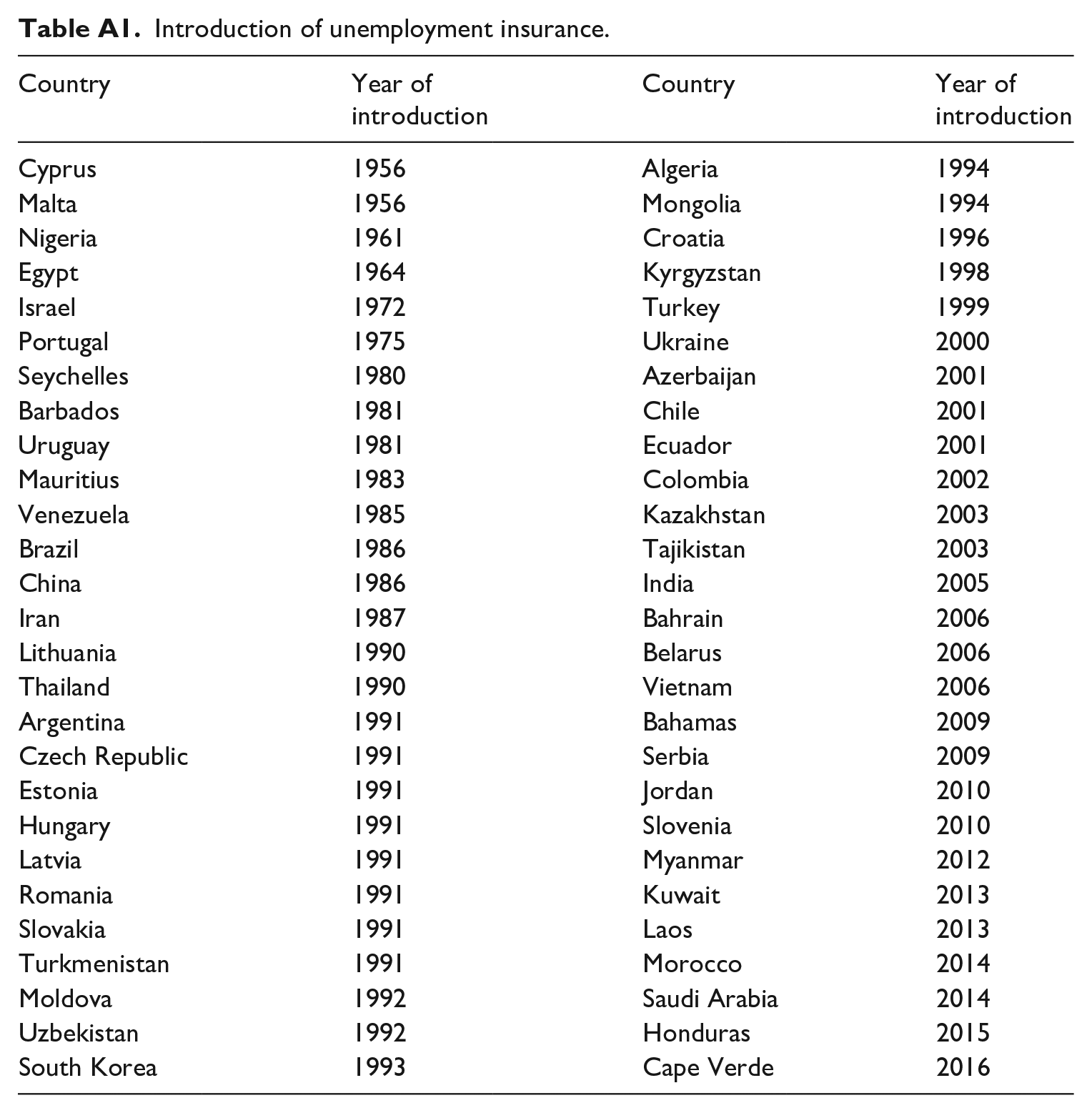
| Country | Year of introduction | Country | Year of introduction |
|---|---|---|---|
| Cyprus | 1956 | Algeria | 1994 |
| Malta | 1956 | Mongolia | 1994 |
| Nigeria | 1961 | Croatia | 1996 |
| Egypt | 1964 | Kyrgyzstan | 1998 |
| Israel | 1972 | Turkey | 1999 |
| Portugal | 1975 | Ukraine | 2000 |
| Seychelles | 1980 | Azerbaijan | 2001 |
| Barbados | 1981 | Chile | 2001 |
| Uruguay | 1981 | Ecuador | 2001 |
| Mauritius | 1983 | Colombia | 2002 |
| Venezuela | 1985 | Kazakhstan | 2003 |
| Brazil | 1986 | Tajikistan | 2003 |
| China | 1986 | India | 2005 |
| Iran | 1987 | Bahrain | 2006 |
| Lithuania | 1990 | Belarus | 2006 |
| Thailand | 1990 | Vietnam | 2006 |
| Argentina | 1991 | Bahamas | 2009 |
| Czech Republic | 1991 | Serbia | 2009 |
| Estonia | 1991 | Jordan | 2010 |
| Hungary | 1991 | Slovenia | 2010 |
| Latvia | 1991 | Myanmar | 2012 |
| Romania | 1991 | Kuwait | 2013 |
| Slovakia | 1991 | Laos | 2013 |
| Turkmenistan | 1991 | Morocco | 2014 |
| Moldova | 1992 | Saudi Arabia | 2014 |
| Uzbekistan | 1992 | Honduras | 2015 |
| South Korea | 1993 | Cape Verde | 2016 |
Funding
The author(s) disclosed receipt of the following financial support for the research, authorship, and/or publication of this article: We are grateful to the anonymous reviewers for very helpful comments and thank the German Research Foundation (DFG) for financial support (Grant No. 374666841 – SFB 1342).
