



Abstract
Does a person’s everyday behavior at home influence their desire to travel sustainably and pay for it? Testing the Holmes, Dodds and Frochot (HDF) model, this research sought to understand the influence that daily behavior – measured by frugality, altruism, and pro-environmental behavior – has on both sustainable travel behavior and a traveler’s propensity to pay. This paper augments the HDF model in that it finds sustainable travel behavior to be not just a single construct, but rather influenced separately by sociocultural, environmental and local consumption behaviors. Second, this study also examines how these differences in sustainable travel influence the traveler’s propensity to pay. The findings of this study explain that day-to-day behavior at home does explain a traveler’s propensity to pay for sustainability efforts when traveling. Those who are more altruistic are more likely to be more environmentally friendly and more likely to look for local experiences when traveling. Those who are more environmentally minded at home are also more likely to seek out cultural, environmentally friendly and local experiences when traveling. In contrast, those who are more frugal are less likely to be environmentally friendly when traveling.
Introduction
Although the term “sustainability” has been defined as encompassing the three pillars related to economic, social, and environmental concerns (United Nations World Tourism Organization, nd), it is a term that has been poorly interpreted and that has evolved to refer to different types and interpretations of activities among consumers (Simpson and Radford, 2012). As Caitlin and Luchs (2017) outline: “academic research operationalizes sustainability in a wide variety of ways and often does not explicitly consider the possible systematic distinctions between these three primary dimensions of sustainability” (p. 246). Specifically, Boström and Micheletti (2016) outline that sustainability can often be treated as a unified product, treating the differing aspects of social, environmental and economic as one. Researchers (e.g., Choi and Ng, 2011; Marcus et al., 2015) call for a more nuanced understanding of the term, such as understanding the need to “distinguish between socially- and environmentally focused issues to examine the influence of each on marketing outcomes” (Chabowski et al., 2011: 64).
Within the tourism industry, studies have questioned the responsibility of tourists, suggesting that often they adopt a more hedonistic or laissez-faire attitude (Cohen, 1982; Gössling, 2017) or that they absolve themselves of responsibility when on holiday (Miller et al., 2010). In addition, not all studies agree that attitude and behavior can positively lead to more sustainable behavior (Antimova et al., 2012; Gössling, 2017; Juvan and Dolnicar, 2014, 2017; Oliver et al., 2021; Walsh and Dodds, 2022), especially with regard to air travel (Barr et al., 2011; Highman et al., 2016). Holmes et al. (2021) sought to understand how everyday behavior influences sustainable travel and found a positive correlation. They examined in depth the pro-ecological behavior, frugality and altruism of daily behaviors at home to determine their influence on sustainable travel behavior and also developed a model. This model, although looking at three different influences, still groups sustainable travel behavior as one unified element. Therefore, there is not only a need to test this model for validity but also to determine whether there are systematic distinctions between the elements of social, environmental or economic behavior.
Theory of planned behavior
While McKercher et al. (2010) clearly outline that no one single theory explains the attitude behavior gap completely, the theory of planned behavior (TPB) is used in this study as it reasons that an individual’s core belief system primarily determines their intentions and subjective norms, and multiple studies have tested this model. The majority of studies on TPB, however, have focused solely on environmental actions (Clark et al., 2019; Fauzi et al., 2022; Han et al., 2018; Liu et al., 2020; Oliver et al., 2021; Wang et al., 2020; Xu et al., 2017 rather than examining sustainability behavior as more than just pro-ecological behavior. This is especially true of tourism-related studies over the decades. e.g., Kinnear et al. (1974) in their research on environmentally responsible behavior in relation to the sustainable tourist found that there is a specific subset of the general population i.e. very ecologically concerned. Teeroovengdum (2018) and Lee and Jan (2018) produced results indicating that pro-environmental attitudes increased the likelihood of sustainable tourism behavior and purchasing behavior. Further, work by Han et al. (2018) found that individuals who reuse towels at home are more likely to carry this behavior over when on vacation. Liu et al. (2020) also confirmed that basic daily green behavior at home (e.g., recycling) led to a higher potential for engaging in the same behavior when traveling. It seems that there is only one study, put forth by Holmes et al. (2021) that examines more than one element of what is defined as sustainable tourism, outlining three different behaviors that may affect travel behavior. These authors built on the work of Corral-Verdugo et al. (2010), modeling the influence that pro-ecological behavior, frugality and altruism had on sustainable travel behavior. Pro-ecological behavior deals with the reduction of human impact on the environment (see Corral-Verdugo et al., 2012; Kaiser, 1998; Sawitri et al., 2015). Frugality was characterized as behaviors that result in the reduction in consumption and/or more equitable use of goods and services (see Evans, 2011; Evans and Abrahamse, 2009). Altruism is the idea of people who look to assist others through actions and/or sacrifices (see Fehr and Fischbacher 2003; Piliavin and Charng 1990; Schultz, 2001). Although Holmes et al. (2021) go into detail on the different factors that affect travel, even they use the phrase “green traveler” and do not differentiate between the different elements that make up sustainable travel. Therefore, there is a need to further examine whether environmental, social or economic aspects of behavior affect different aspects of sustainable travel.
There are also critiques of TPB that should not be ignored. It has been outlined that intentions do not always lead to action (Antimova et al., 2012; Conner and Armitage, 1998; Juvan and Dolnicar, 2014), only a limited percentage of behavior can be predicted (Godin and Cok, 1996) and that there is also cognitive dissonance. Juvan and Dolnicar (2017) suggest that sustainable tourist behaviors may have distinctly different drivers, and Antimova et al. (2012) outline that perhaps community theories are better suited to closing the attitude–behaviour gap.
In line with testing the HDF model, the following hypotheses are proposed: H1 – Altruism positively influences all three types of sustainable travel behavior (social, economic and environmental) H2 – Pro-environmental behavior positively influences all three types of sustainable travel behavior (social, economic and environmental) H3 – Frugality has no influence on any of the three types of sustainable travel behavior (social, economic and environmental)
Everyday behavior and propensity to pay
Beyond examining the ability of everyday behavior to influence sustainable travel behavior, research has established that everyday behavior influences a person’s propensity to pay to travel sustainably. Dolcinar (2006) found that certain tourists are willing to make increased travel changes in order to protect the environment. Teeroovengadum (2018) found that a more defined environmental identity led to more positive attitudes towards ecotourism and a greater likelihood of paying higher fees to support sustainable tourism ventures. This was further supported by similar results regarding the intentions of sustainable tourists found by Ibnou-Laaroussi et al. (2020). It is one thing to outline the propensity to pay but there is also a need to determine this tourist’s willingness to pay for environmental, social or economic elements. Many studies have been put forth claiming that the “more sustainable” tourist will pay more (Bigerna et al., 2019; Dodds et al., 2010; Doran et al., 2015, among others); however, many studies only look at pro environmental behavior (e.g., Debski and Borkowska-Niszczota, 2020; Hwang and Lee, 2018) rather than all constructs of social, economic and environmental behaviours.
Other studies have found those who are more altruistic or environmentally aware/conscious/caring, to be willing to pay for sustainable travel but this is not a guarantee. For example, Pulido-Fernández and López-Sánchez (2016) found contradictory evidence to the notion that the sustainable tourist is willing to pay more to preserve the environment. A study in Australia (Bergin-Seers and Mair, 2009) also described this paradoxical reality. A key finding from the study found that green tourists showed intentions to pay more for environmentally friendly tourism products and services, yet also indicated that there was not enough evidence to indicate that sustainable travelers were changing their consumer purchasing patterns for environmental reasons. McKercher and Tse (2012) also found that behavorial intentions do not always translate into actions, which is further corroborated by Ramchurjee and Suresha (2015), who found that home behavior did not necessarily translate into similar vacation behavior, nor did a willingness to pay for sustainable tourist experiences necessarily beget tangible actions while on vacation. Recently, Walsh and Dodds (2022) in a Canadian study found that cost is a factor when making more-sustainable decisions, as the rise in price may be a deterrent. Wang et al. (2021) found that frugal in/dividuals were less likely to pay for sustainable travel.
While different clusters of travelers may account for discrepancy, there does appear to be mixed findings with regard to the influence that everyday behavior has on a person’s willingness to pay for sustainable travel. This study will not only look at the different constructs of daily behavior as well as travel, it will also seek to examine whether this influences a person’s propensity to pay for sustainable travel. To test such, the following hypotheses are proposed: H4 – Altruism positively influences propensity to pay for sustainable travel H5 – Pro-environmental behavior positively influences propensity to pay for sustainable travel H6 – Frugality negatively influences propensity to pay for sustainable travel Everyday behavior’s influence on sustainable travel behavior and propensity to pay.
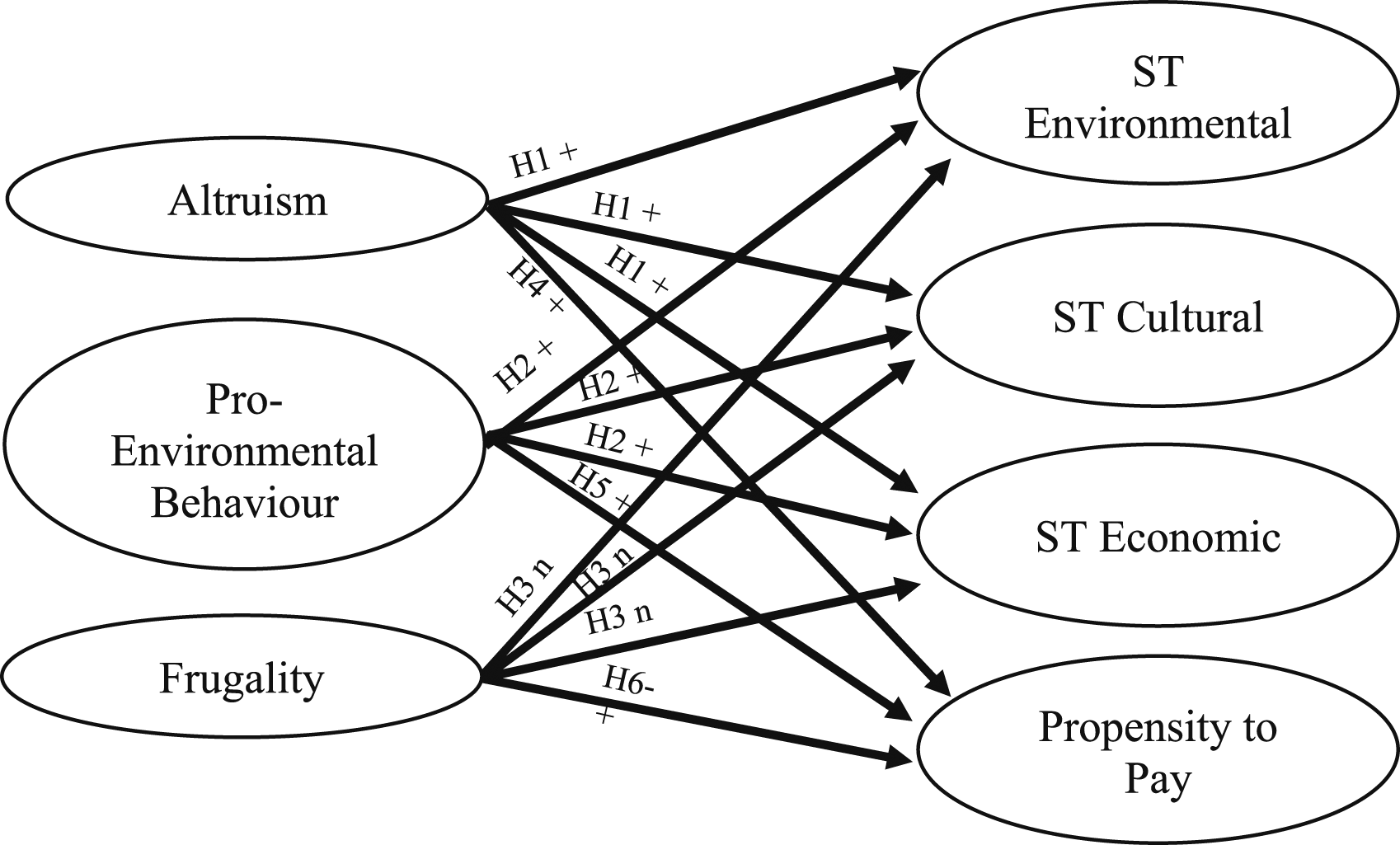
This research looks to test the proposed hypotheses through the model proposed in Figure 1:
Methodology
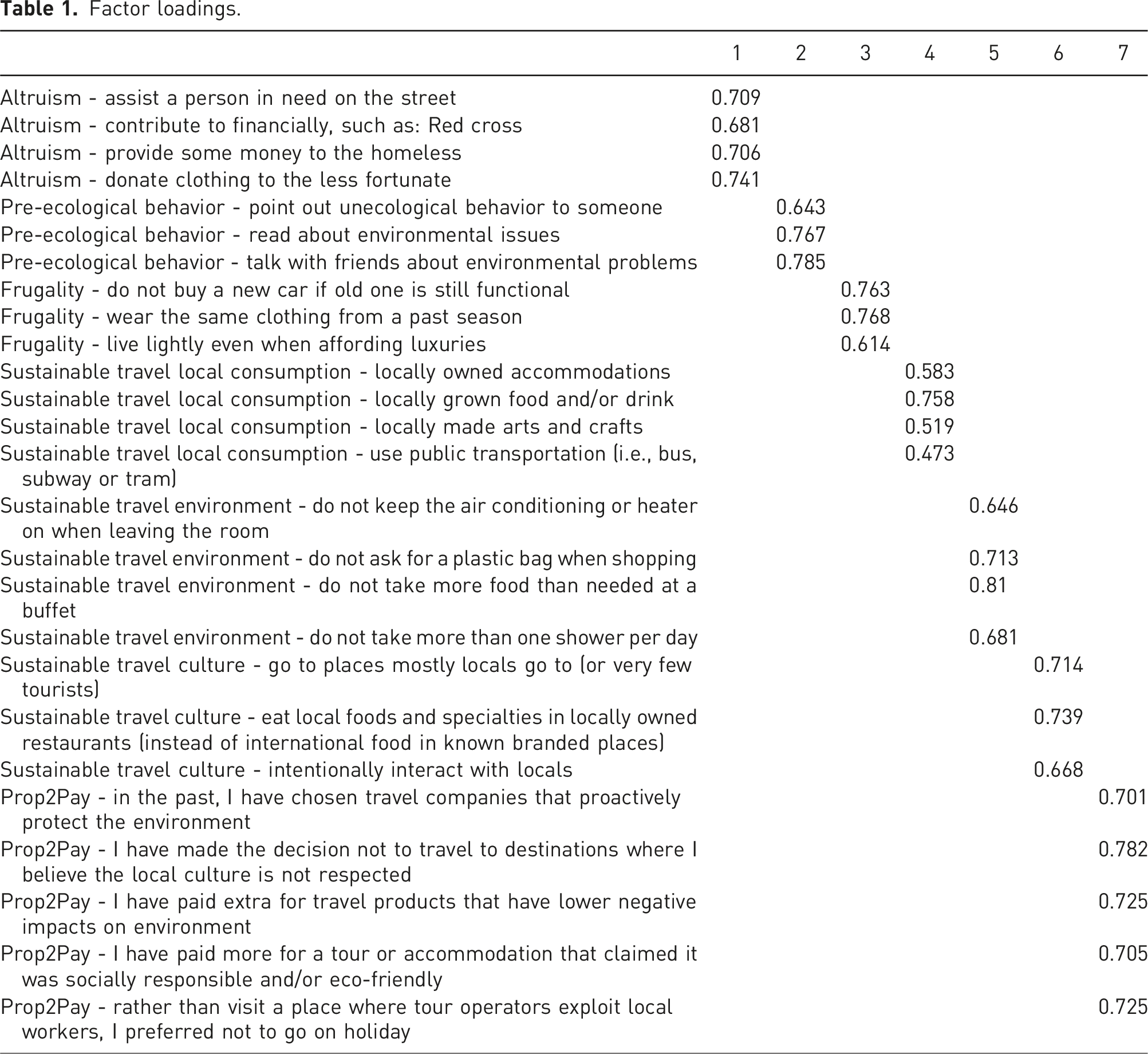
This research employed structured surveys of a panel population, which was administered by the online survey panel company Dynata through the Qualtrics website. The survey respondents were asked to answer questions pertaining to their demographics, everyday behavior (altruism, frugality, pro-environmental), typical reasons for travel (business vs leisure), and sustainable travel behavior. To capture everyday behavior, the constructs of frugality, altruism and pro-environmental behavior as developed by Corral-Verdugo et al. (2010, 2012) were employed. Frugality was measured through statements such as “I live lightly even when affording luxuries.” Altruism was captured through such questions as “I provide some money to the homeless.” Pro-ecological behavior was measured through questions such as “Point out unecological behavior to someone.”
Factor loadings.
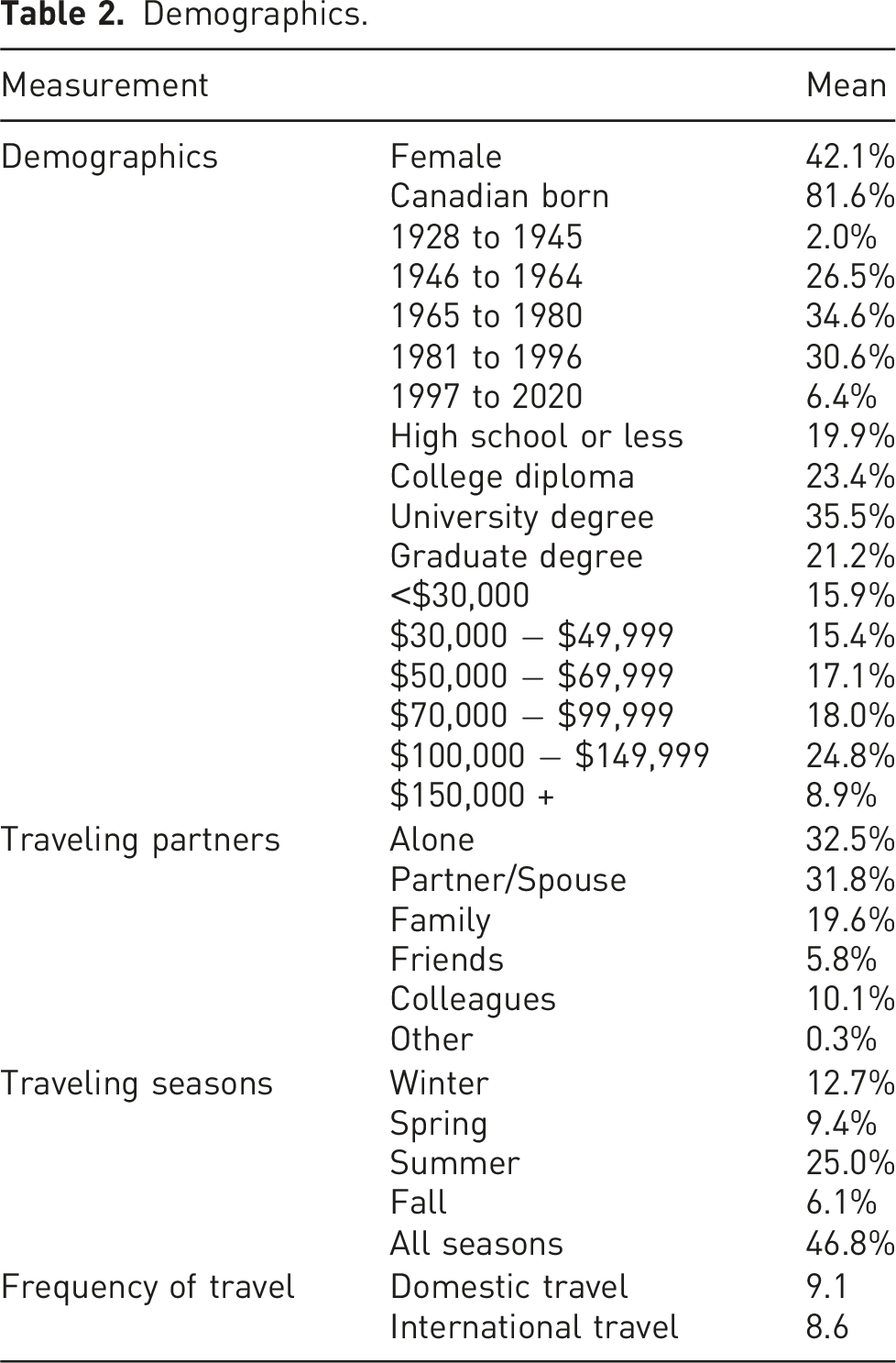
Surveys were captured from 2,886 Canadian travelers in February and March of 2020 before the start of the full lockdowns for COVID-19. Respondents were required to be Canadian travelers who were over 18 years of age, and who had traveled at least once in the past year. Only those respondents who had answered all questions were retained for this analysis, resulting in 755 complete and included surveys.
The results of this research were captured to accomplish two outcomes: first, to confirm the model proposed by Holmes et al. (2021); and second, to understand how everyday behavior influences propensity to purchase environmental travel. To facilitate this understanding, structural equation modeling was employed.
Results
Overall demographics
Demographics.
Factor analysis
Before progressing to undertake a structural equation model, a factor analysis (FA) was employed. The factor analysis identified some questions that fell below 0.45, and they were eliminated to improve internal cohesion. Further, the FA found past sustainable travel behavior to load onto four separate factors − local consumption, environmental, cultural, and a remainder factor − all of which were retained except for the remainder factor. After sorting past sustainable travel behavior into the three separate factors, and removing factor loadings less than 0.45, all factors were found to load onto each construct (see Table 1).
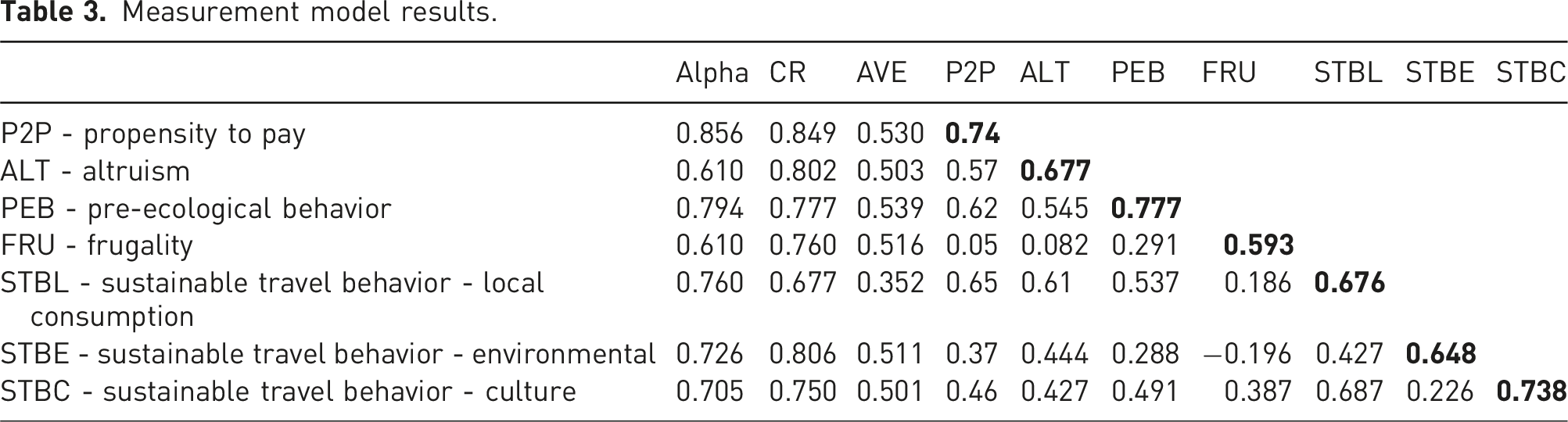
Measurement model results.
Structural equation model
Drawing on the constructs derived from the work of Corral-Verdugo and Pinheiro (2010), Corral-Verdugo et al. (2010 & 2012), Kaiser (1998), López-Sánchez and Pulido Fernández (2016), Juvan and Dolnicar (2016), Passafaro et al. (2015), and Holmes et al. (2021), this research looked to understand how everyday behavior influenced sustainable travel behavior and propensity to pay for environmentally sustainable travel. To test this relationship, a structural equation model (SEM) with all constructs was tested. In the SEM, the influence of everyday behaviors on sustainable travel behavior (local consumption (STBL), environmental (STBE), cultural (STBC)) and propensity to pay (P2P) were examined.
Goodness of fit indices.
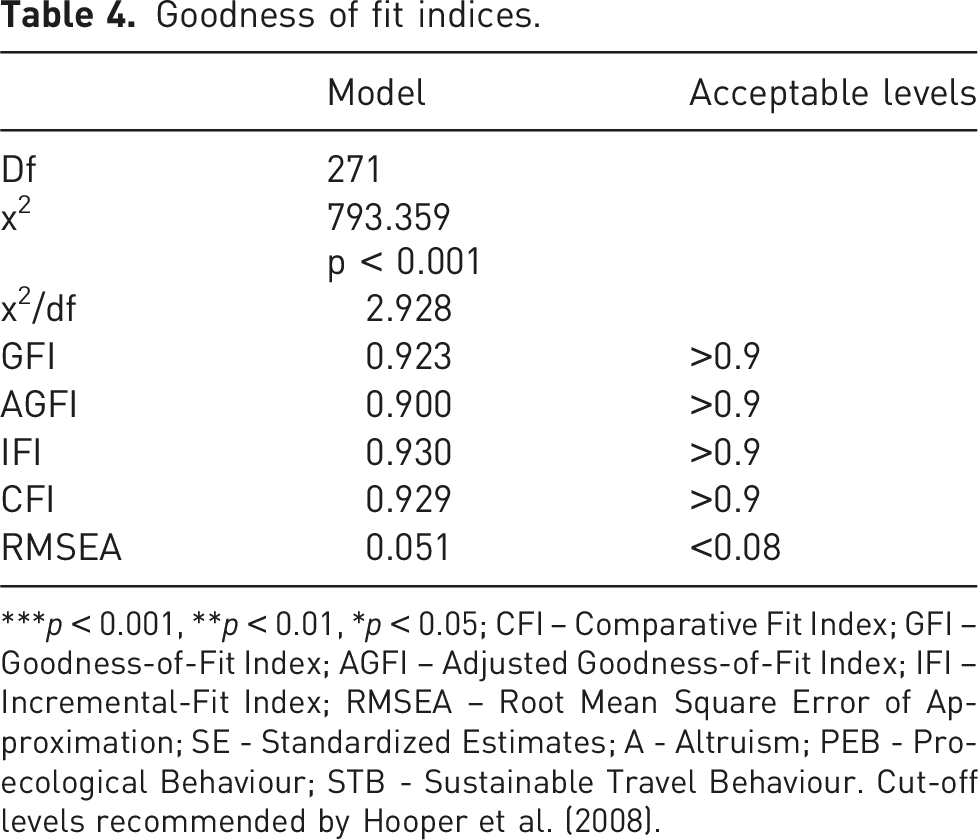
***p < 0.001, **p < 0.01, *p < 0.05; CFI – Comparative Fit Index; GFI – Goodness-of-Fit Index; AGFI – Adjusted Goodness-of-Fit Index; IFI – Incremental-Fit Index; RMSEA – Root Mean Square Error of Approximation; SE - Standardized Estimates; A - Altruism; PEB - Pro-ecological Behaviour; STB - Sustainable Travel Behaviour. Cut-off levels recommended by Hooper et al. (2008).
Structural equation relationships, weights, and squared multiple correlations.
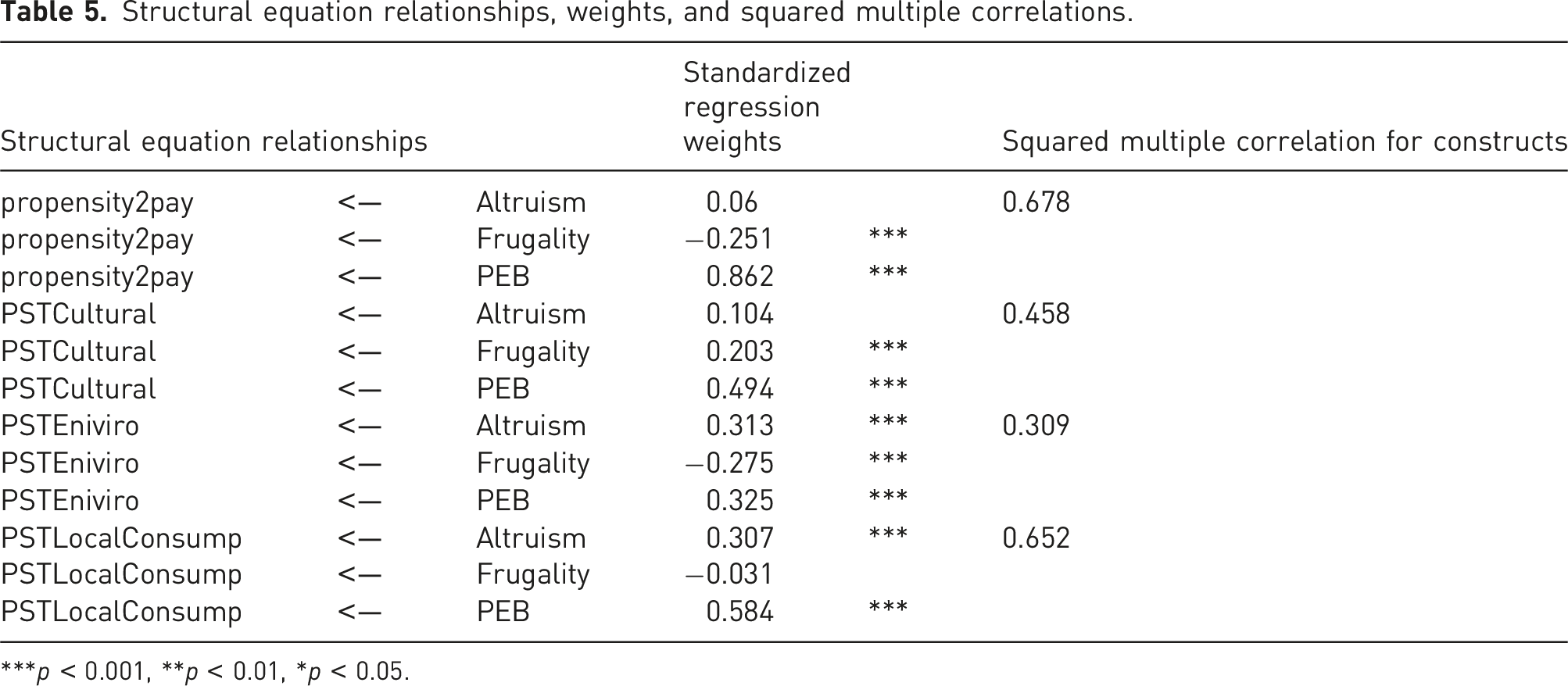
***p < 0.001, **p < 0.01, *p < 0.05.
Hypotheses support.
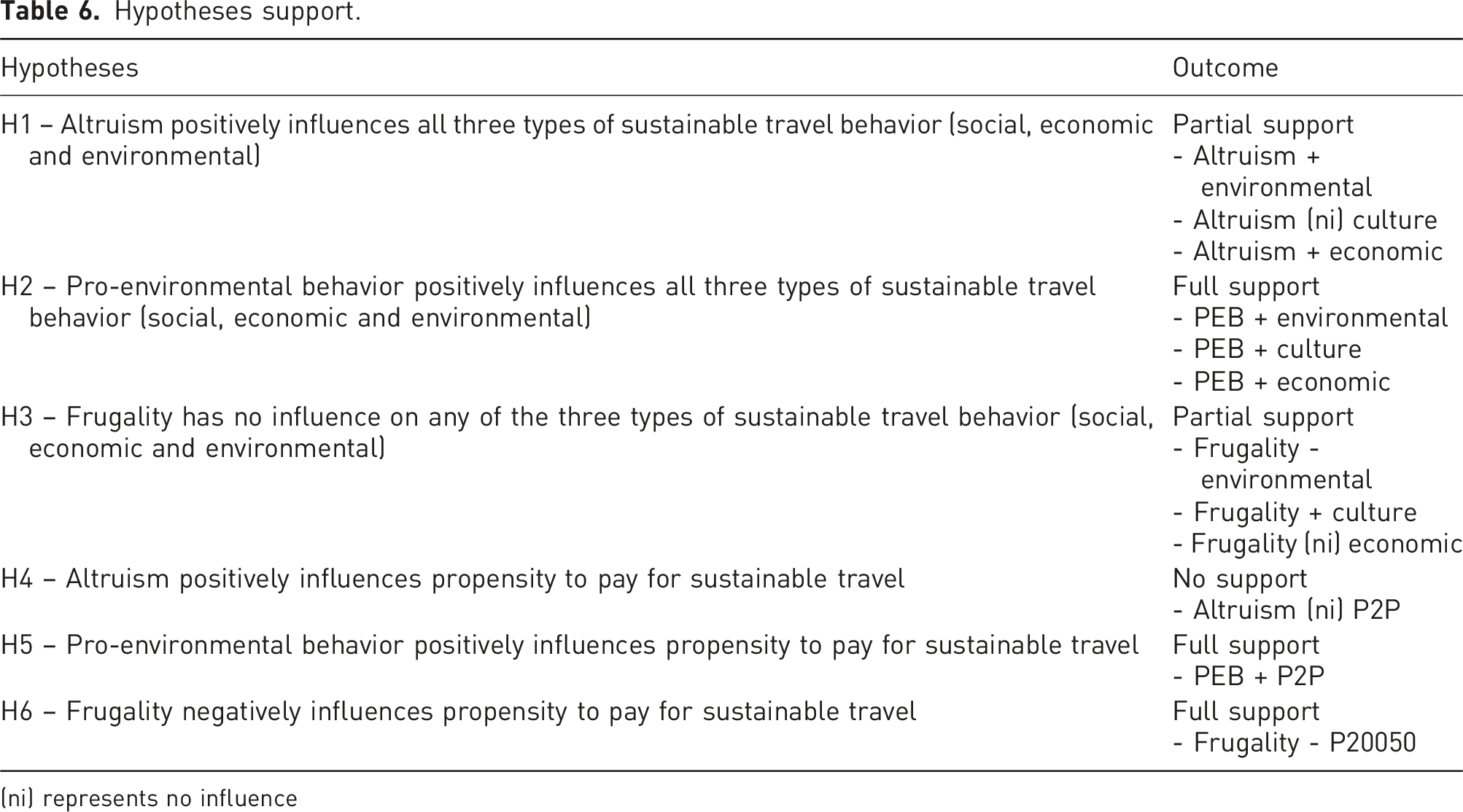
(ni) represents no influence
Discussion
There are three key findings from this research. First, this research found the Holmes, Dodds, and Frochot (HDF) model (Holmes et al., 2021) to hold true, but that sustainable travel behavior should not be examined as a single construct. Sustainable travel behavior needs to be examined as three separate constructs − sustainable travel as it relates to culture, environment, and local consumption − as these behaviors are not the same. This distinction supports the notion that sustainability can be conceptualized as three separate constructs in the sustainability triangle, sometimes known as people, planet and profit (Elkington, 1997; Goel, 2010). This result is not surprising as the concept of the triple bottom line has been around for many decades; however, there has been a tendency to presume or prescribe sustainability as just economic or environmental rather than all three (economic, environmental, and social), which has possibly led to the poor achievement of sustainable tourism overall (Butler and Dodds, 2022; Lew, 2020). The second key finding is that every day behavior explains the variance in each sustainable travel outcome differently. Altruism positively influences environmental and local consumption behavior. Frugality positively influences cultural travel behavior but negatively influences environmental behavior. Pro-environmental everyday behavior positively influences cultural, environmental and local consumption travel behavior (see complete breakdown of influences in Figure 2). While the HDF model did not find frugality to influence sustainable travel behavior, this could have been a result of measuring sustainable travel behavior as a single construct and not three separate constructs, as has been undertaken herein. SEM of everyday behaviors’ influence on Environmental, Cultural, and Economic Sustainable Travel, as well as Propensity to Pay. (Red indicates hypotheses not supported, green indicates hypotheses supported).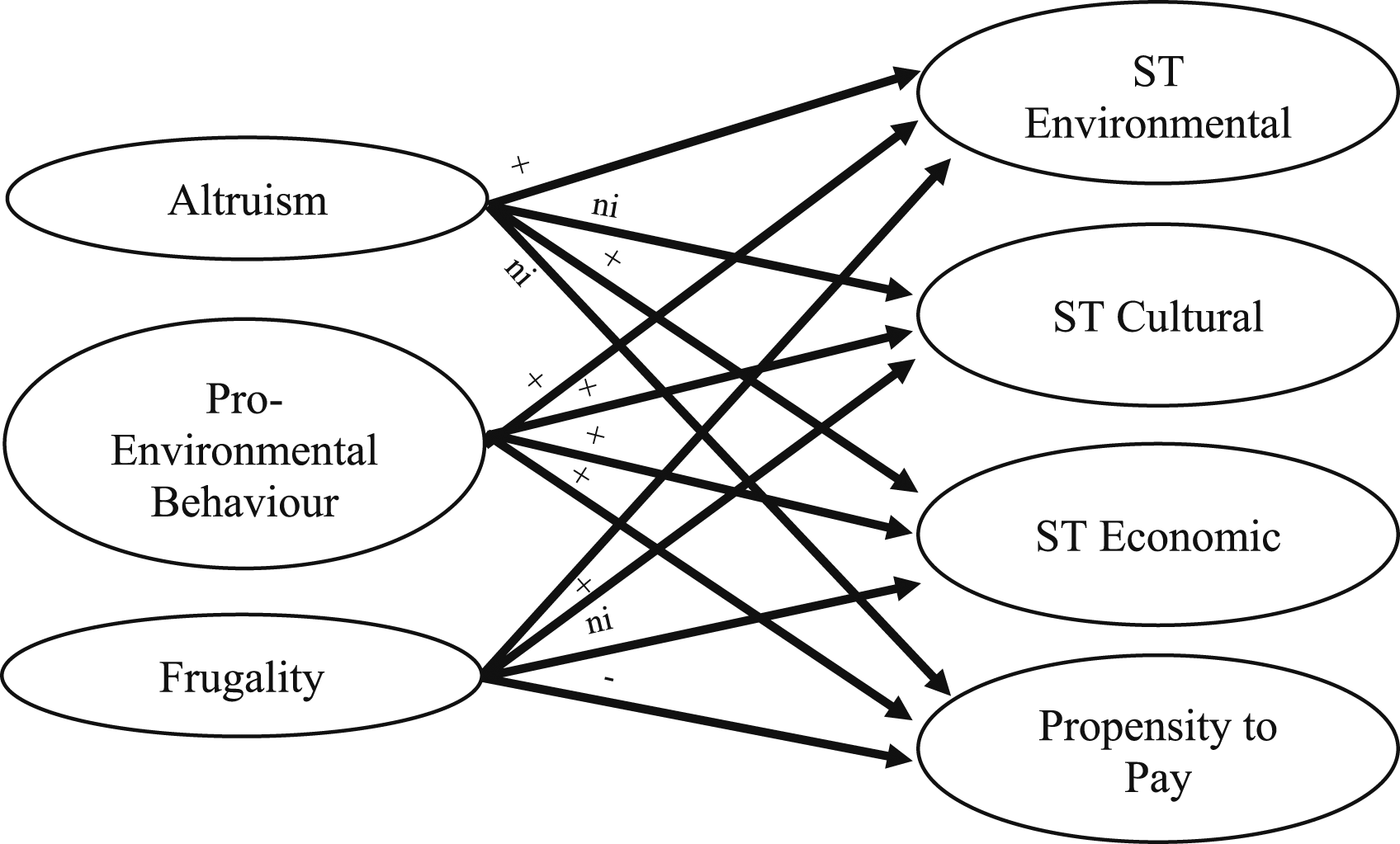
The third key finding is that every day behaviors were found to explain a traveler’s propensity to pay for sustainable travel. While altruism does not have an influence on a person’s propensity to pay, a more frugal individual is less likely to pay for sustainable travel, while a more environmentally conscious person is more likely to pay for it. The finding that pro-environmental behavior at home influences propensity to pay for environmentally sustainable travel supports the previous work done by Dodds et al. (2010), Dolcinar (2006), and Hwang and Lee (2018). Wang et al.’s work (2021) supports the finding that frugality and propensity to pay are inversely related, as indulgence takes importance over frugality when traveling, as it is seen as a more hedonistic behavior.
Conclusions
This paper has sought to shed light on the influence that everyday behavior has on both the three constructs of sustainable travel behavior and propensity to pay for such travel. The results of this research can be divided into both practical and theoretical implications. Practically, by better understanding the drivers that motivate travelers to travel more sustainably, and the types of tourists that are more likely to both travel sustainably and pay for such travel, destinations can better target their marketing to specific travelers based on everyday behavior. Further, destinations can develop packages for each of the different types of tourists (frugal, altruistic, pro-environmental) in order to maximize their attraction to such markets. Regarding this research’s academic contributions, this study has furthered the HDF model, finding that sustainable travel behavior should be examined as a multidimensional as opposed to a single construct. Further, while previous research has looked to understand the influence that socio-economic and travel characteristics have on a person’s willingness to pay for sustainable travel behavior (see Durán-Román et al., 2021), this is the first study to examine the influence that everyday frugality, altruism and pro-environmental behaviors all together have on a traveler’s propensity to pay. Future research should look to take this further by examining how everyday behavior along with socio-economic and travel behavior tendencies will influence both sustainable travel behavior as well as propensity to pay.
Four specific recommendations are derived from this research that can help to focus the marketing efforts of destinations. First, destinations and the tourism industry more broadly should seek out those people who are more environmentally friendly at home as they will also be more likely to conduct this same behavior when traveling and will also be more receptive to purchasing sustainable travel options. Second, while those who are more environmentally conscious at home will be more likely to seek out cultural experiences while traveling, those who are frugal are also interested in having a sustainable cultural experience when traveling. This suggests that destinations should not only focus on popular offerings, but also provide opportunities for all travelers to experience more authentic rather than contrived local culture. Third, industry should work to not only attract those with pro-sustainable behaviors, but they should also look to encourage those normative behaviors. Just because “we say this will happen” does not mean that “this will happen in the destination” if they do not have the infrastructure in place to enable and allow for sustainable behavior. As Hysa et al. (2021) and Walsh and Dodds (2022) outline, it is social media and travel websites that have a significant influence on tourists’ search for sustainable tourism information and therefore guidelines and behavioral expectations outlining more sustainable behavior should be promoted. Lastly, as suggested by Liu et al. (2020), destination stakeholders need to have a better undertraining of the consumer and destination profiles so as to target, attract and retain those people willing to pay for, and consume, sustainable travel options.
Limitations
There are a few limitations to this study. First, the indicators used in this study were self-reported, as such future research should look to investigate observed behavior in a travel destination. Second, this research was undertaken with Canadian travelers with no travel destination specified, therefore, future research should look to examine whether these findings hold true in different cultures, countries, destinations and types of travel (i.e., adventure tourism vs all-inclusive, vs cruise). Third, this paper only looked at individual behavior rather than at a community level. As Animova et al. (2012) point out, influencing individuals at a group or community level may be more effective and long lasting and further research should consider this approach.
Footnotes
Declaration of conflicting interests
The author(s) declared no potential conflicts of interest with respect to the research, authorship, and/or publication of this article.
Funding
The author(s) received no financial support for the research, authorship, and/or publication of this article.
