






Abstract
Some authors have demonstrated the value of egalitarian sharing rules in teams, even when team members have distinct abilities and make different contributions to team performance. However, we show the appearance of an undesirable component of rational altruism when marginal productivities differ across team members and an egalitarian sharing rule is used. We call this new component of rational altruism the Perverse Element of Rational Altruism (PERA). The presence of the PERA decreases team efficiency. In this sense, and considering several scenarios, an analysis of welfare implications and the evolution of team efficiency are presented.
Keywords
Introduction
The flattening of hierarchies and the implementation of team-based forms of work organization have been common practices among firms in recent years (Hamilton et al., 2003). The organization of work in teams increases group efficiency by taking advantage of the complementary resources and abilities of team members and also encourages the transfer of codified knowledge (Lazear and Shaw, 2007). However, as is well known, team-based organization raises unique motivation problems: Team production implies that the total output of the group cannot be broken down into the individual contribution of each of the team members. In addition, team organization generally implies self-management of work and no direct supervision. Therefore, since neither the individual marginal productivity contribution to the total output, nor the amount or quality of the effort given by each individual team member can be measured, the team's compensation has to be tied to the output of the group as a whole, creating inefficiency in the form of free riding and shirking behavior (Alchian and Demsetz, 1972; Holmström, 1982).
Holmström (1982) formally showed that there is no rule of sharing the joint output among team members that gives the first best welfare maximizing solution and satisfies the binding budget constraint at the same time. The lack of such a sharing rule does not preclude the interest in examining the characteristics of second best sharing rules that could be applied to induce effort in team production. Most existing theoretical studies on optimal motivation in team organizations assume symmetry among team members in the sense of an equal marginal productivity contribution by each team member, which could justify why most of the existing work on this topic uses equal sharing rules to explain team behavior.
However, there is some debate among scholars as to whether it is appropriate or not to use egalitarian sharing rules when team members have distinct abilities and make different contributions to team performance.
Studies of the disadvantages of equal sharing rules are numerous in the literature. For example, Wilson (1968) shows that equal sharing cannot be optimal in heterogeneous teams in which team members have different risk tolerances. Farrell and Scotchmer (1988) show that equal sharing will lead to inefficiently small teams if the team members differ in ability. Sherstyuk (1998) not only stated the weaknesses of equal sharing for teams with heterogeneous team members, but also showed that the equal sharing rule will induce team members with similar abilities to form partnerships thereby preventing the formation of mixed ability teams. Kräkel and Steiner (2001) show that equal sharing is not optimal, even when team members are completely homogeneous, due to the fundamental trade-off between incentives and risk sharing. Finally, Goerg et al. (2010) suggest that equal treatment of equals is neither a necessary nor sufficient prerequisite for eliciting high performance in teams.
However, in recent years, some authors have again established the convenience of applying egalitarian sharing rules. Specifically, Bose et al. (2010) demonstrate the value of “equal pay” policies in teams, even when team members have distinct abilities and make different contributions to team performance. Egalitarian sharing rules eliminate the incentive that each team member otherwise has to sabotage the activities of teammates in order to induce a more favorable reward structure. Bartling and Von Siemens (2010) show that with inequity adverse team members, which suffer disutility arising from differences between one's own payoff and others’ payoffs (Fehr and Schmidt, 1999), the equal sharing rule is the only sharing rule that maximizes the team members’ incentive to exert effort.
Our paper elaborates on this current debate and provides new arguments against the application of egalitarian sharing rules in teams with heterogeneous members. The starting point for this paper is the concept of rational altruism introduced by Rotemberg (1994) where each team member appears to be altruistic to the other parties even though his/her true interests are just selfish preferences. Based on this concept, we identify and assess a new and undesirable component of rational altruism which could appear when the application of egalitarian sharing rules result in decreases in team efficiency. We define efficiency as the maximization of social welfare (or wealth creation), which corresponds to the sum of the utilities of the various team members.
Rotemberg (1994) shows that, in the equilibrium of a two stage game, rational altruism implies more effort and greater wealth creation than could be expected from simple selfish behavior. However, our paper proves that the presence of rational altruism may not always be beneficial for the fostering of cooperation among team members. We find that when team member productivity differs, the use of equal sharing rules distorts the way which team members choose their degree of “altruism”. Specifically, less productive team members have incentives to simulate altruistic feelings (by overplaying their level of effort) and increase their parameters of rational altruism, which corresponds to an attempt to expropriate rents from the more productive team members. As a consequence the more productive team members will anticipate this perverse behavior and decrease their degree of altruism and their effort. This induced change in the rational altruism parameter that is masked under the concept of rational altruism stipulated by Rotemberg (1994) is called the Perverse Element of Rational Altruism (PERA). In terms of wealth creation, our results show that the negative effect derived from lower levels of effort by the more productive team members is greater than positive effect derived from higher levels of effort by the less productive team members. Therefore, the presence of the PERA decreases team efficiency.
At this point, the potential PERA presence should be incorporated into the design of optimal sharing rules that could be applied to dilute the undesirable effects of the PERA. Specifically, this paper shows that the counterproductive effect of the PERA is not present if team members are paid based on their relative marginal productivities level.
The contribution of our paper is twofold. First, the paper provides new arguments against the use of egalitarian sharing rules in teams with heterogeneous members. Second, the paper identifies and measures the perverse effects of a component of rational altruism not previously identified in the literature (to the best of our knowledge): the Perverse Element of Rational Altruism (PERA).
The rest of the paper is organized as follows. We first focus on the design of second-best optimal sharing rules, both with and without rational altruism. In the third section, we show the sources of inefficiency that appear when using equal sharing rules in a context of heterogeneous team members and rational altruism. Part of this inefficiency is summarized by the concept of the Perverse Element of Rational Altruism (PERA). In the fourth section, we analyze, considering several scenarios, welfare implications and team efficiency evolution. Finally, we discuss the main conclusions and implications.
Second-best optimal sharing rules
The impossibility theorem of Holmström (1982) concerning the non-existence of a sharing rule that gives the first best level of output in a budget constrained team does not preclude the interest in examining the characteristics of second best sharing rules that could be applied to induce team production effort. Most of the existing theoretical papers on optimal motivation in team organizations assume symmetry among team members in the sense of the equal marginal productivity contribution of each team member, which could justify why most of the existing work on this topic uses equal sharing rules to explain team behavior. This is also the case in Rotemberg's work where, under the assumption that all members are symmetric in terms of their marginal productivity contribution to the team output, it is shown that the altruism parameter will also be the same for all team members (symmetric equilibrium).
However, a hypothesis of symmetric team members can be very unrealistic. Therefore, in this paper we examine the choice of second best output sharing rules in teams with asymmetric members, and how the choice of these rules is affected by the rational altruism of team members.
A proposed optimal sharing rule without rational altruism
We start with a Cobb–Douglas production function (Cobb and Douglas, 1928) with decreasing returns to scale, as this function is widely accepted in economic literature. The use of a Cobb–Douglas production function is adequate for this study because it satisfies the conditions for “team production” as defined by Alchian and Demsetz (1972); it is capable of handling multiple inputs (in our study each input corresponds to the resource provided by a team member: a k where k = 1,…, N); and it exhibits strict complementarities among individual efforts. Moreover, it allows us to identify the elasticities (α k ) of the respective efforts (resources) that each team member (a k ) contributes to the team's output. Precisely, these elasticities will be the measure of the asymmetry of the team member's contribution to the team's output (or contribution-elasticity).
Thus, the Cobb–Douglas production function takes on the following form:

The α parameters are common knowledge to all team members.
The resource provided by team member i (a
i
) has an external market so the opportunity cost of being used in the team production is given by
Let Si, such that S
i
> 0 and Σ
N
k=1 S
k
= 1, be the share of total output assigned to team member i. The net utility of team member i corresponds to the true welfare (in the terminology of Rotemberg (1994) or material payoffs in terminology of Rabin (1993). It is defined as U
i
=S
i
x Y - C
i
(a
i
), which for this particular case of the Cobb–Douglas production function and linear cost function, is equal to:

Team member i will choose the quantity of input to supply to the joint production by maximizing U
i
given in (2). The Nash equilibrium solution corresponding to the N first order conditions of the problems solved by the N members gives a solution of a
i
as a function of the vector S
i
, i = 1 to N; a
i
(S
i
, S
j≠i
) for i = 1 to N. For the given production and cost functions, the degree of effort of each team member will be (see Appendix):

The second best sharing rules are obtained from the solution to the optimization problem:

For the particular production and cost functions and when the participation constraint R
i
(Y) = (S
i
x Y) ≥ C
i
(a
i
),

Result 1
The second best sharing rule implies that team members with higher marginal productivities should receive a larger share of the output than team members with lower marginal productivities. If all team members have the same marginal productivities, then the second best sharing rule is an egalitarian sharing rule.
According to Rotemberg (1994), team members may have an incentive to show altruistic feelings (rational altruism; RA) even though their true interests are merely selfish preferences. Specifically, the concept of RA assumes that individuals are able to choose an optimal degree of altruism before production starts even though they are purely selfish. 2 By choosing altruism, individuals maximize their payoffs by anticipating how others will best respond to their revealed preferences. As in Rotemberg (1994), team members can credibly commit to their rationally chosen altruism even if ex post (the effort exertion phase) they desire not to act altruistically.
We need to assume that team members are purely selfish in order to isolate the rational altruism from other exogenous altruism components.
Specifically, under team production conditions, a selfish team member (i) will show rational altruism toward other team members (j ≠ i) if he/she transmits the conviction to the other team members that his/her utility (Ui
RA
) is:

We have to point out that in order to simplify the model we assume that each team member “feels” the same level of altruism (same rational altruism parameter: λi) for all the other team members. Although this assumption could reduce the applicability of the model, it does not affect our main objective which is the identification of the PERA.
When team member i can enhance his/her material payoffs U
i
(a
i
, a
j
≠ i) by choosing
When efforts are complementary, Rotemberg (1994) shows that rational altruism implies greater effort and greater welfare than would be expected from simple egoistical behavior. Therefore, rational altruism would bring team outcomes closer to first best outcomes compared to a scenario where rational altruism was absent.
In this section, we extend the team production problem to solve for the optimal sharing rule under rational altruism. In this scenario, in line with Rotemberg (1994, p. 690), once all team members have agreed on sharing rules, we also assume that each team member (i) chooses his/her rational altruism parameter (
Therefore, we start with the maximization of each team member's individual utility (U
i
RA
), with a sharing rule based on team output (S
i
RA
) and assuming the presence of rational altruism.

The solution to this stage shows that the degree of effort of each team member (a
i
RA*) for given values of rational altruism parameters (λ
i
) and given values of sharing rules (S
i
RA
) is (see Appendix):

Subsequently, each team member calculates the rational altruism value which maximizes his/her material payoffs, given effort a
i
RA* (8):

The degree of rational altruism shown by each team member (

Finally, we derive the problem of finding the optimal sharing rule S
i
RA*, maximizing the wealth creation by the team, taking into account Eqs. (10) and (8):

Thus, the optimal sharing rule (S
i
RA*) is (see Appendix):

Result 2
The second best sharing rule under rational altruism is the same as that without rational altruism (S i * = S i RA*).
Substituting (12) in (10) the equilibrium value of the altruism parameter is

Result 3
The equilibrium rational altruism parameter is between zero and one. The more productive team members will show higher rational altruism than less productive ones. The equilibrium rational altruism parameter is lower in production technologies with higher scale diseconomies.
The first part of the result comes from (α
i
> 0,
The previous analysis shows how every team member becomes altruistic in his/her own self-interest causing an increase of his/her effort and, as a consequence, an improvement in the firm's efficiency.
The main contribution of the present paper is the identification and assessment of the perverse effects of rational altruism which are called the Perverse Element of Rational Altruism (PERA). The presence of the PERA is clearly detectable when at least one team member shows a rational altruism parameter higher than one. This generates an adverse value effect on wealth creation by the team. Specifically, from expression (6) 4 it can be deduced that the higher the RA parameter is over one, the greater the divergence between the team member's interest and the collective interest.
Transforming expression (6) and expressing it in an equivalent manner:
As noted earlier, when team member abilities are asymmetric, the second best optimal sharing rule assigns a different proportion of the output to each team member. As a consequence, the more productive team members receive a larger share of the output than the less productive ones. However, recent research argues in favor of the benefits of “equal pay” policies on teams (Bose et al., 2010; Bartling and Von Siemens, 2010). In this section we are interested in examining the implications of implementing equal sharing rules, other than the second best optimal one, on rational altruism behavior.
If the egalitarian sharing rule is chosen, (1/N), then the equilibrium expression for the rational altruism parameter (from expression (10)) will be:

Positive elasticity of the effort of each of the team members (α
i
) and decreasing returns to scale (1 - Σj ≠ i α
j
> 0) imply that equilibrium altruism parameters will all be positive (
Result 4
Under an egalitarian sharing rule the equilibrium rational altruism parameter of team member i is independent of his/her contribution-elasticity to the output of the team (α i ). The equilibrium rational altruism parameter of member i increases with the average contribution-elasticity to the output of his/her teammates and decreases with the number of team members.
Moreover, it is obvious that

Result 5
An equal sharing rule implies a rational altruism parameter in equilibrium higher (lower) than the parameter chosen under the second best sharing rule for those team members with lower (higher) marginal productivities.
We refer to the induced change in the rational altruism parameter from the parameter under the optimal second best sharing rule to the one under the equal sharing rule as the Perverse Element of Rational Altruism (PERA). The introduction of an equal sharing rule distorts the rational altruism parameter in such a way that those team members with lower marginal productivities now appear to be more altruistic than they were under the second best sharing rule and the opposite occurs with the more productive team members.
In Rotemberg (1994), the assumption that all team members are symmetric in terms of contribution-elasticity to team output and that the egalitarian sharing rule is the one chosen (1/N) implies that the equilibrium solution will not be affected by the PERA. In the symmetric case all team members would have the same rational altruism parameters. Therefore, all team members would increase their levels of effort equally. Consequently all team members would benefit equally from the presence of rational altruism.
However, when team members are not homogeneous and the egalitarian sharing rule is the one chosen (1/N), the less productive team members tend to exaggerate their altruism (positive PERA). These team members try to foster reciprocal rational altruism feelings from the most productive team members. So, less productive team members would benefit from the higher marginal productivities of their more productive teammates.
However, the more productive team members anticipate that the less productive team members will increase their parameters of altruism and, therefore, they tend to decrease their levels of altruism. In terms of wealth creation, the negative effect derived from lower effort levels of the more productive team members is greater than the positive effect derived from the higher effort levels of the less productive team members. Therefore, the presence of the PERA decreases team efficiency.
In this section we examine the changes in total wealth creation of moving from an equal sharing to an optimal second best sharing rule in heterogeneous teams while also allowing for the possibility of rational altruism of team members. The situations to be compared are summarized in Table 1 where the rows represent the two different sharing rules and the two columns differentiate between teams where members practice rational altruism and teams that do not.
Wealth creation.
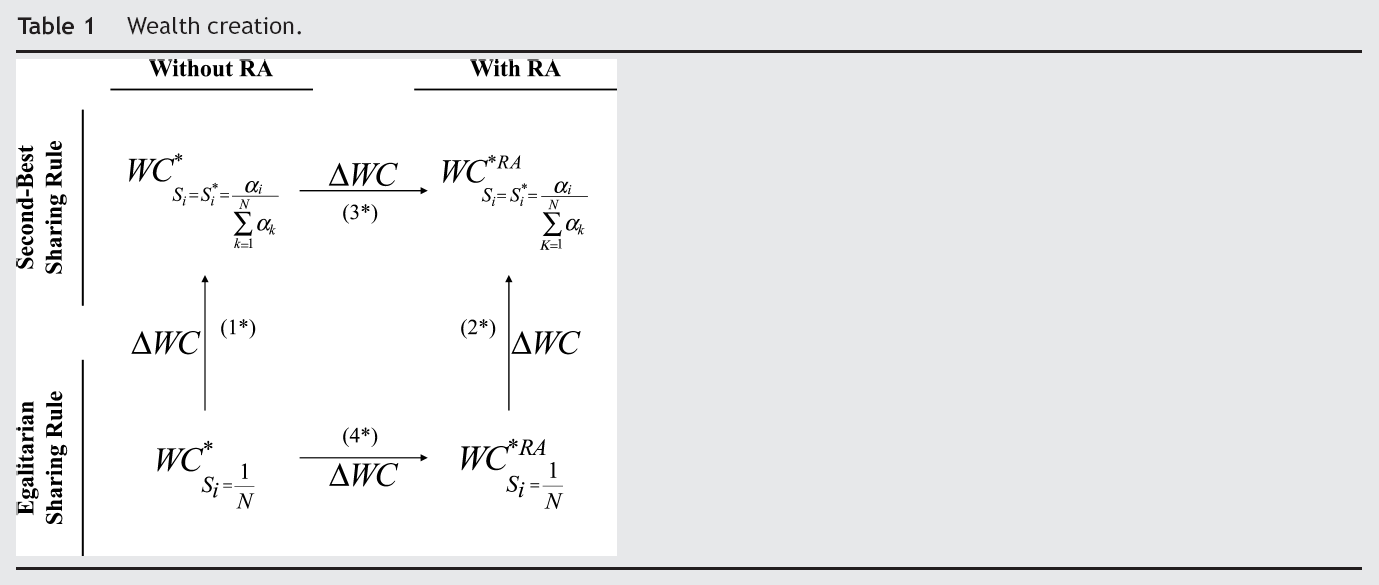
Wealth creation.
All changes in welfare are positive, therefore by definition moving from an equal sharing rule to a second best sharing rule increases total wealth creation [relations (1*) and (2*)]. Also, rational altruism improves wealth creation in teams that apply equal sharing rules and in teams that apply second best sharing rules since rational altruism parameters for all team members are always positive [relations (3*) and (4*)].
In the case of no altruism and asymmetric teams, the use of egalitarian sharing rules (or moving away from the second best sharing rule) decreases team efficiency with respect to the second best sharing rule by lowering the effort levels of the most productive team members relative to the levels under the second best sharing rule. When the sharing rule gives a larger part of the output to the more productive members (using the second best sharing rule) they increase their efforts and team efficiency is improved even though less productive team members decrease their effort levels.
If the team members engage in some form of rational altruism, then the equal sharing rule also distorts the equilibrium altruism parameters such that less productive team members tend to over play their altruism at the expense of the more productive ones. When the sharing rule gives a larger part of the output to the more productive members then the gain through rational altruism by the less productive team members is lower and so they refrain from showing their PERA levels, increasing RA levels of the most productive team members and thereby improving team efficiency.
We are interested in examining when the increases in welfare are higher. We conjecture that the opportunity cost, in terms of lost welfare, of implementing equal sharing rules in asymmetric teams is higher when the members of the team engage in some form of rational altruism.
Specifically, when the team is composed of two members (N = 2), the following relationship holds for wealth creation by the two team members (see Appendix) in the four situations shown in Table 1 (see Appendix):

From expression (16) and taking into account the results shown in Table 1 (WC*RAS1=S2=1/2 > WC*S1=S2=1/2; WC *RAS1=S*1=α1/α1+α2; S2=S*2=α2/α1+α2 > WC*S1 =S*1 =α1/α1+α 2; S2=S2*=α2/α1+α2 and WC*S1 =S*1=α1/α1+α2; S2=S*2=α2/α1+α2 > WC*S1=S2=1/2) we obtain that (WC*RAS1 = S1* =α1/α1+α2; S2=S2*=α2/α1+α2 - WC*RAS1=S2=1/2) > (WC*S1 =S*1=α1/α1 + α2; S2=S2*=α2/α1+α2 - WC*S1=S2=1/2). Therefore, we can conclude that the application of second best sharing rules improves wealth creation more than the application of equal sharing rules, and with rational altruism more than without rational altruism.
This means that the relative gain in welfare of going from equal sharing to second best sharing rules is the same with rational altruism as without altruism. Since the initial welfare base is lower in the case of no altruism, the absolute increase in welfare must be higher when the shift from equal to second best sharing rules occurs in teams with rational altruism. In other words, the opportunity cost, in terms of lost welfare, of implementing equal sharing rules in heterogeneous teams is higher when the members of the team engage in some form of rational altruism. The PERA probably explains this result. Departing from the second best sharing rule in these teams creates an additional distortion of team member behavior such that those with low contribution-elasticity to the team's output overplay their altruism in the hope of increasing the effort of the more productive team members and thereby obtaining additional benefits thanks to the equal sharing rule. When the sharing rule gives a larger part of the output to the more productive members then the gain from rational altruism by the less productive team members is lower and so they refrain from showing their PERA levels. These conclusions are symmetric so we can argue that introducing rational altruism in a team that initially does not practice it will provide a larger increase in total wealth creation when the team uses second best sharing rules than when it uses equal sharing rules.
There is currently no consensus on the appropriateness of using egalitarian sharing rules. Specialized literature gives arguments both in favor of, and against, the use of this rule in different scenarios. Therefore, our paper elaborates on this current debate and provides new arguments against the application of the egalitarian sharing rules when team members have different marginal productivities.
Specifically, when team members display some form of rational altruism (Rotemberg, 1994), we find that the egalitarian sharing rule modifies the rational altruism parameter of team members compared to the parameter chosen in the case of the second best sharing rule (the sharing rule based on relative marginal productivities). In this paper this distortion of the rational altruism parameter is called the Perverse Element of Rational Altruism (PERA). It means that, under equal sharing rules and heterogeneous team members, the less productive team members tend to exaggerate their altruism with the expectation of inducing increased effort from the more productive team members and benefiting from it. On the contrary, the more productive team members anticipate that the less productive ones will increase their parameters of altruism and, therefore, they tend to reduce their altruism. In this scenario rational altruism continues to improve wealth creation in teams with equal sharing rules, compared to the wealth creation in a no altruism scenario, but to a lesser degree than it would under second best sharing rules. Moreover, the opportunity cost, in terms of lost welfare, of implementing equal sharing rules in heterogeneous teams is higher in teams that engage in rational altruism than in teams that do not.
All these conclusions lose relevance in homogeneous teams since in this case the second best sharing rule is the egalitarian one, so all potential distortions disappear. If the recommendation of forming homogeneous teams holds whenever there are restrictions to applying sharing rules other than the egalitarian sharing rule, it is even more applicable in cases where team members can be expected to show some form of rational altruism.
The paper could be extended to other production functions different from the Cobb–Douglas one but we expect that the qualitative conclusions of our results would be the same. Another important line of future research would be to identify the existence of the PERA in experiments; rational altruism is difficult to isolate in empirical observation of behavior so we are unaware of how important it can be in actual team production activities. Controlled experiments should help to isolate this behavior as well as the effect of modifying the sharing rules with and without rational altruism.