




Abstract
This paper examines the job satisfaction levels of national tour guides in the United Arab Emirates. In-depth interviews (n = 34) and a questionnaire (n = 63), incorporating Job Satisfaction Survey dimensions alongside context-specific ones, were used to assess continuance intentions in relation to career development opportunities and societal sentiment on the ‘appropriateness’ of this vocational role. While the nature of the job and promotional opportunities strengthened continuance intentions, stigma towards nationals working in the tourism sector reduced such intentions. A recommendation that fits with the UAE’s goal of better utilising indigenous human capital is to augment the hands-on aspect of the job with academically orientated tasks including archiving, curation and research and thus, raise this role’s status.
Keywords
Introduction
The United Arab Emirates is the Middle East’s top tourist destination; some 20 million individuals visited in 2018 (Al Saed et al., 2020; WEF, 2019). Growth in numbers since the early 2000s, has been meteoric and is a consequence of strategic government investment. Convention states that seeking revenue from tourism is of particular utility to economies that have few comparative advantages and/or lack diversified structures (Salazar, 2005: 628). Oil is the UAE’s principle source of income and has, until recently, totally dominated the economy (Rutledge, 2017). In an endeavour to escape the somewhat ahistorically-framed “Oil Curse” label (Ross, 2012), the UAE has invested vast sums into its travel and tourism sector. It is home now to two of the world’s fasted growing airlines and airport hubs (DXB and AUH). Both government-owned airlines - Emirates and Etihad - have spent hundreds of millions of dollars on brand building, billing the UAE as a holiday destination in its own right (no longer just a gateway to other destinations). The Emirate of Dubai’s dredged islands, set out as a map of the world, really did, as an advertising strapline once read, put Dubai on the world’s map. At present, its opulent malls, state-of-the-art theme parks and luxury resorts—“Disneyesque destinations” in the desert dunes—are attracting record numbers of people from all over the world. If some see Dubai’s tourism trajectory as ‘crass,’ the Emirate of Abu Dhabi is, for the most part, consciously focusing on “cultural tourism” (Lawton and Weaver, 2017; Thani and Heenan, 2017). Abu Dhabi is home to the Jean Nouvel designed Louvre satellite museum, a soon to be opened branch of the Guggenheim designed by Frank Gehry (thought to be the largest yet). It has also obtained World Heritage Status for one of its inland oases and its museums, and some of its resorts, are built to mimic the traditional architecture of the region. The UAE is also the host of Expo 2020 during 2021/22, billed as the Middle East’s biggest ever event. It is evident that the UAE sees tourism as a key source of ‘potentially’ sustainable non-oil income (Government of Abu Dhabi, 2008; Government of Dubai, 2021: 6). ‘Potentially’ because, to truly benefit from the infrastructural and marketing investments being made, the UAE will need to both attract and retain far more of its own indigenous human resource capital to this sector (e.g., Moukhallati, 2015; Swan, 2016). If not, a large fraction of the revenues generated, will go to non-national (expatriate) labour and, in turn, be repatriated overseas.
To a large extent, the infrastructure and the branding is there, increasingly too, is the indigenous human capital capacity. Educational investments since the early 2000s have seen the schooling system radically overhauled, inter alia, the adoption of a curriculum based on the British and Australian ones for both primary and secondary schools; using English as a medium of instruction in these schools and, the hiring of thousands of native English speaking teachers directly from places as far afield as New Zealand and the USA (Stockwell, 2015; Stringer and Hourani, 2016). In the higher education sector, accreditation has become something of an obsession and, by way of financial enticement, NYU and Paris-Sorbonne University, to name just two of dozens, have set up satellite campuses in the UAE (Bazzi, 2017). What is lacking is the willingness of much of the national workforce to consider non-conventional career paths, despite Emiratisation, the UAE’s labour nationalisation program, having been an area of policy focus since the mid-1990s. It is said that maybe as little as one per cent of employed Emiratis work in the real private sector and only about eight per cent in the quasi-private sector – a government-backed but commercially-run entity (GBE) (see, e.g., Sarker and Rahman, 2020; UAE Ministry of Cabinet Affairs, 2019).
Such statistics and labour market rigidities typify the Arabian Gulf’s overarching human capital dilemma: despite an array of policy measures aimed at increasing the number of citizens employed in productive industries, the majority will only accept “comfy government jobs” (Al Nowais, 2017; Swan, 2017). The proliferation and pronounced preference for such classic public sector jobs, is a consequence of the Arabian Gulf Social Contract’s (AGSC) longstanding “job provision mechanism.” A mechanism by which the region’s rulers distribute a proportion of oil wealth to their respective citizenries in lieu of political agency in any meaningful sense (Coates Ulrichsen, 2011; Forstenlechner and Rutledge, 2010). Typically, such jobs are bureaucratic in style, highly renumerated and come with a short working day and long annual leave. Despite this inconvenient and intransigent elephant in the room, “private” sector labour nationalisation policies are nevertheless viewed as being of vital strategic importance in terms of preparing for the impending post-oil era. In 2021, as part of the country’s 50th year of independence, the government announced a series of new Emiratisation policies with the figure ‘5’ featuring prominently (Government of the UAE, 2021). The government plans to provide those nationals willing to take up skilled private sector work with salary top-ups of up to $1,360 (5,000 AED) per month for up to five years, it will, for the first year also cover the pension contributions of such newly hired employees too (Fattah, 2021). On closer inspection many of these newly announced policies are ones previously tried, such as job quotas. Various skilled private sector operators will be required to increase the percentage of nationals they have on their payrolls, first to two per cent then, over the course of five years, to ten per cent (Government of the UAE, 2021). Various quotas have been imposed previously, few were met and most, quietly dismissed, critics will argue that some individuals are hired simply as “window dressing” (Farrell, 2008).
Government-led strategies to recruit and retain more nationals to the tourism sector (Moukhallati, 2015)—and indeed the tour guide profession (Salama, 2014)—fits with the UAE’s transformative “2030 Economic Vision” (Government of Abu Dhabi, 2008). Yet, it is reported that 99 per cent of those employed in the tourism sector are non-nationals (Abu Dhabi Tourism and Culture Authority, 2017). To investigate this, the present study looks at the job satisfaction levels of nationals employed as tour guides. It is informed by the Job Satisfaction Survey construct (JSS; Spector, 1997) and seeks to better understand the impact of sociocultural sentiment (including Goffman’s Stigma theory, 1963) towards the tourism sector in general and this profession in particular, by assessing continuance intentions (informed by Ajzen’s Theory of Planned Behaviour, TPB; Ajzen, 1991). A mixed-methods approach was used: interviews and a survey. Such an approach has the capacity to offer a more comprehensive understanding of the current state of affairs (see, e.g., Cohen et al., 2004; Denzin, 2012). Figure 1 illustrates this study’s conceptual framework. Conceptual framework.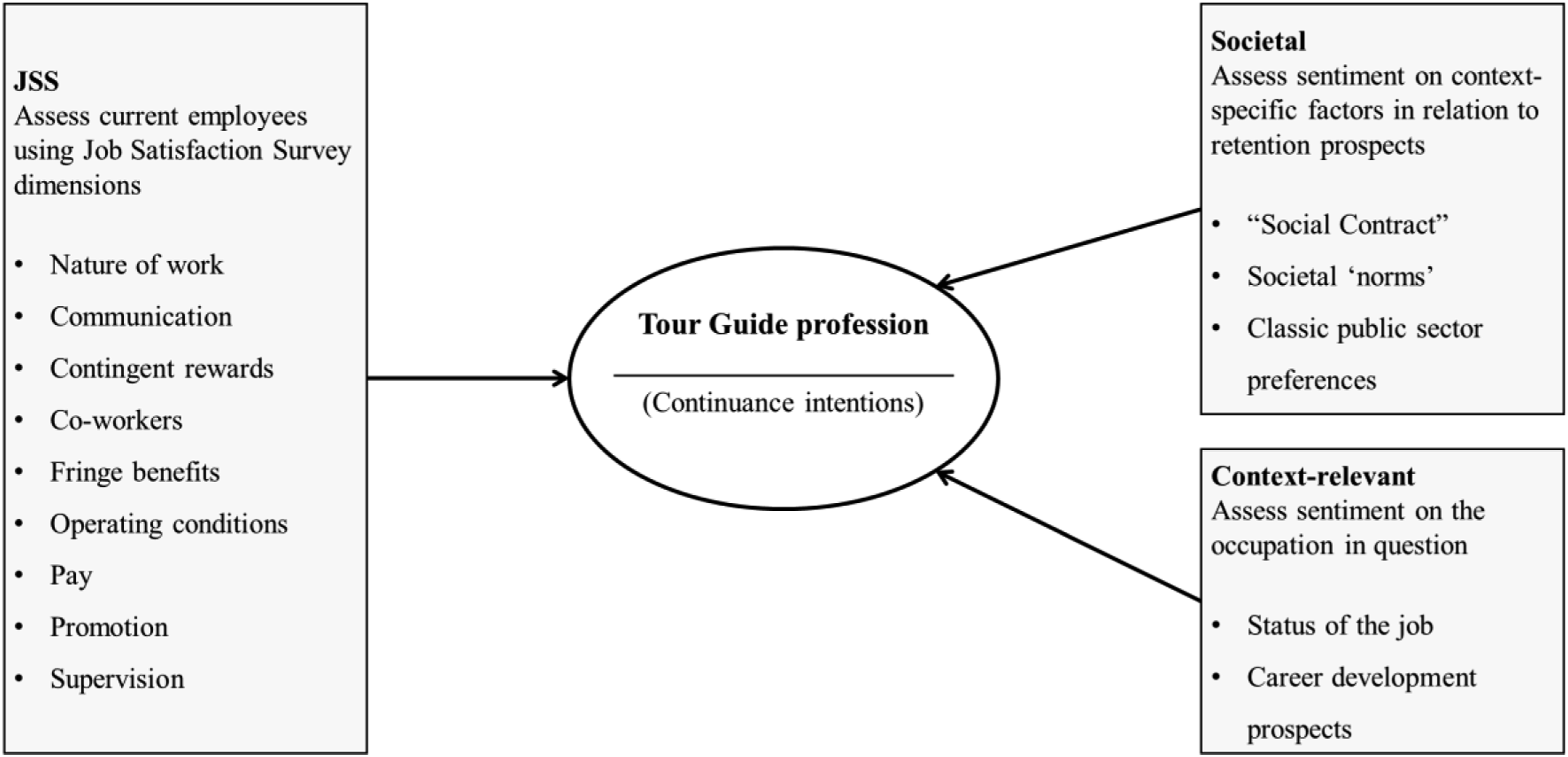
Literature review
Much of the research to date on the tour guide profession considers the tasks this job entails and/or, the ways in which the performance of those tasks impacts on the experiences of visiting tourists (Lugosi and Bray, 2008). This study fits into the former strand. In order to situate the problem—the very low numbers of nationals willing to work in the tourism sector and the high turnover rates amongst those who do—it is necessary to consider the UAE’s tourism and travel sector, alongside the country’s sociocultural idiosyncrasies and politics. If the recruitment and retention of national tour guides are to be improved, the influence of the AGSC and the collectivist, patriarchal nature of society must be examined alongside the preferential pay, benefits and career development opportunity variables ordinarily focused upon when investigating job satisfaction.
Tourism in the UAE
As Dallen (2018, 50) writes, the Emirate of Dubai is “synonymous with efforts to be the most superlative” in almost all tourism-related domains. Some see the Emirate of Abu Dhabi, to a degree, to be following suit(Lawton and Weaver, 2017; Thani and Heenan, 2017). Abu Dhabi’s Sheikh Zayed Grand Mosque houses the world’s largest hand-knotted Persian carpet and its Ferrari World theme park holds the record for the largest space frame structure ever built. It is said that these themed spaces are artificial and do not reflect Arabian culture in any meaningful way but, as one government official wryly put it, as Dubai lacked “the cultural wealth of Paris and the historic buildings of Rome,” it carved for itself a niche in the market by “constructing a mega-city with enough grand structures to support the superlative theme” (Thani and Heenan, 2017). In a theme park called “Global Village” Dubai has in fact, quite literally, built sanitised and scaled-down versions of many of the world’s most valuable historic architectural assets—souvenirs and trinkets can be purchase in structures that look like, e.g., Big Ben and the Taj Mahal.
In a cautionary note, Lawton and Weaver (2017, 164) point out that, “the growing inventory of superlative structures and capacities,” is based at times on “hubris and political legitimisation more than pragmatism.” Nisbett (2021) contends that the UAE “carefully navigates the liberal with the illiberal, and tolerance with intolerance” and does so by, “importing aspects of Western liberalism in order to obscure authoritarian modes of governance.” While superlatives are intended to attract sustained admiration and overseas visitors, may be, so to speak, built upon sand: “today’s number one can quickly become tomorrow’s number two and attract no one’s interest” (Lawton and Weaver, 2017: 164). Upon the completion of Burj Khalifa, the world’s tallest inhabited structure, Saudi Arabia announced the construction of Jeddah Tower; pencilled in to be several tens of metres taller (Weismantle, 2018).
If Dubai fits Ritzer’s (2005) “cathedral of consumption” epithet and, at face value, has a hedonistic, spontaneous and organic approach to tourism, Abu Dhabi is more sedentary, planned and focused on local culture in its approach (such cultural assets are nonetheless, all seamlessly linked to shopping malls, venues such as a Formula 1 racetrack and, of course, AUX). The idea of creating cultural assets and manufacturing identities is perhaps best articulated in Benedict Anderson’s (1983) “imagined communities” thesis. With regard to the Arabian Gulf, Khalaf (2000, 243) eloquently illustrates a successful example of such social engineering. In the late 1970s the once essential (as a mode of transport) and ubiquitous camel gave way rapidly to the utilitarian, then luxurious Japanese four wheel drive car. But, in the mid-1980s, when local populations began to constitute a small minority of these countries’ total populations due to the influx of expatriate labour fuelled by oil wealth, the metaphoric “ship of the desert” was quickly revived. Homage to the camel by ownership and poetry soon came to be a key aspect of local culture. While now typically transported across the dunes in the backs of pick-up trucks, camels are now central to the recently institutionalised annual racing and beauty pageants festivals. Both activities are genuinely popular with locals and, brief excursions upon a camel’s back, constitutes a quintessential part of many a tourist’s ‘cultural’ experience. Of particular relevance to this study is the notion that concepts like ‘appropriate’ and ‘inappropriate’ employment avenues for nationals need not be intransigently set in stone. In time, social engineering could address this too.
The public sector’s pull
The pull of the classic public sector is one factor thought likely to impact on continuance intentions of those working in either the private sector or in a non-conventional vocation. The tour guide profession is currently considered a non-conventional career choice. It is reported that nationals employed in the public sector receive on average three times the pay and more than twice the number of holidays compared to their private sector counterparts (Issa et al., 2013). Job security levels and maternity leave is also much more favourable in the public sector (Rutledge and Madi, 2017). In addition to these pragmatic factors is the issue of ‘appropriacy’ and the ‘prestige’ attached to such jobs (Harry, 2007). Notions of family honour, shame and the implications of ‘Wasta’—using family connections to secure employment on grounds other than merit—in societies said to be more collectivist in nature may well considerably impact on labour market dynamics (Harry, 2007; Van Aerden et al., 2016). The weight given to this form of status may explain why many will seek government positions even if, “the pay and benefits were comparable for like-for-like private sector positions” (Gallup/Silatech, 2011). Although hard to disambiguate the pragmatic pull of the public sector from its attractiveness in terms of being somehow more culturally appropriate, the following can be said: government jobs are typically in administrative departments that use Arabic, not English, as the operational language and usually provide, if not mandate, gender-segregated working environments. Another factor has to do with the AGSC. If traditionally, government jobs were considered something of a birth right, some degree of disenfranchisement may be felt by those who can see some peers and older family members with such jobs but, cannot easily secure such positions themselves—saturation point has long since been reached (Rutledge, 2017). Even though the government launched a range of policy measures to encourage private sector employment in 2021 (Fattah, 2021), these accompanied other measures that make the public sector as desirable as ever. For example, paid leave for up to one year to try and start one’s own business with a guarantee of retaining the same position if the venture is unsuccessful and, being offered early retirement (at just 50 years of age) on a very generous final salary arrangement so as to be able to access a new pool of money to start up their own business (Government of the UAE, 2021). This leads to the following hypothesis:
Social stigma
A significant factor that influences the job preferences of UAE nationals is societal sentiment towards what are and what are not considered ‘appropriate’ employment avenues for locals (see, e.g., Marmenout and Lirio, 2013; Williams et al., 2013). Al-Ismail et al. (2019, 571) found that “social disapproval of working women, and particularly those working in the hotel and tourism sector,” to be a barrier for prospective entrants and a continuance disincentive for the few female nationals working there. The following three studies all sought the opinion of prospective national employees on their vocational plans. Bontenbal and Aziz (2013) write that “tourist venues, particularly hotels and resorts,” were considered by the Omani undergraduates they surveyed to conflict with “cultural and religious values” and that non-national labour was considered “a better match” for such establishments. Rutledge and Madi (2017) found that the sentiments of family impact significantly on vocational decision making processes. They did however report that individuals who had one or more immediate family members working in the UAE’s private sector were more likely to consider this sector themselves. Griffin et al. (2021, 473) observed that while undergraduate female Emiratis are not closed to “the idea of tourism as a career,” societal sentiment (specifically: “working in tourism clashes with Emirati cultural and religious values”) ultimately outweighed “all other perceptions about tourism” and as such continue to “impede the entry and participation” of nationals to this sector (Griffin et al., 2021: 492).
As is clear, much of the research focuses on the vocational plans of female undergraduates. That this cohort face gendered discrimination is evidenced in the work of Farrell (2008), with regard to Emiratisation in the banking sector, as well as the work of Williams et al. (2013) who describe an implicit “patriarchal bargain” that sees fathers encouraging their daughters to get a degree-level education but then discouraging them from joining the workforce unless it be in a gender-segregated workplace. An issue for policymakers to square is that the vast majority of those who study Tourism at tertiary level (and thus the best suited candidates for this sector) are female. At UAEU, the UAE’s principal higher education institution, there were six males and 157 females enrolled in the tourism major in the 2017/8 academic year (UAEU, 2018). Thus, gender issues are part of the equation. But there is too, the aforementioned issue of disenfranchisement from the AGSC. This can be viewed through the prism of Stigma theory as developed by Goffman (1963). Social stigma is a mode of embarrassment that is either imagined (is ‘felt’ and feared) or actually occurs in reality (is ‘faced’). It manifests when individuals think themselves, or members of society consider them, to be abnormal in some way. Those nationals currently working in the tourism sector may feel this as 99 per cent of their colleagues are non-nationals and most of their compatriots will hold conventional jobs. Such social stigma is as likely to be felt by males as it is females. Possibly even more so for, in the AGSC context, it is the men who are supposed to provide for, and protect the family (Marmenout and Lirio, 2013). This sentiment on ‘appropriacy,’ the patriarchal nature of society and social stigma leads to the following statement:
Satisfaction and the nature of the job
The JSS scale measures nine work-related attributes, one of which is “the nature of the job.” It follows then, that the more the job and its constituent tasks are enjoyed, the higher retention rates are likely to be. Job satisfaction refers to the degree to which people like their jobs and how they feel about different aspects of their job (Spector, 1997). According to the vocational behaviour literature, the nature of the job considers things like the typical daily duties (e.g., autonomy, variety, scope of duties) and how engaging they are (Saari and Judge, 2004).
According to the Professional Tour Guide Association of Australia (2017), broadly defined, the nature of this job entails interacting with and informing tourists about a given location and/or cultural practice. As the literature suggests, tour guides need to be leaders, capable of assuming responsibility, engaging educators and ‘ambassadors,’ who extend hospitality and portray the given attraction in such a way as to ensure tourists take back home with them positive views about the attraction and ideally, the host country in general (e.g., Ap and Wong, 2001; Zhang and Chow, 2004). Research suggests this profession requires that individuals, on a daily basis, deal with tourists’ and their line managers’ expectations, and display the emotions that meet the expectations of both. The extent to which one can manage such expectations will impact on productivity, satisfaction and organisational loyalty. Research by Min (2013) conducted in Taiwan focused on the relationship between Quality of Working Life and Emotional Intelligence. Tour guides with higher levels of such intelligence were found to have more effective coping strategies for dealing with the stress-related issues that arise from this job. While such stresses are not likely to be present in the classic public sector, it is the view of some prospective recruits to the tourism sector that it is an interesting area to work in (e.g., Griffin et al., 2021: 488). Many undergraduates report that, all other things being equal, they would prefer an interesting job and one that matches the subject they were focusing on at university (Rutledge and Madi, 2017). Taken together the following hypothesis is proposed:
Career development in the boundaryless era
It has been stated that some tour guides report that they see themselves as being “on the lowest rung” within the tourism sector and, their job lacks “a well-defined career path” (Min, 2013: 1173). Decisions on whether or not to upskill incumbent employees as opposed to hiring new ones who have the requisite skills are not straightforward. There is an argument that, as the notion of a job for life fades, so too might one’s organisational loyalty (De Vos and Dries, 2013; Hess et al., 2012). It is also said that any employer who does not facilitate for ongoing training (and set out clear pathways for promotion) is not likely to retain the more motivated of its employees for long. Yet, the provision of training is not without cost as, armed with new skills, employees may seek to capitalise on this by seeking positions in competing organisations. This may be so for some labour markets but, for the Arabian Gulf is somewhat different. Firstly, the classic public sector jobs traditionally given to nationals tend to be secure for life and, as pension dividends are calculated on final salary, there is little incentive to move horizontally (Forstenlechner and Rutledge, 2010). Also, this sector has offered its national employees a large range of career development opportunities including the full funding of doctoral qualification and paid sabbatical leave. Secondly, retention of nationals is a key objective for many of the nascent GBEs that now operate in the knowledge-based productive sectors of the economy. For such entities the ongoing training of newly hired nationals is almost considered a given. Also, the ‘real’ private sector, when left to its own devices, has hired expatriate labour who already have the experience and skillsets required for the given position. The importance tour guides in the UAE attach to training opportunities in relation to staying in the same role, is investigated as follows:
Methods
This study adopted a mixed-methods approach by combining in-depth, semi-structured interviews with a survey instrument. This was considered the optimal way of getting a more comprehensive understanding of the factors that impact on the continuance intentions of UAE national tour guides. As is stated by Cohen et al. (2004, 407), such a methodological approach can provide deeper insights and a way of investigating “the parts that other approaches cannot reach.” The research was conducted at a number of cultural tourism attractions in the UAE.
The interview construct
Twelve open-ended prompts were used that together were designed to ascertain what factors exactly impacted on continuance intentions (e.g., what do you like most about the role and, if there was something you could change about the role, what would it be?)
One area that was considered optimally addressed by an interview question was to do with societal sentiment. It was considered of merit to collect open-ended responses on the degree to which such sentiment may render this position to be viewed as temporary and, being undertaken to gain experience whilst waiting for a more attractive public sector position to come along. Another area better addressed by this approach was to understand, in the words or those doing the job, the degree to which regularly having to interact with people from different nationalities and religious beliefs (including none), impacted their emotional and physical wellbeing. This format is of utility because, as Fontana and Frey (2011, 698) make clear, it affords a detailed perspective on the given employee’s vocational life.
The survey instrument
The survey instrument included Likert-style items on sectoral preferences, societal sentiment and the JSS dimensions. Regarding the dependent item, “Intention of remaining a tour guide,” this was formatted with TPB in mind. It is a widely held contention that an individual’s planned behaviour is the best available predictor of actual behaviour and will be derived by the given individual’s attitude, subjective norms, and perceived difficulties (Ajzen, 1991). Amongst the items envisaged to form this factor were “I am not satisfied with my position as a tour guide” and “I see myself doing this job for the foreseeable future.”
Sample
For this study, the population was finite and well defined: UAE nationals employed as tour guides. It should be noted that many of those interviewed will also have been surveyed. The total number of completed interviews was 34. The total number of survey participants was 63. Whilst this may not seem like a large sample, the estimated population is not much larger. Within the social sciences a 95 per cent confidence level is considered sufficient and, a sample of 63 met this requirement (Grande, 2016) based on the Tourism Development & Investment Company’s estimate of the total population being approximately 70.
Analytical process
With regard to the interviews, these were conducted face-to-face in Arabic and then translated into English. On average each transcript was around 3,000 words. This data was coded and analysed for themes using NVivo 11. The completed data was examined first by open-coding the information through a process of identifying themes and ideas based on their frequency. In total, just over 50 themes were identified. Within each of these themes it was possible to discern instances of consensus (and also, no consensus). Upon further refinement, most of these themes could be fitted into one of the following categories: 1. The pull of the classic public sector. 2. Societal sentiment on the role and tourism in general. 3. Perspectives on the role (e.g., regulations and job description). 4. The nature of the role and the opportunities for career development.
Survey items and factor loadings.
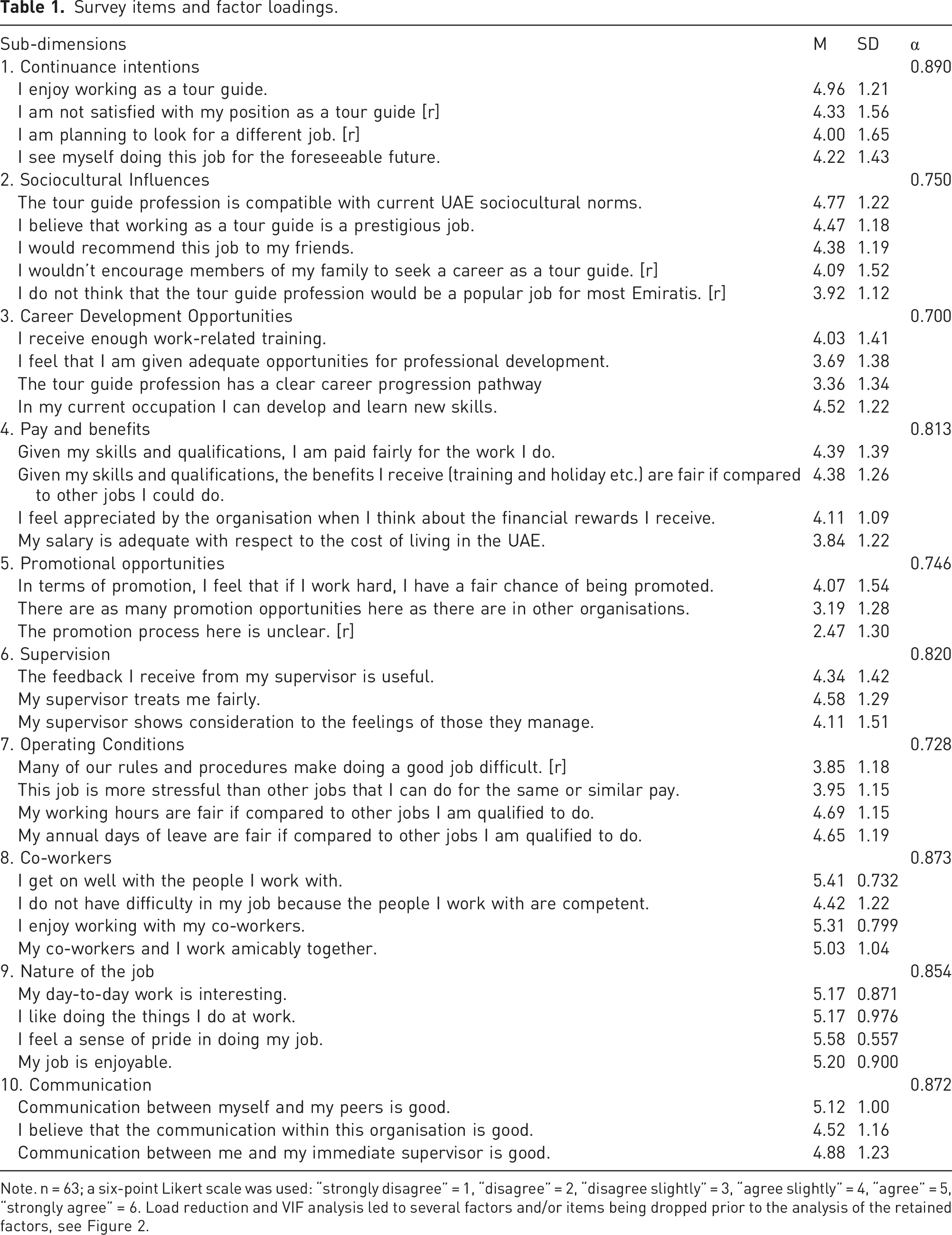
Note. n = 63; a six-point Likert scale was used: “strongly disagree” = 1, “disagree” = 2, “disagree slightly” = 3, “agree slightly” = 4, “agree” = 5, “strongly agree” = 6. Load reduction and VIF analysis led to several factors and/or items being dropped prior to the analysis of the retained factors, see Figure 2.
Results
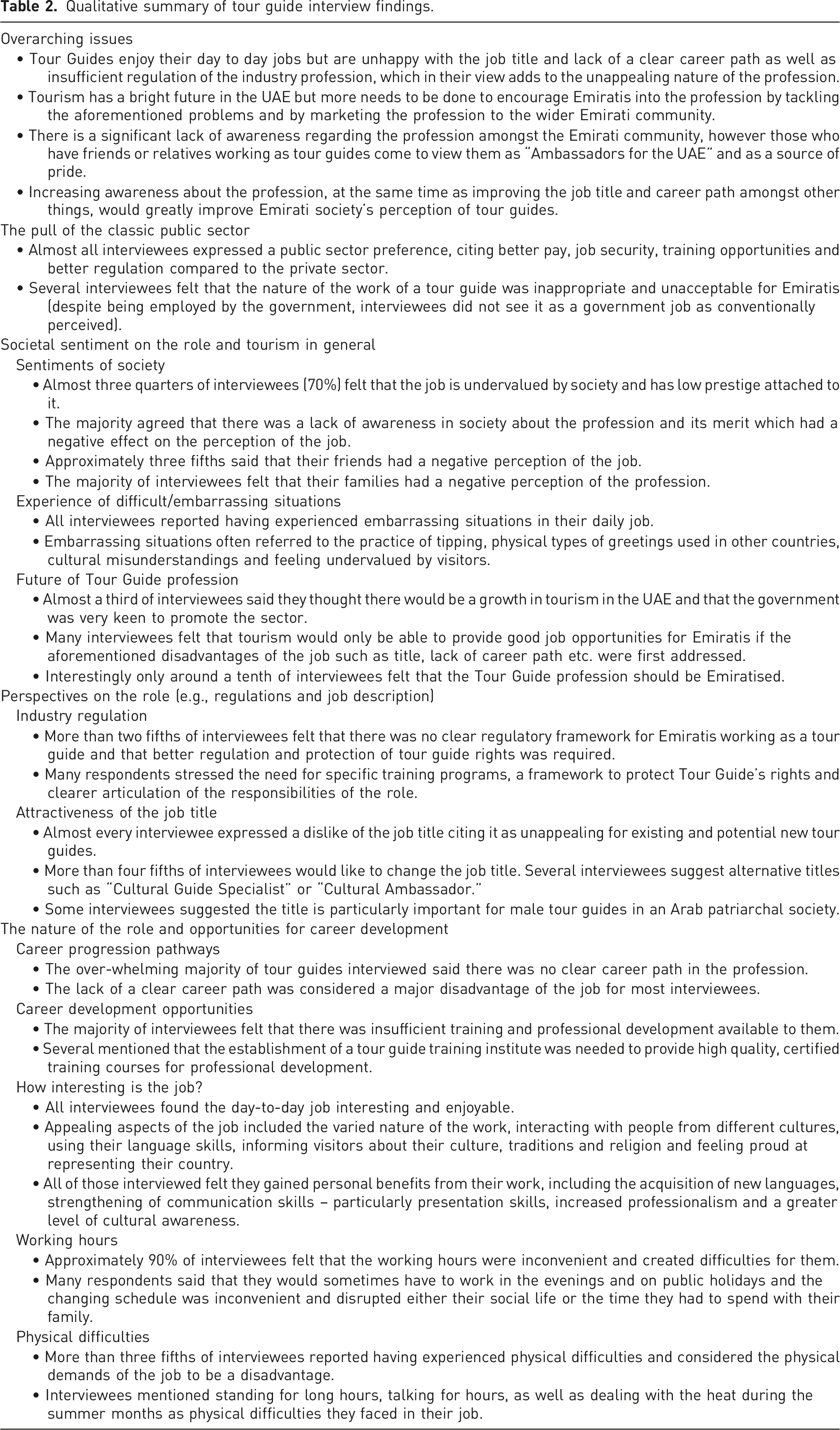
Qualitative summary of tour guide interview findings.
Multiple regression (models summary).
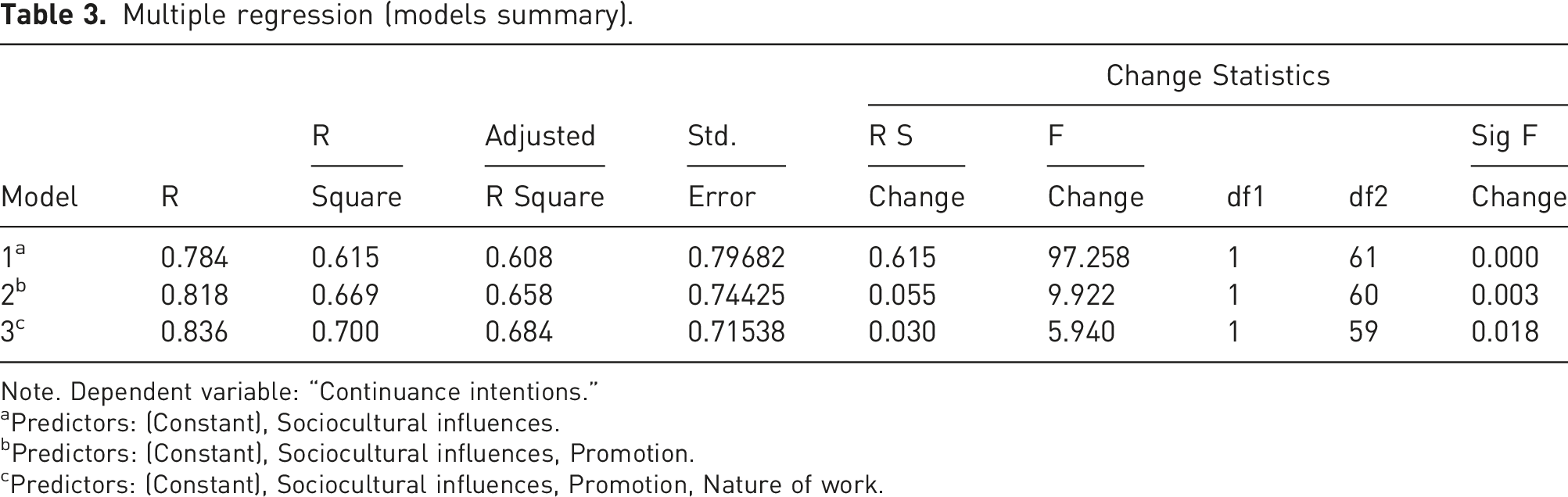
Note. Dependent variable: “Continuance intentions.”
aPredictors: (Constant), Sociocultural influences.
bPredictors: (Constant), Sociocultural influences, Promotion.
cPredictors: (Constant), Sociocultural influences, Promotion, Nature of work.
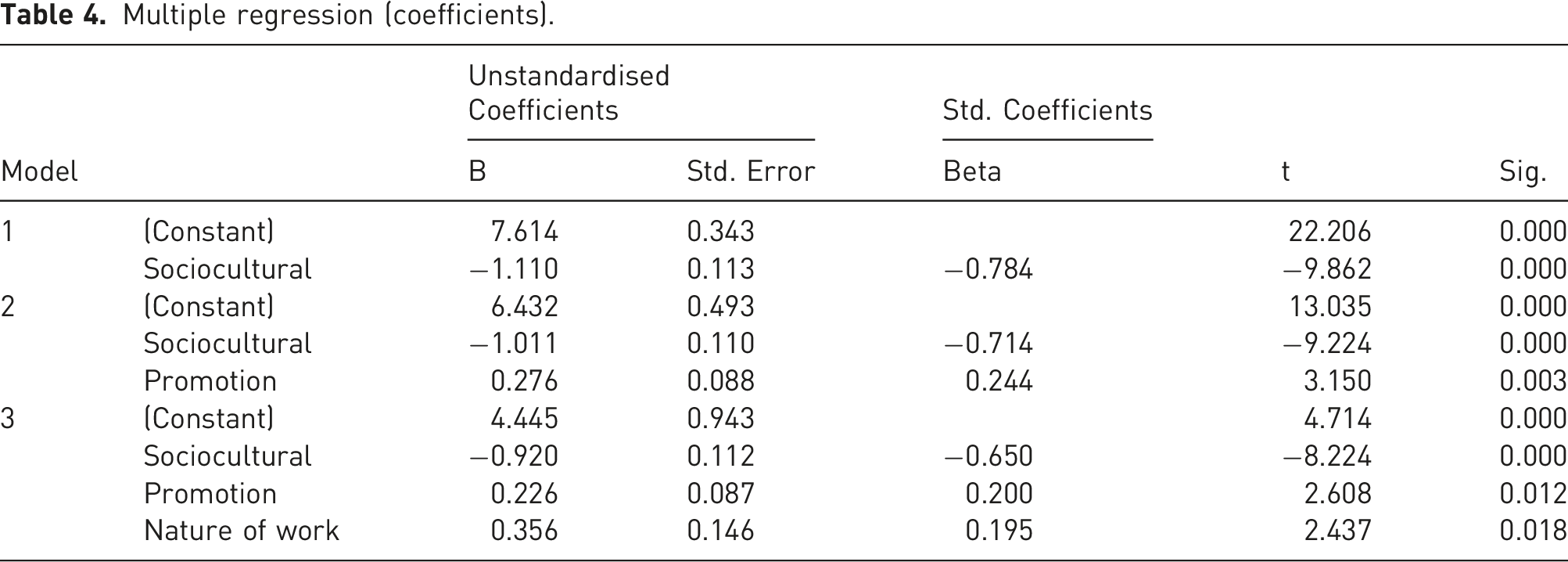
Multiple regression (coefficients).
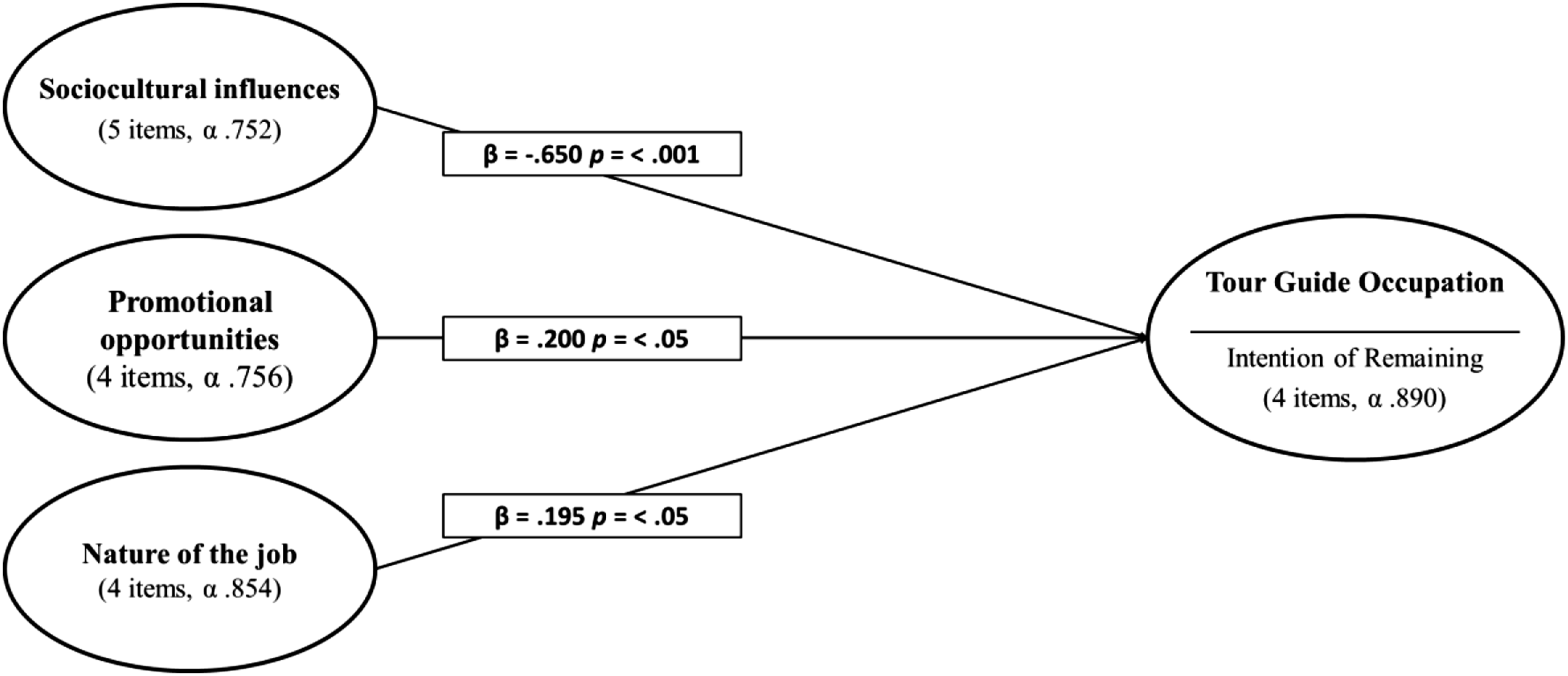
Continuance intentions.
Discussion
The significance of this research—aside from it being the first case from the UAE on the tour guide profession—is the insights it provides on the factors likely to aid the retention rates of UAE national tour guides. These insights can help inform HR practice at the various cultural attractions that have, or seek to employ, tour guides.
Almost all interviewees reported there to be an acute lack of awareness regarding the profession amongst UAE society, especially its many merits. There was a feeling that this lack of awareness was partially accountable for the negative perception many in society were considered to hold towards this profession and the sector in general. It is evident that UAE tour guides do enjoy their day to day jobs but, were less than satisfied with what they considered to be a lack of a clear career progression pathway. Also, they felt that having no specific entity (e.g., a professional guild) tasked with supporting their profession was another shortcoming. Many of those canvased believed that the establishment of a tour guide training institute was needed, inter alia, to provide quality certified training courses for professional development and to provide and disseminate a clearer articulation of the responsibilities and importance of the tour guide role. Thirdly, they felt that the job title itself could be altered to make the position more appealing. More than four fifths of those interviewed would like to change the job title. Alternative titles included: “Cultural Ambassador” and “Specialist Cultural Guide.”
H1
With respect to the first hypothesis, a general preference for a classic public sector position was expressed by a clear majority of interviewees. It is clear from some of the survey item responses that pay was less of a concern than was pejorative societal sentiment. Thus, to escape the stigma and move the abnormal to normal, would be to seek a classic public sector position. It is worth emphasising the point that these tour guides were technically government employees as all of the venues canvased are government owned. Factors cited for making classic public sector jobs more desirable were working hours, job security, training opportunities and better regulation. In terms of working hours, approximately 90 per cent of interviewees felt that these were inconvenient and created difficulties for them. To characterise they asked, why would someone willingly choose an occupation that requires punctuality, consistent appearances, and a fixed working week when their family and friends may have jobs that do not require such commitments. Those with comfy government jobs are able to leave work and attend to family matter at short notice that much more easily.
H2
In relation to the second hypothesis, it is evident that negative societal sentiment towards non-conventional career paths reduced continuance intentions (β = −0.650 p = < 0.001). This survey finding is supported by interview data. Almost three quarters felt that the role was “undervalued by society” and has “low prestige attached to it.” All interviewees reported having experienced embarrassing situations in their daily job. Embarrassing situations often referred to the practice of tipping, physical types of greetings used in other countries, cultural misunderstandings and feelings of being undervalued by visitors. In terms of how their immediate family felt, the consensus view was that while family members were mostly happy about their acting as “cultural ambassadors” for the UAE, they were often unhappy about the long working hours involved and the interaction that female tour guides had with the general public and visitors from overseas.
H3
A significant and positive relationship was found between the nature of the job and continuance intentions (β = 0.195 p = < 0.05). It can be stated that incumbent employees perceive the day-to-day role to be interesting and engaging. Appealing aspects included the varied nature of the work, interacting with people from different cultures, using their language skills, informing visitors about their culture, traditions and religion and being proud of representing their country. All of those interviewed felt they gained personal benefits. Frequently mentioned ones included acquisition of new languages, strengthening of communication skills (particularly presentation skills), increased professionalism and a greater level of cultural awareness. Nonetheless, over three fifths of interviewees reported having experienced physical difficulties and considered the physical demands of the job to be a disadvantage. Interviewees mentioned standing for long hours, talking for hours, as well as dealing with the heat during the summer months as physical difficulties they faced in their job.
H4
The majority of interviewees did not feel career development opportunities were adequate. It is telling then that the JSS dimension ‘promotion’ significantly and positively corelated with continuance intentions (β = 0.200 p = < 0.05). It possibly follows that if more promotional opportunities were on offer, they would be more likely to remain. As mentioned despite over half of the sample already holding a degree-level qualification or higher, 80 percent of all those surveyed still intended to pursue further education.
Recommendations
The first recommendation is to work towards normalising the notion of nationals working as tour guides. This would be best achieved by creating a professional guild of some description. The Professional Tour Guide Association of Australia (2017) could act as an initial template. Such an entity in the UAE would be able to provide accreditation and provide training opportunities (ecological awareness, first aid etc.). The job title of ‘tour guide’ could also be revaluated by such a body, for example interviewees mentioned their preference for a new job title such as ‘cultural ambassador’. Flexibility in terms of what titles individuals adopt incurs little opportunity cost for the HR departments of the various cultural attractions. Such a guild could certainly provide training on how to overcome, if not fully avoid, the embarrassing situations that many of those interviewed deemed to be a disadvantage of the day-to-day job. Albeit with respect to tour guides operating in Taiwan, Min (2013: 1,185) contends that, if properly managed, stress reduction schemes can enhance work/life satisfaction levels. Interviewees made clear that ‘if’ pejorative sociocultural sentiments towards this profession could be abstracted from the equation, they would be less likely to consider other jobs. In this regard, the guild could spearhead media campaigns championing the merits of this profession and portray it as promoting things such as tolerance and intercultural understanding. Another managerial implication of this research is the need to address respondents’ concerns about working hours. This can be improved by introducing flexible working arrangements for tour guides, providing shift choices, flexible working hours and part time options. In particular this would help the relatively large number of female tour guides to combine their work and family life.
The second recommendation is more systemic, but within the UAE labour market context, not unrealistic. Feedback from those in the role clearly demonstrated that the job is at times physically demanding and the constant interaction with tourists, at times, emotionally taxing. Therefore, one option worthy of consideration would be to split the role, making it half coalface tour guide and half desk-bound academic researcher. Be this archiving, curating or by carrying out research on matters related to the country and region’s culture and heritage. Indeed, such individuals, with appropriate training, would be contributing to the UAE’s cultural knowledge base. In addition to this, the option for tour guides to take a sabbatical or a significant period of study leave would also increase existing employees’ ability to undertake practitioner research in relation to the sector. Whilst this would require almost double the number of employees (those happy with the status quo should be given the agency to remain doing so), it would pay dividends as the status of the role would be enhanced in the eyes of wider society and it would provide more scope for promotional pathways. At first gloss this may seem an inefficient use of indigenous human capital but, it is considerably more efficient than further overstaffing the classic public sector.
Conclusion
The tour guide profession in the UAE offers incumbent and potential employees with a career choice that is both interesting and intellectually challenging. Nonetheless, to recruit and retain more nationals, this research has identified a number of managerial and institutional reforms that need to occur. The first would be to establish a professional guild that would champion the importance of this role. The second is to make the role at the country’s cultural attractions more academic in nature. The more physically demanding aspect of the job would become less onerous and the combination of conducting tours and desk-based research is likely to result in a better physical and mental quality of working life. Such a redefined role would also create more promotional pathways and move this cohort away from feelings of being stuck upon “the lower rungs” of the travel and tourism industry. Such a redefined role would lead to the better presentation of the UAE’s cultural artifacts, be it in museums, galleries, sites of historical and natural interest or coffee-table books. Addressing the disincentives to employing national human capital more extensively in the tourism sector, in particular in the key role of tour guide or national ‘cultural ambassadors’, is essential for the UAE as it seeks to transition towards a sustainable and diversified economy.
Footnotes
Declaration of conflicting interests
The author(s) declared no potential conflicts of interest with respect to the research, authorship, and/or publication of this article.
Funding
The author(s) received no financial support for the research, authorship, and/or publication of this article.