




Abstract
Using cultural globalisation as a lens, this article examines the tensions between global and local in food tourism to support urban destinations in realising their sustainability outcomes. This is achieved through investigating the supplier perspective by drawing data from a case study of the cities of York and Sheffield, England. The findings shed light on how food supply side representatives perceive these cultural globalisation tensions by revealing the intrinsic socio-cultural values of tourism promotion and observing how culture and globalisation can work mutually to support sustainable destination development. This study concludes that cultural globalisation sensitises us to the dialectic tension between homogenisation and heterogenisation, which can serve as an impetus for developing sustainable food tourism.
Introduction
Many destinations are engaging with food tourism as part of their fundamental offer because the cultural location of food is appealing to travellers (Ellis et al., 2018). Culinary experiences inspire travel decisions (Berbel-Pineda et al., 2019; Tasi and Wang, 2017). Localisation of food is associated with sustainable tourism because it strengthens the regional identity and supports economic development and conservation of resources (De Jong and Varley, 2018; Ellis et al., 2018; Everett and Slocum, 2013; Gössling et al., 2011). Tourism planners are, however, in a precarious position regarding the sustainable development of food tourism, particularly in urban destinations. This revolves around providing a standardised vs. a localised offer (Edensor, 2008) as they need to strike a balance between developing culinary products that are appealing to diverse groups of tourists whilst simultaneously ensuring the needs of the host communities are met by preserving the local identity and attributes of food (Crespi-Vallbona et al., 2019). Conflict is therefore created regarding resource use and allocation, demonstrating that challenges exist in supporting sustainability with food tourism. Questions continue to be asked on whether local food is sustainable and the relationship between the local environments. Issues also stem from the vagueness in the conceptualisation and inadequate analysis of sustainability and each of the aspects (environmental, economic, socio-cultural), which undermines the utility in how food tourism is developed (De Jong and Varley, 2018; Ellis et al., 2018; Stevenson, 2016). Considering these matters, this article uses cultural globalisation to dissect how urban destinations can harness food tourism to achieve relevant sustainability objectives.
The concerns of globalisation and sustainability have traditionally been treated as two independent and separate areas of study (Krapivin, 2007). This is also a case for food tourism research, where most of the literature has been dedicated to either sustainability (e.g. Everett and Slocum, 2013; Legendre and Baker, 2019; Rinaldi et al., 2020; Sims, 2009) or globalisation (e.g. Mak et al., 2012; Sidali et al., 2015). Recent literature emphasises that globalisation can have positive implications on sustainability from the overall perspective (Tang et al., 2020), which signifies that both concepts can be utilised in empirical research rather than treated as independent areas of study. This is also reaffirmed by Martens and Reza (2010), who claim that the various processes of globalisation could contribute to more sustainable development. Of course, the notion of sustainable globalisation is a complex and contested issue (Martens and Reza, 2010), and thus remains outside our paper's scope.
The literature on food tourism and sustainability has largely concentrated on food festivals (Crespi-Vallbona et al., 2019; Tsai and Wang, 2017), with some emphasis on authenticity (Scarpato and Daniele, 2003; Sims, 2009) and slow food (Fusté-Forné and Jamal, 2020). However, little attention has been given to examining the cultural potential of food in unlocking an understanding of sustainability. Food is a cultural resource, and the sustainable development of food tourism is about managing this resource (Ellis et al., 2018) which should be approached with more interpretative socio-cultural perspectives (Everett, 2019). Cultural globalisation is, therefore, a suitable and meaningful lens for conceptualising the relationship between food (as a cultural artefact) and globalisation. However, in food tourism, what remains significant is the need for a more ingrained application of globalisation and sustainability, which improves its value and utilisation for the advancement of scholarship in this field. Thus, responding to Everett (2019 p. 9) call for food tourism researchers to “interrogate the connective tissue between concepts as opposed to approaching them as separate entities” and Andersson et al. (2017) who stated that more research is necessitated on sustainable food tourism, we aim to address such a research gap. This is significant because by adopting such an innovative approach, we detect how culture and globalisation can work mutually to support sustainable destination development.
The theoretical foundation for this research is centred on the critical analysis of cultural globalisation instead of globalisation. Delineating the effects of food tourism from the perspective of globalisation may not entirely divulge the intrinsic socio-cultural principles of tourism promotion on a destination. We identify previous studies on food tourism and sustainability before introducing the theoretical lens of cultural globalisation. The methodology focuses on two urban tourism destinations, York and Sheffield. Data is collected via semi-structured interviews with food suppliers whose perceptions are under-represented in food tourism research (Presenza and Del Chiappa, 2013). This approach can be invaluable as it includes a sample of those who regularly interact with the key consumer groups. Moreover, they are well-informed about the range of destination resources and, thus, serve as a significant source of knowledge and reliable insights (Crouch, 2011). The findings reveal how these urban destinations use cultural globalisation to construct their food tourism offer and enhance the sustainability of their destinations. The paper concludes by assessing the role of cultural globalisation on sustainable food tourism development.
Literature review
Food tourism and sustainable development
Increasingly, food is utilised in destination development as part of the strategies aiming to deliver wide-ranging benefits (Everett and Slocum, 2013; Legendre and Baker, 2019; Rinaldi et al., 2020; Sidali et al., 2015). Food tourism has been linked with positive sustainability attributes, which is essential in place development (Andersson et al., 2017) and is particularly pertinent to urban destinations that compete to attract new activities, tourists, and more investments (Crespi-Vallbona et al., 2019).
Food is a vital economic resource for tourism destinations (Kim et al., 2019). As a key element of tourist consumption, food directly impacts the destination's economic development, contributing to job formation and generation of the multiplier effect benefiting the local community (Everett and Slocum, 2013; Presenza and Del Chiappa, 2013). Within such context, Chen and Huang (2019) underline local food’s importance in marketing the sustainable destination of mainland China whilst Star et al., (2020) highlight how festivals can uphold artisanal agriculture and sustainable local communities by producing surplus consumer values, thus reinforcing benefits to visitors and host communities. Similarly, focusing on a case study in Barcelona, Spain, Crespi-Vallbona et al. (2019) notes how the Boqueria urban food market positively impacts profitability and contributes to sustaining the local economy and employment generation. Elsewhere, from a social and environmental perspective, Sims (2009) emphasises that by supporting local businesses and encouraging sustainable agricultural practices, food tourism may enhance sustainability's economic and environmental dimensions, bringing benefits to both host communities and visitors.
From an environmental sustainability perspective, Bianchi (2017) outlines that local food in tourism helps to reduce transportation distance, thus resulting in fewer environmental impacts. However, Sims (2010) highlights that environmental sustainability is not only just food miles. Instead, they state that food tourism fosters environmental sustainability by producing nutritious and healthy foods in a way that respects the environment and animal welfare and is subsequently retailed in a manner that supports the community's social and economic sustainability. Environmental sustainability in this context is often linked to slow food which is based on slow, sustainable, and secure food practices and processes (Fusté-Forné and Jamal, 2020).
Regarding the socio-cultural dimension of sustainability, De Jong and Varley (2018) highlight how social sustainability may be boosted by local food festivals as they encourage meaningful exchanges across diverse groups of residents, thus fostering favourable cohabitation. While their study focused on a rural coastal community in Scotland, the potential of food events and festivals to inhibit social integration cannot be discounted in urban destinations because they are multicultural (Sheller and Urry (2006). Food may also strengthen residents' sense of belonging while boosting visitors' understanding of the destination (Andersson et al., 2017), as it has long been seen as an element of culture (Everett, 2019). It can be perceived as a window onto and depiction of another culture. It can bolster residents' participation and pride while supporting and preserving heritage and traditional ways (Everett and Aitchison, 2008).
Food tourism has been hailed as all-around sustainability (Sims, 2009), strengthening social, economic, and environmental benefits. However, in reviewing the food tourism literature, De Jong and Varley (2018) noticed a lack of engagement in critical approaches, particularly sustainability. They emphasise that it is imperative to engage in more critical discourses interrogating how tourism and gastronomy can improve sustainability and development, especially given the international interest in and significance of food tourism. However, in urban destinations, this can be more challenging due to a need for an equilibrium between competing uses. Consequently, while many cities have realised food's potential for sustainable urban development, its value for sustainable tourism development through such multifunctionality requires further exploration (Doernberg et al., 2019).
Cultural globalisation
The impact of globalisation on food tourism has revealed tensions which are widely recognised as dichotomous dimensions of homogenisation versus heterogenisation or global versus local (Mak et al., 2012). Rather than focusing on globalisation, cultural globalisation is proposed as a more suitable lens to understand these tensions and how they can support or hinder sustainable tourism development. Whilst food tourism has been increasingly perceived as a crucial component contributing to destination sustainability (Andersson et al., 2017), what is taking place under contemporary conditions of cultural globalisation is likely even more complex than a global-local dualism (Hooper, 2007). Yet, to understand cultural globalisation, firstly, we need to turn our attention to two rather ambiguous terms culture and globalisation. It must be noted, however, that due to space considerations, it is not our intention to set out a fully developed debate on the various definitions of both terms.
Following a social and cultural studies approach, culture is seen as everyday life and has common meanings (Williams, 2002). It is imperative to discern that such a definition accentuates the dynamic nature of culture. Subsequently, culture can be seen as a process. Within such context, Kecskes (2015, p. 114) states, “culture has fuzzy boundaries, and it is considered neither relatively static nor ever-changing, but both.” Similarly, Hopper (2007) claims that cultures never stay static or stable and always have been in the process of constant and dynamic change.
On the other hand, globalisation has been traditionally viewed in relation to capitalism and the global economy. However, a social and cultural studies approach defines globalisation as “the rapidly developing and ever-densening network of interconnections and interdependences that characterise modern social life” (Tomlinson, 1999, p. 2). Thus, such a definition recognises that globalisation is not just stimulated by capitalism or interconnectedness and exchange (Axford and Huggins, 2011) but should be viewed as the social, economic, political and cultural development that crosses national borders (Hopper, 2007). Here we see the importance of the dynamic cultural process in which globalisation has its effects and is concurrently created and formed. Cultural globalisation is defined as a “concept to describe international, transnational, regional, local and global developments that have a cultural dimension, as well as counter-developments such as forms of cultural consolidation” (Hopper, 2007, p. 188). It is important to emphasise that cultural globalisation is a multidimensional set of collaborative and permeating processes between globalisation and culture. Subsequently, cultural globalisation allows us to view globalisation and culture as mutually intertwining and interpenetrating sets of processes rather than separate and dichotomous entities (Hopper, 2007). These processes are particularly prominent in the sphere of food tourism in urban destinations where there are various tensions between homogenisation, heterogenisation and deterritorialisation.
Homogenisation, Heterogenisation, and Deterritorialisation
From a homogenisation perspective, cultural globalisation is viewed as a process of cultural and economic consolidation overrunning and displacing local cultures, which is evident by the availability of global media, institutions, food, and ideas (Ritzer, 1983). It is believed that homogenisation favours the global and results in cultural sameness, and it is often described as a vehicle for “global cuisine” (Scarpato and Daniele, 2003). It can be argued that homogenisation reduces sustainability by ultimately leading to the world becoming smaller due to the erosion of cultural differences and the disappearance of local traditions and cultures. To demonstrate such a point, Hooper (2007) outlines how urban centres worldwide look increasingly more alike with the same restaurants, retailers and banks.
Concerning food tourism, homogenisation is usually seen as a threat to local food traditions, which in turn may destabilise socio-cultural sustainability. Heterogenisation favours the local and results in cultural diversity (Mak et al., 2012; Hooper, 2007). Thus, contrary to cultural homogenisation, heterogenisation researchers emphasise how the processes of localisation upsurge the socio-cultural diversities (Robertson, 1995). Fundamental to this viewpoint is the concept of cultural glocalisation, which views local and global cultures as tangled with tensions. Glocalisation represents the amalgamation of the global and the local (Everett, 2016). This perspective allows us to differentiate between the territorial and cultural aspects, such as local food or local cuisine, from those homogenised (e.g. fast food) (Sharifonnasabi et al., 2020).
These perspectives would not be possible without the most significant aspect of cultural globalisation, deterritorialisation, which marks a transformation in the relationship between culture and territory (Hooper, 2007). Under conditions of increased mobility, culture becomes increasingly detached, that is deterritorialised, from the geographic location (Tomlinson, 2007). In the context of tourism, this has been previously known as “travelling cultures” Clifford (1992) or “touring cultures” (Rojek and Urry, 1997). Deterritorialisation affects not only those who travel, but it also impacts the culture or cultures of host destinations, as discused by Hooper (2007). For example, global migration patterns mean that diverse communities with different cultures practise their cultures in their own living spaces. As they interact with the locals, there will be a possibility of “mutual intercultural borrowings and the development of new cultural formations” (Hopper, 2007 p. 49). Moreover, Hopper (2007) provides more instances which contribute to cultural deterritorialisation, such as increased flows of trade, capital, media and cultural symbols. Tomlinson (1999, p. 121) discussed the wide range of “foreign” foods on the shelves of supermarkets to explain the concept of cultural deterritorialisation. They state that “the whole world’s cuisine is now assembled in one place. However, this should not be seen as a cultural loss, but rather as a series of blends and transformations which are not generally experienced as dramatic upheavals but are, as Tomlinson (1999, p. 128), “rapidly assimilated to normality and grasped (…) as ‘the way life is' rather than as a series of deviations from the way life has been or ought to be.”
The relationship between sustainable development and globalisation is widely viewed from the economic, socio-cultural and environmental perspectives (Beumer et al., 2018). As culture is central to tourism development (Tolkach and Pratt, 2021) and food articulates culture (Laeis et al., 2020), this lens needs to be adjusted to encompass cultural globalisation to examine the value of food in the sustainable development of tourism. Cultural globalisation can never be seen in a simplistic form as being either a destructive or a cultivating force. Consequently, the underlying argument in this paper focuses on the tensions between cultural globalisation, sustainability and the urban food tourism sphere. These tensions can, on one hand, negate against sustainability, through the processes of homogenisation and thus result in cultural sameness. However, cultural homogenisation can possibly provide an impetus for the reinvention of local food cultures (Mak et al., 2012). This can potentially strengthen sustainability principles in urban destinations facing globalisation pressures as, according to (Everett, 2016), reviving local food can protect and maintain local knowledge. Forming an equilibrium between the local and the global remains a challenge for urban destinations operating in constantly changing environments. It is expected those city actors will consider and devise more cohesive food-based strategies, impelled by the 2030 Agenda for Sustainable Development (Doernberg et al., 2019) because they have an improved understanding of the global-local nexus in progressing sustainable food tourism development.
In summary, the early debates on food tourism sustainability centred on the connectivity between local food and improving the visitor experience (Sims, 2009), which perpetuated as a key theme in the literature (Legendre and Baker, 2019). This was reinforced by Rinaldi (2017), via a comprehensive conceptual review, who argued that the notion of place as a cultural food resource needs to be leveraged for sustainable destination development. Whilst Ellis et al. (2018) and Everett (2019) have urged for more critical approaches in investigating food tourism, research in this sphere is still emergent when the spotlight is on sustainability, as recent offerings have adopted an economic approach (see Chen and Huang, 2019; Star et al., 2020). A sociocultural lens was embraced by Hiamey et al. (2021), but this research sought to develop a deeper understanding of the implications of tourists’ sensory experiences when consuming local food. Useful insights were provided by De Jong and Varley (2018) on how food festivals can support sustainability through building connections which diverse stakeholders, however, this research focused specifically on social sustainability. This existing literature denotes the need for further clarification and critical deconstruction of how food and tourism affect sustainability and development within urban destinations (De Jong et al., 2018).
Mak et al. (2012) were one of the first researchers to synthesise how globalisation impacts tourist food consumption by examining the relationship between the local-global, but what is still poorly understood is whether globalisation, characterised by sameness and standardisation, can be in harmony with sustainable food tourism development. Urban tourism development is often seen to marginalise existing social and cultural structures in cities (Dupre, 2019) by promoting an expected cultural paradigm leading to gentrification of the tourism product and experience due to globalisation. In this paper, we argue that through food tourism, urban destinations can become more than a “touristified” experience as tourist encounters are more than visiting a destination to taste and experience the local food. It revolves around the connection between food, place and people (Rinaldi, 2017). Globalisation has the potential to increase choice and cultural diversity (Cowen, 2002) due to its many nuances. Urban food tourism can be a route to understanding the history and heritage of a destination. This is due to the ongoing process of change occurring in these urban spaces as it is embedded in the destination's cultural identity, enabling more authentic tourist experiences due to connections between heritage, customs, and rituals (Guan et al., 2019; Dimitrovski and Crespi Vallbona, 2018). Moreover, sustainable tourism development can be supported in urban areas due to its linkages with the urban food system and wider societal ecosystems (Doernberg et al., 2019). Hence an opportunity is presented to examine sustainable urban food tourism as the concentration has been on food and rural sustainable tourism development (see Zhang et al., 2019). Additionally, Grah et al. (2020) observed that sustainable tourism has focused on natural and rural environments whilst urban areas are the most visited.
The growing trend of urbanisation and food tourism necessitates the examination of sustainable urban food tourism because in understanding sustainable tourism, thought should be given to the way this is enacted in specific locations (Santhanam-Martin et al., 2015). For this research, sustainable urban food tourism can be conceptualised as the understanding of the interactions between the place (urban location), the people and the food which fosters the protection and maintenance of the economic, cultural and social resources. It is within this setting that this article seeks to address such a research gap. Precisely, this research questions if food tourism in urban destinations enables nuances of cultural globalisation that maintain the local or are new interpretations fostered due to the tensions resulting from urban development, thus upholding sustainability. This is even more crucial as the United Nations Sustainable Development Goal 11 (SDG 11) brings attention to the imperative goal of ensuring that cities and human settlements are inclusive, safe, resilient and sustainable (United Nations, 2016).
Methodology
A qualitative research approach, utilising semi-structured interviews, was adopted in this study to uncover how suppliers in two urban destinations, York and Sheffield located in Yorkshire, UK, engaged with sustainable food tourism development. A qualitative approach is best suited to capture deeper cultural meanings and aspects of food tourism (Hiamey et al., 2021). Additionally, Everett (2019) claims that the cultural facets of food tourism research are frequently studied with qualitative research methodologies. This method enabled the researchers to uncover the respondents' perspectives and understand the meanings they attribute to sustainable food tourism development (e.g. Corbin and Strauss, 2008) and facilitate a more detailed analysis than a quantitative approach (Berg and Lune, 2014). York and Sheffield were purposively pre-selected as the study location based on the presence of food in their marketing materials on their respective destination marketing organisation (DMO) websites which indicated a commitment to the development of food tourism. Furthermore, the DMO structure in England is under consideration (see De Bois, 2021); therefore, these DMOs were also selected where the researchers had contacts to access relevant stakeholders.
Semi-structured interviews
The background of the interviewees.
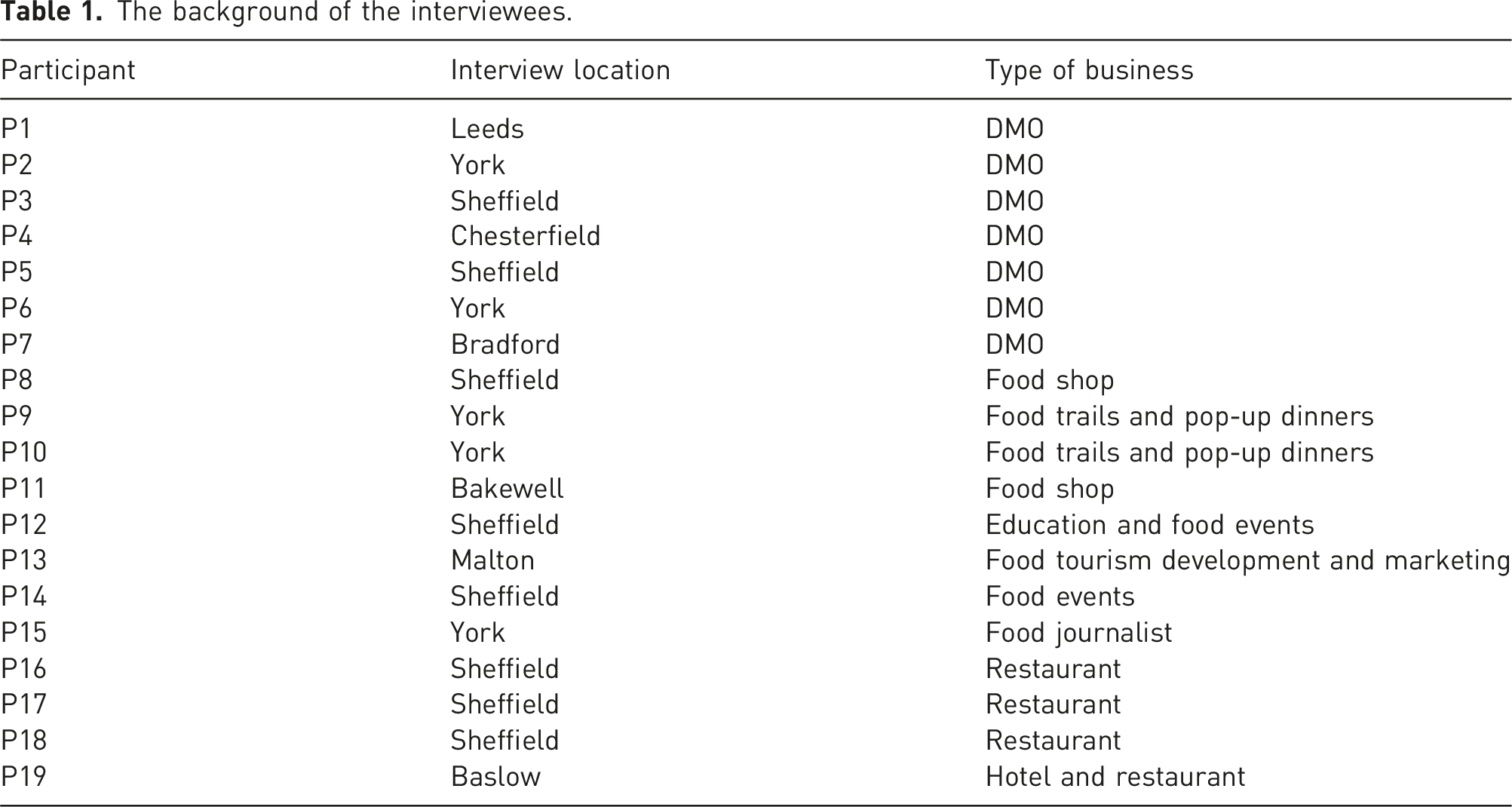
Based on participants’ permission, interviews were either recorded or detailed notes were written. After the interview, these were then verified for accuracy with the interviewee. Each interview lasted from 45 to 60 min. Interviews continued until the data saturation (15 interviews), when new categories or themes were not being developed (Miles et al., 2014). After the data saturation was reached, additional four interviews were conducted, however, they did not result in any new insights. Guest et al. (2006) contend that a sample size of 12 is satisfactory for interviews which intend to explore common experiences and perceptions, similar to this study's approach. Participants were guaranteed anonymity.
The interview material was transcribed verbatim and managed using NVivo 10 software as a data organising and management tool. The steps in Miles et al. (2014) data analysis interactive model were followed: data condensation, data display and verifying and drawing conclusions. During the data condensation process, the interview transcripts were reviewed several times to understand the meaning of each of the sentences. This started the coding process, which was completed in two cycles based on Saldana’s (2016) manual for coding. Cycle one was the initial coding, where codes were assigned to data sections by using a word or short phrase taken directly from that part of the data. This ensured that the themes stayed as close as possible to participants' words and captured key elements of what was being described. This coding approach continued until all the data was coded. Cycle two involved grouping the initial codes to identify the themes. Here, the data were examined carefully by questioning the similarities, differences and meanings until the final themes were reached. Continual refinement occurred until data saturation was reached when no new categories or concepts were obtained from the data (Fusch and Ness, 2015). The data were first analysed by destination (Sheffield, York) and then merged into similar themes and sub-themes. It was decided to use summaries of various statements and phrases from the respondents’ voices to display the main themes, as this helped in drilling down into the explanations and conclusions of the data. There were no clear differences in the findings for York and Sheffield; these results are presented in the next section.
Results and discussion
Urban destinations and local food
Food is a potent attractor because it embodies the local culture and values, incentivising tourists to seek out local food during holidays (Rinaldi, 2017). During the interviews, this was a common theme. Respondents frequently associated local food as an important part of the overall tourism experience (Berbel-Pineda et al., 2019; Presensa and Del Chiappa, 2013), regardless of whether food is a primary or secondary motive. Respondents identified local food as being limited to a geographic area as well as having a cultural meaning where food was linked to the ingredients that are rooted in the soil and climate and transformed through the specific skills of local people as expressed by Participant 10 “It is about how it is created in the first place (…) As much as the ‘where'.
“Local” food for these urban destinations was signified by the food produced in a distinct setting with specific environmental qualities such as the soil and topography blended with skills and knowledge in the local area. It was less about the distance the food was being produced to where it was sold. Hence, “terroir”, which emphasises both the environment, such as soil and climate and the traditions of those producing the food (Hammer, 2011) may explain this. As stated by Participant 2 “it means locally sourced and produced, but also cooked well.” Hence, local food comprises a cultural dimension ingrained in the destination’s environment and culture (Croce and Perri, 2017), accentuating the significance of how the food is produced (Kim et al., 2009). Food tourism in urban destinations can accommodate various identities that ultimately develop the local identity. In our sample, we are seeing the contemporary aspects of social and cultural changes where the focus of local food is not on preserving food traditions per se but rather on the production and how the current food offer connects with the destination. This sheds light on the cultural globalisation tensions and highlights the significance of urban food producers in supporting responsible production, as this connectivity to the area may foster community cohesion and positive environmental impacts (e.g. Leedon et al., 2021). According to Hazburn (2004), globalisation establishes space and place. However, from our data set, the space and place creation are not easily discerned but rather, with food tourism, a new type of space-place relationship is being formed, signalling the importance of location.
In our sample, both the York and Sheffield supply side representatives emphasised the role of food tourism in economic destination development by specifying local job creation and opportunities, thus leading to a broader multiplier effect. These respondents indicated that destination marketers and tourism authorities should revive and reconstruct local food traditions and their peculiarities for tourism. Interviewees also cited active protection of heritage and traditional skills. Food tourism can be considered as an economic development tool, particularly in rural and regional destinations (Everett and Slocum, 2013; Star et al., 2020). As one participant put it, food entices visitors in the low seasons. Thus, it could be used as a means of extending the season (Participant 14). Talking about those issues, local food was associated with sustainable economic impacts at the destination level because it stimulated viable activities in the local areas. It fostered direct linkages between the consumer and supplier (Slocom and Everett, 2010), adding greater customer value (Star et al., 2020).
Food and local identity
The participants revealed that, in their opinion, global food was a vehicle for supporting socio-cultural representation in urban destinations. Thus, rather than viewing cultural homogenisation as a force driving the destruction of local cultures and traditions, participants saw this supposedly homogenising tension as an important element contributing to inclusive destination representation. Surprisingly, participants commented that visitors and residents wanted the predictability of global food in urban destinations due to the “cosmopolitan nature of cities” (Participant 9). Furthermore, Participant two commented that in urban places, there appears to be a need and demand for multicultural food and drink offers. Similarly, Participant 14 explained that cities tend to be “more cosmopolitan.” Correspondingly, Participant 5 indicated that global food offer is “the reflection of a multicultural society.” These comments accentuate the culturally diverse character of these urban destinations, with global food being the channel to showcase this representation. This was also noted in the following comment: I think there has been a mix of different cuisines that have just grown up in different places, even in small towns. We have got Indian restaurants and Chinese Restaurants and all sorts of Italian restaurants. And people have been very happy to accept that and almost expect that [the participant emphasised the words: accept and expect). So, even though English food and local food is growing in England, if a place like York would just have English restaurants, I think people would not appreciate that. We have come to expect a mix of different restaurants that have all gradually come in and joined as part of our English heritage (Participant 14).
This was further emphasised in the following comment, “we are a city with lots of different ethnic groups living in the city. Marketing of the global food offer is about showing that they [different ethnic groups] are part of the city and part of the city life” (Participant 3). These comments highlight the importance of inclusive cultural representation in urban spheres, or as participant seven said, “community cohesion.” Participants felt that international food represented the various cultures and social landscapes in urban destinations, thereby contributing to promoting regeneration and preserving cultural assets, highlighting the fluidity of culture (Pieterse, 1996). Accordingly, this possibly elevates the role of food in urban destinations from a simple, yet important economic means to resources conveying diverse cultural landscapes and social identities at the destination level. Social sustainability needs to be prioritised and meaningfully depicted rather than acting as merely promotional rhetoric (De Jong and Varley, 2018). Early scholars believed that urbanisation would lead to weakened community ties (Beriss, 2019), but our data indicate that cultural globalisation is being reified and asserted as a driver for preserving cultural plurality or cultural difference, thereby supporting socio-cultural sustainability, demonstrating that heterogeneity exists in perpetual dialectic tension with homogeneity.
Destination learning
During the interviews, participants highlighted the role of food producers and independent local food businesses in allowing visitors to experience connectivity to the destination. This is because participants indicated that local food “tells the story about a place” (Participant 1) and “local food is part of the jigsaw puzzle of the place” (Participant 4). Within such a setting, participants accentuated the role of local food in creating a sense of place for the community as well as a purpose and a vision for potentially guiding tourism destination development aligned to an authentic tourist experience, as expressed by Participant 14: Their [tourists’] experience is enhanced because it is not only about going to see that history, but also about adding to the experience, and as a result, people understand more about the region, because of the food they eat when they are there and identifying with the landscape where that food is produced and grown.
The above quote reflects a common belief among the participants that local food and its background, such as the origins of a particular food, can be used to narrate the destination. Food is accepted as a notion of place and culture because of its connectedness with place-making and destination identity (Ellis et al., 2018). This, in turn, possibly raises the role of local food to allow tourists to gain knowledge and understanding of a place. Respondents also stressed that food tourism was important in developing pride for the international tourist, but also the domestic visitors and residents, as English food typically carries negative connotations. They indicated that the food narratives could deepen people’s understanding of food and improve their sense of belonging. In our study, food was seen by suppliers as a construct to reflect the place and cultural experience provided to visitors (Zhang et al., 2019). Thus, local food was seen as an asset to sustainable development (Sims, 2009) because it enabled communities to engage and coalesce (Berno, 2015), providing an indispensable opportunity for them to conceptualise and share their food heritage.
Participants in this study noted that local food in York and other urban destinations could provide an impetus for a “slow-moving way of enjoying the local culture rather than running around and sightseeing” (Participant 6). This comment resonates with the idea of slow travel and its connection with culture and the opportunities it offers for visitors and residents to enjoy more detailed aspects of the destination Serdane (2020). This suggests the association of local food with slow food, which, based on similar principles of slow travel, is seen as an antithesis to fast food and, thus, to the homogenising forces of cultural globalisation. Such experiences are linked to being responsible and engaging in practices which foster sustainability (Fusté-Forné and Jamal, 2020). The slow food movement is usually seen as resistance to globalisation (Sidali et al., 2015; Frost and Liang, 2013) by local entrepreneurs and family businesses. These suppliers demonstrated a slow food ethic which encourages human and environmental benefits (Fusté-Forné and Jamal, 2020). Our respondents did not demonstrate opposition to cultural globalisation but rather recognised the global, and the local were intertwined with each other.
Conclusions
This article employed cultural globalisation to dissect how urban destinations harness food tourism to achieve sustainability outcomes. Few studies have investigated this intricate relationship between globalisation and food tourism (e.g. Mak et al., 2012). The findings indicate that the suppliers in our study connected globalisation and the cultural identity of food in developing their tourism offer. This was achieved by recognising, embracing, and showcasing the cultural multiplicity of food in these destinations. Food, here, was a powerful medium in supporting socio-cultural identity by building local connectivity and enabling inclusivity, positively impacting the destination in the long run.
Our findings demonstrated that suppliers were knowledgeable about the value of local food, and they used this to foster slower travel experiences. By linking local food with the cultural aspects of the destination, they felt tourists’ understanding was stimulated, leading to more experience-driven encounters in these urban settings. Tourism suppliers also expressed that they have a responsibility to the preservation of local food and focus on provenance, hence unbeknownst, they are playing an integral role in sustainability through the sourcing of local food and creating and promoting ‘healthy’ food offerings. Therefore, sustainable tourism development was supported by the way in which these food suppliers managed food cultural resources (Ellis et al., 2018).
By adopting a broader destination perspective, this study extends the current research on food tourism sustainable development. It extends our theoretical understanding via the integration of the cultural globalisation approach by revealing the intrinsic socio-cultural values of tourism promotion and observing how culture and globalisation can work mutually to support destinations in achieving their sustainability objectives. Our findings suggest that heterogeneity is, in principle, a social dynamic that is more conducive to sustainable tourism, and we see these exchanges happening from our sample of suppliers in York and Sheffield. Employing cultural globalisation as a theoretical lens sensitises us to these tensions between homogenisation and heterogenisation as this dialectic tension needs to be understood to support us in understanding how this actualises in practice. Food cultures are constantly evolving (Molz, 2004), with urbanisation being one of the reasons for this. It is necessary for these tourism planners to comprehend the cultural values of tourist suppliers as they shape the food tourism experiences necessitated to support destination sustainability.
The food suppliers in our study clearly showed that they were embracing and developing food as part of the tourism offer. This was clear in the localisation of food as well as the positive, multiplier economic impacts identified. Food is often situated with rural tourism development because of the connection food has with the cultural assets in these locations (Sidali et al., 2015). Our findings indicate that food continues to demonstrate potential as a tourism development strategy in urban contexts, not just in rural destinations, which is valuable not only for economic development but also for much wider socio-cultural sustainability. By applying a cultural globalisation perspective, this research contributes to the ongoing debates on food tourism (Ellis et al., 2018) by firmly positioning it as a distinct and significant type of tourism. The role of food in urban destination development is reconceptualised, seeking to highlight the development of urban communities in a socially and culturally informed manner. It demonstrates the interaction between a destination's food resources and the initiation and growth of community assets. This article extends the existing research, which considers food as part of the wider destination offer and tourist experience (Du Rand and Heath, 2006).
In terms of practical and managerial contributions, the empirical results of this study offer a clearer understanding of how food can boost urban destinations' sustainable tourism development efforts. To meet the growing tourist demand for more sustainable types of tourist experience (Seeler et al., 2021; Weber, 2019), this can be used as a point of differentiation in marketing strategies by elevating the role of food in reinforcing local traditions and heritage, creating a more inclusive approach to destination development. Linked to this, food tourism can also support the re-positioning of urban destinations’ marketing strategy (see Séraphin et al., 2019), which can potentially help to alleviate overtourism concerns. The use of food in tourism can be seen as a political capital (Yeoman and McMahon-Beatte, 2016), which can be used to champion and protect local food, focusing on the people and the place of the destination using food as the leverage.
Food suppliers are important agents in the tourism value chain and are appropriately placed to offer a positive, strategic influence on the future of food tourism. In particular, by identifying and working collaboratively with this stakeholder group, practitioners can create unique product offerings and experiences to meet their desired target audiences. Consequently, it is important for DMOs to take actions that engage locals, food providers, food producers, and tour providers to work together. Such a collaborative approach should not only strengthen urban destinations' sustainable tourism development efforts, but also secure the destination's longevity. This is particularly important in urban destinations where such unique food product offerings and experiences can be used as a means of differentiation and markers of distinction in the constant challenge to attract not only visitors but also investment, business and growth.
This study focused on the perspectives of food suppliers; a limitation is that the perspectives of other tourism stakeholders were not considered. The research did not seek to compare different perspectives on food tourism but rather understand the sustainability actions of these urban food tourism suppliers via a cultural globalisation lens. Future research can expand the scale of the interviews to embed a broader stakeholder perspective to offset any research bias that may have occurred through interviewing one stakeholder group. The findings of this research are based on the representation of two urban destinations via a qualitative research approach. From a positivist perspective, the results are not generalisable; however, they can be transferred to other contexts, such as using cultural globalisation to understand local communities in food tourism and their engagement in broader destination development. Finally, the results point to the critical role these tourism suppliers play in how the food tourism offer is developed and presented via the destination's cultural identity. More research is warranted in understanding their role as cultural intermediaries to shed light on the practices they employ in developing food tourism and sustainable development.
Footnotes
Declaration of conflicting interests
The author(s) declared no potential conflicts of interest with respect to the research, authorship, and/or publication of this article.
Funding
The author(s) received no financial support for the research, authorship, and/or publication of this article.
