



Abstract
Sustainability entrepreneurs are driven by their personal missions about the sustainability-based values that they wish to tap when building a business model. This teaching-case study presents insights into how the personal sustainability missions and goals of entrepreneurs, such as combating climate change in terms of CO2 emission reductions, can be realised, measured and aligned with concrete customer value in order to build a business model. Here, the case of the company Ducky AS is presented, a Norwegian start-up business that has been working for years to transform the specific sustainability missions of its entrepreneurs into concrete social and business values. The case is analysed through the lens of complexity with regards to sustainability management and entrepreneurship. A qualitative research approach with material stemming from a guest lecture and a subsequent interview is used to study the case.
Learning outcomes
To enable students to understand mission-driven entrepreneurship, in general, and mission-driven entrepreneurship in the realm of sustainability, in particular, in the light of complexity;
To examine how the sustainability mission of entrepreneurs can be translated into a value-creating business model;
To understand how entrepreneurs concerned with sustainability manage to overcome the challenges associated with value-creating business models, for example, through digital tools, engagement mechanisms and partnerships.
Introduction 1
Many start-up entrepreneurs are not only concerned both with and about sustainability goals as a value that their business should embrace but also have a personal mission or vision about how they themselves want to contribute to creating a more sustainable world with their start-up businesses. Ultimately, these entrepreneurs work to embrace specific sustainability goals and translate or transpose their missions to the marketplace. Hence, for many contemporary start-up entrepreneurs, sustainability represents more than a trend: it is, rather, a holistic lifestyle and a value in itself that these entrepreneurs choose to live up to. The mindset of these entrepreneurs inspires their entrepreneurship through their visions or missions. Because of this, the aspirations of such entrepreneurs resemble the mission-driven type of entrepreneurship (Kickul and Lyons, 2020) in the domain of social entrepreneurship. Among the broad range of sustainability goals, climate change represents, for many individuals, one of the most pressing issues on a global scale, inspiring persons with missions to contribute to this grand-scale problem. However, mission-driven start-up entrepreneurs can be confronted with important challenges due to the complexity of the grand-scale problem of sustainability (Barile and Saviano, 2018) when it comes to establishing a business model that creates concrete value and the ‘right’ framing of this business model for customers (Magretta, 2002).
Departing from this background, this article presents a case study about a Norwegian start-up business that has been working for years to transform the specific sustainability missions of its entrepreneurs into concrete social and business values. The authors have known the company for years and receive regular updates on its key activities. The case study is based upon qualitative research with material analysed that stems from two sources: firstly, for the topics of the sustainability goals and missions of the entrepreneurs and the development of the company's business model, data were gathered from a guest lecture that the founder, Mads Simonsen, held in the autumn term of 2021 during the class entitled ‘Process, Product and People’ in the Master of Sustainability Management at the University of South-Eastern Norway, School of Business. Secondly, a personal follow-up interview with Mads Simonsen was conducted in the winter of 2021/2022 in order to refine the findings from the guest lecture.
The remainder of this article is organised as follows: after this introduction, the subsequent concise literature review presents the concept of mission-driven entrepreneurship and introduces the challenge of complexity management in connection with sustainability and business models. This is followed by the case presentation which illustrates Ducky's business-model development, both through the company's past and through its current steps to establish the business model and to overcome the challenges related to the founders’ mission. The final part of the teaching case study poses questions about the case and provides a model answer to them.
Literature review
The concept of mission-driven entrepreneurship
In the research on social entrepreneurship, mission-driven entrepreneurship is labelled as entrepreneurship that envisions solutions to wicked, complex and intertwined social challenges and problems through novel, innovative business models (Abu-Saifan, 2012; Marshall, 2011). By translating mission-driven social entrepreneurship to the realm of sustainability, mission-driven sustainability entrepreneurship will be defined in this article as the entrepreneurship of individuals or organisations that embrace a mission of contributing to progress on environmental, social or economic sustainability goals with their start-up businesses or entrepreneurial initiatives as a concrete lever to achieve these goals.
Although it can be assumed that many traditional corporate entrepreneurs also possess a mission which they incorporate in their business model, the concept of mission-driven entrepreneurship is most pronounced with social entrepreneurship. As Weerawardena and Mort (2006: 21) state, ‘social entrepreneurship results in an organization achieving a sustainable competitive advantage, allowing it to achieve its social mission’. Hence, the achievement of a competitive advantage through following a mission is a central idea of mission-driven entrepreneurship. Such a competitive advantage is gained through leading a market, either through reduced costs or based upon differentiated products and/or services (Porter, 1997). By means of following their missions, mission-driven social entrepreneurs may achieve high levels of competitiveness and build a business model that provides a competitive advantage. Simultaneously, mission-driven social entrepreneurs face important challenges with regard to the alignment of their social missions to specific economic-financial goals that need to be pursued in order to remain competitive and survive in the market (see Muñoz and Kimmitt, 2019). This represents a key challenge for social entrepreneurship, in general (Gupta et al., 2020).
Sustainability entrepreneurship: Definition, complexity and challenges
When applying the aforementioned arguments about mission-driven social entrepreneurship to mission-driven sustainability entrepreneurship (see Koprivnjak and Oberman Peterka, 2020), it can be assumed that mission-driven sustainability entrepreneurs may gain a competitive advantage by following their missions with regard to sustainability goals and converting their missions to concrete customer value that supports a competitive advantage. Importantly, the concept of ‘sustainability entrepreneurship’ is relatively novel and not yet clearly defined in the literature. Gast et al. (2017: 46) define ecological-sustainability entrepreneurship as ‘the process of identifying, evaluating and seizing entrepreneurial opportunities that minimize a venture's impact on the natural environment and therefore create benefits for society as a whole and for local communities’. Sarma et al. (2022: 2), moreover, stress that sustainability entrepreneurship is concerned with environmental, social and economic sustainability goals by adopting agency to change or reform, or offer best practice solutions, which is different from conventional entrepreneurship. The term ‘sustainability’ is commonly referred to and expressed in the global United Nation's 17 Sustainability Development Goals (SDGs). 2 Hence, mission-driven entrepreneurs in the field of sustainability often refer to these global SDGs with regards to their entrepreneurial venture.
Similar to grand-scale social problems that inspire mission-driven social entrepreneurs to develop innovative solutions, the SDGs represent a grand-scale, broad, complex – and thus fuzzy – area from which sustainability entrepreneurs can draw inspiration. However, they also meet important challenges: firstly, companies aiming to meet the SDGs must define and interpret specific targets or actions resulting from the global SDGs below the overarching global scale, for example, at the level of a nation or a region. This interpretation represents an important task for start-up entrepreneurs, in particular, because they must clearly state what concrete objectives their start-up business will pursue. Secondly, the alignment of the SDG(s) followed by start-up entrepreneurs with the economic-financial viability of the start-up business is another challenge. As an example, environmental sustainability goals might stand in direct conflict with the goal of achieving profitability through an initial low-cost strategy or the necessary cost reductions over time (Epstein and Buhovac, 2014).
These arguments resonate with the literature that stresses the complex challenges and even the paradoxical configurations for sustainability entrepreneurs following their missions with regard to sustainability (Barile and Saviano, 2018; Edwards, 2021; Hahn et al., 2018; Peter and Swilling, 2014). Hence, the management of complexity inherent in sustainability missions is an important task for sustainability entrepreneurs, both during the start-up period and beyond (Schaltegger et al., 2013).
For this teaching case, the goal of a reduction of carbon dioxide – or CO2 – emissions is a central sustainability mission that the entrepreneurs are pursuing. Across the world, numerous former and new start-ups are dedicated to this sustainability mission. A famous example can be found in the inventor James Dyson, who dedicated his ventures to sustainability efforts (https://www.dyson.co.uk/sustainability). Historically, the goal of CO2 emission reduction has been defined in a top-down fashion on a supranational level: in 2015, almost 200 parties representing most nations of the world signed the so-called Paris Agreement, which is a legally-binding supranational treaty to reduce CO2 emissions, according to a specified goal, thereby limiting the adverse effects of man-made climate change in the age of post-industrialisation. From both the perspective of the individual entrepreneur or organisation dedicated to reducing CO2 emissions, and from that of consumers, who aim to influence the environment through their consumption habits, the objective is a challenge: it is not only a challenge to comprehend but also a challenge to implement, due to the complexity of the cross-cutting factors and interactions involved. The existing models and data on the objective are somewhat limited, and consumers do not access them in their day-to-day lives (see Lammers et al., 2022). In a similar vein, the impact that individuals or single organisations can make with their small contributions is equally difficult to determine and assess. Finally, the contributions towards the goal that are necessary at a small-scale level (e.g. in a municipality, a city or a region) might vary, which renders it, again, complex to specify local goals that can be translated into concrete measures, such as the percentages of the reductions during a certain time period in a given region.
More generally, this complexity may entail that individuals, such as consumers (see Fuentes, 2014) or representatives of private and public organisations (see Preuss and Walker, 2011), face a lack of motivation to engage in combating climate change, notably when they cannot access concrete information about how their own contribution supports the overarching goal and becomes manifest at their particular level, for example, in their region. This represents a major complexity for the entrepreneurs in question with their mission to achieve progress on the SDGs combating climate change. Hence, for the individual entrepreneur, the existence of such complexity regarding the sustainability mission needs to be considered when establishing an initial business model to achieve a competitive advantage and generate customer value; in particular, engaging customers, or individuals, to contribute to the entrepreneur's sustainability mission would seem to be a key factor to which the entrepreneur must pay attention.
Sustainability and business models: Entrepreneurs telling their story about a sustainability mission
The entrepreneur's mission with regards to sustainability is typically expressed through a business model. In fact, business models have recently gained in importance, and most incubator accelerators and regional development offices use business models as tools; for instance, the business model canvas is used for individuals with entrepreneurial aspirations to think through their business ideas and formulate concrete value for specific, determined customer groups (Coombes and Nicholson, 2021; Dahle et al., 2018). This way of thinking stems from the ‘lean start-up’ philosophy (Blank, 2013), which puts emphasis on developing an initial minimum viable product that appeals to customers and can be marketed swiftly. Indeed, Casadesus-Masanell and Ricart (2011) have emphasised that customer value is a vital element of a convincing business model, one which allows a start-up company to build a competitive advantage.
Magretta (2002: 87), moreover, points out that a business model is also about telling a story about one's enterprise, including the framing of the founders’ personal mission, or vision, about how the entrepreneurial venture works and how it provides answers to some fundamental questions, for example, who the key customers are, and where the key markets lie, what value the entrepreneurs will provide to customers and how financial viability will be supported, based upon the business model. Following this argument, it is essential for sustainability entrepreneurs to frame a convincing narrative about their sustainability mission and show the (prospective) customers and other important stakeholders how they will provide concrete value for customers to achieve this mission and remain competitive in the market. Notwithstanding the strong emphasis on customer value propositions in the ‘lean start-up’ philosophy of business models (see Coombes and Nicholson, 2021; Blank, 2013), the formulation of an entire business model helps start-up entrepreneurs to understand better their existing competencies and resources, align these competencies and resources and perform a reality check about whether their business idea might function.
Company background
The company that is presented in the following, Ducky AS, focuses on increasing awareness about climate change and the necessary reduction of CO2 emissions as their core sustainability mission. The company aligns this goal with the organisational strategic value that it provides to customers based upon a data-driven IT solution which it offers. More specifically, Ducky offers two main services: Ducky Application Programming Interface (API), which enables carbon footprint calculation and reporting; and Ducky Engagement, which offers a personalised digital platform to track individual and organisational CO2 emissions and compare them with a benchmark. At the time when the research was conducted, the company employed 24 persons.
The founders’ mission
The adventure of Ducky 3 began in 2014, which was the time when the three founders shared their concern about climate change. Since they had worked in the Norwegian extractive industries for several years, they had experienced the negative environmental effects of these industries and felt guilty about working in this sector. As a result, they became ‘climate-depressed’, as the founders acknowledge. During this time, when the founders had been pondering about how to change their own workplaces and simultaneously contribute to combating climate change, they had been conducting a small survey among urban dwellers in their hometown of Trondheim, a major Norwegian city, asking people in the streets about why they, as individuals, did not take more action to fight against climate change. The answers surprised the Ducky founders: although people were, by and large, willing and motivated to contribute to the grand-scale sustainability goal, they felt that they, as individuals, were not able to make an impact.
Starting from this finding, the founders’ mission grew subsequently on two levels: the first level was that they identified complex and paradoxical issues with the stakeholders that they targeted to approach; these were organisations handling the official goal of CO2 emission reduction in the Norwegian regions. The Ducky founders established contacts with climate advisors in the Norwegian municipalities. These public advisors often found it hard to prioritise the overarching goal because they were overwhelmed with many different tasks and only held one full position, at best, or even one part-time position. These municipality representatives are, however, the actors responsible for the reporting of CO2 emissions in the municipality, such as emissions from a car or vehicle fleet owned by the municipality. The complexity that the Ducky founders identified with regard to the climate advisors was that they only counted the direct emissions, but did not consider the more significant indirect emissions, for instance, through the production of the car with its parts, energy consumed for the car usage, etc. Another, more striking complexity that the company founders noted for the Norwegian municipalities was that the citizens living in the municipalities were rarely included in the CO2 emission calculation, which the Ducky founders call ‘the elephant in the climate room’. While the municipalities apply policies for reducing CO2 emissions among their closest circles, such as municipality employees, the Ducky founders considered the engagement of citizens at municipal level a key to achieving faster progress regarding the climate goal, which was, however, largely neglected. A final example of the complexity with which they met was that measures to reduce direct emissions often relate to carbon capture or storage through heavy-infrastructure policies, which encompass a long-range planning horizon but are not effective in the short term.
On a second level, during their start-up preparations, the Ducky founders became aware of the high motivational levels of the different stakeholders with whom they interacted. In the municipalities, the politicians who work with climate change know about the value of engaging the citizens and have a strong interest in changing the approach to tackle climate change in their municipality. Company- and industry-actors were also motivated to contribute. However, a common issue with these actors was that they lacked the knowledge and/or the tools with regard to how specifically to contribute, which requires the right incentives. Hence, the founders found that: ‘there are so many positive effects of sustainability if it can be framed as something positive’.
The initial business idea and the design of a business model
These challenges, which can be derived from the founders’ mission to follow the complex sustainability goal of CO2 emission reductions, were the trigger that motivated the Ducky founders to launch their business which ‘is all about taking climate research, climate data and climate psychology, etc., and turning it into citizen engagement’. However, it took them some time to realise the goal. Several activities were necessary to understand better how a value-providing business model could be built upon this mission. The founding team engaged in conversations with researchers in industrial ecology at the local polytechnic. These researchers explained to the founders that, in fact, all CO2 emissions could be traced back to the consumers or citizens by means of tracing their consumption of various products and services. The founders, moreover, received a research grant with which they planned to create a consumption-based emission overview for the whole of Norway and collaborated with industry-actors and municipalities. These initial steps laid the foundations for the subsequent business-model development.
Visualisation and tracing of ‘footprints’: Providing information about CO2 emission reductions
Financed by the research grant, Ducky created a map of all Norwegian municipalities in 2020, which illustrates the progress achieved in terms of CO2 emission reductions upon a weekly basis. Users may read on the map which ‘footprint’ 4 a given municipality has reached, and it can be zoomed into neighbourhoods within the municipality by displaying the average CO2 footprint in Norway and comparing it with other neighbourhoods based upon the consumption behaviour of citizens living in the residential areas chosen. For the mayors and politicians working with climate change at municipal level, the provision of such information is important because they may need it in order to understand which measures are necessary to reduce the CO2 emissions locally. In 2021, Ducky had committed 15 active municipalities in Norway to work with this map-based tool, both large cities and suburbanised municipalities. Furthermore, a large Norwegian region joined in 2021 and offered the Ducky platform to all the municipalities in the country, which led to almost 50% of Norway's population living in a region in which the municipalities are aware of the CO2 emission footprint. For the founders, the offer of this tool and the resulting demand for it were the basic steps to develop further functionalities and to integrate them into the map, based upon the tracking of emissions through climate-related data and psychology (see Figures 1 and 2).
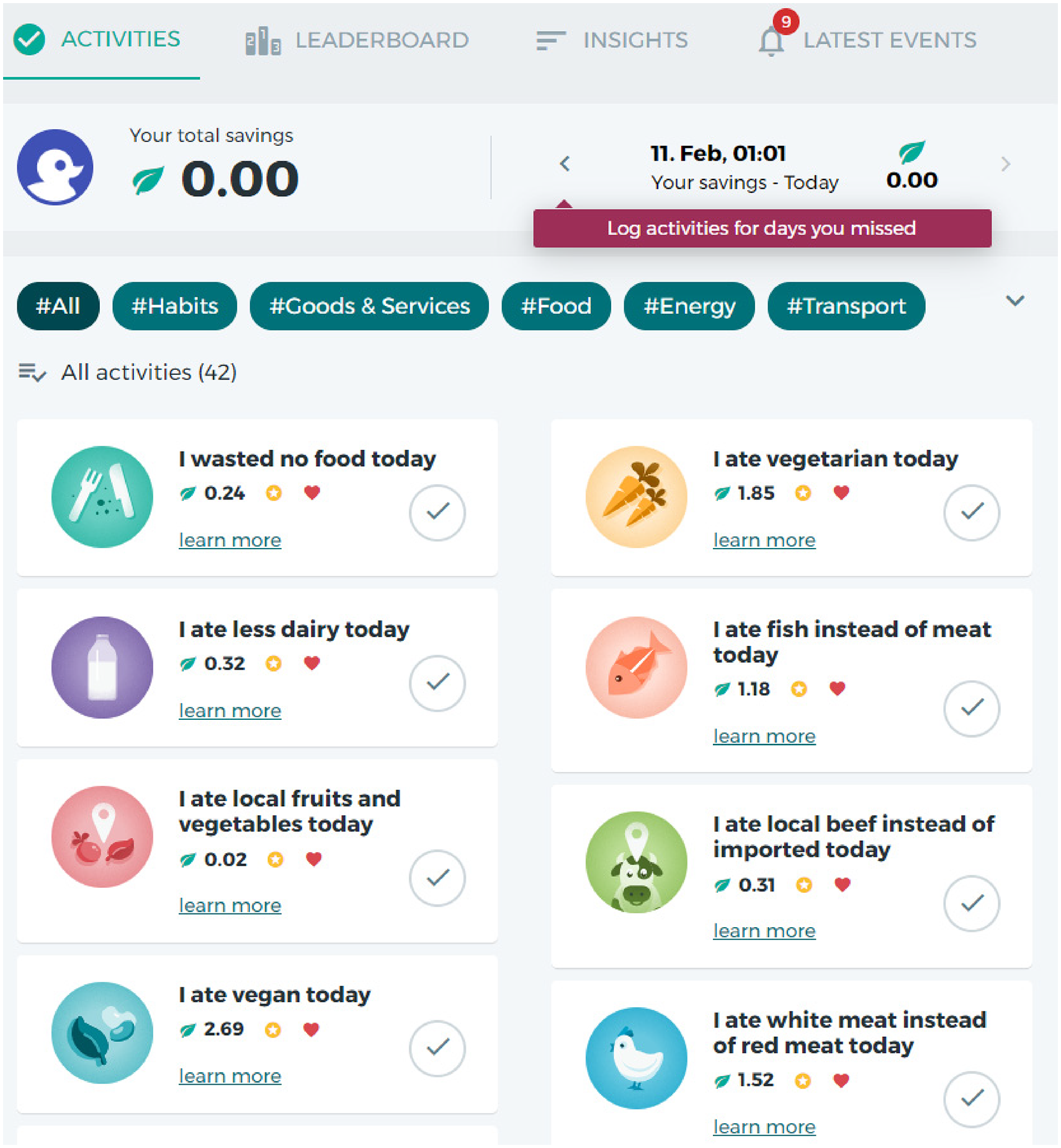
The Ducky interface: visualisation of carbon footprint.
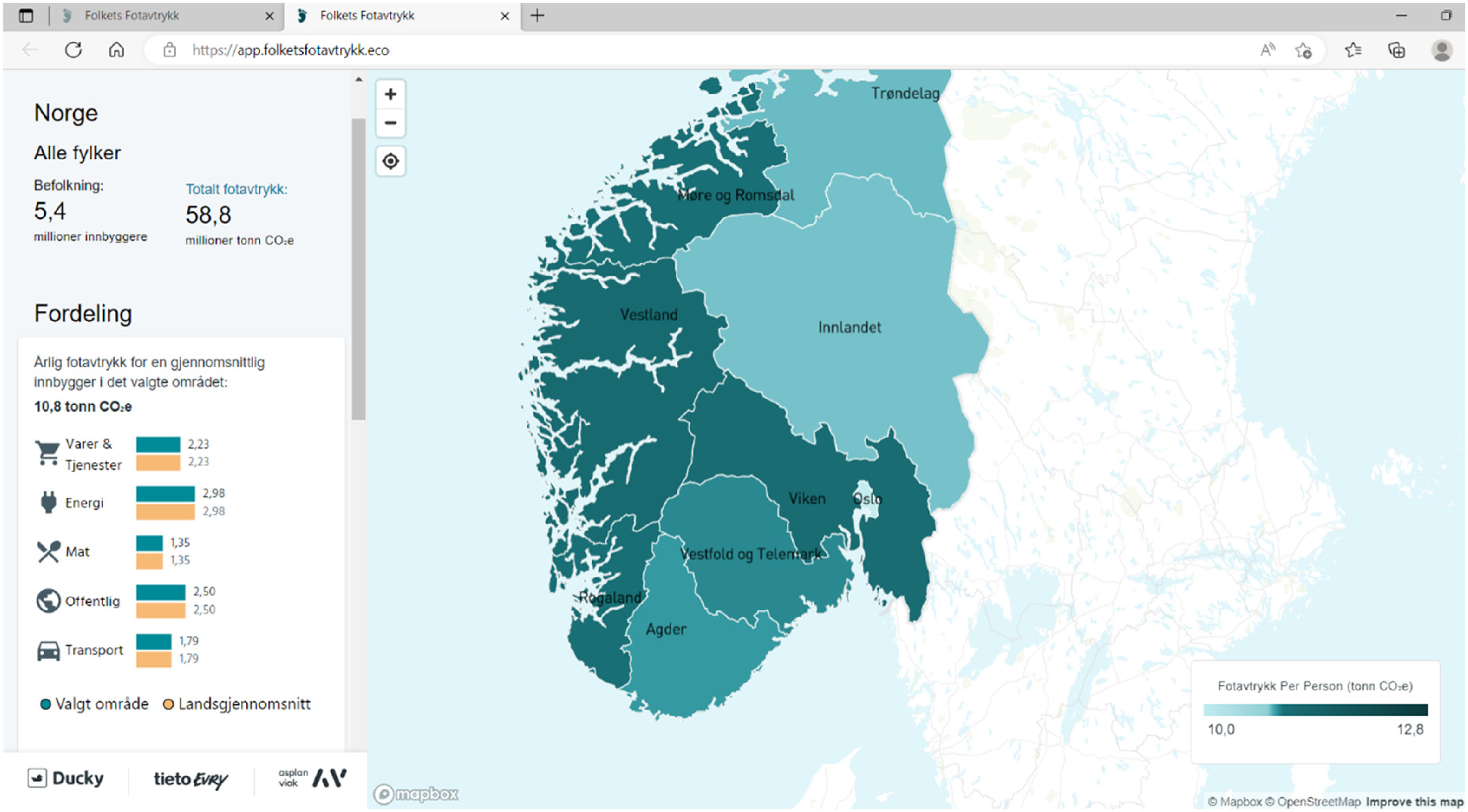
The Ducky interface: visualisation of geographical distribution of carbon footprint.
Community-engaging and community-enabling activities, combined with ‘nudging and learning’: Ducky championships
Another step to offer value to the ‘app users’ and design a value-providing business model was the introduction of a national championship, the so-called ‘Ducky Championships’, which the founders initially organised in 2020, with 53 high schools across Norway competing against one another. The competition resulted in the high motivation of the students, and the concept was taken further. The championship is meant to ‘create a culture that is ready for sustainability’ by collaboration on a common goal related to the ‘footprint change’ and the positive framing of this goal. The community-engaging and community-enabling championships are especially suited for both private companies and public organisations because they can use these events to anchor a sustainability strategy internally and enable their employees to join and identify with the strategy. Hence, the championships are meant to change the culture within organisations with regard to how sustainability is framed as a strategic issue with which employees can identify. To this aim, the so-called ‘footprint teams’ are established in organisations which compete with one another in various challenges. The teams log simple activities (e.g. a vegetarian day in the canteen or biking to work), which increases the knowledge base of employees about the impact of single activities. For instance, employees may become aware of the CO2 emissions saved when having a vegetarian meal, in contrast to a meat-based meal. The championships can be continued after the end of the challenge. One participating company managed to appoint 600 climate ambassadors in its organisation linked to a ‘Ducky Championship’ that supported the management after the campaign. A Ducky championship, which ‘nudges’ the participating group members to adopt a different form of behaviour and provides important learning points to them, is both community-engaging and community-enabling, as it provides the users with the experience of how small actions may matter in order to attain a fuzzy overarching goal.
The final business model: Merging illustration and data visualisation
The final business model that leads to the scaling of the start-up business is called Platform-as-a-Service (PaaS). Recently, Ducky has significantly focused on ‘cloud computing’ that serves as a centralised hub for companies to access a wide range of sustainability-related resources. The platform offers various modules and functionalities tailored to different industry sectors and business sizes. The Ducky platform representing the final business model contains a ‘footprint’ calculator which allows users to calculate the baseline value for their individual CO2 footprint and display it on various consumption items. To this aim, the platform is fed with data, which are retrieved from the existing studies on, for example, the average time to take a shower, the average size of Norwegian houses in the region, the average distance from home to work, etc. These parameters can be changed and updated to show the impact of the individual on the CO2 footprint. The public registries can be integrated into both the databases and the calculator, and all these data can finally be aggregated into a value for the average Norwegian household or citizen footprint of any neighbourhood in Norway. By this token, Ducky can estimate the complete footprint, including the indirect emissions that households or citizens produce on average. The individual consumers as platform users can, moreover, use various interfaces from partner organisations, such as regional or national banks, energy and insurance companies and even grocery stores.
Through the platform, users can customise services and add specific content, for example, the tracking of a footprint when users purchase financial services from their bank. For the municipalities using the tool, this adds value, as they would otherwise lack information on the complete footprint of their citizens; through the app, they can swiftly and directly ‘nudge’ their citizens towards changing their behaviour and habits with regard to various consumption activities. The participating corporate partners – for example, the banks and energy companies – are provided with value, as they can use something concrete to influence their customers, such as providing incentives for CO2 reductions via their products and/or services. This is why the participating banks have developed the interface to the Ducky platform and rolled it out to 95% of the Norwegian banks through the Sparebank One Alliance 5 (a national alliance in the regional banking sector). This means that 1.5 million Norwegian private banking customers in the municipalities will have the ability to trace their climate footprint for their bank activities, such as the financial services that they are using.
Reflecting on the progress thus far
In 2022, that is, eight years after developing its mission about sustainability, climate data and psychology and engagement, the company scaled up this business model swiftly and formed a team of 33 employees. The current review in 2021 had been almost 10 million Norwegian Kroner (NOK). Ducky's original goal to make climate change engaging had been reached, mainly through app-based competitions in which citizens in private or public organisations can engage in reducing CO2 emissions (so-called ‘Ducky Championships’). In the past few years, Ducky had already established different lines of businesses and operated both nationally and internationally, in particular, in Japan and in the United Kingdom. While the company had started out as a non-profit organisation (NPO), they later needed to raise private capital after the start-up stage in order to avoid bankruptcy. Hence, the founding team had to spin out the former NPO into a 92% NPO, which the three founders own as co-founders, and a for-profit enterprise (the remaining 8%), owned by private investors.
Since 2021, Ducky has been working on becoming operational. Many new data sources have been integrated into the basic map, and Ducky is now a partner with a large Nordic IT company that provides data storage and data securities services. Through the partnership, Ducky gained access to many relevant data registers, which provide extra value to the users. Hence, for every municipality and neighbourhood in Norway, Ducky can utilise data registries and calculate CO2 emissions, including the indirect emissions. For instance, data can be accessed about how big the houses in the neighbourhood are, who lives there, what the average income of the residents in the neighbourhood is, how many cars are used in the local neighbourhood, what type of cars the local residents have, the distance between the home and the workplace, etc. These data provide Ducky with a more refined baseline footprint on the emissions that allow it to fine-tune the map, and the CO2 emissions calculator provided through the map.
While the company was starting with this data integration, it also found regional banks and energy companies which became partners as well. These local partners provided more services that integrated climate data on financial services and energy, so that these partners could use the map as a tool to influence their customers through the interface. These partners were also able to share the data back to the app, which allowed the users of the Ducky app to change consumption patterns and illustrate the change on the map by observing the progress that they themselves were making individually on the map. In 2021, Ducky added the food sector to the partnerships through a co-operation with a grocery retail chain company in Norway. Further collaboration is planned with other important sectors, such as transport and insurance investment companies, or organisations from the educational sector.
The customer value provided through the fully operational Ducky platform is a combination of tracing and illustrating individual or group-based progress made on CO2 emission reduction and CO2 footprints, which engages users and instigates change(s) in behaviour. In addition, the collaboration of individuals within organisations, such as employees in teams and departments in organisations, students in school classes, etc., on the platform in order to achieve specific goals are supported. The platform will be developed further so that the users will be provided with more concrete tips and recommendations. For instance, the users can compare their CO2 footprint and/or the reduction of their footprint with that of their neighbourhood, connect the footprint to some of the bonus schemes of retailers or banks; they might also be incentivised through being granted a cheaper loan or insurance by means of a comparison. Hence, when users are not only able to trace but are also able to document a change in behaviour through the platform, they will be granted bonus points. The mission of the Ducky founders that the users become more engaged and learn to use their thinking in their CO2 footprints and carbon emissions is, therefore, part of a value-providing business model for customers, that is, individual citizens, and public and corporate stakeholders.
Despite this success story, the year 2022 marked a turning-point for the former start-up: initially, Ducky started with 22 million NOK of fresh capital from investors and felt ready to scale up the business model. The company invested time and effort in developing the map further and selling it to the public sector. However, this step took too many resources, with the team growing bigger, which ultimately burnt too much capital in salaries. As a result, Ducky needed to reduce their headcount to 18 employees in a painful, yet necessary, action before the end of the year. Their main learning point from this process was that a company should not scale up the team before it finds the perfect product/market fit. Another challenge was that the proof of concept with private-sector organisations and the data integration for them took too much time and further delayed the product development and implementation.
Following these experiences, Ducky focuses its future strategy on becoming a professional data company, which offers access and analytics of CO2 footprints data via APIs (see Figure 3). The company will focus on data collection, data management, data visualisation and outsource all non-core activities, which will allow it to focus on the scaling of their core product according to market needs.
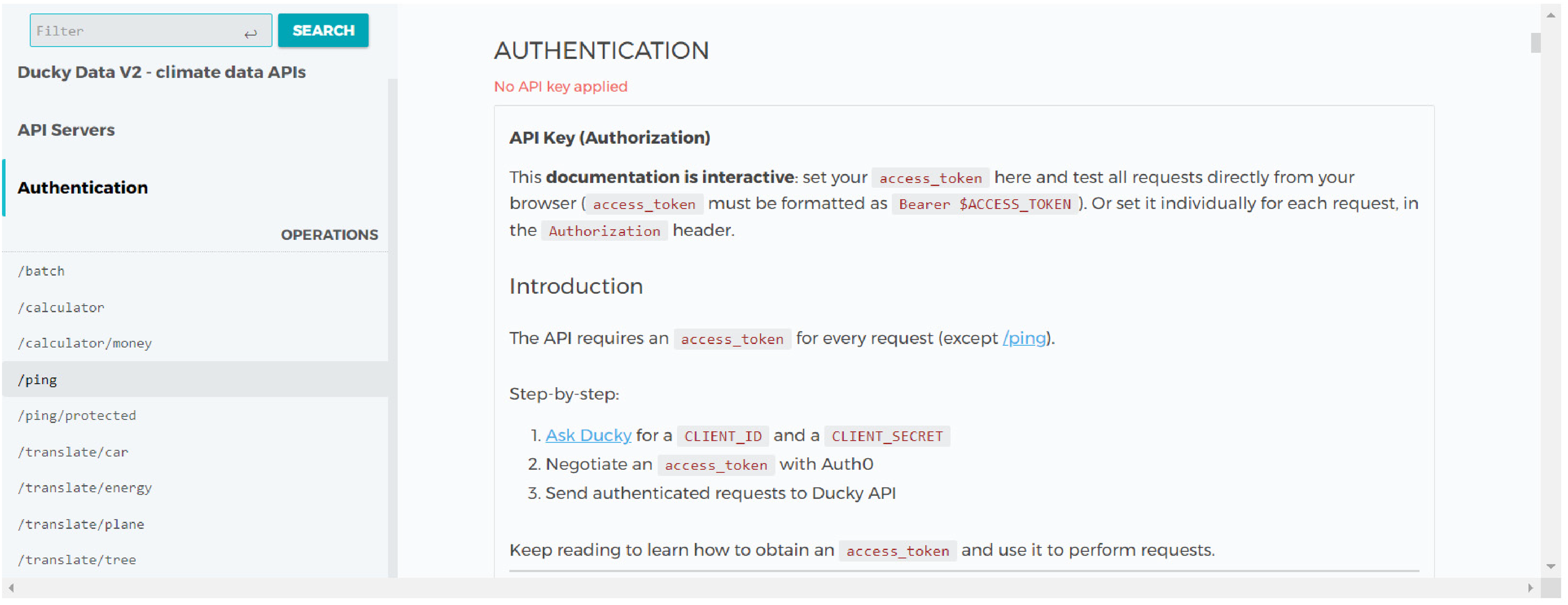
The overview of climate change data Application Programming Interface (API) for organisations.
Conclusion
The case of Ducky presents insights into how personal and organisational sustainability missions of entrepreneurs, such as combating climate change in terms of CO2 emission reductions, can be realised, measured and aligned with concrete customer value in order to build a business model. By visualising concrete information on the sustainability goal and allowing users not only to trace the goal, here, carbon footprints but also influence the progress to reach it through behavioural changes, Ducky provides users with valuable information and learning points to understand their own impact on the emissions and how to reduce their emissions. The introduction of the ‘Ducky Championships’ further enhances not only the individual engagement of users but also community-engaged and community-enabling activities that foster collaboration and create a novel culture of sustainability within various types of private and public organisations. The case illustrates several challenges associated with complexity, which is inherent in the founders’ sustainability mission, and the case stresses how the start-up business managed this complexity through several business pivots in an open and collaborative business model (see Figure 4).
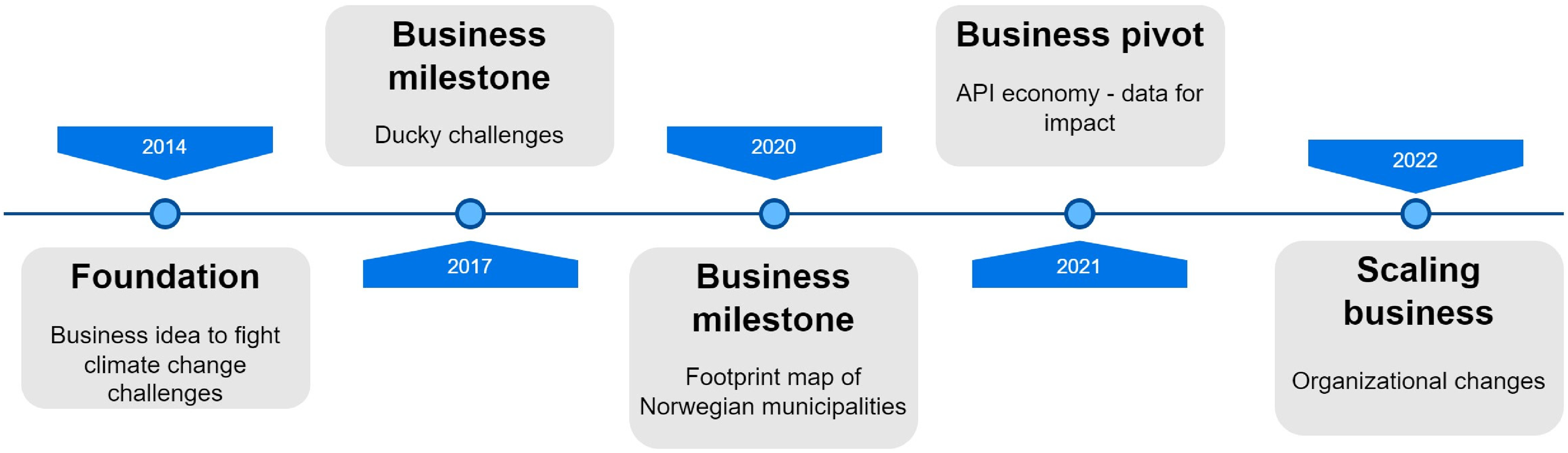
Milestones in business model development.
In terms of its theoretical implications, the case study illustrates mission-driven entrepreneurship as a relevant concept to study sustainability entrepreneurship; moreover, the case study highlights how the management of complexity by start-up entrepreneurs is associated with the establishment of a value-creating business model that conveys the entrepreneurs’ personal mission about sustainability. Furthermore, the case study bears self-evident implications for public policy and entrepreneurship practice. Firstly, policy-makers can leverage platforms, such as Ducky, to disseminate information, engage citizens and encourage sustainable practices. Secondly, organisations of various types can adopt similar approaches to embed sustainability strategies internally and motivate organisational members to participate actively. Thirdly, the success of Ducky also highlights the significant role of information technology in data integration, visualisation and collaboration with stakeholders in building effective business models through platforms that incorporate sustainability goals and missions. By following Ducky's example, other start-up entrepreneurs and incumbent businesses as well as policy-makers can contribute to addressing climate change and promoting a culture of sustainability.
Questions
How did the Ducky founders, in the initial steps of their business start-up, convert their mission to concrete work hypotheses about CO2 emission reductions?
How should Ducky scale up its current business model? How can they monetise the value through fees, subscriptions or licensing models for the different stakeholders (such as private users, companies, public-sector organisations)?
Ducky is a national app-based start-up with ambitions to grow internationally. Which potential obstacles might occur for their international expansion?
Footnotes
Acknowledgements

Declaration of conflicting interests
The author(s) declared no potential conflicts of interest with respect to the research, authorship and/or publication of this article.
Funding
The author(s) received no financial support for the research, authorship and/or publication of this article.