



Abstract
This case study provides a critical understanding of the connection between start-up investment and the development of a loyal brand community. Learners develop an appreciation of how engagement in crowdfunding campaigns can lead to the creation of engaged partners. This is explored through applying the Business Model Canvas to the case of BrewDog, a company that has expanded beyond the niche market of craft brewing to become an international brand. The use of crowdfunding has not only enabled Brewdog to raise the capital to finance expansion but also to develop a special relationship with some of their customers, who through investment and engagement can become partners in the product development process.
Keywords
Aim
This teaching case explores the potential non-monetary benefits of equity crowdfunding and how it can be utilised to foster loyalty within brand communities. The case focuses on how Scottish craft beer maker BrewDog used repeated rounds of equity crowdfunding to create their unique and loyal brand community. The engagement of customers and investors as partners and co-creators is explored from a strategic perspective, through the lens of the Business Model Canvas (Osterwalder and Pigneur, 2010).
Learning outcomes
This case study seeks to achieve the following learning outcomes:
Investigate the business growth opportunities that equity crowdfunding can provide and how the industry context informs these opportunities. Appraise how equity crowdfunding can be utilised to create a loyal brand community. Evaluate how effective equity crowdfunding can influence the business model of a business. Understand how the Business Model Canvas can be used as a tool to analyse community brand building.
Introduction
The craft beer sector was largely seen as an industry with little innovation, centred around tradition and a one-thousand-year-old craft. Emerging in response to a mainstream and commoditised brewing industry, BrewDog has disrupted the craft beer sector using equity crowdfunding and entrepreneurial marketing strategies to develop a business model which brings all the stakeholders to the table (Cabras and Bamforth, 2016; Yongmei Zhang et al., 2015). At the centre of this is customer loyalty, the main stay of all successful businesses (Dawes and Swailes, 1999; Tantakasem and Lee, 2008). This case study bridges this gap to create the knowledge needed to understand how we can use the Business Model Canvas to review entrepreneurial businesses, with the view to create winning crowdfunding campaigns and effective customer engagement.
The customer loyalty challenge in the post-COVID era
For businesses to remain competitive, they need to adapt to the changing external environment. In times of crisis, businesses need to be particularly attuned to the fast-changing environment and how this influences their customers and their relationship with them. One of the most powerful ways to do that is by leveraging the new opportunities offered by the digital transformation of the economy that has taken collaboration and cooperation to new levels, as shown by the emergence of the crowd economy, a ‘distinctly new set of economic relations that depend on the Internet, computation, and data,’ (Kenney and Zysman, 2016: 66). This has provided businesses with new opportunities to change and develop their engagement with customers, who are increasingly seeking a sense of community (Sabia et al., 2022). One way in which businesses can take advantage of such an opportunity to build further community and engagement with customers is through equity crowdfunding. Equity crowdfunding has emerged as a tool for both entrepreneurial finance and entrepreneurial marketing aimed at closing the equity gap whilst providing the entrepreneur an opportunity to build strong links with their communities in the dual role of investors and customers. This case study explores how BrewDog, a producer of craft beers, has used equity crowdfunding, not only to raise finance, but also develop a sense of community. It typifies how entrepreneurs can engage customers at the centre of the entrepreneurial process.
The Covid-19 pandemic has added volatility to the economic environment and threatened the survival of many small and medium sized enterprises (SMEs) (ONS, 2021). The pandemic has led to increased redundancies because of the sudden lack of liquidity that entrepreneurs have had to cope with. This scenario has been worsened by consumer changing habits. For example, brand loyalty dropped from 65% to 49% between March and November 2020 among US consumers (Cooper, 2021). To help alleviate these effects in the future, entrepreneurs need to ensure that customers are at the centre of the entrepreneurial process.
Equity crowdfunding as a tool for raising finance
Crowdfunding has been described as an open call for the provision of financial resources to support initiatives for specific purposes (e.g. Belleflamme et al., 2013). Such collective action allows the ‘crowd’ to provide resources and to engage with the entrepreneurial process. Between the various form of crowdfunding (i.e. donation-based, reward-based, p2p lending, and equity crowdfunding), equity crowdfunding has emerged as a viable alternative entrepreneurial finance strategy for entrepreneurs unable to access the traditional funding channels (Estrin and Khavul, 2016; Moritz and Block, 2016).
Bruton et al. (2014) have suggested that the low servicing costs of equity crowdfunding is an advantage over traditional methods of financing projects, while Ordanini et al. (2011) believe equity crowdfunding brings lower risks to capital providers. Estrin and Khavul (2016) also see (in equity crowdfunding) the opportunity of reducing biases associated with traditional forms of the early stages of entrepreneurial finance, including gender and location of the business. From the capital providers’ perspective, Grossman (2016) argues that digital innovation has made it easier for crowd investors to invest their money, resulting in a remodelling of the whole sector by lowering entry barriers for capital providers. In other words, equity crowdfunding represents one of the most promising opportunities for start-ups and SMEs to stay afloat in uncertain times. Indeed, equity crowdfunding can provide existing companies with immediate liquidity to face the current challenges and is confirmed as a viable alternative in the equity investment market, offering potential to nascent entrepreneurial projects to take off.
Equity crowdfunding as an entrepreneurial marketing tool
Equity crowdfunding has also been identified as an entrepreneurial relationship marketing tool as it develops a community of customers, investors, and entrepreneurs. It represents a way to develop a more inclusive form of society, one in which customers are considered as partners, that is, a central part in the value creation process (Mollick, 2014; Ordanini et al., 2011).
One of the reasons for this success relies on its highly relational nature (Ross et al., 2019). Entrepreneurs can make the most of their social capital, that is, equity crowdfunding offers much more than just money due to the consumer/investor pledge to a company whilst becoming a partner of the entrepreneur. Put simply, the community of investors represents the added value of equity crowdfunding (Mollick, 2016).
For project initiators, that is entrepreneurs, equity crowdfunding has also been a way of promoting a product or an idea at a lower cost when compared to traditional marketing and communication practices (Lehner, 2013). The rationale behind this is the possibility of having a pre-market window during which entrepreneurs can gain public attention and promote their projects (Belleflamme et al., 2013). Therefore equity crowdfunding can potentially be used as a marketing tool connecting and engaging potential users (Brown et al., 2017).
Equity crowdfunding also provides the opportunity of identification between the entrepreneur and the investor (Sabia et al., 2022) and/or between the project and the investor (Efrat et al., 2019) where a mechanism of psychological ownership is activated (Zheng et al., 2018) whose main contributor is commitment (Efrat et al., 2020).
In this perspective, equity crowdfunding is a powerful trigger of customer loyalty. In offering, first and foremost, ownership of a shared vision, as opposed to simply offering equity stakes to crowd investors, equity crowdfunding poses itself as a tool to increase the loyalty of the community around a project. Working together towards a horizon of shared values (Weidinger, 2014), project owners and backers get beyond the market value itself (Schaltegger and Wagner, 2011).
This helps to explain why literature such as Drover et al. (2017) has shown that investors are attracted to entrepreneurs to whom they can relate in many ways. Equity crowdfunding has been found to facilitate the evolution of entrepreneurial ecosystems, creating engagement within brand communities by stimulating fan base interactions and, in turn, fuelling emotional engagement with positive effects on purchase intentions and the sustainability of brand communities (Menon et al., 2018). Whilst equity crowdfunding is used in many industries and sectors, we have selected one to develop greater contextualisation and demonstration of impact. This is particularly evident within craft brewing, with one craft beer company, BrewDog, demonstrating these attributes, which is explored in more detail in this case study.
Craft beer
The concept of small production craft beer started as a small movement in the US in the 1970's but has spread globally in recent years (Koch and Sauerbronn, 2019). Beer companies operating in the mass market have tried to reach consumers within the craft beer sector with only limited success. They have tried both price reductions and promotional campaigns, but these have often been ineffective as craft beer consumers behave differently from traditional beer drinkers (Koch and Sauerbronn, 2019). Gómez-Corona et al. (2016) highlight craft beer as not being chosen for its functional and utilitarian attributes, but rather its sense of identity, providing a sense of authenticity and uniqueness. Similarly, Koch and Sauerbronn (2019) found that craft beer is a sub-culture of consumption where feelings, emotion, and commitment to the cause, play an important role. In terms of craft breweries, numerous authors have found the sector to exhibit a high level of collaboration with both competitors and the communities and customers they serve (Cunningham and Barclay, 2020; Munro and O’Kane, 2021).
The connection and sense of community which craft breweries establish between themselves and their customers can help to develop a sense of identity and loyalty, which identifies them as non-mainstream breweries, which is an essential part of developing authenticity as a craft brewery. Such a relationship also provides the opportunity to share the passion of craft brewing and the potential for engagement through the sharing of feedback and ideas, which can potentially be used for co-creation, to further the relationship. Co-creation has been seen in a variety of sectors (Guzmán et al., 2019) from online football fans (Pongsakornrungsilp and Schroeder, 2011) to coffee shops (Shulga et al., 2021) who have all used it to develop consumer led innovation. Such co-creation and consumer led innovations can lead to the development of new products, services, and processes, identified as potentially valuable to the consumer.
Brewdog
BrewDog has become, in the span of a few years, a craft beer market leader, expanding its reach well beyond the craft beer industry niche. Founded in 2007 in Ellon, Aberdeenshire, by two Scottish entrepreneurs, James Watt and Martin Dickie, the company has grown rapidly to become a top global brand in the industry.
An initial round of Equity for Punks was undertaken in 2009, which offered the opportunity for people to buy shares through equity crowdfunding (Smith, 2018). Additional funds were raised in 2011 when the company offered 8% of their capital for over £2 million through equity crowdfunding.
Today BrewDog can count on more than 700 employees of which almost 80% work in sales and business development, 4 production plants, a global presence comprised of more than 100 bars, a branded hotel, and a supporting crowd of almost 150,000 investors that has helped the company to raise almost £80 million via their equity crowdfunding programme called Equity for Punks. The company has recently developed this concept in Equity for Punks Tomorrow which aims at crowding investors from the globe with the purpose of fostering a new sustainable benchmark in the industry (BrewDog, 2021). The last round of equity crowdfunding was completed in early 2021 during the Covid-19 pandemic. A more detailed account of BrewDog's journey is presented in Figure 1.
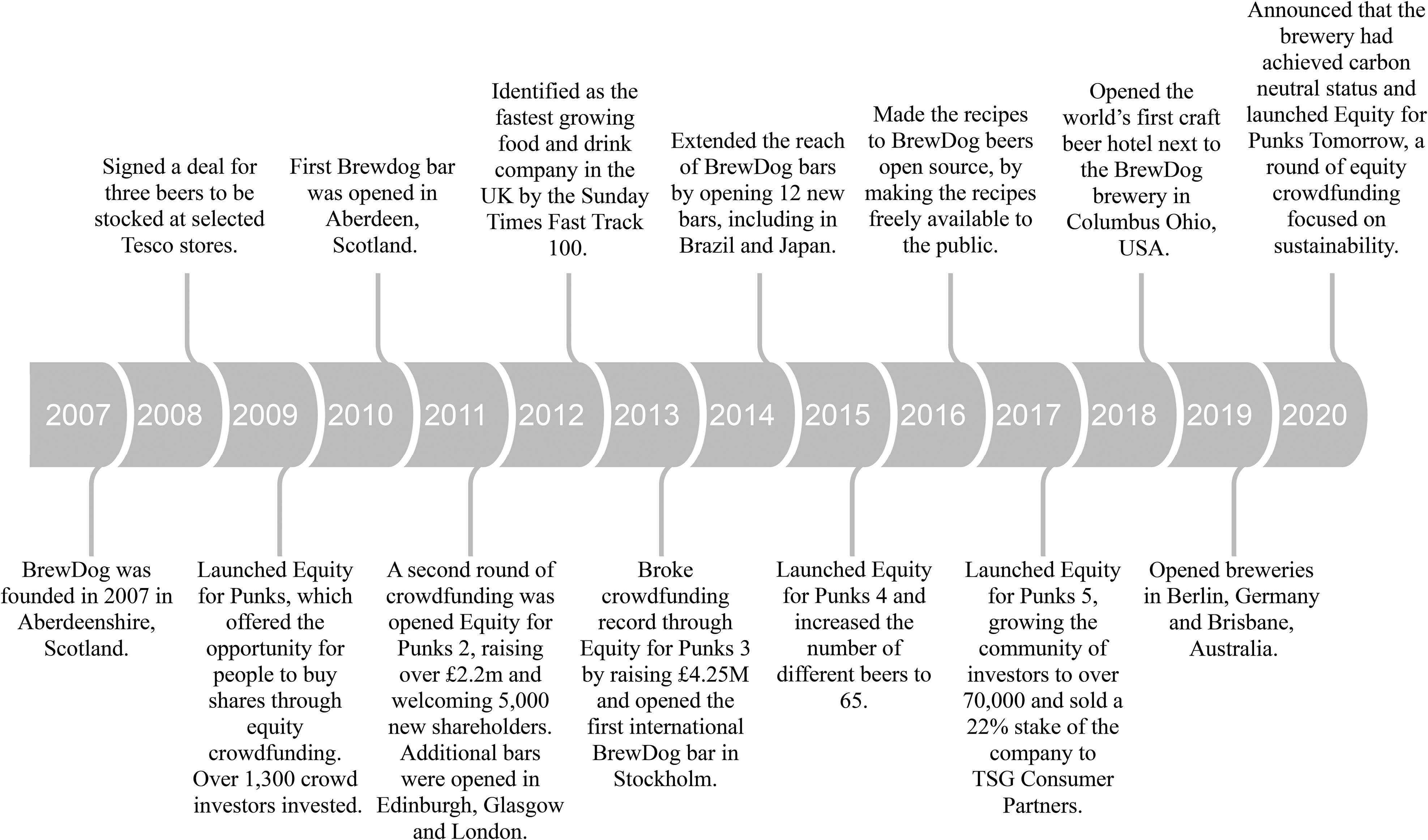
The development and expansion of BrewDog.
Equity crowdfunding is a novel and interesting feature of BrewDog as it has been a key part of their success (Schwienbacher, 2019) and has influenced not just their acquisition of capital, but also their relationship with consumers, and thus their business model. The case study will now briefly summarise the Business Model Canvas, which is the lens which will be used for exploring how BrewDog used equity crowdfunding to build a loyal brand community and the influence it has had on their business model.
Business models and the business model Canvas
Whilst there is no unifying definition of a business model it can be described as representing the organisational and financial architecture of the business and describes the business logic of the value creation, value delivery, and value capture mechanisms that a business adopts (Teece, 2010). Business models provide an opportunity to understand how firms create, deliver, and capture value, thus allowing a simplified view of the whole business (Timmers, 1999). During times of crisis and upheaval where the business environment is changing rapidly it is important to ensure that the business model underpinning an organisation is still effective and sustainable (Liu and Bell, 2019). Kyhnau and Nielsen (2015) argued that it is essential for business models to be customer-centric, and the business model must be honed and developed to meet the particular needs of customers.
The Business Model Canvas is a textual and visual tool developed by Osterwalder and Pigneur (2010) to represent areas which define and explain the business model of a company. The tool is used by investors (Sort and Nielsen, 2018), consultants, managers, and entrepreneurs (Keane et al., 2018) to critically review both strategic and tactical value creation activities within a business; however it is only through a thorough and detailed understanding of the business that the tool becomes truly useful.
It contains nine components namely: Customer segments; value propositions; customer relationships; channels; key activities; key resources; key partnerships; revenue streams; and cost structure.
The case study will now explore how BrewDog used equity crowdfunding to successfully build a loyal brand community by analysing the desirability and feasibility components of the Business Model Canvas and discussing their interlinkage. A visual representation of the Business Model Canvas is presented in Figure 2.
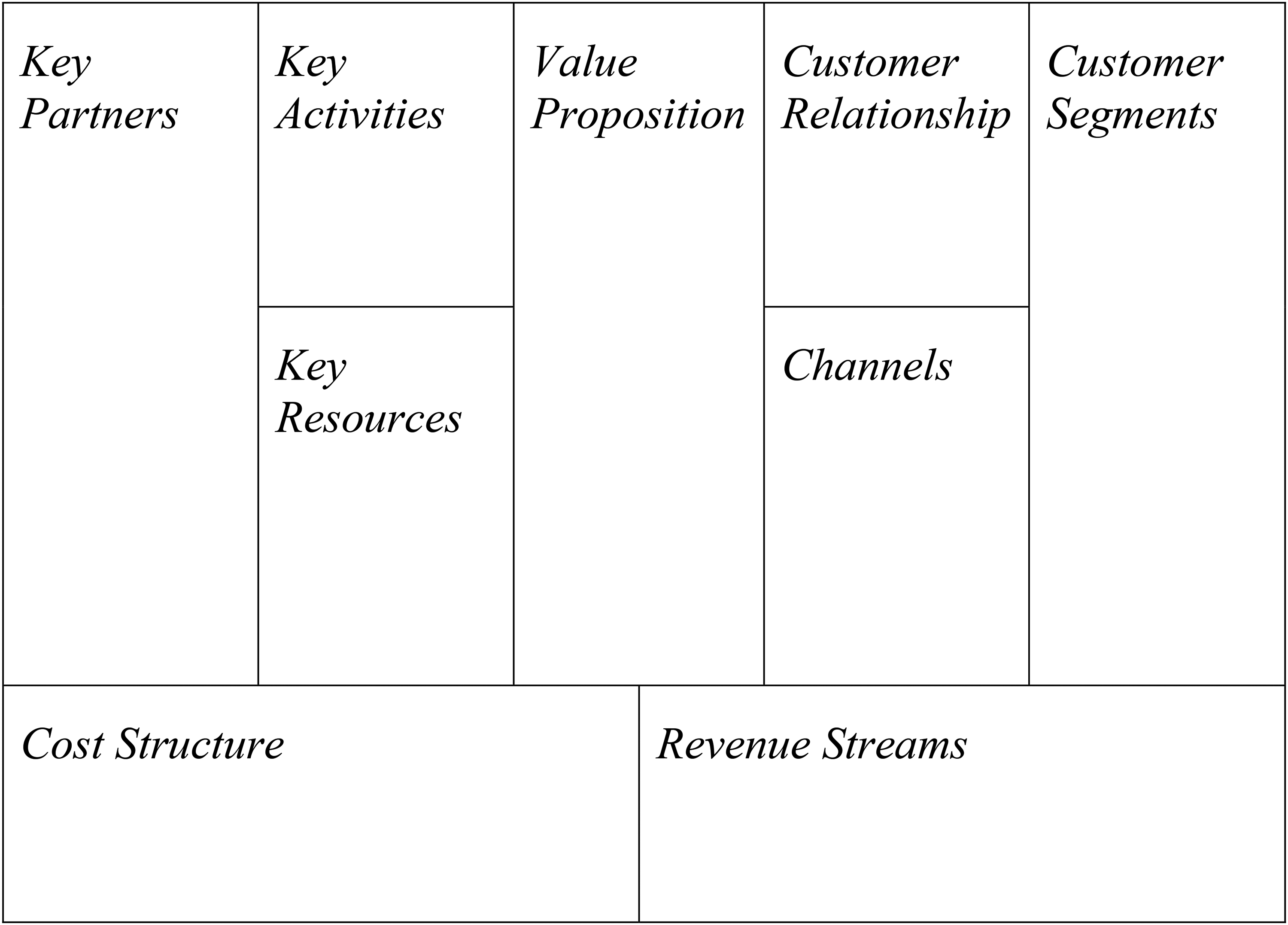
Business model Canvas.
How BrewDog used equity crowdfunding to build a loyal brand community
Through their approach, BrewDog implemented a strategic shift from the idea of customers as only an audience to one of engaging customers as a partner and, in so doing, challenged accepted wisdom in terms of addressing the consumer (Smith et al., 2010). Rounds of equity crowdfunding allowed customers to engage and connect with the company in a deep manner, buying into the company and its philosophy and products. This process can be visualised through the lens provided by the Business Model Canvas.
In terms of the customer segment, BrewDog targeted and defined their core market segment by using the expression ‘beer loving punks’. In doing this they did not refer to their customer segments by using demographics or any kind of standardised measure but instead they focused on a particular attitude.
The rationale behind this is related to the fact that the company was born with the aim to revolutionise the beer industry and redefine British beer-drinking culture (Cunningham and Barclay, 2020). In other words, the founders wanted to create an alternative to the industrially brewed lagers that dominated the UK beer market. In a similar fashion, the band Rage Against the Machine identified with the punk subculture through expressing nonconformity and opposition to the mainstream culture and the status quo. In such a vein the message can be seen as a political one, that is, drinking our beer embodies a specific rebellious ideology, ‘When BrewDog first started, the UK beer market was all fizzy, no flavour, mass produced beers and we demanded better. Manifest 1 defined BrewDogs’ brand communications, created the Craft Beer Revolution, and positioned BrewDog as the leaders of change, elevating the industry’ (Creativebrief, 2021). This became part of BrewDog's ideology and subculture with which people could engage with and buy into; they were on a mission to provide ‘Craft Beer for the People’. This is part of their value proposition integrated into and underpinning the physical product produced.
They also needed to create a following of loyal supporters able to sustain the company's battle in the market to establish their own niche in an already overcrowded market. In terms of the Business Model Canvas, BrewDog made the strategic decision to close the distance with their customers and so the founders decided to make them part owners of part of the company itself.
To achieve this the company launched in 2009 their first equity crowdfunding campaign that they called ‘Equity for Punks’. Populating the Business Model Canvas, and in particular the areas relative to customer relations and the channels, it starts to take the form of the holistic approach the company decided to pursue. The customer relationship became one of co-owners and conspirators in BrewDog's vision of craft beer for the masses through potential equity ownership through crowdfunding. In terms of the channels, these become shorter with increased connection with the customer.
The added value of Equity for Punks was to pave the ground for a loyal community of fans ready to follow the founders in their journey, enjoy their different beers, and effectively, act as brand ambassadors, or even evangelists. In other words, the founders provided their customers with more than a product or being part of a subculture; they provided them a mechanism of identification and as such a purpose to fulfil their need of belonging (Sabia et al., 2022).
In this perspective, the equity crowdfunding campaign started to become something more than just a campaign, as over the years it has become a programme which as of 2021 counts several fundraising rounds since 2009. In other words, equity crowdfunding became a key activity of the company's business model as well as a resource in a virtuous circle which, round after round, has created a tight community so that the customers that had become investors started to be real partners with the company. Therefore, the rounds of crowdfunding can be considered as a key activity within the Business Model Canvas framework.
Members of the community began to be involved in the business development activities of the company such as in brand ambassadorship, business intelligence to open new shops around the world, to explore the possibility of developing new products, or of enriching the portfolio of the activities of the company. This was made possible because of a feeling of ownership that crowd investors had in the business. ‘Each feels ownership, and each spread the word of Craft. Perhaps the most effective marketing campaign with no budget, ever. Equity for Punks entrenched the BrewDog community and ethos. It was effective marketing precisely because it was not about marketing at all’ (Watt, 2015: 121). This means the crowd investors became more than just providers of finance, but a key resource which could help to identify opportunities and co-create new products and offerings.
In this way the company was able to build their own community as partners and then their competitive advantage. Such advocates of the company and products are considered key partners in ensuring the sustainability and growth of BrewDog. As James Watt expounded: ‘Whatever type of business you are in, you need to start building a community and start turning customers into fans. Without a community and without fans a brand of a business is destined to be all too short-lived. Even with a small tight-knit core of passionate fans you can change the world.’ (Watt, 2015: 121).
In summary, a loyal fan base was built around the principles of developing a craft beer community. Allowing consumers to invest in the business through equity crowdfunding helped to reduce the distance between the business and its customers and it united the community around key principles. The development of the community helped in the identification of further opportunities in terms of co-creation and were advocates for the craft beers being produced. This process helped to provide effective marketing for the products and extension of the product range and offering.
However, what can put this fan base at risk are reputational issues that have started to emerge around the figure of the co-founder James Watt, and also, the quality of the work environment in the company. Indeed, the surfacing of negative press in relation to misleading advertising (BBC, 2021) and accusations of a bad workplace culture (CEO Today, 2021; The Guardian, 2021) have the potential to damage the relationship the company has with its customers if its values and commitments are perceived as hollow.
Conclusions
A key takeaway from the case of BrewDog is that in view of the volatility of business, the creation of strong bonds and communities by entrepreneurs can help to develop a competitive advantage. For businesses and entrepreneurs to create such an inner bond with their communities it is important to develop a sense of connectedness, belonging, a mission, and a meaning, which underpin a sense of community. If an entrepreneur can transition from delivering a product to building a community, they can unlock extraordinary competitive advantages and can both create and support a superior business model. The rationale for this has been effectively highlighted by Bussgang and Bacon (2020) who refer to a virtuous circle formed by three elements: firstly, enthusiastic members help acquire new members, resulting in lower customer acquisition costs and a tight viral loop; secondly, in the presence of these conditions members are reluctant to abandon the community and this results in increased retention and therefore improved lifetime value; thirdly, members support one another, resulting in high gross margins due to a lower cost of service.
All in all, entrepreneurial finance through equity crowdfunding has provided BrewDog with a strategic means to navigate that volatility in that it provided support the development of a loyal brand community. Indeed, the case of BrewDog highlights how equity crowdfunding can be applied to help convert customers from being a passive audience to being engaged as partners within a community. From reviewing the case of BrewDog, it can be seen how crowdfunding has been used to add value across components of the business model in a context where the Covid-19 pandemic helped to test this.
While the focus of this teaching case is the use and value gained from crowdfunding processes, it is acknowledged that, at time of publication, BrewDog have suffered from press coverage which questions the culture of the organisation. The loyalty gained from supporters, in large part facilitated through the crowdfunding mechanism explored here, may be tested by such recent challenges to the company's image. It will be interesting to follow these developments in the future and the implications on this teaching case.
Discussion questions
How can entrepreneurs utilise equity crowdfunding to support business growth and development?
How did BrewDog manage to engage customers to foster a successful brand community?
Map out on a Business Model Canvas how BrewDog applied equity crowdfunding and community brand building principles to develop a loyal brand community.
What are some of the benefits for an entrepreneur of building a loyal brand community?
What contextual factors do you believe are conducive in supporting entrepreneurs to successfully build a brand community?
Teaching notes
Synopsis of the case
The case study explores how BrewDog have utilised equity crowdfunding, not only as a means of raising capital, but also as a marketing tool to build a loyal brand community. Developing such a brand community has helped BrewDog establish a following that advocates for and promotes the company's products and engages with identifying opportunities and the co-creation of products and media campaigns. The development of such a community can help businesses insulate themselves in challenging economic times, such as the COVID-19 pandemic and changes in socialisation patterns, and offer the opportunity for businesses to further develop and extend brand communities. The case explains the role of equity crowdfunding in BrewDog's development of a brand community by applying the lens of the Business Model Canvas.
Teaching objectives and target audience
The case is targeted at graduate students, and more specifically MBA students who are already familiar with business models and the Business Model Canvas. The case can be used to teach learners about equity crowdfunding and its benefits, or to demonstrate the value and potential of community brand building and how it can be achieved through applying equity crowdfunding. The teaching case study highlights that equity crowdfunding can have additional non-monetary benefits. Whilst many learners are likely to be somewhat familiar with equity crowdfunding, it is largely viewed from a financial perspective and this teaching case seeks to develop and supplement learners’ existing awareness of equity crowdfunding by unpacking how it can be used from a marketing and brand building perspective.
Teaching approach and strategy
The case study brings together numerous topics included in the entrepreneurship classroom, therefore it is suggested that the case study could be utilised when teaching and discussing entrepreneurial financing, entrepreneurial marketing, or business models, depending on how the educator would like to present and situate the phenomenon of equity crowdfunding. After the introduction, and before moving onto the case study, a short class discussion led by the educator is recommended. This can include discussing the beer industry, focusing on the different products in the market and the different logics, the locations and the consumption habits that different groups of consumers have. This discussion can then be linked to the discussion after the case study regarding the different consumers in the market and the desire to engage with the product in different ways and depths. For example, some beer drinkers are not worried about the brand and are more interested in the price and its functional and utilitarian attributes, whilst others might identify with beer in a different way, seeking authenticity and uniqueness in their choice and thus have commitment, feelings and emotions wrapped up in their choice. Such discussion can set the groundwork for further discussion as to what products members of the class identify with at a deep level and whether any members of the class consider themselves as part of a brand community. This discussion can then be linked to discussion questions 4 and 5.
Before providing the learners with the case study, it is recommended that educators reacquaint the learners with the Business Model Canvas as the case is written assuming that they already have a basic understanding of the Business Model Canvas, rather than with an emphasis on teaching this for the first time. Additionally, it might be useful to provide the learners with a copy of the Business Model Canvas template to remind them of the components and allowing them to complete it as part of discussion question 3.
Model answers
How can entrepreneurs utilise equity crowdfunding to support business growth and development?
Whilst equity crowdfunding is most often seen as a way for entrepreneurs to raise finance, it can be used in a number of ways. These include. as a marketing tool to showcase products and services, and when building a brand community when advocates and followers can buy into the company. Additionally, equity crowdfunding can be used as a way of engaging customers in co-creation as they are now directly involved in the company as partial owners, for example by providing feedback and ideas. Equity crowdfunding can also be used to test or validate new products and services, identify whether there is a demand, and whether potential customers are willing to part with their money.
2. How did BrewDog manage to engage customers to foster a successful brand community? 3. Map out on a Business Model Canvas how BrewDog applied equity crowdfunding and community brand building principles to develop a loyal brand community.
Customer segments – Behavioural segmentation, focusing on customers interested in craft beer rather than mass market beer. Value propositions – Revolutionizing the beer industry and redefining beer drinking culture. Customer relationships – Close customer relationship supported through allowing customers and fans to buy equity in the company and listening to customers’ suggestions. Channels – Direct channels with customers as well as through wholesale. Key activities – Equity crowdfunding becomes a key activity. Key resources – Equity crowdfunding becomes a key resource. Key partnerships – Crowd investors are key partners who are engaged providing feedback, suggestions, and opportunity identification. 4. What are some of the benefits for an entrepreneur of building a loyal brand community?
BrewDog united customers around a vision of ‘better’ beer and the slogan ‘Craft Beer for the People’. They developed a value proposition around the ideology and mission of producing craft beer and taking it to the masses, which resonated with members of the craft beer community. Launching rounds of equity crowdfunding allowed people to buy into the company and its vision. The concept of buying into a craft beer company was popular with many craft beer drinkers, with many identifying with the company and being passionate about craft beer and brewing. Allowing fans to buy into the company in turn allowed BrewDog to develop close customer relationships and share their values and passion for the product. Those fans and customers buying into the company also acted as a key resource and partner in identifying new opportunities and co-creating new products, which in turn further developed the brand community and links to the business.
Figure 3 maps how BrewDog applied equity crowdfunding and community brand building principles to develop a loyal brand community on the Business Model Canvas.
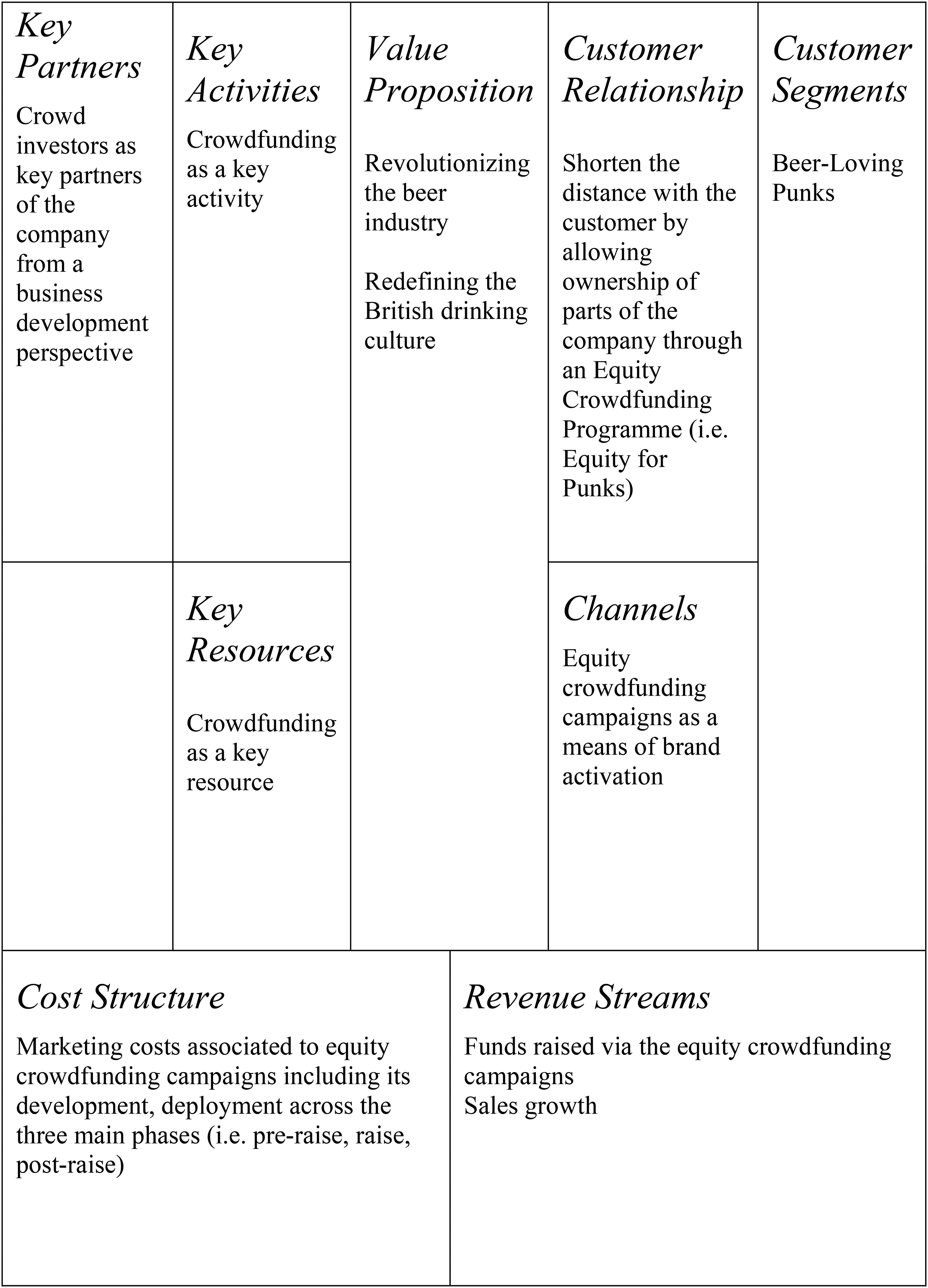
Brewdog business model Canvas.
Building strong brand communities can help as a marketing tool and advocates for the brand can share their positive experiences which can act as word-of-mouth marketing. Such types of marketing can be particularly useful for small and new businesses which must bootstrap in order to develop successful marketing campaigns. Brand communities are often early adopters of new products and can provide effective and cheap feedback on new products and services. Communities can also be used to discuss and identify new products and opportunities which they would welcome, providing relatively cheap and effective market feedback.
Developing strong brand communities can help increase loyalty to the business and weather potential downturns. For example, Apple has built a strong brand community which helps to build and retain loyalty to the Apple ecosystem of products.
Recent press regarding BrewDog highlighted the connections between leadership and a business's internal culture (CEO Today, 2021; The Guardian, 2021). BrewDog has acknowledged the threat posed by these allegations, but this is not the first time that BrewDog has issued a public apology. Such adverse publicity can impact linkage with the brand community and needs to be handled carefully.
5. What contextual factors do you believe are conducive in supporting entrepreneurs to successfully build a brand community?
Customers need to feel a deep connection to a product/industry and be willing to advocate for it. If the product/industry aligns and forms part of the identity of their customers and they share the same values and passions, it is more likely customers will become fans and join a brand community. This customer connection is contextually sensitive and some industries have been shown to benefit from this more than others. Companies and products which customers identify with, and use, can provide signals to others, such as clothing companies, and are often most likely to be able to build strong brand communities. Similarly, the sharing of identity and passion such as for craft beer can also be a strong incentive to being part of a community. Equity crowdfunding can allow customers and fans to buy into businesses to demonstrate their identity further and link customers and fans with the community. Developing this connection allows entrepreneurs to create a community which can bring with it valuable competitive advantages.
Analysis and conclusions
Equity crowdfunding can be used as both an effective entrepreneurial financing and entrepreneurial marketing strategy and, from this perspective, can be a particularly useful approach for new businesses with only limited resources. Indeed, as the case suggests, equity crowdfunding can allow a business and customers to unite around a vision, passion, or mission, which can support the formation of a brand community. In turn, a loyal brand community can offer many benefits including increased devotion, interaction, and feedback with customers, and potential co-creation and opportunity identification. In other words, if used in a strategic way, equity crowdfunding can provide a platform for the entrepreneur to scale their sales and work with a superior business model, that is one where the added value is created and appropriated not only by the entrepreneur but also by the supporting community. The BrewDog case constitutes a best practice in this regard, as it demonstrates how this process can be achieved by providing the crowd with an identification mechanism which allows the community supporting the entrepreneurial project to constantly play an active role in it.
Footnotes
Declaration of conflicting interests
The author(s) declared no potential conflicts of interest with respect to the research, authorship, and/or publication of this article.
Funding
The author(s) received no financial support for the research, authorship, and/or publication of this article.
