



Abstract
‘Growing Better’ is a micro-social enterprise Community Interest Company (CIC), based in the Leeds City Region (UK), which provides a supportive working environment for people with mental health issues at an urban farming facility. This case study explores the business model and informs the challenge of growing a social enterprise with limited human and technical resources. Findings suggest that the potential for growth lies with the social entrepreneur’s ability to harness external stakeholder support; however, any development of the venture should also inform the effective utilisation of resources through operations management. Practically the case explores how aspirations for social and environmental impact drives the need to acquire and manage resources effectively and efficiently.
Keywords
Key learning outcomes
To explore how an urban farming initiative can be utilised to create a social enterprise that promotes mental health and wellbeing.
To analyse the opportunities and challenges facing an early-stage social entrepreneur in pursuit of enterprise growth, through the application of the business model canvas (Osterwalder and Pigneur, 2010).
To understand the strategic and operational challenges in planning for and implementing a growth strategy for a micro-social enterprise.
To apply ‘traditional’ entrepreneurship, strategic and operations management theories and concepts to analyse the design and implementation of the business model.
Introduction
Growing Better consists of an urban farming facility that grows microgreens, such as red and pink basil, mustard and wasabi as well as small leaf greens within a single shipping container using Controlled Environment Agriculture (CEA). These microgreens have high nutritional value and provide a vibrant garnish atop restaurant dishes, all produced hydroponically in an urban location grown all year round.
As a CIC 1 with the aim of supporting people with mental health issues, through the operationalisation of an urban farm, ‘Growing Better’ draws on support from a range of stakeholders and uses a variety of funding streams to create positive social and environmental impact. This case considers the relationship between the context, resources and the role of the social entrepreneur in developing the enterprise. It is the story of a micro-venture ripe for development, if sufficient resources can be found. It also gives insight into the urban farmer as a social entrepreneur, specifically through the application of technology and supportive stakeholder relationships to achieve the aims of the social enterprise.
The narrative tells the story of Growing Better by exploring the relationship between opportunities for growth and the organisation’s access to – and deployment of – resources and the implications for the design and implementation of the business model. It is structured as follows. First, the wider context is explored, discussing the concept of CEA and the nature of urban farming. Second, the venture and the entrepreneur are introduced, detailing the emergence and development of Growing Better. Then the business model is explained, giving insight into the strategy and operations. Finally, the case presents the strategic challenges associated with conceptualising and implementing a growth strategy for ‘Growing Better’.
The Urban agricultural context
CEA is a technology based-approach to food production, with growers utilising an array of hardware and software to regulate variables that are uncontrollable in the natural world, such as: temperature, humidity and lighting (Benke and Tomkins, 2017). CEA can be practiced in a range of structures and spaces (from small household units to scaled farms), using green houses, polytunnels, container units and purpose-built structures. These facilities can be placed in urban locations, utilising methods such as hydroponics, aquaponics and aeroponics to grow food with minimal environmental impact, all year round (Kalantari et al., 2017). Vertical farming relates to the intensive use of space and the ability to farm produce in horizontal and vertical rows.
Much media attention has been given to the entrepreneurs trying to disrupt the norms of conventional agriculture with vertical farming initiatives (Butler, 2019; Tyler and Bendix, 2019). In addition, contemporary studies have looked at the barriers towards technology adoption within farm environments (Gittins et al., 2020; Holloway et al., 2014; Morris et al., 2017). There is, however, a lack of research that explores how small-scale urban farmers are using technology, such as vertical farming, to drive business innovation and growth. This case explores how a social entrepreneur has developed a vertical farming business model to achieve social, economic and environmental enterprise objectives.
Background to the social enterprise – Growing better, CIC, Leeds
On a late summer’s evening, many rural farmers are out bailing hay and harvesting their crops in preparation for winter, Dorota (the CEO of Growing Better); however, is doing things differently, making a social difference through her urban farm. I think a farmer, other than just a grower, is someone who produces food in any space or capacity.
I think entrepreneurs are just business people.…. Social entrepreneurs have more focus on delivering that social value, being resourceful in that and not focusing solely on the profits, knowing when and what to balance and encouraging other businesses to take part.
Dorota joined Growing Better in 2018, after 5 months she was promoted to Operations Director and is now CEO of the venture. She is very hands on with the social enterprise (at the time of writing, Dorota was the only full-time member of staff). She has a broad range of responsibilities and there is the personal challenge of prioritising work amidst wanting to do as much as possible to support the volunteers to develop skills. Dorota is involved in cultivating, working with suppliers and charities, co-ordinating and often doing deliveries to customers, alongside supporting volunteers in undertaking their work.
During her university studies, Dorota became involved with community projects, including a plan to develop a student run polytunnel farm. Whilst that project was not implemented, she gained essential experience in understanding the challenges of developing new ventures with multiple and often competing stakeholder interests. Dorota is now in a position where she can utilise her practical and academic knowledge to develop Growing Better. Her vision is to engage in agriculture that is better for the environment and at the same time offer volunteer opportunities for people with mental health issues. She is a keen advocate of CEA and considers it to be an environmentally friendly approach towards farming, producing microgreens with a small carbon footprint and located close to her customers.
The vertical farm – A controlled environment agriculture facility
The vertical farm operates from within a 20 ft × 8 ft shipping container, which is split into two parts, a small office and the growing environment. Produce is grown to order through a hydroponic system currently operating at maximum capacity.
The unit is a high-tech facility (Figure 1); powered by a ‘central hub’ that monitors and controls the environment, regulating humidity levels and temperature. The produce grows through bio-degradable hemp mats where water filled with nutrients flows through and feeds the growing crops. Under the hydroponic system, this facility can produce pea-shoots from germination to harvest in 2 weeks, undercutting competitors in speed, as well as offering consistent quality at a modest cost. With more investment the CEA set-up could be scaled up; Dorota has access to more land on the existing site and the ability to source the requisite technology for growth; however, despite her commitment to CEA, Dorota is also developing an outdoor plot of land for cultivation and to nurture wildlife. She would like Growing Better to provide a bigger community space for local residents. Dorota is keen to explore how gardening and farm activities could be used to support people with dementia, within their communities.
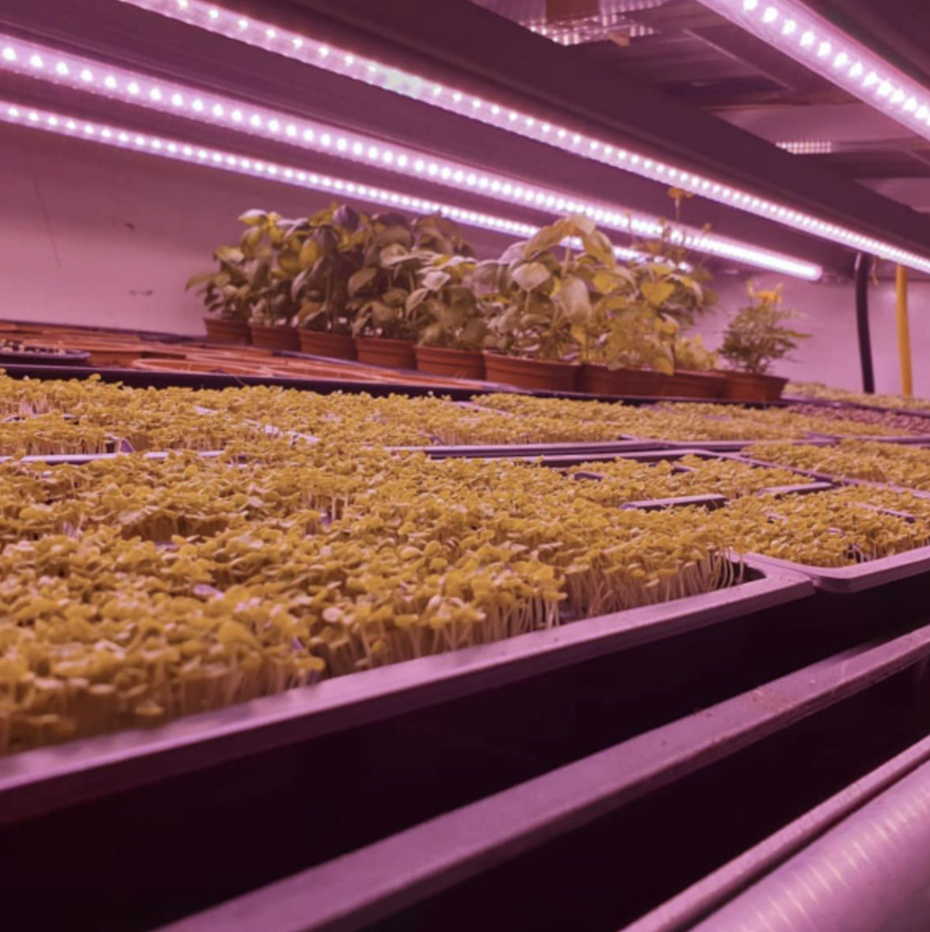
Trays of microgreens underneath the LED grow lights.
The business model
Growing Better operates a ‘Business to Business’ (B2B) sales model, supplying microgreens and small leaf products to local restaurants. In terms of value creation, Growing Better has undergone consistent growth and is perfectly placed to service the independent food and drinks sector in Leeds; however, at times the venture has struggled to meet demand and manage capacity. Currently, customers can choose from an 18 item menu. As sales grow, Dorota is experimenting with a ‘selection box’ innovation, in order to gain some economies of scale through standardisation and enhance value capture. As there is no sales team, Dorota works to gain efficiencies (and a degree of market certainty) through developing strong customer relationships. Dorota does some deliveries and is keen to grow the order and collect system, so that her customers can visit the farm and she can lower her costs. She also organises Open Days, welcoming local residents, supporters and customers (https://www.instagram.com/growing_better/?hl=en) allowing limited B2C sales at these events.
Growing Better receives excellent reviews from restaurant owners and the produce is appreciated for its high quality. Her main competitors are greenhouse growers, who are limited by seasonality, and wholesalers to the restaurant trade. She has plans to increase sales by attending food and drink ‘pop-up’ events – when she has the capacity – but is mindful that moving into new customer segments could overstretch already limited resources. The maintenance and development of the hydroponic system is of strategic importance but currently this is done by an external supplier.
In terms of cost structure, Dorota has negotiated low rental rates at the current site. This helps to minimise financial constraints. Volunteers are not paid directly for their contribution, but Dorota invests considerable time and energy in designing work activities and delivering employability training. Links with local charities have also created opportunities for doing more for less. For example, the local GoodGym group, a volunteer collective that combines outdoor fitness with community support, helped to prepare the outdoor plot and have grown tree saplings on this site to be planted out into the local area. Moreover, operating from a vertical farm allows Dorota to maintain better control over her operational costs, allowing her to achieve a competitive advantage over small-scale indoor and outdoor growers. From an operational perspective, Dorota’s inputs, such as electricity, minerals and water usage are largely fixed, the technology in the farm allows her to monitor and control quality right through from sowing to cropping and delivery. Dorota plans to further make efficiency gains by investing in more technology, specifically automation, to minimise her production costs and ensure the economic viability of the social enterprise.
There are key activities associated with managing the personal and professional development of the volunteers. The volunteers at Growing Better consist of people facing mental health challenges and are typically not in education, employment or undergoing any sort of employability training. Tasks and training are designed to develop each individual’s skillset. Volunteers are involved in office roles such as e-mail correspondence, customer service, running social media accounts as well as helping with deliveries and growing produce. Dorota is very proud that in the previous year, 20 volunteers were able to gain vital skills and some go on to pursue employment opportunities as a result of their experience. She receives great satisfaction in delivering this social value but often finds it difficult to divide her time between meeting the expectations of her volunteers alongside fulfilling the urban farm orders. Dorota has addressed this by designating specific days each week for spending time with her volunteers.
Through effective networking Dorota has cultivated strong relationships with her suppliers (Luke and Chu, 2013) and has in effect extended the organisation architecture of Growing Better (Teece, 2010). She works closely with her hydroponics supplier:
I don’t enjoy doing the technical stuff…he [hydroponics supplier] is going to help us improve on efficiency by bringing in more automation with continuous flow and removing plastic trays which should help free up around four hours a day.
The social enterprise has benefited from donations of equipment and maintenance support, allowing her operations to increase in efficiency and make vital cost-savings. Her good relationship with the technology supplier has been invaluable and together they are considering how they might expand operations. Donations of hydroponic equipment, tools etc. has allowed Dorota to become more productive in her vertical farming operations, alongside enabling her to branch out into new areas of activity within the local community, working in partnership with local schools, colleges and nursing homes. Dorota and her team of volunteers recently created a mini wild-life sanctuary for a local care home in Leeds. Growing Better has strong links with stakeholders to help ensure the viability of her social enterprise, partnering with charities and organisations, such as the Royal Mencap Society and more recently Asda who have provided her with volunteers for employability training. It is evident that Dorota is constantly delivering social impact, she is immensely proud of her 20 volunteers, some of whom have gone on to secure further employment opportunities and she remains focused on tackling the social problems associated with mental health through urban farming initiatives.
Dorota has also been successful in being awarded a number of grants which have allowed her enterprise to grow. Recently she has been awarded funds from UK government backed initiatives, including the Regional Growth Fund, National Lottery Community Fund and the Key Fund, a growing community of grant makers that offer support for growing social enterprises. Grant funding, coupled with the income raised from the sale of produce from the vertical farm, are the main sources of Growing Better’s income.
Income will be coming in from grants and sponsorships, not from sales really, but by the end of the year I would like to double my sales…I want to be all over the place, I don’t want to settle down, there is so much good energy I just want to harness it and use it.
Dorota is also keen to use links with universities and colleges to develop a stronger social media presence. Her openness to new ideas and working with external stakeholders (Fischer et al., 2020) has recently culminated in the opportunity to develop an additional Growing Better facility at another Leeds location, she has a number of polytunnels and events planned at these new sites. However, managing growth of the micro-organisation into a more diverse and physically dispersed enterprise poses a significant challenge (Davies et al., 2019) in terms of costs and management capability.
For a micro-social enterprise, ‘Growing Better’ has different and often competing economic, social and sustainable goals. To meet its social objective of providing training for people living with mental health challenges, the social enterprise must continue to be economically viable. To do this Dorota must produce high quality microgreens for her customers, whilst seeking to minimise overheads. Similarly, she must find time away from the farm to bring in other forms of income through sponsorships, grants and donations, which allow her to engage with the local community and deliver this social impact. The farm is currently operating at maximum capacity, whilst there is potential to increase revenue by acquiring hydroponic equipment and meeting further demand, this would increase labour requirements and could constrain Dorota’s time in sourcing other funding opportunities. Moreover, Dorota does not want ‘Growing Better’ ‘to be the same but just a little bit bigger’ in the future. Dorota must strike a balance between the social and economic goals of the enterprise to ensure she can keep delivering social impact.
Summary
Dorota does not want to deviate from running an environmentally friendly urban farm and improving mental health and wellbeing at the same time. In a relatively short period of time, she has developed the business model and taken a range of growth opportunities in terms of: increased product range and product offering; different interventions to support wellbeing (including indoor and outdoor growing); harnessing stakeholder support, and finding new sites for expansion. However, a clear strategy is needed to ensure the management and development of resources to fulfil growth aspirations. Dorota wants to see more people involved in mindful growing, finding purpose and improving mental health through both indoor and outdoor farming activities. She sees Growing Better as having greater potential for social impact.
Whilst the vertical farm is a core aspect of the social enterprise, Dorota envisions alternative paths to growth.
I see the educational aspect of it bringing more revenue than the microgreens in the long run. If Growing Better was the same and just a little bit bigger in the next few years I will become bored, that’s not what I want to do.
Growing Better projects could happen wherever there is a need. The challenge, at this stage, is to harness and develop resources in order to support growth. Further capital investment is needed to fund the creation of new jobs and pursue planned expansions on two sites as well as increasing productivity and managing operations. With a lack of Standard Operating Procedures (SOP’s), delegating managerial or important tasks to either volunteers or external stakeholders in a consistent and appropriate manner, is problematic.
The challenges
Going forward, the ability to maintain low costs and secure volunteer support depends on the status of the organisation. When Dorota joined the company, Growing Better was already trading; whilst this allowed the venture and a customer base to be established, the company is no longer a start-up and this has caused a change in perspective on the financial strategy and pursuit of grant funding. As an established CIC, she is unable to offer shares in the social enterprise although there are still grant funding opportunities. Now in the role of CEO, Dorota is dedicating more time to pursue funding opportunities to support the expansion of ‘Growing Better’. She may incorporate new ventures that are synergistic and supportive of the wider aims and is now pursuing both funding and external relationships to facilitate this.
At the moment we are putting the bid in for another shipping container, as well as the equipment to utilise at the new site we hope to access.
Dorota’s passion for improving wellbeing – and for the social enterprise to do good – is evident; she is extremely supportive of her volunteers, and mindful of how external stakeholders can help to sustain Growing Better. Plans for growth using different farming methods are driven by her desire to engage with more people in cultivation as the means to improving mental health. She sees the development of Growing Better as a collective agenda.
Dorota is mindful of how generous and supportive stakeholders are integral to the success of the venture. She sees herself as ‘standing on the shoulders of giants, without all the help from everyone I couldn’t do it. I am so thankful to all those that have helped me. It is not just me’. The challenge at this stage is being able to articulate and engage in growth, utilising her existing resource-base (including the reputation of the social enterprise and strong stakeholder support) to acquire new resources. Finally, the entrepreneur might benefit from a more focused role, so that the term ‘Growing Better’ resonates with both the future strategy and structure of the venture. Implementing more formal procedures could aid this, allowing her to delegate responsibilities to others, leaving her to focus on developing growth strategies. In the future she envisions plans for ‘Growing Better’:
The vision in the next 2 years I would like to set up two containers…One for micro greens to meet wholesaler demand which I can’t fulfil at the moment and the other to grow large herbs and lettuces, that sort of thing…But I see it more as an educational extension, not only selling produce but focusing on training and engagement with people. We want to roll out this educational programme and spread the love.
Postscript
The disruptions associated with COVID-19, mainly social distancing, has temporarily halted volunteer work. However, Dorota has remained adaptable to the changing circumstances, continuing to maximise sales through the vertical farm and partnering with local fruit and vegetable businesses to supply farm veg boxes during the pandemic. These new initiatives contribute to an ever increasing stakeholder community, which may prove invaluable for future growth.
Teaching note
The case presents a social entrepreneur who can identify and pursue opportunities for growth; however, the resource base may not be sufficient to enable all aspirations to be implemented. Growth intentions reveal a resource deficit that requires a strategic response. The questions are formulated and sequenced to inform this issue from the perspectives of: the context of the enterprise; the business model; the roles and contributions of the entrepreneur and stakeholders; the structure and operational systems of the enterprise.
Questions and responses
1) How does an urban/vertical farming business model differ from conventional farming? In the case of Growing Better, which aspects of the business model are key to differentiation and which are more challenging for CEA?
Students are encouraged to explore the value of the innovation afforded by CEA. Notably, how the business model is distinct to that of traditional farming and the implications for: the situation of the organisation, customer relationships and competitive capabilities (Chesbrough, 2007). In terms of understanding the business model, we recommend the application of the business model canvas (Osterwalder and Pigneur, 2010). Given that Growing Better is a social enterprise, students may also wish to apply a ‘Triple Layered Business Model Canvas’ (Joyce and Paquin, 2016) that embraces and reconciles economic, social and environmental agendas. This will give a very detailed response and help identify any tensions between value creation and value capture.
An analysis of the business model canvas could explore:
Finally, a discussion around
On reflecting on the relative success of the business model, Teece (2010) provides some useful direction. Is the value proposition compelling? Does the enterprise benefit in terms of lower costs or the mitigation of risks? Importantly, does the enterprise capture value from the sale of products and the provision of services?
2) Explore the relationship between venture and the entrepreneur. Explain the role of the social entrepreneur in this context?
This entrepreneur is utilising technology to disrupt traditional farming practices. Urban farmers are flipping traditional farm business models by engaging local communities, taking a proactive stance to environmental issues and adopting the latest innovations and technology. CEA is redefining the practice and location of farming and what a farmer does. McElwee (2008: 467) defines a farmer as:
those occupied on a part- or full-time basis and engaged in a range of activities that are primarily dependent on the farm and agriculture in the practice of cultivating the soil, growing crops and raising livestock as the main source of income.
Interesting points of discussion are: ‘the practice of cultivating the soil’, being ‘dependent on the farm as the main source of income’ and the nature of fixed assets.
Dorota sees herself as a social entrepreneur, who is strategic in the development of the venture and a change agent (Luke and Chu, 2013) for the wider cause of mental health. The business model is a product of bricolage (Baker and Nelson, 2005) in that this entrepreneur has successfully brought together farming and mental wellbeing through the micro-venture social value proposition.
The social entrepreneur may seek enterprise growth and development, despite recognised resource constraints (Bacq and Janssen, 2011; Gherhes et al., 2016; Orr et al., 2018). Opportunity spotting and market-driven strategy can be motivated by:
– Social impact and the desire to meet beneficiaries’ needs;
– Aligning sustainable growth with growing social worth (Sergio, 2019);
– Acknowledging the risks to beneficiaries of not maintaining or growing the social enterprise.
Discussions concerning the relationship between entrepreneurial identity and venture can also explore values and mindset. Social entrepreneurs may demonstrate hybrid identities in maintaining goals related to social and environmental impact and this has implications for what is prioritised in terms of strategy and stakeholder relationships (York et al., 2016) as well as involvement in enterprise operations. Returning to the business model debate, it could be argued that the CEO has created an ‘externally aware business model’ (Chesbrough, 2007: 14) open to external ideas and technologies, that also compensate for the relative shortfall in resources.
3) Review growth strategies to date and reflect on more recent plans to diversify the business? Address both market-driven and resource-based strategies in making recommendations.
What should the social entrepreneur do? Growing Better is an innovative business model (Chesbrough, 2007) but there is a clear desire to grow for impact. There are strong ambitions to achieve greater social impact related physical and mental wellbeing. Discussions should consider the scalability of social enterprises and Weber et al. (2012) provides some useful terms for discussion:
Scale up – doing more of existing activities, to meet growing demand;
Scale wide – to new beneficiaries, perhaps in new places or working with wider social agendas;
Scale deep – working with existing beneficiaries to ensure lasting and long-term benefits.
In addition, the application of the Ansoff Growth Vector (Ansoff, 1987) enables the categorisation of growth strategies in terms of resource and market implications (and associated risks).
An application of the model can inform different growth strategies:
In order to pursue product and market development as well as diversification opportunities, it is worth noting that direction can come from external partners. The new veg box scheme brings new suppliers, new supply chains and therefore new possibilities in terms of business model innovation. There is the potential to develop B2C sales. Reflections on key relationships may identify that this business model provides an ‘open platform’ (Gassmann et al., 2017), through which partner organisations can drive growth.
On the matter of ‘scale wide’, replicating and modifying the business model in other areas would require Dorota to step away from operational duties to undertake a leadership role and become an animator: i.e. ‘the animation of others to achieve their objectives, and those who exercise animatorship are called animators’ (McElwee et al., 2018: 174).
She could actively encourage entrepreneurial activity of other stakeholders connected to the social enterprise in scaling up, scaling wide and scaling deep.
4) Based on your response to Question 3, how might operations management support the delivery of growth strategies? Use a suitable framework to answer this question. Make suggestions for new roles to address the issues raised.
It is evident that Growing Better is facing several operational challenges that can restrict growth. An application of the operational strategy model developed by Hayes and Wheelwright (1984) reveals the relationship between operations, resources and strategies. The model informs operational objectives and can be applied to understand the capacity for strategy implementation. It comprises of four stages:
It could be argued that Growing Better borders stage 2 and stage 3. The use of technology within the vertical farm allows Growing Better to maintain consistent levels of quality, producing crops with a quick turnaround time and tailored to changing demands. Whilst this level of differentiation provides competitive advantage, it is uncertain how long it will be before other small-scale producers adopt this type of business model. Exploring the potential to integrate with external partners through technology platforms could help to drive a more strategic approach to systems development within the business.
There remain some operational challenges preventing enterprise growth; specifically, relying on donations for CEA may require review. Overall, there is a lack of SOP’s in place that allow delegation of critical tasks to volunteers. Dorota could benefit from outlining some clear and concise rules for volunteers; visual management tools could be used, for example, placing step by step instructions of ‘how to harvest’, allowing her to step back and to empower her volunteers. Importantly, Growing Better competes with green house growers, community farmers markets and wholesalers not just for sales, but for grants too. Dorota’s operations must be at a proficient level to generate cashflow and satisfy the necessary stakeholders to obtain these grants. She must ensure that her operations and strategic visions align.
There is a rise of the number of vertical farmers not just globally but in the UK, with experts predicting that the industry will be worth around 9.84 billion by 2026 (Impey, 2019). The number of start-up organisations in the UK is expected to grow and Growing Better may have the capacity to do more for the benefit of others, if it can invest in the requisite resources for growth.
Footnotes
Acknowledgements
We would like to thank Dorota Hajdukiewicz and everyone else at Growing Better for their welcoming hospitality throughout the entire research process. Thank you.
Declaration of conflicting interests
The author(s) declared no potential conflicts of interest with respect to the research, authorship, and/or publication of this article.
Funding
The author(s) received no financial support for the research, authorship, and/or publication of this article.
