




Abstract
At first glance, the implementation of EU funds should be fluctuating with economic or political demands. However, this quantitative analysis shows that the national implementation is instead characterised by policy continuity. National governments largely adhere to the same budgetary choices as in previous periods when implementing cohesion policy funds, independent of changing political and economic circumstances at the national level. Additionally, countries with a longer implementation experience show more policy continuity. These findings suggest that self-reinforcing dynamics develop not only for domestic funds but also in the EU multi-level governance context. In addition to policy continuity, EU-wide trends were found to matter in the broad national programmatic orientation. When policy continuity prevails, the resulting rigidity can threaten the effectiveness and responsiveness of EU funds.
Introduction
The EU provides large-scale funding schemes through its meanwhile substantial budget, amounting to over 1.2 trillion euros in 2021–2027 (European Commission, 2024c). In principle, EU funds are used to meet socioeconomic needs and promote the respective strategic goals of the incumbent EU Commissions and domestic governments (Bache, 2017: 251–252). In addition to these longer-term goals, EU funds are also deployed to respond to emerging short-term demands, as seen during the Covid-19 pandemic (Tesche, 2022: 487). Consequently, changes in the socioeconomic context and the political agenda should lead to changes in the substance of EU funds. However, research on domestic funds shows that implementation choices are often characterised by policy continuity rather than change (Bali et al., 2022; Chung and Thewissen, 2011; Garritzmann et al., 2023; Mettler and SoRelle, 2023; Pierson, 2001). In short, adopted policies were found to trigger self-reinforcing dynamics so that national governments tend to preserve the status quo of the policy in question. For EU funds, the relevance of policy continuity is unclear as most previous studies have focussed on the effects of the content-related choices for EU funds rather than on their causes (Jovančević et al., 2015; Medve-Bálint, 2018).
A better understanding of the role of policy continuity for EU funds appears pertinent as it can ultimately undermine successful outcomes and weaken political control. Policy continuity promotes rigidity, preventing necessary corrections and adaptations to changing socioeconomic needs (Galvin and Hacker, 2020: 2). These harmful effects of policy continuity give cause for concern when considering the rather mixed findings on the efficiency of EU funds (Jovančević et al., 2015; Medve-Bálint, 2017; Petrova and Sznajder Lee, 2024: 30–31). Moreover, rigidly maintaining the status quo can limit the political influence exercised by citizens and political authorities (Rainone, 2022).
Given the conflicting expectations of a dynamic or continuous substance of EU funds over time and the critical policy implications entailed, this article tackles the research question whether and to what degree policy continuity explains the choices of national governments when implementing EU funds. The article contributes to the implementation literature by demonstrating the applicability of the concept of policy continuity to the context of multi-level governance and EU distributive policies. More specifically, the importance of policy continuity is explored for the domestic budgetary choices regarding cohesion policy funds, one of the largest EU expenditures. A quantitative analysis of the chosen spending categories in the programming periods 2007–2013, 2014–2020, and 2021–2027 shows that policy continuity matters. Previous domestic budgetary choices on cohesion policy funds are strongly linked to future ones, regardless of changing political and economic circumstances at the national level. Policy continuity also appears to increase the longer a member state implements EU cohesion policy funds. Along with policy continuity, EU-wide trends affect the broader budgetary choices. The results highlight the relevance of the concept of policy continuity for the study of EU funds and lay the groundwork for further research, especially on the underlying feedback mechanisms and different effects across EU member states and policy areas.
Change versus stability in the substance of EU funds
The concept of policy continuity belongs to the rich theoretical body of historical institutionalism, which essentially postulates that ‘history matters’ as existing institutions structure policy choices (Knill and Tosun, 2020: 64–65). Policy continuity denotes the stability in institutions and policies, resulting from path-dependent processes (Mettler and SoRelle, 2023; Pierson, 2004). These processes bias the political agenda and the options available to policymakers toward the established policy. Examples are veto points and coordination problems for other policy paths, as well as positive, self-reinforcing feedback loops for the chosen one (Pierson, 2004: 151). Self-reinforcing dynamics appear when individuals and organisations adapt their expectations to the status quo, have learning effects, and invest accordingly (Pierson, 2004: 30–40). Earlier policies also promote corresponding learning and capacity processes within the administration and influence the power of groups and organised interests (Mettler and SoRelle, 2023: 104). These self-reinforcing dynamics increase the resilience of a policy path over time so that later perturbing events have less impact than earlier ones (Pierson, 2004: 45). Certain features, such as the relatively high visibility and the direct advantages for beneficiaries, make distributive policies particularly susceptible to self-reinforcing policy feedback (Skogstad, 2017: 24).
While policy continuity does not explain why specific policies were chosen initially, it helps to explain how these choices evolve within a country over time and the related variation across countries. Moreover, the self-reinforcing dynamics do not deterministically lead to insurmountable lock-in effects but often allow only strongly bounded policy changes (Pierson, 2004: 52). This constrained change argument does not allow a clear threshold to be set for policy continuity versus discontinuity (Kay, 2012: 468). However, the concept of policy continuity with its underlying mechanisms appears to be less valid, the more the current policy deviates from the previous one.
Indeed, fickle policy trajectories are better explained by competing theoretical approaches that attach greater importance to the interests of political actors, socioeconomic circumstances, and transnational pressures. More interest-centred approaches suggest that electoral party politics and political alliances shape social and economic policy choices (Beramendi, 2015; Garritzmann et al., 2023). Conversely, more functionalist approaches focus on the socioeconomic context as the primary cause of policy choices (Glatzer and Rueschemeyer, 2005; Jensen, 2011). Linked to parallel socioeconomic pressures but also to shared ideational paradigms and learning processes, the implementation of (increasingly) similar policies across countries is expected by other scholars (Chung and Thewissen, 2011: 357–358).
The volatile context but inherent inertia of EU funds
Such volatile policy trajectories could also be expected for EU funds, as their implementation takes place in a dynamic context. Both the EU Commission and national policymakers aim to use the allocation of funds for their own policy goals (Bache, 2017). This can entail technocratic problem-solving, such as addressing low regional growth and improving human capital. Another pertinent example has been the prompt decision of the EU Commission to allow the use of EU cohesion policy funds for crisis response and repair measures during the Covid-19 pandemic (Tesche, 2022: 487). Moreover, EU funds serve EU and national institutions in pursuing their respective long-term political objectives. The Green Deal and the Pillar of Social Rights are just two examples of flagship initiatives that the EU Commission intends to promote with EU funds (Miró et al., 2024). Such evolving EU priorities appear to be also more prominent than the approaches introduced to increase regional coherence, such as the smart specialisation strategies since 2010 (Sörvik and Kleibrink, 2015). Since socioeconomic contexts, goals of EU and national policymakers, and political configurations vary over time, the substance of EU funds should also be prone to change. This anticipation contrasts with the theoretical expectations of policy continuity based on previous research on domestic funds (Bali et al., 2022; Chung and Thewissen, 2011; Garritzmann et al., 2023; Mettler and SoRelle, 2023; Pierson, 2001).
In fact, some previous studies support the importance of policy continuity as well for EU distributive policies. Henke et al. investigate how national governments allocate EU funds through the Common Agricultural Policy (CAP) when they are given real discretion in implementation for the first time in the 2014–2020 funding period (2018). They find that past national policies largely shape how EU member states use the new flexibility. Similarly, in the studies examining the national implementation plans of the temporary EU Recovery and Resilience Facility (RRF), one observation is made frequently: despite significant leeway, national governments continue the objectives and framings of previous national policies with the new funding (Rainone, 2022: 48–49; Tassinari, 2022: 452; Theodoropoulou, 2022). These previous studies focus primarily on the impact of earlier national policies. However, given the possibility of triggering their own feedback dynamics, EU distributive policies should be scrutinised for inherent policy continuities. In other words, the earlier domestic implementation of EU funds could drive later domestic spending decisions. This applies in particular to major long-standing EU distributive policies, notably cohesion policy funds, that still need to be reviewed for policy continuity.
Feedback dynamics in the implementation of EU funds
This appears all the more relevant as previous studies have identified dynamics as well around EU funds that resemble well-known policy feedback: the adjustment of political ideas, the creation of interests, and the adaptation of the administration. Firstly, previously adopted EU policies entail a diffusion of policy concepts and related framings moderated by domestic contexts. For instance, the Europe 2020 targets and social investment approaches have been pushed through social EU funds in the last decade (Ferrera, 2017: 1240). Over years of implementation, domestic actors have learned and internalised those ideas in some cases (Gerven et al., 2014: 518–521; Verschraegen et al., 2011: 66–67; Zimmermann, 2016: 13). In other cases, the EU objectives were challenged and adjusted to competing national ideas, depending as well on the degree of policy (mis)fit (Gerven et al., 2014: 516; Henke et al., 2018: 409–410). Secondly, the distribution of EU funds can arouse a certain covetousness among beneficiaries. The EU instrument of income support for farmers serves as an example of how expectations of a group, once fuelled, can complicate later policy modifications (Kay, 2003: 413). Similar strong interests are plausible regarding cohesion policy funds, for which case studies have shown that some organisations have managed to impose their particular thematic priorities and attract large shares of the respective national funding (De Rynck and McAleavey, 2001: 546; Milio, 2014: 393; Potluka et al., 2017: 2217–2218). Thirdly, the implementation of EU funds exhibits specific administrative dynamics. Due to their administrative complexity, EU funds are often implemented by highly specialised civil servants (Büttner et al., 2019: 218). Since these complex processes are difficult for the public and politics to monitor, the responsible administrative units often establish a relatively autonomous policy implementation ‘driven by its own rules and logics’ (Büttner et al., 2019: 210–216). These findings suggest that that the implementation of EU funds triggers relevant policy feedback. The specific national feedback dynamics develop against the background of EU influence and the respective domestic context. Eventually, the feedback dynamics could foster policy continuity in each member state's approach to the implementation of EU funds. Moreover, the identified policy feedback, such as fuelled expectations of beneficiary organisations, suggests that policy continuity could apply not only to broad spending principles but also to the nitty-gritty of national programme-level choices.
Hence, further empirical substantiation is needed to assess whether the content of EU funds is actually more continuous than expected given the dynamic political and economic context. A closer examination of policy continuity in the implementation of EU funds is warranted also, concerning its potential practical consequences. As one important potential drawback, policy continuity can endanger policies’ effectiveness and efficiency. This was evident in cases where policies had become too rigid to be adapted in the light of changing contexts and emerging weaknesses (Bali et al., 2022; Galvin and Hacker, 2020: 2; Valdaliso et al., 2014: 403). If EU funds are not customised anymore to the specific local needs and demand, this threatens their absorption and successful policy outcomes (Cunico et al., 2024: 18; Milio, 2007: 438). In addition, policy continuity can weaken political control through citizens and elected representatives. For instance, the domestic implementation of RRF funds was often found to reflect previous policy trajectories rather than responding to public demands for reform or the latest political priorities by the EU Commission (Pavolini et al., 2023; Rainone, 2022; Theodoropoulou, 2022).
The case of cohesion policy funds 2007–2027
In order to understand the role of policy continuity in the domestic implementation of EU spending, cohesion policy funds lend themselves to investigation. The analysis explores the domestic implementation 2007–2027 of the two budgetary largest cohesion policy funds, namely the European Social Fund (ESF) and the European Regional Development Fund (ERDF). 1 They account for a major share of expenditure within the regular EU budget and are characterised by ‘shared management’ (Bachtler and Mendez, 2020: 233–242). Contrary to the other centrepiece of EU spending, the CAP, cohesion policy funds have always granted member states high autonomy in the implementation (Bachtler and Mendez, 2020: 244; Henke et al., 2018: 404).
Whereas national and regional authorities are responsible for selecting projects and beneficiaries, the allocation of funds across member states is decided in the EU legislation procedure (Bachtler and Mendez, 2020: 243). Since 1999, the cohesion policy funds have been allocated between member states on the basis of the ‘Berlin method’ (European Court of Auditors, 2019: 4). This method primarily considers the regional and national GDP per capita relative to the EU average. The resulting allocations are then adjusted according to other criteria, including unemployment, upper caps, and safety nets (European Court of Auditors, 2019: 7–8). Contrary to other cohesion policy funds, all member states are eligible and receive both ESF and ERDF funds in every programming period. Nevertheless, the total national allocations vary depending on the national wealth relative to the EU average and EU budget developments. In addition, the ratio between ESF and ERDF funding is redetermined in each programming period.
In terms of content, the broader policy objectives are negotiated in the EU legislation procedure, but national authorities have successfully retained significant control over the design of the specific programmes (Bache, 2017: 258). At the beginning of each programming period, member states devise national planning documents in which they select policy objectives and corresponding priorities (Regulation (EC), 2006: Article 32,37; Regulation (EU), 2013: Articles 26–29; Regulation (EU), 2021b: Articles 21, 22). Each fund is associated with several broad policy objectives set in the respective EU regulation, but member states can still select all other objectives as well (e.g. Regulation (EU), 2021a: Article 4). Before the European Commission adopts the programmes, it sends observations to the member states, which can then review their programmes.
In the national planning documents, national authorities also select and weigh spending categories (Medve-Bálint, 2018: 223). They distribute their respective cohesion policy budgets among thematic categories, such as ‘health infrastructure’ or ‘support for primary to secondary education’ (European Commission, 2020, 2024a, 2024b). The choice of thematic categories is highly customisable. For instance, in 2021–2027, the common provision defines that the thematic categories ‘are grouped by policy objectives, but their use is not limited to them. Any [thematic category] can be used under any policy objective’ (Regulation (EU), 2021b: Annex I). Moreover, the ‘earmarking’ of expenditure on thematic concentrations, that has been introduced in 2007, only concerns a small fraction of the budget and still allows for a choice between several categories (Medve-Bálint, 2018: 223). Additionally, Bachtler and Ferry conclude that ‘the potential influence of earmarking was also weakened during the negotiations, principally to give member states more flexibility in what spending would count as earmarked expenditure’ (2015: 1270). Overall, the broad legal basis combined with leverage during the negotiation process allows member states to largely assert their own spending priorities (Blom-Hansen, 2005: 632).
Given the wide margin of discretion in the choice of spending categories, the member states can pursue diverse spending strategies, such as prioritizing infrastructure over social spending or vice versa (Medve-Bálint, 2018: 223). These budgetary choices are also indicative of the potential economic and political impact of the cohesion policy funds in a country. Nevertheless, such budgetary choices can only approximate the actual substance implemented. Although the thematic categories are fairly fine-grained, very minor changes in the substance might not be fully visible in budgetary allocations. The thematic categories also allow a certain leeway for domestic governments when more than one category matches the planned funding activities. However, this applies less to the more distinctly different broader policy areas in which the thematic categories can be grouped. Moreover, the regulatory focus on innovation encourages governments to overemphasize change in their choice of spending categories. In this vein, the spending categories chosen in the national Recovery and Resilience plans were found to create an inflated impression of climate-related investments (European Court of Auditors, 2024: 22). Policy continuity would then be underestimated rather than overestimated.
Hypothesising policy continuity in cohesion policy funds
Given their long-standing domestic implementation, a distinctive policy continuity for cohesion policy funds in each country can be expected. More specifically, policy continuity implies that the budgetary choices for cohesion policy funds remain stable over time for each country, and thus, also the variation across countries. This should apply despite changing economic and fiscal circumstances. In fact, the observation period spans the time before and during the 2008 financial crisis and the 2020 Covid-19 pandemic, as well as varying party and staff compositions of the responsible national and regional governments. Therefore, an investigation of cohesion policy funds over the last three programming periods, 2007–2013, 2014–2020 and 2021–2027, provides the opportunity to assess the relevance of policy continuity against the background of varying contexts. H1: The domestic budgetary choices regarding cohesion policy funds resemble previous ones, independent of changing political and economic circumstances in the member states.
Moreover, the EU context has changed. Along with the wider objectives and strategies of the successive EU Commissions, the agenda for cohesion policy funding has evolved from focusing on growth and jobs in 2007–2013, to competitiveness in 2014–2020, and a link to the European Semester and wider political goals, such as the rule of law, in 2021–2027 (Bache, 2017: 250; Bachtler and Mendez, 2020: 235–249). Simultaneously, member states can draw on an increasing number of other EU spending programmes (Laffan and Lindner, 2020: 223–224). Moreover, the EU framework could gain acceptance across member states or could be imposed more effectively, for instance, with thematic specifications. Despite such EU influences and cross-country convergence pressures, member states should maintain their specific implementation approaches to the legally permitted extent if policy continuity prevails. H2: The domestic budgetary choices regarding cohesion policy funds resemble previous ones, independent of a changing EU context.
While the argument of policy continuity contradicts high volatility in implementation decisions, it still implies certain dynamics over time. Specifically, the underlying self-reinforcing feedback dynamics are expected to cause a higher resilience of a policy path over time (Pierson, 2004: 151). The longer the stakeholders adapt and invest in the status quo, the higher the costs for choosing different implementation paths. As some of the European cohesion policy funds have been implemented for over fifty years, self-reinforcing processes should have had time to unfold, increasing policy continuity. However, these dynamics over time could also lead to differences across member states, as they have implemented cohesion policy funds for varying lengths of time, depending on when they joined the EU. H3: The longer a member state has implemented cohesion policy funds, the more closely the domestic budgetary choices resemble previous ones.
An analysis of the last three programming periods of cohesion policy funds covers an appropriate time-span and sufficient contextual variance to test the developed hypotheses. The findings based on the case of cohesion policy funds 2007–2027 can also be of interest to other EU spending. More generally speaking, this study aims to advance the understanding of the role of policy continuity for domestic choices in the implementation of EU funds.
Research design
Policy continuity is found if domestic governments make the same spending choices in later programming periods as in the previous one, despite varying contextual factors. The expected policy continuity concerns the budgetary shares allocated to spending categories. In contrast to the total national budgets set in EU regulations, domestic governments control and can largely maintain the proportions between spending priorities over programming periods. 2 The postulated hypotheses are tested quantitatively with regression models.
Data and variables
The budgetary shares of spending categories, called thematic categories, serve as the dependent variable for all models. 3 For the test of all three hypotheses, the main explanatory variable is the previous share of the respective spending category, i.e., its share in the national cohesion policy budget of the previous programming period. Corresponding data on the national budgetary allocations is provided by the European Commission (2020, 2024a, 2024b). Moreover, the detailed 69 thematic categories can be clustered into 13 broader policy areas, namely business development, education/ labour market, energy, environment, health, ICT, inclusion/ equality, institutional capacity, other, research and development, territorial development, tourism/ culture, and transport. 4 The shares of the more detailed thematic categories and the shares of the broader policy areas are analysed in different models. In order to ensure the comparability of the domestic spending choices, only national cohesion policy budgets are included in the analysis. Consequently, Belgium is excluded as it exclusively features regional cohesion policy budgets in 2014–2020 and 2021–2027. A separate analysis of regional programmes is not conducted as the sample size appears too limited for statistical analyses, and political control variables are difficult to measure at the corresponding programming levels. A focus on national programmes appears also adequate, considering that national programmes cover the majority of the cohesion policy budget for the period since 2007 (see Online appendix). In addition, an analysis at more fine-grained levels, such as NUTS-2, is not feasible because the data on thematic categories are only available at the programme level, which is predominantly national.
To test the first hypothesis, the effects of GDP per capita and the left-right position of the prime minister party are controlled. As the impact of these variables might vary across subjects, interaction terms with policy areas are included. The GDP data originate from Eurostat (2024a). The information on left-right positions on a 0 to 1 scale is based on party expert surveys summarised in the ParlGov dataset (Döring et al., 2022). GDP and government data are measured in 2006, 2013, and 2020, one year before the start of the respective programming period. The economic and political variables should matter if changing circumstances cause changes in the budgetary shares.
The second hypothesis refers to the EU context, which is determined by the demands of the EU Commission and the priorities agreed with the Council and the European Parliament. As the resulting joint EU position for each spending category is difficult to quantify, an indirect operationalisation is used. If a specific EU approach is asserted, it should be reflected in analogous changes across member states, measured with a leave-one-out-mean. This mean share represents the average budgetary share of the respective thematic category/policy area across all countries except the relevant country. 5 If the joint EU approach changes, a country's choice should also reflect the altered average thematic priorities.
In order to examine the third hypothesis on the increasing importance of policy continuity over time, two categorical variables are included. The first covers the three programming periods and the second depicts the years of EU accession and, thus, differing experiences with the implementation of EU cohesion policy funds between member states.
Estimation strategy
Linear models with fixed effects for both countries and policy areas/ thematic categories are fitted with ordinary least squares (OLS). These models account for the nested nature of the data and control for time-invariant factors specific to each country and spending category. Equation 1 summarises the full empirical model:

Information on model tests is provided in the Online appendix. As a robustness check, generalised linear models (GLM) with a quasibinomial distribution and a logit link function are fitted. Such models are more specifically adapted to proportion data. Moreover, robustness checks test and corroborate the expectation that changes in the total ESF and ERDF national envelopes have no impact on the budgetary shares.
Results
When comparing the budgetary shares devoted to policy areas across programming periods (Figure 1), a positive correlation is visible for most areas. For instance, the respective national shares allocated to Education/ Labour market and R&D appear fairly stable over time. Nevertheless, there are also a few areas that show considerable changes, particularly in the budgetary shares devoted to ICT. Budgetary shares for other policy areas, such as for Transport in 2007–2013 and for Inclusion/Equality in 2014–2027, display an overall positive correlation, but there are a few countries that clearly deviate from their previous choice. In addition to the correlations, the figure indicates that the weight of policy areas varies tremendously. Indeed, the already mentioned two areas, together with Inclusion/ Equality cover, on average, over half of the national budgets in all three investigated programming periods. As with the shares for most policy areas, it appears that the budgetary share allocated to each fund remains relatively stable over the three observed programming periods, with the share allocated to the ESF being lower on average than that to the ERDF (see Online appendix).
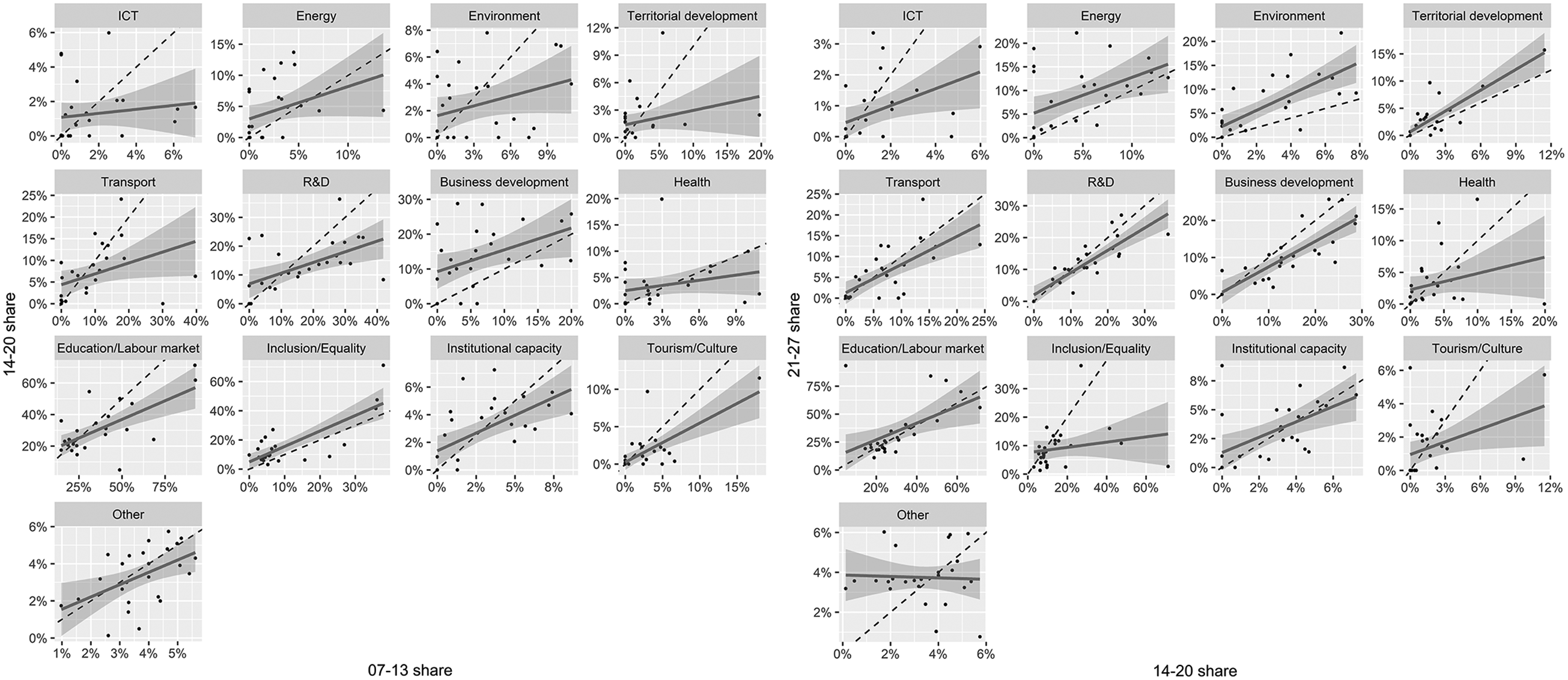
Budgetary share of policy areas.
The regression models (reported in Tables 1 and 2) confirm this initial impression. The previous share is significantly associated with the following share, both regarding policy areas (Table 1, M1–M3) and thematic categories (Table 2, M4–M6). The effect of the previous share remains significant, and its size is fairly stable, also when GDP and government changes are considered (M2, M4). Consequently, the first hypothesis can be kept: domestic budgetary choices regarding cohesion policy funds resemble previous ones, independent of changing political and economic circumstances in the member states. In fact, neither the left-right position nor the GDP per capita (for any of the interactions with policy areas except one) shows significant coefficients. Moreover, the explained variation of the budgetary shares in a country over time increases only marginally when economic and political factors are included in addition to the previous share. Hence, more functionalist explanations (Glatzer and Rueschemeyer, 2005; Jensen, 2011) or interest-centred approaches (Beramendi, 2015; Garritzmann et al., 2023) are not supported.
Regression models of budgetary shares of policy areas.
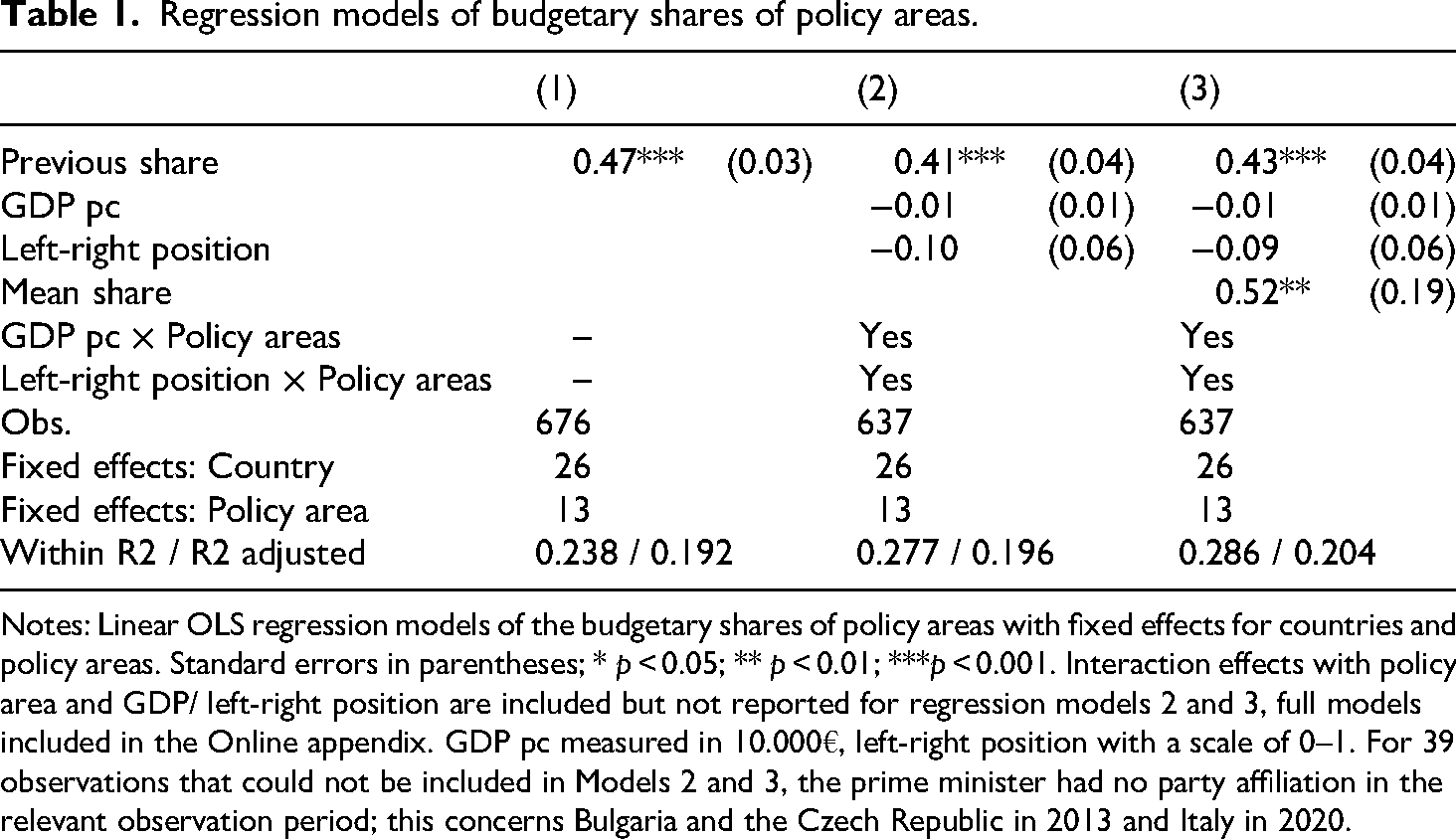
Notes: Linear OLS regression models of the budgetary shares of policy areas with fixed effects for countries and policy areas. Standard errors in parentheses; * p < 0.05; ** p < 0.01; ***p < 0.001. Interaction effects with policy area and GDP/ left-right position are included but not reported for regression models 2 and 3, full models included in the Online appendix. GDP pc measured in 10.000€, left-right position with a scale of 0–1. For 39 observations that could not be included in Models 2 and 3, the prime minister had no party affiliation in the relevant observation period; this concerns Bulgaria and the Czech Republic in 2013 and Italy in 2020.
Regression models of budgetary shares of thematic categories.
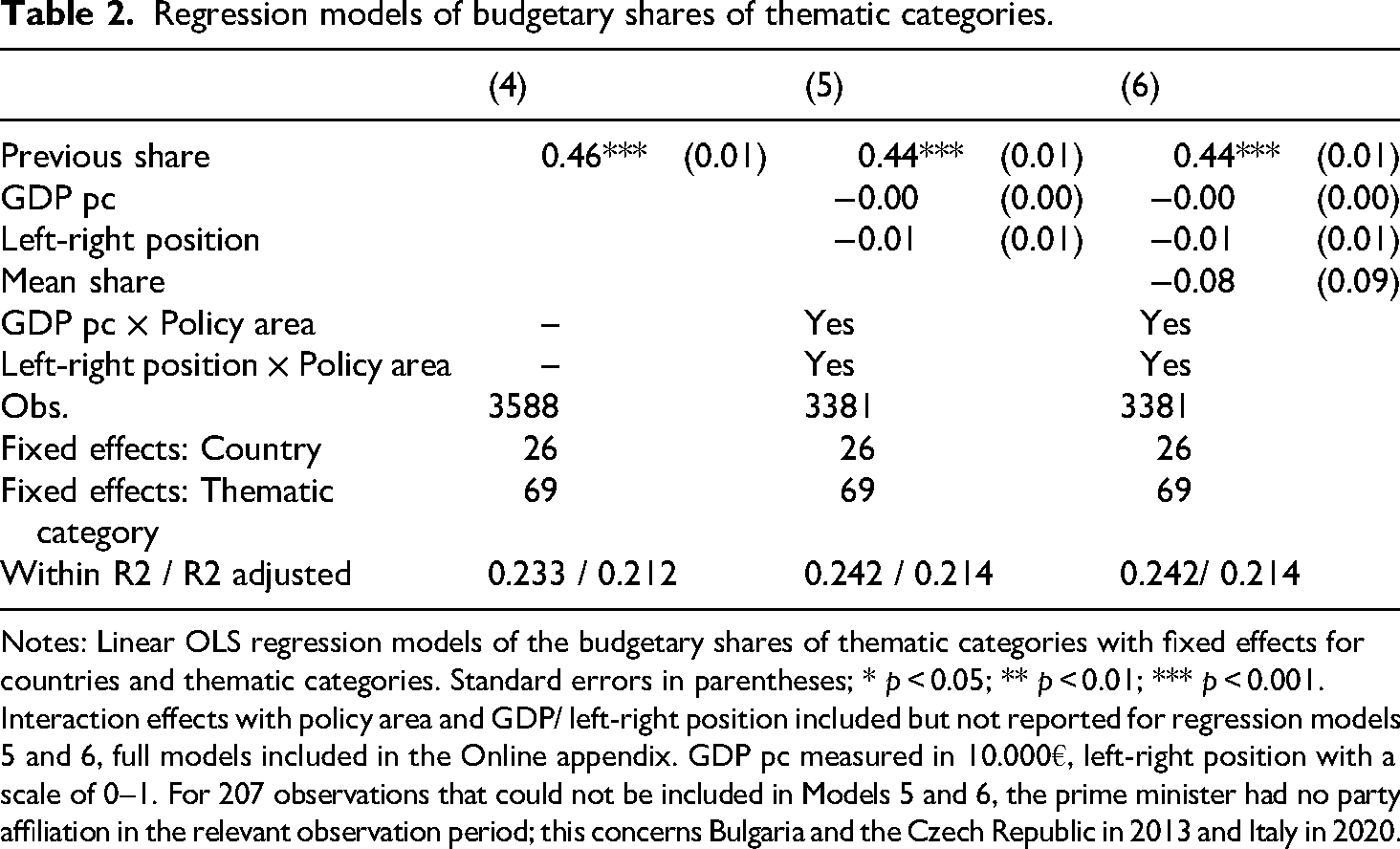
Notes: Linear OLS regression models of the budgetary shares of thematic categories with fixed effects for countries and thematic categories. Standard errors in parentheses; * p < 0.05; ** p < 0.01; *** p < 0.001. Interaction effects with policy area and GDP/ left-right position included but not reported for regression models 5 and 6, full models included in the Online appendix. GDP pc measured in 10.000€, left-right position with a scale of 0–1. For 207 observations that could not be included in Models 5 and 6, the prime minister had no party affiliation in the relevant observation period; this concerns Bulgaria and the Czech Republic in 2013 and Italy in 2020.
The effect of policy continuity can be considered quite substantial. For instance, a twelve percentage points (or one standard deviation) increase in the previous budgetary share of a policy area in a country is associated with an almost six percentage points increase in its share in the following programming period (M1), all else equal. The effect of policy continuity is similarly strong regarding the choice of the more detailed thematic categories (M4). The results are in line with many studies on domestic funds (Bali et al., 2022; Chung and Thewissen, 2011; Garritzmann et al., 2023; Mettler and SoRelle, 2023; Pierson, 2001). However, the unexplained variation and the effect size of the previous share, which is significantly different from zero but also from one, suggest that a certain degree of change does still occur.
In fact, turning to the question of a changing EU context, the regression models show that EU-wide shifts matter for budgetary choices (M3). Member states adapt their spending choices if the prevailing priorities in other member states change. This applies only to policy areas (M3) but not to the nitty-gritty budgetary choices of thematic categories (M6). In contrast, the effect of the previous share remains significant in all specifications (M3, M6). Its coefficient is also rather stable across all specified regressions of thematic categories (M4-M6). Consequently, the second hypothesis can be partially kept, as the detailed domestic budgetary choices are driven exclusively by policy continuity. However, while the broader orientation of spending choices is also influenced by policy continuity, it is also affected by a changing EU context. An increase of eight percentage points (or one standard deviation) of the EU-wide mean share of a policy area would correlate with a four percentage points higher share of that category in the respective country, all else equal (M3). This effect compares with an additional five percentage points when the previous share increases by one standard deviation, all else equal (M3).
Robustness checks corroborate the results
Robustness checks with generalised linear models and models excluding outliers confirm the significant effect of the previous share across different model specifications (see Online appendix for the detailed results of these and the following checks). In the same vein, the significance and size of the coefficient for the previous share do not change if the unemployment rate (Eurostat, 2024c) is included as an additional control variable. While the unemployment rate fluctuates more than the GDP per capita over time and across countries, it does not substantially influence budgetary choices either. Similar results are also produced when a different operationalisation of the left-right variable is used, measuring the average left-right position of the government parties. These robustness checks also confirm a significant coefficient of the mean share in regressions of the policy area shares. Based on Capello and Perucca, additional variables can be considered to assess the changing socioeconomic demand for cohesion policy funds (2018: 1456). Besides unemployment and GDP per capita, population density (World Bank, 2025) and the share of the population with tertiary education (Eurostat, 2024b) are included to measure demand for several policy areas. These more extensive specifications again confirm the relevance of policy continuity, while the control variables show no significance. This also applies when the control variables are used without interaction effects with the policy areas. Moreover, models that include the changes in GDP per capita and the left-right position compared to the previous period corroborate the results further.
Additionally, a joint analysis of both regional and national programmes serves as a further robustness check. The regression models of the total country budgets confirm the significance of the previous share and the insignificance of the socioeconomic and political control variables. Besides its focus on national programmes, the analysis concentrates on budgetary shares as they are, in principle, largely independent of shifts in the total national envelopes. To test this assumption, additional models with interaction terms of budget changes and policy areas have been estimated. Insignificant interaction terms suggest that changes in the total national ESF or ERDF budgets do not systematically alter the relative proportions of spending categories. Moreover, the effect sizes and significance of the previous budgetary share and control variables remain robust. National governments maintain the budgetary shares even if their total cohesion policy budget declines or grows.
Differences across countries
While policy continuity characterises, on average, the budgetary choices, a more nuanced approach reveals some differences across countries and spending categories. Introducing random slopes for the previous share across countries provides a more detailed understanding of the effect (Figure 2). More specifically, Figure 2 expands the regression of the budgetary shares of policy areas (Table 1, M1) and thematic categories (Table 2, M4) with random slopes. On the one hand, policy continuity of the budgetary shares is more pronounced in Germany, France, and many other countries, both regarding policy areas and thematic categories. On the other hand, budgetary choices in some countries appear to be comparatively less determined by policy continuity. This concerns several countries, such as Cyprus and Croatia.
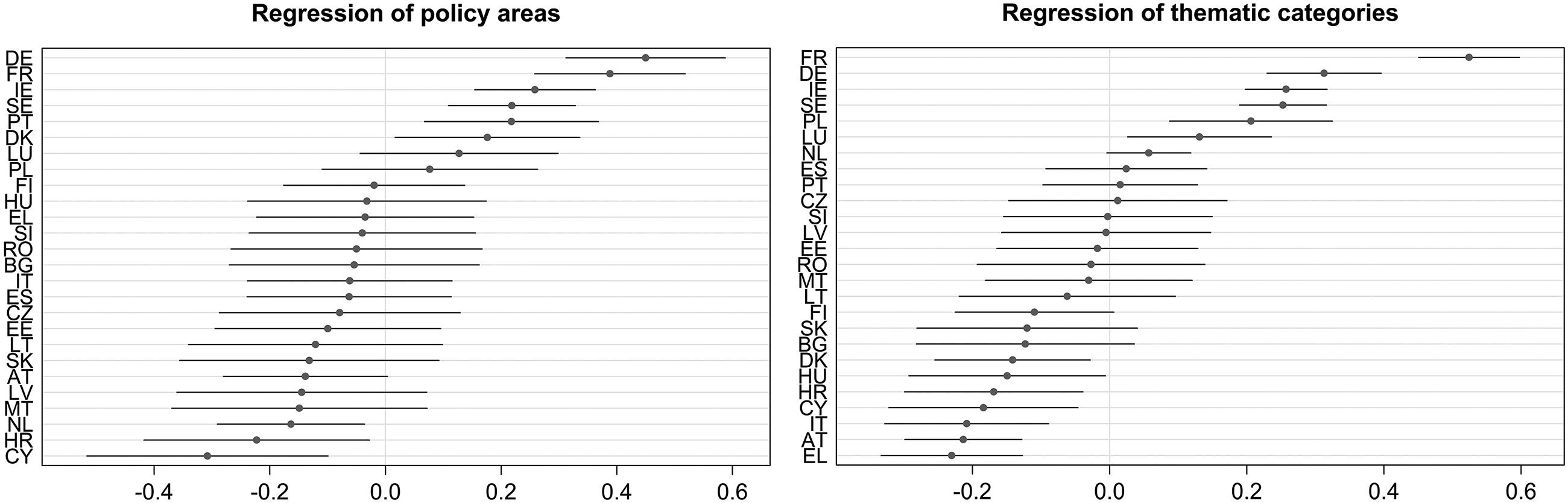
Random slopes across countries for the previous share.
Heterogeneity in the policy continuity across countries could originate from differences in the underlying feedback dynamics, such as disparate administrative implementation styles. Besides, these self-reinforcing dynamics are expected to foster policy continuity over time (Pierson, 2004: 151). Therefore, some of the differences between countries could be attributed to shorter or longer implementation experiences. Although this analysis cannot directly evaluate the individual underlying feedback mechanism, the regression models in Table 3 can give an initial impression of changes over time. In fact, member states that have a longer record in implementing EU funds show more policy continuity (M8, M10). The effect is quite substantial in size regarding the budgetary shares allocated to both policy areas and thematic categories. For instance, the most recent EU member states, namely Bulgaria, Romania, and Croatia, show less than a fifth of the policy continuity of EU15 countries regarding the budgetary shares of policy areas (M8). Even for those countries that joined the EU in 2004, the strength of policy continuity reaches only about 40% of the effect shown for the EU countries with longer implementation experience. This result supports the theoretical expectation (H3) that policy continuity will increase over time.
Regression models of budgetary shares of policy areas (M7, M8) / thematic categories (M9, M10)—with interactions.
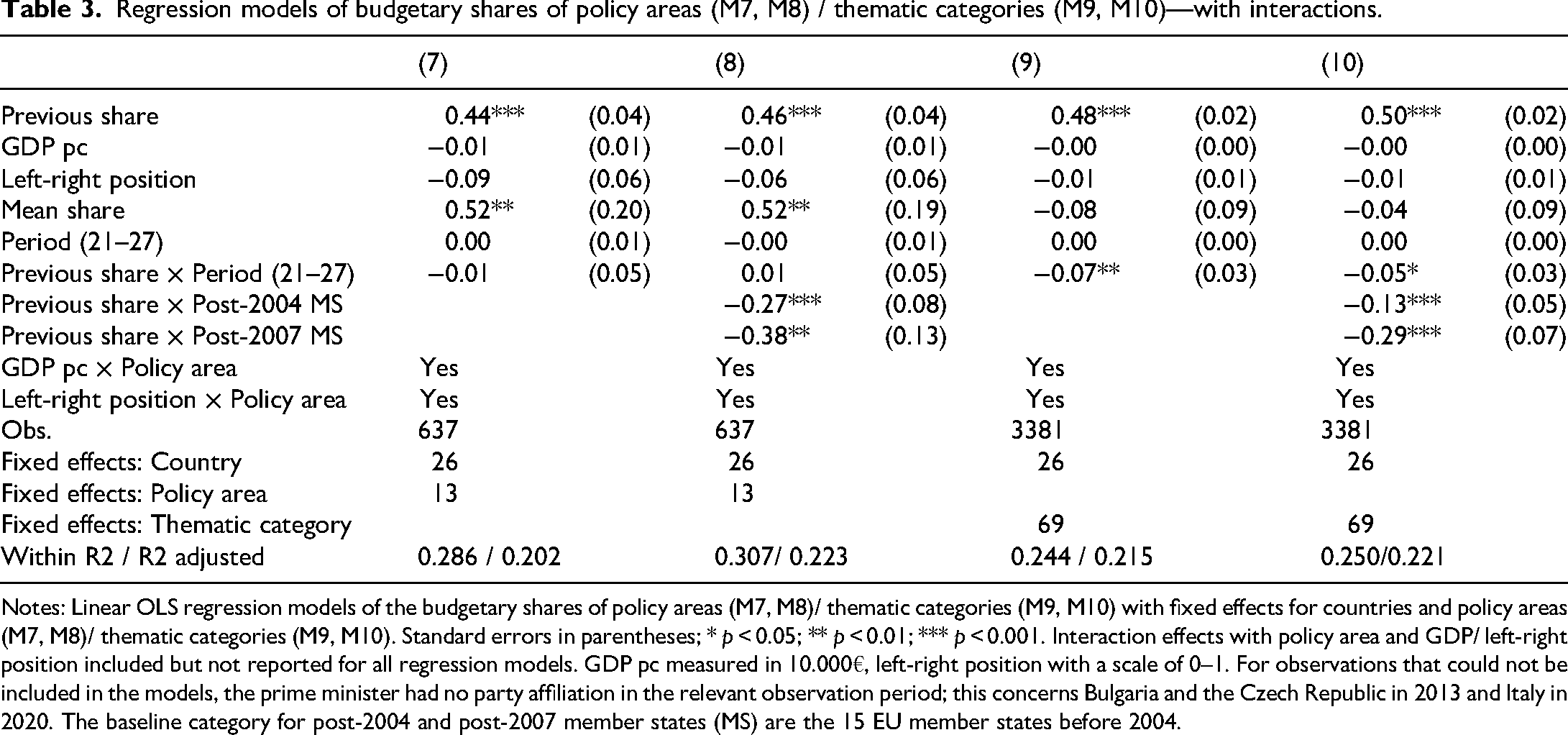
Notes: Linear OLS regression models of the budgetary shares of policy areas (M7, M8)/ thematic categories (M9, M10) with fixed effects for countries and policy areas (M7, M8)/ thematic categories (M9, M10). Standard errors in parentheses; * p < 0.05; ** p < 0.01; *** p < 0.001. Interaction effects with policy area and GDP/ left-right position included but not reported for all regression models. GDP pc measured in 10.000€, left-right position with a scale of 0–1. For observations that could not be included in the models, the prime minister had no party affiliation in the relevant observation period; this concerns Bulgaria and the Czech Republic in 2013 and Italy in 2020. The baseline category for post-2004 and post-2007 member states (MS) are the 15 EU member states before 2004.
Different from expectations based on self-reinforcing dynamics, the overall effect of policy continuity decreases from the programming periods 2014–2020 to 2021–2027 regarding thematic categories (M9). One potential explanation for a lower policy continuity from 2021 could be the adoption of generous other EU funds in the wake of the Covid-19 pandemic (Tesche, 2022: 490). For instance, if earlier beneficiaries are not covered within ESF and ERDF programming lines, they might still receive funding through new EU distributive policies, such as the Recovery and Resilience Fund. Hence, the identified policy continuity might be weaker as only a subset of all EU funding sources is studied. Nevertheless, the identified weakening period effect is relatively small in size and is only statistically significant for the budgetary shares allocated to thematic categories (M9) but not to policy areas (M7).
Differences across policy areas
The level of policy continuity also differs across topics, as suggested by models with random slopes for the previous share across policy areas (see Online appendix). When calculating policy continuity for policy areas, there are no significant differences in the random slopes (with the 95% confidence intervals including zero). This lack of significant variation suggests that the average level of policy continuity identified in the fixed effects models (Tables 1 and 2) is similar across all policy areas. Whereas also for many thematic categories there are no significant differences regarding policy continuity, the budgetary shares allocated to thematic categories under Business development are characterised by less continuity. On the contrary, the shares allocated to the thematic categories under the areas of Inclusion/ Equality and Education/ Labour market are strongly driven by policy continuity. Hence, spending categories that could primarily be described as social seem more susceptible to policy continuity.
One potential reason for the different effects of policy continuity across policy areas could be varying underlying feedback dynamics. Since these cannot be tested with this analysis, any interpretations must remain provisional. It is conceivable, for example, that beneficiaries in social policy areas might develop stronger expectations for sustained funding. This also concerns the intermediary organisations that might rely more extensively and regularly on EU funding than in other sectors. Alternative EU funds could be also less available in the social sector. Notably, the Cohesion Fund, as an important funding source in many countries, does not cover the areas of Inclusion/ Equality and Education/ Labour market.
The different importance of policy continuity across policy areas also accounts for some of the variance noted across countries. This point can be illustrated by the four countries that show the highest policy continuity, namely France, Germany, Ireland, and Sweden. All four countries belong to EU15 and, thus, have implemented EU funds for decades. However, all four countries also spend far above-average shares of their national budgets on social thematic categories. Their long-standing implementation record and substantive focus seem to render these countries particularly prone to policy continuity.
Conclusion
The analysis of cohesion policy funds in 2007–2027 has shown that the national implementation choices are considerably characterised by policy continuity and do not fluctuate with political and economic changes. Policy continuity substantially shapes both broad and detailed budgetary choices of national governments. Being one of the first analyses to examine policy continuity for the implementation of EU funds, the results demonstrate that the concept is also pertinent for EU distributive policies and multi-level governance systems. Not only in the implementation of domestic funds, but also for EU funds, there develops an inherent policy continuity. This finding is also relevant for other EU distributive policies with a certain discretion in implementation.
The analysis has also yielded more differentiated insights that set the stage for further research. The results show that the implementation of cohesion policy funds is not completely unalterable. The broad spending lines are not only subject to policy continuity but are also influenced by EU-wide shifts. Moreover, the extent of continuity vis-à-vis change varies across countries and policy areas. A certain level of bounded change is still consistent with the concept of policy continuity. However, one important task that remains for future research is to define a specific, measurable threshold distinguishing policy continuity from change. Furthermore, causal analyses are necessary to understand which underlying processes reinforce policy continuity or rather allow (bounded) policy change in the implementation of EU funds. This holds particularly when considering the potentially varying feedback dynamics across countries and policy areas. Moreover, while this study has analysed the prevalent national programmes, future studies could also examine whether policy continuity characterises regional implementation equally. Besides, implementation decisions other than budgetary choices remain to be scrutinised for continuity, such as how specific target groups and places are selected. This applies even more when considering that the detailed spending categories only approximate the actual substance as they allow a certain degree of discretion in categorisation and may not fully reflect very fine-grained changes.
The findings have implications for the governance of EU funds. Long-term, broad EU objectives can make a difference as the domestic implementation of EU funds gradually adapts to EU-wide shifts. However, the more detailed substantive decisions appear to lie outside of EU oversight, highlighting the discretion that member states enjoy in the implementation stage. In turn, this also questions the previous efforts of the EU Commission to strengthen its control (Bachtler and Mendez, 2020: 244). At the same time, the lack of convergence in the detailed choices does not necessarily run counter to EU interests, especially if regions pursue smart specialisation strategies (Karo et al., 2017). Moreover, policy continuity in the national implementation could foster policy learning among stakeholders and protect beneficiaries from undue cutbacks (Pierson, 2001: 416; Valdaliso et al., 2014: 403). However, the corresponding rigidity also prevents national governments from using this discretion to adapt EU funds to new domestic circumstances. Consequently, these findings suggest that the steering capability of both EU and national authorities is limited, particularly regarding more detailed substantive choices. While discussing specific reforms to ensure the targeted use of EU funds is beyond the scope of this article, it remains a pressing task at a time when government spending is once again the subject of much debate.
Supplemental Material
sj-docx-1-eup-10.1177_14651165251365553 - Supplemental material for Continuity amid change: Explaining budgetary choices in the national implementation of EU cohesion policy funds
Supplemental material, sj-docx-1-eup-10.1177_14651165251365553 for Continuity amid change: Explaining budgetary choices in the national implementation of EU cohesion policy funds by Romy Hansum in European Union Politics
Supplemental Material
sj-zip-2-eup-10.1177_14651165251365553 - Supplemental material for Continuity amid change: Explaining budgetary choices in the national implementation of EU cohesion policy funds
Supplemental material, sj-zip-2-eup-10.1177_14651165251365553 for Continuity amid change: Explaining budgetary choices in the national implementation of EU cohesion policy funds by Romy Hansum in European Union Politics
Supplemental Material
sj-zip-3-eup-10.1177_14651165251365553 - Supplemental material for Continuity amid change: Explaining budgetary choices in the national implementation of EU cohesion policy funds
Supplemental material, sj-zip-3-eup-10.1177_14651165251365553 for Continuity amid change: Explaining budgetary choices in the national implementation of EU cohesion policy funds by Romy Hansum in European Union Politics
Footnotes
Notes
Acknowledgements
I would like to thank Markus Jachtenfuchs, Miriam Hartlapp and Amandine Crespy for their helpful comments and feedback.

Author contributions
The author solely conducted all research and writing for this article.
Funding
The author received no financial support for the research, authorship, and/or publication of this article.
Declaration of conflicting interests
The author declared no potential conflicts of interest with respect to the research, authorship, and/or publication of this article.
Data availability statement
All data generated or analysed during this study are included in this published article and its Online appendix.
Supplemental material
Supplemental material for this article is available online.
References
Supplementary Material
Please find the following supplemental material available below.
For Open Access articles published under a Creative Commons License, all supplemental material carries the same license as the article it is associated with.
For non-Open Access articles published, all supplemental material carries a non-exclusive license, and permission requests for re-use of supplemental material or any part of supplemental material shall be sent directly to the copyright owner as specified in the copyright notice associated with the article.
