



Abstract
This article inquires into the role of supranational redistributive policies in shaping citizens’ support for European integration. The research proposes a multidimensional concept of supranational redistribution, encompassing policies that directly target European citizens, such as unemployment and non-contributory benefit schemes at the EU level, as well as policies that target member states such as the Next Generation EU programme. Building upon the literature on policy feedback effects and historical institutionalism, the analysis proposes a theoretical model that encompasses both the direct and mediated effects of supranational redistribution. This analysis is supported by a survey experiment conducted in Spain and Italy, the largest recipients of Next Generation EU funds, yet characterised by distinct levels of public opinion and party Euroscepticism. The results show that a European unemployment benefit has the strongest potential to increase support for integration in individuals who are most likely to turn against the EU: citizens with low socio-economic resources and exclusive political identities.
Introduction
Citizen disenchantment and the risk of European disintegration have become recurring themes in recent EU research. Radical right parties have gained prominence in the political landscape of many member states, contributing to the growing opposition towards European integration among EU citizens. While the reasons behind the success of Euroscepticism and populist parties are complex and multifaceted, socio-economic inequalities and cultural anxieties resulting from the free movement of persons, goods, and services are significant factors that have contributed to EU citizens’ lack of support for integration (Boomgaarden et al., 2011; Hobolt and De Vries, 2016a; Hooghe and Marks, 2007; Kuhn et al., 2016). Recent normative approaches have argued that the EU can reverse these trends and increase citizen support by redefining its citizenship and solidarity principles (Ferrera, 2018; Ross, 2020; Vandenbroucke et al., 2017). This solution is predicated on the adoption of an agenda of justice and solidarity that aims to reduce social inequalities and improve opportunities for the least well-off Europeans rather than relying solely on market forces for the distribution of costs and benefits.
In the present European acquis, redistributive principles have been mainly applied to solidarity between EU regions, through the European Structural and Investment Funds, and to member state solidarity, through an increasing array of financial instruments aimed at mitigating economic shocks and promoting economic growth in crisis-hit countries. Studies find that the effect of these redistributive policies on citizen support for the EU can be both positive and negative and is conditional on policy design, area of application and individual predispositions towards European integration (Armingeon and Ceka, 2014; Borin et al., 2018; Dellmuth and Chalmers, 2018; Hobolt and De Vries, 2016b; Rodríguez-Pose and Dijkstra, 2020). However, with the exception of the already terminated SURE programme, 1 there has been no EU initiative specifically targeting EU citizens, aimed at reducing economic inequalities and social risks to the extent of welfare policies in EU member states, despite the increasing concern for a more ‘social’ Europe (Ferrera, 2018; Vandenbroucke et al., 2017).
This study presents original and substantive contributions to the literature by proposing a multidimensional concept of supranational redistribution, which targets both member states and European citizens as core beneficiaries. Drawing on historical institutionalism and policy feedback effects literature, the article subsequently tests a theoretical model that examines how different categories of EU redistributive policies – namely a European Unemployment Benefit, a European Social Benefit, and Next Generation EU (NGEU) – influence support for European integration. Additionally, the analysis inquires whether these policies engender extrapolatory or compensatory effects. In the former scenario, supranational redistributive interventions reinforce support for European integration among citizens who already support the EU – those with high socio-economic resources, a strong European identity, and centrist ideology (Boomgaarden et al., 2011; Gabel, 1998; Hobolt and De Vries, 2016b). In the latter case, the compensation logic suggests that supranational redistribution can offset negative predispositions and enhance EU support among individuals with low socio-economic resources, extreme ideologies, and exclusive nationalist identities. The methodological strategy behind this study is founded on a survey experiment conducted in Spain and Italy: two important recipients of the most generous package of redistribution between member states so far – the Next Generation EU funds – that are significantly different in terms of political party and public opinion support for the EU.
This article contributes significantly to the literature by demonstrating that citizen-centred redistributive policies, such as a supranational unemployment benefit, have a powerful compensatory effect. They not only increase support for European integration among those most likely to oppose the EU – particularly citizens with low socio-economic resources and exclusive political identities – but also bolster broader pro-European attitudes, including trust in European institutions and perceptions of the EU's legitimacy. These findings extend the scope of existing research on the consolidation of the EU political system, particularly through the lens of state-building (Kelemen and McNamara, 2022; Natili and Visconti, 2023), by empirically applying the classical argument that welfare-building fosters state-building (Bartolini, 2005), within a supranational political context. Furthermore, this study engages in a timely empirical dialogue with contemporary normative literature on the EU, addressing what the Union should do to safeguard its integrity in the face of rising challenges (Ferrera, 2018; Ross, 2020; Sangiovanni, 2013; Seeleib-Kaiser, 2018). Crucially, it also returns the national context to the centre of experimental research by analysing the effects of supranational redistribution in two countries with similar welfare systems (Ferrera, 1996), key beneficiaries of NGEU funds, and growing arenas of Euroscepticism and political disengagement (Armingeon et al., 2022).
Theoretical linkages between support for European integration and redistribution
Citizen support for European and redistributive mechanisms at the EU level
Public support for European integration encompasses a spectrum of attitudes, perceptions, and opinions about the EU, ranging from Euroscepticism – the rejection of EU membership – to strong advocacy for European unification (Hobolt and De Vries, 2016a, 2016b). This concept builds on Easton's (1975) distinction between diffuse and specific support, where diffuse support refers to evaluations of political regimes, while specific support pertains to the assessment of particular policies and decisions. Support for European integration is more closely tied to the diffuse dimension, as it relates to the EU's legitimacy as a political system, defined as the ‘citizen belief that the existing political institutions are the most appropriate for the society’ (Lipset, 1959). Recent scholarly debate emphasizes the multidimensional nature of EU support, challenging the idea of a single, unified attitude (Boomgaarden et al., 2011; De Vries and Steenbergen, 2013). Studies have identified a range of factors influencing both support for and scepticism toward the EU. These include the perceived or tangible benefits of EU integration (Gabel, 1998), the interplay between European identity and exclusive nationalism (Kuhn, 2019) and the influence of political parties and mass media through cue-taking (De Vreese and Boomgaarden, 2006).
The study of European policies’ effects on citizen support for integration constitutes an emerging research area, despite the dense web of regulatory and distributive policies at the supranational level. Redistributive policy feedback effects have been studied in the context of the Cohesion Policy as well as bailout policies enacted during the Eurozone crisis. Studies on the Cohesion Policy reveal mixed results regarding the effects of intra-regional redistribution and EU attitudes, contingent upon the (mis)match between European funding and regional needs on the one hand, and citizens’ awareness of these funds on the other (Bachtrögler and Oberhofer, 2018; Borin et al., 2018; Dellmuth and Chalmers, 2018). In addition, scholarly evidence shows that the feedback effect of bailout packages during the Eurozone crisis contributed to increased public opinion and party support for Euroscepticism as a result of austerity measures imposed, failing to transform member-state solidarity measures into an opportunity for EU legitimation and support (Hobolt and De Vries, 2016a, 2016b; Reinl, 2020).
However, supranational redistributive policies can potentially expand across a broader array of fields and instruments. The concept of supranational redistribution operates on a bi-dimensional understanding of EU solidarity, which refers to the sharing of socio-economic risks and resources among EU citizens on the one hand, and territorial jurisdictions such as member states and EU regions on the other (Ciornei and Ross, 2019; Gerhards et al., 2019; Sangiovanni, 2013). This conception mirrors social solidarity in national welfare states, where redistributive policies rely on a social policy arm and an intra-territorial redistributive pillar that are aimed at correcting individual and territorial inequalities as well as assuring a minimum standard of living (Beramendi, 2017; Esping-Andersen and Myles, 2011). Yet, unlike national social policies that include both contributory and non-contributory benefits and that address individual beneficiaries, EU social policy is mainly regulatory and is implemented through the European Pillar of Social Rights (EPSR) and the European Semester (Copeland and Daly, 2018; Ferrera, 2018; Zeitlin and Vanhercke, 2020). Additionally, the European Commission launched limited financial instruments that directly target EU citizens, such as the European Globalization Adjustment Fund (EGF), the Fund for European Aid to the Most Deprived (FEAD), and the temporary Support to mitigate Unemployment Risks in an Emergency (SURE) scheme.
In contrast, redistribution between member states is an integral part of how social solidarity is manifested throughout the union and has been – so far – oriented at addressing risk sharing rather than structural inequalities (Beetsma et al., 2022). The recently enacted Next Generation EU scheme, aimed at economic recovery after the Covid-19 pandemic, is the largest stimulus package ever financed in Europe and includes an important redistributive dimension between member states (Bauhr and Charron, 2023; Unger et al., 2023). However, the allocation of NGEU funds has been criticized for primarily addressing past economic vulnerabilities rather than the severity of the healthcare crisis, with more generous funds being deployed in countries that were most affected by the Eurozone crisis and with growing anti-EU sentiments (Armingeon et al., 2022).
Despite the narrow supranational agenda of social policies that address individual beneficiaries, several academics and policy entrepreneurs have encouraged deeper EU engagement in supranational policies for explicit social purposes that are both regulatory and redistributive and that are funded directly by the EU budget (Ferrera, 2018: 19). Examples of such policies include unemployment benefits, universal basic income, social housing, or minimum income (Andor, 2017; Beblavỳ et al., 2015; Denuit, 2019; Van Parijs, 2013). Experimental research revealed broad public support for a future European Unemployment Benefit (EUB) scheme conditioned by specific policy instruments, such as a generous replacement rate, conditional activation, and training and management by national authorities (Baute et al., 2022; Burgoon et al., 2022; Kuhn et al., 2020). Additionally, it was found that European citizens would also endorse a European Social Benefit (ESB) scheme aimed at providing non-contributory benefits to the most deprived (Baute and Meuleman, 2020).
Supranational redistribution and feedback effects on the European public
Redistributive policies shape citizens’ preferences and political behaviour, with both positive and negative outcomes depending on how burdens and responsibilities are distributed (Busemeyer et al., 2021; Dupuy and Van Ingelgom, 2014; Jacobs and Mettler, 2018; Kumlin and Stadelmann-Steffen, 2014; Pierson, 1993). In national contexts, research shows that social policies have both direct and conditional effects on citizens’ support for the political system (Jacobs and Mettler, 2018; Patashnik and Zelizer, 2013). The former encompasses a direct relationship between redistributive policies and political support for most citizens. The latter capture the varied policy effects on individuals’ political opinions and behaviour, depending on the perceived personal gains from the policy and on ideological cues from political actors and media (Jacobs and Mettler, 2018).
By adapting this framework to a supranational context (Figure 1), I argue that two additional factors must be accounted for when explaining the effects of supranational redistribution: political identities and structural conditions at the national level. First, political identities are a key factor that shapes the perception and evaluations of public policies as well as the broader behaviour of EU institutions (Dellmuth and Chalmers, 2018; Kuhn, 2019). Secondly, several structural variables, such as policy benefits at the country level, welfare regimes and party Euroscepticism and polarisation, have been shown to significantly mediate how supranational redistributive policies are assessed (Baute and Meuleman, 2020). It is important to emphasize that policy effects on citizen attitudes create a feedback loop between public policy and public opinion. In the case of supranational policies, research has shown that policies not only shape politics but also that pro-European attitudes are essential for supporting EU-level solidarity policies (Baute et al., 2019; Reinl et al., 2024). By isolating the causal effect of redistributive policies on citizen attitudes, the experimental design of this article allows overcoming the limitations of cross-sectional analyses, which cannot fully determine whether EU support is merely a prerequisite for EU redistributive policies or is also influenced by these policies.
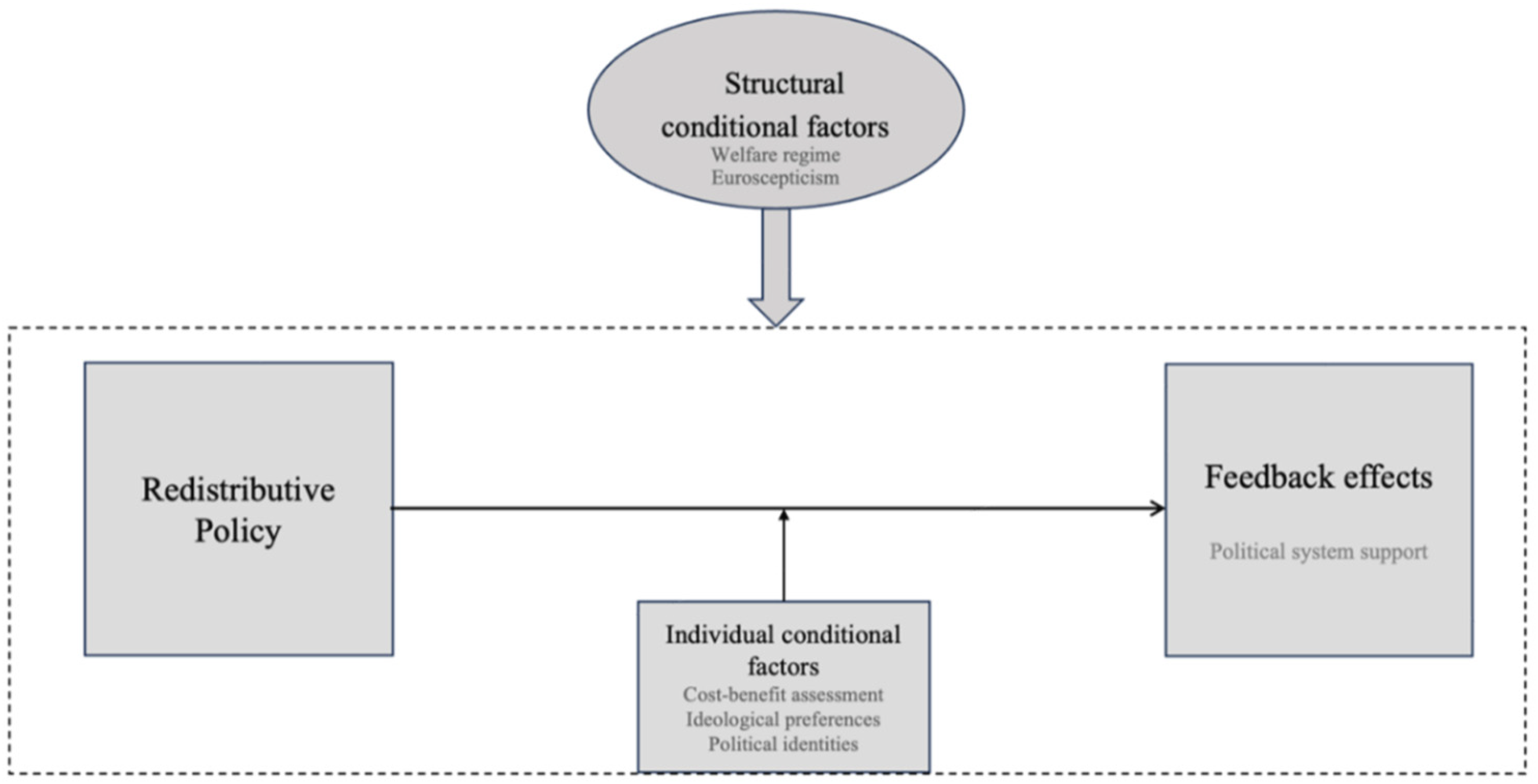
A framework for EU redistributive policy feedback effects.
The direct effects of redistribution are mostly discussed in the historical institutionalism literature, which documents the impacts of social policies on the legitimation and support of national governments. Welfare building is one of the building blocks of nation-state consolidation because social policies are evidence that the political system is capable and willing to ensure the well-being of its citizens (Bartolini, 2005). In the early days of national state formation, national redistributive policies result in increased citizens’ support for the government, social cohesion, and a contoured national identity, especially in the case of federations with fragmented territorial identities (Beramendi, 2017; Béland and Lecours, 2006; McEwen, 2002). Similar effects have been observed at the sub-national level, where the devolution of social policy had important consequences for regional government legitimacy and support (Béland and Lecours, 2006; Dupuy and Van Ingelgom, 2014; McEwen, 2002). Similarly, it can be argued that supranational redistribution can contribute to union-building by increasing support and legitimacy of the EU across European public opinion.
H1: EU redistributive policies increase support for the EU.
Yet, besides these general effects, in-depth policy analyses show that, most often, citizens’ responses are shaped by perceived benefits and predispositions toward the political system. The literature highlights two key logics: extrapolation and compensation (Chalmers and Dellmuth, 2015). Under extrapolation, policies reinforce political support among those with a positive view of the system. In contrast, compensation suggests policies can improve support among more disaffected citizens by addressing negative predispositions, thus fostering system-building effects. While research focuses on positive compensation – where redistributive policies boost support among those predisposed to low levels of support – negative outcomes may also lead to de-compensation, reducing support among those with positive predispositions. In continuation, the analysis proposed a series of hypotheses on the conditional effects of redistributive policies, as outlined in the theoretical model.
Conditional effects at the individual level
There exists a substantial scholarly consensus asserting that cost-benefit calculations constitute the fundamental mechanism through which policies can influence citizen evaluations and political attitudes (Chalmers and Dellmuth, 2015; Jacobs and Mettler, 2018). Within the classical cost-benefit framework, citizens attribute value to policies and broader governmental actions based on their ability to yield tangible benefits (Busemeyer et al., 2021; Pierson, 1993). Consequently, the impact of supranational redistribution on pro-European attitudes is posited to be more pronounced among citizens who stand to gain from such policies (Baute and Meuleman, 2020). Redistributive policies, aimed at reducing social inequalities and benefiting vulnerable groups, are particularly appealing to socioeconomically disadvantaged Europeans. Supranational redistributive policies are expected to have a compensatory effect, increasing EU support among those who may initially be lukewarm toward integration due to their marginalized position within the common market (Gabel, 1998). By improving socio-economic conditions, these policies are anticipated to strengthen citizens’ support for the EU.
Evaluating how member-state redistribution affects support for European integration among citizens with varying socio-economic resources is less straightforward. The costs and benefits of such policies are often diffuse and less noticeable at the individual level. Research shows that the influence of income on support for redistribution depends on policy design and national context (Mariotto and Pellegata, 2023). In creditor countries, support for bailout packages and Next Generation EU funds is higher among educated, high-income citizens (Bauhr and Charron, 2023; Bechtel et al., 2014). In debtor countries, where redistribution is more beneficial overall, individual income plays a lesser role. Thus, whether member-state redistributive policies amplify or compensate support for European integration among disadvantaged groups depends on how they perceive the policies’ tangible benefits at both individual and national levels.
H2: EU redistributive policies have stronger positive effects on EU support for economically vulnerable individuals.
Another factor shaping the effect of redistributive policies on EU support is interpretive. Given the complexity of political issues, many citizens rely on ideological preferences and party identification to guide their views, potentially filtering resource effects (Jacobs and Mettler, 2018). Historically, redistribution has bolstered left-leaning governments and welfare states, supported by left-wing voters (Stjernø, 2009). Supranational redistribution initiatives similarly reflect left-right coalitions seen in national welfare systems (Baute and Meuleman, 2020; Burgoon et al., 2022; Ciornei and Hernandez Sanchez, 2024; Gerhards et al., 2019). Thus, both citizen- and member state-level redistribution are expected to amplify EU support, especially among left-leaning citizens, by reinforcing the EU's role in addressing social inequalities and improving prospects for the disadvantaged. Yet, a different mechanism regarding the conditional effect of ideology is also possible. In the case of member-state redistribution, support is influenced by a centre/extreme divide rather than the traditional left-right spectrum (Bechtel et al., 2014). Supranational redistributive policies may have a negative extrapolation effect on EU support among citizens with extreme ideologies, who are more likely to oppose European integration. For these voters, such policies could heighten their opposition, given their contentious nature.
H3a: EU redistributive policies have stronger positive feedback effects on EU support in the case of left-oriented individuals.
H3b: EU redistributive policies that target member states have stronger negative feedback effects on EU support in the case of individuals placed at the ideological extremes.
Political identities significantly influence public support for European integration and attitudes toward redistributive policies. Scholars of liberal nationalism argue that national identities can strengthen support for the welfare state and political systems, particularly among economically advantaged individuals who may not directly benefit from redistribution (Johnston et al., 2010; Wright and Reeskens, 2013). Identity, in this context, serves as the essential social glue that legitimizes the redistribution of resources across societal groups (Miller, 1995). Similarly, a European identity promotes support for both European integration and redistributive policies benefiting member states and citizens (Ciornei and Hernandez Sanchez, 2024; Verhaegen, 2017); Baute and Meuleman, 2020; Kuhn et al., 2020). According to these theories, supranational redistribution is expected to increase support for European integration by positively shaping EU evaluations among individuals with strong European identities (Bauhr and Charron, 2020; Borz et al., 2022; Capello, 2018; Mora and Bazo, 2020). However, the impact of supranational redistributive policies on citizens with high levels of European identity may be limited due to a ceiling effect, as their strong endorsement of European integration is less influenced by policy decisions.
An opposing scenario is also plausible, particularly regarding citizen-centred redistribution. Exclusive national identities significantly hinder support for European integration, underpin Eurosceptic party support, and provoke resistance to member state solidarity (Hooghe and Marks, 2018; Kuhn, 2019). An important ingredient of exclusive nationalism construction is the perception of European integration as a threat to communal and individual integrity (Hooghe and Marks, 2007). The EU is often perceived as an intrusive and illegitimate political system that undermines national cultures and institutions while appearing distant and irrelevant in terms of enhancing the life prospects of most Europeans (see Trenz, 2016, Ch. 4). Normative approaches that call for a more social Europe as a vehicle for integration and cohesion are founded on the underlying premise that redistribution can effectively disconnect exclusive nationalism and anti-EU attitudes. Their core argument is that political legitimacy is realised through the pursuit of social justice that assures the equality of opportunity and fosters a common meaning and ‘social glue’ within the community (Ross, 2020; Seeleib-Kaiser, 2018).
H4a: EU redistributive policies have stronger positive feedback effects on EU support for individuals with stronger European identity.
H4b: EU redistributive policies that target European citizens have stronger positive feedback effects on EU support for individuals with exclusive national identities.
Conditional effects at the country level
National contexts significantly influence how supranational redistribution shapes broader evaluations of EU integration. A key structural factor is the perceived cost-benefit of the policy at the country level. Due to the EU's asymmetric economic development and the unequal impact of external shocks, some member states (or regions, in the case of Cohesion Policy) receive more financial support than others. Studies suggest that public opinion in donor countries tends to be less supportive of redistributive policies compared to beneficiary states, a pattern that is also evident at the regional level between more developed and less developed regions (Cantó et al., 2024; Mariotto and Pellegata, 2023; Reinl, 2022).
The perceived benefits of supranational redistribution can also be evaluated through the welfare regime lens (Baute et al., 2019; Gerhards et al., 2019). Citizens living in generous welfare states are more likely to view supranational redistribution as a less attractive policy alternative compared to Europeans living in more restrictive welfare regimes. These differing perceptions of the costs and benefits of supranational redistributive policies can create varied spillover effects on citizens’ support for integration.
Furthermore, the broader political contexts and party Euroscepticism not only prompt interpretive effects at the individual level but may engender a climate of EU criticism and opposition in which redistributive policies at the supranational level are received with more reticence. This would consequently result in weaker policy feedback effects compared to countries where public opinion and party discourses have a more positive perspective towards the EU.
H5: Supranational redistributive policies have stronger positive effects on support for European integration in beneficiary countries/regions (H5a), in less generous welfare regimes (H5b) and in countries with less Euroscepticism among the public opinion (H5c).
These structural conditional effects cannot be directly tested in this study due to the limited number of countries analysed. A comparison between the two cases allows for an illustration of the theoretical expectations regarding the effects of national contexts. Nonetheless, the hypotheses discussed constitute a solid theoretical template for future research on the heterogeneous effects of supranational redistributive policies on support for European integration.
Methodology
Case selection
This study is based on a comparison of survey experiment results from Spain and Italy using a diagnostic case selection strategy (Gerring and Cojocaru, 2016). This strategy allows for the testing of causal hypotheses in small-n settings through the comparison of cases that have similar background conditions, but that exhibit significant differences in the causal factors of interest. Spain and Italy have a comparable level of economic development and a Mediterranean welfare regime (Ferrera, 1996). While Italy has been a net contributor to the EU budget over the past decade and Spain is a low-grade beneficiary, both countries underwent severe austerity policies during the Eurozone crisis. Accordingly, Spain and Italy represent the largest recipients of Next Generation EU transfers, constituting a relevant context for the testing of the relationship between redistribution and support for the EU 2 . Yet, the profile of public opinion in these two countries is radically different, with Italians being among the most Eurosceptic Europeans and Spaniards among the most Europhile. Public opinion data shows that only 43% of Italians believe that they would benefit from a redistributive EU emergency fund compared to 65% of Spaniards (Russo, 2023). Spanish public opinion perception may be influenced by the reception of the bailout package from 2012 aimed at recapitalising the banking sector. Furthermore, 80% of Spaniards identify as a citizen of the EU compared to 60% of Italians, the latter of which is one of the lowest shares in the union (European Commission, 2023). This trend in public opinion parallels the higher level of party Euroscepticism in Italy than in Spain (Carteny et al., 2023). 3
The survey experiment
The selection of a survey experimental approach is underpinned by a dual rationale. First, survey experiments facilitate causal inference testing, contrasting with cross-sectional analysis, which predominantly identifies correlation patterns within data (Mutz, 2011). Secondly, the vignette survey experiment allows for the evaluation of counterfactual policies presented as real-world scenarios. The comparison of real policies with prospective proposals, as done in this article, should be considered both a limitation and an opportunity for expanding knowledge. On one hand, respondents may have additional information related to real-world policies, which can influence how these policies affect their political opinions and behaviour. On the other hand, comparing prospective and existing redistributive policies offers a unique contribution to the field, as it allows for the analysis of feedback effects that have typically been examined in separate experiments and studies (Bauhr and Charron, 2023; Burgoon et al., 2022).
The survey is conducted by a specialised survey company, Netquest, on a sample of 1800 opt-in panel respondents from each country during the summer of 2022 (see the Online appendix for survey description). The experiment received ethical clearance from the researcher’s university ethics committee and has been pre-registered on the OSF repository. The samples are representative of the Spanish and Italian adult populations in terms of education, age, and occupational status (employed/unemployed). Before the start of the survey, all respondents signed a consent form regarding the analysis of their anonymised answers. After answering a battery of questions related to demographic and attitudinal variables, the respondents were randomly assigned to one of four groups – three treatment groups and a control. The three treatment groups received a different vignette on a European redistributive policy proposal, while the control group did not receive any information. Each response has been primed by one vignette only. The survey included attention checks and discarded respondents who spent a below-average time when reading the vignette. The European Social Benefit and European Unemployment Benefit groups received a debriefing at the end of the survey stating the hypothetical nature of these policies.
Main variables and operationalisation
The dependent variable captures support for European integration and is operationalised by a standard question on the desired speed of EU integration, commonly employed by the Eurobarometer survey (Gabel, 1998; Hooghe and Marks, 2007). While this question is commonly analysed with the ‘membership’ question 4 in cross-sectional surveys, this survey asks the membership question before the experiment to determine the respondent's baseline level of Euroscepticism. For robustness, the analysis also examines treatment effects on related indicators of attitudes towards European integration, such as trust in European institutions, perceived EU trustworthiness and perceived EU legitimacy. All dependent variables are measured after the vignette section of the experiment (see the Online appendix for further details).
The core independent variable, supranational redistribution, is operationalised in the form of redistribution between European citizens and between member states (Table 1). Based on the literature on welfare states, citizen-centred redistribution took the form of a vignette about a non-contributory social benefit at the EU level, and a vignette on a contributory benefit, such as an EU unemployment benefit. The social benefit vignette is inspired by the European Social Survey (ESS) 2016 question E37 on a ESB scheme. The unemployment benefit vignette builds on the work of Burgoon et al. (2022). The vignette on redistribution between member states refers to an existing policy, the Next Generation EU, and is inspired by the policy description used by the European Commission to advertise the NGEU funds (European Commission, 2022). The supplementary material contains a detailed explanation of the formulation and rationale for each vignette.
Vignette formulation for redistribution addressing member states and EU citizens, respectively.
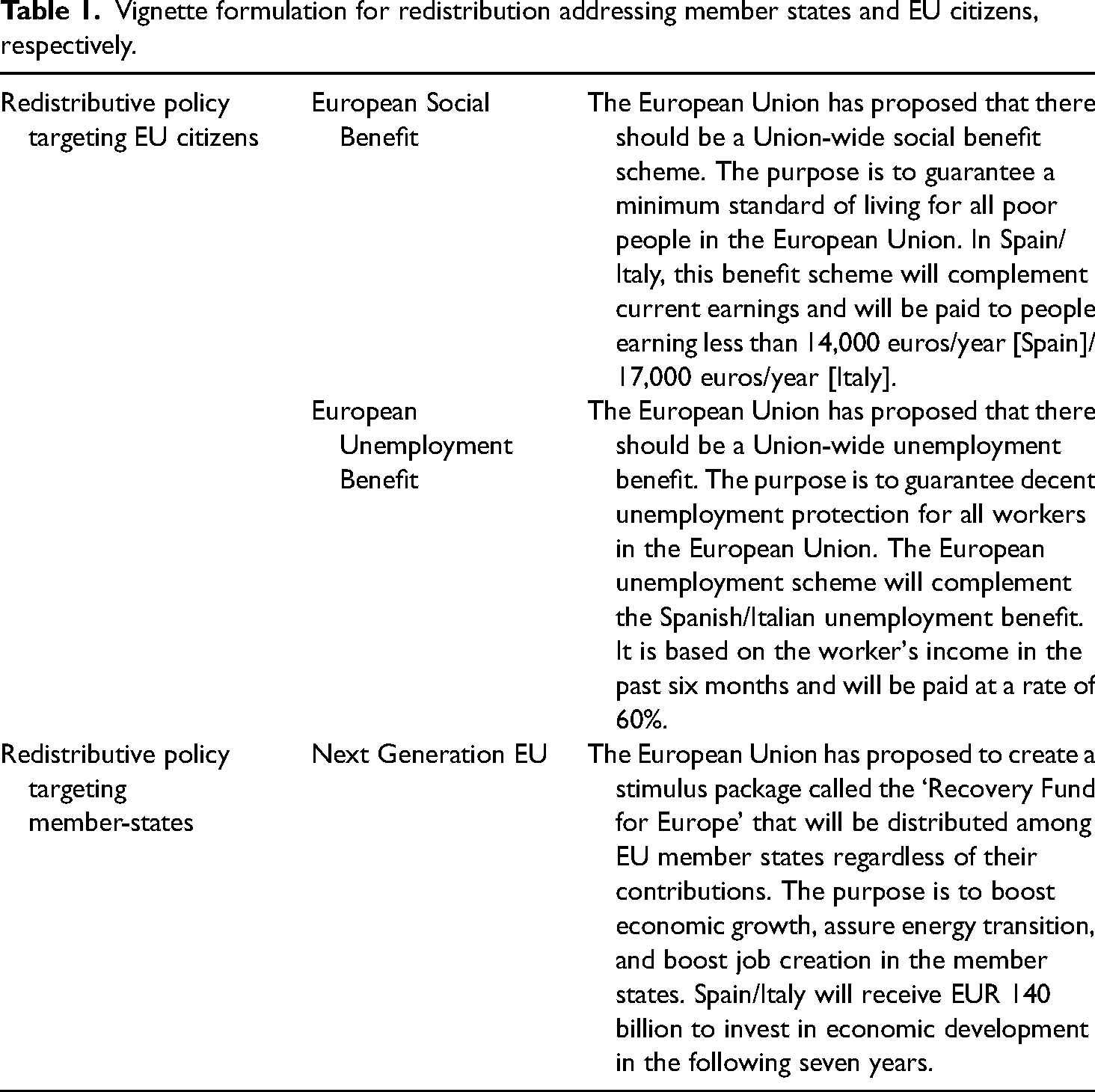
In order to account for redistributive policy support, respondents in the three treatment groups are asked to rate their preferences for the respective policy on a scale of 0–10, after the presentation of each vignette.
Conditional variables measured in the survey include cost-benefit, ideological, identity-related factors and socio-demographic controls. The cost-benefit variable is based on the respondent's economic status, measured as a self-assessment of the personal financial situation (living comfortably on present income/coping on present income/finding it difficult on present income/finding it very difficult on present income). The first two responses are coded as having high economic resources while the last two responses are recorded as possessing low economic resources. Ideology is operationalised in terms of the respondent self-placement scheme on a 0–10 scale, where 0 is the extreme left and 10 is the extreme right. The variable was recoded to capture the three main ideological families as well as the extreme/centre divide. The first recodification was as follows: extreme left (0–2), centre (3–7), extreme right (8–10). The second recodification was as follows: left (0–4), centre (5), right (6–10). These different operationalisations of ideology were tested in distinct models to better capture the influence of both the left/right cleavage as well as the extreme/centre divide.
The concept of European identity builds upon the distinction between a cognitive component (self-perception of belonging to the European community) and an emotional component (feelings of attachment to the European community) (Citrin and Sides, 2004). Borz et al. (2022) find that the emotional component of European identity is more stable and less associated with an instrumental understanding of the EU (265). This article captures the conditional effects of European attachment, measured on a scale from 0 to 10 (ranging from not at all to very attached, respectively). To more easily interpret these interactions as well as to account for heterogeneous effects, the variable is dichotomised as low European identity (0–5) and high European identity (6–10). The middle value of 5 was categorised as 0 since it may point towards the respondent's ambivalence, indifference or moderate stance regarding this item (Bagozzi and Mukherjee, 2012). The exclusivity of a respondent's national identity is identified in two steps: first, the difference between their attachment to Europe (0–10) and their attachment to their home country (0–10) is calculated, with the resultant values ranging between −10 and 10. Exclusive nationalism is coded as 1 when the difference between European attachment and national attachment is larger than −6, and 0 otherwise. In other words, exclusive nationalists are defined as those who have a significant attachment to their home country while having little to no attachment to Europe.
The main models presented in the paper use OLS regressions and present the coefficients of the treatment vs. the control group, as well as the heterogeneous effects of cost-benefit, ideological and identity factors on support for the EU. This follows the recommendations of Mutz (2011), who suggested the use of a minimal number of control variables when analysing treatment effects. Additional models, including socio-demographic controls, are presented in the Online appendix. Control variables include tertiary education, age, and gender.
Analysis
Preferences for EU redistributive policies from a comparative perspective
This first section of the empirical analysis offers an overview of redistributive policy preferences among Italian and Spanish respondents by comparing the policy rating scores assigned by respondents after being exposed to the information treatment (see the Online appendix for the corresponding regression tables). In Spain, the Next Generation EU receives significantly more support than a prospective European minimum benefit or a European unemployment benefit (Figure 2), while in Italy, the largest amount of support is garnered by the ESB scheme.
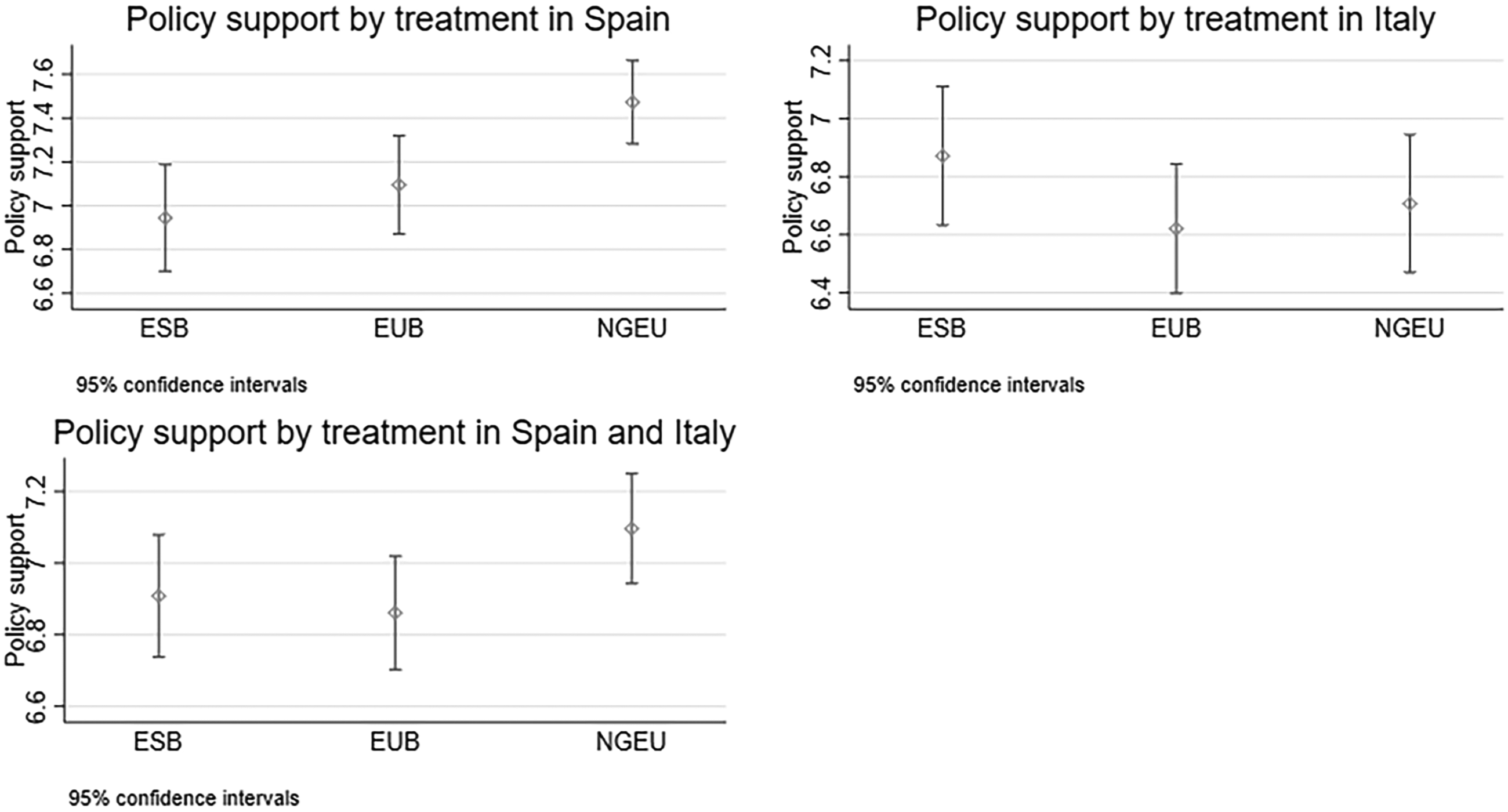
Preferences for supranational redistribution in Spain and Italy. Predicted values, including 95% confidence intervals. ESB: European social benefit; EUB: European unemployment benefit; and NGEU: Next Generation EU.
Besides these significant effects for the entire sample, preferences for supranational redistributive policies are structured by differences in socioeconomic resources, ideology, and EU identity among EU citizens. Individuals with low socio-economic resources in both Italy and Spain support the European social benefit to a larger extent than the Next Generation EU and European unemployment benefit, while those with high socio-economic resources endorse redistribution between member states (NGEU). Ideology is also found to influence an individual's preferences for redistributive policies, with national context playing an essential role in structuring this relationship. In Spain, left-wing citizens display significantly higher support for the European social benefit, when compared to centrist or right-wing voters. In Italy, nonetheless, ideological predispositions do not structure redistributive policy support. With regard to differences in political identities, the European social benefit and the European unemployment benefit receive significantly higher support among Italians with low levels of European attachment. Similarly, exclusive nationalists in Italy exhibit a higher degree of support for the European social benefit and the European unemployment benefit when compared to respondents in the NGEU group (see the Online appendix).
European redistribution and EU support
This section presents the testing of hypotheses 1–4 and the analysis of the direct and conditional effects of redistributive policies on EU support. Figure 3 shows the regression coefficients of the policy treatments (vs. Control group) and control variables on the full sample gathering Italian and Spanish respondents and on separate country samples (see the Online appendix for the supporting regression tables). The findings indicate that, while there is a relatively high degree of endorsement for each of the three redistributive policies both in Italy and Spain (Figure 2), these policies do not significantly increase EU support when compared to the Control group. Control variables have the expected effect. Low economic resources, right-wing ideology and gender are negatively correlated with support for European integration, while tertiary education and European identity significantly increase support for European integration. Additionally, Italian respondents have on average, lower levels of support than the Spanish ones, confirming previous findings based on cross-sectional surveys on European public opinion.
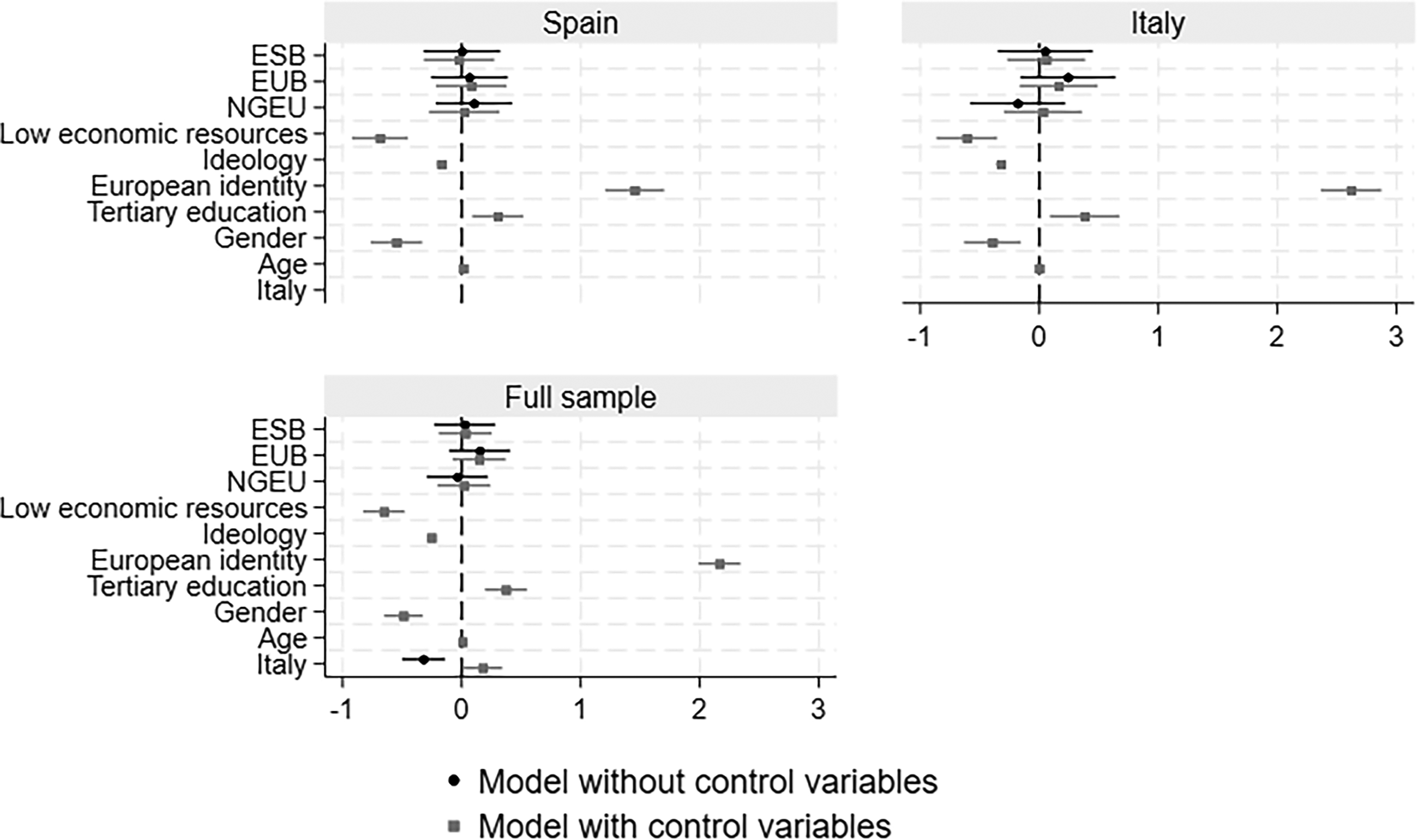
OLS regression coefficients. ESB: European social benefit; EUB: European unemployment benefit; and NGEU: Next Generation EU.
One explanation for the lack of significant effects of the three treatments on support for European integration is that evaluations of redistributive policies and their impact on EU support vary across groups. These evaluations are shaped by differences in cost-benefit considerations, ideological orientations, and political identity predispositions. To explore these heterogeneous treatment effects, the analysis examines marginal effects based on socioeconomic resources and prior attitudes toward integration (see the Online appendix). Figure 4 shows that the European unemployment benefit increases support for European integration for individuals with low socioeconomic resources in Italy, while the Next Generation EU policy has a negative effect on support for the economically deprived in Spain. These findings partially confirm H2 and show that the spillover effects of redistributive policies can be both compensatory, by increasing political support among the economically deprived, and also amplifying the negative effects of low economic resources, depending on the national context and the redistributive logic in question.
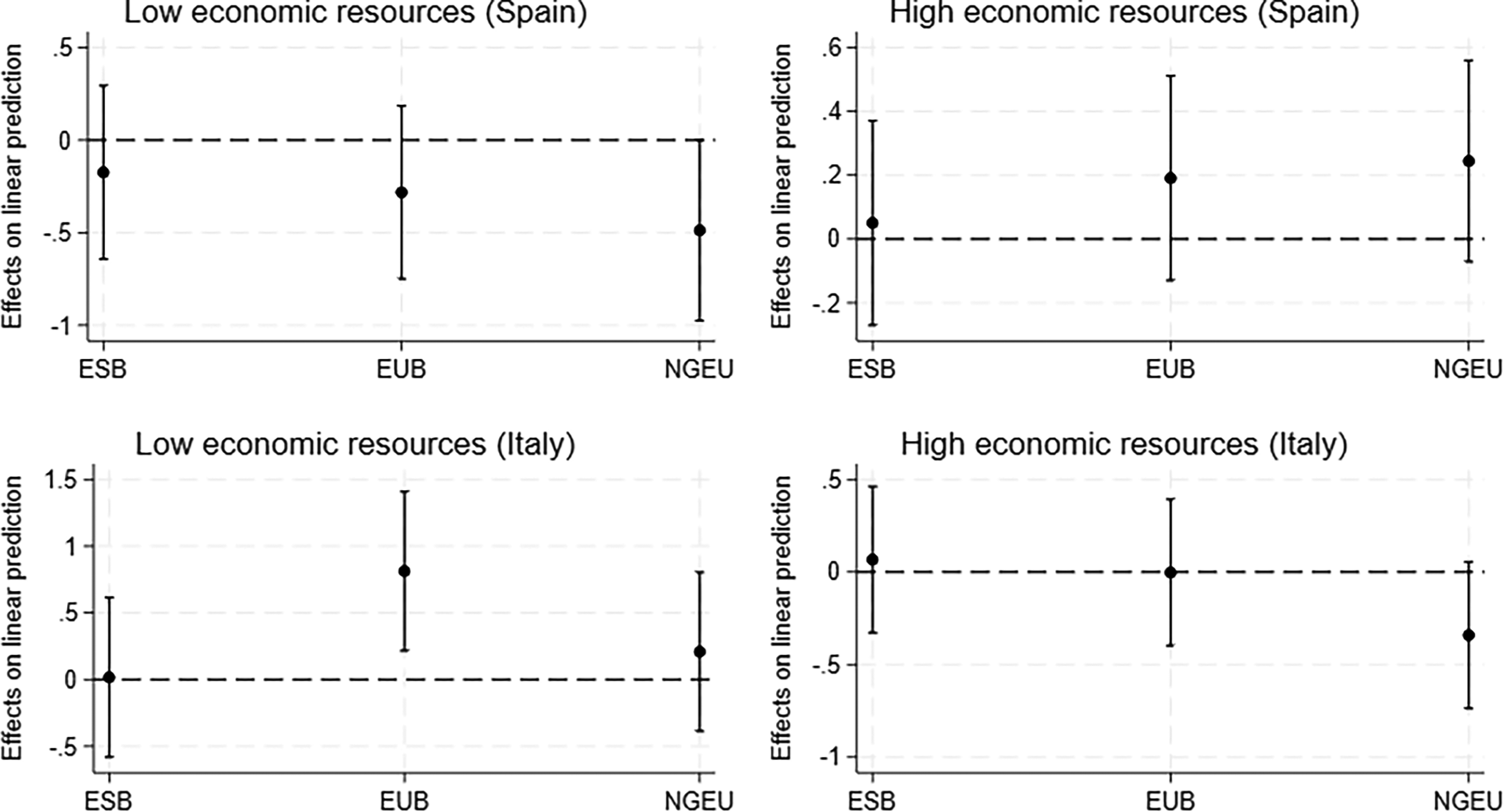
Treatment marginal effects vs. control on support for European integration as a function of individual economic resources. ESB: European social benefit; EUB: European unemployment benefit; and NGEU: Next Generation EU.
While economic resources condition the effect of redistributive policies on EU support in both countries analysed, a significant effect of ideology can only be observed in Italy. Model 2, fully reported in the Online appendix, indicates that exposure to the European unemployment benefit policy significantly increases support for integration among centre and right-wing voters. Model 4, which tests the effects of redistributive policies on centre versus extreme ideological cleavages, suggests that the European social benefit and the Next Generation EU policy enhance support for integration among centrist and far-right citizens compared to extreme left voters in the same treatment group. In summary, these results suggest that supranational redistributive policies operate under a compensation logic in Italy. Here, citizens otherwise predisposed to high levels of scepticism towards European integration, such as right-wing voters, increase their levels of political support when exposed to information about both the member state and citizen-cantered redistribution. These findings do not bring evidence to Hypotheses 3a and 3b, which posited that supranational redistribution is likely to amplify support for European integration for left-wing voters. This may be explained by the fact that Italian right-wing voters expose important doses of Euroscepticism, unlike their counterparts in Spain. In this context, supranational redistribution operates under a compensation logic for the most sceptic citizens, as proposed by hypothesis 4b, rather than by updating and amplifying system support attitudes among the classical supporters of redistribution – the left-wing voters.
Figure 5 illustrates how EU attachment mediates the relationship between supranational redistributive policies and EU support (see the Online appendix for the corresponding regression tables). In both Italy and Spain, the European unemployment benefit treatment significantly increases EU support among individuals with little or no EU attachment. In predicted values, EU support rises from 4.6 in the control group with low EU identity to 5.2 in the group exposed to the European unemployment treatment and low EU identity in the Spanish sample. In Italy, support increases from 3.5 to 4.1 between the control and treatment groups characterised by low levels of EU identity. These findings do not support H4a, which posited that supranational redistribution would significantly increase support for integration among respondents with high levels of European identity. While European identity does significantly increase EU support overall, it does not necessarily lead to greater support in the context of redistributive mechanisms for EU member states and their citizens. As a result, redistributive policies at the EU level appear to have a compensatory effect for citizens with low levels of attachment to the European project, rather than an extrapolative effect for Europeanists.
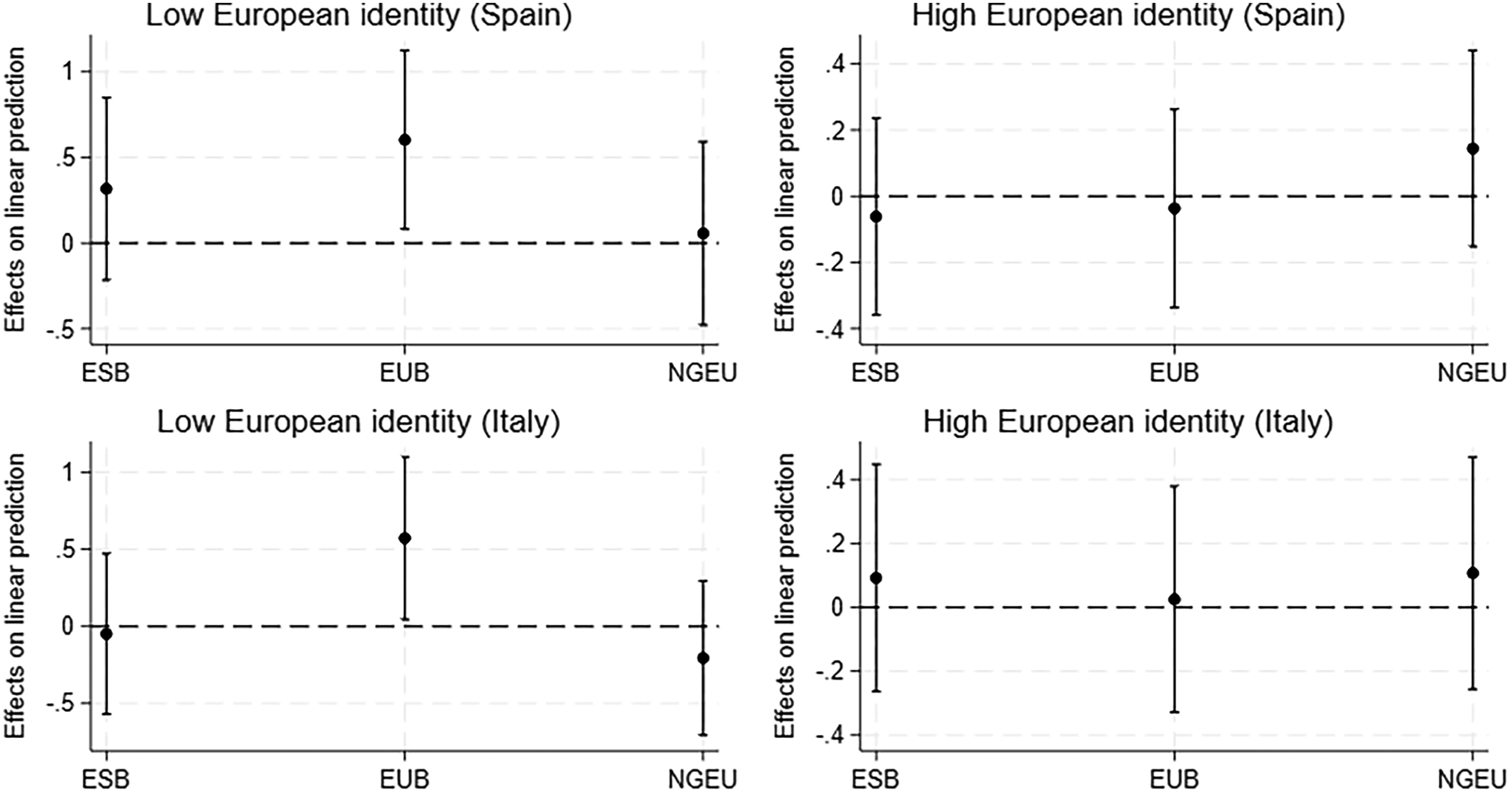
Treatment marginal effects vs. Control on support for European integration as a function of European identity. ESB: European social benefit; EUB: European unemployment benefit; and NGEU: Next Generation EU.
A similar compensatory effect is visible among exclusive nationalists, as shown in Figure 6 (see the Online appendix for the corresponding regression tables). The European unemployment benefit has a significant positive effect on EU support for exclusive nationalists in both countries. In Spain, support rises from 2.5 to 4.8, while in Italy, it increases from 1.1 to 2.8 between the control and the European unemployment benefit groups characterised by exclusive nationalism. Thus, Hypotheses 4a and 4b are confirmed, showing that the EUB scheme has the strongest compensatory effect for groups with high Euroscepticism. The fact that exclusive nationalists respond to the European unemployment treatment suggests that their political disaffection and low support for European integration partly stem from the belief that supranational institutions fail to address economic shocks and risks like unemployment.
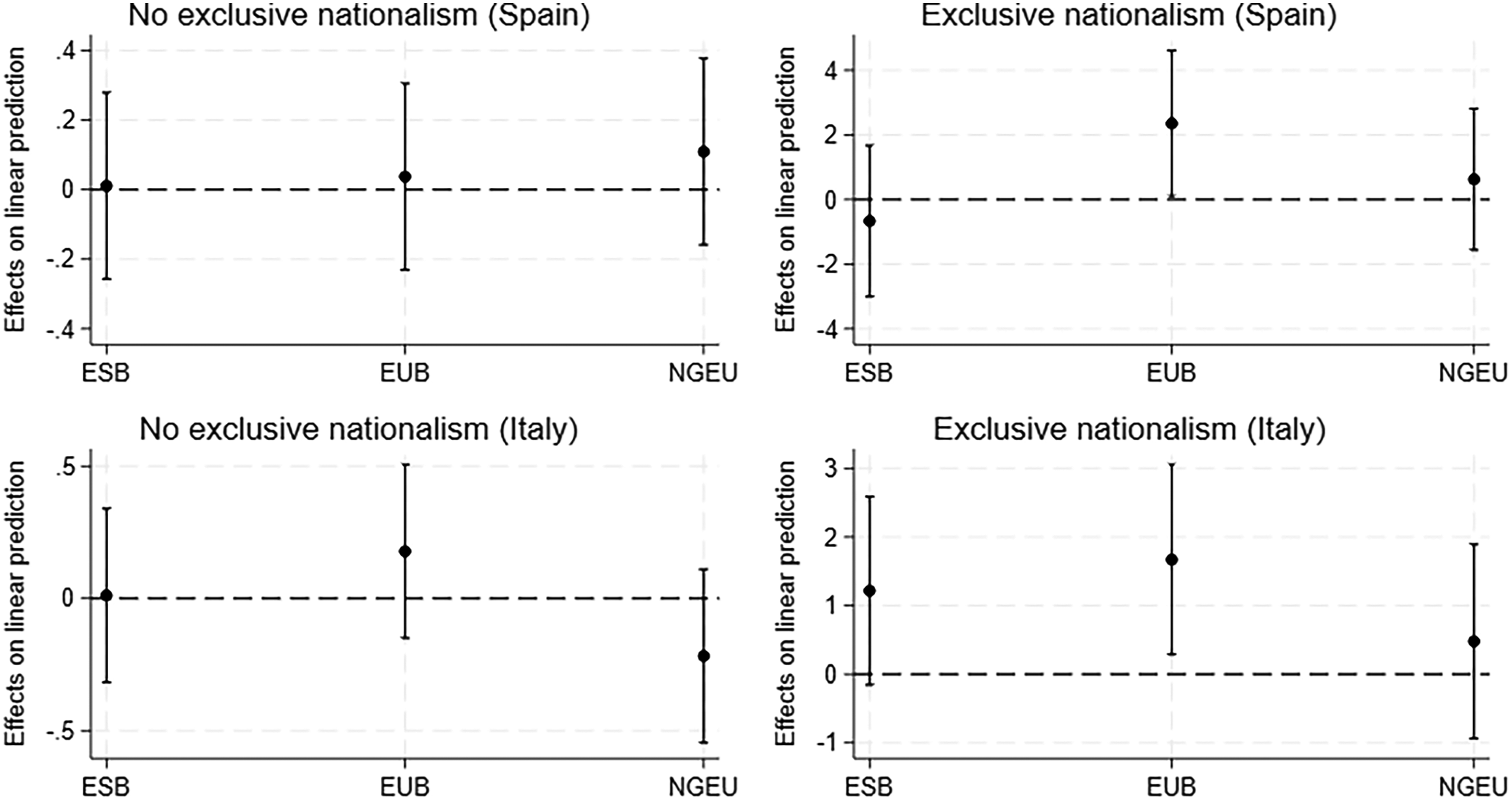
Treatment marginal effects vs. Control on support for European integration as a function of exclusive nationalism. ESB: European social benefit; EUB: European unemployment benefit; and NGEU: Next Generation EU.
The finding that supranational redistributive policies have mainly compensatory effects on traditionally sceptical groups and no extrapolation effects in the case of groups that have a high baseline support for integration can be explained in various ways. Pro-European groups may experience a ‘ceiling effect’, where existing and prospective policies have limited impact on altering the already high levels of support for integration. Additionally, these groups’ high support often stems from their structural position in the labour market and early socialization, making it stable over time. Conversely, groups with traditionally low support for European integration are more susceptible to changing their stance in response to specific policies proposed by supranational institutions. Much of their low support stems from the perception that the EU is either ineffective in addressing social and economic inequalities or even contributes to these issues. Consequently, positive experiences with European integration and meaningful solutions from supranational authorities can help counteract these negative factors.
The role of the national and regional contexts
Although this analysis cannot directly test how national variables moderate the relationship between redistribution and EU support, their implications are important to consider. Hypothesis 5a claims that greater expected benefits of a policy spill over into higher levels of support for European integration. Both Italy and Spain are net beneficiaries of the NGEU transfers and are expected to experience similarly positive effects on their aggregate economies. However, Spanish respondents show stronger support for this policy than their Italian counterparts. It is important to note, nonetheless, that this does not prompt respondents to manifest increased support for European integration when primed with the respective information treatment.
A direct test of how perceived benefits of the policy in a specific territory affect support for European integration can be done by analysing regional differences. In order to test for regional effects, the analysis uses the European Commission classification of NUTS-2 regions for the distribution of Cohesion Policy funds for the 2022–2027 period. Spanish and Italian regions having a GDP/head (PPS) less than 75% of the EU-27 average are classified as less developed. Transitions regions refer to those with a GDP/head (PPS) between 75% and 100% of the EU-27 average, while more developed regions have a GDP/head (PPS) of more than 100% of the EU-27 average. The total number of NUTS-2 units used in the analysis is 40 (19 in Spain and 21 in Italy). While NGEU funds follow a top-down distribution by national governments that does not follow the Cohesion Policy logic, regional experience with Cohesion Policy may shape expectations and provide cues of other redistributive mechanisms like the NGEU (Regions for EU recovery, 2022). Multilevel regressions partially confirm H5a and reveal that the NGEU programme has a positive effect on EU support in transition regions but a negative effect in more developed ones, driven mainly by the Italian sample (see the Online appendix). This may be due to perceptions that the policy benefits transition regions economically, while more developed areas expect minimal gains. Future research should examine how long-term experience with structural funds, shapes the evaluation of new redistributive policies.
With regard to the generosity of the welfare state, hypothesis 5b poses that supranational redistributive policies targeting citizens will have a stronger effect on support for European integration in weaker welfare regimes. Spanish and Italian unemployment benefits do not differ substantially in terms of replacement rates and duration and both countries are considered a Mediterranean type of welfare regime (Ferrera, 1996). However, a supranational unemployment benefit scheme exhibits particularly positive feedback effects in Italy among the more economically deprived citizens.
Finally, Hypothesis 5c posits that the positive effect of supranational redistributive policies is weaker in contexts with higher shares of Euroscepticism. Several data sources note the greater degree of party Euroscepticism in Italy compared to Spain both at the party and public opinion levels (Carteny et al., 2023; European Commission, 2023). However, the analysis finds that redistributive policies targeting European citizens have a compensatory effect on support in more Eurosceptic contexts such as Italy, by appealing to right-wing voters and economically deprived and by restoring their assessment of European integration. Moreover, the lower support for the Next Generation EU policy in Italy when compared to Spain may be explained by the higher degree of partisan conflict over this policy between the Conte and Draghi governments.
These findings highlight that the perceived benefits of a policy at the national or regional level, along with broader factors such as public opinion and party polarisation toward the EU, serve as critical contextual variables that shape the impact of redistributive policies on support for European integration. This conclusion aligns with the argument of Bauhr and Charron (2023) that citizens evaluate pandemic recovery policies, such as the NGEU package, based on elite cues rather than the objective conditions of the aid or its scale.
Robustness checks and alternative estimates
To assess the robustness of the results, I conducted three additional tests (see the Online appendix). First, I add control variables that may alter the heterogeneous effects of the three policy treatments on EU support discussed in the previous section. The results reported in the Online appendix show that controls associated with the educational level, age and gender do not impact the sign and significance of the three treatment conditions on support for European integration presented in the previous section. Secondly, the analysis tests the policy treatment heterogeneous effects on a social group that has an important stake in these policies: the unemployed. I find that the NGEU policy significantly increases the unemployed’s support for integration in Italy. This suggests that the unemployed do not necessarily expect more unemployment provisions from the EU – probably the attachment to national unemployment schemes is strong in this case – but policy solutions that fight against unemployment and contribute to job creation.
The third test examines the results using a multidimensional measure of EU support, incorporating indicators related to both support for integration and trust in European institutions, following established approaches (Boomgaarden et al., 2011; Reinl and Braun, 2023). A confirmatory factor analysis on EU-related attitudes – measured after the experimental intervention – suggests the presence of two distinct factors. The first factor, termed ‘Generalized EU trust’, encompasses trust in EU institutions, support for European integration, and perceived EU legitimacy. The second factor, ‘EU Trustworthiness’, captures perceptions of the EU's ability, benevolence, and integrity (Citrin and Stoker, 2018). While support for European integration contributes to the first factor, its loading is moderate, and a significant portion of its variance (60%) remains unexplained by the two factors. Therefore, analysing support for European integration separately, as previously done in this article, remains valid.
The findings reveal a positive effect of both the European social benefit and the European unemployment benefit on generalized EU trust among Italian and Spanish respondents. These results remain consistent after controlling for socio-demographic variables and prior views on integration, and they are particularly significant in the Italian sample. Regarding EU trustworthiness, I find that information about the Next Generation EU policy lowers perceptions of EU trustworthiness, especially among Italian respondents. The policy appears to trigger perceptions of low competence and integrity in supranational institutions among Italian voters, likely influenced by the intense politicisation of the policy by major Italian political actors.
Conclusions
This research seeks to answer a central question in EU studies, related to the exploration of conditions that reinforce the legitimacy of the EU against the disintegrative forces of Euroscepticism and global inequalities. By accounting for collective identities and structural factors, I have expanded upon theories of policy feedback and neo-institutionalism and propose a theoretical model that captures policy effects in a supranational context. The survey experiment, conducted in the largest Southern European countries, shows that redistributive policies that address social risks, such as a European unemployment benefit, have the largest potential to increase EU support among the social groups that are the most likely to turn against the European Union: the economically deprived, the extreme right voters and the exclusive nationalists. This finding offers empirical evidence in support of normative claims that a more social Europe can change the attitudes of those Europeans for whom supranational integration is perceived as distant and threatening (Ferrera, 2017). Consequently, supranational social policies can have feedback mitigation effects against the globalisation backlash (Walter, 2021). Supplementary analyses of related public opinion indicators, like generalised trust in the EU, show that redistributive policies targeting EU citizens have a positive impact, reinforcing the argument that such policies promote union-building and strengthen pro-European attitudes.
As an addendum to historical institutionalism theories, this research claims that citizen-centred redistribution, and in particular, an unemployment benefit at the EU level, can constitute a venue for union-building among the more Eurosceptic social groups. Potential economic benefits attached to European integration can therefore ‘trump’ exclusive national attachments and revive EU support (also see Unger et al., 2023), highlighting the relevance of EU public policies in consolidating public perceptions of legitimacy and responsiveness. Importantly, the Next Generation EU programme, featured as the most ambitious investment policy at the European level, can strengthen opposition to European integration among economically vulnerable citizens, especially in Spain. This finding has important implications for current policy-making trends that prioritize redistribution between member states through economic investment, including green and digital transitions while overlooking other policy instruments that could address social risks and foster long-term social cohesion. Specifically, the European Commission's strategy of allocating Next Generation EU funds in an attempt to address economic and political vulnerabilities stemming from the Eurozone crisis (Armingeon et al., 2022) may not be efficient in garnering support from the most economically vulnerable Europeans.
The research presented in this article has several limitations that could be addressed through further investigation. For instance, the positive effects of a supranational unemployment benefit scheme may be significantly influenced by the selection of countries. Spain and Italy, which have some of the highest unemployment rates in the EU, may find such policies particularly appealing to their citizens. To strengthen the findings, the arguments presented in this study should be tested in creditor countries, where supranational redistributive policies may be perceived as an additional burden on taxpayers, potentially generating negative feedback effects on support for European integration. Additionally, it is crucial to explore whether citizen-centred redistribution—focused on individual circumstances rather than the economic development of member states—might be perceived as another ‘Trojan horse’. Further research is also needed to examine how the national welfare context and party-based Euroscepticism shape evaluations of supranational redistribution and its spillover effects on integration support.
Supplemental Material
sj-docx-1-eup-10.1177_14651165251340207 - Supplemental material for Supranational redistribution and support for European integration
Supplemental material, sj-docx-1-eup-10.1177_14651165251340207 for Supranational redistribution and support for European integration by Irina Ciornei in European Union Politics
Supplemental Material
sj-zip-2-eup-10.1177_14651165251340207 - Supplemental material for Supranational redistribution and support for European integration
Supplemental material, sj-zip-2-eup-10.1177_14651165251340207 for Supranational redistribution and support for European integration by Irina Ciornei in European Union Politics
Supplemental Material
sj-zip-3-eup-10.1177_14651165251340207 - Supplemental material for Supranational redistribution and support for European integration
Supplemental material, sj-zip-3-eup-10.1177_14651165251340207 for Supranational redistribution and support for European integration by Irina Ciornei in European Union Politics
Footnotes
Acknowledgements
The author would like to thank the EUP editorial team and the anonymous reviewers for the substantive feedback provided during the drafting of this article.
Declaration of conflicting interests
The author declared no potential conflicts of interest with respect to the research, authorship, and/or publication of this article.
Funding
The authors disclosed receipt of the following financial support for the research, authorship, and/or publication of this article: The European Commission, the MSCA-IF Fellowship, grant number 840360.

Data availability statement
The data and replication code are available as part of the Supplementary Material at the DOI of the article.
Supplemental material
Supplemental material for this article is available online.
Notes
References
Supplementary Material
Please find the following supplemental material available below.
For Open Access articles published under a Creative Commons License, all supplemental material carries the same license as the article it is associated with.
For non-Open Access articles published, all supplemental material carries a non-exclusive license, and permission requests for re-use of supplemental material or any part of supplemental material shall be sent directly to the copyright owner as specified in the copyright notice associated with the article.
