




Abstract
This article investigates the role of European Union Cohesion Policy in the development of European identity, drawing on an original and representative survey in 17 regions across 12 member states. We advance a theoretical model which distinguishes cognitive, instrumental and communicative drivers of identity formation. Contrary to existing scholarship, we find that EU Cohesion Policy does contribute to European identity. Citizens that perceive benefits for themselves and for their region's development from EU Cohesion Policy are more likely to develop a European identity. We also find that awareness of the EU Cohesion Fund and exposure to publicity on EU funded projects is positively correlated with European identity. However, while Cohesion Policy contributes to citizens’ self-categorization as European, it does not associate with their emotional attachment to Europe. The study has important implications for understanding European identity formation and communicating the benefits and role of the EU in regional policy.
Keywords
Introduction
There is increasing recognition of the importance of a shared European identity for the sustainability of the European Union (EU) as a political regime (Bellucci et al., 2012; Kaina and Karolewski, 2013). The impact of identity politics on the EU's political landscape is clear from the rise of populist and anti-EU political parties across Europe in the post crisis era, and their successful exploitation of cultural and immigration fears (Hutter et al., 2016). Brexit is a striking example given that concerns about the undermining of British identity and the degree of identification with Europe were strong determinants of how people voted (Curtice, 2017; Hobolt, 2016). Research shows that identification with Europe is a key driver of citizens’ political support for the EU (Hooghe and Marks, 2005; Klingeren et al., 2013) and EU policy responses to the crisis (Verhaegen, 2017). The rise of European identity politics has also led to the rise of new post-functional theories of integration with identity-based factors at their core (Börzel and Risse, 2018; Hooghe and Marks, 2005; Hutter et al., 2016).
A critical question is what accounts for European identity? There is an established body of scholarship examining how and why citizens transfer their allegiance to the EU emphasising a combination of top-down institutional factors and bottom-up individual-level characteristics (for reviews, see Dalton, 2021; Favell et al., 2011; Kaina and Karolewski, 2013; Sanders et al., 2012). However, the study of the impact of EU policies on identity has mainly focused on cultural policies, economic and monetary union, foreign policy or policies that facilitate mobility and transnational social interactions such as the Erasmus programme or internal market (Kaina and Karolewski, 2013).
This article provides additional knowledge and clarification about how EU Cohesion Policy affects citizens’ European identity. The Cohesion Policy domain is particularly instructive for investigating the impact of the EU on identity for several reasons. It is the most explicit expression of EU solidarity in the EU's budget through a redistributive programme of investment focused on the less developed EU countries and regions. Cohesion Policy co-funds highly visible projects impacting on people's daily lives through infrastructure investment, businesses grants and training for people across the EU. Beneficiaries are obliged to publicise the funding, projects and achievements to the public to increase awareness about the benefits and role of the EU. With its pioneering multilevel governance model, Cohesion Policy is credited with encouraging the participation of subnational actors in regional development policies, as well as encouraging civic engagement at all levels.
There are unanswered questions about the extent of public awareness and perceived benefits of Cohesion Policy, and whether this translates into European identity. Previous studies have concluded that EU funding can have a direct or moderating effect on attitudes towards the EU (Chalmers and Dellmuth, 2015; Rodríguez-Pose and Dijkstra, 2021; cf. Dabrowski et al., 2019; Osterloh, 2011) but no impact on European identity in terms of feelings of European citizenship (Verhaegen et al., 2014) or attachment (Capello and Perucca, 2019). A limitation with these studies is that they do not factor in the influence of subjective public perceptions of Cohesion Policy alongside objective funding data on European identity.
We contribute to European identity scholarship by arguing that cognitive, instrumental and communicative mechanisms, which are expected to enhance European identity, can operate through European Structural and Investment Funds. Rather than focusing on what the EU is or how it operates, we focus on what the EU does for citizens and how this contributes to their identity. Analysis of an original survey dataset of 8559 citizens in 17 EU regions provides empirical support for our theoretical expectations. In doing so, our findings challenge and refine the conclusions of studies that do not find an association between EU funding and European identity (Capello and Perucca, 2019; Verhaegen et al., 2014).
Theoretical framework: Cohesion Policy and European identity
The concept of European identity is complex and contested (Kaina and Karolewski, 2013). We conceptualize European identity as a collective identity involving individual self-categorization of being a member of a supranational (European) political community (Niedermayer and Westle, 1995; Risse, 2010; Scheuer, 2005). Drawing on social identity theories, this conceptualization recognises the socially constructed nature of political identities; the co-existence of territorial identities at different levels; and its multi-dimensional character including cognitive (self-categorization) and affective (emotional attachment) dimensions (e.g. Citrin and Sides, 2004; Hermann and Brewer, 2004; Kuhn, 2012; Risse, 2010). While our conceptualization of European identity includes both cognitive (self-categorization) and affective (attachment) components (see also Ceka and Sojka, 2016; Kuhn, 2012), we recognise that European identity is far from the intense and deeply affective national identities witnessed within nation states and is more cognitive in kind because of its greater dependence on rational calculations (Cram, 2012; Fabbrini, 2019; Ruiz Jimenez et al., 2004; Schild, 2001).
Studies of the determinants of European identity emphasise a combination of top-down institutional and policy factors at EU level, bottom-up individual-level characteristics of citizens as well as mediating social and political contextual factors within member states (for reviews, see Favell et al., 2011; Kaina and Karolewski, 2013; Sanders et al., 2012). The study of the contribution of EU policies to European identity has mainly focused on the role of the Economic and Monetary Union, or policies that facilitate mobility and transnational social interactions (e.g. the Single Market or Erasmus) but has paid limited attention to other EU policies.
Research on the role of Cohesion Policy in promoting European identity remains uncharted academic terrain. An exception is a study by Verhaegen et al. (2014) on the economic determinants of European identity. Contrary to expectations, the study did not find a significant relationship between EU Structural Fund allocations at the country level and European identity measured as feelings towards EU citizenship. A regional-level analysis has also reported the absence of a direct association between EU funding and attachment to the EU (Capello and Perucca, 2019). However, these studies could not estimate the impact of perceived benefits from EU Structural Funds among citizens on identity given that the Eurobarometer data used does not include related questions.
Studies have also examined the impact of Cohesion Policy funding on political support for the EU rather European identity, again using Eurobarometer surveys and administrative data on financial allocations over different time periods, but providing conflicting conclusions. Duch and Taylor (1997) found that Cohesion Policy funding did not generate support for European integration in the early 1980s, while others have found a statistically significant and positive effect in the 1990s (Brinegar et al., 2004; Osterloh, 2011). Analyses of the 2007–2013 funding period have concluded that EU Cohesion Policy funding has a conditional effect on EU political support mediated by citizens’ European identity and education (Chalmers and Dellmuth, 2015) and the fit between spending and needs (Dellmuth and Chalmers, 2018)
Going beyond this literature, we draw on European identity scholarship to develop a theoretical model for assessing the relationship between Cohesion Policy and European identity. We argue that cognitive, instrumental and communicative mechanisms, which are expected to enhance European identity, can operate through European Structural and Investment Funds. Rather than focusing on what the EU is or how it operates in general terms, we focus on what the EU does for citizens through Cohesion Policy and how this contributes to their identity by raising awareness of EU funding instruments, publicising projects on the ground and the benefits for citizens’ everyday lives.
Cognitive mobilization
Cognitive mobilization is a well-established driver of European identity. Inglehart (1970: 47) argued that identification with ‘an extensive political community’ like the nation state is notably abstract and requires political skills. The acquisition of such political skills through education, which allow the individual to replace a parochial with a cosmopolitan identity, is what he defined as ‘cognitive mobilization’. Political support for a supranational entity like the EU, or identification with a European community, which is even more remote than the nation state, would require an even higher level of cognitive mobilization (Inglehart, 1977: 337). Cognitive mobilization then refers to the ability to receive and interpret messages and information about an abstract entity like the EU, and is seen as a necessary but not sufficient condition for European identity.
While Inglehart measured cognitive mobilization through citizens’ activity in political discussions, education and knowledge about European membership (Inglehart, 1977: 339), subsequent research operationalized cognitive mobilization by measuring knowledge about European institutions (e.g. Faas, 2007; Thorpe, 2008; Verhaegen and Hooghe, 2015). Quantitative studies using survey data have found strong support for the impact of cognitive mobilization on European identity (Bellucci et al., 2012; Medrano and Guittiérez, 2001). Others show that knowledge about the EU has a significant but limited effect on European identity when compared to other factors (Verhaegen and Hooghe, 2015).
We posit that awareness of specific EU funding programmes, that is, knowledge about how the EU provides structural support to regions and individuals to improve their daily lives, will contribute to EU identity. In this sense, we are proposing that what matters is not so much knowing what the EU is but rather what the EU does through the Cohesion Policy.
H1. Awareness: The more individuals are aware of EU funds, the more likely they are to hold a European identity.
Instrumental rationality
A second factor driving European identity relates to material interests based on instrumental/functionalist calculations about the costs and benefits from European integration. This utilitarian model is derived from economic and rational choices theories and rests on the mechanism of utility maximization of net benefits. This mechanism is central to neo-functionalist theory (Haas, 2004) which predicted that the economic benefits of cooperation and problem-solving by European institutions would lead to further cooperation in new policy areas and, eventually, to a transfer of loyalties from the nation state to the European community. The underpinning assumption is that instrumentally rational actors (states, interest groups and citizens) would shift allegiance toward European institutions in order to further their material interests (Risse, 2003).
A number of studies have shown that the winners from European integration are more likely to identify positively with the EU than the losers (Bellucci et al., 2012; Fligstein, 2009; Fligstein et al., 2012; Laffan, 2004). Previous studies have not found a significant relationship between EU Structural Fund allocations and citizens’ European identity (Capello and Perucca, 2019; Verhaegen et al., 2014). However, we argue that in addition to the impact of EU funding on European identity previously tested in the literature, citizens’ perceived benefits, both for the individual and for their region's development, contribute to European identity.
H2. Perceived benefits: The more individuals perceive benefits from EU funds, the more likely they are to hold a European identity.
Communication
Communication perspectives provide an alternative approach to understanding identity formation. Unlike instrumental rationality or cognitive mobilization models, the primary mechanisms are persuasion and exposure to EU communicative content through symbols, publicity campaigns and the media (Checkel, 2005; Recchi, 2012). We propose a communication effect through Cohesion Policy on European identity through the publicity of co-funded projects (i.e. plaques, banners and posters with the EU emblem and acknowledgment of EU co-funding).
The literature on government communication and branding highlights how the use of symbols (such as logos and images) evoking positive associations can increase trust in and loyalty to government authorities through psychological ‘affect transfer’ processes or so-called ‘evaluative conditioning’ (Alon-Barkat, 2020; Alon-Barkat and Gilad, 2017; Karens et al., 2016; Teodoro and An, 2018). This communicative perspective focuses on the effects of exposure to policy branding in line with the logic of business or political advertising campaigns, contrasting with the cognitive skills or rational calculations of individuals underpinning the previous hypotheses.
Policy communication through adverts can trigger loyalty associations, whereby initial objects of support (such as EU co-funded projects) expand to the entire political regime. A recent study on the European Parliament's advertising campaign found that advertisements can increase political support for the EU, especially if the positive benefits of European integration are emphasised (Hernandez and Pannico, 2020). Other studies highlight how symbols of EU attachment (such as the EU flag) can resonate with the public and promote European identity by providing citizens with everyday exposure to the EU, thereby normalising membership and belonging to a larger political community (Bruter, 2005, 2009; Cram, 2012; Cram and Patriokis, 2014).
H3. Branding: The more individuals are exposed to advertising on EU funded projects, the more likely they are to hold a European identity.
Cognitive and affective European identity
The distinction between the cognitive and affective dimensions of identity is well established in European identity research (Citrin and Sides, 2004), distinguishing self-perception of belonging to a European political community from feelings of attachment to it. This distinction was recognized in European integration and International Relations scholarship on collective loyalties by social psychologists in the 1960s (Pollack, 1998), but is often grounded in Social Identity Theory (Tajfel and Turner, 1979). The theoretical underpinnings are self-categorization theory relating to the cognitive dimension or self-perception of being a member of a group; and social identity theory, which extended the emphasis on group membership to the meaning of being part of the group and the emotional affection towards a group (Abrams and Hogg, 1999).
European identity is far from the intense, affective national identities within nation states, and is more cognitive and instrumental in kind because of its greater dependence on rational calculations (Cram, 2012; Fabbrini, 2019; Ruiz Jimenez et al., 2004; Schild, 2001). While many citizens self-identify cognitively as being part of a larger European political community, the EU is often met with indifference rather than the deep affection characteristic of national identities (Cram, 2012; McNamara and Musgrave, 2020). The stronger cognitive basis of European identity suggests that the contribution of Cohesion Policy to identity is more likely to apply to cognitive European identity than affective European attachment.
There are additional policy-specific reasons motivating the expected cognitive orientation of the relationship between Cohesion Policy and European identity. First, the primary goals of Cohesion Policy are economic in nature in terms of the economic development of all European regions. This economic rationale has increasingly trumped other social cohesion goals in successive policy reforms (Mendez, 2013). The solidarity rationale has also been eroded through increased use of conditionality tied to EU economic governance objectives, and reduced funding to less-developed regions (Bachtler and Mendez, 2020). These trends are more consistent with the assumptions of utilitarian forms of identity emphasising economic calculus as opposed to affective norms of solidarity or attachment.
Second, the redistributive logic underpinning decisions on the size and distribution of funding is inherently conflictual and dominated by calculative bargaining. EU redistribution has an affective dimension as an expression of solidarity towards less-developed countries and regions, but it also exposes winners and losers in politicized budget negotiations. Institutional bargaining over funding dominates the framing of Cohesion Policy in the media (Mendez et al., 2019, 2020), which represents the main source of information and knowledge about the policy for citizens. The prominence of institutional bargaining in the media coupled with the policy's economic development mandate suggests that a calculative logic is more likely to underpin public attitudes than solidaristic norms of mutual reciprocity.
Summing up, our conceptual approach towards the relationship between Cohesion Policy and European identity is more instrumental in nature. To test our hypotheses, we depart from other approaches that combine cognitive and affective identity into a single additive scale (Bellucci et al., 2012); instead, we directly investigate whether our theoretical model holds for both cognitive and affective European identity (i.e. self-categorization and attachment towards Europe). In line with European identity scholarship (Ceka and Sojka, 2016; Kuhn, 2012) and social identity studies on the affective and cognitive components of identity (Barbera and Capone, 2016; Belanche et al., 2021; Johnson et al., 2012), attachment towards Europe and self-categorization with Europe can have different underlying explanatory mechanisms. Consistent with Easton's (1965) distinction between ‘specific’ support for public policies and ‘diffuse’ loyalty to the wider political system (Dalton, 2021; Hernandez and Pannico, 2020), citizens who feel emotionally attached to the European political system will continue to do so regardless of their awareness of Cohesion Policy and its specific benefits.
H4. Cognitive versus affective identity: Awareness, benefits and communication of Cohesion Policy have a stronger association with individual self-categorization with Europe than with individuals’ affective attachment towards Europe.
Data and empirical strategy
To gain new insights into the relationship between citizens’ perceptions of Cohesion Policy and European identity, we commissioned a telephone survey (carried out by Growth for Knowledge company, GfK) of representative samples of adults in 17 regions across 12 EU member states. The sample size per region was 500. It is important to note that samples are representative for the regional populations, not for national populations. Apart from Cyprus, which constitutes a single NUTS 1 or 2 region, we selected one or two regions per country.
While it is was not possible to obtain a representative sample of 275 EU regions because of budget constraints, we have a reasonable sample of regions that vary considerably in terms of EU funding allocations, decision-making responsibility over Cohesion Policy, spending performance, attitudes to the EU, political-institutional conditions and economic development. Further information on regional characteristics is available in the Online appendix. Since we are interested in controlling for regional variation in EU funding and socio-economic conditions when estimating the impact of perceptions on identity, we opted for representative regional samples in 17 regions. These regions however do not sum up to representative national samples for any of the 12 included EU member states. Further information on the sampling, response rates and weighting are available in the Online appendix.
The survey comprised 40 questions asked during short interviews of maximum 15 minutes. We asked respondents about their awareness of Cohesion Policy funds as well as awareness of project publicity, their perceptions of benefits for their region and themselves, their identification with Europe and the EU, as well as general questions about ideology, attitudes to the EU and socio-demographic information. We replicated questions that have been asked previously on these issues, either in Eurobarometer surveys, the European Election Study or the European Social Survey, to ensure comparability between our regional findings and previous surveys based on national samples (see the Online appendix for a description of all variables included in the analyses).
The empirical strategy for testing our hypotheses employs a multilevel multinomial logistic model. Theoretically, it is reasonable to assume a gradual progression of identity: from country only, to country and European, to European and country, to European. We acknowledge however that it is possible for citizens to shift from a country only identity to a European and country identity. For this reason, a multilevel multinomial logit model is more appropriate than an ordinal model as it will calculate the odds of choosing a mixed or European identity in comparison to the country only identity, which we consider the base category in our model. A multilevel model (equation below) is used to account for the joint influence of individual-level characteristics at Level 1 (such as awareness and perceptions of Cohesion Policy) and higher-level region variables at Level 2 (such as funding allocations) on the likelihood of developing a European identity, in line with our theoretical framework.
Level 1
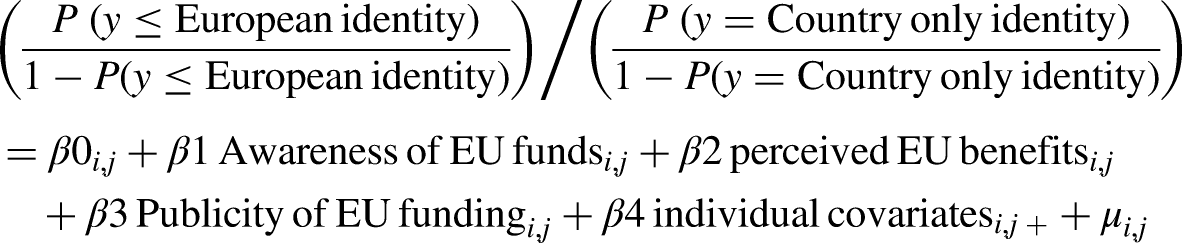

We are not claiming our analysis to be a conclusive test of the direction of causality (benefits → identity). We face the same methodological challenge as most previous studies that also have used cross-sectional data in order to test explanations for identity. Longitudinal or ideally panel-data would be required to test causality in a systematic way. To test our hypotheses, we cannot use Eurobarometer data since it does not include Cohesion Policy and identity questions. However, as we report in the Online appendix, neither awareness of funding nor perceived benefits are concentrated in regions with high levels of prior European identification but instead in regions that receive more EU funding. Further, it is theoretically intuitive that citizens increase their identification with Europe if they believe that they or their region have benefited from EU policies (Sanders et al., 2012). Considering that identity is driven by a range of factors beyond EU funding, benefits and awareness, we control for these factors in the following analyses in order to tease out the marginal impact of Cohesion Policy on European identity.
Dependent variable
Our dependent variable is the level of European identity. We focus on the cognitive dimension (self-categorization) of European identity, adopting a novel approach to measure the concept including various stages from a sole country identity to a sole European identity. Based on the classic ‘Moreno’ question used in Eurobarometer surveys, our survey (Q13) asks the following question: ‘Please listen to the following options and pick one that describes best how you see yourself. Do you see yourself as: country, country and European, European and country, European’.
Our data shows that across our regions a comfortable majority of citizens have some form of European identity (Figure 1). Almost half of our respondents (49%) think of themselves as having a mixed identity which puts their country before Europe (citizens of their country and citizens of Europe), 9% also have a mixed identity which puts Europe before their country and 9% of respondents think of themselves as Europeans. Only 32% of respondents have a sole country identity, which suggests that after we exclude those who refused to answer (1%) and those who do not know (1%), a strong majority of European citizens (67%) have some form of European identity. Few citizens consider themselves European first then national, and fewer exclusively European. These findings are consistent with Europe-wide Eurobarometer surveys, which show that European citizens have a stronger self-categorization with their nation first and Europe second – labelled ‘inclusive nationalism’ (Hooghe and Marks, 2005) or European ‘identity lite’ (Risse, 2010).
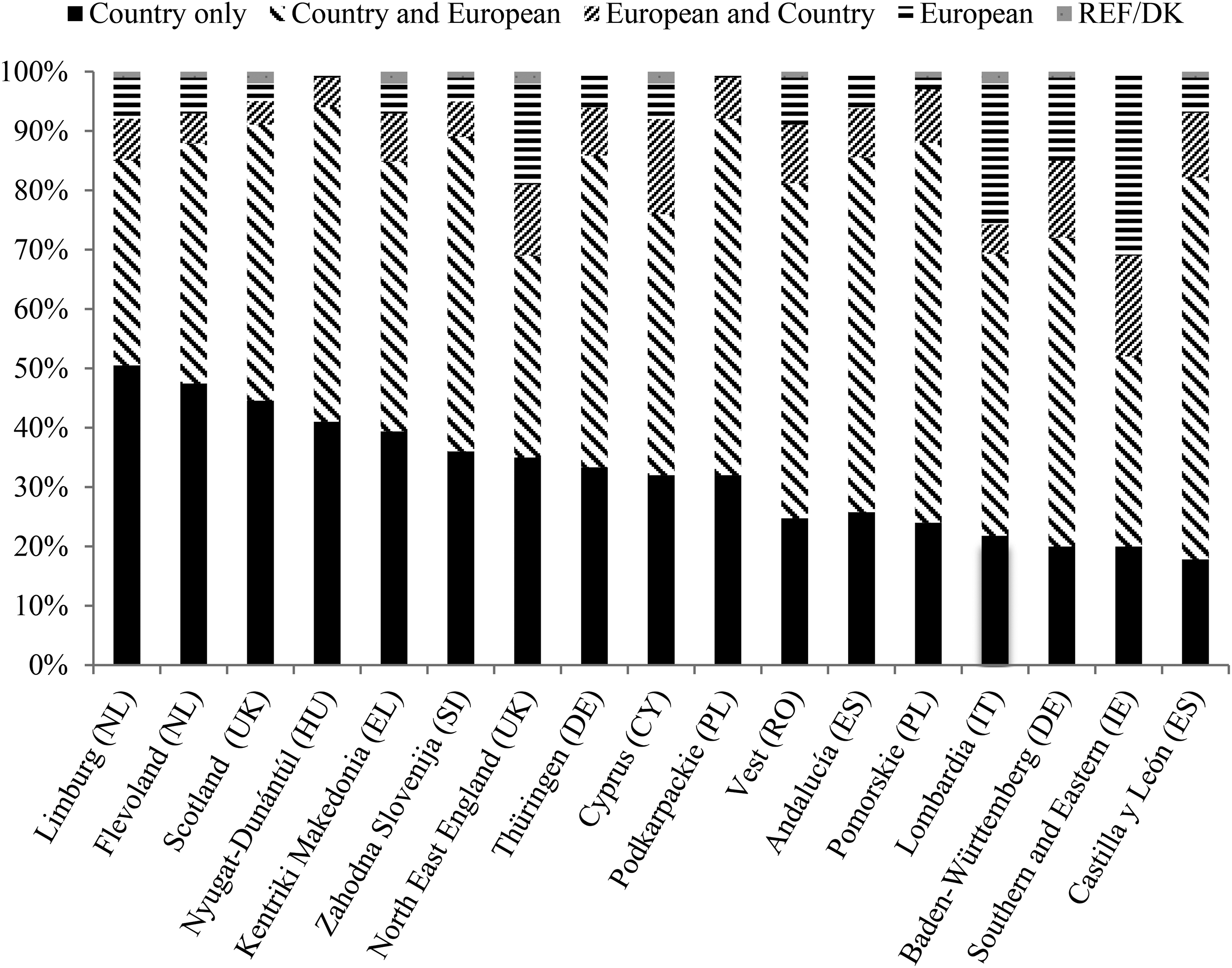
Predominant identity across regions.
We also look at different dimensions of identity by distinguishing cognitive identity (measured by self-categorization) from affective European identity (measured by the level of attachment to Europe). While other authors have combined the cognitive and affective dimension of identity in a single measure, this is problematic because it involves combining ordinal (level of attachment) and categorical measures (self-identification) in a single scale. Moreover, a key theoretical objective of this study is to empirically investigate differences in the relationship between EU funding with self-categorization and with attachment. Accordingly, we analyse the cognitive and attachment dimensions separately. 1
This operationalization of European identity has often been employed by other scholars (Ceka and Sojka, 2016; Citrin and Sides, 2004; Fligstein, 2009; Hooghe and Marks, 2004, 2005; Kuhn, 2012). While previous studies have recoded this question into a dichotomous variable distinguishing between exclusive national identification (‘nationality only’) and those who reported some sort of European identification, we adopt an approach which takes into account four options of self-categorization: country only, country and European, European and country and European only. This allows us to capture not only what explains the difference between exclusively national and some Europe identity, but also the drivers of stronger self-categorization with Europe. Since our sample size is large enough for our models to cope with a four-category dependent variable, there is no reason to artificially reduce variation by collapsing categories. As discussed below, robustness checks with a dichotomized dependent variable confirm the overall findings.
Independent variables
Our core independent variables of theoretical interest are Cohesion Policy awareness, perceived benefits and exposure to communication. To measure awareness, we asked respondents a separate question: ‘Have you heard about the following funds? [Yes; No; Don't Know (DK)]’ about each of the funds associated with Cohesion Policy – the European Regional Development Fund (ERDF), the Cohesion Fund (CF) and the European Social Fund (ESF).
We formulated three questions to measure perception of benefits from a personal as well as more general perspective, quite similar to the distinction between pocketbook and socio-tropic economic voting. The personal question reads: ‘Have you benefited in your daily life from a project funded by any of these three funds? [Yes; No, DK]’ while the more general measure of perceived benefits is covered by this question: ‘How do you think your region or city would have developed without EU funding? [Much better; Somewhat better; Same; Somewhat worse; A lot worse; DK]’. Finally, the country benefits question covers benefits from EU membership: ‘To what extent do you agree with the following statement: “My country has benefited from being a member of the European Union” [Strongly agree; Agree; Neither agree nor disagree; Disagree; Strongly disagree; DK]’.
To test our third hypothesis, we measured exposure to project advertising by asking whether a respondent has noticed any public acknowledgement of EU funding in their region or city (in the form of banners, placards etc.).
We also control for a range of other factors that have previously been shown to drive European identity. These relate to cognitive mobilization, transnational practices, political attitudes and socio-economic context. We outline the rationale and underpinning literature in the Online appendix.
Empirical results
The empirical results provide partial support for our first hypothesis that awareness of Cohesion Policy increases citizen's European identity, in line with cognitive mobilization theories of identity. Distinguishing between funds, those who have heard of the CF are more likely to develop a mixed identity: country and European or, even more so, an identity which places Europe before their national identity. By contrast, awareness of the ERDF and ESF funds are not strong contributors to the development of a European identity (see Table 1). Additional tests (see on-line appendix) show that awareness of ERDF impacts on European identity but its effect is weak and not entirely robust.
Explaining European identity.
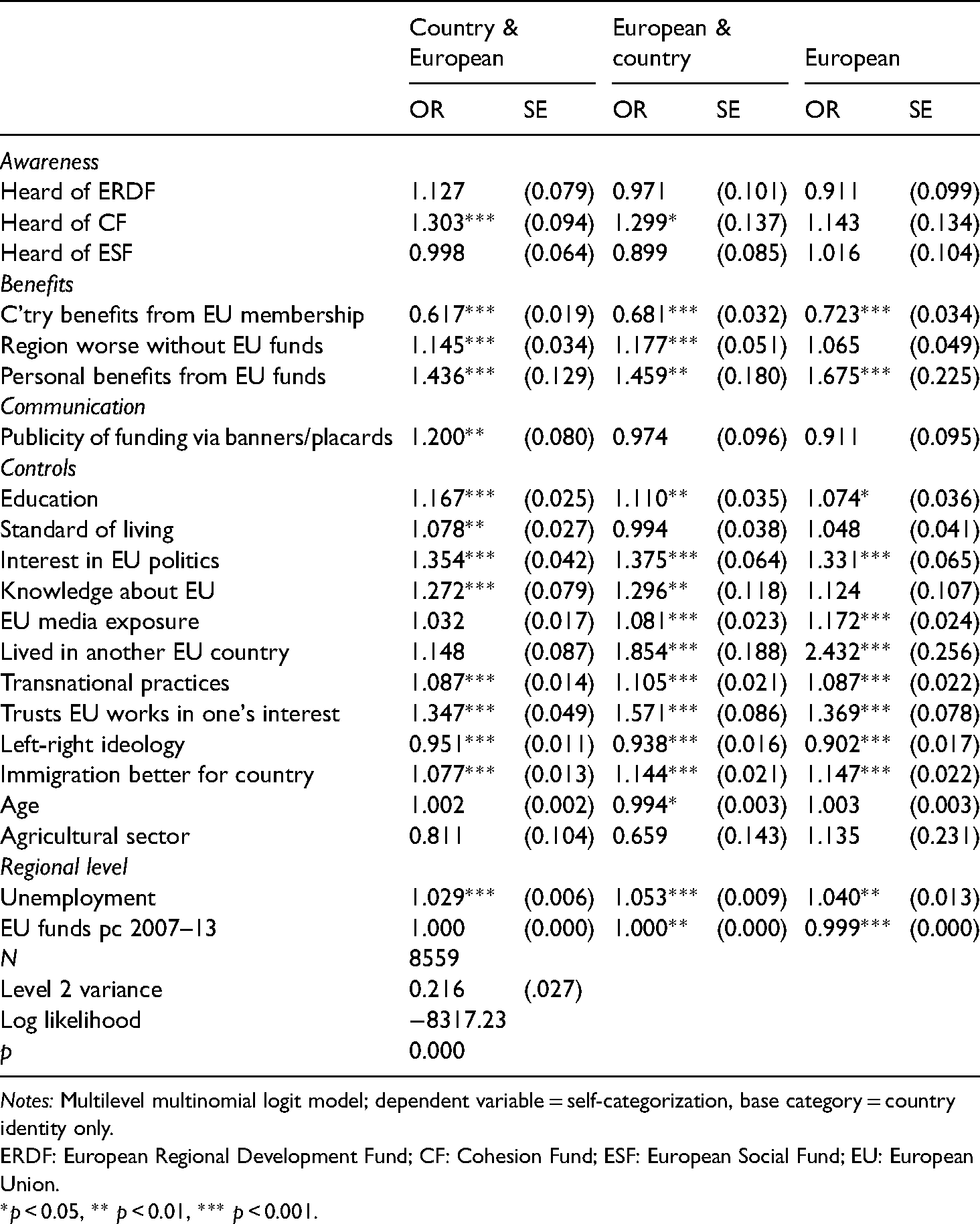
Notes: Multilevel multinomial logit model; dependent variable = self-categorization, base category = country identity only.
ERDF: European Regional Development Fund; CF: Cohesion Fund; ESF: European Social Fund; EU: European Union.
*p < 0.05, ** p < 0.01, *** p < 0.001.
Awareness of the CF has a strong association with European identity. In our sample, 10 out of the 17 regions have a 30% average awareness of this fund (see the Online appendix). The strong cognitive mobilization effect of this fund is most likely due to the greater visibility of the CF than the ERDF or ESF given its focus on large-scale transport and environmental infrastructure projects carrying large publicity banners and placards. In order to further clarify the relationship between publicity, awareness and identity, we conducted a mediation analysis. The results reported in the Online appendix confirm that EU identity levels are higher for those individuals who are aware of Cohesion Policy and awareness increases when individuals see banners acknowledging EU funding 2 . Out of those who heard of the CF, 72% have seen placards acknowledging EU funding. We also find that awareness of the CF is substantial in regions with a high allocation of funding and matters for the development of EU identity. 3 Exposure to EU funding publicity is relatively high in these cases, especially as banners and/or placards are mandatory for large projects over €500k.
Turning to our second hypothesis, we argued that the more benefits citizens perceive from the EU funds, the more likely they are to hold a European identity. Our results (see Table 1) show differentiation between individual and regional benefits from EU funds and country benefits from EU membership. In line with the instrumental rationality argument, perceived regional benefits influence the development of a mixed country and European identity. Those who believe that their region would have developed worse without EU funds tend to hold a mixed country and European or European and country identity, or even an exclusively European identity, over a sole country identity. When we consider the individual level benefits, the type of predominant identity changes. In addition to fostering a mixed form of European identity, perceived individual benefits stimulate a sole identification with Europe. The more individuals think they benefitted in their daily life from EU funds, the more they self-identity as European.
Surprisingly, those who think that their country benefitted from EU membership still have a predominant country identity. One explanation for this result might be that citizens want to take advantage of membership benefits but are unwilling to change their identity and do not welcome the development of the EU project. This is in line with previous research showing that individuals who think that their country benefitted from EU membership do not necessarily want further integration (Rose and Borz, 2016). In other words, country benefits from membership may work through instrumental rationality for endorsing membership but not for developing European identity. Another potential explanation for this relationship is that in our sample a vast majority of citizens who hold a European cognitive identity tend to reside in old member states. In fact, 85% of individuals who declare a sole European identity are citizens of old members states and a substantial percentage (63%) of these respondents do not think their country benefited from EU membership.
Our third hypothesis highlighted the influence of EU publicity on European identity. EU rules oblige projects to acknowledge EU co-funding through billboards, permanent plaques (in large projects) and posters with the EU emblem. Our results show that exposure to EU funding publicity increases the likelihood of holding a mixed (country and European) identity. The regional average for exposure to such banners is 51% while for some regions (in Poland and Hungary for example) over 80% of respondents declare they have seen banners acknowledging EU funding (see the Online appendix).
Finally, in order to test the fourth hypothesis, in Table 2 we explain attachment to Europe by looking at the same factors (awareness, benefits, communication) as in our previous model explaining European self-categorization (see Table 1). Table 2 confirms that attachment to Europe is different from self-categorization with Europe. Except for a small impact from the ESF (not confirmed by our robustness analysis), none of our previous awareness, benefits or communication of Cohesion Policy explanations increase significantly citizens’ attachment to Europe. What matters most significantly for attachment are factors related to cognitive mobilization (interest in EU politics or past residence in an EU country) and trust in the EU. Our analysis thus supports H4. Individual self-categorization with Europe and attachment to Europe are triggered by different explanatory mechanisms, and the calculative benefits, cognitive awareness and communication of Cohesion Policy do not increase the likelihood of European attachment.
Explaining attachment to Europe.
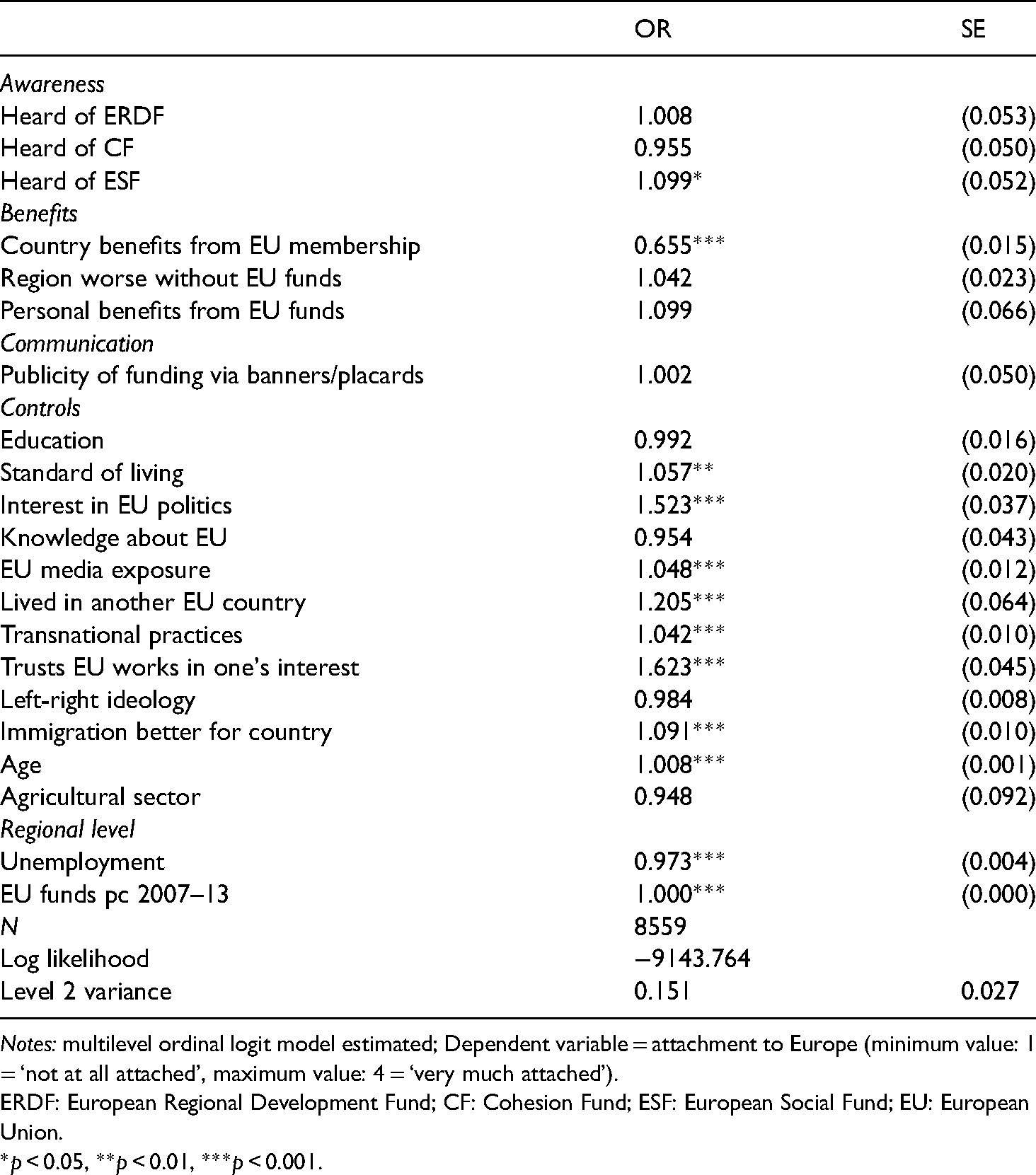
Notes: multilevel ordinal logit model estimated; Dependent variable = attachment to Europe (minimum value: 1 = ‘not at all attached’, maximum value: 4 = ‘very much attached’).
ERDF: European Regional Development Fund; CF: Cohesion Fund; ESF: European Social Fund; EU: European Union.
*p < 0.05, **p < 0.01, ***p < 0.001.
Robustness analysis
In order to test the validity of our results (cognitive identity as self-categorization), we rerun our core model with alternative measures of European identity, such as attachment to Europe, attachment to the EU, which citizens may perceive differently. First, in order to test the robustness of our self-categorization results, we rerun the same multilevel multinomial model from Table 1 with a dependent variable based on three categories (country, all forms of mixed identity and European identity) and then we estimate a multilevel logit model with a dummy dependent variable on self-categorization (see the Online appendix). In the latter case we cumulate all forms of European identity, including the mixed ones and we contrast them to the country only identity. The Online appendix reports the results of a multilevel logit model with a dummy variable (all forms of European identity vs country identity). We include the same explanatory variables as in our main model (Table 1) and our key results hold. The only exception is the effect of funding publicity via banners: the coefficient becomes insignificant only when all categories of identity are collapsed into a dummy variable (country vs all forms of EU identity). Awareness of the CF and regional benefits from EU funds all contribute towards developing a European identity. As expected, cognitive mobilization and instrumental benefits promote European identity.
In order to visualize the effects of our predictors (see the Online appendix), Figure 2 illustrates the average marginal effects of each explanatory factor on the probability of developing a European identity. Apart from the negative relationship between country benefits from EU membership and European identity, it highlights the importance of awareness of the CF and the regional and individual benefits from EU funds for identity. Awareness of CF and personal and regional benefits have a positive effect on all forms of self-categorization with Europe along with cognitive mobilization factors (interest in EU politics or past living experience in another EU country) and trust in the EU.
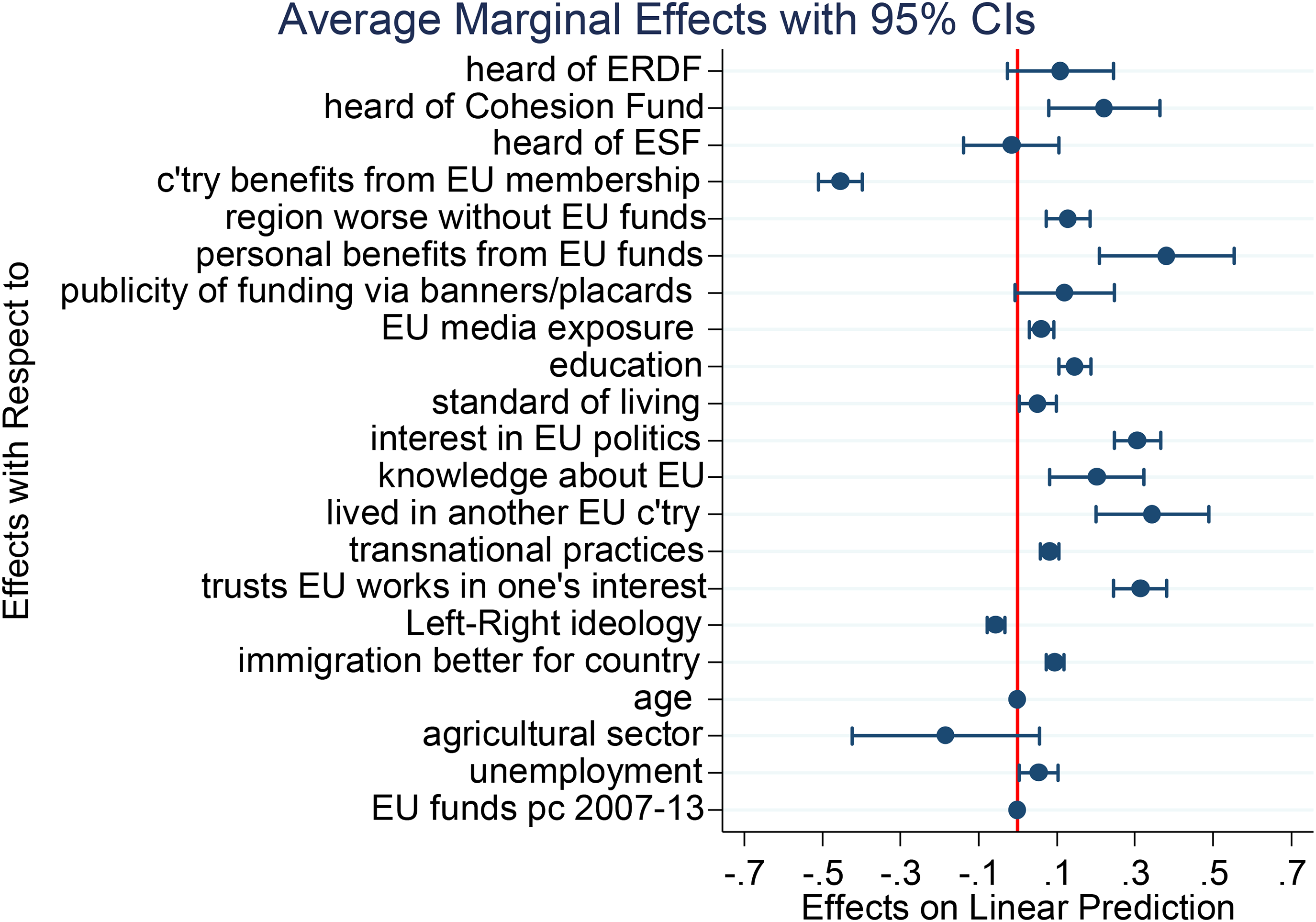
Explaining European cognitive identity – self-categorization.
Secondly, we also test whether attachment to Europe is comparable to attachment to the EU with respect to our explanatory model. We run the same model from Table 1 with the respective Europe and EU dummy dependent variables (results are reported in the Online appendix). In order to visualize the difference, we plot the average marginal effects of our predictors on attachment to Europe in Figure 3 and then on attachment to the EU in Figure 4. Figure 3 illustrates that attachment to Europe relies on cognitive mobilization factors. None of the awareness, publicity of funding or regional perceived benefits explanations matter for citizen's attachment to Europe.
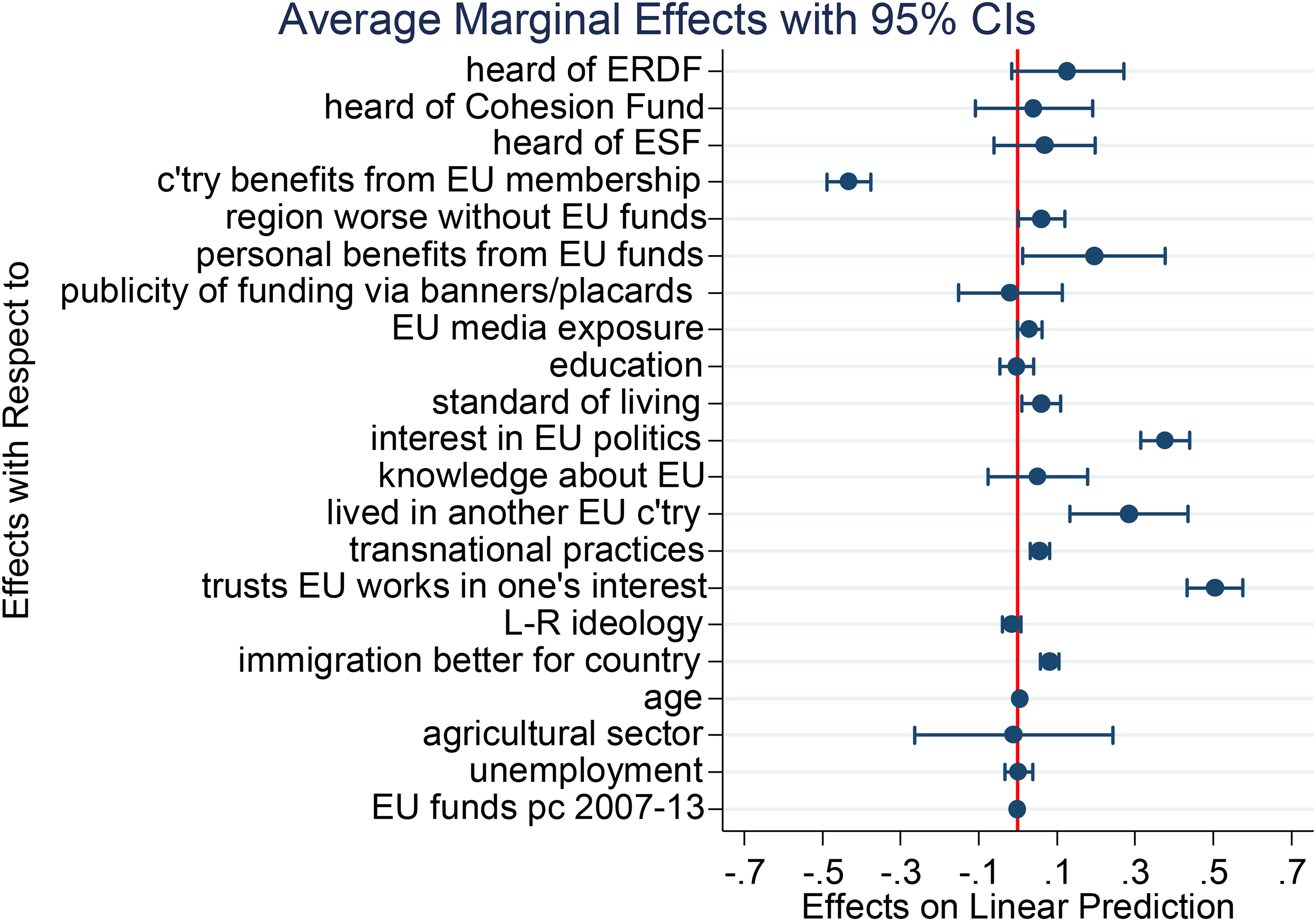
Explaining European affective identity – attachment to Europe.
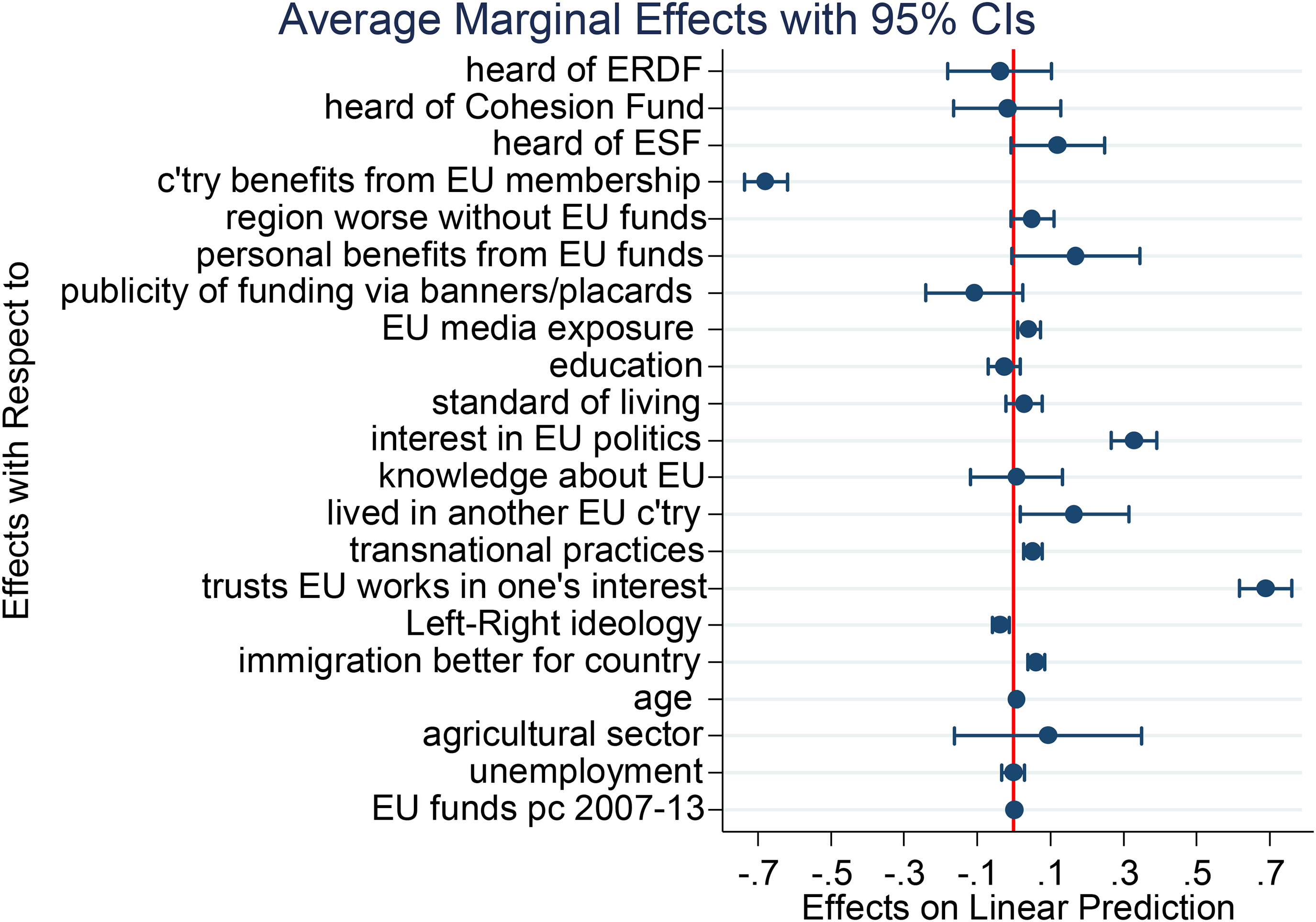
Explaining European affective identity – attachment to the EU.
We repeat the same analysis for attachment to the EU (see the Online appendix) and plot the average marginal effects in Figure 4. Overall, we can conclude that both attachment to Europe and attachment to the EU are driven by cognitive mobilization. Attachment to the EU however is much more related to trust in whether the EU operates in citizen's interests. Furthermore, as our analysis in Table 1 and Figure 2 show, all forms of self-categorization with Europe have a more complex explanation, which apart from cognitive mobilization also take into account awareness of EU funds, benefits and communicative influences.
Further robustness checks were undertaken through a model which excludes the Hungarian outlier region and through structural equation modelling. These models confirm our key findings (see analysis in Online appendix) and further clarify that EU funding publicity increases individual awareness of the policy which in turn positively affects European identity.
Conclusion
This article investigated the relationship between EU Cohesion Policy and European identity, using a new and representative survey of 8559 citizens in 17 EU regions from 12 EU member states. Our approach to measure European identity considers various stages in the shift from a sole identification with one's home country to a mixed national and European identity, to sole identification with the EU. Multinomial analysis was employed to estimate the effects of cognitive, instrumental and communicative mechanisms operating through Cohesion Policy on the likelihood that a respondent develops a European identity.
This article contributes to the European identity literature in several ways. First, we demonstrate how the EU's largest and most redistributive budgetary policy contributes to European identity. We argued that cognitive mobilization (awareness of Cohesion Policy funds), instrumental calculations (perceived benefits to individuals and regions) and communication (exposure to publicity on EU-funded projects) impact on the development of European identity. Previous studies have only explored the relationship between objective indicators of instrumental benefits – Cohesion Policy funding allocations to countries or regions – with political support for or identification with Europe. Through the new data provided by our survey, we were able to run more comprehensive tests by incorporating subjective attitudes at the individual level, as well as objective data on allocations at the regional level. This allows us to investigate closer what the EU does in practice, the perceived consequences for the everyday lives of citizens and the influence on their identity.
Second, our findings provide evidence of a positive association between Cohesion Policy attitudes and European identity. This contrasts with studies that have not found a positive and significant relationship between Cohesion Policy funding and European identity (Verhaegen et al., 2014; Capello and Perucca, 2019), but which have not investigated the role of well-known cognitive, instrumental and communicative drivers of identity through Cohesion Policy. We found that the perceived benefits of Cohesion Policy for citizens and for their region's development contribute to European identity. Cognitive awareness of the CF in particular, which co-funds large-scale and highly visible infrastructure projects, also contributes to citizens' identification with Europe. Turning to communication, exposure to Cohesion Policy publicity (such as EU banners and placards on EU projects) increases the likelihood of holding a European identity. However, while Cohesion Policy contributes to (cognitive) self-categorization with Europe, it does not contribute to affective or emotional attachment to Europe or the EU.
There are several policy implications for EU budget and Cohesion Policy reform. First, if EU policymakers want to connect with citizens by promoting identification with Europe through the EU budget, Cohesion Policy provides an effective instrument for doing so. A second implication is the importance of communication for increasing awareness of EU policies and European identity. Publicising EU funded projects contributes to awareness of Cohesion Policy and has both direct and indirect effects on European identity. Improving and refocusing the publicity, symbols and messaging around EU funding – such as reducing the technical jargon and promoting more visually appealing publicity focused on the achievements of EU funding – could improve public awareness, perceived benefits and identification with the EU. More generally, these findings substantiate the emphasis placed by EU institutions in recent years on raising the visibility of EU funding and upgrading communication in order to connect with citizens.
Finally, this study demonstrates the value of survey research for evaluating Cohesion Policy communication strategies. Unlike the national Eurobarometer surveys of Cohesion Policy awareness, representative citizen surveys at the regional level should be commissioned given the policy's subnational focus and reach. Moreover, the existing Flash Eurobarometer surveys of citizens’ awareness and perceptions of Cohesion Policy should include additional questions on attitudes to and identification with the EU in order to enable the investigation of causal relationships over time. If survey questions on perceptions of Cohesion Policy as well as on attitudes towards the EU and European identity were included repeatedly over coming years, researchers would be able to study how changing European identities (at least at the aggregate level) respond to changes in EU funding and perceptions. This would help to establish causal relations between cognitive, instrumental and communicative dimensions of Cohesion Policy attitudes with identity more robustly than the cross-sectional data used in this study. Future research efforts could also employ experimental designs to investigate the impact of Cohesion Policy communication by exposing study participants to different messages and branding under treatment and control conditions (e.g. Hernández and Pannico, 2020), and cross-validate our findings by analysing a wider selection of European regions.
Supplemental Material
sj-docx-1-eup-10.1177_14651165221076444 - Supplemental material for The impact of EU Cohesion Policy on European identity: A comparative analysis of EU regions
Supplemental material, sj-docx-1-eup-10.1177_14651165221076444 for The impact of EU Cohesion Policy on European identity: A comparative analysis of EU regions by Gabriela Borz, Heinz Brandenburg and Carlos Mendez in European Union Politics
Supplemental Material
sj-dta-2-eup-10.1177_14651165221076444 - Supplemental material for The impact of EU Cohesion Policy on European identity: A comparative analysis of EU regions
Supplemental material, sj-dta-2-eup-10.1177_14651165221076444 for The impact of EU Cohesion Policy on European identity: A comparative analysis of EU regions by Gabriela Borz, Heinz Brandenburg and Carlos Mendez in European Union Politics
Supplemental Material
sj-do-3-eup-10.1177_14651165221076444 - Supplemental material for The impact of EU Cohesion Policy on European identity: A comparative analysis of EU regions
Supplemental material, sj-do-3-eup-10.1177_14651165221076444 for The impact of EU Cohesion Policy on European identity: A comparative analysis of EU regions by Gabriela Borz, Heinz Brandenburg and Carlos Mendez in European Union Politics
Footnotes
Acknowledgements
We would like to thank the editors and the anonymous reviewers for excellent comments and guidance.
Funding
The authors disclosed receipt of the following financial support for the research, authorship, and/or publication of this article: This article is the result of research conducted under the COHESIFY project (February 2016-April 2018) which has received funding from the European Union's Horizon 2020 research and innovation programme under grant agreement No. 693427).

Supplemental material
Supplemental material for this article is available online.
Notes
References
Supplementary Material
Please find the following supplemental material available below.
For Open Access articles published under a Creative Commons License, all supplemental material carries the same license as the article it is associated with.
For non-Open Access articles published, all supplemental material carries a non-exclusive license, and permission requests for re-use of supplemental material or any part of supplemental material shall be sent directly to the copyright owner as specified in the copyright notice associated with the article.
