



Abstract
Recent transnational challenges have spurred calls for an enhanced European Union (EU) social agenda. However, citizens in countries with strong welfare systems fear that increased EU involvement could trigger a ‘race-to-the-bottom’ in benefits. This article examines whether these concerns can be mitigated by guaranteeing existing welfare standards. Using a vignette experiment in Belgium, the analysis explores public preferences for welfare governance within the EU multilevel system, conditional on safeguarding benefit levels. The findings show that, when benefit levels are guaranteed, support for the presented welfare policy is generally neutral to positive across governance levels. This suggests that fears of a ‘race-to-the-bottom’ can be alleviated when citizens are confident that welfare standards will be maintained. Despite hesitant endorsement of alternative governance arrangements, preference for the status quo persists.
Introduction
French Prime Minister Guy Mollet advocated building a truly Social Europe in 1956. He proposed the harmonization of social regulations and fiscal responsibilities among all member states of the European Community for Coal and Steel (Moss, 1998). Despite his efforts, his vision did not gain traction. Ultimately, the emerging European Economic Community prioritized economic cooperation, leaving member states to manage their national social protection policies independently (Scharpf, 2002). From today's perspective, one could argue that this was a missed opportunity. At the time, European welfare states were more closely aligned, making it feasible to find a unified approach. Today—nearly 70 years and several enlargement rounds later—this proves to be more complex (Hemerijck, 2023).
With the outbreak of the Euro area crisis in 2009/2010, the issue of the European Union's (EU) social responsibility has re-entered the political arena. It has gradually became evident that, alongside reforms within the European Economic and Monetary Union, there is a need for more social balancing (Zeitlin and Vanhercke, 2018). Yet, all the policies adopted at that time—like the European Pillar of Social Rights—lack a strong legal basis. As the Covid-19 pandemic unfolded, the necessity of a common EU social agenda has become even more pressing. To mitigate the economic consequences of the pandemic, the EU introduced Support to mitigate Unemployment Risks in an Emergency (SURE). However, SURE was only a temporary instrument. As a result, there is currently no legally binding, enduring policy at the EU level for cross-country welfare provisions. Instead, welfare provisions within the EU remain under the authority of national (or subnational) policymakers.
This raises the question of whether the current distribution of competences serves the public interest or if citizens would prefer to advance EU integration in the social sphere. Existing research suggests that support for an expanded EU social dimension extends beyond periods of crisis (Baute and Pellegata, 2023; Burgoon et al., 2022). However, what also becomes evident is that such proposals for a stronger EU social agenda encounter resistance in countries with well-developed welfare states, where people fear losing their currently (high) benefits in the event of EU-wide regulation (Baute, 2022; Mau, 2005). This tension between public support for greater EU social responsibility and concerns over preserving national welfare standards warrants further attention.
In this article, I argue that citizens could agree to a shift in welfare competences to the EU level (compared to the national and sub-national levels), if their current level of benefits is guaranteed. To test this argument, I analyse pre-registered experimental survey data from Belgium. The experiment randomly varies both the nature of the welfare policy in question and the political level at which it should be enacted and delivered. This design allows for causal conclusions on whether—provided benefit rates remain unchanged—the type of policy or the respective political level influence individual preferences for welfare provision. The survey was carried out in August and September 2023. Besides the direct effects of the experimental treatments, I also test whether a person's geographic attachment plays a moderating role.
Consistent with theoretical expectations, the findings suggest that when citizens are assured that their current welfare benefits will be preserved, they generally evaluate the presented governance proposals neutrally to positively. On average, respondents express a neutral stance towards the EU as a welfare provider, suggesting limited resistance to a more socially oriented Europe within a well-established welfare state like Belgium. The guarantee of current benefit levels alleviates fears of a ‘race-to-the-bottom’ in welfare standards. Preferences for EU versus subnational governance show no significant differences. However, despite the guarantee of stable benefit levels, the national level remains the preferred locus for welfare policy implementation. This suggests that hesitancy towards granting additional welfare competences to the EU is driven more by a preference for the nation-state as the primary provider than by resistance to the EU itself. An exception is childcare benefits, which currently fall under the authority of Belgium's subnational communities. In this policy area, citizens show no clear preference between governance at the arrondissement and federal levels. This suggests that when shifts in welfare governance have already occurred, citizens tend to adapt quickly. Notably, these core findings remain robust regardless of attachment to the respective governance entities.
This article makes three key contributions. First, it bridges European integration theory and literature on national welfare provision by examining whether citizens residing in a country with a strong welfare state are open to transferring welfare responsibilities within the EU multilevel system. The findings suggest that, while Belgian respondents show limited resistance to a more integrated Social Europe, they still prefer the status quo of welfare governance. Second, by employing an original survey experiment, the study enables the first causal inferences regarding public preferences for welfare governance within the EU multilevel framework. Third, it provides insights that could inform future European integration efforts, offering strategic guidance for EU and (sub-)national policymakers and contributing to social stakeholders’ initiatives. By addressing public concerns—such as ensuring the maintenance of national welfare standards under EU governance—further integration could proceed with minimal resistance.
Welfare provision in the EU multilevel system
By far the biggest share of government expenditure within the EU is spent on welfare provision (Eurostat, 2024; see the Online appendix). Welfare provision includes a variety of services, such as healthcare, pensions, unemployment insurance, accident insurance, and family assistance (Häusermann, 2018). Public preferences for national welfare provision appear to be quite stable over time. Public support for state responsibility for the sick and elderly is comparatively highest and backing for families is also strong; however, support for unemployment benefits is lower as the unemployed are often perceived as less deserving. The Covid-19 pandemic led to temporary increases in preferences for greater government responsibility in certain areas of welfare provision (Ebbinghaus et al., 2022). Simultaneously, citizens’ perceptions of their state's effectiveness exhibited noticeable variability, with evaluations improving during the pandemic compared to pre-pandemic levels (Ares et al., 2021). Such temporal fluctuations in perceived effectiveness may create opportunities for reconsidering the allocation of welfare responsibilities within the EU's multilevel system.
The EU itself currently possesses only limited competences in the policy field of welfare provision. Most political decisions in the realm of welfare policies are solely the responsibility of the member states, aligning with the desires of many countries (Schreurs, 2023). Over time, there have been numerous attempts to broaden the EU's influence in the social sphere. This was mostly pursued by means of common guidelines, designed to promote harmonization between the individual welfare states. Examples of this are the Open Method of Coordination, introduced in the 1990s, which, as the name suggests, aims at coordination between the states. During the Juncker Commission presidency, the European Pillar of Social Rights was introduced (2017), and a few years later, the associated Action Plan was launched by the von der Leyen administration (2021). What all these initiatives share, however, is the lack of concrete legal enforcement. Put differently, the final implementation of these soft laws remains in the hands of national policymakers. It was the Covid-19 pandemic that triggered a shift in the discourse on the EU's social responsibility.
In the wake of the pandemic, and in addition to the EU crisis instruments focusing on medical supplies and economic progress, the community also introduced a tool directed towards a core policy of national welfare states. In 2020, for the very first time, a so-called ‘buffer mechanism’ (Miró et al., 2024) for national unemployment schemes was installed: SURE. 1 Member countries facing economic pressure could access SURE to cap the costs associated with rising unemployment figures. In this case, the EU did not act as a direct provider of unemployment benefits but operated indirectly. Despite this revolutionary turn in the EU's social impact, the instrument was not designed to be permanent. Instead, it was planned solely for the acute period of the pandemic and its more immediate economic consequences.
Based on this, the EU's social dimension is still underdeveloped to date, with EU-wide social initiatives either remaining legally non-binding or being implemented on a temporary basis.
Yet, is this distribution of political competences truly in the public interest, or would citizens prefer to advance EU integration in the social sphere as well?
Public preferences for welfare provision in the EU multilevel system
Although the EU is often criticized for its democratic deficit, studies have shown that the voices of its citizens are indeed heard and exert influence over political decisions (Lahav, 2004; Meijers et al., 2019). Therefore, it is pertinent—particularly in policy domains directly impacting individuals’ daily lives—to solicit and incorporate their viewpoints (Busemeyer and Garritzmann, 2022; Schreurs, 2023). Existing studies have already investigated whether citizens would be prepared to transfer more welfare state responsibilities to the EU. For example, several academic publications were dedicated to the idea of installing EU-wide unemployment re-insurance. Such a policy instrument receives generally positive public assessment, especially when the programme is generous, comes with no additional taxes, and country as well as individual level conditionalities are attached to its activation (Burgoon et al., 2022). Other positively evaluated ideas are the establishment of an EU-wide support scheme directed towards the poor (Baute and Meuleman, 2020; Reinl et al., 2024a), as well as the setup of a uniform EU welfare system (Gerhards et al., 2016).
Yet, past research highlights significant cross-country differences in public support for EU welfare policies. These variations emerge not only between economically stronger and weaker member states but also across distinct welfare regime types. For example, individuals in countries with well-established welfare states tend to show lower levels of approval of social rights being managed at the EU level. In these contexts, citizens frequently express concerns about a potential ‘race-to-the-bottom’— the perceived risk of national welfare systems deteriorating under EU-wide regulation (Beaudonnet, 2014). Similarly, Burgoon (2009) finds that welfare generosity correlates with expectations of benefit losses under enhanced EU governance, particularly in areas like poverty alleviation and social exclusion. Reinl (2022) further demonstrates that public support for a uniform EU welfare system varies significantly, with strong approval in Greece contrasting with scepticism in Germany and Austria.
Following from that, previous studies indicate that people in countries with already generous welfare systems have little or no interest in EU-level welfare provision. Often, individuals in these countries simply do not feel the need for a change because their national system works well, or they even fear a deterioration should a shift towards the EU level occur. Put differently, people are applying simple cost-benefit calculations. If the EU could assist in enhancing their current welfare provision, they will be more inclined to delegate additional competences to the EU, as opposed to situations in which the costs outweigh the subsequent benefits (Baute and Meuleman, 2020; Beaudonnet, 2014; Mau, 2005). This raises two key research questions: What happens when people are assured that their current level of benefits will be maintained? Does the responsible political level still shape citizens’ preferences in such cases?
Framing policies with explicit trade-offs can increase public acceptance of welfare reforms. By strategically offering compensatory measures, policymakers can mitigate reform opposition, promoting smoother governance of welfare policies (Häusermann et al., 2019). Such compensatory strategies may also be instrumental in reducing public apprehension regarding the transfer of welfare responsibilities within the EU multilevel system. If people are assured of current levels of welfare provision, any form of governance is likely to face only limited resistance.
The vignette experiment
To examine whether EU citizens would support reallocating welfare policy competences under specific conditions, a pre-registered 2 vignette experiment 3 was developed. The experiment randomly manipulates the political level responsible for implementing welfare policies and assesses preferences across various policy domains. Its design is unique and, to the best of the author's knowledge, has not been conducted for any other country or target group.
At the outset of the experiment, each respondent was presented with an identical introductory text that briefly outlines a political issue currently under discussion. As a result of the numerous crises in Europe in recent years, people started to think about the future of welfare state policies. Proposals have been made concerning the political level at which certain policies should be delivered. Some suggest enacting and delivering all [childcare/ healthcare/ unemployment/ pension] related benefits at the [arrondissement/ region/ national/ EU] level. The benefit rates would not differ from the current scheme.
The decision to include these categories in the two experimental treatments was driven by several key considerations. Regarding the type of welfare policy, focusing solely on general support for welfare provision would have overlooked important nuances arising from the diversity of welfare policies. To address this, the experiment selects four policy fields as representative cornerstones of welfare states. While other policies could have been considered, this selection offers a balanced representation of key demographic groups, including the elderly, youth, and unemployed. Regarding the governance level, the experiment differentiates between four political levels to capture the EU's multilevel structure. Respondents were not informed whether the policy presented is currently enacted and delivered at the specified governance level. This deliberate design choice ensures consistency across vignette presentations. The potential influence of respondents’ awareness of current governance arrangements on their policy preferences is considered in the interpretation of the results.
Following the presentation of the proposed policy, participants were asked whether they agree or disagree with the given proposal. The response scale runs from 1- strongly disagree to 5- strongly agree. Respondents were not provided with a non-response option.
Afterwards, the procedure was repeated one more time. Once again, the respondents saw a policy proposal and were asked to choose whether they agree or disagrees with its content. The presentation of this second proposal was introduced with the following words ‘In a different proposal, some suggest enacting and delivering […]’. No respondent saw the same policy proposal twice, and they were prohibited from revisiting the first round after progressing to the second. Upon completing both experimental questions, respondents were debriefed and informed that the proposed scenarios are purely fictitious and not part of any ongoing policy discussion.
The case of Belgium
A country with a well-developed welfare state and highly autonomous subnational entities provides an ideal testing ground for investigating the research questions at hand. The first aspect is relevant to capture preferences for welfare governance within the EU multilevel system in a setting where people are least likely to perceive a need for change. The second aspect helps distinguish the allocation of welfare authority, not only along the national-EU divide but also by considering subnational structures.
The Belgian welfare state is classified as conservative (Esping-Andersen, 1990; Van Kersbergen and Kremer, 2008), with expenditure for social protection among the highest in the EU (Online appendix). Literature suggests that, in this context, citizens’ satisfaction with the current system and scepticism towards EU involvement in welfare policies are likely to be pronounced (Gerhards et al., 2019). Supporting this, a 2014 public opinion survey shows a stable level of trust in the national social security system (Baute et al., 2019). Furthermore, data from the European Social Survey (2016/2017) indicates that most Belgian respondents fear lower benefits and services if more welfare decisions are made at the EU level (ESS Round 8, 2016).
Although the majority of welfare state policies in Belgium are still decided and administered at the federal level, an OECD report (OECD, 2019) shows that Belgium has the highest share of public investment carried out by subnational policymakers among all OECD countries. The Sixth State Reform, negotiated in 2011 and implemented beginning in 2014, transferred responsibility for childcare allowances to the Belgian communities, removing it from federal jurisdiction (Federale Overheidsdienst - Sociale Zekerheid, 2024). In contrast, the federal government retains full authority over benefits related to pensions, healthcare, and unemployment. 4
Taken together, these insights position Belgium as a particularly interesting case study. On the one hand, its citizens are unlikely to feel an urgent need for change in welfare provision and, instead, fear a ‘race-to-the-bottom’ under EU governance. On the other hand, Belgians are already accustomed to shifts in welfare provision due to previous decentralization processes, which could make them more open to future changes in welfare governance.
Public preferences for welfare provision: A multi-level and multi-dimensional perspective
Experimental treatment effects
Research indicates that citizens often approach proposed changes to social policy jurisdiction with heightened scepticism, particularly when such changes threaten to reduce current benefits (Mau, 2005). This article, however, employs an experimental framework that explicitly assures respondents that the proposed policy will uphold existing standards. Consequently, I anticipate generally positive receptions of the policy proposals across all presented policy types and levels of governance. Respondents are likely less concerned about which level of governance is responsible for which welfare policy, as long as existing benefits are preserved, thereby alleviating fears of a ‘race-to-the-bottom’ scenario.
H1: Support for the policy proposal is expected to be high, irrespective of the policy type or political level. H2a: Support for the policy proposal is expected to be higher for more economic welfare policies (unemployment) and lower for policies targeting the weakest of the society (childcare, healthcare, pensions). H2b: Support for the policy proposal is expected to be lowest for pension benefits compared to all other policies. H3: Support for the policy proposal is expected to be highest if it is located at the national level followed by the subnational levels and the EU. H4: Support for enacting and delivering a policy proposal at the EU level is expected to be higher for more economic welfare policies (unemployment) and lower for policies targeting the weakest of the society (childcare, healthcare, pensions).
Yet, when examining the approval of specific policy proposals, I anticipate uncovering more nuanced differences in preferences. Welfare policies encompass a broad spectrum of initiatives targeting diverse demographic groups. The experiment analyzed in this article aims to represent this diversity adequately. While existing benefits are guaranteed, concerns may still arise regarding potential negative consequences of shifting competences. Respondents are likely to prioritize safeguarding the status quo, particularly for the most vulnerable segments of the population (Van Oorschot and Roosma, 2017). Consequently, support for transferring responsibilities in unemployment policy is expected to be higher than for other policy areas, where maintaining the status quo is likely to be even more desirable (Berg, 2007).
Moreover, any proposed alteration to the pension system should be regarded with particular scrutiny. Nearly all respondents anticipate relying on pension benefits at some stage, a circumstance not necessarily applicable to other welfare programs. Thus, the pension system should be perceived as especially deserving of protection, making respondents less inclined to endorse innovations in this domain.
In a country with a well-established welfare state, adherence to past practices is likely to ensure the continued delivery of welfare benefits (Berg, 2007). Currently, the majority of welfare benefit distribution in Belgium remains under the jurisdiction of the federal government, highlighting its enduring stability. Additionally, in recent years, there has been a notable transfer of welfare policy responsibilities to the subnational levels. Given this context, it is reasonable to assume that, despite a guarantee of current benefits in the vignette text, priority should be given to national and subnational governance over the EU in the enactment and delivery of welfare policy measures. This leads to the following hypothesis:
Lastly, this study is explicitly interested in welfare policies likely to garner support or face rejection, particularly regarding the EU level. While studies like those of Baute et al. (2019) and Baute and Pellegata (2023) have assessed public support for EU-level welfare policies, they did not experimentally differentiate between policy domains nor account for a potential shift from current (sub-)national policies to EU-level initiatives, leaving a significant gap. It is hypothesized that public backing is stronger for transferring economy-related welfare policies to the EU, given the EU's prior involvement in this area. For example, the unemployment buffer mechanism SURE, implemented during the Covid-19 pandemic, received positive public reception (Burgoon et al., 2022), even in wealthier regions (Reinl et al., 2023). A similar response is expected in this article's experiment.
Heterogenous spatial attachment: heterogenous policy preferences?
Research suggests that stronger self-identification with Europe positively influences public support for a more robust EU social dimension, both in general (Berg, 2007; Mau, 2005) and in specific welfare policy areas, including childcare, unemployment benefits, and minimum income at the EU level (Baute et al., 2019). Hence, it is expected that feelings of identity moderate the effects of the experimental treatments. Specifically, emotional attachment to a particular level of governance is anticipated to amplify the positive effect of that political level on the overall evaluation of a given policy proposal. Conversely, a lack of attachment to a specific spatial entity may reduce support for implementing the given welfare policy at that political level.
H5: The effect of the political level on support for the policy proposal depends on the respondent's attachment to that political level.
Data and methods
Data
The survey data collection took place in August/September 2023. 5 Ipsos collected the data via its Ipsos iSay Online Access Panel. Before the respondents began answering the questions, they saw an introductory text that roughly described what the survey was about, how long it would take and how their data would be protected. The full introductory text is presented in the Online appendix. The survey featured both experimental and non-experimental components. The vignette experiment analysed in this article was installed at the end of the questionnaire so as not to distort the response behaviour on the non-experimental questions. Respondents were not allowed to skip any questions. All respondents were over 18 years old, and the survey time took up to seven minutes. The survey language was either English, Flemish, or French (free choice). In total 1250 respondents were interviewed in pre-selected arrondissements (NUTS 3 level). The decision to gather very fine-grained local data was influenced by recent studies on EU solidarity. These studies have highlighted that, alongside the national context, regional disparities shape the EU solidarity preferences of local residents (Reinl et al., 2023, 2024b). While existing studies primarily focused on broader regional levels, such as NUTS 1/2, this article examines individual NUTS 3 regions in greater depth. This approach aims to uncover additional effects, as mapping respondents’ immediate surroundings more closely enhances the accuracy of their preference predictions (Bisgaard et al., 2016).
The arrondissements included in the survey are Brussels-Capital (250 respondents), Gent (250 respondents), Nivelles (250 respondents), Tongeren (250 respondents) as well as Virton, Thuin, and La Louvière (250 respondents for these three regions together). These arrondissements were selected because they represent the economically strongest (Gent, Nivelles) and weakest (Tongeren, Virton, Thuin, La Louvière) arrondissements of the greater regions (NUTS 1) of Flanders and Wallonia. 6 In the case of the economically most disadvantaged arrondissements in Wallonia, individuals from the three poorest areas were aggregated because the single poorest arrondissement or the two poorest combined had small populations, making it unfeasible to garner enough respondents for the survey. It was also not possible to collect more localized survey data for Brussels-Capital. The investigation focuses on both the economically most affluent and the most deprived arrondissements (NUTS 3) within the broader regions (NUTS 1), as this methodology encompasses the widest possible spectrum of local economic heterogeneity. Furthermore, given the high level of autonomy vested in the Belgian greater regions (NUTS 1), residing in a less affluent area in either Flanders or Wallonia may reveal discernible disparities.
The data collection stopped once it reached the required number of respondents per arrondissement. Data collection was based on quotas for respondents’ gender (male/female), age (five age groups) and education (three levels) in all selected arrondissements (based on national level quotas).
Methods
The five-point Likert scale following the vignette experiment is the dependent variable used in this article's empirical analyses. Based on the design of the experiment, the key explanatory variables to test hypotheses 2(a, b), 3 and 4 are the randomly assigned experimental treatments. Given the anticipated heterogeneous treatment effects related to emotional attachment to a spatial entity (Hypothesis 5), the following item is used to measure it: On a scale of 0 to 10 (where 0 means ‘totally unattached’, and 10 means ‘very attached’), how attached do you feel with respect to… [arrondissement] [region] [Belgium] [Europe])?
The analysis proceeds in three steps. First, descriptive insights are presented, examining general support for the policy proposals across all policy types and levels of governance, while differentiating between the two experimental rounds. Second, OLS regression analysis is conducted to assess the effects of the experimental treatments on policy preferences. In this step, observations from both rounds of the experiment are pooled, and standard errors are clustered by respondent. Third, interactions between the two experimental treatments are explored to identify the most and least popular policy proposals. Finally, the role of spatial attachment is investigated to assess whether it moderates the relationship between the level of governance presented and policy support.
All don’t know and prefer not to say answers are classified as missing values throughout the empirical analyses, and only respondents who passed the attention checks before and after the vignette experiment are considered. The latter decision ensures high data quality by including only respondents in the analysis who were attentive while answering the experiment. In total, 201 respondents (approximately 16%) had to be excluded from the analysis because they failed at least one of the two attention checks.
Results
Figure 1 illustrates overall approval of the policy proposals, with results from the first round shown in the solid grey bars and those from the second round in the bars with dotted frames. 8 The findings support this article's first research hypothesis. When assurance is provided that the proposed policy will not alter existing benefits, support for it—across all specified policy types and political levels—exceeds the average. Most respondents position themselves in the middle category (‘neither agree nor disagree’), indicating neutrality towards the policy proposal. Thus, concerns about a ‘race-to-the-bottom’ in welfare benefits appear to have dissipated, and opposition to the proposed policies remains low. The tendency towards the middle diminishes slightly with the experiment's repetition. In the second round, respondents display a more decisive shift towards the extremes. This suggests a learning effect.
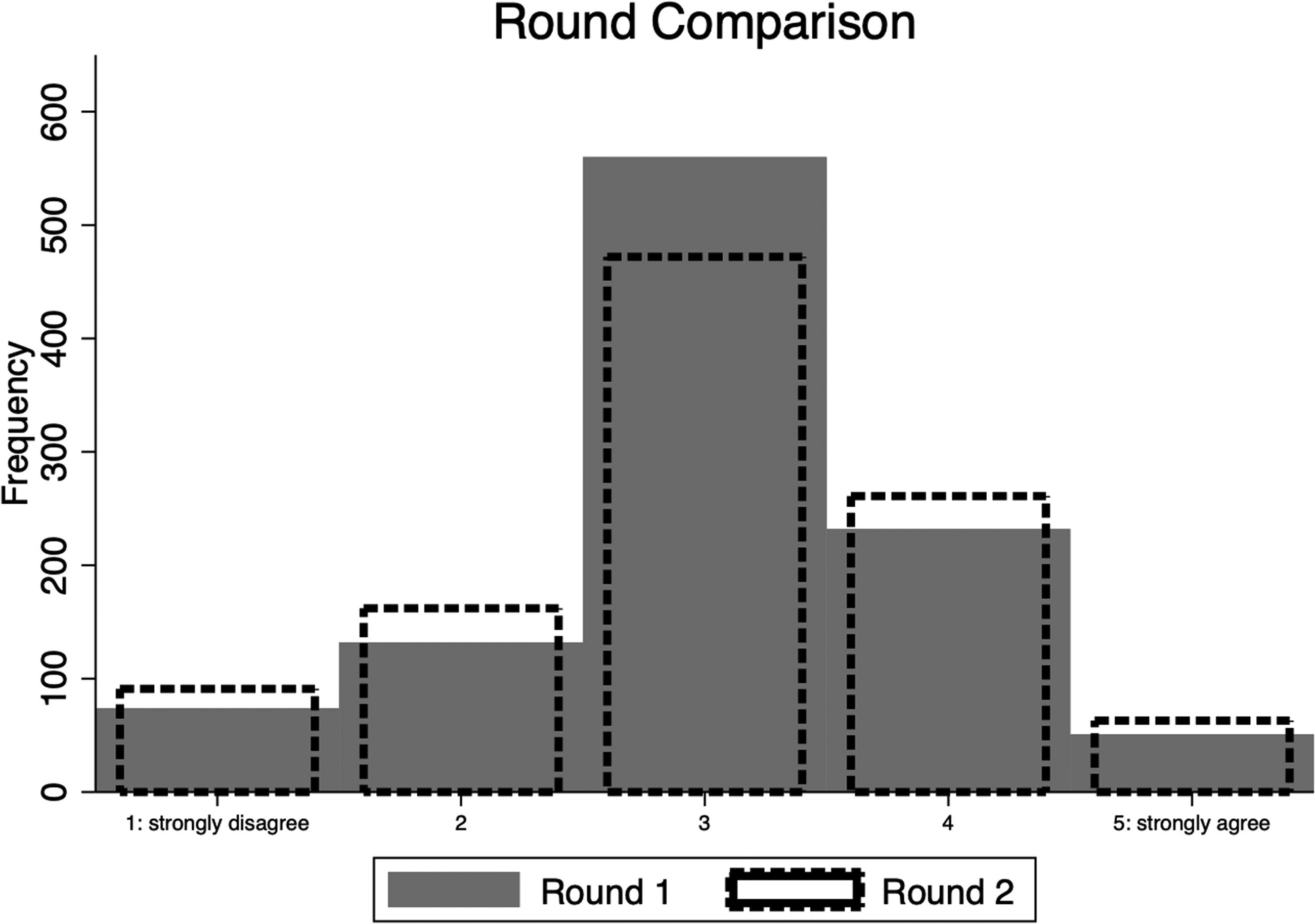
Average support for the policy proposal by round.
The OLS regression analysis presented in Figure 2 estimates the effects of the experimental treatments, enabling causal inferences. For this analysis step, both rounds of the experiment are pooled, with standard errors clustered by respondent. The models discussed here exclude control variables, as prior research indicates minimal effects of such variables in randomized settings (Mutz and Pemantle, 2015). The full regression model, including controls, is presented in the Online appendix. 9
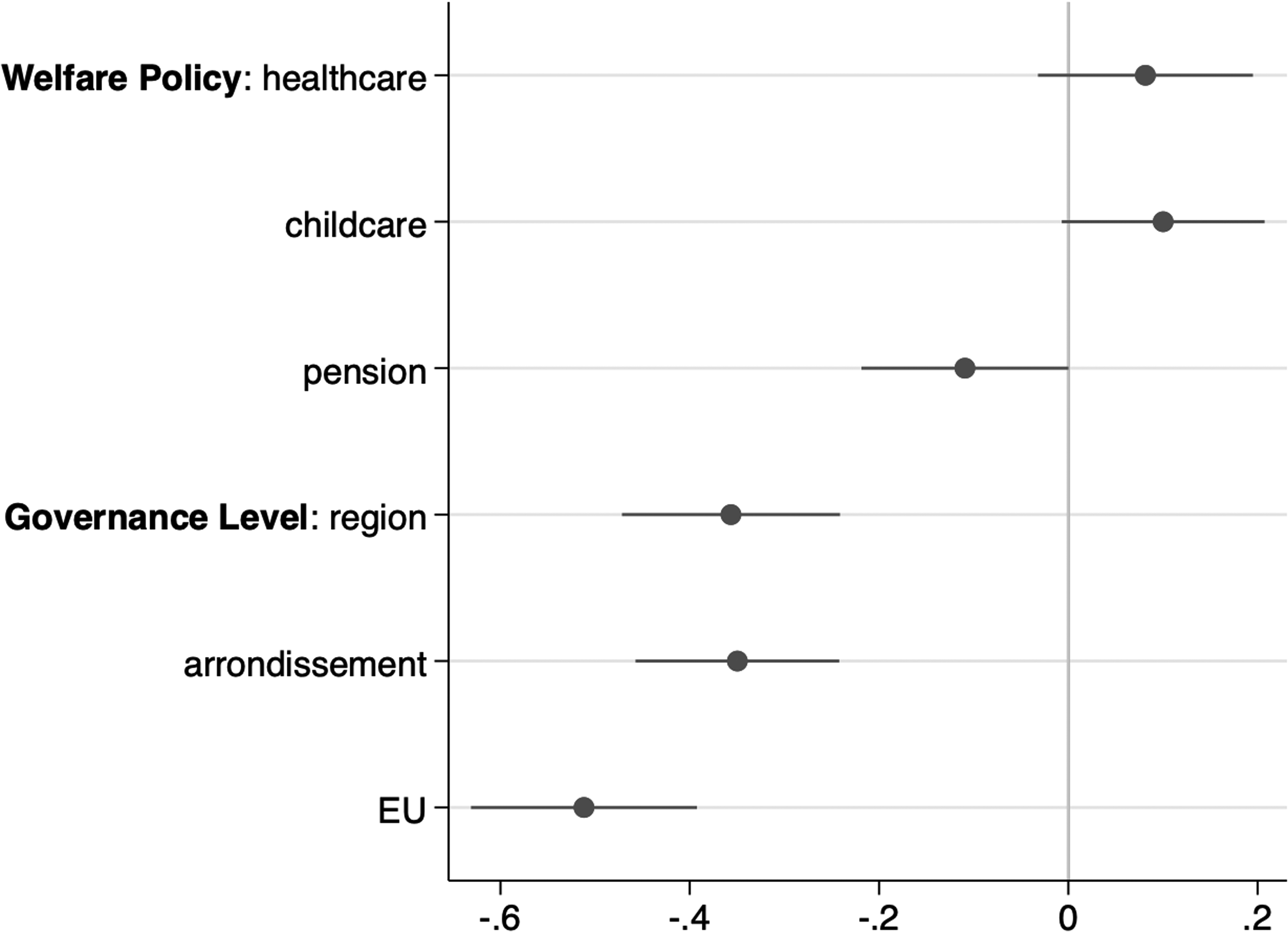
Regression results.
The effects of welfare policy types deviate from the theoretical expectations set out in the previous section. Specifically, the hypothesis that policy proposals related to unemployment benefits would receive the most support (Hypothesis 2a) is not supported, as there is no statistically significant difference between this and the other policy fields. Furthermore, the comparison between unemployment and pension benefits also yields a non-significant variance (Hypothesis 2b). This suggests that the type of welfare policy itself does not significantly influence preferences for the proposed policy. In contrast, and consistent with Hypothesis 3, approval for all policy proposals is significantly lower when positioned at a level other than the national level. Although respondents generally evaluate most policy proposals neutrally to positively (see Figure 1), they express a strong preference for policies to be situated at the national level (see Figure 2) – even when a guarantee of current benefits is provided. This preference likely reflects the perception that the national level provides greater continuity.
However, what does not emerge is that the EU level is significantly less popular than the two subnational levels, contradicting Hypothesis 3. This result is particularly notable, as the Sixth State Reform had already transferred certain welfare competences from the federal government to the communities, potentially strengthening the legitimacy of subnational governance. The absence of a significantly greater preference for subnational governance over the EU may be explained by limited public awareness regarding which political entity holds responsibility for specific welfare policies. A 2013 poll in Belgium—conducted after the reform agreement but before its implementation—found that most respondents had only a rudimentary understanding of the shifting competences in family allowances (Béland and Lecours, 2018). Another possible explanation is that preferences for the governance level may simply differ by policy type. Hence, Figure 3 provides insights into the interactions between the two experimental treatments.
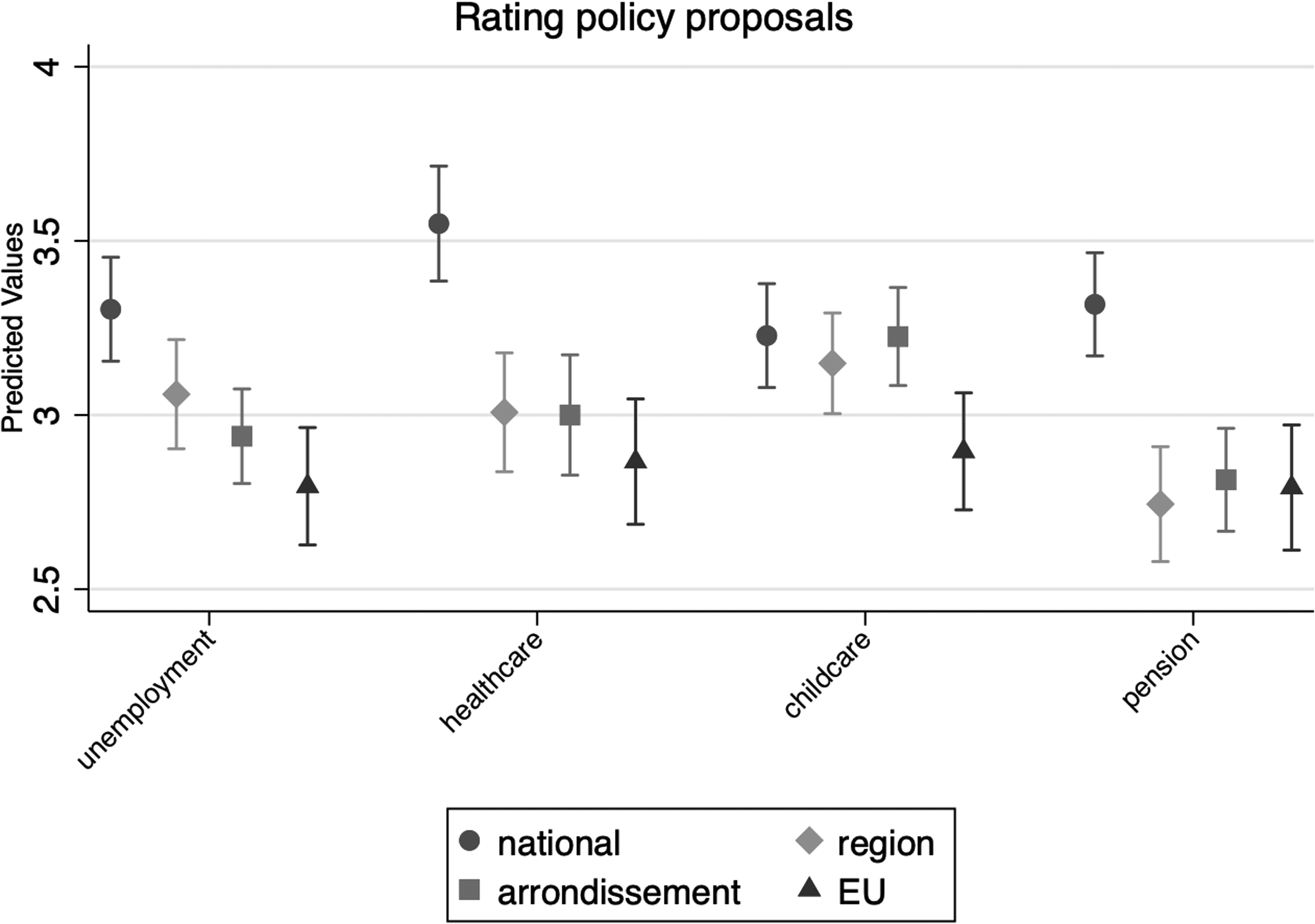
Interaction experimental treatments.
The figure visualizes the predicted values of policy support, differentiated by policy type (x-axis) and governance level (markers). In the case of unemployment benefits, the difference between governance levels is non-significant. While support is highest for the national level, the other levels are also rated quite positively. This may be due to the fact that all levels of governance have either already assumed, or are in the process of assuming, responsibility for certain unemployment-related policies or services (such as SURE or subnational unemployment counselling). For healthcare, the national level is by far the most popular, possibly due to people's positive experiences with healthcare benefits during the pandemic. While the effect of the national level is significantly higher compared to the other levels, preferences for subnational and EU governance are indifferent. Regarding childcare benefits, the differences between governance levels are minimal. Here, the national and subnational levels are equally popular, suggesting that for this particular policy field, which has recently shifted to subnational levels following the Sixth State Reform, the national level no longer holds a dominant position. Finally, support for pension benefits is again significantly higher for the national level, with no discernible difference between the other levels.
Taken together, these findings extend the insights from the previous two analysis steps. They reveal that the national level is no longer the dominant preference for welfare governance in areas where responsibilities have recently shifted to subnational authorities. Instead, respondents tend to favour the governance level currently in charge of that policy. This indicates satisfaction with Belgium's existing welfare system, while also suggesting that citizens may quickly adjust to potential future changes in welfare governance.
Hypothesis 4 specifically focuses on EU-level policies and their support. Overall, support for proposed EU welfare measures is moderate across the board. Even in a well-equipped welfare state like Belgium, resistance to EU-wide welfare authority remains minimal, as long as current standards are upheld. However, support does not vary significantly across the presented EU welfare measures, contradicting Hypothesis 4. This may reflect respondents’ difficulty in assessing EU-level welfare provision due to limited direct experience with this governance level, whereas national and, to a lesser extent, subnational welfare structures are more familiar.
Finally, it is assessed whether spatial identities moderate the effect of governance level on policy approval (see Online appendix). 10 Contrary to Hypothesis 5, the interaction between spatial identities and governance levels is non-significant across all levels of spatial attachment. This result is particularly surprising given Belgium's well-established regional identities. One possible explanation is that respondents may prioritize the perceived capacities of political institutions or their satisfaction with the current system over emotional attachments to these governance entities. In shaping preferences for welfare governance within the EU multilevel system, rational considerations appear to trump spatial attachment.
Conclusion
The multiple international crises that have challenged the EU over the past decade have intensified calls for EU-wide social balancing mechanisms. While such proposals have gained substantial support in countries with weakening welfare states, they remain far less popular in high-performing welfare systems. In these contexts, concerns persist about a ‘race to the bottom’ in benefits under EU regulation. This article draws on an original survey vignette experiment conducted in Belgium in 2023. The experimental design is innovative in two key respects: it randomly varies the type of welfare policy and the level of political governance. This approach enables a causal assessment of how these factors shape policy preferences.
The results suggest that concerns about a ‘race to the bottom’ scenario can be alleviated when existing welfare standards are guaranteed—a compensatory mechanism that could also facilitate deeper EU integration in other policy domains. Although support for EU-level welfare governance is comparable to preferences for subnational governance, the national level continues to be the preferred option for the majority of welfare policies. This pattern indicates that opposition to EU involvement in welfare provision is not driven by an inherent aversion to supranational governance but rather by a strong attachment to the status quo. Intriguingly, in policy areas where subnational authorities have recently assumed welfare responsibilities (childcare allowance), the national level's dominance in popularity fades. This suggests that individuals seem to quickly adapt to new governance structures and are satisfied with the current system.
How might the findings from this study travel to other EU member states? It is likely that similar results could be observed in other countries with high levels of welfare spending, such as those in Northern and Western Europe, where citizens do not perceive an immediate need for change in welfare governance. In these states, concerns about a ‘race-to-the-bottom’ are most pronounced (ESS Round 8, 2016). In contrast, for countries with less developed welfare systems, such as those in Southern and Eastern Europe, support for changes in welfare governance may generally be higher—even without assurances regarding the preservation of current benefits. Whether these assumptions hold should be tested in future research.
There are, of course, limitations to this study. Future studies should interview more people to first increase the number of respondents per policy proposal and second the number of respondents per arrondissement. A bigger sample size would enable more fine-grained spatial analysis and potentially detect other significant effects. Another major drawback is that respondents were not asked to choose between diverse policy packages—like in the case of most conjoint experiments—but to evaluate single policy descriptions. Consequently, it remains uncertain whether respondents might have consistently opted for the status quo when given a choice. Future research should advance the experimental design in such a direction. Additionally, my vignette experiment did not include information on the financing or costs of the presented policy. Addressing these aspects could offer an intriguing avenue for further investigation in subsequent research.
The robustness checks could not account for all potential confounders. For example, Berg (2007) highlighted the role of political trust in shaping preferences for welfare provision across different political levels. As the data used in this study does not include measures of political trust, future research should incorporate this dimension. Additionally, the absence of questions on respondents’ satisfaction with social benefits (Baute and Meuleman, 2020) represents a limitation and future studies should examine how perceptions of a political level's capacity to implement welfare policies might influence public support for policy proposals.
All of this suggests that advancing a more social EU requires political leadership willing to realize a vision first articulated by Mollet nearly 70 years ago. If existing benefit levels are guaranteed, opposition to EU welfare provision is unlikely to be pronounced. Instead, the more pressing challenge is demonstrating why the EU is a suitable provider of welfare. The window for implementing such reforms, however, may be narrowing, particularly given the rising influence of Eurosceptic parties across the Union.
Supplemental Material
sj-docx-1-eup-10.1177_14651165251340208 - Supplemental material for From fear to support? The role of benefit guarantees in EU multilevel welfare governance
Supplemental material, sj-docx-1-eup-10.1177_14651165251340208 for From fear to support? The role of benefit guarantees in EU multilevel welfare governance by Ann-Kathrin Reinl in European Union Politics
Supplemental Material
sj-zip-2-eup-10.1177_14651165251340208 - Supplemental material for From fear to support? The role of benefit guarantees in EU multilevel welfare governance
Supplemental material, sj-zip-2-eup-10.1177_14651165251340208 for From fear to support? The role of benefit guarantees in EU multilevel welfare governance by Ann-Kathrin Reinl in European Union Politics
Supplemental Material
sj-zip-3-eup-10.1177_14651165251340208 - Supplemental material for From fear to support? The role of benefit guarantees in EU multilevel welfare governance
Supplemental material, sj-zip-3-eup-10.1177_14651165251340208 for From fear to support? The role of benefit guarantees in EU multilevel welfare governance by Ann-Kathrin Reinl in European Union Politics
Footnotes
Acknowledgements
I would like to express my gratitude to a multitude of people who have supported me throughout the various stages of this article. First and foremost, my thanks go to those who assisted me in setting up and testing my survey, namely: Liese Berkvens, Irina Ciornei, Christa Crusius, Claire Dupont, Christina Eder, Heiko Giebler, Alexia Katsanidou, Francesco Nicoli, Alessandro Pellegata, Peter Thijssen, Valerie Vervaenen, David van der Duin, and Stefan Wallaschek. Previous versions of this article were presented at the International Studies Seminar Series at the University of Konstanz as well as at the Council for European Studies (CES) conference 2024. I am grateful to the participants for their valuable feedback and to Ashley Mantha-Hollands for her final review of the article.
Funding
Research on this article was supported by the Research Foundation – Flanders (FWO) under grant number 1248723N and by the Max Weber Programme for Postdoctoral Studies at the European University Institute.
Declaration of conflicting interests
The author declared no potential conflicts of interest with respect to the research, authorship, and/ or publication of this article.

Data availability statement
The data and replication code are available as part of the Supplementary Material at the DOI of the article.
Supplemental material
Supplemental material for this article is available online.
Notes
References
Supplementary Material
Please find the following supplemental material available below.
For Open Access articles published under a Creative Commons License, all supplemental material carries the same license as the article it is associated with.
For non-Open Access articles published, all supplemental material carries a non-exclusive license, and permission requests for re-use of supplemental material or any part of supplemental material shall be sent directly to the copyright owner as specified in the copyright notice associated with the article.
