



Abstract
This essay takes stock of the current state of scholarship on gendered careers in the European Union. Examining the careers of women in the political system of the European Union raises several theoretical and analytical issues, especially considering the long-held reputation of European Union institutions as particularly favorable to the representation of women. First, it will ask whether scholarship has produced convincing evidence substantiating claims that European Union institutions are indeed more gender egalitarian in all aspects of the representational process, from the supply of candidates to shattering the glass ceiling of executive positions. Second, it asks whether scholarship has sufficiently theorized the contextual effects that account for the apparent success of women gaining representation in European Union institutions compared to national institutions.
Introduction
The European Union's (EU) explicit commitment to the promotion of gender quality and women's rights makes it an exceptional political arena among its constituent countries (Pollack and Hafner-Burton, 2000). The European Commission has made gender equality a cornerstone of its policy activities (Hartlapp et al., 2021) and the Court of Justice of the EU (CJEU) has been a long-time champion of women's rights and gender equality (Cichowski, 2013). The adoption of measures to promote gender-balanced representation in decision-making starting in the early 1990s makes the EU a pioneering actor (Abels and Mushaben, 2020; Ahrens, 2019; Kantola, 2009). This commitment to promote gender-balanced representation places a high moral burden on the achievement of egalitarian career paths in EU institutions. Against the backdrop of the EU's declared commitment to gender equality, the question arises if the EU has the kind of unique, sui generis institutional setting that is more permissive for women's political careers.
In addressing this question, this forum article pursues two objectives. Its first objective is descriptive and explores whether scholarship has produced convincing evidence substantiating claims that EU institutions are indeed more gender egalitarian in various aspects of the representational process. The second objective is analytical and examines the extent to which scholarship has theorized what are the defining features of the EU that account for the apparent success of women gaining representation in its institutions. In most cases, scholars have drawn on theories developed in national contexts to investigate women's presence in EU institutions: the effects of party structures and ideology on nominations, the workings of electoral rules on chances of being elected, the role of gender stereotypes on portfolio allocations, to name only some. In much rarer cases, the EU has been used as a laboratory to generate and develop theories explaining women's advancement in different career paths. This leads to the question of whether EU institutions are indeed sui generis or just “another case” on which theories are mostly tested (and sometimes generated) when it comes to the careers of women.
Despite the EU's explicit commitment to gender equality, this essay contends that the careers of women in EU institutions resemble what we observe in member states' domestic institutions. The typology of challenges to women's political careers developed in the introduction to this special issue (Frech, 2025a) allows for a focus on exceptional areas, such as the closing of the gender gap in the Commission and the higher proportion of women as Members of the European Parliament (MEPs). These areas seem delimited to where personnel selection is highly dependent on political elites that share a strong commitment to gender equality. In addition to their exceptional nature in terms of female representation, the visibility and influence of Commissioners and MEPs renders them highly consequential. In other arenas and aspects of careers, however, the challenges that women face are similar at the national and at the EU levels. So far, the scholarship on gendered political careers has evolved in parallel with, and possibly even a step behind, research on national representative institutions. To identify what sets the EU apart, future research should directly incorporate these different political arenas into their frameworks and examine whether challenges differ by area or if women encounter consistent hurdles.
Are EU institutions more gender equal?
This section explores whether scholarship has produced convincing evidence to substantiate claims that EU institutions are indeed more gender egalitarian in all aspects of the representational process, from the supply of candidates to breaking through the glass ceiling of executive positions. For some positions, women's advancement has remained slow; for others, progression has been incremental, while in some cases, change has been swifter and sweeping. The appointment procedures—election or selection—for each position as well as the organizational structure of each institution play key roles in explaining women's differential advancement.
Elections: The presence of women in the European Parliament
One of the most prolific branches of research in this field has focused on the presence of women MEPs in the European Parliament (EP), where their higher representation remains an exception. Since its inception, the EP has been an emblematic arena where women are represented at a higher rate than in the parliaments of its member states. With Kantola's agenda setting paper (2009), this discrepancy in numerical representation between the EP and national parliaments is a puzzle that has given rise to a thriving literature seeking to explain the differences.
Many of the explanations developed are grounded in factors that shape elections in each of the constituent countries. For instance, the rational choice institutionalist literature on the effects of electoral rules on the election of women highlights the importance of proportional formulas for EP elections, which would explain the larger proportions of women elected to the EP compared to national legislatures (Vallance and Davis, 1986). Some have looked at the relative importance of EU elections versus national elections, the differences in levels of competitiveness of the electoral environments for national and EP elections, as well at the level of activism of women's movements (Aldrich and Daniel, 2020; Footitt, 2016; Fortin-Rittberger and Rittberger, 2014; Freedman, 2004; Kantola, 2010; Norris and Lovenduski, 1995; Stockemer, 2007; Xydias, 2016).
While there is merit in all these strands of research, so far, an unequivocal explanation still eludes researchers as to why the proportion of women represented in the EP remains higher than that of its member states (in aggregate). In some countries, there are significant disparities between representation in national parliaments and the EP; in others, the differences are trivial. This suggests that there is likely no single explanation or uniform structural force at play, even though all EP elections are held under proportional formulas. The bulk of the variation likely stems from other factors, such as district magnitude, delegation size, or situational elements like crises that affect specific elections, which are not easily generalizable. A case in point is Högenauer's contribution to this special issue about opportunities for women in smaller countries, such as Malta and Luxemburg, which have their own dynamics due to the small number of MEPs that do not lend themselves to straightforward comparisons with the larger member states (Högenauer, 2025).
Political parties as gatekeepers: Nominations, incentives, and ideology
Absent a general explanation that operates at the EU level to account for differing levels of women's presence in the EP relative to member countries, scholars adjusted their focus of analysis to zoom in on political party–level rather than country-level explanations. In this domain, we find two complementary sets of explanations about recruitment procedures and characteristics of political parties. The bulk of this scholarship operates from insights developed for advanced industrial democracies rather than for EU institutions specifically and generates similar insights for national parliaments and the EP.
One strand of scholarship has examined recruitment procedures within political parties, which vary broadly across both countries and parties: some are inclusive insofar as a broad array of actors are involved in the process of selecting candidates for political office, some are exclusive and mainly elite driven. While the lion's share of this literature has investigated the gendered effect of recruitment procedures in different countries, influenced by the pioneering work of Norris and Lovenduski (1995), recent contributions have attempted to apply these insights to the selection of candidates for the EP (Aldrich, 2020; Fortin-Rittberger and Rittberger, 2015; Frech, 2015; Lühiste and Kenny, 2016; Pemstein et al., 2015). The key operating mechanism explaining why women are either penalized or rewarded remains an open-ended question: Some have found the inclusiveness of the selectorate in the early stages of the selection process as one of the central determinants of gender-balanced lists in the 2009 EP elections (Fortin-Rittberger and Rittberger, 2015), contrariwise Lühiste (2015) finds that the inclusiveness of selectorates does not seem to affect female candidates’ chances to be placed on a winnable party list position for EP elections.
Alongside the intricacies of parties’ recruitment processes, political parties are also strategically responsive to the perceived demand for women candidates among the electorate. When parties perceive the demand to be low, they are less likely to address gender imbalances by nominating more women (Conway, 2001; Lühiste, 2015; Tremblay and Pelletier, 2001). Däubler, Lühiste and Chiru break new ground by tracing how changes in voters’ attitudes about gender equality impact parties’ nomination of women on their lists for EP elections (Däubler et al., 2025). The connection between aggregate attitudes and party nominations is not a direct one: Parties’ decisions to nominate more women seemingly do not hinge on, or closely follow, public preferences, thus the source of strategic incentives to balance lists is elsewhere. This is a key finding for the scholarship seeking to isolate which step in the recruitment process is most impactful in shaping women's nominations. Insights from Däubler et al. suggest that the explanation lies more on supply-side factors rather than on demand from the electorate.
Research on supply-side mechanisms suggests that the composition of the initial pool of potential candidates, who steps forward and who is recruited, largely channels the makeup of candidate lists in the following stages. If this initial pool is skewed in its gender composition—and we know this pool is skewed from the onset since women are less likely to want to run for office (Lawless and Fox, 2005)—subsequent candidate pools are also likely to remain askew (Fortin-Rittberger and Rittberger 2015). The effect of selectorate composition in the process remains disputed. Since parties differ along many features—ideology, size, leadership, membership and opportunity structures, territorial organization, etc.—it is challenging to isolate the causal effect of individual recruitment processes from all other potential cofounders. We also do not know enough about how selectorates for EP elections differ from those of national elections, or if candidate ambition also differs systematically across the different electoral arenas (preliminary evidence does not find large differences; see Devroe et al., 2023). What Frech (2025b) makes clear is that parties are the most powerful shapers of EP candidates’ political fortunes, as is the case for candidates running for office in the parliaments of Western Europe (Kittilson, 2006).
Relatedly, the other large strand of research focuses on political parties’ ideological characteristics. In contrast to scholarship on recruitment, there exists a quasi-consensus: Green parties and parties located on the left of the ideological spectrum, both at the national and the EU level, are more likely to support women as candidates than parties on the right (Beckwith, 1992; Caul, 1999; Freedman, 2002; Hix and Lord, 1997; Krook, 2010; Mather, 2001; Matland, 1993; Norris and Franklin, 1997; Vallance and Davis, 1986). Party positioning on European integration also plays a role: Chiva (2014) found that eurosceptic parties are more reluctant to recruit women in Eastern European countries. The most recent works examining these two factors for EP elections confirm these insights (Aldrich, 2020; Lühiste and Kenny, 2016; Sundström and Stockemer, 2022). Newer trends by extreme right and radical right parties nominating women in prominent positions to increase their vote shares (Weeks et al., 2023), however, might signal the end of this quasi-automatic linkage between party ideology and the proportion of women nominated.
In both the domestic and the EU electoral arenas, parties play a pivotal role in shaping the chances of women to be nominated. Political parties thus act as the main gatekeepers and the central role they play for candidate recruitment is not a feature that is unique to EP elections compared to national and subnational parliamentary contests.
Are female MEPs different?
A large field has sought to establish typologies of career paths and to explore whether, and to what extent, the EU has a political class of its own (Beauvallet-Haddad et al., 2016; Bíró-Nagy, 2019; Daniel and Metzger, 2018; Dodeigne et al., 2024; Høyland et al., 2019; Kakepaki and Karayiannis, 2021; Salvati, 2016; Scarrow, 1997; Verzichelli and Edinger, 2005; Whitaker, 2014). Scholarship focusing on career paths in the EP and in national legislatures has evolved in parallel and has yet to engage directly with one another. To explain differences in women's presence in the EP compared to national parliaments, scholars should also scrutinize the extent to which career paths are gendered and if career paths differ across electoral arenas, both at the EU level and domestically. Yet, gender has not been of primary interest in these strands of scholarship until recently.
Bringing gender into the spotlight, Lühiste and Kenny (2016) find subtle distinctions rather than wholesale diverging trajectories between men and women's career pathways to the EP. Women are more likely to be nominated by left-wing or green parties, as outlined in the previous section, and there are upward mobility differences between men and women. More recent investigations, such as those of Aldrich and Daniel (2020) as well as Salvati (2024), validate some of these gendered patterns in career paths. There are fewer female than male newcomers among MEPs. Women new entrants’ credentials are more professionalized, even more so since the adoption of gender quotas, which puts to rest unsubstantiated fears that quotas might decrease candidate quality (Aldrich and Daniel, 2020; Hermansen, 2025). These observations mirror those from national legislatures, where female MPs tend to exhibit higher educational achievements than their male peers (Beer and Camp, 2016; Franceschet and Piscopo, 2014). The large literature on national legislatures has gone furthest in examining sociodemographic variables, such as the interplay of age, motherhood and marital status, to theorize remaining differences in candidate emergence (Bernhard et al., 2021; Franceschet et al., 2016; Joshi and Och, 2021; Teele et al., 2018). Such analyses have only recently emerged in the context of the EP (e.g., Frech and Kopsch, 2024). We do not know how large these sociodemographic differences are, how they impact careers in the long run, or if the observed trends are transient rather than enduring features of MEPs careers. Most importantly, we have yet to systematically establish, if and how, national careers differ from EU careers for women, in particular.
Turnover and exit paths complete the sketch of MEP personnel dynamics. Aggregate legislature turnover rates only seem to be marginally lower in the EP than in national assemblies, suggesting that the EP offers a somewhat distinct institutional context with its own competitive dynamics, which in turn shapes parties’ incentives when it comes to nominating candidates (Muyters and Maddens, 2023). Breaking up these aggregated legislative turnover figures by gender, however, reveals surprisingly little differences: Men and women's turnover rates in European legislative assemblies and the EP are broadly similar, though men tend to experience marginally higher rates of turnover (Gouglas et al., 2025).
In sum, this strand of research on female MEPs has expected to find quantitative differences between men and women in all aspects of their political careers. The fact that women are represented in smaller proportions leads us to hypothesize that other aspects of women's careers will be gendered, including exit. Yet we observe trivial gender differences in personnel characteristics and turnover of MPs and MEPs. The relatively comparable characteristics and turnover rates suggest two possibilities. First, there may no longer be strong theoretical reasons to expect men and women to have significantly different career paths once elected. Alternatively, the key factor in explaining underrepresentation may occur earlier in the process: paths to entry are distinctly gendered, while turnover rates seem to show less of a gender difference. Barriers to entry are the largest stumbling blocks.
Mobility and appointment to power positions (positional leadership)
While the presence of women in the EP has been impressive from the onset, the picture is considerably less remarkable when we consider leadership positions in the EP and in executive positions in the Commission. Research on EU institutions and EU member countries is concordant: Women are fewest in executive bodies and other leadership positions inside parties and legislatures, such as committee chairs (Annesley et al., 2019; Bauer and Tremblay, 2011; Claveria, 2014; Escobar-Lemmon and Taylor-Robinson, 2005; Goddard, 2019; Jalalzai, 2013; Kroeber and Hüffelmann, 2022; Krook and O’Brien, 2012). For a long period of the EU's existence, women were absent from highly influential positions. Yet the adage “the higher the fewer” has become less of a truism in the last 20 years in EU institutions. In many areas, the presence of women progressed from symbolic to achieving almost parity very rapidly in the 2000s (Alayrac et al., 2025). For example, research tracing the number of women in leadership positions in the EP, such as rapporteurships and committee chairs, found little quantitative differences in the odds of men and women acceding to these positions in past EP terms (Chiou et al., 2020; Chiru, 2020; Obholzer et al., 2019).
A similar development unfolded for women in executive positions. Women only gained footing in the Commission in 1989—as Commissioner, Directors-General, Secretary-General—only to reach parity in 2020 (Alayrac et al., 2025; Hartlapp et al., 2021; Müller and Tömmel, 2022). Research in this field has sought to trace differently gendered routes to leadership, that is, in the Commission's political and administrative top echelons (Alayrac et al., 2025; Hartlapp et al., 2021; Hartlapp and Blome, 2022). At the top of the decision-making hierarchy exercising both legislative and executive functions is the Council of Ministers. Owing to the different composition of each sectoral council, the presence of women at this level has been scarcest (Abels, 2021). One of the reasons remains rooted in the dynamic of national politics: positions in the Council originate from the composition of each member countries’ national government. An increase in women in these bodies can only result from changes in levels of descriptive representation within cabinets in the EU's member countries.
Potentially the most interesting gender-related variations pertain to the policy areas in which we find women to be concentrated: portfolio allocation in the EP and in the Commission. The most sought-after position inside the EP is the role of committee chair. 1 The allocation of these desirable positions has been decidedly gendered, and the most influential committees are disproportionally chaired by men (Dingler and Fortin-Rittberger, 2022). This is also the case in national parliaments, where these observations about gender-imbalances originated (Davis, 1997; O’Brien, 2015; Pansardi and Vercesi, 2017). Gendered patterns of committee chair allocations are also discernable in the substantial focus of the committees: Female MEPs are overrepresented in committees belonging to “feminine” policy areas in the sense that the topics tend to reflect stereotypical ideas about women's role in the society, such as women's rights, social welfare or culture.
As in the composition of committees and committee chairmanships in the EP, we can also discern a certain division of labor among women and men in the portfolios allocated in the Commission. Following research on national executives that find gendered patterns of portfolio allocation, women are less likely to be allocated the most prestigious and powerful portfolios (Escobar-Lemmon and Taylor-Robinson, 2005; Goddard, 2019; Kroeber and Hüffelmann, 2022; Krook and O’Brien, 2012). Research on the EU has also uncovered such patterns of women being allocated more conventionally “feminine” portfolios but with less sharp contours. For instance, while the allocation of portfolios tends to espouse the patterns outlined in most other arenas, women nowadays are increasingly leading prestigious EU portfolios in the Commission (Hartlapp and Blome, 2022). This trend is relatively recent, however.
Overall, whether we look at the EP, the Commission or to national parliaments, women's promotion to leadership positions often hinges on the nature and focus of these roles, with men predominantly heading the more powerful and traditionally more “masculine” subjects. Pathways to power remain clearly gendered in the form of a horizontal, thematically driven division of labor.
The effects of descriptive representation on substantive representation
Do patterns of descriptive representation spillover into the domain of substantive representation? The EP's high level of women's descriptive representation renders this conjecture compelling. If descriptive representation is higher in the EP than in national parliaments, does this imply that the quality or degree of substantive representation is higher than in national parliaments? Differently put, if men and women have divergent policy preferences, these should be reflected in the preference composition of MEPs. With the fast rise of the access of female MEPs to positions of influence in the EP and the Commission in the last decade, we could expect the EU to be a distinctive, and—compared to domestic arenas—a more dynamic arena, in which the observed changes in descriptive representation should have pronounced effects on substantive representation.
In a thriving literature on national and subnational parliaments, scholars have looked at how the presence of women shapes policy outcomes, who represents women's interests and the extent to which female MPs and male MPs have different policy preferences (Allen and Childs, 2018; Campbell et al., 2010; Celis, 2008; Childs and Krook, 2008; Dingler et al., 2019; Höhmann, 2020a, 2020b; Kroeber, 2022; Mateo Diaz, 2005; Swers, 2002). In the lineage of these contributions, scholars have only recently started to scrutinize the preferences and behaviors of MEPs with a gendered lens (i.e., Ramstetter and Habersack, 2020). In their study of written parliamentary questions in the EP covering the most recent two decades of activity, Dodeigne, Erzeel and Randour (2025) offer a significant breakthrough. While there are no gender disparities in overall levels of activity, the authors find variations in how activity is distributed across policy domains. Female MEPs ask fewer questions in “hard” domains—agriculture, economy and finance, trade, justice, defense, foreign affairs—and more questions in “soft” policy domains, that is, culture, education, health, and social policy, which is in line with studies of national parliaments (Bäck et al., 2014) but also with the patterns observed in committees (Dingler and Fortin-Rittberger, 2022; Sozzi, 2022). One of the most interesting findings is that these differences are not fixed features of MEP behavior but change over the spans of careers. Gendered patterns are most pronounced for rookie female MEPs and fade as they gain seniority. Such transformations in behavior over the acquisition of experience is only discernible for women, men display the same level of activity whether they are junior or senior. These are interesting points of departure for future research on forces—both institutional and psychological—that shape the behavior of MPs/MEPs.
What this survey of research shows is that we should be weary of overzealous generalizations. Despite areas of success, there remain large discrepancies in women's presence across the EP, not only executive positions but also administrative and management positions. Different EU institutions have idiosyncratic institutional cultures, as well as selection and appointment methods that differ markedly. As thematized in the introduction to this special issue (Frech, 2025a), selectorates differ, so do career advancement hierarchies. The timing—and perhaps more tellingly the pace—at which women have been able to make inroads is noteworthy.
Is the EU a “context” or a special case?
The idea that the EU is exceptional for women's careers is largely shaped by the significant presence of women in the EP. Does this distinctive feature of the EU align with existing theoretical frameworks, or does it represent a special case requiring its own theoretical perspective? So far, when we think about women's political careers, scholarship has tended to draw on the same corpus of theories developed in comparative politics, yet both areas have been kept empirically isolated. Without succumbing to the notion that the EU is a sui generis political system that eschews comparison (elegantly debunked by Hix, 1999), the study of the EU as a ‘regular’ polity has yet a lot to say (and work to do) to explain gendered differences in descriptive and substantive representation in EU institutions. This has been a blind spot, not because theories were missing or because the EU is seen as exceptional, but because it has not yet fully been taken on by scholars.
This section seeks to trace promising avenues for research in theorizing the causes of the apparent success of women gaining representation in EU institutions compared to national institutions. This is especially relevant considering that institutions are powerful shapers of formal and informal rules that govern the careers of elected officials and that their effects are gendered (Krook and Mackay, 2010). Table 1 illustratively condenses the findings on gender gaps in women's presence in political positions and whether the patterns observed are unique to the EU when compared with the findings from domestic arenas. It is at the intersection of these patterns that we find where the EU is “special,” that is, where the challenges to women's careers (as outlined in Frech, 2025a) are potentially bound by different set conditions, the study of which would require more direct empirical engagement.
Comparing gender gaps in political careers in the EU versus member states.
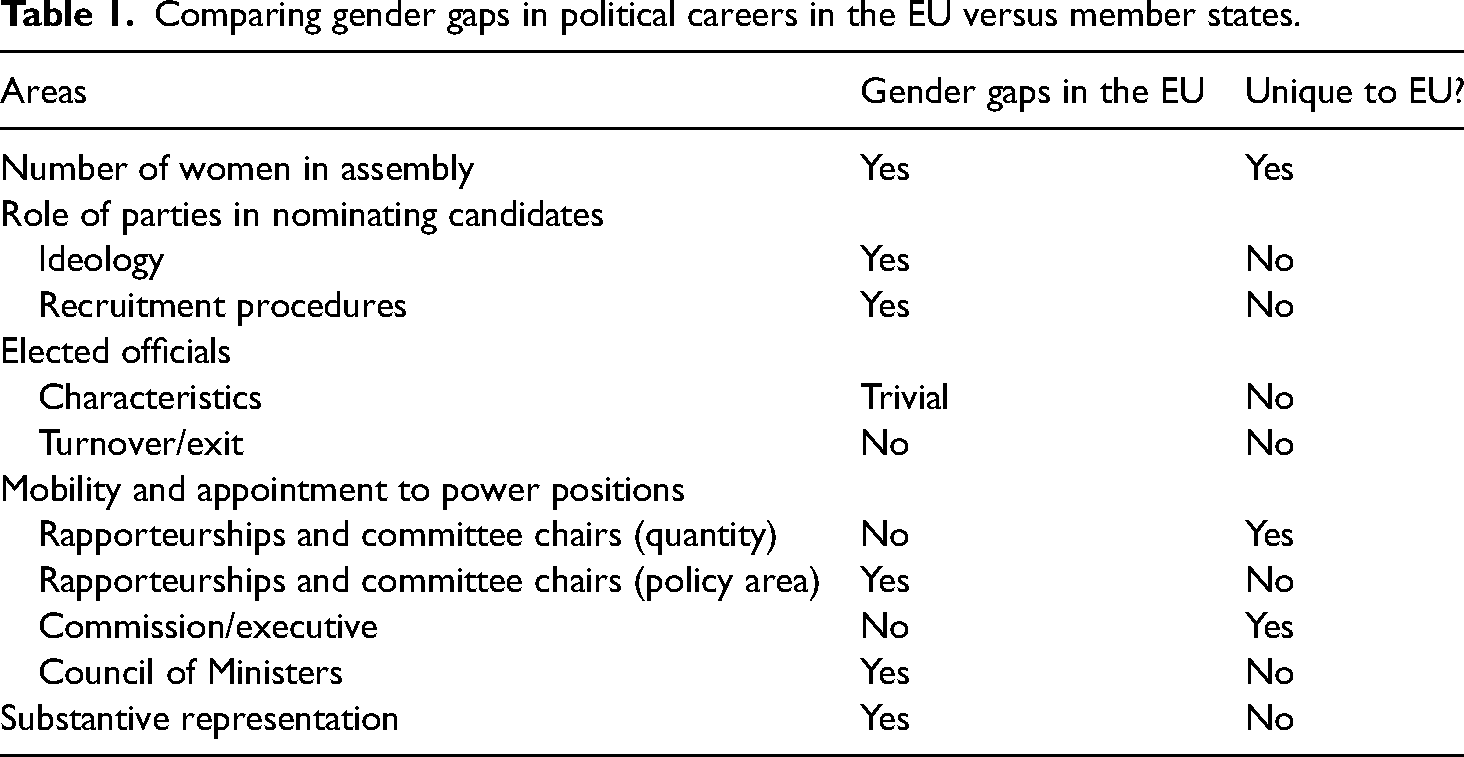
The areas where the comparison between domestic and EU arenas displays the largest degree of “uniqueness,” in the sense that EU patterns most strongly diverge from those in domestic arenas, are twofold: First, while there is a higher proportion of women in the EP compared to legislatures in the member states, a sizable gender gap in favor of men lingers. This remaining gender gap has narrowed with each EP election as progress in this area has been incremental, until 2024. The latest EP election marks the first registered setback in women's representation since 1979, with women winning 38.5% of the seats, down from 40.6% after the 2019 election (EP). Second, and more spectacular, is the rapid closing of the gender gap in many highly visible and high-powered executive positions. Historically, gender imbalances in the College of Commissioners were stark. Women's presence began to rise slowly in the 90s, with a sharper increase over the 2000s. This culminated in parity under Ursula von der Leyen's first tenure as Commission President between 2019 and 2024, closing the gender gap entirely. Whether this trend holds is not yet a given. These contrasting trends—where gender representation in the EP has increased incrementally, while executive positions have undergone swifter and significant leaps in progress—highlight the varying dynamics of achieving gender equality.
Some domains have seen much less progress in gender equality: many administrative positions, courts and technical agencies, including the European Central Bank (ECB). When comparing political positions to nonelected positions, such as senior civil servant positions in public administration, the contrast with elected positions is stark. Large gender gaps remain in the composition of the CJEU as well as of the ECB: Women constitute fewer than 20% of the judges and advocate generals at the CJEU and women are practically absent from the ECB's Governing Council. Career paths in specialist areas follow hierarchies that are more professionalized and where appointments rarely jump ranks. These are the areas in which women have made least progress in advancing to top positions. This explains much of the very slow progression or stagnation in some of the bureaucracies that have career paths that are highly specialized and where advancement can only be incremental. In bureaucratized hierarchical systems of career advancement, gender equality is subsidiary to other criteria: here the challenges to women's political careers remain the highest and the EU is not exceptional in this.
If there is an EU-specific “context” that has been a particularly powerful shaper of women's careers, it is in the commitment of elites to craft gender-balanced decision-making bodies. This is the aspect that contrasts most sharply to member states’ domestic politics. Women have made the quickest strides in areas where elites are actively involved in closing gender gaps. Personnel in the top positions of the Commission are appointed, with various bodies having the potential to exercise some degree of oversight on personnel nominations. The process is essentially elite driven but includes also a large dose of country-specific factors. Commission Presidents have been instrumental in setting the incentives to nominate women in the Commission (Hartlapp and Blome, 2022). For example, Ursula von der Leyen, elected for a second five-year term as European Commission president in July 2024, asked member countries to put forward a man and a woman as candidates for Commissioner roles. Some countries have not acted on this request. While the President could politically sanction those who do not comply by granting some nominees more junior roles, there is no legally enforceable obligation for governments to follow through. At this stage, it is too early to assess which nominees will clear the Parliament's hearings set for November 2024, and there is no certainty that gender parity will be maintained.
This episode demonstrates the putative influence of very small political elite in the EU to swiftly redress gender imbalances in leadership positions if there is the political will to do so. This EU-specific “context,” however, is also a potential source of fragility, insofar as it is dependent on the degree of commitment to gender equality by individuals rather than enshrined in formal institutions. This creates numerous stimulating avenues for research. To what extent could the gains in gender equality be reversed if elites in particular EU institutions become less committed to gender equality? Once women break the glass ceiling of leadership positions, are the gains achieved durable even if the conditions that gave them rise have changed? What kind of spillovers are there between a higher proportion of women in high office and other types of outcomes, such as substantive and symbolic representation, not only in the context of the EU but also in member state's domestic politics? The particular trajectory of women's careers in EU leadership positions will spur new theoretical advances in linking descriptive to substantive representation perhaps even transcending levels of government.
The puzzle as to why the EP remains more gender equal than most of the legislatures of its member states remains unresolved despite the large volume of literature devoted to this issue. We know that the larger countries and those with gender quotas have been more likely to nominate women, but since political parties are as powerful in EU elections as in other types of elections in shaping political fortunes, we are still short of an explanation that convincingly accounts for the differences. Does the pool of aspirants for national politics and for the EP differ systematically, or does one level display a steeper gender imbalance from the onset? One promising area of research will be to isolate whether the demand for and the supply of women candidates varies systematically between national and European contexts. Additionally, there is a need for more studies that investigate at which stage—prenomination, during the nomination phase, or at election time—women encounter the most significant challenges to advancement, and how these challenges differ between national and supranational elections.
Many gender gaps in women's careers in the EU mirror what we observe in national and subnational parliaments in established democracies. For instance, women MEPs and MPs tend to be rather similar to their male counterparts in terms of individual characteristics, aside from being slightly more educated. Turnover and exit patterns do not seem to be particularly gendered in either the EP or national parliaments. At face value, the gendered division of labor across issue areas in EU institutions also reflects patterns outlined in research on domestic politics.
Still wanting in this field are investigations that integrate the EU in a testing environment as a case among others (such as proposed in De Vries et al., 2021), facilitating more direct theorization of the institutional features responsible for the areas of “uniqueness.” What has been unique is the stated commitment to gender equality by various EU institutions and the willingness to implement corrective measures in areas where elites are in a position to do so: In the Commission where members are appointed, but also through the implementation of legislated gender quotas which many EU countries have adopted. As this special issue demonstrates, studying the EU's unique features is just one aspect; the EU is also a key area for advancing our understanding of gender in political careers.
Where we are, and looking ahead
Forty years of research on women's careers in the EU has generated a vibrant scholarship and it continues to be a flourishing research agenda. The bulk of this research has centered on the presence of women in various positions—a more descriptive type of representation—and on gender gaps mapping differences between men and women in their career paths. We have a sizable scholarship that explains “head counts” mainly informed by theories developed to fit the context of advanced industrial democracies. This research has allowed us to zero-in on areas where inequalities are most pronounced, but also to trace developments over time. As the research in this collection has outlined, observable gender differences are not equally present in all aspects of women's careers, and the challenges women face are multidimensional (Frech, 2025a), mirroring the complexity of the EU's political system and its institutions.
What is, and remains, most gendered is the political ambition of would-be candidates and the likelihood of being nominated by a political party, which are the most powerful factors explaining who gets elected. In the EU, as well as in national and subnational assemblies, the largest barriers for women remain at the point of entry into politics and nomination to powerful positions. Once women are in place, however, many differences tend to fade. Cases in point are women's chances of reelection and legislative turnover rates, which are not distinctively gendered. Yet the absence of “gender gaps” in such features does not mean other patterns—such as formal and informal procedures in party groups, the patterns of upward mobility, how often MEPs speak, which issues they take up, the stereotypes they face, and even how they speak (Dodeigne et al., 2025; Kantola, 2022; Kantola and Rolandsen Agustín, 2019; Kantola and Waylen, 2024; Müller and Pansardi, 2023)—are not gendered. Gendered patterns persist in almost every aspect of political careers.
The idea that the EP is a friendlier electoral environment for women still prevails among researchers and commentators despite a large amount of research showing that there are very few differences in women's careers when we compare the EU and member countries. Beyond the seemingly more advantageous access to legislative office in the EP, when we turn to leadership positions, the research outlined in this review is less simplistic than the narrative of the EP as a success story for the representation of women promises. In other words, we should be careful and resist the temptation to assume that elections at the European level are intrinsically distinct electoral contests, despite the higher levels of descriptive representation. For all this higher headcount in the EP, the spillovers in other areas have not exhibited discernible patterns or progressed in tandem.
If norms of gender equality are one of the central features explaining the increased presence of women in the political institutions of the EU, one question we must urgently tackle is whether achievements that were made thus far are reversible. What would be the consequences of a waning of the norms that underpin the successes this review has outlined? We are at a critical juncture for analyzing the influence of antidemocratic forces in both national politics and the EU (Gaweda, 2021; Hertner, 2021). It is important to examine how these forces might affect gender equality and determine where their impact could be most significant.
