



Abstract
A shift in public attitudes towards gender equality may explain improvements we have witnessed in women’s descriptive representation. However, existing studies rely on cross-sectional comparisons, likely beset with confounding problems. To examine the causal effect of public attitudes on candidate selection, we draw on data from more than 10,000 candidacies across four European Parliament elections (1999–2014). Using a difference-in-differences approach, we compare nomination decisions in countries with major attitude changes between elections to those in the control group. We find no evidence that shifts towards more egalitarian gender attitudes lead to an increase in women candidates, neither overall nor in subgroups by electoral system or socio-cultural party positions. The heterogeneity of effects across time and space appears to be a plausible explanation for our findings.
Introduction
Research on the causes of the continued gender imbalance in legislatures tends to differentiate between the demand side (citizens and civil society) and the supply side (politicians and parties). To explain why women remain under-represented in the political domain, large bodies of work examine demand-side factors like the degree of gender equality in the society more widely (e.g. Lühiste, 2015; Paxton and Kunovich, 2003; Schwindt-Bayer and Mishler, 2005; Tripp and Kang, 2008) and citizens’ electoral support for female and male candidates (e.g. Barnes and Cassese, 2017; Valdini, 2013). On the supply side, factors explaining why women become political aspirants (e.g. Lawless and Fox, 2010) and why party selectorates nominate female politicians (e.g. Lühiste, 2015; Valdini, 2012) have received much attention. Yet, we have limited knowledge of how the demand and supply side factors interact. The few studies that consider this link mostly focus on the theoretical dimensions of this interaction (Lovenduski, 2016; Verge, 2015) or rely on cross-sectional data (Lühiste, 2015; Valdini, 2012, 2013). We address this gap by investigating whether over-time shifts in public opinion towards gender egalitarianism causally affect the share of women that parties nominate for elections.
We study this in the context of European Parliament (EP) elections. As recognized by other contributions to this Special Issue, the EP as the only directly elected European Union (EU) institution is a particularly interesting case for studying gender and political careers. Although the EP has been portrayed as a rather women-friendly legislature (e.g. Chiva, 2014), the issue of gender equality has become increasingly politicized, with populist radical right Members of the EP (MEPs) denouncing it as a harmful ‘gender ideology’ (Kantola and Lombardo, 2021). More importantly, the EP offers an excellent testing ground for the relationship between demand and supply side factors, because we can repeatedly observe simultaneous elections to the same representative body across a large number of countries with varying public opinion trends.
From the theoretical perspective of this Special Issue, as introduced by Frech (2025b), we examine how an informal challenge posed by attitudes in society (as a collective actor at the macro level) affects the decisions by collective actors at the meso level, political parties. Focusing on candidate selection, our analysis examines the pre-institutional phase. Empirically, we study four EP elections (1999–2014), combining data capturing public opinion on gender egalitarianism over space and time (Woo et al., 2023) with information covering more than 10,000 candidacies. Using a difference-in-differences approach, we test for causal effects of major attitude shifts in favour of more women in politics. On average, we do not find that party selectors nominate more women following a change in public opinion. The results suggest that the main reason for this finding is the heterogeneity of causal effects. Sometimes, liberalization of public opinion may even lead to the nomination of fewer women. Hence, it is not clear whether changes towards more gender-egalitarian attitudes necessarily help with improving women’s political representation in the EU (and possibly beyond).
Our findings, thus, have important implications for our understanding of representative democracy and party responsiveness. On the one hand, the limited impact of public attitudes about gender equality on the share of women on candidate lists may be good for women’s descriptive representation in contexts where voters hold more traditional views. However, the fact that changes towards more gender-egalitarian attitudes do not lead party gatekeepers to further balance the lists suggests that the barriers to improved descriptive representation of women lie primarily on the supply side. Therefore, specific electoral rules and other measures, such as quotas, that incentivize parties to diversify their candidate lists are likely the fastest way to improve descriptive representation (see, however, Högenauer, 2025 in this Special Issue).
Challenges to gender-balanced legislatures
The continuous under-representation of women in politics has inspired a wealth of research. This work can be broadly grouped into studies focusing on the societal demand side and those looking at the political supply side (politicians and parties).
A first line of research considering demand provides consistent empirical evidence that a higher level of gender equality in a society is a positive predictor of women’s (viable) candidacy (Lühiste, 2015), the amount of media coverage women receive (Lühiste and Banducci, 2016), and the level of women’s descriptive representation (Paxton and Kunovich, 2003; Schwindt-Bayer and Mishler, 2005; Tripp and Kang, 2008). A second line of work on the demand side examines the extent to which voters support or discriminate against male and female candidates. Theoretically, it builds on gender stereotypes and gender role expectations (Huddy and Terkildsen, 1993; Lawless, 2004). Yet, there is little consistent evidence of voter discrimination against female politicians. Early, mostly experimental, studies indicated some potential voter bias against women in older democracies (e.g. Fox and Smith, 1998; Rosenwasser and Dean, 1989), and younger ones like Latvia (Matland and Lilliefeldt, 2014) and Lithuania (Ragauskas, 2021). However, other work finds either no evidence of a gender bias (Dahl and Nyrup, 2021; Dolan, 2014) or suggests that (female) voters display a slight preference for women over men (Golder et al., 2017; Schwarz and Coppock, 2022; Stegmaier et al., 2014).
The limited evidence for voter discrimination driving women’s continued under-representation in politics can be contrasted with research on supply side factors. An increasing body of scholarship concentrates on the role of political parties in determining the number of women running for office and the number of these getting elected (Krook, 2010; Lühiste, 2015; Valdini, 2019). This focus on parties as the main gatekeepers to more gender-balanced parliaments is understandable, as parties tend to control the first stage of election – the nomination stage – when they determine not only who becomes a candidate, but also their viability in terms of list rank or constituency assignment (Put and Maddens, 2013). Rahat (2007) compares candidate selection to deciding on menus at restaurants, where usually a select group of individuals (i.e. chefs) determine what is cooked. In analogy, party gatekeepers decide which candidates appear (where) on the ballot paper, and voters’ choices are thus restricted (Frech, 2016, 2025a).
If we know that the wider societal context correlates with women’s descriptive representation and that parties’ nomination decisions are crucial, it is important to ask how the former may affect the latter. Work linking the demand and supply sides is scarce. Some is predominantly theoretical (Lovenduski, 2016; Verge, 2015), and empirical studies rely on cross-sectional data (Lühiste, 2015; Valdini, 2012, 2013). Hence, from a theoretical perspective, we need to think about the micro-foundations (or meso-foundations when it comes to political parties) underlying the macro-level link between attitudinal changes in society and descriptive representation. And from an empirical perspective, we should attempt to find out whether such a relationship is causal in nature.
The link between demand and supply: Theoretical arguments
The main argument of this study is that citizens’ views on gender equality have an impact on parties’ candidate nomination decisions. This also implies that over-time changes in public attitudes should motivate change in nomination patterns. Before discussing the causal mechanisms underlying this relationship, it is useful to reflect upon the factors behind such changes in public opinion.
As implied by theories of modernization, the rise in affluence and education levels in many European societies is associated with changing attitudes towards women in politics. According to the post-materialist argument, one of the key self-expression values that has grown remarkably in the past 60 years is gender equality (Inglehart, 2008). Thus, having been relatively free of material deprivation or survival anxieties in their formative years, more and more citizens are able to prioritize demands regarding equal participation in political and societal decision-making (Inglehart and Norris, 2003). Similarly, the massive increase in tertiary education has also contributed to liberalized attitudes towards gender equality and women’s political participation (Campbell and Horowitz, 2016). However, sociologists continue to debate whether there is a universal development towards egalitarian gender-role attitudes or a ‘stalled revolution’ implying a mix of traditional and egalitarian views (Knight and Brinton, 2017: 1488–1490). Empirically, there is considerable cross-country variation both in levels and changes over time (Begall et al., 2023; Knight and Brinton, 2017).
When changes towards more egalitarian attitudes occur, political parties have a clear electoral incentive to improve the representation of women among their candidates, leadership, and elected officials – or at least signal that they are trying to do so. There are multiple causal mechanisms that may explain this link.
First, women are more likely to enter politics when they have the same access as men to socio-economic and educational resources associated with political participation (Schwindt-Bayer, 2005). Therefore, the more gender equal the society, the higher the chances for women to aspire and to subsequently become candidates.
Second, in a more gender-equal society, political parties have higher incentives to promote female candidacy (Lühiste, 2015; Valdini, 2012). If political parties are rational actors who are seeking to maximize their electoral support, then party selectors are likely to perceive a higher risk of being punished by voters for casting a list with very few women only in a society with stronger gender equality norms. Similarly, where the public supports gender equality, parties can hope to obtain electoral rewards for fielding more women on their slates. As Paxton and Kunovich (2003) argue, the overall gender ideology in a society will likely influence party elites’ decisions to support female candidates.
Third, the extent of potential voter discrimination against female candidates is likely lower in more gender-equal contexts, with past research offering empirical evidence of women candidates doing better in more women-friendly constituencies (Ondercin and Welch, 2009). This reduces the motivation for party selectors to favour men over women, since the costs traditionally associated with women’s candidacy are lower.
Fourth, as the majority of party gatekeepers remain male, the probable reliance on male-dominated networks may create an additional barrier for female aspirants (Kittilson, 2006). However, the exact extent of this barrier may depend on how party selectors perceive voters’ attitudes towards gender equality.
Finally, when attitudes towards gender equality change in society at large, then they may also do so for many party selectors. Hence, it could also be the case that fielding more female candidates is in line with the selectors’ own changed preferences (compare also Dodeigne et al., 2025). Furthermore, the EP (among other things due to its second-order elections) is often referred to as a ‘women-friendly’ legislature (Chiva, 2014; Lühiste and Kenny, 2016). This makes it a favourable context for observing a response from party selectors to public opinion becoming more gender egalitarian over time.
Taken together, we can therefore state:
H1: In countries where public opinion has moved towards more gender egalitarianism, party selectors will nominate a higher proportion of women candidates.
We can extend this argument by considering that parties are constrained by more than just the broader gender norms prevalent in a society. Electoral institutions and party ideology may moderate how voter attitudes on gender equality affect party gatekeepers’ decisions. Past research suggests that closed-list proportional-representation (PR) rules are more beneficial to women than those allowing for preference voting (Gonzalez-Eiras and Sanz, 2021; Lühiste, 2015). Yet the mechanism behind this effect is under-explored. Lühiste (2015) and Valdini (2012, 2019) both argue that the selectorate has a strong incentive to be attentive to the prevalent gender norms in society and thus balance the ticket accordingly. Valdini (2012) suggests that a high prevalence of traditional gender norms in the society likely forces the selectorate in more open list systems to temper the gender balance on candidate lists to a greater extent than in closed-list systems. Voters are likely to engage more actively with the actual candidate list in systems with a preference vote option than in closed-list systems, where they vote for a full slate. Similarly, incumbency advantage – another well-documented barrier to female representation (Meserve et al., 2020; Lühiste and Kenny, 2016; Schwindt-Bayer, 2005) – has been shown to materialize at the nomination stage under systems that allow for a preference vote (e.g. Fiva and Røhr, 2018). Conversely, in closed-list systems, parties can present more or less gender-equal candidate lists without voters being able to interfere. Similarly, if attitudes towards gender equality liberalize over time, it is more visible if parties do not respond to that change in systems where voters need to engage with the full candidate list. This implies:
H2: The effect of a shift in public attitudes towards gender equality on the proportion of women in candidate lists is stronger in countries that employ preferential voting.
Party ideology is also likely to influence party gatekeepers’ reactions to public opinion shifts. Centrist parties might be more responsive to the overall public opinion on gender equality as they are to a lesser extent constrained by previously assumed ideological positions. Moreover, they have strong electoral incentives to be congruent with the median or mean voter. Conversely, previous research has shown that parties strongly supporting traditional values (TAN parties) and parties that are strongly in favour of liberal values (GAL parties) are both less likely to adjust their policies in response to shifts in public opinion (Adams et al., 2006). We expect GAL parties to be more committed to promoting women’s descriptive representation and to try to shape public opinion regarding gender equality in a more progressive direction, rather than just reflect societal views. Last but not least, TAN parties regularly attempt to capitalize on the backlash that changing societal values on gender and family issues trigger among conservative voters (Norris and Inglehart, 2019). This would not bode well for the chances of female candidates being promoted by such parties, although it may still happen for electoral reasons (Weeks et al., 2023). Thus, we obtain:
H3: The effect of a shift in public attitudes towards gender equality on the proportion of women in candidate lists is stronger for socio-culturally centrist parties.
Candidate gender quotas are an important factor influencing women’s chances for (viable) candidacy, and they might reduce gender bias in selection (see Hermansen, 2025). Our empirical analysis focuses on the subset of EP contests that do not have a legislative candidate quota in place. Such quotas increase women’s representation (Tripp and Kang, 2008), making it difficult to examine any additional effects due to public opinion. Attitudinal change might of course affect the adoption of quotas and the compliance with them once adopted (Catalano Weeks, 2019), but these research questions are different from ours.
Empirical analysis
Data on nominations and public opinion
To examine the effects of public attitudes on the nomination of women, we utilize a large purpose-built dataset that covers four European electoral cycles across all member states. Our starting point is COMEPELDA, the Comprehensive European Parliament Electoral Data collection (Däubler et al., 2022), which provides information on political parties, electoral rules and candidate lists for the EP elections from 1999 to 2014, building on and extending data from Høyland et al. (2009), Däubler and Hix (2018) and Döring and Manow (2020). COMEPELDA has a broad coverage of parties, including those that ‘win any seats in the current [EP] election, have done so in the previous [EP] election, or run any MEPs serving in the outgoing EP session’ (Däubler et al., 2022: 6).
Based on the candidate names included in COMEPELDA, we coded the gender for the vast majority of individual politicians (for
To measure our main explanatory variable, public attitudes on gender equality, we use the Public Gender Egalitarianism (PGE) indicator recently introduced by Woo et al. (2023). Drawing on a dynamic item response theory model, these authors infer a latent variable from 51 different survey items from 123 surveys. Their modelling approach is designed to overcome the underlying problems of sparsity and non-comparability of the raw data and produces a score that performs well in tests of convergent and construct validity (Woo et al., 2023: 779–783). The PGE indicator has a range from zero to one, but it is not measured on an intuitively interpretable scale. As we will discuss below in more detail, we use the PGE measure to code a binary treatment variable, indicating whether a country experiences a major shift towards more gender egalitarianism in the five-year period between two pre-EP election years. The PGE score reflects the attitude of the mean respondent in a country-year (Woo et al., 2023: 779). While there can be heterogeneity in the change over time within countries, for example, in the form of increasing polarization on gender-role attitudes, our additional analysis of survey data (European Values Study, 2021) summarized in the Online appendix suggests that time trends during our observation period are frequently parallel across left, centrist and right segments of the population.
Descriptive results
Figure 1 shows the trends for both public opinion on gender equality (in the year before the EP election took place) and the share of female candidates (the mean across party or party-district slates in the respective election). Since we are not analysing them, country elections with a legislated quota in place – coded on the basis of the Gender Quota Database (International IDEA, 2023) – are not shown. The plot illustrates several key patterns. First, in line with previous studies, we observe considerable variation across member states, both in terms of public attitudes regarding gender equality (Fernández and Valiente, 2021) and the share of female candidates in EP elections. Second, it appears that parties in countries with more gender-equal attitudes indeed run more women. There are cases that clearly correspond to this pattern: compare countries like Hungary, Lithuania or Romania (low PGE and share of female candidates) to Finland or Sweden (high on both measures). Still, there are also cases that seem to fit less well, for example, Austria or Denmark. Third, changes within countries over time are less pronounced. For sure, there are some national electorates that have become more progressive (e.g. Cyprus and Luxembourg), but in comparison with cross-national differences, the changes within countries appear modest. In a similar fashion, we observe some increases in the average share of female candidates, for example, in Estonia and Malta. 2 Again, though, most changes within countries are fairly small. This also points to a methodological challenge. Inferring causal effects in a setting where most variation is cross-national and the within-country variation is characterized by time trends is difficult. Hence, we need to think carefully about an appropriate causal identification strategy.
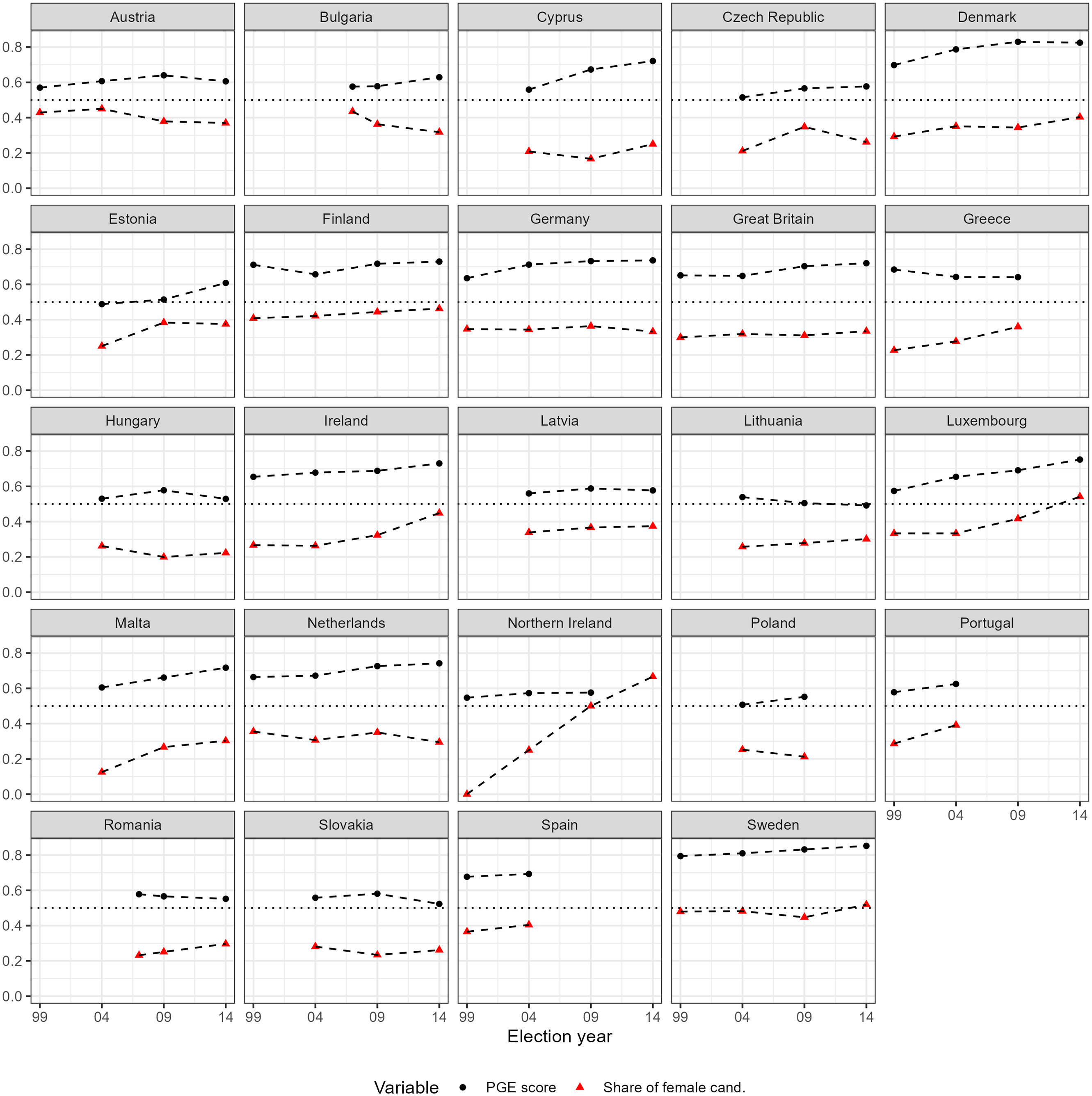
Public support for gender equality and mean female candidate share across EP elections.
Research design
Our aim is moving beyond studying the association between public attitudes and the nomination of women. It is, of course, difficult to infer causal effects from observational data. 3 Public attitudes on gender equality are not randomly assigned to countries, and their causal relationship with the nomination of female candidates can be confounded by other variables. However, the longitudinal nature of our data allows us to keep any time-invariant factors at the country-level constant. We can do the same even at the level of political parties, in a second set of analyses that focus on those parties that are observed in more than one election. Note that we do not make claims that our analyses establish causal effects without doubt, since we need to make some assumptions whose examination (not to speak of relaxation) is beyond the scope of this article. 4 However, to the best of our knowledge, we believe that our approach comes at least closer to identifying a causal relationship than previous work.
To infer causal effects of interest, we make several fundamental choices for the research design. To begin with, our analyses focus on the causal impact of major shifts in public opinion towards more gender egalitarianism. Societal attitudes towards gender equality can be differentiated along a continuum, as done also by the PGE score (Woo et al., 2023). Changes in public opinion over time can be gradual, but occasionally larger ‘shocks’ occur. We focus on such shifts, for two reasons. First, from a theoretical perspective, a political reaction is more likely when there is a clearly noticeable jump in public attitudes compared to when there is just a slow evolution. We expect that a signal of attitude change needs to be sufficiently strong in order to be heard. Second, from a methodological perspective, comparing situations with and without a larger shift makes the causal inference problem much more tractable. We can focus on the effect of a binary treatment, whose examination does not require the assumption or estimation of a certain functional form of the full relationship. Also, gradual change may be difficult to separate from time trends, and the PGE score is a latent variable characterized by uncertainty. Therefore, we code a binary treatment variable to indicate whether there is a major shift towards more gender-egalitarian public opinion in the five-year interval spanning two pre-election years (e.g. 2008 and 2013 for nominations to the 2009 and 2014 elections). This equals 1 if we are more certain than not that this over-time change is at least 0.05.
5
Based on Figure 4 in Woo et al. (2023: 772), a difference of +0.05 on the scale of the latent variable corresponds to an
Another key aspect of our analyses is the focus on (fairly) short-term effects. We examine whether parties in countries with a marked liberalization of public attitudes – compared to the previous European election five years earlier – nominate more women than those elsewhere. This implies that we study how selectors react to their choice from the current pool of potential candidates. There could, of course, be more long-term effects of public opinion on women’s decision to enter politics or aspire to higher office, which could be addressed in further research.
From an initial
We use a difference-in-differences approach. Recent methodological literature (e.g. Goodman-Bacon, 2021) has revealed that the standard estimation approach – a regression model with fixed effects for units and time periods – does not identify the average treatment effect on the treated (ATT) when there are multiple time periods and different units are treated at different times – unless one is willing to make strong assumptions about the homogeneity of treatment effects across the treated groups and time points. Therefore, we rely on the approach introduced by Callaway and Sant’Anna (2021). The basic idea is to estimate group- and time-specific ATTs by comparing trends between treated and not-yet-treated cases, which can then be aggregated to form an overall ATT. 7 To keep any time-invariant confounders constant, we work with two types of panels: one at the country level with the mean share of female candidates across parties as the outcome, and one at the party level for those parties that we observe repeatedly over time.
Key assumptions in this causal identification approach are (a) that selectorates do not anticipate future shifts in public opinion, and (b) that the nomination behaviour of selectorates in countries with major shifts in public opinion would (absent the shift) show an over-time change that runs parallel to that of selectorates in countries without a shift. The origin of the public opinion shocks need not be random, as long as the parallel trend assumption holds. It could be violated when certain societal changes influence both public opinion on gender equality and nomination behaviour, implying a different trend for countries with a shift even if it had not happened. In our models, we include the electoral system type (existence of preference vote option) as a time-varying control variable, since electoral system changes could imply different trends in nominations. 8 As a robustness check, we also run models that include the lagged outcome in the selection equation.
Estimates of causal effects
Table 1 summarizes the estimates of the ATT for both the country-panel and the party-panel specification. It shows both the aggregation (in the top row) and the ATTs specific to the time point (with the treated cases cited in parentheses). The table reports the effect of experiencing a major public opinion shift on the proportion of women in the slate, with a range between 0 and 1. Here in the text, we express the estimates as percentages between 0 and 100. In both models, the estimated overall ATT of experiencing a major shift towards more gender-egalitarian attitudes on the share of female candidates is close to zero and statistically insignificant. The country-panel analysis gives a point estimate of
Estimated ATTs of major public opinion shift on the nomination of women.
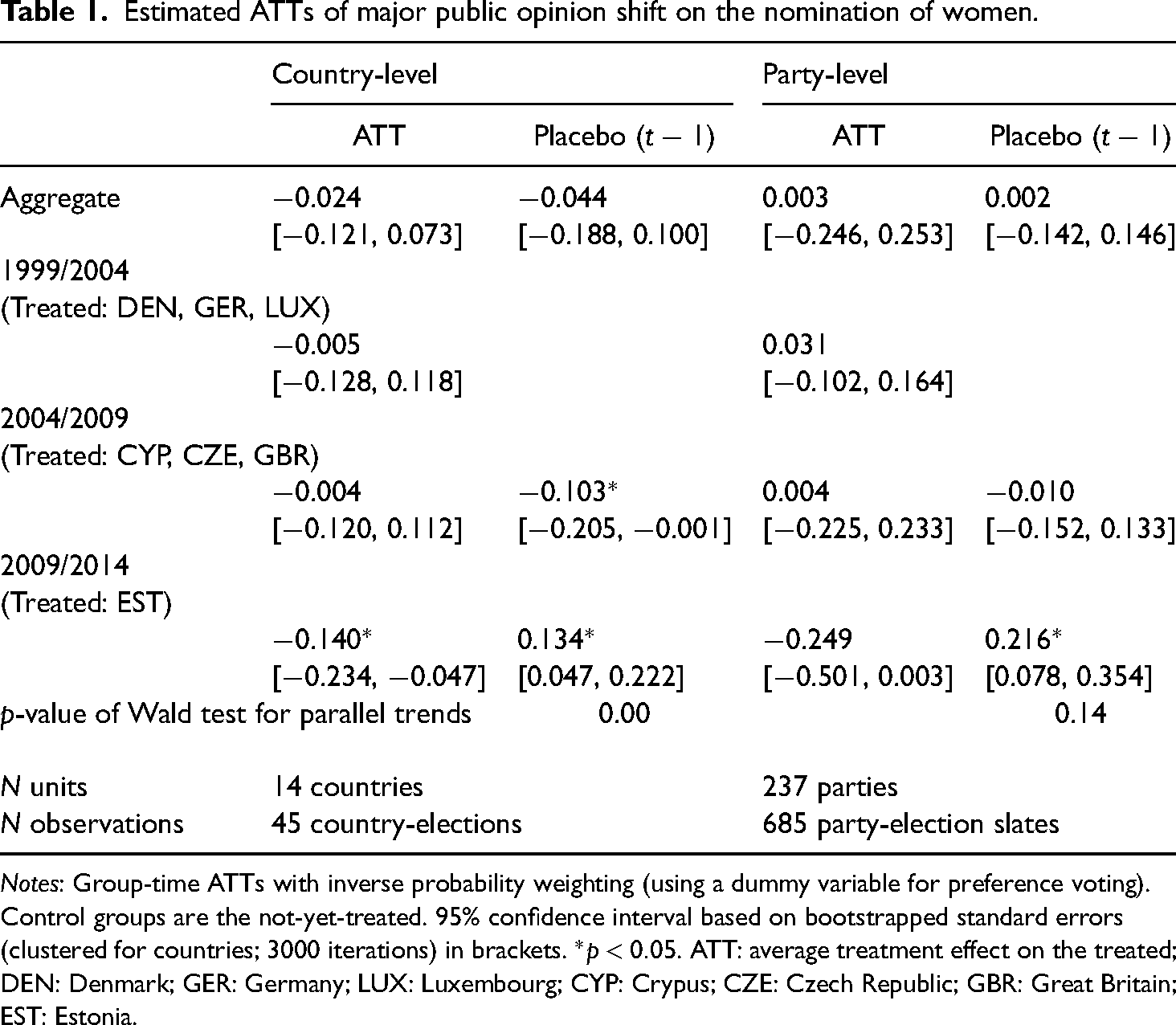
Notes: Group-time ATTs with inverse probability weighting (using a dummy variable for preference voting). Control groups are the not-yet-treated. 95% confidence interval based on bootstrapped standard errors (clustered for countries; 3000 iterations) in brackets.
An advantage of the approach by Callaway and Sant’Anna (2021) is that we can also look at the disaggregated results. This reveals an interesting pattern. While the ATTs are small in those countries that experienced liberalization between the 1999–2004 and 2004–2009 periods, the estimated effect is negative for Estonia, which underwent such a change between 2009 and 2014. The country-level analysis suggests that the number of female candidates changes by
Table 1 also reports the results of placebo tests, analysing pre-treatment changes. Treatment and control groups should ideally not differ in their trajectory in the time period before the shift in public opinion occurs. The point estimates are
We next examine potential moderators of the public opinion effects. Splitting the observation sample into subsets, we estimate ATTs separately for countries with and without preference voting, and for parties with leftist, centrist and rightist socio-cultural policy positions (for details on the measurement, see Online appendix). The subset analysis is conducted at the party level, that is, for slates that are observed more than once. The comparisons across subgroups need to be interpreted with caution, since the moderating variable could also reflect other differences between countries and parties that have an influence on the effect of interest. Figure 2 displays the subgroup-specific estimates for countries depending on the type of PR system they use. The overall ATT is negative but substantively small (and statistically insignificant) in countries with closed-list PR. For member states with some form of candidate voting (flexible lists, fully open lists, or Single Transferable Vote), the effects are positive (
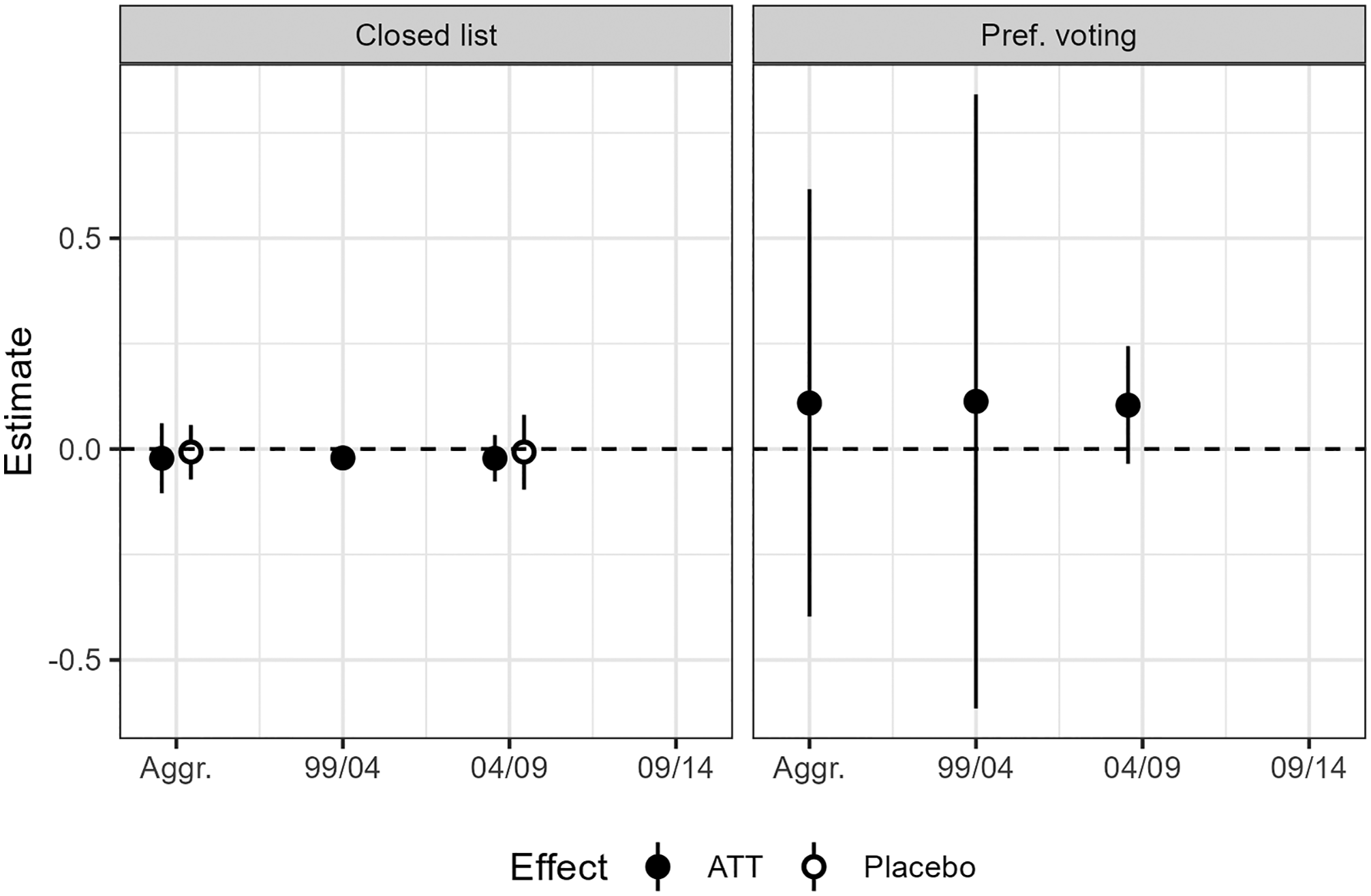
Effects for subgroups by electoral system.
Figure 3 compares the effects of shifts towards more gender egalitarianism across different types of parties, based on their socio-cultural positions. Among other things, this can give us an indication as to what extent parties’ reactions are moderated by the ideology of the parties concerned. As stated earlier in H3, socio-culturally centrist parties may be expected to be particularly responsive to the public’s views on gender, since their own views may be neutral and their motivation may be more strongly oriented towards vote-seeking. Comparing ATTs across party groups, as shown in Figure 3, again suggests that there are no clear differences. The aggregate point estimates (on the very left within each panel) are positive for GAL and centrist parties but negative for TAN parties. However, all confidence intervals include zero. The expectation that especially centrist parties are responsive is not borne out by the data. Rather, it could be the case that TAN parties react to societies becoming more egalitarian by nominating fewer women. We need to exercise caution, though, since the placebo tests point to problems. It seems like TAN parties in treated countries had nominated more women than those in the control group before the public opinion shift, so the parallel trends assumption could be problematic.
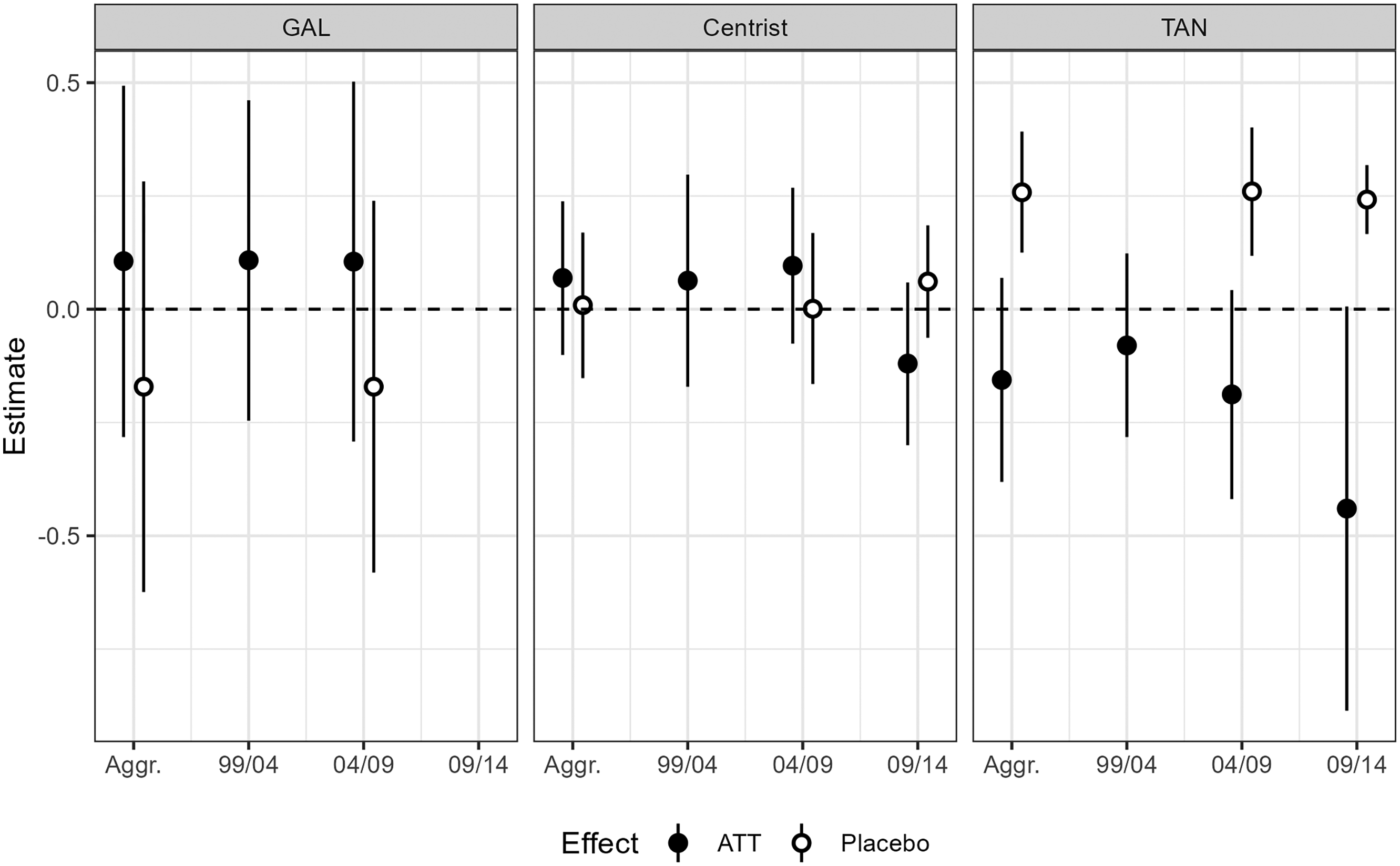
Effects for subgroups by party position.
Further analyses
Our identification strategy rests on the idea of comparing nomination trends in countries that experience major shifts towards more egalitarian attitudes to those in countries which do not. Deciding where to draw the boundaries between minor changes and major shifts can be difficult. To assess the robustness of our findings, we conduct some additional analyses. First, we use a higher cut-off to classify public opinion shocks. If we require that we need to be at least 50% certain that the change over time is at least 0.07 (corresponding to an
Second, to capture more of the variation in public opinion, we estimate parametric models in the form of binomial logit models with the continuous PGE score as a predictor. The Online appendix reports the results from such models with country and party fixed effects specifications (which use all cases without legislated quotas). The regressions also take into account the uncertainty in the public opinion measure. The findings corroborate the causal effect estimates presented above: there is no statistically significant positive association between the PGE score and female nominations in any of the models. The analyses that look at pairs of adjacent elections reveal negative point estimates (with country-fixed effects) or coefficients with the same signs as in the causal analysis (with party-fixed effects; positive for 1999–2004 and 2004–2009 but negative for 2009–2014). Overall, this reinforces the insight that the average effect of public opinion is nil, which seems to be driven by the heterogeneity of effects across space and time.
Third, it could be argued that causality runs (also) in the other direction, with past nominations of female candidates contributing to shifts in public opinion. Since it is well possible that past nominations also affect current nominations (e.g. due to an incumbency bonus in obtaining (re-)nomination), this would imply confounding and violate the parallel trends assumption. The Online appendix reports the results from models taking the lagged outcome into account. The country-level analysis indicates that public opinion shifts may reduce the number of female nominations (the ATT is
Finally, it could be asked whether effects differ when considering nominations to more prominent positions, that is, those near the top of ranked lists. As additional findings reported in the Online appendix show, we also obtain substantively small and statistically insignificant aggregate ATTs when zooming in on the first four positions in countries that use ranked lists. Taken together, the pattern of overall null effects, characterized by some heterogeneity across space and time, persists also across the various robustness checks.
Conclusion
While a substantive majority of EU citizens believe that there should be more women in politics (Fernández and Valiente, 2021), and public opinion has moved towards favouring more gender equality in several member states, women still remain under-represented both as candidates in European elections and as legislators in the supranational assembly. Past research has shown a positive association between societal gender equality and the number of female candidates (Lühiste, 2015; Valdini, 2012, 2013), but this article is (to our knowledge) the first attempt at probing the causal nature of such a relationship. Using a difference-in-differences analysis drawing on more than 10,000 candidacies from four EP elections, we do not find evidence that major shifts in public opinion towards women have a positive effect on female nominations. On average, the effect is nil.
There are several potential explanations for this finding. First, it is possible that the extent of the changes occurring in public opinion over five-year periods between EP elections is too small to make an impact. This could also be linked to the specific observation period (the 1999–2014 elections). 12
Second, the hypothesized effect may take longer to materialize, especially if it works primarily through enlarging the pool of female aspirants (compare Coffé et al., 2022; Dahl and Nyrup, 2021; Ohmura and Bailer, 2022) rather than by affecting selectors’ choices from a given set of potential candidates. 13 Related to this point, the electoral incentives for party selectorates to nominate more or less women may not be as strong as expected. 14 Third, the effects of changes towards more egalitarian attitudes may be heterogeneous and context-dependent, with a tendency to cancel out. The fact that the election-specific point estimates are sometimes positive and sometimes negative provides some support for this argument. In addition, effects could also vary at the level of parties, for example, due to the organization of the candidate selection process (Aldrich, 2020). However, ultimately only further research can adjudicate between these (or other) explanations.
In the context of this Special Issue, we have analysed an informal challenge to women’s careers at the pre-institutional stage: the candidate selection for EP elections. The fact that societal change towards more gender-egalitarian attitudes does not help female politicians become nominated may be interpreted as bad news, especially since the EP is the only directly elected – and typically regarded as a female-friendly – EU institution. From a broader perspective, our findings also contribute to the attempts of recent literature to disambiguate how gender equality policies are being promoted or contested in the EP (Kantola and Lombardo, 2018). The divorce between progressive public opinion change and women’s representation might add another layer of explanation as to why the EP has not always lived up to its earlier reputation of a unified, progressive actor on gender issues. Relatedly, further research could investigate whether public opinion shifts play any role in the gender mainstreaming efforts of the EU Commission and the perception of the corresponding EU policies. Our findings also point to potentially wider issues regarding party responsiveness and democratic representation. The fact that significant liberalization of public opinion does not result in increased diversity amongst candidates highlights the stickiness of the existing power imbalances and men’s over-representation in politics. While parties may need more time to react to the shifts in public attitudes, either because of a limited number of female aspirants or the dominance of existing male networks, slow response to citizens’ views may further increase political apathy. As political alienation is associated with low levels of political participation, especially among traditionally under-represented groups, such as women and the youth – both of whom tend to hold more gender-egalitarian attitudes – this unresponsiveness to public opinion change may thus further disengage those already less interested in politics.
Supplemental Material
sj-pdf-1-eup-10.1177_14651165241299111 - Supplemental material for Do public attitudes on gender equality affect candidate selection in proportional representation systems? Evidence from European Parliament elections
Supplemental material, sj-pdf-1-eup-10.1177_14651165241299111 for Do public attitudes on gender equality affect candidate selection in proportional representation systems? Evidence from European Parliament elections by Thomas Däubler, Maarja Lühiste and Mihail Chiru in European Union Politics
Footnotes
Acknowledgements
Earlier versions of this article were presented at the EPSA Annual Conference 2022 and at the EUropean Political Careers Workshop in Bamberg in May 2023. In addition to participants at these events, we are grateful to Elena Frech for editing the Special Issue, to Jan Bulla and Benjamin Elsner for methodological suggestions and to Conor Twomey and Dino Wildi for research assistance. Thomas Däubler would also like to thank the Citizens, Opinion, Representation (MOR) research group in the Department of Comparative Politics at the University of Bergen for facilitating a research stay in Summer 2023, during which large parts of the empirical work on this study were conducted.
Author Contributions
The authors developed this study together. M.L. and M.C. wrote the literature review and made large contributions to the theoretical part and the conclusions. T.D. was in charge of the empirical part and took the lead in finalizing the manuscript.
Declaration of Conflicting Interests
The authors declared no potential conflicts of interest with respect to the research, authorship, and/or publication of this article.
Funding
The authors received no financial support for the research, authorship, and/or publication of this article.

Data Availability Statement
The data and replication code are available as part of the Supplementary Material at the DOI of the article.
Supplemental material
Supplemental material for this article is available online.
Notes
References
Supplementary Material
Please find the following supplemental material available below.
For Open Access articles published under a Creative Commons License, all supplemental material carries the same license as the article it is associated with.
For non-Open Access articles published, all supplemental material carries a non-exclusive license, and permission requests for re-use of supplemental material or any part of supplemental material shall be sent directly to the copyright owner as specified in the copyright notice associated with the article.
