



Abstract
Even as the far-right parties of Western Europe have made broad electoral gains, mainstream parties continue to enact a cordon sanitaire, effectively curtailing their legislative impact. Any potential ability of women far-right politicians to cooperate across party lines would open up important political opportunities not available for them within the far right. This article seeks to address the following question: are women of the far right able to cooperate with members of other political parties in ways that their men colleagues cannot? Using a network analysis of motion co-authorship across three sessions of the European Parliament, I find that there is a double marginalization of far-right women politicians – as women in far-right politics, and as far-right politicians in the European Parliament – which results in women politicians who lack influence within their parties, and within the European Parliament more broadly.
Introduction
Even as their political support has grown, and as they have made significant electoral gains, far-right parties in Europe have been met with varying levels of cooperation and exclusion. Cooperation and collaboration are important tools for advancing policy agendas, and the far right faces many barriers in this regard. Their far-right position on the political spectrum leaves them with few coalition partners, politically isolating them in parliament. In many cases, mainstream parties have actively refused to work with the far right, thereby setting up a cordon sanitaire 1 either by official policy or unofficial social norm (Axelsen, 2023). Their support draws from a distrust and dislike of ‘mainstream’ politics, so that far-right voters are often against cooperation with centrist parties (Röth et al., 2018). As a result, there remain open questions about the legislative impact of these parties, even as their electoral representation grows (Akkerman, 2012; Minkenberg, 2013; Röth et al., 2018).
Cooperation across parties, and between politicians and outside interest groups, is a key source of action and information for politicians (Wonka and Haunss, 2020). While women continue to be underrepresented and marginalized in politics, research on women politicians not on the far right has shown them to be effective lawmakers specifically due to their greater willingness to cooperate across party lines (Volden et al., 2013). This willingness has meant that women politicians, in particular those of minority parties, are more likely than men to be able to carry their sponsored legislation through to enactment (Weeks and Baldez, 2015). The limited research on women on the far right in parliament, however, has painted a picture of them as passive and marginalized within their parties (Geus and Shorrocks, 2020; Rashkova, 2021). And so, the potential ability of women far-right politicians to cooperate across party lines would open up important political opportunities not typically available for them within the far right.
Far-right women politician's network positions, whether they are central or isolated, shed light on their broader influence both within the growing far-right movement, and in party politics more generally. Specifically, I seek to answer the following question: are women of the far right able to bypass the cordon sanitaire and cooperate with members of other political parties in ways that their men colleagues cannot? In answering this question, I seek to contribute to this literature in two ways: first, by examining the impact of the cordon sanitaire on the interpersonal network of political cooperation in the European Parliament, and second, by examining any potential gender differences in the impact of the cordon sanitaire.
To this end, I build a network of motion co-authorship within the European Parliament over three parliamentary sessions, analysing trends in group connectivity and influence across political groups and gender. I find that the far right, as represented by four parliamentary groups across the three sessions, is indeed poorly connected and structurally isolated within the European Parliament. Their low centrality values point to their isolation and lack of influence within the parliamentary networks of motion co-authorship. The findings on gender are more complex, however; while women do generally have larger networks, they are not uniformly more influential or central than the men of their parties. The women of the far-right groups, in particular, have poor access not only to the resources, opportunities, and information flowing between members of the European Parliament (MEPs) of the other groups, but also to those flowing between the men MEPs of their groups. Women on the far right, I argue, are exceptionally marginalized: not only are they isolated within the European Parliament through their party membership, but they also lack influence in their own parties.
Gender, political parties, and the cordon sanitaire
Political parties on the far right have made electoral gains across Western Europe, taking seats in national parliaments in several countries, including Denmark, France, and the Netherlands, and even entering government at times, most recently in Italy under the leadership of Giorgia Meloni (Kirby, 2022; Rooduijn, 2015). The far right is also making gains at the supranational level: in the last European Parliamentary elections, held in 2019, 192 of the 751 seats went to politicians who could be considered on the far right 2 (Guisan, 2022). As they have made these gains, their reception by other political parties and government has varied significantly, ranging from mainstreaming and normalization to complete exclusion (Heinze, 2018; Minkenberg, 2013).
Research into a variety of European contexts has documented the normalization and mainstreaming of the far right, often aided by accommodation by media (Neuber, 2023; Paxton and Peace, 2021), or by the legitimization offered by electoral success (Valentim, 2021; Vrakopoulos, 2022). For example, the media coverage of the Dutch far right leading up to the 2021 elections treated them as legitimate political actors, removing the stigma associated with their extremism, and increasing awareness of their politics, thereby contributing to the normalization of the far right in the Dutch public sphere (De Jonge and Gaufman, 2022). In the European Parliament, meanwhile, far-right MEPs have relied on their institutional affiliation to lend legitimacy to their exclusionary and Eurosceptic views (Pytlas, 2021). Women are a key part of this mainstreaming process, impacting both media depictions, and voter receptions, of the far right. The association of women with gendered stereotypes of kindness, caring, and compassion, primes voters to view their politics as less extreme or cruel than they might otherwise (Ben-Shitrit et al., 2022; Elad-Strenger et al., 2024).
On the other hand, there are those contexts in which the far right is shunned and excluded. This exclusion is generally understood to be a political strategy of non-far-right political parties and is referred to in the literature as the cordon sanitaire. The cordon sanitaire can be defined simply as the ‘collective refusal to collaborate with a political party on principle’ (Axelsen, 2023: 1). In practice, this has entailed media bans, little representation in debates, refusal of parties to enter into coalitions, as well as a broad reluctance to cooperate on legislative activities (De Jonge, 2021; McDonnell et al., 2021). The cordon sanitaire, as a strategy of exclusion and isolation, effectively reduces the blackmail and coalitionary potential of the far right, thereby reducing the relevance and influence of their exclusionary and extreme politics (Benedetto, 2008; Sartori, 2005).
That said, the literature in the field is not united on whether the cordon sanitaire is an effective tool with which to reduce the electoral appeal of far-right parties and politicians. By blocking far-right parties’ legislative efforts, the mainstream can work to portray them as ineffective and unproductive, attempting to convince potential far-right voters that their votes would be wasted (Heinze, 2018). On the other hand, the cordon sanitaire, by isolating extreme actors, can increase the public perception of policy convergence across mainstream parties, thereby increasing appetite for far-right politics (Loxbo, 2014). Beyond that, the cordon sanitaire has not proved effective in blocking the proposal or passage of Eurosceptic or anti-immigrant legislation when proposed by more mainstream right groups (Servent and Panning, 2021).
The cordon sanitaire, as a policy or an informal norm, is aimed at a party or political group as a whole: it is meant to effectively isolate political parties, leaving them without ideological allies or policy partners. However, we can also think about the cordon sanitaire as operating at the level of interpersonal ties, where members of the group being excluded would experience that exclusion as a general reduction in their connectedness within a legislature. Interaction through shared activities, broadly understood, increases the network ties between actors (Feld, 1981). Taking a legislature as a social context within which networks are formed, then politicians can be understood as forming social ties through their interaction in joint activities, such as committee participation or legislative co-authorship. The cordon sanitaire blocks these interactions between politicians, thereby diminishing the network ties between radical right politicians and others.
Within the context of politics, networks are important in cooperation, recruitment, identity formation, resource sharing, and more (Crossley, 2007; Wonka and Haunss, 2020). Position within these networks has wide reaching ramifications for a politician's career: their centrality within the network determines their influence on other politicians, and their access to donors, party resources, and executive positions (Franceschet and Piscopo, 2014). And so, more connected politicians are more influential within their parties and within the larger legislative context (Fowler, 2005). Here again, the cordon sanitaire negatively impacts the far right: by refusing the cooperate with the far right, mainstream parties curtail the social ties of far-right parties and their members, reducing their access to knowledge, resources, brokerage positions, and more.
Even as they remain widely underrepresented and marginalized in politics, there is a growing body of literature highlighting how women in politics tend to be highly collaborative, effective, and productive. Gendered patterns of socialization, in particular around conflict, mean that women politicians tend to place more value on collaboration and consensus building and are more likely to work with members of other parties to further their political goals (Barnes, 2016; Weeks and Baldez, 2015). Women in minority parties benefit especially from these tendencies, and are arguably more able to carry legislation through to enactment than the men of the parties (Volden et al., 2013). Clearly, then, cross-party cooperation provides a powerful tool for women trying to enact policy goals in a context on ongoing gender inequality (McGing, 2022).
In recent years, women have greatly increased their representation at all levels of the far right. Women leaders have led far-right parties to unprecedented success – under Meloni's leadership, for example, the Fratelli d’Italia quadrupled their seat share in the European Parliament in 2024 (Newth, 2024). However, with the exception of a few powerful women, it appears that their representation has remained largely symbolic (Mulinari and Neergaard, 2017; Rashkova, 2021). Existing research has found that women on the far right tend to be less productive than their men colleagues, and occupy marginal positions within party structures (Ralph-Morrow, 2022; Rashkova, 2021; Rashkova and Zankina, 2017). Far-right groups tend to favour a regressive and essentialist construction of gender, which explains, in part, the reluctance of these groups to institute measures aimed at gender equality, or to raise women into positions of power (Kantola, 2022; Ralph-Morrow, 2022). And so, any ability to cooperate or collaborate across party lines in ways that their men colleagues cannot has the potential to open up important opportunities for influence for women on the far right.
The far right in the European Parliament
No longer a purely consultative body, the European Parliament has developed over the past few decades to hold substantial power in the running of the European Union (Hix et al., 2007). As the power and size of the European Parliament has increased, the rules of procedure have been repeatedly revised – often in ways to ensure smooth running of government, and to regulate more clearly the behaviour of MEPs. Such regulation – including limiting the ability to filibuster and setting standards of conflict of interest – has had as its effect a weakening of the influence on parliamentary activity of individual MEPs (Brack, 2018). Today, the most important parliamentary activities require the cooperation of large numbers of MEPs; for example, a nomination for president of the European Parliament requires the backing of either a political group, or one-twentieth of the parliament (Brack, 2018). In effect, the declining importance of individual MEPs has led to the increased importance of parliamentary cooperation within and across political groups.
For those far-right parties and politicians represented in the European Parliament, cooperation and group membership has never been straightforward. With the exception of their shared Eurosceptic stances and common preferences for restrictive policy on migration, these parties support a wide variety of fiscal and social policies (Cavallaro et al., 2018; Falkner and Plattner, 2020; Halikiopoulou et al., 2012). Their conflicting nationalist agendas, not to mention their inconsistent policy stances on issues as diverse as the European single market, national deference, and family policies, create rifts between them (Falkner and Plattner, 2020; McDonnell and Werner, 2018). As a result, past parliamentary groups have been short lived and ineffectual (McDonnell and Werner, 2019). In the past three sessions alone there have been four active political groups that can be considered to be far right or populist right: the Europe of Freedom and Democracy (EFD) in Session 7, the Europe of Freedom and Direct Democracy (EFDD) and Europe of Nations and Freedom (ENF) groups in Session 8, and, most recently, the Identity and Democracy Group (IDG) in Session 9. So, even as the far right has increased their representation in the European Parliament, group cohesion on the far right in voting remains low, as does cooperation across parties by politicians within this group (Brack, 2013; Cavallaro et al., 2018; Chiru and Wunsch, 2023).
Not only is the far right beset with internal conflicts and so unable to form coherent policy advocacy blocks, but these political groups have also struggled to work with members of other political groups within the European Parliament. Their anti-establishment tendencies make far-right politicians suspicious of political institutions, and their ideological distance from other groups leaves them few options for legislative partners (Akkerman, 2012; Akkerman and Rooduijn, 2015). Moreover, their extreme positions on issues like gender equality or immigration make them unpopular with mainstream voters (Röth et al., 2018). As a result, the main groups of the European Parliament tend to work together on important and sensitive issues, purposefully avoiding the need to work with, or to compromise with, marginal and extremist groups (Brack, 2018; Chiru and Wunsch, 2023). In addition, when far-right MEPs have managed to form political groups, they have been systematically excluded from positions of influence: the short lived Identity, Tradition and Sovereignty political group, which formed and subsequently dissolved in 2007, was the only political group not to be granted a report in that session, and the only group without any members heading committees (Almeida, 2010). Politicians’ productivity and collaboration matter for parties: if politicians, especially those that are in a minority status, are unable to work with others due to their ideological stances, it follows that they will be unable to enact their policy preferences or positions (Herzog, 1987; Kreppel, 2001).
Research into substantive representation of women politicians outside of the far right has found that they tend to be more effective than their men colleagues when in elected office. Gendered norms around conflict avoidance and cooperation mean that women in politics are more collaborative across party lines (Adams et al., 2023; Barnes, 2016; Naurin et al., 2019). As a result, women politicians, especially those in minority parties, are more likely to see legislation through to enactment than their men colleagues (Volden et al., 2013). There remain open questions, however, about the impact of party affiliation and ideological alignment on these patterns of legislative efficacy. Specifically, little is known about what impact gender has, if any, on the well-documented findings of poor legislative efficacy and low parliamentary cooperative among far-right politicians (Akkerman and Rooduijn, 2015; Riera and Pastor, 2022).
The European Parliament provides an effective case for testing the marginalization of women politicians within far-right parties. The European Parliament is rather unique as a legislative arena. Not only is there no government there, but individual members are quite limited in their activities. Individual MEPs can table a motion for resolution on their own and can ask up to 20 parliamentary questions every three months (Brack, 2018). Most other parliamentary activities, such as proposing amendments or nominating for key positions, require cooperation between large numbers of MEPs (Brack, 2018). Given the collaborative tendencies of women politicians broadly, they might be expected to perform especially well in a highly collaborative legislative setting like the European Parliament (McEvoy, 2016). Should the women of the far right resemble their same gender colleagues – rather than the uncooperative men of their parties – that would present new and important opportunities for implementing far-right policy priorities. Moreover, it would imply that there are legislative contexts where the misogyny embedded within far-right politics can be overcome. And so, I seek to answer the following question: are women of the far right able to cooperate with members of other political parties in ways that their men colleagues cannot?
Data and methods
In this article, I seek to contribute to our understanding both of the impact of the cordon sanitaire on interpersonal networks of political cooperation, and of the gendered dynamics of political cooperation in the context of the cordon sanitaire. The European Parliament provides a prime location in which to study the potential isolation or cooperation of the far right. Unlike in other legislative contexts, there is no government in the European Parliament, and so most of the legislative work done there is done by committees. The presence of a cordon sanitaire limiting cooperation with the far right will, it stands to reason, impact significantly on their influence and collaboration. Within this context, I seek to the answer the following question: given women politicians documented collaborative tendencies, might women on the far right overcome the isolation of the far right and collaborate across party lines?
Social network analysis allows for the construction and visualization of the relationships (‘edges’) between a set of actors (‘nodes’) (Crossley, 2007). In order to construct a network of cooperation in the European Parliament, I pulled all the parliamentary motions for a resolution tabled in the three most recent sessions (Sessions 7 to 9). These motions were publicly available on the website of the European Parliament's Public Register of Documents, along with other parliamentary documents such as budgetary procedures, and committee reports. I opted to use motions as my data source for parliamentary cooperation as almost all sitting politicians have been involved in authoring at least one motion. Motions can be authored by a parliamentary committee, a group of MEPs, or even a single MEP. Authorship on a motion is voluntary and many motions are authored by groups of MEPs cooperating across political groups. Moreover, since motions do not need to be approved by other political groups, they include the positions of isolated and unpopular politicians and political groups in a way that legislation would not.
In total, I collected 9148 motions, spanning the three parliamentary sessions, dated between 23 July 2009 and 19 November 2023. In each session, roughly 700 MEPs were involved in authoring motions at least once: in Session 7 (from 2014 to 2019), there were 2773 motions authored by 720 individual MEPs; in Session 8 (from 2014 to 2019), there were 4328 motions authored by 794 MEPs; and in Session 9 (from 2019 to 2024), there were 2047 motions authored by 759 MEPs. The distribution of authors 3 by parliamentary group and gender for each session is shown in Table 1, with the groups ordered by their position on the political spectrum, from left to right.
Sample statistics.
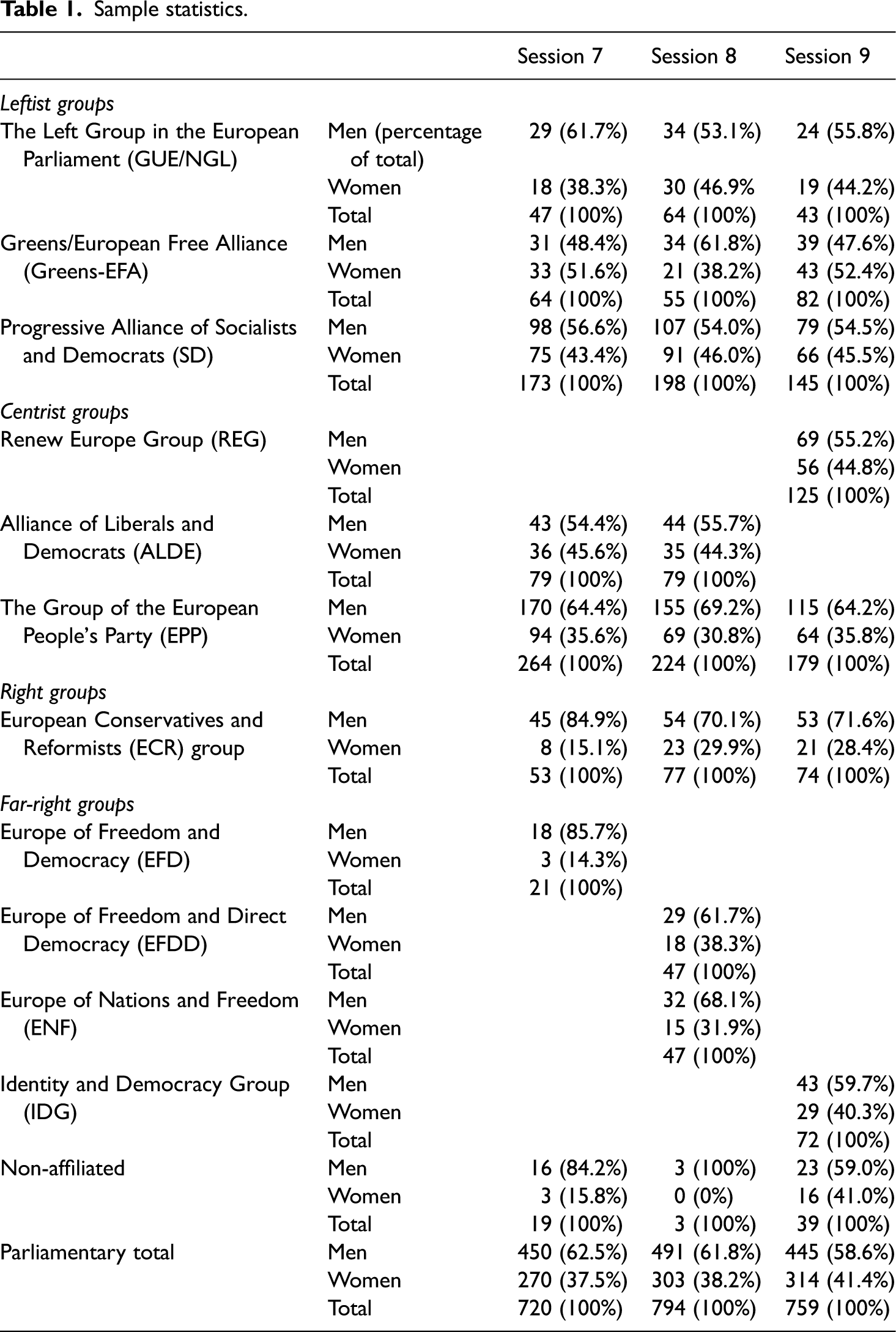
As Table 1 shows, women's representation in the European Parliament's motion authorship increased slightly across the three sessions, from 37.5% in Session 7 to 41.4% in Session 9. Those parties towards the left of the political spectrum tend to be more gender equal in their motion authorship: in all three sessions, the Left Group in the European Parliament (GUE/NGL), Greens-European Free Alliance (Greens-EFA), and Progressive Alliance of Socialists and Democrats (SD) groups were between 38% and 53% women. Conversely, the European Conservatives and Reformists (ECR) group, for example, never reported more than 30% women. The four far-right groups, each active in only one session, also consistently reported a majority of men. While remaining a minority, women did improve their representation on the far right significantly between 2009 and 2023: in Session 7, only 14.3% of the far-right MEPs involved in authoring motions were women, but by Session 9, that number was 40.3%.
From these motions, I developed a list of co-author pairs, consisting of every possible duo from each motion's authorship list. The co-author pairs were then weighted by occurrence, and divided by parliamentary session, resulting in three samples, or edge lists, where the edges represent co-authorship relationships and connect nodes that represent individual politicians. I used this edge list to construct three non-directed, weighted networks – one for each of parliamentary session. For my analysis, I used the Python Networkx package, which includes tools that not only build the network, but also produce a variety of network measures, including density and assortativity. Density represents the proportion of possible ties that are actually present in a given network, and so can range from 0 to 1. Assortativity refers to the tendency of nodes to connect with similar nodes, rather than with dissimilar nodes, with respect to a specific attribute. Assortativity coefficients can range from −1 to 1, where positive values represent a tendency in the network for similar nodes to connect, and negative values represent a tendency for dissimilar nodes to connect (Barrenas et al., 2009). For my analyses I used the assortativity of political group affiliation, providing an approximation of the network political homophily, or put another way, of the tendency of politicians to work across groups.
Using these networks, I ran a two-step analysis: focusing first on the position of the far right (as represented by the EFD, EFDD, ENF, and the IDG) within the full network, and then on the position of women MEPs more specifically. For both analyses, I calculated group level measures of degree centrality, betweenness centrality, and closeness centrality. Using group level measures of centrality allows for a measurement of the importance and position of a group of people, rather than of the individual (Everett and Borgatti, 1999). More importantly, using group level measurements has the clear advantage of not conflating intra- and inter-group interactions, something that would happen when simply averaging centrality measurements across the members of a group. Put simply, using group level measurements of centrality allows me to study only how well groups are connected to one another, ignoring the density of connections within groups.
In the first set of measurements, I took as my groups the political groups of the European Parliament. The purpose of this set of network measurements was to establish a baseline isolation of the far right. In the second, I split each political group into two, treating the men and women MEPs of each political group as their own network group, thereby shedding light on the individual connectivity of the men and women of each group to the full European Parliament network. Using these measures, 4 I was able to focus on the double effects of gender and political party on women's positions within the networks of political cooperation in the European Parliament.
Broadly, a node's degree is a measurement of how connected that node is to other nodes. Group degree centrality, according to Everett and Borgatti (1999: 3), refers to the ‘number of non-group nodes connected to group members’ as a proportion of the total non-group nodes. Group degree centrality, then, provides a measurement of how connected a group is to members of other groups. Next, when betweenness centrality is measured at the individual level, it represents the number of shortest paths that travel through a given node. Group betweenness centrality, on the other hand, refers to the proportion of shortest paths ‘connecting pairs of non-group members that pass through the group’ (Everett and Borgatti, 1999: 11). In my networks of politician co-authorship, the group betweenness centrality value for the IDG, for example, would represent the proportion of shortest paths between non-IDG politicians that pass through an IDG politician. Betweenness centrality is often used to measure brokerage and influence, given how it represents the frequency with which nodes connect otherwise unconnected others. Groups with high group betweenness centrality gain influence through facilitating novel connections, while groups with low group betweenness centrality have more redundant connections.
Finally, group closeness centrality is a measurement of how closely connected the group is to every other node in the network. In closeness centrality, distance is measured as the number of nodes passed through on the path between group nodes and each non-group node. Networkx provides a normalized measurement of closeness (see Everett and Borgatti, 1999), where larger numbers indicate a greater closeness centrality. Group closeness centrality functions as a measurement of how quickly a group can access the information or resources flowing through a network; that is, how many steps (or nodes) would someone in a group need to go through to access that information? Groups with high closeness centrality are, therefore, more connected to more groups, and have faster and easier access to their information; groups with low closeness centrality are isolated and disadvantaged (Hansen et al., 2020). Both betweenness centrality and closeness centrality measures account for edge weight – that is, for the number of times that two politicians engage in a motion co-authorship relationship. The combination of these three group level measurements of centrality provides a solid overview of the position of a group – its connectedness, its isolation, and its influence – in relation to the rest of the network.
Findings: Networks of parliamentary cooperation
The network analyses of the European Parliament from 2009 to 2023, constructed through the co-authorship of motions for resolution, revealed a picture of the far right as relatively structurally isolated. Three far-right groups – ENF, EFD, EFDD, IDG – routinely scored the lowest group centrality values, pointing to their poor integration within the parliamentary networks of co-authorship. Furthermore, the group centrality measures for women MEPs, which measure their network centrality compared to other MEPs and to the men of their own group, reveal the extent of the marginalization of women on the far right. Given their low degree centrality, closeness centrality, betweenness centrality, it would appear that women on the far right have poor access not only to the resources and information flowing through the parliamentary network, but also those flowing through the networks of their men colleagues.
Isolation of the far right
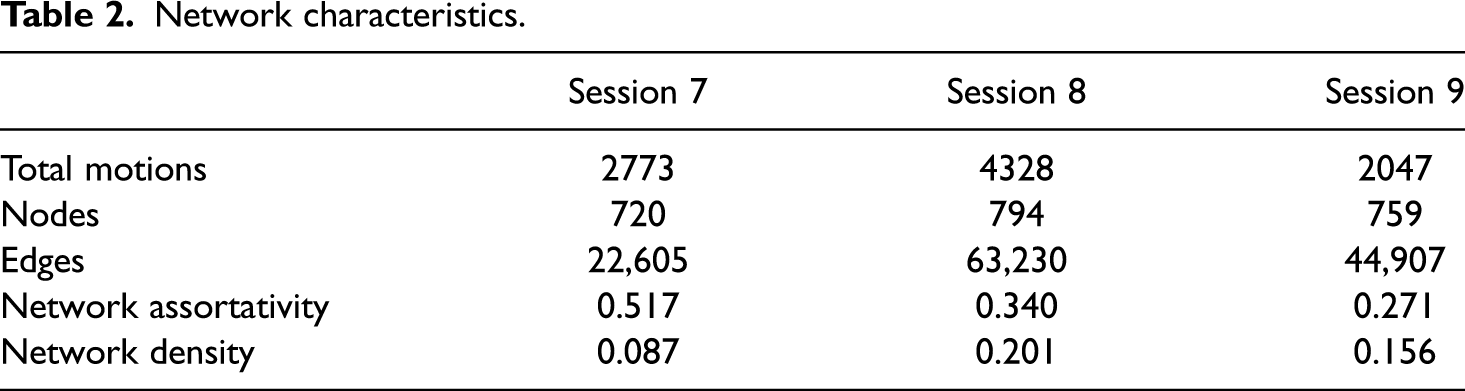
The networks of motion co-authorship reveal of picture of uncommon isolation for the far right. Figure 1 displays the three networks constructed from motion co-authorship, and shows how the far right (represented by purple nodes) sits, clustered, on the edges of the parliamentary network. 5 In addition to this trend of far-right isolation, the network analyses revealed two other interesting trends: first, that the networks of motion co-authorship in the European Parliament are sparse, with only a small percentage of possible relationships being realized. For example, the densest network (Session 8) returned a density coefficient of 0.201, indicating that the 63,230 edges in the network represent only about 20.1% of the possible ties between the 794 MEPs involved in motion co-authorship in that session. Second, the network assortativity decreases over the course of the three sessions, from 0.517, to 0.340, and finally to 0.271. This downward trend indicates an increased tendency of MEPs to connect with members of other parliamentary groups (Table 2).
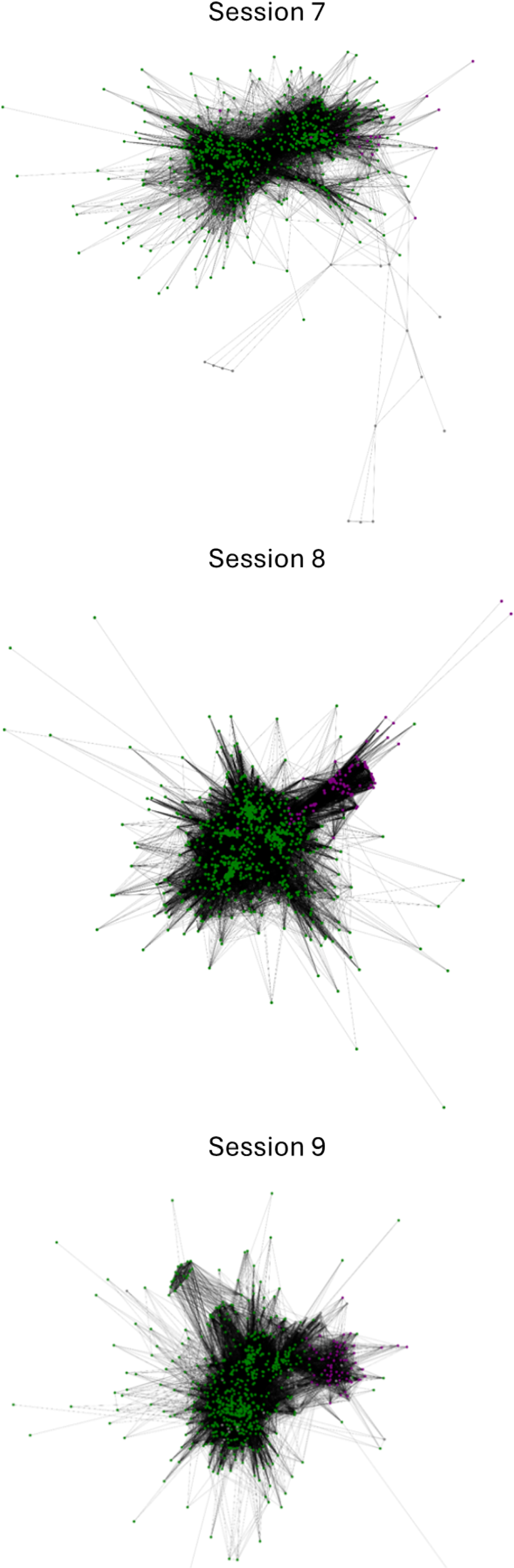
Networks of motion co-authorship, by parliamentary session.
Network characteristics.
The group centrality scores reveal the extent of the isolation of the far right in the European Parliament. As Table 3 shows, over time, the far-right groups of the European Parliament – namely the EFD, ENF, and IDG – report the lowest group centrality scores. Their low degree, closeness, and betweenness indicate that, as a group, the far right is extremely poorly connected to the rest of the parliament and, as a result, have less influence, less access to information and resources, and are more isolated. Moreover, the minimal changes in their group centrality scores across the three sessions point to their failure to improve their influence within the parliament over time.
Group centrality measures, by political group and parliamentary session.
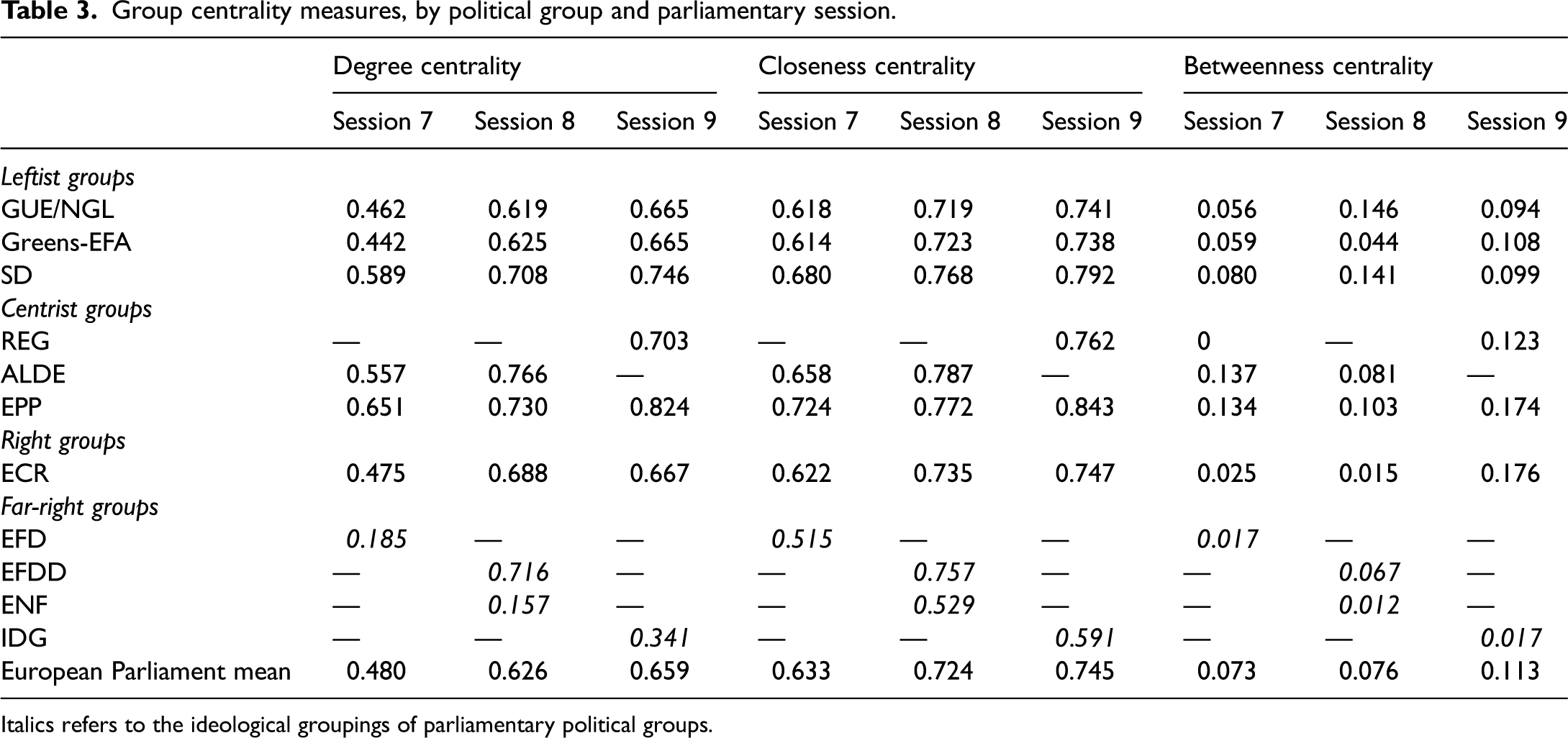
Italics refers to the ideological groupings of parliamentary political groups.
In all three parliamentary sessions, the lowest group degree centrality score was reported by a far-right parliamentary group. Group degree centrality, as detailed above, provides a measure of the number of non-group nodes connected to a group, as a proportion of the total number of non-group nodes. In the seventh session, the EFD group had a group degree centrality score of only 0.185, meaning that only 18.5% of MEPs not affiliated with EFD had co-authored a motion with an EFD MEP. This score of 0.185 was less than half the next lowest score: the Greens-EFA, with the second lowest group degree centrality, received a score of 0.442, meaning that they were connected to a full 44.2% of non-group member MEPs through motion co-authorship. The far right in that session, then, is much less connected to other groups than those groups are connected to one another – they sit on the outskirts of the parliamentary network.
The trend in group degree centrality was similar in Sessions 8 and 9 of the European Parliament. The ENF group and the IDG both scored the lowest group degree centrality values in their respective parliamentary sessions. The ENF, in Session 8, were only co-authored motions with 15.7% of non-ENF MEPs (centrality value = 0.157), while the IDG did so with 34.1% of non-IDG MEPs in Session 9 (centrality value = 0.341%). While this does point to an increase in the connectedness of the far right over time – moving from 0.185 in Session 7 to 0.341 in Session 9 – their increased degree centrality is not unique. As Table 3 shows, the parliament as a whole becomes more connected over the course of Sessions 7 to 9, with the parliamentary mean group degree centrality rising from 0.480 to 0.659. And so, despite their increased group degree centrality, the far-right groups remain the least connected of the European Parliament over time.
With few exceptions, the European People's Party (EPP) group had the highest group centrality scores across the three sessions. Their degree centrality ranged from 0.651 to 0.824, meaning that they co-authored motions with between 65.1% and 82.4% of MEPs affiliated with other groups – nearly three times the number of non-group MEPs who co-authored motions with MEPs from the far-right groups. Similarly, the EPP had the highest group closeness centrality in both Sessions 7 and 9. Group closeness centrality measures the distance between groups with a calculation of the number of nodes passed through on the path between group nodes and each non-group node (Everett and Borgatti, 1999). In essence, it estimates the ease with which, and the speed at which, group members can access non-group members, and their associated knowledges, information, and resources. The EPP, with its high group closeness centrality (0.724 in Session 7, 0.772 in Session 8, and 0.843 in Session 9), has easy access to the resources of other parliamentary groups through their close co-author connections. Conversely, groups with low group closeness centrality (indicated by smaller numbers), such as the EFD, ENF, and IDG, are more distant from other groups and as such as more isolated and disadvantaged (Hansen et al., 2020).
Finally, group betweenness centrality provides a measure of a group's brokerage – of how often group members connect otherwise unconnected others. Groups with low group betweenness centrality, then, have more redundant connections; that is to say, they connected unconnected others relatively rarely, and so do not facilitate new connections or flow of novel information. As such, betweenness centrality is an important measure of influence: it measures the normalized measure of group betweenness centrality and can be interpreted as the proportion of shortest paths between two non-group members that pass through a group member. For example, the GUE/NGL has a group betweenness centrality of 0.146 in Session 8, meaning that a full 14.6% of the shortest paths between MEPs from other groups are facilitated by GUE/NGL MEPs. The ENF, by comparison, only facilitated 1.2% of shortest paths between non-group members in Session 8, meaning that they broker significantly fewer novel co-authorship connections than other MEPs.
Figure 2 plots group betweenness centrality by group and session. As the figure shows, the lowest betweenness centrality in each session is reported by one of the far-right parliamentary groups: EFD in Session 7, ENF in Session 8, and IDG in Session 9. Even the EFDD, which has a much higher group betweenness centrality than the other far-right groups, remains below the mean (as represented by the vertical line in each graph). Moreover, the group betweenness centrality of the far-right groups in the European Parliament does not improve over time: the EFD facilitate only 1.7% of the shortest paths between otherwise unconnected others in Session 7, as do the IDG 10 years later, in Session 9. The group closeness centrality of the far-right groups, similarly, increases very little, even as the parliamentary mean does. Combined with their consistently low degree centrality, these measures paint a picture of a poorly connected ideological faction, and one that is not increasing their influence or power over time.
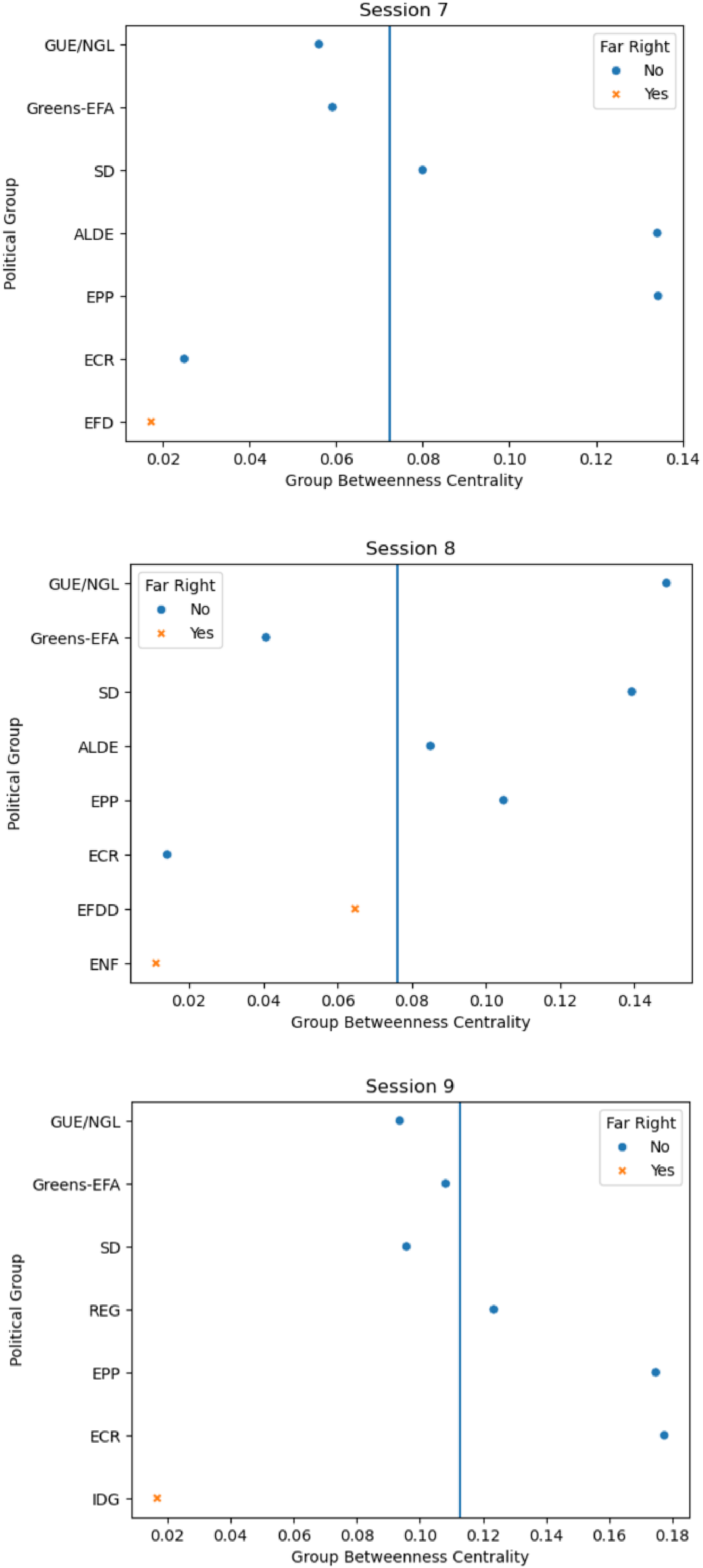
Differences in group betweenness centrality, by parliamentary session.
Marginalization of women far-right politicians
As the second step in my analysis, I split each political group between their men and women MEPs, in order to narrow in on the doubled effects of political affiliation and gender on centrality. In effect, it makes visible the differences between men and women of the same party in their connectedness within the European Parliamentary network. 6 There is little evidence of broad gendered patterns: the position of men and women in the full network relative to each other varies across parties and measures. That said, clear in the figures below is the particularly poor network position of the women MEPs in the far-right parliamentary groups. Their low levels of degree centrality, betweenness centrality, and closeness centrality were being disguised by the higher (although still comparatively low) levels of the men of their parties when the group as whole's centrality was measured.
Figure 3 plots the group degree centrality scores of the parliamentary groups by gender for each session studied, along with the mean group degree centrality. As the figure shows, the women of the far right fall significantly below the parliamentary mean for group degree centrality. In all cases but one, they also fall below the values of their men colleagues. For example, when the 29 women of the IDG are separated out and treated as their own group, their group degree centrality is a mere 0.230. Put simply, only about 23% of the politicians who are not women MEPs in the IDG are connected to the women of the IDG through motion co-authorship. While the men MEPs of the IDG are still poorly connected compared to other groups, they are much better connected to non-IDG politicians than the women of their party, co-authoring motions with 32.7% of non-group members. Treated as their own groups, the women MEPs of the other eight political groups have group degree centralities ranging from 0.555 to 0.796. Importantly, the lack of connection of the far-right women to other groups cannot be explained just by their small group size; for example, in Session 9, there were fewer women MEPs in the ECR (21) and in the GUE/NGL (19) groups and yet the women MEPs of both these groups have much higher group degree centrality values (0.560, and 0.650 respectively).
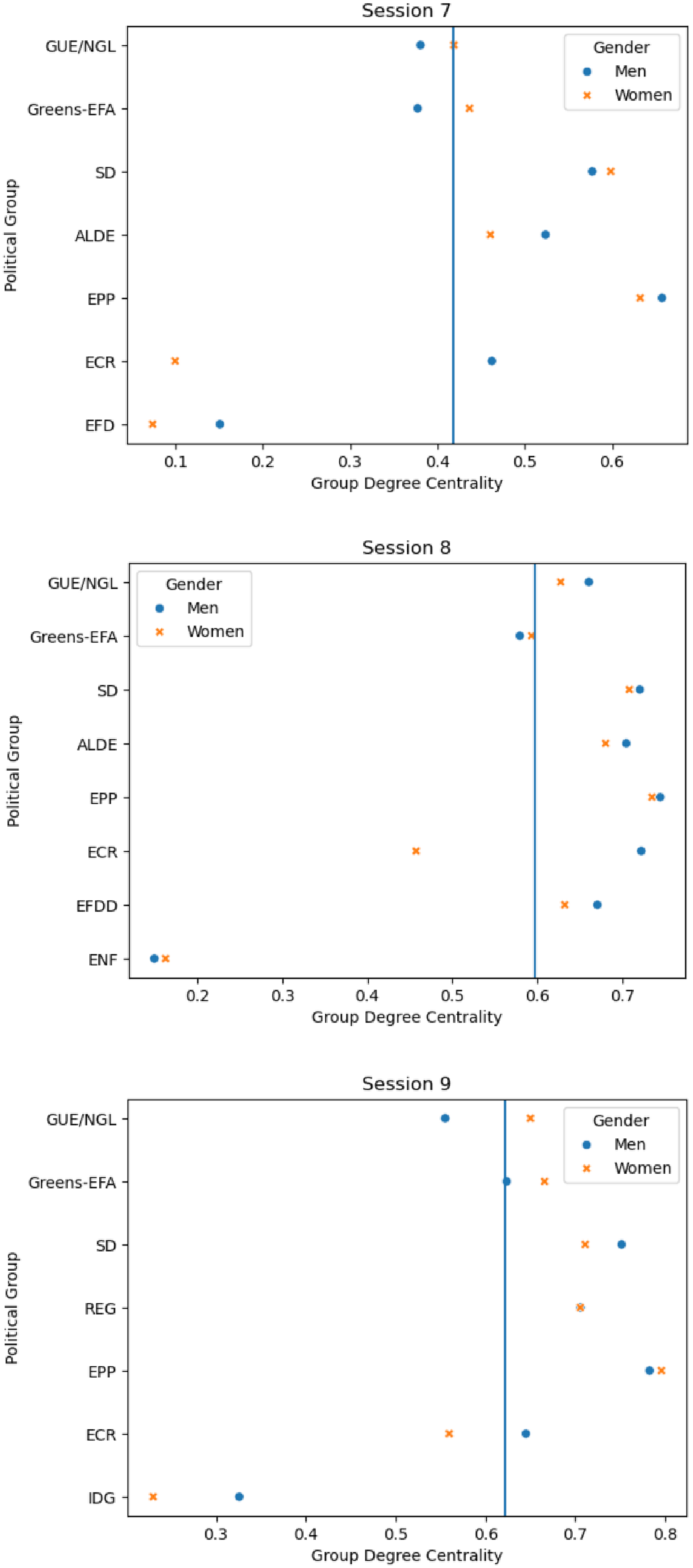
Differences in group degree centrality, by gender, political group, and parliamentary session.
There is only one exception to this trend: the women of the ENF have a higher degree centrality than their men counterparts, although both the men and women of that group have by far the lowest group degree centrality recorded in Session 8. Men MEPs affiliated with the ENF group have a group degree centrality score of 0.133, compared to the 0.176 of women MEPs affiliated with the same group, meaning that women are connected to about 4% more non-group members than men (17.6% vs. 13.3%). Notice, however, how much lower these group degree centrality values are than for the other groups: even the groups with the next lowest score (the Greens-EFA) have centrality values more than twice those of the ENF. And so, while the women of the ENF are better connected than the men of their group, the parliamentary mean values for group degree centrality – of 0.604 for men and 0.581 for women – show that they are still connected to far fewer non-group members than the norm in the European Parliament.
Table 4 summarizes the three sets of group centrality scores for each group by gender and parliamentary session. The gendered differences in group closeness centrality are small, but a pattern does emerge, where parliamentary groups on the left (GUE/NGL, Greens-EFA, and SD), women tend to have higher group closeness centrality than men, while the reverse is true for those groups towards the centre and right (REG, ALDE, EPP, and ECR). For example, the group closeness centrality value for the women of the Greens-EFA group is between 0.004 and 0.023 higher than that of the men of the group across the three sessions. Conversely, the women of the ECR group, which is home to politicians to the right on the political spectrum, had group closeness centrality values between 0.054 and 0.148 points lower than those of the men. On the far right, too, men have higher group closeness centrality than the women, with the exception of the ENF. The differences between parties also tend to be small, but it is worth noting that, while all other groups increase their closeness centrality over time, the far right does not, and that, as a result, the gap between them and the rest of the European Parliament grows between Sessions 7 and 9.
Group centrality measures, by political group, gender, and session.
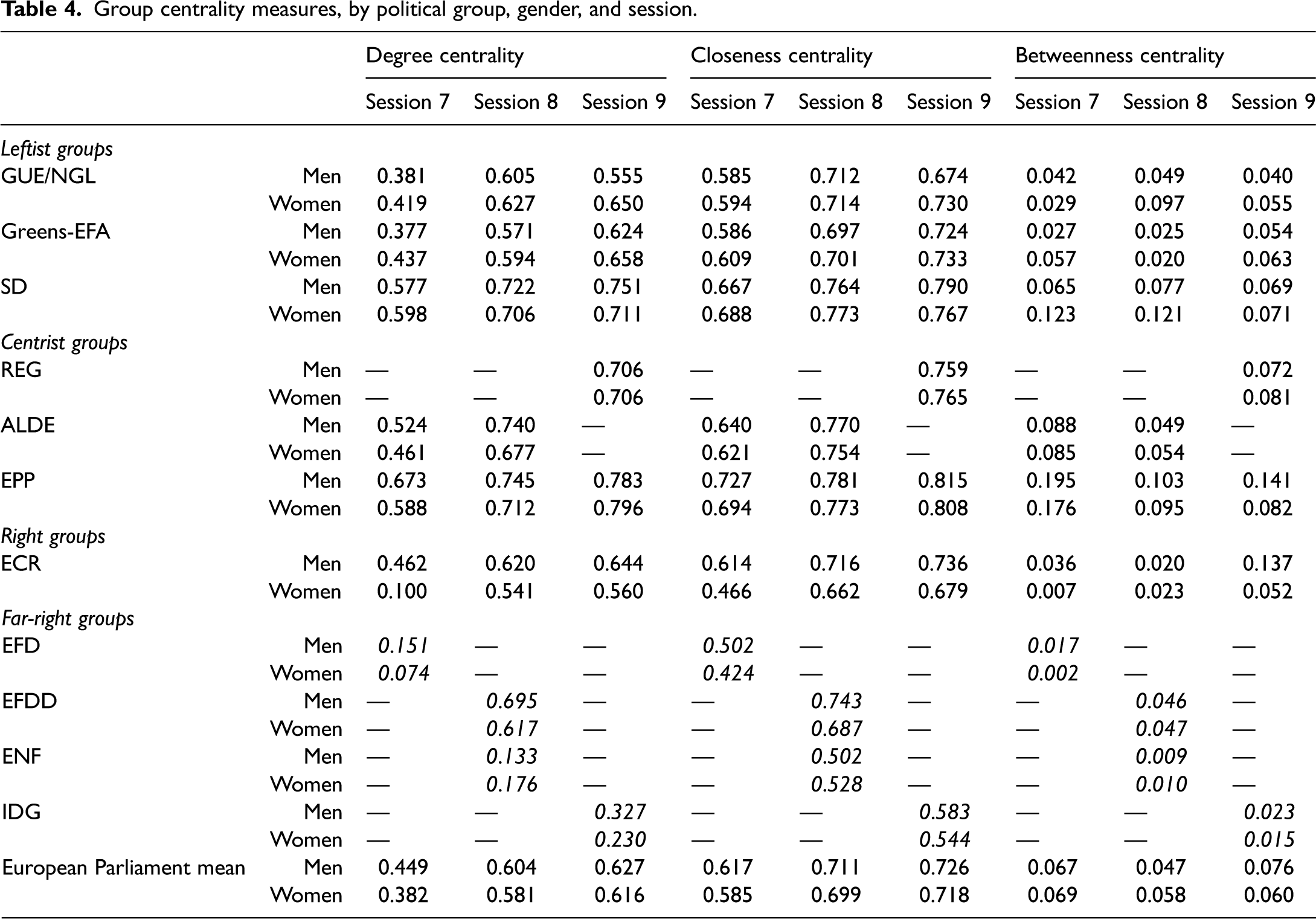
Next, the women of the far right have lower group betweenness centrality values than the men of the groups. For example, in Session 7, women MEPs affiliated with the EFD group had a group betweenness centrality score of 0.002, a score much lower than the 0.017 for men. Again, these values represent proportions, so they can be interpreted as the percentage of shortest paths between non-group nodes that pass through the group nodes. Put simply, between 2009 and 2014, the women members of the EFD only facilitated 0.2% of novel connections between MEPs who were not women in the EFD group. The men, meanwhile, provided 1.7% of connections between otherwise unconnected others; while a much higher centrality than that of the women, both fall significantly below the parliamentary means for men (0.067) and women (0.069) in that session.
Similarly, the network analysis of Session 9 motion co-authorship produced a group betweenness centrality value of 0.023 for the men of the IDG – nearly double that of the women of the IDG (0.015). For the IDG MEPs, the men only serve as brokers in 2.3% of all the shortest paths between non-group politicians (which include both the women of the IDG, and all MEPs of other groups), and the women in only 1.5% of the total number of shortest paths. While the men of the far right groups have little influence – when influence is taken to be the ability to connect others – the women of these groups have even less.
Discussion and conclusion
The rise of prominent women leaders on the far right in recent years has inspired new lines of inequality about the role of gender politics and of women politicians in advancing the far-right political project. While research into the efficacy of women politicians has found that they are generally more collaborative and cooperative across party lines (Adams et al., 2023; McGing, 2022; Weeks and Baldez, 2015), the question remains whether this trend holds for those women on the far right. Women on the far right have been shown to be marginalized within their parties, constrained by gendered norms of behaviour that frame women as poorly suited for politics and leadership (Finnsdottir, 2023; Ralph-Morrow, 2022). Less is known, however, about how women on the far right interact with representatives of other political parties; that is, whether they are collaborative like their same gender colleagues, or isolated within legislative contexts like the men of their parties.
In answering my research question – that of the potential for women of the far right able to bypass the cordon sanitaire and cooperate with members of other political parties in ways that their men colleagues cannot – I undertook a network analysis, measuring group centralities of the men and women of the political groups of the European Parliament. The network positions of the men and women of the far right were of particular interest, specifically those MEPs affiliated with the EFD, EFDD, ENF, and IDG groups. In all three sessions, far-right MEPs found themselves with the lowest group centrality scores. Put simply, these MEPs sit on the outskirts of the motion co-authorship networks and work mostly with one another. Crucially, they rarely occupy broker positions, and so lack the political influence that comes from connecting otherwise unconnected others. Moreover, as a result of their low group betweenness centrality and closeness centrality, far-right MEPs have poor access to the information and resources flowing within the European Parliament network. The cordon sanitaire of the European Parliament is, clearly, working.
These findings of far-right structural isolation are in line with previous work documenting the use of the cordon sanitaire in the European Parliament (Kantola and Miller, 2021). The failure of the far right to work across ideological differences has severely curtailed their parliamentary influence (Chiru and Wunsch, 2023). That said, this isolation is not simply the result of anti-establishment attitudes, or poor legislative performance: these groups, due to their regressive and extremist positions, are often purposely excluded from the business of governance by mainstream political groups looking to impede their legislative activities (Axelsen, 2023; Haute and Pauwels, 2016; Kitschelt, 2018; McDonnell et al., 2021).
The EFDD are an interesting outlier to the trend of radical right isolation. One possible explanation for their higher integration is their more ideological diverse membership. While the bulk of the EFDD group were MEPs from the United Kingdom Independence Party, the parliamentary group also included nearly the same number of members from the Italian populist Five Star Movement, along with MEPs representing agrarian and traditionally conservative parties like the Latvian Farmers Union (Bressanelli and Candia, 2019). Further research could explore whether the less extreme positions of certain portions of the EFDD allowed its members to bypass the cordon sanitaire in the European Parliament.
The women of the far right, with some exceptions, are even more isolated from the European Parliament network than the men. The network analyses here measured their centrality as a group within the rest of the network, in effect measuring their connectedness not only to other political groups but also to the men of their own groups. Their low centrality values mean that women far-right MEPs are both poorly connected to political groups not on the far right and lack access to the networks of their men colleagues. These findings of women's marginalization are in line with previous work on women's substantive representation on the far right, which has found that women far-right politicians tend to be less productive, and occupy less powerful positions, than men (Gwiazda, 2021; Ralph-Morrow, 2022; Rashkova, 2021). Clearly then, in answer to my research question, the women of the far right are not able to bypass the cordon sanitaire of the European Parliament and collaborate with members of other political groups.
Political groups and institutions are inherently gendered, and are both structured by and constitutive of gendered relations, and as such as deeply implicated in the (re)production of gendered inequality in politics (Aldrich, 2020; Childs and Kittilson, 2016). Political parties – through their programmatic appeals, electoral strategies, their internal politics, etc. – make decisions that either encourage or discourage women's substantive representation in politics. These decisions are, in part at least, informed by party ideology which has been shown to have important influence on party organization, leadership, and women's representation (Keith and Verge, 2018; Kitschelt, 2007). The gender ideology of the far right – rooted as it is in traditional and heteronormative understandings of gender (see Campbell and Erzeel, 2018; Christley, 2022) – pervades party structure, reproducing patterns of gendered inequality among supporters and representatives alike. As a result, women's substantive representation – their ability to speak for women, not just represent them (Celis and Childs, 2012) – is limited on the far right.
In conclusion, as women's participation on the far right increases (Erzeel and Rashkova, 2017; Mayer, 2015), they are still excluded and pushed aside within their own parties. Women's lack of coalitionary potential on the far right has importance for how we understand their role in the growth of anti-democratic and regressive politics in recent years. Scholars have commented on how public association of women far-right politicians with stereotypically feminine values of care and compassion has broadened the appeal of these parties (Ben-Shitrit et al., 2022; Snipes and Mudde, 2020). And, indeed, political leaders like Marine Le Pen have led their parties to unprecedented successes, closing the gender gap in far right voting (Mayer, 2015). However, it would appear that the emergence of high-profile women on the far right – most recently Giorgia Meloni – does not so far signal a fundamental shift in the gender politics of these political parties. Within the networks of political cooperation in the European Parliament, the far right is isolated and excluded by a cordon sanitaire. For the women of these political groups, this isolation is experienced more deeply, as they are doubly marginalized within the European Parliament: as members of the far right, they are isolated within the parliamentary network, and as women they are sidelined within their own political group.
Footnotes
Acknowledgements
I would like to thank my supervisor, Dr John Veugelers, along with my committee members Dr Lee and Dr Dokshin for their support and advice. I would also like to thank the reviewers and the editor for their insightful and critical commentary.
Funding
The author(s) disclosed receipt of the following financial support for the research, authorship, and/or publication of this article: This research was supported by funding from the Social Sciences and Humanities Research Council of Canada (grant number 752-2021-1331).
Supplemental material
Supplemental material for this article is available online.
Data availability statement
All data used in these network analyses are published in a Borealis Dataverse. They can be accessed here:  . Link to data: Finnsdottir, Maria, 2023, “EP Networks Data June2023”, https://doi.org/10.5683/SP3/2C7NN6, Borealis, V2, UNF:6:IaMwjEAKIGaxmCFQC/KY8Q== [fileUNF].
Notes
References
Supplementary Material
Please find the following supplemental material available below.
For Open Access articles published under a Creative Commons License, all supplemental material carries the same license as the article it is associated with.
For non-Open Access articles published, all supplemental material carries a non-exclusive license, and permission requests for re-use of supplemental material or any part of supplemental material shall be sent directly to the copyright owner as specified in the copyright notice associated with the article.
