



Abstract
This forum article presents a new dataset on roll call votes in the committees of the European Parliament in the 2014 to 2019 legislative term. Data on roll call votes in the plenary has greatly informed research on the functioning of the European Parliament, broader legislative politics and European Union decision-making. Responding to transparency concerns about legislative decisions increasingly taken at committee level, a change of the European Parliament's Rules of Procedure introduced mandatory roll calls in committees from 2014. The article explains the context of the rule change, the data collection effort, and the data as such. A discussion of conflict across committees, party group cohesion and participation in roll call votes illustrates potential applications of the data.
Introduction
Research based on roll call votes has significantly advanced our understanding of European Parliament (EP) decision-making and broader European Union (EU) politics. Prior contributions focus on conflict dimensions, cohesion of party groups as well as party competition, and coalition formation (Attiná, 1990; Hix et al., 2007; Kreppel and Hix, 2003; Raunio, 1997). We have learnt from these studies how members of the EP (MEPs) faced with two principals behave and about the role of the EP in broader EU decision-making. Moreover, data on voting behaviour – including positional data primarily based on NOMINATE scores – has informed a broad literature on legislative organisation within the EP, shedding light, for example on committee and rapporteur assignments. Yet, so far, analysis of roll call votes has been limited to the plenary – a limitation that became increasingly acute as decision-making moved from the plenary to the committee-level when early agreements with the Council became the norm after the entry into force of the Amsterdam treaty (Reh et al., 2011).
We address this limitation by presenting a new dataset comprising all roll call votes in the committees of the EP in the 2014 to 2019 legislative term. It includes 3669 decisions in the 20 standing committees and joint committee meetings, making up more than 140,000 votes of individual MEPs. For the first time, the data thus offers systematic insights into legislative dynamics at committee level and provides a basis for studying voting behaviour of individual MEPs, party competition, coalition formation beyond the plenary, and other topics. Existing research has reported frequently lopsided votes at committee level (Settembri and Neuhold, 2009), but these insights were limited to vote totals. Researchers have also used alternative data to study committee decision-making, such as amendments (Baller, 2017; Hurka, 2013) or interviews and qualitative case studies (Roger and Winzen, 2015). By publishing the dataset, we hope to encourage EU scholars to revisit past insights and work towards a better understanding of legislative politics in the EU.
We present descriptive information along with a series of insights from the dataset, covering consensus and conflict across committees, party group cohesion and participation in roll call votes. The findings show that consensus is high, but some committees, such as Women's Rights and Gender Equality (FEMM), are markedly more divided. In keeping with findings on the plenary (Hix et al., 2018; Yordanova and Mühlböck, 2015), conflict is higher on requested roll call votes than it is on votes on which the roll is called by default, but only slightly so. This holds for both the committees as such and the largest parties. Further, party group cohesion is notably higher for the Progressive Alliance of Socialists and Democrats (S&D) than for the European People's Party (EPP) in the FEMM committee as well as in the Employment and Social Affairs (EMPL) committee. Moreover, we demonstrate that a significant share of votes – for example 30% in the case of the EPP – is not cast by committee members, inviting closer scrutiny of who takes decisions at committee level.
The dataset includes MEP's institutional IDs as well as inter-institutional reference numbers for legislative files, which facilitate integrating the data with other MEP or legislation-focused datasets. For instance, it can be combined with electoral data from the COMEPELDA datasets (Däubler et al., 2022), plenary roll call data from the Votewatch Europe datasets (Hix et al., 2022), or career and biographical data from the EP website (Høyland et al., 2009). Likewise, additional information on the different legislative files and procedures can be obtained from the EP's Legislative Observatory, 1 EUR-LEX 2 and related datasets (Golub, 2024; Häge, 2011; Ovádek, 2021) based on the inter-institutional reference number.
Committees in the EP: Towards mandatory roll call votes
Research on the EP's committees is in a healthy state. In lockstep with the empowerment of the parliament over the last decades (Hix and Høyland, 2013), scholarly interest in the institution has increased considerably and has zoomed in on the committees as the EP's ‘legislative backbone’ (Westlake, 1994). First studies provide descriptive analyses of their role (e.g. Neuhold, 2001) and situate the committee system in theories of legislative organisation and decision-making in the EU (Bowler and Farrell, 1995). A second wave of research turns the focus towards intra-committee dynamics, examining the role of report allocation, national parties and consensus building (e.g. Hausemer, 2006; Settembri and Neuhold, 2009; Whitaker, 2001, 2005, 2011). More recent contributions shed light on composition and assignment processes and applied congressional theories to the study of the EP's committees (Whitaker, 2019; Yordanova, 2009, 2011, 2013). Regarding individual MEPs, the selection of committee chairs and (shadow) rapporteurs as influential actors has attracted academic attention (e.g. Benedetto, 2005; Chiou et al., 2019; Chiru, 2020; Hurka et al., 2015; Kaeding, 2004; Treib and Schlipphak, 2019; Yoshinaka et al., 2010). Finally, alternative approaches examine the relationship between the committees and behaviour in the plenary (Finke, 2012; Hurka, 2013; Ringe, 2010; Roger and Winzen, 2015).
Research on the committees became more urgent when in the aftermath of the Amsterdam Treaty a remarkable increase in so-called ‘first-reading agreements’ was widely perceived to move legislative influence in the EP away from the plenary. Trilogue meetings between EP negotiators, the Council presidency and the Commission allowed for fast-track legislation under the co-decision procedure (now: Ordinary Legislative Procedure), boosting the influence of individual representatives and shifting decision-making ‘from public inclusive to informal secluded arenas’ (Reh et al., 2011: 1112). Even though committees appoint the key negotiators, their options to effectively monitor the process remained limited. The sharp increase in first-reading agreements was accompanied by a lively academic debate on trade-offs between efficiency gains on the one hand and informalisation trends that caused normative concerns on the other (Rasmussen, 2011; Reh et al., 2011; Reh, 2014). A crucial critique centred on missing political justification, reinforced by an apparent lack of contestation at the plenary and committee level, where MEPs were perceived to rubberstamp pre-cooked deals (Reh, 2014).
The EP reacted to the informalisation trend and the shift of power within the legislature with various changes in its Rules of Procedure. First, non-binding guidelines for negotiations under the co-decision procedure were introduced in 2004 and culminated in a code of conduct in 2009, which strengthened the role of shadow rapporteurs and institutionalised the composition of negotiation teams (Judge and Earnshaw, 2011). Committees regained access to key moments in decision-making by taking formal decisions on the opening of inter-institutional negotiations and specifying the mandate of rapporteurs before the start of negotiations with Council and Commission. Committees can also decide to back up this mandate with a plenary decision, ensuring a high level of legitimacy for their negotiators (Corbett et al., 2016). This differs decisively from previous practice, where results from inter-institutional negotiations were included in draft reports prior to first discussions in committees, presenting both committees and subsequently the plenary with faits accomplis. In sum, the changes re-formalised several stages of the decision-making process and re-established stronger oversight by the committee as a whole.
Despite the new rules and guidelines, the strengthening of committees still left a wide gap in terms of transparency when compared to the plenary. Whereas for the plenary mandatory roll call voting for final legislative votes was introduced in 2009, on committee level they still had to be requested by at least a quarter of members present. It was only in 2014 that a change to the EP's Rules of Procedure introduced compulsory roll call voting for all final votes on reports and opinions in committees (Rule 218(3), formerly 208 (3), EP Rules of Procedure): ‘Any single and/or final vote in committee on a report or opinion shall be taken by roll call in accordance with Rule 180(3) and (4). The vote on amendments and other votes shall be taken by a show of hands, unless the Chair decides to proceed to an electronic vote or members or a political group or groups reaching at least the high threshold [25% of members] in the committee request a vote by roll call’ (Rule 208(3), EP Rules of Procedure).
In sum, this demonstrates how, after the Amsterdam Treaty allowed for first-reading agreements, the informalisation of decision-making and concomitant shift of power from the plenary to the committees and their rapporteurs lead to institutional reform. This ultimately included the adoption of mandatory roll call voting in committees, which aimed at improving transparency and accountability of committee-level decision-making. These roll call votes offer intriguing insights into revealed preferences before an issue reaches plenary. They hence represent a promising avenue to extending our knowledge of the committee level as a key arena in the EP's decision-making process, as well as of its interaction with the plenary level.
Data collection
The EP offers extensive information on the activities of its committees on its website, including general information on their composition, ongoing work and meeting documents. Roll call votes are documented in their own sub-section of the committees’ websites 3 and in the appendices to the meeting minutes. Although rules and guidelines to record roll call votes apply to all committees, the way of presenting the data on the website varied unsystematically from committee to committee for the period our dataset covers. 4 In what follows, we expound the process of data collection, important issues we encountered, and how we addressed them.
In a first step, we manually collected the data from the committees’ websites, which led to a total of 3081 decisions including all 20 standing committees, sub-committees and joint committee meetings. In a second step, we cross-checked the data by combing through the appendices of all meeting minutes. This identified 588 additional votes, not published on the websites, while 85 votes were published on the websites but not in the minutes. Overall, we found the data to be of poor quality considering it captures important legislative decisions. First, there were slip-of-the-pen type of errors, such as typos in MEPs’ names, suggesting human error in manually written up documents. Second, and more importantly, in the process of carefully cross-checking information published on the websites and the minutes, we found various inconsistencies, such as mismatches between the results indicated and the names of MEPs reported or between the minutes and the corresponding roll call data on the websites. Hence, in a final step we contacted the committee secretariats directly to better understand the underlying issues, obtain the missing information and corresponding corrections.
We received answer from the Directorate-General for Internal Policies (DG IPOL), which assists the EP committees in the area of internal policies of the EU and supports the work of most of the standing committees. Some of the errors could be explained as the output of the electronic voting system ‘was not usable for publication purposes’, so that ‘secretariats had to manually copy the results of the RCV [roll call vote] into a template which was then published on the committees’ websites and subsequently annexed to the minutes’ (email from DG IPOL, 30 June 2021). These ‘systemic weaknesses’ (email from DG IPOL, 30 June 2021) were largely addressed within the EP with the implementation of new procedures, which from October 2019 limited manual intervention in the creation of the result sheets to vote changes and MEPs having forgotten their vote cards.
Further publication discrepancies could be explained by inconsistent compliance with the (non-binding) guidelines on roll call votes by the Conference of Committee Chairs, in particular with regard to roll call votes not required by the EP's Rules of Procedure and hence arguably not unambiguously subject to a publication requirement.
The key insight from the engagement with the secretariat was that where discrepancies between different published results existed, the version annexed to the minutes should be considered definitive. We implemented this in the data. As a result, the dataset comprises all roll call votes published by the EP across the committee websites and committee minutes.
Introducing the dataset
We publish two datasets alongside this article. The first comprises MEPs’ individual votes on the 3669 decisions put to roll call vote in the 2014 to 2019 legislative term. We account for vote corrections, which MEPs can enter into the record, for example when pressing the wrong button on the electronic voting system. We consider these more indicative of revealed preferences.
The second dataset includes additional information on the votes. First, it includes the committee in which the vote took place. The 20 standing committees of the EP differ considerably in size, jurisdiction and prestige. In the past, scholars have used these differences to classify the committees based on the type of their policy output (Cox and McCubbins, 1993; Whitaker, 2005), power (McElroy, 2008) or a combination of output and power (Yordanova, 2011). Figure 1 shows the distribution of votes across committees, demonstrating that most roll calls took place in the Civil Liberties, Justice and Home Affairs (LIBE) committee, followed by the Budgetary Control (CONT) Committee and Legal Affairs (JURI), while the least took place in the Petitions (PETI) committee, AFCO and FEMM. Only in a few of the committees we see a significant number of roll call votes on amendments.
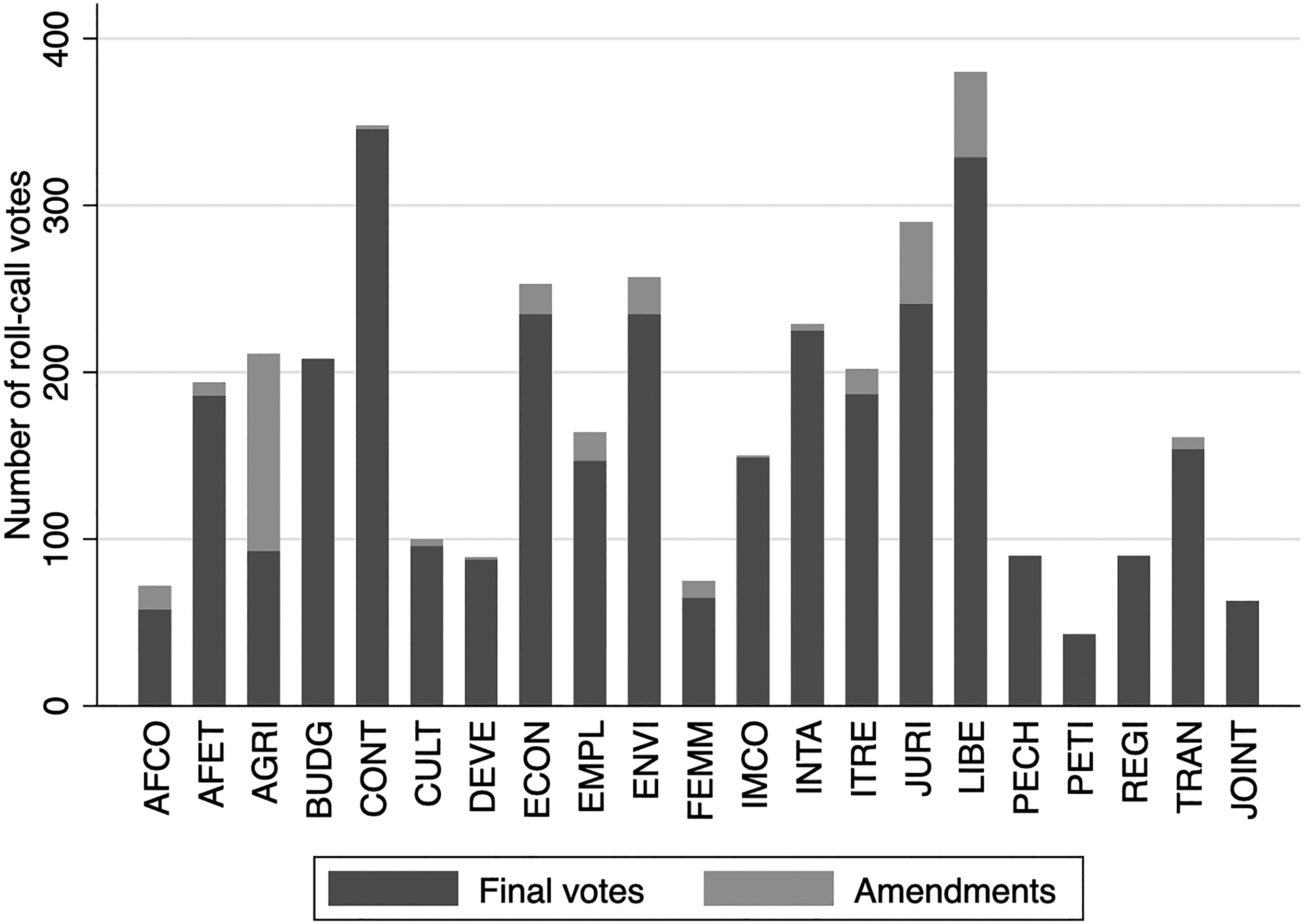
Number of roll call votes across committees 9 (final votes and amendments).
Second, we recorded the date of the vote. Figure 2 illustrates the distribution of votes over time. The legislative agenda is clearly structured by the terms of the Commission and EP, with activity ramping up in the lead-up to the 2019 elections: in the second half of the term, the number of votes more than doubled.
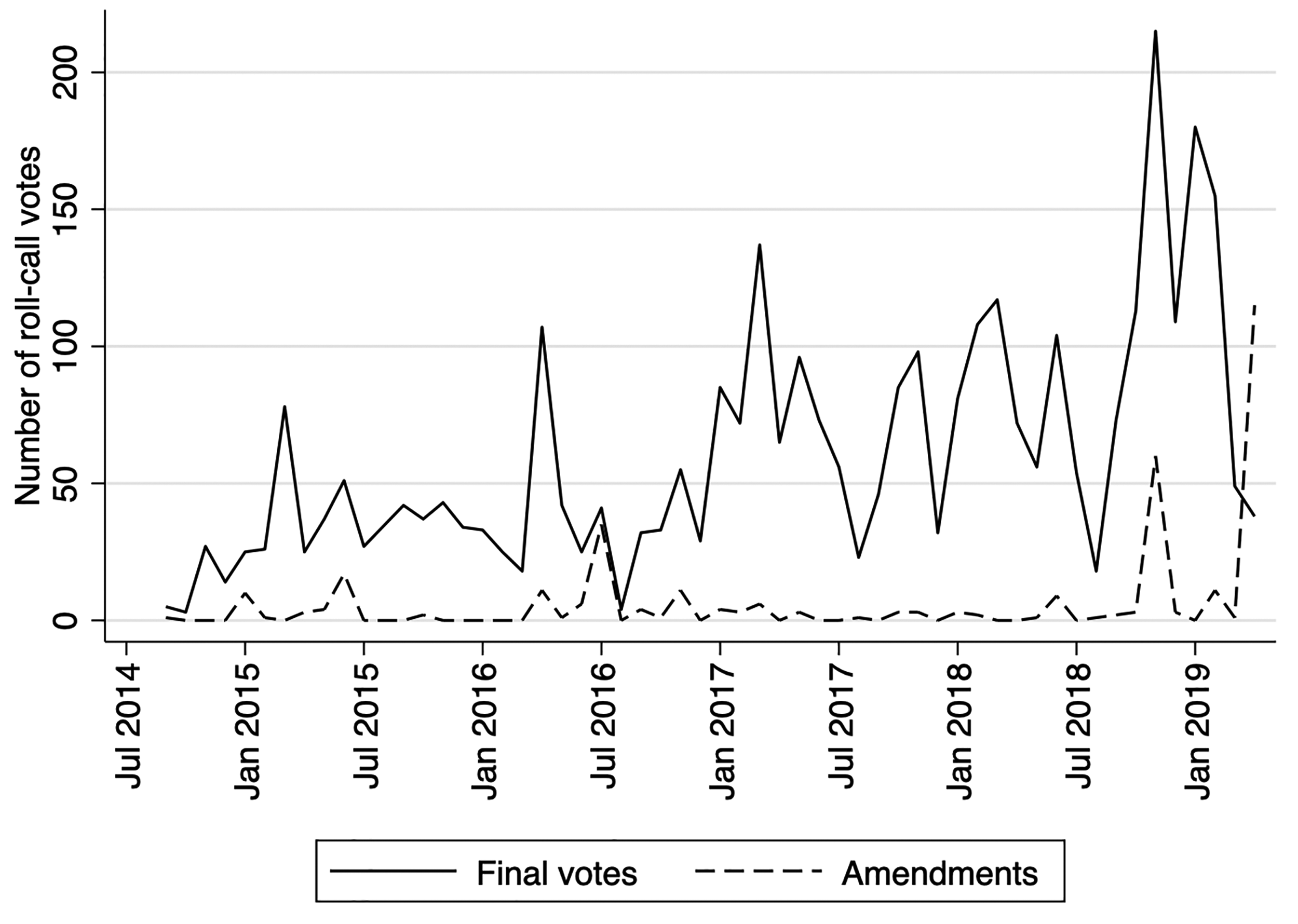
Number of roll call votes by month (final votes and amendments).
Third, the dataset contains information identifying the individual votes. This includes the title of each legislative proposal and the inter-institutional reference number. The latter provides a link to further information, such as from EUR-Lex or the EP's ‘Legislative Observatory’ database. In addition, the inter-institutional reference number can be used to link voting behaviour in committees and plenary. We also added a vote description, which indicates whether the roll call represents a final vote (including those on mandates, decisions to enter inter-institutional negotiations or to approve provisional agreements reached therein), or a vote on a (compromise) amendment. Further, file type captures whether the committee provided an opinion, whether it was solely responsible for a file (lead), or whether a joint committee procedure was followed. Finally, we have included a variable that contains the rapporteur for every motion.
Based on the vote description, Figures 1 and 2 differentiate between amendments and any other, final votes. This proxies for the distinction between requested and non-requested roll call votes, which has informed debates about selection effects and their impact on studies using roll call votes at the plenary level (Carrubba et al., 2006). Unlike the plenary, however, the committee records do not reliably show if a roll call was requested (and by whom) or whether it was prescribed by the rules. For amendments, there was no requirement for a roll call either in the Rules of Procedure or the guidelines discussed above. Hence, we assume that these were all requested. Other votes include those with a clear legal requirement in the Rules of Procedure and those covered by the guidelines, such as votes on opening inter-institutional negotiations, votes on mandates or agreements reached in inter-institutional negotiations. Here, we subsume all of these roll calls, which we assume to have been taken by default, under final votes. Thus, the distinction between requested and obligatory roll call votes is not quite as clear-cut as at plenary level. It is also important to highlight that many of the 341 votes on amendments concern only a handful of controversial files. Almost one third of the votes (110) fall under a regulation on Common Agricultural Policy Strategic Plans, 5 another 42 on legislation protecting whistle-blowers 6 and 35 on a directive setting out the EU's approach to terrorism. 7 In sum, this means that the results cannot be transposed neatly to those at the plenary stage.
Insights
The dataset allows scholars to address a variety of questions regarding legislative dynamics in the committees of the EP. The data provides a new perspective on party competition and cohesion of committees and parties. A well-known measure of cohesion is the Agreement Index proposed by Hix et al. (2007: 93) based on the following formula:

First, we draw on this agreement index to compare the cohesion of committees. Figure 3 shows that consensus and conflict vary across committees. Decisions are often taken by large majorities, leading to overall high cohesion scores. The FEMM committee stands out for its lack of cohesion. This chimes with recent research by Börzel et al. (2023), who analysed plenary-level roll call votes across policy areas, as demarcated by committee jurisdictions. They found high polarisation among Europhiles and Eurosceptics in roll call votes on FEMM issues. Our results suggest that this phenomenon may not be limited to the plenary. Indeed, the low committee cohesion may be indicative of a committee that does not consist of preference outliers united in their quest for gender equality, but that membership rather reflects positions represented in the plenary at large (cf. Ahrens, 2016). In general, the example illustrates how the data can be used to compare voting behaviour in committees and the plenary, adjudicating on debates on the role of committees in the legislature (Cox and McCubbins, 1993; Gilligan and Krehbiel, 1990; Krehbiel, 1991; Shepsle and Weingast, 1987, 1994).
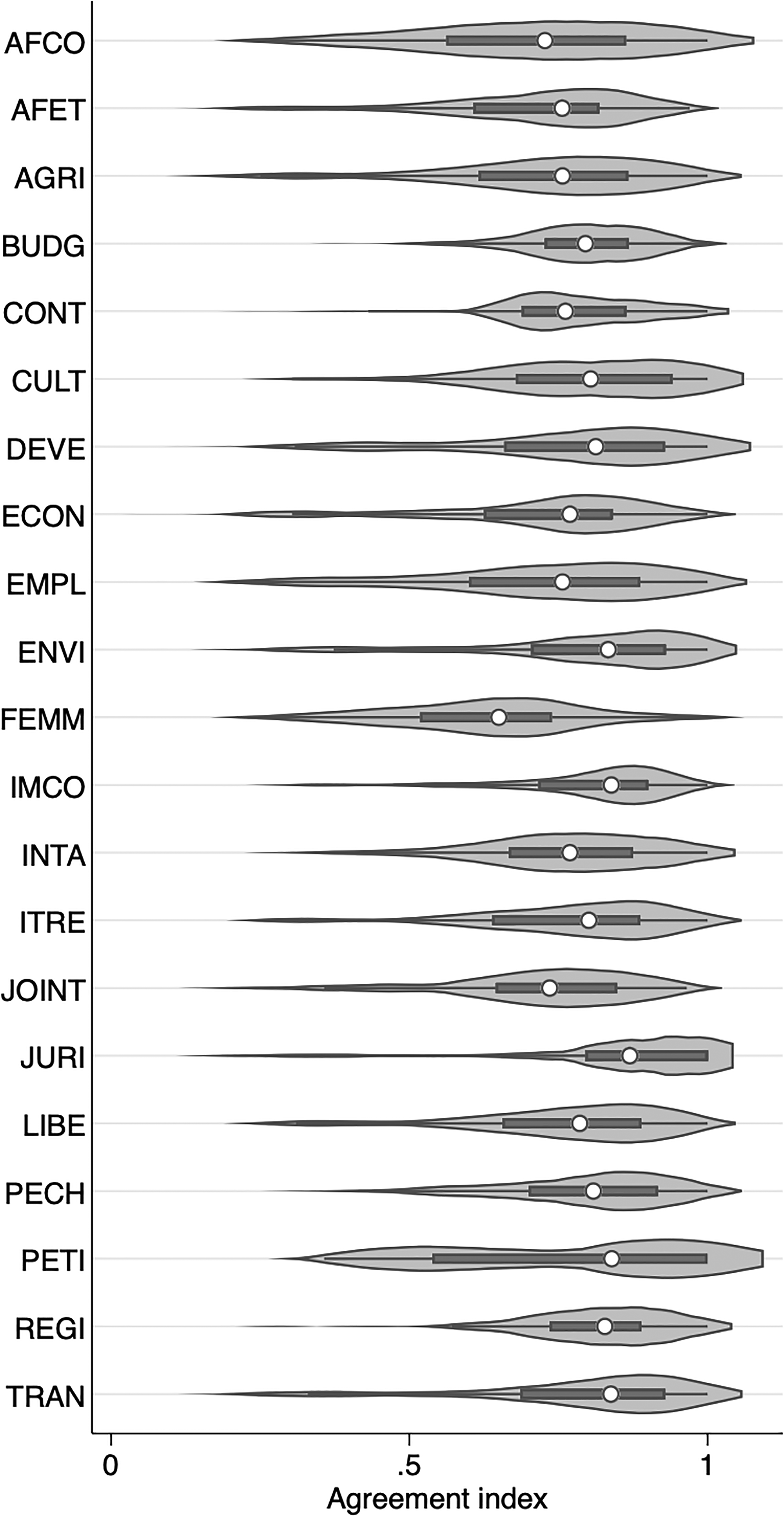
Agreement in roll call votes by committee.
Figure 4 contrasts committee cohesion in roll call votes on final votes and amendments. Bearing in mind the caveats explained above, which imply that requested and obligatory roll call votes cannot be as neatly distinguished at committee level as at plenary level, the results are not dissimilar to those reported at the plenary (Yordanova and Mühlböck, 2015). Conflict is higher on amendments, for which we know that roll call votes have to be requested, than for other votes, which we assume to be roll calls by default. The distribution of cohesion scores on amendments demonstrates that a number of them was very clearly divisive. Yet, this holds by no means for all votes. This is not surprising, as roll calls may serve different objectives in terms of signalling to the plenary but also to the Council and Commission (e.g. Yordanova and Mühlböck, 2015).
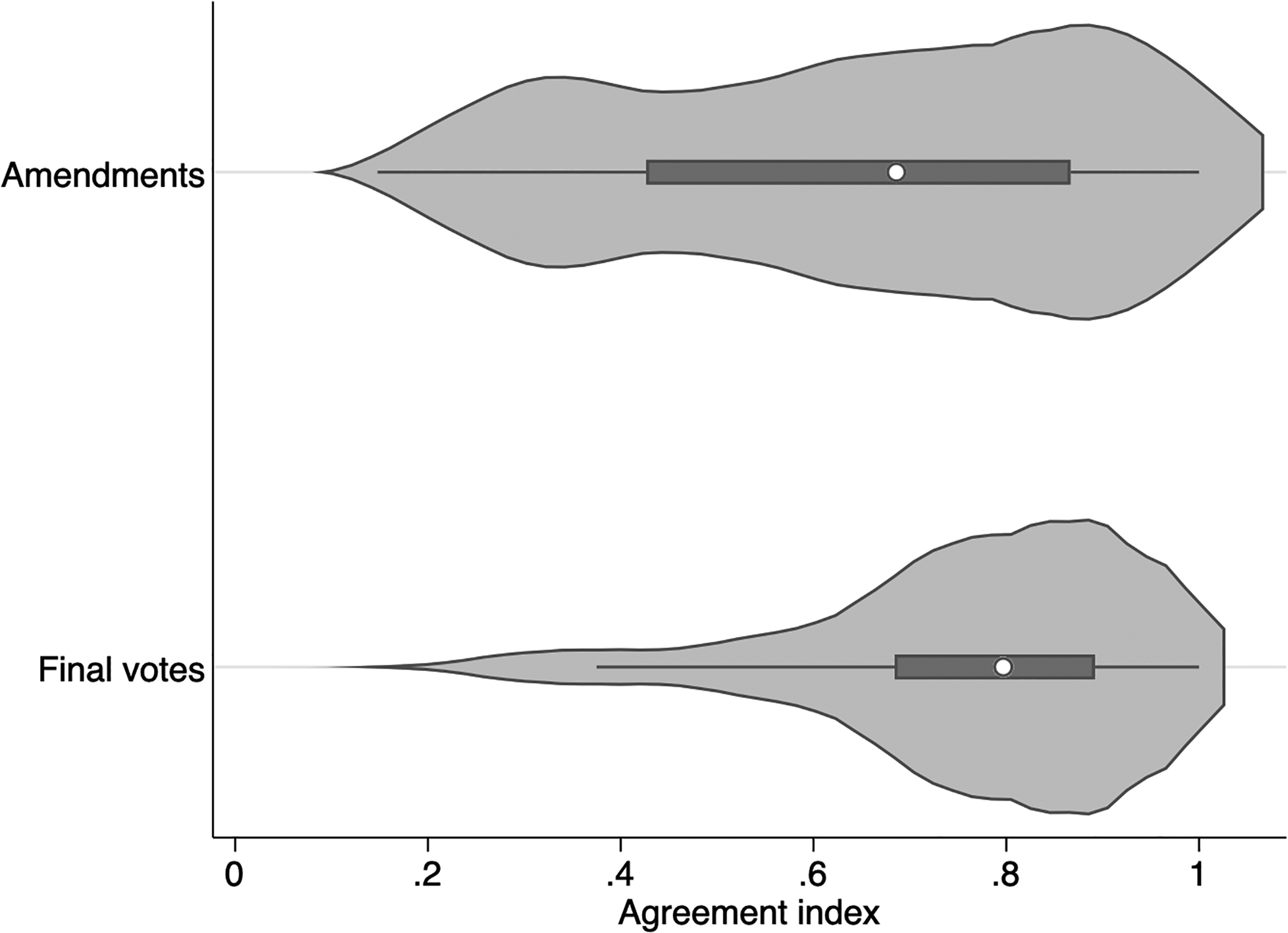
Comparing agreement across final votes and amendments.
Second, we can apply the agreement index to party groups in order to learn about party cohesion. To do so in a valid manner, we only include votes in which at least three members of a party group participated. We find very high cohesion scores for the large and mainly pro-integrationist party groups. The mean cohesion score for the EPP is 0.96 (based on 3657 votes), for the S&D 0.97 (3653 votes), for the Alliance of Liberals and Democrats for Europe (ALDE) 0.96 (1861 votes), and for the Greens 0.99 (1089 votes). By contrast, the European United Left/Nordic Green Left (GUE/NGL) score a comparatively low 0.91 (1016 votes), while the European Conservatives and Reformists (ECR) attain 0.87 (1016 votes). The Europe of Freedom and Direct Democracy (EFDD) and Europe of Nations and Freedom (ENF) groups are so small that only 147 and 43 votes, respectively, meet the threshold of three MEPs casting a vote, which renders their scores less informative. For all but the two largest groups, the votes included in this sample represent specific (large) committees.
For this reason, we consider the party group cohesion of the EPP and S&D in more detail. Figure 5 shows the party groups’ cohesion scores across the different standing committees. The scores are overall high and largely similar, but the FEMM committee again stands out. Here, the S&D is highly cohesive, reaching its second highest cohesion score of 0.996, while the EPP can only muster a cohesion score of 0.64, the by far lowest value. Another committee in which the S&D group is clearly more cohesive is EMPL, covering key issues for the group. This cohesion gives them a 0.1 edge over the EPP. By contrast, the EPP is markedly more cohesive in roll call votes in the fisheries (PECH) committee, where it reaches 0.98, more than the S&D at 0.95.
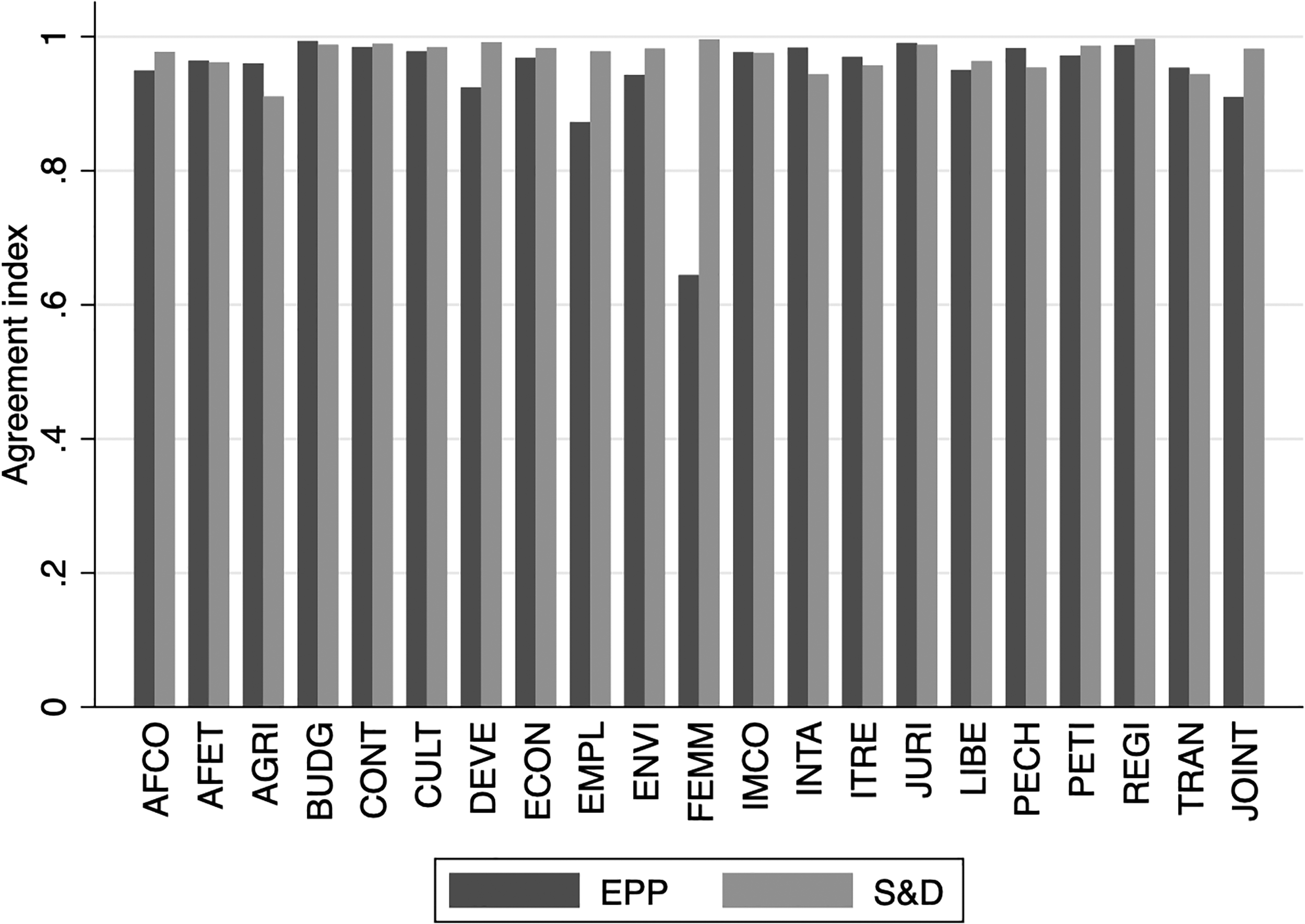
EPP and S&D party group cohesion across committees.
Beyond the committee averages displayed in the figure, we can also consider the difference in cohesion for the two groups when making the distinction between requested roll call votes (‘amendments’) and those taken by default (‘final votes’). For both groups, cohesion is higher on final votes. Whereas the score drops for the EPP from 0.96 to 0.94 when comparing final votes and amendments, it falls more significantly, from 0.98 to 0.93, for the S&D. Previous contributions using plenary roll call votes (Carrubba et al., 2006; Thiem, 2006) have pointed to a possible overestimation of party unity when using roll call votes to analyse party cohesion, mainly because requested roll call votes were theorised as instruments to either enforce party discipline or signal policy positions (Yordanova and Mühlböck, 2015: 373). Chiming with results from the plenary, here too differences appear to be small (Hix et al., 2018), but point to cohesion being lower on requested roll call votes (Yordanova and Mühlböck, 2015).
Further, previous research has shown that election proximity negatively affects party group cohesion in the plenary. Different mechanisms explaining this have been suggested. As elections approach, career incentives can for example make MEPs prioritise demands from their national party over those from the European party group leadership, and national parties may intensify their scrutiny of MEP behaviour in particular for salient votes (Klüver and Spoon, 2015; Koop et al., 2018; Lindstädt et al., 2011; Meserve et al., 2009). While such scrutiny of important roll call votes at the plenary level is plausible in particular for larger national party delegations, the task becomes more challenging at committee level, where national parties are spread thin over the 20 standing committees. Yet, as Figure 6 reveals, party group cohesion decreased as the legislative term advanced and the next European election approached, both for the large party groups and when taking all groups into account. This raises new questions, requiring more detailed analyses, about the causal mechanism behind the drop in cohesion.
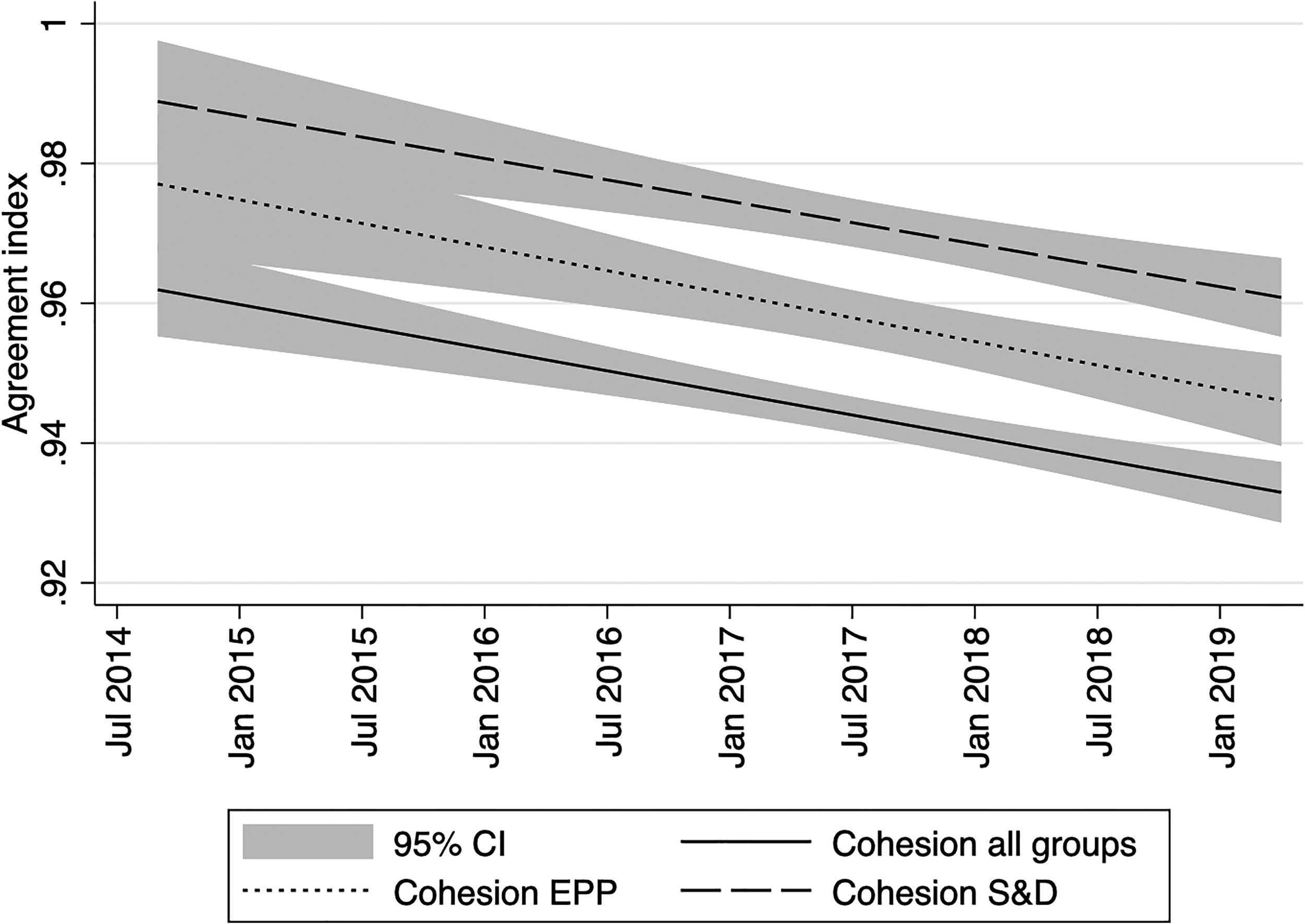
Party group cohesion throughout the legislative term.
Some studies have used participation in plenary-level votes as an indicator of party loyalty and commitment (e.g. Yoshinaka et al., 2010). Others have sought to explain participation in votes as a measure of legislative effort (Hurka et al., 2018). In the past, high absenteeism has also created public controversies, such as in the case of the German MEP Koch-Mehrin (Reyher, 2011). Unlike at the plenary level, where MEPs not taking part in a vote mean that the party group loses an opportunity to influence the outcome, party groups nominate for each committee substitutes who can take absent colleagues’ place in voting. Corbett et al. (2016: 170) highlight that these substitutes ‘may put more effort into this committee than their main one’ and that they ‘suffer little disadvantage compared to full members’. 8 However, little is known about how big a role substitutes play. The dataset can help shed light on this question.
Figure 7 shows three relevant indicators for the different party groups. Participation including substitutes (defined broadly as any party group member irrespective of formal substitute status) indicates the share of votes cast by party group members. For instance, 91% of potential votes are cast by EPP members, meaning that only 9% of votes are missed without a substitute taking the absent committee member's spot. Participation excluding substitutes captures the share of votes by committee members only. For the EPP, committee members take part in 70% of votes. Votes cast by substitutes reflects the proportion of votes cast by substitutes only. In the case of the EPP, this means that 31% of votes are by MEPs who do not sit on the committee as ordinary members. In sum, the results demonstrate that a better understanding of these substitutes may be called for. If about 30% of votes in committees are cast by substitutes, this suggests that they may affect legislative work and the analysis of the role of committees more broadly.
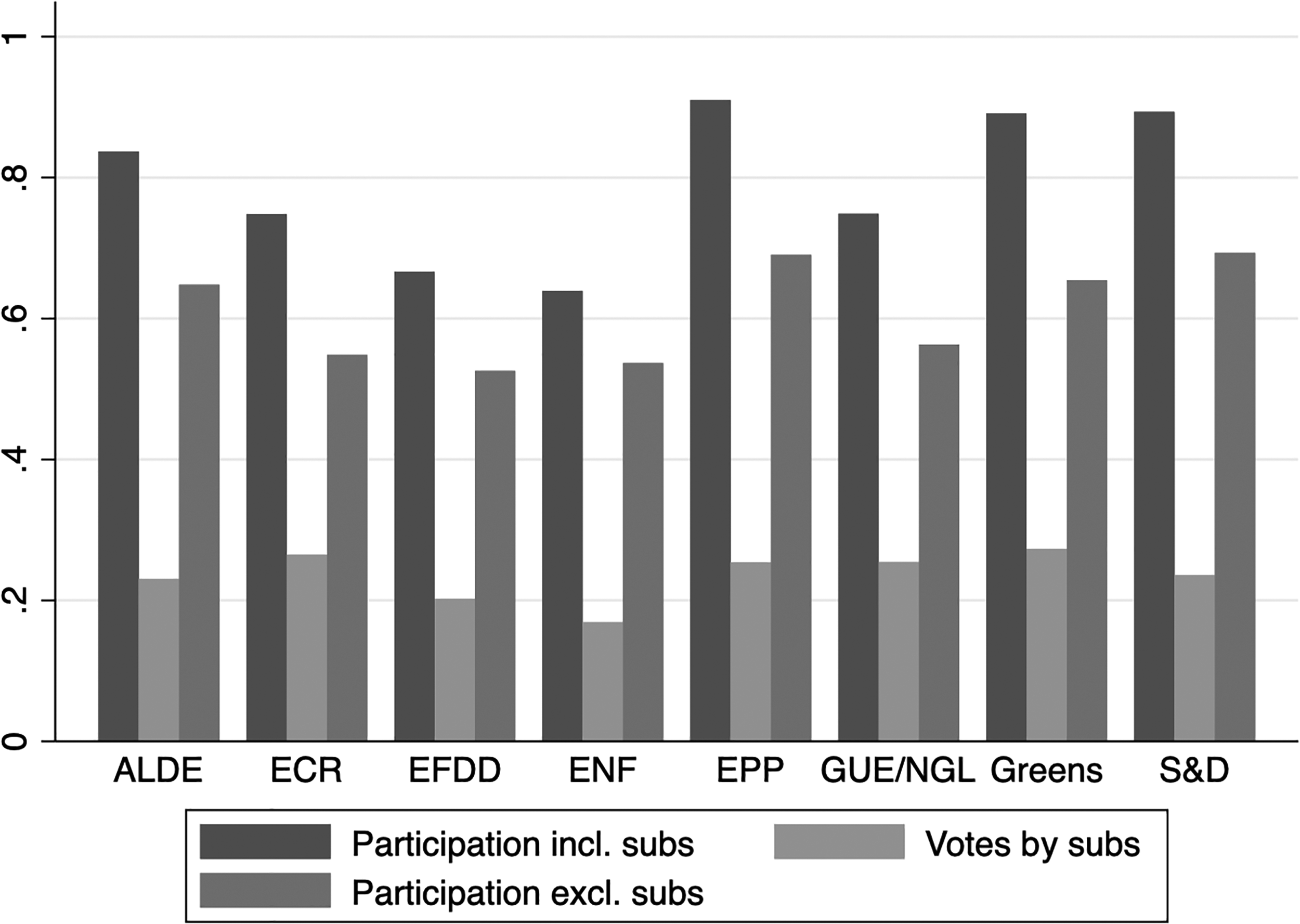
Participation in roll call votes.
Avenues for research
The data introduced here allows scholars to investigate new questions as well as re-examine old ones. First, understanding committee decision-making is important in its own right, given its significance for final legislative outcomes and EU policy. What coalitions are formed? Which conflict dimensions matter? Second, committee and plenary voting differ in important respects, such as public attention and subject matter expertise of MEPs. Do the factors that have been found to predict voting behaviour at plenary level extend to committees as well? Initial results indicate that patterns of individual defections from the party group differ markedly from expectations derived from previous research on voting in the plenary. This raises important theoretical questions on committee decision-making and potentially raises questions beyond the empirical case of the EP. Third, party loyalty based on plenary roll call votes has become a standard variable in models testing the allocation of key positions, such as committee chairs or rapporteurs, as well as re-selection of MEPs as candidates in European elections. Yet, loyalty in committee votes may, for example, be more important to a party group coordinator selecting a rapporteur than loyalty in votes in different policy areas at the plenary level. The data may thus provide a more precise, or at least an alternative, operationalisation of loyalty. This holds in particular when considering theories of legislative organisation that suggest than committee membership represents preference outliers (Shepsle and Weingast, 1987). Finally, by linking our data to activities beyond the legislature, scholars can address further questions regarding individual MEP behaviour, such as moonlighting, social-media activity or campaigning. An interesting option would be research into voting behaviour in requested roll calls before the 2014 to 2019 term and a comparison of behaviour across terms. However, given uncertainty about the scale of such votes and the data collection effort required, this would be a risky undertaking.
In sum, the dataset presented in this forum article provides various opportunities to study legislative behaviour in the EP, shed light on the function and role of its committee system, and position the EP in a broader comparative perspective. In addition to quantitative research, it can also provide a starting point for qualitative researchers to identify interesting cases in decision-making and legislative behaviour. We hope legislative scholars will actively explore this new data and push the boundary of our knowledge of legislative politics in the EU.
Supplemental Material
sj-zip-1-eup-10.1177_14651165241271064 - Supplemental material for Roll call votes in the committees of the European Parliament: A new dataset
Supplemental material, sj-zip-1-eup-10.1177_14651165241271064 for Roll call votes in the committees of the European Parliament: A new dataset by Lukas Obholzer and Moritz Wiesenthal in European Union Politics
Footnotes
Author contributions
The authors contributed equally to the article.
Funding
The authors received no financial support for the research, authorship and/or publication of this article.

Data availability statement
Supplemental material
Supplemental material for this article is available online.
Notes
References
Supplementary Material
Please find the following supplemental material available below.
For Open Access articles published under a Creative Commons License, all supplemental material carries the same license as the article it is associated with.
For non-Open Access articles published, all supplemental material carries a non-exclusive license, and permission requests for re-use of supplemental material or any part of supplemental material shall be sent directly to the copyright owner as specified in the copyright notice associated with the article.
