



Abstract
Although parliamentary questions are an essential tool of legislative oversight, there is limited research on their variation in holding governments accountable. In this article, we analyse a new dataset of 1393 oral questions posed by Members of the European Parliament during the 8th parliamentary term. After distinguishing between questions asking for information, justification, or rectification of conduct, we explain their variation in connection to the formal oversight relationship between parliaments and scrutinised actors, and to the type of policy activity carried out by the latter. We find that Members of the European Parliament are more likely to address rectification questions and less likely to ask information questions the fewer legal controls they have. Moreover, information questions are more likely to occur in the oversight of policy formulation, while justification questions are prevalent in the oversight of policy execution. The findings flag the importance of structural factors in the practice of legislative oversight.
Keywords
Introduction
Parliamentary questions (PQs) are a pervasive tool of legislative oversight in democratic systems. Across the world, members of parliaments (MPs) pose questions to governmental actors both in writing and orally in plenary meetings (‘question time’), committee hearings, or as part of inquiry commissions (Pelizzo and Stapenhurst, 2012; Yamamoto, 2007). In the logic of oversight, PQs are linked to a parliament's function to control the government (Von Beyme, 2000: 81–82) by throwing ‘the light of publicity on its acts’, demanding ‘a full exposition and justification’ (Mill, 2010: 104) of problematic decisions, and demanding changes to current policy (Cole, 1999; Franklin and Norton, 1993). In practice, MPs use questions for a plurality of reasons beyond oversight, for instance, to represent constituency interests or to further their political careers (Martin, 2011a; Wiberg and Koura, 1994). From this perspective, questions are considered to serve a symbolic purpose because they have little direct impact on actual policies (Otjes and Louwerse, 2018; Van Aelst and Vliegenthart, 2014). In the academic literature, the difficulty to show the impact of PQs on policymaking has led to a shift in scholarly attention from the role of questions in oversight to the reasons why MPs asked questions in the first place. In fact, previous research on the topic has focused predominantly on the political motivations behind PQs (Höhmann and Sieberer, 2020; Jensen et al., 2013; Kellermann, 2016; Martin, 2011a; Russo and Wiberg, 2010; Vliegenthart and Walgrave, 2011).
By contrast, we know less about the variation of PQs in relation to oversight, namely the role of questions to ‘check, verify, scrutinize, inspect, examine, […] criticize, censure, challenge, [and] call to account’ (Gregory, 1990: 64) the government or public administration. Under what conditions do MPs ask different types of oversight questions? In this article, we aim to identify key determinants affecting the variation of questions in legislative oversight. Borrowing from the public administration literature on accountability (Bovens, 2007), we identify three categories of questions depending on the obligation they impose on an addressee to (a) share information; (b) justify conduct; or (c) rectify decisions (cf. Maricut-Akbik, 2021). Accordingly, information questions refer to the transparency of government actions, justification questions are about explaining the rationale of decisions, whilst rectification questions demand concrete changes to existing policies.
Next, we build a structural account of the variation of questions in legislative oversight that includes two drivers: (a) the legal framework of the oversight relationship at play; and (b) the nature of the policy activity under scrutiny. In contrast to existing literature that focuses on the political motivations behind PQs (Martin, 2011a; Russo and Wiberg, 2010), we argue that structural factors are more important for understanding the variation of questions for oversight purposes. First, drawing on principal-agent (P-A) insights (Fearon, 1999; Lupia and McCubbins, 1994; Strøm, 2000), we conceptualise the degree of formal oversight relationships based on the legal framework regulating the interactions between parliaments and actors under scrutiny. 1 The conceptualisation is based on the range of legal controls available to parliaments in different jurisdictions, which create the basis for legislative oversight (what we term ‘oversight-on-paper’). What remains unclear is how the presence of legal controls will affect the range of questions asked by MPs in practice. Second, we consider the type of activity conducted by the actor under scrutiny and the extent to which they engage in policy formulation (a key task of parliaments) or policy execution (the implementation of public policy, in which parliaments are not involved). Since PQs are a central monitoring mechanism through which parliaments can control government activity (Saalfeld, 2000), MPs are expected to ask more rectification questions when they oversee executive actions as opposed to policy formulation.
Empirically, we study the European Parliament (EP) in the Economic and Monetary Union (EMU). We based our case selection on two parameters: in the universe of parliaments around the world, the EP is a least-likely case (Gerring, 2007) for encountering variation in oversight questions owing to its traditional focus on law-making and budgetary control (Brack and Costa, 2018; Hix and Høyland, 2013). Furthermore, among the plethora of European Union (EU) policy areas, EMU is a diverse case (Gerring, 2009) capturing the full variation of inter-institutional dynamics at the EU level: specifically, the EP oversees both the supranational arm of the EMU (through the European Central Bank (ECB) and the European Commission (EC)) and the intergovernmental arm (through the Council). Our analysis is based on a new dataset of 1393 PQs addressed orally by Members of the EP (MEPs) in the 8th parliamentary term (2014 to 2019). The dataset includes questions addressed to four different actors: the ECB in its capacity as the chief banking supervisor in the Eurozone, the EC, the Economic and Financial Affairs Council (Ecofin), and the Eurogroup. Although the EP does not enjoy a reputation as a powerful oversight body in the EU, we discover that MEPs ask a variety of PQs requesting different actions from the actors under scrutiny, including information, the justification of conduct, or the rectification of decisions; furthermore, we find that the variation in PQs is indeed connected both to the availability of legal controls vis-à-vis the actors under scrutiny, and to the kind activity scrutinised – either policy formulation or execution. Specifically, we show (a) a higher likelihood of MEPs posing information questions the more legal controls they have over an actor, and when they oversee policy formulation; (b) a higher likelihood of justification questions when the overseen actor is engaged in policy execution; and (c) a higher likelihood of rectification questions when the EP has few legal controls over the actor under scrutiny.
Beyond the EP, our findings are relevant for national and regional parliaments in different contexts. As we control for multiple factors which potentially affect the variation of PQs (such as government-opposition dynamics at the national level, references to constituency demands, ideological positions, etc.), we flag the importance of structural factors in determining the practice of legislative oversight. Specifically, we show that the presence of fewer formal legal controls in an oversight relationship increases the likelihood of asking rectification questions and decreases the likelihood of asking information questions. This suggests that PQs can be used to compensate for the lack of an extensive oversight relationship on paper. In addition, MPs are generally more interested in overseeing executive action, although there are many governmental actors that engage in policy formulation alongside parliaments. The trend is consistent with the notion of checks and balances in a democratic system, as parliaments use questions to explore and potentially criticize how policies are implemented as opposed to how they are made by other actors (such as regulatory agencies).
The study of PQs: Beyond political motivations
Contemporary studies on PQs can be broadly separated into two strands. The first strand is descriptive and centres on the function of questions in legislative oversight, referring to the task of parliaments to ‘keep a watchful eye’ over the government and public administration (Aberbach, 1990). In a democratic system of government, parliamentary oversight aims to prevent abuses by other public actors, including but not limited to dishonesty, waste, arbitrariness, unresponsiveness, or deviation from legislative intent (MacMahon, 1943: 162–163). In this context, questions contribute to oversight by allowing MPs to ‘request information’, ‘press for action’, ‘demand an explanation’, ‘test’ or ‘attack’ actors in controversial areas of their policies etc. (Wiberg and Koura, 1994: 30–31). In the academic literature, descriptive studies on the function of PQs are limited to classifying the role of questions in holding governments accountable (Cole, 1999; Gregory, 1990), or alternatively, categorising the procedures through which questions are asked (Franklin and Norton, 1993; Pelizzo and Stapenhurst, 2012). What is missing, however, is an explanation of the drivers of PQ from the perspective of oversight – in other words, under what conditions MPs ask different types of oversight questions.
A second, more explanatory strand of research focuses on the political behaviour of parliamentarians who ask questions (Martin, 2011a; Russo and Wiberg, 2010). In this category, some scholars have studied the electoral motivations of MPs by examining the extent to which they refer directly to their constituency in the text of questions (Chiru, 2018; Kellermann, 2016; Martin, 2011b; Saalfeld, 2011). Others have analysed party politics by looking at government-opposition dynamics or how MPs seek to gain strategic advantages within one's party by posing questions (Ciftci and Yildirim, 2019; Höhmann and Sieberer, 2020; Jensen et al., 2013; Otjes and Louwerse, 2018; Proksch and Slapin, 2011). In relation to the media, scholars investigated the influence of press coverage and the extent to which MPs use questions to follow up on issues considered newsworthy (Van Aelst and Vliegenthart, 2014; Van Santen et al., 2015; Vliegenthart and Walgrave, 2011). Based on this literature, we know that PQs are an important signal to the constituency, a political instrument of parties (especially those in opposition), and an indicator of media salience at a particular moment in time.
Conversely, there is less explanatory research on the link between PQs and the goal of legislative oversight to hold governments accountable. To put it simply, even if MPs ask questions for electoral or career gains, this does not diminish their original ‘oversight purpose’ to seek to control the government or the bureaucracy. After all, the same question can serve multiple functions. In this article, we specifically examine the oversight role of PQs and their potential drivers. Under what circumstances do MPs ask different types of oversight questions? The next section develops an explanation in this direction.
Understanding and explaining the variation of PQs in legislative oversight
To discuss the role of PQs in legislative oversight, we first need to conceptualise their variation clearly. Building on an existing typology (Maricut-Akbik, 2021), we propose a threefold categorisation of questions that captures their function in legislative oversight. Theoretically, the classification draws on the public administration literature on accountability, which is particularly relevant for the study of oversight due to its concern for the exercise of democratic checks and balances in a democratic system (Mulgan, 2000). Borrowing from the work of Mark Bovens, we define accountability as the relationship between two parties – an actor and a forum – characterised by institutionalised mechanisms through which (a) the actor is obliged to disclose information about its activities on a regular basis; (b) the forum can interrogate the actor about the adequacy of its conduct; and (c) the forum can pass positive or negative judgements on the behaviour of the actor, including through the imposition of sanctions (Bovens, 2007: 450–451). Technically speaking, PQs are part of the second stage of accountability because they constitute only one element of holding actors accountable. However, for the purposes of classifying PQs, the stages are extremely useful for identifying both the objectives of questions and the way in which they challenge the actions of the addressee.
Accordingly, we categorise questions in line with the three stages of accountability relationships (Maricut-Akbik, 2021: 544–545). First, we argue that MPs can use PQs to request information from an actor, seeking details about past and future government activities (for example, which decision was taken at that meeting? Who was involved? What should be done about it?). More generally, information questions concern the transparency of government measures, and they can encompass requests about the substance of decisions (policy transparency), the decision-making process (procedural transparency), or value positioning on an issue (political transparency) for different categories of transparency (Ball, 2009). Second, and in line with the next stage of accountability relations, MPs can use PQs to demand the justification of a government decisions or conduct, challenging the discretion, effectiveness, fairness, or appropriateness of specific measures (cf. MacMahon, 1943). By default, requests for justification questions are ‘why’ questions, for instance, why did you do X in that situation? Third, and following the final stage of accountability relations, MPs can use PQs to demand the rectification of decisions or conducts, demanding that actors make specific changes to policy (why not do Y instead of X?). 2 Rectification questions are linked to the possibility of ‘making amends’, which is crucial to the idea of holding actors accountable (Oliver, 1991: 28). In her work, Maricut-Akbik (2021) distinguishes between questions demanding change from those requesting sanctions, but we think they can be treated together because they belong to the same logic of ‘making amends’ or ‘passing judgement’ in the final stage of accountability relationships (Bovens, 2007).
Moreover, in contrast to existing literature, we do not rank the three categories of questions according to the intensity with which they challenge the actor under scrutiny (Akbik, 2022; Maricut-Akbik, 2021). The reason for this choice is empirical: for example, information questions can be more or less demanding of an actor depending on whether the government is trying to conceal something from parliament at that moment in time. In a similar vein, rectification questions are less imposing if a government has already agreed to implement a change in a certain field. In other words, from a research perspective, we might not be able to correctly place questions on a continuum unless we know the context and motivation of every single PQ. For this reason, we argue that it is better to categorise questions solely on the object of their request as (a) information; (b) justification; or (c) rectification questions.
In the next section, we identify potential drivers of the variation in questions by emphasising two structural elements of legislative oversight. Our account is structural for one key reason: if PQs are meant to serve multiple purposes, it makes sense for political factors such as ideology, government-opposition dynamics, or constituency focus to explain the distribution of questions on the left-right continuum, the number of questions addressed by opposition parties, or the percentage of questions addressing constituency concerns. However, in the logic of oversight, PQs aim to hold actors accountable, which may or may not be related to political rivalries, electoral concerns, or career considerations. With this in mind, we turn the existing literature on its head and control for political factors while looking for a broader explanation for the variation of PQs in oversight – which is structural.
A structural account of legislative oversight
At the micro level, MPs ask oversight questions for a variety of personal reasons: to pursue individual policy interests, to advance their position within their own party, to show support for their constituency, to gain publicity during crises and scandals, and so forth. However, while the analysis of the micro level is important, it tells an incomplete story because it is not specific to oversight; in fact, the motivations listed above could apply to most public activities of career politicians. Consequently, to uncover the variation of PQs in relation to oversight, we propose a theoretical account that includes two structural factors, namely the (a) the type of oversight relationship at play; and (b) the nature of the policy activity under scrutiny. Below we argue that these two elements are essential to understanding the variation of PQs encountered in the practice of oversight.
The type of oversight relationship at play
The parameters of any oversight relationship can be found in the legal framework, which specifies various mechanisms through which parliaments can exercise control over governments and public administration. Theoretically, the notion of control is anchored in P-A applications of delegation in representative democracies (Kiewiet and McCubbins, 1991; Lupia and McCubbins, 1994; Strøm, 2000). In the P-A logic, oversight is the counterpart to delegation, based on the premise that ‘A is obliged to act in some way on behalf of B’ and, in turn, that ‘B is empowered by some formal institutional or perhaps informal rules to sanction or reward A for her activities or performance in this capacity’ (Fearon, 1999). In this framework, B is the principal (for our purposes, the parliament doing the delegation), and A is the agent (the institution acting on the parliament's behalf). From a P-A perspective, the purpose of oversight is to ensure parliamentary control of the agent (which can be a member of the government, a specialised agency, or a bureaucracy). In practice, only parliamentary systems have a single chain of delegation from (a) voters; to (b) elected representatives; to (c) members of the cabinet and specialised agencies; to (d) civil servants in ministries and government bodies. By contrast, in presidential systems, the delegation chain is complex, as the president/government and the parliament act as competing principals, yet at the same time the parliament is expected to oversee the government (Strøm, 2000).
Depending on the system of government and the type of actor under scrutiny, there can be considerable variation in the legal framework of oversight relationships. To capture this variation, we propose to examine the range of legal controls available to parliaments to oversee governmental or administrative actors (what we term ‘oversight-on-paper’). In turn, this will allow us to investigate how these controls interact with the practical use of questions by MPS. To put it simply, does a limited oversight framework ‘on paper’ produce different types of PQs? To conceptualise oversight-on-paper, we build on studies on congressional oversight, specifically those focused on institutional mechanisms through which principals can control agency loss in P-A relationships (Kiewiet and McCubbins, 1991; Pelizzo and Stapenhurst, 2012). Since the goal is to consider multiple aspects of oversight relationships, we first identify mechanisms of ex ante control, including (a) contract design at the moment of delegation; and (b) screening and selection of the agent by the principal, and combine them with mechanisms of ex post control; namely (c) monitoring and reporting requirements of the agent to the principal; and (d) the right of the principal to dismiss the agent (Kiewiet and McCubbins, 1991).
Drawing on the work of Strøm (1995, 2000), we define each element below. First, contract design refers to the ‘set of terms on which the [agent] is allowed to take office’ and has the purpose to ‘establish shared interests, or incentive compatibility, between principals and agents’ (Strøm, 1995: 73). In relation to the formation of new governments, contract design can denote coalition agreements or investiture roles; when it comes to independent agencies, contract design encompasses the mandate of the new body as well as the specification of mechanisms of ex post control (cf. Lupia, 2006: 45). Second, screening and selection aim to ‘eliminate potentially troublesome cabinet members before they ever get into office’ (Strøm, 1995: 75). The same logic could be applied to the leadership of independent agencies, whose directors or presidents are screened by MPs in appointment hearings before getting the job. After finalising the delegation contract and the selection process of the agent, principals can exercise control in two ways. First, they can create institutionalised structures for monitoring and reporting, including the possibility to ask questions in writing and orally in parliamentary hearings (Strøm, 2000: 271). Simultaneously, monitoring mechanisms may allow the principal to conduct inquiries into the behaviour of the agent, in which the agent would be legally obliged to participate (Pelizzo and Stapenhurst, 2012). Finally, a strong oversight framework would allow principals to dismiss the agent under specific circumstances, such as deviating from legislative intent or arbitrary use of power. In this case, the most powerful tool of parliaments consists of no-confidence votes (Strøm, 1995: 76).
Against this background, we identify three potential arguments about the relationship between the legal framework for oversight and the range of PQs encountered in practice. First, we expect that the availability of multiple legal controls in an oversight relationship will increase the likelihood of MPs asking information as opposed to rectification questions. In this scenario, MPs are aware that they have other institutionalised mechanisms to make their preferences clear and prevent ‘agency shirk’ by the actor, so they see no need to use questions to demand the rectification of specific decisions or conducts. Consequently, PQs become a tool to reduce information asymmetries in a classic P-A relationship (Lupia, 2006). By the same logic, the lack of structural opportunities to reduce agency loss will increase the likelihood of MPs asking rectification questions, which become the only alternative to demand policy or institutional change in the absence of other legal mechanisms to signal disagreement or discontent with the actor (H1a).
Simultaneously, we can imagine a second and competing scenario in which the availability of multiple legal controls in an oversight relationship will reduce the likelihood of MPs asking information questions. In this case, MPs would be less concerned to close information asymmetries because they would think they already have alternative legal means to force the actor to increase its transparency. Conversely, and precisely by virtue of those legal mechanisms, MPs would feel emboldened to use PQs to demand the actor to amend decisions or rectify its conduct (H1b). Accordingly, our first two hypotheses are competing:
H1a: The more legal controls a parliament has over an actor under scrutiny, the higher the likelihood that MPs will ask more information and fewer rectification questions in the practice of oversight. H1b: The more legal controls a parliament has over an actor under scrutiny, the higher the likelihood that MPs will ask fewer information and more rectification questions in the practice of oversight.
Third, as far as justification is concerned, there is no theoretical way to link the likelihood of questions to the oversight powers of parliaments over actors. In practice, if MPs perceive some actors as making mistakes, they will be asked for justification irrespective of the availability of control mechanisms in the legal framework.
H1c: Regardless of the number of legal controls a parliament has over an actor under scrutiny, MPs are going to ask justification questions in the practice of oversight.
The nature of the policy activity under scrutiny
The second element of our structural account of oversight is related to the nature of the policy activity under scrutiny. It is widely accepted that oversight can happen at different stages of the policy process and be either backward-looking (ex-post) or forward-looking (ex-ante), depending on the timing of MPs’ activities (Stapenhurst, 2008: 13). In some legislatures, there are specific ex-ante instruments that involve PQs – such as reviewing rulemaking by independent agencies (Gerber et al., 2005). Yet, despite the frequency of PQs that have an ex-ante focus (see also Wiberg and Koura, 1994), they are not the main category associated with oversight. In the institutional logic of parliaments, PQs are typically linked to the classic parliamentary function of watching and controlling the government by publicising their activities and demanding explanations of decisions (Mill, 1861). In fact, early definitions of legislative oversight emphasised the ex-post dimension: ‘oversight, strictly speaking, refers to review after the fact. It includes inquiries about policies that are or have been in effect, investigations of past administrative actions, and the calling of executive officers to account for their financial transactions’ (Harris, 1964: 9). In connection to legislation, oversight had a clear role: ‘after participating in law-making, the legislature's main role is to see whether laws are being effectively implemented and whether, in fact, they address and correct problems as intended by their drafters’ (National Democratic Institute, 2000: 24). In practice, however, the distinction between ex-ante influence and ex-post accountability is difficult to distinguish, as MPs can pursue both simultaneously (cf. Wiberg and Koura, 1994): for instance, one can ask a question about something that happened in the past (ex-post) but have a clear intention to influence policy-making in the future (ex-ante).
Following this line of thought, our second set of hypotheses (H2a and H2b) relates to the nature of the policy activity under parliamentary scrutiny. Based on theories of the policy cycle (Pülzl and Treib, 2007: 94), we distinguish broadly between decisions concerning policy formulation (the negotiation and adoption of policies) and decisions concerning policy execution (the implementation and enforcement of adopted policies). Since parliaments are involved in policy formulation through legislation, we expect them to focus their scrutiny on policy execution and the extent to which their governments deviate from legislative intent (MacMahon, 1943).
H2a: If an actor's key domain of activity is policy execution (as opposed to policy formulation), then MPs are more likely to ask the actor (a) less information questions; and (b) more justification questions in the practice of oversight.
As far as rectification is concerned, the theoretical trend is less clear because MPs can demand changes in the implementation of decisions or changes in the content of the policies themselves. The latter is common when cabinets and government agencies get involved in policy formulation by issuing executive orders or taking regulatory action (Kerwin and Furlong, 2018). In this case, MPs might address requests for rectification irrespective of the policy activity of the actor.
H2b: Regardless of the type of policy activity in which an actor is involved, MPs are going to ask rectification questions in the practice of oversight.
Research design
Case selection: The EP in the EMU
Our case selection is based on two parameters, namely which parliament and what policy area are the most suitable for the purposes of our investigation. On the one hand, we chose committee hearings in the EP as a least-likely case (Gerring, 2007) for encountering variation in oversight questions. First, despite its institutional mandate for oversight and the procedures available to ask questions in different formats (Remáč, 2019), the practice of PQs has often been ‘patchy and unfocused’ (Dionigi, 2020). One reason for this is the fragmentation of executive power in the EU, which blurs lines of responsibility between the institutions subject to parliamentary scrutiny (Curtin and Egeberg, 2008). Second, the variation of national and ideological interests among MEPs (Hix, 2002) makes them pursue a wide range of issues in legislative oversight – with no coordination between or even within political groups (Claeys and Domínguez-Jiménez, 2020). Third, the EP is traditionally more focused on its legislative and budgetary powers (Hix and Høyland, 2013) as opposed to the ‘ex ante [s]election of officeholders’, and ‘the ex post control of the cabinet’ (for an index of parliamentary powers, see Fish and Kroenig, 2009). For these reasons, in principle we do not expect to find a lot of variation in the types of PQs asked by MEPs.
On the other hand, concerning the policy area, we aimed to capture the full variation of inter-institutional dynamics at the EU level. In this sense, the EMU is a diverse case (Gerring, 2009) because it includes both a strong supranational institution (the ECB) and a strong intergovernmental body (the Eurogroup) (for an overview of the institutional framework in EMU, see Verdun, 2016). Furthermore, while economic governance was politically salient during the euro crisis (Hutter and Kriesi, 2019), the field also includes many technical issues outside media spotlight, such as financial supervision. In our view, the EMU is thus representative of inter-institutional dynamics existing in both more supranational/technical policy areas (such as the internal market) and intergovernmental/political ones (such as foreign policy). Moreover, in the aftermath of the euro crisis, MEPs gained new scrutiny powers in the field which allowed them to address oral PQs to all key EMU actors (Fasone, 2014). Our analysis focuses precisely on these instruments. First, we examine the ‘Banking Dialogues’ with the ECB, a type of public hearings institutionalised in late 2013 to facilitate EP scrutiny of the ECB as the chief banking supervisor in the Eurozone (Fromage and Ibrido, 2018). Second, we analyse the Economic Dialogues with the EC, Ecofin and the Eurogroup, which established (starting 2012) regular exchanges of views between MEPs and key EMU actors with the purpose ‘to ensure greater transparency and accountability’ (De La Parra, 2017: 102). To cover a full parliamentary term and thus capture consistent party dynamics, we focus on the period from 2014 to 2019 (corresponding to the EP's 8th parliamentary term).
The dataset
We collect an original dataset of 1393 PQs addressed orally 3 by MEPs to the ECB, the EC, the Ecofin, and the Eurogroup in the 8th parliamentary term (2014 to 2019). Committee meetings with the four actors are available on the EP's website in a video format; in total, 51 meetings were retrieved and transcribed using the software Sonix (with further text editing by three research assistants). Individual questions were then manually coded in Atlas.ti. The coding included information about the type of oversight question identified, the addressee, the type of activity under discussion (formulation or implementation), the year, and the topic. In addition, we categorised data concerning the characteristics of the 131 MEPs: their nationality, political group affiliation, and whether they asked a constituency-focused question (about their own country, other EU member states, or concerning multiple countries). On average, MEPs asked 27 PQs per meeting, with a minimum of 12 questions on 22 July 2014 and a maximum of 44 questions on 20 November 2018. Overall, the highest number of questions is addressed to Ecofin (n = 414), followed by the EC (n = 355), the ECB (n = 324) and the Eurogroup (n = 300) (see Online appendix). This is consistent with the organisation of committee hearings with each actor, which includes 17 meetings with Ecofin, 14 with the EC, 11 with the ECB, and nine with the Eurogroup.
The dependent variable
In our study, the dependent variable is the type of question asked by an MP. In line with the theoretical section, we identify three categories of questions: (a) PQs demanding information along the lines of policy, procedural, or political transparency; (b) PQs demanding the justification of decisions or conduct; and (c) PQs demanding the rectification of decisions or conduct. The resulting dependent variable is a categorical variable taking the value of 0 for questions requesting information, 1 for question asking to justify one's conduct/decision and 2 for questions requesting rectification. To ensure the reliability of the coding, two independent researchers were tasked with categorizing a sample including 10% of all questions (retrieved randomly from different meetings across time). The inter-coder reliability test resulted in an 80% agreement between the two coders, which reflects substantial agreement.
In terms of the distribution of the dependent variable, information questions prevail, followed by requests for rectification and justification (Figure 1, Panel A). Furthermore, the ECB and Ecofin receive the highest number of information and rectification questions, while requests for justification seem quite evenly distributed among different actors (Figure 1, Panel B).
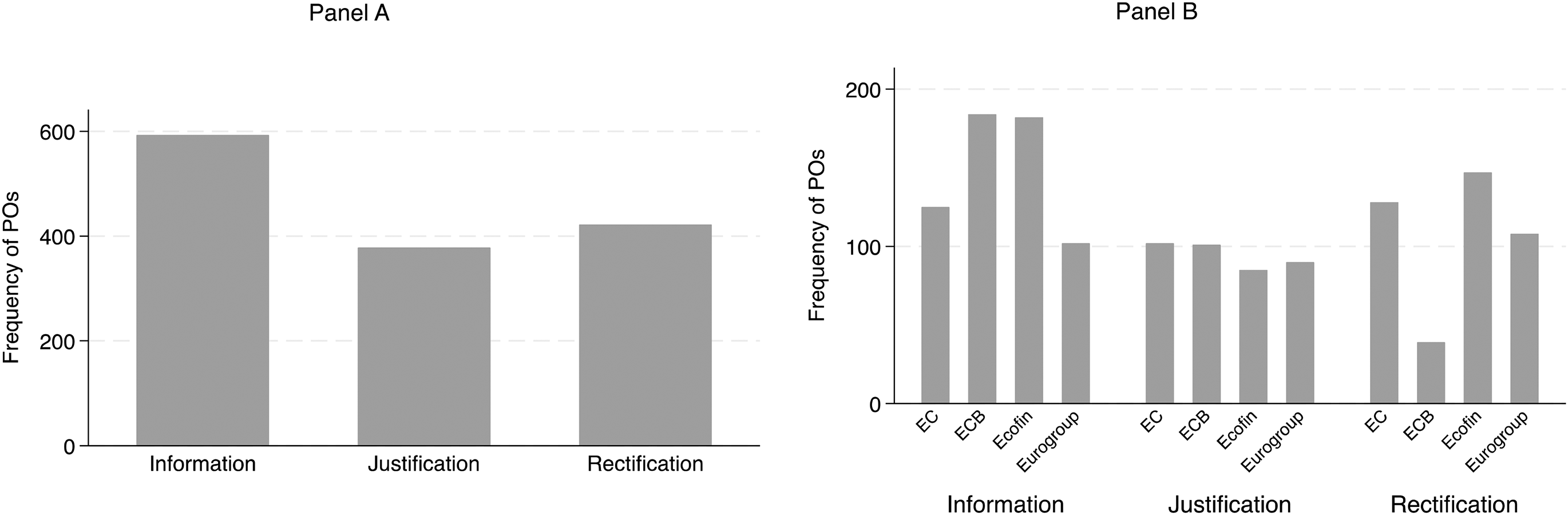
Types of PQs (Panel A); types of PQs by addressee (Panel B).
Independent variables
The first set of explanatory variables concerns the relationship between the legal oversight of an actor under scrutiny and the types of PQs received by that actor in practice (H1a, H1b, and H1c). In this context, we apply our conceptualisation of the type of oversight relationship at play to establish the EP's level of formal oversight vis-à-vis the four institutional actors under study. Borrowing from survey research, we propose a Likert-like scale that measures the strength of oversight-on-paper with ordinal categories ranging from 1 to 5, where 1 = very low oversight, and 5 = very high oversight (see Table 1). Accordingly, for each of the dimensions identified (contract design, screening and selection, monitoring & reporting, dismiss agent), we assign values ranging from 1 to 5, which are then aggregated in a median score, in line with the standard in survey research (Jamieson, 2004: 1217). We explain individual scores below.
Measuring the European Parliament's strength of oversight-on-paper in the Economic and Monetary Union.
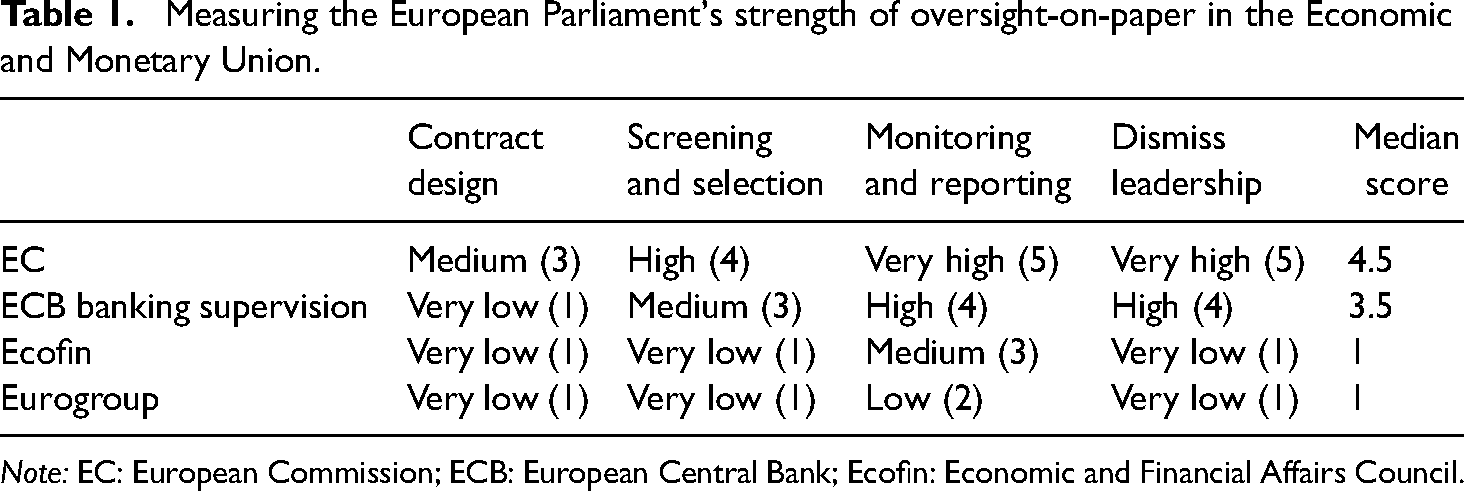
Note: EC: European Commission; ECB: European Central Bank; Ecofin: Economic and Financial Affairs Council.
From the four institutions, the EP clearly has more legal controls over the EC and the ECB than over Ecofin and the Eurogroup. According to the Treaty on European Union (TEU), the relationship with the EC is the closest to P-A expectations, given the EP's role in the appointment of the EC every five years. While MEPs cannot nominate the EC President or the Commissioners-designate, they hold appointment hearings, can reject candidates, and thus indirectly influence the priorities of the new College [Article 17(7) TEU]. In addition, the EP has multiple mechanisms to monitor the activities of the EC on a regular basis (Remáč, 2019) and the right to initiate a motion of censure against the entire College [Article 17(8) TEU]. Next, the EP has fewer legal controls over the ECB, an institution established by the Treaties (Protocol 4 TFEU) whose mandate in banking supervision was adopted through a Council Regulation where the EP was only consulted (Amtenbrink and Markakis, 2019). However, although the EP is not technically the principal of the ECB in the field, MEPs have formal powers to monitor the institution on a regular basis as well as to veto the selection (and potential dismissal) of the Chair of the Supervisory Board (SSM Regulation, Art 20 and 26). Bearing this in mind, we ranked the EP's relationship with the EC higher than the ECB in our measurement of oversight-on-paper, with median scores of 4.5 and 3.5 respectively.
By contrast, the EP has few legal controls over Ecofin and the Eurogroup, despite their key executive and legislative roles in EU economic governance since the Maastricht Treaty (Akbik, 2022: 6). With the Lisbon Treaty, the EP received co-decision rights in economic governance and became actively involved in legislating in the banking union (Schoeller and Héritier, 2019). However, the relationship with Ecofin and the Eurogroup remains awkward: as part of the Council, the two actors are meant to represent member states in EU decision-making, while the EP is supposed to represent citizens (Article 10 TEU). This means that Ecofin and the Eurogroup are, if anything, competing principals in the EU political system, and their role vis-à-vis the EP can be compared to president-parliament dynamics in presidential regimes (Strøm, 2000). As such, the EP does not set the mandates of Ecofin or the Eurogroup, it cannot screen and select their leadership, or initiate a motion of censure in case of problems. For scholars interested in the accountability of EU institutions, this institutional structure is problematic because it means that individual finance ministers can be held accountable by their respective national parliaments and electorates, but there are no mechanisms to hold Ecofin and Eurogroup accountable for decisions taken collectively at the EU level – a task that could be legitimately performed by the EP (Akbik, 2022; Brandsma et al., 2016). In fact, this was precisely the idea of the scrutiny reforms introduced during the euro crisis with the institutionalisation of the Economic Dialogues, which made explicit reference to Ecofin and the Eurogroup as interlocutors for the EP (De La Parra, 2017). In this way, the EP received some monitoring powers over the two intergovernmental actors. To sum up, based on the EU's legal framework, we ranked Ecofin and Eurogroup equally low in our measurement of the EP's oversight-on-paper (with a median score of 1).
The key advantage of this operationalisation is that it allows a clear ranking of different levels of formal oversight, which is essential for our purposes. Although a Likert-like scale does not permit us to claim with certainty that the difference between ‘low’ and ‘medium’ is exactly the same as that between ‘high’ and ‘very high’ oversight (cf. Callegaro et al., 2015: 45), we can reasonably argue that according to the EU institutional setup, the EC and the ECB have far more similar levels of oversight-on-paper than the EC and the Council, which is reflected in our measurement. In addition, this continuous measure allows for the possibility that other EU institutions (which are not present in the study) could be ranked in a similar way.
Finally, to test H2a and H2b relating to the type of activity under scrutiny, we included a dichotomous variable capturing whether a question concerned policy formulation, specifically the EU legislative process, or policy execution, that is, the implementation of adopted decisions. In practice, questions about policy formulation made direct reference to a specific legislative act currently in the decision-making pipeline, while questions about executive actions included everything else that was not explicitly legislative, including developments at the national level resulting from or requiring EU action. Furthermore, in line with the EU legal framework, all the four actors included in the analysis have competences in the formulation and execution of EU policy. First, next to its traditional right of initiative in EU legislation, the EC gained new executive powers during the euro crisis in the framework of the European Semester (Savage and Verdun, 2016). Second, while the ECB is a classic executive actor tasked with the implementation of EU legislation in banking supervision, the Bank has a formal role to provide an opinion on all legislative dossiers concerning the Banking and Capital Markets Union (European Central Bank, 2021). Third, within the Council, finance ministers in Ecofin were supposed to take a lead role in the implementation of the European Semester, in addition to their usual role in the legislative process (Akbik, 2022), while the Eurogroup became a key decision-maker on financial assistance and institutional reforms during the euro crisis (Craig, 2017). In other words, both Council configurations have competences in policy formulation and execution, and they might exercise different functions at different moments in time. This variation in the legal framework is also translated into the practice of PQs, as MEPs posed questions about legislative or executive decisions to all actors. In our dataset, it appears that Ecofin receives the highest number of questions in relation to policy formulation, while the EC receives the highest number of questions on policy execution (see the Online appendix).
Control variables
The analysis also includes several control variables which are essential to an argument about the structural determinants of oversight. In terms of political factors, we consider the government-opposition status of MEPs based on their party affiliation at the national level. This is consistent with previous research that has shown that in the EP, the practice of questions is driven by the opposition status of MEPs towards their national government (Font and Duran, 2016; Jensen et al., 2013; Proksch and Slapin, 2011). Accordingly, we include a dichotomous variable, using 0 for an MEP whose party is in opposition at the national level, and 1 for an MEP whose party is in government. The measurement is based on the Parlgov dataset (Döring and Manow, 2020) and calculated by Khokhlova (2022). Other controls concerning the characteristics of MEPs refer to their political positioning along the left-right and pro-/anti-EU dimension (Schmitt et al., 2018), their affiliation to a debtor, creditor or non-Eurozone country during the euro crisis (Akbik and Migliorati, 2023), as well as their gender (male/female) and seniority (understood as the number of parliamentary terms served).
Next, we control for the constituency focus of questions, capturing whether MEPs ask a question about national issues affected by EU policy (or its lack thereof), or whether they refer to general EU policies/interests. This is based on the general expectation that questions serve as an electoral signal to one's constituency, allowing MEPs to show that they take seriously the interests of their member states (Jensen et al., 2013; Martin, 2011b; Proksch and Slapin, 2011). In addition, we control for the subtopic of questions, including 17 dimensions ranging from banking supervision to financial assistance to budgetary deficits and social issues (see the Online appendix). Finally, we also control for year effects and for EP party group affiliation (descriptive statistics are reported in the Online appendix).
Analysis and results
To test the determinants of the variation in the three possible outcomes of the dependent variable – information (0), justification (1), and rectification (2), we use a multivariate analysis by means of multinomial logistic regression models with robust standard errors. A multinomial model is a suitable choice for a dependent variable composed of distinct nominal categories, as it estimates the effects of predictor variables on the odds of each possible outcome. As explained earlier, we control for several factors that might affect the variation in PQs, including several features of MEPs. We also include year, topic, and party group fixed effects to ensure that variation is not determined by specificities of these three dimensions. Before conducting the analysis, we checked for correlations between the independent and control variables (see the Online appendix). We specify three main models testing the two sets of hypotheses separately, and a summary regression model including both explanatory variables (full regression tables are displayed in the Online appendix). 4
H1a and H1b hypothesise that the type of question asked is linked to the availability of legal controls (‘oversight-on-paper’) in the EP vis-à-vis the actors under scrutiny. The regression coefficients show a highly significant difference (p < .01) between questions asking for information and questions asking for rectification (and vice versa), while they fall short of (or have lower) significance when justification is used as base outcome. In turn, justification displays a significant coefficient only in respect to rectification. To better interpret this output, we look at marginal effects (Figure 2), from which it appears clearly that, in line with H1a, the presence of more legal controls is associated with a higher likelihood of information questions, while fewer legal controls increase the likelihood of rectification questions. As shown in the upper left quadrant of Figure 2, the probability of an MEP asking an information question is higher when the EP has more legal controls available: on average, it is 35% more likely that MEPs ask for information from the EC, the actor scoring the highest score in oversight-on-paper in our sample, than to the Eurogroup and Ecofin, the actors scoring the lowest score. Conversely, as shown in the lower-left quadrant of Figure 2, the probability of an MEP asking a question requesting rectification is higher when the EP has fewer legal controls available. In practice, it is about 45% more likely that an MEP asks rectification questions of the Eurogroup and Ecofin than of the EC.
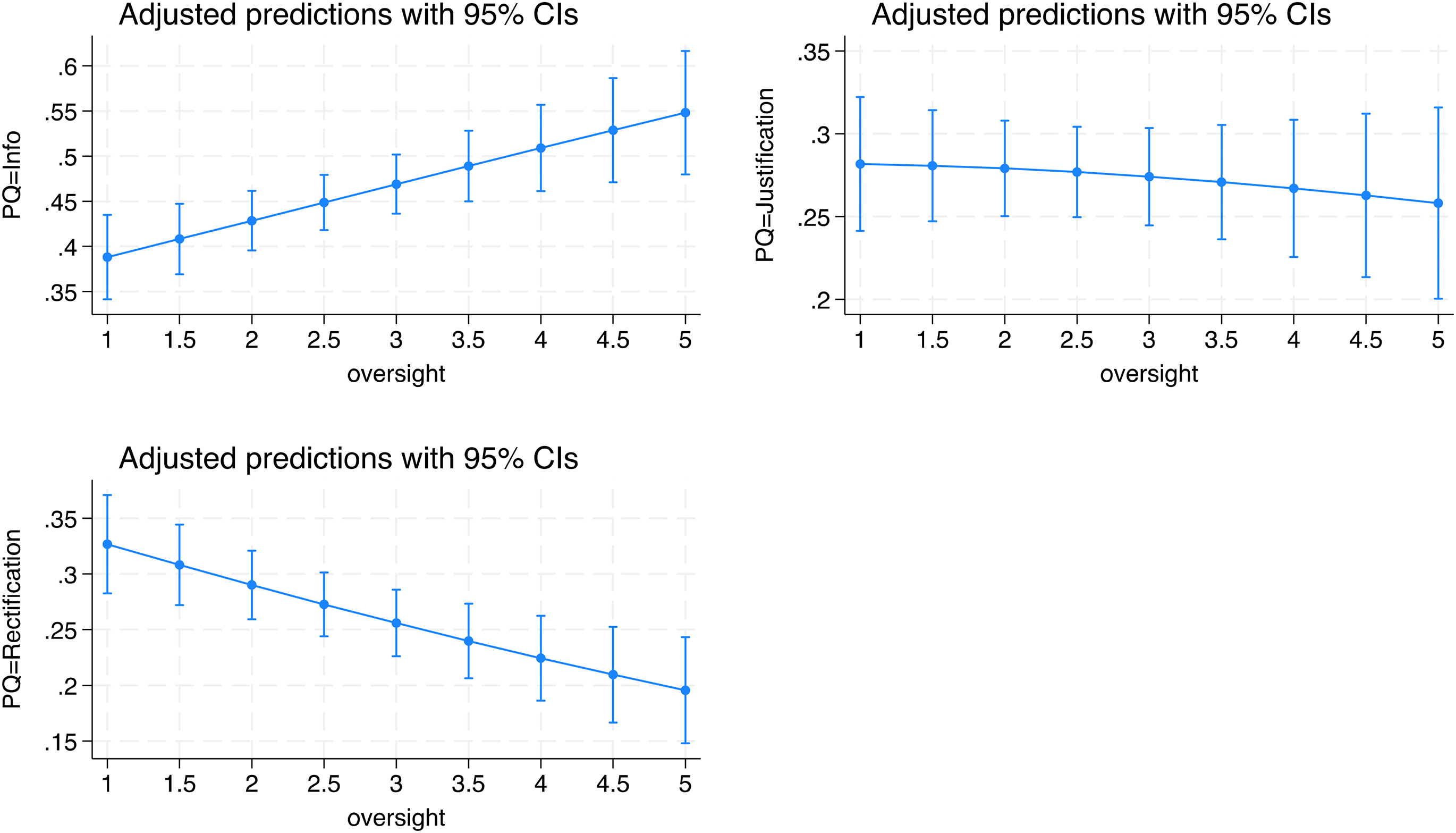
Effect of availability of legal controls on the probability of MEPs asking for information, justification, or rectification.
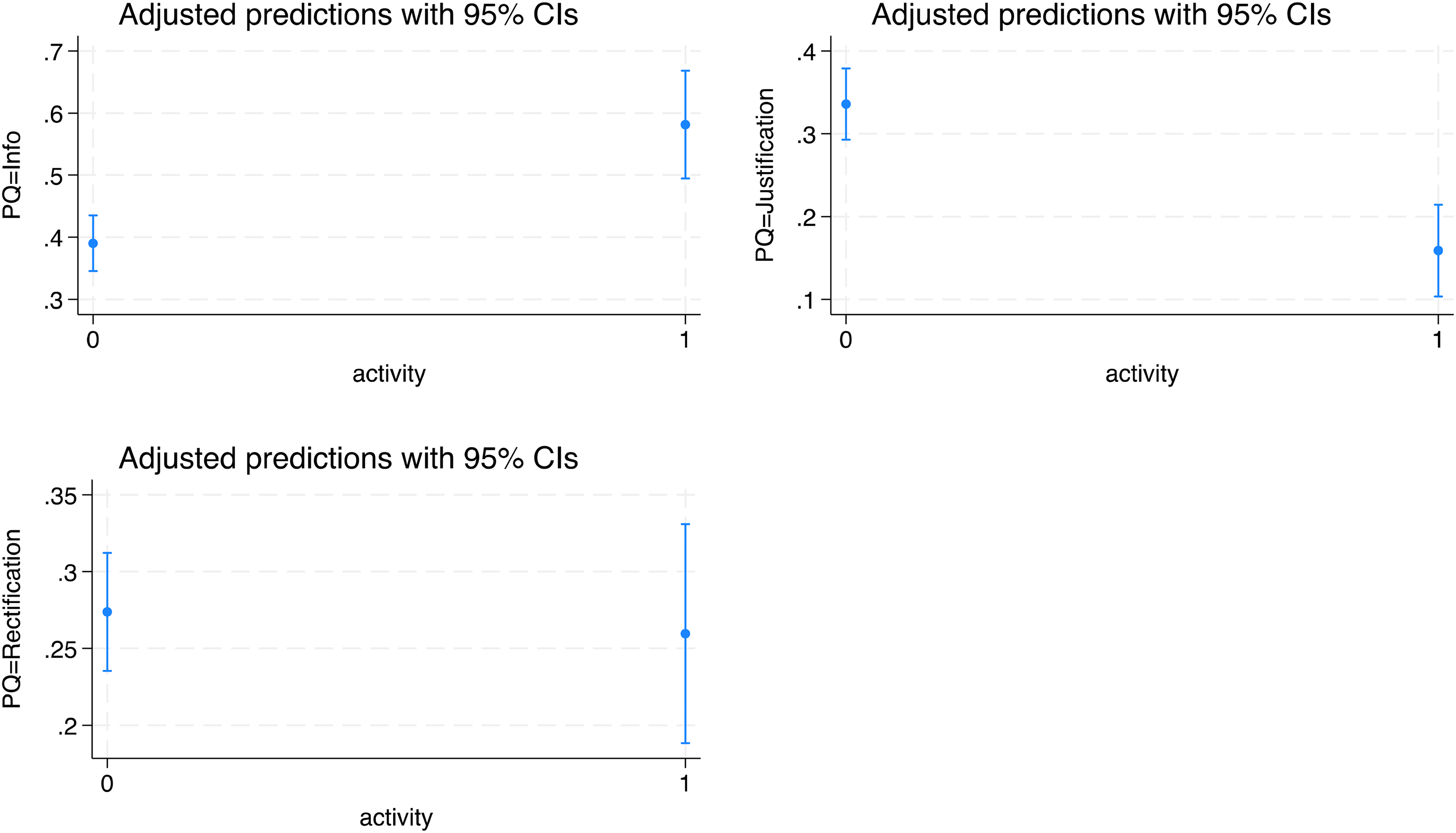
Effect of policy activity type on the probability of MEPs asking for information, justification, or rectification.
Finally, based on the upper-right quadrant of Figure 2, the availability of legal controls makes neither a sizable nor a significant difference in respect to the likelihood of MEPs asking justification questions. As formulated in H1c, MEP might demand justification when they want to challenge the decisions of the actor, regardless of the number of control mechanisms at their disposal. In this scenario, what matters is that an actor is perceived as making mistakes for whatever reason, for which MEPs demand an account. 5
H2a and H2b hypothesise that the type of oversight question is connected to the kind of activity being scrutinised (either policy formulation or execution). Regression coefficients show a highly significant difference between information and justification questions (p < .01) and between rectification and justification (p < .01), while the effect of the IV on information falls short of significance if rectification is base outcome. On closer inspection of marginal effects, as shown in the upper-left quadrant in Figure 3, MEPs are about 40% more likely to ask information questions if an actor's key domain of activity is policy execution (as opposed to policy formulation). Conversely, MEPs are about twice more likely to ask justification questions when the activity is executive rather than legislative (H2a). Finally, marginal effects show no sizeable effect of kind of activity as far as rectification questions are concerned. This could be because MEPs can ask for rectification when they criticize how the EC implemented the European Semester, or when they disagree with Ecofin's proposal on a legislative file. In line with H2b, requests for policy change may apply to both types of policy activity (execution and formulation). The finding provides interesting insights into the practical use of PQs in connection to the legislative process: specifically, MEPs take the opportunity of committee meetings to ask for information about the content of EC proposals or the status of legislative negotiations in the Council, keeping in mind that the EP will later be involved in these negotiations in its capacity as co-legislator in the EU's ordinary legislative procedure. For the same reason, MEPs ask the ECB for opinions on ongoing legislative files, taking advantage of the Bank's expertise in the field of financial supervision.
Among controls, we do not find any significant impact of MEPs’ characteristics such as gender, seniority, and country's economic status. The constituency focus appears significant but does not display any sizeable impact when inspecting the marginal effects in the Online appendix. Moreover, ideological variables (left-right, pro-anti EU dimensions) do not show any significance or systematic trend. In turn, party group affiliation seems to have some impact when it comes to the European People’s Party, whose members are more likely to pose information questions, and to Europe of Freedom and Direct Democracy, whose members seem the more likely to pose rectification questions. Finally, there are no noteworthy differences to report with respect to years or topics. All these results can be found in the Online appendix.
Overall, our results point to an important implication: on average, MEPs seem to understand PQs – and exploit them – as a tool to enhance their scrutiny of those institutional actors over which they have less control via other legal means. In addition, our analysis shows the limited influence of MEPs’ political characteristics in driving the variation of PQs in legislative oversight. This is in contrast to other authors who point to the role of the opposition status of MEPs at the national level (Font and Duran, 2016; Jensen et al., 2013; Proksch and Slapin, 2011) or their ideology (left-right or pro-/anti-European) in the practice of PQs (Guinaudeau and Costa, 2021). Our contribution is thus to bring nuance to such studies, which only focused on the number of questions asked by MEPs or the policy area in which a question was asked. Instead, we argued that the content of questions – in relation to their original function to hold actors accountable – is directly shaped by the EP's structural opportunities for oversight vis-à-vis different EU bodies.
Conclusion
This article aimed to answer a question relevant for any parliament: in the practice of scrutinising various actors, why would MPs ask different types of oversight questions? Considering the wealth of factors that may influence parliamentary behaviour, we tested the plausibility of two arguments rooted in theories of bureaucratic control. Our first point was that oversight relationships enshrined in pre-existing legal arrangements are the main driver of the variation seen in oversight questions: specifically, the fewer legal controls MPs have over an actor, the higher the likelihood that they will ask rectification questions. The second point was that MPs ask more justification questions in their oversight of policy execution (as opposed to policy formulation), which is consistent with the idea of parliamentary scrutiny over the executive (MacMahon, 1943) but far from self-evident. In practice, while MPs ask all sorts of PQs in legislative oversight, they reserve justification questions for executive actions, following the traditional democratic view of calling governments to account (Bovens, 2007). In the case of the EP, our findings hold regardless of MEPs’ political affiliation, government/opposition status at the national level, gender, seniority in the EP, or the constituency claimed to be represented through PQs.
To what extent does this logic travel beyond the EP? Although national parliaments have a longer tradition of parliamentary scrutiny than the EP, they face similar structural challenges related to the legal framework of oversight relationships and the concentration of executive power in the hands of governments (especially visible, for instance, in the context of the COVID-19 pandemic). In addition, parliaments are different – some are more focused on legislation, others on the ex-ante and ex-post control of cabinets (Fish and Kroenig, 2009; Sieberer, 2011). This means that there is wide scope for structural factors to influence the use of questions in the practice of legislative oversight. To put it differently, there is a difference between the number of questions being asked in a parliamentary term and the type of oversight exercised through those questions. As demonstrated by previous research, the number of PQs is determined by the government-opposition status of MPs (Jensen et al., 2013), their affiliation to a coalition government (Höhmann and Sieberer, 2020), or by the ideological and electoral competition between parties (Otjes and Louwerse, 2018). However, the type of questions being asked – and their purpose in trying to hold governments accountable – depends more on structural factors, as shown in this article. Future research can establish the applicability of our findings to national parliaments worldwide and explore the interaction between political and structural factors in driving the variation of PQs in legislative oversight.
Supplemental Material
sj-zip-2-eup-10.1177_14651165241268274 - Supplemental material for Understanding oversight through parliamentary questions: The European Parliament in the Economic and Monetary Union
Supplemental material, sj-zip-2-eup-10.1177_14651165241268274 for Understanding oversight through parliamentary questions: The European Parliament in the Economic and Monetary Union by Adina Akbik and Marta Migliorati in European Union Politics
Supplemental Material
sj-docx-3-eup-10.1177_14651165241268274 - Supplemental material for Understanding oversight through parliamentary questions: The European Parliament in the Economic and Monetary Union
Supplemental material, sj-docx-3-eup-10.1177_14651165241268274 for Understanding oversight through parliamentary questions: The European Parliament in the Economic and Monetary Union by Adina Akbik and Marta Migliorati in European Union Politics
Footnotes
Acknowledgements
The authors would like to thank Nikoleta Yordanova, who provided extensive comments on an earlier version of the paper. We are also grateful for constructive feedback received during the 2022–2023 conferences of the ECPR Standing Group on the European Union and of the European Union Studies Association, as well as in the review process.
Author contributions
The authors contributed equally to the article.
Funding
The authors disclosed receipt of the following financial support for the research, authorship, and/or publication of this article: This work was supported by the European Research Council under the European Union's Horizon 2020 research and innovation programme (grant: 716923).

Data availability statement
The dataset analyzed during the current study is available in the Harvard Dataverse repository, https://dataverse.harvard.edu/dataset.xhtml?persistentId=doi:10.7910/DVN/NZS4O8.
Supplemental material
Supplemental material for this article is available online.
Notes
References
Supplementary Material
Please find the following supplemental material available below.
For Open Access articles published under a Creative Commons License, all supplemental material carries the same license as the article it is associated with.
For non-Open Access articles published, all supplemental material carries a non-exclusive license, and permission requests for re-use of supplemental material or any part of supplemental material shall be sent directly to the copyright owner as specified in the copyright notice associated with the article.
