



Abstract
Differentiated integration is often considered a solution to gridlock in the European Union. However, questions remain concerning its perceived legitimacy among the public. While research shows that most citizens are not, in principle, opposed to differentiated integration – although support varies across different differentiated integration models and different country contexts – we still know little about the role institutional design plays in citizens’ evaluations of differentiated integration. This article inspects how citizens evaluate different hypothetical differentiated integration arrangements, with varying decision-making procedures, using a conjoint experiment. We ask whether institutional arrangements can overcome citizens’ preference heterogeneity over differentiated integration, and thereby foster the legitimacy of a differentiated European Union. We find that while a majority of citizens care about the inclusiveness of differentiated integration arrangements, they also support limiting the number of veto points. Our analysis also reveals noteworthy differences across citizens with pro- and anti-European Union attitudes in the perceived fairness of differentiated integration arrangements.
Introduction
Differentiated integration (DI) is an often-proposed solution to accommodate preference heterogeneity among the 27 member states of the European Union (EU) and thus to overcome gridlock in EU decision-making (Holzinger and Schimmelfennig, 2012; Stubb, 2002). However, DI comes at a price with respect to both its efficiency and legitimacy (Adler-Nissen, 2014; Schimmelfennig et al., 2023). This article focuses on the latter dimension and takes as a starting point the observation that the success and legitimacy of future (differentiated) integration hinges on citizens’ support (Hobolt and De Vries, 2016; Hooghe and Marks, 2009).
While extant research on public support for DI has revealed that most EU citizens are not, in principle, opposed to it, their support differs along their ideological predispositions, their national context and different types of DI (De Blok and De Vries, 2023; Leuffen et al., 2022a; Schuessler et al., 2023). While EU supporters favour temporary differentiation (‘multi-speed Europe’) and think that opt-outs should require the consent of other EU countries, Eurosceptics are ready to accept more permanent forms of differentiation and would like member states to have the freedom to choose from a menu of common policies (‘Europe à la carte’). In addition, support for DI is not equally distributed across the Union; Northern EU countries are more supportive of a ‘multi-speed Europe’ than Southern EU countries. However, we still know little about the role of institutional design for citizens’ evaluations of DI. Moreover, the extant literature is largely based on observational data, and thus cannot inspect the precise mechanisms of citizens’ support for, or opposition to, various forms of DI.
In this article, we turn to the literature on losers’ consent (Anderson et al., 2005) and procedural fairness theory (Lind and Tyler, 1988), which underline that the institutional design of decision-making procedures can foster legitimacy perceptions, even among the losers in the political game. Indeed, recent work on EU integration suggests that balanced institutional practices can help overcome existing ideological pro-/anti-EU cleavages to find arrangements that appeal to all citizens (Hahm et al., 2020; Schäfer et al., 2023). The question then becomes: can institutional arrangements overcome citizens’ preference heterogeneity over DI, and thereby foster the legitimacy of a differentiated EU?
This article presents the results of a (pre-registered) conjoint experiment fielded among 11,520 citizens from eight EU member states in the spring of 2021. 1 The experiment was designed to study the impact of institutional design on the support for DI. More specifically, it considers the role of three institutional components of DI proposals: (a) the relative involvement of intergovernmental and supranational institutions in decision-making (including veto rules); (b) the size of the group that wants to diverge; and (c) the permanency of the DI arrangement. In addition, we explore in which policy areas differentiation is appreciated by citizens, or not. In doing so, we move beyond conceptual DI models such as ‘multi-speed’ or ‘variable geometry’ on which previous public opinion studies had focused and bridge the study of citizens’ attitudes towards a differentiated EU with recent work on the role of institutional design for general support for European integration (Hahm et al., 2020; Schäfer et al., 2023; Schraff and Schimmelfennig, 2020).
Why institutions matter
In the recent decade, we have observed an expansion of instances of DI in the EU, with various integrated policies being neither uniformly nor exclusively valid in the EU member states. The literature on the causes of DI sees (polarised) individual-level preferences as an impetus for differentiation as preference heterogeneity hampers further collective integration efforts (Bellamy and Kröger, 2017; Leuffen et al., 2022b; Schimmelfennig, 2016). However, recent work on public support for DI challenges the idea that it can be used as an instrument to overcome preference heterogeneity in EU policy, demonstrating dissensus between pro-EU and Eurosceptic citizens and those with more or less liberal economic attitudes on the preferred form of differentiation (De Blok and De Vries, 2023; Leuffen et al., 2022a). Accordingly, a DI proposal may reinforce existing conflict lines, creating winners and losers, thereby potentially increasing the contestation of the EU.
Procedural fairness theory may help in this respect. Empirical research has repeatedly shown that losing reduces the perceived legitimacy of decisions and decision-making processes (the so-called ‘winner-loser gap’) (cf. De Fine Licht et al., 2022; Esaiasson et al., 2023). Similarly, utilitarian considerations are a key driver of support for European integration (De Vries, 2018). However, procedural fairness theory argues that fair and appropriate procedural arrangements in decision-making can enhance citizens‘ willingness to accept a decision, even if they view the outcome as unfavourable (Tyler, 2006). Put differently, fair procedures can help to generate losers’ consent (Anderson et al., 2005). Perceptions of voice and control are core aspects of a fair process (Hirschman, 1970), whereby a process will be perceived as fairer if citizens have the idea that they can exercise influence and communicate their views during the decision-making process (Thibaut and Walker, 1975).
Despite the longstanding debate on the democratic deficit of the EU (Follesdal and Hix, 2006), scholars have only recently started to investigate the role of institutional design for EU support (but see Rohrschneider, 2002), predominantly with the use of conjoint experiments. Hahm et al. (2020) find consensus among the EU public on the ideal institutional set-up, where citizens prefer the existing bicameral procedure and the majority voting rule, but oppose the European Commission's exclusive proposal power and unanimity. Alternatively, Schäfer et al. (2023) demonstrate that such voting procedures, as well as DI in general, are highly contested between Eurosceptics and Europhiles, with the latter being more opposed to intergovernmental decision-making processes (i.e. unanimity) compared to supranational ones (i.e. majority voting), and more in favour of voluntary compliance to EU policies. In addition, De Vries (2018) finds that institutional preferences for the EU also have a communal dimension, that is, the number of EU countries involved (see also Bechtel and Scheve (2013) on the role of the number of countries participating in international agreements), and a functional dimension, that is, the policies that the EU should be promoting. Concerning the latter, EU citizens prefer further integration related to peace and security issues over economic integration and are more strongly opposed to integration on energy, immigration and climate change compared to the single market (De Vries, 2018).
While this work demonstrates that institutional design matters for general EU support, we do not know how the institutional design and procedures shape support for DI. Therefore, we build on and extend the existing literature by designing a conjoint experiment on support for DI that considers various degrees of intergovernmental and supranational influences at various stages of the decision-making process, in addition to communal and functional characteristics (size of the subgroup and policy area). We expect Europhiles and Eurosceptics to evaluate the decision-making process for DI differently (cf. De Blok and De Vries, 2023; Schäfer et al., 2023). Whereas Eurosceptics should prefer proposals that allow for more permanent forms of differentiation, with strong intergovernmental elements (in agenda-setting and voting procedures), Europhiles should oppose small subgroup differentiation, and hold stronger preferences for supranational decision-making.
Conjoint experiment
The existing research suggests that different citizens prefer different models of DI (De Blok and De Vries, 2023; Schuessler et al., 2023). For DI to be a legitimate mechanism to overcome gridlock in the EU, it is therefore important that citizens can at least agree on the institutional procedure in which such decisions are taken (cf. Anderson et al., 2005). To identify an institutional design that satisfies all EU citizens, we conducted a forced-choice experiment (Hainmueller et al., 2014) in eight EU member states representing close to two-thirds of the EU population but varying in size and geographical location (N = 1500 per country). 2 Each conjoint scenario describes how the EU could use DI to resolve policy gridlocks. The scenarios vary in five attributes situated along three dimensions (see Table 1). 3 First, in the decision-making procedure, we vary more intergovernmental and more supranational procedures over which EU supporters and opponents typically disagree (Schäfer et al., 2023), divided into a proposal and a decision-making stage. In the battery on veto players, we decided to include both the European Parliament (EP) and different configurations of countries in the Council. It should be noted here that the EP veto can be aligned with different decision-making rules in the Council, however, we aimed at limiting the number of dimensions and thereby the cognitive complexity for the respondents. Second, concerning the group composition and the finalité of DI, we tap into two aspects of DI, previously identified to matter to citizens: inclusiveness and permanence (Schuessler et al., 2023). Third, we vary the policy to be differentiated, choosing among four policy areas, in which DI is particularly likely. Namely, we include three areas of core state powers (migration, taxation, and the Euro) as well as a politically salient social regulation (a common European minimum wage 4 ).
Design of conjoint experiment on DI preferences.
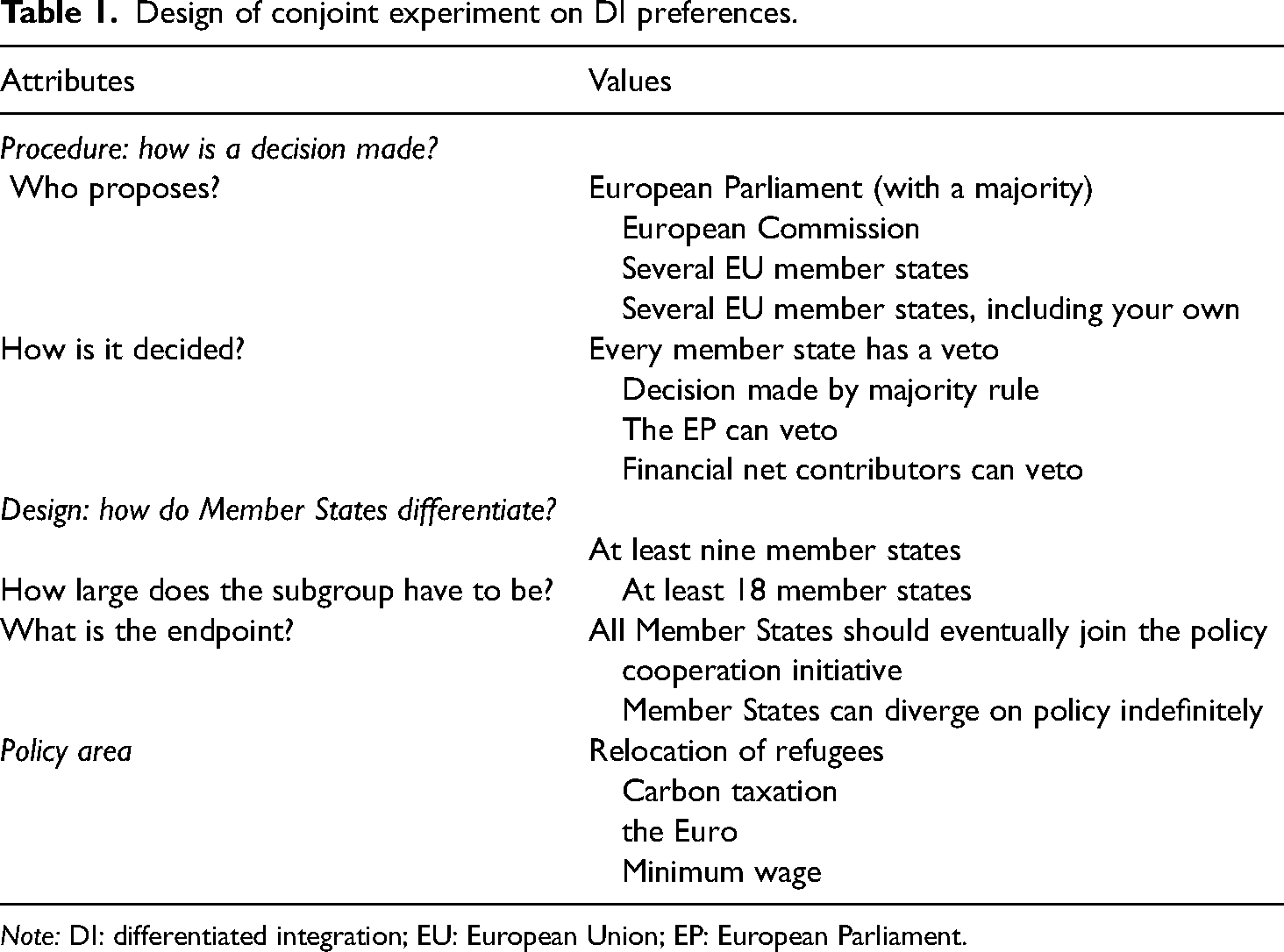
Note: DI: differentiated integration; EU: European Union; EP: European Parliament.
As the dependent variable, we create a binary outcome variable for each profile indicating whether it was chosen or not. Additionally, respondents were also asked to indicate their support for each profile and rate its fairness (both on a 10-point scale). This aligns with common practice in procedural fairness research where it has repeatedly been shown that the fairness of procedures is closely linked to other core facts of legitimacy, such as decision acceptance and trust in authorities (e.g. Esaiasson et al., 2019; Grimes, 2006), while legitimacy in turn encourages consent (Tyler, 2003). In our case, the results of the fairness and support rating measures correspond to those of the choice variable (see the second panel in Figure 1 and the Online appendix). We estimate linear regression models with standard errors clustered at the individual level.
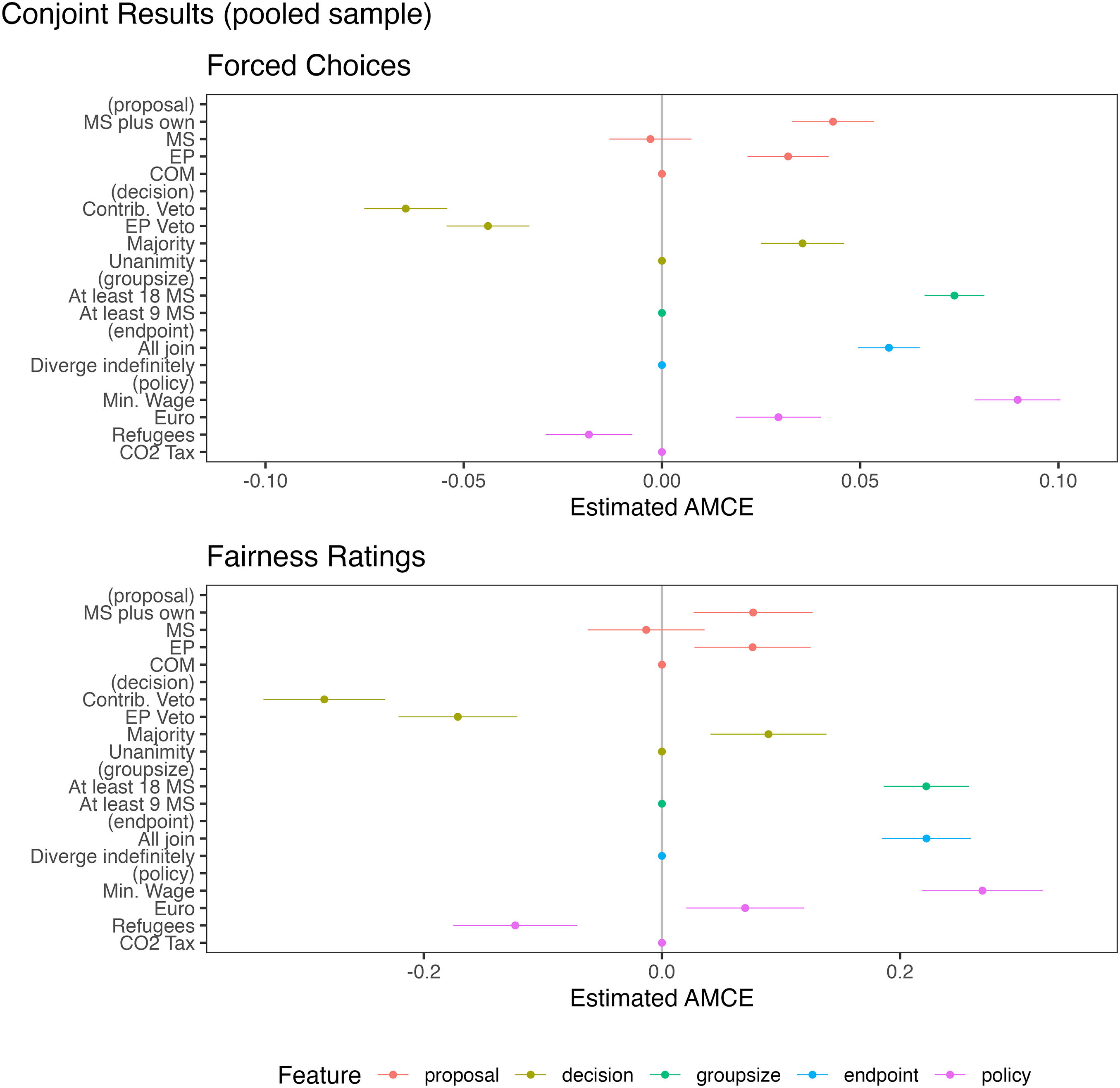
Conjoint results (pooled sample). Note: MS: member states.
Results
Figure 1 presents the average marginal component effect (AMCE) of each attribute in the pooled sample. Results by country are reported in the Online appendix.
In a fully randomised conjoint design like ours, AMCEs can be interpreted as the extent to which a given value of an attribute increases or decreases a respondent's favourability towards a specific conjoint profile, in relation to the baseline, averaging across all respondents and all other profile features (Leeper et al., 2020). The baseline of each attribute is the value with an AMCE of 0.
Starting with the procedural dimension, we see that proposals for DI that are put forward by a group of member states including the respondent's own country or by the EP garner greater support, with a difference in profile favourability of 4 and 3 percentage points, respectively, compared to proposals from the European Commission. However, a proposal coming from a group of countries that does not explicitly include the respondent's home country does not result in higher support compared to a proposal from the European Commission. This result implies that there might be a ‘home country bias’: citizens prefer intergovernmental proposals to Commission proposals but only if their own country is involved. Otherwise, they might reverse back to the supranational actors, which they may perceive to be more impartial than the other EU members.
The decision-making rule also significantly affects public support for DI. Citizens prefer majority decisions over unanimity, with a 4 percentage points difference in profile favourability. However, unanimity is considered preferable to an, arguably, arbitrary veto for financial net contributors as well as to a veto by the supranational EP, where a contributors’ veto decreases the profile favourability by 6 percentage points, while an EP veto decreases it by 4 percentage points, compared to a proposal based on unanimity. Possibly, the term ‘veto’ has reduced support for a decision-making rule, highlighting citizens’ overall tendency to support DI. This reading is backed by the somewhat contrary finding towards the EP: while respondents are willing to grant it a crucial role at the proposal stage, they display opposition against the EP being in a position to exert a veto against DI (against our intuition and the current ordinary legislative procedure for secondary law).
Moreover, group size also matters for public support. Citizens are generally more supportive of scenarios in which a larger group of countries integrates further compared to smaller groups, with a difference of 7 percentage points in profile favourability. This is in line with the finding that our respondents prefer differentiation scenarios, in which the eventual endpoint is the same for all member states as compared to a model in which member states can diverge indefinitely (a difference of 6 percentage points in profile favourability). Apparently, a majority of citizens still value unity in the EU; however, they are willing to accept DI as a second-best option, when this unity is unavailable.
Additionally, our results indicate that DI is considered to be more desirable in some policy areas compared to others. DI proposals on a minimum wage or the Eurozone generate more support, with increases of 9 and 3 percentage points in profile favourability respectively, compared to proposals on carbon taxation. A differentiation proposal on the relocation of refugees further decreases support by 2 percentage points, in reference to a carbon tax. It may be that citizens intuitively grasp that differentiation in the latter two areas may encourage free riding by non-participating member states, echoing Lord's (2015) reflections on the role of externalities in DI. Note that we find similar patterns across all dimensions for our alternative outcome variables that capture degrees of support and fairness (see the second panel in Figure 1 and the Online appendix). This suggests that personal preferences for DI align with ideas about whether it is fair or legitimate.
Finally, we tested for heterogeneous treatment effects between EU supporters and opponents (see Figure 2). In line with previous research, we find that these groups evaluate differentiation proposals differently, in particular on the procedural and institutional dimensions. Contrary to EU supporters, Eurosceptics do not favour a majority decision over unanimity. However, the difference between the two decision rules is statistically insignificant. Majority voting does not reduce their support for DI significantly. Another indicator that Eurosceptics lean towards intergovernmental decision-making is that the ‘home state bias’ identified above clearly appears for pro-EU respondents but not for Eurosceptics. Furthermore, while both groups prefer DI proposals with larger subgroups, temporary differentiation only has a large positive effect for EU supporters (9 percentage points increase in profile favourability) compared to permanent divergence. However, as in the case of majority voting, temporary differentiation does not reduce support among Eurosceptics but is simply not significantly different from permanent differentiation.
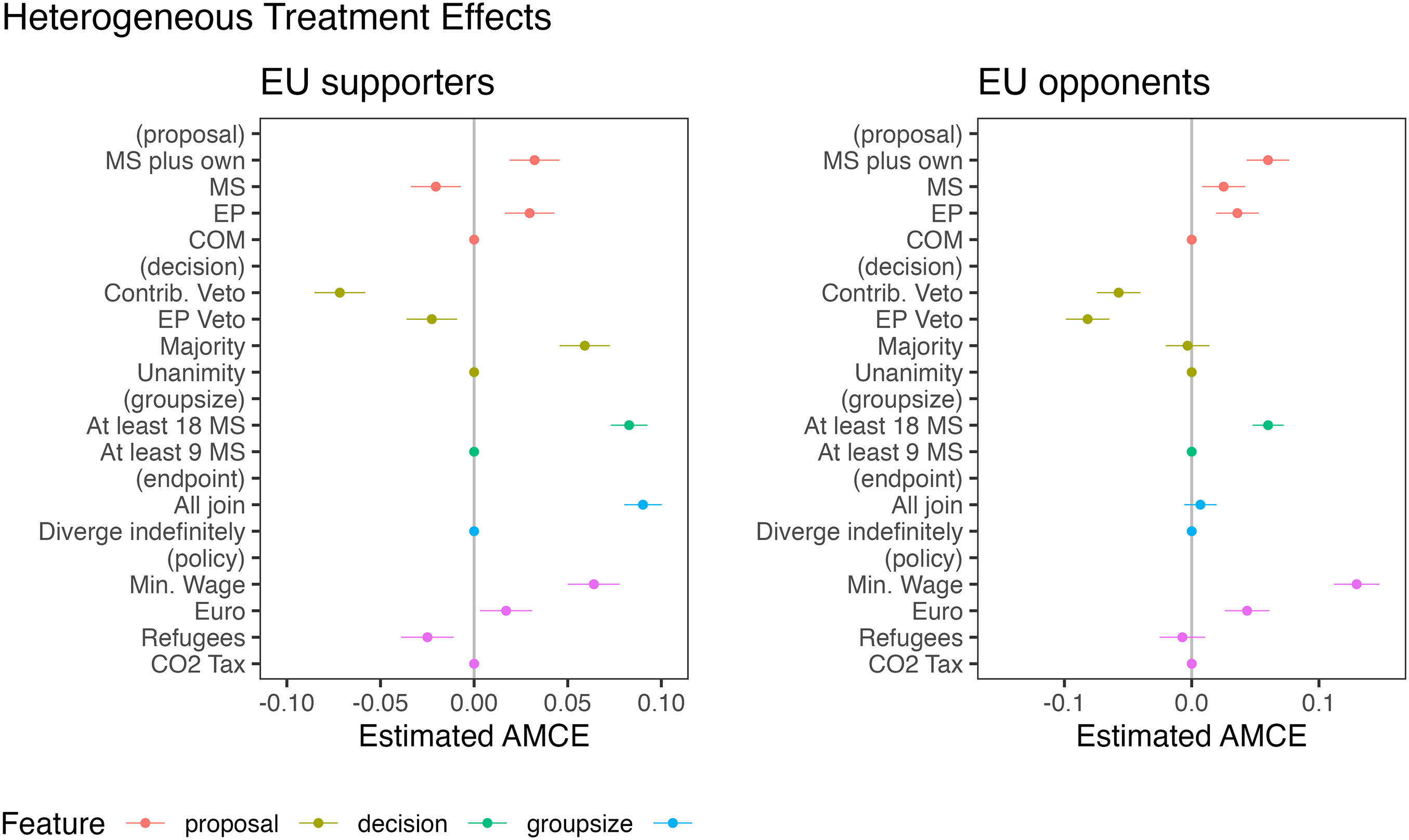
AMCEs across types of EU supporters.
Lastly, results disaggregated by country (see the Online appendix) do not exhibit systematic heterogeneity. That some effects turn insignificant is not unexpected, given the lower statistical power. If anything, it appears that Danish citizens are less integrationist in the context of DI, compared to the other nationalities. For example, they prefer potential indefinite divergence over all EU countries joining the initiative. This is consistent with Denmark's historical relationship with the EU and the appreciation of sovereignty differentiation in this country. 5
Conclusion
DI is often proposed as a response to preference heterogeneity and gridlock in the EU. However, to live up to this promise, and to enjoy legitimacy, DI requires public support. In this article, we have studied citizens’ preferences over the institutional design and governance of DI.
We find that citizens generally prefer temporal over permanent differentiation and larger to smaller differentiating subgroups. This result indicates that citizens perceive a ‘multi-speed’ EU that keeps as many member states as possible on board more favourable than a permanently differentiated Europe of ‘variable geometries’ (cf. Holzinger and Schimmelfennig, 2012). This interpretation aligns with findings from Schuessler et al. (2023), who show that a majority of EU citizens prefer an integrationist ‘core Europe’ with limited opt-outs.
When it comes to the decision-making process, citizens prefer a majority vote among EU member states over unanimity. Citizens do not want (differentiated) integration to be held back by an individual member state. While they appreciate it if their home country advocates for a differentiation initiative, citizens appear to be somewhat distrustful of other EU members. Moreover, citizens welcome the participation of the EP at the proposal stage. At the same time, EU supporters and Eurosceptics disagree over granting it veto powers. These findings indicate not only that national governments act as an important source cue for their citizens’ preference formation but also that the supranational institutions have an important part to play in the deliberations about DI, not least to reassure citizens that no group is discriminated against or taken advantage of. Moreover, our findings speak to and support previous research on citizens’ institutional preferences for European integration more broadly. Citizens support granting the EP a right to initiate (differentiated) legislation (see also Hahm et al., 2020) and prefer (qualified) majority voting in the Council over unanimity voting in the case of DI (see also Hahm et al., 2020; Schäfer et al., 2023).
While our results highlight the role of EU support in shaping attitudes towards (decision-making over) DI, differences between EU supporters and Eurosceptics do not seem to be insurmountable. For example, while Eurosceptics do not favour temporary over permanent differentiation, a choice for the former does not significantly reduce their support for DI.
Finally, our experiment also provides evidence that, in the eyes of citizens, different policy areas lend themselves better or worse to DI. While DI appears to offer a path forward for social policy initiatives, such as a common minimum wage, it may not work for other controversial policy areas. Notably, citizens oppose differentiation when it comes to the relocation of refugees and are also less supportive of a differentiated carbon tax – possibly because they worry about others free-riding on their efforts (cf. Lord, 2015). However, despite greater citizen support, social policy differentiation is not without its critics. For example, the European Commission has argued that DI could lead to unequal social rights between citizens from different member states (Leruth and Schreurs, 2022). Our results suggest that if a large subgroup of member states would like to build a more ’social Europe’, then temporary differentiation involving supranational institutions at the policy formulation stage and majority voting in the Council would garner public support.
In a heterogeneous and politicised EU, DI promises a path forward. But to fulfil its potential, differentiation needs citizens’ support. An institutionalised decision-making process that is perceived to be fair and impartial plays an important role in fostering public support.
Supplemental Material
sj-docx-1-eup-10.1177_14651165241246384 - Supplemental material for All on board? The role of institutional design for public support for differentiated integration
Supplemental material, sj-docx-1-eup-10.1177_14651165241246384 for All on board? The role of institutional design for public support for differentiated integration by Lisanne de Blok, Max Heermann, Julian Schuessler, Dirk Leuffen and Catherine E. de Vries in European Union Politics
Supplemental Material
sj-zip-2-eup-10.1177_14651165241246384 - Supplemental material for All on board? The role of institutional design for public support for differentiated integration
Supplemental material, sj-zip-2-eup-10.1177_14651165241246384 for All on board? The role of institutional design for public support for differentiated integration by Lisanne de Blok, Max Heermann, Julian Schuessler, Dirk Leuffen and Catherine E. de Vries in European Union Politics
Footnotes
Acknowledgements
We thank two anonymous reviewers and the editor for their helpful comments. Moreover, we are grateful to Sandra Kröger, Frank Schimmelfennig, as well as participants of the ‘DI Garage’ of the ECPR Research Network on Differentiated Integration for their valuable input. Work on this article was generously supported by the European Union's Horizon 2020 Research and Innovation Programme under Grant Agreement 822419 and Grant Agreement 822304 and by the European Research Council under Grant Agreement 864687.
Funding
The author(s) disclosed receipt of the following financial support for the research, authorship, and/or publication of this article. This work was supported by the Horizon 2020 Framework Programme (Grant Numbers 822304 and 822419) and the European Research Council (Grant Agreement 864687).

Data availability statement
The replication material, including a dataset, are published online with the Supplemental Material.
Supplemental material
Supplemental material for this article is available online.
Notes
Correction (May 2024):
Article updated to correct the article type from “Letter” to “Article”.
References
Supplementary Material
Please find the following supplemental material available below.
For Open Access articles published under a Creative Commons License, all supplemental material carries the same license as the article it is associated with.
For non-Open Access articles published, all supplemental material carries a non-exclusive license, and permission requests for re-use of supplemental material or any part of supplemental material shall be sent directly to the copyright owner as specified in the copyright notice associated with the article.
