



Abstract
How do foreign political events shape voters’ evaluation of policies whose outcomes are hard to observe? We argue that policy-specific political processes abroad provide information about the policy's feasibility and desirability that allows voters to update their preferences. We analyze how key events in British Brexit politics affected attitudes towards the European Union in other European countries. The results of ‘unexpected events during survey' designs, a natural experiment, and a panel analysis show that events highlighting the difficulties of the United Kingdom's withdrawal from the European Union led to a higher support of European integration in remaining member states, whereas an event highlighting the opportunities of Brexit resulted in more Eurosceptic attitudes. The article demonstrates that foreign events can influence voters’ policy attitudes in other countries, highlighting the systemic consequences of events like Brexit.
Introduction
In recent years, the globalization backlash, support for, and electoral success of, populist parties, and challenges to democracy seem to have swept across Western democracies like a wave. This raises the question of whether and how political developments in one country are perceived and evaluated by the mass public abroad and calls for an improved understanding of the diffusion of ideas and political developments across countries. Understanding whether and how voters learn from observing political developments abroad not only contributes to better distinguishing between domestic and international sources of these current political changes, but also helps to better understand the systemic dynamics underlying these changes.
Previous research has shown that voters do indeed look abroad in order to benchmark domestic policy successes and failures. Studies of economic voting show that voters compare the performance of their national economy with the world economy, thus effectively using the performance of other countries as a benchmark (Kayser and Peress, 2012; Aytaç, 2018). Yet, what happens when voters seek to evaluate policies whose outcomes are hard to observe, either because they have not yet been implemented, or because the ultimate outcomes take time to materialize? This is a key question as the current backlash against globalization and the populist wave so far have predominantly come in the form of politics, rather than policy outcomes. We argue that absent information about policy outcomes, voters observe the political process through which policies emerge. Party politics, political maneuvering, and political struggles abroad convey important information about the political pitfalls, difficulties, and opportunities associated with certain policy proposals (Gilardi, 2010; Saideman, 2012; Gilardi and Wasserfallen, 2019). As Gilardi (2010: 651) suggests in his study of policy diffusion among policy-makers, “the object of learning is the policy consequences of policy change” but “the political effects are likely to be as important, if not more so.”
In this article, we ask whether this argument holds for voters, too, and examine whether and to which extent political processes and events abroad affect how domestic voters assess the feasibility and desirability of certain policies. On the one hand, the generally low level of political knowledge about politics (Gilens, 2001; Clark and Hellwig, 2012) makes it unlikely that voters directly respond to political developments in other countries. On the other hand, observing other countries’ domestic politics, as well as the type of reporting and elite discourse this generates in their home country, can simplify voters’ decision making by reducing the uncertainty associated with alternative policy choices. When media coverage of the political struggles around the approval of a policy in other countries is high, voters can use this information to update their evaluations and preferences regarding similar policy proposals at home. Political processes fraught with political conflicts and problems then serve as a signal that the policy question may not be so feasible and desirable after all and may carry considerable political costs. In contrast, a smooth and successful political approval and implementation of a certain policy abroad sends a positive signal and increases the acceptability and desirability of such a policy among domestic voters.
We examine this argument in the context of Brexit and investigate how the United Kingdom's (UK) domestic political struggles surrounding the country's withdrawal from the European Union (EU) reverberated in the other EU-27 member states. These struggles conveyed important information to the mass publics in other EU countries about the consequences of leaving the EU, a policy choice that Eurosceptic politicians and parties across other EU countries have equally been promoting. As such, we argue that they informed Europeans not just about the feasibility and desirability of EU withdrawal, but also about the political repercussions of such a policy for its political champions and domestic politics more generally. As the ups and downs of British Brexit politics were prominently covered by the media in other European countries, we expect that voters in the remaining EU member states updated their EU-related attitudes in response to domestic political developments in the UK.
Studies that have so far analyzed the international reverberations of Brexit report mixed findings in this regard. A number of studies point to a deterrence effect of Brexit on support for leaving the EU among voters (De Vries, 2017) and political parties (Van Kessel et al., 2020; Chopin and Lequesne, 2021; Martini and Walter, 2023) in remaining member states. Others document both deterrence and encouragement effects among voters in the EU-27 and in third countries such as Switzerland (Walter, 2021a; Malet and Walter, 2023). Finally, results from an EU-wide survey experiment fielded right after the 2019 European elections only find significant encouragement effects of positive Brexit primes (Hobolt et al., 2022). To overcome problems associated with either observational and experimental studies, we present four sets of analyses that exploit the co-occurrence of key events in British politics and the fieldwork of two surveys, a natural experiment that leverages exogenous variation in news coverage of Brexit, and a panel study about opinion changes over a period in which Brexit-related events were particularly salient.
Our analyses of how both positive and negative information about the domestic politics of Brexit affected individuals’ EU-related opinions show that the politics of the British Brexit process reverberated abroad. Information about Brexit-related struggles and difficulties in British politics deterred voters in other EU countries from pursuing a similar path, resulting in more positive views of the EU. However, we also find that British political events that demonstrated Brexit as an electorally successful and feasible policy option increased negative evaluations of the EU in the remaining member states. Focusing on intra-individual changes, a panel analysis then shows that EU attitudes became significantly more positive over a period in which Brexit made particularly negative headlines. Finally, the findings from the natural experiment show that domestic political events that are covered by the media and not drowned out by other local events—in our case football games by the local team—lead to an updating of preferences by changing expectations of policy outcomes.
Taken together, we find that information about the politics surrounding certain policy proposals influence how voters abroad assess the merits of these policies, and this in turn affects their policy preferences for similar policy proposals in their own countries. This has implications for benchmarking theories of public opinion formation, as it broadens the scope of voters’ comparison to include assessments of political feasibility and desirability, and for theories of policy diffusion, insofar as public opinion operates as an independent channel of transmission and with similar mechanisms to those found in research on elites (e.g. Gilardi, 2010; Gilardi and Wasserfallen, 2019). Our findings also have important implications for our understanding of the current backlash against political globalization as they shed light on the systemic consequences of one of the most significant events of this backlash: Brexit.
Why foreign political events can lead to domestic attitude change
People tend to judge themselves and the group to whom they belong by means of a comparison with other people and other groups (Festinger, 1954). As voters, people evaluate the performance of their local government by comparing policy outcomes with those of other jurisdictions (Besley and Case, 1995). In an increasingly interconnected world, people evaluate their own country by comparing their economic conditions and political opportunities to those of citizens of foreign countries (Kayser and Peress, 2012; Huang and Yeh, 2016; Aytaç, 2018). However, policy outcomes in other countries are often not easy to observe, either because they are not heavily reported, or simply because they take a long time to materialize.
What is much more heavily reported, however, are the politics of other countries: Election campaigns, riots, scandals, or the successes and failures of political leaders tend to be more newsworthy than performance indicators. In a commercialized media system, journalistic practices, such as horse-race reporting, personalization, and infotainment, tend to highlight the political contest at the expense of the substantive content of policies (Esser, 2013). Given the limited space that national newspapers can devote to media coverage of foreign countries, citizens are therefore more likely to be aware of foreign political processes rather than policy outcomes.
We therefore argue that prominent events in other countries’ political processes of designing and approving a policy represent an important source of information for voters, which they can use to update their own political attitudes. Research has shown that major political events, such as the rejection of the EU Constitution by French voters in 2005 (Malet, 2022), Donald Trump's election victory (Minkus et al., 2018; Giani and Méon, 2019), or the spring 2019 Brexit chaos (Walter, 2021a), were associated with attitude changes in other countries. More fundamentally, major ‘iconic events’, such as the 1917 Russian revolution or the successful protests in Tunisia and Egypt that marked the beginning of the Arab spring, increased political contention abroad (Weyland, 2010; Hale, 2013; Bamert et al., 2015).
In this study, we argue that political events that are far less consequential than a revolution can lead to attitude changes among voters abroad. There are several mechanisms through which this can operate, as such events provide voters with information about the policies themselves, the political consequences of pursuing such policies, and the acceptability and legitimacy of them. First, foreign political events associated with a certain policy provide voters with information about issues such as the likelihood of success and failure of this policy, the feasibility of implementing such a policy, and a better sense of the likely outcome of it. Using these expectations as a benchmark, voters can then revise their domestic policy preferences. In addition, political events provide information about the political pitfalls and opportunities associated with the political process of implementing a certain policy (Gilardi, 2010; Saideman, 2012; Gilardi and Wasserfallen, 2019) and the political consequences of pursuing certain policies for the leaders and parties most prominently involved in these events. Political events can also signal the perceived appropriateness of certain policies and a shift in social norms (Giani and Méon, 2019). For example, national electoral victories of radical right parties seem to signal the acceptability of previously stigmatized positions to voters (Bischof and Wagner, 2019). Finally, political events abroad can influence the political discourse of both political elites (Van Kessel et al., 2020; Chopin and Lequesne, 2021; Martini and Walter, 2023) and media reporting, which may change the tone and the frequency with which a certain policy is talked about. These different channels are not mutually exclusive but can operate at the same time.
As a result of these multiple channels, political events can lead voters abroad to update their attitudes. Learning about the political processes that surround the definition and formulation of a policy can affect citizens’ assessments of both the acceptability, feasibility, and desirability of a policy. Policy-making processes that are marked by high levels of disagreements, long and tedious discussions, and repeated failures, signal that policy outcomes and political consequences for politicians and parties supporting such a policy could be unfavorable too. They are thus likely to result in a deterrence effect on policy attitudes (Walter, 2021a). Conversely, when policies enjoy a large consensus and come into being through a smooth approval process, such political processes can legitimize certain policies and signal that the actual consequences of the policy may be equally positive, resulting in an encouragement effect. Both mechanisms can occur directly (via learning processes) or indirectly (via an updating of attitudes in response to changing media and/or elite discourse).
Against this backdrop, we argue that political events in other countries lead voters to update their policy attitudes about similar policies in their own country. Of course, such updating can only work when voters are aware of what is going on in other countries’ politics and/or in their own country's media and elite discourse. We therefore expect cross-national learning effects to be particularly pronounced when the international media coverage of domestic political events is high and when voters exhibit elevated levels of political interest and knowledge.
Research design
We examine our argument about the effect of foreign political events on voters’ domestic policy preferences by focusing on the UK's domestic political struggles during the country's withdrawal from the EU. After the Brexit referendum vote in 2016, British politics entered a new phase of intense political debates over both the concrete implementation of the referendum and the negotiating strategy with the EU. Brexit is a case where the actual consequences of leaving the EU will take time to materialize. At the same time, the fact that several Eurosceptic parties called for their countries to follow the British example and leave the EU as well (Chopin and Lequesne, 2021; Martini and Walter, 2023) turned the question on whether to follow the British lead or not into an important question for voters across many European countries. In this context, the political ups and downs of the Brexit process represented a clear source of information for citizens of remaining member states. Coverage of these political struggles produced a sort of EU-wide informational campaign about the political feasibility and desirability of leaving the EU.
Figure 1(a) demonstrates how the Brexit negotiation process sparked interest in the other EU member states. It shows the weekly internet searches for the word “Brexit” during the UK-EU negotiations in all EU member states, as provided by Google Trends. The data cover the period from 13 July 2016, when Theresa May became Prime Minister shortly after the Brexit referendum vote, until 31 January 2020, which marked the official exit of the UK from the EU. The analysis shows that interest began to increase in the fall of 2018, when the UK government's domestic troubles in having the Withdrawal Agreement with the EU approved by the UK parliament became increasingly clear. There are several spikes in interest, such as during the first rejection of Theresa May's Brexit Deal in January 2019, the Near-No-Deal Brexit chaos in late March and early April 2019, or the conclusion of the Johnson Brexit Deal in October 2019. 1 More generally, in light of the British government's domestic political difficulties of ratifying the EU-UK Withdrawal Agreement and the widely reported election of Boris Johnson as Prime Minister, the UK's efforts to implement Brexit became a salient and widely reported topic across the EU between December 2018 and January 2020, when the UK officially left the EU.
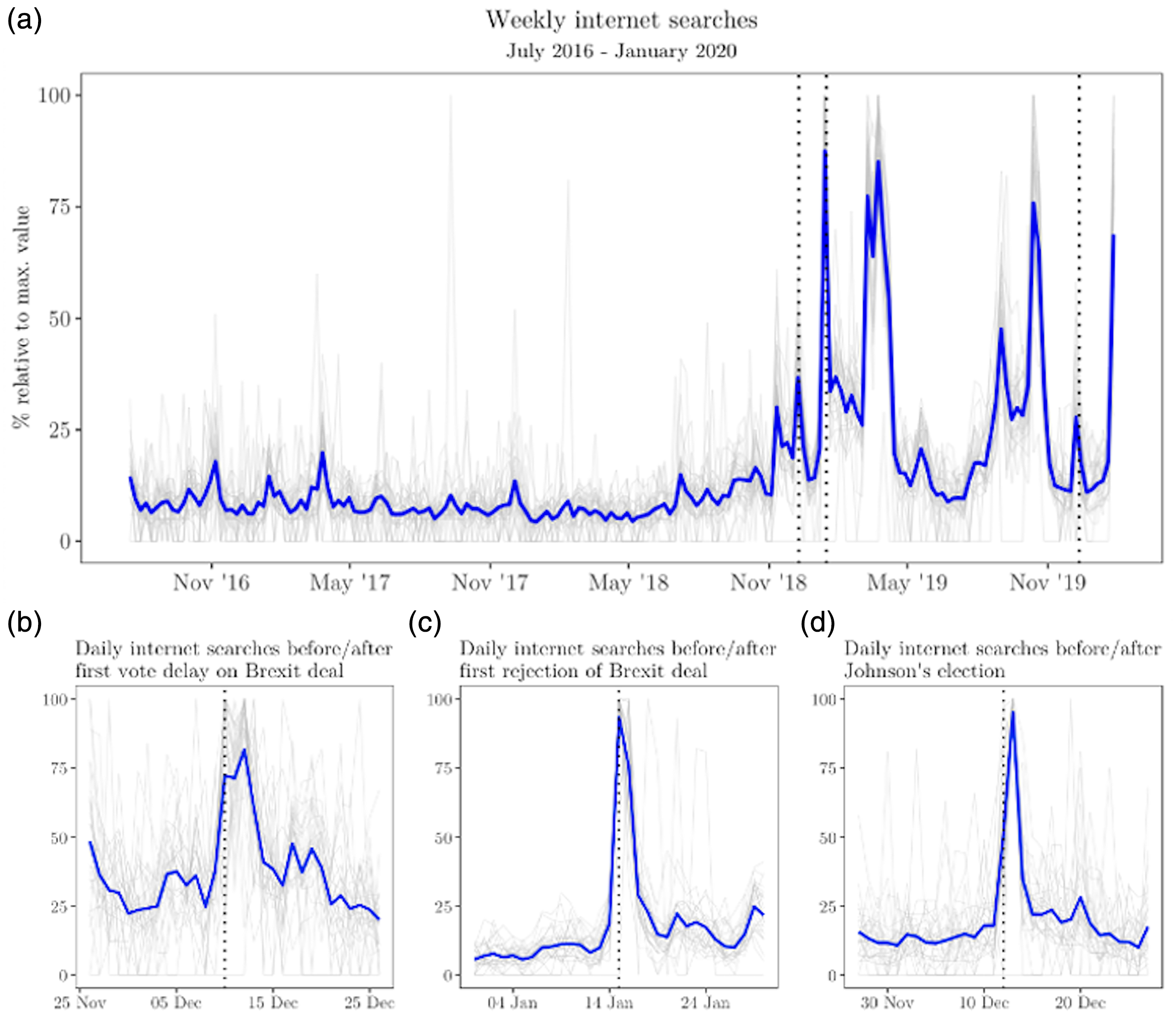
Internet searches for ‘Brexit' in EU member states.
To study the effect of these ups and downs of British Brexit politics on EU citizens’ attitudes about the EU, we exploit that three high-profile domestic political events in the Brexit process coincided with the fieldwork of public opinion surveys in certain EU-27 countries: (a) the fight within the Tory party that led to the postponement of the first parliamentary vote on the Brexit Deal and the challenge to Theresa May's leadership in December 2018; (b) the first parliamentary rejection of the Withdrawal Agreement in the following month; and (c) the national elections marked by the success of Boris Johnson in December 2019. For each of these events, the Google Trends analysis in Figure 1 shows a peak in interest, suggesting that they increased the salience of the Brexit debate in other European countries. 2 As Google Trends have been found to be a reliable source of issue salience (Mellon, 2014), this is a crucial piece of evidence that the Brexit events we study generated public interest in the rest of Europe. This also chimes in with earlier research that documents a considerable level of understanding of Brexit among citizens of other European countries (De Vries, 2017; Walter, 2021b; Malet and Walter, 2023). 3
Important for our analysis is that the first two of these events highlighted the domestic political conflicts and problems caused by the Brexit process, whereas Boris Johnson's election victory demonstrated that a policy project like Brexit can also generate domestic political gains. The negative and positive connotations of these events are corroborated by a text analysis of four newspapers in one remaining member state: Germany (Bild, Die Welt, Süddeutsche Zeitung, and Handelsblatt, see Online appendix). The sentiment analysis we perform on a subset of titles and leads containing the word Brexit shows that the struggles of May's government were reported with clear negative words, while Johnson's electoral success was positively reported. The co-occurrence of survey fieldwork with these events allows us to estimate how the positive and negative signals about the domestic political consequences of Brexit associated with these events affected EU-related attitudes in the remaining member states. Our argument suggests that the two events that highlighted the difficulties of the British government in implementing Brexit should have increased support for European integration in remaining member states. Conversely, we expect that Johnson's election win sent a positive signal about the feasibility and desirability of Brexit, thus resulting in a negative impact on EU attitudes of voters in other member states.
Our analysis proceeds in four steps. We first present two sets of analyses that examine the effect of negative (Analysis 1) and positive (Analysis 2) Brexit events on public opinion in the EU-27. We then delve more deeply into exploring the mechanism and explore the role of over-time learning and its heterogenous effects (Analysis 3) and information availability (Analysis 4). Although these analyses do not allow us to differentiate in detail between the multiple channels through which positive and negative signals foster attitude change, they allow us to demonstrate how foreign political events can contribute to an updating of domestic voter preferences.
Analysis 1: British Brexit struggles as negative signals
In a first analysis, we examine the effect of two Brexit-related episodes that highlighted the difficulties associated with Brexit on support for the EU in several EU-27 countries. These episodes were domestic political events and did not have an immediate major effect on EU-UK relations or the Brexit negotiations, but were covered intensely in the European media. The first event occurred when the British Prime Minister, Theresa May, postponed the first vote in the House of Commons on the Brexit Withdrawal Agreement negotiated by her government because she was faced with the prospect of a defeat after massive opposition within her own party (10 December 2008). Three days later, May survived a no confidence vote in her leadership of the Tory Party, but was forced to promise to step down before the next election. The second episode happened one month later, on 15 January 2019, when the House of Commons indeed rejected the Withdrawal Agreement with 432 votes against the Agreement and only 202 in favor (the largest defeat for a government motion in UK's history since the introduction of universal suffrage). The same day, May survived another vote of no confidence in her party leadership. As we show in the Online appendix, the two events we study were widely covered by the media in other European countries.
We exploit the fact that both of these events happened during the fieldwork of the European Social Survey (ESS). Our strategy relies on the quasi-random nature of the events relative to the timing of interviews in the ESS. Hence, our assumption is that the Brexit negotiations did not interfere with the implementation of the survey (Muñoz et al., 2020). The two events occurred during the survey fieldwork of 14 EU member states. 4
Following previous studies that use an ‘unexpected event during survey' design (Giani and Méon, 2019; Depetris-Chauvin et al., 2020), we base our main analysis on an interval of plus or minus 15 days before and after each of the two episodes: the 10 December 2018 challenge to May's leadership, and the 15 January 2019 rejection of the agreement. This bandwidth mitigates the risk that other events confound the estimation of the impact of Brexit events on public attitudes. At the same time, it allows us to retain a large enough number of observations, given that the ESS is based on face-to-face interviews that require long fieldwork periods. In the Online appendix, however, we replicate the analyses with different bandwidths. Balance tests for several respondent characteristics that may potentially correlate with the timing of the interview and the outcomes of interest—such as gender, education, age, unemployment status in the previous 12 months, the type of community where respondents live, and whether they voted in the previous national elections—show that differences between the sample of respondents interviewed before and after the two events are relatively small (see Online appendix). We additionally use a popular matching technique, entropy balancing (Hainmueller, 2012), to adjust inequalities in the distributions of the pre-treatment covariates mentioned above.
The domestic political events discussed above are inherently linked to the UK's policy decision to leave the EU and thus allow respondents in other European countries to benchmark their assessment of a similar policy for their own countries. Our outcome of interest is respondents’ support for European integration. The question asks: ‘Now thinking about the European Union, some say European unification should go further. Others say it has already gone too far. Using this card, what number on the scale best describes your position?’. The card displays an 11-point scale from zero (‘Unification has already gone too far') to 10 (‘Unification should go further'). A second set of analyses uses a second question that asks respondents about their support for a policy similar to Brexit for their own country: ‘Imagine there were a referendum in [your country] tomorrow about membership of the European Union. Would you vote for [your country] to remain a member of the European Union or to leave the European Union?'. Possible answers beyond ‘leave' and ‘remain' include ‘submit a blank ballot', ‘spoil the ballot paper', ‘would not vote', and ‘don’t know'. We regroup all these answers into one category and analyze this question with a multinomial logit model where the absence of a clear opinion on EU membership is the reference category.
Results
How did British domestic political events that showcased the difficulties and political problems associated with the Brexit process affect respondents’ support for the EU? To answer this question, we compare respondents interviewed in the two weeks after each event with respondents interviewed in the two weeks before. Results in Table 1 show that the Brexit-related domestic troubles of the British government reverberated in other EU member states and affected respondents’ attitudes about the EU. Both episodes under study have a small but statistically significant positive effect on peoples’ support for European integration: people interviewed in the aftermath of the first postponement of the parliamentary vote on the Brexit Deal were around two percentage points more likely to think that European integration should be pushed further. We detect a similar effect for people interviewed after the first rejection of May's Withdrawal Agreement in January 2019. These effects represent 7 to 8% of a standard deviation. While substantively small, this effect size is in line with other studies that have looked at the effect of political events on support for the EU and find effect sizes between 1.9 and 3% (Semetko et al., 2003; Minkus et al., 2018; Walter, 2021a; Malet, 2022). Given that for some people these events might have not been unexpected so that some observers might have already internalized their outcome in advance, these estimates are likely to represent a lower bound of the actual effect of cross-national learning. This lower bound represents the updating of attitudes among those people who were not following the Brexit saga before, and who learned about it thanks to the increased salience provided by the relevant political events. Moreover, these events are also likely to have had a cumulative effect on people's support for European integration.
The effect of Brexit-related domestic political struggles in the UK on support for European integration.
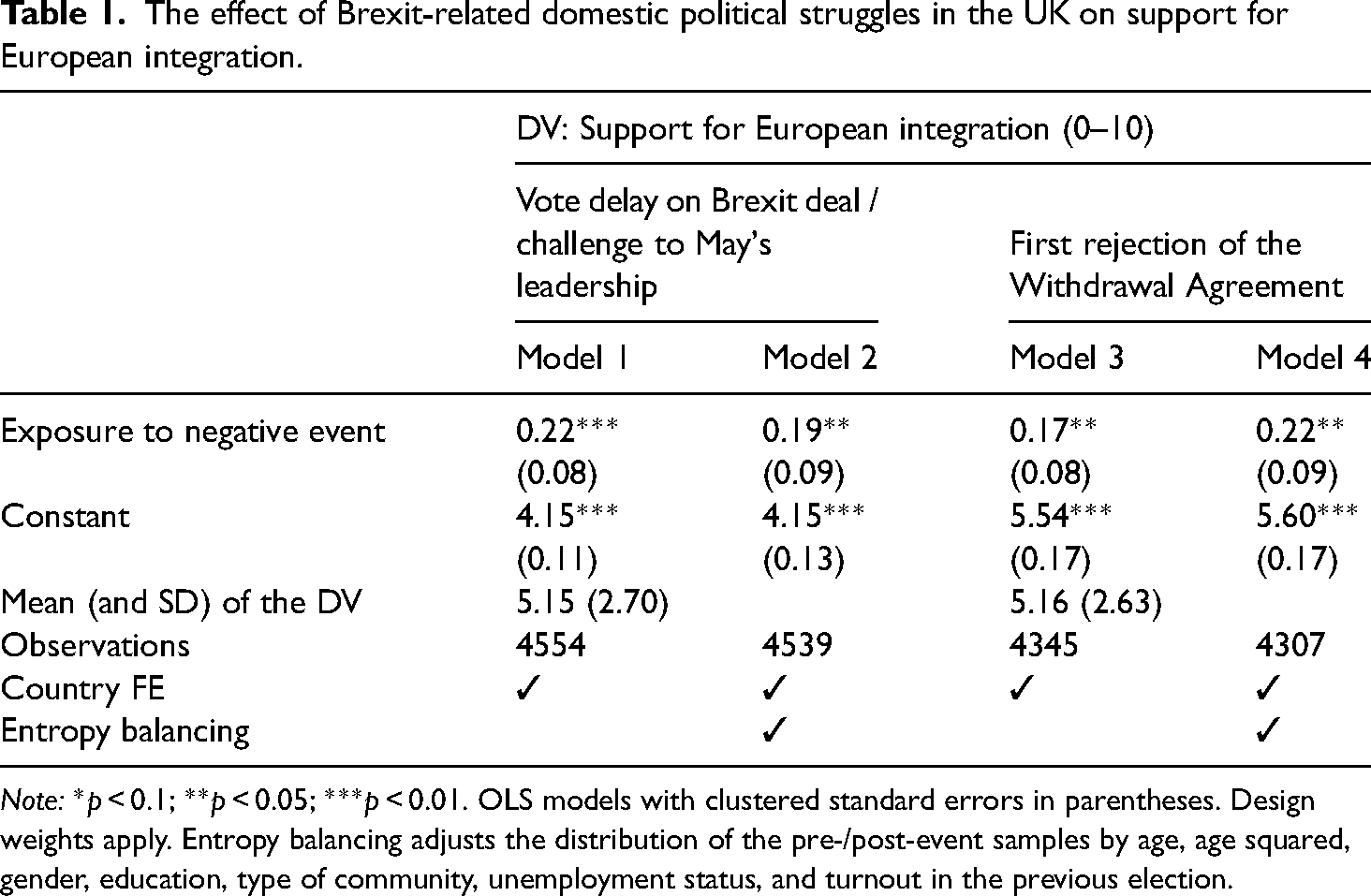
Note: *p < 0.1; **p < 0.05; ***p < 0.01. OLS models with clustered standard errors in parentheses. Design weights apply. Entropy balancing adjusts the distribution of the pre-/post-event samples by age, age squared, gender, education, type of community, unemployment status, and turnout in the previous election.
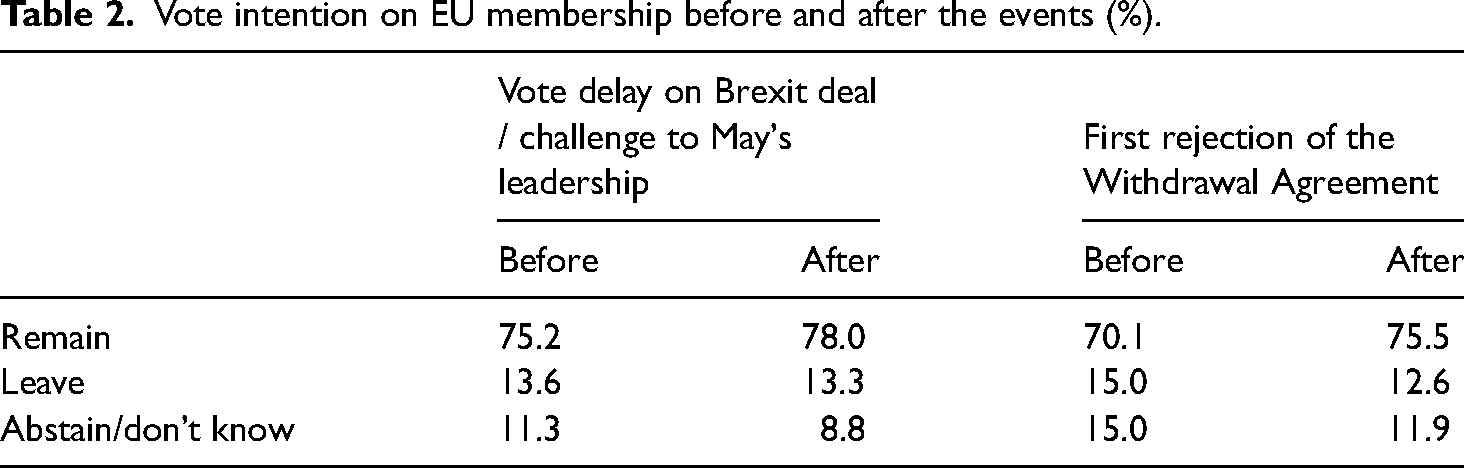
We can further explore the effect of the exposure to the two negative signals using a different dependent variable: people's vote intentions in a hypothetical referendum on their country's EU membership. Table 2 shows that both events increased the share of people willing to vote for remaining in the EU: plus 2.8% after the vote delay on the Brexit Deal, and plus 5.4% after the first rejection of the Withdrawal Agreement. When we model those vote intentions with a multinomial logistic regression (Table 3), this result is confirmed, although the increase in support for Remain is statistically significant only for the first event (the challenge to May's leadership, Models 1 to 2), but not for the rejection of the Withdrawal Agreement (Models 3 to 4). Models 1 and 2 can also tell us something about the type of attitude change that the first vote delay on the Brexit deal generated, as the increase in the probability to vote in favor of remaining an EU member does not come at the expense of the probability of voting ‘leave'. Instead, after the event, it is the probability to abstain, spoil the ballot, or answering ‘don’t know' that decreases. These results tentatively suggest that negative events increased support for European integration among people without strong preferences. We further explore the heterogeneity of the effect with individual panel data below in Analysis 3. 5
Vote intention on EU membership before and after the events (%).
The effect of Brexit-related domestic political struggles in the UK on support for EU membership (multinomial logit).
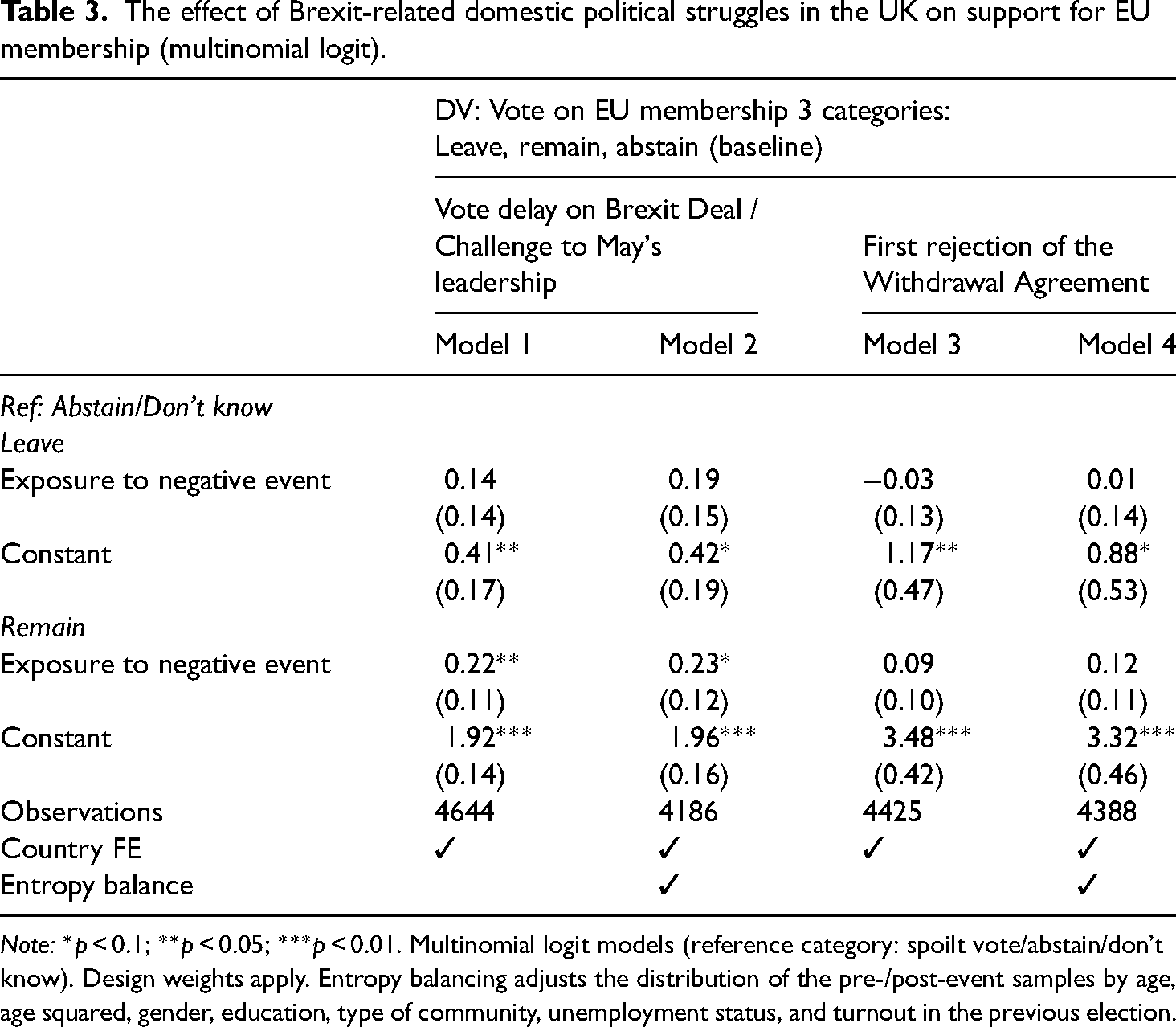
Note: *p < 0.1; **p < 0.05; ***p < 0.01. Multinomial logit models (reference category: spoilt vote/abstain/don’t know). Design weights apply. Entropy balancing adjusts the distribution of the pre-/post-event samples by age, age squared, gender, education, type of community, unemployment status, and turnout in the previous election.
Our analysis rests on the assumption that the timing of the survey interview does not affect the outcome through any other channel except for the event of interest (excludability). In the Online appendix, we present some falsification tests to corroborate this assumption. First, we replicate the analyses by varying the bandwidth around the cutoff date. Interestingly, when we analyze people interviewed only within one week before and after both events – thus further limiting the possibility that other events or unobserved confounders may lie behind our findings – we actually detect a stronger effect. When we expand the bandwidth to three and four weeks, we find a slightly smaller and (partially) non-significant effect. Second, we show that the events we study have no effect on other placebo outcomes, such as satisfaction with the economy, left-right placement, and immigration attitudes. These results lend support to our identification strategy as they show that the timing of the survey interview does not affect the outcome through other channels, such as simultaneous events or unrelated time trends. At the same time, this design limits our ability to learn about the individual-level causal mechanism. This is why in Analysis 3 we turn to the analysis of panel data.
Analysis 2: Johnson's electoral success as a positive signal
In a second analysis, we study the effect of the electoral victory of the Conservative Party in December 2019. As the 2017 election had resulted in a minority government, after the replacement of Theresa May, the new Prime Minister Boris Johnson called a snap election to increase the parliamentary support for his Brexit strategy. The campaign mainly centered around the new Withdrawal Agreement he had negotiated with the EU, and for which he was now asking the British electorate for a parliamentary majority. We leverage the fact that the election results came out during the fieldwork of the Eurobarometer survey 92.4. The British elections took place on 12 December, exactly in the middle of the fieldwork that lasted from 6 December to 19 December. The analysis of the Eurobarometer thus covers all 27 EU member states.
Although the Eurobarometer 92.4 was devoted to investigate environmental concerns, the questionnaire also asks a couple of questions about the EU. The first question asks respondents to rank their perception of the EU from one (a very negative image) to five (a very positive image). The second question asks: “At the present time, would you say that, in general, things are going in the right direction or in the wrong direction, in the European Union?” This question follows an identically worded question that asks about how things are going at the national level. We can thus compare answers to these two questions. We dichotomize the answers so that a value of one means that things are going in the right direction, and zero otherwise. Results are robust to estimating an ordinal logistic regression in which “neither of the two” answers is coded as a middle option (see Supplemental material).
Results
The results presented in Table 4 show no significant effects of Johnson's victory on people's perceived image of the EU. However, people were 2% less likely to say that things were going in the right direction in the EU after the British elections. The effect size is again around two percentage points (4% of a standard deviation), similar to the effect sizes found in Table 1 and in previous studies (Semetko et al., 2003; Minkus et al., 2018; Walter, 2021a; Malet, 2022). No effect is found on people's rating of the current direction of their own country.
The effect of Johnson's victory on people's perceived EU image and evaluations of the EU's current direction.
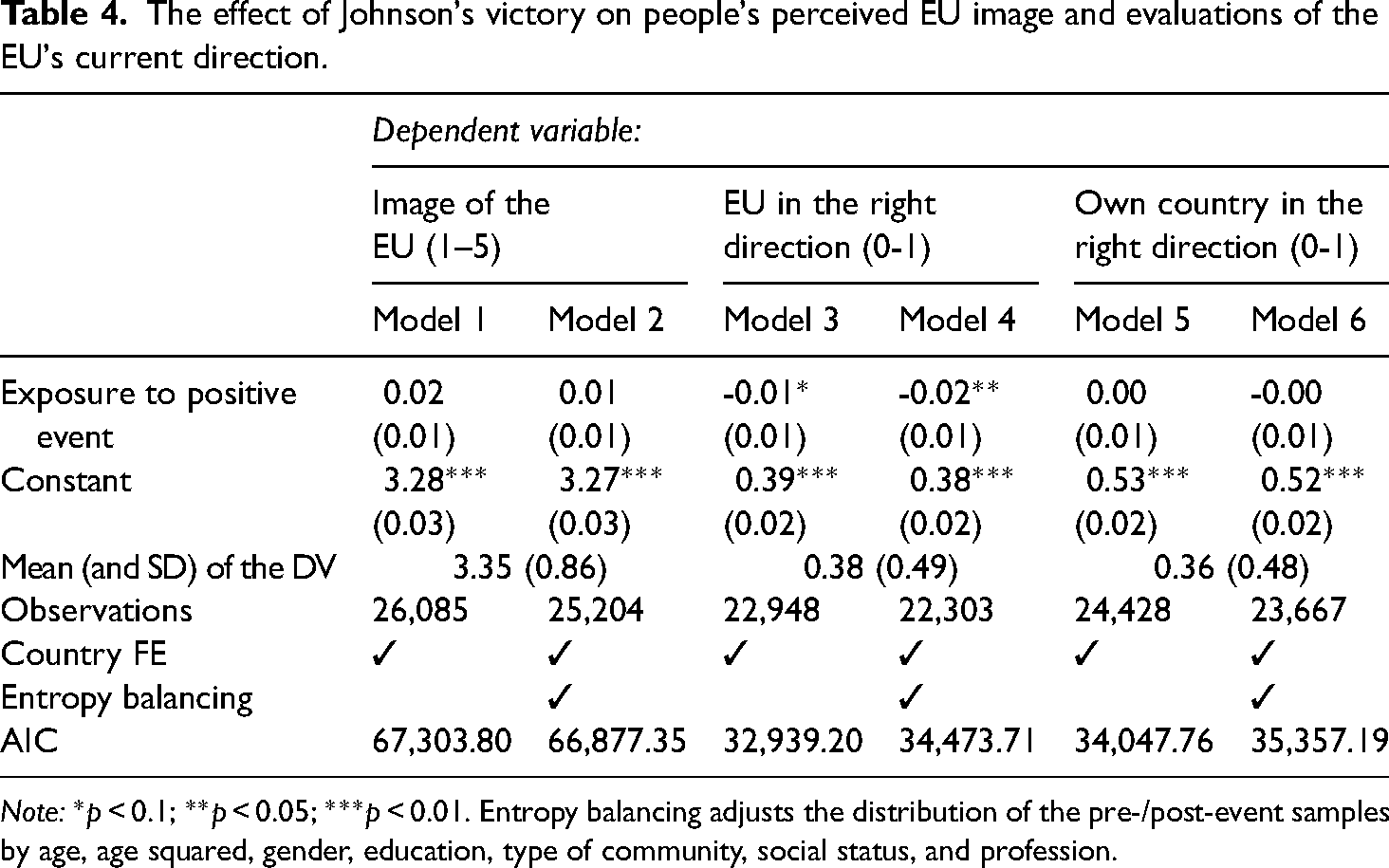
Note: *p < 0.1; **p < 0.05; ***p < 0.01. Entropy balancing adjusts the distribution of the pre-/post-event samples by age, age squared, gender, education, type of community, social status, and profession.
Although the limited availability of relevant survey questions does not allow us to test the exact channel through which Johnson's victory affected public opinion, these results nonetheless provide clear evidence that the reverberations of British Brexit politics were not limited to a deterrence effect. Instead, and in line with previous experimental evidence (Hobolt et al., 2022), these findings show how the potential encouragement effect of positive Brexit signals can negatively affect people's current evaluations of the EU abroad. As discussed above, several channels are likely to have contributed to this effect. Encouragement may, for example, be due to (a) increased acceptability of Eurosceptic ideas that Johnson's election victory legitimized; (b) the increase in the perceived feasibility of an EU exit that a strong popular mandate for his Brexit plan signaled in remaining member states; or (c) the positive political consequences of EU exit for political parties championing such a policy. These different channels generated an encouragement effect, which contributed to more critical attitudes about the EU among respondents outside of the UK.
Analysis 3: probing the cross-national learning mechanism
Our analyses so far have allowed us to demonstrate that foreign political events can lead to changes in domestic attitudes on related issues. Because the cross-sectional nature of these analyses does not allow for an analysis of intra-individual learning processes, we analyze panel data to probe the interpretation of attitude change as results of cross-national learning. For this purpose, we use the German Longitudinal Election Study, a panel survey where the same respondents are interviewed across multiple waves. Two waves of this panel survey were conveniently fielded in November 2018 (wave 10, between 6 and 21 November) and in May and June 2019 (wave 11, between 28 May and 12 June 2019), before and after a particularly difficult period of the Brexit negotiations, which was marked by a heightened attention to Brexit (see Figure 1). A sentiment analysis of German newspapers (see Online appendix) shows that reporting on the events unfolding over this period was very negative. Thanks to individual fixed effects models, this allows us to explore whether, and how, EU attitudes of the 9522 respondents changed over this period (while also controlling for other time-varying variables).
The question we analyze asks: ‘Should European unification be pushed further in order to establish a joint government soon or has the European unification already gone too far?'. Answers range from one to seven and were rescaled from zero to one. We analyze the effect of being interviewed in wave 11, while controlling for some important time-varying variables: vote intention, trust in government, political interest, ideology, and personal economic evaluations. Respondents were also asked whether they agreed or disagreed with the following statement: ‘It is good that Great Britain is leaving the European Union'. Although the formulation is rather vague and unfortunately was only asked in wave 11, we can interact the wave dummy with this variable to test whether the change in EU attitudes differs among people with diverging opinions on Brexit. Finally, we present additional interaction effects by factual political knowledge and previous EU attitudes.
Results
Table 5 reports the results of individual fixed effects models that allow us to analyze changes in respondents’ EU attitudes over a six-months period that highlighted the difficulties of Brexit. We report both the model without controls (Model 1) and the one that controls for other time-varying variables (see Model 2). Like in Analysis 1, we find a deterrence effect: over the course of this particularly difficult period in the Brexit negotiations, German citizens became on average 4% more supportive of European integration. Model 3 shows that this effect is driven by those respondents who had a negative opinion of Brexit by May or June 2019, suggesting that the more positive EU attitudes are related to a deterrence effect of Brexit. Interestingly, people who still had a positive opinion of Brexit at the end of this period did not change their evaluation of the EU. This shows that political events abroad do not lead to an updating of attitudes across the board, but can be concentrated in certain groups of voters.
Change in support for European integration between November 2018 and May/June 2019: German longitudinal election study.
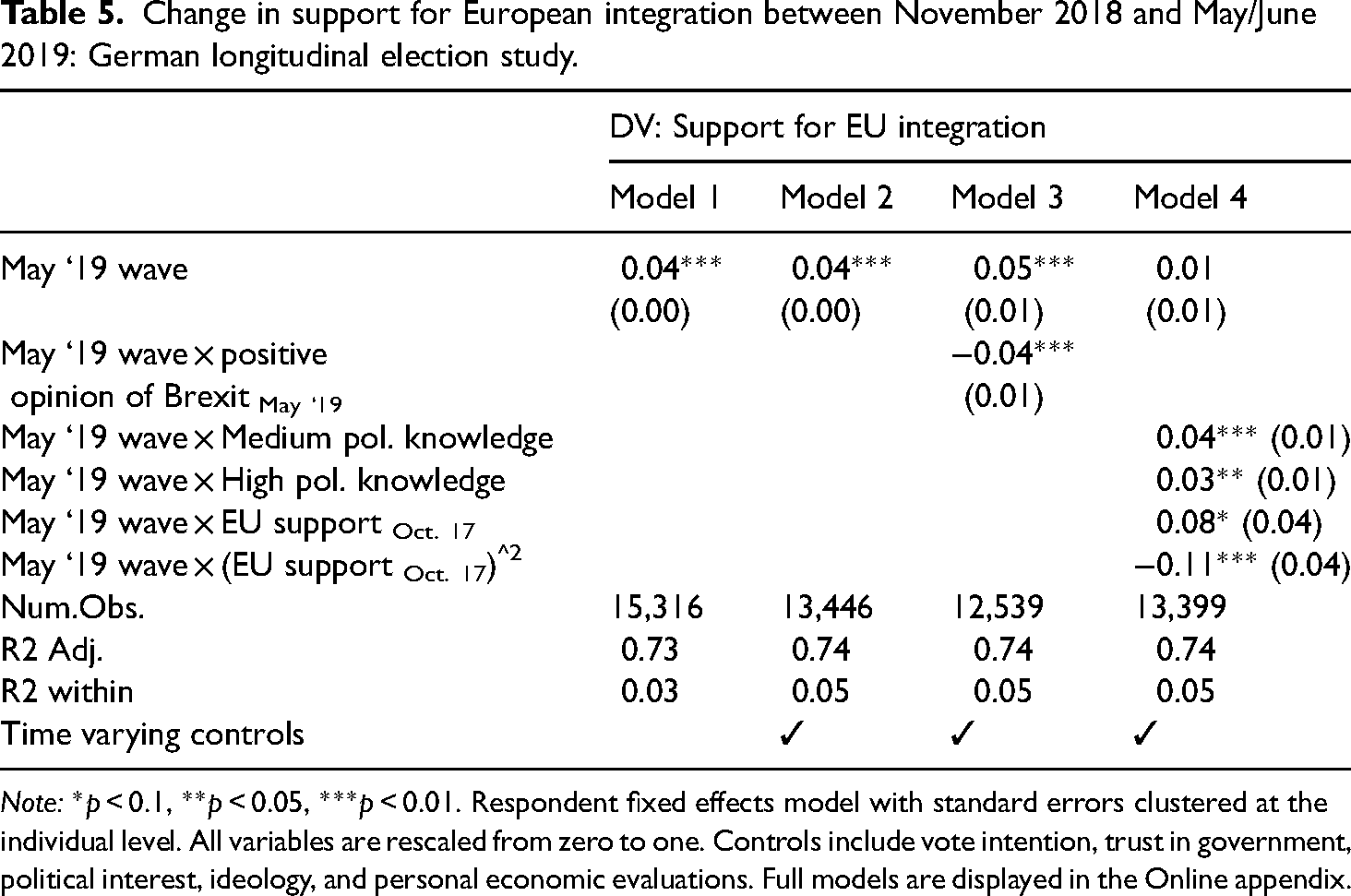
Note: *p < 0.1, **p < 0.05, ***p < 0.01. Respondent fixed effects model with standard errors clustered at the individual level. All variables are rescaled from zero to one. Controls include vote intention, trust in government, political interest, ideology, and personal economic evaluations. Full models are displayed in the Online appendix.
The panel data also allows us to evaluate the argument that an updating of attitudes is most likely to occur among people who have enough political awareness and interest to understand and process new information but not too much for being committed to their own opinions (Zaller, 1992). In line with this argument, Model 4 shows that the increase in support for European integration was the highest among people with a medium level of political knowledge. We also find that people with extreme previous EU attitudes were much less likely to change their opinion than those with less entrenched attitudes, in line with theories of motivated reasoning (Taber and Lodge, 2006). Altogether, these findings suggest that the reverberations of British Brexit politics abroad that we have documented in the aggregate are at least partly driven by cross-national learning.
Analysis 4: testing the informational mechanism
In a fourth and final analysis, we investigate the role of the media in conveying information about foreign domestic politics in more detail, and its effect on people's ability to use this information as a benchmark for their EU support. For this purpose, we exploit the fact that we had an original public opinion survey in the field just after Theresa May postponed the vote on the Withdrawal Agreement and promised to step down before the following elections (10 to 13 December 2018). The survey was part of a tracking survey which surveyed respondents in all EU-27 countries on Brexit- and EU-related issues in six-months intervals throughout the Brexit withdrawal negotiations (July 2017 to December 2019; for details, see Walter, 2021a). The December 2018 wave was fielded between 14 and 21 December 2018, and thus right after Theresa May's difficulties.
We use a difference-in-differences design, which analyzes changes in Brexit evaluations and support for a German EU exit between the preceding wave, whose fieldwork was carried out from 22 June to 2 July, and the December 2018 survey wave. We compare German respondents who were exposed to more Brexit-related information about this difficult phase in the Brexit negotiations, to those who were exposed to less media coverage of Brexit. For this purpose, our design leverages that Theresa May's Brexit-related difficulties in December 2019 happened at the same time as the final round of the group stage of the two main Europe-wide football championships (11 to 13 December 2018). Focusing on Germany, where support for football teams has a clear regional pattern, we assume that the media coverage of other countries’ political struggles was lower in regions (in our case Länder) where the local team played a match in the Champions League or the Europa League, as soccer coverage tends to dominate the news during these periods. 6
Figure 2 corroborates this assumption of our research design. It shows the coverage of Brexit – defined as any article mentioning the word Brexit – for all the 36 German local newspaper archived in the database of Factiva in a period between 10 days before and 10 days after the period we study. 7
The data presented in Figure 2 show that the UK's Brexit-related political struggles in mid-December 2019 is reflected in a high media coverage of Brexit. At the same time, we see that Brexit-related coverage is lower in outlets from Länder where the local team was playing a European or Champions League game than in local newspapers from Länder where no soccer team had qualified. More detailed analyses presented in the Online appendix show that newspapers in Länder with no competing soccer teams were 37% more likely to report on Brexit and published on average one additional article compared to the 10 days before and after the Brexit events. While local newspapers in Länder with teams playing in the Championships were also more likely to report on Brexit, this coverage only increased by 25%, with on average of 0.7 articles more than usual published during this period. We do not find a statistically significant effect in the length of the articles mentioning Brexit. Similar to Eisensee and Strömberg (2007), who show that countries that experience a natural disaster during the Olympic games receive less attention and thus less financial support, we use this setup to argue that respondents with local soccer teams in the championships received less information about Brexit. As a result, this quasi-random variation in news coverage of the Brexit difficulties in the German media allows us to study how information about Brexit-related events in the UK affected support for a similar policy – EU exit – in Germany. 8
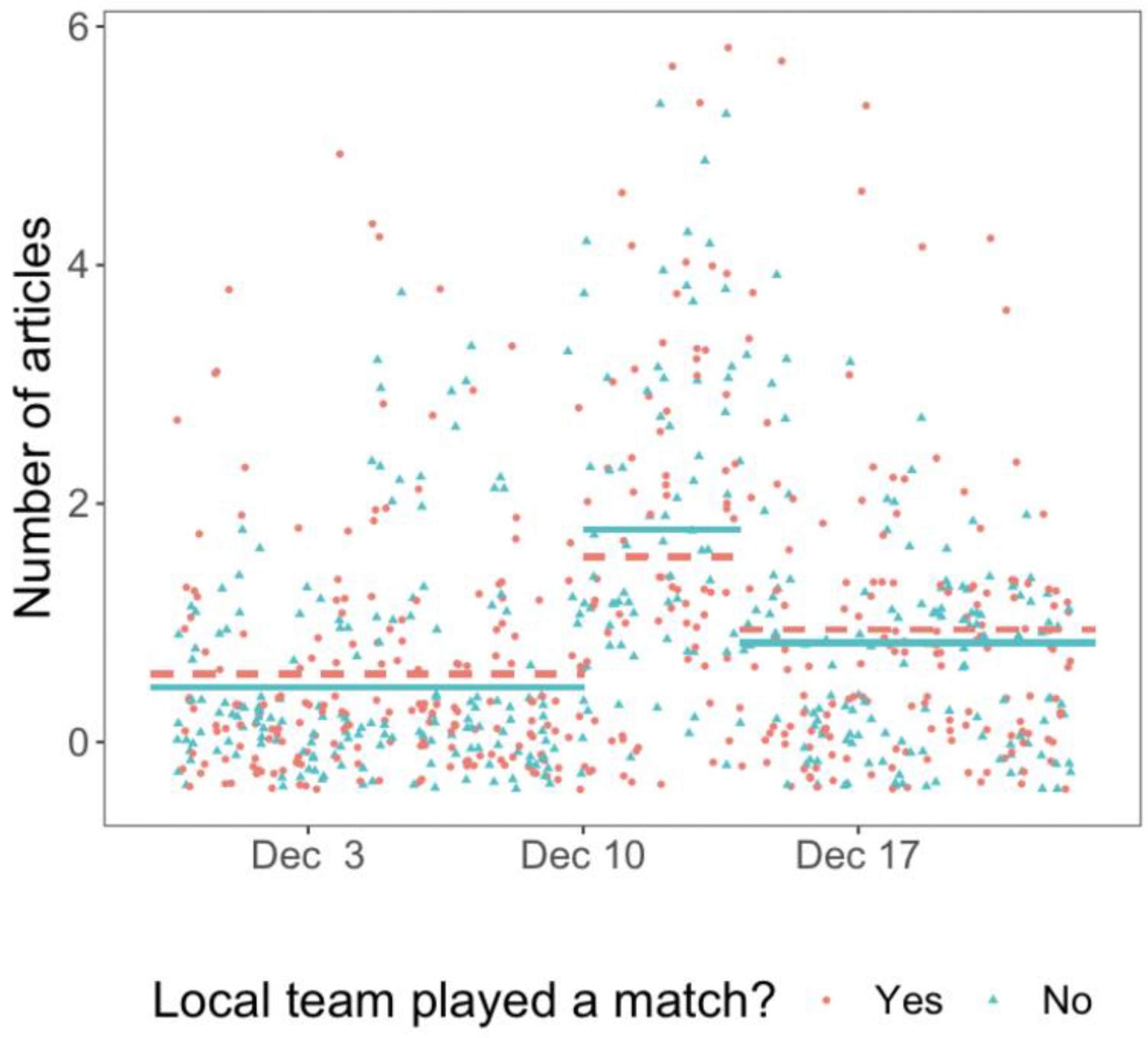
Coverage of Brexit in local German newspapers.
Two outcomes are of interest. First, we analyze respondents’ evaluation of the effect of Brexit on the UK. The question asks: ‘Five years from now on, do you think Brexit will make the UK much better off, somewhat better off, neither better nor worse off, somewhat worse off, or much worse off?'. Responses are marked on a 5-point scale ranging from one (‘much worse off') to five (‘much better off'). Second, we analyze respondents’ support for their own country's exit from the EU. The question asks: ‘If Germany were to hold a referendum on leaving the EU today, how would you vote?'. Respondents could choose four options from one (‘I would definitely vote to remain the EU') to four (‘I would definitely vote to leave the EU').
We use the participation of the local team in one of the two football competitions as a random source of regional variation in exposure to Brexit-related information and investigate the effect of exposure to Brexit-related news in a difference-in-differences setting by comparing respondents’ answers in the July 2018 and December 2018 survey waves. We construct a binary treatment indicator called Higher Exposure (no game), that measures whether (one of) the local football teams played in the Champions League or Europa League's group stage. This variable takes the value of zero for all Länder in the July wave. In the December wave, it takes the value of zero if the local team played in a match, meaning that media coverage was pre-occupied with soccer-related news, and one if the local team did not play, leaving more space for coverage of the UK's internal Brexit struggles. This operationalization of the treatment variable, along the inclusion of wave and region fixed effects, exclude the need of an interaction term. In addition, we include a number of pre-treatment covariates (gender, age, age squared, education, and whether the respondent lives in an urban or rural community). We estimate Ordinary Least Squares models both with and without covariates. The exact equation of the model is provided in the Online appendix. We expect evaluations of Brexit to become more negative between July and December for all respondents, but especially for those who were more exposed to negative information about Brexit because they live in Länder where media reporting was not preoccupied with reporting on the local soccer team. Accordingly, we also expect people in these Länder to become less supportive of a hypothetical German exit from the EU.
Results
In line with our expectations, the results in Table 6 show that respondents living in high exposure contexts (i.e. Länder whose local soccer team was not playing in the final round of the European championships) updated their attitudes three times more compared to people in contexts with low exposure to Brexit-related media coverage (i.e. Länder where the local team played in the European football Championships). In high-exposure contexts, where Theresa May's Brexit woes were broadly reported, voters evaluated the effects of Brexit on the UK more negatively and became less supportive of a German exit from the EU. The effect size is substantial. The decline in Brexit evaluations is equal to minus 0.14 for less exposed respondents and minus 0.34 for more exposed respondents. This means that people that received more information were 9% more likely to have negative evaluations of the effect of Brexit on the UK compared to people interviewed six months earlier in the same Länder. In contrast, the effect for respondents which were less exposed to new information is reduced to a three percentage point change. These results are in line with our argument that the British struggles over Brexit provided new information to people in other European countries about the political consequences of leaving the EU and that those who were more exposed to this information were more likely to update their evaluations of Brexit and their support for leaving the EU.
Difference-in-differences models: Germany.
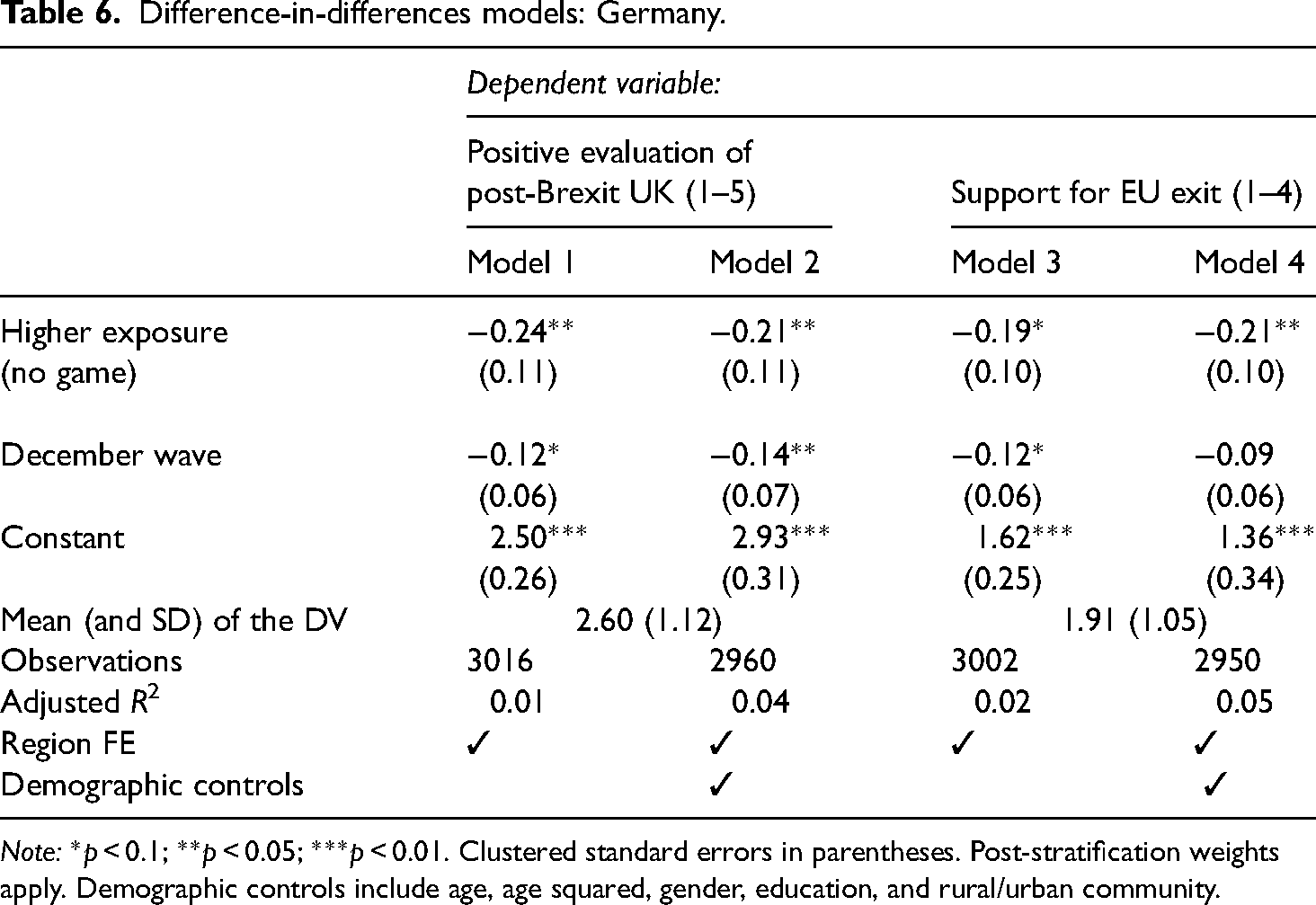
Note: *p < 0.1; **p < 0.05; ***p < 0.01. Clustered standard errors in parentheses. Post-stratification weights apply. Demographic controls include age, age squared, gender, education, and rural/urban community.
To check whether public opinion in Länder with and without a football team in one of the two European championships followed similar trends prior to the event, we plot the trends in Brexit evaluations and support for EU exit from July 2017 and December 2019 for the two groups of Länder in the Online appendix. This shows that there is no significant difference prior to the December 2018 wave. We also conduct a falsification test and estimate a placebo difference-in-differences regression with a similar specification for the previous waves of our survey. Moreover, we estimate the same models presented in Table 4 with two placebo outcomes such as respondents’ satisfaction with the position of the German government in the Brexit negotiations, and their evaluations of Brexit effects on Germany. There are no significant treatment effects on these two placebo outcomes. This lends support to our identification strategy, because it excludes the possibility that other unrelated events affected our outcome of interest.
In the Online appendix, we also explore the causal mechanism in a mediation analysis, because this allows us to test whether, and to what extent, the change in Brexit evaluations mediates the decline in support for exit produced by the higher exposure to Brexit-related information. The results demonstrate that a higher exposure to Brexit information has no significant direct effect on support for EU exit, while the average causal mediation effect is equal to minus 0.037. The decline in Brexit evaluations accounts for 53% of the total effect of higher exposure on decline in support for EU exit (see Online appendix for the results of a sensitivity analysis). This also means that other mechanisms are likely to be at play at the same time. Indeed, as discussed above, the effect of Brexit events on EU attitudes is likely to be caused by multiple channels, such as changes in media reporting or party discourse. The causal mediation analysis suggests, however, that some of the effect of political events on individual attitudes indeed works through individual-level effects: The results show that a higher exposure to negative information about Brexit worsened people's perceptions of the consequences of Brexit for the UK. The worsened expectations, in turn, reduced people's willingness to support a similar course of action in their country.
Conclusion
This paper analyzes whether, and how, political events abroad influence domestic policy attitudes. We argue that such cross-national reverberations are likely to occur for a number of reasons. For one, foreign political events provide voters with information about the likelihood of success and failure of a policy and the feasibility, political pitfalls, and opportunities associated with implementing this policy, especially for the leaders and parties most prominently involved in these events. Foreign political events can also signal the perceived appropriateness of certain policies and a shift in social norms. Finally, such events can influence the domestic media and elite discourse, which may change the tone and the frequency with which a certain policy is talked about domestically. As a result of these multiple channels, foreign political events can lead voters abroad to update their attitudes.
To test this argument, we study how British domestic politics during the Brexit negotiations reverberated on public opinion in remaining EU member countries in four different sets of analyses. The results show that events that signaled the difficulties of achieving the high hopes associated with Brexit – such as the first postponement of the parliamentary vote on the Withdrawal Agreement, and its first parliamentary rejection – increased public support for European integration abroad. In contrast, a positive event – Johnson's electoral success – made people's evaluations of the current direction of the EU more negative. A panel data analysis additionally demonstrates within-individual opinion change over a period in which negative Brexit-related events were particularly salient. Finally, a difference-in-differences design that exploits random variation in exposure to information among German voters shows that respondents who were more exposed to new Brexit-related information updated their attitudes much more strongly than respondents who were less exposed to this information. A mediation analysis additionally provides evidence for a learning effect. It shows that the downward shift in respondents’ support for a German withdrawal from the EU is driven to a significant degree by more negative views of the consequences of Brexit for the UK that respondents developed when the difficulties of the Brexit approval process became evident abroad.
These findings show that political events abroad can lead to changes in domestic policy attitudes. They also confirm previous arguments about both a deterrence and encouragement effect of Brexit (De Vries, 2017; Walter, 2021a; Hobolt et al., 2022; Malet and Walter, 2023). More generally, they also highlight the mechanisms of such effects, thus contributing to our understanding of the systemic reverberations of the backlash against international institutions. At the same time, the fact that voters are able to gather information about the domestic politics of foreign countries and apply it in their own political evaluations has important normative implications. On the one hand, cross-country comparisons may provide a corrective for people's status quo bias (Kahneman and Tversky, 1979) by reducing the uncertainty associated with alternative policy choices. On the other hand, the possibility to learn from other countries’ successes and failures could help voters to hold politicians accountable for policy pledges and outcomes. Foreign countries’ policy failures could warn voters and political elites against ill-conceived policies, while the success of a policy in another country could enable voters to distinguish potential flaws in their own country's policy design. More generally, our results suggest that events like Brexit can have systemic consequences.
Supplemental Material
sj-docx-1-eup-10.1177_14651165231207225 - Supplemental material for The reverberations of British Brexit politics abroad
Supplemental material, sj-docx-1-eup-10.1177_14651165231207225 for The reverberations of British Brexit politics abroad by Giorgio Malet and Stefanie Walter in European Union Politics
Supplemental Material
sj-r-2-eup-10.1177_14651165231207225 - Supplemental material for The reverberations of British Brexit politics abroad
Supplemental material, sj-r-2-eup-10.1177_14651165231207225 for The reverberations of British Brexit politics abroad by Giorgio Malet and Stefanie Walter in European Union Politics
Supplemental Material
sj-r-3-eup-10.1177_14651165231207225 - Supplemental material for The reverberations of British Brexit politics abroad
Supplemental material, sj-r-3-eup-10.1177_14651165231207225 for The reverberations of British Brexit politics abroad by Giorgio Malet and Stefanie Walter in European Union Politics
Supplemental Material
sj-r-4-eup-10.1177_14651165231207225 - Supplemental material for The reverberations of British Brexit politics abroad
Supplemental material, sj-r-4-eup-10.1177_14651165231207225 for The reverberations of British Brexit politics abroad by Giorgio Malet and Stefanie Walter in European Union Politics
Supplemental Material
sj-r-5-eup-10.1177_14651165231207225 - Supplemental material for The reverberations of British Brexit politics abroad
Supplemental material, sj-r-5-eup-10.1177_14651165231207225 for The reverberations of British Brexit politics abroad by Giorgio Malet and Stefanie Walter in European Union Politics
Supplemental Material
sj-r-6-eup-10.1177_14651165231207225 - Supplemental material for The reverberations of British Brexit politics abroad
Supplemental material, sj-r-6-eup-10.1177_14651165231207225 for The reverberations of British Brexit politics abroad by Giorgio Malet and Stefanie Walter in European Union Politics
Supplemental Material
sj-r-7-eup-10.1177_14651165231207225 - Supplemental material for The reverberations of British Brexit politics abroad
Supplemental material, sj-r-7-eup-10.1177_14651165231207225 for The reverberations of British Brexit politics abroad by Giorgio Malet and Stefanie Walter in European Union Politics
Supplemental Material
sj-rds-8-eup-10.1177_14651165231207225 - Supplemental material for The reverberations of British Brexit politics abroad
Supplemental material, sj-rds-8-eup-10.1177_14651165231207225 for The reverberations of British Brexit politics abroad by Giorgio Malet and Stefanie Walter in European Union Politics
Supplemental Material
sj-rds-9-eup-10.1177_14651165231207225 - Supplemental material for The reverberations of British Brexit politics abroad
Supplemental material, sj-rds-9-eup-10.1177_14651165231207225 for The reverberations of British Brexit politics abroad by Giorgio Malet and Stefanie Walter in European Union Politics
Supplemental Material
sj-rds-10-eup-10.1177_14651165231207225 - Supplemental material for The reverberations of British Brexit politics abroad
Supplemental material, sj-rds-10-eup-10.1177_14651165231207225 for The reverberations of British Brexit politics abroad by Giorgio Malet and Stefanie Walter in European Union Politics
Supplemental Material
sj-rds-11-eup-10.1177_14651165231207225 - Supplemental material for The reverberations of British Brexit politics abroad
Supplemental material, sj-rds-11-eup-10.1177_14651165231207225 for The reverberations of British Brexit politics abroad by Giorgio Malet and Stefanie Walter in European Union Politics
Supplemental Material
sj-rds-12-eup-10.1177_14651165231207225 - Supplemental material for The reverberations of British Brexit politics abroad
Supplemental material, sj-rds-12-eup-10.1177_14651165231207225 for The reverberations of British Brexit politics abroad by Giorgio Malet and Stefanie Walter in European Union Politics
Footnotes
Acknowledgements
Previous versions of the paper were presented at SVPW 2021, EPSA 2021, SISP 2021, at the University of Konstanz, and at the workshop “International Institutions: Backlash and Resilience.” We would like to thank conference participants as well as Tanja Börzel, Edoardo Bressanelli, Sara Hobolt, Max Joosten, Friederike Kelle, Marco Martini, Cassilde Schwartz, Jonas Tallberg, Dustin Tingley, and Christopher Wratil for very helpful comments and Nemo Krüger, Stefanie Matter, and Lukas Stiefel for excellent research assistance.
Author contributions
The authors contributed equally to the article.
Funding
The authors disclosed receipt of the following financial support for the research, authorship, and/or publication of this article: This work was supported by the H2020 European Research Council, Universität Zürich, (grant number Consolidator Grant 817582, Stiftung Wissenschaftliche Forschung STWF-18-024).

Supplemental material
Supplemental material for this article is available online.
Notes
References
Supplementary Material
Please find the following supplemental material available below.
For Open Access articles published under a Creative Commons License, all supplemental material carries the same license as the article it is associated with.
For non-Open Access articles published, all supplemental material carries a non-exclusive license, and permission requests for re-use of supplemental material or any part of supplemental material shall be sent directly to the copyright owner as specified in the copyright notice associated with the article.
