



Abstract
What are the effects on public support for the European Union (EU) when a member state exits? We examine this question in the context of Britain's momentous decision to leave the EU. Combining analyses of the European Election Study 2019 and a unique survey-embedded experiment conducted in all member states, we analyse the effect of Brexit on support for membership among citizens in the EU-27. The experimental evidence shows that while information about the negative economic consequences of Brexit had no significant effect, positive information about Britain's sovereignty significantly increased optimism about leaving the EU. Our findings suggest that Brexit acts as a benchmark for citizens’ evaluations of EU membership across EU-27, and that it may not continue to act as a deterrent in the future.
Introduction
The European Union (EU) has been faced with several crises over the past decades, including the Euro crisis, the refugee crisis and the coronavirus disease 2019 (COVID-19) pandemic. While most of these crises were in some way caused by external developments, one was internal, namely Brexit. The United Kingdom's (UK) 2016 referendum decision to leave the EU was unprecedented. But while the UK is the first member state to leave the EU, this decision can also be seen in the broader context of a growing politicization of the EU and its institutions across its member states (De Vries, 2018; De Vries et al., 2021; Hobolt and De Vries, 2016; Hooghe and Marks, 2009; Hutter et al., 2016; Van der Brug et al., 2022). Indeed, the result of the Brexit referendum initially lead Eurosceptic parties in other European nations to call for their own membership referendums. Among supporters of the EU, this sparked fears of political contagion across Europe. This raises the question: What is the effect of Brexit on public support for the EU in other member states?
We examine this question in the context of Britain's prolonged process of leaving the EU and negotiating a new relationship with the EU. Has Brexit inspired followers elsewhere on the continent or does it act as a deterrent? This question is relevant not only to understand the short-term effect of Brexit, but also because Brexit marks a critical juncture for Britain and for the remaining member states. What are the consequences for the EU, that is used to countries queuing up to join the club, when one of its largest members decides to leave? This article argues that a member state leaving the EU is a significant ‘benchmark’ heuristic that shapes the evaluations of membership in the remaining member states. Building on benchmarking theory, we argue that citizens compare the benefits of membership to the alternative state of being outside the Union (De Vries 2018; see also Hobolt, 2009; Kayser and Peress 2012; Hobolt and De Vries, 2016; De Vries 2017). Such comparisons may involve not only an assessment of the quality of national institutions, but also across nations as they assess the potential costs and potential benefits of exiting the Union.
Hence, our argument is that Brexit acts as a benchmark for citizens evaluating the prospects for their own nation outside the EU, and in turn their support for membership. When the consequences of Brexit are viewed negatively, support for the EU goes up, but when Brexit is viewed as a success, support decreases. During the prolonged Brexit negotiations between the UK and the EU, the Brexit benchmark heuristic was mainly one of deterrence, since they clearly illustrated that leaving the EU is far from uncomplicated (Walter, 2020). However, as with any benchmark, this can change if Brexit is seen to have a more positive effect. Thus, we argue that the effect of one member state's exit is conditioned by perceptions of how well or how badly an ‘emeritus’ member state is faring outside the EU.
To test this argument empirically, we combine observational and experimental data. First, we analyse data from the European Election Study (EES) 2019, a post-election voter study conducted in all 28 member states (Schmitt et al., 2019), to demonstrate that citizens who believe that Britain will be worse off after Brexit are more likely to support the EU. The findings are consistent with the theory that the Brexit benchmark matters to membership support: people who think that Brexit will make Britain worse off are less attracted to the option of leaving the EU. However, it is difficult to establish the direction of causality with observational data. The direction of causality may also run the other way: people who are more supportive of the EU (and who don't want their country to leave the Union) will think that Brexit has negative consequences for Britain.
Hence, in a second step, our study leverages an original survey-embedded experiment in all member states, where we prime respondents with different ‘Brexit benchmarks’, which are randomly assigned in order to examine how priming respondents about the consequences of Brexit affects their views of their own country's EU membership. This allows us to test the mechanism that drives the Brexit effect by assessing whether individuals, when priming them with negative or positive benchmarks about Brexit, think differently about their own country's future outside the Union. The findings show that whereas the negative information has no consistent effect on perceptions of membership outside the EU, positive information increases people's optimism about their own country's future outside the EU. This indicates that while Brexit may currently serve as a deterrent, it has the potential to make an EU-exodus more appealing in the future if people think it has positive consequences.
Explaining support for EU membership
When seeking to understand how one country's exit may influence how citizens in the remaining member states view the EU, we can build on the large literature on EU support (see Hobolt and De Vries, 2016 for an overview). Within this body of research, the ‘utilitarian’ and the ‘cue-taking and benchmarking’ approaches are particularly instructive. 1 The utilitarian approach views support for the EU as the result of an individual cost-benefit analysis of membership. The basic idea is that European trade liberalization will favour citizens with higher levels of human capital (education and occupational skills) and income, and as a consequence such individuals will be more supportive of European integration (Anderson and Reichert, 1995; Gabel, 1998; Gabel and Palmer, 1995; Tucker et al., 2002). The removal of barriers to trade allows firms to shift production across borders and increases job insecurity for low-skilled workers whereas high-skilled workers and those with capital can take advantage of the opportunities resulting from a liberalized European market. Studies have consistently shown that socio-economic factors influence public support, and recent work even suggests that education has become a more important determinant of EU support over time, as the less educated are becoming less supportive of the integration project (see Hakhverdian et al., 2013). In contrast, evidence is more mixed when considering the effect of national-level factors, such as net fiscal transfers from the EU or improved trade and favourable economic conditions, on public support for membership (Anderson and Kaltenthaler, 1996; Carrubba, 1997; Eichenberg and Dalton, 1993).
This raises the question of how citizens form their opinion on whether EU membership is likely to be costly or beneficial, on balance. A large literature has argued that European integration is too complex and remote from the daily lives of most citizens for them to have sufficient interest or awareness to base their attitudes on an evaluation of the implications of the integration process (Anderson, 1998). Instead, citizens rely on heuristics, information shortcuts or cues to be able to overcome their shortfalls in terms of factual knowledge. Studies on political knowledge and behaviour have shown that citizens can make competent choices even with limited information by relying on informational heuristics (e.g. Bowler and Donovan, 1998; Lau and Redlawsk, 2001; Lupia, 1994). Such informational shortcuts may take various forms, but since citizens generally pay more attention to the national political arena than to European politics it seems reasonable that they employ domestic cues to form opinions about European integration. The notion of citizens relying on ‘national proxies” to make choices pertaining to the EU was first developed in the context of research on European elections and referendums (Franklin et al., 1994; Hobolt, 2009; Reif and Schmitt, 1980; Van der Brug and De Vreese, 2016) but has also been applied to the study of support for integration.
In particular, it has been argued that the domestic political institutions are a benchmark for people's views on European integration. In its simplest version, the argument is that as citizens lack sufficient knowledge about the EU, they evaluate the EU by using national proxies about which they have more direct information (Anderson, 1998; Kritzinger, 2003). A slightly different version is proposed by Sánchez-Cuenca (2000), who argues that the national context provides a contrasting lens producing an inverse perception of national and European institutions: those citizens who are dissatisfied with the performance of their national systems will be more willing to transfer sovereignty to the EU level and vice versa. Similarly, Rohrschneider (2002) has demonstrated that citizens who consider their national democratic institutions to be working well display much lower levels of EU regime support, as they perceive politics at the European level to be democratically deficient. These findings fit with the conclusion reached in other studies, namely that individuals, particularly those who are politically aware, are capable of distinguishing between EU and national institutions when making their evaluations (Karp et al., 2003).
We build on these benchmark arguments to understand how the exit of one member state may shape support for the EU in other member states. The core idea is that people use the experience of the exiting member state as a counterfactual to evaluate the costs and benefits of leaving the EU. The most comprehensive account of the benchmark argument has been put forward by De Vries (2018) who argues that people's attitudes towards the EU are ultimately rooted in a comparison between the current status quo of membership and the alternative state of being outside the Union (see also De Vries, 2017; Hobolt and De Vries, 2016). One such benchmark that people use to gather what the ‘alternative state’ might look like is their assessment of domestic political institutions. Accordingly, people are more willing to contemplate leaving the EU when the alternative to membership, i.e. the likely performance of national institutions and the economy, is perceived to be better (De Vries, 2018).
We argue that the national level does not provide the only possible benchmark for the ‘alternative state’; another benchmark are countries outside the EU or those in the process of leaving. Indeed, Kayser and Peress (2012) have shown that in the context of economic voting, the international context matters as voters benchmark national economic growth against that abroad. In contrast, Arel-Bundock et al. (2021) find little sign of international benchmarking in economic voting, but argue that it seems reasonable to expect that there might be circumstances where populations are more responsive to international comparisons. Broadly speaking, countries in similar political jurisdictions (e.g. within the EU) are a valuable source of comparative information for citizens as they offer citizens important yardsticks for evaluations (Hansen et al., 2015; Olsen, 2017). Hence, given the significance and salience of the British vote to leave the EU, it is likely to provide a tangible benchmark for many people for what the ‘alternative state’ of leaving the EU might look like.
We would thus expect that as the Brexit negotiations became protracted and the prospects of greater prosperity outside the EU more elusive, this also affected the cost-benefit analysis for citizens and parties outside the UK. Analysing eupinions survey data from 2016 in 5 countries (and an EU average), De Vries (2017) has shown that support for EU membership increased in the immediate aftermath of Brexit, especially among those who thought the consequences of Brexit would be bad for Britain. In line with the benchmarking theory, De Vries (2018) argues that results from the immediate aftermath of the referendum (August 2016) suggest that the outcome of the Brexit vote, and the political and economic uncertainty following the vote, provided a powerful signal for people in the remaining 27 member states about the potential costs and benefits of exit. The impact of Brexit as a benchmark could have become even more significant for citizens. Given that there is great uncertainty about what it would be like for a country to leave the EU, citizens have little choice but to act as ‘limited information processors” (Lau and Redlawsk, 2001), making it more likely that they move beyond national proxies in their evaluation of the EU (Rohrschneider, 2002; Sánchez-Cuenca, 2000).
Consequently, we argue that Brexit serves as benchmark of EU support and we explore the mechanisms linking Britain's exit to membership attitudes in the remaining member states. Given that the British government was forced to ask the EU for an extension of the negotiation period after failing to ratify the deal domestically, Britain's exit from the EU was widely portrayed as fraught with difficulty. The information that citizens gained during these first 3 years of negotiations are likely to have shaped their support for the Union. Walter (2020), in her analysis of public attitudes towards the Brexit negotiations conducted in late 2018, shows that most citizens in the 27 EU member state have a fairly bleak assessment of the consequences of Brexit for Britain with half of respondents thinking that Brexit will affect the UK negatively, and only a quarter thinking the UK will be better off. We expect that those who perceived that Brexit will have negative consequences for the UK were more likely to support their own country's membership of the EU, since EU membership will appear more advantageous when the ‘alternative state’ is undesirable.
H1a: People who think that Britain's exit from the European Union will have negative consequences are more supportive of their own country's membership of the EU.
We also expect that the effect of perceptions of Brexit on EU support is moderated by the degree to which a country is exposed to Brexit. As the process of Brexit and its consequences received significant coverage by the media across the EU (Borchardt et al., 2018), it is not unreasonable to expect that many citizens across the Union have formed an opinion of how Brexit might impact their country, especially in neighbouring countries more likely to be affected due, for instance, to close trading ties. Walter (2020) has demonstrated that the economic exposure to Brexit moderates citizens’ opinions on whether the EU should accommodate the UK during the Brexit negotiations. In line with the benchmarking argument, we expect that the link between Brexit perceptions and support for the EU is stronger in countries where the national economy is more interlinked with the British economy. Exposure to the British economy is expected to reinforce the association between the Brexit benchmark and support for the EU, as Brexit is a more pertinent issue for citizens in these countries. For those citizens who perceive Brexit as a negative benchmark, economic exposure highlights the adverse effects of an exodus, thus increasing support for the EU. Similarly, for people who believe that the UK will prosper after Brexit, this will have a stronger effect on EU support if they are more exposed to the UK economy.
We test these hypotheses on the effect of perceptions of Brexit on EU support in the specific context of the ongoing Brexit negotiations and the European Parliament elections in May 2019. In addition, we are also interested in examining how alternate Brexit outcomes may influence people's perceptions of the ‘alternative state’ of their own country outside the EU, and in turn, their support for the EU. In order to provide a better test of our theory of Brexit as a benchmark, we designed an experiment in which we gave people information that served to influence the benchmark. In this experiment, respondents were randomly assigned to treatments with additional factual information about Brexit in a way that could change the benchmark and thus the perceptions of how costly or beneficial it will be for respondents’ own country to leave the EU. Respondents were assigned to one of three vignettes. Group 1 received negative factual information about the economic consequences of Brexit; Group 2 received positive information about the additional sovereignty Britain has acquired outside the EU and finally, a control group received no additional information about the consequences of Brexit. Providing additional information to citizens have been shown in previous work to have a range of effects on perceptions and behaviour, for instance, on electoral preferences (Bartels, 1996), policy preferences (Althaus, 1998; Gilens, 2001), and perceptions of democratic accountability (Pande, 2011). Our expectation is that the additional factual information will also influence how citizens view their own country's prospects outside the EU as Britain's exit is a credible yardstick (Hansen et al., 2015; Olsen, 2017).
H2b: When people are given information about the positive consequences of Britain's exit
from the EU, they become more optimistic about the consequences of their own country
leaving the EU.
Examining the Brexit effect on support for EU membership
Before we test our hypotheses, we start by looking at how attitudes have changed over time. We plot the most commonly used indicator of EU support, namely answers to the question ‘Generally speaking, do you think that [country] membership of the European Union is..?’, (with responses ‘bad thing’, ‘good thing’ or ‘neither’). The European Parliament's Eurobarometer surveys enable us to examine changes in EU support over time. Figure 1 shows an increase in support in late 2016, as the Brexit negotiations between the EU and UK commenced. This suggests that the Brexit process acted as a negative benchmark stimulating more support for the EU. However, there may of course be several other reasons, such as the improving economic conditions, that could also account for these changes in public support for the EU.
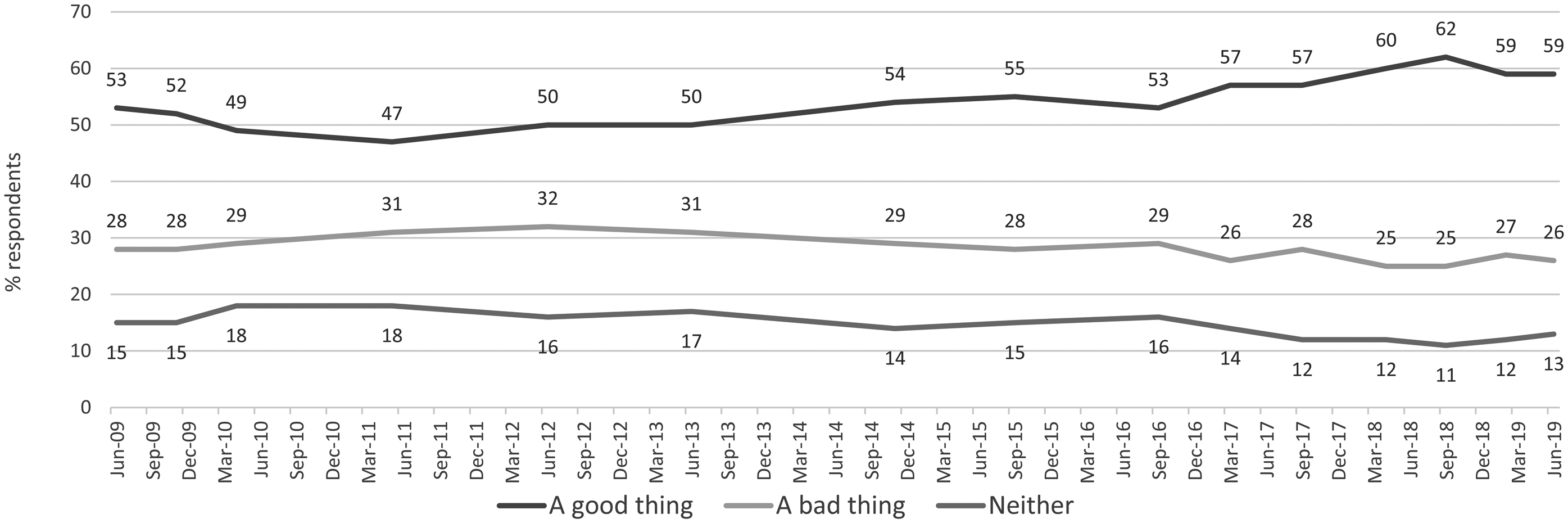
Perceptions of EU membership.
To explore the effect of Brexit perceptions on EU support, we analyse data from a cross-national post-election survey, EES 2019, conducted in all 28 member states with over 26,500 respondents 2 in the aftermath of the 2019 European Parliament elections in May 2019 (see Schmitt et al., 2019). To operationalize support for the EU, i.e. our response variable, we make use of two different measures. The first uses a well-established instrument that captures the support for EU membership, shown in Figure 1. For the purpose of our analysis we recode this variable to (1) ‘EU membership is a good thing’ and (0) otherwise. The second response variable measures behavioural intentions rather than attitudes as it asks respondents whether they would vote (1) ‘Remain’ or (0) ‘Leave’ in a referendum on their country's membership of the EU. 3 This allows us to directly capture the effect of Brexit for the other member states and ultimately for the future composition of the EU.
The main independent variable is shown in Figure 2, namely the perceptions of the consequences of Brexit. People who indicate that Britain will be ‘worse off’ after Brexit (compared to those who think there will be no change, or things will stay the same). 4 The expectation is that pessimism about Britain's prospect has a deterrent effect and is associated with an increase in the likelihood of support for the EU (H1a).
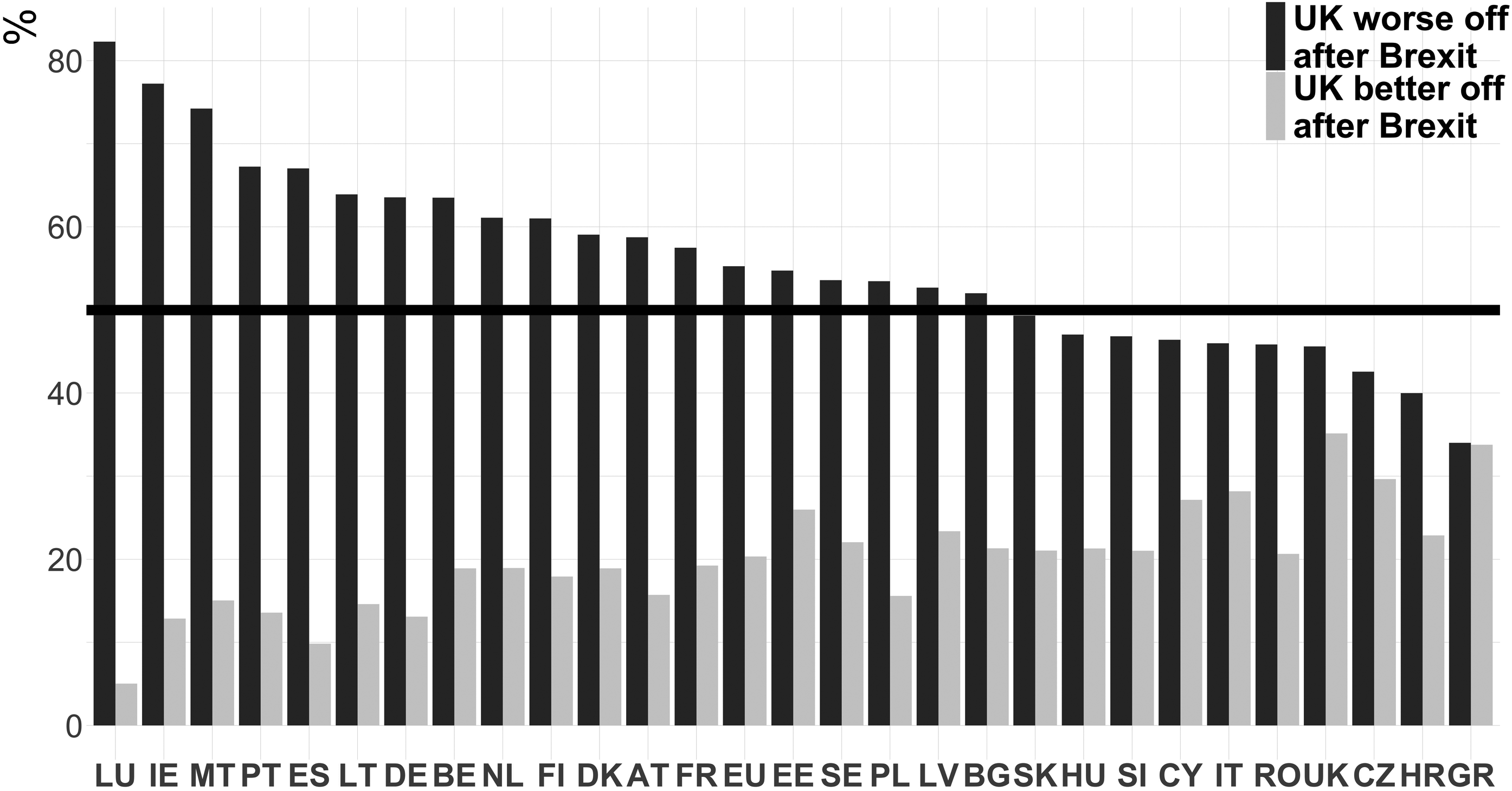
Perceptions of the consequences of Brexit.
To capture the degree to which positive and negative perceptions of benchmarking vary as a function of the exposure of the country to Brexit (i.e. the moderating effect in H1b), we include a measure of the economic impact of Brexit by using the country's GDP exposure to Brexit, as calculated by Chen and co-authors (Chen et al., 2018: 38). 5
Our model also controls for satisfaction with the economy, satisfaction with the current state of democracy in the country, political interest as well as measures of the libertarian-authoritarian attitudes (support for civil liberties, support for same sex marriage, support for immigration) that have been shown to correlate with EU support (Hooghe and Marks, 2009). Moreover, we control for the ‘national benchmark’ as people that rate their national institutions over European ones are more likely to be Eurosceptic (De Vries, 2018; Rohrschneider, 2002). We operationalize this by measuring a ‘trust differential’ between the national parliament and European Parliament, calculating trust in the national parliament minus trust in the European Parliament (both measured on a scale from ‘Totally trust’ to ‘Not at all’). In addition to these attitudinal variables, the model includes a number of demographic variables that have been previously linked to EU support: place of residence (urban vs. rural), age, gender (female vs. other), employment status, subjective social class (upper, middle vs. rest), educational level and wealth. All individual level predictors are rescaled to take values between 0 and 1 (see the Online appendix for descriptive statistics).
As our data has a multilevel structure with individuals nested in countries, we run multilevel regressions with random intercepts at the country level. Fixed-effects models yield substantially the same results. All country level predictors are grand mean centred. For models including cross level interactions (Model 2 and Model 4) we use random slopes for the individual level term.
The results presented in Table 1 offer substantial support for our first hypothesis (H1a). They show that positive perceptions of Brexit consequences (i.e. believing that Brexit will have a positive effect for the UK) are negatively associated with both support for membership of the EU (see Model 1) and voting ‘Remain’ in a hypothetical EU referendum (see Model 3). Individuals who think that Brexit will lead to positive changes are roughly two time less likely to think that the EU is ‘a good thing’ and approximately five times less likely to vote ‘Remain’ in comparison to those who think the situation will stay the same. In contrast, those who think Brexit will have negative consequences (i.e. Brexit having a negative effect for the UK) are also more likely to think that EU membership is ‘a good thing’ (Model 1) and to vote ‘Remain’ (Model 3). The substantive magnitude of this effect is noteworthy: those who perceive that the ‘UK will be better off’ after Brexit are 4.6 times more likely to think that EU is ‘a good thing’ and about seven times more likely to vote ‘Remain’ in comparison to those who think the ‘UK will stay the same’. If we translate this to probabilities (see Figure 3), we can show that an average individual who thinks that the ‘UK will be worse off’ is about 60 percentage points more likely support the EU and about 50 percentage points more likely to vote ‘Remain’ than those who think that the ‘UK will be better off’ after Brexit.
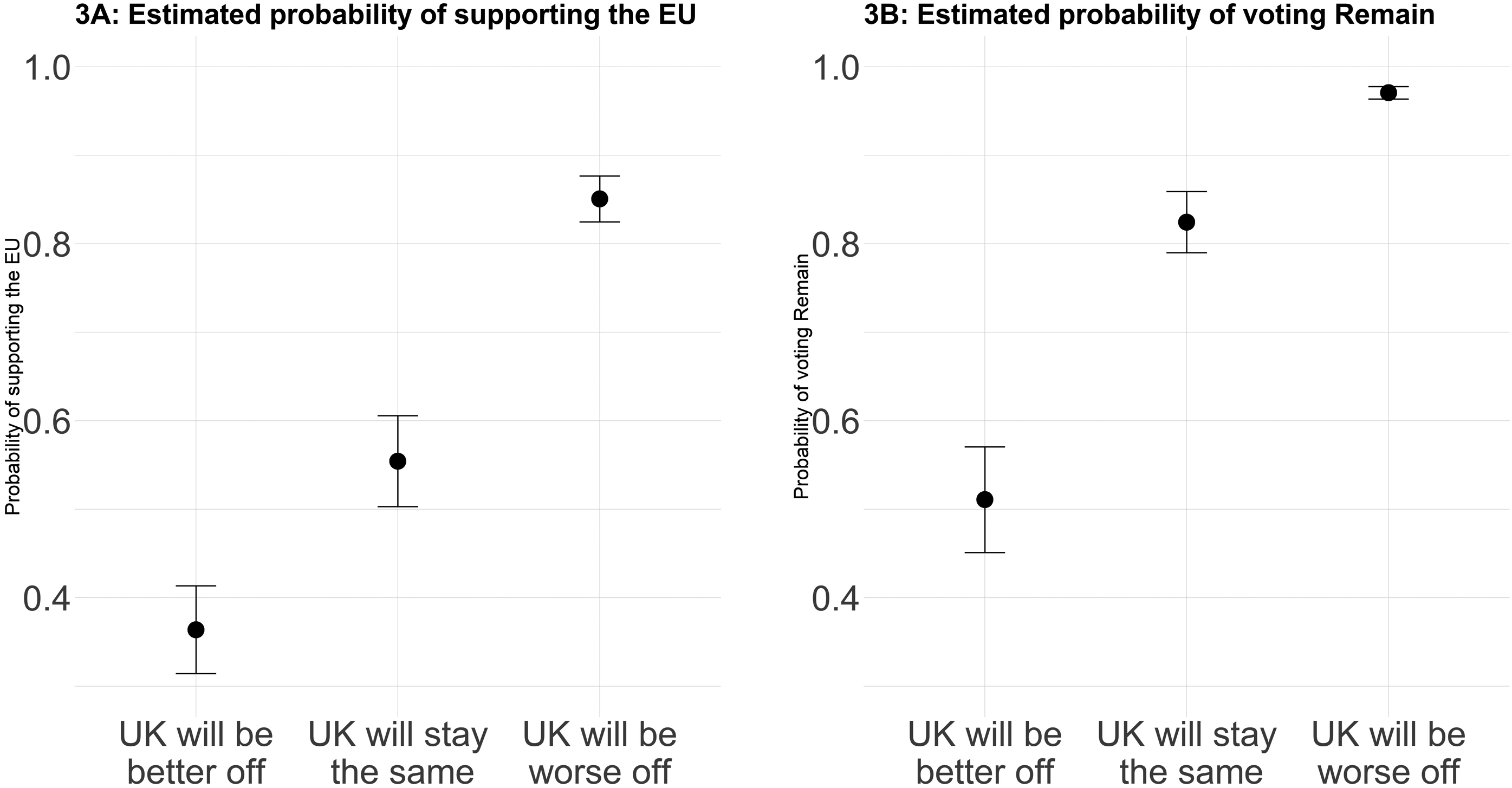
Impact of perceptions of Brexit consequences on EU support. (a) Estimated probability of supporting the EU. (b) Estimated probability of voting Remain.
Impact of perceived Brexit consequences on EU support.
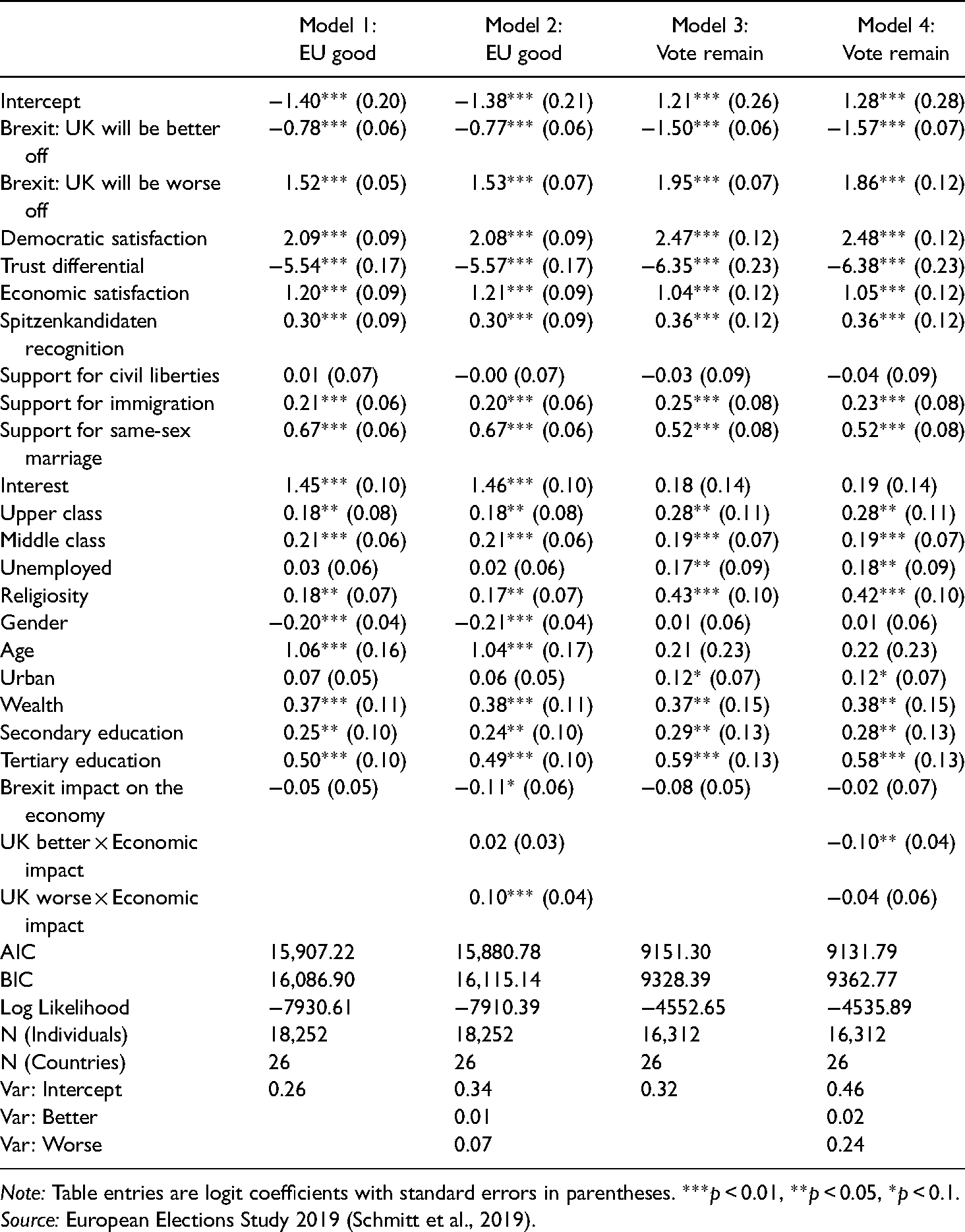
Note: Table entries are logit coefficients with standard errors in parentheses. ***p < 0.01, **p < 0.05, *p < 0.1.
Source: European Elections Study 2019 (Schmitt et al., 2019).
Moving on to H1b, the results presented in Model 2 and Model 4 in Table 1 clearly show that the relationship between Brexit perceptions and support for the EU is moderated by the economic exposure of the country to Brexit. More specifically, we show that the link between Brexit perceptions and EU support and referendum vote intention is indeed stronger for people living in countries more exposed to the economic consequences of Brexit. These findings provide additional evidence that Brexit perceptions can influence EU support (rather than vice versa) since the exogenous moderating variable ‘exposure to Brexit’ is likely to have a greater effect on the salience of Brexit perceptions than on the salience of EU support.
In order to facilitate the interpretation of these results, we plot the marginal effect of having negative and positive opinions about the consequences of Brexit across the values of the country-level predictors (see Figure 4). 6 Figure 4(a) shows that there is a statistically significant moderation effect of economic exposure to Brexit for those who think that the ‘UK will be worse off’ (the baseline for comparison is ‘UK will stay the same’). As expected, the impact of thinking that Brexit will have negative consequences is stronger in countries which are more exposed to Brexit. Figure 4(b) shows the difference in the predicted probability of voting ‘Remain’ between those who think that ‘the UK will be better off’ and the baseline category ‘UK will stay the same’ as well as between those who think that ‘UK will be worse off’ and the same baseline category. This shows a statistically significant moderation effect of economic exposure to Brexit for those who think that the ‘UK will be better off’, but not for those who think the ‘UK will be worse off’ (see also Model 4). Broadly, however, this supports our expectation that the impact of Brexit consequences is greater in countries that are economically exposed to Brexit in comparison to countries that have minimal exposure to Brexit.
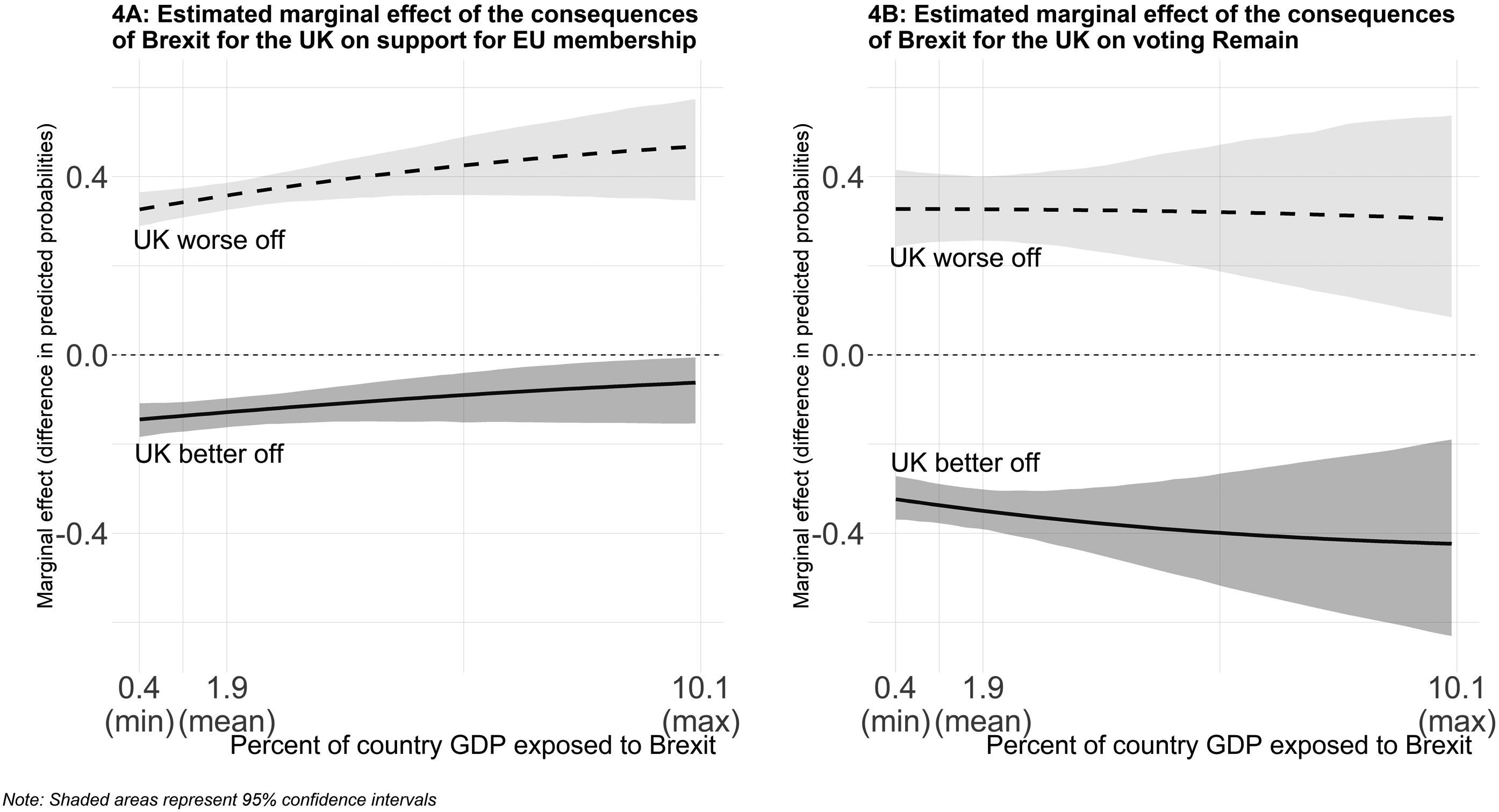
Conditional marginal effect of Brexit consequences for the UK on the predicted probability of supporting the EU depending on economic exposure. (a) Estimated marginal effect of the consequences of Brexit for the UK on support for EU membership. (b) Estimated marginal effect of the consequences of Brexit for the UK on voting Remain.
One possible explanation for the differences in moderation effects between the two operationalizations of EU support are ‘floor’ and ‘ceiling’ effects respectively. On the one hand, the probability of voting Remain for those who think ‘UK will be worse off’ is already close to one (see Figure 3(b)), hence the effect of this variable cannot be higher for those living in countries that are exposed to Brexit. On the other hand, the probability of considering EU membership as a good thing is already very low, on average, for those who think that the ‘UK will be better off’ (see Figure 3(a)), hence it is unlikely that the effect of such consideration can be moderated by the exposure to Brexit. In both cases, our analysis suggests that the national-level economic exposure to Brexit strengthens the effect of Brexit perceptions on EU support.
Benchmarking Brexit: Experimental evidence
The results presented in the observational analysis shows a strong association between the perceptions of the consequences of Brexit and EU membership support. But this raises two questions. Firstly, there may be a concern about the direction of causality: does Brexit perceptions shape support for EU membership or does support for the EU influence people's perceptions of the consequences of Brexit? Secondly, if Brexit acts as a benchmark of success to emulate or a failure to steer clear off for citizens in other member states, this may depend on how the consequences of Brexit are perceived at any given point in time. At this moment we cannot predict what the political and economic consequences of Brexit will be for the UK, nor how citizens will evaluate such consequences. Yet, an experiment can tell us whether priming respondents with an alternative benchmark (positive or negative consequences of Brexit) will affect their perceptions of the positive or negative consequences of their own country leaving the EU and indirectly affect their support for EU membership (H2a and H2b).
We test these hypotheses in an innovative, cross-national population-based experiment that combines the strengths of laboratory experiments and national surveys. By randomly assigning respondents to different treatments, we can identify the causal effects of being exposed to different types of information about the consequences of Brexit for how people perceive their own country's future outside the EU. Uniquely, we conduct the same experiment in all 28 member states on samples designed to reflect the national population. This enables us to examine the Brexit benchmark effect in individual countries as well as in the EU as a whole.
As outlined above, our experiment randomly assigned respondents to three groups: one group received a short vignette about the negative economic effects of Brexit on the British economy, one group received a short vignette about the positive effect of Brexit on ‘taking back control’ with a special focus on migration and a final group received no vignette. The two vignettes were chosen to provide factual information about two issues that had dominated the Brexit referendum campaign, both in the media (Moore and Ramsay, 2017) and public salience (Hobolt, 2016; Vasilopoulou, 2016). These two issues were also prominent in the depiction of the Brexit process in the media across the EU (Borchardt et al., 2018). While media coverage of Brexit in the EU generally adopted a mostly neutral tone, it did highlight the negative economic consequences of Brexit (Borchardt et al., 2018: 18–19). To reflect these negative effects of Brexit on the UK economy, treatment group 1 was shown the following vignette: ‘Britain leaving the EU is expected to reduce growth and may lead to an economic recession in Britain.’
Sovereignty was another important issue of the campaign, with approximately 6% of the articles in UK media referring to law-making power (Moore and Ramsay, 2017). This issue was often linked in the campaign with the issue of immigration, which was the second most prominent referendum issue in the UK (Moore and Ramsay, 2017). The desire to take control over of the border and immigration was not only dominant in the British media but was also highly salient to voters and affected the Leave vote (Hobolt, 2016; Vasilopoulou, 2016). Surprisingly, however the issue of sovereignty received very little attention in the European coverage of Brexit, with only 2% of the total coverage mentioning the issue (Borchardt et al., 2018: 23). To reflect the positive effects of Brexit on regaining sovereignty especially when it comes to taking control of immigration, treatment group 2 was shown the following vignette: ‘Britain leaving the EU will mean that Britain will have more control over its own laws, including controlling migration.’
All respondents were then asked the question: ‘If [your country] leaves the EU what do you think the consequences for [your country] will be, if any?’ with the answer categories ‘better off’, ‘no significant change’, or ‘worse off’ 7 . Our expectations are that the negative Brexit frame will make people more pessimistic about the consequences of an EU exit for their own country (H2a) while a positive Brexit frame will make people more optimistic about their own country's future outside the EU (H2b).
Our experimental manipulations consist of two components, the tone of the argument (negative vs. positive) and the topic (economic vs. immigration). While using two different policy areas may complicate the comparison of the two treatments, it has the distinct advantage of being more realistic to respondents. Since the purpose of the experiment is to assess whether attitudes towards EU membership are affected by providing respondents with a different benchmark, it is important that the treatments are credible to respondents. During the Brexit referendum, the Remain camp mainly emphasized economic consequences and the Leave camp national sovereignty (Hobolt, 2016), and we therefore decided to stay close to these messages to enhance the external validity of the experiment.
Our experiment reveals mixed results, as shown in Figure 5 and Table 2. 8 On the one hand, we find strong support for the effect of the positive Brexit benchmark treatment (H2b). Figure 5 shows that across the 27 EU member states presenting individuals with a positive frame with regard to control over laws and migration reduces negative perceptions of consequences of their own country leaving the EU by 5.6 percentage points in comparison to the control group (t = 7.204, df = 14,872, p < 0.001). 9 This pattern is roughly consistent across member states, although due to the considerably smaller sample size of the experimental groups (i.e. roughly 550 individuals) and the relative small magnitude of our treatment these effects only reach statistical significant in 12 out of the 28 countries (see the Online appendix). 10 Overall, the positive information about Brexit leads to a substantial drop in pessimism about leaving the EU and an increase in positive sentiment associated with an exodus. This would, in turn, most likely mean a decrease in support for EU membership, as we have seen in the previous section.
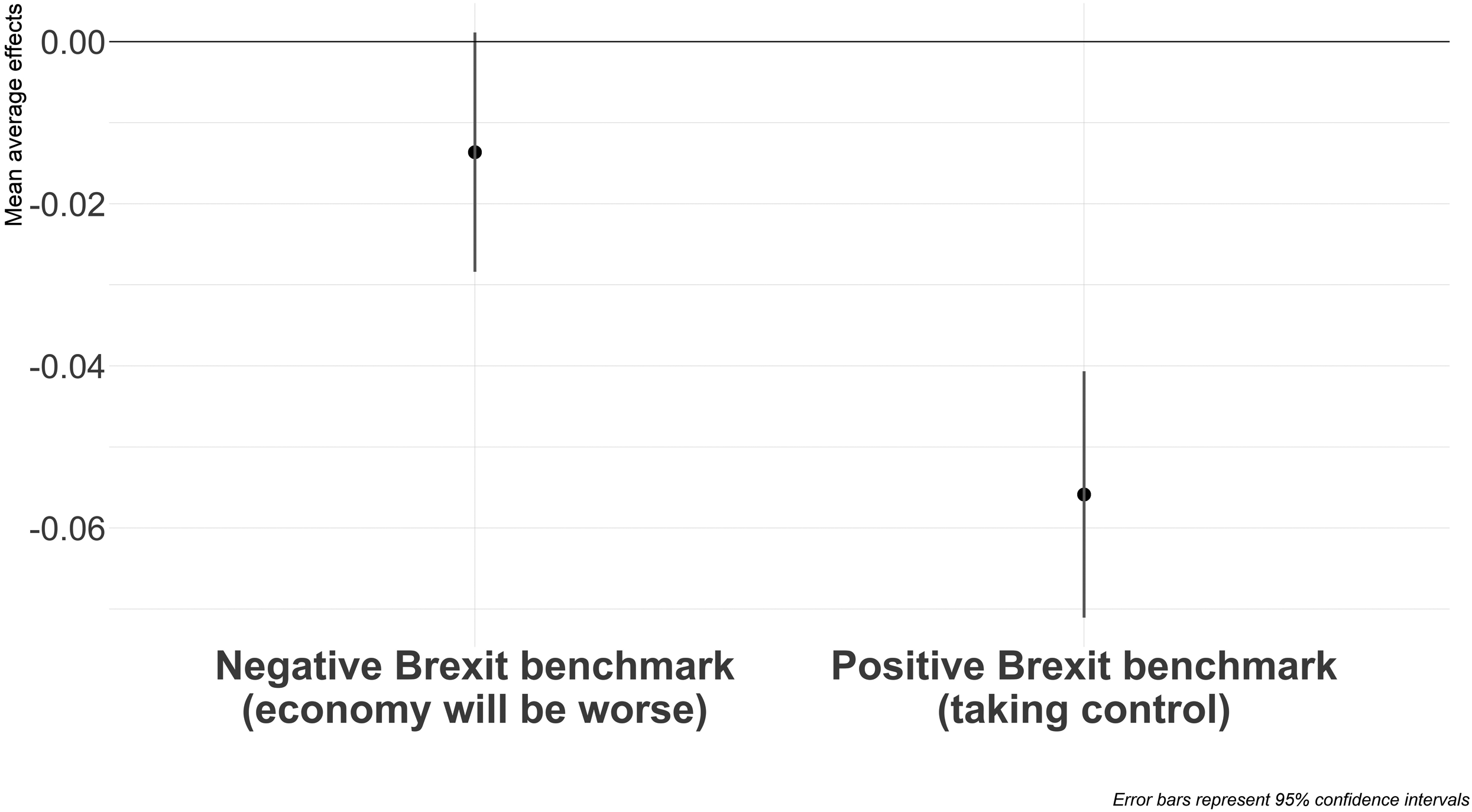
Average treatment effect of the experiment.
Experimental evidence, regression analysis.
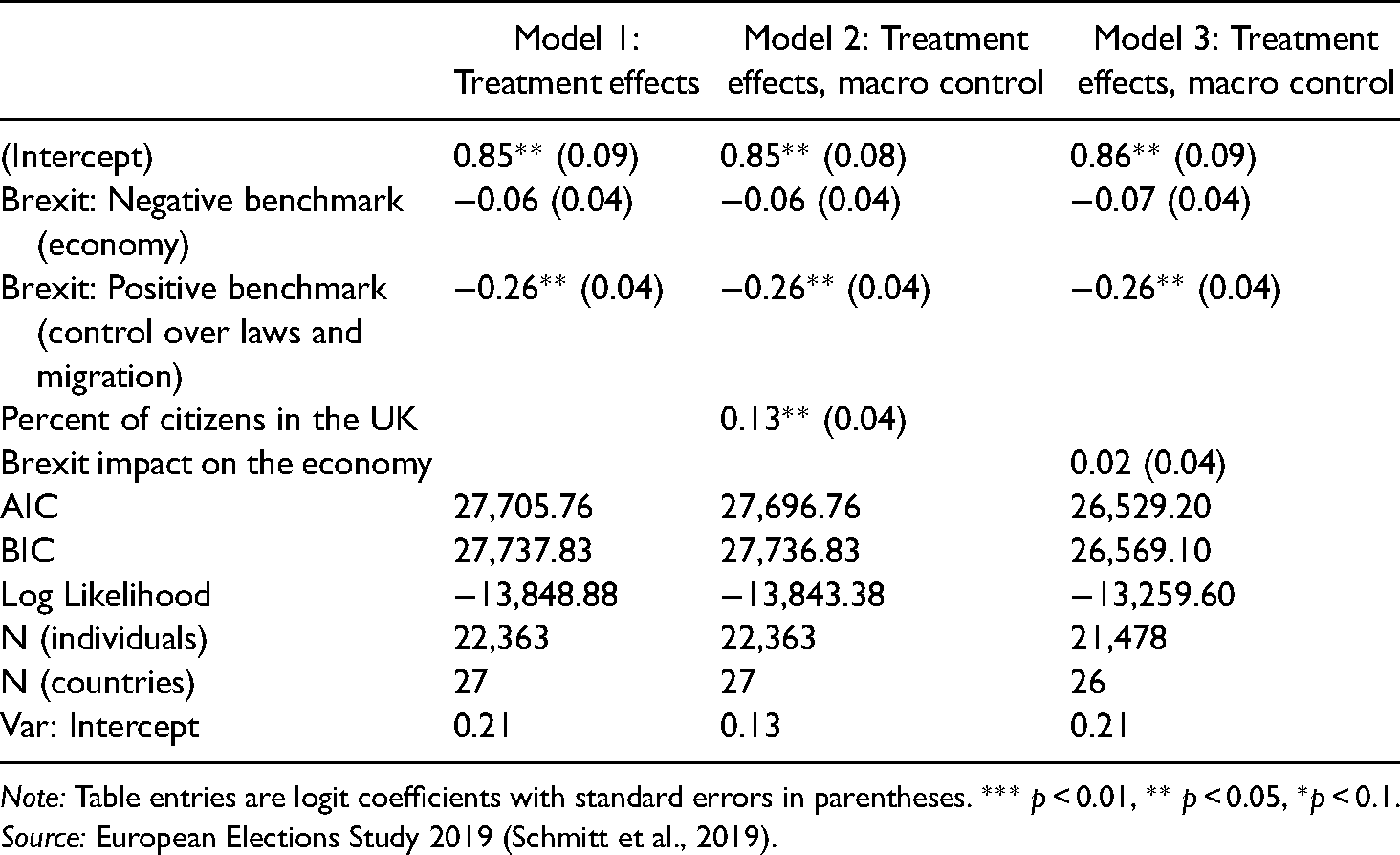
Note: Table entries are logit coefficients with standard errors in parentheses. *** p < 0.01, ** p < 0.05, *p < 0.1.
Source: European Elections Study 2019 (Schmitt et al., 2019).
In contrast, the Brexit benchmark which highlights the negative economic consequences of Brexit does not yield statistically significant differences between the treatment and control group (t = 1.79, df = 14,919, p-value = 0.07) among the citizens of the 27 EU member states as shown in Figure 5 (including UK in the analysis does not alter this conclusion). Furthermore, a country by country analysis also reveals an inconsistent pattern with most country effects failing to reach statistical significance.
A possible explanation for this is that the negative effects of Brexit are already ‘priced in’ by the respondents, as they have been exposed to (or pre-treated) a lot of negative coverage about the economic effects of Brexit (Borchardt et al., 2018). Hence, our simple vignette does not shift perceptions of the Brexit consequences further. A related possibility is that the null finding is due to a ceiling effect as the results presented in Figure 3 already reveal that there is a substantive proportion of respondents who consider that the UK will be worse due to the UK leaving the EU. Given such circumstances, the weak treatment in our survey experiment did little to alter these already strong views.
Conclusion
Does the exit of one member state from the EU create a domino effect of disintegration or does it merely serve as a deterrent for citizens in the remaining member states? In the immediate aftermath of the Brexit referendum, politicians in Brussels and around European capitals feared that this would boost Eurosceptic parties and their mission to exit from the EU across Europe. Yet, during the Brexit negotiations, there was a noticeable uptick in support for membership in the EU-27. So, is Brexit a deterrent or an incentive for citizens in the remaining member states?
In this article, we have argued that Brexit presents a benchmark that helps citizens to form an opinion of what their own country's future might look like outside the EU and this, in turn, will shape how they evaluate membership of the EU. This argument builds on the heuristics and benchmarking approaches to understanding attitude formation and attitude change (De Vries, 2017, 2018; Hobolt and De Vries, 2016; Kayser and Peress, 2012). In particular, we have examined the mechanism that links Brexit and EU support. To do so empirically, we use both observational and experimental data from all EU member states. The analysis of observational data reveals that in the summer of 2019, far from being an example for others to follow, Brexit was a deterrent for many citizens in the rest of the EU. The protracted Brexit negotiations and failure to find an acceptable solution in the British parliament had meant that a majority of citizens in the EU-27 thought that Britain will be worse off outside and fewer than 1 in 5 expected a positive outcome for the UK. Those who viewed the consequences of Brexit negatively were also more likely to view an exit option for their own country more pessimistically and to support the EU, while an optimistic view of Brexit had the opposite effect on EU membership support. However, this raises the question of causal direction – does Brexit perceptions shape EU membership support or vice versa? – and of how Brexit may shape EU support in the future if it is perceived as a success.
To address this, we conducted a cross-national population-based vignette experiment that was designed to manipulate the benchmark that citizens use to evaluate the advantages and disadvantages of their countries’ membership of the EU. Respondents were randomly assigned to a ‘negative’ (economic) or a ‘positive’ (sovereignty) Brexit information treatment or a ‘no-information’ control group. The analyses revealed no consistent results for the negative Brexit benchmark, while the positive information treatment enhanced people's optimism about their own country's future outside the EU. The lack of effects for the negative treatment may be explained by the fact that most respondents were already ‘pre-treated’ with negative Brexit information, as such a frame had dominated in much of the Brexit coverage in the member states. This null finding could thus be related to the specific political context at the time the experiment was fielded. If the experiment had been conducted at a different time when coverage of the UK was more positive or mixed, it is possible that there might have been more scope to find an effect of a negative benchmark. Nonetheless, the effects of the positive information indicate that alternative consequences of Britain's exit from the EU may in the future give a boost to Eurosceptics in the EU-27 who want their countries to leave the EU. This suggests that, depending upon Britain's future outside the EU, Brexit might be as much a deterrent as an encouragement for other countries to leave the EU.
These findings imply that the UK's exit from the EU may continue to influence the European integration in several ways. First, even though an initial agreement has been reached between the UK and the EU on future relations, trade negotiations will continue over the next years. Our results highlight the risks for the EU in accommodating UK demands (Walter, 2020, 2021). While a closer trading relationship between the UK and the EU is likely economically beneficial to both parties, it also carries risks for the EU, since an economically successful UK with greater sovereignty may lower citizens support for membership. Obviously, citizens will never be able to know the counterfactual (how successful the UK would be inside the EU), but in this case perceptions are all that matter. For example, if the UK is perceived to be more (or less) successful in combating the coronavirus that might be seen as a positive (negative) benchmark for EU membership. Similarly, the speed of the economic recovery may be compared across borders (Kayser and Peress, 2012) and influence support for membership. It remains to be seen how such events might influence the public's perception of Brexit and EU integration. However, the evidence presented in this paper implies that Brexit benchmarks, whether negative or positive, can shape attitudes toward membership in EU countries. Second, the experimental evidence suggests that there is scope for Eurosceptic political entrepreneurs within the member states to successfully mobilize against the EU on a ‘take back control’ message whereas the pro-European ‘project fear’ message of economic risk may be less effective – similar to what has been shown in the 2016 campaign in the UK (Hobolt, 2016). Overall, our paper suggests that while Brexit has not resulted in a further disintegration, a more successful ‘emeritus member state’ could well boost support for exit in the remaining member states in the future.
Supplemental Material
sj-docx-1-eup-10.1177_14651165211032766 - Supplemental material for The Brexit deterrent? How member state exit shapes public support for the European Union
Supplemental material, sj-docx-1-eup-10.1177_14651165211032766 for The Brexit deterrent? How member state exit shapes public support for the European Union by Sara B Hobolt, Sebastian Adrian Popa, Wouter Van der Brug and Hermann Schmitt in European Union Politics
Supplemental Material
sj-R-2-eup-10.1177_14651165211032766 - Supplemental material for The Brexit deterrent? How member state exit shapes public support for the European Union
Supplemental material, sj-R-2-eup-10.1177_14651165211032766 for The Brexit deterrent? How member state exit shapes public support for the European Union by Sara B Hobolt, Sebastian Adrian Popa, Wouter Van der Brug and Hermann Schmitt in European Union Politics
Supplemental Material
sj-R-3-eup-10.1177_14651165211032766 - Supplemental material for The Brexit deterrent? How member state exit shapes public support for the European Union
Supplemental material, sj-R-3-eup-10.1177_14651165211032766 for The Brexit deterrent? How member state exit shapes public support for the European Union by Sara B Hobolt, Sebastian Adrian Popa, Wouter Van der Brug and Hermann Schmitt in European Union Politics
Supplemental Material
sj-txt-4-eup-10.1177_14651165211032766 - Supplemental material for The Brexit deterrent? How member state exit shapes public support for the European Union
Supplemental material, sj-txt-4-eup-10.1177_14651165211032766 for The Brexit deterrent? How member state exit shapes public support for the European Union by Sara B Hobolt, Sebastian Adrian Popa, Wouter Van der Brug and Hermann Schmitt in European Union Politics
Supplemental Material
sj-RData-5-eup-10.1177_14651165211032766 - Supplemental material for The Brexit deterrent? How member state exit shapes public support for the European Union
Supplemental material, sj-RData-5-eup-10.1177_14651165211032766 for The Brexit deterrent? How member state exit shapes public support for the European Union by Sara B Hobolt, Sebastian Adrian Popa, Wouter Van der Brug and Hermann Schmitt in European Union Politics
Supplemental Material
sj-csv-6-eup-10.1177_14651165211032766 - Supplemental material for The Brexit deterrent? How member state exit shapes public support for the European Union
Supplemental material, sj-csv-6-eup-10.1177_14651165211032766 for The Brexit deterrent? How member state exit shapes public support for the European Union by Sara B Hobolt, Sebastian Adrian Popa, Wouter Van der Brug and Hermann Schmitt in European Union Politics
Supplemental Material
sj-csv-7-eup-10.1177_14651165211032766 - Supplemental material for The Brexit deterrent? How member state exit shapes public support for the European Union
Supplemental material, sj-csv-7-eup-10.1177_14651165211032766 for The Brexit deterrent? How member state exit shapes public support for the European Union by Sara B Hobolt, Sebastian Adrian Popa, Wouter Van der Brug and Hermann Schmitt in European Union Politics
Supplemental Material
sj-xlsx-8-eup-10.1177_14651165211032766 - Supplemental material for The Brexit deterrent? How member state exit shapes public support for the European Union
Supplemental material, sj-xlsx-8-eup-10.1177_14651165211032766 for The Brexit deterrent? How member state exit shapes public support for the European Union by Sara B Hobolt, Sebastian Adrian Popa, Wouter Van der Brug and Hermann Schmitt in European Union Politics
Footnotes
Funding
The author(s) disclosed receipt of the following financial support for the research, authorship, and/or publication of this article: This work was supported by the Volkswagen Foundation (grant EES 2019).

Supplemental material
Supplemental material for this article is available online.
Notes
References
Supplementary Material
Please find the following supplemental material available below.
For Open Access articles published under a Creative Commons License, all supplemental material carries the same license as the article it is associated with.
For non-Open Access articles published, all supplemental material carries a non-exclusive license, and permission requests for re-use of supplemental material or any part of supplemental material shall be sent directly to the copyright owner as specified in the copyright notice associated with the article.
