



Abstract
This article assesses the factors associated with member states’ bargaining success during the negotiations in the European Council's 2010 task force on strengthening economic governance, the pre-decision stage for the Six-Pack. We test theories of decision-making based on the expertise of institutions, and EU member states’ preferences and power resources using new data. With methods derived from the decision-making in the EU projects, we find that proximity to the European Central Bank was associated with greater bargaining success for member states and that the opposite was the case for closeness to the Commission's preferences. We find mixed evidence that member states’ level of indebtedness is associated with bargaining success, defined as the minimum distance between the position of a member state and the final outcome. The findings indicate the importance of the ECB's role given its technical expertise, in defining the outcomes of the task force.
Keywords
Introduction
One of the consequences of the 2008 Global Financial Crisis in the European Union (EU or Union) was ‘the emergence of the European Council as the centre of political gravity’, as heads of state and government met frequently in an effort to stabilise the Eurozone (Puetter, 2012: 161). Using the powers of Article 15.1 of the Treaty on the European Union (TEU), the member states requested then President of the European Council Herman Van Rompuy to establish, in co-operation with the European Commission (Commission), a task force on strengthening economic governance in the EU (Task Force) in May 2010. The role of the Task Force was to prepare for the European Council, by October 2010, a set of recommendations to reform the EU's economic governance structures (European Council, 2010a). 1 While the literature acknowledges the role of the Task Force in proposing reforms to the Union's economic governance architecture, there has yet to be an in-depth study of this pre-decision stage of the Six-Pack negotiations. By analysing these negotiations, this article contributes to the theoretical debates on coalition formation and the role of Commission and the European Central Bank (ECB) in intergovernmental decision-making on economic governance. We address the gap in understanding decision-making processes in the Task Force by asking how much the outcomes on the six salient issues in the Task Force negotiations deviated from the preferences of member states, the ECB and the Commission, and which factors are associated with the proximity of preferences to outcomes. We answer these questions using a new dataset based on methods derived from the decision-making in the EU projects (e.g., Arregui and Thomson, 2009).
Within these negotiations, six salient issues would emerge: (1) the linking of debt criteria (a debt to GDP ratio of 60%) to the medium-term budgetary objective (MTO); (2) the temporary suspension of funds from the EU budget for those member states that fail to meet the debt criteria; (3) the introduction of interest-bearing deposits for member states not meeting their MTOs; (4) the introduction of reverse qualified majority voting; (5) greater flexibility in the excessive deficit procedure (EDP) for member states that had undertaken pension reforms; and (6) the establishment of fiscal councils in member states to provide economic policy advice independent of the national government. Bargaining in the Task Force on these issues is significant because the summit participants called for secondary legislation to be fast tracked to ensure that the Task Force recommendations on these issues were adopted (European Council, 2010b). These recommendations would form the basis of the Six-Pack legislative package, which came into force in 2011 (Bocquillon and Dobbels, 2014; Chang, 2013; Moloney, 2021). The Six-Pack would form the core of the reforms to the Stability and Growth Pact (SGP).
Our findings suggest that a fiscally-conservative coalition of northern and eastern member states was more successful in shaping the Task Force recommendations than a southern coalition and that proximity to the ECB was associated with smaller gaps between member states’ positions and outcomes in an institutional set-up that allowed the ECB a greater role than under normal legislative decision-making processes. Only one of the issues in our dataset had an outcome at the least fiscally-conservative position, with the other outcomes either at the most fiscally-conservative point (for three issues) or at the midpoint in our scale (two issues). Our study therefore makes two contributions to the literature on decision-making in the EU and the ECB. Firstly, our research presents the first systematic examination of the gaps between final outcomes and the initial positions (Arregui and Thomson, 2009; Thomson, 2011; Thomson and Stokman, 2006) of the Commission, ECB and member states in the pre-decision stage of the Six-Pack. This decision-making took place in a forum established outside the Community Method (Bocquillon and Dobbels, 2014; Moloney, 2021), allowing us to compare findings with studies of economic governance based on standard decision-making rules in the EU. Specifically, our interviewees described the Task Force as operating by consensus. The direct involvement of the ECB in the Task Force means that by studying this environment, we can assess how far the ECB's positions are related to outcomes when operating in a less formal environment compared with legislative decision-making. In addition, the Task Force was concerned with a highly technical area of policy. Under these circumstances, we expect the ECB's positions to matter in the outcomes given its technical expertise. Member states may react to this situation by taking cues from the ECB about how to act. While we cannot test this directly with our data, we can assess how far proximity to the ECB's positions is associated with smaller distances between member state positions and outcomes on the issues we study. Second, despite the length of time that has passed since the establishment of the Task Force, the negotiations can provide an insight into the influence of ECB when assessing future reforms to the EU's economic governance framework (European Commission, 2022).
In particular, examining the Task Force allows us to assess how far the ECB's and Commission's positions were associated with bargaining success in an area of policy that is highly technical in nature and was outside of the Community Method of decision-making. We can also examine how far findings in other work on EU economic governance reform about the success of creditor over debtor states apply to this particular case. To clarify, we define bargaining success, following Thomson's (2011) definition, as the minimum distance between the position of a member state and the final outcome. By using the term ‘success’, we do not imply causality. Rather, we use a multivariate analysis to pick out the factors associated with these smallest distances between positions and outcomes. 2
Literature review
The role of the Task Force in shaping the EU's initial response to the crisis has been examined in a number of studies (Bocquillon and Dobbels, 2014; Chang, 2013; Moloney, 2021). These have focused largely on the question of competition between the European Council and the Commission to set the agenda. Bocquillon and Dobbels (2014: 32) contends that the European Council ‘played a decisive role in the initiation’ of the Six-Pack in that the Commission's proposals for the latter were very similar to the Task Force's recommendations. Likewise, Chang (2013: 259) argues that setting up the Task Force took away the position of the Commission as an agenda-setter, a role it would have played in the absence of the Task Force. Moloney (2021) suggests that although the European Council became the institution in which the agenda for economic governance reform was set, the Commission was nevertheless able to use its technical expertise to influence the negotiations.
Other recent literature using decision-making data (e.g., Lundgren et al., 2019) examines bargaining success under various legislative voting procedures. Lundgren et al. (2019) use the EMU Choices data (Wasserfallen et al., 2019) which applies Decision-Making in the EU methods (e.g., Arregui and Thomson, 2009). They show that proximity to the Commission's position is associated with greater bargaining success in a series of issues related to reform of economic governance. They also find that closeness to the Commission has a greater association with bargaining success when the ordinary legislative procedure (OLP) is in use. Given the formal agenda-setting power of the Commission in the OLP, this appears reasonable (Lundgren et al., 2019: 77). Arregui and Thomson (2009: 671) found evidence of Commission influence but only under the consultation procedure. Using data from 2004–2008, Cross (2013: 89–90) finds that proximity to the European Parliament and to the Commission is associated with higher bargaining success.
The EMU Choices data have been employed to examine the role of the ECB in changes to the economic governance structures of the EU. Looking for evidence of technocracy, Tortola and Târlea (2021: 1961) find that closeness to the Commission is associated with greater bargaining success (consistent with Lundgren et al., 2019) but that the opposite is true of proximity to the ECB's preferences. Being close to either of these institutions is correlated with lower bargaining success in dossiers that are higher in complexity, leading Tortola and Târlea (2021: 1961–1964) to conclude that the EU is perhaps not as technocratic as often thought.
Our study uses a smaller dataset of six issues that were raised in the Task Force negotiations (May-October 2010), compared to Lundgren et al.'s (2019) study, which contained 39 issues collected during the Eurozone reform period 2010–2015, but we build on the EMU Choices project by analysing the influence of the member states, the Commission and the ECB at the pre-decision stage of the Six-Pack through the Task Force negotiations. While much of the existing literature on decision-making in the EU has focused primarily on the role of member states, we look at the role of the ECB in a forum where decision-making by consensus in a highly technical area of policy may have provided it with a greater opportunity to influence outcomes than in those areas governed by the Community Method.
Research on policy-making in economic governance and on decision-making among the EU's member states more broadly, indicates the presence of coalitions based on attitudes to fiscal transfers or member states’ EU budgetary status (pitting net beneficiaries against net contributors). Lehner and Wasserfallen (2019) apply multidimensional scaling methods to the EMU Choices data to assess the nature of conflict in decision-making on economic governance. They find a division between countries who favoured fiscal transfers, such as France, Greece, Spain, Portugal and Italy, and those who preferred measures promoting fiscal discipline, including the Netherlands, Finland and Germany. Using textual analysis techniques to study debates in the Economic and Financial Affairs configuration of the Council of the EU (Council) (2010–15), Wratil and Hobolt (2019: 520) similarly find divisions between wealthier member states who favour a limited EU budget and economic competitiveness, and poorer member states who prefer a larger EU budget and more regulation.
Studies of Council decision-making drawing on areas beyond economic policy also show evidence of coalitions based around economic indicators, especially member states’ status as either net beneficiaries or net contributors to the EU budget. In their analysis of all Council votes from 2004–2016, Hagemann et al. (2019) find that net recipients were less likely to abstain or vote against proposals than others. Bailer et al.'s (2015) study of voting in four of the Council's formations between 2004 and 2009 also finds that EU-budget-beneficiary status and GDP matter for voting behaviour. Zimmer et al. (2005) find a coalition of poorer member states in their analysis of preferences in the decision-making in the EU data from 1999–2002.
This body of research suggests we should expect to see divisions between creditor and debtor states in our analysis of decision-making in the Task Force on Economic Governance. In addition, Frieden and Walter (2017) and Schimmelfennig (2015) find that the preferences of creditor states weighed more heavily than those of debtors in the policies adopted in response to the Eurozone crisis. This is particularly evident in the imposition of austerity programmes on member states in receipt of bailouts (Frieden and Walter, 2017: 372). If this is true of the Task Force, then we would expect to see creditor states’ preferences reflected more in outcomes than those of debtor states. From the qualitative description of coalitions formed in the Task Force as outlined in the Online appendix, we know that there was a northern/eastern-versus-southern coalition in the negotiations. This fits to some degree with a creditor-versus-debtor division. Hence it will be important to look for evidence of this divide in our quantitative empirical analysis.
Hypotheses about states’ bargaining success
As noted above, the influence of the Commission during the European sovereign debt crisis has been much debated. The shift towards intergovernmental decision-making during the crisis (Puetter, 2012) has supported the contention of a number of scholars that the Commission's influence in policy-making was on the wane (Bocquillon and Dobbels, 2014; Chang, 2013). Earlier work looking at decision-making in a range of policy areas also found no effect for proximity to the Commission on bargaining success for member states (Arregui and Thomson, 2009: 666–667). However, this argument has been increasingly challenged in recent analyses on the Commission's influence in reform of economic governance, where taking the same position as the Commission is associated with greater bargaining success (Lundgren et al., 2019; Tortola and Târlea, 2021). The Commission is known for its skill of taking advantage of windows of opportunity that enable actors to present major policy initiatives (Nugent and Rhinard, 2016: 1201) and as an information hub for policy (Bauer and Becker, 2014: 226). H1: The greater the distance between a member state's policy position and the preference of the Commission, the less bargaining success a member state will have.
Research that examines the role of the ECB during the crisis (Schoeller, 2018; Tortola and Pansardi, 2019) has argued it has gone beyond its mandate of price stability. The ECB is the foremost guardian of the Euro and was established as a ‘technical actor par excellence’ (Tortola and Târlea, 2021: 1954). If the ECB is expected to have more influence when the subject of decision-making is more complex and technical (Tortola and Târlea, 2021), then the complexity of the economic governance reform discussed in the Task Force should mean the ECB was in a position to provide unrivalled technical expertise through, for example, its written submission to the Task Force, something which neither the Commission nor the vast majority of member states could do. As noted earlier, the less formalised environment of the Task Force may also mean the ECB has a greater opportunity to influence outcomes than under standard decision-making procedures. On this basis, we expect the member states to rely to some degree on the ECB's expertise as part of deciding what position to take on each issue in the negotiations. H2: The greater the distance between a member state's policy position and the preferences of the ECB, the less bargaining success it will have.
As noted above, previous research (Frieden and Walter, 2017; Schimmelfennig, 2015) has found that measures to deal with the Eurozone have reflected the preferences of creditor states more than they have those of debtors. Schimmelfennig (2015: 185) argues this is because the risks of holding out for their preferred solution were greater for debtors – who faced the possibility of bankruptcy – than creditors. H3: Outcomes will be further from the preferences of debtor states than others.
We include a series of control variables in our models. Economic power has been theorised to increase member states’ bargaining success (e.g., Bailer, 2004; Lundgren et al., 2019) on the grounds that member states marshal their financial resources to further their economic objectives (Keohane and Nye, 2012: 25). Some studies have measured member state power, including economic power, using the size of a country's population (Arregui and Thomson, 2009; Cross, 2013). The arguments for influence here are similar, namely that larger member states have well-resourced bureaucracies that can conduct superior lobbing efforts (Arregui and Thomson, 2009) or that they have the economic resources to offer side payments (Cross, 2013). Nevertheless, the findings on this are often at odds with the theory. While Bailer (2004: 114) finds weak support for the positive effect of economic power on bargaining success, this is only in one of the policy sectors (agriculture) she examines. Lundgren et al. (2019: 76) find either a negative effect or no effect at all for economic power on bargaining success in issues of economic governance reform. In a study that includes a wider range of EU policy areas, Arregui and Thomson (2009: 666–667) find a negative effect on bargaining success for population size, or no effect in some models. Cross (2013: 85) also finds a negative relationship between this variable and bargaining success in the Council. Golub (2022) finds that some smaller member states are much more successful in EU policy-making than we might expect. As the Task Force was not a formal Council configuration, economic power may have mattered less in bargaining success. For this reason, we expect that the larger a member state's GDP, the less bargaining success the member state will have. We also measure state power using member states’ population size, as in some of the literature (Arregui and Thomson, 2009; Cross, 2013). Following these findings, we expect that large populations will be associated with lower bargaining success.
Network capital describes the potential partners that a member state has for building coalitions and to exchange information during negotiations (Naurin and Lindahl, 2010). In controlling the informal flow of information, member states can exercise a degree of influence over negotiations. Network capital has been found to have negative (Golub, 2012) and positive (Arregui and Thomson, 2009; Lundgren et al., 2019) effects on the bargaining success of the member states. Assuming that member states with the highest levels of network capital were able to form coalitions in the Task Force and use this to their advantage, we expect this variable to have a positive effect on bargaining success.
Domestic constraints on a government's room for manoeuvre in negotiations may affect bargaining power. Based on Putnam's (1988) two-level game model, member states with negotiating mandates that are tightly controlled domestically can argue that they are unlikely to ratify agreements which move far from their preferences. This will put them in a stronger position in negotiations. Both positive (Hug and König, 2002) and negative correlations (Lundgren et al., 2019) have been found between domestic constraints and bargaining success. In the Task Force, a powerful European Affairs Committee (EAC) in a national parliament could have been a source of bargaining power, as a negotiator may have used the constraints placed on the member state by national parliament to extract concessions. We therefore expect this variable to have a positive effect.
Salience describes the proportion of the potential capabilities that an actor is willing to marshal in an attempt to shape the decision outcome (Thomson and Stokman, 2006: 41). Despite the seriousness of the crisis, member states attached varying levels of salience to issues in the negotiations. High levels of salience may have indicated weakness in the Task Force, underlining how desperate a member state's position was in the negotiations. Likewise, a member state that attaches a low level of salience to an issue may not have considered it worth investing resources in shaping the outcome of the negotiations. Evidence of the effect of salience on bargaining success is mixed. Several studies (Bailer, 2004; Cross, 2013; Lundgren et al., 2019) have found no effect for salience. The literature examining bargaining success in negotiations on EU legislative proposals (Arregui and Thomson, 2009) has, however, found evidence that member states achieve higher bargaining success for issues to which they attached a higher salience relative to the mean salience attached by all member states. On this basis, we expect that if member states attached higher levels of relative salience to an issue, this will be associated with higher bargaining success.
Research design
In the studies by Bueno de Mesquita and Stokman (1994), controversial issues that are identified by the senior policy-makers are formulated as policy scales. The spatial model of politics is a theoretical modelling framework that assumes relevant actors have spatial preferences along continuous issue or ideological dimensions. This approach can be used as a conceptual guide for how to assess bargaining success and policy influence. Spatial voting models have been applied to a range of studies on EU decision-making (e.g., Selck and Steunenberg, 2004).
Figure 1 presents the positions taken by the member states, the Commission and the ECB on whether there should be fiscal councils, and the extent of their powers. Fiscal councils were to be created at the national level with the aim of reinforcing economic governance through providing forecasts, assessments and analysis of domestic economic policy matters, free of political interference. Member states and institutions that supported allowing fiscal councils to issue binding opinions are placed at 100 on the scale. Member states that supported fiscal councils issuing non-binding recommendations are at 50 on the scale. 0 on the scale represents a preference for the status quo or the continued policy of not having fiscal councils. No actor supported this position.
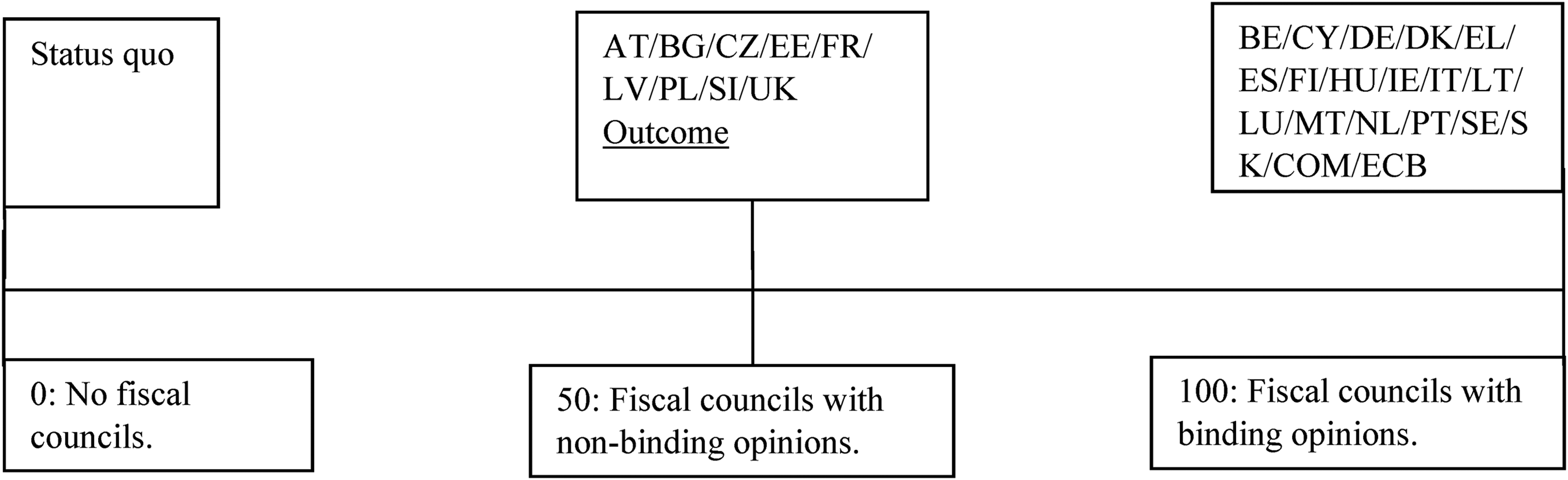
Preferences of the member states, Commission and ECB on the powers of fiscal councils.
Controversial issues in the Task Force negotiations were identified by key-informants from documents accessed on the Council's public register and through a freedom of information request submitted to the Finnish Ministry of Finance. The Council documents included a report of the first meeting of the Sherpa Committee – the Task Force working group, and drafts of the final report. The files released by the Finnish Ministry of Finance were minutes of the Sherpa Committee and ministerial meetings. 54 semi-structured interviews were conducted to determine the policy positions of the actors on the six controversial issues that were identified from the documents by the key-informants (see the Online appendix for descriptions of these issues) during the Task Force negotiations (May-October 2010). The officials were interviewed between May 2016 and April 2017, either in Brussels or by phone. The semi-structured interviews lasted between 45 and 60 min. 40 key-informants were senior policy-makers from the ministries of finance or from the permanent representations in Brussels. Seven were senior bureaucrats working in the Commission's Directorate-General for Economic and Financial Affairs. Another seven were high level officials from the Council's Economic Policy Committee (EPC) and the Eurogroup Working Group of the Economic and Financial Affairs Council configuration. In several cases, more than one senior policy-maker representing a member state or institution was interviewed.
A number of challenges occurred during data collection. Some key-informants had left their positions and no longer had access to files, while in some cases more than one official handled the dossier. The length of time that had passed between the conclusion of the Task Force negotiations and the data collection stage provided another difficulty, as the recollections of some of the key-informants had faded. Thus, where such cases arose, more than one key-informant was interviewed from each member state or institution to ensure that accurate data were collected. In the occurrence of diverging scores, the key-informants were asked to agree one final score and where this was not possible, and in line with Thomson (2011), a judgement was made on which sets of estimates should be used in the analysis based on the answers of the key-informants (Thomson, 2011: 35). This article represents the first use of these data to assess the positions of the member states in the Task Force on the six controversial issues.
In line with the decision-making in the EU framework, the key-informants were asked to estimate the policy position of their respective member state or institution, along with the status quo and the outcome of the negotiations for each issue on the scale. The status quo is the current policy, and the failure of negotiators to reach an agreement on an issue leaves it as the only possible outcome. Outcomes represent the Task Force's collective decision at the end of the negotiations. From the policy positions of the actors, the status quo and the outcome, the key-informants were asked to identify the extreme policy options. The policy extremes characterise the endpoints of each policy scale. Where the policy preference of the actors was not judged to align with one of the policy extremes, the senior officials gave a score ranging from 0–100 on the scale in units of ten. The senior bureaucrats were then asked to support their judgements for the positions they had given for the member states, the institutions, the outcome and the status quo with a detailed explanation (Thomson, 2011: 29–45).
Factors associated with bargaining success (Models 1a and 1b) and salience-weighted bargaining success (Models 2a and 2b).
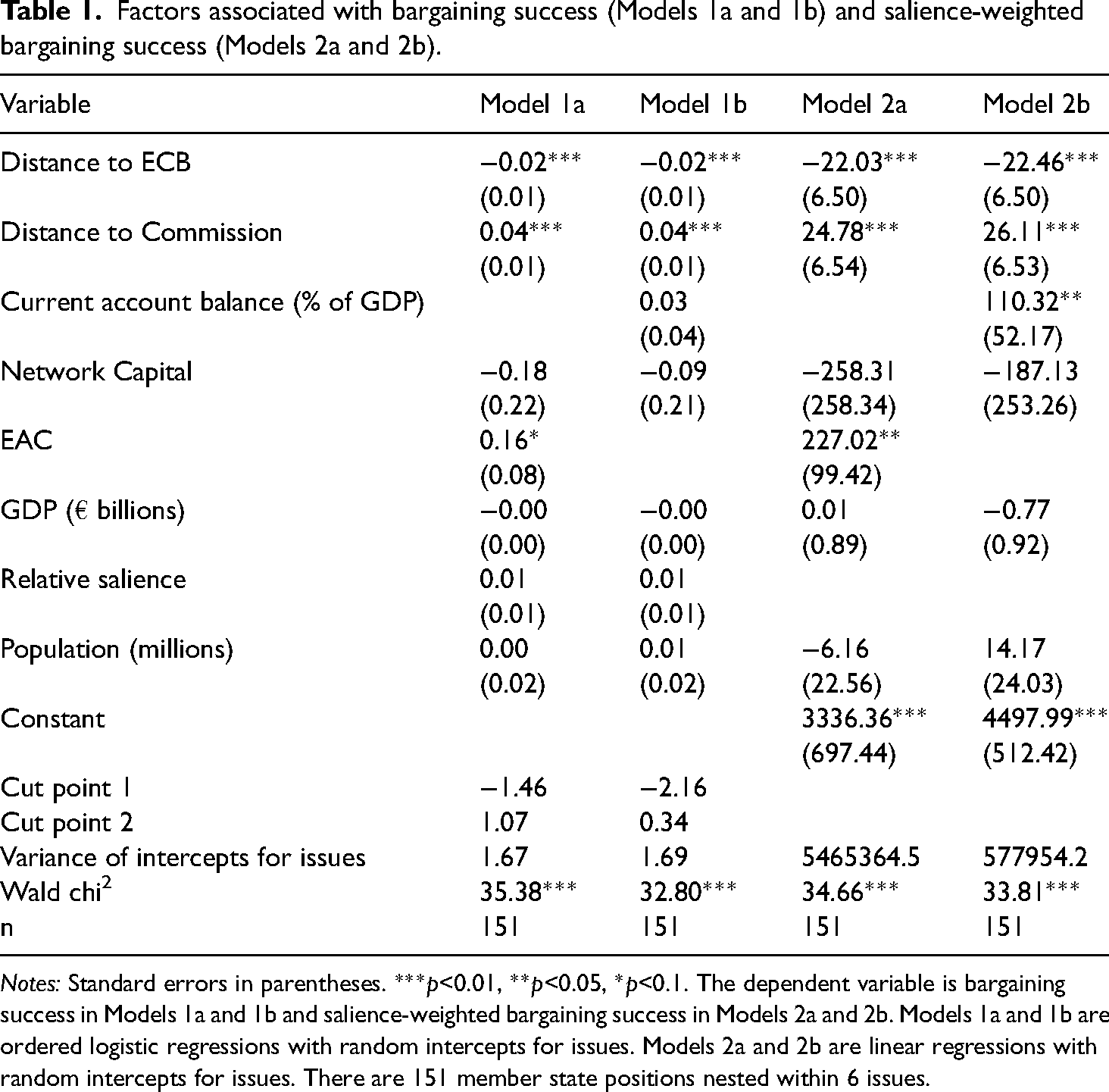
Notes: Standard errors in parentheses. ***p<0.01, **p<0.05, *p<0.1. The dependent variable is bargaining success in Models 1a and 1b and salience-weighted bargaining success in Models 2a and 2b. Models 1a and 1b are ordered logistic regressions with random intercepts for issues. Models 2a and 2b are linear regressions with random intercepts for issues. There are 151 member state positions nested within 6 issues.
There are 151 observations in our Task Force dataset. On five of the six issues there are 26 member state observations. On the sixth issue there are 21 member state observations. As this issue concerned whether Post-Communist EU Member States that had undertaken pension reforms should be exempt from the EDP, a number of southern member states opted not to take a position. The dependent variable in our study is based on the distance between the position of each member state and the decision outcome on each of the six controversial issues in the Task Force. We start by calculating bargaining success as:
We operationalised the independent variables using data from the interviews and other sources. The variables measuring distance from the ECB and Commission reflect the absolute value of that distance for each member state on each issue. In formal terms with the example of distance to the ECB, this is:
To measure debtor status, we use data on member states’ current account balances as a percentage of their GDP in 2010 (World Bank, 2022). We operationalise the economic power and population variables with data from Eurostat on GDP for 2010 as expressed in billions of euros, and the total population of the member state expressed in millions. For the network capital and EAC variables we use pre-existing data collected by Naurin et al. (2020) and Karlas (2012). Network capital is the level of co-operation between national delegations in the Council's EPC in 2009. A member state's network capital is the average point given to a member state by representatives of other member states. Scores are based on the order in which member states are mentioned by representatives. The scoring is as follows: 1st mentioned = 10 points; 2nd mentioned = 9 points…10th mentioned = 1 point; and >10th = 0 points (Naurin and Lindahl, 2010: 491).
The EAC data consist of five dimensions of control: (1) whether both or only one of either the EU proposal and the government's negotiating position are scrutinised; (2) whether committees other than the EAC are frequently involved in scrutiny; (3) how frequently mandates are adopted or whether a scrutiny reserve is used; (4) the extent to which parliamentary mandates are binding and (5) whether the upper chamber contributes to adopting mandates and whether it is consulted by government if a mandate cannot be followed (Karlas, 2012: 1101). Higher numbers on the index represent tighter control of governments by parliaments. As a robustness check, we also run our models with Winzen's (2012) data on national parliaments’ control over governments in EU affairs. Results for this are in the Online appendix.
To operationalise salience, we use data collected through the interviews on the level of salience attached to each issue based on the senior bureaucrats’ estimates on a 0–100 salience scale (Arregui and Thomson, 2009). The key-informants were asked to provide a thorough explanation for their estimates. On the basis that salience is unlikely to make a difference if all member states prioritise an issue similarly highly, we use measures of relative salience. There are different ways of building this into a model. We created relative salience scores, following Arregui and Thomson (2009: 664), by subtracting the mean salience for an issue for all member states, from each state's own salience score on that issue. We use this as an independent variable. As a robustness test, we also run our models with an alternative measure whereby salience is incorporated in the dependent variable. We adapt Golub (2012)'s approach by multiplying bargaining success on an issue by the salience a member state attaches to that issue. We correspondingly remove relative salience from the independent variables in those models, where the dependent variable is salience-weighted success (Golub, 2012: 1300). 4 Descriptive statistics for variables included in the models are reported in the Online appendix.
Analysis
Before beginning our multivariate analysis, we consider some descriptive data on actors’ positions and bargaining success. Figure 2 shows the mean position of all actors in our data across the six issues we identified in the Task Force's deliberations. Note that positions were coded such that higher scores indicate preferences for fiscal discipline while lower scores indicate the opposite. As in previous work on patterns of preferences in the Council (e.g., Bailer et al., 2015; Lehner and Wasserfallen, 2019), we see an alignment based to some extent on creditor and debtor status. Many of the debtor states (such as France, Greece, Spain, Ireland and Italy) have preferences positioned towards the middle or left-hand side of the x axis, indicating opposition to fiscal discipline. States with current account surpluses in 2010 are among those taking the opposite view, positioned near the right-hand side of Figure 2, including Luxembourg, the Netherlands, Finland and Germany. This reflects some of the northern/eastern versus southern divide referred to by our interviewees.
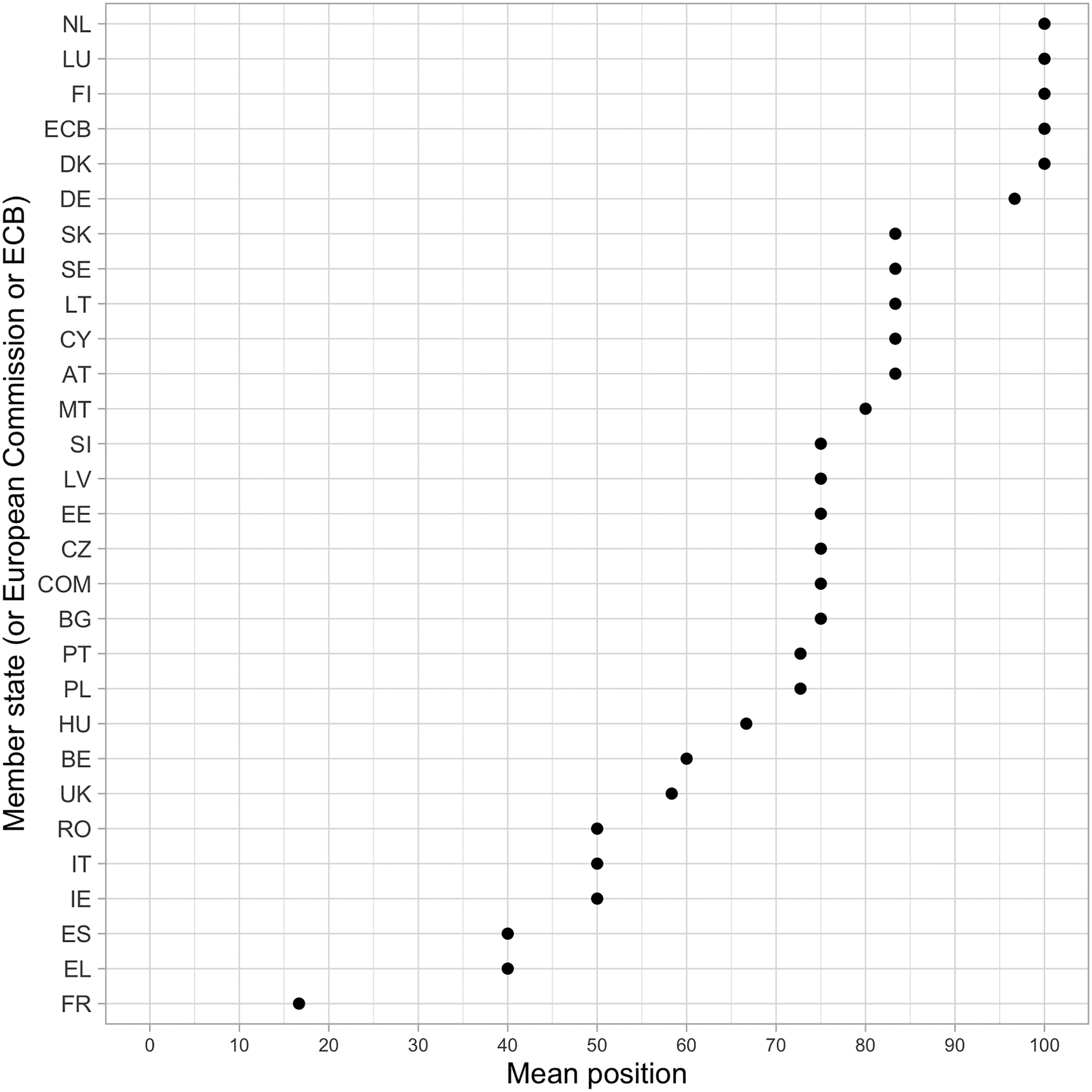
Mean position of each actor across the Task Force issues.
Figure 3 shows the mean level of bargaining success of each member state, the ECB and the Commission. There are three notable findings. First, there is some evidence, although it is rather mixed, of a creditor-versus-debtor alignment in the distance between preferences and outcomes. Some states with current account deficits are among those with the largest gaps between preferences and outcomes (Greece, Spain, France, Italy, Portugal) while some creditors (Luxembourg, the Netherlands, Germany and Finland) have higher bargaining success.
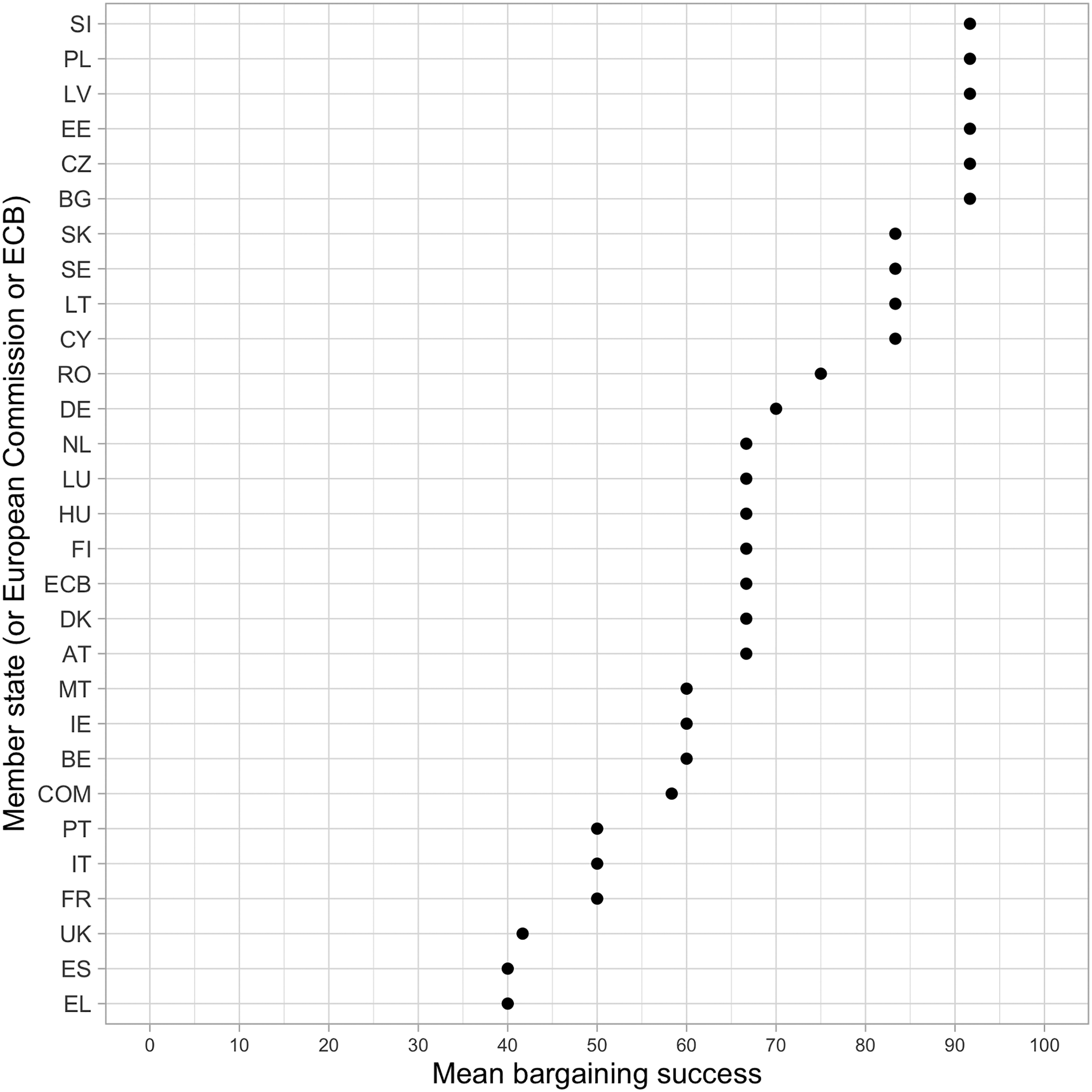
Mean bargaining success of the ECB, commission and member states in the Task Force.
There are exceptions to this pattern. States such as Slovakia and Cyprus had deficits in 2010 but took positions towards the fiscal-discipline end of the scale (Figure 2) and had higher success than other debtor states (Figure 3). These findings therefore partially fit with research that finds outcomes in EU economic governance reform are closer to, if not entirely in line with, the preferences of creditor states (Schimmelfennig, 2015). Second, Figure 3 fits with the findings of other research that the policy preferences of the post-2004 cohort of member states (Lundgren et al., 2019) and some small states (Golub, 2012) were reflected in the outcomes of negotiations on other issues. A third notable finding is the comparatively low level of bargaining success for the Commission, which runs against H1, and the better position of the ECB, which is consistent with H2. We investigate this further in our multivariate analysis but it seems to indicate that the set-up of the Task Force was perhaps less conducive to Commission influence than conventional decision-making procedures.
To assess our hypotheses, we analyse member state bargaining success on all issues in our dataset. The data have a two-level structure with 151 member state positions nested within six issues. To deal with this, we use multilevel regression, with random intercepts for issues. There is a considerable correlation between our measure of the power of European Affairs Committees (Karlas 2012) and member states’ current account balances (0.55, p<0.001). We therefore look for the effects of these variables in separate models. Table 1 presents the results. In Model 1a and Model 1b the dependent variable is our ordinal measure of bargaining success with relative salience included as an independent variable. These models use multi-level ordered logistic regression with random intercepts for our six issues. The dependent variable in Model 2a and Model 2b is salience-weighted bargaining success and relative salience is excluded from the independent variables. These models are based on a multi-level linear regression with random intercepts for issues.
All four models show, contrary to H1, that distance from the Commission is associated with higher bargaining success in the Task Force negotiations. This is consistent with Chang's (2013) findings that the Commission's role was marginalized in the policy process that applied via the Task Force. Without its conventional leading role of talking to interested actors in the Council and using that information to propose draft legislation likely to gain support (Chang, 2013: 259), the Commission seems to have been further away from the positions of the most successful actors. All the models show, in contrast, that greater distances from the ECB's position were associated with lower bargaining success, consistent with H2. Note that in Model 2a and 2b, distance from the ECB (and distance from the Commission) should be interpreted as being associated with higher bargaining success for those issues about which member states care the most. These findings concerning the ECB make sense in light of the complexity of the issues under discussion combined with the ECB's expertise in this area of policy (increasing the likelihood that member states would rely on the ECB's suggestions in deciding on their positions) and the greater opportunity for influence afforded to the ECB via the Task Force compared with the Community Method of decision-making. There are two reasons why these findings are important. First, on the influence of the Commission, the findings provide a different perspective on the influence of this institution on the bargaining success of the member states. As noted in our literature review, several scholars of decision-making in the EU have found that the Commission has a positive effect on a member states bargaining success, we did not. Second, the finding that proximity to the ECB's position was associated with higher bargaining success supports the contention (H2) that expertise can translate into influence. This finding is contrary to those of Tortola and Târlea, (2021: 1964) who concluded that in contexts that are more favourable, the ECB was unable to improve its performance. Thus, our results show that proximity to an actor with much technical expertise (the ECB) matters for outcomes under particular settings. Given that the Task Force outcomes formed the basis of legislation agreed in the Six-Pack, this finding is significant.
Our interviews help shed more light on the contrast between the coefficients for distance to the Commission and the ECB. As we noted earlier, across the six salient issues, the Commission and the ECB took different positions on two. First, on linking debt criteria (a debt to GDP ratio of 60%) to the medium-term budgetary objective (MTO)), the ECB wanted the debt criteria to be binding (ECB1). The Commission argued that the SGP already had a separate procedure for the debt criteria and that linking the debt criteria to the MTO was unwarranted (COM1). On the temporary suspension of funds from the EU budget for member states not meeting the debt criteria, the ECB wanted all EU funds to be eligible for suspension (ECB1). Conversely, the Commission argued that this should apply only to cohesion and structural funds to which there was a clear economic connection (COM1). More broadly, many of the creditor member states took a similar fiscal-discipline-based position to the ECB. This compares with the Commission, which had to take a more nuanced and political approach when addressing the debt criteria in the Task Force, and later in the Six-Pack proposals, due the concerns of high-debt member states such as Italy (MS9). The differences in the positions of the Commission and the ECB on the two issues exemplify the differing approaches to the crisis and the constraints that faced each institution in the negotiations in the Task Force. In responding to the crisis, the ECB took a more hawkish line than the Commission. While welcoming the Commission's ‘Communication on reinforcing economic governance’, 5 the ECB favoured a more ambitious approach based on ‘a genuine sense of co-responsibility of all euro area countries for the smooth functioning of EMU and the soundness of fiscal and structural policies in the euro area’ (European Central Bank, 2010: 4). As Bailer (2014: 49) has noted, the Commission's legislative success depends on the member states. Its position as a conciliator and broker is different from that of the ECB. The ECB has a narrower remit – maintaining price stability – and is independent, making it immune to the political pressures that the Commission faces from member states. Within the Task Force, the ECB was able to champion fiscally hawkish policies as a neutral actor that a more politically inclined Commission could not. Further, the ECB came into the Task Force with a reputation among member states for responding to the financial crisis far quicker than the Commission, while the Commission was considered by the ECB and member states to have been too lenient in the implementation of the SGP in the run up to the crisis (ECB1). We therefore suggest that for these reasons, the ECB's contributions in the Task Force carried more weight among fiscally hawkish member states than the Commission's.
We see only limited support for H3 as it is only significant in our model of salience-weighted bargaining success – although the coefficient for our measure of current account balances as a percentage of GDP is in the expected direction in both cases. The inconsistency of the results for this variable surely reflects the rather mixed evidence in Figure 3 of creditor states being more successful in the negotiations in the Task Force. Evidently, some creditor states such as Belgium and Luxembourg were not as successful in these negotiations as others.
Turning to the control variables, Model 1a and Model 2a indicate that member states with more powerful EACs have higher bargaining success. However, this finding comes with uncertainty: when we use Winzen's (2012) measure of EAC influence (see the Online appendix), the coefficient only reaches statistical significance in the model of salience-weighted bargaining success. Beyond this, our controls for member state bargaining power, in the form of GDP and population size, show no statistically significant effects. This is consistent with the absence of an effect for these variables in some of the models of bargaining success reported in other studies (Arregui and Thomson, 2009; Bailer, 2004; Lundgren et al., 2019). Also, this finding fits with the data in Figure 3 where many of those member states with the most bargaining success are small (or medium sized), central, eastern or northern European countries (such as the Czech Republic, Estonia, Latvia, Poland, Slovenia and Sweden). Our other measure of member state power, in the form of network capital, lacks statistically significant coefficients in our models.
Lastly, Model 1a and Model 1b show no effect for the relative salience that member states attached to the issues discussed in the Task Force. This is consistent with Lundgren et al.'s (2019) lack of findings for salience in their study of bargaining success in the reform of the EU's economic governance.
Conclusions
Between May and October 2010, member states negotiated the Task Force recommendations, which formed the basis of the Six-Pack. The creation of the Task Force and its role in shaping these major reforms to the SGP, represented a new approach to decision-making in the EU. Using data based on the pre-negotiation of the Six-Pack in the Task Force, we have conducted a systematic assessment of member states’ bargaining success. Our findings show that proximity to the ECB was associated with higher levels of bargaining success in the Task Force. This is consistent with the highly technical nature of the policy areas under discussion and with an institutional set-up which gave the ECB greater opportunity to influence outcomes than would be the case under conventional decision-making procedures. By contrast, we find that being distant from the Commission was associated with higher levels of bargaining success. This finding supports qualitative studies arguing that the Commission was not able to take its normal agenda-setting position (Chang, 2013), as the Task Force had been set up by the European Council, which took a leading role with Van Rompuy at the helm (Bocquillon and Dobbels, 2014: 31).
We see patterns in the positions of member states in the Task Force that reflect coalitions referred to in interviews conducted for our data collection. These involve northern and eastern member states taking similar positions on some, if not all issues, that tend towards the fiscally-conservative end of the issue dimensions in our data. Some of the southern member states, by contrast, took positions towards the opposite end of the issue dimensions. While this reflects, to a degree, patterns found in other studies of decision-making in the Council (e.g., Lehner and Wasserfallen, 2019; Wratil and Hobolt, 2019), when taking into account other factors in our models, we find only some evidence that member states’ debtor status was associated with a lack of bargaining success. Specifically, the evidence for this is only seen when we model bargaining success weighted by the salience attached to issues by member states. In these cases, higher current account surpluses in member states were associated with higher levels of bargaining success on issues that mattered most to those member states. This is at least partly consistent with Frieden and Walter's (2017) and Schimmelfennig's (2015) findings concerning the success of creditor nations in EU economic governance reform.
Overall, our findings point to the significance of the ECB in a situation where procedural rules allowed it to devise plans for legislation in a unique situation. When this is combined with its expertise in the subject matter of economic governance, we find that being close to the ECB appears to have been associated with higher levels of bargaining success. Other work has also shown the importance of decision rules in explaining bargaining success in economic governance reform (Lundgren et al., 2019). In our case though, we find evidence concerning a technocratic actor. The implications of this depend on views about technocracy and democracy but the results presented here raise interesting questions about how much the ECB can impact decision-making that ultimately leads to legislation. Further, based on our results, future researchers may find it worthwhile to consider the ECB as an influential actor when examining any future negotiations that emanate from the Commission's forthcoming proposals to reform the SGP.
Supplemental Material
sj-docx-1-eup-10.1177_14651165231157601 - Supplemental material for Working up the six-pack: Bargaining success in the European Council's task force on strengthening economic governance
Supplemental material, sj-docx-1-eup-10.1177_14651165231157601 for Working up the six-pack: Bargaining success in the European Council's task force on strengthening economic governance by David Moloney and Richard Whitaker in European Union Politics
Supplemental Material
sj-dta-2-eup-10.1177_14651165231157601 - Supplemental material for Working up the six-pack: Bargaining success in the European Council's task force on strengthening economic governance
Supplemental material, sj-dta-2-eup-10.1177_14651165231157601 for Working up the six-pack: Bargaining success in the European Council's task force on strengthening economic governance by David Moloney and Richard Whitaker in European Union Politics
Supplemental Material
sj-do-3-eup-10.1177_14651165231157601 - Supplemental material for Working up the six-pack: Bargaining success in the European Council's task force on strengthening economic governance
Supplemental material, sj-do-3-eup-10.1177_14651165231157601 for Working up the six-pack: Bargaining success in the European Council's task force on strengthening economic governance by David Moloney and Richard Whitaker in European Union Politics
Supplemental Material
sj-csv-4-eup-10.1177_14651165231157601 - Supplemental material for Working up the six-pack: Bargaining success in the European Council's task force on strengthening economic governance
Supplemental material, sj-csv-4-eup-10.1177_14651165231157601 for Working up the six-pack: Bargaining success in the European Council's task force on strengthening economic governance by David Moloney and Richard Whitaker in European Union Politics
Supplemental Material
sj-r-5-eup-10.1177_14651165231157601 - Supplemental material for Working up the six-pack: Bargaining success in the European Council's task force on strengthening economic governance
Supplemental material, sj-r-5-eup-10.1177_14651165231157601 for Working up the six-pack: Bargaining success in the European Council's task force on strengthening economic governance by David Moloney and Richard Whitaker in European Union Politics
Footnotes
Acknowledgements
The authors would first like to thank the interviewees for participating in this study. The authors would also like to thank the anonymous reviewers for their very helpful comments during the review process. Their comments undoubtedly strengthened the article. Finally, the authors would like to thank Professor Schneider in his role as editor of European Union Politics and the editorial staff of the journal for their guidance during the review process. D.M. would especially like to thank Dr Frank Häge of the University of Limerick and Professor Daniele Caramani of the European Union Institute for their support during the data collection stage and writing stage.
Author contributions
D.M. designed the article, collected the data for the analysis and outlined the process of data collection. R.W. conducted the statistical analysis. D.M. and R.W. worked on the framing of the article, its contributions to the literature, the explanatory variables and the interpretation of the data. D.M. and R.W. worked on revising the article for its submission and agreed to be accountable for all aspects of work ensuring integrity and accuracy.
Funding
The author(s) disclosed receipt of the following financial support for the research, authorship, and/or publication of this article: The data was collected when D.M. was in receipt of funding for his doctoral studies from the Irish Research Council (Grant ID: GOIP/2015/3280). The authors however are not in receipt of any financial support for the authorship, and/or publication of this article.

Supplemental material
Supplemental material for this article is available online.
Notes
References
Supplementary Material
Please find the following supplemental material available below.
For Open Access articles published under a Creative Commons License, all supplemental material carries the same license as the article it is associated with.
For non-Open Access articles published, all supplemental material carries a non-exclusive license, and permission requests for re-use of supplemental material or any part of supplemental material shall be sent directly to the copyright owner as specified in the copyright notice associated with the article.
