



Abstract
Parliamentarians receive public funding to employ local staff in the constituency. Local staff help members of parliament to execute their representative duties, but can also become an electoral asset. Drawing on theories of personal vote-seeking we study local staff as an example of constituency service. Modelling within-individual changes in local staff size among 1174 Members of the European Parliament (MEPs), we find that the number of local staff increases before both European and national elections, and more so in candidate-centred than party-centred systems. Despite a single European Parliament (EP) staff system, EU citizens are represented differently depending on where they elect their members and the electoral system that applies. Attempts to mend the EU’s democratic deficit by strengthening MEPs’ contacts with citizens through local staff potentially means that European public money is used to fund EP incumbents’ electoral campaigns. We discuss the implications of our findings for the democratic functioning of the European multi-level system.
Keywords
Introduction
Parliamentary allowances for members of parliament (MPs) have grown over the last decades to meet the rising complexity of legislation and constituency work (Poguntke et al., 2016: 665). While allowances are meant for citizen representation, they are frequently spent for electoral campaigning too (Bolleyer and Gauja, 2015: 334; Nassmacher, 2006: 466–450). For example, travel allowances are spent for campaign travel, office space is used for party meetings, telephone and other communication technologies are used for political advertising, and MPs’ staff are involved in campaigning activities (Nassmacher, 2006: 450).
Such behaviour is normatively problematic because funding for representing citizens in parliament obeys different principles than funding for electoral representation. Parliamentary representation is when those who are elected speak, advocate and act on behalf of citizens (substantive representation; Pitkin, 1967). Electoral representation, in the context of this article, are activities that present candidates to voters (formalistic representation). When resources for parliamentary representation are used for electoral representation (e.g. campaigns), voters get a lopsided menu of choice. Electoral competition is under pressure creating inequality among candidates, which public funding for electoral representation seeks to equalise (van Biezen, 2008: 348). As a result, financing for parliamentary and electoral representation ought to be separated, as reflected in electoral financing laws across Europe (Muñoz, 2018).
Parliamentary allowances are nevertheless key to an effective democracy. They endow legislators with resources to monitor the executive and facilitate representation. District work, financed through parliamentary allowances and performed by MPs and their constituency-based (local) staff, is a means for legislators to voice citizens’ grievances, cultivate their trust and link them with representative institutions.
Considering the blurred lines between parliamentary and electoral representation, we investigate the electoral determinants of parliamentarians’ investment in local staff in the European Parliament (EP). We model the spending of Members of the European Parliament (MEPs) on local staff as a function of the electoral calendar and MEPs’ incentives to cultivate a personal vote. Observing the hiring of local staff among MEPs offers an opportunity to empirically assess parliamentary allowances as electoral resources and explore the effect of diverse (European and domestic) career ambitions on MEPs’ behaviour (local staff spending). This is one of the least researched fields in the study of political public finance because politicians are reluctant to share information on public spending (Poguntke et al., 2016: 665). Data on the EP is nonetheless available due to commitments to transparency.
We make a theoretical contribution by casting legislators’ spending on local staff as an example of constituency work and applying insights from the literature on personal vote-seeking. On the one hand, research on MPs’ staff has focused on those working in parliament (Leal and Hess, 2004), while MPs’ staff prioritisation and how it hinges on the surrounding rules are rarely considered. On the other hand, the literature on electoral systems has established that legislators perform more constituency work when electoral rules incentivise personal vote-seeking and that such activities increase before elections (André et al., 2014; Zittel, 2020). However, this literature is limited to legislators’ time and activities, while staff allowances have passed under the radar. Since allowances are institutionally regulated – while legislators’ schedule is not – we ask how rules on staff allowances serve their purpose for parliamentary representation vis-à-vis electoral representation.
Just like the United States (US) Congress, EP rules prohibits members from using allowances to finance electoral campaigns (European Parliament, 2009, 2015; US House of Representatives, 2008). Yet the distinction between constituency service and campaign activities for incumbent candidates is sufficiently unclear that these rules may be of little practical consequence. Mayhew (1974) famously argued that the US Congress was organized to fit members’ electoral goals. This includes a committee system where members can trade influence to provide particularised legislation to their constituents (Shepsle and Weingast, 1981). It also includes time and resources for legislators to invest in their ‘home-style’ to build the trust required for executing their mandate (Fenno, 1978). Local staff in the constituency is central to both strategies. Modern-time legislators find themselves heading large enterprises of staffers (Salisbury and Shepsle, 1981), and a non-negligible part of them are based in the constituencies. While all US Congressmen obtain seats through personal votes, there is substantial variation in how the ballot structure for European elections incentivises personal vote-seeking. Furthermore, no clear MEP majority is subject to a specific ballot structure, which means EP rules are hard to revise. The result is a malleable – but sticky – staffing system that leaves substantial leeway for MEPs’ priorities.
Drawing on a unique data set, we follow the hiring of local staff among 1174 MEPs over a five-year period. We find that EP’s rules only partially dictate members’ decision to hire local staff, while differences in electoral ballots – set by member states – serve as significant predictors. This has three consequences. First, among Western democracies, the size of MEPs’ local staff is only surpassed in the US Congress. The generous staff allowance is justified as an attempt at mending the purported democratic deficit between MEPs and voters (Føllesdal and Hix, 2006). We find MEPs that benefit from a personal vote because they compete in candidate-centred systems keep a larger local staff. This creates differences in parliamentary representation across the EU depending on where citizens elect their MEPs. Second, local staff numbers increase in election years. We interpret the difference as the EP’s ‘subsidy’ of incumbent candidacies. Third, we find similar behaviour when domestic elections approach. This means that staff allowances obtained at the European level for recruiting local staff are also used for pursuing goals at the member-state level, thus missing their purpose. If staff allowances are to ameliorate parliamentary representation in the EU, MEPs should spend them for citizens’ representation at the European level. Our analysis shows that such a link is difficult to realise without considering MEPs’ ambitions and electoral incentives.
This latter point illustrates the practical limitations of extant theoretical debates. Making strong assumptions about where office holders intend to go next, may underestimate the effect of electoral rules. The literature on electoral systems has produced granular knowledge of the conditions for when personal votes matter to candidates, emphasising the mediating effects of intra-party competition and candidate vulnerability (André et al., 2015; Carey and Shugart, 1995; Crisp et al., 2007). These studies assume that politicians anticipate and adapt to the institutional setting of their coveted office (Black, 1972; Stolz, 2003; Schlesinger, 1966). However, the data required for reliable predictions are often unavailable, as scholars do not know which office representatives intend to pursue. When a non-negligible share of legislators seek office elsewhere (as is the case for MEPs), we need to consider the electoral rules regulating MPs’ current office and the rules of other offices that MPs find attractive (Høyland et al., 2019). When assessing the effect of electoral ballots on MEPs’ hiring decisions, we do not assume that all members seek re-election. Instead, we show that even a simple dichotomy between candidate- and party-centred systems in a multi-level system is predictive of local hires.
Our study contributes to a better understanding of the pros and cons of electoral systems for parliamentary representation. We show that MEPs reaping advantages from personal vote-seeking keep more local staff throughout their mandate, potentially improving the citizen-EU connection. However, we also illustrate the limitations that the EP faces when seeking to regulate MEPs’ behaviour regarding staff spending. Certainly, the EP provides members with staff, but member states decide the electoral rules that motivate staff spending. This means that as long as electoral rules are not revised, differences in how EU citizens are represented will linger.
Parliamentary allowances
Parliamentary allowances are public money given to individual MPs to carry out functions deriving from elected office. They are known as the ‘tools of the trade’ enabling MPs to pursue their work as legislators and representatives by covering travel, office and staffing cost. Staff employment is the most significant expenditure, making staff allowances the worthiest of consideration.
Staff allowances
Staff allowances permit parliamentarians to organise an office through the recruitment of personal staff. 1 Personal staff are recruited directly by MPs with contracts tied to parliamentary mandates. Since their career is connected to that of an MP, personal staff loyally serve their employers’ needs and interests (Salisbury and Shepsle, 1981).
Legislators divide their time between the premises of parliament and their constituencies. The organisation of MPs’ offices reflects this division of work. There are two types of personal staff: those working in parliament (parliamentary staff) and those working in constituencies (local staff). MPs’ constituency representation and activities are better understood when studying local staff, especially in parliaments with a high degree of specialisation between staff in parliament and the constituency, as in the US Congress and the EP (Michon, 2014; Schiff and Smith, 1983).
Parliamentary staff help MPs navigate the legislative agenda. They take care of legislative and oversight activities by following the work of committees, the plenary and party groups (Busby, 2013; Jones, 2006; Otjes, 2022; Russell, 2004; Schiff and Smith, 1983; Russell, 2004). They write background notes, draft amendments, questions and plenary speeches, attend meetings with lobbyists, and develop relationships with other MPs and party groups. Parliamentary staff can also play a role in MPs’ representative function when responding to constituents’ policy inquiries and advising parliamentarians on laws’ effects on the constituency. These activities concern MPs’ policy responsiveness to their voters and the party while representing them on substantive issues in parliament (Eulau and Karps, 1977; Norris, 1997).
However, the extent to which parliamentary staff are resources for policy responsiveness is debatable. Hertel-Fernandez et al. (2018) found that Washington-based staff are ill-informed about constituents’ preferences, arguably because of limited face-to-face contact (Kean, 2001). For the EP, it was observed that Brussels offices receive, on average, only four constituency requests per month (Busby, 2013), and that local rather than parliamentary staff deal with constituency mail (Michon, 2014).
In contrast, local staff work on the ground in a constituency office. Their location gives them regular and frequent access to voters, the local party and party supporters (Michon, 2014). Hence, they are well-placed to research constituents’ preferences and advise MPs on how to be policy responsive (Kaslovsky, 2022; Landgrave and Weller, 2020; Russell, 2004; Tomkova, 2014). Local staff participate in town hall meetings and stay in touch with local party leaders; they help hold surgeries and discuss matters of concern to constituents. Moreover, local staff are involved in casework advancing the interest of constituents. As such, local staff are a component of service responsiveness (Cain et al., 1984; Fenno, 1978; Norris, 1997). Many are long-term residents and have a proven record of involvement with community organisations giving them a service-orientated mentality (Kean, 2001; Michon, 2014). They can also act on MPs’ behalf and are carriers of symbolic representation, for instance, when attending events or holding surgeries. 2 Contributing to policy and service responsiveness, local staff engage in reputation-building activities throughout a mandate and during elections (Kean, 2001; Poguntke et al., 2016). Serving constituents and responding to their queries is a desirable part of every elected representative’s job, especially considering decreasing citizen trust in the institutions of representative government.
In performing casework and other constituency-based tasks, local staff can become an advantage to incumbents. The utilisation of local staff for campaigning – either to work on a campaign or as a means to free up incumbents’ time – falls into the ‘grey area’ of political financing that blurs the lines between parliamentary and electoral representation to favour incumbents over challengers. Even in the US Congress, where personal staff’s involvement in campaigns is explicitly forbidden, compliance is challenging to ensure (US House of Representatives, 2008).
EP staff allowances
MEPs’ staff allowances are high compared to other European legislatures, purportedly to mend the EU’s democratic deficit. In 2022, MEPs were allocated EUR 26,734 per month for personal staff (European Parliament, 2022). 3 In comparison, MPs receive EUR 3,690 in Italy (Camera dei Deputati, 2019), EUR 10,581 in France (Assemblée nationale, 2019), £12,994 in the UK (IPSA, 2019) 4 and EUR 23,205 in Germany (Bundestag, 2022). Similarly to the US House of Representatives, MEPs, on average, represent more than 600,000 citizens, which is high even compared to the situation in the largest EU member states. Therefore, like the US Congress, the EP invests heavily to support MEPs in representative activities.
In the EP, local and parliamentary staff are financed over the same budget. As such, the allocation between the two illustrates MEPs’ broader trade-offs between constituency and parliamentary work. Until 2009, MEPs freely allocated staff between the constituency and parliament, with all staff employed under national laws. The majority of MEPs invested the most in local staff, which might seem surprising since the EP receives little attention from voters, parties and the media, and faces few demands from constituents. However, the local investment can be explained as a way to strengthen the EU’s presence in the member states to improve citizens’ perception of the EP as a policy-salient legislature.
Following an expense scandal in 2008, the EP initiated reforms to increase spending transparency. A single set of EU-level rules were introduced for the employment of parliamentary staff (Council of the European Union, 2009). New contracts provided parliamentary staff with incentives to pursue longer careers and acquire expertise equivalent to staff in party groups and the EP’s Secretariat. The greater expertise should have encouraged MEPs to spend more on parliamentary staff (Pegan, 2017, 2022).
A new review in 2015 made it clear that this was not the case. The EP called for a greater spending balance (European Parliament, 2016) requiring MEPs to spend at least a quarter of their allowance for parliamentary staff (European Parliament, 2015). 5 MEPs could no longer employ more than three (exceptionally four) parliamentary assistants at any given time regardless of contract durations.
By comparing the average staff size per MEP before the reform (autumn 2015) with the staff of the same 697 MEPs immediately after its implementation (spring 2016), we see that the reform produced some of its intended effects. The number of local staff decreased on average by 0.75 employees per MEP, while the number of parliamentary staff increased by the same amount (indicated through an average treatment effect of 0.87).
However, the reform did not remove the underlying incentive structure. Notably, the management of local staff’s contracts remained untouched, meaning there is more scope to adjust staffing levels in constituency offices than in parliamentary offices. Unlike contracts for parliamentary staff, which the EP’s administration manages directly, MEPs hire paying agents to process MEPs’ expenses for local staff (European Parliament, 2009). These are subject to different national employment rules and are, therefore, more difficult to verify (European Parliament, 2015). Moreover, despite a cap on local spending, the number of local staff contracts is not limited as in the case of parliamentary assistants. Finally, in contrast to the US Congress, EP rules do not specify which activities relate to the parliamentary mandate and which would qualify as a campaign activity (US House of Representatives, 2008).
These factors allow MEPs to use local staff beyond their parliamentary mandate, for example, for electoral campaigning. Although this is not allowed, the blurred lines between MEPs as representatives and candidates (parliamentary representation versus electoral representation) are such that any rational, goal-oriented politician would respond similarly to the underlying incentives.
Theoretical framework
We look at local staff as a previously unexplored proxy for parliamentarians’ linkage with constituents (Fenno, 1978; Eulau and Karps, 1977). Investing resources towards the constituency positively affects voters’ views on representatives (Parker and Goodman, 2009), and we argue that electoral concerns drive this investment. Legislators may well pursue power in parliament and good public policy. However, to obtain these, members must secure (re-)election (Mayhew, 1974).
Local staff and ‘home style’
Legislators – with support from local staff – invest in their ‘home-style’ to build the trust required to execute their mandate (Fenno, 1978). MEPs’ local investment for staffing varies despite the same budget and common rules. We argue that this is due to different rules structuring European elections and MEPs’ varying career goals.
First, local staffing is affected by the importance of personal vote-seeking. This is in turn determined by electoral rules (André et al., 2014; Cain et al., 1984; Carey and Shugart, 1995; Farrell and McAllister, 2006; Farrell and Scully, 2010). At the European level, all electoral systems follow proportional representation with variations in the ballot structures between open/flexible and closed lists (Däubler et al., 2021). In closed-list systems, the party determines the order of candidates, and voters can only choose between different party lists. The party has thus substantial influence on who is elected. We classify closed-list systems as party-centred systems.
In contrast, open- and flexible-list systems leave voters a choice between candidates. Preference votes thus impact candidates’ election chances. These systems are known as candidate-centred. Candidates are more likely to invest in visible activities, such as constituency work carried out by local staff, since success depends on the support of many relatively uninformed voters. Therefore, we hypothesise that, compared to party-centred systems, individuals competing in candidate-centred systems allocate more resources to local staff throughout their parliamentary mandate.
We can reverse the argument and observe it from candidates’ perspectives in party-centred systems. Here, candidates’ profiles are important for the within-party selection process. To improve their list placement, incumbents invest in activities that the party values. Assuming parties are policy-seekers and better informed about legislative activities than voters, incumbents are prone to do less constituency service and more legislative work. Hence, they employ fewer local staff than members from candidate-centred systems. This meshes with findings that MEPs’ legislative record – built using parliamentary staff – positively affects the re-(s)election in party-centred systems (Frech, 2016; Hermansen, 2018). In contrast, the impact is minimal in candidate-centred systems (Däubler et al., 2018).
H1: The number of local staff is higher in candidate-centred systems than in party-centred systems.
Several studies report that ballot structures affect behaviour in the EP. MEPs from candidate-centred systems maintain more contacts with constituents, hold permanent local offices (Bowler and Farrell, 1993; Farrell and Scully, 2010), do casework and surgeries (Poyet, 2018), and display greater presences on social media than MEPs hailing from party-centred systems (Daniel et al., 2019). We begin by verifying that these insights also apply to MEPs’ prioritization of staff allowance.
Local staff and the electoral calendar
We further argue that local staffing varies according to the electoral cycle. Specifically, we expect that MEPs mobilise before elections. Local staff can be hired for shorter periods than Brussels-based parliamentary staff allowing MEPs to dynamically adjust their local office size for campaign needs. Indeed, many local staffers have ‘militant’ backgrounds and campaigning experience (Michon, 2014). The relative rule ambiguity on EP’s local staff – compared to rules in the US Congress and those that apply for EP’s parliamentary staff – facilitates this mobilisation. Similar behaviour has already been observed among US Congressmen (Kean, 2001) and political parties (Poguntke et al., 2016: 666; Moens, 2021). We investigate the same logic at the individual level in the EP and hypothesise that members hire more local staff before elections.
H2: The number of local staff increases before parliamentary elections.
Third, we bring these hypotheses together, expecting that members mobilise more when they stand to win from garnering personal votes.
H3: The number of local staff increases the most before parliamentary elections among members from candidate-centred systems.
Multilevel governance and career ambitions
The link between constituency service and electoral rules, as well as campaign activities and electoral rules, is well established (Bowler and Farrel, 2011; Farrell and Scully, 2010). Although evidence shows that the territorial organisation of government shapes service responsiveness, few studies have investigated these relationships for multilevel governance (André et al., 2014). Testing these theories in the EU informs us of how well they travel across institutional contexts.
We look at the context of multilevel governance from the viewpoint of MEPs’ career ambitions. In multilevel systems, parliamentarians’ career goals are diverse (Black, 1972; Schlesinger, 1966). They seek re-election to their current office (static ambition) or wish to secure office elsewhere (progressive ambition). The EP is no exception. Survey data indicate that 38% of MEPs in our sample aimed for European careers, while 18% favoured domestic careers (Hix et al., 2016). This implies that some MEPs might use staff to secure elections outside their current office and compete for a national mandate. Therefore, we expect MEPs to adapt to both European and national contexts. However, since the proportion of MEPs that aspire to national mandates is lower, we expect a more moderate response to national settings.
H4: Hypotheses 2 and 3 apply to both European and national parliamentary elections.
Extant research has established that participation in legislative activities is a function of MEPs’ static (European) or progressive (national) ambitions (Høyland et al., 2019). Our study explores the same dynamic focusing on what happens in the constituency.
Data and method
Our dataset includes observations of 1174 MEPs. We do not have the starting employment date for each local staff, but we know when they first appeared on the EP website. To account for the publication lag, members were observed each semester (January–June; June–January) between 2012 and 2017. During this period, all member states organised at least one national election in addition to the 2014 European ballot. In total, the data includes 7143 observations, with each MEP being observed up to 10 times.
Variables
The dependent variable reports the Number of local staff that an MEP employed at the time of the observation. Where MEPs share local staff, we divide their number by the number of MEPs they work for. The variable ranges from zero to 43, with the median MEP employing two individuals. The range is large because local staff are paid national wages, while MEPs’ budget is the same. This means that MEPs’ capacity to finance local staff varies. To control for wage difference, all models include a measure of Labour cost, which effectively subsumes much of the variation in the number of local staff. When exploring the effect of the electoral calendar, we also include a lag of the dependent variable, which further subsumes the between-member variations.
We cannot distinguish between part-time and full-time staff because the EP does not report this information. As an alternative to the main regressions, we model our dependent variable as if it contained rounding errors (Lunn et al., 2012: 195–201). Since the results are similar, this model is presented in the supplemental material.
MEPs are free to share staff (European Parliament, 2009). However, as Figure 1 shows, few MEPs did so before the 2016 reform. This changed once local spending was capped. Pooling resources is more common among MEPs that can expect less intra-party competition in the next election. Six months after the reform, 51% of the MEPs from countries where elections are party-centred shared at least one local staff. In contrast, only 21% of the MEPs that are elected in systems where national and European elections are candidate-centred, shared local staff. This speaks to the degree of trust between colleagues in party-centred systems and the resulting efficiency gains in staff spending that the electoral rules can induce. The gradual increase in staff allowances has historically contributed to MEPs’ independence vis-à-vis the transnational party groups. In contrast, the renewed trend towards sharing local staff may shift the power relationship favouring MEPs’ national parties.
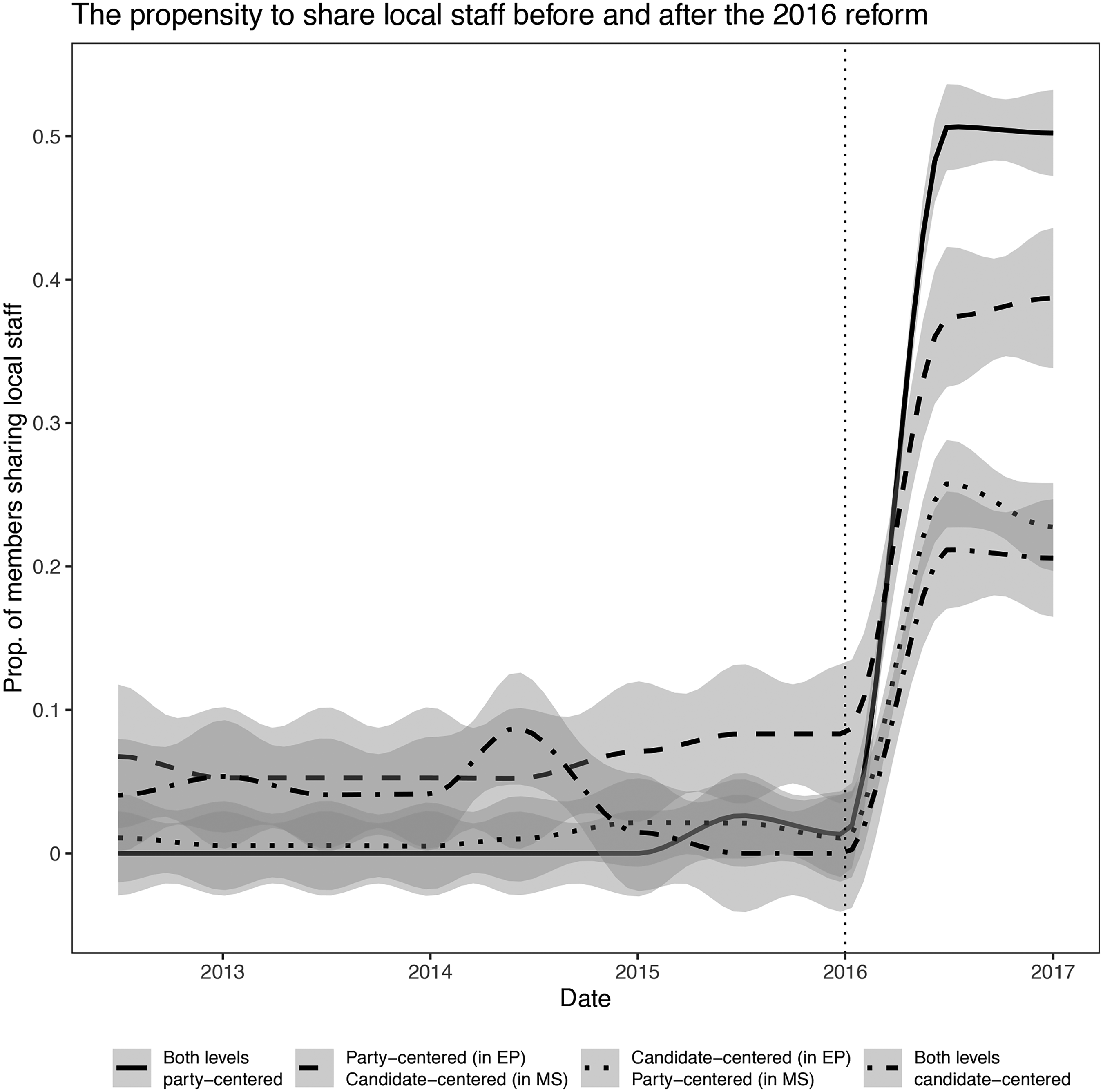
Sharing local staff became more prominent among MEPs after the 2016 reform and is more common in party-centred systems.
Our main explanatory variables are the proximity to European and national elections and the electoral system employed. Proximity to European election indicates the spring term before the 2014 election. Although more frequent monitoring of MEPs’ staff size would be desirable, it implies more measurement errors since we only have the publication date of the employment. In contrast, since national elections are staggered, Proximity to national election is a continuous measure capturing the (negative) number of years to the next national parliamentary election. Electoral cycles vary between 4 and 5 years. For comparability, we censured the measure to a maximum of 4 years.
For clarity (and statistical power), we dichotomise our explanatory variables into candidate- and party-centred systems. This way, we have a robust measure that taps into the effect of incentives to personal-vote seeking on MEPs’ staff hiring (Table 1). At the European level, all systems follow proportional representation. We adopt a restrictive definition of ‘party-centred’. Party-centred system (EU) describes lists that are either ranked and closed or the possibility to reorder candidates is such that it rarely affects the distribution of seats. The remaining systems – open lists, single transferable votes and where the majority of lists are ‘strongly flexible’ – are lumped together and labelled Candidate-centred system (EU). This classification is based on Däubler and Hix (2017) (see the Online appendix).
Combinations of national and European electoral systems according to their incentives to cultivate a personal vote.
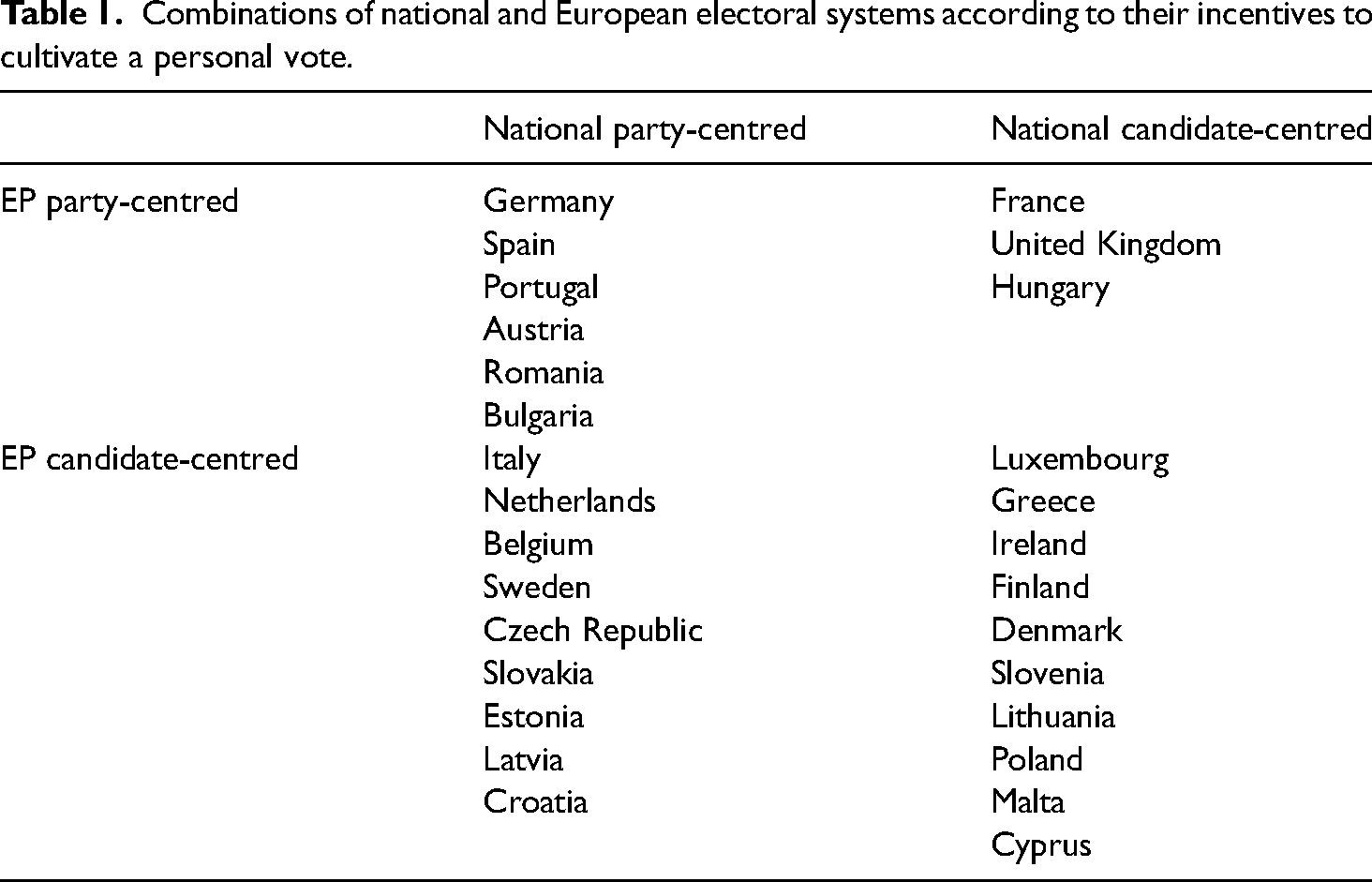
At the national level, we apply a slightly different cut-off: The variation in electoral systems is greater. We rely on the rank-ordered index suggested by Farrell and McAllister (2006) and updated by Söderlund (2016). We applied a cut-off between mixed-member systems such as Germany (‘party-centred’) and single-seat districts such as France and the UK (‘candidate-centred’). In other words, we use a cut-off at 4; between ‘Mixed-member system with plurality rule’ and ‘Single-seat districts, plurality with party control’. We have relied on descriptions available on the Inter-Parliamentary Union’s Parline database for the remainder of the member states.
Our results could depend on the classification thresholds. To counter this, we took several measures. First, while the original scale is ordinal, we preferred a binary classification. Second, we opted for a restrictive definition of ‘party-centred’ systems. Third, we tested alternative classifications. The results remain largely the same (see the Online appendix).
Control variables. Since 2016, MEPs have to spend at least a quarter of their staff allowance for the employment of parliamentary staff. The variable Reform indicates whether an observation occurred after the reform.
Party-specific aspects such as size, resources and ideology might impact MEPs’ choice to hire local staff. National laws regulate the financing of national and European elections, and national parties are the main organisers of national and European elections. Since parties receive public grants based on their representation in national parliaments, parties with fewer parliamentary seats are worse off at election time than parties with more seats (Murphy, 2016). Thus, MEPs from parties with smaller national parliamentary representation might have to finance more local staff over their European staff allowance. We control for this aspect with the variable Party size in national parliament, which measures a party’s proportion of seats in the national legislature.
A similar argument can be made for government parties (van Biezen and Kopecky, 2007). Their control over the executive administration gives them more assistance, which implies a negative correlation between MEPs’ staff size and membership in government. On the other hand, governmental parties tend to do worse in EP elections due to protest voting (Reif and Schmitt, 1980), and constituency service may be a strategy to avoid punishment (Kam, 2009). This would imply a positive correlation between staff size and governmental position. We control for these aspects with the binary variable Party in government.
Parties vary in how they value legislation at the EU level. That is, parties’ attitudes towards European integration affect their investment in EU politics (Hobolt and Høyland, 2011). Parties with a more detailed EU policy agenda are more likely to treat European elections as first-order and field candidates with policy-making potential (Pemstein et al., 2015). Such parties are also more likely to resource their candidates appropriately for European elections and thus limiting MEPs’ drive to deploy local staff for European elections. Furthermore, attitudes towards European integration are often shared by parties and MEPs. Stronger European attitudes are likely to reflect MEPs’ institutional identity and propensity to pursue a European career. Political actors with strong institutional identities use parliamentary allowances less frequently as a source of indirect income (Bolleyer and Gauja, 2015). This leads us to expect they are also less likely to use staff allowances for unearmarked purposes. We control for these mechanisms with the variable Party’s euroenthusiasm, which is a 7-point scale with high levels indicating pro-EU attitudes (Bakker et al., 2015; Polk et al., 2017).
In addition to the average labour cost, we use the number of seats in the EP to control for the Size of member state. MEPs from larger member states have reasonably more need for local staff because they need to connect with more constituents. We furthermore allow for the possibility that MEPs are at the end of their political career (Age) or have already opted for a European career and, therefore, enjoy a certain incumbency advantage that lets them spend less on local staff (Incumbent, i.e. they have been re-elected at least once).
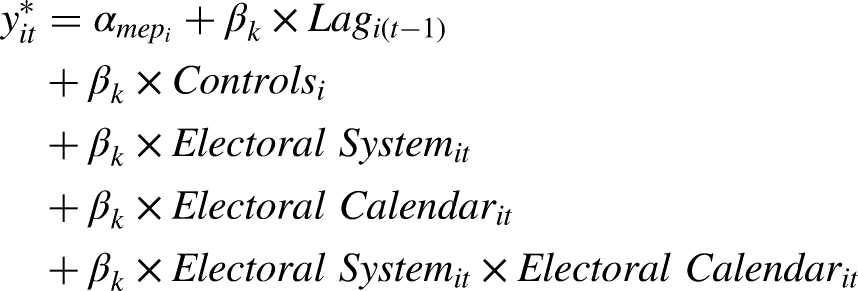
Modeling choices
Our dependent variable,
First, we compare between electoral systems while controlling for period-specific fluctuations in local hiring (Model 1). We include random intercepts for the time-period in question (
Results
We begin by verifying whether electoral rules condition the hiring of local staff. The first model controls for the fluctuations in local staff size to investigate the time-invariant elements of local spending. We anticipate that MEPs as a group are responsive to both national and European-level electoral rules. The model consequently includes combinations of electoral systems at both levels of government as dummies. The reference group is MEPs from member states applying a party-centred ballot for national and European elections.
As reported in Table 2 and illustrated in Figure 2, local staff size is significantly larger in candidate-centred systems (H1). Where European and national elections use party-centred ballots, the typical MEP is predicted to employ around two local staffers. 6 This number increases to almost five when all venues are candidate-centred. The most substantial difference is between systems at the European level. This is expected, as more MEPs pursue European rather than national careers.
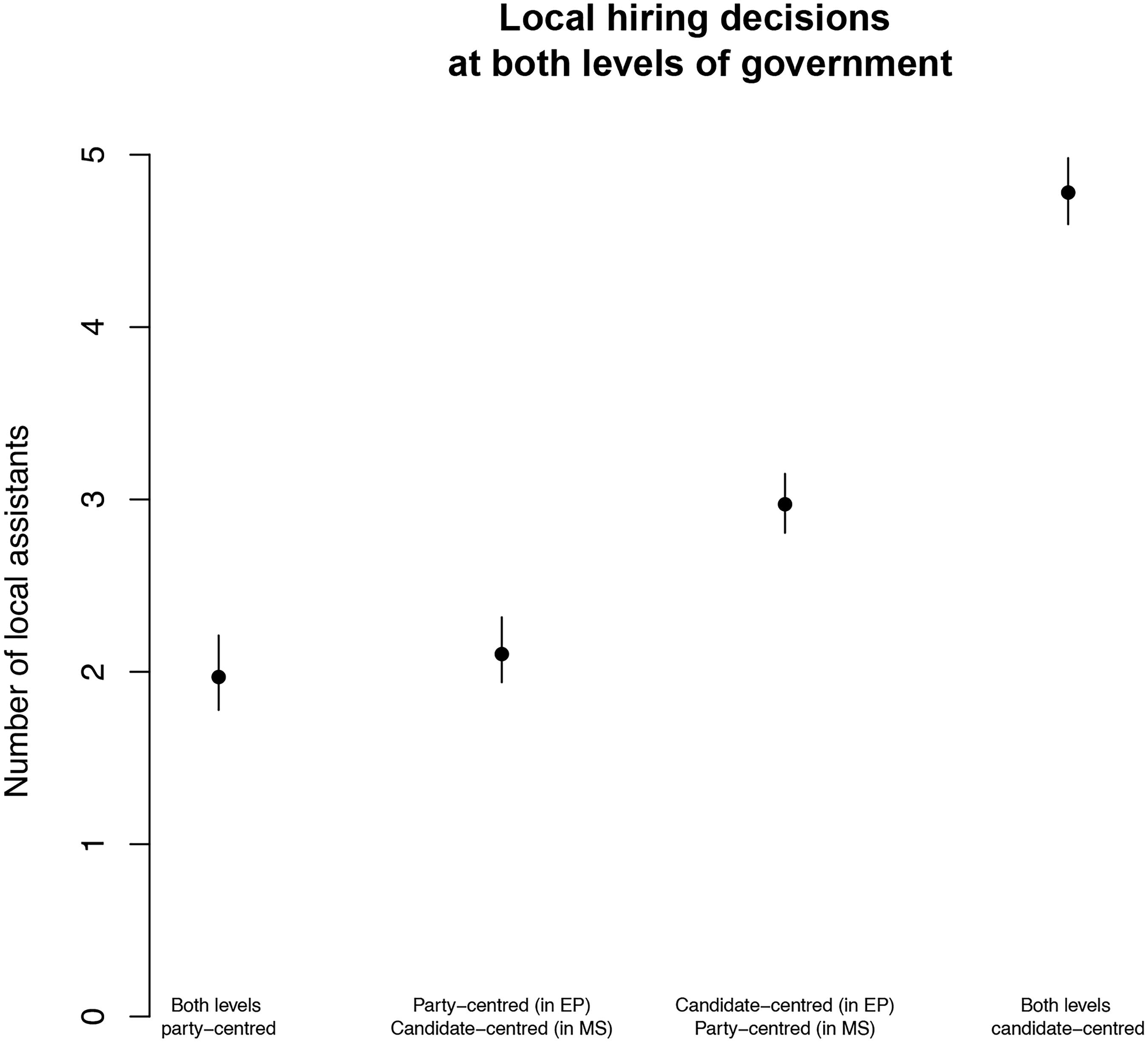
The size of local staff increases as the share of MEPs who need to cultivate a personal vote increases (Table 2, Model 1).
The use of local staff is conditioned by the electoral system. Results from a left-censored (Tobit) regression with varying intercepts for time periods.
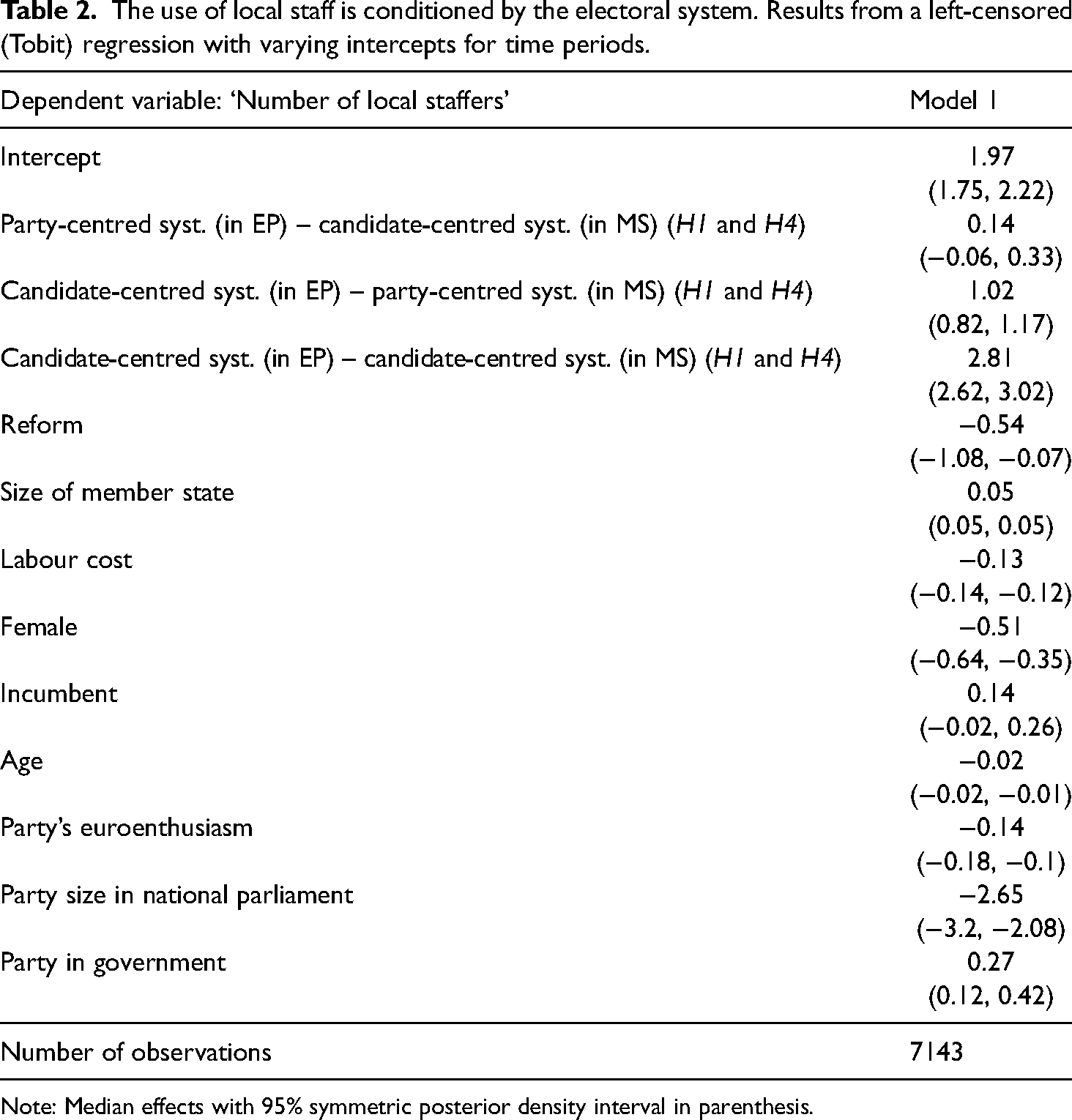
Note: Median effects with 95% symmetric posterior density interval in parenthesis.
MEPs’ responsiveness to incentives deriving from electoral rules follows the argument that electoral ambition motivates constituency representation. This is visible in the local staff size differences between MEPs who stood for EP re-election in 2014 and those that did not. Table 3 reports the results from a binomial model where we estimate MEPs’ likelihood to stand for re-election (candidacies) as a function of their local staff, controlling for career stage and nationality. Since local staff size is heavily skewed, it is log-transformed. An additional local staffer increases the likelihood that an MEP seeks re-election by 44%. This number more than doubles when considering the difference between MEPs with one local staffer (25th percentile) and those with four (75th percentile). This is in line with H2.
Candidacies to the 2014 European election as a function of local staff size immediately prior to the election.
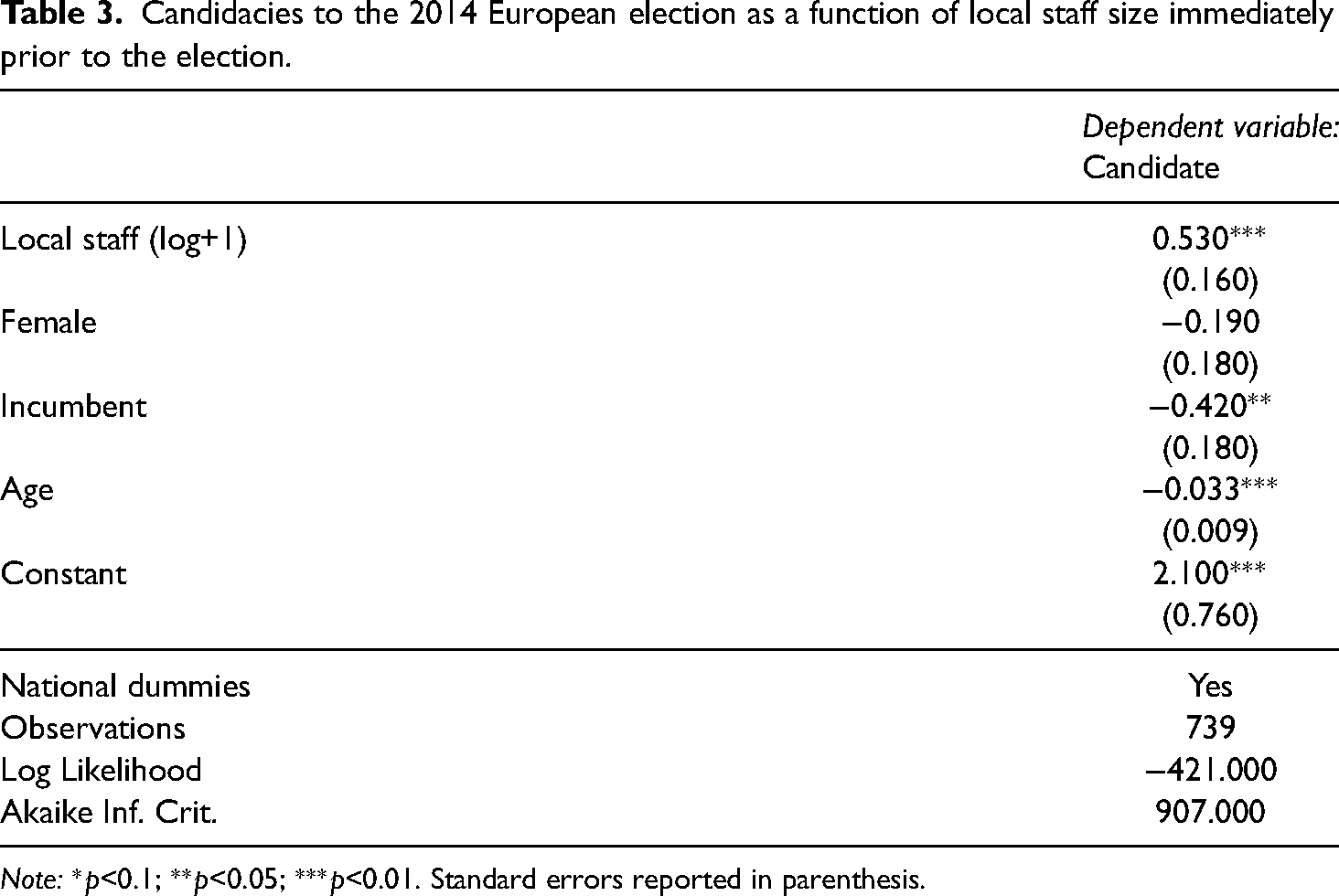
Note:
We explore this argument further by investigating whether local staff increase before elections and to what extent European and domestic electoral rules condition the effect. Since acquiring the party’s endorsement is endogenous to MEPs’ electoral pursuit (whereby members with the lowest chances of success may mobilise the most), we leave aside the actual candidacy to consider mobilisation. For context, we compare our results with re-election rates and the proportion of MEPs claiming to pursue either a European or a national political career as recorded in the EP Research Group (EPRG) Survey (Hix et al., 2016).
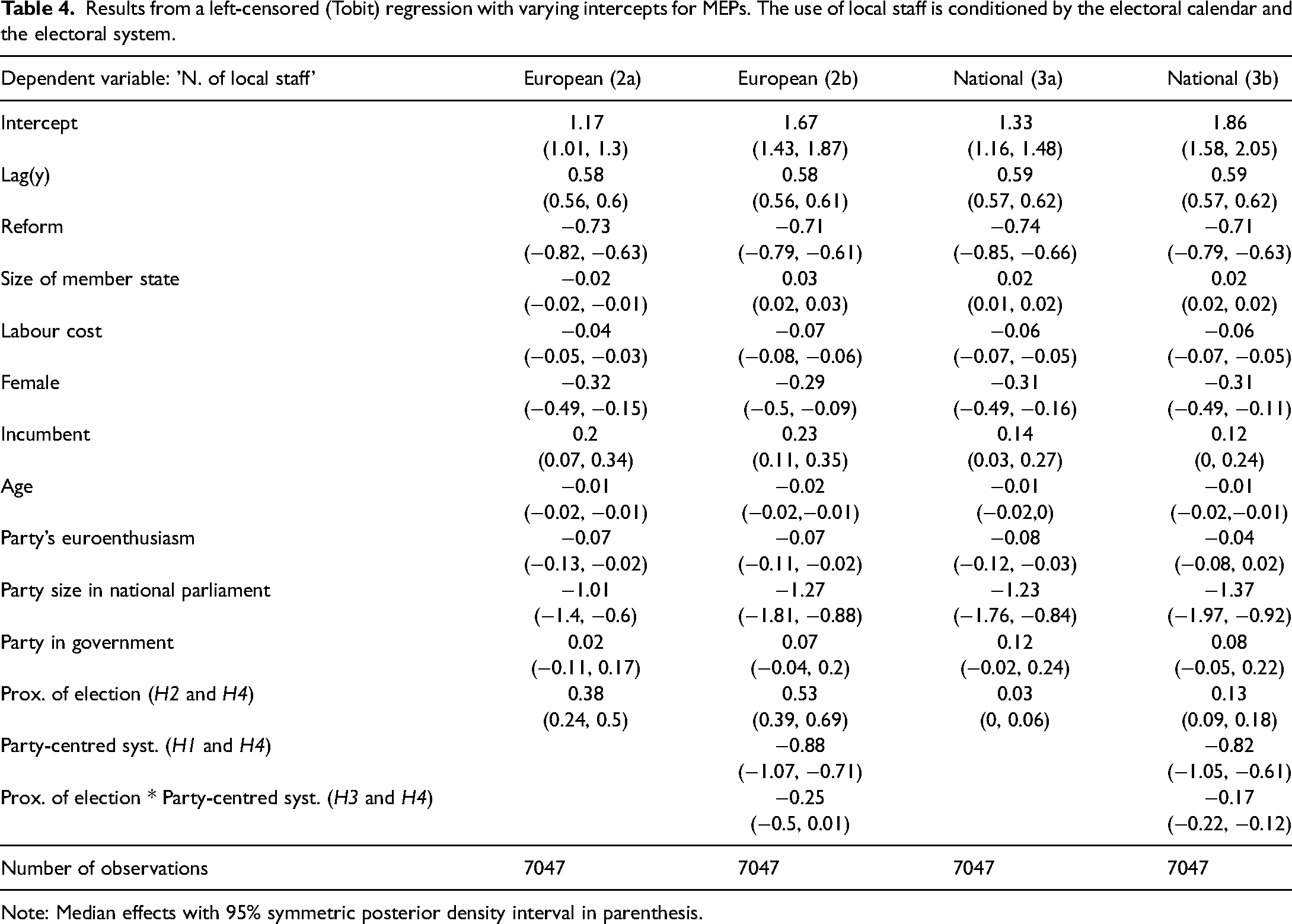
Our focus is on the time-varying component in MEPs’ hiring decisions. Thus, the models estimate the ‘quasi-change’ in local staff size as a function of the electoral calendar. The results are reported in Table 4 and illustrated in Figures 3 and 4. They show – in line with H2 and H4 – that the number of local staff increases before elections regardless of the level of government. However – as predicted by H3 – the electoral system mediates the degree of mobilisation. MEPs hailing from candidate-centred systems are more likely to proceed to additional local hires before elections.
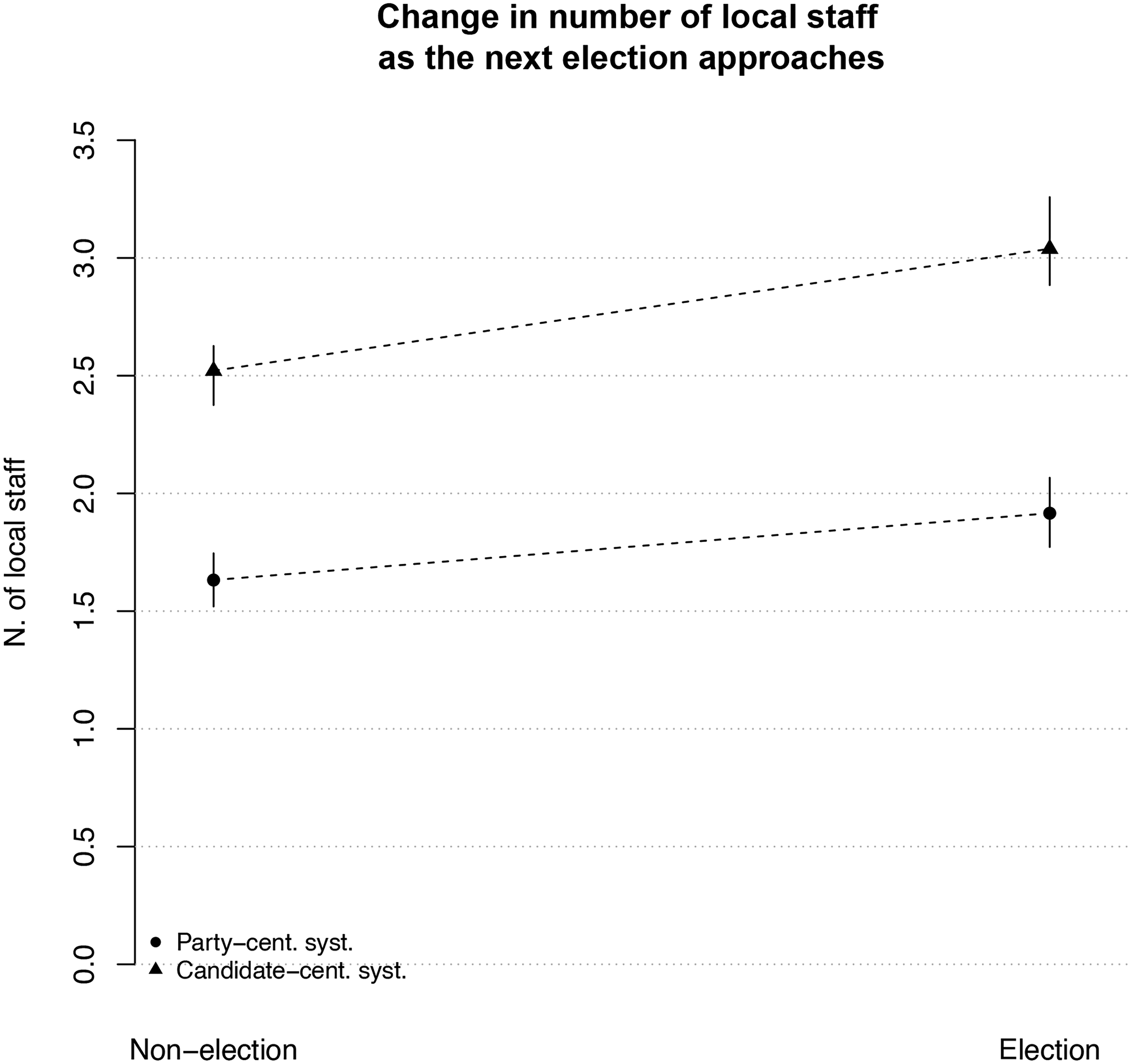
Members of the European Parliament (EP) mobilise before EUROPEAN elections by hiring more local staff (Table 4, Model 2b).
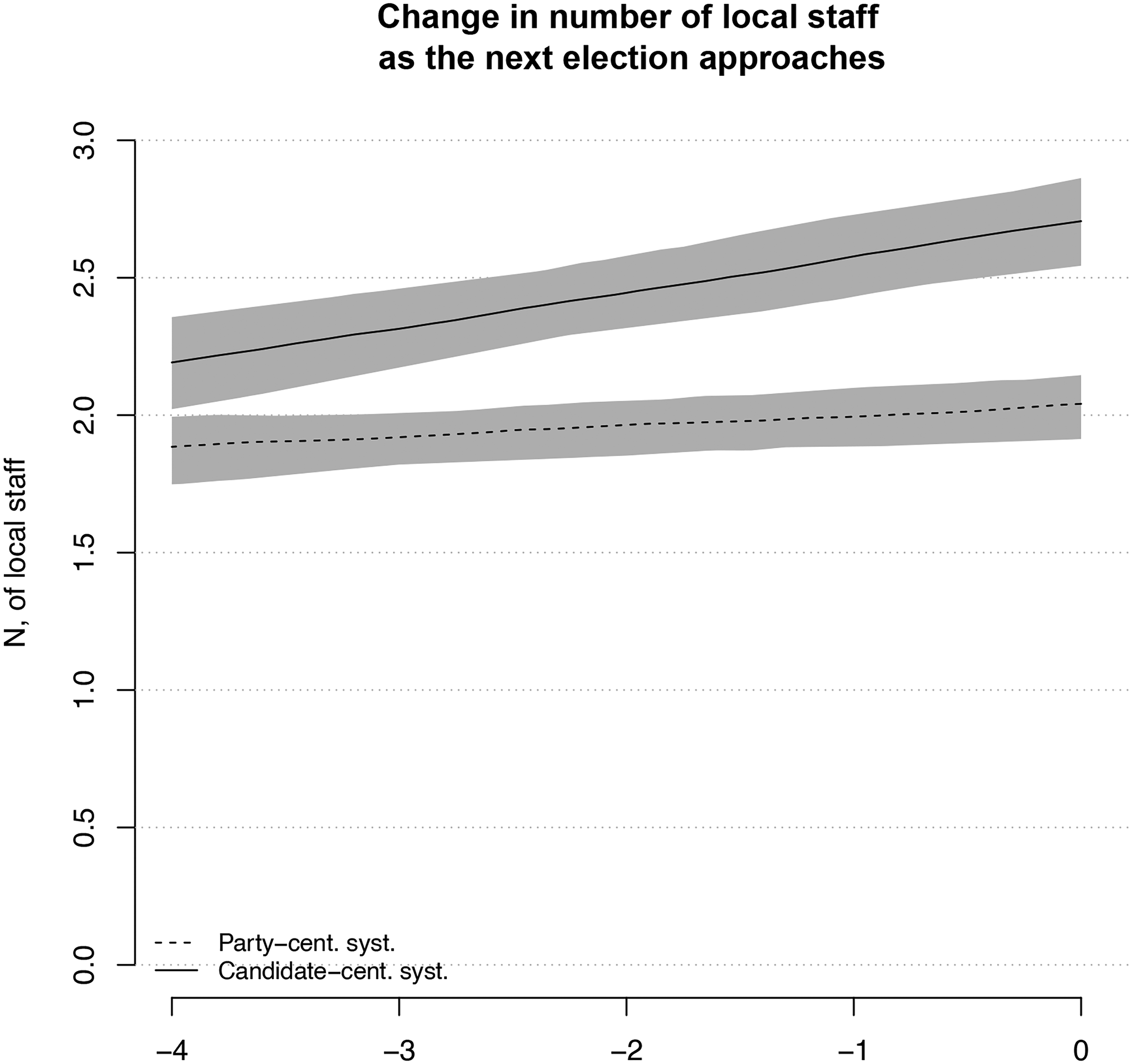
MEPs also mobilise before NATIONAL elections by hiring more local staff (Table 4, Model 3b).
Results from a left-censored (Tobit) regression with varying intercepts for MEPs. The use of local staff is conditioned by the electoral calendar and the electoral system.
Note: Median effects with 95% symmetric posterior density interval in parenthesis.
Mobilisation in party-centred systems implies a median increase of 0.28 local staffers per member before European elections. A possible interpretation is that one in four MEPs recruited an additional employee for the campaign period. This is lower than the 38% of MEPs (from European party-centred systems) who in the EPRG survey indicated they wanted to pursue a European career. In contrast, national elections do not impact hires at all. One reason might be that only 14% of the respondents from our sample intend to switch to domestic politics. Overall, many MEPs in party-centred systems do not hire additional local staffers during electoral campaigns. This is in line with the argument that candidates in these systems are elected on the party label and, therefore, have less need for local staff to build a personal reputation.
MEPs from candidate-centred systems proceed to substantially more additional local staff hires during elections. The 2014 European campaign period implied a median increase of 0.53 local staffers per MEP. Stated differently, one in two members was likely to hire an additional pair of hands in the months preceding the European election. This finding is similar to the 54% re-election rate of MEPs in 2014 (Hermansen, 2018: 388).
The same rationale holds for national elections. When national electoral systems are candidate-centred, the predicted number of local staff is 0.51 higher immediately before a national contest than immediately afterwards. The effect can be compared to the 21% of MEPs from our sample who in the EPRG survey reported to strive for a national career. Leaning on this comparison, MEPs who pursue a national career hire two to three additional staffers before national elections. One reason for this high figure might be that MEPs enter national races as challengers and compensate by investing more resources.
Discussion
Our findings shed light on the practical limits and normative implications of the EP’s staff allowance for citizens’ democratic representation. First, in the absence of a common electoral system, there will always be variation in local staff presence in the constituency. Assuming parliamentarians are motivated by (re-)election concerns, MEPs competing in candidate-centred systems keep more local staff than in party-centred systems. With increasing citizen distrust in political institutions, resourcing the representative function of parliamentarians through local staff may increase their knowledge of constituents’ interests and values. However, at best, the current system improves democratic representation in half of the EU’s member states. Furthermore, parliamentary and local assistants are financed over the same budget, so an increase in one leads to a decrease in the other. Increased local spending, therefore, implies fewer resources for parliamentary work, and this varies systematically across member states. This means that EU citizens are represented differently depending on the member state.
Second, our findings speak to the fairness of the electoral contest. To serve both their re-election and legislative goals, MEPs adopt a dynamic approach to recruitment whereby local staff are mobilised before elections and demobilised afterwards. The hiring cycle frees up resources for parliamentary work between campaign periods while reserving assets to contest elections if MEPs later (re-)run for office. The EP, therefore, provides an incumbency advantage to its members that may keep contending candidates out of power. While using parliamentary allowances for campaign spending is illegal, the hiring cycle itself may not be. For example, it may be that local staff free up time for MEPs to campaign for re-election or that constituency activities are strengthened during the campaigning period. A stricter control regime may, therefore, not solve the issue. The trend nevertheless runs counter to the fairness principle that guides most European solutions for state financing of electoral campaigns (Muñoz, 2018).
Third, the number of local staff is conditioned by and varies with national electoral cycles. This suggests that the EU’s multilevel character affects MEPs’ decisions on local staffing. Namely, staff allowances obtained at the EU level are used for electoral purposes at the national level, thus missing representation activities at the targeted (European) level. In particular, EP staff allowances might help MEPs parachute into national politics (when national electoral systems are candidate-centred).
This is a phenomenon that may endure for some time still. In the aftermath of the 2008 crisis, several EU member states reduced public funding for political actors as part of austerity. Diminished funding in the member states means using the EU to finance national political life – as the first-order political arena – becomes more salient. State funding is often indexed on parties’ size in national parliaments. Our results (Table 2) show that MEPs from smaller national parties tend to keep a larger local staff, possibly to compensate for party size drawbacks. For example, an MEP from a small national party (with 5% of the seats) is predicted to keep one additional local staffer on the payroll compared to an MEP from a large party (45% of the seats). While this is a phenomenon across the political spectrum, the EP paradoxically disproportionately finances the national ventures of Eurosceptic parties, which are more prone to invest resources locally. Thus, one in two MEPs from parties with similar attitudes as the French Front National keeps one additional local staffer on their team compared to the average MEP. These two effects are additive. To the extent that Eurosceptic parties are marginal, the EP disproportionately finances the campaigns of its critics. EP staff allowances aim to strengthen the connection between Europeans and EU policy-making. Therefore, the mobilisation of MEPs’ local staff around national elections represents a distinct puzzle.
Overall, our findings indicate that local staff are used to forward MEPs’ careers at the European and national levels. This is not foreseen in the rules governing staff allowances. MEPs, thus, walk a fine line between the intended (parliamentary representation) and unintended (electoral representation) purposes of staff allowances. Public funding for campaign activities and parliamentary activities is common and legitimate. Yet, the first is intended to support candidates; the second is meant to support those who are elected for the purpose of representation. Since funding obeys different principles and functions, they ought to be separated. The current system, in contrast, often incentivises the blending of the two.
Conclusion
We have studied MEPs’ decisions to hire local staff paid through the EP’s staff allowance as a function of their electoral incentives. There are three takeaways from our findings: First, while MEPs’ staff allowance could potentially contribute to bridging the gap between representatives and voters/citizens, local staff is also frequently used for contesting elections (H2). We can interpret the staff increase before European elections as EP’s direct support for campaigning activities. Second, the single allowance system for all MEPs produces very different effects depending on the electoral system in use (H1). Third, MEPs’ behaviour is also conditioned on electoral incentives stemming from the national level (H4). Overall, the EP incidentally finances political careers both inside and outside the EU sphere.
To better understand the consequences of leveraging local staff around elections, we would benefit from research into MEPs’ representative functions in the constituency, namely what activities MEPs and local staff perform, the division of work in the local office and how activities vary considering the electoral calendar. It is often claimed that MEPs play an important role in connecting European citizens to the EU. This is among the reasons why MEPs are so generously endowed with a staff allowance. Two implications for EU democracy arise: First, EP’s staff allowances finance political life and domestic careers in the member states. What are the consequences of this, and is it in line with European goals? Second, to what extent do elections drive MEPs’ constituency presence regarding their representation versus campaigning activities? Considering the low electoral turnout at European elections, which suggests that only a part of the European electorate is connected to European representative institutions, these are important questions to answer in the future.
Supplemental Material
sj-pdf-1-eup-10.1177_14651165221149900 - Supplemental material for Blurred lines between electoral and parliamentary representation: The use of constituency staff among Members of the European Parliament
Supplemental material, sj-pdf-1-eup-10.1177_14651165221149900 for Blurred lines between electoral and parliamentary representation: The use of constituency staff among Members of the European Parliament by Silje Synnøve Lyder Hermansen and Andreja Pegan in European Union Politics
Footnotes
Acknowledgements
We would like to thank the three anonymous reviewers as well as Gerald Schneider and the rest of the EUP editorial team for generous and constructive feedback.
Author contributions
Authors contributed equally.
Funding
The work of Andreja Pegan was supported by the Luxembourg National Research Fund (FNR), AFR Individual grant [grant number 1080494].

Supplemental material
Notes
References
Supplementary Material
Please find the following supplemental material available below.
For Open Access articles published under a Creative Commons License, all supplemental material carries the same license as the article it is associated with.
For non-Open Access articles published, all supplemental material carries a non-exclusive license, and permission requests for re-use of supplemental material or any part of supplemental material shall be sent directly to the copyright owner as specified in the copyright notice associated with the article.
