



Abstract
Research into parliamentary speech making–behaviour of Members of the European Parliament (MEPs) usually takes a static perspective. We offer an interactive and dynamic approach that understands parliamentary debates as a relational network phenomenon and investigates MEPs’ debate interactions. This allows us to uncover dynamics of inclusiveness and pluralism, self-reinforcing power relationships and transnational policy alliances. Analyzing 11,408 debate interactions between MEPs using a combination of text and dynamic network analysis, we find that male, senior and influential parliamentarians from powerful member states receive more attention with evidence for a self-reinforcing effect over time. Interestingly, seniority matters more for debate attention than leadership positions. Sharing the same nationality and a similar political leaning also shape debate coalitions with the former being more important than the latter.
Introduction
Parliamentary debate is a ‘dynamic network phenomenon’ (Leifeld, 2017: 301) because members of parliament interact verbally with one another over time. To capture such interdependent and relational parliamentary debate interactions between Members of the European Parliament (MEPs), we introduce an innovative combination of automated text and dynamic network analysis to answer two interrelated questions: Who refers to whom in European Parliament (EP) debates? Which factors foster or hinder debate interactions over time?
Understanding such debate networks is important because they show how parliamentary actors juggle conflicting principals, deal with an increasingly polarized political environment and try to reconcile the interests of a diverse citizenry in their debate practices. Existing approaches to MEPs’ legislative (speech-making) behaviour have so far largely ignored the networked nature of debate. Current studies rather investigate, for example, who votes how (Koop et al., 2018), who takes the parliamentary floor (Slapin and Proksch, 2010), or who engages in different parliamentary activities (Sorace, 2018). In contrast, we use an actor-based network approach that helps us understand who is central in a network (receiver of debate attention: who is mentioned?) and how debate interactions are structured (who interacts with whom?). It is dynamic rather than static as it accounts for structural factors such as inertia or reciprocity in debate interactions over time.
This dynamic network perspective has three distinct advantages: First, it sheds new light on the inclusiveness and pluralism of EP debates. Although it is important to take into account who speaks in the first place (Sorace, 2018), who ultimately receives attention and whom other MEPs actually engage with tell us more about how inclusive and pluralistic a debate is. A lack of diversity signals continuity and compromise, but less potential for change and innovation in intra-EP decision-making.
Second, through debate interactions, we can trace the dynamics of coalition building in the EP. We can study how far MEPs engage with ideologically close colleagues or their fellow nationals and neighbours. The former indicates coalition formation along transnational lines (e.g. Lefkofridi and Katsanidou, 2018; Pittors, 2022), the latter along national and geographic dividing lines. Finally, the dynamic nature of our approach allows us to uncover potentially self-reinforcing effects over time. Formal hierarchies such as leadership positions may shape debate attention and interactions, but they may also depend on previous debating behaviour.
Analyzing 11,408 debate interactions between MEPs, we find that male, senior and influential parliamentarians from powerful member states receive more attention with evidence for a self-reinforcing effect over time. An MEP's seniority matters more for debate attention than their leadership position. Debate coalitions also form around national similarity and shared political positions on the left-right spectrum. Yet, the former is more important than the latter.
Debate networks in the EP
With the rise of computational social science, scholars’ attention has turned to parliamentary speech-making behaviour as an essential, yet long-neglected stage of the parliamentary process – not only in the EP (e.g. Proksch and Slapin, 2015). Asking who participates, how and for what reason in EP speeches, extant research has a unidirectional focus on the speaker (i.e. sender). It finds, for instance, that rapporteurs often speak in plenary debates (Pennetreau and Laloux, 2021), visible frontbenchers dominate highly procedurally constrained activities such as plenary debates, while less constrained activities are more inclusive of backbenchers (Sorace, 2018). We also know that the issues MEPs include on the agenda are driven by voting behaviour and their institutional positions (Greene and Cross, 2017). MEPs’ policy positions in EP speeches align along a pro-anti EU dimension as well as national divisions rather than left-right considerations (Proksch and Slapin, 2010). Some studies on justification patterns and the quality of EP debates have taken a more interactive approach (Lord, 2013; Lord and Tamvaki, 2013) looking at engagement with other MEPs and their arguments, but they have not made use of the network structure of their data.
Overall, there is considerable knowledge about who talks and what MEPs talk about in the EP. But we know little about who talks to whom and why. Put differently, a network perspective on debate interactions in the EP is missing. A similar network perspective has been applied in EU studies with a focus on cooperation and diffusion networks within the EP (Baller, 2017; Ringe et al., 2013) and between parliaments in the EU (Malang et al., 2019).
The few existing network approaches on EP discourse use manual coding and usually describe actor networks at the EP Party Group (EPG) level and for specific policy areas (e.g. Vogeler, 2022). Our dynamic actor-centered approach can additionally uncover individual explanatory factors such as power positions, shared experiences and backgrounds as well as structural factors related to past mentions that shape debate interactions. Figure 1 summarizes possible receiver and homophily effects capturing similarities in the relationships between two MEPs (as sender and receiver) and structural effects of past mentions that we expect to influence who mentions whom independent of individual characteristics.
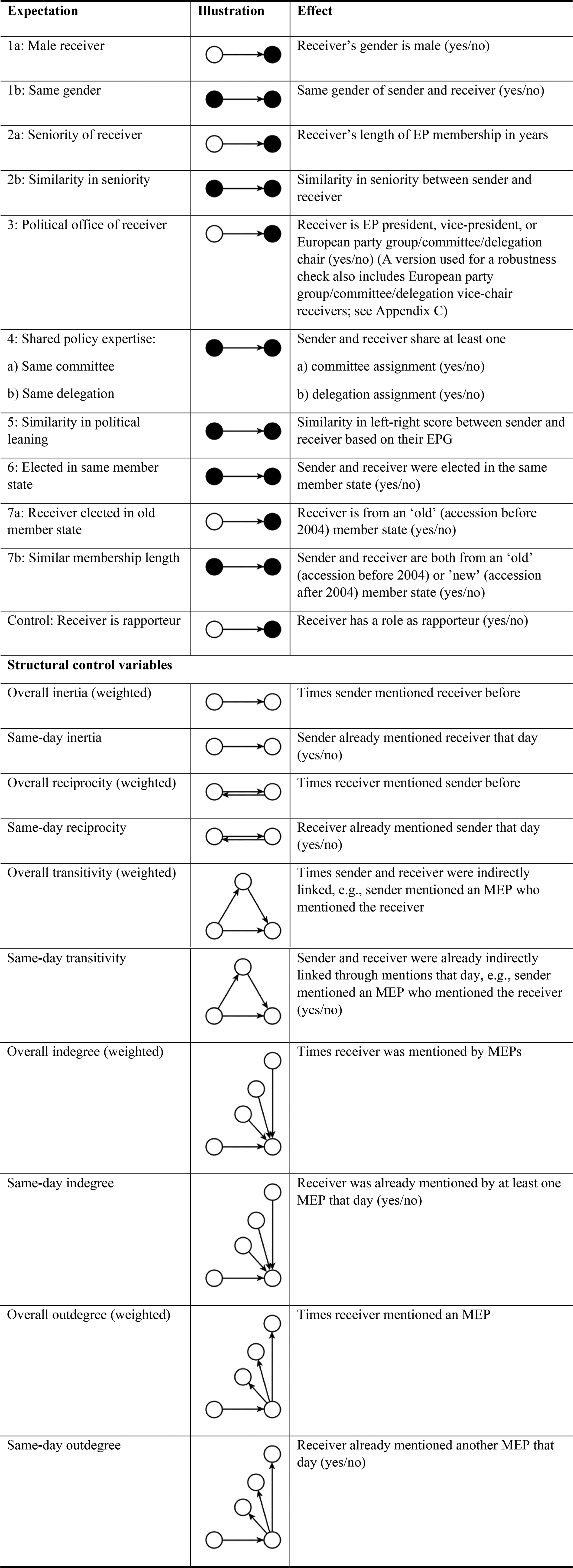
Receiver, homophily and structural effects.
Although individual actor attributes such as socio-demographic characteristics, expertise, experience and power position help us understand who receives more ties in the network, we know that homophily is also central to understanding network structures (Lusher et al., 2013: 16–19). Homophily as a concept captures that ‘contact between similar people occurs at a higher rate than among dissimilar people’ (McPherson et al., 2001: 416) and empirical research on both social and political networks has repeatedly shown that ‘similarity breeds ties’ (e.g. Gerber et al., 2013). The general mechanism behind such homophily effects is that visible characteristics function as ‘short-cuts’ or cues to identify common ground, mutual understanding and communication (Tasselli et al., 2015). Such homophily is a central determinant of tie formation in different types of networks. Although the concept is well established in social network research in sociology or communication studies, scholars use it less often to understand politics. This is even more surprising in EU studies, given the fundamentally networked nature of the EU's multi-level system of governance.
In parliamentary politics, homophily arguably reduces transaction costs: Sharing political similarities provides clues about collaborations as it decreases time spent on ‘discovering and bargaining over the distribution of costs and benefits from joint activities’ (Gerber et al., 2013: 600). We expect these similarities to relate to socio-demographic, ideological and national characteristics as well as shared expertise and experience. Homophily then offers a mechanism that explains why these similarities may shape network patterns in parliamentary debates.
Research on (transnational) advocacy networks and networks among political activists (e.g. Keck and Sikkink, 1998) as well as political discussion networks (e.g. Song, 2015) confirms the importance of both individual actor attributes and similarity for network patterns. For example, recent research has looked at interest group networks and policymaking in the EU through the lens of actor and country homophily (Bunea et al., 2022). Party-ideological explanations are known to influence coalition formation in the EP (e.g. Lefkofridi and Katsanidou, 2018), while member states remain a relevant framework in which MEPs operate due to national electoral lists.
Further, the model allows us to control for the structure of past mentions in the network. This has two distinct advantages. First, we can uncover a potential self-reinforcing Matthew effect (Merton, 1968) in that debate attention and interaction in the past may translate into debate attention and interaction in the future. Second, we can distinguish such structural effects of past mentions from attribute-related effects. For example, an MEP with a leadership role may have been mentioned frequently in the past. Not controlling for the structure of past mentions, we would attribute all new mentions to the leadership role and could overestimate its effects, while in reality, the Matthew effect is also at play.
Methodology
Data
To analyze debate networks in the EP, we use the English language EuroParl-UdS corpus (Karakanta et al., 2018) and select speeches by MEPs, excluding written questions (N = 35,689, see the Online appendix for more details). The corpus also includes metadata (e.g. date of speech) and information on the speaker (e.g. their name, nationality, party (group)). We supplemented these data by manually coding the gender of an MEP, their level of seniority, their political offices, EP committee and delegation 1 memberships, as well as left-right scores based on their memberships in EPGs (see the Online appendix for more details). The time frame of our analysis covers the years 2009–2012. 2 During this period, there were 736 MEPs from 27 member states which increased to 754 on 1 December 2011 following the Treaty of Lisbon. The total number of MEPs included in our study is 812 as not all MEPs are part of the EP for the entire legislative period (more below).
Dictionary
We used automated text analysis and developed a dictionary to identify mentions of MEPs in parliamentary speeches based on MEPs’ names. Using an MEP's last name alone did not lead to satisfactory results, as some are also first names (e.g. Martin), or refer to other entities (e.g. Post). Using keywords-in-context, our analysis showed that MEPs last names are mostly mentioned after honorifics (e.g. Mr, Ms, Mrs, but also Sir, Dr, Lady or Lord). Thus, the dictionary includes varying honorifics followed by MEPs’ last names, in addition to their full names. The analysis was carried out in R using the quanteda package (Benoit et al., 2018). Duplicate MEP names are problematic: For example, the mention of ‘Mr Martin’ in a speech can refer to Hans-Peter Martin or Mr Martin Schulz, while ‘Mr Schulz’ in turn might refer to the MEP Martin Schulz or Werner Schulz. To address this issue, we first identified duplicate MEP names, extracted ambiguous mentions and manually validated which MEP is referred to in a given speech by checking the verbatim reports of the respective debates. From the debate context, we then inferred who was mentioned because the reference was usually made to a previous speaker or someone who had also been mentioned previously. In a small number of cases, we were unable to clarify which MEP was mentioned and we removed the references. Another problem is MEPs who joined or left the EP during the legislative term. For example, Michel Barnier was an MEP before he joined the European Commission in 2010. Not accounting for these changes will falsely classify mentions of Michel Barnier as a Commissioner. We thus also created and included variables with the date of entry and exit of the EP and only include mentions in speeches that fall within this time frame. 3
Time-stamped network analysis
We apply dynamic actor-oriented Markov models (DyNAM) (Stadtfeld et al., 2017; Stadtfeld and Block, 2017). This method has been developed for the study of interpersonal interaction through time and is able to explain who (event sender) mentions whom (event receiver) at what point in time (event time). Independent variables can capture events in the past (i mentions j if j mentioned i within a time interval defined by the researcher), relationships between people (i mentions j if i and j belong to the same committee/delegation), individual characteristics (i mentions j if j is in a political leadership position), or matches in individual characteristics (i mentions j if they have the same gender). We include DyNAM independent variables and estimate parameters for them, while controlling for structural effects (e.g. reciprocity: i mentions j if j also mentioned i) that influence who mentions whom independent of their individual characteristics. Whereas some individual characteristics may be less common in the network than others (e.g. more male than female MEPs, and more people not in leadership positions than in leadership positions), the model takes this opportunity structure into account. We estimate how often relationships appear between individuals with specific characteristics (e.g. when i and j have the same gender, or when j is in a political leadership position), compared with relationships not appearing between the same types of people. Within the DyNAM framework, we apply a DyNAM choice model (Stadtfeld and Block, 2017), which treats the sender of the event (who mentions someone) as exogenously given, and only models whom this person will mention.
The model takes an actor-oriented perspective. This means that for each mention, the decision of the sender on whom to mention is modelled by a multinomial choice function, in which the probability of mentioning each MEP is based on their values along with all independent variables. Parameters are estimated from the contribution of each independent variable to MEPs being mentioned. The coefficients can be interpreted as conditional log odds ratios, similar to the interpretation of coefficients in the logistic regression framework.
Procedure
We constructed an edge list based on the dictionary results. To each mention, we assigned a date and time: We had information on the date and the order of all speeches within the day, as well as the order of mentions within the same speech (when multiple MEPs were mentioned). Keeping the order, we assigned random times to the mentions during the day. These exact times had to be specified for the inclusion of the so-called ‘window’ effects in our models (e.g. an MEP mentioning someone who mentioned this MEP during a specific time interval). We note that the windows we use consist of 12 h, which effectively means that all mentions occur during the same day, and these are therefore not affected by the randomly allocated times.
Model specification
The model includes not only independent variables to test our expectations but also variables based on the network structure of past mentions (see Figure 1 and the Online appendix for details on data sources and operationalization). Here, we take into account the effects of the near past (past mentions on the given day) and the effects of the overall past (all past mentions since the start of the analyzed period). For the effect of the near past, we use unweighted versions of each variable; for the effect of the overall past, we use weighted versions allowing us to account for several aspects of past mentions in the model. The analysis was carried out in R using the goldfish package (Stadtfeld and Hollway, 2020).
Results
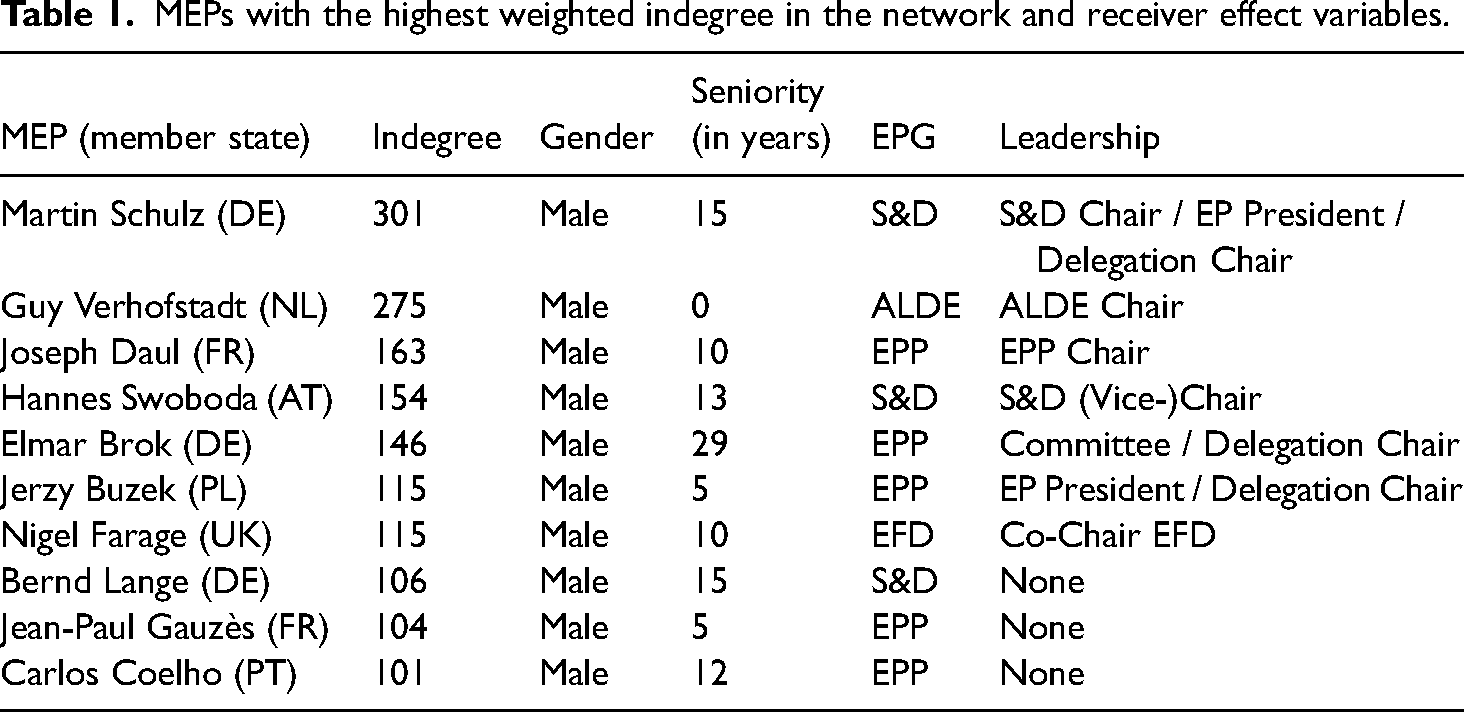
Looking first at the most important actors in the EP debate network based on their weighted indegree (Table 1), we see that the attention is on prominent, male MEPs from ‘old’ Western member states (see the Online appendix for summary statistics of the network overall).
MEPs with the highest weighted indegree in the network and receiver effect variables.
The DyNAM choice model (Table 2) confirms significant gender differences with male MEPs more likely to be mentioned than female MEPs independent of the effect of other variables in the model. We furthermore find evidence for gender homophily with MEPs being significantly more likely to mention other MEPs of the same gender. We expected parliamentary seniority as a measure of experience to affect the network structure. Our results show that MEPs, who spent more years in the EP, that is, have a higher level of seniority, are mentioned significantly more often; independently, MEPs are significantly more likely to mention others with similar seniority levels to their own. As a measure of prominence, power and visibility, we see that MEPs with leadership positions in the parliamentary party groups (party group chair) and legislative arena (EP president and vice president, committee and delegation chair) receive more attention in form of mentions than MEPs without such offices. These findings are robust when using a broader definition of political office (see the Online appendix).
Results of a DyNAM choice model.
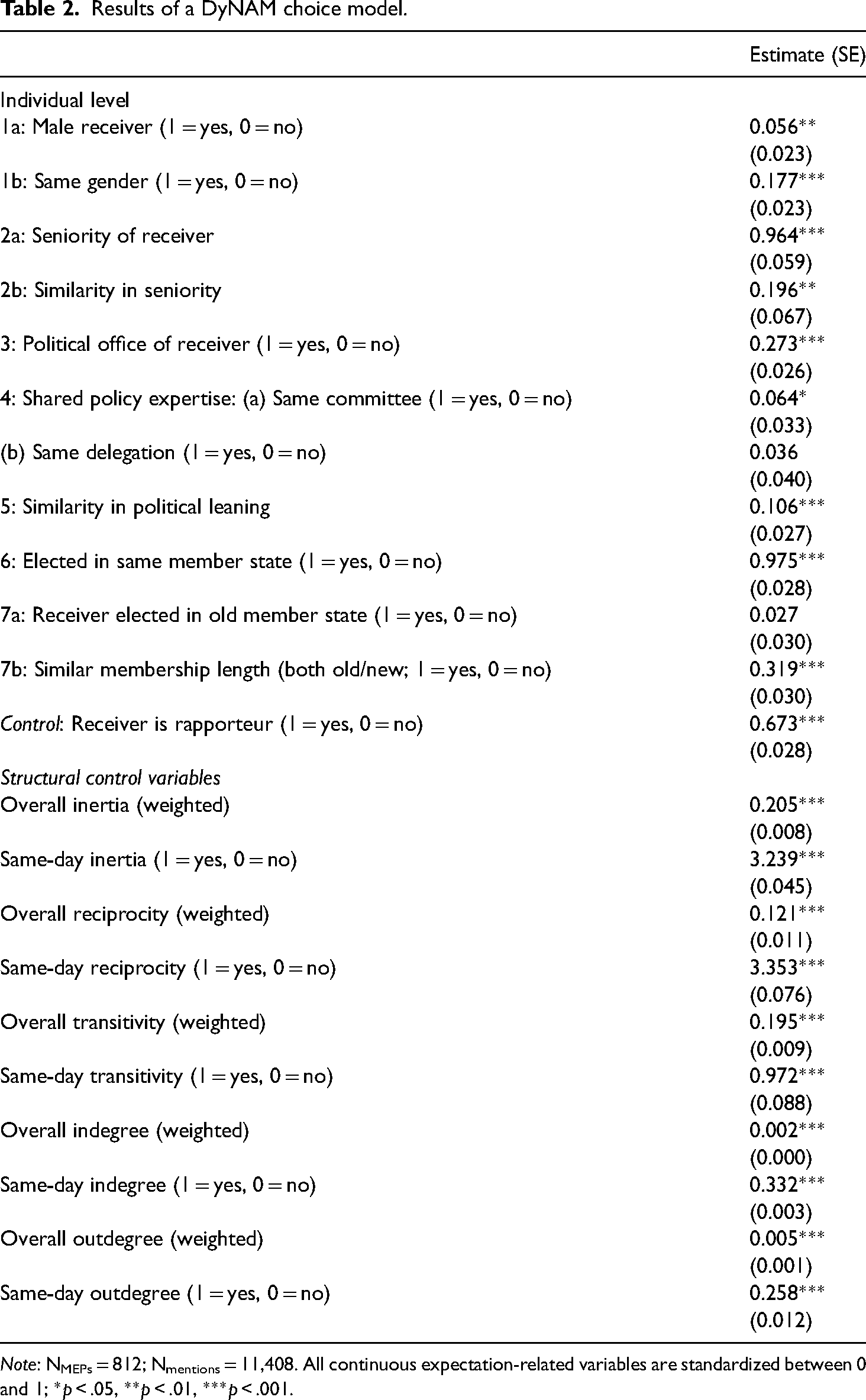
Note: NMEPs = 812; Nmentions = 11,408. All continuous expectation-related variables are standardized between 0 and 1; *p < .05, **p < .01, ***p < .001.
We also find that those who share at least one committee, but not a delegation assignment, are significantly more likely to mention each other. At the party level, political leaning also plays a role in who mentions whom. We find homophily effects, that is, MEPs with a similar ideological position being more likely to mention each other. Transnational debate coalitions are forming along the left-right conflict dimensions.
Finally, we looked at receiver and homophily effects based on the member state an MEP represents given national electoral lists. We find that they are indeed significantly more likely to mention other MEPs from the same member state. Although MEPs from ‘old’ member states are not significantly more likely to be mentioned than their colleagues from ‘new’ member states, having a similar membership length within the EU is a significant predictor of mentions.
Figure 2 shows the conditional log odds ratios for our expectation-related coefficients visually. In each row, the dot shows the point estimate for the given parameter, and the line shows the standard error. For the binary variables, the figure shows the effect of the variable taking the value 1 instead of 0 (e.g. receiver being male instead of female, sender and receiver having the same gender instead of different genders, etc.). To ease comparability, the continuous variables were standardized to range between 0 and 1.
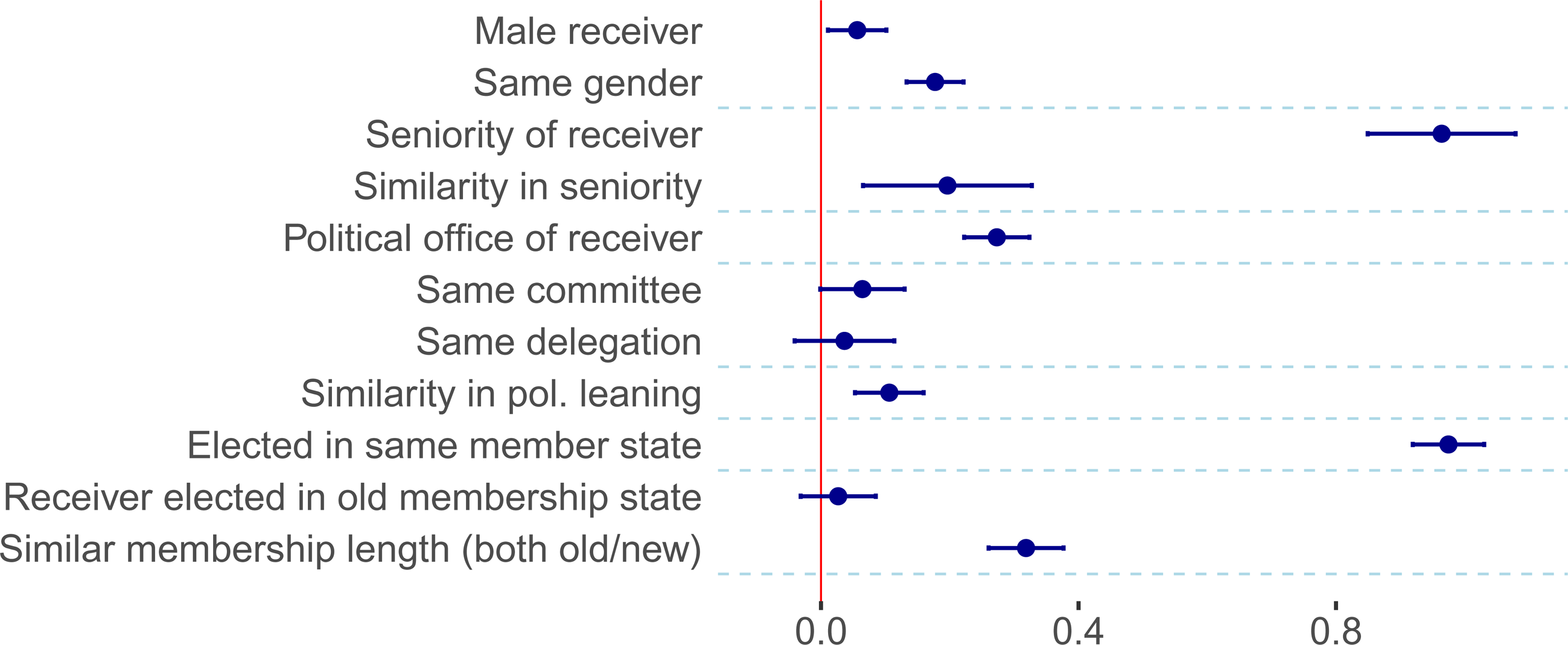
Substantive effects of expectation-related variables.
Being elected in the same member state has the strongest substantive effect on mentions. Similar political leaning has a comparatively small effect. We conclude here that while both national and transnational homophily drive debate interaction, coalitions tend to form more around national similarities than shared ideological positions on the left-right spectrum. Seniority of the receiver has the second largest substantive effect, notably much stronger than that of a receiver's political office. This indicates that long careers and experience in the EP matter more than prominent leadership positions.
We also take into account the effect of the network structure (i.e. the structure of past mentions) on each new mention - for the interpretation of these variables, also see their visual illustration in Figure 1. We observe positive and significant effects of inertia: MEPs are more likely to mention those again whom they have already mentioned before, independent of individual attributes. Additionally, we find that MEPs are more likely to mention those who have mentioned them in the past (reciprocity effect). The positive and significant transitivity parameters show that MEPs are likely to ‘close’ indirect links to other MEPs, for instance, an MEP mentioning other MEPs who are mentioned by someone they mentioned. Finally, we see positive and significant indegree and outdegree effects, indicating that those who were mentioned by more MEPs (indegree), and those who mentioned more MEPs themselves (outdegree), are more likely to be mentioned, independent of individual attributes.
In addition to the importance of mentioning other MEPs in speeches in general (see outdegree effect), whom an MEP engages in a conversation with also has a major effect on being mentioned by others later (see reciprocity and transitivity effects). Finally, we demonstrate that being mentioned by others is self-reinforcing: Those mentioned more in the past will be more likely mentioned in the future, independent of their individual characteristics or whom they mention in their own speeches (see indegree effect).
Discussion and conclusion
Our dynamic network perspective on debate interactions in the EP revealed that the attention is on male, senior and influential parliamentarians, and we see evidence for a Matthew effect, which is the self-reinforcing nature of such power and influence (Merton, 1968). When it comes to who receives attention in the network, the 7th EP is rather exclusive and little pluralist (cf. Sorace, 2018) valuing continuity, and consensus-seeking over listening to diverse, potentially more fragmented voices. On the one hand, formal hierarchies are perpetuated through such informal debate practices. On the other hand, the effect of the structure of past mentions suggests that MEPs can become influential in debates even without holding official positions. Actively participating in the debates of the EP pays off as it, in itself, induces more presence in the speeches of other MEPs.
When it comes to debate interactions, we see patterns of reciprocity in line with deliberative debating practices (Lord and Tamvaki, 2013). MEPs talk to each other rather than past each other. Such debate interactions signal transnational coalition formation along a left-right conflict dimension as well as interactions based on geographic, socio-economic and political–cultural similarity. Shared policy experience and established working relationships in committees also shape debate interactions. In that sense, the EP is a policy-based working parliament (Lord, 2018).
These findings from our dynamic network perspective on EP debates based on receiver and homophily effects have several important implications. First, we show that not only being elected in the same member state is the strongest predictor of mentions but also a similar membership length matters. This shows us that at the European level, for our period of observation, shared nationality was a driving force. Second, similarity in positions on the left-right spectrum indicates emerging transnational party dynamics that are likely even stronger in recent years. In their debates, MEPs juggle two (competing) principals, national parties and voters as well as EP party groups and voters. Finally, the importance of expertise and leadership positions speaks to the growing professionalization of EP parliamentary practice.
Since this study only draws on speeches until the end of 2012, we could not fully assess the impact of the increasing political polarization due to right-wing populist parties. Future research could investigate these patterns and may consider multilingual analyses. Our study did not discriminate between the kinds of debate references, that is, whether MEPs are supportive of or in opposition to the respective other MEPs they mention. Besides the actor networks, future research could also capture policy networks, that is, the topics debate coalitions are formed around. It might, for example, be possible that homophily effects are more or less relevant depending on the issue discussed.
Additionally, it would be interesting to assess to what extent different MEP career paths and goals shape debate interactions including the question of how becoming more senior and familiar with the EP changes individual MEPs’ debate interactions. In terms of methodology, research should explore named entity recognition as an alternative way to capture mentions of MEPs and machine translation to explore more recent data.
Supplemental Material
sj-pdf-1-eup-10.1177_14651165221137994 - Supplemental material for Who talks to whom? Using social network models to understand debate networks in the European Parliament
Supplemental material, sj-pdf-1-eup-10.1177_14651165221137994 for Who talks to whom? Using social network models to understand debate networks in the European Parliament by Stefanie Walter, Lucy Kinski and Zsófia Boda in European Union Politics
Footnotes
Acknowledgements
The authors would like to thank the editor, the three anonymous reviewers and Mihail Chiru, Ariadna Ripoll Servent, Christoph Stadtfeld and Resul Umit for their helpful comments and suggestions.
Author contributions
All authors contributed equally to the manuscript.
Funding
The author(s) disclosed receipt of the following financial support for the research, authorship, and/or publication of this article: The work by Zsófia Boda was supported by the Economic and Social Research Council (grant number: ES/S012486/1).

Supplemental material
Supplemental material for this article is available online.
Notes
References
Supplementary Material
Please find the following supplemental material available below.
For Open Access articles published under a Creative Commons License, all supplemental material carries the same license as the article it is associated with.
For non-Open Access articles published, all supplemental material carries a non-exclusive license, and permission requests for re-use of supplemental material or any part of supplemental material shall be sent directly to the copyright owner as specified in the copyright notice associated with the article.
