




Abstract
Analyses of strategic agenda-setting in the European Union treat the European Commission as a unitary actor with perfect information. Yet, the constraints for correctly anticipating acceptable policies vary heavily across its individual Directorates-General. Do these internal rifts affect the Commission’s agenda-setting ability? This article tests corresponding expectations on the edit distances between 2237 Commission proposals and the adopted laws across 23 years. The quality of legislative anticipation indeed varies with the responsible Directorate-General. Legislative proposals are more likely to remain unchanged if they face less parliamentary involvement, are less complex, were drafted by an experienced Directorate-General, and were coordinated more seamlessly within the Commission. However, the uncovered variation also calls for more systematic research on the distribution of legislative capacities inside the Commission.
Introduction
The European Commission is considered a key actor fueling, fostering, and shaping the process of political integration in Europe. Depicted positively as the ‘engine of European integration’ or negatively as a ‘runaway bureaucracy’, the Commission is seen to significantly influence the speed and direction by which political competences are transferred from the national to the supranational level (Hooghe, 2001; Pollack, 1997; Sandholtz and Zysman, 1989). Scholars primarily locate its influence in day-to-day policy making where the grand bargains struck in the European Council are interpreted and transformed into binding rules for Europe’s more than 500 million citizens. Early in the policy cycle, the Commission can act as an informal agenda-setter or policy entrepreneur, e.g. by creating judicial precedents (Schmidt, 2000), strategic information collection (Haverland et al., 2018), or by setting up expert groups, initiating stakeholder consultations, or issuing discussion papers (Princen and Rhinard, 2006).
When it then comes to formal policy making, the Commission controls another precious asset that is of primary interest here: the exclusive prerogative of legislative initiative for most areas of European competence (Biesenbender, 2011). Of course, any Commission proposal needs to find the agreement of the Council of Ministers and often also the European Parliament (EP). But especially the spatial modelling literature (e.g. Crombez and Vangerven, 2014; Selck, 2006; Tsebelis and Garrett, 2001) suggests that the Commission’s first-mover advantage nevertheless results in sizable legislative agenda-setting power. It allows the Commission to select and to propose the one policy from the set of all feasible ones that comes closest to its own preferences.
This article engages with this model of formal legislative agenda-setting in the European Union (EU). I argue that the Commission’s legislative influence hinges strongly on the quality of anticipation it can muster. Quality of anticipation refers to the degree to which the Commission can correctly identify the set of politically feasible policy choices before it tables its formal proposal. Correctly anticipating the political leeway it enjoys for a given initiative is a necessary condition for the Commission’s legislative success.
Yet, carving out this leeway is a resource-intensive business, and in-depth analyses of policy formulation inside the Commission (e.g. Cram, 1994; Hartlapp et al., 2014) emphasize that the individual Directorates-General (DGs) of the Commission are not created equal in this regard. These case studies imply that varying political clout of DG leaders, scarce administrative resources, internal conflicts, and haphazard co-ordination limit the Commission’s capacity of strategic anticipation. Accordingly, this article asks: how strongly and along which factors does the quality of legislative anticipation vary across the individual DGs of the European Commission?
In the following, I embed the disaggregated view on legislative anticipation inside the Commission into the extant models of strategic agenda-setting power in the EU. The research design to test the resulting hypotheses rests on the idea that better anticipation of politically acceptable choices leads to fewer changes of a Commission proposal in the subsequent inter-institutional negotiations. Based on the corresponding minimum edit distances between 2228 Commission proposals and the finally adopted EU regulations and directives during the 1994-2016 period I show that the likelihood of proposing a law that is directly acceptable for the co-legislators indeed varies systematically with the Commission DG that has drafted it. This partially depends on the legislative procedure a DG faces: More formal involvement of the EP makes it harder to table a directly acceptable policy proposal. But I also find that DGs which control more long-standing legislative experience, which draft less complex policies, and which engage in more seamless internal coordination appear to muster higher levels of correct legislative anticipation. In contrast, Council decision rule and preference heterogeneity, the political experience of the lead Commissioner, or the administrative setup of the DG do not exhibit the expected effects. The empirical patterns shown here indicate that more systematic research on the varying legislative capacities inside the Commission is needed.
Legislative agenda-setting of and inside the European Commission
This article focusses on the formal legislative agenda-setting prerogative of the European Commission. In its current version, Article 17(2) of the Treaty on the Functioning of the European Union (TFEU) states that ‘Union legislative acts may only be adopted on the basis of a Commission proposal’. The Commission thus needs to make the first formal move in most legislative processes in the EU.
The institutionalist literature discusses intensively whether this turns the Commission into a ‘political’ agenda-setter with significant influence over the contents of European law or whether it boils down to a merely ‘technical’ provision of legal services (Kreppel and Oztas, 2017). Indeed, the monopoly of legislative initiative does not grant unlimited influence. Initially, this formal prerogative does not confer gatekeeping power (Crombez et al., 2006). Both the Council and the EP and – since Lisbon – a sufficient number of citizens from different member states may request a Commission proposal on a specific policy. The Commission is thus not entirely free to select which policy areas are to be tackled by European legislation.
More importantly, the Commission’s political ambitions are obviously constrained by the fact that any proposal needs to find the agreement of the representatives in the Council of Ministers and increasingly often also the EP. Especially the spatial modelling literature has been influential in assessing the relative powers of these co-legislators (e.g. Crombez and Vangerven, 2014; Selck, 2006; Tsebelis and Garrett, 2001). In these models, European legislative actors are typically assumed to have Euclidean policy preferences as well as perfect information about the ideal positions of all other actors and the status quo in the absence of a common decision. This, together with the sequence of individual actors’ moves in the applicable legislative procedure, leads to clear expectations as to which actors can move the outcome closest to their most preferred policy.
This literature debates the correct interpretation of formal rules, plausible preference configurations, or the dimensionality of the policy space. But it agrees on two general propositions. First, the agenda-setting power of the Commission is curtailed to the win-set, i.e. all policies that the respectively necessary majorities in the Council and/or the EP prefer over the status quo. Second, the Commission can still be considered influential if it is able to steer the process towards those policy outcomes in the win-set that come closest to its own policy preference.
Exactly in this latter regard the prerogative to draw up the initial legal text offers strategic leverage. As a rational actor, the Commission should exploit its ‘power of the pen’ to initiate the legislative process with proposing the one policy option that satisfies the required majorities in the Council and the EP while also minimizing the distance to its own most preferred outcome (whatever these preferences may be for a given initiative). Picking policy choices strategically from the win-sets of its co-legislators can then accumulate to significant political influence over the range of EU law-making.
This model of agenda setting implies very quick, one-shot inter-institutional processes. The targeted policy choice, that the Commission is expected to propose, should find almost immediate agreement in the Council and the EP. In European practice, however, one easily finds often lengthy and partially highly controversial negotiations of Commission proposals among the Council and the EP (e.g. Drüner et al., 2018; König, 2007). What, then, keeps the Commission from proposing optimal policy choices?
I argue that we can gain insights from problematizing the perfect information assumption which drives most institutionalist models of legislative agenda setting in the EU (cf. Bueno de Mesquita, 2004; Rittberger, 2000). The expectation that the Commission can strategically pick policies from the win-sets of the Council and the EP needs to presume that the Commission controls correct information on these win-sets in the first place. Yet, this information is not easily accessible per se – carving out the set of acceptable choices for any given policy issue on the agenda is a costly business. Amongst other things, the Commission first needs to understand the actual legal alternatives for the policy at hand (and which of these alternatives it prefers under some more general objective). This will often require very technical information on the idiosyncrasies of the specific policy area. Second, the Commission needs to figure out what the respective status quo on the policy in question is. In many cases, it will face a myriad of different national laws, regulations, or domestic jurisprudences. And third, the Commission must distill all this information to then test different options in its networks in order to learn which policy choices would actually be acceptable to a sufficient number of the diverse political actors in the Council and the EP. Accepting that such information is costly to obtain means that the Commission’s agenda-setting success also hinges on its ability to correctly anticipate a set of politically feasible policy choices before it tables its formal proposal. In other words, the influence that the Commission can gain from its formal monopoly of legislative initiative should depend on the quality of legislative anticipation it can muster.
The costs of mustering such sufficiently correct anticipation should vary with procedural, policy-related, and organizational characteristics of the respective policy process. Initially, the applicable legislative procedure is likely to play a role here. Higher majority hurdles initially mean that a larger set of actors needs to accept the Commission proposal. Unless there are obvious individual preference outliers with veto rights, higher majority hurdles thus often also imply that the Commission has to gather a larger amount of reliable information on the preferences of the different external actors. In this regard, the decision rule in the Council of Ministers should be important. If the Council decides by unanimity on a given policy proposal, the Commission needs to identify the preferences of all national governments in the Council to correctly anticipate whether a policy choice is politically feasible or not. Under qualified majority voting (QMV), which now governs about 70% of all European policy competences (Biesenbender, 2011), the number of governments that need to agree is lower. This does not necessarily help the Commission if it is a strong preference outlier on the policy in question. In this scenario, the Commission still needs to rank the preferences of all national governments to figure out which possibly pivotal actor is furthest away from its own preference. Yet, if the Commission’s own preference lies somewhere in between the national preferences for a given policy, the Commission can stop researching and testing national preferences once it has assembled a sufficient qualified majority. At least on average, thus, identifying a winning coalition should be comparatively less costly under QMV: H1: The quality of legislative anticipation by the Commission is on average lower under unanimity rule than under QMV in the Council. H2: The quality of legislative anticipation by the Commission decreases with preference heterogeneity in the Council.
The cooperation procedure introduced by the Single European Act (SEA) in 1985 increases the informational requirements for the Commission. It conferred a veto right to the EP that only an unanimous Council could override. To anticipate its leeway correctly, thus, the Commission must identify the most conservative Council member again – at least if it also has information that an EP majority disagrees with a qualified majority in the Council. Correctly predicting the possible outcomes of a cooperation procedure should thus be systematically more demanding in informational terms than doing the same for a consultation procedure.
Correct anticipation has been complicated further by the co-decision procedure introduced at Maastricht. It requires a conciliation committee if Council and EP disagree on a Commission proposal. Any agreement reached in this committee needs to find a simple majority in the EP and a qualified majority in the Council unless both actors fall back to the original Commission proposal. The co-decision procedure was further reformed in the 1999 Treaty of Amsterdam and re-named as the ordinary legislative procedure (OLP) in the 2008 Treaty of Lisbon. This now valid version even removes the possibility to fall back on the original Commission proposal. Furthermore, the procedure allows for so-called early agreements where representatives from each of the three institutions can informally strike a deal that only the Council and EP majorities have to ratify in the end (Reh et al., 2013). Dissolving the sequential nature of the game and allowing for rather unconstrained bargaining in such ‘trilogue’ meetings curtails the Commission’s ability to correctly predict the range of acceptable outcomes further (cf. Cross and Hermansson, 2017). In any case, the increasing legislative involvement of the EP should have also increased the strategic information demands that the Commission faces when trying to propose an optimal policy choice: H3: The quality of legislative anticipation by the Commission decreases with more formal amendment powers of the EP (Co-decision/OLP < Cooperation < Consultation). H4: The quality of legislative anticipation by the Commission decreases with the complexity of the policy in question. H5: The quality of legislative anticipation by the Commission increases with the time a policy area already falls under European legislative competence. H6a: The quality of legislative anticipation by the Commission increases with the amount of administrative experience and resources of the responsible DG. H6b: The quality of legislative anticipation by the Commission increases with the political experience and resources of the leadership of the responsible DG.
Formally, the Commission is a collegiate body and has tried to beef up its coordinative ability not the least by strengthening the Secretariat-General (SG) headed by the Commission president (Kassim et al., 2017; Wille, 2010). But in the bottom-up process of policy formulation, way before a given proposal reaches the level of European Commissioners (if it is explicitly reviewed at this level at all), the lead DG has various opportunities to bias a proposal towards its own preferences (Hartlapp et al., 2012). However, a Commission proposal that is biased to specific sector, ideological, or turf considerations is also more likely to encounter disagreement in the inter-institutional process. Inversely, if different DGs get their chance to have a say on a legal draft, it is already more adequately tested against different viewpoints and considerations. Thus, where the Commission fails to adequately balance varying policy preferences internally, the resulting legislative proposal should also be less likely to satisfy the various interests represented in the subsequent inter-institutional negotiations: H7: The quality of legislative anticipation by the Commission decreases with insufficient coordination during internal proposal preparation.
Research design
The empirical approach builds on the idea that the quality of legislative anticipation by the Commission is reflected in the degree of change its proposals experience during the inter-institutional negotiations. The better the Commission has anticipated which policies the respective majorities in the Council and the EP would accept, the less these co-legislators should see the need to change the proposed law. Inversely, the more the Council and the EP see the need to significantly move away from the contents of the original proposal, the worse the Commission has performed in anticipating its leeway correctly.1
Accordingly, the dependent variable systematically compares the full text of the Commission proposal to that of the European law which the Council and the EP finally adopt. To measure such change in a large-N setting, I resort to minimum edit distance algorithms which have been successfully employed to analyze change over consecutive versions of very different political texts, also including European legislation (Cross and Hermansson, 2017). Generally, such algorithms compare two ordered chains of symbols and retrieve the minimum number of symbols that need to be changed to convert one chain into the other. My operationalization asks how many edits – on the level of individual words – are needed to ‘convert’ the text of the original Commission proposal into the text of the European law that the co-legislators have ultimately adopted.2
Specifically, I resort to the Damerau-Levenshtein minimum edit distance (Damerau, 1964; Levenshtein, 1966). This algorithm traverses through the matrix spanned by the ordered word lists of the proposal and the law text, to count each deletion, insertion, substitution, and adjacent transposition of individual words as one edit operation.3 I normalize these counts to the varying text lengths. Finally, I invert this so that higher values express more similarity between proposals and adopted law, thereby indicating better anticipation in legislative agenda setting of the European Commission. The resulting metric ranges between 0 and 1 and can be roughly interpreted as the probability that an individual word in the original Commission proposals remains unchanged during negotiations of the Council and the EP.
To collect the required legal text pairs, I scraped information on all Commission proposals between 1985 and 2016 from EUR-Lex, the official online gateway to legislative documents of the EU (scraper executed in summer 2017 and detailed in the Online appendix).4 This exercise reveals that EUR-Lex provides directly machine-readable (html) full text pairs of Commission proposals and finally adopted laws only from 1994 onwards. This allows covering 23 years of European legislation.
The analysis concentrates on Commission proposals for binding secondary EU law, i.e. directives and regulations, during this period. I exclude decisions as these instruments usually prescribe temporarily limited measures addressing individual entities rather than resulting in generally applicable European Union law. I furthermore exclude tertiary law such as implementing and delegated acts which can be understood as an alternative route of law-making when the Commission anticipates legislative resistance (Williams and Bevan, 2019).
Along these criteria, EUR-Lex archives 3049 Commission proposals for binding regulations or directives in the 23 years covered.5 The adoption rate is high (cf. Boranbay-Akan et al., 2017). Only 13%, that is 405 of the cases, did not result in a binding European law, either because the proposals have been withdrawn or are technically still pending. In another 821 cases (27%) the full text for either the Commission proposal or the finally adopted law is missing or erroneous in EUR-Lex. These missings cluster in the final two years of the investigation period, suggesting archiving delays in EUR-Lex (the helpdesk could not satisfactorily answer requests on this matter). Beyond this temporal pattern, the missing cases appear not to be systematically different along the independent variables discussed below. In sum, 2237 legislative processes are available for analysis, covering 73% of the initiatives for binding secondary law that the Commission has proposed between 1994 and 2016.
I enriched this dataset with several independent variables. Initially, we need to capture procedural characteristics. The Council majority rule (H1) has been coded by extracting the CELEX reference of the respective treaty articles a Commission proposal is formally based on (using Ovádek, 2020a). This information could then be matched to the manual coding of Council decision rules in individual Treaty articles kindly shared by Michal Ovádek (2020b). Preference heterogeneity in the Council (H2) is measured along the pro/anti EU and left/right dimensions conventionally used to model the policy space in the EU. In particular, I follow Döring (2013) and collect the Parlgov/Comparative Manifestos Project (CMP) positions on these dimensions, aggregate them to the national level along cabinet shares, to finally store the variance of respective positions in the Council at the point in time at which the respective proposal was tabled. Parliamentary involvement in negotiating a given proposal (H3) is directly inferred from the procedural steps scraped from EUR-Lex (cf. Häge, 2011).
Regarding policy characteristics, legislative anticipation should be negatively related to more complex proposals touching upon more diverse social and legal phenomena (H4). To measure policy complexity, I follow recent, text-based large-N studies (Hurka and Haag, 2020; Katz and Bommarito, 2014) exploiting information theory and Shannon’s signal entropy, in particular. Entropy captures the informational density of a message along the variability of signals it contains. For legal texts, the variability of terminology used is a corresponding indicator: the more empirical and legal phenomena a proposal covers, the greater the variability of words it uses should be.6 To capture a Commission DG’s experience in the policy area (H5), the data store the duration for which the respective policy field is already a European legislative competence, relying on the treaty coding by Biesenbender (2011) and the policy mapping in the Online appendix. The variable expresses the difference in years between proposal adoption and the entry into force of the EU treaty that provided the first legislative competences in the policy area.
Systematic data on internal organizational characteristics are most challenging to obtain (H6). The Commission often retains information on its internal dynamics along the argument that this would impair its standing in inter-institutional negotiations (Hartlapp et al., 2014: ch. 3). To the best of my knowledge, the only source that allows tracking features of Commission DGs over time is the ‘Position Formation in the EU Commission’ (PEU) database (Hartlapp and Lorenz, 2012).7 To operationalize political resources of a DG, I resort to the so-called ‘power index’ of the responsible Commissioner. Similar to Döring (2007) and Franchino (2009), the variable provides a score for the highest prior political office ranging from 2.27 for former Prime Ministers, over .5 for junior ministers, down to .2 for mere party activists. The assumption is that the networks and skills a Commissioner has obtained in top-level jobs on the national level can be invested in carving out winning coalitions for the policy proposals of her or his DG. However, national networks might matter less in the Brussels scene. Therefore, I additionally capture European professional experience by the number of days since the person has taken up a Commissioner office. Regarding DGs’ administrative resources, the number of staff working on a particular proposal would be ideal but is unfortunately not public knowledge. Equally, staff numbers and administrative expenditures on DG level are not consistently available over the period covered here. The closest I can get is the number of units per drafting DG provided in the PEU database. This proxies administrative resources in at least so far as a higher number of units provides more contact points and informal networks for digesting information from the political environment while also indicating higher levels of specialization and functional division of labor which may generate more sectoral expertise for crafting policy proposals.
To tap into internal coordination (H7), I consider the Secretariat-General of the Commission (SecGen), a service directly accountable to the Commission president. It manages internal ‘upstream coordination’ through its sectoral policy coordination units, as well as its involvement in impact assessments, inter-service consultation, and political programming (Hartlapp et al., 2012; Kassim, 2006; Tholoniat, 2009). Like for the drafting DGs, the corresponding variable taps into administrative resources by storing the number of units at the time each individual policy proposal was tabled. More importantly, I assess the coordination of the individual policy proposals along the internal decision mode by which it was adopted within the Commission (indicated in EUR-Lex). The variable marks proposals that were decided by oral procedure. In contrast to the written procedure, such proposals were an agenda item in the Tuesday’s meeting of the College of Commissioners which often involve non-recorded votes. Sometimes, the Commission president decides to handle a proposal on this level for political signaling reasons. For the majority of cases, however, individual initiatives end up on the College agenda after a formalized spiral of internal conflict escalation (Hartlapp et al., 2012). Only when internal conflicts could not be solved ‘downstream’, first through bilateral DG contacts, then through the formal interservice-consultations, or finally through direct negotiations among the responsible Directors-General, the political level of the Commission becomes involved. An oral procedure thus often signals significant levels of unresolved internal conflict on the policy in question.
Taken together, this set of variables (descriptives in the Online appendix) allows a first systematic glimpse on the quality of legislative anticipation that the European Commission can muster across a rather large number of policy proposals over more than two decades of European integration.
Results
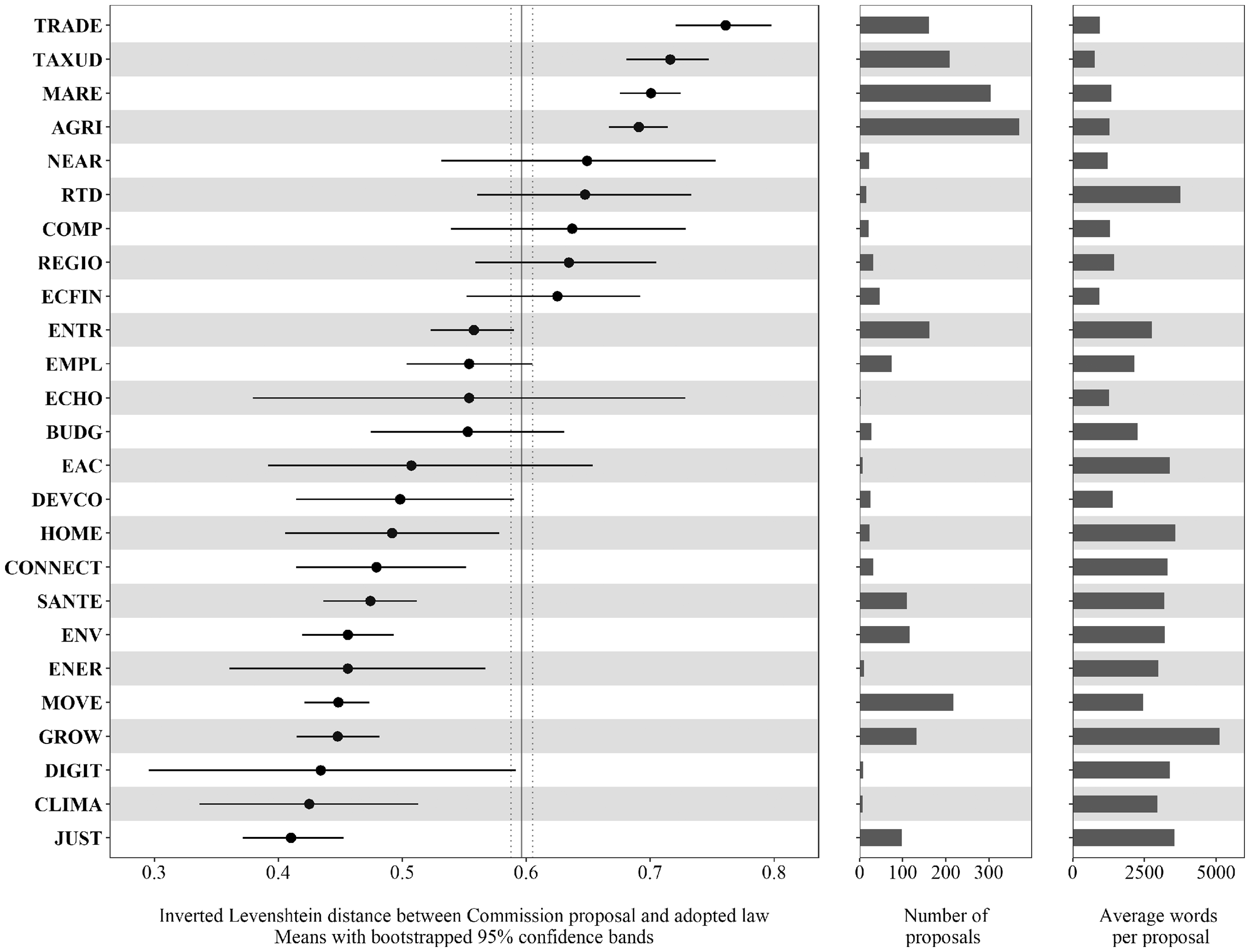
I start with a descriptive overview of the dependent variable: the probability that the text of a Commission proposal is turned into European law without significant change by the co-legislators. The left panel of Figure 1 shows the average inverted edit distance between the text of the Commission proposal and the text of the finally adopted law. The grand mean of this measure (vertical line) indicates a roughly 60% chance that the adopted law equals what the Commission has originally proposed. The Commission is thus rather good in terms of strategic anticipation on average. But it is also not perfect: more than 40% of the words in the Commission’s initial policy choices are edited during inter-institutional negotiations.
Descriptive overview.
Most importantly for our purposes, these data highlight that the ability to draft readily acceptable policies varies systematically across the individual DGs of the Commission. The policies drafted by four DGs – external trade (TRADE), Taxations and Customs Union (TAXUD), Fisheries (MARE), as well as Agriculture and Rural Development (AGRI) – have a consistently higher chance to survive the inter-institutional negotiations without much textual change. The adopted law equals the original Commission proposal in about 70 to 80% of the text that these DGs have put forward. In contrast, other DGs perform consistently below the Commission average. At the bottom end of the spectrum we find, for example, the DG for Justice Affairs (JUST), Climate Action (CLIMA), or Informatics (DIGIT) which only have a below 45% chance that the finally adopted law reflects the original text they have proposed.
This strong descriptive variation in the ability of individual DGs to anticipate which policies are acceptable to the Council and/or the EP also hints to some of the earlier theoretical expectations. The middle and right panels of Figure 1 highlight that the more successful DGs also table significantly more and significantly shorter policies than most of the less successful DGs. In addition, the more successful DGs operate in areas in which a European legislative competence was established early on, while some of the less successful ones have been created only after more recent EU treaty revisions. It thus stands to reason that both the legislative experience a DG controls (H5) and/or the complexity of policies it is responsible for (H4) affect the quality of legislative anticipation it can muster.
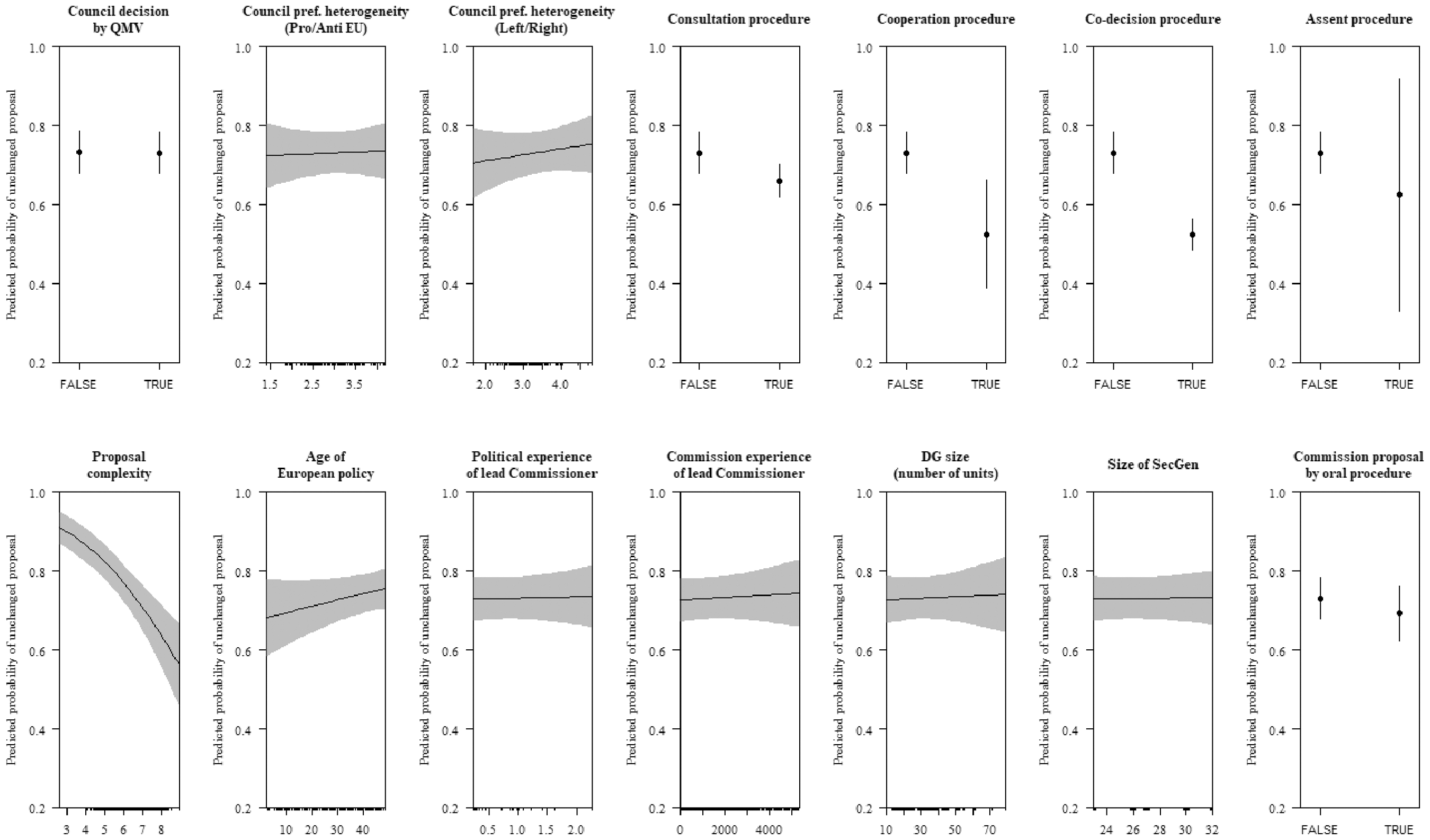
A multivariate analysis should show whether these patterns are also borne out when controlling for the other theorized factors. Since the inverted normalized Damerau-Levenshtein distance is bound between 0 and 1 and can be interpreted as a continuous probability of the text being unchanged, I employ logistic regression models (regression tables and alternative specifications in the Online appendix). In such a non-linear setting, average marginal effects might be misleading and provide little insights into the substantive effect sizes. Figure 2 thus presents the predicted probability for an unchanged Commission proposal when each independent variable moves across its full observed range while all other variables are held at their mean (Leeper, 2018).
Predicted values from the full logistic regression model (see the Online appendix).
The top-left panel shows that the expected effect of Council majority voting on the Commission’s ability of anticipation must be rejected (H1). Across the more than 2000 cases covered here, the likelihood that the Commission proposal remains unchanged appears identical for proposals handled under either unanimity or QMV rule in the Council. Similarly, H2 of the limiting effects of preference heterogeneity in the Council is not supported by the data. Greater variance in governments’ positions on the pro-/anti-EU or left/right dimensions is not, or only very weakly associated with the likelihood that a Commission proposal experiences textual change. Variance on the left/right dimension even has a weak positive tendency, possibly indicating that a more polarized Council fails more often to agree on amendments (cf. Tsebelis and Garrett, 2001). Yet, this effect is substantially small and reaches conventional levels of statistical significance only in very few of the model specifications provided in the Online appendix.
In contrast, formal involvement of the European Parliament seems to complicate anticipation strongly (H3). Descriptively, there is a roughly 77% chance that a Commission proposal remains unchanged when the respective procedure excludes the EP (441 cases in the sample). This chance drops to 55% when the EP has any kind of formal role in the procedure. This effect also holds in the multivariate setting and for the different types of formal EP involvement (panels 4-7 in top row of Figure 2). Already the consultation procedure apparently complicates anticipation for the Commission. Controlling for all other model variables, we observe a drop of roughly seven percentage points in the likelihood that the Commission can push through its original proposal. Even the mere consultation of the EP sometimes seems to unveil new policy issues that the Commission had not been able to anticipate when drafting the legal text. In those procedures where the EP has formal amendment powers, the negative effect on the anticipation quality of the Commission is even more pronounced. For the cooperation (64 cases) and especially co-decision procedures (957 cases), the chance that a proposal survives the negotiations among the Commission’s co-legislators unchanged drops by about 21 percentage points. These estimated effects are substantially large, statistically robust, and hold across different estimation specifications. The negative effect of EP involvement can also be seen in the assent procedure, though it is less robust here given the rarity of these events (11 cases). Taken together, the data strongly support the expectation that formal involvement of the EP makes it much harder for the Commission to anticipate and to draft policies that pass the inter-institutional process seamlessly.
The lower-left panel of Figure 2 furthermore strongly supports the notion that the Commission’s anticipatory quality is hampered by the complexity of the policies it drafts (H4). The higher the entropy (variability of terminology) of a Commission proposal’s text, the lower are the chances that it remains unchanged during the process. Moving from proposals with the lowest entropy values in the sample to the ones with the largest values decreases the normalized success rate by 15 percentage points – a sizable and statistically robust effect.
The second panel in the lower row of Figure 2 shows that legislative experience in a given policy area is beneficial for high quality anticipation as expected (H5). Holding all other variables constant, we see that the time passed since the policy area was first mentioned as a legislative competence in an EU treaty is positively related to the probability that a Commission proposal in this area passes through the inter-institutional negotiations without textual change. Moving from areas that are covered by EU treaties for only two years at the point the Commission DG tables a proposal (e.g. a directive on consumer protection in food prices by DG SANTE in 1994) to others that fall already under European competence for more than 39 years (e.g. a regulation on trade in agricultural products by DG AGRI in 2016) increases the likelihood that the original Commission draft is not changed during the process by six percentage points. Yet, some caution is warranted here: the effect reaches conventional levels of statistical significance in most, but not all tested model specifications.
The other DG level variables, however, do not exhibit the theoretically expected effects (panels 3–5 in the bottom row of Figure 2). Neither the prior political experience of the Commissioner heading the drafting DG nor her or his time in the top-level EU office appear to be linked to the degree of change a proposal experiences in inter-institutional negotiations. The same holds for the administrative resources of the drafting DG or Secretariat General which are – arguably crudely – proxied here by the number of units in the respective organization.
But there is at least some evidence that internal coordination matters for subsequent legislative success: Those proposals that have internally escalated to the highest hierarchical level within the Commission as evidenced by an oral procedure (549 cases in the sample) have a four percentage points lower chance to pass through the Council and the EP in an unchanged manner. Failures of internal coordination thus at least partially predict inter-institutional success as theorized (H7). This association is substantially modest, but statistically robust across different model specifications.
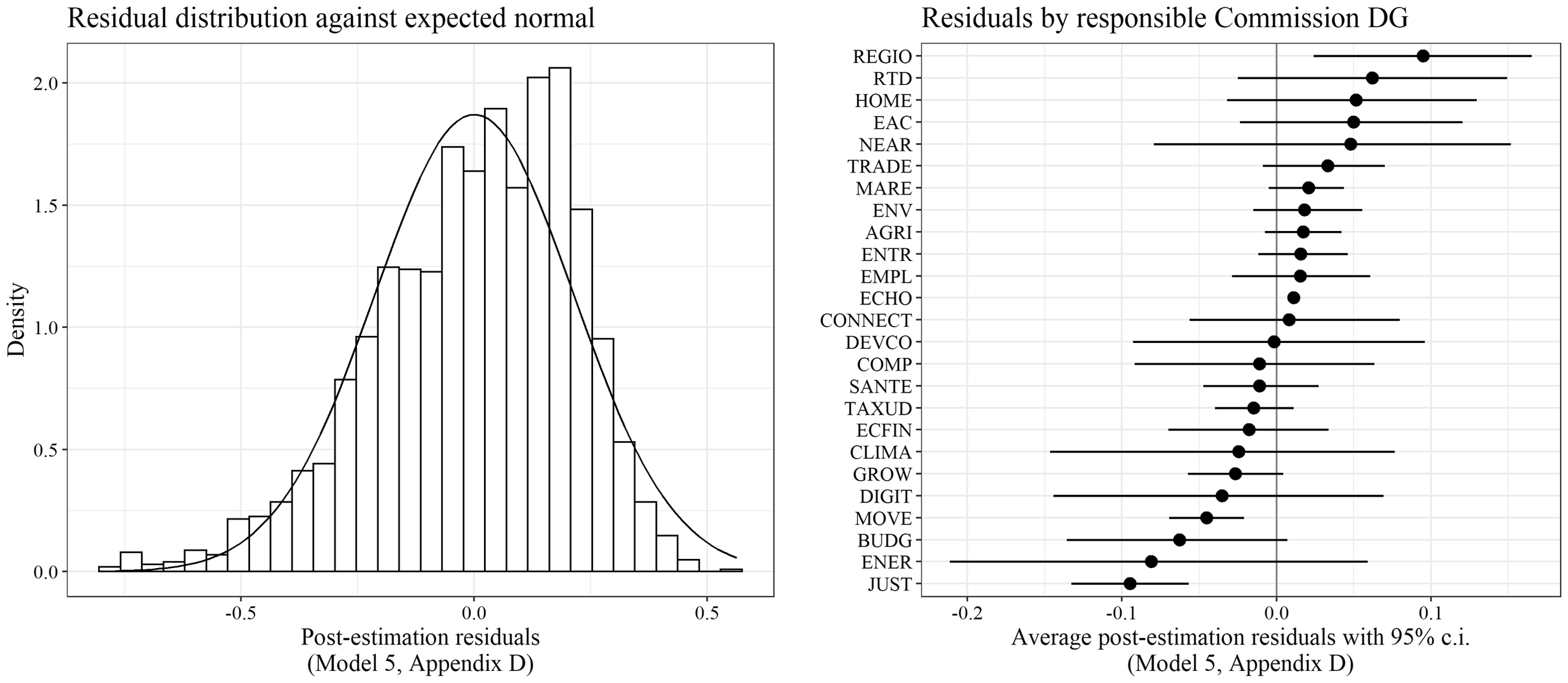
These, in summary mixed, results raise the question to what extent the theoretical arguments proposed here can explain the high amount of variation in the ability of individual Commission DGs to propose policies that the co-legislators can directly accept. A closer look at the nested regression models in the Online appendix suggests that each of the batteries of hypotheses regarding procedural rules, policy characteristics, and organizational variables can capture some of the observed variation. Yet, the model fit measures also warrant caution in absolute terms. As judged by McFadden’s pseudo-R2 we cover only around 14% of the overall variation in our dependent variable across the more than 2200 cases. This entails the risk of systematic omitted variable bias. Figure 3 thus analyses the post-estimation residuals of the main model. The overall residual distribution (left panel) is modestly skewed to the left, suggesting that the model tends to underestimate the quality of legislative anticipation by the Commission. However, the observed distribution does not deviate dramatically from the expected normal, building trust in the patterns we have captured thus far.
Analysis of post-estimation residuals of the main model (see the Online appendix).
Regarding estimation accuracy across drafting Commission DG (right panel), we observe only very few cases that systematically deviate from the expected residual value of zero. The model seems to only consistently underestimate the legislative anticipation that the DG for regional development (REGIO) can muster. This DG mainly drafts proposals on the EU’s regional and structural adjustment funds. While these are usually rather complex texts, they primarily propose financial, zero-sum distributions of funds. For these distributions it is possibly rather easy to predict Council and EP preferences – a nuisance that our current model cannot readily cover by a dedicated independent variable. On the other end of the spectrum, there are a few DGs for which the model overestimates the legislative anticipation quality. These are mostly DGs that operate in long-standing EU policy areas but that were organizationally split and re-organized during the investigation period. For example, DG ENER (energy) was part of DG MOVE (Transport, earlier Transport & Energy) until 2010. DG JUST (justice) split off from DG HOME (migration and home affairs) also in 2010. Likewise, DG GROW is made up of units that were part of DG MARKT (internal market) and DG ENTR (Enterprises) before 2010. These cases thus receive high values on the variable capturing policy specific experience but are in fact younger organizations that possibly still need to find an appropriate workflow for successfully drafting legislation. Taken together, the residual analysis does not indicate systematic bias but points to improvable operationalizations regarding the costs and resources individual Commission DGs face or can invest in preparing individual policy proposals.
Conclusions
This article started from conventional claims that the European Commission is a potentially influential actor in European law-making. While it is constrained by the priorities and preferences of its co-legislators, its rather encompassing monopoly in initiating European legislation offers a distinct first-mover advantage: within the set of all policies that the Council and the EP would accept in principle, the Commission may propose the one policy choice it prefers the most, thereby tilting the aggregate contents of European law. This is a key insight of existing rational-institutionalist analyses of relative legislative powers in the EU.
Yet, this literature treats the Commission mostly as a unitary agenda setter controlling perfect information. Relaxing these assumptions along two lines, I have argued, promises additional insights for the legislative influence that the Commission can muster. First, the high informational demands of strategic agenda setting are costly to meet: The Commission needs to invest in information collection to correctly identify a policy that meets its own expectations while also being acceptable to its co-legislators. The costs of mustering such high-quality anticipation should be negatively related to the complexities of the applicable legislative procedures and the policies in question. Second, the resources to handle these high informational demands are unequally distributed in the European Commission and should also hinge on internal coordination. To test expectations derived from this enhanced model, I analyse the edit distances between Commission proposals and finally adopted laws in more than 2200 legislative processes between 1994 and 2016.
Descriptively, these data show that the quality of legislative anticipation varies heavily across Commission proposals and, notably, also systematically across the different DGs in the European Commission. While some DGs only have a 45% chance that their proposal is fully reflected in the final European law, others reach values of up to 80% on average. When it comes to exploiting the legislative first-mover advantage strategically, in other words, we do not face one but many, rather differently skilful agenda setters in the European polity.
Trying to explain this variation in a multivariate analysis has produced mixed results. Four aggregate findings are robust and consistent with the theoretical expectations. First, the Commission is less capable of predicting a winning policy whenever the European Parliament is formally involved in the respective process. Second, the more complex the respective policy is, the harder correct legislative anticipation seems to be. Third, in terms of the age of European policy competence, more experienced DGs seem to better anticipate which policies the co-legislators will accept. Fourth, the findings regarding proposals concluded by the oral procedure in the Commission suggest that conflictual coordination in the Commission hampers inter-institutional success.
Yet, other hypotheses derived from the overarching model were not supported. The analysis rejects the claim that the Commission faces stronger hurdles in crafting winning policies under unanimity or higher preference heterogeneity on the aggregate left/right or pro-/anti-EU dimensions in the Council. Future research might develop and apply more policy-specific preference measures (cf. König and Luig, 2012), study interactions between preferences and decision rule, or try to account for possible changes in the preferences and/or the status quo during the inter-institutional negotiations (Moser, 1996). Recent research furthermore shows that not only Council preferences but also the policy priorities of the Council and especially its presidency affect legislative decision-making (Cross and Vaznonytė, 2020). Along this line, the Commission’s legislative success may also be driven by the varying amount of Council scrutiny that individual policy areas receive over time.
The analyses also highlight that there is still much unexplained variation at the level of Commission DGs. This calls for better long-term data on their varying administrative and political resources as well as on the coordination inside the Commission. The lack of empirical support that the corresponding expectations have found in the analyses here may be partially due to the only rather crude measures I could exploit over the long period covered here. Recent research has made empirical progress on these fronts for more confined time periods (on coordination: Blom-Hansen and Finke, 2020; on administrative resources: Ershova, 2019). Linking such systematic internal information to the inter-institutional success of the Commission appears as a very promising route for future research. Such research could also account for whether the allocation of policy proposals to individual Commission DGs follows strategic considerations in the first place. Case studies show that the distribution of proposal responsibilities is contested inside the Commission (Hartlapp et al., 2014) while large-N research shows that the Commission is aware of the procedural implications of allocating policies to specific legal bases in the EU treaties (Ovádek, 2020b). Yet, we do not know whether the individual DGs’ capacities to muster high quality anticipation affect these choices as well. Finally, the residual analysis of the main model suggests that legislative success may be linked to internal re-organizations and reforms, also implying that we can gain insights on legislative success by building on insights from public administration approaches (cf. Bauer, 2013).
In sum, the patterns uncovered here provide evidence that a disaggregated perspective on strategic agenda setting of the European Commission is substantially warranted. Relaxing the unitary actor and perfect information assumptions should thus also help to better understand the political ramifications of portfolio distributions and managerial reforms that come up again and again at the beginning of each Commission term. Second and more importantly, accounting for varying strategic capacities within the Commission should lead to better predictions on how the integration through law will evolve across different policy areas of the European Union in the long run.
Supplemental Material
sj-pdf-1-eup-10.1177_1465116520961467 - Supplemental material for One agenda-setter or many? The varying success of policy initiatives by individual Directorates-General of the European Commission 1994–2016
Supplemental material, sj-pdf-1-eup-10.1177_1465116520961467 for One agenda-setter or many? The varying success of policy initiatives by individual Directorates-General of the European Commission 1994–2016 by Christian Rauh in European Union Politics
Supplemental Material
sj-zip-2-eup-10.1177_1465116520961467 - Supplemental material for One agenda-setter or many? The varying success of policy initiatives by individual Directorates-General of the European Commission 1994–2016
Supplemental material, sj-zip-2-eup-10.1177_1465116520961467 for One agenda-setter or many? The varying success of policy initiatives by individual Directorates-General of the European Commission 1994–2016 by Christian Rauh in European Union Politics
Footnotes
Acknowledgements
I highly appreciate the research assistance by Markus Konrad, Johannes Scherzinger and Rhianna Vonk. The manuscript has benefitted from feedback received at the workshop ‘Computational EU Politics’, University of Oslo, 25-26 September 2018, and the ECPR General Conference Wrocław, 4–7 September 2019. I am especially grateful for comments by Steffen Eckhardt, Miriam Hartlapp, Bjørn Høyland, and for the challenging, yet highly constructive input from the three anonymous reviewers and the editor.
Funding
The author(s) received no financial support for the research, authorship, and/or publication of this article.

Notes
Supplemental material
Supplemental material for this article is available online.
References
Supplementary Material
Please find the following supplemental material available below.
For Open Access articles published under a Creative Commons License, all supplemental material carries the same license as the article it is associated with.
For non-Open Access articles published, all supplemental material carries a non-exclusive license, and permission requests for re-use of supplemental material or any part of supplemental material shall be sent directly to the copyright owner as specified in the copyright notice associated with the article.
