



Abstract
Research on differentiated integration has paid considerable attention to its causes. However, we know very little about its consequences. Using the synthetic control method and interactive factor models, this article investigates the effects of differentiated integration on citizens’ support for the EU. We find that in cases where member states are granted an opt-out or are allowed to integrate into a policy area they were previously excluded from, support increases. In contrast, support decreases when member states are not granted a requested opt-out or are excluded from a policy area they would like to join. These findings carry important implications for the EU's legitimacy. While differentiated integration has the potential to enhance citizens’ legitimacy perceptions, it can also undermine them simultaneously.
Introduction
In its early days, European integration was mainly an affair of bargaining among national elites. However, as the European Union (EU) grew wider and deeper, it became a highly contested political issue with different national publics holding increasingly dissimilar views about the EU and its future (De Vries, 2018; Hooghe and Marks, 2009). Against this backdrop, a system of differentiated integration (DI) emerged, allowing to accommodate this heterogeneity in preferences by granting the member states a possibility to vary levels of engagement in EU policy (Schimmelfennig and Winzen, 2020). Over the years, and in light of the multiple crises that the EU has been facing, DI has become commonplace in the EU's legal order. In response to this development, a rapidly growing body of literature has been devoted to understanding the causes, spatial patterns, and historical trajectories of differentiation (Leruth et al., 2019; Schimmelfennig and Winzen, 2020). Despite these important advancements in the study of DI, research on public opinion and differentiation is still lacking behind. Although studies are beginning to address public opinion about DI (De Blok and De Vries, 2023; Hix et al., 2022), empirical research on the reverse relationship, namely the consequences of differentiation for citizens’ EU attitudes, remains scarce (see Burk and Leuffen, 2019; but also see Schraff and Schimmelfennig, 2020).
This is an important knowledge gap, given that the EU's future critically hinges on public support, making it crucial to understand the link between increasing differentiation on the one hand, and EU public opinion on the other. Existing studies on DI tend to make strong assumptions about the supposed effects of differentiation on citizens’ EU attitudes without testing them empirically. Conceiving the EU as an essentially “demoi-cratic” polity, comprising multiple and diverse demoi (instead of a unified demos) (Bellamy and Kröger, 2017; Cheneval and Schimmelfennig, 2013; Nicolaïdis, 2013), one stream in the DI literature views differentiation as an adequate acknowledgement of the EU's diversity, leaving it up to each national political community to determine how much integration is enough integration (Lord, 2015: 792). From this perspective, DI is a valuable tool to counter contemporary political challenges to integration, such as Euroscepticism, by accommodating national preferences in sensitive policy areas, while facilitating further integration among the willing.
In contrast, another stream in this literature has been much more critical of DI (Adler-Nissen, 2014: 27–32; Schimmelfennig and Winzen, 2020: 176–186). Among other things 1 , some argue that differentiation may be used to exclude member states from certain policy areas to avoid costs (e.g., by restricting the free movement of workers within the EU), thereby fostering discrimination and creating different classes of EU citizens (see Schimmelfennig and Winzen, 2020: 180). Moreover, extending these criticisms, DI may also be argued to potentially alienate Europhiles who desire further integration but belong, at the same time, to a national political community that opts out from a policy or is unwillingly excluded from it.
Based on these two streams of thought, DI can be seen as either part of the problem or part of the solution to the various crises currently facing the EU and thus, it may or may not be a desirable scenario for the EU's future (European Commission, 2017). Yet, with this debate operating on largely theoretical grounds, we know little about the actual consequences of DI for citizens’ EU attitudes which, in turn, affect the course of the EU as a whole. We aim at filling this gap by grounding these existing theoretical arguments in empirical evidence, investigating the effects of DI on EU public opinion for different cases of differentiation events. With this in mind, we propose a theoretical and methodological framework for the investigation of DI effects on citizens’ EU attitudes focusing on EU support as a central measure tapping into citizens’ perceptions of the EU's legitimacy.
Using the synthetic control method, interactive factor models (Abadie et al., 2010, 2015; Gobillon and Magnac, 2016), and two-way fixed effect models, we find that EU public opinion is indeed responsive to differentiation. In short, in cases where member states are granted an opt-out they requested or are allowed to integrate into a policy area that previously excluded them, EU support increases. Conversely, public support decreases if European publics are excluded from integrating into a policy area they expected to join or when they have to integrate into a policy area they were previously expecting to abstain from.
These findings carry important implications for the legitimacy of the EU. While DI has the potential to bolster support for the EU, it can also undermine it at the same time. Fundamentally, if DI is used to accommodate heterogeneous preferences by granting member states the possibility to opt-in or to opt-out, it enhances public legitimacy perceptions. However, when differentiation is used to exclude member states from a given policy area, or if a member state is denied an opt-out it requested, legitimacy perceptions suffer. In this regard, it seems that the “demoi-cratic” literature is right when praising DI for acknowledging the EU's diversity (Bellamy and Kröger, 2017; Cheneval and Schimmelfennig, 2013; Nicolaïdis, 2013), while concurrently, more cautious voices also have a point when reminding us of the potential problems of discriminatory differentiation (Adler-Nissen, 2014: 27–32; Schimmelfennig and Winzen, 2020: 176–186).
From causes to consequences: theorizing the effects of DI on citizens’ EU support
A typology of DI effects on EU support
In its “White Paper on the Future of Europe,” the European Commission (2017) has formulated five major scenarios of how the EU could develop by 2025. Here, one of the most prominent sketches, gaining increasing support at the political stage in Brussels and beyond, pertains a future where “those who want more, do more”, and as such closely corresponds to what is currently discussed in the academic literature as DI. 2 Considering the increasingly diverse set of preferences different national publics hold about the future of Europe, the main advantage of this scenario is its ability to accommodate preference heterogeneity for certain policy areas, while moving the European project forward (Holzinger and Schimmelfennig, 2012). Essentially, by giving member states a choice of how much Europe is desirable for their national community (Lord, 2015: 792), DI is frequently floated as a potential solution to the gridlock the EU is facing at the moment.
However, despite these possible benefits, in terms of empirical evidence, we know very little about the consequences of DI, in particular, when it comes to its effects on citizens’ EU attitudes (Burk and Leuffen, 2019). Schraff and Schimmelfennig (2020) started to address this gap by investigating how the 2015 Danish Justice and Home Affairs opt-out referendum affected citizens’ EU efficacy. Using a quasi-experimental design, they find a positive effect of the vote on citizens’ believes that their voices matter in EU politics. Focusing on the micro-level, they also identify significant effect heterogeneity, with Eurosceptic voters’ efficacy particularly increasing (Schraff and Schimmelfennig, 2020). Although these findings are important, the scope of this study remains limited as it only looks at one specific scenario of decision-making in the context of differentiation, where citizens were given a clear opportunity to state their collective voice through a referendum. However, when it comes to DI potentially affecting citizens’ EU attitudes, one can think of multiple other cases each yielding divergent theoretical expectations.
To overcome this shortcoming, we develop a typology of four scenarios that theorize the link between DI and EU attitudes on the aggregate level, focusing on EU support. The resulting typology is portrayed in Table 1. As a first scenario (upper left panel of Table 1), we expect that “those who want less, do less” has a positive net effect on EU support. When a national public is anticipating a differentiation in a certain EU policy area, and is subsequently granted an opt-out, this should have a boosting effect for citizens’ EU attitudes within this national community. In this sense, our reasoning is in line with the “demoi-cratic” arguments highlighting DI's potential to allow for the accommodation of heterogeneous national preferences (Bellamy and Kröger, 2017; Cheneval and Schimmelfennig, 2013; Lord, 2015; Nicolaïdis, 2013). Furthermore, decisions to accommodate a highly anticipated differentiation may also have the potential to silence Eurosceptic voices, insofar as they are fuelled by popular concerns about national sovereignty regarding the policy area at hand (Boomgaarden et al., 2011; De Vries, 2018; Serricchio et al., 2013). Similarly, following the utilitarian approach to EU support, understanding public opinion toward Europe as resulting from a cost-benefit analysis (Anderson and Kaltenthaler, 1996; Eichenberg and Dalton, 1993; Gabel and Whitten, 1997), a said opt-out, if perceived as economically profitable, may likewise have a positive net effect on citizens’ EU support.
A typology of DI effects on EU support.
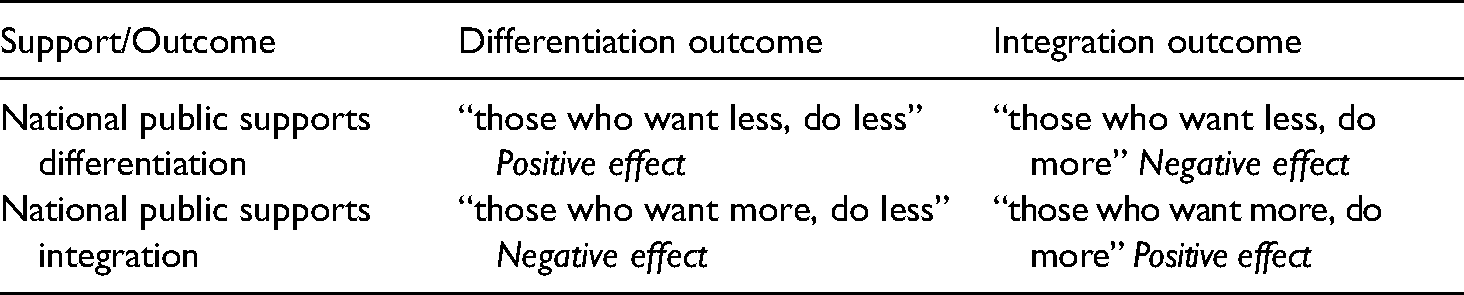
As a second scenario (lower right panel of Table 1), we expect that a situation where “those who want more, do more” has a similar positive net effect on EU support. This category includes circumstances of receiving highly requested opt-ins, in particular after being excluded from integration before. Such cases are defined by Schimmelfennig and Winzen (2014) as discriminatory differentiation and exceptive differentiation, both of which tend to be directed toward newer and poorer member states. Scholars recognize that demand for this type of differentiation is driven by old member states (Schimmelfennig, 2014) and serves the purpose of rendering a widening of the EU pareto-efficient in the first place (Schneider, 2007). One fitting example of this scenario pertains the free movement of people as this is a policy area where new member states are often initially restricted and then progressively allowed to fully integrate. Hence, considering that some member states perceive freedom of movement as an opportunity to improve their economic position (Vasilopoulou and Talving, 2019), being granted an opt-in in this area might have an overall positive net effect on citizens’ EU support within these countries. Furthermore, the same dynamic may also be at play when it comes to monetary policy. In this case, being allowed into the Eurozone might be perceived as something beneficial for the national economy and may thus positively influence citizens’ opinion of the EU. Since new member states are excluded before they can fulfil certain predetermined conditions, we assume they would experience positive effects once they are accepted.
The opposite situation arises where “those who want more, do less” (lower left panel of Table 1). The literature underlines potential negative side effects of such instances of DI. They are often argued to foster discrimination between citizens from different member states (see Schimmelfennig and Winzen, 2020: 180) and, thus, may lead to a net erosion of EU support in the countries that are excluded from a given policy area they would like to join. Usually, policy areas where such discrimination takes place are more salient for newer member states and frequently act as a continued “carrot and stick” approach to encourage desired behavior after accession to the EU (De Neve, 2007: 512–513). Although such kind of exclusions are generally intended to be temporary, they may, in some cases, fail to be lifted, resulting in a situation where member states find themselves to be excluded indefinitely. Drawing on this observation, some DI scholars have criticized these instances as a display of lacking solidarity on the side of the wealthier or older member states, who wish to exempt themselves from the costs incurred when admitting new members states into certain policies (Adler-Nissen, 2014: 30–31). In this regard, these exclusions may eventually alienate citizens from the idea of a united Europe and leave them sobered after a phase of initial enthusiasm accompanying accession. If exclusions persist beyond what the member states originally agreed upon, we expect a negative net effect on public support for the EU.
Lastly, the final scenario relates to failed attempts to receive an opt-out that is anticipated by the national public. We expect that cases where “those who want less, do more” (upper right panel of Table 1) give rise to a negative net effect on EU support. In this case, the EU is perceived as imposing its policies on the national public in question while neglecting its wishes for more self-determination and control, which could have a detrimental effect for citizens’ EU support. Previous literature has found that if European integration becomes politicized in the national arena, there could be substantial spillover effects on EU support (Ares et al., 2017) as the domestic arena becomes more responsive to public opinion about integration (Hooghe and Marks, 2009). Thus, in a case where DI becomes politicized by the national government's failure to negotiate an opt-out, Eurosceptic political entrepreneurs might use this as an opportunity to mobilize against European integration at the domestic level (De Vries and Hobolt, 2020). Under these conditions, we expect declining EU support in return.
Exploratory cases
We test our theoretical expectations by relying on four cases each of which corresponds to one of the scenarios outlined above. 3 Following our typology, the cases are based on the interaction between the outcome (differentiation or integration) and what was previously expected about the policy area in the member state(s) in question. First, to test the effects of DI where “those who want less, do less”, we look at the negotiations of the “Treaty on Stability, Coordination and Governance in the Economic and Monetary Union” (also referred to as the Fiscal Stability Treaty). This treaty was negotiated in response to the 2009 European sovereign debt crisis to enforce fiscal discipline, coordination, and governance. The content of the treaty, and in particular “The Fiscal Compact” (EFC), had considerable implications for core state powers relating to government spending and fiscal policy. Therefore, negotiations were complicated and ultimately needed differentiation in order to succeed. More specifically, in 2013, the EFC was adopted by all Eurozone members as well as Romania, Denmark, and Bulgaria, while Hungary, Poland, and Sweden received opt-outs and were subsequently not obliged to implement any laws for the enforcement of the EFC into their legal systems. These countries thus fall into the category of “those who want less, do less”, where we expect a positive net effect on EU support following the opt-out.
Second, we investigate the DI effects of the scenario “those who want more, do more” by facilitating the case of Latvia and Lithuania joining the Eurozone in 2014 and 2015, respectively. Although their accession was initially postponed due to the European debt crisis, both countries were eventually allowed to join without any objections or additional requirements. The Latvian and Lithuanian public widely perceived the adoption of the Euro as something beneficial for their domestic economies. Although not completely unopposed, in both countries major political actors of government and opposition principally agreed that joining the Eurozone was the right path, eventually increasing overall wealth. This general positive stance toward adopting the Euro is also reflected in surveys following both countries’ accession to the Eurozone. In October 2015, a majority of Latvians and Lithuanians said that having the Euro was good for their country. 4 Against this backdrop, it seems that citizens’ cost-benefit analysis of European integration might have improved following these opt-ins and may thus have boosted EU support.
Third, we employ the case of Bulgaria and Romania not being allowed to join the Schengen area in 2011 to investigate the effects of DI on EU support when “those who want more, do less”. Having fulfilled all technical criteria necessary to join Schengen, and after the European Parliament and the European Commission approved their accession in 2011, the European Council blocked the admission of both countries over concerns about lacking sufficient anti-corruption measures. In this context, then Bulgarian prime minister Sergey Stanishev declared, “it is clear Bulgaria complied with its obligations, which were formulated in a certain way … and Bulgaria should be a member of the Schengen by now” (Euroviews, 2014). Along the same lines, Romanian MEP Norica Nicolai stated that “Romania and Bulgaria do not need to prove anything to these countries. We are all EU members, equal under the EU treaties, there should not be a question of proving anything to countries which are supposed to be our allies under the same organization” (Euroviews, 2014). These quotes speak to the broad public support for joining the Schengen area also reflected in opinion polls. For instance, in January 2011, 67% of Bulgarians were in favour of Schengen membership, while only 6% were against it. 5 Therefore, we expect a negative net effect on EU support in the wake of Bulgaria and Romania being denied joining Schengen.
Lastly, we draw on the Czech Republic's opt-out negotiations for the Charter of Human Rights in the context of finalizing the ratification of the Lisbon Treaty. Representing a case of “those who want less, do more”, Czech officials, including then president Václav Klaus, refused to sign the Lisbon Treaty over fears that the Charter would allow EU courts to challenge post-war laws of Czechoslovakia expelling Germans from the territories of the present-day Czech Republic. Although not a formal differentiation from a legal standpoint, the European Council voted that the “Protocol No 30 on the application of the Charter of Fundamental Rights of the European Union to Poland and to the United Kingdom shall apply to the Czech Republic” and “in the same terms” 6 , promising that a differentiation would take place during the next accession treaty. In February 2014, the new social democratic government formally withdrew the country's claim, bringing the bid for a Czech opt-out to a conclusive end. At the same time, the government started incorporating parts of the Fiscal Compact into national law, although the country had not previously signed the treaty and was not bound by it. We expect these two initiatives of the newly elected government to have a negative effect on EU support, as the national public is confronted with two integration outcomes changing the previously existing status quo.
In all our cases, treatment refers to a binary indicator that takes the value of 1 if a country receives a differentiation (or integrates into a policy area). We expect that any effect on public support should materialize after the treatment occurs. For example, the Council voted to maintain the exclusion of Bulgaria and Romania from Schengen in September 2011, therefore the treatment should take effect in the next period, which is the first semester of 2012.
From a philosophical perspective, we consider cases as differentiation (or integration) events, which may or may not go through intergovernmental negotiations, triggering a public reaction. This entails some additional key points: As we mention above, the case should be within the universe of what can be reasonably expected based on the status quo. However, it should be underlined that we consider this universe to be relatively broad, because all countries have a position in any given policy area, thus creating expectations about how they should proceed in the future. In this sense, the “negative cases” (Bulgaria and Romania, and the Czech Republic) have to do with instances where these reasonable expectations were not fulfilled, and the “positive cases” (Latvia and Lithuania, and the Fiscal compact cases) have to do with instances where these were met. In addition, we focus on typical cases and cases that were important enough to be featured in the national debate.
Empirical framework
Methods
Our empirical strategy rests on synthetic control and interactive factor models. More specifically, we use the methods outlined by Abadie et al. (2010, 2015) for synthetic control and Gobillon and Magnac (2016) for interactive factor models utilizing the expectation-maximization (EM) algorithm. Conceptually, this estimation relies on constructing a combination of control units to construct a hypothetical “doppelganger” to the treated unit. We also employ linear fixed effects models (time-unit) with clustered standard errors on the country level.
Although initially designed for policy impact evaluation, such methodological approaches like synthetic control models have been recently used in political science research as well. For instance, in the field of European politics, the generalized synthetic control method (Xu, 2017) has been implemented to estimate the effect of Eurozone bailouts on national politics (Schraff and Schimmelfennig, 2019). The synthetic control approach makes it possible to estimate the effect of differentiation on citizens’ EU support in a given treated country by approximating a counterfactual based on comparable cases recruited from a donor pool of untreated units. The weight of every control case from that donor pool is adjusted based on covariates and pre-treatment outcomes, so that the trajectory of the synthetic counterfactual follows the most similar trend to that of the treated unit up to the time treatment occurs. The difference between the observed and hypothetical trend, in turn, presents the average treatment effect (ATT) on each treated unit (Abadie et al., 2010, 2015). The ATT is defined as
For interactive factor models, the literature has put forward a number of alternative approaches, including the EM algorithm proposed by Gobillon and Magnac (2016). This approach follows Bai's estimation method (2009) and uses an EM algorithm to obtain estimators of all parameters when using all observations of untreated units and pre-treatment observations of treated units only. After the counterfactual trajectory is estimated by using pre-treatment data, it is compared to the development of the treated unit. We use the interactive factor method for cases with more than one treated unit, and the synthetic control method for the Czech case, where only one unit is treated. We exclude potential control cases that receive differentiations around the same time to the one we investigate. For example, EFC differentiation for Poland, Hungary, and Sweden takes place around the same time as treatment occurs for our cases of Bulgaria and Romania, as well as the Czech Republic. Therefore, each group of these “treated” cases are excluded from the pool of potential control cases of the other.
We also employ linear unit-time fixed effect models with clustered standard errors at the country level as an alternative specification, which represents a more established and simpler approach. We discuss details of our empirical strategies in the Online appendix, including the exact specifications used for all empirical models.
Data
We collected Eurobarometer data on citizens’ EU support dating back to the 1990s, ranging from 1995 to 2019. EU support is operationalized by an item asking respondents whether they think that their countries’ membership of the EU is a good thing, a bad thing or neither a good nor a bad thing. Besides including data from the Standard and Special Topic Eurobarometer, we also rely on data from the Candidate Countries Eurobarometer, in order to keep missing values at a minimum. 7 We organize our data by country-semesters. In contrast to country-years, this has the advantage of a longer and more accurate time series. For this purpose, we aggregate our individual level Eurobarometer data to the country-semester level and use prostratification weights. We drop Eurobarometer waves where fieldwork was conducted in between two different semesters (e.g., June and July). If two or more surveys were conducted in the same semester, we form a semester average. For the purpose of our analysis, we operationalize EU support as the combined share of respondents indicating that their countries’ EU membership is a good thing or neither a good nor a bad thing. 8 We include additional variables from the Varieties of Democracy dataset (Coppedge et al., 2021) to be used in the synthetic control and fixed effect models. These include GDP per capita and growth, import to export ratio, inflation rate, fertility rate, and the liberal democracy ranking.
Results
In the following section, we present the results of our empirical analysis. First, we show and discuss the results for each element of our typology, as well as the regression results for the linear fixed effects models. We include several robustness checks in the Online appendix.
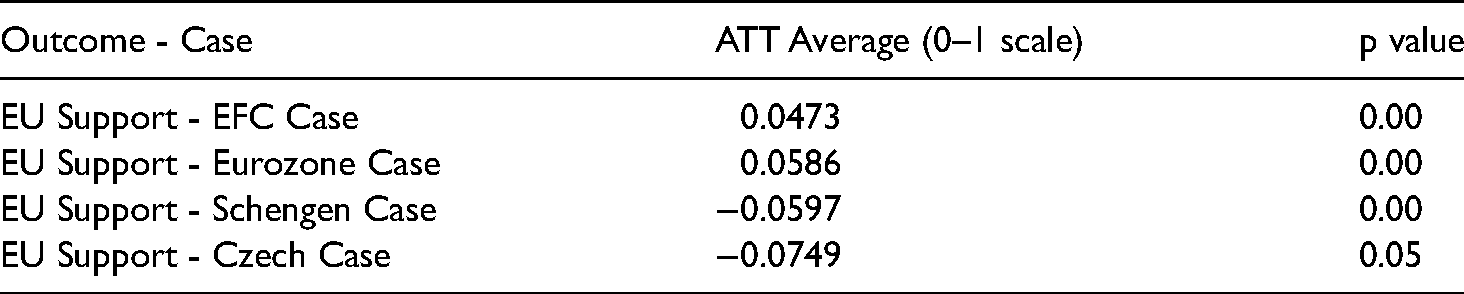
For each of the four cases, we show results for EU support using plots that track the difference between the observed and synthesized outcome trend. We also include a summary table with all estimated ATT averages (Table 2) to discuss the effect magnitude of differentiation events on EU support. The Online appendix includes additional plots, which track the treated and synthetic units through time.
Average treatment effects and statistical significance for all cases.
Member states that receive an opt-out -“those who want less, do less”
As described above, for the case of “those who want less, do less”, we investigate the Fiscal Compact opt-outs for Hungary, Poland, and Sweden. The plot in Figure 1 displays a positive effect on EU support. Comparing between the pre-/post-treatment periods, there is a positive and statistically significant effect for the entire post-treatment period. On the aggregate level, this means that countries that received an opt-out from the EFC show higher levels of EU support compared to their counterparts in the semesters following this particular differentiation.
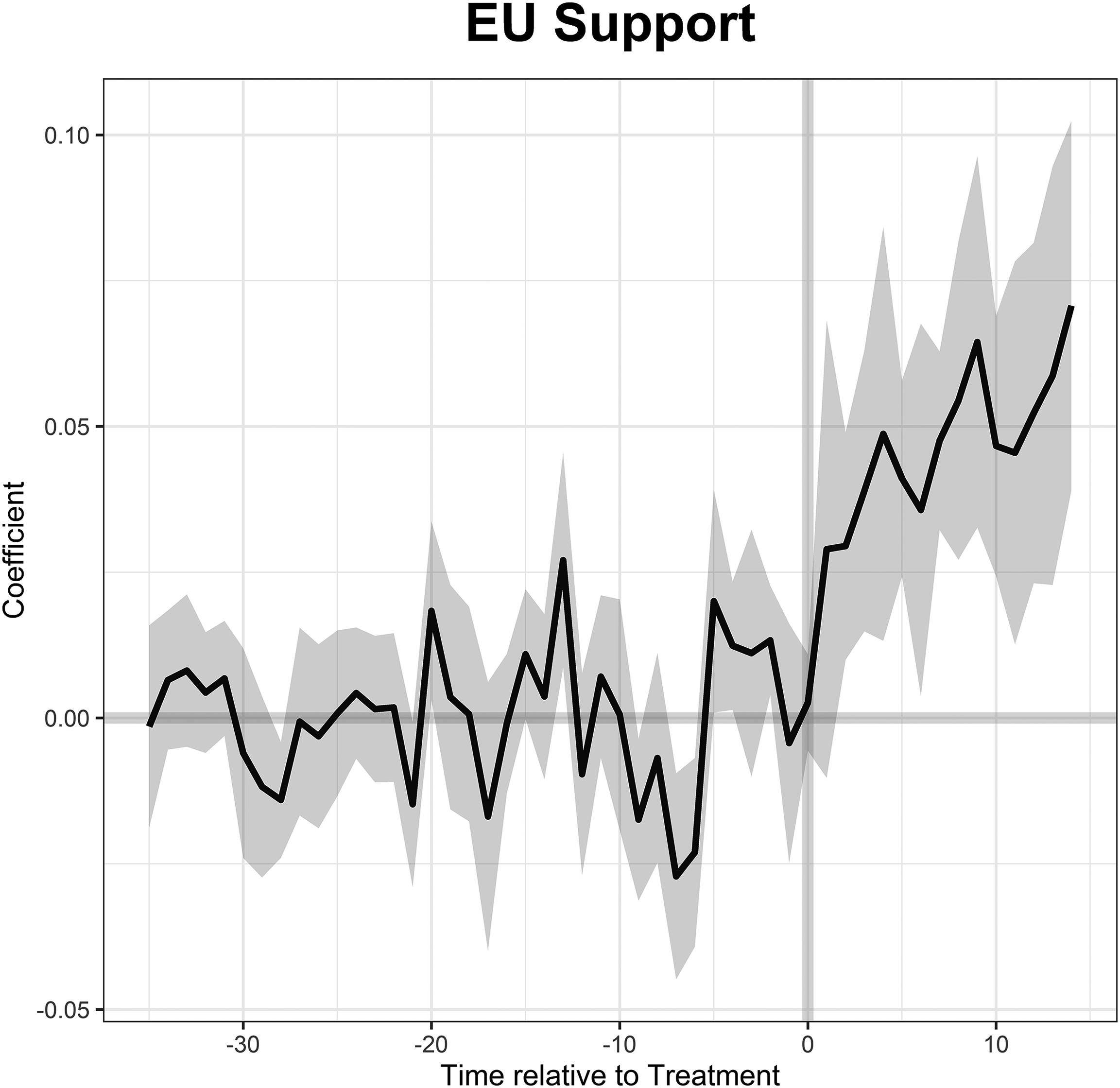
Gap plot for effects of Fiscal Compact differentiation for Hungary, Poland, and Sweden on EU support with 95% confidence intervals.
Member states that receive an opt-in -“those who want more, do more”
Here we investigate the case of Latvia and Lithuania eventually joining the Eurozone in 2014 and 2015, 10 years after their accession to the EU. In Figure 2, we see that their Eurozone membership results in an increase of EU support, even though it took place during a time of considerable scepticism toward common monetary policy. Note, however, that the gap plot for EU support shows a small but statistically significant difference between treated and control units during the pre-treatment period close to 5 years before the treatment (i.e., T = −10). Yet, the overall fit of the model is good.
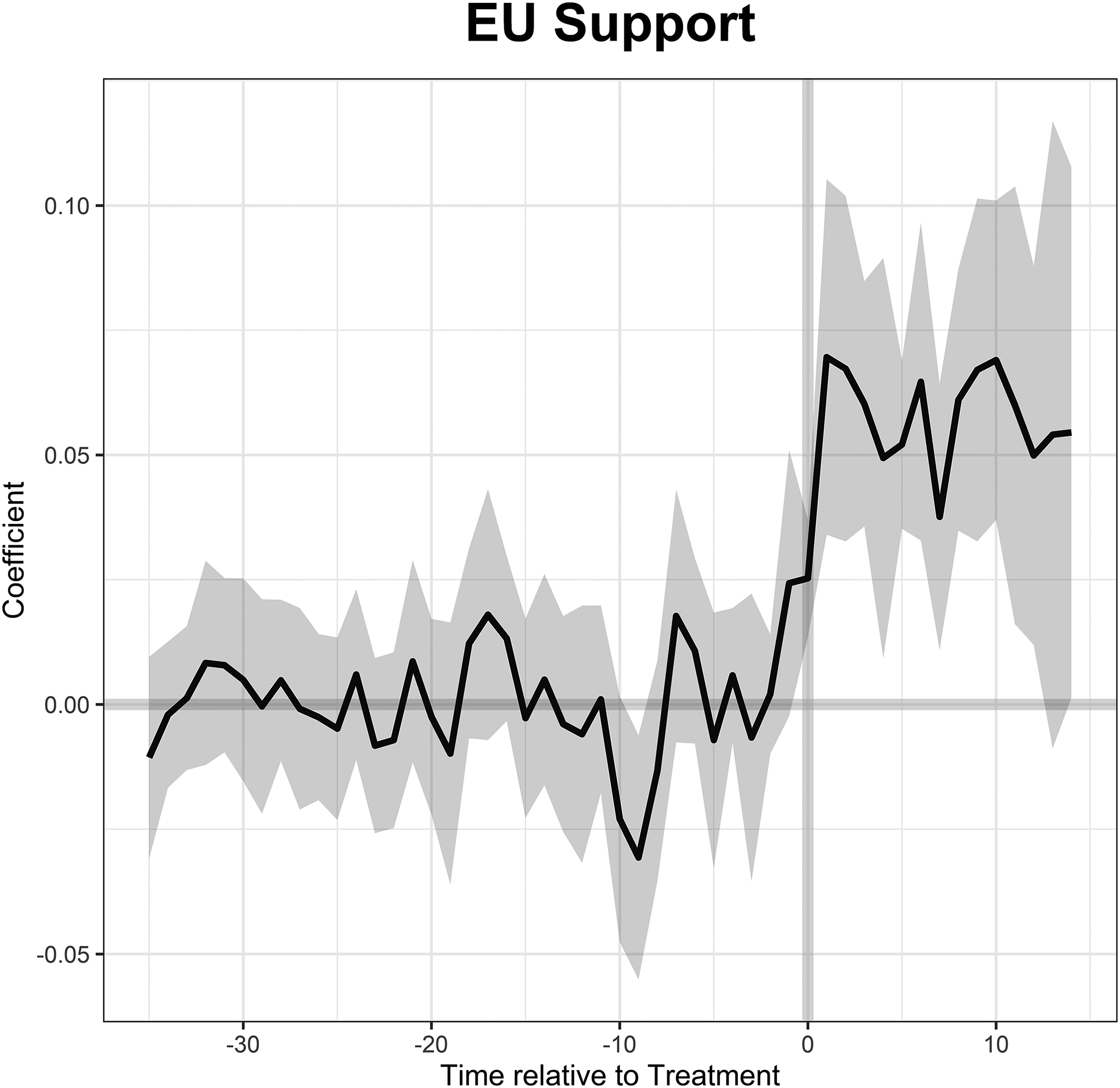
Gap plots for effects of Eurozone integration for Latvia and Lithuania on EU support with 95% confidence intervals.
Member states that do not receive an opt-in -“those who want more, do less”
Next, we visit the case of withholding Bulgaria and Romania from joining Schengen by the Council. The cases of Bulgaria and Romania are somewhat complicated because having the approval of the European Parliament and then being blocked by the Council can be seen as a “double treatment”. As mentioned above, by June 2011, the Council and the Commission concluded that the evaluation process was successful and that the two countries fulfilled all technical accession criteria. In the same month, the European Parliament approved their accession, but the Council blocked the two countries from integrating. As it becomes clear that both countries would not be allowed to join, we can see an overall negative and statistically significant effect for the post-treatment period on EU support in Figure 3.
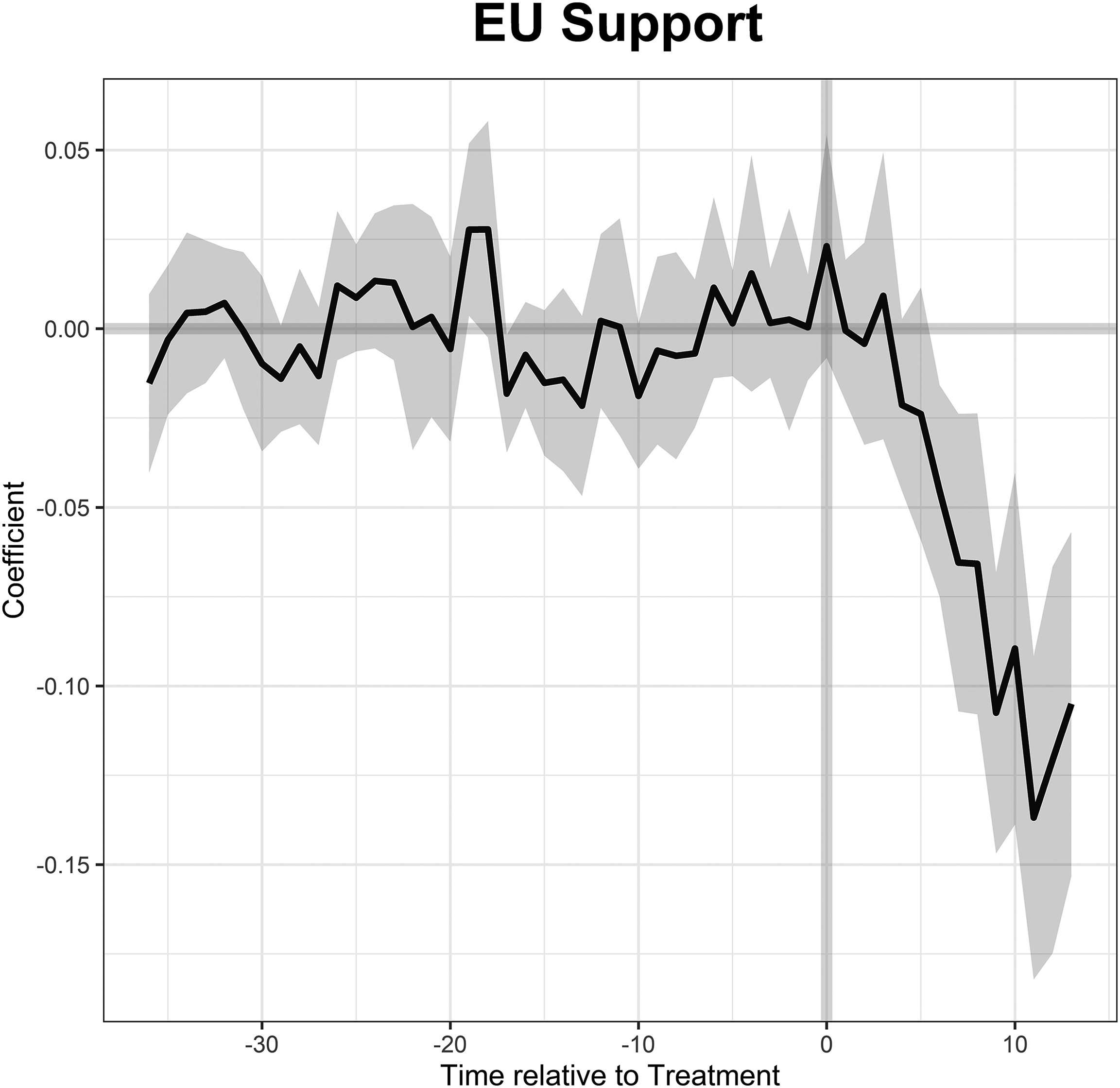
Gap plots for effects of Schengen differentiation for Bulgaria and Romania on EU support with 95% confidence intervals.
Member states that do not receive an opt-out -“those who want less, do more”
Finally, for the Czech case, we use the synthetic control method, as we only have one treated case. As with all cases, we are excluding countries that received some type of differentiation treatment before or around the same time as the treated unit in order to avoid bias introduced by other countries that receive an opt-out or opt-in. To construct the synthetic counterfactual, we use pre-treatment levels of EU support and control variables discussed above. In line with our expectations, as shown in Figure 4, we observe a considerable decrease in EU support after treatment.
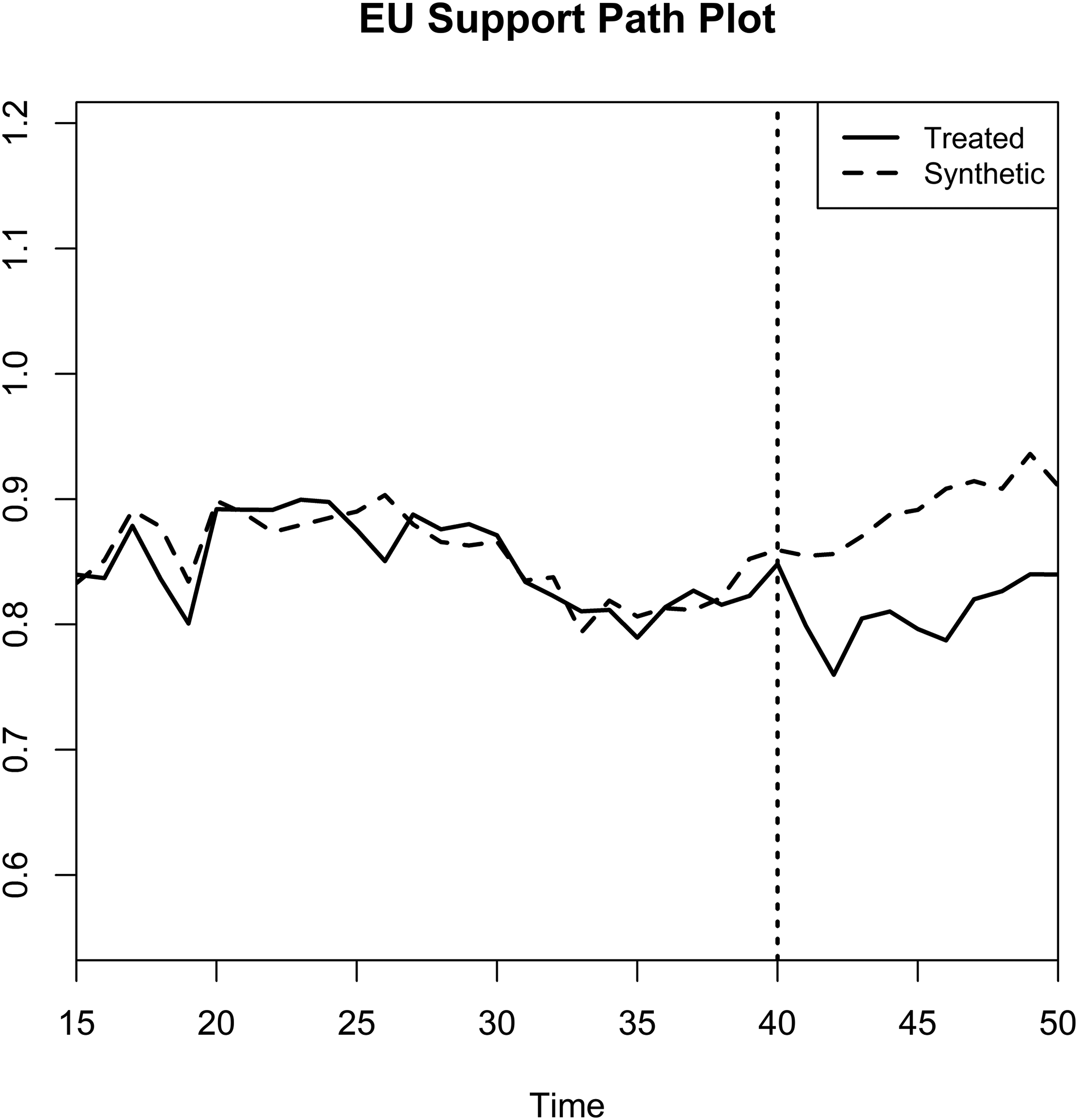
Path plot for effects of Czech case on EU support.
The synthetic control method is not informative for statistical significance on its own, so we employ an additional analysis to determine that. We run a placebo-in-space test to evaluate the probability of uncovering an effect as profound as the one we see above by assigning the treatment to all cases. To do so, we implement the method for all member states and estimate the post-/pre-root mean square prediction error ratio (rmspe). 9 As indicated in Figure 5, the Czech case is clearly divergent from the rest of the distribution, and no control member state achieves nearly as large a ratio. If we were to assign an exact “p-value” to this effect, it would be equal to 1/20 10 = 0.05 for all cases. This way of determining statistical significance in synthetic control is consistent with the seminal study by Abadie et al. (2010).
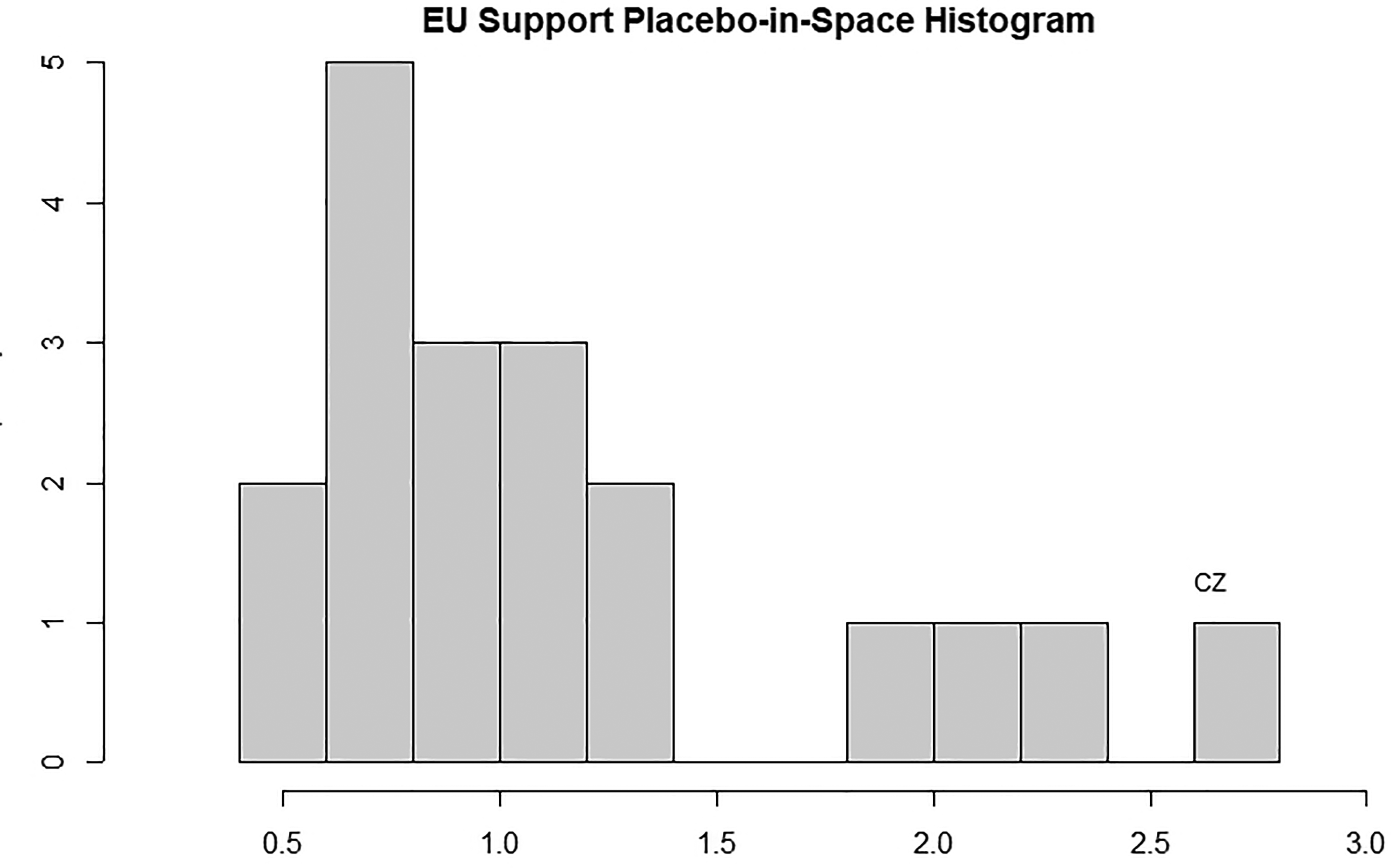
Density histogram for Placebo-in-Space post-/pre-root mean square prediction error ratio for EU support.
Average treatment effects
Table 2 shows the average treatment effects for all above mentioned cases and the corresponding p-values. In line with our expectations depicted in the typology, we find that member states receiving a requested opt-out (EFC case) and those allowed to integrate into a policy area that previously excluded them (Eurozone case) exhibit an increase in EU support. At the same time, not receiving a highly demanded opt-out (Czech case) and being excluded from integration (Schengen case) are detrimental to public support. More specifically, effects have a magnitude of a 4% to 7% increase or decrease in aggregate levels of EU support and are statistically significant at conventional levels.
Fixed effects
Finally, we repeat our analysis by using two-way fixed effect models (unit and time) with clustered standard errors at the country level. We also reproduce our analysis operationalizing EU support as the share of respondents indicating that their countries’ EU membership is a good thing, as a robustness check. Our substantive findings remain the same and the effect sizes are similar to the methods outlined above. As shown in Table 3, the results remain consistent for the “positive” cases (Fiscal Compact, Latvia and Lithuania; see Models 3 and 4) and the “negative” cases (Bulgaria, Romania, Czech Republic; see Models 1 and 2) accordingly. In Model 4 (Table 3), the statistical significance stands at 0.108, falling slightly below the 10% threshold. In summary, we find consistent evidence that differentiation events can trigger public reactions toward higher or lower support for the EU.
Results with grouped specifications.
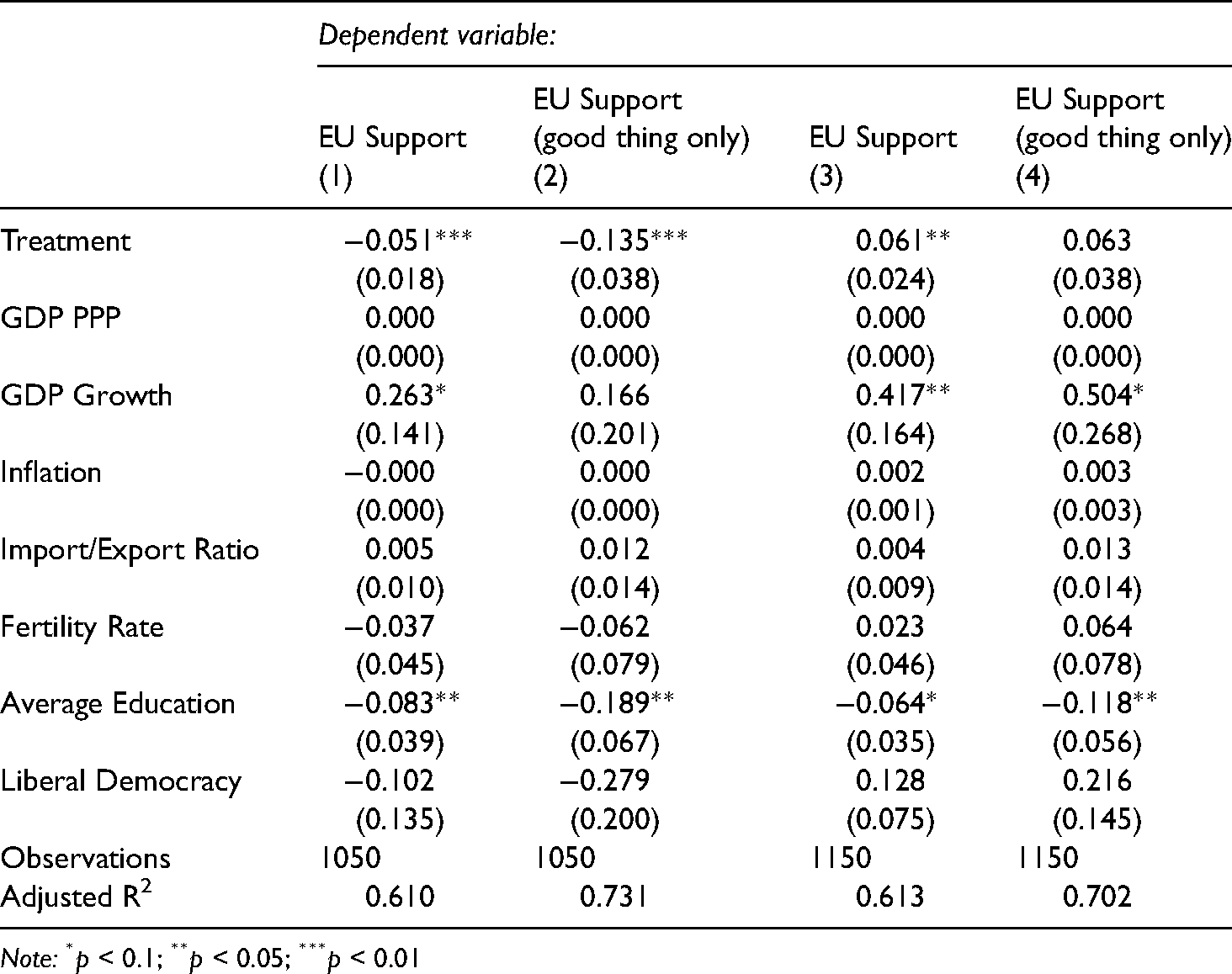
Note: *p < 0.1; **p < 0.05; ***p < 0.01
Conclusion
With European integration becoming increasingly politicized and in light of the multiple crises facing the EU today, DI is now a common tool in the EU's legal order (Schimmelfennig and Winzen, 2020). While this growth of DI has triggered an expanding literature investigating its causes, spatial patterns, and historical trajectories (Leruth et al., 2019; Schimmelfennig and Winzen, 2020), research on public opinion and differentiation has been limited so far (Burk and Leuffen, 2019). In particular, when it comes to the consequences of DI, little work has looked into the effects of differentiation on EU public opinion. Existing studies concerned with this question have largely engaged in a theoretical debate making strong assumptions about DI's supposed effects on EU attitudes, yet, without scrutinizing these assumptions empirically. Within this literature, DI is both praised and criticised, for allowing the accommodation of heterogeneous preferences on the one hand (Bellamy and Kröger, 2017; Cheneval and Schimmelfennig, 2013; Nicolaïdis, 2013), but also for giving rise to possibly discriminatory practices on the other (Adler-Nissen, 2014: 27–32; Schimmelfennig and Winzen, 2020: 176–186). In this sense, DI can be seen as either a blessing or a curse for the EU's future.
With this article, we provide empirical evidence underpinning these theoretical arguments. Relying on the synthetic control method and interactive factor models, we show that European publics indeed respond to differentiation. However, whether DI has a positive or negative effect for EU support depends on the specific instances of DI. Looking at the opt-out from the Fiscal Compact, we find that when these countries were granted an opt-out that was highly anticipated and justified in their eyes, EU support increased. Similarly, when Latvia and Lithuania were allowed to join the Eurozone in 2014 and 2015, in both countries average EU support levels went up. The opposite was true when Bulgaria and Romania were not allowed to join Schengen in 2011. Here, EU support decreased considerably, after it became clear that both countries would not be allowed to integrate. We find a similar negative effect on EU support for the Czech case, when an opt-out from the Charter of Human Rights was planned but was subsequently cancelled. In summary, it seems that when publics are confronted with a change in their country's position in the system of DI, they may react positively or negatively, based on their perceptions about the policy in question and their previous support and expectations about their county's trajectory in European integration.
Our findings have important implications for the legitimacy of the EU. With DI being able to accommodate diverse national preferences, it can have a positive impact on EU support. Yet, when used to exclude member states from policy areas, or when opt-outs are cancelled, national publics tend to punish the EU with support deteriorating as a result. In this sense, DI can be a desirable scenario for the EU's future only when used for a careful acknowledgement of member state diversity and when discriminatory practices are avoided.
Some limitations to our study remain nevertheless. Importantly, our approach is only valid insofar as the synthetic control method and the interactive factor models produce reliable estimates in the provided context, which only allows for a lower number of observations than typically used in these methods. Furthermore, we have to assume that the outcomes of our control cases are not directly affected by the treatments, for example public support for the EU increasing or decreasing in Greece because Bulgaria and Romania were not allowed into Schengen. However, from a demoi-cratic perspective, it seems reasonable that EU public opinion is largely determined within the context of a single demos and that individuals in other countries are unlikely to substantially change their EU attitudes based on another country's position in the system of DI. Lastly, the Czech case is perhaps not ideal for studying the effects of not receiving a requested opt-out, as it is not an official differentiation but rather a validated promise of differentiation that was cancelled. At the same time, it is puzzling why the Czech public punishes the EU for something done by a recently elected national government.
Future research could investigate a number of potential avenues. For one, studies should investigate effect heterogeneity between citizens, moving from the country level to the individual. This research could already be pursued with the data at hand, while our typology could also be modified to include heterogeneity between different individual characteristics, for example Europhile and Eurosceptic citizens. Another line of research could touch upon the potential role of national governments, as it seems likely that citizens also reward and punish domestic executives for failing or succeeding to negotiate opt-ins or opt-outs. Furthermore, other cases of DI could be included for all elements of the proposed typology, in order to provide further external validity to our findings. Lastly, to get a better idea about the political effects of DI, the analysis could be extended to include electoral outcomes, such as incumbent support or voting for Eurosceptic parties, as well as to other political and cultural variables such as European identity.
Supplemental Material
sj-pdf-1-eup-10.1177_14651165221135742 - Supplemental material for From causes to consequences: Investigating the effects of differentiated integration on citizens’ EU support
Supplemental material, sj-pdf-1-eup-10.1177_14651165221135742 for From causes to consequences: Investigating the effects of differentiated integration on citizens’ EU support by Ioannis Vergioglou and Sven Hegewald in European Union Politics
Supplemental Material
sj-r-2-eup-10.1177_14651165221135742 - Supplemental material for From causes to consequences: Investigating the effects of differentiated integration on citizens’ EU support
Supplemental material, sj-r-2-eup-10.1177_14651165221135742 for From causes to consequences: Investigating the effects of differentiated integration on citizens’ EU support by Ioannis Vergioglou and Sven Hegewald in European Union Politics
Supplemental Material
sj-r-3-eup-10.1177_14651165221135742 - Supplemental material for From causes to consequences: Investigating the effects of differentiated integration on citizens’ EU support
Supplemental material, sj-r-3-eup-10.1177_14651165221135742 for From causes to consequences: Investigating the effects of differentiated integration on citizens’ EU support by Ioannis Vergioglou and Sven Hegewald in European Union Politics
Supplemental Material
sj-r-4-eup-10.1177_14651165221135742 - Supplemental material for From causes to consequences: Investigating the effects of differentiated integration on citizens’ EU support
Supplemental material, sj-r-4-eup-10.1177_14651165221135742 for From causes to consequences: Investigating the effects of differentiated integration on citizens’ EU support by Ioannis Vergioglou and Sven Hegewald in European Union Politics
Supplemental Material
sj-csv-5-eup-10.1177_14651165221135742 - Supplemental material for From causes to consequences: Investigating the effects of differentiated integration on citizens’ EU support
Supplemental material, sj-csv-5-eup-10.1177_14651165221135742 for From causes to consequences: Investigating the effects of differentiated integration on citizens’ EU support by Ioannis Vergioglou and Sven Hegewald in European Union Politics
Footnotes
Acknowledgments
The authors are grateful to Catherine De Vries, Dirk Leuffen, Frank Schimmelfennig, and the anonymous reviewers at European Union Politics for their thoughtful comments. We would also like to thank all participants on our panels at the 2021 ECPR and SVPW general conferences as well as all members of the InDivEU consortium and the European Politics Research Group at ETH Zurich.
Funding
The author(s) received no financial support for the research, authorship, and/or publication of this article.

Supplemental material
Supplemental material for this article is available online.
Notes
References
Supplementary Material
Please find the following supplemental material available below.
For Open Access articles published under a Creative Commons License, all supplemental material carries the same license as the article it is associated with.
For non-Open Access articles published, all supplemental material carries a non-exclusive license, and permission requests for re-use of supplemental material or any part of supplemental material shall be sent directly to the copyright owner as specified in the copyright notice associated with the article.
