



Abstract
While ample research has scrutinised the causes and consequences of support for the European Union, a pressing question remains: what do people actually mean when they express support for, or opposition to, their country’s membership of the institution? We use Correlational Class Analysis to assess this. Our analysis of high-quality representative Dutch survey data (n = 2053), including novel items informed by in-depth qualitative research, reveals that European Union support comes in three guises: federalist, non-federalist and instrumental-pragmatist Strikingly, many Europhiles are not federalists. In addition, we reveal that the social bases of the three types of support especially differ regarding political competence, political orientation, and media consumption. The implications for ongoing debates on European Union atttidues are discussed.
Keywords
Introduction
A notable feature of public opinion on the European Union (EU) is that it can be difficult to identify clear patterns in attitudes towards the institution (Hainsworth, 2006; Vasilopoulou, 2013). Indeed, views reflecting support or opposition cannot easily be assigned to specific political or social groups, as ‘there is often little that holds together Eurosceptic groups or movements beyond some dislike or disquiet of a nominal referent object’ (Leruth et al., 2018: 4). Similarly, some researchers have noted that Euroscepticism is ‘a very broad umbrella term’ that can be related to ‘a most unusual set of political adversaries’ (Taggart, 2004: 281). It is accordingly likely that different segments of the population ascribe different meanings to their country’s membership in the EU.
Whereas extant survey research has successfully uncovered multiple dimensions of EU attitudes among the public-at-large (see, e.g. Boomgaarden et al., 2011; De Vreese et al., 2019; De Vries and Steenbergen, 2013; Hobolt and Wratil, 2015; Lubbers, 2008), research on EU attitudes is thus far less sensitive to the possibility that different groups of citizens might have different understandings of what the EU entails, and therefore differ in which dimensions are salient to them, and in how their positions on those dimensions interrelate. Whereas research into the multidimensionality of EU attitudes has provided important insights into the complexity of views on the EU on an aggregate level, whether different segments of the public ascribe different meanings to the EU remains an open question.
We aim to take the field a crucial step further by uncovering various meanings of EU support among a national population. It is noteworthy that research on how ‘Europe’ is perceived by different citizens (e.g. Kufer, 2009; Van Mol, 2022) suggests that a focus on the polysemic nature of the concept of the EU is promising, just like a recent inductive study by Toshkov and Krouwel (2022), which concludes that citizens show significant differences in how EU attitudes are related to other political attitudes. Moreover, a recent in-depth qualitative study involving dozens of strategically selected Dutch citizens from a wide variety of backgrounds demonstrates that their country’s membership in the EU means different things to different people (Van den Hoogen et al., 2022), which has thus far remained hidden from view. Building on those insights, this study has a twofold aim. First, we aim to uncover whether there are different meanings ascribed to support for EU membership among different segments of the public. Second, in order to grasp which citizens ascribe which meanings to the EU, we will analyse the social bases of the different meanings found.
Our focus is on the Dutch context, which is especially relevant because the EU is a highly debated issue in this ‘traditionally Europhile nation’ (Usherwood and Startin, 2013: 6; cf. Hobolt and Brouard, 2011; Ringlerova, 2019). As this is the first step into uncovering a variety of meanings ascribed to the EU among the public at large, we first innovatively apply a recently developed method: Correlational Class Analysis (CCA). It inductively reveals different meanings ascribed to the EU by uncovering different ways in which survey items informed by earlier qualitative research and extant literature interrelate with items asking respondents’ extent of support for their country’s EU membership. Subsequently, we regress the different meanings uncovered on citizens’ characteristics known to be relevant for forming one’s perspective on the world, as to map their social bases. These analyses are conducted on data from a high-quality representative survey (n = 2053).
The CCA reveals that, in addition to the previously identified minority of Eurosceptics, the bulk of the Dutch population is composed of three types of Europhiles: federalists, non-federalists and instrumental-pragmatists. These groups all embrace Dutch membership of the EU, but differ in what that membership means to them and what it should entail. Europhilia, then, is not the same as ‘embracing federalism’. Counterintuitively, our analyses also showed that federalists are not among the most culturally liberal and elitist groups, nor are they in the group that is most interested in the EU. As we discuss in the concluding section along with avenues for further research, these findings have important implications for understanding contemporary EU support.
Understanding support for EU membership: Different meanings in different groups?
Research has long treated the EU as a ‘single latent variable of fixed attitudes toward European integration, ranging from rejection of the European project to high levels of support for European unification’ (Hobolt and De Vries, 2016: 415). More recently, however, various scholars have claimed that ‘the EU is an evolving multidimensional polity’ which ‘research should reflect’ (Boomgaarden et al., 2011: 261; see, also, De Vreese et al., 2019). Survey research on the multidimensionality of EU attitudes predominantly focuses on the population-at-large, for instance by distinguishing economic/utilitarian, political/democratic, national identity, sovereignty-related dimensions, and identifying which of these are most pertinent to citizens in general (e.g. De Vreese et al., 2019; Hobolt and Wratil, 2015). Similarly, research into the antecedents of EU attitudes also focuses on the population-at-large, for example, by staging a ‘battle of explanations’ (Lubbers, 2008: 74) trying to determine which factors – identity, utilitarian or political – are most relevant, or in concluding that EU support is determined ‘by attributes of the individual and the national political environment’ (De Vries and Steenbergen, 2013: 137). As a result, it is clear that research has thus far produced numerous relevant insights, but has not systematically taken into account that segments of the population can differ in the meaning they ascribe to the EU.
Consequently, an important next step is to analyse whether the EU means different things to different segments of the public. Recent in-depth group interviews with strategically selected Dutch citizens with a wide variety of backgrounds suggest that this is indeed the case (Van den Hoogen et al., 2022): the participants spoke in different ways about the EU, indicating that supporting (or opposing) EU membership can have multiple meanings. As an example, aside from specific Eurosceptic complaints, such as regarding the EU as ‘total control and suppression by the elite’, EU support came in a variety of forms: some supporters noted that the EU lacks power as it ‘think[s] too much in nation states, rather than in terms of Europe as a whole’, expressing a preference for a ‘United States of Europe’, while others claimed that the EU should only involve itself with the ‘basics’, arguing that ‘all that other stuff they need to organise nationally’.
These small-scale qualitative findings strongly suggest that it is relevant to analyse the different meanings of EU support among a large-scale representative sample. Yet, how can this be achieved? As meaning is relational (Mohr, 1998), the meanings ascribed to the EU can be highlighted by examining the ways in which distinct attitudes are interrelated: ‘the meaning of symbols [….] rests not in the signs themselves but in the relationships among them’ (Boutyline, 2017: 355; cf. Mohr, 1998). Indeed, people may organise their attitudes to the EU differently, which can reveal the divergent meanings they ascribe to it. Therefore, we look at the relationships between survey items measuring support for EU membership and items measuring people’s opinions on other relevant aspects of the EU as to uncover whether that support has different meanings for different segments of the public.
More specifically, our analysis scrutinises how support for EU membership is related to items informed by both earlier studies on EU attitudes (e.g. Boomgaarden et al., 2011; Di Mauro and Memoli, 2016; Rohrschneider, 2002) and in-depth group interviews (Van den Hoogen et al., 2022). These relate to the following perspectives: federalist (i.e. items focusing on a more united and centralised Europe, or on further EU expansion); pragmatic or basic; and anti-establishment. In this article, our focus is not on whether citizens oppose or support EU membership. Instead, we assess what citizens mean if they indicate that they support or oppose their country’s membership of the EU by analysing how that support or opposition is interrelated with other attitudes to the EU. In order to do so, we draw on Converse’s (1964) notion of belief systems, who defines a belief system as ‘a configuration of ideas and attitudes in which the elements are bound together by some form of constraint or functional interdependence’ (1964: 3). Belief systems, thus, do not refer to people’s attitudinal position (e.g. Eurosceptic or Europhile), but to the manner in which people structure their political attitudes (and political adversaries, e.g. Eurosceptics and Europhiles, could consequently share the same belief system).
That said, we differ from Converse’s dismissal of other belief systems than the ones adhered to by elites. We instead align ourselves with recent works by embracing the possibility that multiple belief systems can co-exist in society (see, e.g. Baldassarri and Goldberg, 2014; Daenekindt et al., 2017). As ‘different people might interpret the same reality in different ways’ (Goldberg, 2011: 1397), it is likely that different belief systems in the EU exist among different segments of the population.
Our aim is to unearth not only the multiple belief systems that enable us to uncover the different meanings that support for EU membership can entail, but also the social bases of those different meanings. Our goal to uncover those social bases builds on the idea that specific belief systems do not exist in a social vacuum: members of a social group typically share a framework that informs their perspective on social reality (Zerubavel, 1997). Exploring the social bases of different belief systems provides insight into those citizens that ascribe a certain meaning to their country’s EU membership, and how they differ from others who ascribe a different meaning to the same issue.
Inspired by previous research, we investigate the social bases of the uncovered belief systems by focusing on people’s political orientation (measured with indicators for the two dominant attitudinal cleavages: cultural liberalism and economic egalitarianism; cf. Achterberg and Houtman, 2009), political competence (measured as the level of education and interest in the EU) and the type of media they prefer. In the first place, because it has been abundantly demonstrated that the level of EU support associates with cultural liberalism and/or economic egalitarianism (Van Bohemen et al., 2019), education (Hakhverdian et al., 2013; Lubbers, 2008), media cues (e.g. Azrout et al., 2012; De Vreese, 2007; De Vreese and Boomgaarden, 2006) and political cues (e.g. Anderson, 1998; Hobolt, 2005, 2007; Hooghe and Marks, 2005; Torcal et al., 2018). In the second place, and more importantly given our research aim, because there are strong suggestions that people’s political orientation, political competence and media consumption may shape the meaning they ascribe to political issues, including the EU.
First, research in political science (e.g. Bolsen et al., 2014) shows that political orientation plays an important role in determining how one perceives certain issues, making it likely that one’s political orientation also plays an important role in shaping the meaning ascribed to EU membership. Second, when it comes to political competence, it is relevant that education plays an important role in the development of how we perceive the world in general (Zerubavel, 1997) and the political field specifically (Spruyt and Kuppens, 2015), and political interest too, as
In sum, not only the extent of EU support (the focus of much extant research), but also the meaning ascribed to support for the EU (the focus of the present research) is likely to be shaped by people’s political orientation, political competence and media consumption.
Analytical strategy
We use a two-step strategy: (1) with the statistical method CCA, we identify different belief systems to uncover the different meanings ascribed to EU membership; and (2) with a multinomial regression analysis we investigate their social bases.
As belief systems are characterised by specific patterns of interrelationships between attitudes, they can be held by people who have different stances on a particular issue, who nevertheless agree on what defines it (Martin, 2000). This has been illustrated by Converse (1964), who compared conservatives and progressives. He found that although these two groups clearly disagree in their political beliefs, they nevertheless agree about how these beliefs are interconnected. Therefore, they have the same belief system. In other words, people with a conservative (or progressive) stance on one cultural issue (e.g. abortion) also have a conservative (or progressive) stance on others (e.g. LGBTQ + rights, euthanasia): they are on opposite sides of the same coin. In the current case, the CCA will uncover belief systems as networks of interconnected attitudes about the EU, and such belief systems can thus include both EU supporters and opponents.
CCA is a correlation-based extension of Relational Class Analysis (RCA) (Boutyline, 2017; Goldberg, 2011). Unlike conventional statistical methods, ‘CCA does not make any a priori assumptions on the constraints characterising belief systems, nor does it impose one belief system on every individual in the data’ (Daenekindt et al., 2017: 799). In other words, rather than imposing the same structure on every participant (e.g. as in a factor analysis), it ‘divides data into groups of respondents who exhibit distinctive patterns across a set of variables’ (Daenekindt et al., 2017: 799). A key reason for our use of CCA is that, unlike a method such as Latent Class Analysis (LCA), it does not cluster individuals with similar attitudes (in this case, to the EU), but instead clusters individuals who have similar relationships between such attitudes (Boutyline, 2017; Goldberg, 2011).
Although only recently developed, CCA and RCA have been used successfully to reveal belief systems held by the public. The study by Baldassarri and Goldberg (2014) on the political attitudes of US voters is an example of this, with three distinct belief systems identified: ideologues, alternatives and agnostics. Meanwhile, Daenekindt et al. (2017) unearthed three cultural belief systems among the Dutch public: integrated, intermediate and partitioned. Both studies show that people organise their political and cultural attitudes differently, meaning that different belief systems can be identified among the population-at-large. These CCA or RCA studies demonstrate that patterns commonly considered to be representative of the overall population are actually just the characteristics of a specific subset of the population, and reveal quite different patterns – that have hitherto been hidden from view – among other parts of the population.
After using a CCA to unearth the different belief systems of the EU present in the Dutch population, we employed a multinomial logistic regression analysis to uncover the social bases of the belief systems. This regression included the following independent variables: political orientation, measured as cultural liberalism and economic egalitarianism; political competence, assessed through education and interest in the EU; and media consumption, determined in terms of a preference for ‘soft’ news. We also included age, gender, and income as control variables, as these have proved to be relevant when it comes to identifying the social bases of belief systems relating to cultural (Daenekindt et al., 2017) and political (DiMaggio and Goldberg, 2018) attitudes.
Data and measures
Our study used data from the LISS (Longitudinal Internet Studies for the Social Sciences) panel, which is administered by Centerdata (Tilburg University, the Netherlands). This is based on a true probability sample of private households taken from the official Dutch population register and currently comprises 8026 active individuals (LISS data, 2021; Scherpenzeel, 2009). The participants are paid to complete surveys on a regular basis. Data for the current study were specifically collected on our behalf, as part of a wider research project on various political and societal issues (De Koster et al., 2020). A total of 2935 Dutch citizens (18 years and older) were sampled and 2218 completed our survey, equating to a response rate of 75.6%. After data cleaning (excluding 39 participants who answered the questions in less than 10 min, which we determined was an unrealistic amount of time for proper completion of the survey, and excluding a further 72 respondents due to straight-lining and 54 because of missing values on one or more items included in the CCA) the sample for our analyses is composed by 2053 individuals.
Table 1 provides an overview of the items we used in the CCA to uncover the different belief systems regarding attitudes towards EU membership. All these items are measured on a seven-point Likert-scale ranging from ‘completely disagree’ to ‘completely agree’. We included a modest number of items in our CCA to increase interpretability. We ensured that these items, which are based on extant literature and recent in-depth interviews, reflect the most relevant aspects of the EU.
Item names and wordings.
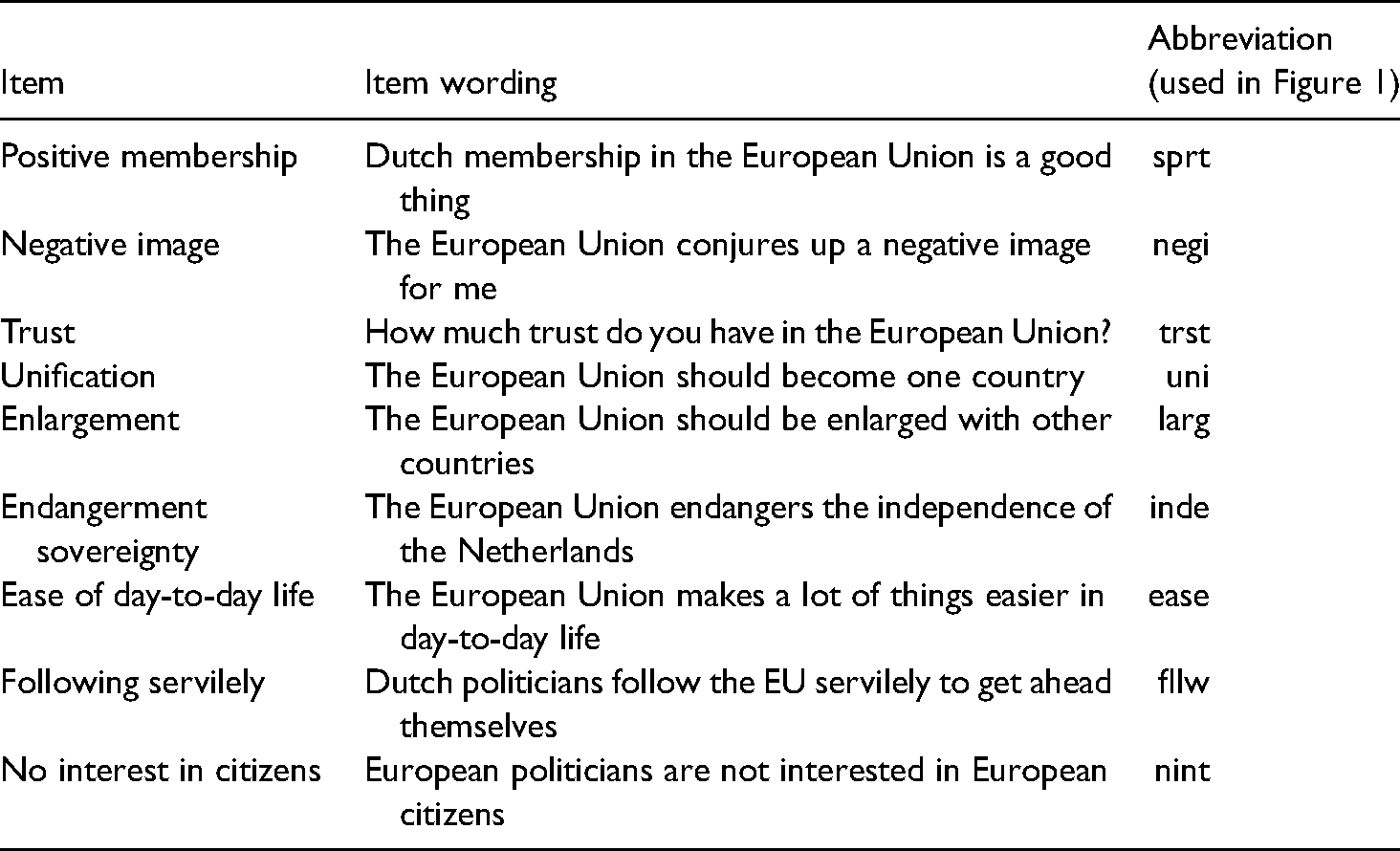
Three items that measure support for EU membership more generally are used as items of reference. Our main focus is on how the item ‘Dutch membership of the European Union is a good thing’ (positive membership) – which is commonly used to measure EU attitudes in general (e.g. Boomgaarden et al., 2011; De Vreese et al., 2019) – interrelates with all other items. Thus, for the sake of clarity, when we talk about EU support/opposition (and Europhiles/ Eurosceptics) in this study, we mean support for/opposition to Dutch membership of the EU. We furthermore included two additional items that are often used to measure general attitudes to the EU, that is, items relating to the image of the EU (negative image) and trust in the EU (trust) (Boomgaarden et al., 2011; Di Mauro and Memoli, 2016; see also Harteveld et al., 2013 on the relevance of measuring trust).
The other six items tap into the most salient aspects that differed across the various meanings ascribed to the EU, as identified in prior qualitative research (Van den Hoogen et al., 2022). Through in-depth interviews, we aimed to uncover a variety of what the EU means to people, and we made extensive efforts to interview a broad array of citizens: we did so by maximising heterogeneity in terms of (social) backgrounds and interviewed a total of 45 respondents. From these interviews emerged key themes, which we used to develop the items (Van den Hoogen et al., 2022). First, we found that the notion of EU unification and expansion is central to the understanding of the EU for some respondents, and thus included the items unification and enlargement (also used by Boomgaarden et al., 2011). Meanwhile, for others, the perceived threat to Dutch sovereignty was crucial in the meaning they ascribed to the EU. To reflect this, we developed the item endangerment sovereignty. Still, others emphasized the convenience, or ‘ease’, of belonging to the EU that they experienced in their day-to-day life, for which we developed the item ease of day-to-day life. Some stressed a perceived malicious intent of the EU and EU politicians; thus, we created the items following servilely and no interest in citizens. In sum, we included items that reflect different aspects of the EU that were relevant for different groups of citizens.
By combining items that measure attitudes towards the EU more generally with items that reflect aspects of the EU that we found to be highly relevant for various groups of citizens, we ensure that we can uncover the meaning ascribed to support for EU membership by looking at the way the aspect-specific items relate to the general ones.
Eight concepts were used for the multinomial regression analysis to uncover the social bases of the identified belief systems, and these are operationalised below. When it comes to political orientation, both cultural liberalism and economic egalitarianism are relevant. Not only do they reflect the two key dimensions of political orientation in general (Achterberg and Houtman, 2009), but they are also prominent when it comes to understanding support for the EU (Van Bohemen et al., 2019). We measured cultural liberalism using ethnic tolerance, which is widely considered to be indicative of cultural liberalism in general (e.g. Houtman, 2001; Inglehart et al., 2008). This was measured with four seven-point Likert items, with response categories ranging from ‘completely disagree’ to ‘completely agree’: ‘Cultural life in the Netherlands is generally enriched by people coming to live here from other countries’; ‘The Netherlands is made a better place to live by people coming to live here from other countries’; ‘Foreigners living in the Netherlands should adapt to Dutch uses and customs’; and ‘The Netherlands should have never let foreign guest workers in’. The last two items were reverse coded. The first two were based on items in the European Social Survey (ESS), while the latter two have previously been used by Van Bohemen et al. (2019). Together, they combine into a reliable scale (α = 0.76).
We used four seven-point Likert items to measure economic egalitarianism, with the response categories ranging from ‘completely disagree’ to ‘completely agree’: ‘It is not a good thing if differences between the rich and the poor are large’; ‘Large income differences are not a problem’; ‘It is important that children from poor families get the same opportunities as children from rich families’; and ‘In a fair society, differences in what people are able to spend are small’. We reverse coded the second item. The first item was based on one used in previous research (e.g. Houtman, 2003), the second and fourth on items in the ESS, and the third was tailor-made for our study. Taken together, these items were found to be a reliable measure of economic egalitarianism (α = 0.75).
Media consumption. We measured media consumption as the respondents’ preference for ‘soft’ news. According to Reinemann and colleagues’ (2011: 233) famous conceptualisation, ‘The more a news items is not politically relevant, the more it reports in an episodic way, focuses on individual consequences of events, is personal and emotional in style, the more it can be regarded as soft news.’ We measured a respondent’s soft news preference by asking two questions that contrasted a Dutch hard news programme, broadcast by the Dutch public broadcasting service, and a soft news show on Dutch commercial television (cf. Reinemann et al., 2011): ‘If I had to choose between two sources, I’d rather follow the news on Hart van Nederland … NOS journaal’ and ‘EenVandaag … Shownieuws’. Preference was measured on a seven-point scale, ranging from a preference for a hard news source to one for a soft news source (the first item was reverse coded). The items were combined in a single variable by calculating the mean score. A reliability test based on the Spearman–Brown coefficient, which is regarded as the most appropriate way to examine the reliability of two-item scales (Eisinga et al., 2013), found that these two items were a sufficiently reliable measure of a preference for soft news (α = 0.68).
Political competence. We measured political competence using the respondents’ level of education and self-reported level of interest in the EU. Education level was assessed as the number of years required to complete the highest level of education attained by a respondent. Interest in the EU was measured using the following questions: ‘I’m very interested in the European Union’ and ‘I keep a good track of the news on the European Union’. These items were measured using a seven-point Likert scale, with possible responses ranging from ‘completely disagree’ to ‘completely agree’. The items were combined in a single variable by calculating the mean score. A reliability test based on the Spearman–Brown coefficient found that the two items were a reliable measure of interest in the EU (α = 0.89).
We also included the control variables age (in years), gender and net monthly household income (in euros). Respondents who indicated that they had either no income (n = 15), which is implausible in the context of the Dutch welfare state, or one that was unrealistically high (n = 2) were coded as missing. We used the logarithm of income in our analysis to reduce skewness.
Results
Three different meanings of EU support
The CCA reveals three belief systems that cover, respectively, 44.6%, 28.5% and 27% of the respondents (see Figure 1). These belief systems differ in three ways: (1) the meaning of support for/opposition to Dutch membership of the EU, established by assessing how the other items correlated with the item ‘Dutch membership of the European Union is a good thing’; (2) the level of integration of the belief systems; and (3) the extent of the respondents’ support for/opposition to the EU within the belief systems.
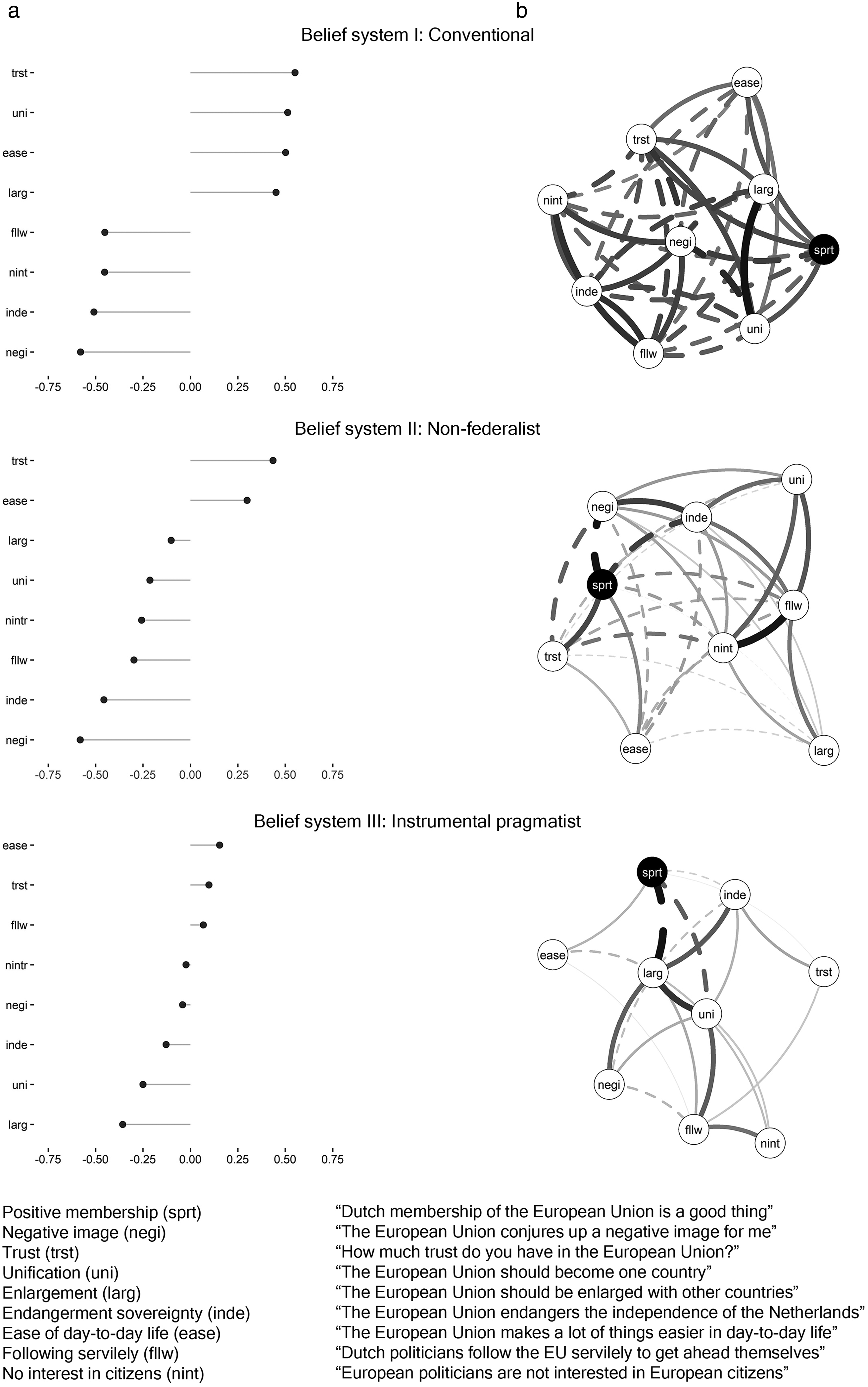
Correlation networks of the thee belief systems (a); correlation of each item with support for EU membership (b).
Figure 2 shows that views on the Netherlands’ EU membership range from very negative to very positive in the first belief system. In contrast, there is considerably less variation in support for the EU in the second and third belief systems, with the attitudes towards the EU of those respondents ranging from moderate to very positive. It is thus clear that the first belief system has to be interpreted as a spectrum, as it contains both Europhiles, that is, people who support EU membership, and Eurosceptics, that is, those who oppose it. In contrast, belief systems two and three can only be interpreted in one direction: they almost exclusively contain Europhiles.
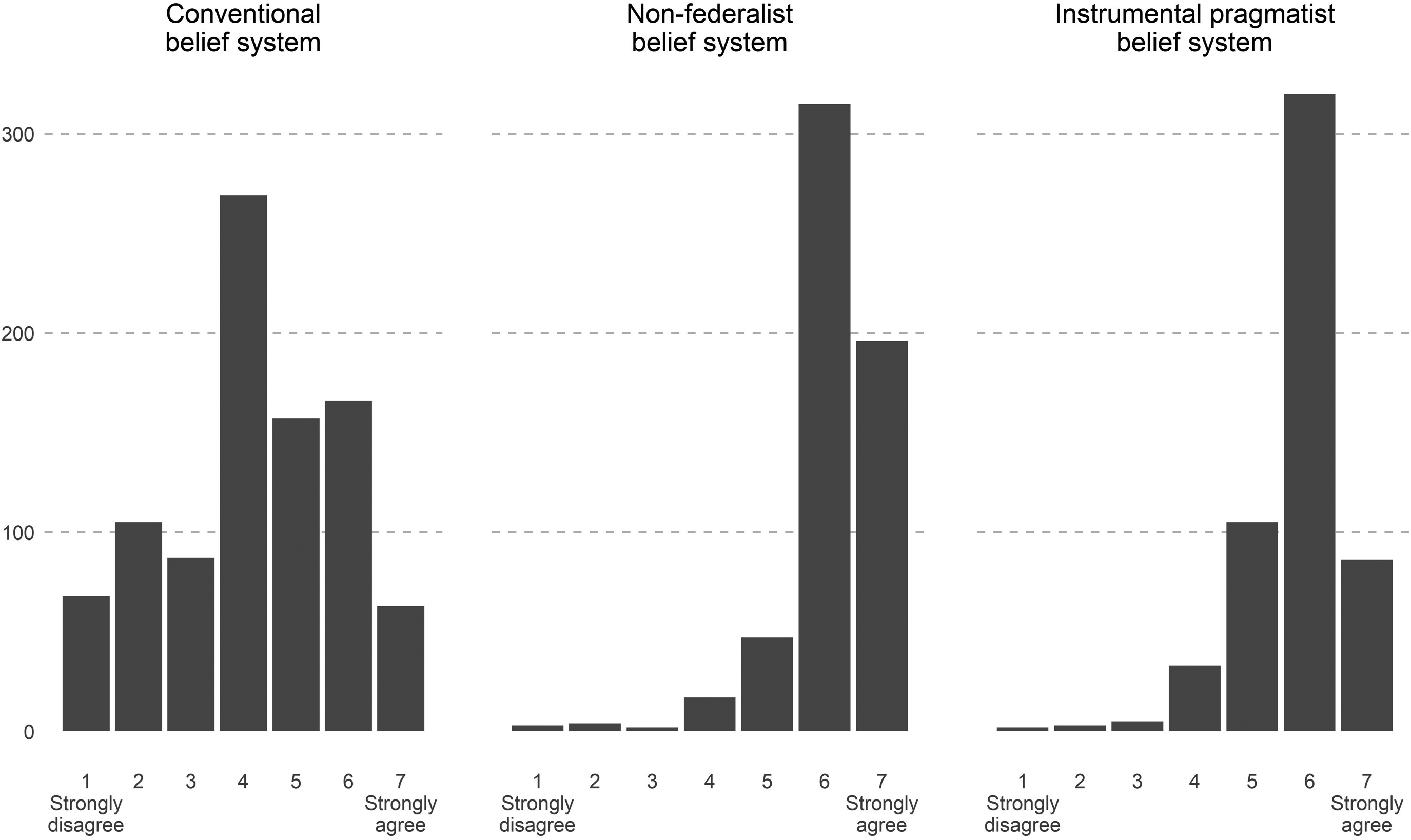
Distribution of EU membership support (answers to item ‘Dutch membership of the European Union is a good thing’).
Conventional belief system
The first belief system closely matches the conventional perspective on EU attitudes found in the literature, namely that views are on a spectrum from (anti-institutional) Euroscepticism to (federalist) Europhilia. The CCA shows that the correlations are negative and strong between the item ‘Dutch membership of the European Union is a good thing’ on the one hand and ‘the European Union conjures up a negative image for me’, ‘the European Union is a danger to the independence of the Netherlands’, ‘Dutch politicians follow the EU servilely to get ahead themselves’, and ‘European politicians are not interested in European citizens’ on the other hand. These correlations suggest that for citizens who oppose membership of the EU: (a) the EU conjures up a negative image; (b) regard the EU as a threat to Dutch sovereignty; (c) believe that Dutch politicians are subservient to the EU and act only in their own interests; and (d) hold the view that EU politicians are not concerned about their citizens. The opposite is true for those who support EU membership, that is, favouring the EU is linked to disagreement with the items above and is associated with a rejection of this kind of anti-institutionalism.
Furthermore, supporting EU membership correlates strongly and positively with the items ‘How much trust do you have in the European Union?’, ‘The European Union makes a lot of things easier in day-to-day life’, ‘The EU should become one country’ and ‘The European Union should be enlarged with other countries’. These correlations indicate that favouring EU membership does not only indicate high trust in the EU and agreement that the EU eases day-to-day life, but also that enlargement of the EU with other countries and uniting all EU member states go hand in hand with support for the EU: a federalist perspective. At the same time, and like the first set of items discussed in relation to this belief system, the reverse is true for those who opposed the EU: opposition to the EU is linked to disagreement with these items. This suggests that being against the EU is associated with a rejection of ostensible EU federalism.
In summary, the first belief system clearly indicates that those who ascribe similar meanings to the EU do not necessarily agree in terms of their appreciation of the institution: anti-institutionalism and federalism are two sides of the same coin, suggesting that the EU is seen as a far-reaching, powerful body that is evaluated either positively or negatively. Supporting EU membership in this belief system thus reflects having a federalist perspective, where the focus is on a desire for a more centralised institution, with less power for nation states and more power for the EU. The reverse is true for those opposed to EU membership, with these respondents having an anti-institutional perspective where the EU has too much power to the detriment of the Netherlands as a nation.
Non-federalist belief system
The second belief system is held by citizens who are predominantly supportive of EU membership, although this backing is not associated with federalist stances. Compared to the previous belief system, where support for the EU reflects an explicit sense of federalism, this second version differs in the sense that: (a) the correlations identified are less strong than in the previous belief system; and (b) the correlations between the item on supporting EU membership and those regarding enlargement and unification are negative instead of positive. Other positive correlations identified are similar to those in the conventional belief system, and thus indicate a similar pattern: a positive attitude towards Dutch membership corresponds with trust in the EU and thinking that it makes day-to-day life easier. Furthermore, there are similar patterns in terms of the negative correlations with the item on having a positive attitude towards EU membership and the ‘negative image’, ‘endangering society’, ‘following servilely’, and ‘no interest in citizens’ items. This indicates that feeling positive about EU membership in this non-federalist belief system correlates with: (a) not having a negative image of the EU; (b) not thinking that it endangers Dutch sovereignty; and (c) not believing that (EU) politicians have malicious intentions. Those ascribing to this belief system can be regarded as Europhiles in the sense that they are explicitly pro-EU membership, but they nevertheless do not have ostensibly federalist perspectives. Overall, this belief system shows that it is possible to be both a Europhile and against EU unification or enlargement.
Instrumental-pragmatist belief system
The third belief system reveals an instrumental-pragmatic perspective on the EU. Although these respondents are mainly enthusiastic about the EU (see Figure 2), the correlations are rather weak and, for some items, almost non-existent: the only moderately strong correlations with the items on supporting EU membership are negative ones with ‘unification’ and ‘enlargement’, and a positive one, with ‘ease of day-to-day life’. Accordingly, the support here does not mean backing enlargement or unification, but instead reflects an appreciation for the EU as an instrument that makes daily life easier. The other correlations found are almost non-existent or very weak. Strikingly, the item about trust in the EU barely correlates with having a positive attitude towards Dutch membership. This supports our interpretation of instrumental-pragmatic Europhilia, that is, seeing the EU as a means to an end in a way that stands apart from other political considerations.
Social bases of the identified belief systems
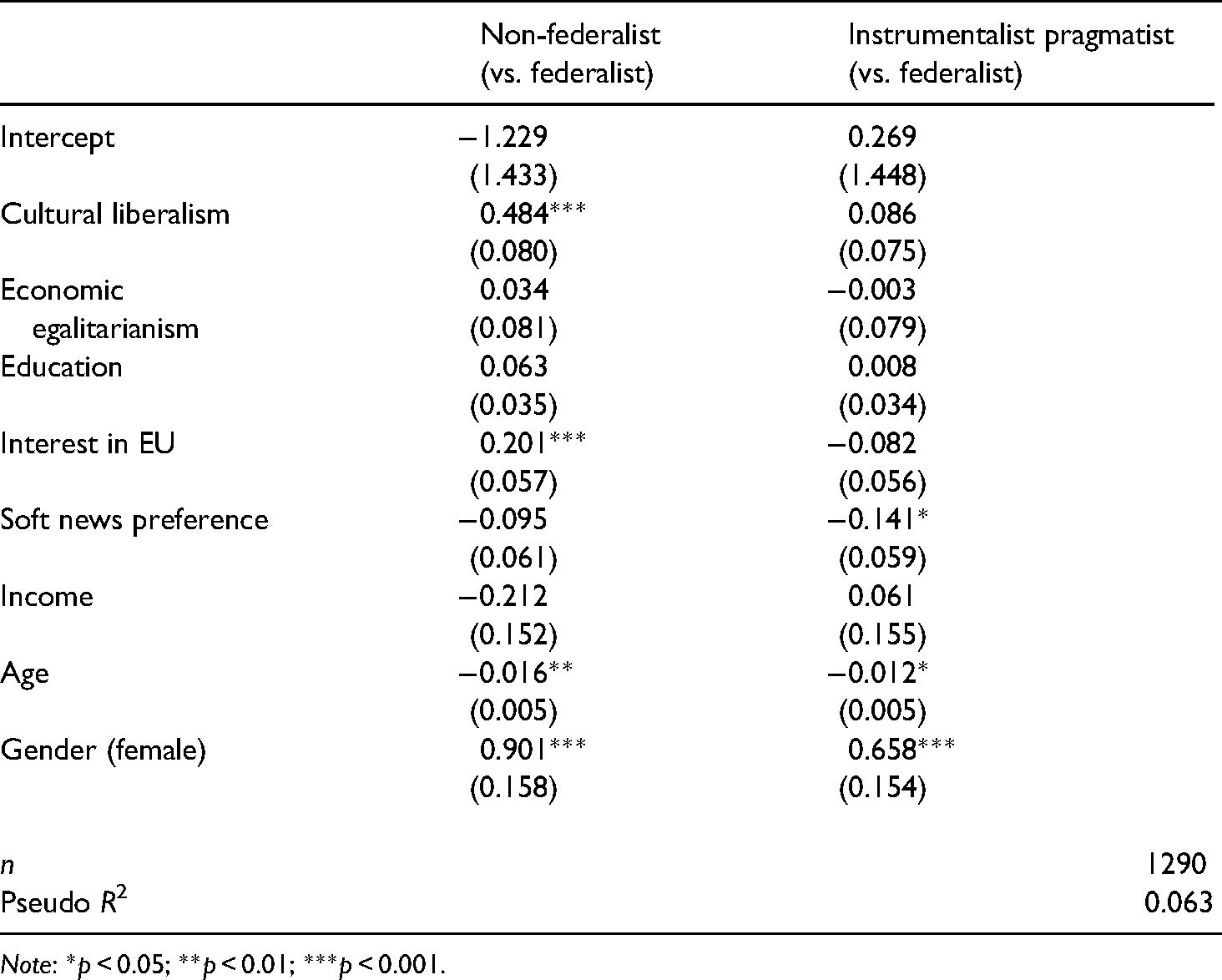
We perform a multinomial logistic regression analysis to identify which people are more likely to ascribe to a particular belief system, with the belief systems as the dependent variable and the federalist belief system as the category of reference (see Table 2). We limit our comparison to the three types of Europhiles uncovered in the CCA, that is, federalists, non-federalists and instrumental-pragmatists, thus excluding all the respondents with a low score on ‘EU membership’. There are two reasons for this: (a) it ensures that the comparison between the groups of respondents is not clouded by differences between supporters and opponents, as most of the Eurosceptics can be found in the first belief system and are almost non-existent in the second and third; and (b) the social determinants of Euroscepticism are already well established (e.g. Van Bohemen et al., 2019; Gabel, 1998; Hakhverdian et al., 2013; Hooghe and Marks, 2005; Lubbers, 2008; Nelsen and Guth, 2000; Rekker, 2018). In summary, by concentrating on the three types of EU support identified, we ensure that our focus is on the novel contribution made by this study.
Multinomial logistic regression analysis on the belief systems (‘EU membership’ > 4): logit coefficients (standard errors in parentheses).
Note: *p < 0.05; **p < 0.01; ***p < 0.001.
When it comes to the role of political orientation, we find that those who scored one unit higher on our seven-point scale for cultural liberalism are 1.62 (e0.484) times more likely to belong to the non-federalist than to the federalist group, but the three types of Europhiles do not differ in their level of economic egalitarianism. In relation to political competence, the odds of being a non-federalist are 1.22 (e0.201) times higher for those who scored one unit higher on our seven-point measure for interest in the EU, but the instrumental-pragmatists do not differ from the federalists in that regard. The reverse is true for media consumption: the non-federalists do not differ from the federalists, but those who score one unit higher on our seven-point measure for a preference for soft news are 0.87 (e−0.141) times less likely to be instrumental-pragmatists than federalists.
The control variables show that women are 2.46 (e0.901) times more likely than men to be non-federalists, and 1.93 (e0. 658) times more likely to be instrumental-pragmatists than federalists. The odds of being a non-federalist or instrumental-pragmatist are lower for older people (i.e. one year older associated with being, respectively, 0.98 (e−0.016) and 0.99 (e−0.012) times less likely to be non-federalist or instrumental-pragmatist).
In summary, compared to the federalists, the non-federalists stand out as being both more culturally liberal and interested in the EU, while the instrumental-pragmatists prefer soft news somewhat less. Those in these groups are younger and more likely to be female than those in the federalist group.
Conclusion and discussion
This article studied various meanings of support for EU membership among different segments of the public by applying CCA on high-quality nationally representative survey data collected in the Netherlands. Below we will reflect on the insights gained, why they matter, and what they imply for future research.
Our analysis discerned three belief systems regarding the EU among the Dutch population. Interestingly, only the first meaning – labelled as conventional and comprising 44.6% of the population – resembles the one ascribed to EU attitudes that commonly features in extant research: a spectrum ranging from anti-institutional Euroscepticism to federalist Europhilia. We found that the second (non-federalist, 28.5% of the population) and third (instrumental-pragmatist, 27% of the population) meaning almost exclusively involved Europhiles: both support EU membership, but reject the federalists’ desire for unification and/or enlargement. In addition, the instrumental-pragmatists do not even perceive EU membership to be a politicized issue. In short, a key insight provided by these findings is that being less supportive of a more federalist EU does not equate to being less supportive of the institution, which adds to recent findings by Toshkov and Krouwel (2022), who conclude that support for the EU and support for further expansion of the EU are separate attitudinal dimensions.
Our analysis complements studies analysing EU attitudes’ multidimensionality (e.g. Boomgaarden et al., 2011; De Vreese et al., 2019; Hobolt and Wratil, 2015) and antecedents (e.g. Boomgaarden et al., 2011; Carey, 2002; De Vries and Steenbergen, 2013; Hooghe and Marks, 2005; Lubbers, 2008) among citizens in general. We show that the meanings ascribed to EU support vary across different segments of the population, suggesting that the relevance of various dimensions in and antecedents of EU attitudes differs across subpopulations. Standard dimensions like those focussing on national identity and sovereignty (Boomgaarden et al., 2011; De Vreese et al., 2019) are, for instance, likely to play an important role for the EU attitudes of federalists and non-federalists, while they are less relevant for instrumental pragmatists.
Turning to the antecedents of EU attitudes: citizens’ economic position and interests – at least as measured by income and economic egalitarianism – are not informative for determining the type of Europhilia Dutch citizens adhere to. Besides, our finding that non-federalists are more culturally liberal than federalists is striking, as one might expect cultural liberalism to be associated with favouring EU enlargement or unification. In case the focus is on discerning Eurosceptics from Europhiles in general, as aforementioned extant research commonly does, cultural liberalism will indeed most likely play a crucial role (cf. Van Bohemen et al., 2019). Yet, comparing the three types of Europhilia that our analyses uncovered reveals that the most culturally liberal citizens do not ascribe the most federalist meaning to support for EU membership. This remarkable pattern may be because the ‘illiberal turn’ in countries like Poland and Hungary (Krastev and Holmes, 2018) makes the most culturally liberal citizens in more established liberal democracies like the Netherlands more hesitant about EU enlargement or unification.
Our analyses also revealed that Euroscepticism seems to be more uniform than Europhilia: the only kind we found was the well-established, anti-institutionalist or populist one. It focuses on a distinction between ‘the people’ and ‘the elite’, defending popular sovereignty at all costs (e.g. Heinisch et al., 2020; Krouwel and Abts, 2007; Mudde, 2004; Pirro and van Kessel, 2017, 2018; Spruyt et al., 2016), and is located in the most coherent belief system (i.e. where all the attitudes correlated strongly). This is at odds with the classic idea that the most integrated belief systems reflect the way the elites think, while the least integrated are the result of limited political competence (Converse, 1964). In addition, the Europhiles of the federalist type who were also part of the most integrated belief system were not among those who were most interested in the EU, nor were they the most elitist regarding their level of education, income, political orientation and media consumption.
Reflecting on why our approach matters, and what this means for future research, four further implications stand out. First of all, we uncovered two types of Europhile respondents who are averse to expanding the EU. That opposition can coexist with Europhilia is likely to have contributed to the remarkably negative results of the EU referendums on enlargement, for instance, in a Europhile nation like the Netherlands. Moreover, this finding indicates that we should not interpret such results as unequivocally reflecting Euroscepticism. Future research could explore this issue in greater depth, and in other national contexts.
Second, we find that populist Euroscepticism is the only kind of Euroscepticism among the Dutch public. As Dutch Eurosceptic parties are typically populist (Van Bohemen et al., 2019), this suggests that these parties also appeal to the way of looking at the EU broadly shared among the Eurosceptic electorate, in addition to their well-established high level of Euroscepticism (Van Bohemen et al., 2019). This could help explain the electoral success of such parties, which is for future research to uncover.
Third, the polysemic nature of Europhilia likely shapes how EU-related information or policy proposals are perceived and responded to. For example, federalist Europhiles likely respond positively to information on potential EU enlargement, while non-federalist and instrumental pragmatist Europhiles do not, or may even react negatively. This could help explain why media messages on the EU are puzzlingly found to be ‘both fuelling and reducing Euroscepticism’ ( De Vreese, 2007: 280), and why other studies on media effects (e.g. Azrout et al., 2012; De Vreese and Boomgaarden, 2006) and campaign effects (e.g. Goodwin et al., 2020; Schuck and De Vreese, 2006) on EU attitudes produced mixed results. Future (experimental) research could investigate how varying meanings ascribed to the EU shape the effects of information campaigns or policy proposals on EU attitudes.
Fourth, our findings inform expectations beyond the Dutch context. It is both possible that other belief systems are found in countries with a different relationship to the EU or that the same ones exist, yet, differing in their social bases and salience. For example, the EU measures adopted in the aftermath of the 2007 financial crisis in some countries (e.g. Greece, Portugal or Spain; Hobolt, 2014) might make economic and redistribution issues more relevant for the formation of belief systems, and the economic standing and interests of citizens more relevant for determining their social bases. Moreover, in countries undergoing an ‘illiberal turn’ (e.g. Hungary or Poland; Krastev and Holmes, 2018), the most culturally liberal subset of the population may be the most federalist, as in those specific contexts this group might regard the EU as a safeguard of, instead of a threat to, the rule of law. Future research is needed to explore these issues.
In sum, our study on the Dutch case shows that whereas Euroscepticism seems to have a singular meaning that reflects the populist Euroscepticism found in Eurosceptic parties, Europhilia harbours three types: federalist, non-federalist and instrumental-pragmatist. Mirroring seminal studies applying a meaning-centred approach regarding other political issues (e.g. Baldassarri and Goldberg, 2014; Daenekindt et al., 2017; DiMaggio and Goldberg, 2018), this article showed its relevance in studying EU attitudes. Future research should uncover the variety of belief systems in the EU and their wider political relevance beyond the Dutch case.
Supplemental Material
sj-dta-1-eup-10.1177_14651165221101505 - Supplemental material for Support for European Union membership comes in various guises: Evidence from a Correlational Class Analysis of novel Dutch survey data
Supplemental material, sj-dta-1-eup-10.1177_14651165221101505 for Support for European Union membership comes in various guises: Evidence from a Correlational Class Analysis of novel Dutch survey data by Elske van den Hoogen, Stijn Daenekindt, Willem de Koster and Jeroen van der Waal in European Union Politics
Supplemental Material
sj-txt-2-eup-10.1177_14651165221101505 - Supplemental material for Support for European Union membership comes in various guises: Evidence from a Correlational Class Analysis of novel Dutch survey data
Supplemental material, sj-txt-2-eup-10.1177_14651165221101505 for Support for European Union membership comes in various guises: Evidence from a Correlational Class Analysis of novel Dutch survey data by Elske van den Hoogen, Stijn Daenekindt, Willem de Koster and Jeroen van der Waal in European Union Politics
Supplemental Material
sj-R-3-eup-10.1177_14651165221101505 - Supplemental material for Support for European Union membership comes in various guises: Evidence from a Correlational Class Analysis of novel Dutch survey data
Supplemental material, sj-R-3-eup-10.1177_14651165221101505 for Support for European Union membership comes in various guises: Evidence from a Correlational Class Analysis of novel Dutch survey data by Elske van den Hoogen, Stijn Daenekindt, Willem de Koster and Jeroen van der Waal in European Union Politics
Supplemental Material
sj-do-4-eup-10.1177_14651165221101505 - Supplemental material for Support for European Union membership comes in various guises: Evidence from a Correlational Class Analysis of novel Dutch survey data
Supplemental material, sj-do-4-eup-10.1177_14651165221101505 for Support for European Union membership comes in various guises: Evidence from a Correlational Class Analysis of novel Dutch survey data by Elske van den Hoogen, Stijn Daenekindt, Willem de Koster and Jeroen van der Waal in European Union Politics
Supplemental Material
sj-do-5-eup-10.1177_14651165221101505 - Supplemental material for Support for European Union membership comes in various guises: Evidence from a Correlational Class Analysis of novel Dutch survey data
Supplemental material, sj-do-5-eup-10.1177_14651165221101505 for Support for European Union membership comes in various guises: Evidence from a Correlational Class Analysis of novel Dutch survey data by Elske van den Hoogen, Stijn Daenekindt, Willem de Koster and Jeroen van der Waal in European Union Politics
Footnotes
Acknowledgements
Previous drafts of this article were presented at NSV Dag van de Sociologie 2021, ESA General Conference 2021, and the Tilburg/Leuven/Rotterdam ‘Culture, Politics & Society’ seminar. The authors would like to thank the discussants, fellow panellists and panel attendants for their helpful feedback. The authors would furthermore like to sincerely thank the editors and the anonymous reviewers for their excellent comments and guidance.
Funding
The authors disclosed receipt of the following financial support for the research, authorship, and/or publication of this article: This work was supported by the Nederlandse Organisatie Voor Wetenschappelijk Onderzoek (NWO) (grant no. 016.Vidi.185.207).

Supplemental material
Supplemental material for this article is available online.
References
Supplementary Material
Please find the following supplemental material available below.
For Open Access articles published under a Creative Commons License, all supplemental material carries the same license as the article it is associated with.
For non-Open Access articles published, all supplemental material carries a non-exclusive license, and permission requests for re-use of supplemental material or any part of supplemental material shall be sent directly to the copyright owner as specified in the copyright notice associated with the article.
