




Abstract
One key question in the study of the European Union has always been the extent of Commission discretion. We take the discretion index, typically used by principal–agent scholars to measure the Commission's designed discretion, to measure its actual discretion. Commission designed discretion can today be computationally generated with sufficient accuracy across all secondary acts. The study of designed discretion thus reaches considerable maturity. Therefore, we argue that scholars should prioritize studying Commission actual discretion. We present a systematic and transparent investigative technique based on the discretion index, which we use as a roadmap to guide our empirical investigation. The index facilitates the accumulation of knowledge across policy areas and time by providing exact values for Commission discretion. We illustrate our approach with the Development Cooperation Instrument.
Keywords
Introduction
In 1999, Epstein and O’Halloran developed a discretion index to study delegation and discretion from the United States Congress to the executive branch of government. This discretion index also had a major impact on the study of delegation and discretion in the European Union (EU). Franchino (2004a, 2007) adapted the index to study delegation and discretion from the Council of the EU (henceforth, Council) to the European Commission (henceforth, Commission) and national administrations in secondary legislation. Similarly, Pollack (2003) drew on the discretion index to study delegation and discretion from EU member states to the Commission, European Court of Justice, and European Parliament (EP) in the EU's founding treaties. Since then, the index has been used in numerous empirical studies (Ershova, 2019; Migliorati, 2021; Zahariadis, 2010), although sometimes in an adapted form (Citi and Jensen, 2022; Gastinger and Dür, 2021; Steunenberg and Toshkov, 2009; Thomson and Torenvlied, 2011). Most importantly, Anastasopoulos and Bertelli (2020) used machine learning to train an algorithm allowing them to computationally generate the discretion index for all directives and regulations adopted since 1958 that successfully replicated previous empirical findings.
Anastasopoulos and Bertelli's research is a sea change for the study of delegation and discretion in the EU in that it exhausts the total population of secondary legislation and opens the door to future quantitative analyses. Thus, the literature on designed Commission discretion (as stipulated at the point of delegation) reaches a state of considerable maturity. By contrast, the study of actual Commission discretion (as materializing in the post-delegation stage) still offers endless opportunities for further scholarly engagement. We thus show how the discretion index guides research in this second step. While this was foreshadowed in Pollack (2003: Part II), we outline an approach that is considerably more systematic. 1 We argue that the starting point should always be a detailed understanding of the act of delegation by (manually) preparing the discretion index, which summarizes the provisions delegating authority and constraints attached. Without a detailed understanding of the act of delegation, scholars run the risk of missing key elements of the Commission's designed discretion. Rather than using the index to explain initial delegation decisions, we use it as a roadmap to guide our empirical study of the Commission's actual discretion, which we define as the extent of discretionary power exercised by the Commission during implementation.
Thus, the discretion index can be used for two analytical steps. First, it offers a systematic and replicable measure of designed discretion, which enables comparisons across different policy areas and over time. Second, the discretion index can be used to assess actual discretion by highlighting areas requiring further empirical attention. In this second step, the index retains the same basic properties, allowing us to highlight variation in discretion across policy areas and time. One common criticism of case studies is that they are ill-suited to provide an exact measure of actual Commission discretion (Pollack, 2003: 9). While we do not claim to overcome subjectivity entirely, we present an approach of how these two steps can be integrated into one systematic investigative technique to study Commission discretion with the benefit of improving transparency (Elman et al., 2018) and facilitating the accumulation of knowledge by making findings more readily comparable.
Empirically, we focus on the Development Cooperation Instrument (DCI), which is one of the EU's main instruments for development cooperation, for three reasons. First, because development cooperation forms part of the EU's external relations, national administrations are usually not empowered, leading to higher levels of Commission discretion (Gastinger and Dür, 2021). This provides us with ample opportunities to illustrate our approach. Second, the more constraining ‘regulatory committee’ was first established in development cooperation, which required the Commission to attain a qualified majority in the Council (Blom-Hansen, 2008: 219–220). This suggests that member states carefully select Commission discretion in this area. Third, we address an open question in the literature on the extent of Commission discretion in development cooperation. Pollack (2003: 94) asserts that there is zero delegation of executive powers to the Commission. Similarly, Dür and Elsig (2011: 327) note that member states keep national development cooperation policies, leaving the Commission with ‘limited powers’. In contrast, Franchino (2007: 271) states that development cooperation requires ‘non-trivial’ executive powers for the Commission. We provide further evidence that the Commission enjoys considerable discretion, both designed and actual. As such, our article sheds light on the EU as a development actor, which receives increasing attention (Hackenesch et al., 2021; Michaelowa et al., 2018).
A short review of the principal–agent literature on Commission discretion
From the onset, the question of Commission discretion attracted considerable attention among EU scholars, with ‘neofunctionalists generally asserting, and intergovernmentalists generally denying, any important causal role for supranational institutions’ (Pollack, 1997: 99). More recently, the principal–agent model generated specific hypotheses and did not ‘systematically privilege the role played by one institution’ (Kassim and Menon, 2003: 125). It can be applied to the ‘macro delegation’ (Dür and Elsig, 2011: 331) occurring from EU member states through the treaty to EU-level actors and ‘micro delegation’ dealing with the EU on a day-to-day basis, for example through secondary acts or specific mandates for individual negotiations. Crucially, delegation always comes with the potential for agency losses, which manifest in several forms: agency shirking and agency slippage (Conceição-Heldt, 2013). Principals thus usually attach mechanisms of control to the transfer of authority, unless they seek to establish a far-reaching fiduciary relationship (Majone, 2001). This insight serves as the basis for the discretion index, which uses delegation and constraint ratios and provides systematic coding rules to minimize subjectivity (Epstein and O’Halloran, 1999).
Thus far, this describes the level of designed discretion inscribed in the act of delegation rather than the level of actual discretion enjoyed by empowered agents. Still, the relationship among principals and agents is ‘a process rather than a one-off event,’ and ‘the formal initial zone of discretion is the starting point for analysis, not the end of it’ (Thatcher and Stone Sweet, 2002: 16, 18). These two agendas, while closely interrelated, pose different methodological and empirical challenges, with actual Commission discretion often relying on case studies (Pollack, 2003: 8–9). For example, in trade negotiations, the state of the literature on actual discretion is fairly advanced. Given that the authority to conduct trade negotiations is conferred upon the Commission in the treaty and these provisions have hardly changed since Rome, the literature is almost exclusively concerned with actual discretion. Previous studies showed that conditions such as Council conflict (Conceição-Heldt, 2011; Elgström and Larsén, 2010), information asymmetries (Delreux and Kerremans, 2010; Gastinger, 2016), and agenda setting (Elsig, 2007; Elsig and Dupont, 2012) increase discretion, without losing sight of control mechanisms (De Bièvre and Dür, 2005; Gastinger and Adriaensen, 2019) or multiple principals such as the EP (Heldt, 2021; Ripoll Servent, 2014). However, one downside of case studies is that they usually present a ‘mixed picture’ (Pollack, 2003: 277) and offer no clear process for exactly quantifying discretion.
The same holds true for secondary law and even when using a wider principal–agent framework. Blom-Hansen’s (2005) comprehensive analysis of EU cohesion policy regulation provides an apt illustration. Using the model for ‘theoretical guidance’ (Blom-Hansen, 2005: 627), he found that: (a) agent selection is unavailable since member states implement projects, (b) the act of delegation is broad and non-binding, and (c) sanctioning non-compliant behaviour is impossible if not done with criminal intent. He summarizes that member states are in ‘full control’ (Blom-Hansen, 2005: 537) thus completely discounting the role of the Commission. This contrasts starkly with the analysis by Pollack (2003: 349), who found ‘considerable powers and discretion’ for the Commission. This motivates our unified approach for measuring actual Commission discretion in form of the discretion index in order to achieve greater comparability across studies.
The discretion index and designed Commission discretion
We first assess the extent of designed Commission discretion in EU development cooperation based on the DCI (European Union, 2014). 2 The discretion index comprises two components. First, the delegation ratio includes all provisions delegating authority over the total number of provisions. Following Franchino (2004a: 293a), delegation is ‘any major provision that gives the […] Commission the authority to move the policy away from the status quo’. Second, the index accounts for 12 procedural constraints in the constraint ratio, with discretion decreasing as the number of constraints included in a law increases. The discretion index is the difference between the delegation ratio and the product of the constraint and delegation ratio, which gives it a range from 0% to 100%. To ensure comparability with previous studies, we replicated a dozen acts from Franchino (2004b) and regularly referred back to this material throughout the coding process (Table 1).
Extent of designed Commission discretion in the DCI.
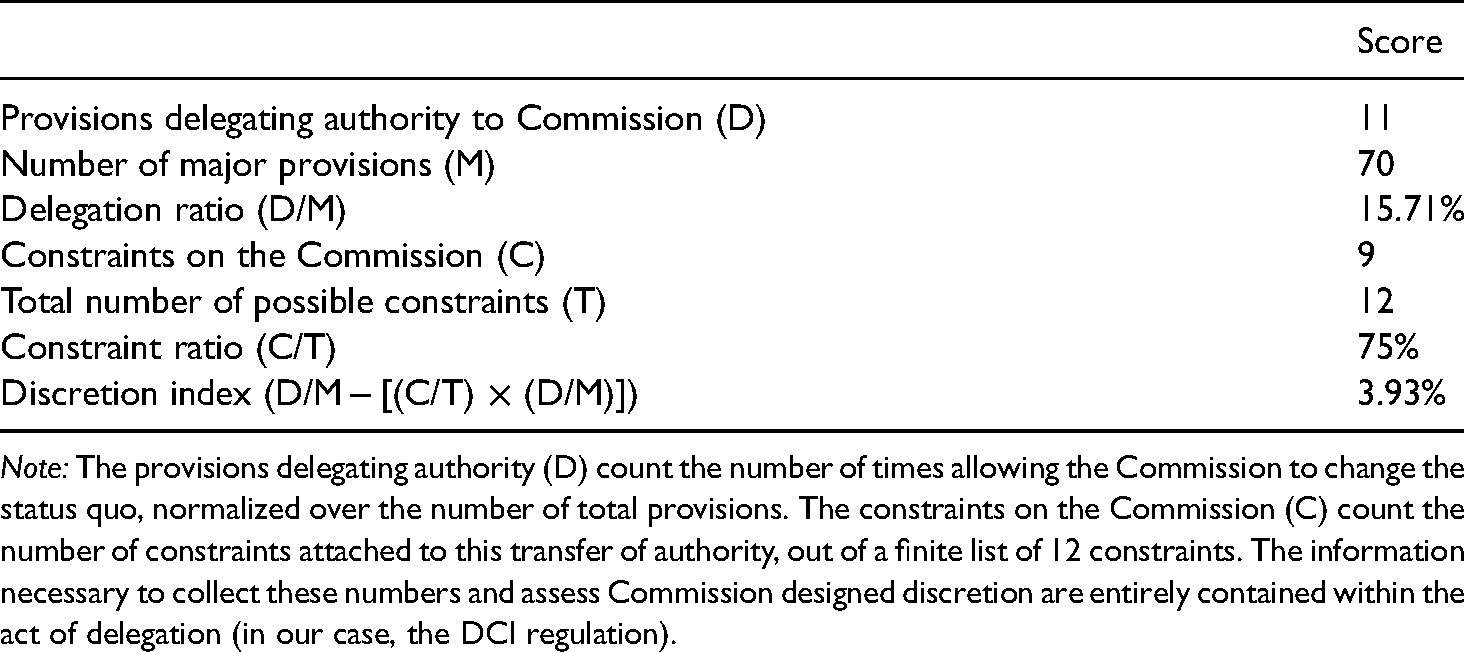
Note: The provisions delegating authority (D) count the number of times allowing the Commission to change the status quo, normalized over the number of total provisions. The constraints on the Commission (C) count the number of constraints attached to this transfer of authority, out of a finite list of 12 constraints. The information necessary to collect these numbers and assess Commission designed discretion are entirely contained within the act of delegation (in our case, the DCI regulation).
The Commission's designed discretion index score is 3.93% for the DCI (see Table 1). Where does this position development cooperation relative to other policy areas? In Pollack (2003: 94), it would be ranked in the penultimate position. However, comparisons between primary and secondary legislation are problematic because the discretion index is sensitive to the number of provisions, which are far lower in the treaty. When placing this score alongside Franchino’s (2004a: 288) observations, Commission discretion ranks considerably higher, namely at 14 of 25 categories. The Commission lacks the far-reaching powers it has in competition policy, where the index stands at 20.67%. Still, it has more leeway than in other areas such as credit and banking, where it reaches 0.79%. In fact, Commission discretion in development cooperation is close to its average level of discretion across all secondary laws (4.4%). This may explain the wide variety of assessments in the literature. Moreover, this shows that the discretion index facilitates comparisons across policy areas and supports the accumulation of knowledge over time. However, the index has thus far mainly been used to assess designed discretion. We show how the information included in the index can inform an additional analytical step to measure the Commission's actual discretion in the post-delegation stage.
The discretion index and actual Commission discretion
We suggest beginning this second step with the constraints entering the discretion index. Given how the discretion index is computed, the constraint ratio has a major influence on the results. Consider a regulation with 100 major provisions and every provision enabling the Commission to change the status quo. The delegation ratio is thus 100%. However, if all 12 constraints are included within the same regulation, the constraint ratio also becomes 100% and the overall discretion index becomes 0% as a result. This is entirely in line with the principal–agent model, where discretion is always interpreted by accounting for mechanisms of control. In this sense, ‘[t]he principal–agent perspective puts the control question centre stage’ (Blom-Hansen, 2005: 629).
We distinguish between ‘universal’ constraints affecting the act of delegation as a whole (Table 2) and ‘specific’ constraints tied to corresponding provisions delegating authority (Table 3). The original discretion index includes constraints on a dichotomous basis and we keep this approach when probing into actual discretion. Universal constraints effectively reining in the Commission retain a value of one but we accord a value of zero if the constraint factually puts few limits on the Commission during implementation. This may introduce an element of subjectivity but – as in the original discretion index – some subjectivity is unavoidable (Epstein and O’Halloran, 1999: 86; Franchino, 2004a: 293a). For the sake of transparency, we disclose how we arrived at our assessments in the discussion below. In making these assessments, we adopt a strong prior that designed and actual discretion are strongly correlated. We require overwhelming empirical evidence to depart from this prior belief.
Constraints in the DCI applying to all provisions delegating authority.
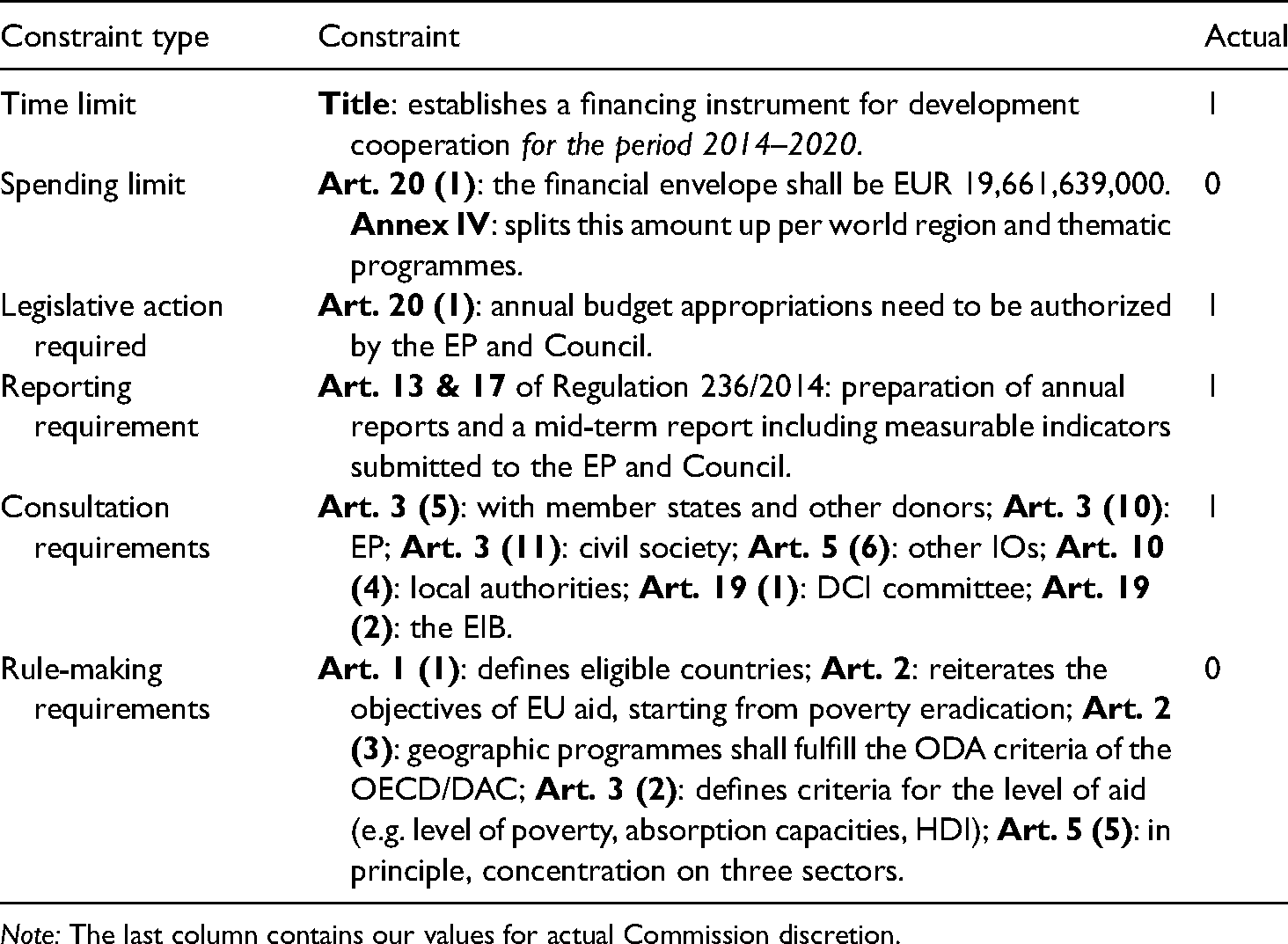
Note: The last column contains our values for actual Commission discretion.
Provisions delegating authority to the commission and corresponding constraints in the DCI.
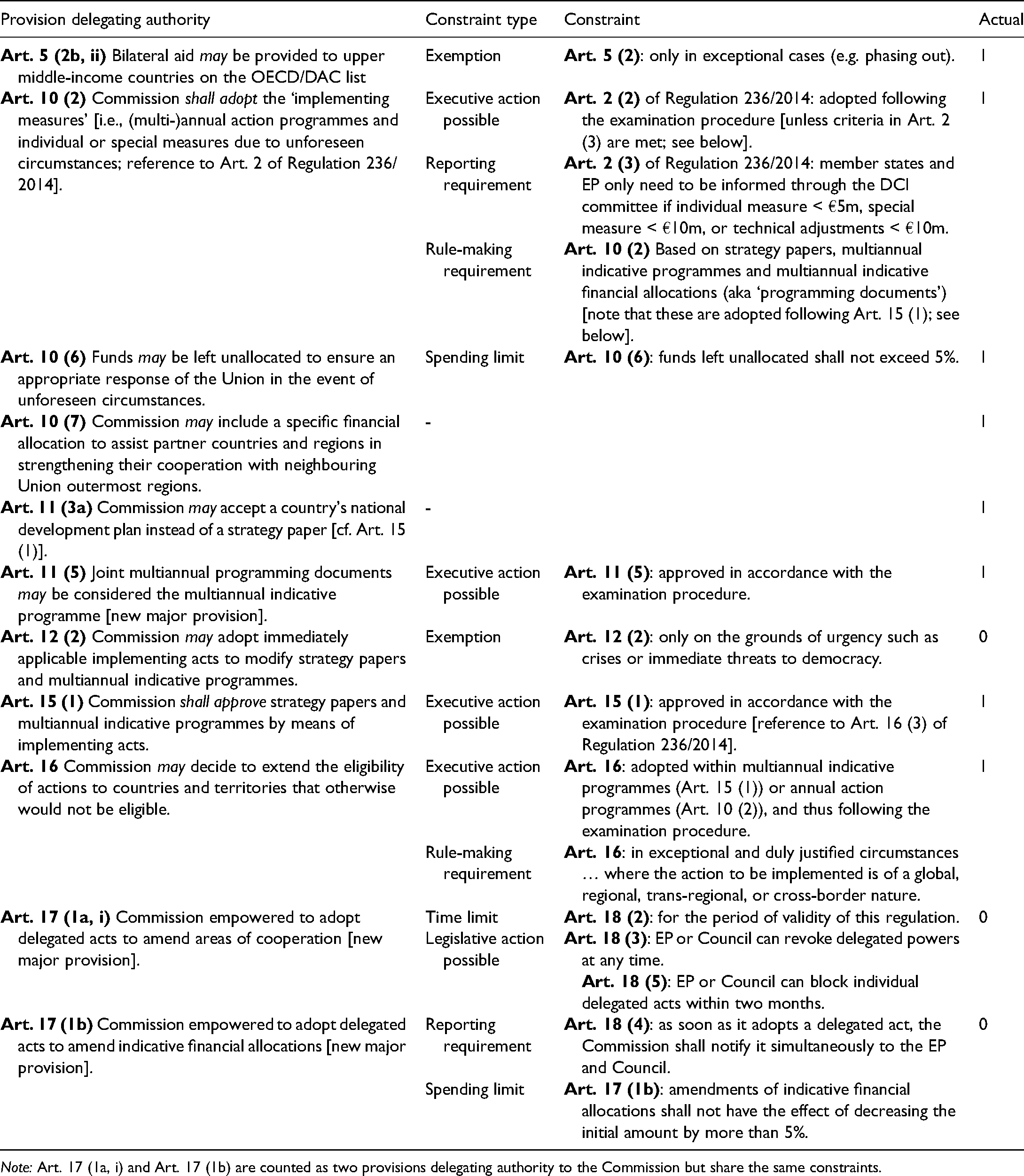
Note: Art. 17 (1a, i) and Art. 17 (1b) are counted as two provisions delegating authority to the Commission but share the same constraints.
Universal constraints
Various observations can be made based on Table 2. First, the DCI imposes strict time limits and is concluded for seven years, as it is aligned with the EU multiannual financial framework. This sunset provision ensures that the Commission needs to seek reauthorization, which gives the principals (Council and EP) the chance to sanction the Commission if it blatantly oversteps its authority in the preceding funding period. In cohesion policy, for instance, the Commission exploited the extensive powers it got in a landmark 1988 reform, after which its authority was gradually ‘renationalized’ (Pollack, 2003: 348–9).
Second, and in contrast to the first constraint, we find the spending limits to be generous to the point that they are hardly constraining. While annual budget appropriations need to be duly authorized by the EP and Council (legislative action required), the ceilings stipulated are so high that we would not describe them as a constraint. We admit that defining when spending limits are so generous they are hardly constraining can be controversial. However, in the DCI, this appears clear-cut. The DCI contains around €3 billion annually. This amounts to about one-third of the ‘Global Europe’ section in the EU budget or about 2% of the overall budget (European Union, 2020: 13). The substantive importance of these volumes is also illustrated by the fact that the EU is among the top 10 donors in all DCI countries and among the top 5 in most (OECD, 2021). More importantly, 100% of the DCI is committed supranationally by EU institutions. Again, the comparison with cohesion policy is instructive, wherein Pollack described a decrease in funds earmarked for supranational implementation from 9% to 6% as a ‘drastic’ reduction in Commission discretion (Pollack, 2003: 349). The size and supranational character of the DCI support the interpretation that this points to Commission discretion rather than Council control. Hence, this is the first time that we adapt the discretion index.
Third, the Commission has specific reporting duties to the EP and Council. It is charged with preparing annual reports and a Mid-Term Review Report on EU external actions. This requirement also extends to the DCI. The exact contents of these reports are spelled out in detail to ensure that they provide a comprehensive picture of EU development cooperation. They also proved useful to us for assessing the extent of actual Commission discretion below. Fourth, the DCI regulation foresees consultation requirements with several third parties. This lets principals ‘stack the deck in favor of groups benefiting from the policy’ (Franchino, 2007: 8) and constrain agents.
Finally, the DCI contains rule-making requirements that, however, only reflect generally accepted standards in the development community coalescing around poverty reduction. Unlike in the EU's other development policy instruments, in the DCI the Commission needs to follow the criteria for official development assistance of the Organisation for Economic Cooperation and Development (European Commission, 2017b: 5). In other words, the Council and EP could not make full use in the act of delegation of constraining the Commission due to pre-existing international standards. Moreover, these rules only slightly constrain the Commission because they allow much flexibility (Hynes and Scott, 2013). We can draw another inference from EU cohesion policy, where Blom-Hansen (2005: 631–2) found little ‘legal incentives’ for agents to pursue a certain agenda given the broad mandate. The upshot of this analysis of universal constraints is that we revise actual Commission discretion upward. Spending limits and rule-making requirements set only soft boundaries on Commission actions.
Provisions delegating authority and specific constraints
We now focus on the 11 provisions delegating authority (Table 3). Such provisions are often indicated by the modal verbs ‘may’ or ‘shall’. Furthermore, provisions do not always explicitly mention the Commission. Still, given the governance architecture of the regulation, we find it difficult to see who else could be implicitly empowered. Member states are involved through the DCI committee, which is also required for the adoption of programming and implementation documents. However, the DCI committee is not foreseen as an executive body actively steering implementation and the EP is only foreseen as a political principal overseeing implementation. Hence, where the addressee of a provision delegating authority was not explicitly stated, we assumed these powers to fall on the Commission.
The discretion index divides the DCI into specific provisions delegating authority to the Commission and constraints attached thereto, which will require scrutiny from us. We shift our focus to specific constraints attached to provisions delegating authority because – in contrast to universal constraints – they can only be meaningfully assessed together with the provisions to which they are attached. Nevertheless, we again follow the same procedure as for universal constraints. Where the designed discretion index accurately describes Commission actual discretion in the post-delegation stage, we kept the value of one for the provision delegating authority. Where we gathered overwhelming evidence that Commission discretion presents itself differently, we modified this value to zero. Where designed authority was not used at least once, we treated it as actual Commission discretion being overestimated. The Commission may have used these powers during implementation given different circumstances. However, if it was never used in the given set of circumstances, it does not contribute to actual discretion.
To assess the provisions delegating authority, we primarily drew on Commission staff working documents such as the Mid-Term Review Report of the DCI (European Commission, 2017a). This mid-term report covers the period from 1 January 2014 to 30 June 2017 and thus half the DCI's life cycle. The final report of the DCI is not yet available and the available annual reports contain scant information on the questions we are interested in. To close critical gaps in our empirical understanding, we thus filed several document access requests with the Commission. 3 In sum, we are confident that we provide an accurate picture of actual Commission discretion.
The first provision delegating authority to the Commission is Art. 5 (2b, ii), which lets the EU grant bilateral aid to upper middle-income countries in ‘exceptional’ circumstances such as phasing out aid to countries that have graduated and only recently attained that development status. This power was applied to Iraq and Turkmenistan (European Commission, 2017a: 11), who together received around €100 million or 1.3% of all aid committed under the DCI between 2014 and 2017 (European Commission, 2017b: 21). These are significant amounts that enable the Commission to act as a major development actor in countries in a similar position. Thus, the discretion index correctly predicts actual Commission discretion.
Art. 10 (2) and Art. 15 (1) empower the Commission to adopt implementing measures (e.g. multi-annual action programmes) and programming documents (e.g. strategy papers and multiannual indicative programmes). 4 In both cases, a specialized Council body in the form of the ‘DCI committee’ is involved in the adoption through the examination procedure. Here, our approach interlinks with the literature on comitology. Commission implementing acts are the most numerous EU acts (Blom-Hansen, 2019: 701). However, as the discretion index shows, an exclusive focus on Commission discretion through implementing acts underestimates its true extent because not all provisions delegating authority materialize in the form of implementing acts.
In the examination procedure, the Commission usually seeks qualified support in favour of its proposals among national representatives or at least ensures that decisions are not opposed by a qualified majority (Héritier et al., 2013: 54–55). While the Commission enjoys a strong position in implementation committees (Finke and Blom-Hansen, 2021: 5), the intensity of control efforts exerted by the Council and EP varies. Concerning the Council, one can gauge the intensity of control through the number of dissenting votes, which occurs in about 20% of implementing acts (Fernández Pasarín et al., 2021: 317). Between 2014 and 2020, the DCI committee met 70 times and adopted 303 decisions, 8 of which without a positive opinion but, also then, only with ‘no’ opinion (not a dissenting vote). 5 An alternative proxy for Commission discretion is to which extent member states are ‘interested’ in decisions taking shape (Gastinger and Adriaensen, 2019). The intuition here is that the Commission is constrained more if more member states ‘follow’ how it exercises delegated authority such as by attending meetings. On average, 11 member states missed the DCI committee, putting the average rate of attendance at only around 60%. 6
While this points in the direction of the index underestimating Commission discretion, the EP also has the right to scrutinize implementing acts (Brandsma and Blom-Hansen, 2012). The Commission must inform the EP about the agenda, draft implementing acts, and the final version of adopted acts of every committee meeting where the ordinary legislative procedure applies (as is the case for the DCI). To see whether the EP used this right, we searched the term ‘DCI’ on the EP public register of documents between 2014 and 2020. Narrowing the search to document type ‘3.1.7.1 Comitology – Right of scrutiny’, we found 480 documents, mostly filed under the EP's Committee on Development. Given the 70 DCI meetings in this timeframe, this corresponds to approximately 7 documents scrutinized per meeting. The DCI, which concerns aid to the poorest countries and is thus politically salient, therefore encounters a regular stream of parliamentary scrutiny. In other acts, the numbers for the Council and EP may both indicate higher Commission discretion. However, in the DCI we found no overwhelming evidence that the discretion index incorrectly captures actual Commission discretion. 7
The remaining provisions delegating authority to the Commission require less space to elaborate. Under Art. 17 (1a, i), the Commission can amend areas of cooperation and, under Art. 17 (1b), indicative financial allocations by up to 5%. The Commission never used these delegated powers, making this an example of the designed discretion index overestimating actual discretion. Since the constraint ‘legislative action possible’ is only tied to this provision, we also exclude it from the computation of actual discretion below.
Art. 10 (6) allows the Commission to leave 5% of funds unallocated to respond to unforeseen developments. Unallocated funds were substantial in 2014, when they amounted to €758 million (37% of all commitments). However, at the beginning of the programming period, 100% of funds are unallocated. The 5% value only becomes relevant in later years. By 2017, unallocated funds were reduced to €263 million (European Commission, 2017a: 12) or around 3% of the DCI overall. This reserve gives the Commission the ability to act as an important development actor in post-crisis situations. Overall, we believe the discretion index thus provides an accurate picture of Commission discretion.
Under Art. 10 (7), the Commission can include financial allocations to DCI countries to strengthen cooperation with the EU's outermost regions. The exact amount of these allocations is not included in the Mid-Term Review Report and unavailable from the Commission directly. However, given the size of the outermost regions, we expect this number to be relatively small. Still, it increases the Commission's flexibility at the margins and we do not adjust the discretion index. The assessment that actual discretion is over- or underestimated is reserved for situations where the evidence overwhelmingly points in the same direction.
According to Art. 11 (3a), the Commission may accept developing countries’ national development plans as strategy papers, as both aim to provide a framework for cooperation. EU strategy papers today are the exception, with national development plans often accepted as the basis for cooperation. All of Latina America, more than half of all countries in Asia, and South Africa have multiannual indicative programmes based on their national development plans (document access request). The impact on Commission discretion hinges, to some extent, on whether it can informally shape third-country national plans more than strategy papers, which are formally discussed with EU member states in the DCI committee. This notwithstanding, Commission actual discretion increases by granting it the flexibility to accept national plans. Hence, we do not adjust the designed discretion index.
Under Art. 11 (5), the EU and member states can adopt ‘joint multiannual programming documents’ to replace multiannual indicative programmes. This is intended to increase policy coherence between EU-level and EU member states’ (national) aid to facilitate the achievement of sustainable development goals. By December 2018, 23 joint programming documents were in place (European Commission, 2019: 21). Joint programming may provide the Commission with inroads to shape development cooperation plans within member states, extending its reach beyond EU-level aid and Europeanising national development cooperation policies (Orbie and Carbone, 2016). Still, given that this hinges on member states, actual discretion should be largely correctly captured by the discretion index.
Under Art. 12 (2), the Commission can immediately adapt programming documents on grounds of urgency and involve the DCI committee only ex-post. However, this power has not once been used (document access request). As was the case for delegated acts, the discretion index thus overestimates Commission discretion. Finally, under Art. 16, the Commission can expand the scope of the DCI beyond those countries defined in Art. 1 of the regulation. This is a potentially far-reaching power because it lets the Commission include countries it considers necessary on grounds of ‘exceptional and duly justified’ circumstances. While it has been used only in a handful of cases in Asia and Latin America (document access request), it shows that the Commission did use this authority and can approach countries with the prospect of including them within the scope of the DCI. Hence, we consider the discretion index to correctly capture Commission discretion.
We can now use the formula for the designed discretion index and plug in the values for the Commission's actual discretion, leaving all other values unchanged. We subtract three types of constraints. With regard to universal constraints, the DCI grants the Commission extensive resources and only requires it to follow generally accepted development standards. Moreover, we excluded ‘legislative action possible’ because it is tied to a provision delegating authority that was never used. Thus, the types of constraints are reduced to 6 (instead of 9) of 12. In terms of provisions delegating authority, we subtract three that have never been used, taking this part of the index from 11 to 8. The result is an actual discretion index of 5.71%. This is an absolute increase of 1.79% or a relative increase of around 50% over the value for designed discretion. This shows that the difference between designed and actual discretion can be considerable.
Conclusion
In this article, we employed the discretion index typically used by principal–agent scholars to measure designed Commission discretion to assess its actual discretion. We suggested using the information necessary for the designed discretion index to inform a second step to measure the Commission's actual discretion in the post-delegation stage. Distinguishing in our approach between constraints and provisions delegating authority, we showed how the discretion index provides a roadmap for scholarly investigation. Finally, we adjusted the designed discretion index in cases where it clearly under- or overestimated discretion and derived a scalar value for the exact extent of Commission discretion. We do not claim that this approach fully overcomes subjectivity. Rather, we argue that the discretion index provides the basis for a systematic and transparent measurement of actual Commission discretion that facilitates comparisons across policy areas and time.
We see several important uses of our approach. First, we found that actual discretion in the DCI is considerably higher than designed discretion. While we cannot extrapolate from a single case, our findings show that designed and actual discretion can deviate. Future research may reveal that actual discretion is always higher and can be explained by the same factors as those for designed discretion. However, the two could diverge in a more systematic fashion and be driven by alternative factors. Also noteworthy is that, while we focus on a single case study, our measurement of actual discretion can also pave the way for quantitative analyses. As more comparable data on actual discretion become available, these could be analyzed quantitatively. Second, the discretion index is usually not only interested in delegation to the Commission but also other actors such as EU member states (Zhelyazkova and Torenvlied, 2011) or EU agencies (Migliorati, 2020; see also Wonka and Rittberger, 2010). Our approach could easily be extended in these directions, thereby proving useful beyond the question of Commission discretion.
In addition, our approach has value beyond the EU. Given that the discretion index was developed by Epstein and O’Halloran, our approach could inform the scholarly literature on the post-delegation discretion of the American president (Rottinghaus, 2019) or regulatory agencies (Groll et al., 2021), extending to more than one type of constraint such as budgetary limitations (Bolton and Thrower, 2019). Since machine-learning techniques are even capable of measuring discretion without relying on pre-existing manual coding (Vannoni et al., 2021), a greater focus on post-delegation dynamics becomes even more critical. Our approach could be used in other national contexts, thereby informing a research agenda on actual executive discretion from a comparative politics perspective. Beyond national political systems, there is strong interest in international relations to study the consequences of delegating authority to international agents, such as to permanent secretariats in international organizations (Bauer and Ege, 2016; Hawkins et al., 2006; Hooghe and Marks, 2015). Similarly here, the discretion index can provide the basis for a comparative analysis of both designed and actual discretion.
We conclude with a word of caution on our approach. The discretion index may provide a false sense of comprehensiveness in that the act of delegation can be considered an incomplete contract (Héritier and Lehmkuhl, 2008). The Commission could be empowered or constrained through alternative channels, such as the appointment procedure (Crombez et al., 2017; Wonka, 2007) or national parliaments (van Gruisen and Huysmans, 2020). Informally, Commission discretion could be impacted by sharing the stage with member states (Delreux and Keukeleire, 2017) or its (in)ability to informally set the agenda (Blom-Hansen, 2008). Encouraging scholars to focus on the act of delegation runs the risk of losing sight of such alternative channels. Thus, we fully acknowledge the continued value of other types of analyses. Still, most studies benefit from a detailed understanding of the act of delegation as provided by the discretion index. Thus, our contribution proves a valuable step in other studies, resulting in more comparable data on actual discretion and opening new avenues for future research over time. Machine learning can automatically generate values for designed discretion because it is fully contained within legal acts that can be clearly identified and are suitable for text processing. However, actual discretion requires scholars to dig deeper and, guided by the discretion index, probe into different aspects. This level of artificial intelligence has not yet been achieved. Assessing actual discretion thus requires the collaboration of political scientists, at least for now.
Supplemental Material
sj-pdf-1-eup-10.1177_14651165221098487 - Supplemental material for Measuring actual discretion of the European Commission: Using the discretion index to guide empirical research
Supplemental material, sj-pdf-1-eup-10.1177_14651165221098487 for Measuring actual discretion of the European Commission: Using the discretion index to guide empirical research by Markus Gastinger and Eugénia C Heldt in European Union Politics
Footnotes
Acknowledgements
For comments on previous drafts of this article we are grateful to four anonymous reviewers, Gerald Schneider, Jens Blom-Hansen, Michael Blauberger, Fabienne Bossuyt, Hussein Kassim, Myriam Oehri, Mark Pollack, Mark Rhinard, Ariadna Ripoll Servent, Jarle Trondal, and the participants of panel 028 at the CES 23rd International Conference of Europeanists 2016 in Philadelphia, panel 2E at the EUSA Fifteenth Biennial Conference 2017 in Miami, and panel 11F at the EUSA Sixteenth Biennial Conference 2019 in Denver. We also want to express our profound gratitude to the Commission officials assisting us with the document access requests. All remaining errors and inconsistencies remain our own.
Funding
The authors disclosed receipt of the following financial support for the research, authorship and/or publication of this article: This project has received funding from the European Union's Horizon 2020 research and innovation programme under the Marie Skłodowska-Curie grant agreement No 840135. This research has also received funding from the European Research Council under the European Union's Seventh Framework Programme for research, technological development and demonstration (grant agreement No 312368).

Supplemental material
Supplemental Material for this article is available online.
Notes
References
Supplementary Material
Please find the following supplemental material available below.
For Open Access articles published under a Creative Commons License, all supplemental material carries the same license as the article it is associated with.
For non-Open Access articles published, all supplemental material carries a non-exclusive license, and permission requests for re-use of supplemental material or any part of supplemental material shall be sent directly to the copyright owner as specified in the copyright notice associated with the article.
