




Abstract
In many international agreements, the European Union sets up joint bodies such as ‘association councils’ or ‘joint committees’. These institutions bring together European Union and third-country officials for agreement implementation. To date, we know surprisingly little about how much discretion the European Commission enjoys in them. Drawing on a principal–agent framework, we hypothesise that the complexity of agreements, the voting rule, conflict within the Council, and agency losses can explain Commission discretion in these institutions. Drawing on an original dataset covering nearly 300 such joint bodies set up by the European Union since 1992, we find robust empirical support for all expectations except for the agency loss thesis. Our findings suggest that the European Commission is the primary actor in the implementation of many of the European Union's international agreements, allowing it to influence EU external relations beyond what is currently acknowledged in the literature.
Keywords
Introduction
The European Union (EU) is one of the most prolific authors of international agreements in the world. In the area of trade, for example, the EU has concluded more agreements than any other state or regional organisation (Dür et al., 2014: 357). In many respects, international agreements only constitute a ‘starting point’ (Cooley and Spruyt, 2009: 9) and leave it to states to flesh them out through continued government-to-government interactions after entry into force. Just as important as the conclusion of agreements, therefore, is a stable institutional framework for their successful implementation. This function is provided by what we term ‘joint bodies’ (JBs) in this article. Whoever in the EU holds the keys to these bodies can steer implementation and shape EU external relations for years to come.
Prominent examples of these institutions include association councils or joint committees. These bodies bring together representatives from the EU and the other agreement signatories for continued negotiations over agreement implementation. In the EU, it is often the European Commission (henceforth ‘Commission’) that carries out vital functions in JBs. Which exact role the Commission plays, however, varies across agreements. In the Comprehensive Economic and Trade Agreement (CETA) with Canada, for example, the Council of the European Union (‘Council’) gave the Commission substantial leeway. The Commission can, for example, define the EU position for negotiations with Canada on which geographical indications to include in the future. Moreover, in the CETA joint committee, where these negotiations with Canada take place, the EU is represented by the Commissioner for Trade. Germany's constitutional court criticised that member states were not even assured a seat at the table, which risked undermining their influence (German Federal Constitutional Court, 2016: paragraph 62). However, the German government supported extensive powers for the Commission noting that such arrangements were ‘common’ in EU trade agreements (German Federal Constitutional Court, 2016: paragraph 29).
The Commission does not always enjoy such a high level of discretion. In the ‘stepping stone’ Economic Partnership Agreement with Ghana, concluded within months of CETA, the Council ensured that the joint committee includes representatives of the Commission and the Council. In the Euro-Mediterranean Agreements with Israel, Jordan, Morocco, and Tunisia signed between 1995 and 1997, member states empowered the Council Presidency to represent the EU in the joint institutions rather than the Commission. When concluding an agreement with the Seychelles in 2014 on access for fishing vessels to Mayotte, member states even pinned a 400-word annex on the Commission detailing its ‘scope of the empowerment’ in the joint committee (Council, 2015). What explains this variation in discretion across JBs that the Council gives the Commission?
In this article, we formulate a principal–agent argument to explain Commission discretion in these bodies, understood as the leeway that the Commission is formally granted (which may differ from the autonomy the Commission exerts in practice). Our theoretical framework, and subsequent empirical findings, shows that the same factors often expected to explain delegation in internal (domestic) legislation are also apt to explain discretion in external relations. However, we also argue that in external relations Commission discretion is generally high because the Council cannot delegate implementation to national bureaucracies and it relies on the Commission's skills to aggregate diverse preferences before negotiations with third countries. This makes delegation in EU external relations noticeably different from delegation in internal acts. Beyond the limited pool of available agents in external relations and the need to speak with a single voice in negotiations with third countries, member states in the Council cannot reap the benefits of international cooperation without efficient implementation. To unlock these joint gains, which depend in great part on continued negotiations with the third country, EU member states give the Commission substantial leeway and, essentially, hand it the keys to a vast network of joint institutions spanning the entire globe.
Despite this wider dynamic, we show that the Council still tailors Commission discretion in line with previous applications of the principal–agent model. Commission discretion increases with: (a) the complexity of international agreements; (b) a majority voting rule for agreement ratification; and (c) conflict among EU governments in the Council. By contrast, like most large-N empirical studies on Commission discretion, we find no support that the Council grants more leeway to the Commission where their preferences are more closely aligned (see the Online appendix for a discussion of previous findings).
To empirically test our expectations, we rely on an original dataset of 252 international agreements concluded by the EU between 1992 and 2018. For all agreements, we have gathered full texts and EU ratification documents, which detail who represents the EU and how the EU position is adopted before JB meetings. These two sources provide unique insight into the inter-institutional dynamic of these bodies. In terms of actors, we focus fully on the dyadic relationship between the Commission and the Council. The European Parliament (EP) is practically completely sidestepped in JBs and we, too, find no evidence of any meaningful role for it based on our data. Moreover, we do not include the third country in our analysis. The decision of who represents the EU and how it defines its position is entirely one for the EU to make. Even if the international agreement does contain information on who should represent the EU, this part of the agreement can be changed unilaterally through EU-internal decisions (see the Online appendix for details).
Our article makes several contributions to the literature. Theoretically, we develop an original argument on why the Commission experiences high levels of discretion in external relations. Despite this generally high watermark, we show that variables traditionally found in principal–agent scholarship still apply. This underlines the model's versatility and robustness across different policy areas. Empirically, we push the envelope concerning research on JBs. Despite their importance for EU external relations, current knowledge is limited to small-N, qualitative case studies often predicated on the EU's neighbourhood. We base our analysis on a much larger number of cases and without any a priori regional limitation. Combining these two insights, we also add to the large literature on EU external relations by arguing that the Commission has been the primary beneficiary of the spread of these bodies and gained considerable latitude in shaping EU external relations through them. Methodologically, we heed the calls of multiple principal–agent scholars to test the model's predictions with large-N research designs (e.g. Anastasopoulos and Bertelli, 2020; Laloux and Delreux, 2018; Migliorati, 2020). Our results can therefore be generalised with greater levels of confidence.
Joint bodies in EU agreements with third countries: What do we know this far?
How JBs operate is still, largely, a mystery. They garnered most attention with countries in and around Europe and based on qualitative methods. For example, Leuffen et al. (2013: 77) focus on European countries with an accession perspective when arguing that horizontal external differentiation ‘goes hand in hand with a proliferation of association councils and bilateral committees’. Gstöhl (2015) systematically surveys institutional solutions with countries in the EU's neighbourhood and shows that joint institutions are an almost universal feature that serve to support varying levels of ‘deep economic integration’ with the EU. From an external governance perspective, Lavenex and Schimmelfennig (2009: 798) argue that these institutional ties with third countries are a form of network governance, which underlines the importance of continued negotiations to resolve conflicts on a sectoral level (see also Lavenex et al., 2009). Finally, Schimmelfennig (2003: 121) reports how Turkey suspended its participation in the association council to protest the EU's refusal to accord it candidate country status in 1997. This suggests that participation in such bodies is valued by states as else Turkey would not have felt it could use its withdrawal to put pressure on the EU.
While these contributions are primarily concerned with the effect of JBs on relations between the EU and third countries, the intra-EU dimension of how these bodies affect the relationship between EU institutions themselves is currently underdeveloped. There are only two exceptions that we could identify, both again based on qualitative methods. In painstaking archival research, Gastinger (2016) uncovered how these bodies have been at the centre of a decades-long dispute between the Commission and Council in the formative years of the EU's external relations. Börzel and Van Hüllen (2014: 1039) report that the Commission enjoys wide latitude in bilateral negotiations with European Neighbourhood Policy countries conducted within JBs when promoting (conflicting) goals of good governance through so-called ‘Action Plans’.
Another interesting thread in the literature differentiates JBs along their effect on democratic decision making. Political scientists, generally, take a remarkably optimistic view of these bodies. For example, the European Economic Area/European Free Trade Association (EEA/EFTA) countries adopt a substantial amount of the EU acquis without formal representation in the decision-making process. Here, joint EU–third country institutions are portrayed as assuaging legitimacy concerns rather than exacerbating them (Lavenex et al., 2009: 818). Similarly, when dealing with autocratic states in Europe's neighbourhood, such bodies are viewed as tools for promoting democracy abroad (van Hüllen, 2012) rather than undermining democracy at home. Overdevest and Zeitlin (2018: 67) argue that JBs with developing countries promoting sustainable forest governance play a ‘crucial role’ by inviting civil-society actors to help monitor implementation, thereby increasing public accountability.
This contrasts starkly with critical voices expressed primarily by legal scholars. They point out that JBs can adopt binding decisions that may be directly applicable without further actions required from the Council and EP (Maresceau, 2006: 247; Mendez, 2013: 103). Schmalenbach (2016: paragraph 30), for example, observes that the EP only needs to be informed of EU positions and decisions in such bodies. To increase their legitimacy, Weiß (2018: 31–32) suggests requiring EP consent for ‘essential’ decisions taken in these bodies and including members of the EP as part of the EU delegation. Finally, Melillo (2019: 107) finds that these bodies are often not transparent, which impedes public scrutiny. While all of this may make JBs powerful tools for the efficient implementation of agreements and the reduction of transaction costs, it also concentrates extensive powers in their hands.
We take away two main points from this brief discussion of the state of art. First, JBs matter: while they have never been at the centre of scholarly investigation, it is clear from the literature that they are widespread and take important decisions. Second, functional concerns seem to trump continuous participation of political principals. The focus is to delegate extensive powers to the Commission to ensure efficient implementation of international agreements rather than establishing an elaborate system of checks and balances among EU institutions. 1 It is also this second observation that serves as our starting point for the development of hypotheses explaining Commission discretion from a principal–agent perspective.
Theoretical framework
The principal–agent approach is a conceptual toolbox for understanding the delegation of authority from ‘principals’ (such as the Council) to ‘agents’ (such as the Commission). This decision always involves a trade-off for principals between granting agents sufficient discretion to efficiently carry out the mandated tasks and maintaining control to reduce agency shirking (Pollack, 1997: 115). Discretion thus refers to an agent's ‘leeway so that it can adapt to changes in its task environment’ (Bendor et al., 2001: 264). Leeway possibly translates into autonomy to engage in independent actions, if the agent uses it to pursue its own interests once empowered (Hawkins et al., 2006: 8).
In developing our theoretical expectations on Commission discretion, we focus on the Council–Commission relationship. Our theoretical framework uses well-established variables, but we argue that the Commission generally enjoys high levels of discretion in external relations. To illustrate the Commission's central position in EU external relations, we juxtapose external relations and internal legislation along two broad lines.
First, the literature on domestic legislation is primarily interested in different implementation paths, explaining when the Council delegates implementation to supranational agents such as the Commission rather than national agents such as their own national bureaucracies. In external relations, however, the ‘pool of available agents’ (Hawkins and Jacoby, 2006: 203) is restricted to the Commission, the Council itself, or the High Representative/Vice President. 2 If the option of empowering national bureaucracies is available, the Council largely refrains from empowering the Commission and, on average, accords less discretion to it than to national bureaucracies (Franchino, 2007; Migliorati, 2020). The mere fact that delegation to national bureaucracies is unavailable in external relations is in itself an important point of distinction that promises to have a major impact on member states’ calculus for the delegation of authority to supranational agents.
Second, Franchino (2007: 143–144) argues that the Council relies on the Commission for general managerial skills, but delegates to national bureaucracies when specialised technical skills are required. However, in JBs – as in comitology bodies – both these skill sets are necessary to ensure efficient implementation. If substantive technical knowledge is needed, the Commission can ‘draw upon the expertise of the member states’ national administrations’ (Brandsma and Blom-Hansen, 2010: 503) to craft common EU positions. If the focus is on managerial or process expertise, it can use its superior knowledge of the acquis to shape outcomes (see also Dijkstra, 2010: 531). Our argument, therefore, is not that the Commission is entirely cut lose from national bureaucracies in external relations – and neither do we believe that it would be in its own interest to seek such a radical notion of autonomy. However, we contend that the implementation of international agreements always requires ‘general managerial skills’ to tie various interests together and coherently negotiate with third countries. As Dür and Elsig (2011: 331) observe, ‘delegation is most likely for reasons of efficiency […] when negotiating with third countries’.
Nevertheless, there is ample variation in Commission discretion across JBs that can be explained with principal–agent variables. In the remainder, we discuss four such variables: complexity, decision-making rules, Council conflict, and agency losses.
Complexity
One of the primary predictors for agent discretion encountered in the principal–agent literature is the complexity – or ‘information intensity’ – of delegated decisions. The provision of technical knowledge by specialised agents is a key functional benefit of delegation (Dür and Elsig, 2011: 329; Hawkins et al., 2006: 13). Put succinctly, agents generate policy-relevant information to keep up with the ‘technical complexity of modern society’ (McCubbins, 1985: 722), leading to superior policy outcomes. As we have just argued, the Commission primarily provides general managerial skills and lacks specialised technical knowledge, which is more readily available on the national level. However, if an international agreement requires a complex implementation effort on part of the EU, the need for overarching coordination only becomes stronger, particularly since delegation to national-level bureaucracies directly is generally unavailable. Therefore, we expect complexity and Commission discretion to go hand in hand in JBs. H1: The higher the complexity of an international agreement, the more discretion the Council grants to the Commission in JBs.
Decision-making rule
Another predictor of Commission discretion is the voting rule applicable in the Council when ratifying the international agreement setting up the JB. The Council qualifies as a ‘collective’ principal (Nielson and Tierney, 2003: 247) made up of various actors that need to solve decision-making problems before empowering the Commission. Spatial models of connected winning coalitions predict that unanimity voting introduces a ‘lowest common denominator’ bias into legislative politics in the Council and leads to less integrationist outcomes (Garrett and Tsebelis, 1996: 281), such as less Commission discretion. If the Council can delegate to national instead of supranational bureaucracies, Franchino (2007: 51) predicts no discretion for the Commission whatsoever under unanimity. While this effect is mitigated in external relations because delegation to national bureaucracies is unavailable, the voting rule within a collective principal still promises to be an important predictor of agent discretion. H2: When unanimity is required in the Council for agreement ratification, the Commission is granted less discretion in JBs.
Council conflict
Given the Council's nature as a collective principal, a further factor explaining Commission discretion can be found in heterogeneous preferences among EU member states. While diverging positions among principals almost always lead to more discretion when agents exercise authority once delegated (e.g. Conceição-Heldt, 2011; Schneider and Tobin, 2013), its effect during the initial legislative game is more ambiguous. Pollack (2003: 32) suggests that principals anticipate greater difficulties in reining in agents and reduce discretion from the start. Bendor et al. (2001: 245) similarly suggest that divided principals limit agent discretion to ensure that no principal is made worse off by delegation. Franchino (2007: 48–49), by contrast, argues that heterogeneous preferences among member states allow the Commission to table proposals including more discretion for itself. Bailer (2014: 7), similarly, holds that conflict enables the Commission to ‘strategically build alliances’ with likeminded governments and secure more discretion. These opposing views can also lead to conflicting expectations concerning the direction of the effect of preference heterogeneity on agent discretion (Thomson and Torenvlied, 2011: 147).
Our reasoning differs from both of these positions and focuses on the specificities of EU external relations. To reap the expected gains from agreement implementation, the Council needs to ensure that the EU can negotiate effectively with third countries. To that end, the Commission first needs to aggregate the Council's diverse preferences, which will be more daunting in situations of marked preference heterogeneity. To allow the Commission to negotiate effectively, the Council thus needs to grant the Commission more discretion to lower transaction costs during implementation. Clearly, for this relationship to materialise preferences cannot be ‘so extreme as to vitiate the gains from delegation’ (Hawkins et al., 2006: 28). However, this condition is necessarily given in the cases we are interested in as the EU can only sign an international agreement if there is sufficient support for it within the Council. In other words, member states grant discretion to the Commission to avoid Council conflict impeding the implementation of the agreement, which would defy the purpose of signing an agreement in the first place. H3: The more conflict within the Council, the greater the discretion granted to the Commission in JBs.
Agency losses
Even though (and partly because) governments are interested in efficient agreement implementation, they may be concerned that the Commission can use the authority delegated in unintended ways. Agency losses, in the form of agents bringing about policy outcomes different from what principals prefer, are among delegation's primary problems (Pollack, 1997: 108). The preferences of principals and agents, both conceived as self-interested rational actors in the principal–agent model, are bound to diverge to some extent. Principals weigh the benefits of delegation against its expected costs, the latter coming primarily in the form of undesired policy outcomes. The further the agent's preferences are from those of the principal, the greater the expected agency losses and the less discretion agents will be granted (Bendor and Meirowitz, 2004: 307; Epstein and O’Halloran, 1999: 77–79). By contrast, the more principals see their own and the agent's preferences overlap, the more leeway they grant agents to adapt to unforeseen events and external shocks (Franchino, 2007: 56). H4: The greater the preference distance between the pivotal government in the Council and the Commission, the less discretion the Commission is granted in JBs.
Research design
The starting point for our analysis is the Treaties Office Database (TOD) of the EU. Set up in 2006, its purpose is to provide a comprehensive picture of international agreements negotiated by the EU institutions. Its advantage over EUR-Lex, which is an even more comprehensive database containing the entire EU acquis, is that the TOD includes information on whether JBs have been set up for the management of agreements. However, since this information proved incomplete in some cases, we manually mapped these bodies ourselves. In May 2020, we identified 252 agreements with JBs concluded by the EU since 1992 for which we could find information concerning Commission discretion either in the agreements themselves or the EU ratification decisions associated with them. We exclude agreements before 1992 as there is a break in the data in terms of agreements included in the TOD. Still, our dataset is easily the most comprehensive on Commission discretion in JBs available to date.
Dependent variable
To measure Commission Discretion (defined above as the leeway the Commission has when carrying out its tasks), we have collected the full texts of all 252 agreements from various sources and all documents connected to their ratification. Based on these two data sources, we build an additive index consisting of five indicators. These indicators can be grouped into two dimensions. The first dimension focuses on how JB meetings are conducted with the third country and consists of three indicators. Indicators four and five are connected to a second dimension of how the EU position is prepared before such meetings. Moreover, we account for two institutional levels in our analysis. All agreements in our dataset set up at least one joint committee. Moreover, 45 agreements top up this structure with a joint council, which we also included (see the Online appendix for additional details). This brings the total number of JBs covered by our article to 297.
First, we coded whether the Commission represents the EU in the joint committee. While in comitology bodies the Commission always presides over meetings, in JBs this decision can be taken freely by EU member states. This is particularly important when it is the EU's turn to the chairmanship in JBs, which alternates between the EU and the third party. If the Commission represents the EU, it chairs JB meetings in those periods. Holding the chairmanship allows actors to shape outcomes (Tallberg, 2010), thus adding to Commission discretion in JBs.
Second, we look for any indication that EU member states are present during JB meetings and engage in direct ‘police-patrol’ monitoring to mitigate problems of asymmetric information (Pollack, 2003: 26). Again, in comitology bodies national representatives are always present, but in JBs this can vary freely. Whether member states are present or not can be indicated, for example, by the agreement stating that representatives of the Council form part of the joint committee or a general reference that the Commission should be assisted by representatives of the member states. We add one point to Commission discretion where member states have not secured their right to a seat at the table when JBs meet.
Third, member states in the Council can rein in the Commission through joint councils. Similar to decisions within the EU that need to be adopted by the Council before coming into force, this can constrain Commission leeway. In fact, joint committees can often only act where empowered by the joint council to do so. Therefore, if the Council plays a stronger role in the joint council, it can use this position to limit the margin of manoeuvre of the Commission in the joint committee. For example, EU member states could make clear to the Commission that they would not consider adopting a decision prepared in the joint committee at the level of the joint council or oppose the delegation of powers to the joint committee in the first place. Since joint councils (like joint committees) always operate on the principle of consensus, EU member states do not have to rely on third-country support to employ such sanctioning mechanisms effectively but can wield them unilaterally. We thus accord one point to agreements not setting up a joint council in which the EU is represented by an actor other than the Commission.
Fourth, and turning to how EU positions are adopted, we code whether the Commission can, in at least one instance, define the EU position with only majority support among member states in the Council. This mostly means qualified majority support, though in isolated instances it could also mean lower voting thresholds. When the position is adopted by a majority in the Council, the Commission also practically always enjoys agenda-setting power, which is why we did not make this as a separate indicator in our index. Still, this combination gives the Commission considerable discretion to shape the EU position before JBs meet.
Fifth, and finally, the Council sometimes sets up specialised committees to assist the Commission in JBs. Since a special committee should be more effective in controlling the Commission than a looser format or when decisions are prepared within a body not primarily concerned with the JB, we accord one additional point to Commission discretion if the Council does not set up a specialised committee.
Our final dependent variable takes two forms. First, we determine statistically optimal weights to add up these items using latent trait analysis. We apply a Rasch model that weighs the five indicators according to the frequency with which they appear in the index (Discretion (Rasch)). Second, we construct a simple additive index ranging from 0 to 5 that assigns one point to Commission discretion for each indicator. While we prefer the former variable because of the optimisation of indicator weights, our results are robust to using the simple additive index.
Predictors
Complexity, our first predictor, is notoriously difficult to operationalise. In studies on internal legislation, the number of recitals is often used for a lack of better alternatives (Rasmussen and Toshkov, 2011: 82). However, recitals in international agreements are used differently than in EU legislative acts. The preamble, while a fundamental part of most international agreements, does not appear to us to be a good proxy for complexity. Instead, we use the length of the annex in words as an indicator for complexity (Complexity). We add one to avoid 0 values for agreements without annexes and take the log of that score because of outliers.
H2 refers to agreements that require unanimity in the Council for ratification (Unanimity). To determine the decision-making rule, we collected the legal bases used to conclude agreements from the TOD and ratification documents. Knowing the legal bases, we could infer the decision-making rule from the treaty governing the EU at any given point in time. Today, for example, this mostly refers to the Treaty on the Functioning of the European Union (TFEU). We operationalise this variable as a dummy that is coded 1 for agreements that include at least one legal basis requiring unanimity in the Council and 0 otherwise.
We operationalise ‘Council conflict’ as used in H3 by calculating the policy range that exists on an issue in the Council (Council policy range). In doing so, we assume that the policy range and decision-making rule at the time of ratification extend into the implementation phase of the agreement. We first matched agreements with substantive policy categories included in the Comparative Manifestos Project. To aid this process, we have been guided by the agreement's EuroVoc descriptors available on EUR-Lex, the summaries available for each agreement in the TOD, and in case of doubt agreement texts themselves. To determine the policy position of each member state in the Council, we have used the position of the parties in government, weighted by seat shares in the country's lower house in the case of coalition governments. To identify the parties in government, we have relied on the parliaments and governments (ParlGov) database (Döring, 2013). Council policy range, under unanimity, is the range between the governments in the Council with the most extreme scores in the applicable policy category. Under qualified majority voting, it is the range between the government with the most extreme policy score on the side of the status quo and the pivotal government at which the qualified majority threshold is first met (see the Online appendix for details).
H4 requires us to determine the policy distance between the Council pivot and the Commission (Council Commissioner distance). The pivot, again, is the position of the government that is necessary to unlock negotiations in the Council given the decision-making rule. To determine the Commission's preferences, we take the position of the Commissioner in charge of the primary lead Directorate General (Thomson, 2008). The lead Directorate General is identified in the procedure tab of EUR-Lex, which we extracted manually for all 252 agreements. To derive the position of the Commissioner, we rely on the position formation in the EU dataset (Hartlapp et al., 2014), which we supplemented with information for the Barroso II and Juncker Commissions. For ‘political’ Commissioners, we take the position of the party to which they belong when first appointed. For ‘technocratic’ Commissioners, we take the position of the government at the time of appointment.
Control variables
In our baseline model, we control for agreements concerning a core competence of the Commission. As Conceição-Heldt and Meunier (2014: 967) note, in trade ‘the EU is solely responsible for acting and representing a common position externally’. This does not by itself specify that the EU must be represented by the Commission at all times. But Art. 207 TFEU unequivocally puts the Commission in the lead for trade negotiations, giving the Treaty an ‘in-built bias’ (Brandsma and Blom-Hansen, 2017: 26–27) for conferring powers on the Commission also during implementation. Moreover, we include agriculture as a core competence of the Commission because of its strong interlinkages with trade policy (Dür and Elsig, 2011: 311; Young and Peterson, 2014: Chapter 4). We construct a dummy variable (Core competence) that is 1 if at least one legal basis of the agreement falls under the EU's common commercial policy or agriculture, and 0 otherwise.
Furthermore, we control for procedural differences concerning the ratification of agreements. First, the EP's assent can be necessary. The EP could support higher discretion for the Commission as its ‘supranational ally’ (Ellinas and Suleiman, 2012: 76) in the legislative game played with the Council. Whether the EP's assent was necessary was inferred from the ratification documents, which spell out whether the EP had given its assent, only provided an opinion, or was not involved at all. If no ratification document was available, we resorted to the legal bases to infer the EP's level of involvement. We create a dummy variable that takes a value of 1 if the EP's assent was necessary and 0 otherwise (EP assent).
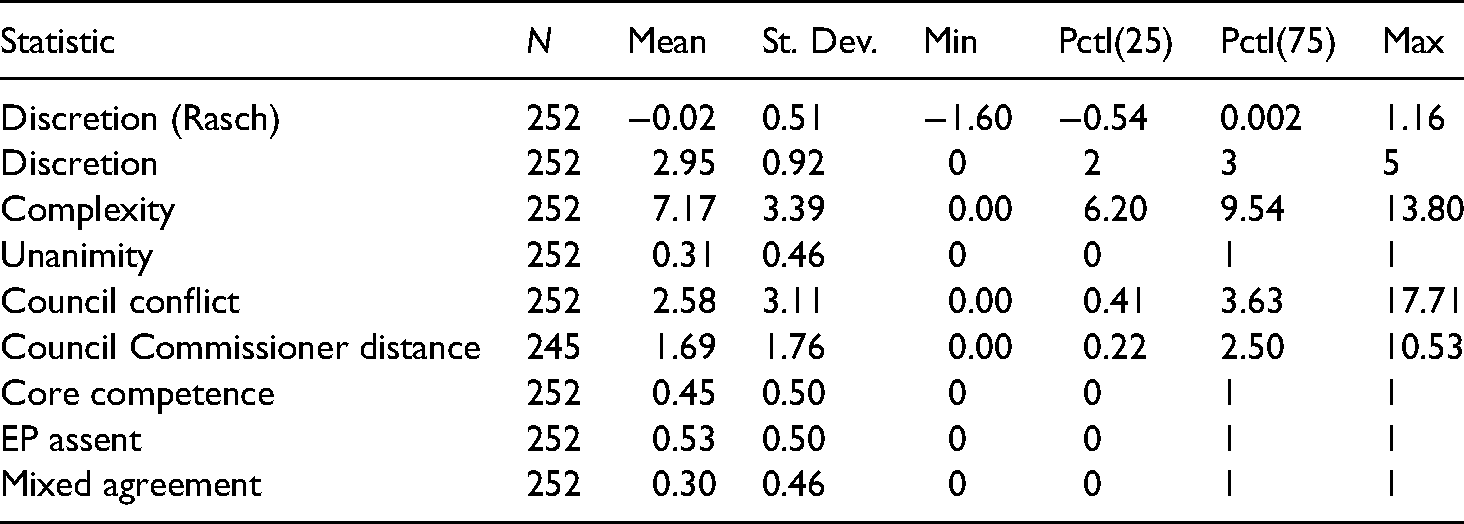
Second, we control for mixed agreements that require ratification both at the EU and national level. The need to obtain the assent of all national (and, in some member states, even regional) parliaments increases the number of veto players that could block higher Commission discretion (Mixed agreements). Finally, to account for systematic changes over time and the influence of different treaty frameworks (Migliorati, 2020: 12), we add dummies for the treaty in effect when an agreement was concluded. Table 1 contains descriptive statistics for all variables but the treaty dummies.
Descriptive statistics.
Empirical evidence
We show the results of our empirical analysis in Table 2. We treat Discretion (Rasch), the dependent variable of Model 1, as a continuous variable and use ordinary least squares regression. Since Discretion, the dependent variable of Model 2, is an ordinal variable, we employ an ordinal logistic regression. The standard errors are robust to heteroscedasticity. The distribution of our dependent variables supports our expectation that the Commission generally enjoys high levels of discretion in external relations. In fact, we only find two agreements in which there is no evidence that the Commission plays any role, both in the area of Common Foreign and Security Policy (CFSP).
Baseline models.
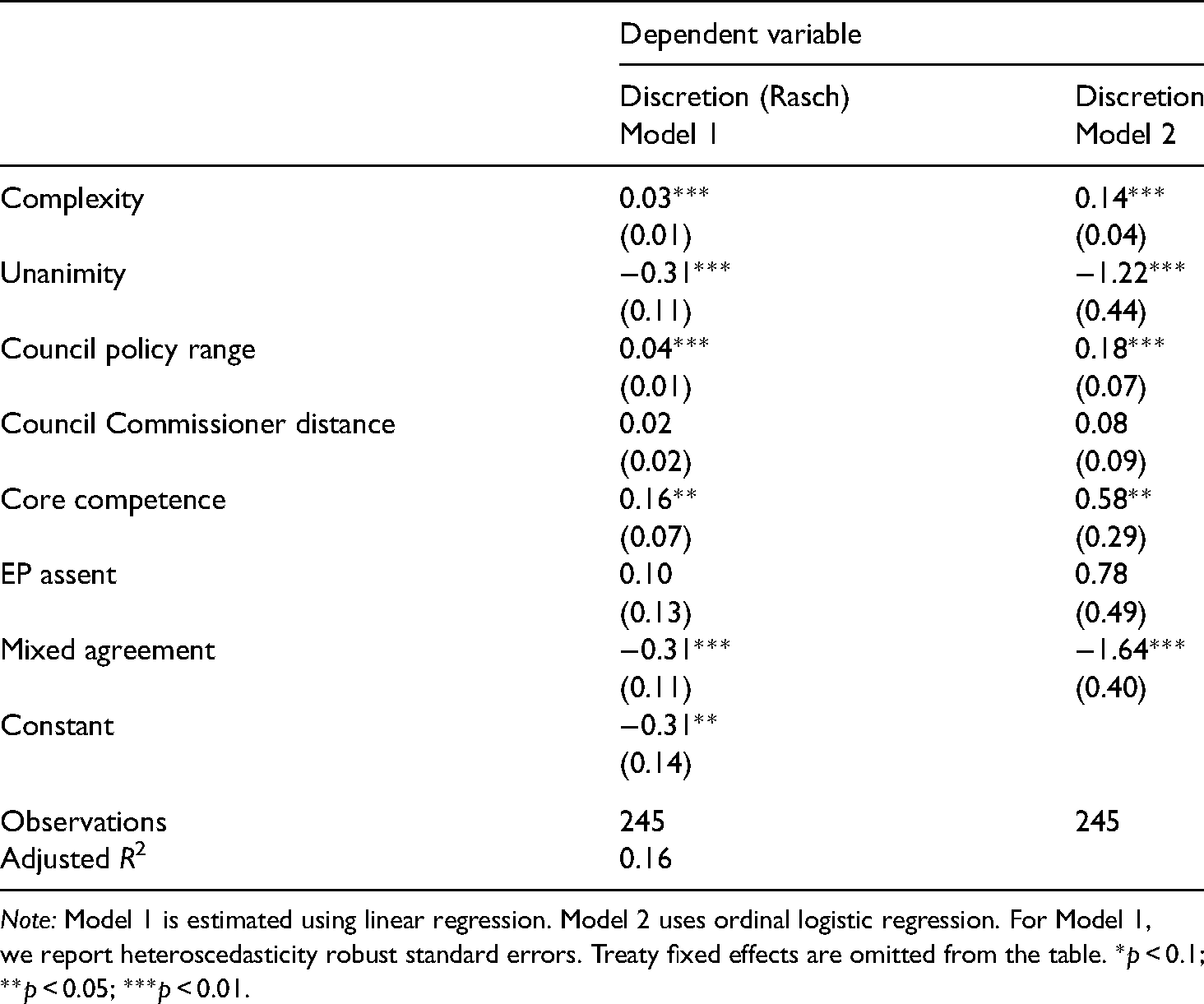
Note: Model 1 is estimated using linear regression. Model 2 uses ordinal logistic regression. For Model 1, we report heteroscedasticity robust standard errors. Treaty fixed effects are omitted from the table. *p < 0.1; **p < 0.05; ***p < 0.01.
The results from our statistical analyses support three hypotheses. The coefficient for Complexity is positive and statistically significant. This means that Commission discretion increases with more complex agreements (H1). Substantively, moving Complexity from its minimum to its maximum is associated with a change in the dependent variable of 17 percentage points. This is approximately equivalent to one of the five indicators of Commission discretion being 1 rather than 0. In line with H2, we find a negative and statistically significant coefficient for Unanimity. The substantive effect of this variable is just slightly smaller than the one of Complexity.
For Council policy range, we find a positive and statistically significant coefficient. Again, this is in line with the expectation set out in H3. Greater conflict in the Council thus is positively associated with Commission discretion in JBs. Substantively, this variable has the largest effect of the three variables discussed so far. Moving it from the minimum to the maximum is associated with a change of about 27 percentage points in the dependent variable. Adding the effects of the three variables together suggests that we capture a considerable portion of the variation in the dependent variable with our theoretical framework.
We do not, however, find support for H4. The coefficient for Council Commissioner distance fails to reach statistical significance and has the wrong sign. Various reasons may account for this non-finding. For one, our operationalisation of Commission(er) preference is necessarily crude. Commissioners may diverge in their preferences on specific issues from the governments or parties that appointed them. Alternatively, the Council's overriding concern for reaping gains through implementation (see H3) may trump any uneasiness about agency losses. Finally, this may be a result of the limited pool of agents in external relations, which means the Council has no alternative agent with preferences closer to its own.
With respect to the control variables, Core competence has a positive and statistically significant coefficient. At the same time, the coefficient for Mixed agreement is negative and statistically significant. These are the effects that we expected for these variables. By contrast, greater involvement by the EP (EP assent) does not seem to explain Commission discretion in JBs.
Model 2, which is estimated using ordinal logistic regression with Discretion as the dependent variable, confirms all of these findings both with respect to the sign of the coefficients and their level of statistical significance. Overall, therefore, we find empirical support for all hypotheses except H4.
Robustness checks
We performed several tests to check the robustness of our findings (see the Online appendix). In two models, we take up the question whether it is really the policy range within the Council and the policy distance between the Council and the Commission that matters for Commission discretion. We do so by substituting the respective variables with ones that capture the integration range and integration distance. The integration dimension is the primary dividing line among member states in theories of European integration (Franchino, 2007: 124). These variables are calculated relying on ParlGov data (Döring and Manow, 2016) and each party's integration preferences as gauged by the Chapel Hill Expert Survey (Bakker et al., 2015). We find little evidence that integration preferences are driving Commission discretion in JBs. None of the coefficients for Council integration range and Council Commission integration distance is statistically significant (although the one for Council integration range comes close to statistical significance). The other results are robust, with the exception that the coefficient for Unanimity loses statistical significance in one model.
In an additional set of robustness checks, we include some further control variables. For one, our results may be driven by CFSP agreements. CFSP may be particular in that it is a very salient policy area in many EU member states. Adding a variable that is coded one for all agreements including a legal basis of CFSP (CFSP), however, hardly changes the results. The coefficient for CFSP itself is negative and statistically significant.
Alternatively, our results may be biased because we do not control for the depth or level of ambition of agreements. 3 The depth of an agreement is defined as the ‘extent to which it requires states to depart from what they would have done in its absence’ (Downs et al., 1996: 383). More ambitious agreements may mean more Commission discretion because the Council needs more support from the Commission during implementation to reap its benefits. But is may also spell less Commission discretion because the Council is more reluctant to empower the Commission to induce policy change. While we have no direct measure for the depth of agreements across different policy areas, we add two proxies for depth: the (natural log of the) word count of agreements (Word count) and a dummy variable that is one if the agreement is a broad association agreement (Association agreement). Adding these variables again does not change the results for Complexity and Council policy range. However, the coefficient for Unanimity now just misses statistical significance (p = 0.11). The coefficient for Word count is negative and statistically significant, whereas the one for Association agreement is negative but not statistically significant. Depth thus seems to be negatively associated with Commission discretion in JBs.
In another model, we substitute the treaties under which the agreements have been concluded with year dummies. Doing so does not affect our key results, with the exception that the coefficient for Council policy range is only weakly statistically significant. Finally, in the last model we drop agreements that have not yet been ratified. In these cases, we rely on Commission proposals, which could still be changed by the Council before ratification. Excluding those agreements, however, has no effect on our findings. Overall, the results supporting H1, H2 and H3 are robust, but we find no support for H4.
Conclusion
In this article, we have put the question of Commission discretion in JBs at the centre of scholarly investigation for the first time. We add to the principal–agent literature that the European Commission generally enjoys high levels of discretion in external relations. We show empirically that in only two cases JBs are not empowering the Commission. Both these agreements were concluded in the area of CFSP, where the Commission has an exceptionally weak standing. Moreover, we have shown that Commission discretion – despite generally high levels – can still be explained with established principal–agent variables. Testing our expectations across 252 international agreements concluded since 1992, we find robust support that complexity, the decision-making rule, and conflict within the Council explain Commission discretion. By contrast, like most other large-N empirical studies applied to the EU, we find no evidence that divergent interests between the Council and the Commission influence this decision. Our study thus also sheds new light on open debates on the effects of various principal–agent variables on Commission discretion (see the Online appendix for more details on these previous studies).
Our findings have several broader implications for different strands of literature. Our article marks a major step in better understanding how JBs impact the EU's inter-institutional balance by concentrating powers in the hands of the Commission. For the literature on the EU as a global actor, we take from this finding that the Commission is in a stronger position to shape EU external relations than previously recognised. JBs are pervasive and play a major role in the implementation of international agreements. The important role the Commission plays should make the EU a more ‘internally cohesive’ actor (Conceição-Heldt and Meunier, 2014: 966) that can speak with a ‘single voice’ in international negotiations within JBs. What remains to be investigated is whether this cohesiveness translates into increased effectiveness, thus raising the EU's profile as a global actor.
For the literature on permanent secretariats in international organisations more broadly (Bauer and Ege, 2016; Haftel, 2013; Hooghe and Marks, 2015), our findings point towards an important oversight. Where international organisations possess the authority to strike international agreements and these agreements set up JBs, permanent secretariats could find themselves empowered far beyond what is currently acknowledged. The focus of these studies is often limited to an internal perspective of how these secretariats impact relations among member states. Therefore, it would be desirable to extend the research agenda on bureaucratic autonomy within JBs developed in our article to international organisations beyond the EU.
Moreover, JBs can be incorporated into the picture of the EU as a market power. Damro (2015: 1345–1346) emphasises that this framework is not limited to economic issues but inclusive of many policy areas. Still, the framework currently pays scarce attention to implementation, which is described as a ‘separate issue’ (Damro, 2012: 692). Damro's account supports the interpretation that the Commission is the major actor pushing the boundaries of Market Power Europe (his article cites five Commission documents and not one Council or EP document). This sits well with our own argument that the Commission often finds itself empowered in international agreements. It also suggests that the Commission strategically uses JBs to promote Europe's interests, both at political and sectoral expert levels (Lavenex, 2014). How exactly the Commission employs these bodies, however, is still unknown.
Finally, in the light of the far-reaching decisions taken in JBs, it is paramount to learn more about how they operate on the side of the EU. There is a limit to how much insight can be gleaned through documentary evidence providing the empirical foundation for our article. For example, the EP and civil society could play a bigger role when EU positions for JB meetings are drafted than is apparent from formal provisions. Also, the Commission could be monitored by national representatives even if no such provision is included or vote-taking could occur rarely because the Commission strives to form broad consensus among member states. In this sense, the variation we uncovered in this article could be more formal than real. Still, we feel confident that one of our central claims, namely that the Commission finds itself greatly empowered through the spread of these bodies, would remain true. Qualitative case studies focused on JBs or surveys with officials active in these bodies promise valuable insight into those questions, which are also at the heart of the legitimacy concerns raised by their creation. We hope that our contribution will spur further research on what we consider the most glaringly overlooked aspect of EU external relations today.
Supplemental Material
sj-pdf-1-eup-10.1177_14651165211027397 - Supplemental material for Joint bodies in the European Union's international agreements: Delegating powers to the European Commission in EU external relations
Supplemental material, sj-pdf-1-eup-10.1177_14651165211027397 for Joint bodies in the European Union's international agreements: Delegating powers to the European Commission in EU external relations by Markus Gastinger and Andreas Dür in European Union Politics
Supplemental Material
sj-txt-2-eup-10.1177_14651165211027397 - Supplemental material for Joint bodies in the European Union's international agreements: Delegating powers to the European Commission in EU external relations
Supplemental material, sj-txt-2-eup-10.1177_14651165211027397 for Joint bodies in the European Union's international agreements: Delegating powers to the European Commission in EU external relations by Markus Gastinger and Andreas Dür in European Union Politics
Supplemental Material
sj-txt-3-eup-10.1177_14651165211027397 - Supplemental material for Joint bodies in the European Union's international agreements: Delegating powers to the European Commission in EU external relations
Supplemental material, sj-txt-3-eup-10.1177_14651165211027397 for Joint bodies in the European Union's international agreements: Delegating powers to the European Commission in EU external relations by Markus Gastinger and Andreas Dür in European Union Politics
Footnotes
Acknowledgements
For valuable comments on earlier drafts of this article we are very grateful to three anonymous referees, Gerald Schneider, Michael Blauberger, Spyros Blavoukos, Thomas Christiansen, Tom Delreux, Jessica Fortin-Rittberger, Stefan Griller, Madeleine Hosli, Florian Huber, Robert Huber, Zoe Lefkofridi, Monika Mühlböck, Kirsten Schmalenbach, Gabriele Spilker, Fabien Terpan, Wolfgang Weiß, Anne Wetzel, Jonathan Zeitlin, and the participants of panel P396 at the European Consortium for Political Research General Conference (held virtually, 24–28 August 2020). All remaining errors and inconsistencies remain our own.
Declaration of conflicting interests
The author(s) declared no potential conflicts of interest with respect to the research, authorship and/or publication of this article.
Funding
Andreas Dür acknowledges funding from the European Research Council under the European Union's Horizon 2020 research and innovation programme (grant agreement No 724107). This project has also received funding from the European Union's Horizon 2020 research and innovation programme under the Marie Skłodowska-Curie grant agreement No 840135.

Supplemental material
Supplemental material for this article is available online.
Notes
References
Supplementary Material
Please find the following supplemental material available below.
For Open Access articles published under a Creative Commons License, all supplemental material carries the same license as the article it is associated with.
For non-Open Access articles published, all supplemental material carries a non-exclusive license, and permission requests for re-use of supplemental material or any part of supplemental material shall be sent directly to the copyright owner as specified in the copyright notice associated with the article.
