



Abstract
What was the impact of the 2014–2016 refugee crisis on immigration attitudes and national identification in Europe? Several studies show that radical right parties benefitted electorally from the refugee crisis, but research also shows that anti-immigration attitudes did not increase. We hypothesize that the refugee crisis affected right-wing citizens differently than left-wing citizens. We test this hypothesis by combining individual level survey data (from five Eurobarometer waves in the 2014–2016 period) with country level statistics on the asylum applications in 28 EU member states. In Western Europe, we find that increases in the number of asylum applications lead to a polarization of attitudes towards immigrants between left- and right-leaning citizens. In the Southern European ‘arrival countries’ and in Central-Eastern Europe we find no significant effects. Nationalistic attitudes are also not affected significantly.
Introduction
Mainly as a consequence of the civil war in Syria, massive groups of refugees tried to reach Europe to seek asylum in the years 2014–2016. The number of refugees increased steadily from 2014 onward, then peaked in the summer of 2015, after which the numbers declined. The events of 2015 have been labelled as ‘refugee crisis’, mainly because the governments of the different European Union (EU) member states appeared to be unable to exercise control over the way the events unfolded. Refugee receiving countries, Greece and Italy in particular, appeared unable to control external EU borders and the European Commission appeared unable to organize any meaningful solidarity with the main refugee receiving countries. When German Chancellor Angela Merkel was pressured by Hungarian Prime Minister Victor Orbán to ‘temporarily’ open the borders for refugees to solve a humanitarian crisis, this led to hundreds of thousands of immigrants of all kinds (not just refugees) arriving at the Austrian-German border. The German migration authorities simply lacked the capacity to even conduct the most basic routine check of whether these people were refugees or not, and they simply let anyone in.
These chaotic situations played into the hands of populist radical right parties like the National Front (now National Rally) in France, Fidesz in Hungary, Golden Dawn in Greece, the Lega in Italy and the Alternative for Germany. The PopuList records 2015 as the year with the single-largest increase in support for the populist radical right in decades (Rooduijn et al., 2019). Around the same time, the pro-Brexit campaign introduced the slogan ‘take back control’. This simple slogan appealed to many citizens, as it summarized very effectively their concerns about events that threaten their way of life. In the narrative of the far right, these concerns are linked to European unification. As the Dutch far-right politician Wilders writes on his party’s website: Democracy equals sovereignty. But through our governments’ transfer of powers to Brussels, the EU institutions and other countries decide on matters that are essential for our nation: our immigration policy, our monetary policy, our trade policy and many other policies.
1
We argue that it is not realistic to expect a uniform effect for all citizens across Europe. Rather, we would expect the effect of the refugee crisis on public opinion to be conditional on two factors. First, we hypothesize that the refugee crisis will exert the strongest effect in countries that received the most immigrants. This is simply because the refugee crisis had the largest impact in these countries, and we would thus expect this to resonate the most in the public and political debate in these countries. Our second hypothesis is that the main effect of the refugee crisis is moderated by citizens’ prior worldviews, as different people interpret the same events in different ways.
Our study estimates the conditional impact of the refugee crisis on immigration attitudes and national identification in Europe. We formulate two possible ways in which large influxes of refugees might have impacted such attitudes. The Backlash hypothesis, which builds on ethnic threat theory (Davidov and Semyonov, 2017; Quillian, 1995), predicts that if large numbers of asylum seekers seek refuge in a society, the existing population becomes more critical of immigration and acquires a more exclusive national identity. This has so far been studied only at the level of local communities that hosted refugee centres (Dinas et al., 2019; Dustmann et al., 2019), but we argue it is likely that the absorption of refugee flows also affects public opinion in the rest of the country.
By contrast, the Polarization hypothesis predicts that only right-wing citizens become more nationalistic and critical of immigration, while left-wing citizens are not affected, or even become more open towards immigration and less nationalistic. This would be due to motivated reasoning (Taber and Lodge, 2006), which encourages citizens to interpret real-world events in line with their existing worldview. Moreover, left and right-leaning citizens are likely to be exposed to different elite cues from politicians. People who were already sceptical about immigration would interpret the events as confirming their views that countries need to control their borders more firmly. Yet, for those who believe that refugees have the right to obtain asylum, the images of drowning people in the Mediterranean or being stuck in the mud at the Hungarian border, could confirm their views that we have a moral obligation to help people in need. When Chancellor Merkel decided to ‘open the borders’, many German citizens welcomed the migrants with flowers and volunteered to help them. This was coined the ‘welcoming culture’.
We test these expectations by analysing how the (sizeable) over-time and within-country variation in official asylum applications during the 2014–2016 period in 28 Western, Southern and Central-Eastern European (CEE) countries (as reported by Eurostat) corresponds with changing immigration attitudes and national identification, as measured in several Eurobarometer waves.
Our findings show that, on average, immigration attitudes and national identification hardly responded to the waxing and waning of refugee arrivals. However, this masks two opposing patterns underneath. First, while we find some evidence for a general backlash in Central-Eastern Europe, this did not occur in Western Europe or Southern Europe. Second, among right-wing citizens in Western Europe, higher numbers of refugee applications in their country did result in more negative feelings towards immigrants, while among left-wing citizens it rather increased support for immigration. National identification was affected to a lesser extent, possibly increasing even on the left, and did not appear to polarize.
We thus find clear evidence that the refugee crisis polarized public opinion on immigration in Western Europe, and possibly in Southern Europe. The effects were very limited in Central-Eastern Europe: if anything, nationalism and hostility towards immigrants increased across the board. In the concluding section we discuss the implications for the relevant literature.
Theory
Below, we discuss two possible ways in which a large inflow of refugees might affect citizens’ nationalistic attitudes and their attitudes towards immigration, which we call the Backlash hypothesis and the Polarization hypothesis. We then turn to a discussion how the situation might differ across contexts, in particular between Western, Southern, and CEE countries.
Backlash or polarization?
Anti-immigrant backlash
There are good reasons to expect that the attitudes of majority-group citizens towards immigrants respond to an actual or perceived influx in the number of refugees. 3 The causal mechanism is clearly described in the ethnic threat literature. It posits that the presence of many immigrants in a country or region will be perceived as threatening to citizens who belong to the majority-group. This may be caused by competition with outgroup members over scarce economic resources, such as jobs or houses, but also because people perceive immigrants as a cultural or symbolic threat to their ‘way of life’ (Hainmueller and Hopkins, 2014; Quillian, 1995). An important insight is that especially sudden increases in these numbers induce a negative reaction among majority-group citizens (Kaufmann, 2017; Olzak, 1992; Savelkoul et al., 2017; Tolsma and Van der Meer, 2017). Kaufmann (2017) argues that the presence of a sizable group of immigrants leads citizens to accept them (a ‘commonplace diversity’; Wessendorf, 2014), thus merely invoking indifference. Yet, steep increases in the number of immigrants might invoke fear. The refugee crisis might well have created exactly these circumstances. While some have argued that the immigration inflow was small compared to the size of the host countries’ majority-group population and their pre-existing immigrant bodies, it did have exactly the character of sudden, large increases, particularly in countries like Sweden and Germany where many refugees applied for asylum.
The ‘ethnic threat’ theories have been tested mainly in contexts in which immigrants arrived in a country in smaller groups, but over a much longer period of time. Some exceptions are recent studies on the sudden arrival or placement of refugees in Denmark (Dustmann et al., 2019) and Greece (Dinas et al., 2019), which show that sudden increases in specific regions stimulate support for the populist radical right (which is also the dependent variable in some of the studies listed in the previous paragraph). It is very plausible that heightened anti-immigration sentiment functions as the mediator here, given the centrality of immigration to these parties’ platforms and their voters’ worldview (Rooduijn, 2018). There is much debate in the literature on the role of personal experience and contact with immigrants. There are no data available on the regions where the refugees have settled and most people do not live in the areas where refugees move into. In this study, we thus rely on country level statistics about the arrival of refugees.
The national level is highly relevant for two reasons. First, most people receive their information about the refugee crisis through the media and the media are nationally organized and report in the national language of each country. Harteveld et al. (2018) show that in 11 EU countries, there was a strong correlation between the attention to the refugee crisis and the number of refugees arriving. Secondly, immigration policies are to a large extent nationally organized and the political debates are national ones. So, when more refugees arrive in a country, this could fuel feelings of ethnic threat and nationalistic feelings among some citizens. H1a: As the number of asylum seekers entering a country increases, support for immigration will decrease (backlash hypothesis).
One crucial element of identification with the nation, is that it portrays the world in terms of an in-group (people who belong to the nation) and an out-group (people who belong to other nations). In this binary world, the ‘in-group’ will be affected by the arrival of many refugees who belong to the ‘out-group’ (e.g. Rooduijn et al., 2021). A context of perceived threat to the in-group increases bias against the outgroup and produces a tendency to hunker down into the in-group (e.g. Brewer, 1999; Clark and Rohrschneider, 2019; Curtis, 2014). H1b: As the number of asylum seekers entering a country increases, feelings of nationalism will increase as well (backlash hypothesis).
Polarization
Our previous hypothesis assumed a backlash against immigration across the whole population. However, there are reasons to expect the effects to differ depending on citizens’ worldview.
The first reason is that citizens often select and interpret new information in line with existing beliefs (see Taber and Lodge, 2006). Even though left-right positions are not strongly correlated to nationalistic and anti-immigration attitudes (see e.g. Jackson and Jolly, 2021), right-wing Europeans are on average more critical of immigration and the prospects of integrating ethnic minorities (De Vries et al., 2013; Hainmueller and Hopkins, 2014). The ‘situational trigger’ of a large refugee inflow can be expected to strengthen and deepen existing worries about uncontrollable immigration among right-wing citizens. By contrast, among left-wing 4 citizens, support for immigration is generally higher to begin with. Among them, the TV-footage of refugees drowning, camping in the rain and suffering from the cold and lack of basic commodities, could have the opposite effect. By making the human rights frame more concrete, these images could strengthen abstract notions that people have the right to seek asylum when their lives are in danger. In Germany for instance, in response to the large influx of refugees, we saw manifestations of a ‘welcoming culture’ on the one hand as well as a rise of the radical right Alternative for Germany (AfD) on the other.
The second reason to expect the impact of refugee inflow to be moderated by ideological position is due to elite cues. In order to develop and crystallize their position on issues, citizens often look to trusted elites for cues, which includes the political leaders they support (Bolsen et al., 2014; Lau and Redlawsk, 2006; Lenz, 2009). Left- and right-wing political actors responded very differently to the 2014–2016 events. In Germany, the country that welcomed the largest group of refugees, the opposition to chancellor Angela Merkel’s ‘welcoming culture’ was voiced most strongly by the radical right. Yet, while some Germans welcomed asylum seekers from Syria with flowers, Merkel’s policies created much schism within her own party. Especially the Bavarian Christian Social Union (CSU) was very critical of her decision to allow almost one million refugees to apply for asylum in Germany in 2015. By contrast, left-wing parties and politicians tended to be more willing to allow them to seek asylum than the political right, and to present the refugee crisis as a humanitarian crisis that called for empathy with the refugees.
Strongly differentiated messages about the nature of the crisis, the extent of threat, and the appropriate response are likely to lead to a decrease in support for immigration among right-wing citizens, but not among left-wing citizens. In fact, if left-wing parties make an appeal to citizens to be more welcoming on humanitarian grounds, this could even lead to more supportive migration attitudes among left-wing citizens. H2a: As the number of asylum seekers entering a country increases, support for immigration will decrease among right-wing citizens only, but not among left-wing citizens (polarization hypothesis). H2b: As the number of asylum seekers entering a country increases, feelings of nationalism will increase among right-wing citizens, but not among left-wing citizens (polarization hypothesis).
Differences between member states
We expect the hypotheses formulated above to be true across the board in Europe. Of course, we acknowledge that patterns likely diverge between countries, depending on a range of context conditions. This is, however, not the main focus of our article, of which the theoretical interest lies with the interaction between refugee inflows and ideology. Still, we distinguish two particular groups of countries throughout our analysis.
The first are the Southern European countries where most refugees arrived when entering the EU, in particular Greece, Italy and Spain. According to the Dublin agreement, these countries were responsible for handling the asylum claims, which put most of the strains on them. Southern European countries asked for solidarity from other EU member states, but to little avail. At the same time, many refugees did not apply for asylum in the countries of arrival, because they wanted to move onwards and the arrival countries did not do much to prevent them from trying to do so. As a result, the official application numbers in these countries were low, while the refugee crisis had a big impact. We should therefore check whether the effects are different in the main arrival countries of Greece, Italy and Spain (which we will denote ‘Southern Europe’ as a shorthand).
Secondly, we also check whether the effects are different in CEE countries than in the other countries. This is relevant for two reasons. First, the absolute numbers of refugee applications, and over-time variation therein, is much smaller in CEE countries than elsewhere (with the exception of Hungary). While refugees passed through several CEE countries, few intended to stay there. We therefore do not expect these migration figures to explain much variation in public opinion in these countries. 5
Second, the role of immigration as a political issue, and its relation to left-right ideology, is vastly different in Western and Central-Eastern Europe. While in Western Europe immigration has been a heavily politicized issue, it has until recently been much more absent in CEE countries. Politicians in these countries, who mobilized on a nativist platform, mainly targeted historical minorities (such as the Roma or Jewish communities) rather than more recent immigrants. Only in the most recent years does immigration function more prominently in Central-Eastern Europe, for instance in Victor Orbán’s immigration referendum of 2016. When the issue did become politicized at the height of the refugee crisis, fewer parties spoke up on behalf of refugees, while anti-immigration stances could be heard all over the political spectrum. As a result, immigration attitudes are not correlated with left-right ideology in the same way as in Western Europe. 6
Because of these regional particularities, we will analyse whether our expectations hold in the main arrival countries, CEE countries, and the remaining countries (in shorthand, ‘Southern’, ‘Central-Eastern’ and ‘Western’ Europe). Of course, this does not exhaust the potential contextual moderators. We do not formulate explicit hypotheses regarding other country-level moderators, but we will tentatively explore whether the results depend on the most obvious of these, which is the economic situation in a country. The theoretical argument for this is that intergroup tensions might increase under conditions of scarcity (Colantone and Stanig, 2018; Georgiadou et al., 2018; Golder, 2003; Nicoli and Reinl, 2020; Rydgren and Ruth, 2013).
Data and method
Our study combines individual level survey data in all 28 member states of the EU at five different point in time between 2015 and 2016 (Eurobarometer 7 ), with asylum application numbers in each country per month collected by Eurostat. The survey data are cross-sectional studies and each time a sample of about 1000 respondents is interviewed per country. A main challenge is that, at the country-level, the correlation between asylum applications and public opinion is partly endogenous, as refugees are more likely to seek entrance to countries that are more welcoming. As our study focuses on the effect of the refugee crisis, we decided to specify a fixed-effects model at the country level. This implies that we estimate the effects of the variation in asylum applications within each country. We predict variation in public opinion at multiple moments in time in each country by the number of refugees requesting asylum in that country. To further reduce endogeneity, we predict public opinion by asylum application in the month before the fieldwork started. 8 Still, if the public reaction to the arrival of refugees depended upon the number of refugees who are already in the country, and if refugees applied for asylum in countries where public opinion is already positive, the relationship would nevertheless still be partially endogenous. In a final step we therefore replicate our analysis on two subsets of countries: those that had either relative low levels and those that had relative high levels of anti-immigrant attitudes at the start of the period. We report the results of this exercise in the Online appendix.
Operationalization
In the analyses presented below, our main independent variable is the number of asylum applications in each individual country (per 10,000 inhabitants), in the month before the fieldwork of the Eurobarometer started. These data are publicly available at Eurostat. Not all refugees applied for asylum: some went on from the arrival countries to apply elsewhere, whereas others did not apply at all. While this is a clear limitation of our dependent variable, there are good reasons to expect there to be a clear relationship between the number of asylum applications and the number of refugees actually arriving in a particular period in a country. Harteveld et al. (2018) show that the number of asylum applications is strongly related to media attention to the refugee crisis. It seems plausible that the media are more likely to report on the actual number arriving than on the official asylum applications. Still, given that our measure likely captures the experiences of citizens imperfectly, any relation we do find between applications and public opinion might well be conservative. Application numbers in the EU as a whole are reported in Figure 1; application numbers in each country are reported in the Online appendix. 9
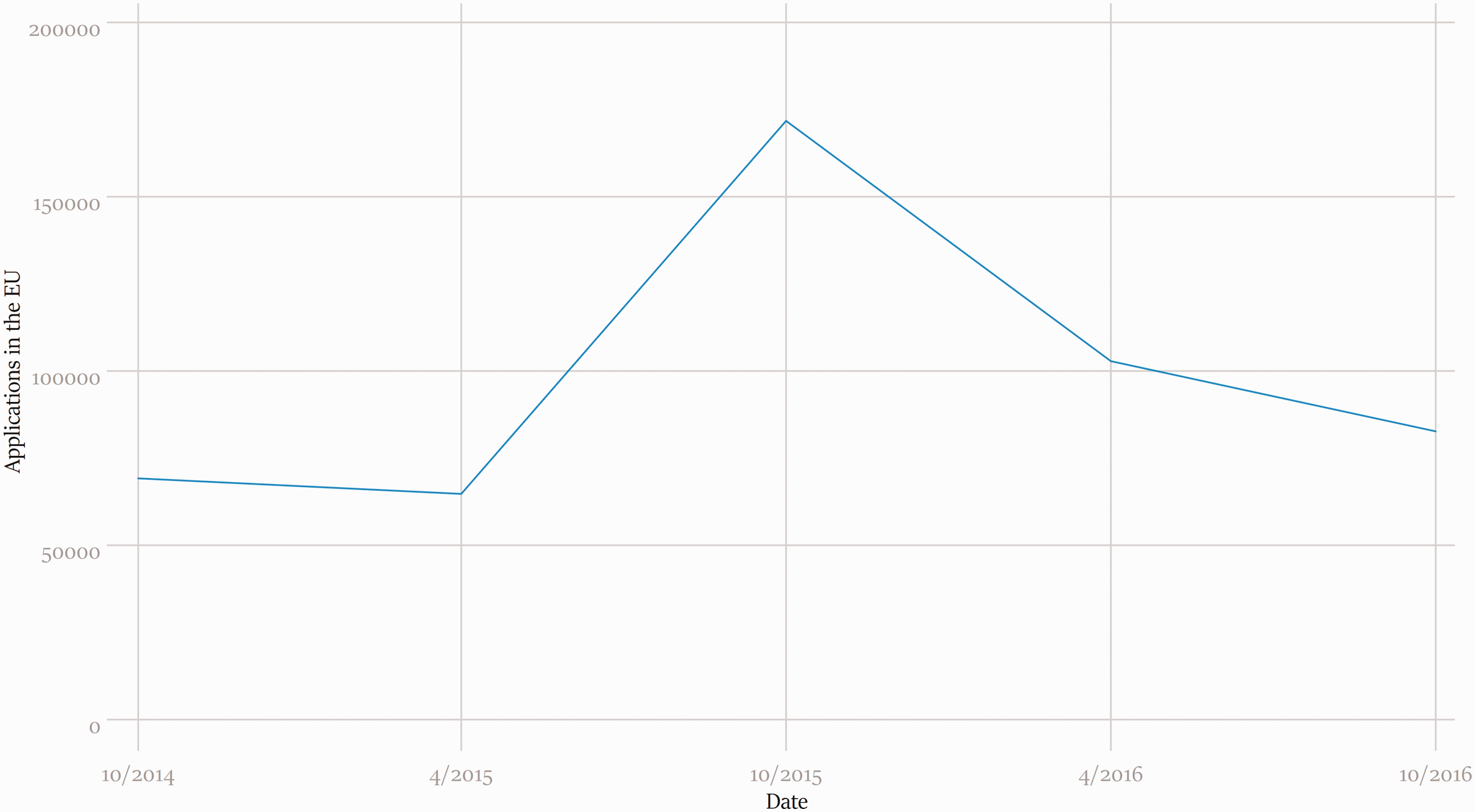
Asylum applications at each of the employed Eurobarometer waves.
To measure the effect of the number of refugees, we employ survey questions collected by Eurobarometer over the period 2014–2016. We are restricted in our choice of dependent variables to questions that have been asked repeatedly. Two relevant items are available multiple times over this period.
The first dependent variable is based on the question ‘How do you feel about immigration from outside the EU?’, with the answer categories Very positive, fairly positive, fairly negative, and very negative. We label this item Negative feelings towards immigrants. This question was asked in the Fall of 2014, the Spring of 2015, the Fall of 2015, the Spring of 2016, and the Fall of 2016. The second dependent variable is based on ‘Please tell me how attached you feel to [country]’. The answer categories were Very attached, fairly attached, not very attached, and not at all attached. We label this item Attachment to country. This item was measured in Fall 2014, Fall 2015 and Fall 2016.
The correlation between the two dependent variables is only r = 0.06, which allows for the possibility that both were impacted in different ways. Both items give us at least one measurement early in the refugee crisis, one at the peak, and one after its peak – albeit in a more fine-grained way with the immigration variable (five waves) than with the national identification variable (three waves). Moreover, the national identification item is very skewed: 32% answers Fairly attached and 60% answers Very attached. This means that in practice the variation on this scale is limited. While we still argue it is relevant to study polarization on this attitude, we will be careful in drawing any firm conclusions given the very limited variation to explain.
Ideology is measured using left-right self-placement on a scale from 0 to 10. 10 Self-placement on such a scale can obviously be endogenous to views about immigration and attachment to the country. However, to the extent it is, it should move together with these views. This cannot explain any differences in attitudes we might find on the left and right at different moments in time. We are furthermore aware that ideology is a multidimensional concept, and that the labels of left and right are imperfect in capturing people’s worldview: its correlation with immigration is only around r = 0.18 (although up to 0.30 in Western European countries). However, it is exactly because of the distance between a broader ideological worldview on the one hand and immigration attitudes and national attachment on the other that we can test how the former shapes changes in the latter.
The control variables are gender (dummy for male), age (in years) and education (measured in years of full-time education). All descriptive statistics can be found in the Online appendix.
Method and design
To test our hypotheses, we use a regression specification with the immigration and national identification attitudes (on the individual level) as the dependent variables, and asylum inflow in the preceding month in each country as the key independent variable. Because we argued that ethnic threat theory appears to work in non-linear ways, we include the squared term for asylum inflow. To restrict our models to variation within countries, we estimate a hierarchical linear model, and we include fixed effects for countries. Because of the dependence of observations, we use robust standard errors clustered on the level of survey-wave.
To test whether the effects are moderated by ideology, as predicted by the polarization hypotheses, we include interactions between refugee numbers and left-right self-placement in later models. We analyse our models with an additional interaction with regional dummies for ‘Central-East’ (all countries that acceded to the EU after 2004 except Malta and Cyprus), ‘South’ (the main arrival countries of Greece, Italy, and Spain), and ‘West’ (all others). It is important to note that the category ‘South’ relies on relatively few observations at the higher level (five waves times three countries), which makes estimating effects for this category less reliable.
Results
The results section is organized as follows. First, we will present the general trends in our variables in a descriptive way. Second, we will test our hypotheses with the fixed-effects regression analyses described above. We test the effect of asylum applications on attitudes and its interaction with ideology. We conduct these analyses separating the three regions: the South, the Central-East and the West.
Trends
Figure 1 shows the number of asylum applications in the EU as a whole during each of the five waves of the Eurobarometer data collection used in this study. The peak of the refugee crisis in the autumn of 2015 is clearly visible. The Online appendix presents these trends for each individual country, which generally displays a somewhat similar pattern, but at very different levels and speeds.
Figure 2 shows the trend in our dependent variables in all three regions: negative feelings towards immigrants in the top panels and attachment to the country in the lower panels. It shows separate lines with average scores depending on ideology (modelled as an interaction with the continuous left-right scale): dark lines for those scoring very left-wing (0), light lines for those scoring centrist (5) and a dotted line for those scoring very right-wing (10).
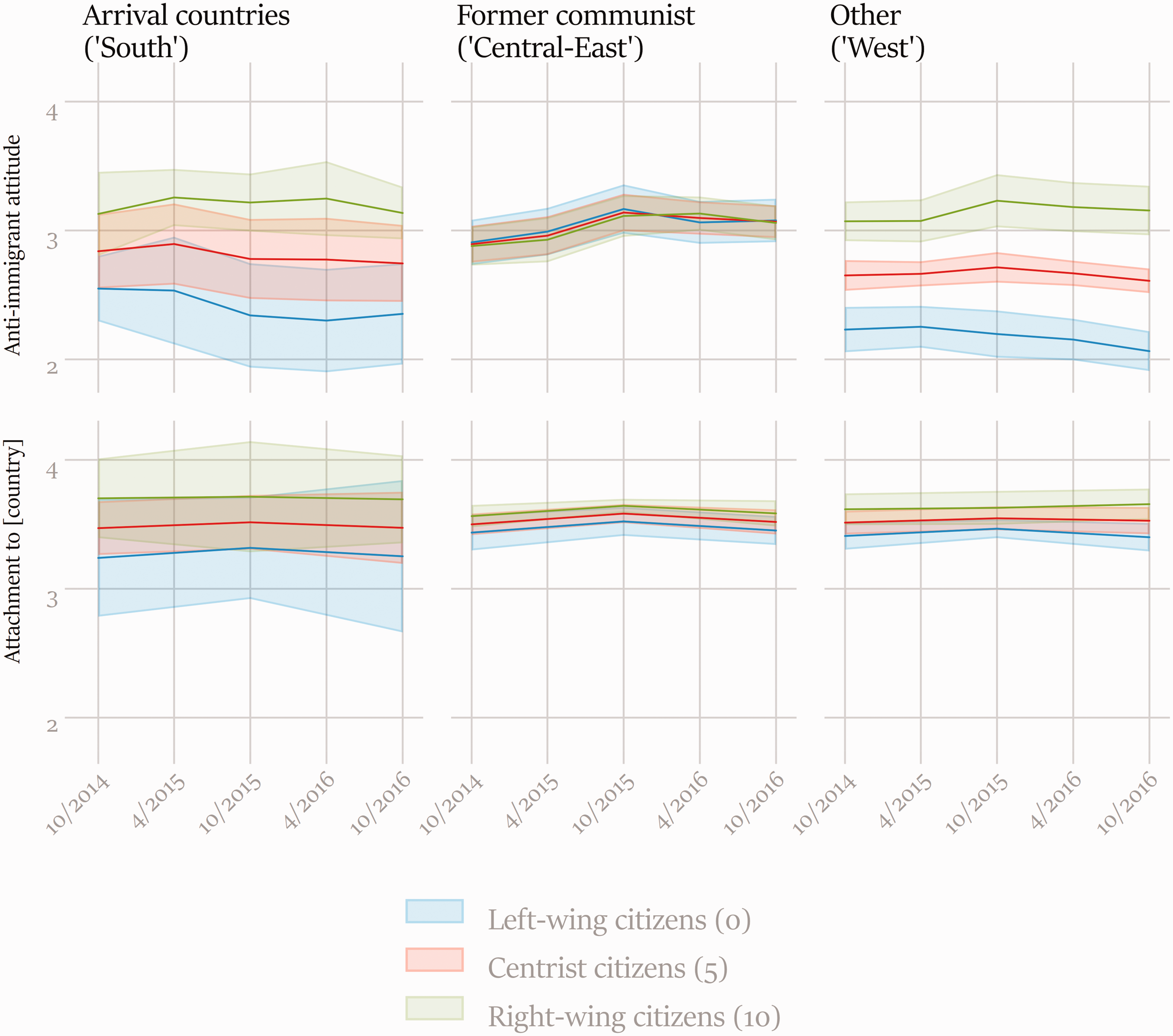
Average scores on the dependent variables over time.
The upper panel figures, showing trends in negative feelings towards immigrants, suggest very different patterns across regions. In Western Europe, and to a weaker extent in Southern Europe, somewhat of an increase in negative feelings towards immigrants from 2014 to mid-2014 is visible, but only among right-wing citizens. Left-wing citizens become more positive about immigrants. This is followed by a slight trend towards more positive feelings among both left- and right-wing citizens during the later phase of the crisis in Western Europe. All in all, the gap between the left and the right widens during the refugee crisis in Western Europe and to a weaker extent in Southern Europe, which supports the polarization hypothesis. By contrast, in CEE countries, there is no difference between left- and right-citizens in their immigrant feelings to begin with, nor in the way they react to the refugee inflow dynamics. By the autumn of 2015, all citizens had become uniformly more negative about immigrants. This supports the backlash hypothesis for Central-Eastern Europe.
In the case of national identification, none of the changes are substantial or significant. If anything, there appears a very insubstantial increase at the height of the crisis, after which it returns to previous levels after the crisis.
All in all, the aggregated pattern suggests that immigration attitudes were polarized along ideological lines in Western Europe, and subject to (somewhat of) a homogeneous backlash in Eastern Europe. National identification does not follow this pattern. Still, these aggregate findings might mask dynamics in individual countries. We therefore turn a more formal test which also takes national applications into account.
Multivariate regression
We test our hypotheses by means of regression analyses in which we predict the dependent variables by the number of applications and their interaction with ideology, with fixed effects for countries and robust standard errors clustered at the country-wave level (as discussed above). These regressions include a squared term and higher-order interaction effects, which makes the regression tables (see the Online appendix) difficult to interpret. Therefore, we present the results of these regressions graphically in Figure 3 and discuss which marginal effects are significant.
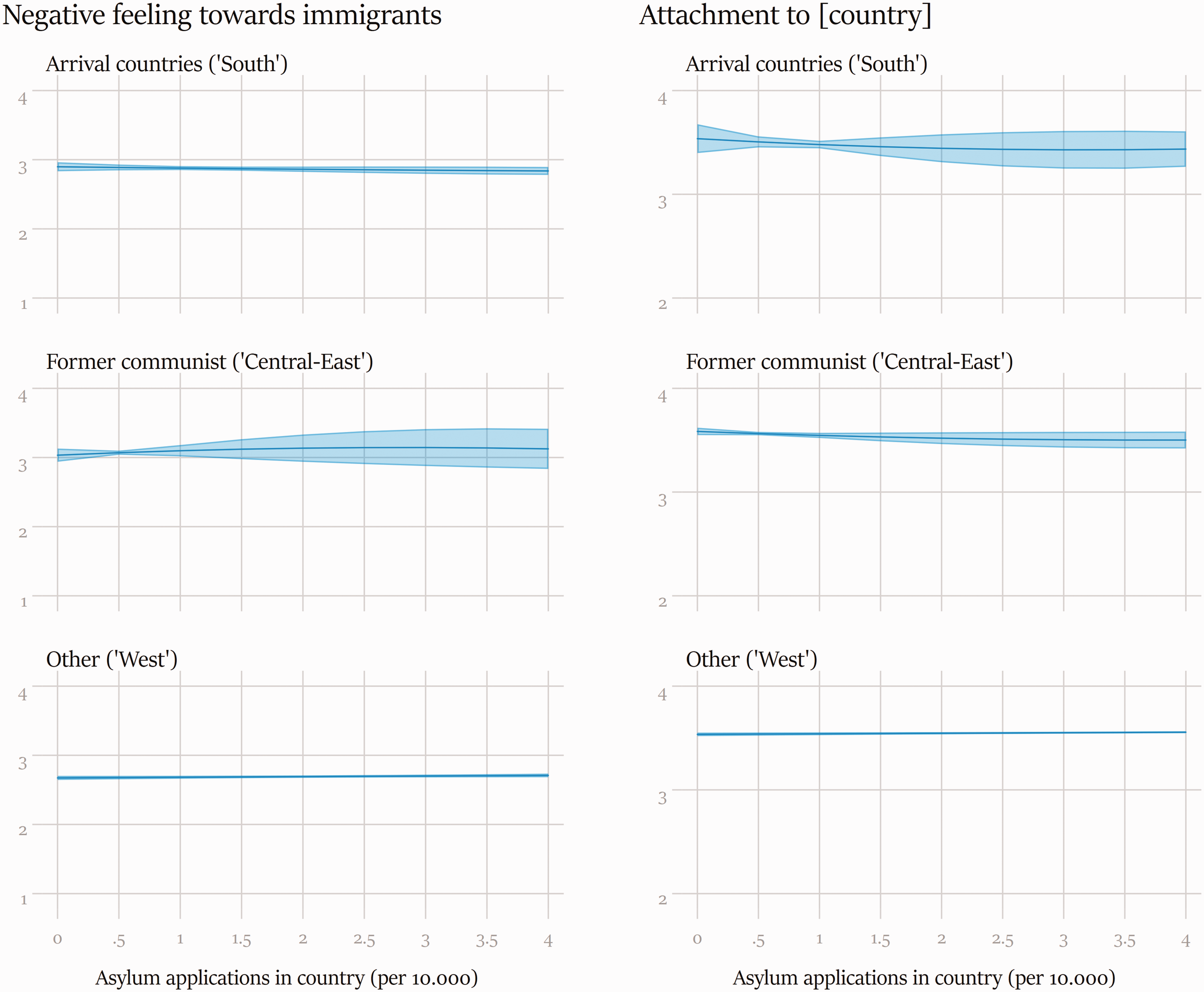
Predicted attitudes based on asylum applications in a country.
If we do not distinguish respondents by their ideological positions, the effects of the number of asylum applications are not significant. Descriptively, Central Europe appears to show somewhat of a backlash effect, as an increase in asylum applications appears associated with stronger anti-immigration sentiment, but this is not a significant increase (p = 0.30). So, in line with the conclusions of Stockemer et al. (2020), we find that hypotheses H1a and H1b need to be rejected.
However, it is likely that the patterns above conceal heterogeneity between citizens. How are these effects moderated by ideology? In Figure 4, we show the predicted levels of immigrant feelings and national identification for left (0), centrist (5) and right-wing (10) citizens based on asylum applications in the EU as a whole and individual countries. Each figure is again split out by region. The full regression tables are presented in the Online appendix.
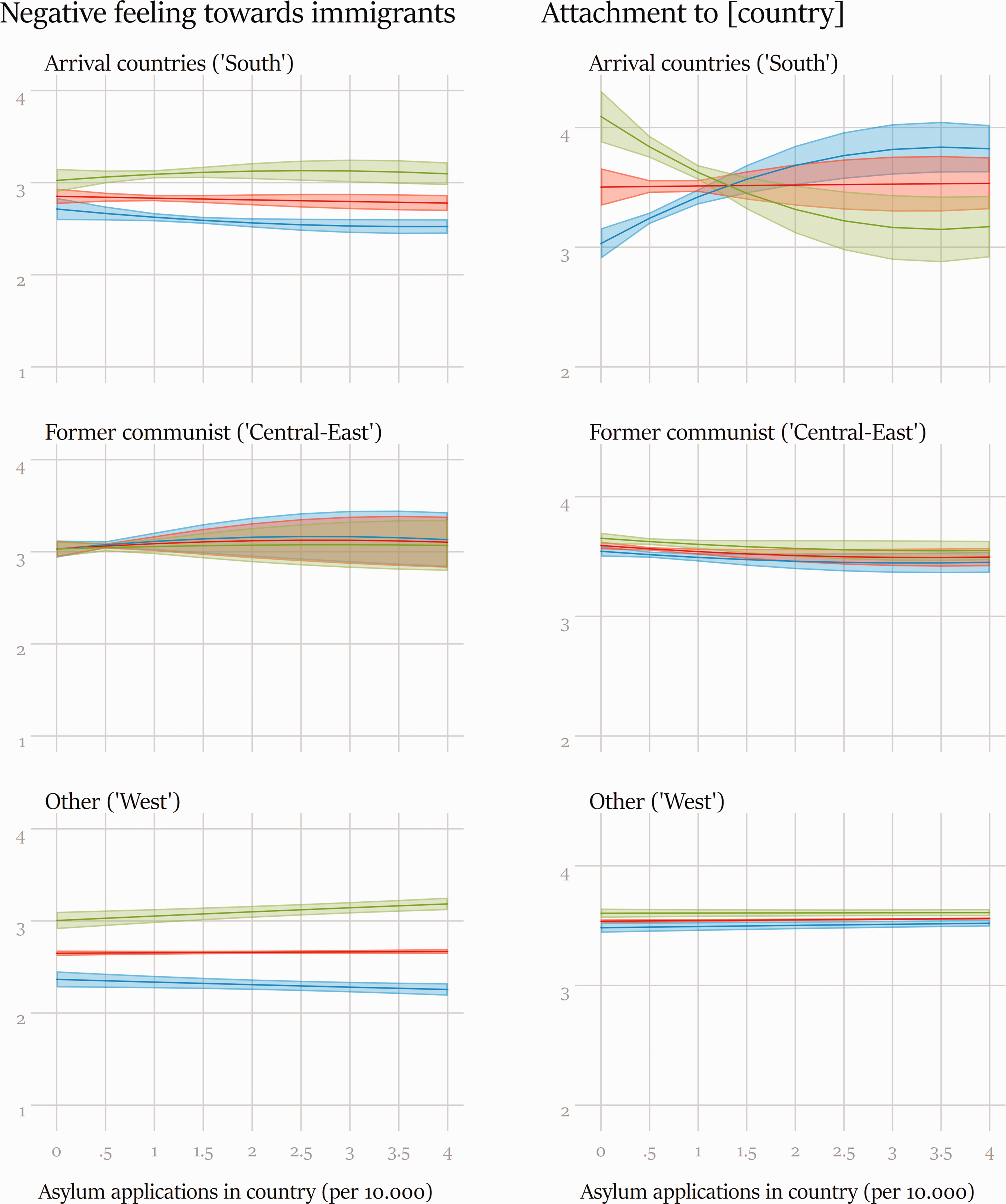
Effect of asylum applications on attitudes.
The results presented in Figure 4 show virtually the same patterns in CEE countries for voters at different positions of the ideological spectrum. Irrespective of their ideology, citizens of CEE countries again appear to have become somewhat more anti-immigration in response to an increase in EU asylum numbers, although this is again not significant (p > 0.20). The most striking pattern is that across Western Europe, by contrast, an increase in the number of refugees is associated with a clear polarization in anti-immigration attitudes. Both the decrease on the left and the increase on the right are significant (p < 0.05). The estimated effects are quite substantive. The model predicts that an increase in the number of asylum applications from 0 to 4 per 10,000 citizens leads to an increase in the standardized anti-immigration attitude of 0.2 standard deviations among Western European right-wing citizens. An increase until the 90th percentile (5.9 per 10,000 citizens, which the majority of Western European countries experienced during at least one wave) is associated with an increase of 0.3 standard deviations, despite the short time span over which this plays out. The Southern arrival countries take an in-between position, in which some polarization is visible, but only the pro-immigration tendency on the left is marginally significant (p = 0.10).
As noted earlier, nationalist attitudes are not affected significantly on either the right or left. The exception is a ‘reversed’ polarization in the South, where left and right appear to swap in their level of national attachment. While this should be interpreted with caution given the limited number of higher level observations in this region, the result might reflect that left-wing Southern Europe came more endeared to their national identity after experiencing the large role their country took (or perhaps was forced to take) in sheltering refugees at the front line. However, this interpretation remains speculative due to the low variation and the fact that it does not appear in the aggregated descriptive data of Figure 2, but certainly worthwhile to pursue in future research.
Additional analyses
As a final step, we conducted two analyses that gauge whether our findings hold across subsets of countries. First, to further rule out endogeneity, we replicated our analysis on anti-immigrant attitudes in Western Europe – the dependent variable and region that yielded the clearest evidence of an impact of the refugee crisis – in two subgroups of countries: those with the weakest and the strongest anti-immigrant attitudes at the start of the period (split by the median). The Online appendix reports the selection of countries and visualizes the results of this model. We find very similar patterns of divergence between the left and the right in both groups of countries. So, our main conclusion holds. Second, we added an additional interaction with gross domestic product (GDP) growth to the model that forms the basis of Figure 4. The Online appendix visualizes the effects of this model and shows that the polarizing effect in Western Europe is indeed stronger under bad economic conditions than under good ones. While our main interest is in the overall pattern, the fact that the patterns are amplified by economic decline is in line with the literature (Colantone and Stanig, 2018; Georgiadou et al., 2018; Golder, 2003; Nicoli and Reinl, 2020; Rydgren and Ruth, 2013).
Discussion
Eurostat reports that more than 1.3 million people applied for asylum in the 28 member states of the EU in 2015. The numbers of asylum applications varied enormously between countries. In this study, we asked whether the number of asylum applications fuelled feelings of nationalism and anti-immigration attitudes. Our findings can be summarized as follows. While no universal (across all groups of citizens, EU-wide) effect of the refugee crisis was detected, we did find clearly conditional effects. In Western Europe, and, to a weaker extent, in the arrival countries of Southern Europe, the attitudes towards immigrants of left-wing and right-wing citizens became more polarized during the refugee crisis, especially if a country experienced a large number of asylum applications. In Central-Eastern Europe, no significant differences exist between the attitudes towards immigration of left-wing and right-wing citizens to start with. In these countries the refugee crisis (as reflected in the number of applications across Europe as a whole) was accompanied by a slight but not significant increase in anti-immigration attitudes among citizens at both sides of the ideological spectrum. In all parts of Europe, attachment to the national identity seemed to have been hardly affected, with the possible exception of the countries affected the most by large numbers of refugees arriving (Greece, Italy, and Spain).
How do we explain the differences between the various regions of Europe as well as the differences between the two dependent variables? In general, we find it plausible that the distinct patterns are the result of how the political debate on the refugee crisis developed in these countries. Unfortunately, we do not have systematic data on the position taking of parties, protest groups and non-governmental organizations. Yet, we believe that left-leaning actors in Western and Southern Europe were more likely to speak out favourably about refugees than in Central-Eastern Europe. This is to be expected, because expert survey data show that many CEE left-wing parties tend to take substantially more critical stands on immigration than left-wing parties in Western Europe (Marks et al., 2006). So, if left-wing actors in Western and Southern Europe responded differently to the refugee crisis than left-wing actors in Central-Eastern Europe, diverging patterns would be expected.
Two limitations of our study stand out. The first is that the available data about asylum applications are at the country level only. We assume that the influx of asylum seekers leads to political debates in each country and that people respond to those debates. Yet, we cannot test this causal mechanism, nor do we have the data to estimate whether the effects are larger in those regions where many refugees settle. In a country such as Greece, refugees seem to be concentrated in specific regions (e.g. Dinas et al., 2019), but this is not the case in other countries like for instance Germany (Schneider et al., 2020). Second, the number of asylum applications in a country is only imperfectly correlated with the number of refugees arriving. Some refugees applied elsewhere in the EU or chose not to apply at all. Because we are interested in citizens’ direct or mediated experience of refugee arrivals, the difference between refugees who did or did not apply is artificial. It might well be that data on the arrival of refugees more broadly defined, while currently unavailable, would uncover even stronger effects, and such analyses would be a welcome future addition to ours.
While we expected nationalism to move in tandem with immigrant feelings, we find little evidence for this. This could well be due to the item used to measure it, which was asked less frequently and turned out to be highly skewed. A further drawback of the measure is that it does not enable us to distinguish between ethnic, cultural, or civic nationalism, which is an important distinction in the relevant literature (e.g. Ariely, 2012; Bonikowski, 2017; Reeskens and Hooghe, 2010). Theoretically, we expected ethnic and cultural nationalism to respond to the refugee crisis, but not civic nationalism. As we cannot make this distinction with the available data, it seems plausible that the link between the refugee crisis and attitudes towards immigrants is more obvious and direct than the linkage between the refugee crisis and (a generic type of) national identification. Moreover, nation identification may be more deep-rooted than attitudes towards immigration.
A more substantive explanation for the lack of polarization in national attachment, despite evidence for such polarization in immigrant attitudes, is that left-wing politicians and parties in Western Europe did speak out positively about immigrants during the refugee crisis but did not speak out against nationalism. To the extent that nationalism was raised during the refugee crisis, it would then have been raised in the context of cultural nationalism that is typical of a (radical) right-wing discourse. If the left had no counter-frame in linking refugees to nationalism, the effect of the refugee crisis (if any) would move public opinion in just one direction: more nationalistic. Again, lacking data on the ways in which news on the refugee crisis was framed, we cannot test this explanation. Yet, we consider this explanation a plausible one.
The results of our study, as well as the explanations we just provided, speak to research showing that anti-immigrant feelings are weakly related to the sheer numbers of immigrants arriving (Stockemer, 2016; Stockemer et al., 2020). We show that any correlation that does exist is conditional on citizens’ worldview and the discursive context in which they live. How people respond to immigrants in general and to refugees in particular will to a large degree depend upon the framing of the events, not just by journalists, but also by political parties and other collective actors. Events such as the refugee crisis obviously open up opportunities for political parties and movements from the (far) right. Yet, the fact that opinions polarized in Western Europe also provides opportunities for more left-wing parties and movements to enter the debate with a plausible counter-frame.
Supplemental Material
sj-pdf-1-eup-10.1177_1465116520988905 - Supplemental material for The conditional effects of the refugee crisis on immigration attitudes and nationalism
Supplemental material, sj-pdf-1-eup-10.1177_1465116520988905 for The conditional effects of the refugee crisis on immigration attitudes and nationalism by Wouter van der Brug and Eelco Harteveld in European Union Politics
Supplemental Material
sj-zip-2-eup-10.1177_1465116520988905 - Supplemental material for The conditional effects of the refugee crisis on immigration attitudes and nationalism
Supplemental material, sj-zip-2-eup-10.1177_1465116520988905 for The conditional effects of the refugee crisis on immigration attitudes and nationalism by Wouter van der Brug and Eelco Harteveld in European Union Politics
Footnotes

References
Supplementary Material
Please find the following supplemental material available below.
For Open Access articles published under a Creative Commons License, all supplemental material carries the same license as the article it is associated with.
For non-Open Access articles published, all supplemental material carries a non-exclusive license, and permission requests for re-use of supplemental material or any part of supplemental material shall be sent directly to the copyright owner as specified in the copyright notice associated with the article.
