




Abstract
This article looks at how the Greek, German and British press have addressed the issue of the refugee crisis in Europe. Using a mixed research approach that combines corpus linguistics and discourse analysis, this article examines 1340 articles that were published online between 20 March and 31 May 2016 in Greece (Kathimerini, To vima), Germany (Die Welt, Süddeutsche Zeitung) and the UK (The Guardian, The Telegraph). The results presented by this article suggest that the press in all three countries mostly presented the refugee crisis in numbers. Geographical qualifiers were also deployed in the effort to broach this thorny issue, while the managerial aspect of the refugee crisis, the critical issue of child refugees and the EU–Turkey agreement were all among the most frequent topics covered by the press.
Introduction
Europe is facing an unprecedented migration and refugee crisis as a result of the ongoing civil war in Syria, which began in 2011 and has resulted in over 250,000 casualties as well as millions of refugees and internally displaced persons. According to the International Organisation for Migration (
Some media outlets soon began to write about ‘the largest movement of people that Europe has seen since 1945’ (Financial Times
This article aims to explore the ways in which the migrant and refugee crisis has been covered by online media in Germany, Greece and the UK. More concretely, the article aims to both identify the way the sampled online newspapers in the above-mentioned countries portray the migrants and refugees, and provide a preliminary analysis of the aspects on which journalists focused when covering this crisis. In this regard, this study does not constitute a large-scale analysis of the media discourse on the refugee crisis as a whole.
Prior efforts to investigate the media discourse on immigrants and refugees
The media holds a pivotal role in disseminating information, spreading knowledge and shaping ideologies, as well as exerting influence over societies. In this regard, the media discourse on immigrants and refugees has attracted considerable attention from several scholars. Focusing on discursive mechanisms of representing and interpreting the ‘others’ (i.e. immigrants and refugees), Van Dijk (
In the construction of moral panics, the journalists gave up their right to take reporting as a process of searching for the truth and the story was told by the dominant ideology, instead of by them. As loyal followers of the professional ideology, they objectified the adopted xenophobic discourse of the dominant ideology by reference to the creators of such discourse (Erjavec
In the same vein, while Leudar et al. (
Methodology
Two mainstream online newspapers from each of the above-mentioned countries were selected, and a combination of the methodologies associated with corpus linguistics (CL) and discourse analysis was employed (see Table 1). First we examined the wording of the articles in detail by enumerating the words (collocates) that were most likely to appear in the text either before or after the following keywords: (i) migrants, (ii) immigrants, (iii) refugees, and (iv) asylum seekers. In a similar study, examining the discourse on refugees and asylum seekers in the UK press, Baker et al. (
L1 and c-collocates

Source: Allen and Blinder
The following collocates were employed:
Those words placed immediately to the left of the above-mentioned keywords or descriptors, labelled ‘L1 collocates’.
Those words that regularly emerged within 10 words of our keywords, either to the left or to the right, labelled ‘consistent collocates’ (c-collocates) (see Baker et al.
In this regard, we endeavoured to collate the vocabulary that the various online newspapers used to portray the migrants and refugees, as well as to highlight the aspects on which the selected online media focused when covering this crisis. Our research is based on an analysis of a corpus of 1340 articles published online between 20 March and 31 May 2016. In contrast to previous studies that covered several years of research and a large amount of data (e.g. Baker et al.
We selected 20 March 2016 as a landmark date since this is when the EU signed an agreement with Turkey with the aim of reducing the number of refugees arriving on the Greek islands, while 31 May 2016 was chosen as closing date due to our belief that gathering data from articles that were published over a duration of two months would allow us to export firm conclusions without the need to employ computerised methods.
However, CL studies seem unable to provide a qualitative analysis of the linguistic context (e.g. tone and meaning) where collocates are used within sentences or phrases. Therefore, as a second step, we tried to further present and interpret the main aspects of the top collocates of our target words (see Table 3). For instance, what was written about ‘Idomeni’, ‘hotspots’ or Turkey’?
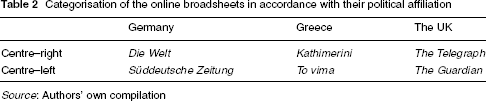
Categorisation of the online broadsheets in accordance with their political affiliation
Source: Authors’ own compilation
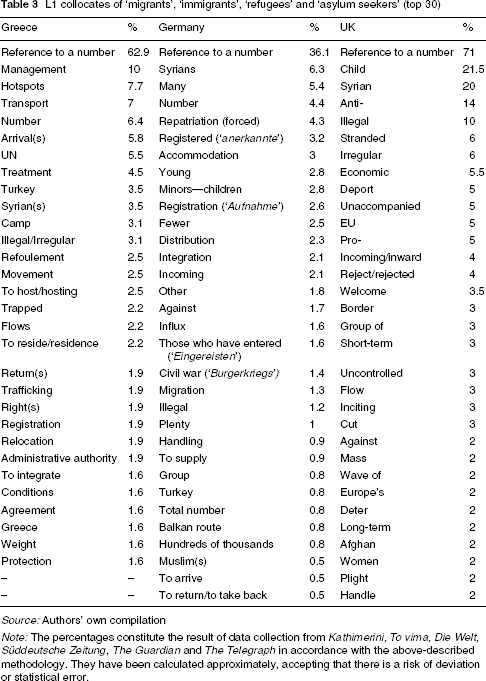
L1 collocates of ‘migrants’, ‘immigrants’, ‘refugees’ and ‘asylum seekers’ (top 30)
Source: Authors’ own compilation
Note: The percentages constitute the result of data collection from Kathimerini, To vima, Die Welt, Süddeutsche Zeitung, The Guardian and The Telegraph in accordance with the above-described methodology. They have been calculated approximately, accepting that there is a risk of deviation or statistical error.
As was noted above, this research takes the EU–Turkey deal of 20 March 2016 as a landmark. The selection of online broadsheets was based both on ease of research and the authors’ consideration that the content and discourse of the online versions of the mainstream media are to a great extent consistent with the print and broadcast media. In addition, online journalism is progressively gaining a significant audience.
The online newspapers were selected in accordance with their political affiliation—centre–right/centre–left, as well as their circulation (see Table 2). From Germany, we selected Die Welt and Süddeutsche Zeitung, while from Greece Kathimerini and To vima. Last but not least, from the UK we examined The Guardian and The Telegraph.
Regarding the countries that serve as case studies, the selection of Germany, Greece and the UK serves the purpose of covering as many EU member states as possible and representing countries from the northern and the southern part of the EU. Additionally, Greece seems to have been the EU country most affected by the refugee crisis, especially since the closure of the ‘Balkan route’, as it is playing host to tens of thousands of refugees and irregular migrants, according to the latest reports. A humanitarian crisis has been sparked in Greece due to its geopolitical position, primarily its border with Turkey, along which smugglers continue to operate. With regard to Germany, it was agreed that it would be interesting to capture how the online coverage from the German newspapers presents and comments on the crisis, taking into consideration the decisiveness and efforts of German Chancellor Angela Merkel to implement the quota plan to deal with the refugee crisis.
Another important element regarding the selection of the aforementioned countries is that extreme right-wing populist parties have gained significant support within both Germany (Alternative für Deutschland) and Greece (Golden Dawn), and there has been a notable rise in Euroscepticism in these countries.
As far as the UK is concerned, taking into consideration its sceptical position within the EU as well as the result of the EU referendum, it was agreed that it would be interesting to capture and analyse the UK newspapers’ perspectives of the refugee crisis. Unfortunately, due to language and space limitations, the eastern part of the EU was not covered.
Findings and discussion
L1 collocates
Table 3 shows the words (L1 collocates) that, in the articles examined, preceded the target words of ‘migrants’, ‘immigrants’, ‘refugees’ and ‘asylum seekers’. L1 collocates are the words used to describe or define these words.
To begin with, as one might expect, the most common collocate in all three countries of our study was not a word but a number (in 62.9% of cases in Greece, 36.1% in Germany and 71% in the UK), specifying the number of immigrants/refugees/asylum seekers arriving/being deported/being repatriated to/from Greece, Turkey and Italy. This rather highlights the fact that the online media in our sample seemed to focus on the perspective of quantity. The second most common L1 collocate in Greece, was ‘management’ (10% of the relevant articles), while in Germany it was ‘Syrians’, which appeared in 6.3% of the examined articles. In this regard, one could argue that the press in Greece focused on the managerial aspect of the refugees arriving in the country, while the selected online newspapers in Germany provided a geographical qualifier. In the UK, the second most common L1 collocate was the word ‘child’ (21.5%), a fact that underlines the emphasis given by the British press to the sensitive issue of child refugees. In addition, the L1 collocate ‘unaccompanied’ appeared before the word ‘refugees’ in 5% of the articles examined in the British press. The Guardian, reporting on the change of attitude of former Prime Minister David Cameron towards the ‘unaccompanied children’ from Syria, questioned whether ‘David Cameron's U-turn on unaccompanied child refugees [should] be celebrated’ (Gentleman
Unsurprisingly, during our analysis, we noticed that the word ‘hotspots’ was among those that most often appeared before the words ‘immigrants’, ‘refugees’ or ‘asylum seekers’ in the Greek newspapers Kathimerini and To vima (7.7%). The online coverage of both Greek newspapers condemned the ‘extremely poor living conditions’ in the hotspots, the ‘violent scenes’ among immigrants/refugees and the process of ‘immigrant/refugee registration’, while reporting/commenting on the accumulation of refugees in Greece, and ‘the ongoing tensions among the refugees’ within hotspots. To vima (
In an article with the headline, ‘Refugee camps on Greek islands “bursting at the seams'”, The Telegraph wrote that ‘living conditions are rough, food is often inadequate and thousands of children, many of them Syrians who fled the war, are missing out on their schooling’ (Squires
As listed in the table below, the third most used L1 collocate in the British press was the word ‘Syrian’. Significantly, immigrants were not so frequently described as ‘irregular’ or ‘illegal’ in our Greek and German samples (3.1% in Greece and 1.2% in Germany), something that does not apply to the British sample: 10% of the instances of the word ‘immigrant’ were preceded by the word ‘illegal’ and 6% by the word ‘irregular’. The latter collocate did not concern the words ‘refugees’ or ‘asylum seekers’, as by definition refugees and asylum seekers cannot be described as illegal/irregular. The German newspapers analysed also seemed to also focus on unaccompanied children who had been forced to abandon their countries (‘young’ and ‘minors—children’). Significantly, Die Welt (
Another important element that can be seen from Table 3 is the frequent use of the metaphors of ‘flows’ and ‘influx’ in the Greek, German and British press, highlighting the high volume of migrant and refugee arrivals. Although this seems to suggest a generally negative representation of migrants/refugees (Khosravinik
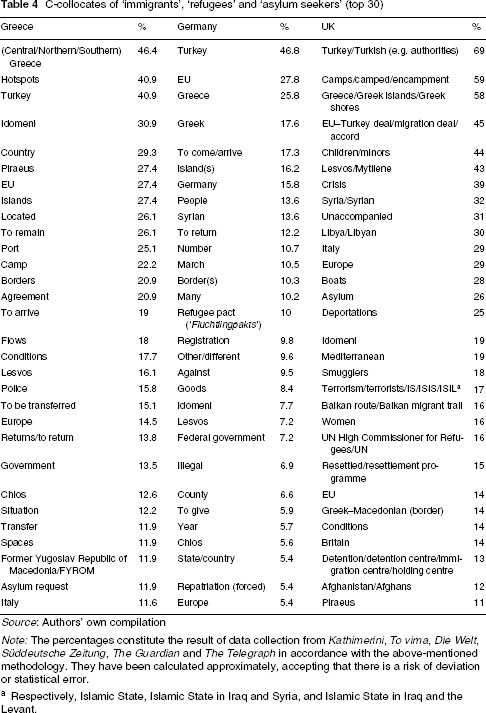
C-collocates of ‘immigrants’, ‘refugees’ and ‘asylum seekers’ (top 30)
Source: Authors’ own compilation
Note: The percentages constitute the result of data collection from Kathimerini, To vima, Die Welt, Süddeutsche Zeitung, The Guardian and The Telegraph in accordance with the above-mentioned methodology. They have been calculated approximately, accepting that there is a risk of deviation or statistical error.
Respectively, Islamic State, Islamic State in Iraq and Syria, and Islamic State in Iraq and the Levant.
C-collocates
The most common ‘c-collocate’ in the Greek newspapers Kathimerini and To vima was ‘Greece’, usually accompanied by the adjectives ‘Central’, ‘Northern’ or ‘Southern’ in order to provide a geographic location for the migrants’ and refugees’ arrival, and their accumulation, registration and relocation, as well as to present other incidents related to migrants/refugees (e.g. violent scenes, living conditions). Similarly, the German online media referred to ‘Greece’ to a significant extent according to Table 4 (25.8%). In general the selected German and British newspapers were sympathetic towards Greece, which seems to have been the EU country most affected by the refugee crisis, hosting tens of thousands refugees and irregular migrants, while a humanitarian crisis has been sparked there. However, the problems of accommodation and care for the migrants and refugees were issues that were also highlighted, and were touched upon by the Greek newspapers as well. Nevertheless, the most common c-collocate in Die Welt and Süddeutsche Zeitung was ‘Turkey’ (46.8%), something that interestingly applies to the British newspapers as well (69%).
It seems that all six online newspapers paid a lot of attention to the EU–Turkey deal, referring to the nature and provisions of this agreement, as well as to the perspective of its implementation. For instance, Süddeutsche Zeitung (
Turning our attention to the coverage of this crisis by the Greek newspapers in our sample, they seem to focus on the state of play at the hotspots within Greece: at the makeshift camp in Idomeni where violent incidents and protests have taken place, and at the port of Piraeus where several migrants and refugees have been trapped in makeshift camps. ‘Hunger strike in Chios’ where ‘the situation has been derailed’, ‘turmoil in Idomeni’, ‘the deadlock in Idomeni remains’, and ‘stone-throwing in overcrowded Idomeni’ were some of the headlines in Kathimerini (
Furthermore, both in Greece and in Germany, the word ‘borders’ appeared frequently, while the British press often referred to the ‘Greek–Macedonian border’. The word ‘FYROM’
2
appeared in 11.9% of the articles analysed in the Greek papers. These references to ‘FYROM’ were mostly made in the context of the closing of the Balkan route or the violent scenes between the authorities of the Former Republic of Macedonia and the refugees and migrants at the borders between Greece and that country. The British press also highlighted that clashes took place. The Guardian reported on several injuries after ‘clashes at Greece–Macedonian borders’, when ‘Macedonian police fired teargas and rubber bullets at crowds on the Greek side of the border’ (The Guardian
Former Yugoslav Republic of Macedonia.
Importantly, all the newspapers in the study made mention of the Greek islands, and more specifically of Chios and Lesvos, where the numbers of migrant and refugee arrivals rocketed. Additionally, from an examination of Table 4, it seems that there were several references to Italy in the Greek and the British press, something that cannot be said for the German press in our sample.
At this point, it is interesting to note that when analysing the articles from the two British newspapers, the authors of this article expected a significant reference to the Brexit debate on migration. However, references to the word ‘Brexit’ or to the EU referendum appeared in only 4% of the articles examined.
Finally, we were surprised to note that the articles studied in the Greek and the German press did not include in a percentage worth mentioning the words ‘terrorists’, ‘terrorism’, ‘ISIL’, ‘IS’ or ‘ISIS’.
Conclusions
The findings of this article suggest that with Europe shaken to its foundations and the EU's values and common future having been called into question, the media seems to have taken a uniform approach to covering this crisis. This contrasts with the conflicting views of Europe's leaders. At the same time, it seems that hate speech has caught the attention of the media and caused public concern. As mentioned earlier, refugees were portrayed as victims of the civil war in Syria, helpless and desperate, while there was also a focus among all the newspapers on the ‘numbers’ of the crisis. Unsurprisingly, the EU–Turkey agreement was at the heart of the daily coverage. Apart from references to the nature and provisions of this agreement, as well as its implementation, various articles expressed scepticism regarding its legality and concerns about its possible collapse. Finally, all the newspapers examined paid a good deal of attention to the tragic issue of child refugees, who are living in extreme peril and facing inhumane living conditions and various atrocious threats.
Footnotes