




Abstract
Trust in the European Union is strongly related to trust in national political institutions through extrapolation, i.e. cues from national politics. Most evidence for this mechanism, however, is based on surveys using question blocks that present several institutions at once in non-randomized order. We conducted six split-ballot survey experiments in five European countries, asking about trust in national and European Union institutions (a) separately or in the same question block and (b) in different question orders. Our findings demonstrate survey context effects: asking about two institutions within the same question block increases the correlation of reported levels of trust in these institutions. Furthermore, our findings indicate that national primes decrease reported trust in the European Union, providing novel micro-level evidence for extrapolation and cue-taking from national politics in the formation of public opinion about the European Union.
Introduction
Evaluations of the European Union (EU) and national political institutions are intertwined – when citizens decide whether or not they trust the EU, this judgement is rarely independent from national politics. For many citizens, the EU is a relatively remote and complex political institution, about which they have little knowledge and few readily accessible opinions (Clark, 2014). Consequently, when asked about the EU, citizens often rely on their evaluations of national politics and extrapolate their opinions about the EU from those national evaluations. This extrapolation mechanism explains why trust in the EU correlates highly with trust in national political institutions (Anderson, 1998; Harteveld et al., 2013; Muñoz et al., 2011), and why national political trust was identified as the strongest attitudinal explanation of EU trust (Harteveld et al., 2013).
The majority of studies on the relationship between national and EU political trust rely on surveys that include items on trust in several national and European institutions within a single question block. Such surveys pose two major methodological problems for scholars with a substantive interest in either absolute levels of trust or correlations between trusts in different institutions. First, including different institutions as part of the same list of items with identical response scales encourages response consistency and thus artificially increases the correlation between the items. Second, within-block question order is usually not randomized; items on national institutions precede EU institutions in most surveys. Therefore, priming effects may also skew widely used measures for EU trust. This raises the question to what extent existing findings of extrapolation reflect real-world mechanisms, or are – to a certain degree – an artefact of the survey context.
We study the effects of survey context on the occurrence of extrapolation and reported levels of EU trust, using an experimental set-up, which allows us to make both methodological and theoretical contributions. First, we assess the extent and nature of the effects of commonly used question blocks on the measurement of institutional trust and the consequences for studies comparing national and EU political trust. Second, and more fundamentally, the experimental set-up enables us to put the extrapolation mechanism to a more rigorous test. Previous research has mostly relied on correlations between measures of trust in EU institutions and national political institutions. We use variations in survey context to analyze the effect of cues from national politics on trust in the EU. The results contribute to our knowledge of the cognitive processes underlying the formation of political trust towards different levels of governance.
We distinguish two mechanisms that could produce survey context effects. First, question order can enhance extrapolation: preceding questions about national political institutions could lead respondents to base their EU trust on similar considerations. Second, general consistency effects can occur as responses to questions in the same block are assimilated, for instance due to satisficing response behavior.
To disentangle these mechanisms, we employ a split-ballot survey experiment. The experiment uses a 2 × 2 factorial design, varying both the question order and whether the items are part of the same or different item blocks. We replicated our experiment at different time points and in five different European countries. Our findings show strong evidence of consistency effects: displaying trust items in a single question block significantly increases the correlation between these items. Furthermore, we find that question order matters: putting questions about national institutions first generally leads to lower EU trust, particularly among citizens who are dissatisfied with their own government. Priming on national institutions thus leads to an activation of national considerations when subsequently evaluating the EU, which lends support to the extrapolation hypothesis.
These findings have both methodological and theoretical implications. Methodologically, our study shows that the use of standard item blocks for measuring trust in different institutions affects the levels of measured trust and inflates inter-item correlations. This urges researchers to carefully decide how to measure institutional trust – using randomized question order or separate question blocks – depending on the research question. We contribute to theories on the formation of political trust in multi-level governance by demonstrating the impact of a ‘national prime’ on subsequently expressed trust in the EU and provide novel micro-level evidence for the existence of an extrapolation mechanism, i.e. citizens relying on cues from national politics when expressing their trust in the EU.
Theory
National heuristics and EU trust
Political trust can be conceptualized as an evaluation of political institutions (Kasperson et al., 1992; van der Meer and Dekker, 2011; Mishler and Rose, 2001). Such evaluations need to be based on some form of information about the evaluated object. In the EU context, this is often information about economic performance and identity-based considerations (Harteveld et al., 2013; Hooghe and Marks, 2005). Specifically, the European debt crisis led to a considerable decline in support for and trust in the EU (Gomez, 2015), but also in national governments (Foster and Frieden, 2017). Similarly, the migration crisis negatively changed public opinion about the EU (Harteveld et al., 2018). In addition, when citizens have sufficient knowledge about both the EU and national institutions, they may also use national politics as a ‘benchmark’ to judge the EU based on an informed comparison (De Vries, 2018; Muñoz et al., 2011; Sánchez-Cuenca, 2000).
However, generally speaking, citizens often lack specific knowledge about the performance and functioning of the EU, especially when compared to their more readily available knowledge about national political institutions (Clark, 2014; Hobolt, 2007). When individuals lack the political knowledge to inform their voting decisions or support for institutions, they are more likely to use heuristics and cues as a basis for evaluations instead (Lau and Redlawsk, 2001). In the case of the EU, this means that trust in national political institutions ‘spills over’ or is extrapolated to trust in the EU. Indeed, citizens who trust their own government more are also more likely to trust the EU (Anderson, 1998). A similarly high correlation has been found for satisfaction with democracy at the two levels (Hobolt, 2012; Rohrschneider, 2002). Harteveld et al. (2013) identified extrapolation as the most important predictor of trust in the EU, surpassing utilitarian and identity-based EU evaluations (see also Armingeon and Ceka, 2014; Muñoz, 2017). In line with this reasoning, the extrapolation mechanism is weaker for more knowledgeable citizens (Armingeon and Ceka, 2014; Karp et al., 2003; Muñoz, 2017). The existing evidence is mostly based on correlational data, but generally concludes that there is a causal direction: Citizens use cues from national politics to form their trust in the EU and not vice versa. Armingeon and Ceka (2014) support this assumption with analyses showing that (a) domestic political events which lower governmental trust also lower EU trust and that (b) governmental trust predicts EU trust, even when this relationship is controlled for EU performance evaluations. In sum, existing evidence based on correlational data supports the assumption of an extrapolation mechanism, but we lack causal evidence of the impact of cue-taking on reported trust in the EU.
Survey context effects
An important limitation of studies comparing and correlating political trust on the national and EU level is that most of them rely on data from the Eurobarometer (Anderson, 1998; Armingeon and Ceka, 2014; Harteveld et al., 2013; Muñoz, 2017; Rohrschneider, 2002; Sánchez-Cuenca, 2000); others have used the European Social Survey (ESS) (Muñoz et al., 2011). These two survey datasets share important characteristics that may influence the measurement of institutional trust. Both surveys follow the common practice of presenting the respondents with a block of items measuring trust in several institutions. In both cases, data are collected through face-to-face interviews, in which the interviewer asks how much or whether the respondent trusts a number of institutions. All institutions are named within the same block and in a fixed order, with trust in the EU following trust in national institutions. Interestingly, a study using questions from separate blocks by McLaren (2007) concludes that national institutional trust is less important for EU support than suggested by previous studies.
Survey research has demonstrated that an identical question can produce different response patterns depending on the preceding questions in the survey (Schuman and Presser, 1996). Question context exerts this influence through what is essentially a priming mechanism by altering the availability and salience of the considerations that are used to answer the survey question at hand (Tourangeau et al., 2000: 198). In addition, similarly phrased questions can induce a general need for consistency in respondents. These context effects can have two kinds of consequences for the response pattern: directional and correlational context effects (Tourangeau et al., 2000). Directional effects occur when the question order leads to a change in the level of the variable of interest; this is generally the case when the relationship between the target question and context question is unconditional, i.e. when the context item has the same impact on all respondents irrespective of their position on the context item. Correlational effects occur if context effects alter the relation between the target and context questions; these take the form of conditional effects, where the score on the context item determines the score on the target question.
Hypotheses
Combining the literature on national heuristics and trust in the EU with existing knowledge of survey context effects, we develop a set of hypotheses about survey context effects on EU trust, and more specifically, what happens when national political trust is probed before trust in EU institutions in a survey. According to the extrapolation logic, EU evaluations are largely based on considerations about national politics; someone who trusts national institutions is more likely to also trust more removed institutions, whereas someone who does not trust national institutions is less likely to trust the EU. Question order could make considerations about national political institutions more salient. Asking about the national government before the EU could thus influence average reported levels of trust in the EU, aligning the levels of trust in the two institutions and thereby making government evaluations a more important predictor for EU evaluations. Specifically, asking about a less trusted national institution first would decrease subsequently reported trust in the EU, in comparison to when the EU is asked about before the national institution. Conversely, asking about a more trusted national institution first would increase reported trust in the EU. H1: Reported trust in the EU is higher when preceded by questions about a trusted national institution, whereas it is lower when preceded by a non-trusted national political institution (extrapolation hypothesis).
Evidently, even in low-trust countries, national political trust varies considerably at the individual level. As an additional test of our hypotheses, we analyze this effect in more detail by considering citizens’ individual government satisfaction. We expect that citizens with lower government satisfaction extrapolate and also report lower trust in the EU when asked about the government first, whereas those with high government satisfaction, in contrast, should report higher trust in the EU when asked about the government first. In order to test this assumption, we conduct an additional analysis for groups of citizens with high, medium and low government satisfaction. We rely on government satisfaction for this test because this variable is measured independently from the experimental manipulation.
The priming effect of displaying a national political institution before an EU institution posited in hypothesis 1 will likely wear off over the course of a survey. We expect that the extrapolation effect is stronger when items about EU trust and trust in national institutions are part of one block, in comparison to when they appear in two separate blocks. When the question about national politics directly precedes the one about the EU within the same block, the immediate memory of it should increase the effect, whereas the effect should be weaker when other questions are asked in between the two measures of trust. H2: Extrapolation effects (H1) are stronger when EU and national political trust items are part of the same question block (proximity hypothesis). H3: The correlation between reported EU and national political trust is higher when both are part of the same question block (consistency hypothesis).
Methods
The experiment was carried out in the context of a larger panel survey focused on EU public opinion (Goldberg et al., 2019). The data were collected in the form of computer-assisted web interviewing. Study 1, in January 2018, included 2648 Dutch respondents; Study 2, in December 2018, included 1942 Dutch respondents; Study 3, in December 2018, included 2678 Danish respondents, 2895 German respondents, 2746 Hungarian respondents and 2867 Spanish respondents. Levels of trust in both national and European institutions differ considerably across these countries (see e.g. Special Eurobarometer 461, 2017). Quotas on age, gender, education and region were enforced to ensure a representative sample of the respective populations.
In order to measure our main variables of interest, we asked respondents how much they agree with the following statements on a seven-point scale ranging from ‘not at all’ (1) to ‘completely’ (7): ‘I trust the European Union’, ‘I trust the national government’, and ‘I trust the national parliament’ (see the Online appendix for question wording). The order of these questions was randomized in four experimental conditions. In addition, we asked respondents how satisfied they were with the performance of their respective national governments on a scale ranging from 1 (‘very unsatisfied’) to 7 (‘very satisfied’).
In Study 1, Conditions A and B include the two questions on trust in national political institutions and in the EU at the start of a larger block of questions about institutional trust. In Condition A (N = 617), respondents are asked about their trust in the two national institutions first (the parliament always following the government), as it is usually done in surveys, whereas in Condition B (N = 687), trust in the EU comes first. In Condition C and D, the trust questions are asked in two blocks, which are separated by an eight-question block on political participation. In Condition C (N = 656), national trust precedes EU trust. This order is reversed in Condition D (N = 688). In total, N = 2648 respondents participated in the experiment.
In Study 2 and Study 3, we simplified the design and excluded the national parliament, leaving only questions about trust in the national government and the EU. Before making this decision, we analyzed an independent panel wave dataset in the Netherlands (N = 2236), collected in June 2018, in which the question order of all trust items was randomized. This analysis showed that the correlations between trust in the EU are almost identical for both trust in the national parliament (r = 0.766) and trust in the national government (r = 0.765). Thus, the results are not likely to be affected by the choice of institution. Besides this simplification, the design of Study 1 was fully replicated in Study 2. The experimental conditions are visualized in Figure 1. It is noteworthy that the Dutch samples in Study 1 and Study 2 are drawn from the same panel. Thus, all Dutch respondents in Study 2 (N = 1942; NA = 472, NB = 497, NC = 484, ND = 489) also participated in Study 1, which further enhances comparability. Study 3 was an exact replication of Study 2 with respondents from Denmark (N = 2678; NA = 660, NB = 655, NC = 669, ND = 694), Germany (N = 2895; NA = 674, NB = 752, NC = 720, ND = 749), Hungary (N = 2746; NA = 701, NB = 704, NC = 681, ND = 660) and Spain (N = 2867; NA = 686, NB = 721, NC = 765, ND = 695). The results are visualized using the package ggplot2 (Wickham, 2016) in R (R Core Team, 2016).
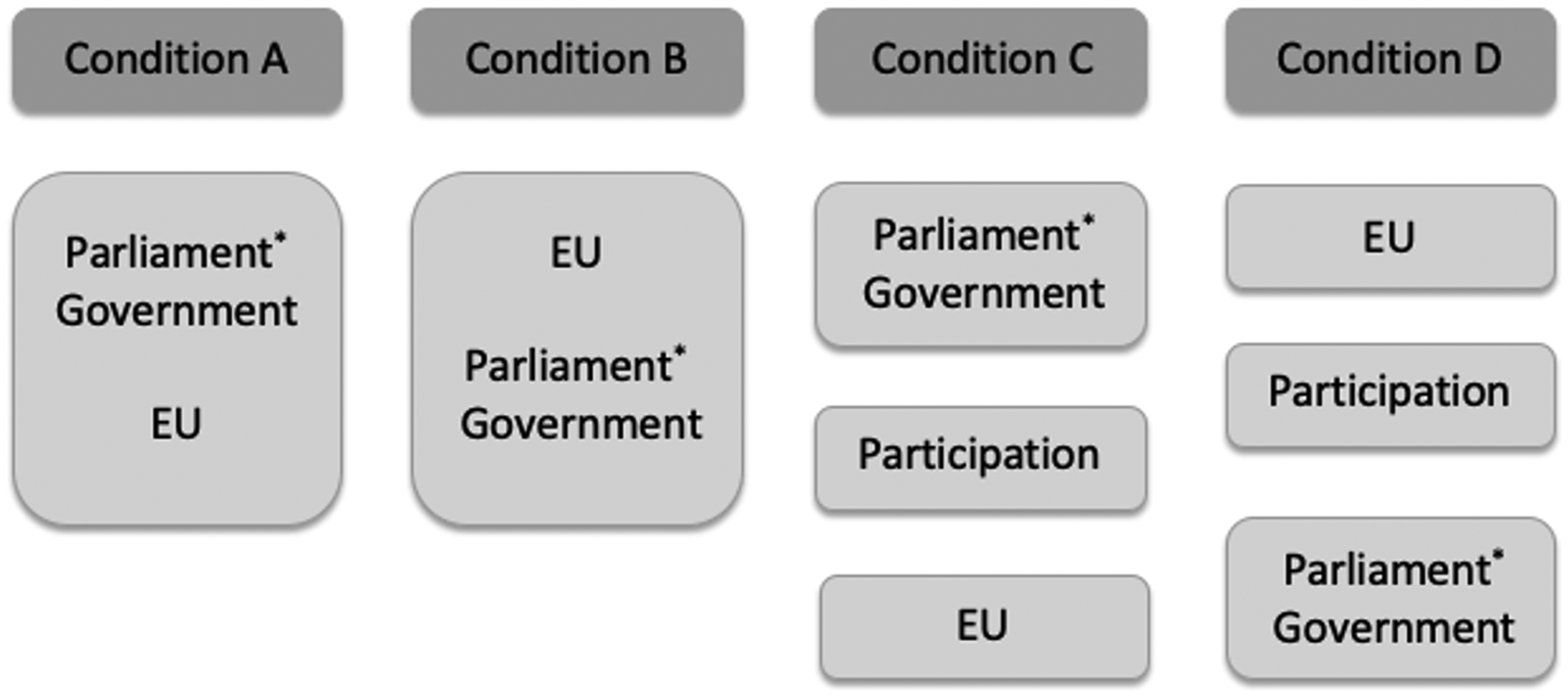
Experimental conditions. *Note: The national parliament was only included in Study 1.
Results
Figure 2 shows descriptive statistics for trust in the government, parliament, and the EU for all five countries in the three studies. First, it is important to note that trust in the government tends to be low in all countries, never exceeding the mid-point (4) of the scale (ranging from 1 to 7). This confirms our assumption that asking about the government first would function as a negative cue in these countries. While there are no considerable differences between trust in the government and trust in the EU in Denmark and Germany, trust in the EU is considerably higher than trust in the government in Hungary and Spain. In the Netherlands, the difference changes between waves: while trust in the EU is somewhat lower than trust in the government (and parliament) in the first wave, this difference becomes marginal in the second survey wave. While these results are somewhat different than the results from the Eurobarometer (where trust is measured as a binary variable), they show the same general patterns – national institutions are more trusted in the Netherlands, Denmark and Germany than in Spain and Hungary.
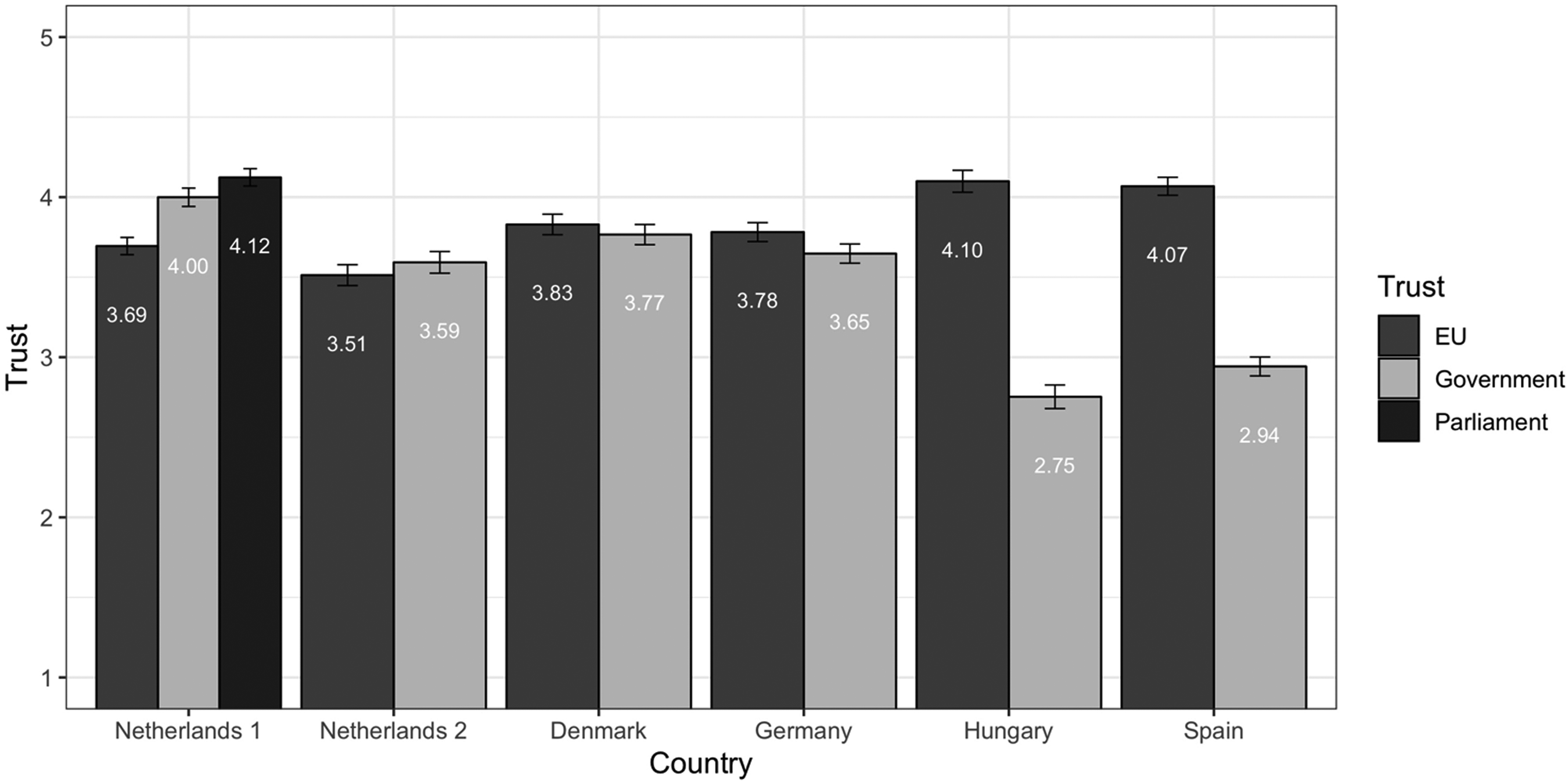
Average trust in the EU, government, and parliament.Note: Scale ranges from 1 to 7.
Study 1 – the Netherlands
An analysis of variance (ANOVA) shows that trust in the EU is highest in Condition B, in which trust in the EU precedes national institutions in the same block. A Bonferroni post-hoc test shows that EU trust in Condition A, in which national trust precedes EU trust, is significantly lower (p < 0.01) than in Condition B, C or D (see Figure 3). This evidence supports the extrapolation hypothesis: when the EU is contrasted with national political institutions, trust in the EU is lower. However, it also seems that this effect only occurs when the two trust questions are displayed in the same block, as there is no significant difference between Conditions C and D based on question order. This confirms our expectations for H2. In other words, for extrapolation to occur, it is necessary that the benchmark is recent and hence salient, according to the results of Study 1.
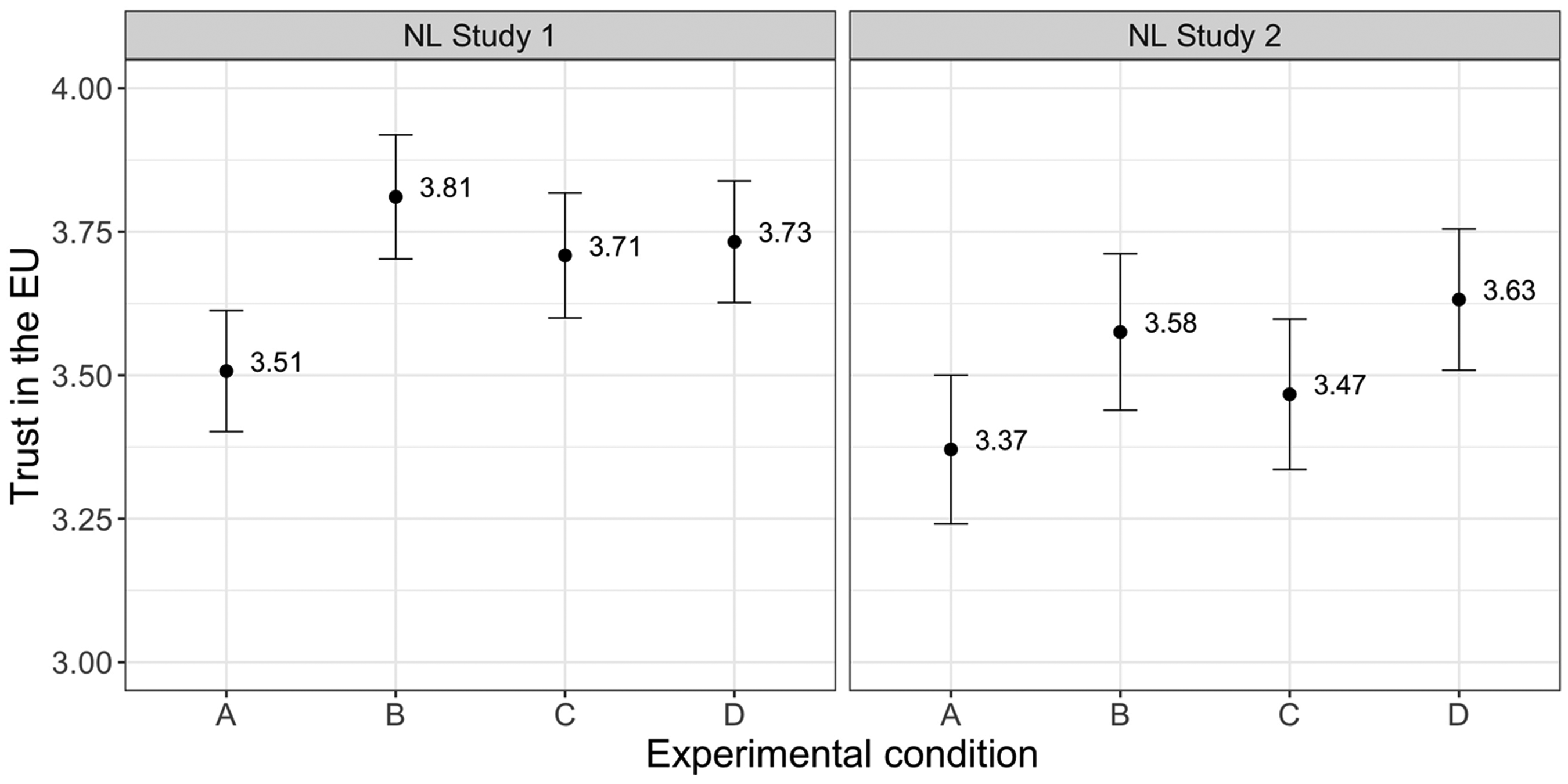
Mean score on trust in the EU per condition for Study 1 and Study 2 in the Netherlands.
In a second step, we test H1 for groups of citizens with low satisfaction with the national government (answering 1 to 3 on a scale from 1 to 7), medium satisfaction (4), or high satisfaction (5 to 7). However, as visualized in Figure 4, there are no clear-cut differences in the effects of the experimental conditions between the three groups for Study 1.
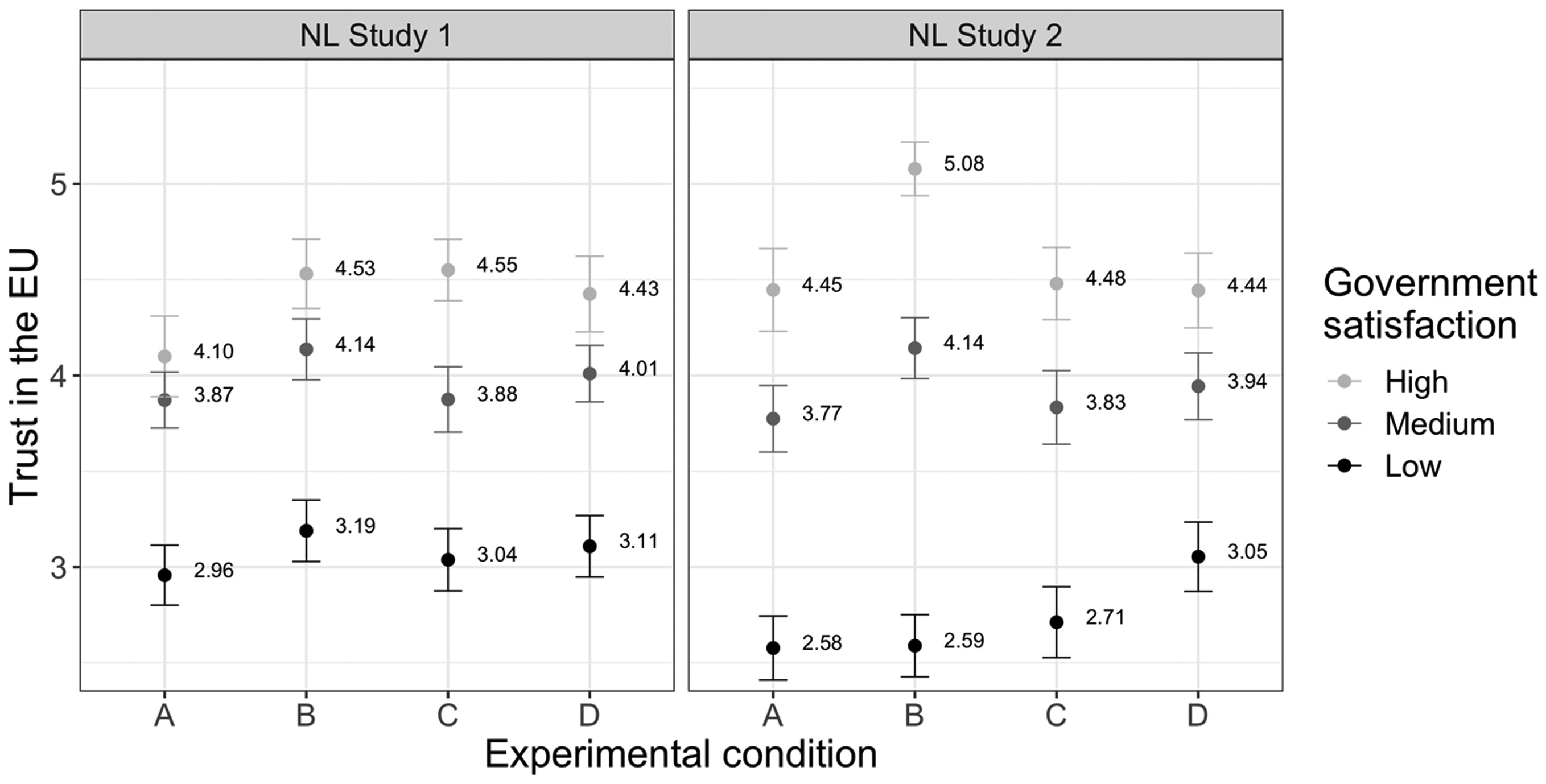
Mean score on trust in the EU per condition for Study 1 and Study 2 in the Netherlands for citizens with low, medium and high government satisfaction.
H3 stated that the correlation between trust in national institutions and trust in the EU – the basis for the extrapolation hypothesis – would be lower when the two items are not displayed within the same question block. We test this hypothesis for the two national political institutions, government and parliament, separately, using Pearson’s correlation coefficient and Fisher’s r-to-z transformation. The correlation between trust in the government and trust in the EU is r = 0.71 in Condition A, r = 0.69 in Condition B, r = 0.63 in Condition C and r = 0.63 in Condition D. We combined Conditions A and B into a one-block condition with 1304 respondents in which the correlation between trust in the government and trust in the EU is r = 0.699, and Conditions C and D into a separate-blocks condition with 1344 respondents, in which the correlation is r = 0.631. These two correlations are significantly different from each other (z = 3.14, p < 0.01). This shows that the correlation between trust in the government and trust in the EU is somewhat higher when the two are asked within the same block, which is typically the case in existing surveys. The correlation between trust in the national parliament and trust in the EU is r = 0.64 in Condition A, r = 0.72 in Condition B, r = 0.64 in Condition C and r = 0.61 in Condition D. These results are not identical to the correlation between EU trust and government trust. However, the lower correlation between trust in the parliament and trust in the EU could be caused by the item order. In Condition A, national institutions precede the EU, but the specific question order is parliament – government – EU. Therefore, it is plausible to assume that consistency effects are stronger between the government and the EU question than between the parliament and the EU question in this condition. In Condition B, where the order is EU – parliament – government, the correlation is the strongest for the EU and the parliament, i.e. the two institutions that follow each other directly. This finding further supports our hypothesis that consistent response patterns increase when survey items about trust directly follow each other and emphasizes the fine-grained nature of these effects.
Study 2 – the Netherlands
The replication of our study in the Netherlands, shows a similar, but not identical, pattern of results. In this replication, trust in the EU is highest in Condition D, and almost as high in Condition B; the difference between the two is not significant (p = 1.00). Trust in the EU in Condition A is significantly lower than in Condition D (p = .03). The other differences are not statistically significant. However, the pattern of results is similar: trust in the EU is higher when it is not preceded by a question on trust in the national government, which lends some further support to H1. The analysis for the separate groups of government satisfaction displayed in Figure 4, however, provides only mixed support for H1. Respondents with high government satisfaction have the highest EU trust in Condition B (in which the EU precedes the national government within the same block), which does not support extrapolation. On the other hand, respondents with lower government satisfaction have the highest trust in the EU in Condition D (where the EU precedes the national government with a buffer question block between the two), which supports the idea of extrapolation (H1), but not H2 on question proximity effects.
The correlation between trust in the government and trust in the EU is r = 0.81 in Condition A, r = 0.78 in Condition B, r = 0.78 in Condition C and r = 0.73 in Condition D. In Conditions A and B combined (N = 969), the correlation is r = 0.784, whereas in Conditions C and D (N = 973), it is r = 0.755. This difference is not significant (z = 1.57, p = 0.12), which means that the correlation between trust in the government and in the EU does not depend on whether the two are asked in the same or separate blocks. In contrast to Study 1, this does not confirm hypothesis 3.
Study 3 – Denmark, Germany, Hungary and Spain
For all four countries, simple ANOVAs show significant group differences in the levels of trust in the EU across the experimental groups. These differences are visualized in Figure 5. The results from Denmark are highly similar to the findings from Study 1 in the Netherlands; trust in the EU is significantly lower in Condition A than in Condition B (p = 0.01), offering support for the extrapolation hypothesis (H1). The results from Germany follow a similar pattern but are closer to the results from Study 2 in the Netherlands: only the difference between Conditions A and D is significant (p < 0.01), also supporting H1. The difference between Conditions A and B goes in the same general direction but is not statistically significant (p = 0.06).
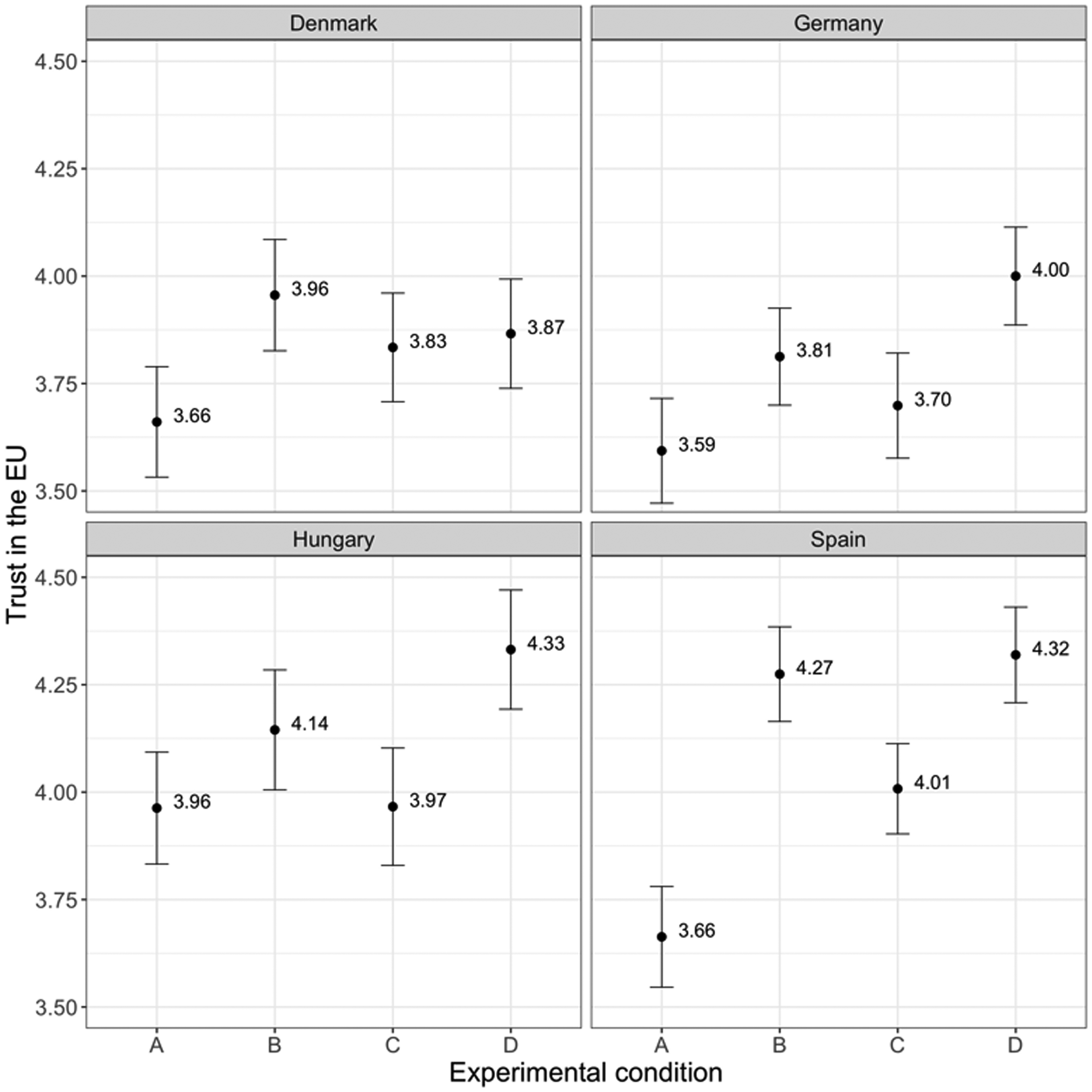
Mean score on trust in the EU per condition for Study 3.
The results from Hungary and Spain, the two countries with the lowest levels of government trust, are similar to the results from the Netherlands, Denmark and Germany, but more pronounced. These results also support the extrapolation hypothesis (H1): when the less trusted national institutions are asked about first (Conditions A and C), trust in the EU decreases. In Spain, the difference in trust in the EU is significant for Conditions A and B (p < 0.01), as well as for C and D (p = 0.01). Furthermore, the differences between Conditions A and C (p < 0.01), A and D (p < 0.01) and B and C (p < 0.01) are also significant. The difference between Condition A and B is greater than between C and D, which supports hypothesis 2. In Hungary, the difference in trust in the EU is only significant in the separate-blocks condition: while Conditions A and B are not significantly different (p = 0.37), Conditions C and D (p < 0.01), as well as A and D (p < 0.01) are significantly different, which still offers support for H1, but not H2.
When the analysis is split into three groups of citizens with low, medium and high government satisfaction, the results become more clear-cut across all four countries: while there are no considerable differences in EU trust between the experimental groups for those who have high government satisfaction, the differences become more pronounced for those with medium satisfaction and are highest for those with low government satisfaction (see Figure 6).
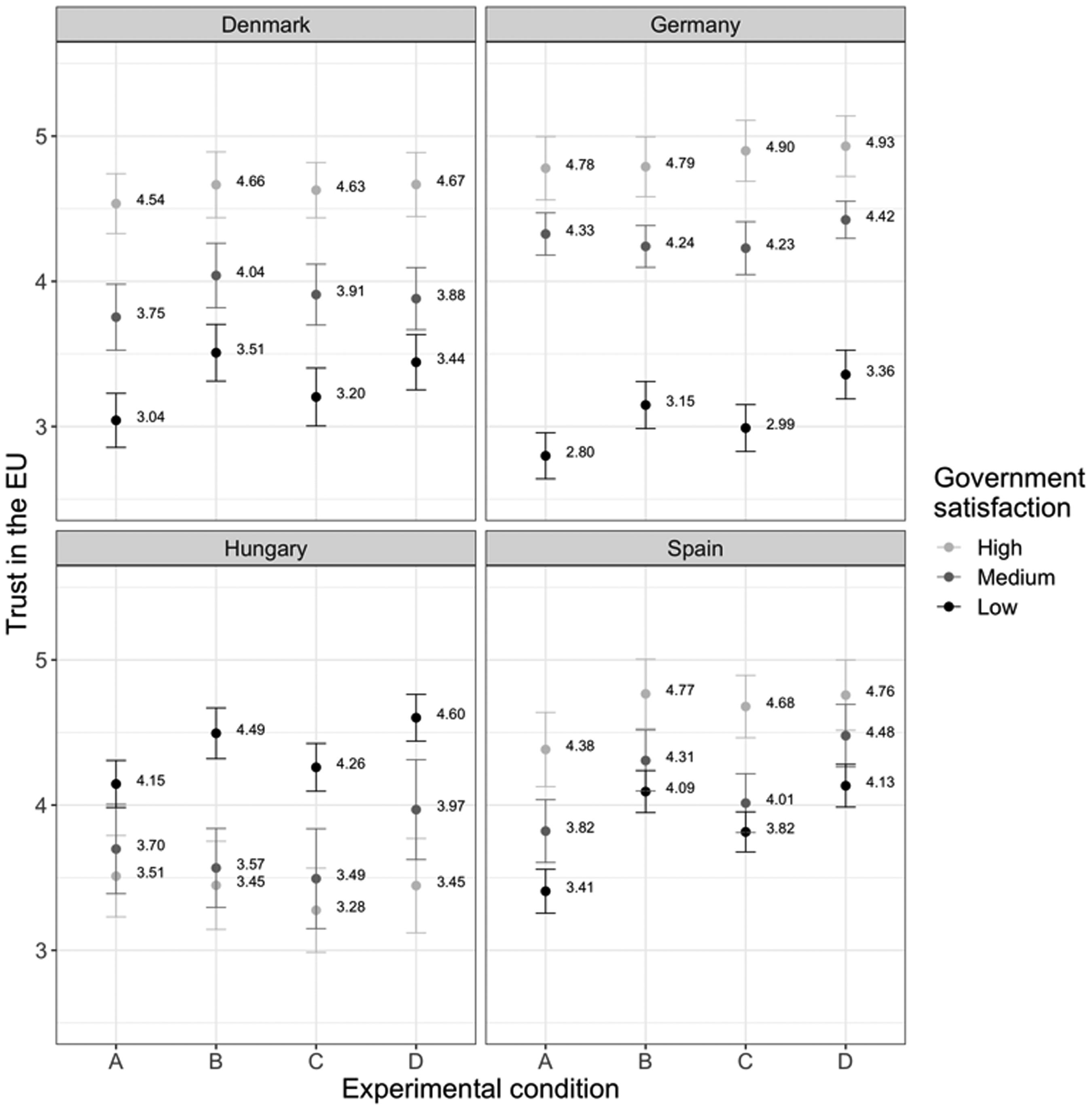
Mean score on trust in the EU per condition for Study 3 for citizens with low, medium, and high government satisfaction.
In other words, when the national government is made more salient through question order, those with low government satisfaction react to this cue by reporting lower EU trust; for those with high government satisfaction, no effect of national government cues is visible. Thus, all things considered, the results of Study 3 lend strong support for the existence of an extrapolation mechanism in all four countries, yet the impact of national cues seems to be limited to negative cues (i.e. less trusted institutions).
Regarding hypothesis 3, the results consistently show that the correlation between trust in the EU and trust in the national government is stronger (or in the case of Hungary, the correlation is less negative) when the two questions were asked in the same block, rather than separately. This supports hypothesis 3. Table 1 shows the correlations in each experimental group and for Condition A and B, as well as C and D combined. The z-score and corresponding p-value are based on the correlations of the combined conditions.
Correlations between trust in the national government and trust in the EU in different experimental conditions.
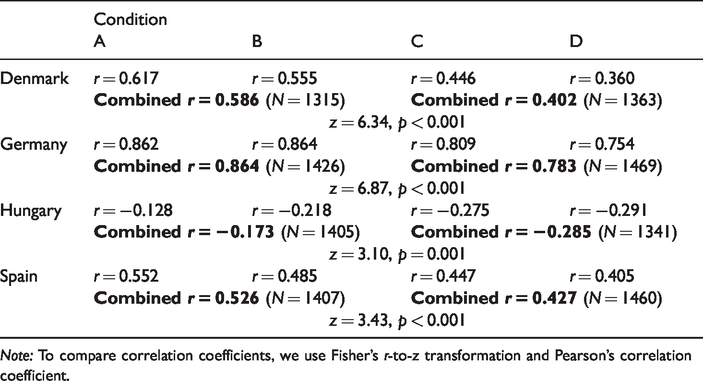
Note: To compare correlation coefficients, we use Fisher’s r-to-z transformation and Pearson’s correlation coefficient.
Discussion
Our study investigates how cues from national politics can affect political trust in the EU, using experimental evidence with multiple replications in different contexts. There are two main results. First, we find quite consistent evidence that the correlation between one’s political trust in national institutions and the EU is stronger if the two items are in the same block. Second, we find evidence for the effect of question order on the occurrence of extrapolation processes in different countries. Most results point to the extrapolation effect being increased when a question about the EU is preceded by a question about the national government. Our analyses also give insight into the underlying mechanism: particularly respondents with low government satisfaction extrapolate from their governments to the EU when the government is made more salient through question order. This indicates that the process of extrapolation might be mainly based on negative primes, at least in the European context, where trust in the national government is often low.
These findings have both methodological and substantive implications. Methodologically, the results highlight the need to tailor questionnaire design to the specific research question, whenever possible. Even though large-scale, cross-national surveys like the Eurobarometer or the ESS offer unique, high-quality data and their use is certainly justified, they measure political trust in a single block, in which trust in the EU follows trust in national institutions. Researchers interested in trust in multiple specific institutions, rather than overall institutional trust, should consider randomizing the display order of institutions within a block. For researchers with a particular interest in the levels of trust in the EU (or other specific supra-national institutions), it may also be advisable to ask about said institution first, thereby avoiding respondents extrapolating from more familiar institutions, such as the national government. Researchers with a particular interest in multi-level government could also consider separating evaluations of institutions on different levels within a survey, especially when evaluating the relative importance of cue-taking in comparison to other explanatory variables. This will likely prevent the inflation of correlations between trusts in different institutions due to survey context effects. Overall, our findings stress the importance of accounting for potential effects of questionnaire design and adapting questionnaires to the specific requirements of a certain research question. They also tie in with previous criticism of survey context effects in, for instance, the Eurobarometer (Haverland et al., 2015; Höpner and Jurczyk, 2015; Saris and Kaase, 1997). At the same time, it is important to note that the effects of survey context are limited and, in this particular case, do not drive findings on extrapolation in the EU literature. Therefore, our results also show that data from the ESS and Eurobarometer are nevertheless suited to give insights into such questions.
Substantively, our study contributes to understanding the processes through which citizens develop their (dis)trust in the EU in an experimental setting. This allows us to isolate the effect of national institutions as a prime, and directly test whether this prime leads to extrapolation. Even though the evidence is not clear-cut across all countries, the findings generally support the extrapolation hypothesis. This implies that when forming their EU trust, citizens tend to use more readily available information about familiar institutions. Mentioning the national government before the EU decreases trust in the EU relatively consistently across contexts. It is noteworthy that our separate analysis for citizens with higher government satisfaction does not show a reversed pattern of extrapolation in the opposite direction, but rather just fewer effects. This could indicate that a positive cue from national politics is not as effective at eliciting an extrapolation response as a negative cue, which would be in line with a general negativity bias.
However, this finding could also point to alternative explanations, for example that the national government functions as a negative prime regardless of its perceived or objective quality. Possibly, the government prime makes respondents think more about certain policy areas that are dominated by national politics, such as social welfare issues, rather than EU politics. It could also shift respondents’ focus to incumbent politicians and parties on the national level, which could go hand in hand with a greater focus on the role that these specific actors simultaneously play in EU politics in the subsequent questions. However, these explanations remain speculative and still speak to the idea of a heuristic-based extrapolation mechanism. Future research could use specific control variables or diversify the type of experimental cues to further test the nature of the extrapolation hypothesis. It would also be interesting to replicate this experiment in other, non-European, multi-level government contexts, especially in cases where the lower-level government is more trusted.
Overall, the results further support theories of cue-taking in the formation of public opinion about the EU. Given relatively low levels of political knowledge about the EU, it is not surprising that citizens rely on alternative information, such as cues from national politics, to base their evaluations on (see also Armingeon and Ceka, 2014; Muñoz, 2017). There are potentially greater implications for democracy: Citizens who find themselves in multi-level government contexts could generalize dissatisfaction with national politics to the supranational level and lose political trust, which ultimately undermines the democratic legitimization of elected officials and institutions.
Supplemental Material
EUP896010 Supplemental Material1 - Supplemental material for Trust in context: National heuristics and survey context effects on political trust in the European Union
Supplemental material, EUP896010 Supplemental Material1 for Trust in context: National heuristics and survey context effects on political trust in the European Union by Anna Brosius, Erika J van Elsas and Claes H de Vreese in European Union Politics
Supplemental Material
EUP896010 Supplemental Material2 - Supplemental material for Trust in context: National heuristics and survey context effects on political trust in the European Union
Supplemental material, EUP896010 Supplemental Material2 for Trust in context: National heuristics and survey context effects on political trust in the European Union by Anna Brosius, Erika J van Elsas and Claes H de Vreese in European Union Politics
Footnotes
Funding
The author(s) disclosed receipt of the following financial support for the research, authorship, and/or publication of this article: This research is funded by a grant from the European Research Council (ERC), grant number 647316.

Supplemental Material
Supplemental material for this article is available online.
References
Supplementary Material
Please find the following supplemental material available below.
For Open Access articles published under a Creative Commons License, all supplemental material carries the same license as the article it is associated with.
For non-Open Access articles published, all supplemental material carries a non-exclusive license, and permission requests for re-use of supplemental material or any part of supplemental material shall be sent directly to the copyright owner as specified in the copyright notice associated with the article.
