




Abstract
In recent years, the number of immigrants reaching the EU has grown dramatically. The migration crisis and its political repercussions have been felt with different intensity across Europe. In this critical situation, EU-level coordination has proved problematic due to the nested interests of the member states. This article addresses the problem of public support for an integrated EU immigration policy. Using data from the EUENGAGE project, we explore citizens’ attitudes towards EU-level coordination of immigration, and we introduce a set of theoretical arguments that aim to explain their attitudes. We show that those subjects who are more frightened by immigrants and who demand stricter policy and greater protection from unwanted migration are keener to delegate policy competence to the EU in this field.
Introduction
In 2015, more than one million people arrived in Europe after crossing the Mediterranean Sea, a huge increase from 250,000 in 2014 and 60,000 in 2013. Migration Commissioner Dimitris Avramopoulos declared ‘the world finds itself facing the worst refugee crisis since the Second World War and Europe finds itself struggling to deal with the high influxes of people seeking refuge within our borders’. 1 This critical scenario has made immigration a more salient issue in many European Union (EU) countries: according to Eurobarometer data, since 2015, immigration has been seen by citizens as the most important issue currently facing the EU. 2 The connection often made between immigration, crime and terrorism (Fitzgerald et al., 2012) has contributed to spreading moral panic within society and to bringing the immigration issue to the top of the agenda.
Despite an extensive literature on public attitudes towards immigration (see Freeman et al., 2015), as documented in a comprehensive review by Kentmen-Cin and Erisen (2017: 9–10), studies on citizens’ attitudes towards an integrated immigration policy in Europe are very rare. In broad terms, some have argued that attitudes towards immigration and support for EU integration are positively related (Azrout and Wojcieszak, 2017; De Vreese and Boomgaarden, 2005; Lubbers and Coenders, 2017), but this relationship has remained underexplored overall and, most importantly, it is not always updated with the most recent events. Erisen and Kentmen-Cin’s recent work (2017) is the main exception: they show that the perceived economic, security and cultural threats of different immigrant groups sustain public attitudes towards the creation of a common EU immigration policy. The main aim of this article is to understand the levels of public support (for a larger group of countries) for an integrated immigration policy at EU level: Under what conditions would citizens agree to support an EU-wide immigration policy? Notably, we are interested in understanding if, how and why citizens would be ready to support greater EU coordination in this policy field. We hypothesise that people who perceive immigrants as a threat would be more inclined to support greater EU action to share the burden of their presence. Our analysis benefits from the availability of original data from the EUENGAGE survey of public opinion in 10 member states that was specifically designed to test people’s reactions to the most urgent challenges facing the EU. Through this study, we find confirmation for our expectations and we conclude that public support for EU policy competence in immigration should not be sought from those segments of society that believe immigrants generate more benefits than costs. Rather it should be sought in those sectors that display more negative attitudes and feel more threatened by immigrants.
Attitudes towards immigration and support for European policy coordination: Defining some hypotheses
The determinants of attitudes towards immigration have been investigated by scholars of different disciplines. From the abundant literature in this field, socialisation and socio-psychological factors, along with economic, contextual, institutional and political factors, have emerged at the core of the kaleidoscopic set of elements explaining how people perceive immigration. Some of them have emphasised the role played by identity (Bail, 2008; Haubert and Fussell, 2006; Levanon and Lewin-Epstein, 2010; Sides and Citrin, 2007; Verkuyten and Martinovic, 2015) or individual ideological orientations (Hainmueller and Hiscox, 2007; Semyonov et al., 2008). Others have stressed the influence of economic interests and sociotropic concerns (Hainmueller and Hopkins, 2015; Valentino et al., 2017), and the perception of the state of the national economy (Rodolph, 2002; Ruist, 2016; Sides and Citrin, 2007). In more recent times, some have questioned the impact of the economic and financial crises on those attitudes (Creighton et al., 2015). Other variables, that have been found to play a significant role, pertain to context factors. For example, the number of immigrants in a territory along with patterns of socialisation with natives (Hopkins, 2011) have been considered crucial. Citizens have also been found to react to immigration in different ways depending on their individual levels of collective mindedness or social capital (Fieldhouse and Cutts, 2010), and also depending on the personal characteristics and belief systems of immigrants (Azrout and Wojcieszak, 2017; Beierlein et al., 2016; Davidov and Meuleman, 2012; Erisen and Kentmen-Cin, 2017; Hopkins, 2015; Valentino et al., 2017) and how these are supposed to interact with their own culture.
Surprisingly, most studies on public attitudes towards immigration generally lack to establish a link between those attitudes and specific support for EU integration in immigration policy. The migration crisis clearly shows its nature as a wider issue that demands some kind of transnational collective action. In the last 10 years, common policies on immigration and asylum have marked some important developments at the EU level (Peers et al., 2015; Zaun, 2017). For these reasons, in this article, we concentrate on whether EU-coordinated action in this field would be supported by citizens.
When addressing this problem, the first conceptual issue that arises has to do with the multidimensional nature of the problem itself (see Hellwig and Kweon, 2016). Citizens may distinguish between different components and generate distinctive attitudes towards immigrants and immigration policies (for a short review, see Ceobanu and Escandell, 2010). Thus, the first step in our analysis is to empirically test whether EU citizens have distinct attitudes towards immigration (or immigrants) and EU intervention in this policy field. The second step then consists of an accurate examination of the relationship between these different components.
Many studies have investigated citizens’ attitudes towards the EU, but more rarely has there been an effort to isolate some underlying factors that could explain attitudes towards the EU and immigration (or immigrants). Kentmen-Cin and Erisen (2017) recommend redesigning survey research to identify the specific cultural and economic threats posed by immigrants in order to understand opposition to European integration. Some studies have found national identity to negatively affect support for European integration at any level (see Marks and Hooghe, 2003; McLaren, 2002, 2007) as well as citizens’ own perceptions about immigrants and immigration (Luedtke, 2005). In more general terms, it has been shown that overall attitudes towards a broad phenomenon (i.e. immigration) affect people’s views on more specific aspects (i.e. EU policy coordination of immigration) of the same phenomenon (Simon and Lynch, 1999; Soroka and Wlezien, 2010). We expect that attitudes towards immigration influence support for EU policy integration in this field.
The EU institutions have become a fundamental part of the multilevel governance system operating in Europe. Different levels are responsible for addressing different policy problems, some of which are, by definition, more transnational and require coordination at the European level. In general, EU citizens recognise that EU institutions are authorities created to guarantee policy outcomes that address societal needs on a European scale (Hobolt and Tilley, 2014). Because immigration has an intrinsic transnational scope, we expect that people who perceive immigrants as a threat would be more inclined to support greater EU action to cope with their presence, as opposed to single country interventions that could prove ineffective given the wider scope of the phenomenon. Since the EU is in charge of providing solutions to problems, citizens should be ready to support its involvement when other solutions have proved ineffective, and especially when they are concerned about unsolved problems. Here we build on the findings of Isernia and Cotta (2016) who show that Europe is seen as a rescuer by citizens when they perceive transnational problems as being unsolved and constituting a threat. This kind of finding should not be surprising and may simply rejuvenate classical theory on European integration, in which Europe is seen as a rescuer of nation states (Milward, 1992), unable to handle urgent transnational problems effectively. Thus, we expect a positive relationship between threat perception of immigration and the role of the EU as a shield:
H1: A respondent is more likely to support an EU-wide immigration policy the more immigration is perceived as a cost or a threat.
This expectation regarding policy preferences on issues with a transnational scope has been put forward by past research (Luedtke, 2005). However, it has not been tested on a large scale in the EU as it currently stands; nor has it been tested with respect to immigration policy specifically (Isernia and Cotta, 2016). 3 Since support for the EU is a complex multidimensional stance dictated by different motivations, the direction of which is often contested in the literature, confirmation of our expectations would offer evidence that attitudes towards immigration have an opposite effect on (specific) support for EU policy integration. This would be an interesting finding, pointing to a relevant phenomenon: subjects who feel more threatened by immigration are potential supporters of EU intervention in this field. Within the emergency context of the refugee crisis, and as a result of the media and political discourse filtering immigration through the lens of terrorism (Frederking, 2012; Lazaridis and Wadia, 2015; Togral, 2011), we expect a particularly strong effect of perceived threats linked to immigration:
H2: Higher levels of threat perception should increase support for EU intervention even when immigration is perceived as beneficial overall.
Consistent with an extensive literature that attempts to explain attitudes towards the EU (and EU integration), our analysis is conducted at the individual level. However, our strategy does not exclude the possibility that national characteristics also play a role in explaining support for EU intervention. We believe national contexts matter and may influence results at the individual level. We test the effects of contextual variables concerning the geographic position of the respondents’ countries (i.e. Southern countries of ‘entrance’, Northern countries of ‘destination’ and Eastern countries), some macro-economic factors (growth and unemployment) as well as some particular characteristics of immigration at national level. Notably, we expect that the perception of the EU as a shield is emphasised by difficulties encountered at the domestic level. Higher levels of unemployment, a high refugee and Muslim presence and being a country of destination may lead respondents to support EU intervention in immigration, mainly for compensation purposes. On the contrary, economic growth, lower levels of unemployment and a lower presence of Muslims and refugees are expected to produce less support for EU intervention.
The test of our research hypotheses is reinforced by the use of other control variables. They include some indicators of polity attachment, since nationalists are expected to oppose immigration (Luedtke, 2005) as well as the idea of deeper EU integration (Mclaren, 2002).
We then consider the respondents’ general views of other people and their active networking in civil society, because people trusting others and participating actively in civil society are, in general, more cosmopolitan and supportive of EU integration (Bahry, 2016; Herreros and Criado, 2009). We introduced political ideology under the assumption that those leaning to the right hold more hostile attitudes towards supranationalism and the delegation of sovereignty to the EU (Hainmueller and Hiscox, 2007; Hooghe et al., 2002; Semyonov et al., 2008).
We also considered the influence of blaming the EU for policy ineffectiveness. The relationship between responsibility attribution for policy failure and attitudes towards the EU has acquired relevance in recent research (Hobolt and Tilley, 2014), showing, for example, that blame can positively be associated with a request for more action at the EU level, especially in those policy fields where the role of the EU is more limited (Di Mauro and Memoli, 2016). Following past research in the field, we also included attitudes towards the EU (see Luedtke, 2005; Magalhães, 2012; McLaren, 2007), as we expect that people supporting the EU as a whole are keener to support EU intervention in specific policy fields. Other controls comprise attitudes towards the national government (Anderson, 1998), socio-demographic variables assessing the effects of cognitive elements (such as education) or interests (income) on the dependent variable (on this point see Gabel, 1998), age and gender.
Data and method
This article uses the data collected by the Horizon 2020 project EUENGAGE. In June and July 2016, the project launched a public opinion survey addressing some urgent European issues such as immigration, along with some more general attitudes towards national and EU institutions. The survey was conducted through Computer Assisted Web Interviewing and involved a representative sample of citizens of 10 EU member states consisting of about 20,000 cases. 4 Although our data are not representative of the whole EU, we believe they are a valuable source of information and they can provide the specific indicators (normally not available in other EU-wide surveys) that are necessary for our analysis. From the available data, we selected information on attitudes towards immigration in general and on citizens’ positions on EU policy integration in particular (see the Online appendix). Unfortunately, the question wording does not allow us to distinguish between different characteristics of migrants (such as their country of origin, cultural background, or ethnicity) (see Erisen and Kentmen-Cin, 2017). Although other studies in the field rely on this kind of data, they are usually based on single (or a small number of) cases. Our study contributes, conversely, to the literature through the combination of specific questions on migration and on EU migration policy in the context of a sizable number of countries.
To start our investigation, we ran a principal component analysis of the selected variables to determine their underlying structure (see the Online appendix). 5 The analysis unveiled the presence of three broad factors explaining 65.8% of the total variance. 6 The first dimension, which refers to the association of immigration with cultural threat and other threats such as terrorism and crime (with factor loadings higher than 0.5), explains 40.6% of the total variance. This dimension spells out perceived threats in greater detail than any past research that simply questioned whether immigrants were a threat to security (see Azrout et al., 2012; De Vreese et al., 2008; Hobolt et al., 2011). 7 The second dimension, which relates to the costs/benefits that immigrants bring to the hosting country in both economic and cultural terms, explains 13.2% of the total variance. Finally, the third dimension, accounting for 12% of the total variance, refers to the coordination of immigration policy at the European level. Thus, citizens appear to distinguish three dimensions with respect to the phenomenon under analysis. The first two dimensions relate to general attitudes towards immigrants/immigration under the point of view of threat and cost perceptions, respectively. These two dimensions will be treated as predictors in the following analyses. The third dimension concerns immigration policy, notably the role of the EU (in establishing migrant quotas for the member states) and the sharing of costs and hosting of migrants among the member states. Interestingly, migrant quotas and burden sharing among the member states are not separate solutions in the minds of citizens, but they are part of the broader concept of integration of immigration policy. In the analysis, this dimension will be taken as the dependent variable. In the models that we present in the following sections, control variables consist of our indicators of social capital (trust in others, organisational membership and size of associational network), territorial attachment/identity, blame, ideology (left–right), trust in national government. We also included the following indicators of attitudes towards the EU: EU benefit, EU responsiveness, satisfaction with EU democracy and EU integration (see the Online appendix). Some studies (see, for example, Beaudonnet and Di Mauro, 2012; Boomgaarden et al., 2011; Fuchs, 2009) show that these indicators capture the multidimensional nature of attitudes towards the EU and they allow us to include different aspects of the EU process in the analysis. 8
We pooled the EUENGAGE dataset with aggregate indicators at the country level, such as gross domestic product (GDP) growth, unemployment rate, percentage of Muslim population, and number of residing refugees. 9 Finally, we distinguished three geographic regions consisting of the south (Greece, Italy, Portugal, Spain), the north (France, Germany, The Netherlands and the United Kingdom (UK)) and the east (Czech Republic and Poland), under the assumption that countries in the north tend to attract more migrants as final destination while countries at the southern borders receive the largest share of arrivals.
Main patterns in citizens’ attitudes
The principal component analysis of the previous section highlights the presence of three broad factors pertaining to public stances on immigration that we labelled Insecurity, Benefits and Integration, respectively. These will be treated as separate concepts. We made use of their factor scores to build three corresponding indexes: Insecurity assesses sentiments of fear and concern about the impact of immigration on security; Benefits measures the perceived gains stemming from immigration; Integration measures the degree of public support for European-level coordination of immigration policy.
Table 1 shows the average values of the factor scores for the different countries covered in the survey. Factor 1 (Insecurity) ranges from –3.7 to 2.35. Of the 10 countries, the Czech Republic is the most concerned about insecurity, while Portugal and Spain are the least concerned. Factor 2 (Benefits) ranges from –3.3 to 3.45 and we can see that 5 out of 10 countries show, on average, negative values that reflect a perception that the costs of immigration outweigh the benefits. This is most evident for the Czech Republic, while especially the public in the UK and Spain tend to perceive benefits as greater than costs. Factor 3 also has a range similar (from –2.9 to 2.42) to the other two factors. The most opposed to EU policy integration related to immigration are the Central and Eastern European member states (the Czech Republic and Poland) together with the UK, while the most positively oriented are the Southern European countries (Greece, Italy, and Spain in particular). These distributions may give a general idea of the trends at work in the EU (differences between countries are significant at p < .05 for all three factors), and some additional descriptive statistics contribute to the picture.
Attitudes of Europeans: factor scores by country.
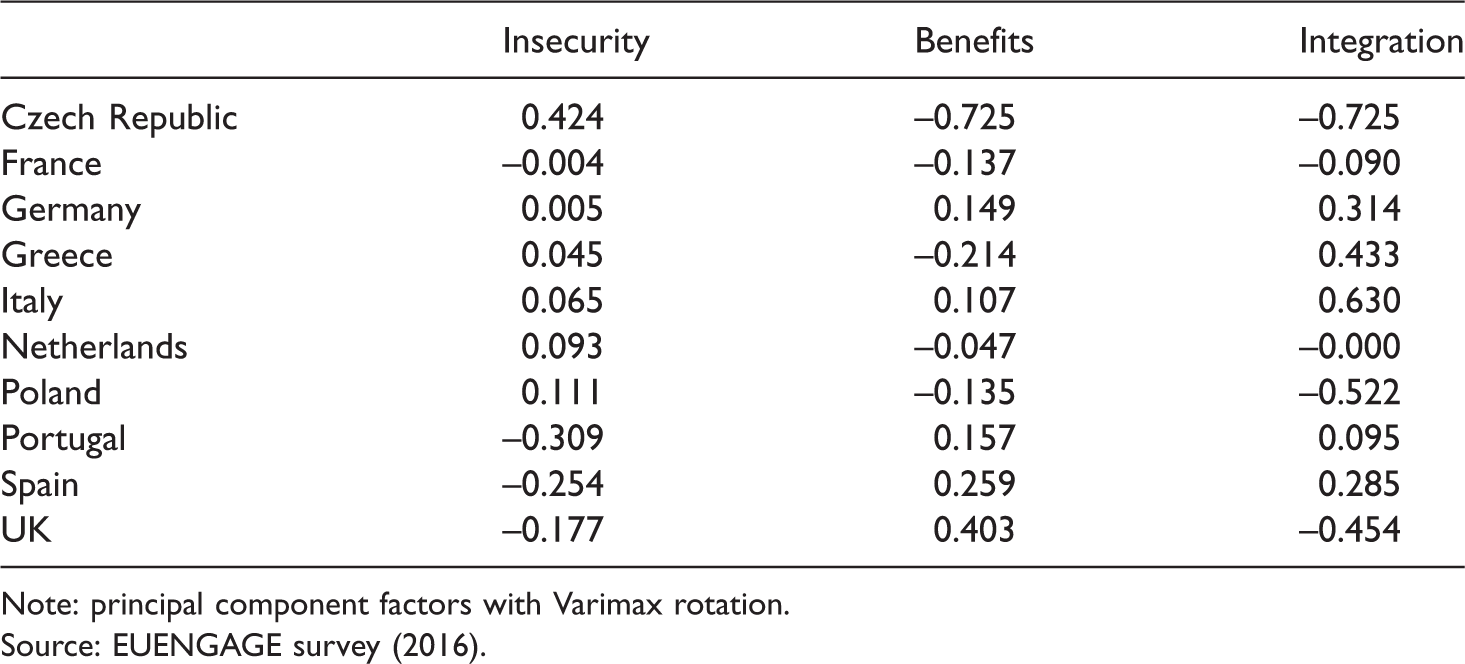
Note: principal component factors with Varimax rotation.
Source: EUENGAGE survey (2016).
OLS Models with support for EU integration in immigration policy as dependent variable.

Note: *p <.1; **p <.01; ***p <.001. Reference categories in parentheses. Source: EUENGAGE survey (June 2016).
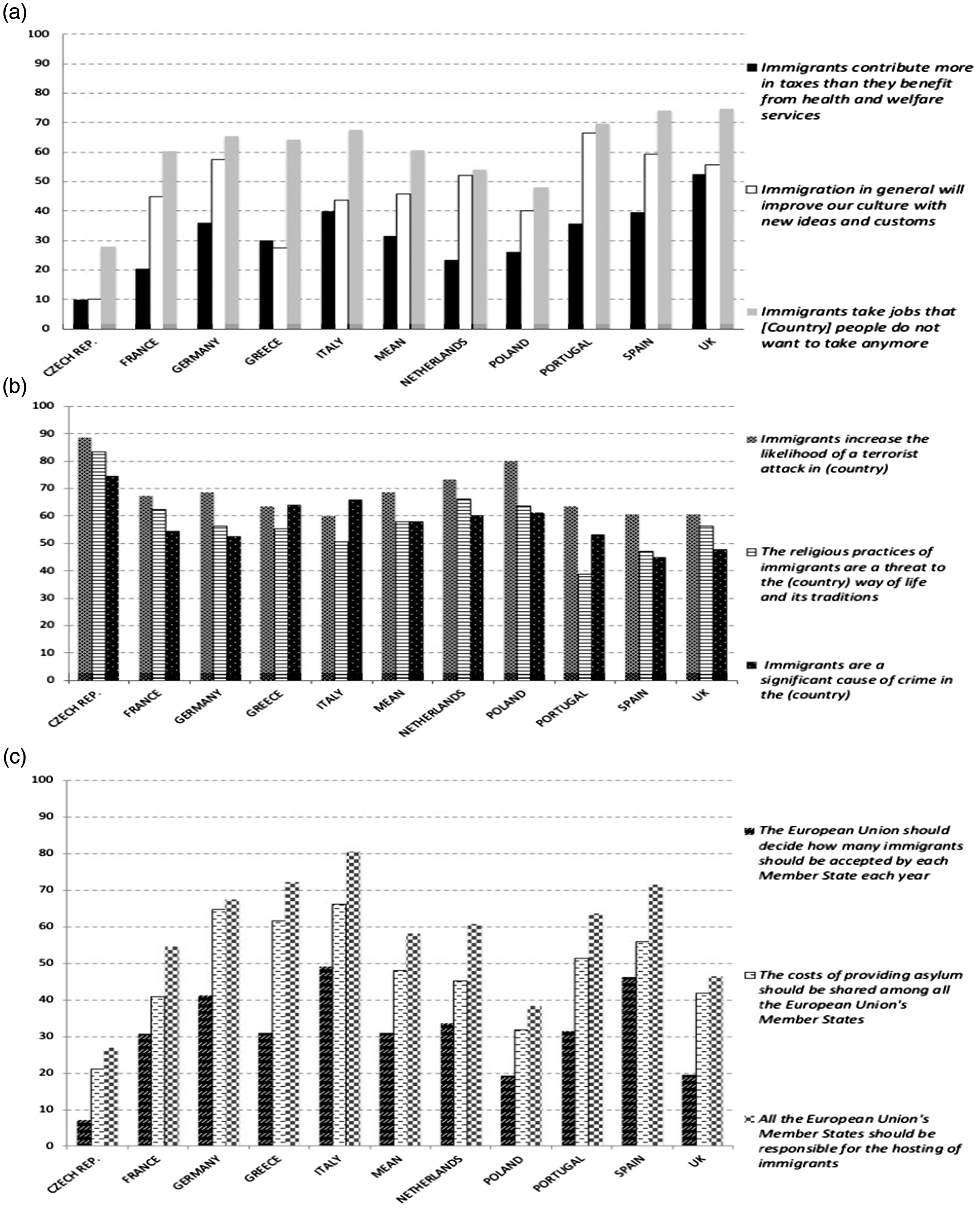
Percentages of respondents agreeing (‘somewhat agree’ and ‘strongly agree’) on different questions.
Figure 1(a) shows the percentages of people who agree (both ‘strongly agree’ and ‘agree’) to the three questions that build the Benefits index. Except for the UK, the majority of people (53%) in the other nine countries do not think that immigrants contribute more in taxes than they receive in services. The percentage of positive responses is very low in the Czech Republic (10%) and up to 10% below the mean (31%) in France, Poland, the Netherlands and Greece; it is above the mean in Portugal, Germany, Spain and Italy. A more favourable view is shown, on the contrary, by the second question relating to culture. In five of the 10 countries, the majority of people believe that immigration improves the national culture (UK, the Netherlands, Spain, Portugal and Germany), while in the Czech Republic, only a small minority of citizens (10%) agree on this point. In all countries under analysis (except for the Czech Republic and Poland), most people agree that immigrants do not take the jobs of natives, with peaks of 74% in Spain and the UK.
Figure 1(b) displays the percentage of people agreeing to the questions that build the Insecurity index. In all countries, the majority of people (from 60% to 88%) think that immigration increases the likelihood of terrorist attacks. Except for Portugal and Spain (39% and 47%, respectively), the majority of people also agree with the view that immigrants’ religious practices are a threat to the national way of life (percentages are in the range of 50% to 60% in most countries). Finally, immigration is seen as increasing crime for the majority of people in almost every country, especially in the Czech Republic, Italy and Greece (75%, 66% and 64%, respectively), but not in Spain (44%) and the UK (48%).
Moving to the Integration index (Figure 1(c)), we find that eight out of 10 countries show that the majority of respondents support the idea of shared responsibility for hosting migrants – since the question asked respondents to indicate ‘nation state’ or ‘Europe’ from 0 (‘nation state’) to 10 (‘Europe’), we report here the percentages of answers above 5 (from 6 to 10). However, how this should be done from an operational point of view is far more contentious. In Greece, Italy, Germany, Portugal and Spain a majority of respondents agree that the costs of providing asylum should be shared among the member states. On the contrary, according to citizens, the number of immigrants that should be allowed in every country is a decision that should rest in the hands of the member states and, in all countries, the majority of respondents are against an EU-coordinated quota system (only in Italy, Spain and Germany more than 40% of people support this idea).
The picture that we were able to draw shows citizens’ concerns for immigration, and only limited support for its handling at the EU level. Our descriptive statistics have also highlighted some interesting differences between the EU member states (see the Online appendix for other summary statistics by country); however, they cannot explain the sources of support and opposition (towards immigration and/or EU policy integration) at the individual level. For this purpose, the analysis now moves to an explanation of the individual attitudes of citizens through the use of models that integrate the different predictors discussed above.
Analysis
In this section, we test our hypotheses through three linear regression models with robust standard errors; support for the integration of immigration policy is the dependent variable. The discussion of comparative statistics implies that all other variables are held constant. We decided to include regions (north, south, east) instead of country dummies since the former may provide information about attitudes in countries of ‘destination’ and ‘transit’. However, for a check of robustness, we also ran the same models including country dummies (not shown) and we found confirmation of our hypotheses.
Model 1 is the baseline model including all control variables both at individual and aggregate level (Table 2). The effect directions and sizes of our control variables mainly confirm our expectations. Respondents who position themselves towards the right of the political spectrum tend to see Integration more negatively (for every unit increase on the left–right scale a 0.02 unit decrease in EU integration is predicted), while each unit increase of the blaming index increases support for Integration by 0.08.
The older generations tend to support EU integration more than the younger generations (between 0.1 and 0.15 unit increase in EU integration is predicted). Respondents with higher levels of education and those with higher income are keener to support EU intervention on immigration (for graduate respondents and incomes higher than 48,000 pounds, a 0.14 and 0.09 unit increase in EU integration is predicted, respectively).
Trust in the national government shows a significant negative effect; however, the question in our survey differs from the traditional measures used in the field, so results may not be directly comparable. Respondents seeing more benefits from EU membership and those willing to push the process of EU integration further are, consistently, more likely to support EU integration in immigration policy.
As far as pooled country-level variables are concerned, we found that economic growth tends to be negatively related to support for European level coordination of immigration, while higher levels of unemployment show a positive relationship. For each 1% increase in GDP a 0.15 unit decrease in EU integration is predicted, while for each 1% increase in unemployment a 0.01 increase in Integration is predicted. Beta values show that GDP growth has an effect five times larger than unemployment (beta coefficients are –0.22 and 0.04, respectively). The relationship between the number of refugees in a country and support for EU intervention is positive: the model predicts a 0.002 increase in support for integration for every increase of 1000 refugee residents. In countries where a higher percentage of Muslims reside, people tend to prefer national policy to European policy coordination (for every 1% increase of Muslim residents a 0.05 unit decrease in support for EU integration is predicted). Southern (0.1 increase) and Northern Europeans (0.61 increase) are more likely than Eastern Europeans to support EU intervention in immigration.
Our results confirm that conditions of weakness and perceived threat at the national level – such as a higher number of refugees, a higher unemployment rate or the status of migrants’ favoured destination – increase the likelihood of supporting EU-level integration of immigration and burden sharing. On the contrary, a higher GDP growth and lower levels of unemployment increase support for the status quo. We have seen that a higher presence of Muslims within the national population is not conducive to greater support for EU intervention on immigration. In the literature, the aversion towards Muslim immigrants is considered a by-product of cultural/racial rejections (Valentino et al., 2017: 22) since ‘racial attitudes remain a powerful determinant of opinions about immigrants’ and Muslims, in particular, elicit significantly lower levels of support for immigrants. The reasons why a larger presence of Muslims in a country does not translate into threat perception of immigration and, in turn, into support for EU intervention, is a question that future research could address. One possibility is that the party systems in these countries normally include radical right-wing parties that make use of racial prejudices, together with nationalism and Euroscepticism to gain consensus. Here, defence of sovereignty and prejudice against Muslims by some segments of society may well represent two faces of the same coin.
In Model 2, the impact of Benefits and Insecurity on Integration confirms our hypotheses. 10 Specifically, when citizens feel insecure, they are keener to support EU integration in immigration policy (0.19 for each unit increase in Insecurity, hypothesis 1 is thus confirmed). On the contrary, if people perceive immigration as beneficial, support for EU integration tends to be lower in this policy field (–0.18 for each unit increase in Benefits). The beta coefficients show that Benefits and Insecurity are among the four strongest predictors of support for EU integration. Although these results go in a different direction than Luedtke’s (2005) findings (see, in particular, his second hypothesis), we should clarify that the indicators used in our study differ from those used by Luedtke, so the two analyses may not be perfectly symmetric. However, it could well be that, 10 years after Luedtke’s work, the migration crisis in Europe has changed citizens’ attitudes and our analysis documents such change with new findings.
By adding our main independent variables to Model 2, the effects of most control variables are confirmed, and some become significant. Trust in others and a cosmopolitan (world) identity are significantly and positively related to support for EU integration in immigration policy. National identity and EU responsiveness also become significant and show negative effects. Instead, trust in government is not significant in Model 2.
Finally, the interaction between Insecurity and Benefits in Model 3 adds relevant information: when their sense of insecurity increases, people support greater EU integration in immigration policy. This support remains positive even when the perceived benefits of immigration increase (Figure 2). Hence, we can conclude that when respondents feel insecure due to immigrants, they tend to support EU intervention and burden sharing among the member states, regardless of the perceived level of benefits they associate with immigration. This confirms the second hypothesis.
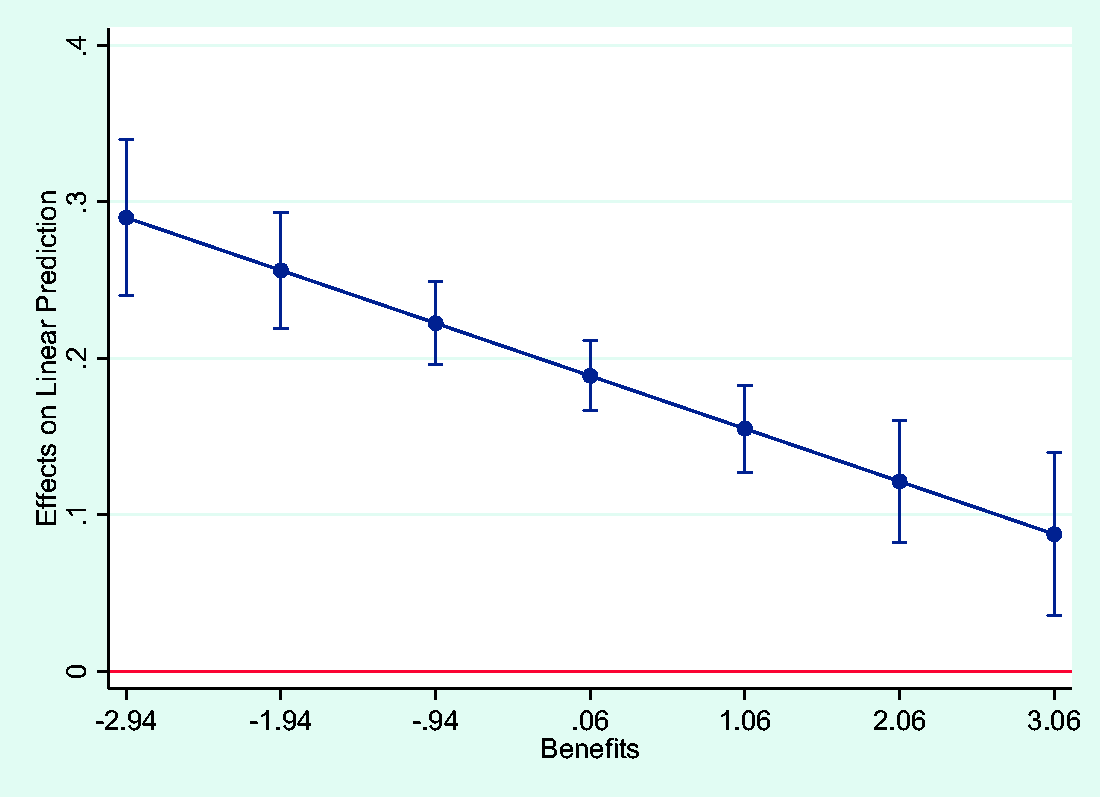
Interaction effect of Insecurity with 95% CIs.
Discussion
After a shocking and prolonged economic crisis, the EU has experienced a migration crisis that is raising many concerns among citizens. The article investigates how and why citizens are keen on sharing the burden of immigration among EU member states and are ready to support a leading role for the EU in coordinating such efforts. Our findings reveal three different dimensions with respect to attitudes at the individual level which we label Insecurity, Benefits and Integration. The first two concern general attitudes towards immigration, while the last relates to public support for sharing the costs of immigration among the member states and coordination of migrant quotas by the EU. Our work adds to the literature by showing that people who perceive immigration as a cost and a threat also tend to support cost sharing among the member states and EU coordination in this field. On the contrary, those who perceive immigration as mainly generating benefits and, especially, not as a threat to their own security, oppose policy integration and a stronger EU role and prefer instead a national handling of the relevant policies. Ultimately, support for EU level coordination in this field increases especially among those citizens who perceive immigration to be malignant. Moreover, pooled variables at country level tend to confirm a vision of the EU as a shield against domestic weakness and exposure to risk: higher unemployment and refugee rates in one’s own country are positively related to support for EU integration of immigration policy, while higher GDP growth shows the opposite relation.
More than a decade ago, De Vreese and Boomgaarden (2005) argued that negative attitudes towards immigrants increase opposition towards EU integration as a whole. Focusing on immigration policy, our study shows that fear of immigration produces an opposite effect on EU integration to the one predicted by De Vreese and Boomgaarden (2005) and Erisen and Kentmen-Cin (2017). Threat perception of immigration and a sense of insecurity among citizens create a stronger demand for EU initiatives. Given the scope of the migration challenge, the ability of the state to handle immigration pressure might not garner sufficient trust; hence it might be considered rational to ask for European intervention. Within a European context not particularly well disposed to immigration, it is remarkable and, to some extent, disturbing, to find that those who are keener to delegate policy competence to the EU are those very subjects who are more frightened by immigration and who demand stricter policy and greater protection from unwanted migration.
Supplemental Material
Supplemental Material1 - Supplemental material for Citizens, immigration and the EU as a shield
Supplemental material, Supplemental Material1 for Citizens, immigration and the EU as a shield by Nicolò Conti, Danilo Di Mauro and Vincenzo Memoli in European Union Politics
Supplemental Material
Supplemental Material2 - Supplemental material for Citizens, immigration and the EU as a shield
Supplemental material, Supplemental Material2 for Citizens, immigration and the EU as a shield by Nicolò Conti, Danilo Di Mauro and Vincenzo Memoli in European Union Politics
Footnotes
Funding
The author(s) disclosed receipt of the following financial support for the research, authorship, and/or publication of this article: The research that is presented in the article was funded by the European Union’s Horizon 2020 research and innovation programme under grant agreement No. 649281 – EUENGAGE – H2020-EURO-2014-2015/H2020-EURO-SOCIETY-2014.
Notes
References
Supplementary Material
Please find the following supplemental material available below.
For Open Access articles published under a Creative Commons License, all supplemental material carries the same license as the article it is associated with.
For non-Open Access articles published, all supplemental material carries a non-exclusive license, and permission requests for re-use of supplemental material or any part of supplemental material shall be sent directly to the copyright owner as specified in the copyright notice associated with the article.
