




Abstract
The concentration of the world's refugees in developing countries calls for international collaboration on the matter. In the face of concerns voiced not only amongst politicians but also the public, we investigate how people trade-off the two most prominent responsibility-sharing mechanism. We conduct a survey experiment in 26 countries asking whether people would rather: (a) admit more asylum seekers and (b) provide financial assistance to the host countries. We find that most respondents prefer admitting asylum seekers over paying. We also establish significant individual-level heterogeneity that sheds new light on people's attitudes towards asylum seekers. Importantly, we report on the effect of welfare chauvinism and nativism on the willingness to admit rather than to pay.
Keywords
Introduction
Despite the COVID-19 pandemic, the number of people fleeing wars, violence, persecution, and human rights violations in 2020 rose to nearly 82.4 million people (UNHCR, 2021). A substantial number of these found refuge in developing countries that often lack the means to accommodate and help them. Because of the uneven distribution of asylum claims, concerns are increasingly being voiced that the first border crossed cannot be the exclusive principle of responsibility. It should be an ambition to achieve a more equitable sharing of international responsibility in refugee issues (Doyle, 2018).
Fundamentally, there are two broad mechanisms for international responsibility sharing in refugee issues: the provision of financial assistance to host countries, and the admission of refugees, most commonly through resettlement (Dowd and McAdam, 2017). In other words, a country can either provide financial help to ensure that other countries can guarantee basic rights and decent living conditions for refugees, or else admit more asylum seekers from countries already hosting comparatively large numbers of them. The objective of this article is to examine how people trade-off these two mechanisms. In a situation where a country handles fewer asylum application cases compared to many others, would citizens of that country – in the pursuit of responsibility sharing – prefer that their country admits more applicants or else that their country pays a financial solidarity contribution to another country that handles these cases instead?
The question of how people trade-off financial assistance against admission of asylum seekers has not previously been studied but is of vital interest. Importantly, responsibility sharing has received increased attention during the past decade, due particularly to the imbalance in state responsibility. The obligations that states have towards refugees in their own territory, as well as at their borders, are well defined, while their obligations to support refugees in territories outside their own borders are much weaker and thus very political. The situation is consequently one in which geography and proximity to crisis de facto defines responsibility (Betts, 2018). Because this could be argued to be ethically unsustainable, burden sharing today enjoys a prominent place in the public as well as the political discourse. Furthermore, the issue of responsibility sharing in the context of the European Union (EU) has received considerable scholarly attention (e.g., Bansak et al., 2017; Bovens et al., 2012; Kaufmann, 2021; Zaun, 2018).
The relocation of asylum seekers has been at the heart of fierce controversies in the EU. The uneven distribution of large influxes of asylum seekers has created tensions between member states and exposed the need to reform the Common European Asylum System in general, and the Dublin Regulation in particular. Importantly, the European Commission previously proposed a ‘corrective allocation’ mechanism to be triggered when a member state is faced with disproportionate numbers of asylum seekers. According to this proposal, a member state could decide not to accept the allocation of asylum seekers from another state under pressure and instead pay a ‘solidarity contribution’ of €250,000 per applicant. Thus, it would be possible, under said proposal, for member states to pay a financial contribution rather than to accept a reallocated asylum seeker. 1
Ultimately, whether countries will pursue responsibility sharing depends to a large extent on the political will of governments to develop and implement their pledges and commitments. Previous research has established that public opinion affects policies, especially on salient issues (Burstein, 2003; Page and Shapiro, 1983). Therefore, how people choose between these two responsibility-sharing mechanisms is highly relevant. The ultimate political success of any responsibility-sharing mechanism will depend on its public acceptance. It is important to stress that public opinion has become increasingly important for policymakers in the EU, as illustrated by its new focus on various types of stakeholder consultations. A central part of the European Commission's Better Regulation Agenda is precisely the increased stakeholder consultation in the legislative process and a focus on improving citizen participation in public consultations (Bunea and Ibenskas, 2017).
Our findings are based on a large-scale experimental study of how people trade-off the two responsibility-sharing mechanisms using financial solidarity contributions as the treatment. The respondents were randomly assigned to one of the three treatment groups and provided a hypothetical choice – either accept that their country is reallocated 100 new asylum applicants because it handles fewer cases compared to many other countries, or else pay a financial solidarity contribution to another country that accepts them. The size of the contribution varied between the treatment groups: in Group 1, the solidarity contribution was set at €5000; in Group 2, €50,000; and in Group 3, €250,000. The main objective is to explore to what extent the size of the solidarity contribution affects people's willingness to pay rather than to accept reallocation. Further, we also explore how other factors, like people's cultural and distributional concerns, and the contextual features of their country, affect people's preferences for one mechanism over the other. The experiment was conducted on general population samples in 19 EU countries in addition to Canada, Mexico, Norway, South Africa, Turkey, the United States and the United Kingdom.
Four important results are worth mentioning in this introduction. First, a clear majority of the respondents support international collaboration to protect the world's refugees. Second, when people must choose between the two responsibility-sharing mechanisms, a sizable majority choose accepting over paying. Third, the treatment effects are large, implying that the price of paying affects people's decisions. Fourth, cultural and redistributive concerns strongly affect the likelihood of choosing one responsibility-sharing mechanism over the other.
Our results provide novel evidence of an important dimension of people's immigration attitudes that has not yet been systematically explored. Previous research has typically focused on people's immigration sentiments in general (e.g., Esses et al., 2017; Hopkins, 2010) and, equally crucial, how anti-immigrant sentiments affect important policies such as welfare state legislation (e.g., Crepaz and Damron, 2009). The extent to which people have different attitudes towards distinct groups of immigrants, for instance, which migration motives foreigners are admitted for, has also been an important topic of exploration (e.g., Hainmueller and Hiscox, 2010; Hainmueller and Hopkins, 2015; Sniderman, et al., 2004).
Theoretical framework
Responsibility sharing in asylum matters is a long-standing issue and the two main responsibility-sharing mechanisms are well known in policy circles. 2 However, it is far from straightforward how people trade-off these two mechanisms. We expect three main calculations to be involved in the decision process: a pecuniary, a redistributive and a cultural one. These are well-known approaches in the literature that explores anti-immigrant sentiments more broadly, and we assume that respondents in our experiment who choose to pay a financial solidarity contribution overall are more opposed to immigration compared to respondents who choose to admit refugees. However, respondents who share the same immigration sentiments can have different beliefs about, for example, the financial cost of admitting asylum seekers, which can affect their willingness to pay.
Pecuniary calculations
The political economy literature theorises that public attitudes towards immigration are likely to be shaped by native-born citizens’ economic self-interests (Hainmueller and Hopkins, 2014). Immigration has distributional consequences, and there is assumed to be competition over resources between immigrants and natives. A particular focus of this research has been the fiscal impacts of immigration, for example, how (especially low-skill) immigration negatively affects the post-tax income of natives through its impact on tax rates and transfers (Hainmueller and Hopkins, 2014). If people believe that immigrants represent a net burden for public finances through raised taxes or reduced per capita transfers for public spending, this can increase exclusionary immigrant attitudes – particularly for high-income individuals who are more affected by raised taxes than low-income individuals (Hainmueller and Hiscox, 2010; Hainmueller and Hopkins, 2014). This proposition sometimes finds support in the empirical literature (e.g., Facchini and Mayda, 2009). It has also been proposed that it is low-income/low-skill individuals who hold the most negative views towards immigration, because their job security is particularly vulnerable to low-skill immigration (Expectation 1, hereinafter E1; Burns and Gimpel, 2000).
When people make economic calculations, they do not necessarily consider uniquely their own economic situation and how they themselves will be affected by immigration; they can alternatively or additionally focus on the nations’ collective welfare (Sides and Citrin, 2007). Thus, it is not only economic self-interest that motivates individuals to form their preference, but also country-level economic factors (Schaffer and Spilker, 2019).
The economic calculations that the respondents must make when responding to our survey experiment are less straightforward than in the standard economic modelling above because there is a cost to not admitting asylum seekers. This cost has a precise monetary value that represents a net burden for public finances, so respondents must compare what they perceive to be the monetary costs (or benefits) of admitting an asylum seeker to the cost of paying instead. Even though a respondent perceives immigration to be an economic burden, which could otherwise cause him or her to develop exclusionary attitudes, the respondents could be swayed to accept asylum seekers instead of paying because the latter alternative is, on balance, economically more detrimental than the former.
We nevertheless expect treatment effects, which would indicate that economic calculations affect people's decisions (E2). The costlier it is to pay rather than to admit, the less likely it is that people will choose to pay the financial solidarity contribution. However, as we explain below, economic calculations may be compromised by cultural and redistributive calculations.
Cultural calculations
Beyond pecuniary concerns, cultural calculations, such as whether immigrants are seen as a threat to the cultural homogeneity and the national identity of the host society, are also found to be crucial (e.g., Sniderman et al., 2004). Studies indicate that perceived cultural threats strongly correlate with restrictive immigration attitudes (e.g., Esses et al., 2017).
Perceiving immigrants as a cultural threat strongly associates with nativist sentiments, which we define as a preference for a policy promoting the interests of the natives rather than the immigrants. An extreme form of nativism, often associated with radical right-wing parties, is a conviction that the state should be inhabited exclusively by members of the native group (Mudde, 2007). However, the more basic philosophy contained in nativism is that non-native elements, be they people or ideas, represent a threat to the native communities. The majority group therefore needs protection against foreign influences (Higham, 2002; Knoll, 2013). Evidence shows that nativism is associated with certain immigration-related policy preferences, such as stricter immigration laws (Knoll, 2013). We therefore expect that respondents in our experiment who exhibit nativist sentiments will be more willing to pay a financial solidarity contribution rather than accept asylum seekers compared to non-nativists (E3).
While nativists allow full inclusion only for natives, the citizenship perspective prescribes a treatment of persons based on the degree of their insiderness. That is, the more a person is a part of the community of citizens, the less of a threat they pose. Earlier research indicates that the more inclusive a person's notion of citizenship, the more positive their attitude towards immigration (Sicakkan, 2005). Thus, we expect respondents who exhibit a restrictive stance on who is entitled to full citizen rights to be more in favour of paying a financial solidarity contribution than admitting asylum seekers, compared to respondents who have a more inclusive view of citizenship (E4).
Redistributive calculations
Redistributive calculation, as we define it here, concerns the respondents’ readiness to share their social welfare rights with the newcomers. Previous research strongly indicates that ‘welfare chauvinism’ – the idea that native citizens are unwilling to grant social rights (e.g., various forms of positive assistance like publicly funded health care, education, housing and social assistance) to foreigners (Andersen and Bjørklund, 1990) – is widespread across Europe (e.g., Cappelen and Peters, 2018; Van Der Waal et al., 2013). Recent studies indicate that nativists’ welfare chauvinistic sentiments are strengthened by welfare policies that exclude immigrants (Crepaz, 2022) as well as by their prejudice as to who benefits from welfare rights (Hjorth, 2016). Thus, we assume that welfare chauvinism can be spurred by both economic and cultural threat perceptions of foreigners. More precisely, regarding economically motivated welfare chauvinism, fully including foreigners into the welfare state may foster anti-immigrant sentiments among those who believe that foreigners represent an increased fiscal burden to the welfare state. Concerning culture-induced welfare chauvinism, unconditional admission to the welfare states may be perceived as unfair by those who believe that foreigners (or non-natives) should not be included in the community of social rights.
Thus, how much of their welfare entitlements citizens are willing to share with refugees is another important factor in their trade-off between admitting asylum seekers and paying. We expect that the more a person agrees with sharing welfare with refugees, the more they will be inclined to admit refugees rather than to pay (E5).
Conditional effects
In addition to the calculations presented above, we posit that the effect of the financial contribution's cost is affected by individual characteristics.
Previous studies indicate that perceived cultural threats correlate with support for restrictive immigration attitudes, and thus arguably for whether a person chooses to pay or to admit asylum seekers. Imagine a person who perceives immigrants as a very strong cultural threat. It is reasonable to expect that for such a person, the monetary costs of not admitting only weakly affect their decision of whether to pay. In extreme cases a person's antipathy against refugees is so strong that the cost of paying is close to irrelevant: They will choose to pay whatever the price of not admitting. On the other hand, there may be some people who are very positive to immigration, who do not see immigrants as a cultural threat at all, but rather as culturally enriching their country. Again, for these people the monetary cost of not admitting is likely to only weakly affect their decision about whether to pay or to admit. They are likely to admit rather than to pay, independent of the costs. Between these opposites – those with extreme cultural threat perceptions and those who see immigrants as an enrichment – there is a range of people with more modest threat perceptions for whom the monetary cost of non-admittance is more influential on their behaviour.
Following the above reasoning, we expect that the cost of not admitting only weakly influences the decision to pay or to admit asylum seekers for: (a) people with very strong nativist sentiments (E6) and (b) people who exhibit a strongly restrictive stance on who is entitled to full citizen rights (E7). The same is true for their polar opposites.
It is also reasonable to expect an interaction related to perceived threats. To illustrate, a person who has strong welfare chauvinistic sentiments is typically against admission of asylum seekers because of high expected (economic) welfare costs. When the cost of non-admission (the financial solidarity contribution) is relatively low, they calculate that the cost of paying is lower than the cost of admission (and the expected welfare costs), hence they choose to pay. However, as the price of non-admission increases, for instance to €250,000 per asylum seeker, the calculation could yield a different result: the cost of non-admission is higher than the expected welfare costs; hence, they choose to admit. For people who are not welfare chauvinists, the price of non-admission is arguably less influential in the decision to pay or not. Hence, we expect the treatment effects in our experiment to be conditioned on degree of welfare chauvinism (E8).
A similar logic applies to economic self-interest. We theorised previously that people who believe that immigrants represent an economic burden for public finances are likely to develop anti-immigrant sentiments, and that this association could be particularly strong for high-income individuals, who are more affected by raised taxes than low-income individuals. It is therefore reasonable to expect that the price of non-admission more strongly influences rich people's decision to pay or to admit, compared to people with lower incomes, simply because the price of non-admission to a large extent are paid (or perceived to be paid) by the rich (E9).
Design, data and methods
Studies on public preferences regarding asylum/refugee policies are sparse compared to studies on attitudes towards immigration policies (Jeannet et al., 2021), and they indicate ambivalent preferences. Because of humanitarian concerns, many are willing to help refugees; however, because of national interests (e.g., bogus asylum claims), some are concerned about admitting refugees (Jeannet et al., 2021). More precisely, the rather limited amount of research on refugee and asylum policy preferences finds that a heightened sense of humanitarianism (Fraser and Murakami, 2022), low fear of terrorism (De Coninck, 2020), identification with left-leaning and green-leaning parties (Gravelle, 2019), and being a citizen of an extensive welfare state and a historically immigration-oriented country (Koos and Seibel, 2019) are positively associated with a preference for liberal refugee and asylum policies.
We show that most people agree to responsibility sharing in refugee protection. However, it remains to be seen which responsibility-sharing mechanism people prefer and how they would like responsibility sharing to be implemented. Our objective is to explore this issue by asking people to choose between the two main responsibility mechanisms proposed in scholarship and policy circles, namely accepting more asylum seekers or paying a financial solidarity contribution (Dowd and McAdam, 2017).
Dataset
Our expectations are tested on an original dataset from a web survey conducted by a consortium of survey firms in June–July 2021 in 26 countries. 3 These countries are selected to represent the cross-country diversity in: (a) citizenship models, (b) migration regimes, (c) government responses to the recently adopted Global Migration Compact, (d) status as host or transit country and (e) proximity to migrant-sending countries. 4 Each national sample includes a minimum of 1000 respondents (2000 for the United States) amounting to a total of 27,429 respondents. Due to missing responses to some survey items, the actual number of usable datapoints is 22,209, equivalent to 19% attrition in total. Attrition is however comparable across countries and only marginally affects distribution in our treatment groups. We collected data by quotas to constitute nationally representative samples of the adult population (18 + years old) on a set of observable characteristics (age, gender and area of residence). Post-stratification weights were calculated to correct for unbalanced samples. The Online appendix provides more information on the data.
Dependent variable
We employ a factorial survey experiment (Auspurg and Hinz, 2015), which explores the effect of the size of a financial solidarity contribution on the willingness to accept new asylum seekers. All the respondents were provided with the following vignette: Many countries are handling a disproportionate number of asylum applications by comparison to the overall number of asylum claims. It could therefore be considered fair that some of the applicants in these countries are reallocated to other countries with fewer applicants. Assume that [your country] is reallocated 100 new applicants because it handles fewer cases compared to many other countries. However; [COUNTRY NAME] is given the option of paying a financial solidarity contribution rather than accepting the new applicants.
If you could decide, which of the following two options would you choose?
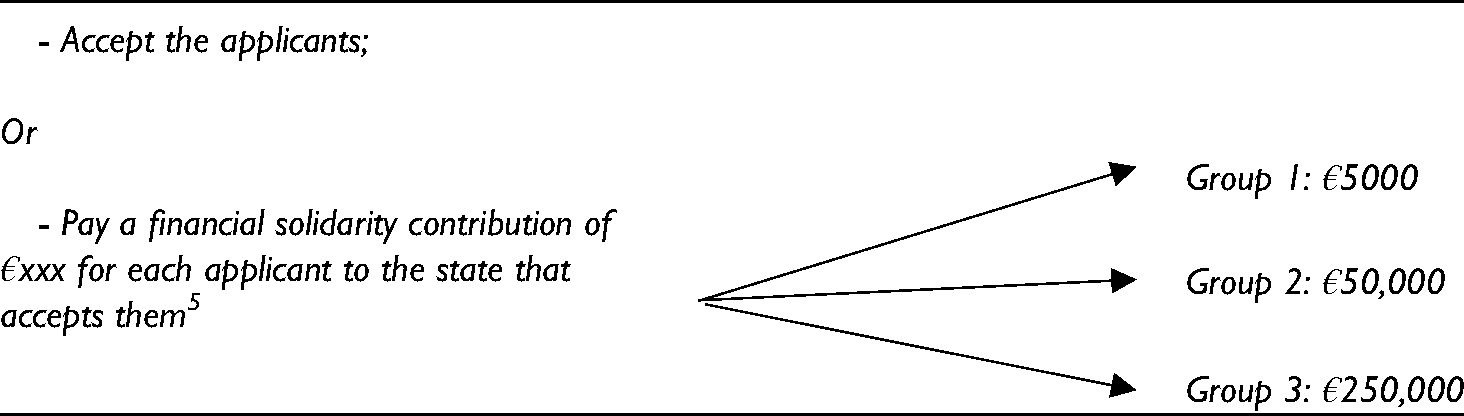
The amounts correspond to credible policy options. The first, €5000, comes close to the amount provided for the Union Resettlement Programme established by the Asylum, Migration and Integration Fund, which provided a lump sum of €6000 for each resettled person (Regulation 516/2014/EU; art. 17). Furthermore, it is a small enough amount to establish a baseline against which to assess other sums. The third amount replicates that of the European Commission's proposal for the reform of the Dublin system (Dublin IV; COM(2016)270 final: 19) which foresees a solidarity contribution of €250,000 for each asylum seeker that a country refuses to admit. The amount was deliberately high and considered as a sanction for derogation to mandatory participation. The second amount – €50,000 – is lower than the Dublin IV reform proposal but still twice as much as the estimated yearly cost of admitting an asylum seeker estimated for Germany (Wagner and Baumgartner, 2017).
Our dependent variable is binary; respondents are constrained to choose between two responsibility-sharing mechanisms, irrespective of their attitudes towards asylum in general. Either respondents are willing to accept the allocation of 100 reallocated applicants to their country or else pay a financial solidarity contribution for each applicant to the state that accepts them. We first compare the three groups’ means through standard analysis of variance tests to provide a first estimate of the effect of the vignettes. Because distribution in the three groups is randomised at the national level, comparing means for each group provides reliable results. However, the treatment effects may be confounded by other factors that are unevenly distributed across groups. We thus test a more complex set of hypotheses by running multivariate logistic regressions. Similarly, multivariate regression allows the investigation of factors determining the outcome, thus helping explain why some people would rather accept asylum seekers in their country or else pay another one to accept them.
Because the respondents were located within specific countries, the observations are not independently distributed. We model heterogeneity through country fixed effects (random intercepts models are provided in the Online appendix to test country-level expectation).
Independent individual-level variables
To investigate the effects of nativism, inclusive citizenship and welfare chauvinism, we create three scales ranging from −3 (most nativist, least inclusive and most welfare chauvinist) to 3 (least nativist, most inclusive and least welfare chauvinist). We employed the following questions to measure nativist sentiments and inclusive citizenship: How much do you agree or disagree with each of the following statements? (Answer options: Strongly agree, Agree, Partly agree, Neutral, Partly disagree, Disagree, Strongly disagree, Don’t know.)
People whose ancestors and family have lived in [Country] for generations should always come first;
Minorities whose ancestors and family have lived in the [Country] for generations should have the same citizen rights as the majority;
People of foreign ancestry who are born and raised in the [Country] should have the same citizen rights as the majority;
Immigrants not born here but who have been granted the [Country]'s citizenship should have the same citizen rights as the majority;
All citizens of [Country] should be able to enjoy the same citizen rights without discrimination.
We observe a clear distinction between item (a) and the four other items. Item (a), by stating that the country's native people always should come first, alludes to the nativist rhetoric that considers the members of the dominant ethnic group to be the only full members of the nation (Mudde, 2007). Items (b) to (e) concern the rights attached to different levels of membership to the citizenry (Kabeer, 2005), namely ethnic minorities (b), second or third-generation migrants (c), first-generation migrants who acquired citizenship (d), and the all-encompassing category of every citizen in the country (e). The two scales are conceptually separate and empirically distinct (as demonstrated in the Online appendix). To extract our two scales, we consider item (a) to be supportive of nativism while we consider the arithmetic mean of the other four items to be supportive of inclusive citizenship.
The degree of welfare chauvinism was measured by asking the respondents (answer options are the same as above): When it comes to the refugees already admitted and living legally in [country], your country should…
Give them access to education, competence-building, and job-seeking on equal terms as citizens;
Give them access to existing social benefits and services on equal terms as citizens;
Give them privileges beyond citizens’ entitlements to enable them to earn a decent living (e.g., free vocational training, cost-free investment credits, public-funded traineeships, etc.).
We follow a similar process as that for our two previous scales. We calculate the arithmetic mean of items (a) to (c) and compare it to the predicted component obtained through Principal component analysis (PCA). The results (presented in detail in the Online appendix) suggest that we should use the arithmetic mean since it is more easily interpretable.
We include several controls. Political affiliation has been shown to be associated with attitudes towards migration (Canetti et al., 2016). We study this association with a variable ranging from 0 (left) to 10 (right). To study the effect of self-interest, we include as independent variables the respondents’ income and their employment status. Furthermore, previous studies indicate that issue salience affects policy preferences (Dennison and Geddes, 2019). To measure salience, the respondents were asked which three issues among a list of issues (including immigration) they think are the most important challenges currently facing their country. Subsequently, the respondents were asked to indicate more precisely how important, from 0 to 10, these issues are to them personally. Salience of migration is thus a scale ranging from 0 to 10. Other individual-level controls include interest in politics (a scale variable ranging from 0 (no interest) to 10 (very interested)), gender, age and country of birth (0 for native, 1 for foreign-born). Whether the respondent is born abroad can be relevant because foreigners might hold different opinions on migration issues than natives (Berlinschi and Harutyunyan, 2019). 6
Country-level independent variables
While the main text only displays fixed effects models, the Online appendix reports the results of random effects models where different hypotheses are tested at country level. Namely, we test the effect of a set of macro-economic features, including gross domestic product (GDP) per capita (in purchasing power parity), growth in GDP, and unemployment (World Bank data). We moreover control for educational attainment through the percentage of the population with tertiary education (Organisation for Economic Co-operation and Development (OECD) and Eurostat). We also include variables aimed to capture migration pressure, which has proven to affect people's opinion on migration and refugees as some countries have received more migrants and/or asylum seekers over the years than others (Hatton, 2016; Hopkins, 2010; Koos and Seibel, 2019; Schneider, 2008). We thus account for the percentage of foreigners residing in the country, the change in said percentage between 2015 and 2020 (United Nations Development Programme [UNDP] data), and the number of asylum claims lodged in the country over the past 3 years (per thousand residents; our elaboration on United Nations High Commissioner for Refugees [UNHCR] data). The percentage of Muslims in the country is also accounted for (several sources; see the Online appendix). We add a dummy variable for EU membership. Finally, we account for population size to control for the relative perception of the importance of 100 new asylum seekers in a country (as per our survey question). Descriptive statistics and data references are available in the Online appendix.
Results
All of the respondents in our survey were asked about the extent to which they agree that all countries should ‘collaborate and strive by all means to protect the world's refugees’. A clear majority (66.6%) of the respondents agree to various extent with this statement (see the Online appendix). Overall, a clear majority of the respondents chooses to accept the asylum seekers rather than pay the solidarity contribution, irrespective of the cost. We observe strong treatment effects: the willingness to admit increases with the size of the contribution. Across countries, 45% of the respondents would want their country to pay if the amount is €5000, 38% if the amount is €50,000, and 32% if the amount increases to €250,000 (Figure 1).
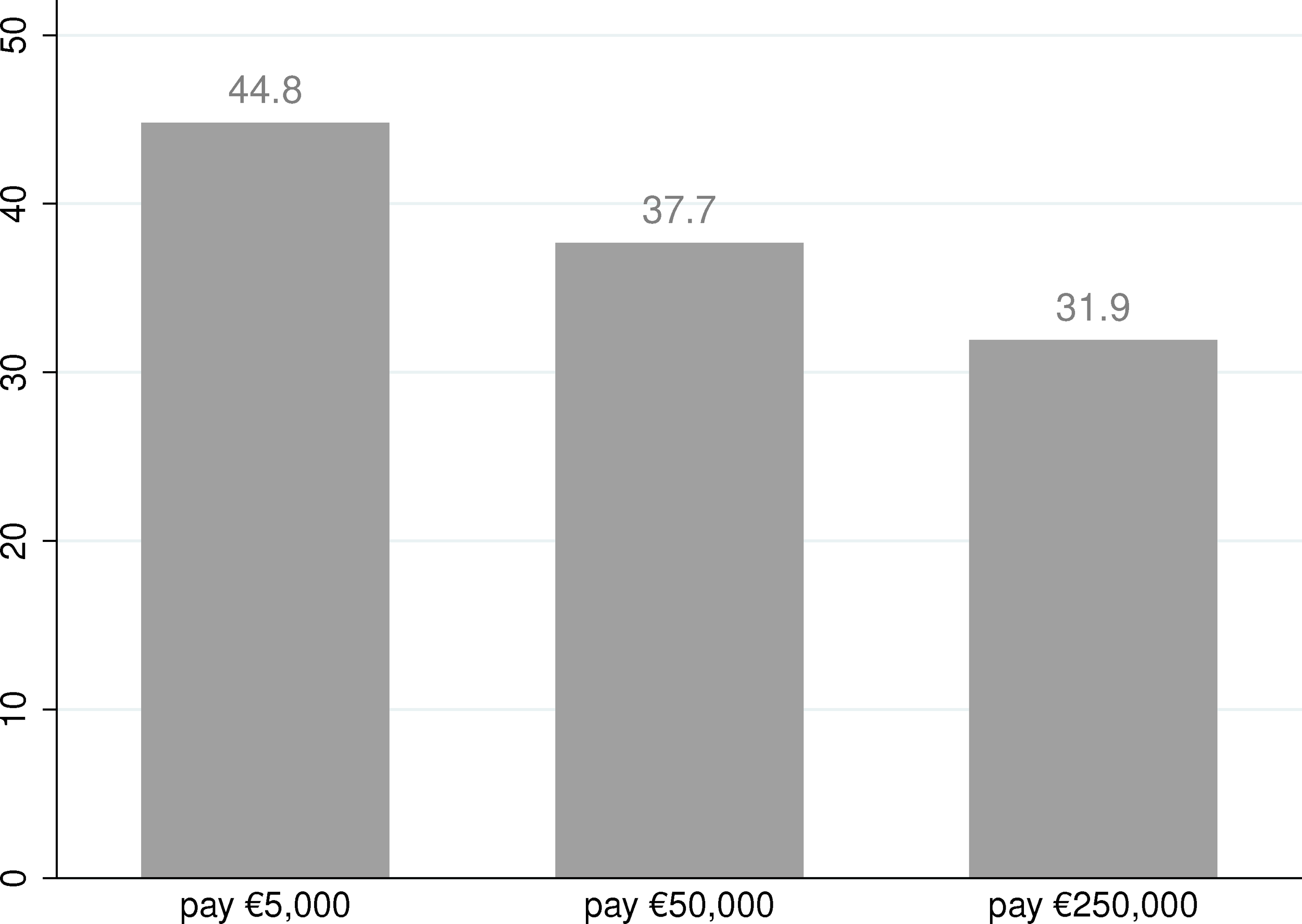
Percentage of respondents willing to pay another country.
The pattern of response is similar across countries but with notable differences in terms of magnitude. Figure 2 shows the difference between the share of respondents choosing to pay in Groups 1 and 3. There are considerable gaps in some countries (Slovenia, Slovakia and the Netherlands) between responses to the €5000 vignette and the €250,000 one, but relatively small differences in other countries (Mexico, Belgium and Sweden). The Online appendix provides more detail on country-level differences and their limited role in explaining cross-country heterogeneity.
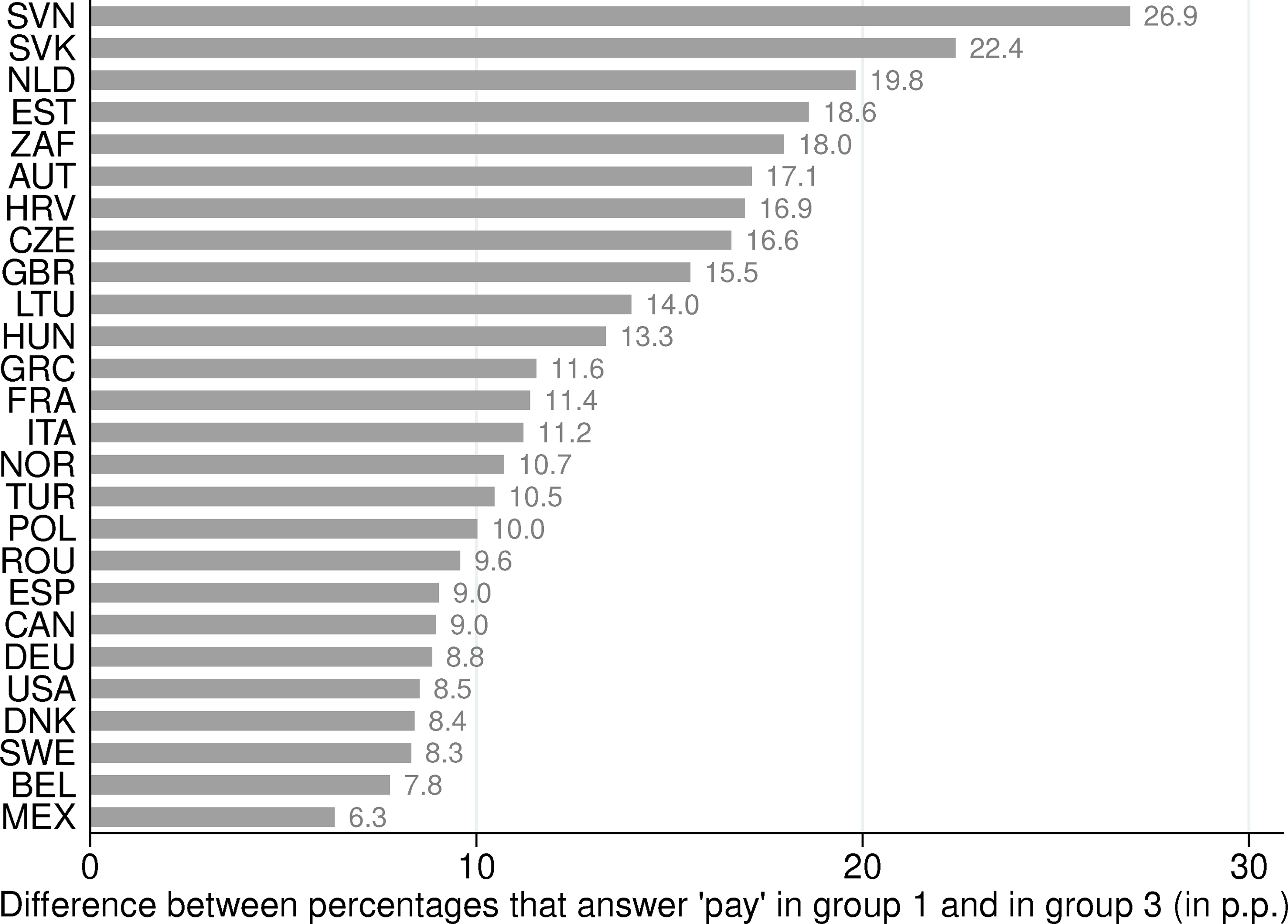
Differences between the percentage of respondents willing to pay in Groups 1 and 3 (in percentage points).
We first explore the treatment effects through an analysis of variance in the data and pairwise comparisons of group means. Table 1 shows the means for the three groups and indicates that at least one group has a mean significantly different from another group (left side of Table 1). Pairwise comparisons of the means show that all three means differ significantly (right side of Table 1).
Analysis of variance and pairwise comparison of the three treatment groups.
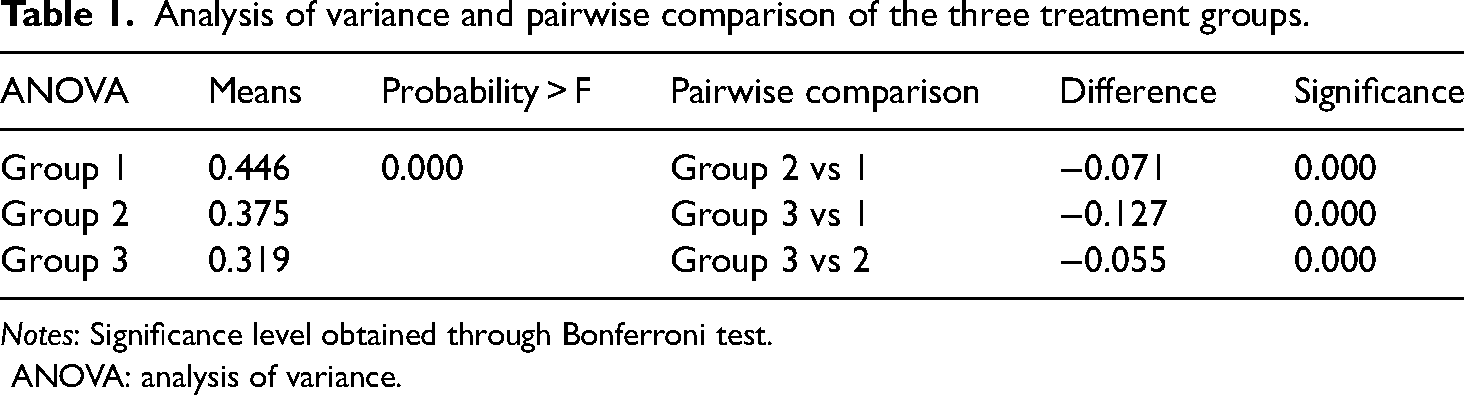
Notes: Significance level obtained through Bonferroni test.
ANOVA: analysis of variance.
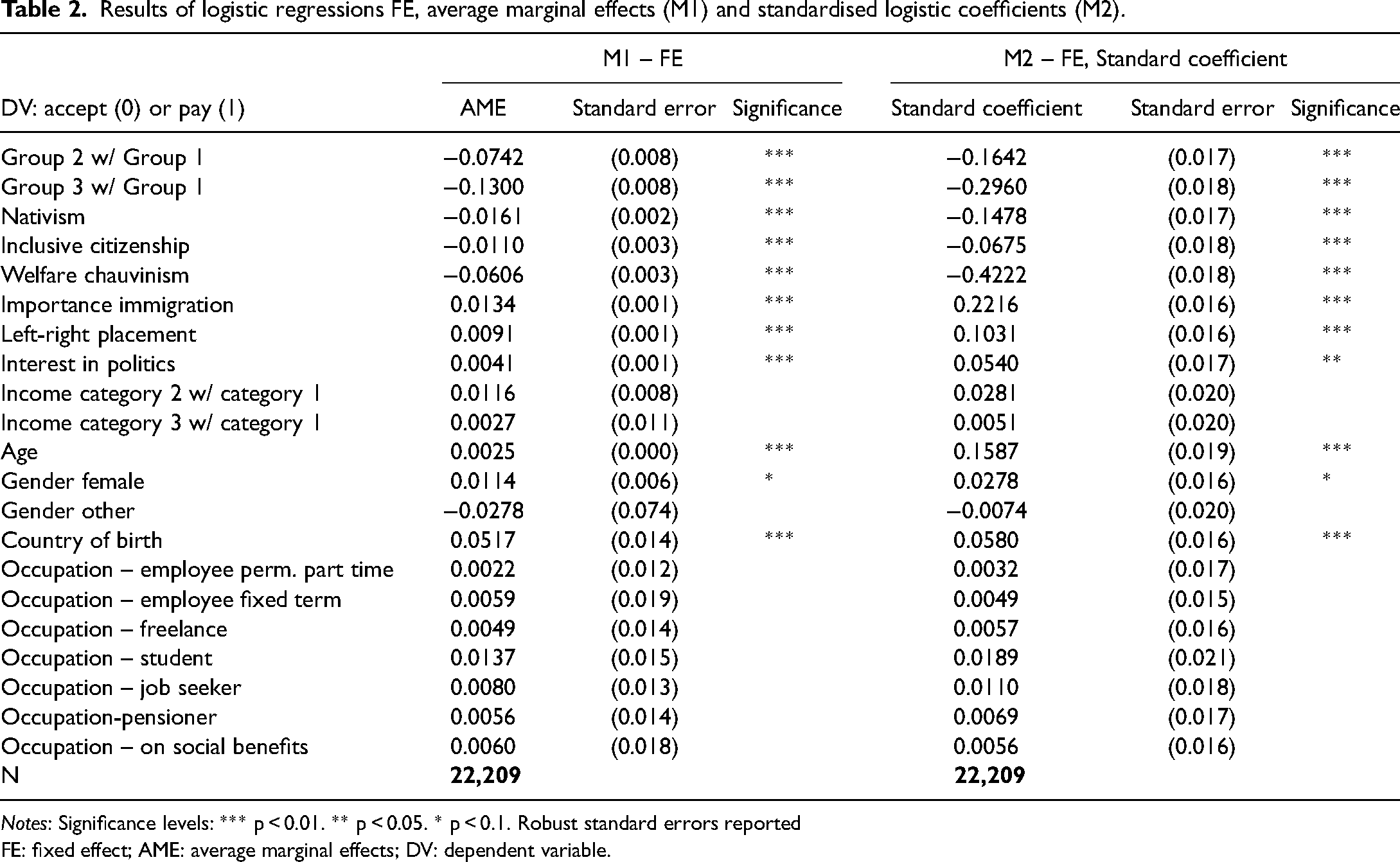
To robustly establish causality, we run more complex models that account for the effect of confounders as well as for country differences. Additional models and robustness tests are available in the Online appendix. Results are obtained through logistic regressions. Table 2 shows the results of two models that account for country heterogeneity through country fixed effects. Random effects models show that country-level explanations only marginally contribute to explaining willingness to pay (see the Online appendix). M1 (Table 2) presents the average marginal effects of our individual-level covariates; M2 (Table 2) reports standardised coefficients to help compare coefficients.
Results of logistic regressions FE, average marginal effects (M1) and standardised logistic coefficients (M2).
Notes: Significance levels: *** p < 0.01. ** p < 0.05. * p < 0.1. Robust standard errors reported
FE: fixed effect; AME: average marginal effects; DV: dependent variable.
The differences in means obtained through simple pairwise comparisons (Table 1) are confirmed in M1 (Table 2), both in terms of statistical significance and magnitude. Namely, the probability of respondents’ willingness to pay decreases as the amount presented increases, by about 7 percentage points from Groups 2 to 1 and by about 13 percentage points from Groups 3 to 1. These results support our expectation that respondents’ propensity to accept or pay is affected by economic calculations – the higher the financial contribution, the more likely they are to accept asylum seekers (E2).
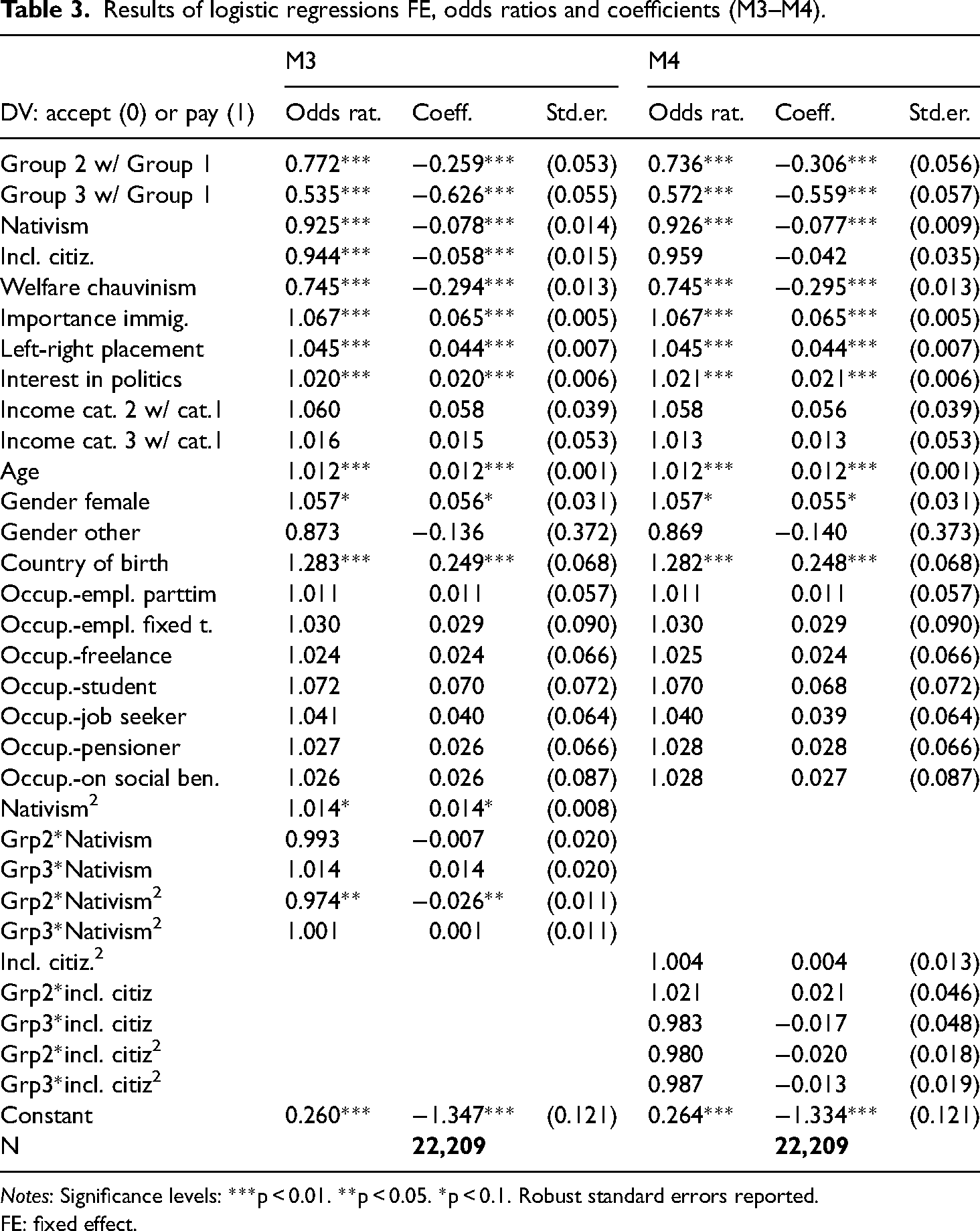
Furthermore, our findings suggest that nativist sentiments, attitudes to citizenship rights, and welfare chauvinism are associated with the decision of whether to accept or to pay. The least nativist respondents (high values on the nativist scale) are significantly more in favour of accepting asylum seekers than the most nativist ones (E3), a finding in line with our expectation and with the literature on nativism and immigration perceived as a cultural threat (Esses et al., 2017; Mudde, 2007). This effect is quite large (M3, Table 3) and constant across the nativist spectrum.
Results of logistic regressions FE, odds ratios and coefficients (M3–M4).
Notes: Significance levels: ***p < 0.01. **p < 0.05. *p < 0.1. Robust standard errors reported.
FE: fixed effect.
Figure 3 displays the predicted probabilities of respondents’ willingness to pay rather than to admit in the three treatment groups. Figure 3(a) shows that the probability of choosing to pay decreases as we move along the values of nativism, from most nativist (left) to least nativist (right). The difference between the three groups is similar in magnitude for all values of the variable.
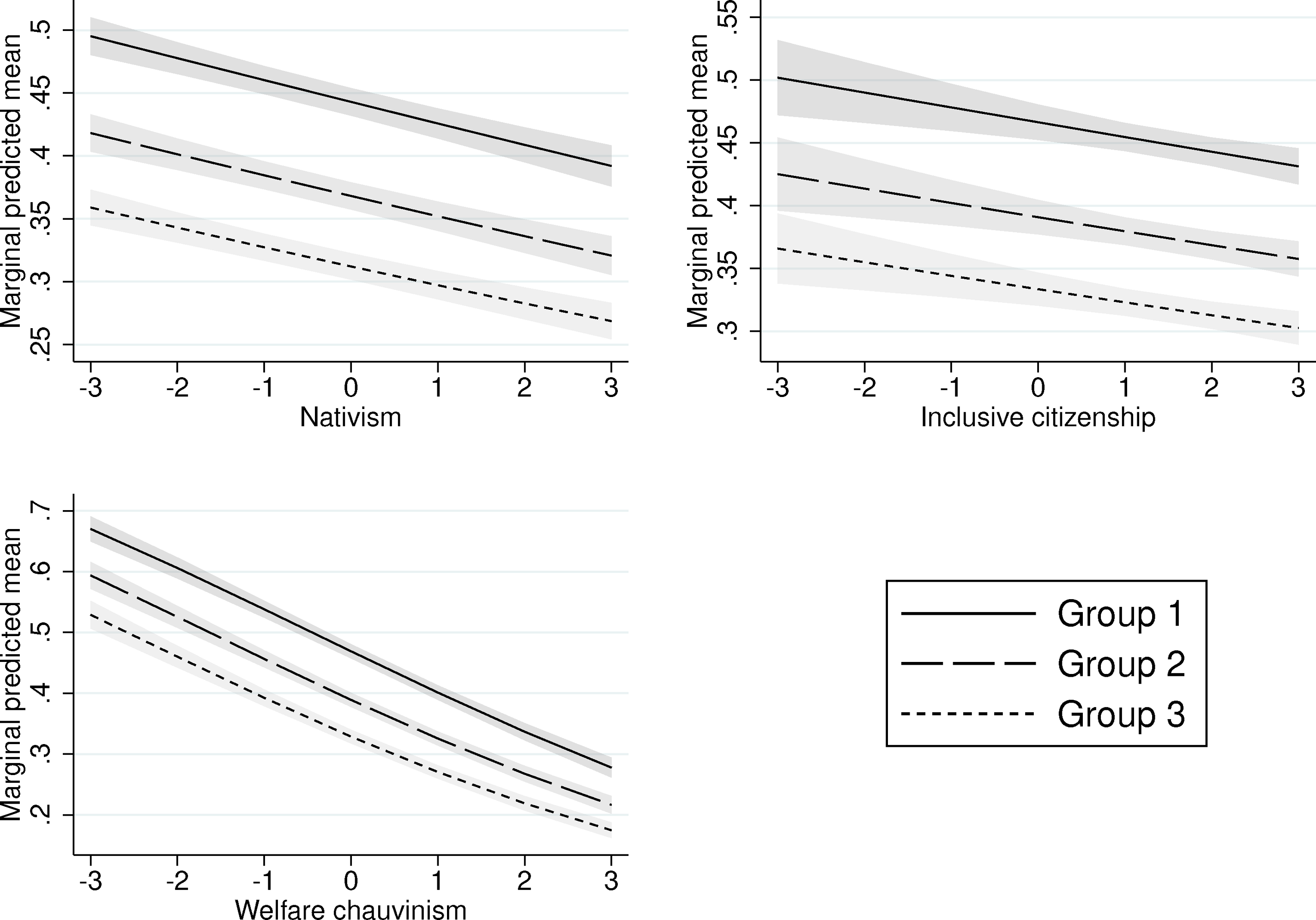
Predicted probabilities of willingness to pay according to values of nativism (a), inclusive citizenship (b) and welfare chauvinism (c) for each treatment group.
A similar trend is observed for the inclusive citizenship scale (E4; Figure 3 (b)), but with a flatter slope, mirroring the size of the average marginal effect shown in Table 2. However, the effect is not robust across the three treatment groups, as the results of separate regressions demonstrate (see the Online appendix). While the coefficient is sizable and statistically significant for Group 3, it is not for the first two groups. This is illustrative of how people trade-off cultural and pecuniary calculations. The position on inclusiveness matters little as long as the costs of reallocating asylum seekers are contained, but it does matter when the amount to be paid is high. Our expectation is thus partly verified: less inclusive conceptions of citizenship are associated with a lower probability of accepting more asylum seekers, but only when the cost of relocating asylum seekers is deemed too high.
The degree of welfare chauvinistic sentiments is also significantly associated with the likelihood of paying (E5; Figure 3(c)). The effect of the variable is sizable and greater in magnitude than nativism and inclusive citizenship (M3, Table 3). In fact, it appears to be the strongest determinant of the probability to choose to pay. Respondents who would rather limit redistribution in favour of non-natives show a higher probability of answering ‘pay’ than those who would include non-natives in redistributive policies.
Turning to the effect of economic calculations (E1), previous studies distinguish between material self-interest and sociotropic concerns. In their review article, Hainmueller and Hopkins (2014: 240) claim that most studies on the association between material self-interest and attitudes towards immigration indicate no such associations. Our analysis confirms these previous findings. Neither unemployment nor wage levels are associated with the willingness to pay.
At the aggregate level, as displayed in the Online appendix, we observe no effect of unemployment (in line with previous findings, notably Hatton (2016)) or GDP per capita. However, we do find an effect of economic change. Higher levels of growth in GDP are associated with increased willingness to pay. This finding contrasts with a study by Hatton (2016) that does not find any effect of economic downturns on attitudes towards migration when analysing economic changes over 10 years. This result may, however, be situational: in 2020 most countries in our sample experienced negative growth due to the COVID-19 emergency, a trend that they had not experienced since the Global Financial Crisis of 2008–2010. Our cross-sectional data does not allow for the assessment of contextual explanations over time.
To test conditional effects of our treatments, we introduce interaction terms between treatment and our main explanatory variables: nativism, inclusive citizenship, welfare chauvinism and income. For nativism and inclusive citizenship, our conditional expectations entail a curvilinear relationship, which we model by squaring the two variables in their respective models in Table 3 (M3 and M4). Treatment effects are not conditional on respondents’ position on inclusive citizenship (E7), partially conditional on respondents’ position on the nativism spectrum (E6), and conditional on the degree of welfare chauvinism (E8). To investigate these interactions further, we compute the average marginal effects of the treatments at different levels of nativism and welfare chauvinism. As Figure 4(a) shows, the cost of financial contributions matters, even for the most nativists, but only when the amount is greater than €5000 (E6). The probability for the most nativists to answer pay is similar if the cost is €50,000 or €250,000, but it is clearly higher for Group 1. For the least nativists, they also are more likely to answer pay when the amount is the lowest and more likely to answer admit if the amount is greater. Interestingly, however, respondents who neither agree nor disagree with nativist statements in Group 2 have a probability of answering pay that is closer to Group 1. This indicates that the treatment effect is lower between Groups 2 and 1 than it is between Groups 3 and 1.
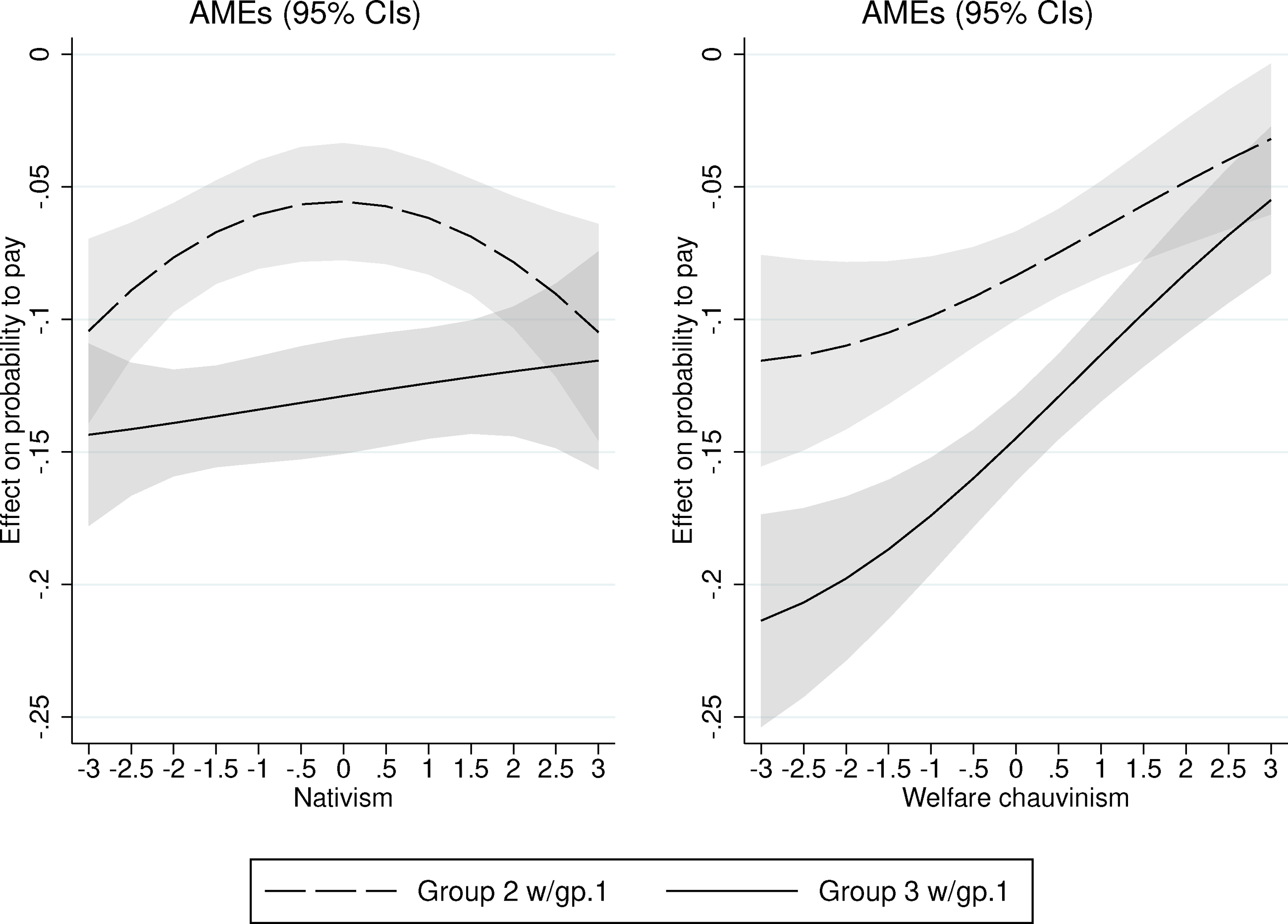
Average marginal effects of treatment groups at different levels of nativism (a) and welfare chauvinism (b).
For welfare chauvinism (E8), the average marginal effects of the treatment groups (the difference between the predicted probability to answer yes in Group 2 or 3 and Group 1) are greater and negative when the respondents are more chauvinistic (Figure 4(a)). This effect becomes smaller as we move towards the right-hand side of Figure 4(a) and is almost null for the least welfare chauvinistic: the average marginal effects are close to zero and the confidence intervals overlap. Put differently, the strongest welfare chauvinists are more likely to choose to pay than those with weaker sentiments, irrespective of the amount. Yet, their probability to be willing to pay significantly decreases as the amount of the financial contribution increases (from 0.7 in Group 1 to 0.5 in Group 3). This responsiveness to the cost of the financial contribution suggests that the strongest welfare chauvinists may also be concerned about public expenditure in general. Conversely, those with the weakest welfare chauvinists are more likely to choose to admit asylum seekers independent of the financial contribution. That is, there is almost no difference between the three groups’ responses (as shown in Figure 4(b)). Our initial hypothesis is thus partly confirmed.
Turning to the conditional effect of treatment at different income levels (E9; M6, Table 4), only the interaction between Group 2 and high income is significantly different – and only at the 90% level – from the interaction between Group 1 and low income. Plotting the predicted probabilities (not reported) reveals that the confidence intervals for the three groups interacted with the three income categories overlap considerably, so that the interaction adds little information to the effect of the variables considered separately.
Results of logistic regressions FEs, odds ratios and coefficients (M5–M6).
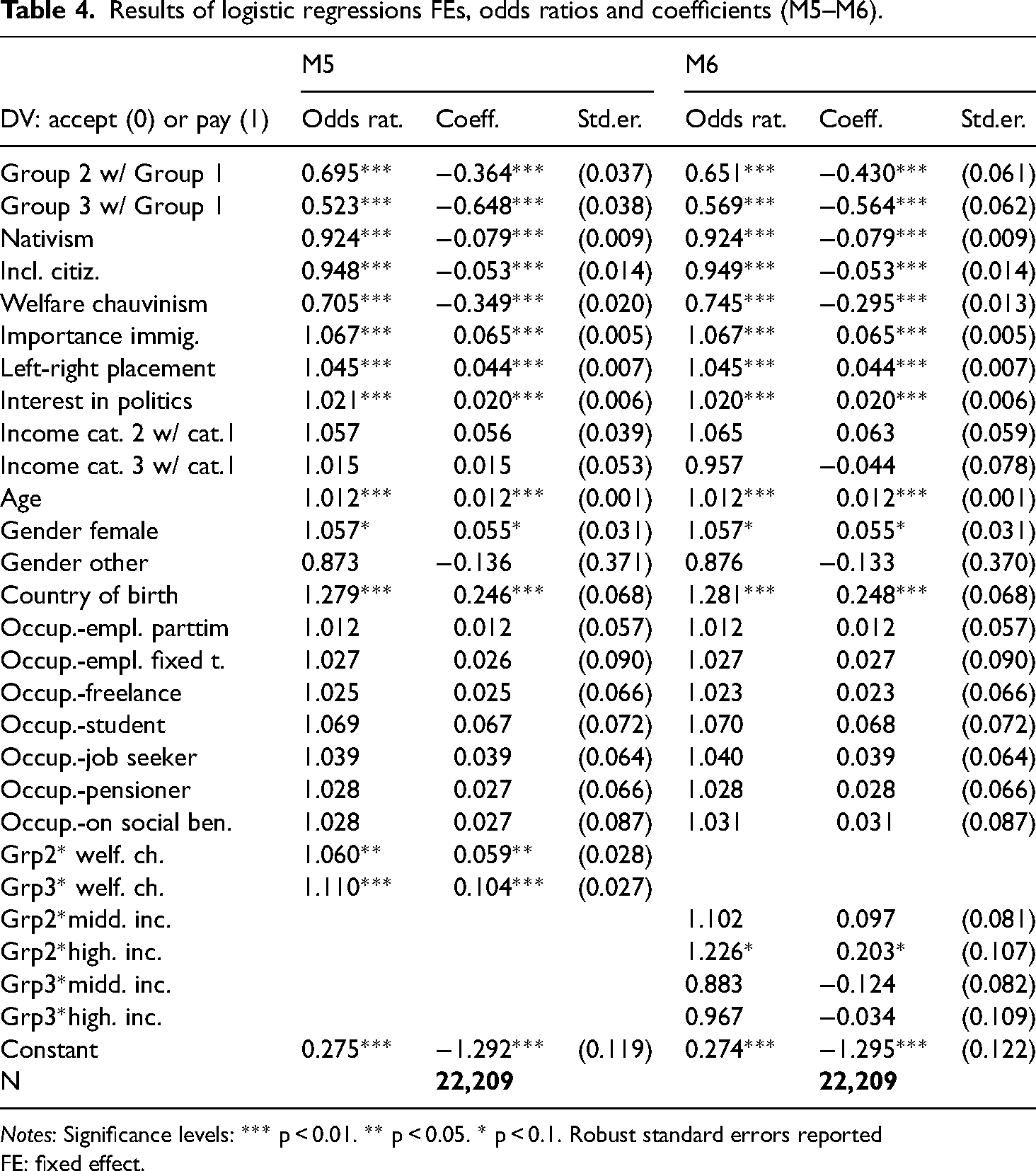
Notes: Significance levels: *** p < 0.01. ** p < 0.05. * p < 0.1. Robust standard errors reported
FE: fixed effect.
Altogether, the results presented in Tables 3 and 4 indicate that the treatment effects are stable across individual characteristics, partially conditional on nativism, and conditional on the respondents’ level of welfare chauvinism.
Conclusion
Given the increasing relevance of burden sharing in refugee issues, it is imperative to understand how people choose between the two main responsibility-sharing mechanisms – admitting more asylum seekers or paying other countries to host them. This article provides novel large-scale evidence on the nature of people's preferences regarding this trade-off from 26 countries. We find that, overall, most people prefer to accept rather than to pay, but we also establish significant individual-level heterogeneity that sheds new light on people's attitudes towards asylum seekers and refugees. Moving beyond simply asking people about their attitudes towards responsibility sharing, we introduce a new research avenue that focuses on the concrete responsibility-sharing mechanisms.
Importantly, we provide a depiction of people's trade-off between the available responsibility-sharing mechanisms in international protection. We find that the cost of non-admission strongly affects people's willingness to accept asylum seekers into their country: the lower the cost of paying, the more likely people are to admit. This observation arguably relates to people's sociotropic concerns; if the price of non-admittance is high, paying can be detrimental for (national) economic performance. Differently, cultural calculations also affect people's willingness to pay. People with nativist sentiments, who believe that immigrants pose a threat to cultural homogeneity and national identity, are more inclined to pay (rather than to admit) compared to non-nativists. This aligns with previous research, which indicates that cultural threat perceptions can cause anti-immigrant sentiments (Esses et al., 2017; Knoll, 2013). Furthermore, we find that people who exhibit a restrictive stance on who is entitled to full citizen rights are more in favour of paying rather than accepting compared to people who have a more lenient notion of citizenship. Both observations align with our theoretical expectations and with previous findings (Sicakkan, 2005).
We also report a particularly strong association between welfare chauvinism and willingness to pay, which can be explained by sociotropic concerns (sharing welfare benefits with refugees is costly and detrimental to economic performance) as well as by cultural concerns (it is unfair that refugees have the same welfare rights as natives).
Treatment effects – the effects of the amount of the solidarity contribution on the willingness to pay – are stable across individual characteristics, with two exceptions. First, they are conditional on degree of welfare chauvinistic sentiments. People who are strong welfare chauvinists are more likely to choose to pay compared to those with weaker welfare chauvinistic sentiments, irrespective of the amount. However, their probability to choose paying significantly decreases as the amount of the financial solidarity contribution increases. Conversely, those with the weakest welfare chauvinist sentiments are more likely to choose to admit asylum seekers, independent of the amount. This indicates that for people who have strong welfare chauvinistic sentiments, sociotropic economic concerns related to the welfare costs of immigration affect their decision to choose one responsibility-sharing mechanism over the other. This aligns with extant evidence on the effect of economic sociotropic concerns on immigration attitudes (e.g., Hainmueller and Hopkins, 2014). Second, treatment effects are partially conditional on respondents’ degree of nativism as the cost of financial contributions matters, even for the most nativists. Our findings are policy relevant. The failure to adopt a stable EU-wide responsibility-sharing instrument (e.g., fierce opposition to Dublin IV's mandatory relocation mechanism and underwhelming performance of the European Commission's temporary relocation schemes), together with endeavours to externalise migration controls to third countries, bears witness to states’ attempt to limit inflows of asylum seekers. Notwithstanding, our results provide compelling evidence of the sustainability of responsibility sharing through relocation programmes. Public opinion is not only favourable to responsibility sharing in general, but furthermore, when they must choose between the two responsibility-sharing mechanisms, a clear majority chooses to accept rather than to pay. In the framework of the New Pact on Migration and Asylum (and also the Global Compact on Refugees), member states have to collaborate on international protection, but relocation is voluntary. Our findings suggest that relocation might receive strong public support.
Two caveats are in order, however. First, we conducted our survey at a time marked by the COVID-19 pandemic. It has been argued that this pandemic has led to increased feelings of threats and competition and of heightened uncertainty (Esses and Hamilton, 2021). Early research indicates that anxiety about the COVID-19 pandemic has negatively impacted immigration attitudes (Hartman et al., 2021). Nevertheless, we still find that most people prefer to admit rather than to pay, and that a clear majority agrees that all countries should collaborate and strive to protect the world's refugees.
Secondly, how people trade off economic calculations and cultural calculations may be affected by other factors that we are not able to measure. Namely, some people may be put off by the very idea of attributing a market value to asylum seekers (Sandel, 2000). Independent of the price of not having to admit asylum seekers, some respondents may simply be put off by the idea of allowing markets to influence immigration issues, and they might be inclined to admit asylum seekers rather than to pay, independently of how they make economic and cultural calculations.
Supplemental Material
sj-pdf-1-eup-10.1177_14651165231156525 - Supplemental material for The trade-off between admitting and paying: Experimental evidence on attitudes towards asylum responsibility-sharing
Supplemental material, sj-pdf-1-eup-10.1177_14651165231156525 for The trade-off between admitting and paying: Experimental evidence on attitudes towards asylum responsibility-sharing by Cornelius Wright Cappelen, Hakan G. Sicakkan and Pierre Georges Van Wolleghem in European Union Politics
Supplemental Material
sj-do-2-eup-10.1177_14651165231156525 - Supplemental material for The trade-off between admitting and paying: Experimental evidence on attitudes towards asylum responsibility-sharing
Supplemental material, sj-do-2-eup-10.1177_14651165231156525 for The trade-off between admitting and paying: Experimental evidence on attitudes towards asylum responsibility-sharing by Cornelius Wright Cappelen, Hakan G. Sicakkan and Pierre Georges Van Wolleghem in European Union Politics
Supplemental Material
sj-dta-3-eup-10.1177_14651165231156525 - Supplemental material for The trade-off between admitting and paying: Experimental evidence on attitudes towards asylum responsibility-sharing
Supplemental material, sj-dta-3-eup-10.1177_14651165231156525 for The trade-off between admitting and paying: Experimental evidence on attitudes towards asylum responsibility-sharing by Cornelius Wright Cappelen, Hakan G. Sicakkan and Pierre Georges Van Wolleghem in European Union Politics
Footnotes
Acknowledgements
We wish to thank the anonymous reviewers for the time they dedicated to commenting on our article. Their insights have been invaluable. We also wish to thank all our colleagues and friends who helped translate and correct our survey questionnaire.
Author Contributions
The authors contributed equally to the article.
Funding
The author(s) disclosed receipt of the following financial support for the research, authorship, and/or publication of this article: This article is part of PROTECT The Right to International Protection: A Pendulum between Globalization and Nativization? ( ), a research and innovation project which is funded by the European Union's Horizon 2020 Framework Programme and coordinated by the University of Bergen (Grant Agreement No 870761).
Supplemental Material
Supplemental material for this article is available online.
Notes
References
Supplementary Material
Please find the following supplemental material available below.
For Open Access articles published under a Creative Commons License, all supplemental material carries the same license as the article it is associated with.
For non-Open Access articles published, all supplemental material carries a non-exclusive license, and permission requests for re-use of supplemental material or any part of supplemental material shall be sent directly to the copyright owner as specified in the copyright notice associated with the article.
