




Abstract
In this paper, we develop the “News is Not Made for Me” scale for measuring audience alienation from news. Drawing on literature highlighting the importance of recognition, learning, and understanding in journalism, we developed this eight-item scale by utilizing findings from qualitative research exploring the gaps between news media and audiences. Using a three-wave panel survey across the United Kingdom (n = 1248) and Brazil (n = 1998), we find that people who score higher on the “News is Not Made for Me” scale tend to be younger, have greater attention problems, lower socioeconomic backgrounds, express lower news self-efficacy, and have greater interest in soft news. We also find that people who believe news is not made for them tend to avoid news more often (despite also reporting higher levels of news consumption), score lower on current affairs knowledge, and score higher on belief in misinformation. Οverall, people who believe the news is not made for them are reaping far fewer benefits from news, despite consuming more of it than their counterparts. The “News is Not Made for Me” scale provides a layer of understanding regarding the growing gap between news audiences and journalists as well as the increasing inequalities in news use and its outcomes.
The rapid growth of available news and information has led to increased choice, feelings of information overload, and increasing inequalities across demographic groups in news use and knowledge gains (Goyanes et al., 2021; Van Aelst et al., 2017; Xu et al., 2024; for a meta-analysis, see Lind and Boomgaarden, 2019). These factors have widened the gap between readers and journalists, leaving readers feeling alienated from their news sources. Qualitative research has repeatedly highlighted audiences’ feelings that news does not seem to be written or produced for them, whether that be because of the language, relevancy, relatability, accessibility, or related reasons (e.g., Delli Carpini et al., 2018; Hardman et al., 2023; Soular and Bernal, 2021). Scholars have identified similar concerns among industry leaders, wherein scarce resources, increasing expectations, and growing distance between producers and consumers have made it difficult to provide timely and useful news and information (e.g., Coddington et al., 2021; Neff et al., 2022). Furthermore, the triad of recognition, learning, and understanding are critical to consumer experiences of news and can drive perceptions of journalism as valuable to audiences (Costera Meijer, 2021). Taken together, these insights suggest that audience alienation may result from a combination of audiences’ perceptions of who the news is for and potential challenges they may experience with various design aspects of news. To help identify these facets of news that audiences find alienating, we develop a scale identifying perceptions that “News is Not Made for Me.”
The News is Not Made for Me scale captures different dimensions of how news consumers perceive news they have encountered, and how those may affect their relationship to news. Notably, the News is Not Made for Me scale builds on but differs from existing concepts such as news avoidance, news fatigue, and news self-efficacy as it captures how audiences’ relationship with the news may be shaped by their perceptions of who the news is made for, and challenges they may face to make sense of the news. We developed an eight-item scale through a process of pretesting (n = 212) and validation across the United Kingdom (n = 1248) and Brazil (n = 1998) in a three-wave panel survey. Brazil and the UK are particularly interesting countries for this study, as they have different media systems and social structures, but comparable levels of digital news use, with most users accessing news online, and declining trust in news (Newman et al., 2024). By testing our scale in these two contexts, we demonstrate the antecedents and consequences of “News is Not Made for Me” perceptions across two diverse democracies.
We find that the News is Not Made for Me measure is associated with several individual-level traits linked to inequalities (i.e., attention, income, education, and age) as well as with news self-efficacy and interests. Paradoxically, people who feel the news is not made for them report frequently consuming news but are also likely to selectively avoid it. Furthermore, we find a concerning relationship wherein people who feel the news is not made for them score lower on current affairs knowledge and higher in misinformation belief, highlighting the potential consequences of audience alienation. This novel measurement thus furthers journalism studies in that it helps explain disparities in consumption and outcomes of news use for a unique group of people feeling left out by news outlets.
Theoretical framework
News made for whom?
When journalists write stories, they envision a reader based on their interpersonal relationships and their interactions with community members in their work (Coddington et al., 2021). This sense of connection and homophily with the reader can lead to blind spots in connecting with audiences they don’t envision, i.e., people who are not like them. As some work has shown that journalists tend to be more middle-class, middle-aged, and well-educated, this limits the scope of the potential imagined audiences (Powers, 2022). Along these lines, scholars have recently criticized contemporary journalism as relying on entrenched and outdated norms, deepening the divide between news and consumers and leading to a striking irrelevancy of most news for everyday audiences (Zelizer et al., 2022). This criticism highlights an important point: journalists may be out of touch with potential consumers. As such, we have kept “news” intentionally vague when we refer to “News is Not Made for Me,” allowing the reader to consider their own perceptions of what constitutes news when evaluating whether it is made for them or not. 1
The items that make up the News is Not Made for Me scale are informed by qualitative research that has investigated how people in underserved communities engage with the news. This body of research identified issues such as language, rurality, and class as barriers to accessing relevant and usable news (e.g., Delli Carpini et al., 2018; Hardman et al., 2023; Lawrence et al., 2022 ; Soular and Bernal, 2021; Stonbely, 2021). These sentiments are also supported by Costera Meijer’s (2021) meta-analytic work defining valuable journalism through audience research projects. This work identifies getting recognition (e.g., feeling a sense of belonging, feeling represented), learning something new (e.g., multi-perspectival, opening up one’s horizon), and increasing mutual understanding (e.g., constructive, empathetic, humorous) as the three key experiences articulated by audiences as integral to journalism in enriching their lives. As such, incorporating the experience of news (i.e., recognition, learning, understanding) into our quantitative scale furthers our understanding of people’s interactions with news and its subsequent outcomes.
The “News is not made for me” profile
The News is Not Made for Me scale builds on pre-existing concepts (e.g., news avoidance, news fatigue, and news finds me) insofar as it aims to capture how people’s experiences with the news may lead to alienation or withdrawal but makes a distinctive conceptual contribution to understanding these dynamics. We draw on extensive literature demonstrating how news audiences experience news and the reasons why they may turn away from it to develop our measure of individual’s perceptions about their own place in the proverbial news audience. Consider, for example, the difference between news fatigue and News is Not Made for Me: One could conceivably perceive news as for them (i.e., a frequent news user) finding it accessible and understandable, yet be overwhelmed and fatigued by the barrage of stories related to specific events (e.g., the COVID-19 pandemic) leading to disillusionment even in regular news users (Nguyen et al., 2022). Indeed, people who believe news is not made for them may avoid feelings of fatigue as they selectively remove parts of the news from their diets that they find alienating.
It is well established that discrepancies in news consumption reflect societal inequalities, including age, gender, income, education, race, and urbanity (e.g., Benesch, 2012; Haugsgjerd and Karlsen, 2022; Shehata and Strömbäck, 2011; Toff and Palmer, 2018). We expect that these inequalities will likely have a similar relationship with News is Not Made for Me, such that less privileged groups may feel more alienated from the news. Furthermore, studies examining relationships between politics and the media have found that news sources tend to cater to more liberal audiences (Usher, 2021) and that far right groups attack and undermine the credibility of traditional news media (Baugut and Neumann, 2018; Massuchin et al., 2022). While political ideology can be a source of alienation, such that one’s ideology may be related to feelings that news is not made for them, we also believe that News is Not Made for Me captures a different dimension than audience polarization insofar as it draws heavily on audience evaluations of news features that can be understood as generally ideologically agnostic (e.g., language complexity, readership community, ability to access content, and pace).
In addition to these well-studied demographic factors, we also consider how problems with attention may influence whether a person feels that news is made for them. Prior qualitative research has demonstrated that news avoiders often feel like the pace of the news is too fast to keep up with or that they get lost trying to put together the bigger picture (Palmer and Toff, 2020; Toff et al., 2023). News fatigue, or exhaustion brought on by repeated exposure to information, has been similarly used to explain the cognitive energy that audiences must expend when consuming news (Gurr and Metag, 2023; Hasell and Halversen, 2024; Tandoc and Kim, 2022). Indeed, audiences report feeling overloaded by the complexity and redundancy of news, which can lead to selective news avoidance (Xu et al., 2024) and difficulty with analyzing information (Tandoc and Kim, 2022). Furthermore, problems with attention have been significantly associated with more political participation, while simultaneously fostering passive “news finds me” consumption habits (Waismel-Manor et al., 2023), raising questions about how these attention problems might relate to feeling alienated by news. We thus anticipate that problems with attention may play a role in feeling like the news is not made for someone. RQ1a: Which individual factors (i.e., age, gender, income, education, political ideology, region, and attention problems) correlate with the News is Not Made for Me measure?
We also consider news self-efficacy and interest in hard/soft news as potentially related to the News is Not Made for Me perception. News self-efficacy examines how confident people feel in their own ability to navigate media institutions (Edgerly, 2021). Recent qualitative research on news avoidance suggests that navigating news can be mentally taxing (Palmer and Toff, 2020; Toff and Nielsen, 2022). A lack of confidence in one’s ability to navigate news can thus lead to resistance or avoidance as people turn away from the mental or emotional work it takes to engage (Edgerly, 2021; Goyanes et al., 2021; Hasell and Halversen, 2024). A key difference between news self-efficacy and News is Not Made for me is that one does not necessarily have to be confident (or insecure) in their information seeking abilities to feel alienated by news. Indeed, the News is Not Made for Me scale is intended to expand on understandings of news self-efficacy by identifying perceived issues with news delivery (e.g., language, pace) and identification (e.g., readership community, accessible channels) that make audiences feel blocked from engagement, which could in turn be both influential of and influenced by their own self-efficacy related to information gathering. As such, we examine the relationship between our novel scale and news self-efficacy. RQ1b: How does news self-efficacy correlate with the News is Not Made for Me measure?
Interest in news is a well-established predictor of news consumption (e.g., Aalberg et al., 2013), with scholars differentiating between hard (e.g., international, business) and soft (e.g., entertainment, sports) news topics (Toff and Kalogeropoulos, 2020). Mainstream media tends to produce a mix of hard and soft news alongside general entertainment programming (Prior, 2003), and this has the potential to diversify audience news consumption (Hahn et al., 2011). Scholarly debates on the value of soft news for political interest and knowledge have been inconsistent, with conflicting findings about the impact on knowledge acquisition, its role as a possible gateway to more information, and its correlation with additional political variables (Baum, 2003; Prior, 2003). We thus consider how the News is Not Made for Me scale relates to interest in hard and soft news, given their different informational features. RQ1c: How does interest in hard/soft news correlate with the News is Not Made for Me measure?
Potential consequences of “News is not made for me”
In addition to investigating the correlates of News is Not Made for Me, we also investigate its potential consequences in terms of news consumption and avoidance, as well as knowledge and vulnerability to misinformation. News avoidance has been a topic of heightened concern in recent years (Andersen et al., 2024). News is Not Made for Me can be a useful measure for understanding selective news avoidance for three key reasons. First, it is possible that audiences feel alienated from news despite choosing to consume it anyway, as demonstrated by information needs assessment research (e.g., Hardman et al., 2023). Second, news avoiders may not necessarily feel alienated by the news, rather, they may simply not be interested in it despite being the imagined audience. Finally, folk theories about news often dictate that “news” refers to political or international affairs, and it is possible that audiences may feel that kind of news is not for them, while consuming other types of news (e.g., sports). We consider, then, how feeling alienated from the news may partially explain recent consumption and avoidance trends. RQ2a: How does the News is Not Made for Me measure correlate with news consumption? RQ2b: How does the News is Not Made for Me measure correlate with selective news avoidance?
Prior research has established that both current affairs knowledge (e.g., Delli Carpini and Keeter, 1993) and belief in misinformation (Humprecht et al., 2020) are shaped by information pathways, including news exposure. Variables such as the news finds me perception (Gil De Zúñiga and Diehl, 2018), selective news avoidance (Damstra et al., 2021), and social media usage (Boukes, 2019) can have adverse effects on political and current affairs knowledge acquisition and retention. Similarly, social media usage (Theocharis et al., 2021), news fatigue and selective news avoidance (Tandoc and Kim, 2022), and information literacy (Bryanov and Vziatysheva, 2021) have demonstrated influences on individual susceptibility to and belief in misinformation statements, which has concerning implications for the role of truth in democratic discourse (e.g., Pérez-Escolar et al., 2023). We thus extend this literature by examining how News is Not Made for Me is associated with these outcomes, providing new insights on how alienation from news relates to key news benefits. RQ2c: How does the News is Not Made for Me measure correlate with current affairs knowledge? RQ2d: How does the News is Not Made for Me measure correlate with misinformation beliefs?
Context: Brazil & UK
To answer these research questions, we tested the News is Not Made for Me scale with two samples across Brazil and the UK. These countries represent democracies with different media systems and social structures in terms of demographic equalities (e.g., United Nations Gender Inequality Index; UNDP, 2024), but comparable levels of digital news use, including via social media (Newman et al., 2024). The differences in language between the two countries also allowed us to validate the scale in English and Portuguese.
Pretest
The pretest was conducted with a sample of 212 respondents from the UK fielded by the Netquest panel company. The original scale had 16 items adapted from various qualitative research projects (see Supplemental Material). Items included statements such as “Deciphering the news is mentally draining” and “Nobody in the news looks like me.” We used Principal Component Analyses to create the final scale. The PCA indicated eight potential components, though only two of these options achieved a sufficient Cronbach’s alpha of internal consistency (≥0.80). After minor adjustments to the newly structured and reduced scale based on our theoretical framework and goals, the resulting scale had strong internal consistency (α = 0.84). See Supplemental Materials for a comprehensive description.
Method
Sample
The study draws from two panel surveys collected simultaneously by Netquest, with ethical approval from [Redacted]. Respondents from the United Kingdom and Brazil were sampled three times between November and December 2024, with the same respondents completing the questionnaires with approximately 1-1.5 weeks in between waves. The number of valid responses from the UK in Wave 1 was 1,248, in Wave 2 was 1,138, and in Wave 3 was 1034 (82.85% retention rate W1-W3). The final number of responses from Brazil in Wave 1 was 1,998, in Wave 2 was 1,849, and in Wave 3 was 1552 (77.68% retention rate W1-W3). See Supplemental Materials for complete sample demographics. While panel surveying allows us to explore associations between variables, we cannot make causal claims based on this dataset.
Measures
News is not made for me
Final News is Not Made for Me Scale.
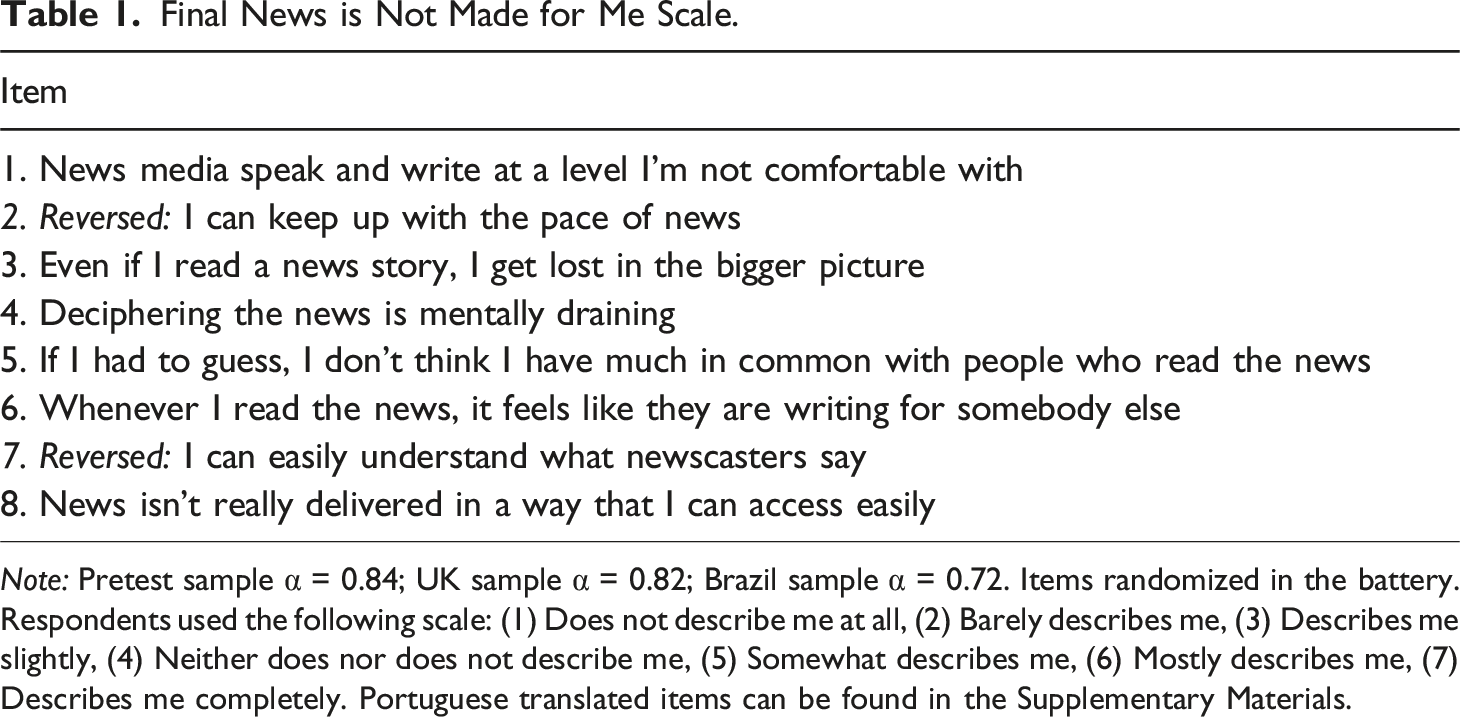
Note: Pretest sample α = 0.84; UK sample α = 0.82; Brazil sample α = 0.72. Items randomized in the battery. Respondents used the following scale: (1) Does not describe me at all, (2) Barely describes me, (3) Describes me slightly, (4) Neither does nor does not describe me, (5) Somewhat describes me, (6) Mostly describes me, (7) Describes me completely. Portuguese translated items can be found in the Supplementary Materials.
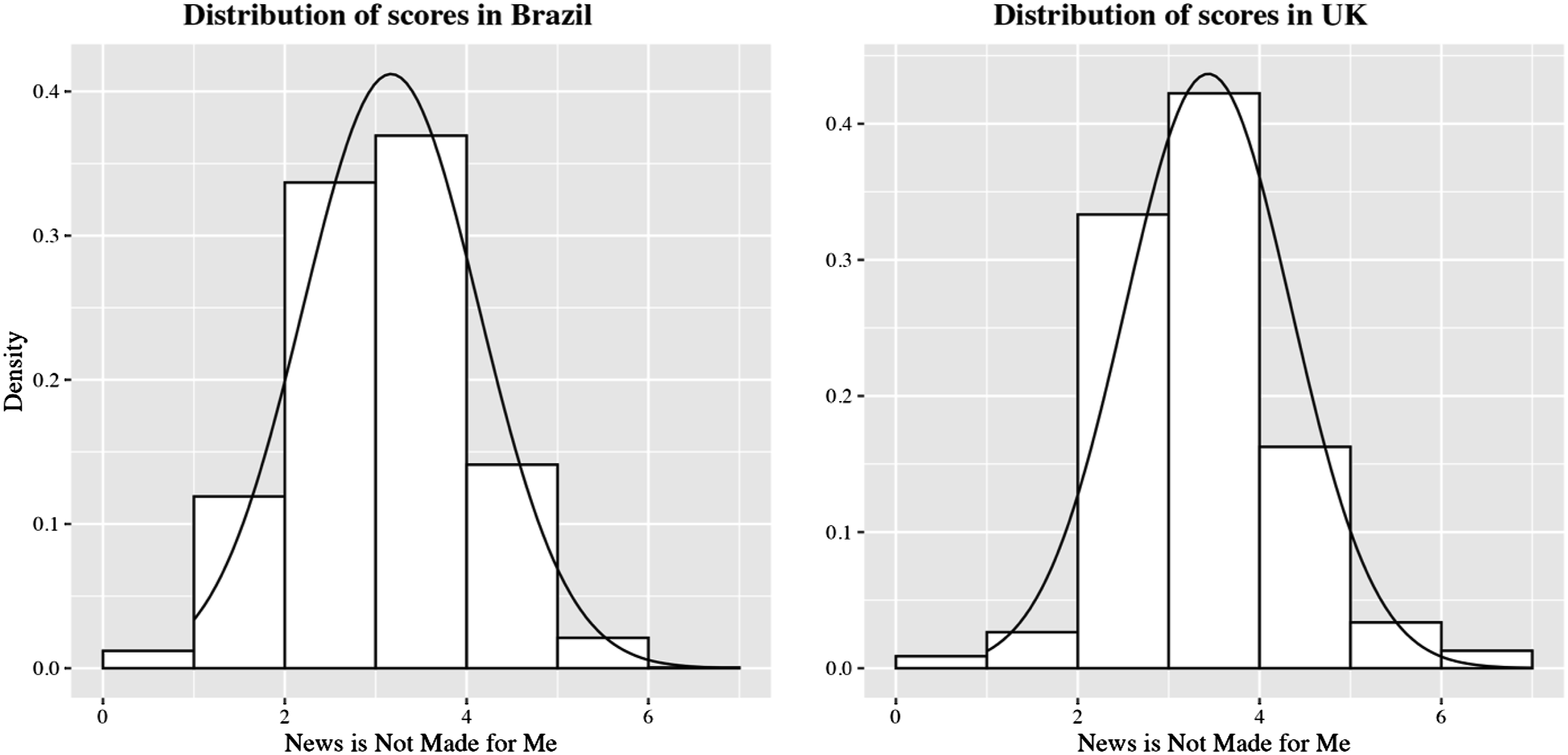
Distribution of News is Not Made for Me scores in Brazil (left) and the UK (right).
Individual factors
We include age, gender, income, education, and political ideology as individual factors correlated with News is Not Made for Me (see RQ1a). Age is measured as a continuous variable in years. Gender was dichotomized as man/not man (i.e., woman, non-binary, prefer not to answer, or prefer to self-describe) for analyses. Income was measured with categorical ranges provided by Netquest based on the local currency. Education was measured with the categorical item used by the Digital News Report (Newman et al., 2024). Political ideology was measured using a seven-point scale from very left-wing to very right-wing, with additional prefer not to answer and don’t know options; this was recoded into two variables in analyses (i.e., left-wing ideology and right-wing ideology).
Two less standard variables are also included as individual factors. First, urbanity of region is adapted from qualitative research on information needs (Hardman et al., 2023; Lawrence et al., 2022). We used an item from the Brazilian census, “Is your home in a rural, suburban, or urban area?” and dichotomized responses as urban/not urban for analysis. Attention problems were measured through an adapted scale used in studies on media multitasking (Baumgartner et al., 2018) and political participation and news use (Waismel-Manor et al., 2023). We pretested the scale and shortened it to four items, such as “I avoid or delay getting started on tasks that require a lot of thought” and “I have problems remembering appointments or obligations.” Respondents answered these using a five-point Likert scale from never to very often.
News self-efficacy
News self-efficacy gauged respondent’s level of self-confidence in navigating news and information systems (Edgerly, 2021). Using a previously validated scale, respondents rated their self-confidence about aspects of news consumption on five items with a seven-point strongly (dis-)agree Likert scale. Items included statements such as “I know how to check if facts in the news are correct or not” and “Most of the time, it is easy for me to determine what information is trustworthy.”
Interest in news
Interest in news was measured using a three-point scale where respondents were asked to rate their level of interest in several topics. Hard news interest is a sum of interest in international, political, business and economic, and crime news; soft news is a sum of interest in entertainment/celebrity, lifestyle, arts/culture, sports, and weird news (Toff and Kalogeropoulos, 2020).
News consumption
News consumption was measured with the question: “In the past week, how often did you get news using the following channels? By news we mean national, international, regional/local news and other topical events” (Newman et al., 2024). Respondents reported their consumption for nine different channels (e.g., news podcasts, print tabloids) using a five-point Likert scale from never to multiple times per day. Total news consumption is a sum of these nine items.
Selective news avoidance
Selective news avoidance was measured using a single item: “Do you find yourself actively trying to avoid news these days?” (Newman et al., 2024), with responses in a five-point Likert scale from always to never. We specify selective news avoidance to reflect news avoidance as an active behavior rather than a wholesale rejection of news (Palmer et al., 2023; Toff et al., 2023).
Current affairs knowledge
Following existing models of multi-wave knowledge measurement (Boukes, 2019; Lecheler and De Vreese, 2017), current affairs knowledge was measured using a sum of correct answers to questions about recent news in each country across all three waves. The waves followed an n + 1 format: Three questions in Wave 1, four in Wave 2, and five in Wave 3. We identified prominent news stories on websites for national news sources and wrote questions about the events that required some basic level of attentiveness to recent news to be answered correctly.
Misinformation belief
Misinformation belief was adapted from previous research (Damstra et al., 2021; Theocharis et al., 2021). Respondents viewed four false statements per wave that were taken from fact checking sources within each country (e.g., Aos Fatos [Brazil] and FullFact [UK]). For each statement, respondents were asked “To the best of your knowledge, how true do you think this statement is?” and answered using a five-point Likert scale from “definitely false” to “definitely true.” Responses were dichotomized so that 1 = believed a statement that was false to be either probably or definitely true (0 = all others) and then summed to create a score, where higher scores indicated participants were more misinformed.
Results
To answer our research questions, we ran six standardized linear regression models. RQ1 is answered with a regression model where News is Not Made for Me is the dependent variable and all individual-level factors (i.e., age, gender, income, education, political ideology, urbanity, attention problems, news self-efficacy, and interest in hard/soft news) are independent variables. RQ2 is answered with five regression models where news consumption, selective news avoidance, current affairs knowledge, autoregressive current affairs knowledge, and misinformation beliefs are each treated as dependent variables. For these models, News is Not Made for Me is an independent variable, alongside various controls. See Supplemental Materials for regression tables.
RQ1: Profile of news is not made for me
Figure 2 plots the regression coefficients for each sample. There are no significant correlations between News is Not Made for Me and gender, right wing ideology, and urbanity in either context. All other relationships are discussed further. Linear regression results where News is Not Made for Me is the Dependent Variable for Brazil (teal) and the UK (pink).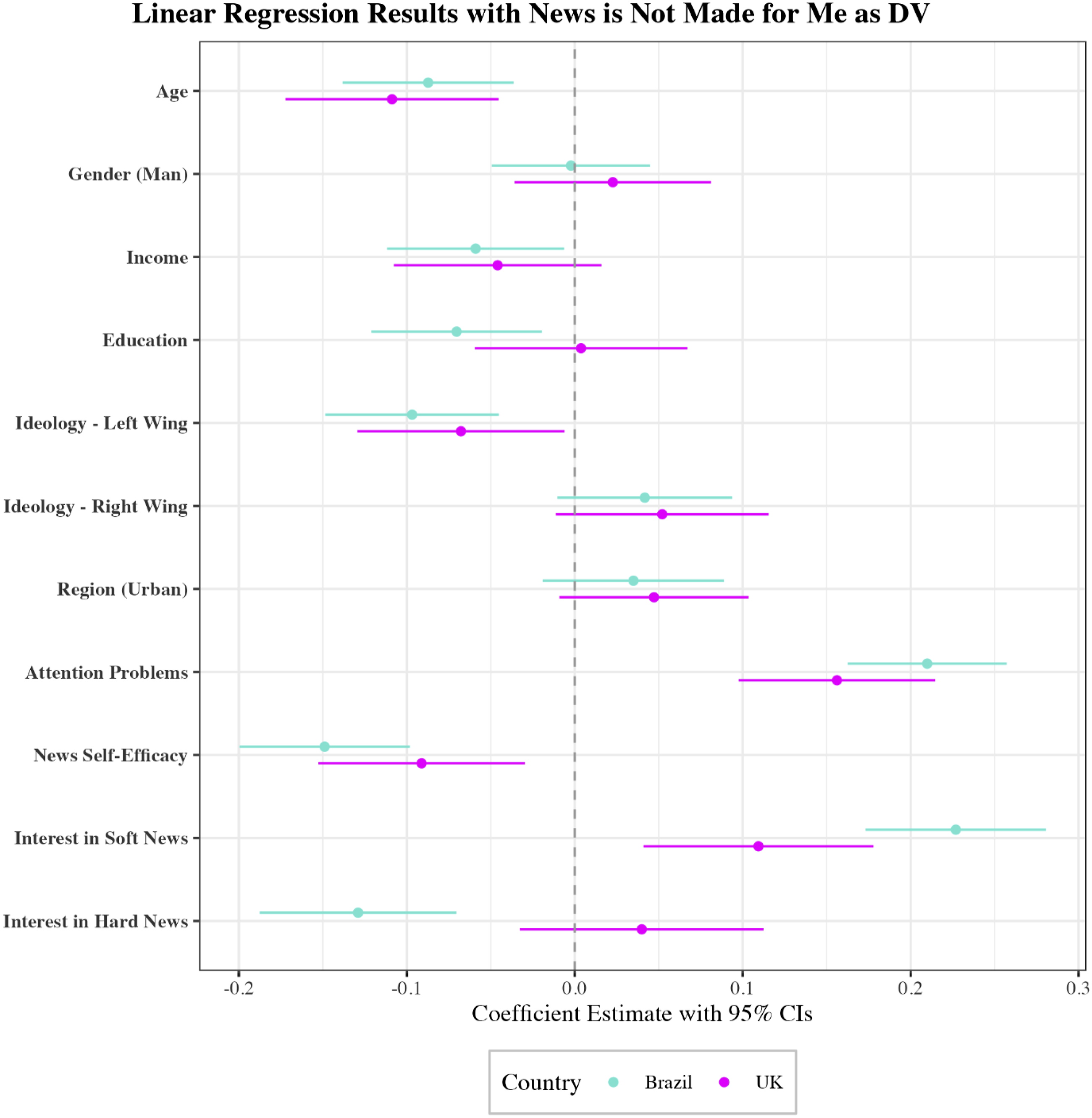
Concerning RQ1a, there are significant relationships between News is Not Made for Me and age, left wing ideology, income, education, and attention problems. In both models, younger people report significantly stronger feelings that the news is not made for them; Brazil β = −0.09; p < .001; UK β = −0.11; p < .001. Left wing ideology is also negatively correlated with News is Not Made for Me, indicating that the further from the left a person identifies, the more likely they are to report stronger feelings that news is not made for them (Brazil β = −0.10; p < .001; UK β = −0.07; p = .031). Income and education are significant predictors of News is Not Made for Me in Brazil (but not the UK), indicating a class element related to perceptions of news. Both relationships are negative, such that those reporting a lower income (Brazil β = −0.06; p = .028) and/or less education (Brazil β = −0.07; p = .007) also report stronger feelings of alienation from the news. Finally, there is a significant, positive relationship between attention problems and News is Not Made for Me wherein those respondents who self-report more issues with attention also report greater feelings that news is not made for them (Brazil β = 0.21; p < .001; UK β = 0.16; p < .001).
Regarding RQ1b, there is a significant negative relationship between news self-efficacy and News is Not Made for Me (Brazil β = −0.15; p < .001; UK β = −0.09; p = .004). Those who feel less confident in their own abilities to navigate information systems also feel more strongly alienated by news. Additionally, interest in soft news has a strong positive relationship with News is Not Made for Me, wherein the more interest a person has in topics like celebrities and sports, the higher they score on the News is Not Made for Me scale (Brazil β = 0.23; p < .001; UK β = 0.11; p = .002). There is also a significant negative relationship between interest in hard news and News is Not Made for Me in Brazil, such that the less interest a person has in topics like politics and business, the more they feel alienated from the news (Brazil β = −0.13; p < .001).
RQ2: Outcomes of news is not made for me
Figure 3 plots the regression coefficients of News is Not Made for Me for five outcome variables (i.e., news consumption, selective news avoidance, current affairs knowledge, autoregressive current affairs knowledge, and misinformation beliefs). All models control for age, gender, income, education, and political ideology; the models for knowledge outcomes and misinformation beliefs additionally control for news consumption. Notably, the News is Not Made for Me measure is significantly correlated with all five outcome variables across both contexts. Regression Coefficients where News is Not Made for is an Independent Variable for Brazil (teal) and the UK (pink).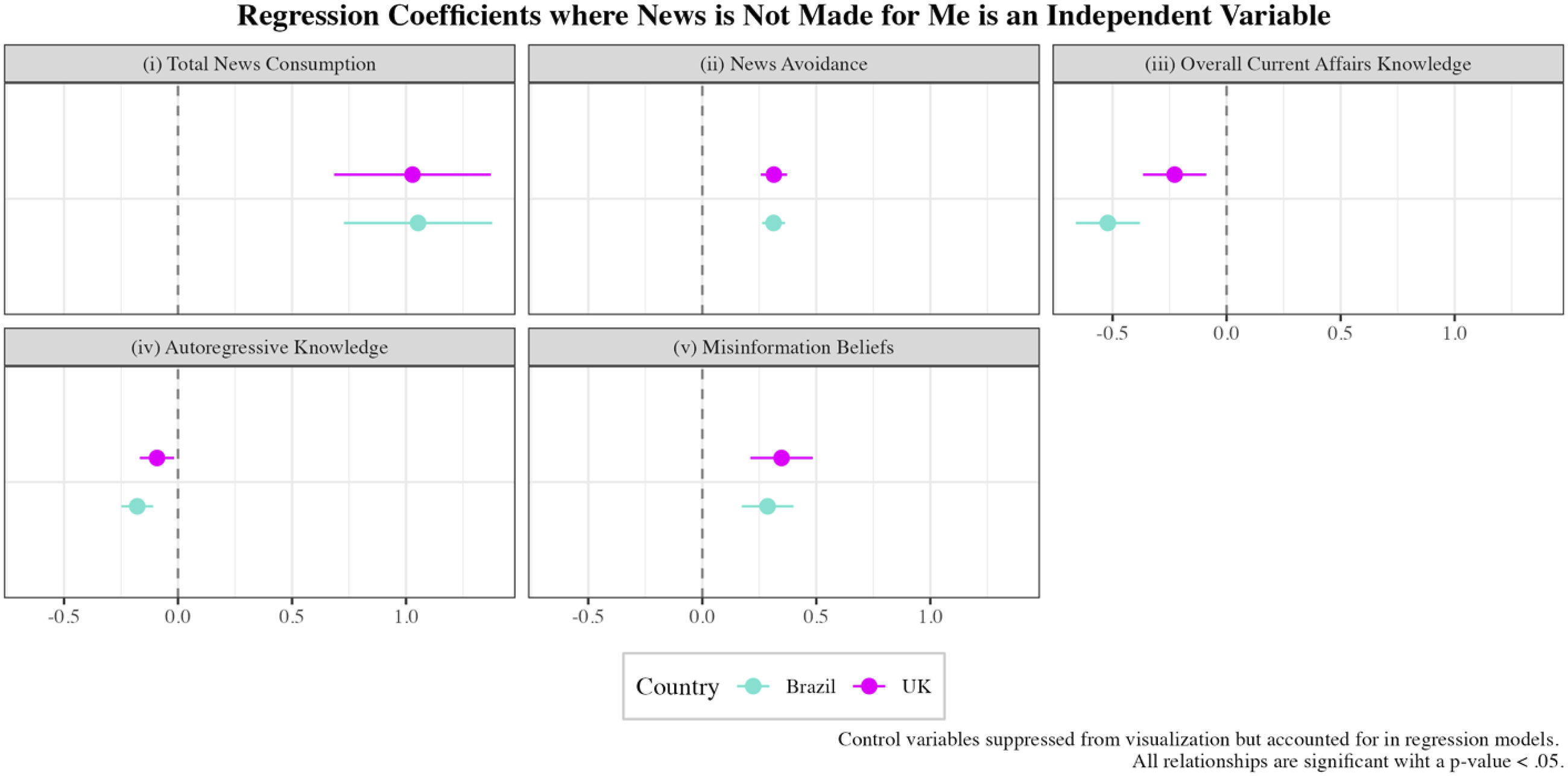
The News is Not Made for Me scale is significantly and positively correlated with total news consumption in both contexts (Brazil β = 1.05; p < .001; UK β = 1.03; p < .001) 3 , meaning that the more someone feels news is not for them, the more they report consuming news. Interestingly, there is also a positive significant relationship between News is Not Made for Me and news avoidance (Brazil β = 0.31; p < .001; UK β = 0.31; p < .001), wherein stronger feelings of alienation from the news are associated with more selective news avoidance. 4
To assess whether the News is Not Made for Me sentiment is associated with factual current affairs knowledge, we measured overall current affairs knowledge and knowledge over time using autoregression (predicting Wave 3 correct knowledge questions, accounting for Wave 1 baseline).
5
We find a negative relationship between News is Not Made for Me and overall current affairs knowledge in Brazil (β = −0.52; p < .001) and the UK (β = −0.23; p = .001). There is also a significant negative relationship between News is Not Made for Me and knowledge in wave 3 accounting for knowledge in wave 1 through autoregression in both countries (Brazil, β = −0.18; p < .001; UK β = - 0.09; p = .016). Thus, despite interests in some news and greater self-reported news consumption, those who feel alienated from the news tend to be less informed about current affairs. Finally, News is Not Made for Me is strongly correlated with misinformation beliefs in both Brazil (β = 0.29; p < .001) and the UK (β = 0.35; p < .001).
Discussion
This study validates a novel “News is Not Made for Me” scale that measures perceptions of alienation from the news. The scale demonstrates and effectively measures previously untapped news audiences’ perceptions of news that can help explain audience alienation. Until now, many of these sentiments were expressed in qualitative terms, with, for example, interviewees sharing their frustrations on the inaccessibility of news (e.g., Delli Carpini et al., 2018; Toff et al., 2023), but existing quantitative work missed this phenomenon due to a lack of adequate empirical measures. Thus, this study makes a distinctive contribution to the study of news audiences by developing a scale that has demonstrable value in the study of news avoidance, who benefits from news, and the proliferation of misinformation. Scholars who are interested in understanding the crisis of news, particularly concerning declines in news use and media literacy, should consider implementing this scale when analyzing news audiences, given its demonstrated functionality at identifying a previously invisible group: those who are alienated by the provision of news as they understand and experience it.
Valuable journalism fosters enrichment in audiences through its ability to elicit experiences related to feeling recognized, learning something new, and increasing mutual understanding (Costera Meijer, 2021). As evidenced by our study, some audiences feel left out by news outlets, indicating that what they consider “news” is not something they think is made for them. These findings echo prior work highlighting how journalists are influenced by their social circles and professional connections (Coddington et al., 2021; Powers, 2022). As journalists are often middle-class, liberal, well-educated people (Powers, 2022; Usher, 2021), it is unsurprising that audiences who feel news is not for them would be younger, less left-leaning, and of lower socioeconomic backgrounds. Journalists and scholars alike should thus consider the features and assumptions built into news (e.g., language complexity and assumed audience education level) that could be ostracizing to the audience, particularly as these sentiments may lead to news avoidance and a misinformed public.
News is Not Made for Me perceptions were most strongly associated with attention problems and lack of news self-efficacy. Both variables point to challenges in navigating a relentless news cycle and a complex media landscape that blurs the lines between journalism, influencers, and bad faith actors (Hasell and Halversen, 2024; Newman et al., 2024). In line with research findings that feeling overwhelmed by news can lead to news avoidance (Gurr and Metag, 2023; Hasell and Halversen, 2024), this study demonstrates that the cognitive demand of keeping up with and interpreting news makes people feel alienated. Indeed, the significant relationship between attention problems and News is Not Made for Me is supported by qualitative research demonstrating that news can be difficult to decipher and mentally taxing (Palmer and Toff, 2020; Toff et al., 2023; Toff and Nielsen, 2022). Furthermore, we extend the body of news fatigue literature by showing how attention problems and confidence in one’s ability to navigate the information environment (i.e., news self-efficacy; Edgerly, 2021; Tandoc and Kim, 2022) are related to the News is Not for Me perception, going beyond an exhaustion with news to an outright alienation.
Importantly, people who feel news is not made for them are not uninterested in news. Rather, they tend to have higher interest in soft news. Perhaps these individuals would benefit from hard news delivered in softer formats, as has been proposed in previous work (e.g., Delli Carpini et al., 2018). People who feel news is not made for them may prefer information that is easier to navigate and digest, which aligns with our findings regarding attention problems and low news self-efficacy. However, our study also echoes previous research that knowledge acquisition is limited when transferred through soft news (Prior, 2003), with the significant negative relationship between News is Not Made for Me and current affairs knowledge (to be discussed further below). Still, the significant correlation between News is Not Made for Me and interest in soft news seems to indicate a failure on the part of hard news to demonstrate itself as valuable journalism to a portion of the audience, as well as potentially indicating that those who believe news is not for them do not consider soft news to be news.
Interestingly, those who express feeling like news is not made for them are not withdrawing from news altogether; instead, they express interest in soft topics and report frequently using news. However, they also report more selective avoidance of news. Though this paradox of more news consumption and more reported avoidance is not out of line with previous research (Andersen et al., 2024), it still raises questions about what kinds of news a person alienated from news would avoid and how this relates to the various items comprising the News is Not Made for Me scale, which could be explored in future research.
Perhaps our most significant contribution is our finding that people who believe the news is not made for them reap far fewer benefits from news, despite consuming more of it than their counterparts. Those who feel alienated from the news know less about current affairs, gain less knowledge over time, and are more vulnerable to misinformation. This points to a gap in learning, where perhaps the language, accessibility, or other features of news stories makes retention and understanding difficult for some consumers. These individuals potentially miss out on previously established links between knowledge and resilience to misinformation (Damstra et al., 2021; Tandoc and Kim, 2022). As such, the News is Not Made for Me scale makes an important contribution in helping scholars understand the crisis of news use by showing how alienation from news can negatively influence previously established barometers for benefits of news use.
This study has several limitations that scholars should consider as they apply the News is Not Made for Me scale in their studies. First, this study was conducted using online panels, and findings may not describe audiences who primarily get their news offline. Second, our findings may not replicate in political and media systems that are very different from the ones we studied. Third, while our use of panel surveys is advantageous compared to cross-sectional designs, scholars should consider prioritizing causal relationships to address more ambiguously directional variables, including variables we did not account for. Additionally, future research should test the scale with more specificity to see if our findings hold in different arenas (e.g., health news or newspapers are not made for me) and accounting for societal-level variables (e.g., in contexts of varying levels of political parallelism or media distrust).
As journalism scholars continue to unravel the psychological mechanisms behind information processing, knowledge acquisition, and its related outcomes, it is critical that they account for whether people feel like (1) they are an intended audience member and (2) they can efficaciously navigate the news environment. By tapping into the disconnect between news production and news audiences, the News is Not Made for Me scale makes a distinctive contribution to developing effective approaches to address the crisis of news use and related contemporary challenges, including avoidance, misinformation, and benefits of news use, across numerous fields, including journalism, political communication, and psychology.
Supplemental Material
Supplemental Material - News is not made for me: A novel scale for measuring audience alienation from news and its outcomes
Supplemental Material for News is not made for me: A novel scale for measuring audience alienation from news and its outcomes by Courtney D Tabor, Antonis Kalogeropoulos, Patrícia Rossini in Journalism
Footnotes
Acknowledgements
The authors would like to thank Atri Mukherjee for his support in the early stages of this project. The authors would also like to thank the peer reviewers and journal editors for their constructive criticism, and all others who have helped shape this paper.
Declaration of conflicting interests
The author(s) declared no potential conflicts of interest with respect to the research, authorship, and/or publication of this article.
Funding
The author(s) disclosed receipt of the following financial support for the research, authorship, and/or publication of this article: Funded by the European Union (Project 101077310).
Disclaimer
Views and opinions expressed are however those of the author(s) only and do not necessarily reflect those of the European Union or the European Research Council Executive Agency. Neither the European Union nor the granting authority can be held responsible for them.
Ethical approval
Ethical approval was granted by Vrije Universiteit Brussel.
Informed consent
Respondents provided their informed consent at the start of the study. These documents can be provided upon request.

Data Availability Statement
Data and materials for this research can be provided upon request.
Supplemental Material
Supplemental material for this article is available online.
Notes
Author biographies
References
Supplementary Material
Please find the following supplemental material available below.
For Open Access articles published under a Creative Commons License, all supplemental material carries the same license as the article it is associated with.
For non-Open Access articles published, all supplemental material carries a non-exclusive license, and permission requests for re-use of supplemental material or any part of supplemental material shall be sent directly to the copyright owner as specified in the copyright notice associated with the article.
