




Abstract
Concern over misinformation on social media has amplified calls to improve the public’s knowledge about how news is produced, distributed and financed. This study investigates the relationship between people’s news media knowledge and the ways in which they use social media for news using online survey data in five countries: the United Kingdom, United States, Germany, Spain and Sweden (N = 10,595). We find that people with higher news media knowledge are more likely to include social media in their news repertoire – but not as their main or only source of news. Second, we find that news media knowledge is positively associated with paying attention to source and editorial cues. When it comes to different social endorsement cues, news media knowledge is positively associated with paying attention to the person who shared the news, but negatively associated with paying attention to the number of likes, comments and shares.
The complexity of national and global news environments has drastically increased in recent years. We have moved from a relatively clear, structured, print- and broadcast-dominated environment to a digital world that is intricate and constantly evolving. And even though it has long been impossible to follow all the news (Graber, 1984), the supply of information today can feel almost limitless. People have to manage an ever more crowded information space. They have to make numerous decisions per day among an abundance of available information sources online and offline. They have to decide which information to trust, which to ignore, and which to dismiss as false or misleading, and they have to find a balance between too much and too little news consumption. In this context, social media are often discussed as particularly challenging because of the different (partially automated) rules by which people come across news and information within these networks compared to traditional news media (Thorson and Wells, 2016). There is also high concern about social networks like Facebook, Twitter and YouTube as potential sources of false or misleading information (Newman et al., 2020).
These observations have motivated thinking on what could help people to manage and navigate the contemporary news environment in ways that are both beneficial for the individual and society. One solution often discussed by scholars, journalists and policymakers is to enhance the public’s knowledge about the news – that is, their knowledge of how the news is produced, distributed, or financed. Much like political knowledge that has been shown to influence turnout and vote choice, or even a person’s political beliefs (Delli Carpini and Keeter, 1996), news media knowledge can be thought of as a ‘consequential civic resource’ (Amazeen and Bucy, 2019: 416) with the potential to empower citizens to successfully participate in the complex information environment they live in today.
The present study investigates this potential in that it examines the role that news media knowledge plays in if and how people use social media as a news source. We build upon existing research in two respects. First, by exploring the association between news media knowledge and how people use social media for news – in particular, how social media fits alongside other sources of news (e.g. television, radio, print and news websites) in people’s news repertoires, and what features of a social media news post people rely on when establishing whether it is worth their time (e.g. source cues, editorial cues, social endorsement cues). Second, by using online survey data to explore these associations across five different countries (United Kingdom, United States, Germany, Spain and Sweden).
Across all five countries, we find that (1) people with higher levels of news media knowledge are more likely to have social media as part of their news repertoire. However, (2) among those that do use social media as a source of news, those with lower levels of knowledge of the news media are more likely to say it is their main or only source of news (ahead of print, television, radio, or news websites). In other words, higher news media knowledge is associated with using social media as a supplement to other sources of news, and lower news media knowledge is associated with using social media as a main or only source of news. We also find that (3) news media knowledge is positively associated with deeming different sources and editorial cues on social media important, such as the news brand and the accompanying picture or headline. Higher news media knowledge is also associated with considering the person who shared the news story important, but negatively associated with ascribing importance to the number of likes, comments and shares a story has. These findings suggest that existing ideas about what constitutes news media knowledge, though largely developed within the context of the US media system, may also be applicable elsewhere (e.g. Amazeen and Bucy, 2019; Maksl et al., 2015; Tully et al., 2021). They also add more detail to our understanding of how people with varying levels of knowledge about the news navigate news and information on social media.
News media knowledge
We define news media knowledge in a similar way to how Delli Carpini and Keeter (1996) defined political knowledge 25 years ago (p. 10). That is, as the range of factual information about news that people have stored in their long-term memory. Three elements of this definition are critical to what may or may not constitute news media knowledge: the focus on information (as opposed to attitudes, values, beliefs and opinions), the emphasis on factual (as opposed to incorrect information or information that ‘is not subject to reasonable tests of correctness’, Delli Carpini and Keeter, 1996: 11), and the notion of a range of information (vs individual facts alone).
A few studies in the field of communication have introduced conceptualisations of news media knowledge that come very close to this definition. For example, Amazeen and Bucy (2019) examined the role of procedural news knowledge in people’s ability to recognise fabricated news. This referred to knowledge about ‘how mainstream news organisations operate’ or about ‘what legitimate news production and reporting entails’ (Amazeen and Bucy, 2019: 419). News media knowledge also plays an important role in research on news literacy, where it was initially termed news media system knowledge (Maksl et al., 2015). Recently, the concept of news literacy has been developed further and is now understood to comprise (1) knowledge about the news and (2) people’s skills ‘to exercise some control over their relationship with news’ (Tully et al., 2021: 5). To help distinguish broader conceptualisations from what we focus on in our study, we refer to news media knowledge here.
People have different views regarding what exactly news media knowledge should encompass. Even if we focus on factual information alone, there is considerable room for legitimate disagreement over what domains are relevant, what specific knowledge would constitute an adequate understanding of that domain, and how empirical information pertaining to them should be interpreted. Here we include knowledge about how the news is produced, how it is distributed and how it is financed. But naturally, all of this will vary depending on the context, as different countries are home to different media systems (Brüggemann et al., 2014), each requiring different sets of knowledge. And, of course, media systems themselves are constantly evolving, and what constitutes news media knowledge today may no longer be sufficient tomorrow.
Despite the potential difficulties of defining and conceptualising news media knowledge and the use of different measures and operationalizations, studies in the field agree on the idea that news media knowledge has the potential to encourage news-related behaviours that are beneficial for the individual as well as for society. Just as political knowledge is thought to (and has been found to) positively impact different forms of political participation, for example, turnout, ‘because people know where, how, and for whom to vote’ (Prior, 2005: 579), news media knowledge is expected to positively impact different forms of participation around news, for example, where people find news and how they establish whether it is truthful – because people know more about where, how and from whom to get it.
And indeed, empirical research that has made use of news media knowledge measures mostly finds positive associations between knowing more about the news and behaving in ways that are often thought of as normatively desirable. For example, closest to our own research, Amazeen and Bucy (2019) have shown that individuals with higher levels of what they called procedural news knowledge are better able to distinguish between real and ‘fake’ headlines. News literacy studies that analyse the influence of news media knowledge separately from other news literacy dimensions show that US university students who are more knowledgeable about the news are also more knowledgeable about political events (Ashley et al., 2017) and that US adults with greater knowledge about the news are less likely to endorse conspiracy theories (Craft et al., 2017).
News media knowledge and social media as a news source
One shortcoming of recent research into news media knowledge is that few studies have thus far explored how it is linked to people’s use of social networks to get news. In many countries, the Internet now competes with television as people’s main source of news, and social media is used for news by a significant minority (Newman et al., 2020). Using social media for news is different from using other sources, such as television, print, or even news websites, in several important respects. First, in addition to providing news from established legacy media, social media also provides news from a whole host of new ‘digital-born’ outlets with different journalistic practises and norms, as well as pieces of user-generated content that blur the lines between ‘the news’ and ‘new information’ (Edgerly and Vraga, 2020). Second, because social networks surface news using a combination of different curation processes from a variety of different actors, including algorithms and other users, they apply a secondary process of selection to what has already been selected as news by editors and journalists (Thorson and Wells, 2016). And third, because news on social media is packaged differently. Links to news stories are typically presented in the form of snippets, which contain a headline and picture to introduce the story, and the name of the outlet that produced it, together with additional information about the level of interaction with that story from other users.
In one of the few studies to focus on social media, Vraga and Tully (2021) found that people’s ‘knowledge of media structures and effects’ (p. 157) is negatively associated with seeing more news and political content on Facebook and YouTube, and with posting news and political information on Facebook, YouTube and Twitter – and that individuals who know more about the news are more sceptical of the information they see there. But research has not yet explored whether and how news knowledge relates to differences in how people integrate social media into their news repertoires, or whether there are consistent patterns across countries.
We can imagine that people’s news repertoires vary in terms of the importance of social media, ranging from not using it at all, through using it as a secondary source of news, to using it as the primary or perhaps only source of news – and that these choices are associated with different levels of news media knowledge. We believe that individuals who know about how the news is made and distributed are aware of the various online and offline sources of news, of which social media are a part, and aware that different sources offer different types of news. We suspect that they will recognise social media as a viable source of news that they can benefit from, for example, because it offers information that cannot be found elsewhere or because it presents news in entertaining ways (Newman et al., 2021). However, we expect to see differences by news media knowledge within the group that uses social media for news, especially when it comes to understanding why some choose social media as their primary or only source of news. While a news repertoire heavily reliant on social media can still be rich and diverse in theory, most social networks do not prioritise news. Only a very small proportion of tweets (Malik and Pfeffer, 2016) and YouTube videos (Van Kessel et al., 2019) are news-related, and Facebook claims that just 4% of people’s feeds are taken up by news (Zuckerberg, 2018). Although individuals who know how news is distributed and produced in contemporary media environments might also be more likely to curate their social feed so it contains more news (or a specific type of news), it seems unlikely that they would rely primarily or solely on social media as a news source given the range of other online and offline sources available and the different types of news they offer.
We will test these assumptions using the logic of contrasts depicted in Figure 1. We explore how news media knowledge predicts the likelihood of being in groups defined by different levels of social media news use. We posit that people with higher news media knowledge will be more likely to use social media for news versus not using it at all (H1), but among social media users, people with higher news media knowledge will be less likely to have social media as their primary news source (H2), and less likely still to have it as their only source of news (H3).
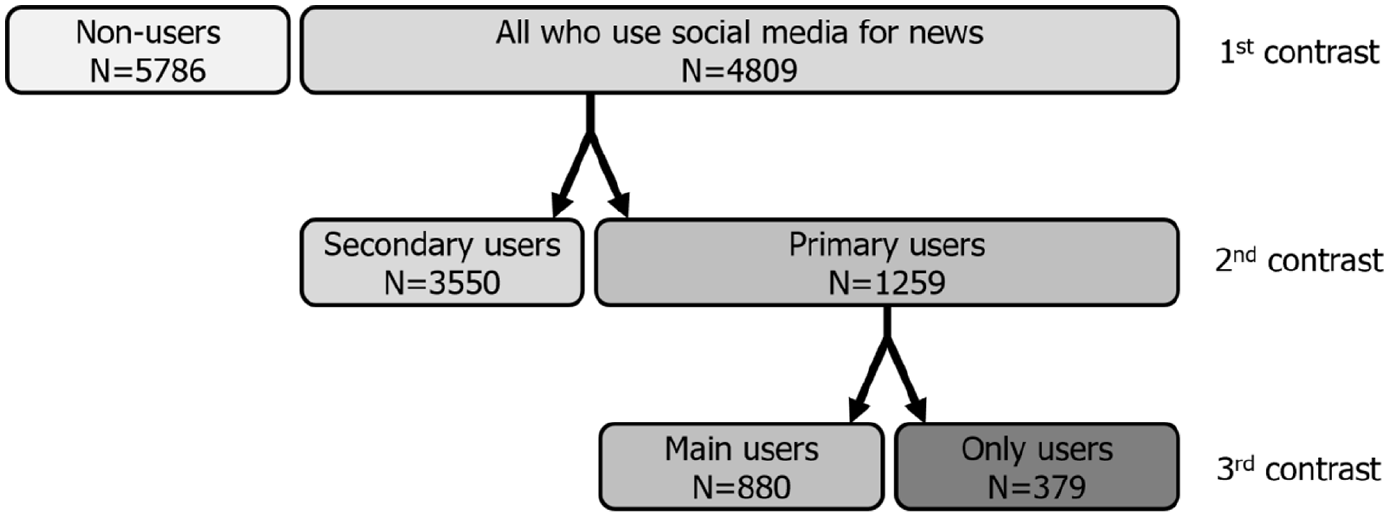
Planned contrasts between different types of social media news users.
News media knowledge and source and social cues on social media
We also expect differences in news media knowledge in how people make selection decisions around news on social media. Economists sometimes refer to news as an ‘experience good’ (Hamilton, 2004), meaning its value can only truly be judged after consumption and that people must rely on heuristics triggered by certain cues to decide in advance whether a news item is likely to be worth their time (cf. Petty and Cacioppo, 1986). When people encounter news on social media, a wide range of indicators surrounding a news snippet can be used to draw conclusions about its value. We can divide these into two categories: source cues (e.g. the news brand, headline, or an accompanying picture), and personal and aggregated social endorsement cues (e.g. the person who shared it, or the number of likes, comments and shares) (Kümpel, 2019; Messing and Westwood, 2014). All of these vary in terms of how reliable or potentially misleading they are, also depending on how much faith individual users have in them.
One of the most prominent source cues available to users is the news brand that originally published the story. People associate different news brands with certain traits, such as sincerity and sophistication (Chan-Olmsted and Cha, 2007), and trust some news brands more than others (Newman et al., 2020). Regardless of the specific associations people might have with news outlets, a key purpose of branding is to guide people’s expectations in a consistent way, and we expect people with higher levels of news media knowledge to have a clearer sense of what each brand is likely to provide, and therefore they will deem it more important (H4).
The same is likely to be true for the headline or picture accompanying a news item. They can describe the topic and nature of the message, and are thus important in establishing the (subjective) value of a news item given that people have different interests (Appelman and Sundar, 2016). But at the same time, because some news organisations are incentivised to guide traffic to their websites, headlines and pictures can be designed to be particularly eye-catching, but in the process also become potentially misleading (Scacco and Muddiman, 2020). Because individuals with higher news media knowledge are more likely to be aware of the existence of these techniques and also better able to spot them, we hypothesise that they are more likely to think headlines and pictures are important in deciding whether a story is worth their time (H5).
As mentioned earlier, social media also provides users with social endorsement cues around news. Continuing a tradition that emphasises the role of the social in persuasion (Katz and Lazarsfeld, 1955), much research has focused on the importance of the person who shared the news content. Personal influence has been found to reduce partisan selective exposure (Messing and Westwood, 2014), especially if content was recommended by someone familiar (Anspach, 2017). Although people’s social media networks may contain many weak ties, when it comes to news seeking, social media users typically say they rely on a small number of opinion leaders (Bergström and Belfrage, 2018). Similar to news brands, we expect people with higher levels of news media knowledge to have a clearer sense of what the person sharing the story is likely to offer – particularly if they are journalists or opinion leaders – and will therefore deem them more important (H6).
Other studies have described the influence of meta-data on interactions with a news story – such as the number of times it has been shared, liked, or commented upon – showing, for example, that people prefer stories that are more highly recommended (Winter et al., 2016). But while some may choose to pay attention to viral content because it is viral, the number of likes, shares and comments primarily indicates whether the content was relevant to other people – mostly people outside of their network. Furthermore, some research suggests that this can be a misleading cue, leading people to overestimate the credibility of false news headlines that have a high number of likes and shares (Luo et al., 2022). Because people with higher levels of news media knowledge are more likely to know that interactions on social media do not necessarily indicate quality and relevance and can sometimes be misleading, we hypothesise that they will think those are less important when deciding whether a news item is worth their time (H7).
Country differences
Previous work on news media knowledge has heavily focused on the United States. But, as we know, social media has a different status as a source of news in different countries, meaning that it could be possible that news media knowledge relates differently to its use as a result. Hence, for our study, we chose countries that represent four different media systems, following a typology empirically defined by Brüggemann et al. (2014). We include a ‘northern’ media system (Sweden), two ‘central’ (Germany and the United Kingdom), one ‘western’ (United States) and one ‘southern’ (Spain). These countries have also been found to vary in terms of their resilience to mis- and disinformation (Humprecht et al., 2020) and in how social media is used as a source of news. Although many of the same social networks (e.g. Facebook and Twitter) are among the most popular in all five countries, the extent to which they are used for news varies considerably. In Spain, 55% say they regularly use social media as a source of news, compared to 47% in Sweden, around 40% in the United States and the United Kingdom, and 31% in Germany (Newman et al., 2021). If national context plays a role in how news media knowledge relates to using social media as a news source, we should be able to detect these differences among the selected countries. We therefore explore whether there are country differences in how news media knowledge relates to how people use social media for news (RQ1).
Method
Data
We use data from the 2018 Reuters Institute Digital News Report survey (Newman et al., 2018), a large cross-sectional online survey (N = 10,595), to investigate our hypotheses in five countries: the United Kingdom, United States, Spain, Germany and Sweden (N ≈ 2000/country). The data were gathered by YouGov in January/February 2018, and the same (translated) questions were asked in all countries. Samples were drawn from online panels and were based on nationally representative quotas for age, gender, education and region, and the very small proportion of individuals who indicated that they typically consume news less than once a month were filtered out. As such, our data are cross-sectional, meaning that it cannot be used to identify causal relationships. Also, the sample is not random, and the news use measures, which we will introduce below, are all based on self-reports. Despite these limitations, the data are still suitable to test our hypotheses (Table A1 in the Supplemental online appendix provides basic descriptive statistics on the samples in each country).
Measures
Independent variables
News media knowledge
News media knowledge is measured as knowledge about the news using four multiple-choice questions that refer to different knowledge domains (cf. Vraga et al., 2021b). We asked about how news is financed, who makes it, how it is selected, and the financial state of the news business (Table 1).
Percent of correct responses per question per country.
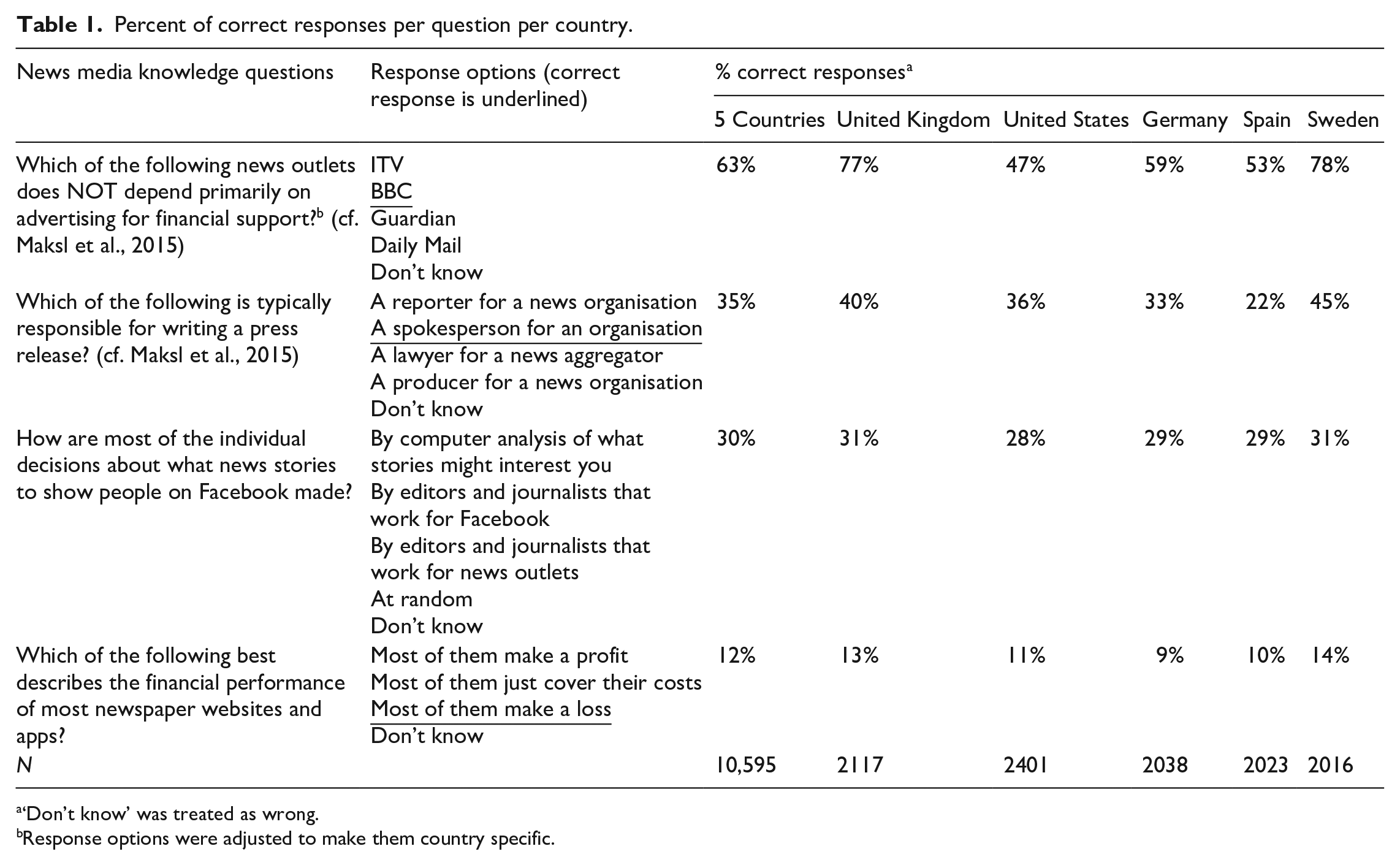
‘Don’t know’ was treated as wrong.
Response options were adjusted to make them country specific.
In line with the definition and research aims introduced above, the questions were designed to (1) focus on factual information, (2) tap a broad range of knowledge dimensions about how the news is made, (3) be applicable in a variety of national contexts, and (4) to vary in difficulty. More extensive batteries have been developed for news literacy research in the US context, but many of the questions, and indeed the theorised components, are simply not applicable to other countries (even in other Western contexts). Two of the questions that could be used were adapted from Maksl et al. (2015). The other questions were formulated through conversations with experts from each of the five countries to ensure that they meaningfully tapped relevant knowledge domains.
The descriptive statistics presented in Table 1 illustrate that varying difficulty was achieved, as some questions drew many correct responses, and others few. The individual country data reveal that we find the same rank order in every country except for Spain, where a larger share of the sample knew about algorithms selecting the news one sees on social media and a slightly smaller share knew that spokespersons are behind press releases.
To form our main predictor, we summed the correct responses across these four questions, treating ‘Don’t know’ as incorrect. This resulted in a variable ranging from 0 to 4 correct answers. The Loevinger’s H for this scale across all five countries was 0.33, indicating that it is acceptable for ordering respondents along a single underlying dimension (Mokken, 1971) – however, it is also clear that future research could improve upon this measure of news knowledge.
Across all five countries, 24% gave zero correct responses, 58% had one or two correct responses, and 17% had three or four correct responses. We see strong country variation on the aggregate level. The share of those who gave three or four correct responses is as high as 24% in Sweden and as low as 10% in Spain (see Table A2 in the Supplemental online appendix). No more than half of those surveyed were able to give more than two correct responses. One may perhaps therefore conclude that news media knowledge, as measured here, is not particularly high in any of the countries studied.
Control variables
We included a series of control variables. These were standard socio-demographic measures such as age, gender and education, as well as interest in news, left-right attitude extremity, trust in news, and trust in news on social media (see Table A3 in the Supplemental online appendix).
Dependent variables
Social media use for news
We combine two survey questions to define different types of social media news use. First, respondents were asked which sources of news they have used in the last week (‘Which, if any, of the following have you used in the last week as a source of news? Please select all that apply’). This list included traditional news sources such as television and newspapers, as well as digital news media such as websites and apps for newspapers, blogs or social media. In a follow-up question, we asked participants to select their one main source of news from their previous selections (‘You say you’ve used these sources of news in the last week, which would you say is your MAIN source of news?’).
To form our first dependent variable, we assigned the value 1 to all those who selected social media as a source of news (users, 45% across countries) and, as a reference category, we assigned a 0 to all others (non-users, 55%). To form our second dependent variable, we assigned the value 1 to all social media news users who selected social media as their main source of news on the second question (primary users, 12%) and formed a reference category by assigning a 0 to the remaining social media users (secondary users, 34%) while setting non-users as missing. For our third dependent variable, we assigned a 1 to all those who chose only social media as a source of news in the first question (only users, 4%) and contrasted this group to the remaining primary users (main users, 8%), with non-users and secondary users set as missing (see Table A4 for country-specific descriptive data).
Importance of source and social cues
We asked respondents to rate the importance of different cues on social media using the following question: ‘Please indicate your level of agreement with the following statements – When looking at stories on social media, ____ is very important in helping me decide whether information is likely to be worth my time.’ Respondents rated four cues on a scale from 1 (strongly disagree) to 5 (strongly agree): the news brand (
Results
The hypotheses are investigated using logistic (H1–H3) and linear regression models (H4–H7). We account for the clustered nature of the data by pooling it and including a dummy variable for each of the five countries. This fixed effects approach has been shown to provide better estimates than multilevel modelling when analysing data with very few clusters (McNeish and Stapleton, 2016). To these models we also add our news media knowledge and control variables. To test for country differences in how news media knowledge relates to our different outcome variables (RQ1), we added an interaction between news media knowledge and country.
Social media for news
With our first hypothesis, we posit that higher news media knowledge relates to using social media as a news source (H1). Model 1a in Table 2 documents the predicted association (OR = 1.23, p < .001). We see that with every unit increase in news media knowledge (i.e. one more correct response across our four questions), the odds of using social media for news (vs not using it for news) increase by 23%. As this result is statistically significant, we see support for H1 in our data. Those who know more about how the news is made, distributed, and financed are more likely to have news repertoires comprising social media.
Fixed effects of logistic regression models where the dependent variables are different types of social media news users.
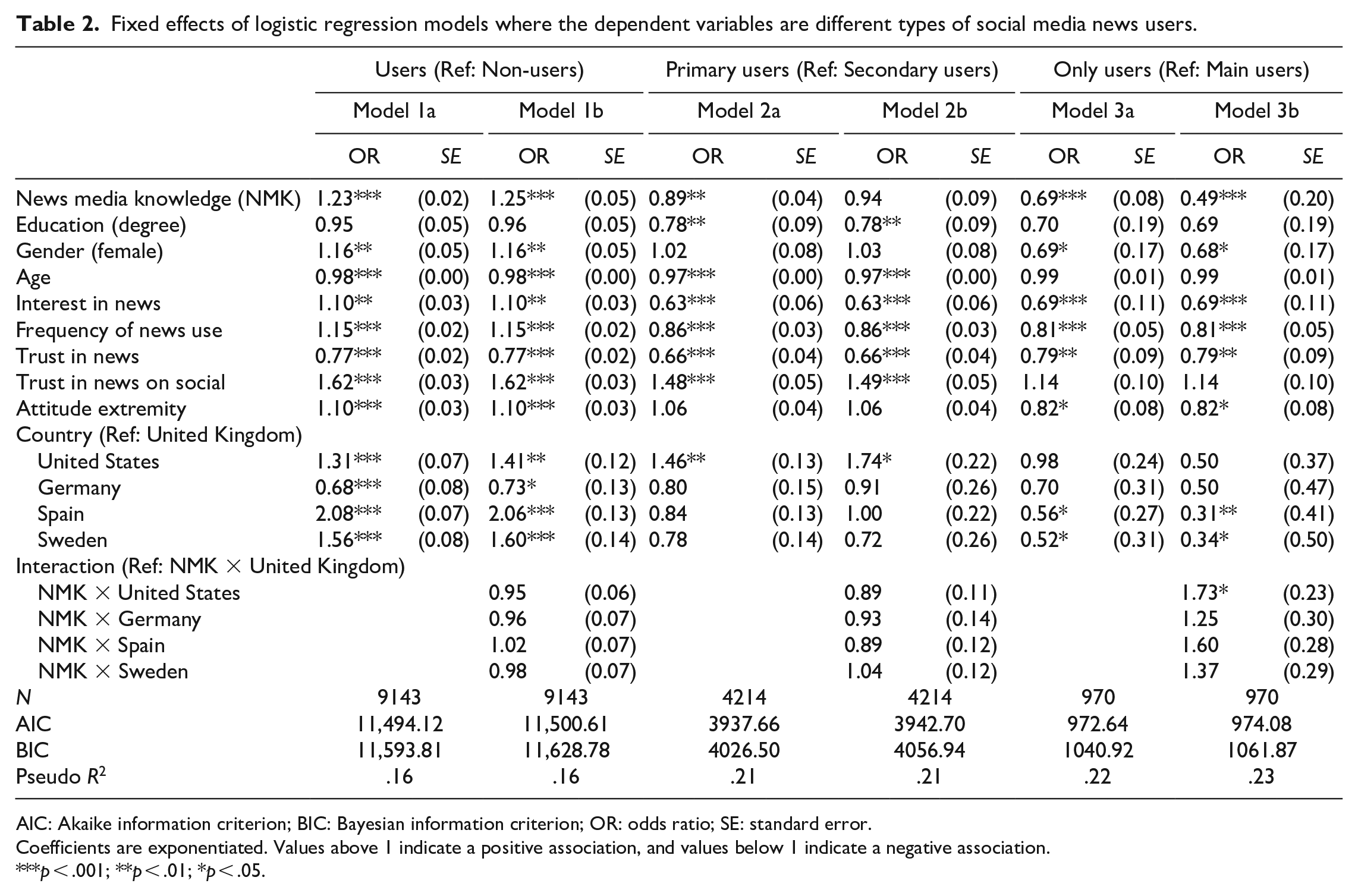
AIC: Akaike information criterion; BIC: Bayesian information criterion; OR: odds ratio; SE: standard error.
Coefficients are exponentiated. Values above 1 indicate a positive association, and values below 1 indicate a negative association.
p < .001; **p < .01; *p < .05.
But news repertoires in which social media play a more central role, become less likely with increasing news media knowledge. Model 2a shows that higher news media knowledge is associated with a significantly lower likelihood of having social media as a primary news source compared with using it as a secondary news source (OR = .89, p < .01), providing support for H2. News media knowledge plays an even greater role in separating those that use social media as their main source of news from those that use it as their only source of news. Looking at Model 3a we see that the likelihood of being an only user (versus a main user) decreases by a factor of .69 (p < .001) with every correct response on our news media knowledge measure, supporting H3.
It is important to keep in mind that we are sometimes looking at rather small groups, as few people across all countries use social media as a primary news source (i.e. as their main or only news source). But the analysed contrasts yield that news media knowledge is comparatively low among those few that chose social media as their main news source and even lower for those who chose it as their only source of news. It seems highest among those that use it as a secondary news source, higher still than among those that do not use social media for news at all.
We have yet to explore possible differences between the five countries in our sample (RQ1). To do so, we repeat the analysis presented above but add an interaction term between news media knowledge and country, using the United Kingdom as the reference category. The b-Models in Table 2 summarise our findings, and country-specific effects are visualised in Figure 2. Looking at Model 1b and the corresponding plot in panel 1 of Figure 2, we see significant level differences, indicating that social media is used most as a source of news in Spain and least in Germany. However, there are no significant interaction effects, meaning that the degree to which news media knowledge is associated with using social media as a news source is the same in each country: In all five countries studied, higher degrees of news media knowledge are associated with a higher likelihood of using social media for news versus not using it for news at all. The pattern is similar for Model 2b, which shows no differences in the strength of the effect of news media knowledge on using social media as a primary versus secondary source of news by country. Although slopes vary slightly, they do not differ significantly from the UK slope that serves as the reference here. In comparing only users and main users, we see that news media knowledge decreases the likelihood of using social media as one’s only source versus main source for news in all countries (Figure 2, panel 3), but this negative effect is less pronounced in the United States (OR = 1.73, p < .05) compared to the United Kingdom. Setting other countries as the reference category for the country variable did not indicate any other significant differences between any of the other countries in all three b-Models in Table 2.
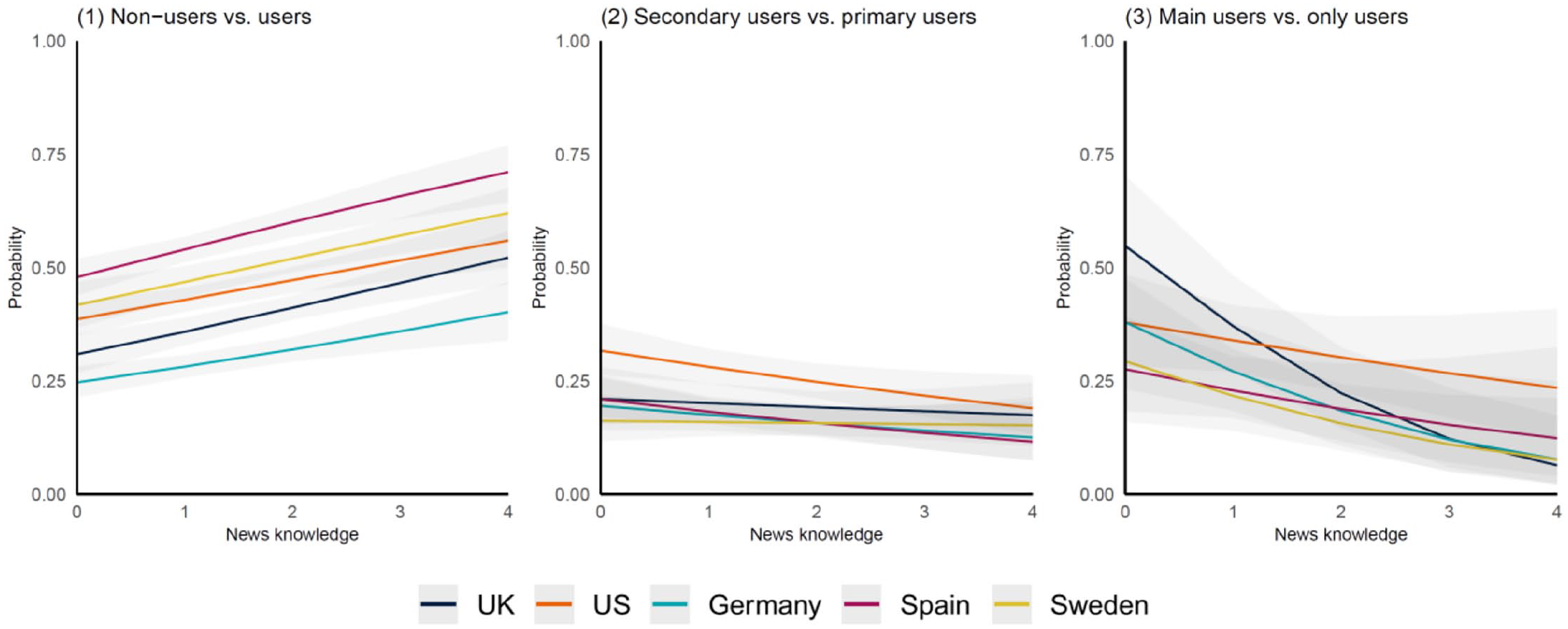
Fixed effects for news media knowledge on using social media as a source of news/primary source of news/only source of news varied by country.
Source and social cues
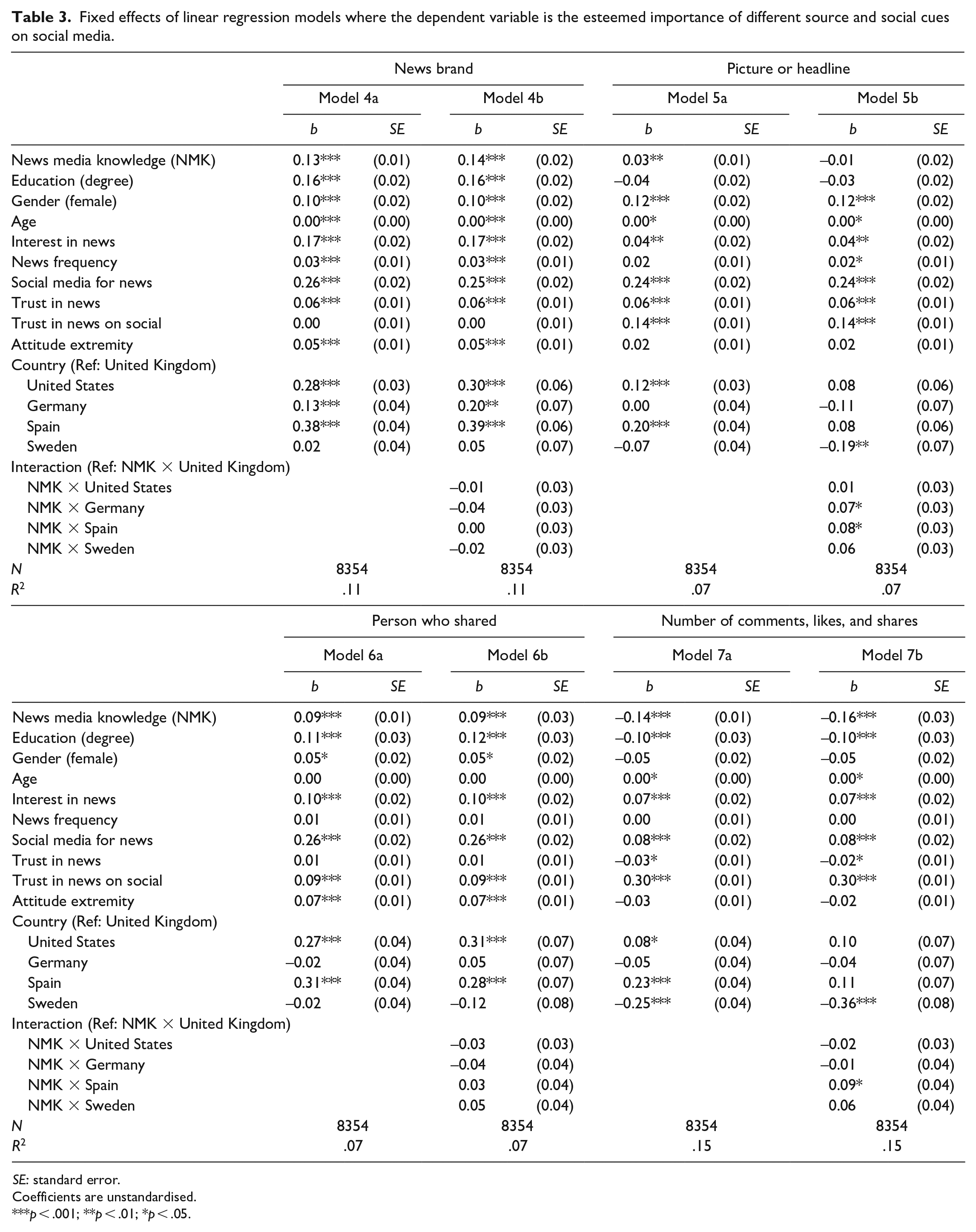
With our second set of hypotheses (H4–H7), we predicted that higher news media knowledge would be positively associated with deeming important the news brand, a news item’s headline and picture, as well as the person who shared the news item when deciding whether a news item is worth engaging with. We posited a negative association between news media knowledge and thinking that the number of comments, likes and shares would be important. The a-Models in Table 3 summarise the results of several linear regressions into which we entered the same predictors as for the previous analysis, but also controlled for using social media for news – the binary outcome in Model 1 above.
Fixed effects of linear regression models where the dependent variable is the esteemed importance of different source and social cues on social media.
SE: standard error.
Coefficients are unstandardised.
p < .001; **p < .01; *p < .05.
As was predicted, higher news media knowledge is significantly related to attributing more importance to the news brand (b = .13, p < .001, Model 4a) as well as to a news story’s headline or picture (b = .03, p < .01, Model 5a). The person who shared a news item becomes more important the higher the level of news media knowledge (b = .09, p < .001, Model 6a). Finally, as hypothesised, the number of likes, comments and shares becomes less important as people’s news literacy rises (b = –.14, p < .001, Model 7a). We therefore find support for H4 to H7 in our data.
Last, we explore country differences in the relationship between news media knowledge and the importance of source and social cues. As above, we repeated the analysis but added an interaction term between country and news media knowledge, setting the United Kingdom as the reference category. These results are captured in the b-Models in Table 3 and Figure 3, panels 4 to 7. We see only small level differences for some outcomes, and no notable differences in association strength. In all countries, news media knowledge seems to be associated positively with ascribing importance to the news brand, the picture or headline, as well as the person who shared a news item, and negatively with the number of comments, likes and shares. Models 5b and 7b show small yet positive significant interactions for a few countries, indicating that (compared to the United Kingdom) news media knowledge has a stronger association with thinking the headline and picture of a news post are important in Germany (b = .07, p < .05) and Spain (b = .08, p < .05) and a weaker association with thinking the number of comments, shares and likes are important in Spain (b = .09, p < .05).
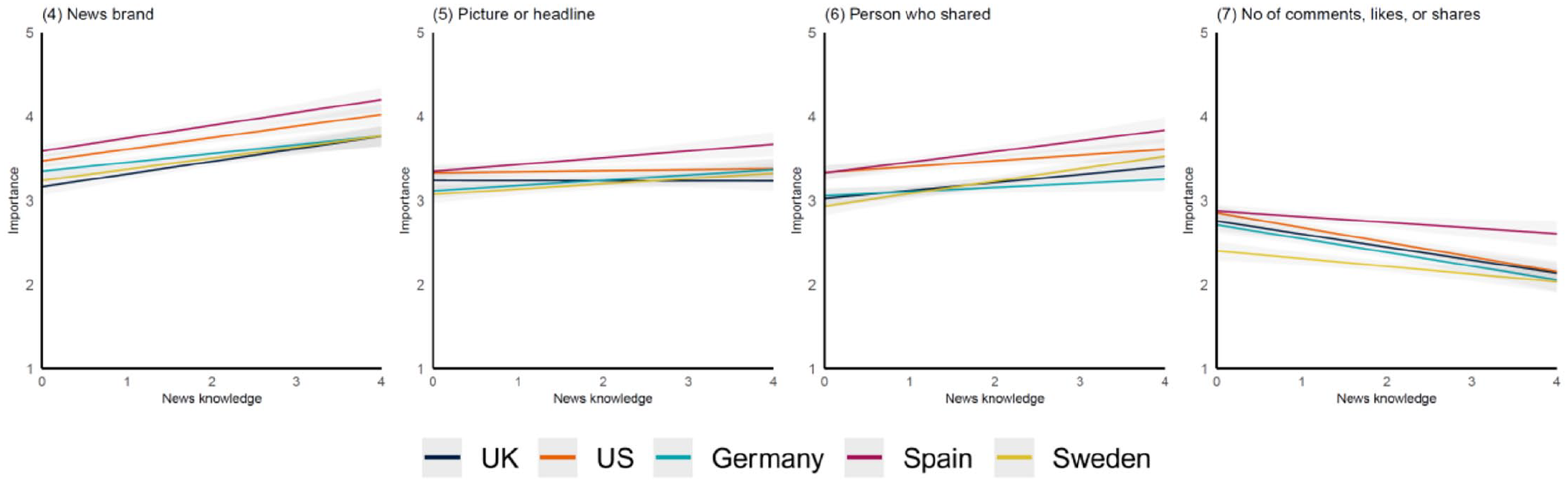
Fixed effects for news media knowledge on the esteemed importance of source and social cues on social media varied by country.
As changing the reference category for the country variable led to a few further significant differences between countries that had previously not been compared with one another, we ran a new series of models based on single country data for all four dependent variables, measuring the importance of source and social cues. Summaries of these models are reported in the Supplemental Appendix, Tables A6 to A9. Looking at the importance of the news brand (A6), the person who shared the news item (A8) and the number of likes, comments and shares (A9), the coefficients for news media knowledge are always significant and point in the same direction in all countries. Any differences that significant interaction effects indicate should be interpreted as differences regarding the strength of the association only. For example, the higher someone’s news media knowledge, the more importance is ascribed to the person who shared the news item in all five countries, but this association is particularly strong in Spain and Sweden. It is weaker, but still positive and significant in Germany and the United States, with the UK slope lying in the middle. But, looking at the importance that people ascribe to the headline or picture (A7), the association with news media knowledge is only significant in Germany and in Spain. The association is not significant in the United States, the United Kingdom and Sweden. The resulting pattern is partially captured in Figure 3 (although the plot is based on an analysis of the pooled data), where the slopes for the United Kingdom and the United States are noticeably flat. These somewhat mixed findings could be because this dependent variable grouped together two different cues – the headline of a news post and the picture that accompanies it (see measurement description).
Discussion
Using online survey data from five Western countries, we find that higher news media knowledge – that is, knowledge about how the news is made – is positively associated with using social media as a source of news, but negatively associated with using it as the primary or only source of news. In other words, those who know more about how the news is made understand that social media can be a useful part of a wider news media repertoire, but also that it is sensible to combine it with other sources of information. Furthermore, when deciding whether the news on social media is going to be worth their time, those who are more knowledgeable about the news attach more importance to source cues and social endorsement cues that refer to people they know, that is, the news brand and the person who shared the item. The headline or picture of a shared news article was only considered important to those with higher news media knowledge in Spain and Germany, while the association was not significant in the other three countries. In contrast to this, the number of likes, comments and shares – which largely refer to relevance outside of someone’s network and can be misleading – only rise in importance as news media knowledge decreases.
Moreover, we found largely the same pattern in five Western countries. Although countries fare differently regarding the level of people’s news media knowledge (Table A2) and although our knowledge measure worked slightly better in some countries compared to others, associations between knowing more about the news and our dependent variables came out very similarly, varying in strength only (with the exception being the importance of headlines and pictures). That our findings align relatively well is surprising to some extent, as our sample includes countries from four different media systems in which social media play different roles. Nonetheless, people who know more about how news is produced, financed and distributed seem to have a relatively similar understanding of the role social media can play as a source of news and how news on social platforms ought to be approached in all studied countries. Whether this is the case elsewhere, in other media systems, is an open empirical question. Our findings offer support for the idea that increasing the public’s knowledge about news has the potential to change the way they use social media for news. But of course, there is a difference between how people say they approach the news in general and how they actually respond to specific stories. As was also noted with regards to news literacy more generally, behaving in a news literate way hinges not only on being news literate but is also conditioned by other attitudes and social norms (Vraga et al., 2021b). With this in mind, we can say that our findings show that people with higher news media knowledge at least seem to know what behaviours are desirable. Whether they actually pay more attention to the brand and less attention to the number of likes is a question that experimental research (e.g. using eye-tracking technology) may investigate. We also know little about what people understand as news on social media or how much time they spend with news on the platforms. Future research may wish to follow up with more specific questions or selection tasks to see, for example, if higher news knowledge also relates to selecting news from specific sources or news about specific topics.
Moreover, reliance on cross-sectional survey data means we know little about the causal processes that might underlie the associations we describe. While it is possible that learning about how the news is made shapes how people use social media for news, it might as well be due to the time that people spend on the platforms that they gather knowledge about news production and distribution. In this context, it is also important to remember that our data are from 2018. During the coronavirus pandemic starting early in 2020, people might have gone through phases of intense digital news consumption followed by debate about false or misleading information about the virus (e.g. Nielsen et al., 2021). Whether this has impacted people’s news media knowledge levels in any way is something future research could seek to understand.
Future work should also try to investigate these relationships in countries outside the Western context. A research endeavour like this will never be easy and would have to start with the identification of relevant knowledge domains so that a set of questions can be developed around them. We believe that asking about how news is produced, distributed and financed could be a useful starting point anywhere. But depending on where a study is conducted, additional knowledge domains might be important. For this very reason, it will also be difficult to develop extensive news media knowledge batteries to compare across countries. This is a common drawback of all comparative research.
Can we conclude, based on this and other studies’ findings, that investing more in the public’s news media knowledge would be money well spent? Before responding to this question, it needs to be acknowledged that news and knowledge about how it is made touches upon only one aspect of democratic citizenship, and resources devoted to improving the public’s news media knowledge could be spent on other worthwhile initiatives. But, our findings suggest that higher news media knowledge makes a difference – it is demonstrably significantly associated with indicators of media behaviour that are often considered broadly desirable. And if news media knowledge helps people to appreciate the breadth of the contemporary news environment and to make use of it effectively, it could be taken as a prerequisite for other types of knowledge gain, including political knowledge. As Delli Carpini and Keeter (1996) state, ‘those who participate are advantaged – as individuals and as members of certain groups and classes – in the process of deciding who gets what from government and, ultimately, in the determination of the public good’ (p. 9). We believe the same argument can be applied to news media knowledge that has, as the findings of this and similar studies show, the potential to enable participation in today’s news environment – something which is, of course, also important for political knowledge.
But how far should education about the news go? Some scholars have highlighted that ‘media literacy gone bad’ might result in a public that is paralysed by cynicism (boyd, 2018; Vraga et al., 2021a). Concern of this kind seems justified where initiatives become too politics- and value-laden or are focused only on media criticism. The possible consequence of this might be thought of as a form of negative sovereignty where citizens primarily negate and never affirm (Rosanvallon, 2008). Arguably, citizens should be encouraged to do both, reject some options, but also be equipped to make confident, informed choices about what they want to embrace. Higher news media knowledge can help achieve this when it comes to media use and sources of information.
Achieving this is, of course, easier said than done. But it is for this reason that we suggest that one possible way forward for any programme aiming to increase the public’s knowledge of the news media is to be grounded in an objective (rather than subjective or normative) understanding of the news media. While the knowledge we tapped in this study is somewhat specialised, and the answers are both time and context dependent, it is objective rather than subjective, and we found that people who differ along it adopt very different social media news consumption patterns. Those who know more about how the news is made are found to be rather inclusive, embracing the variety of news sources we have available today while showing an awareness of the different degrees to which different sources and social cues on social media can be reliable or misleading.
Supplemental Material
sj-docx-1-nms-10.1177_14614448221108957 – Supplemental material for The role of news media knowledge for how people use social media for news in five countries
Supplemental material, sj-docx-1-nms-10.1177_14614448221108957 for The role of news media knowledge for how people use social media for news in five countries by Anne Schulz, Richard Fletcher and Rasmus Kleis Nielsen in New Media & Society
Footnotes
Acknowledgements
The authors would like to thank all those who worked on the 2018 Digital News Report project for providing the data, as well as all other members of the research team at the Reuters Institute for the Study of Journalism for helpful comments on an early version of the manuscript.
Funding
The author(s) disclosed receipt of the following financial support for the research, authorship, and/or publication of this article: This research was supported by Google UK as part of the Google News Initiative.

Supplemental material
Supplemental material for this article is available online.
Author biographies
References
Supplementary Material
Please find the following supplemental material available below.
For Open Access articles published under a Creative Commons License, all supplemental material carries the same license as the article it is associated with.
For non-Open Access articles published, all supplemental material carries a non-exclusive license, and permission requests for re-use of supplemental material or any part of supplemental material shall be sent directly to the copyright owner as specified in the copyright notice associated with the article.
