




Abstract
In the last two decades, as Canada’s demographics have shifted, Canadian news publications have struggled to reflect increasing diversity in both their newsroom makeup and their content. In Canada, news organizations have historically resisted instituting a process to examine their staff composition. In the absence of consistent self-reporting data, this study aims to fill in important information about Canadian newspaper newsroom composition by focusing on data that is actually self-reported by opinion journalists from within their publications. Using phrases from columnists’ published work, this study examines how far the demographic makeup of columnists at Canada’s three largest national newspapers by circulation reflects the diversity of the Canadian population at large. Our findings indicate that while representation of women columnists at the Toronto Star, The Globe and Mail and the National Post improved over the 21-year period of our study, white columnists – regardless of gender – became significantly more overrepresented, in sharp contrast to census data over the same period. The absence of Indigenous columnists and Black women columnists is especially significant at a time when the discourse around Indigenous issues and anti-Blackness has increased. This paper concludes that while Canada’s population grew increasingly diverse over this period, the gulf between the country’s demographics and those who write on key Canadian issues widened. As a result, a large part of the Canadian public remains underrepresented by major news publications. This paper draws connections between the lack of self-reporting and its potential to impact voice and agency in the newsroom.
Introduction
Over the past several decades, as a result of an aggressive federal immigration policy, Canada’s demographics have shifted significantly, and continue to change. Census data shows us just how radical the shift is over time. For instance, according to the 2021 census, 52% of the population in Toronto, Canada’s largest city by population, is composed of visible minorities; this figure was 13.6% when measured in 1981. The concentration of immigrant movements into urban centers means these patterns and demographics differ from coast to coast. Census data was revealing, and we wanted to compare it with demographic data on staffing in Canadian newsrooms. By looking at Canadian census data, we knew that between 1998 and 2018 — the period of our study — Canada’s white population decreased by 11 percentage points, down from 88% of the overall population to 77% of the population. We wanted to know how this change is reflected in staffing in Canadian newsrooms. Are they representative of that shift in demographics?
Our research focuses on the newsroom composition of Canada’s three largest newspapers by circulation. The word “newspaper” encompasses more than just a print product as these organizations now also publish digitally. With the exception of broadcasters, who are federally mandated to report, news organizations in Canada have historically resisted instituting a process to examine their staff composition despite previous researchers’ attempts at gathering such data (Miller et al., 2010; Miller and Court, 2006; Mochama, 2016; Robertson, 2017). The Employment Equity Act (EEA) has been in place since 1986 following the recommendations of the Abella Commission (Abella, 1984), which proposed the act; a government-led task force is currently conducting a review of the EEA to update it. The EEA’s purpose is to ensure “equality in the workplace” and to create inclusive and diverse working environments. Under the Broadcast Act, the Canadian Radio-Television Commission requires private companies with more than 100 staff to submit reports about their diversity practices. Since news organizations often comprise only a part of their broader media businesses, it is difficult to get an accurate picture. However, since the Canadian Broadcasting Corporation (CBC) is a government body, it is required under the icu EEA to report on staff composition of women, Indigenous people, people with disabilities, and “visible minorities,” the four designated groups mentioned under the EEA. The CBC also provides more granular data and additional information about programming and diversity efforts but there is no collective, self-reported capture of staffing across the media sector.
Based on information and documentation from professional journalism organizations and researchers, previous efforts to obtain data from newsrooms have been met with reluctance (Miller and Caron, 2006; Miller et al., 2010; Robertson, 2017; Mochama, 2016). So we decided to look for spaces where basic identity questions were being self-reported in the public domain. To start with a significant and reflective dataset, we decided to look at newspaper columnists. There were two reasons for this: one, newsroom reluctance to participate in demographic studies would make getting self-reported data directly from newsrooms a challenge; second, columnists often self-identified in their work – sometimes in witty, self-deprecating ways, such as “I, for one (old WASP)” – and we focused on those who were staffers or wrote at least 40 times in a calendar year, thereby reflecting the news publications’ longer-term investment in giving those columnists’ significant real estate.
Opinion journalism is “not fundamentally about reporting the news but about making sense of it” (Kovach and Rosenstiel, 2021: 185) and the newspaper columnist is charged with not only sense-making, but with being an authority on important issues. The news publication makes an editorial decision to spotlight a specific columnist’s voice and gives them a prominent platform. Their purpose is “to persuade readers that (they are) someone whose views have weight and validity beyond those of the ordinary reader, someone whose views should be trusted” (McNair, 2008: 108). Being assigned a regular newspaper column is often seen as a recognition of a journalist’s expertise and voice. Columnists tend to skew older as their tenure is often correlated with the depth of their knowledge and their name recognition. By their own admission – in their own words – columnists often share their identities and life experiences. We focused on three major Canadian news publications with national audiences headquartered in Canada’s largest city, Toronto. Our dates of coverage began in 1998 (when the National Post first launched) and ended with 2018 to cover a two-decade period of significant transition for the larger Canadian demographic, as mentioned earlier. Once our data collection started, we were surprised by the ease with which we were able to capture an individual’s identity. Most of this data came from columnists’ own writing and the remaining gaps were filled through information provided on the columnists’ public social media accounts and/or LinkedIn profiles.
This study provides valuable direction for more detailed research and investigation into newsroom composition. It is a starting point for newsroom self-reflection and engagement on the journalists who report the news and the communities they cover. Specifically, it provides foundational information to support the development of a qualitative self-reporting survey to provide more granular and experiential data on newsroom makeup and to offer actionable insights into the culture and practices of newsrooms in Canada.
Literature review and research context
Journalism is often thought of as the “Fourth Estate,” charged with the task of holding the powerful to account (Kovach and Rosenstiel, 2021). Mahtani (2001: 99) also suggests that “the media is responsible for the ways that Canadian society is interpreted, considered and evaluated among its residents.” Yet media studies research reveals that Canadian journalism is failing to live up to this responsibility due in part to negative depictions of non-dominant groups, even as Census figures show “visible minorities” comprise a growing share of the country’s population (Bullock and Jafri, 2001; Dhillon, 2018; Fleras and Kunz, 2001). “Visible minorities” as defined by Canadian government agencies are “persons, other than aboriginal peoples, who are non-Caucasian in race or non-white in colour” (Statistics Canada, 2021). Research also indicates that a lack of racial diversity in newsrooms is partially responsible for these negative depictions, which collectively reduce trust in journalists and their institutions (Mahtani, 2001; Miller and Court, 2006; Miller et al., 2010). Miller (1998) poses a question worth reiterating in the wake of two more decades of escalating news industry layoffs: “Is it any wonder that newspaper circulation has plunged when the daily news is prepared by people who are whiter, more masculine, better educated and better paid than most of their readers?”
Cohen (2016) underscores the critical link between who makes the media and the stories that are told, highlighting that the Canadian media landscape, much like that in the United States and the United Kingdom, remains predominantly white and male, especially in senior roles where hiring decisions are made. This demographic homogeneity not only skews the perspectives presented in media but also reinforces the exclusion of diverse voices from mainstream narratives. As argued, (Gasher et al., 2018), a lack of diversity in media undermines the democratic function of the press, which should promote respect for diversity and pluralism. The over-reliance on journalistic objectivity often masks the biases inherent in predominantly white newsrooms, which tend to privilege the perspectives of national or elite press over local or alternative media (George, 2013).
Historical resistance to examining and addressing staff composition has further entrenched this problem. The Royal Commission on Newspapers, or the Kent Commission, criticized the concentration of media ownership and the lack of diversity in the Canadian newspaper industry as far back as the 1980s (Keshen and MacAskill, 2000). This concentration has only worsened the issue, as media conglomerates often prioritize profit over diverse representation, perpetuating a cycle of exclusion and marginalization. Finneman et al. (2022) note that journalism defined and practiced primarily by white journalists for white audiences perpetuates a narrow and exclusionary view of what constitutes professional journalism. This bias not only affects how stories are told but also who gets to tell them. Douglas (2022) highlights the challenges faced by Black and brown journalists in British news institutions, which mirror those in Canada, where minority journalists often find their contributions disregarded and their perspectives marginalized (Dhillon, 2018). Clark (2022) and Usher (2021) discuss the broader implications of this lack of diversity, noting that white-dominated newsrooms create content that reflects their perspectives, often ignoring or misrepresenting minority issues.
Since 1990, there have been only a few academic studies in Canada (Miller and Court, 2006; Miller et al., 2010; Miller and Prince, 1994; Pritchard and Sauvageau, 1998; Worlds of Journalism, 2016) examining this question, all with different focuses, thus making any sort of comparison difficult. In 2021, the Canadian Association of Journalists (CAJ) released the results of its inaugural diversity survey of print and digital newsrooms with co-operation from newsroom managers at 209 organizations, including 3873 journalists (Canadian Association of Journalists, 2021). Out of 636 news organizations, 209 outlets provided data on race and gender composition collected between November 2020 and July 2021. Based on this information, their most significant findings were that 75% of newsroom employees were white and 53% were women. Though it cannot address the lack of historical data, the CAJ survey marks an important first step in analyzing the current demographics of the nation’s print and digital newsrooms.
By comparison, in the United States, the News Leaders Association (formerly the American Society of News Editors) has been conducting annual diversity studies of major newsrooms since 1978, allowing for meaningful trends to be mapped (News Leaders Association, 1997). In the United Kingdom, the National Council for the Training of Journalists conducted a “Journalists At Work” survey in 2002, 2012, and 2018. These surveys include a broad range of questions, allowing for an in-depth understanding of the demographic makeup of journalists. Moreover, in 2016, the United Kingdom had one of the most detailed surveys of all the countries that took part in the “Worlds of Journalism” study. Australia, meanwhile, initially had scattered surveys, like Canada, but has since had several surveys conducted allowing for a better understanding of the industry in recent years. For example, Australia’s 2013 entry to the “Worlds of Journalism” study, while identical to the other country surveys, had high engagement with a 90% response rate from its pool of over 600 journalists. The recent “Valuing Diversity in News and Newsrooms” mixed-methods 2023 study from the University of Canberra surveyed 2266 Australians and 196 journalists “to understand how journalists think about and act with diversity in mind while practicing their craft” (McGuinness et al., 2023). The study found that journalists who identified with non-Anglo or non-European backgrounds are more likely to prioritize improving ethnic or cultural diversity compared to those with Anglo-Celtic or Australian/New Zealander backgrounds.
However, when it comes to studies of columnists in particular, very few exist. A 2013 Gawker study examined opinion columnists in The New York Times, The Washington Post and The Wall Street Journal, and opinion writers for four press syndicates, the Creators Syndicate, Universal Press, King Features, and Tribune Media (Hedgecock, 2013). The study, which had a sample size of 143, looked at columnists’ gender and age, and found that 27% were women, while the median age was 60.
Canada has had three studies that either focus entirely on, or have a breakdown of, the demographic makeup of Canadian columnists and how it compares to the population at large. One of these was an academic study (Miller et al., 2010), while the other two were conducted by J-Source, a publication of the Canadian Journalism Project, in 2014 and 2017.
The 2010 academic study, “Diversity in Leadership and Media: A Multi-Perspective Analysis of the Greater Toronto Area” examined the representation of racialized people in the Greater Toronto Area (GTA) in various sectors, including media management, television reporters, hosts and sources, and columnists. To determine the demographic makeup, researchers curated a sample of GTA newspapers and created a “constructed week”. Using this approach, all sections of the newspaper were examined for “a constructed week,” yielding 471 columns. Finally, they used author photographs accompanying the column to determine if the columnist was a “visible minority”. While using images for race and gender identification is methodologically questionable, the researchers collected the data, listed each section of the newspaper, and noted the number and percentage of both “visible minority” columnists, as well as articles written by a “visible minority.” They found that of the 282 columnists in their sample size, only 10 were “visible minorities.” 1
The 2014 J-Source study focused on columnists at Canada’s 76 English-language daily newspapers, leading to a sample size of 339. Researcher Dylan Robertson sorted the columnists by national and regional publication, determining their gender by their photos. There was no explanation of the criteria used in determining gender visually; it is a subjective approach open to misidentification. Then, columnists were sent a survey requesting their age; national columnists were asked to provide the specific year of birth, while regional columnists were asked to select from an age range. Columnists whose articles were published without a photo were asked to specify their gender as well. Of these 339 columnists, 155 replied to the survey with answers. Robertson (2014) included the age of some columnists who did not answer if he was able to find their birth year on Wikipedia. Relying on open-sourced information from Wikipedia is a questionable approach as its information is crowd-sourced and de facto crowd-verified. Robertson found that 27% of columnists were women, with a median age of 58.5 and 50 to 59 for national and regional columnists respectively.
The 2017 J-Source study, again conducted by Robertson, focused solely on columnists at Canada’s 77 English-language daily newspapers. Columnists were sorted by national and regional publication, and sent a survey, with at least two follow ups. The survey asked them to note their age, and select which of the following five categories they identify with: a woman, a visible minority or racialized person, an Indigenous person in Canada, a person with a disability, a gender or sexual minority (LGBTQ). Of these 296 columnists, 125 responded. Robertson found a median age of 56 and 57 for national and regional columnists respectively. Twenty percent of respondents identified as women, 4% as visible minorities, 4% as Indigenous, 2% as a person with a disability and 3% as LGBTQ (Robertson, 2017).
However, while these Canadian studies have captured some valuable insights, they rely on researchers’ and newsroom leadership’s assessments of demographic composition. There is a need for surveys in Canada that allow journalists the opportunity to self-identify, especially when it comes to race and gender. Our study of Canadian columnists and their self-identification in their own words is a step in that direction.
Research questions and methodology
We sought to investigate how the demographic makeup of columnists at Canada’s major newspapers reflects the diversity of the Canadian population. We focused on columnists because they have an outsized ability to help start, and shape, national conversations. We focused exclusively on news and politics columnists as “the political columnist’s role is to ‘help create the debate,’ to effect the ‘professional initiation and shaping’ of national discussions” (Duff, 2008). They use their large platforms to advocate for causes and communities, and guide the public’s understanding of ongoing events. Using terms of self-identification found in the columnists’ own words, in their published work and on their social media posts, we categorized their race and gender by census category.
Our research questions were as follows: (1) How do columnists at Canada’s three largest national news publications identify themselves in their writing? and (2) How does this information compare with Canadian census data during the period of study (1998–2018)? It’s important to note that this study is exploratory as it doesn’t necessarily reflect the composition of these newsrooms, however, it provides valuable insight into editorial decision-making and who their intended audiences are. Exploratory research occurs at a preliminary stage of a problem (Babbie, 2016). Such studies are “most typically done for three purposes: (1) to satisfy the researcher’s curiosity and desire for better understanding, (2) to test the feasibility of undertaking a more extensive study, and (3) to develop the methods to be employed in any subsequent study.” (Babbie, 2016: 90).
We applied the following filters: i) exclusively studying the columnist rosters at the Toronto Star, The Globe and Mail, and the National Post; ii) narrowing down the duration of our study to the timeframe of 1998 to 2018; iii) defining a columnist as someone published at least once a week, or 40 times in a year, in the print editions of these papers; iv) exclusively concentrating on news, and politics columnists, who were editorially published in the main section of the paper; v) seeking to determine the race, gender, age, place of birth and university attendance of each columnist. For this particular study, we chose to limit our focus, employing higher-level categories to make a case for a more detailed and expansive study of newsroom composition in Canada.
We focused on the Toronto Star, The Globe and Mail, and the National Post because the latter two are Canada’s only national publications, while the former has often had the greatest circulation in the country (News Media Canada, 2022). We regarded these publications as “major,” while recognizing that our study does leave out smaller but important publications. These three publications also, to an extent, exemplify the Overton window in Canada’s mass media, ranging from the political left to right.
We began our study in 1998 to coincide with the founding of the National Post. We determined that extending the study to 2018 was ideal. The major justification for this range was the absence of longitudinal research on the demographic makeup of Canadian newspapers. In essence, this means there is only data available for a few points throughout a two-decade span, and no real way to compare the data due to different research focuses and methodologies. As noted earlier, this is not the case in other countries. Our research attempts to fill this gap by allowing for direct comparisons over a significant period, to ensure trends can be investigated and the claims news organizations make regarding diversity can be fairly evaluated.
Columnists are often marketed as an essential aspect of a newspaper’s brand, and as such readers expect to see them on a regular basis, often on recurring days. We defined a columnist as someone who writes at least once a week, and/or 40 or more times in a year, to separate them from someone who happens to contribute often but not on a regular basis. We also decided, based on our professional experiences as newsroom leaders, to incorporate a cutoff point of 40 articles per year to account for holidays, illnesses, leaves and other factors that could prevent a staff columnist from writing each week. We excluded people who newspapers refer to as columnists, but who write less often, typically bi-weekly or monthly, as these journalists are not staples of the publication, and are less likely to be formally employed by the publication or have the column serve as their primary source of income.
Finally, we attempted to determine the race, gender, age, place of birth and university attendance of each columnist to have a broad range of data to analyze. Each of these criteria are relevant to determining how the makeup of columnists reflects the Canadian population overall. A diverse newsroom and an inclusive editorial vision mean consistent coverage of meaningful Canadian issues: race, gender, disability, for example. The absence of a representative workforce means a disservice to audiences through significant gaps in coverage on issues that are relevant to populations in Canada (Fatah and Malik, 2019). We also recognized that focusing solely on any one of these determinants would be insufficient for our research goal.
To pursue our research goal, we devised a hybrid research method that overcame many of the inadequacies of previous attempts to analyze the demographics of Canadian columnists in comparison to the population at large.
First, we used the ProQuest “Canadian Newsstream” tool to have access to the archives at each of the three publications, allowing us to view the entirety of each newspaper issue printed by the three publications from 1998 to 2018. Then, we used the search function, and by setting a date range and using keywords found in headlines (for example, National Post column headlines begin with the prefix “Full Comment”) and at the end of columns (as in the Globe and Mail, “X’s column appears in the Review section Monday to Thursday and on Saturday”), we were able to determine the years a columnist wrote for a publication, how often they wrote, and the sort of articles they wrote. This allowed us to compile a list of 89 columnists who met our criteria over the period of our study.
Once we had come up with the list of applicable columnists, we then needed to identify each of their demographic determinants. In the past, studies in Canada have done so using one of two methods. The first method has been to send a survey to newsroom managers, or the journalists themselves, have them answer the questions and return the survey, and then analyze the data. This was the method used in the 2017 J-Source study. The other method, used in a 2010 study (Miller et al., 2010) and in part in J-Source’s 2014 study, has been to come to a determination about the demographic factor of a columnist without contacting the columnist, for example, by looking at their author photo to determine their race or gender.
While the first method has the strength of ensuring the data is more accurate, because the answers come from the columnists themselves, its major flaw has proven to be a lack of response from newsrooms. This has outright prevented studies from being conducted, or hindered them from providing a representative sample (Mochama, 2016). While the 2014 and 2017 J-Source studies had favorable response rates of 47 and 42% respectively, they left sensitive and complicated questions, such as race or gender, to the discretion of a researcher using a questionable method of data collection.
Our method was a hybrid of the two, allowing us to incorporate their strengths while avoiding their weaknesses. We did not make contact with any columnists or newsrooms. Instead, we attempted to answer the questions on our own. This would allow us to get as close as possible to identifying all of the columnists, ensuring our research is more representative than other studies with a smaller sample size. Moreover, due to the wide range of our study, many of the columnists in our list no longer work in media, and some have died, making it impractical to run a survey.
Unlike past studies, we did not come to our answers based solely on our judgment. Instead, we used primary sources, or trustworthy secondary sources, to attempt to determine the race, gender, age, place of birth and university attendance of the columnists. These entirely public sources included articles the columnists wrote, their posts on social media platforms, profiles about/interviews with the columnists conducted by other publications, the columnists’ profiles on services such as the Canadian Who’s Who and past surveys conducted by other organizations including J-Source. This method allowed us to acquire data as accurate as a survey without relying on the cooperation of previously reluctant columnists or newsrooms. However, we do recognize that gender identities can change over time and there may be a margin of error as a result. In essence, we found cases where the columnists publicly stated answers to our questions, and then compiled them for data analysis. Using this method, we were able to find and record 98.7% of the data in the five categories for all columnists.
The next step was taking the data and entering it into a multi-section spreadsheet. The first section has a full list of the columnists in our study, in alphabetical order, with their race, gender, current age or age at death, place of birth, and university attendance listed. In the second section, there is a page for each of the three publications, broken down by year, listing all applicable columnists and their race, gender, age during the year in question, place of birth, and university attendance.
In order to determine whether columnists are reflective of the broad population in Canada, we compared the numbers we found to the Canadian Census of Population. 2 Statistics Canada understands the concept of “racialized people” to include those it identifies as “visible minorities,” a term popularized by the Employment Equity Act (1986), which defines racialized people as “persons other than Aboriginal peoples, who are non-Caucasian in race and non-white in colour.” 3 As mentioned earlier, this term, which mixes race (a social construct) with ethnicity, is currently under review (Statistics Canada, 2022). While we find these conflations problematic, we employed census data, as it was captured, in this study to make a comparative commentary on newsroom composition. We recognize its limitations but are confident that it proves the point we are making about a lack of representation in newsrooms in Canada.
Within the range of our research there were five applicable censuses. We compared: the columnist data for 1998 to 2000 to the 1996 census; 4 the columnist data for 2001 to 2005 to the 2001 census; 5 the columnist data for 2006 to 2010 to the 2006 census; 6 the columnist data for 2011 to 2015 to the 2011 census; 7 the columnist data for 2016 to 2018 to the 2016 census. 8 Here we employed a descriptive statistics methodology, computations which allowed us to “summarize a set of simple observations” (Babbie, 2016: 460). Comparing our data to censuses over the years was the easiest and most accurate way to answer our question for this exploratory research project.
In breaking down the categories of “racialized groups,” Statistics Canada states that “the racialized population consists mainly of the following groups: South Asian, Chinese, Black, Filipino, Arab, Latin American, Southeast Asian, West Asian, Korean and Japanese.” 9 Accordingly, we also used these census population group categories to sort our columnists, with minor changes. First, instead of having Korean, Japanese and Chinese listed as separate categories, as they are in the census, we combined them into an “East Asian” group, recognizing the existence of other similar broad categories in the census, such as South Asian. Second, until the 2021 census, the only gender options for respondents were “man” and “woman,” while we created another category for anyone who does not identify within a gender binary.
Finally, our top-level analysis was divided into five categories: white, Black, racialized, multiracial, Indigenous. Racialized does not exist as a category in the census, and we intended it to include anyone who does not identify as white, Black or Indigenous, but who identifies with only one group. However, in our more detailed analysis, we broke it down into specific categories, such as East Asian and South Asian. The census also does not include a multiracial category, but we included it to acknowledge those who identify as such, and their complex experiences. Other than those changes, we kept our categorizations aligned with the Canadian census.
For the purpose of this study, we narrowed our analysis to two of our five categories: race and gender. Then, we divided the data by each of the three publications (The Globe and Mail, Toronto Star and National Post) and compared the results with Canadian census data, broken down by census blocks.
Findings and analysis
Our study reveals that more than 20 years of Canadian opinion journalism has been dominated by white men. White women have made advancements, but Black and Indigenous female representation remains low.
Figure 1 shows the percentage of certain demographic groups in the Canadian population at large for each of the five national census blocks, which we used to compare the results of our analysis against throughout all applicable areas of our following analysis. Percentage of a demographic group as part of the population, broken down by Canadian census block Source: Statistics Canada.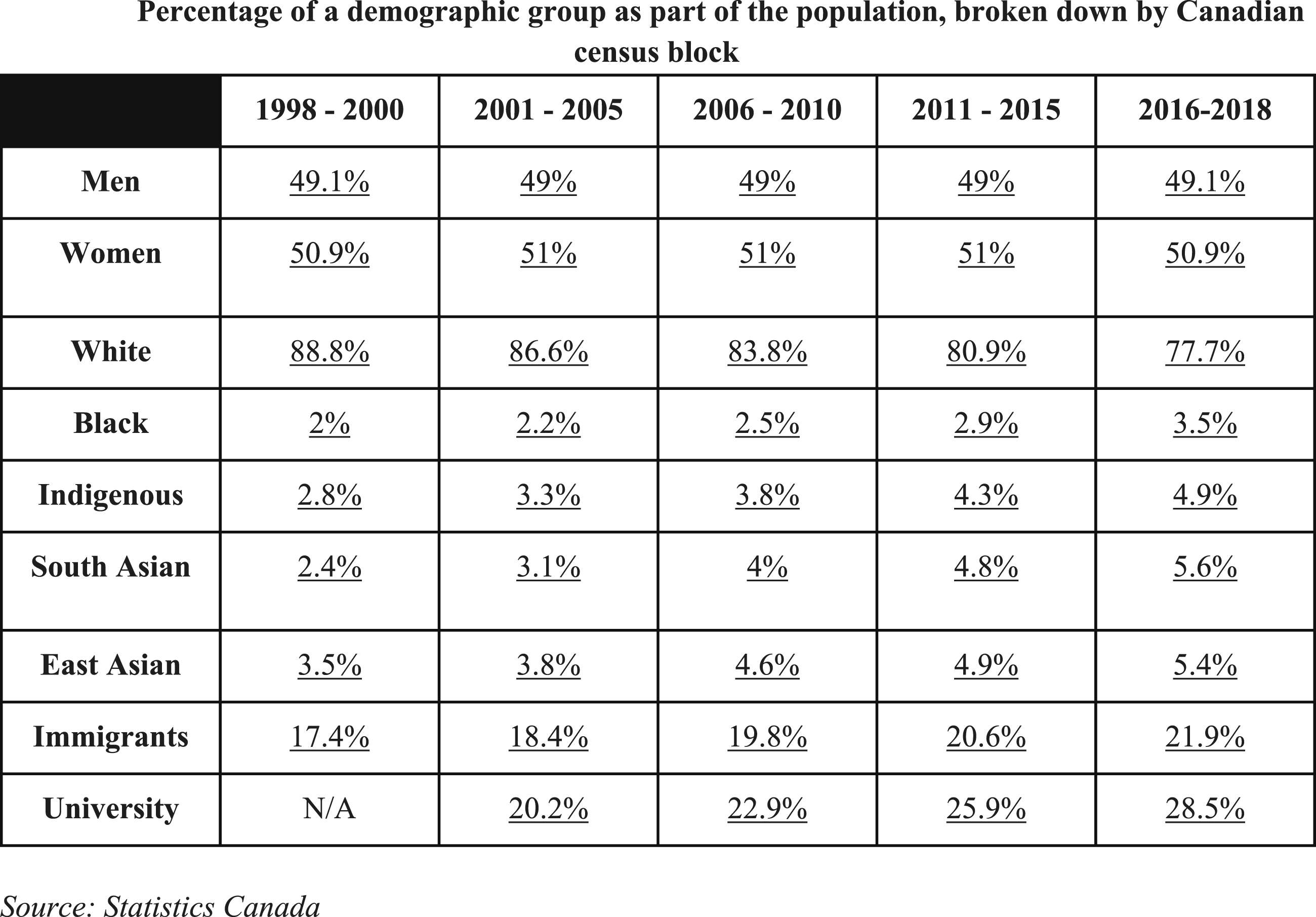
Race
The percentage of white columnists at the three publications decreased from 1998 to 2018, from 92.8% in the first census block to 88.7% in the last (Figure 2). Percentage of white columnists at National Post, The Globe and Mail and Toronto Star (combined), by census block, with a percentage point comparison to the general Canadian population.
However, the relevant question here is the representation of white columnists in comparison to the representation of white people in the Canadian population. Figure 2 includes the percentage point difference from the level of white representation among columnists to the general Canadian population for each census block in brackets. For example, we found that in the first census block, 92.8% of columnists were white in comparison to 88.8% of Canadians, and so we included “+4” in brackets beside “92.8.” This method was also used in Figure 3. Percentage of columnists at National Post, The Globe and Mail and Toronto Star (combined) who identify as women, by census block, with a percentage point comparison to the general Canadian population in that census block.
With this in mind, we discovered the following: i) white people were overrepresented in every census block throughout our study; ii) the first census block had the least disparity in representation of white columnists to the Canadian population; iii) white columnists actually became more overrepresented throughout the duration of our study, by nearly 300% when comparing the last census block to the first. White columnists started off overrepresented and then had their representation drop by fewer percentage points than in the Canadian population at large over the duration of our research period.
We also analyzed the data by examining the racial makeup of the 89 columnists as a whole, irrespective of their period of employment. We found that there were three Black columnists (3%), five racialized columnists (6%) and two multiracial columnists (2%) throughout the entire period of our study.
There were no Black columnists who identified as women who met our criteria. Vicky Mochama, a Black journalist who formerly worked as a columnist for Star Metro, had her articles appear in the Toronto Star biweekly from June 2017 to June 2018, and as such did not meet our weekly cutoff point. There were also no Indigenous columnists throughout the period of our study that met our criteria, despite Indigenous people making up 2.8% of the Canadian population in the first census block, and 4.9% in the latest census. Columns written by Alison Blackduck, an Indigenous woman, appeared in the Toronto Star on a biweekly or monthly basis from May 2000 to December 2001, and did not meet our weekly cutoff point.
We also offered a more granular look at the “racialized groups” category, as defined by Statistics Canada, in our data collection. We found that four of the five racialized columnists identified as South Asian, while only one was East Asian. From this, we can come to a few conclusions. First, East Asian columnists were underrepresented in our study period, as the group made up 3.5% of the Canadian population in the first census block, and 5.4% in the last, and yet only 1% of columnists at the three publications. Second, there was an underrepresentation of North African, West Central Asian and Middle Eastern columnists. Compared to 2016 census figures, Canadians with North African or West Central Asian and Middle Eastern origins made up 4% of the population, and yet we only found one columnist, who identified as one-quarter Turkish, who partially fits into this category. Third, several groups were not represented at all, including Latinx Americans, who made up more than 2% of the Canadian population in the 2016 census. Finally, we found that South Asian columnists were approximately represented at the same level as their share of the broader Canadian population throughout our study.
The National Post was the publication with the greatest overrepresentation of white columnists, by a significant margin, while the Toronto Star was the most diverse. However, The Globe and Mail had 11 years with an all-white columnist roster, compared to seven for the National Post, and zero at the Toronto Star. The Globe and Mail also had the greatest overrepresentation of white columnists for any given census block, with 17.6 percentage points more than the Canadian population in 2011–2015. The Toronto Star meanwhile, was the only publication to have white columnists represented at a lower rate than the general Canadian population in any census block, with this being true in three of the five census blocks.
The results show white people have become more overrepresented throughout the course of our study, at the expense of almost every other racial group, who are either underrepresented or not represented at all. One notable exception were columnists who identified as South Asian.
Gender
Upon examining the gender makeup of the 89 columnists as a whole, irrespective of their period of work, we found that only 25 (28%) of the columnists identified as women. The percentage of columnists who identify as women increased from the beginning of our research period to the end (see Figure 3). Accordingly, as women made up 51% of the Canadian population in each census block, columnists who identify as women also achieved greater representation. These changes were not linear, however, as representation of women dipped in two census periods (2001–2005) and (2006–2010) before climbing in the next two census periods
Moreover, we did not find any columnists who fit into our “Other” gender category that encompassed all non-cisgender people throughout our research period. When we conducted our research, there were only “Man” and “Woman” census categories. In 2021, Statistics Canada revised the variables to “gender of person” and “sex at birth of person” for that year’s Census. The classifications “man,” “woman” and “non-binary,” as well as the categories “cisgender,” “transgender” and “gender non-binary” have since been introduced (Statistics Canada, 2021). We recognize future research categories must be more inclusive of multiple gender identities.
Although improvements were made in the representation of women as columnists, they remain underrepresented, and were so every year for each publication. The Toronto Star in 2018 came closest to representation matching the broader population, with 50% of their columnists identifying as women. Meanwhile, the National Post only had one columnist who identified as a woman (6.3%) in 2009, the closest any of these publications came to having no women represented.
Men were less overrepresented at the Toronto Star than other publications, with only 61.3% of columnists identifying as such compared to 73.3 and 77.8 at The Globe and Mail and the National Post respectively. The Globe and Mail is still far from on par representation, yet has made steady improvement since the beginning of our study period. Columnists who identify as women at the National Post, meanwhile, remain significantly underrepresented, seeing no improvement from the first census block to the last, and with the lowest representation of women in every single census block. Overall, we’ve determined that women columnists, while still far from achieving representation on par with the Canadian population at large, have become better represented throughout the period of our study.
We also offered a breakdown of columnists by gender and race. We discovered that columnists who identify as women are slightly more diverse than those who identify as men. Even so, according to the Canadian Association of Journalists (2021) newsroom diversity survey, 79.7% of women journalists in Canadian newsrooms are identified as white.
We recognize that a more complex methodology is necessary for a larger demographic study of newsrooms in Canada, as well as content analysis of the stories they produce. Our ongoing research to develop a qualitative set of questions will also offer more insight into newsroom culture.
Conclusion
While the opinion journalism landscape has changed over the last two decades with the proliferation of diverse voices online and the increasing importance of social media and other platforms, the diversity of the columnists representing the media establishment in the country’s newspapers has not.
Our findings illuminate specific hiring choices for full-time or regular columnist positions at Canada’s three largest news publications over a significant period of time, ending in 2018. While the 2021 CAJ study cited earlier categorizes journalists by full-time and part-time position, neither that survey nor our study examine the role of freelancers in this space, nor the pay and job insecurity they experience. Here, there are opportunities to connect with Nicole S. Cohen’s extensive research on the experiences of freelance journalists in Canada and the U.S. (Cohen, 2016) and look at how news organizations’ increasing reliance on precarious workers has an impact both on the demographics of their newsrooms as well the composition of their freelancers.
As newsrooms struggle amidst economic uncertainty, more junior journalists from marginalized communities are often the first to be laid off (Zeng, 2016). Media studies scholars have recognized that a first step to overcoming the lack of diversity in the news industry is collecting data about newsroom demographics to identify the scope of the problem, inform qualitative solutions and keep track of progress (Chideya, 2018; Hanusch, 2013). Canadian journalism advocacy groups have also found that making this data public is useful to encourage newsrooms to follow through on solutions (Robertson, 2017). The introduction of the CAJ survey is a welcome step in this direction.
As researchers, we recognize the need to move beyond reluctantly provided statistics and to address issues of equity and inclusion that go beyond representation. All stakeholders must be engaged in identifying the issues facing journalists from marginalized communities. Canadian newsroom leaders must be part of the solution, along with professional organizations such as Canadian Journalists of Colour and Canadian Association of Black Journalists. What are the questions we need to ask about newsrooms, beyond census categories? What kinds of jobs are people doing more of and what is the nature of that employment? Future research should also address qualitative questions on issues such as newsroom leadership (“In your experience in the newsroom, how has leadership responded to a concern you, or any other colleague, has raised about an equity issue?”) and culture (“How are discussions around equity and underrepresented communities reflective of your newsroom culture?”).
Our preliminary findings are concerning. For more than two decades, the voices that these publications chose to give prominence to did not reflect the perspectives and interests of a large segment of Canada’s population. The impact of predominantly white leadership and staff in newsrooms results in an approach to newsgathering devoid of vital racial and political context, as well as history (Anderson and Robertson, 2011; Clark, 2022). Callison and Young (2020) have also noted that Canadian newsrooms reflect a “persistent whiteness” and “the closed systems” of journalism and legacy organizations must be opened to include and support journalists from underrepresented communities.
Ultimately who is in the newsroom matters because news decisions influence the public record and what stories get told (Cohen, 2016). These findings reflect that the largest Canadian newsrooms have relied overwhelmingly on white columnists to lead the opinion agenda for their readers when it comes to news and politics. George (2013) notes that this can mask the bias inherent in newsrooms, making it harder for non-dominant voices to be represented in the mainstream press. The lack of representation impacts journalists’ capacity to participate as valued members of the news establishment. This is not just a Canadian problem as evidence from other markets shows that journalists of colour face many challenges in exercising their voice and perspectives in newsrooms (Douglas, 2022). This was best expressed by journalist Sunny Dhillon of the Globe and Mail when he quit the publication in 2018 after experiencing a sustained disregard for his editorial judgment: “I have worked as a journalist in this country for the last decade. Some solutions are as obvious as can be—hire more people of colour, hear their voices, elevate them to positions of power or prominence—and yet continue to go unacted upon. I cannot say I am particularly optimistic.”
Footnotes
Declaration of conflicting interests
The authors declared no potential conflicts of interest with respect to the research, authorship, and/or publication of this article.
Funding
The authors disclosed receipt of the following financial support for the research, authorship, and/or publication of this article: This work was supported by Toronto Metropolitan University (Journalism Research Centre) ($10,000).
