




Abstract
Higher education is working to diversify the undergraduate curriculum to support critical thinking and promote racial justice—pressing work, particularly at predominantly white colleges and universities. To support students’ critical thinking, we need to better understand their awareness of systemic inequities as they enter and exit undergraduate diversity courses. To inform the development of undergraduate curricula, we use iterative comparative analysis of students’ written work to investigate patterns in their thinking regarding issues of systemic inequalities in U.S. public schools before and after an undergraduate diversity course. We examine patterns in student language as they make sense of systemic inequities using course data that centers historic and systemic inequities in U.S schools. We find that students consider these data within their already-held narratives of meritocracy and individuality, resulting in troubled text regarding the role of race and class privilege, and the responsibility/culpability of systems versus individuals in educational attainment.
Introduction
For much of its history, formal education in the United States has participated in what scholars have called a majoritarian “master narrative,” a form of racist storytelling that normalizes white racial privilege by insisting that educational success is a function of innate ability, cultural superiority, or individual worth (see e.g., Ladson-Billings, 1998; Love, 2004; Solórzano & Yosso, 2002). Majoritarian storytelling functions, in part, by tidying away narratively inconvenient aspects of the historical and social contexts of U.S. education. Such storytelling silences ideas that would challenge the master narrative—ideas like systemic injustice, anti-Black racism, colonialist violence, and white privilege. In their place, for example, majoritarian storytelling endorses the “myth of meritocracy” (e.g., Liu, 2011; Love, 2004), which holds that educational systems are fundamentally neutral and objective, and that widespread disparities in educational access and outcomes—and in social mobility and stratification, more generally—are natural byproducts of disparities in student merit.
Diversity coursework in higher education is one way that institutions aim to disrupt majoritarian storytelling, foregrounding data on and analysis of the contexts that this racist master narrative attempts to overwrite. Within this context, “diversity courses” are those designed not only to be “inclusive of diversity in their content and methods of instruction” (Nelson Laird et al., 2005, p. 449), but also to “expose college students to issues of difference and inequality” (Denson et al., 2021, p. 544), particularly where matters of racial and ethnic diversity are concerned (Denson & Bowman, 2017; Gurin et al., 2002; Nelson Laird, 2005). Yet messing with the master narrative through diversity courses is complicated work; it involves introducing students to new questions, and remaking familiar features of education into sources of uncertainty. If we hope to mess with the master narrative effectively, it is essential we know more about what understandings of systemic inequities students bring into university diversity courses and about the (often “messy”) ways that student understandings shift and develop during this “untidying” process.
While the findings regarding the effects of diversity coursework are mixed, there remains a pressing need to support undergraduates in developing critical awareness of historic and systemic educational inequities (e.g., Bidell et al., 1994; Castagno, 2008; Gurin et al., 2002). This project aims to document the patterns and trajectories of thinking among undergraduates in a diversity course at a large, Midwestern predominately white institution (PWI). The findings add to the field’s understanding of student thinking and development as it pertains to systemic educational inequities as a function of undergraduate diversity courses.
We analyze evidence of participants’ thinking in an undergraduate education course as participants engage with data regarding the ways U.S. public schools have and have not offered equitable learning opportunities. Using pre- and post-course data, we investigate patterns and trajectories in participant thinking in the context of a PWI, with predominantly white and economically privileged students.
As such, we confront “whiteness in a sea of whiteness” (Kenyon, 2018) as we take up these questions. Analysis of participants’ responses over time illuminate the ways participants were understanding issues of privilege, access, and stratification; these findings can inform undergraduate diversity course design, support undergraduates’ critical awareness of historic educational inequities, and develop an appreciation of and advocacy for diversity and equity in U.S. higher education. Our analysis focuses on how participants construct their arguments and on the evidence they use to support their statements.
We investigate:
What views of privilege, access, and stratification in U.S. public schools do college students hold at the beginning of the course? What are their views at the end of the course?
What is the nature of the change in participant thinking? What are the patterns and trajectories in their thinking over the course?
How do participants who have benefited from schooling wrestle with content that complicates or critiques the idea of meritocracy? How does that look by race and class?
Literature Review
Nelson Laird (2003), reviewing research on undergraduate diversity courses, proposed four major goals of diversity courses: increasing awareness of histories of cultural groups; promoting effective intergroup dynamics; improving critical thinking and perspective-taking skills; and reducing bias and supporting action around social inequities (see also Denson & Bowman, 2017, pp. 36–37; Nelson Laird, 2005; Nelson Laird et al., 2005). Such goals are ones that Twine (2010) and others have identified as important to developing “racial literacy,” which refers to “conceptual tools and analytical skills…to identify, translate, negotiate, and counter everyday racism and forms of discrimination” (p. 88), including those that shape education (see e.g., Guinier, 2004; Laugher et al., 2023). Importantly, while research points to diversity courses as powerful sites for countering racism and developing empathy (e.g., Denson & Bowman, 2017; Denson et al., 2021; de Novais & Spencer, 2019), scholars have also stressed the need to understand racial literacy development as an ongoing and often uneven process (Grayson, 2019), rather than something completed in a single one-off course (Sealey-Ruiz, 2021).
Within higher education, Gurin et al. (2002) have advanced a framework, grounded in Piagetian understandings of cognitive dissonance, for conceptualizing the effects of diversity coursework. They suggest that diversity courses offer experiences that contradict previously held assumptions, causing disequilibrium and leading to either assimilation of new experiences into pre-existing worldviews or to shifting understandings based on new experiences (Gurin et al., 2002). Bowman (2009) takes up this frame to consider the range of responses to these experiences as a function of undergraduates’ social groups, positing exploration and resistance perspectives to explain the ways one’s privilege may influence responses to disequilibrium, whereby undergraduates from privileged groups can either respond from an exploratory perspective (i.e., reconsidering prior understandings, leading to cognitive growth) or else resist reconsidering their worldview. Bowman (2009) argues that both perspectives can work together, where some undergraduates begin resistant but eventually demonstrate some growth (see also Denson & Bowman, 2017). Relatedly, Kumashiro (2000) describes how many faculty seek to avoid crisis in their teaching, with many asking, “How do we teach uncomfortable and controversial material without upsetting students, parents, and community members; in other words, how do we avoid crisis?” (italics in original, p. 6). Kumashiro’s (2000) scholarship pushes back on this avoidance; he argues instead for the importance of undergraduates confronting crisis. He contends, for example, that the predilection to teach in ways that are “rational” results in avoidance: “They did not believe their privileges made a difference in their education, and instead shifted the focus of our conversations to the people who were different from the norm at their school—they wanted to talk about them” (p. 9). Here, the concept of contradiction—of the dissonance that can occur when undergraduates, especially undergraduates who themselves have benefited from U.S. public schools, engage and wrestle with data and content that contradicts their own experience—is, itself, critical for their developing understandings.
We extend Kumashiro’s (2000) work on confronting crisis and Bowman’s (2009) exploration and resistance perspectives, elaborating ways our participants responded to an undergraduate course’s attempts to mess with the master narrative. These responses show students wrestling with disequilibrium between historic master narratives and course content concerning how U.S. public schooling disadvantages groups as a function of race/ethnicity, class, religion, linguistic background, and other identities. Specifically, our research documents the discourse moves of undergraduate participants as they engage with course content regarding historic and modern inequities in public schooling in the United States. In this regard, critical investigation of meritocracy is important because “conventional wisdom suggests that meritocracy is a positive system in which society functions”; however, meritocracy and individualism obscure greater structural social inequities at play (Liu, 2011, p. 384). The myth of meritocracy has been identified by Love (2004) as “a primary tool of majoritarian storytelling” (p. 230). Thus while meritocracy can appear to advance a fair, race-neutral and “equal” distribution of educational resources, those in power get to define and operationalize “merit.” In a society that identifies whiteness as default and desirable (Donnor, 2013), it should not surprise us that “the color of the ‘cream’ that usually ‘rises’ is White” (Bonilla-Silva, 2021, p. 86).
Bidell et al. (1994) examined white undergraduates’ understanding of systemic racism using pre/post measures after a one-semester undergraduate diversity course, documenting shifts in undergraduates’ understandings of the causes and complexity of racism. In this vein, research on diversity courses often points to more consistent, positive effects for white students as compared to students of color (e.g., Denson & Bowman, 2017; Gurin et al., 2002; cf. Denson et al., 2021). Yet as Brown et al. (2021) have observed, the benefits of courses that support racial literacy development are not exclusive to white students, and can provide students of color and Indigenous students with explicit opportunities for critical vocabulary development and dialogue, aiding them as they (en)counter white supremacist narratives and systems (see also Denson et al., 2021). Further, Flynn et al. (2018) highlight that a major affordance of racial literacy as a framework is the understanding that: “there is not an ‘endpoint’ for literacy; it is a continual process, which is helpful for teaching and learning about race” (p. 241; see also Grayson, 2019; Rolón-Dow et al., 2021). Indeed, they found that developing (white) undergraduates’ racial literacy is critical for confronting the following “obstacles”: reckoning with the difficulties of speaking about race; focusing on responsibility and not guilt when confronting oppression; and helping undergraduates to “see that race and racism are relevant and real” (Flynn et al., 2018, p. 243). Racial literacy, they found, does not avoid these obstacles but enables productive wrestling with these challenges (see also Rolón-Dow et al., 2021). Responding to findings like these, we document how white students and students of color talk about inequities and stratification in public schooling, and we consider patterns in the trajectories of their thinking within and across racial and ethnic groups. Highlighting the need for such scholarship, Denson and Bowman (2017) have found that although “diversity courses do appear to have a positive effect on various student outcomes in certain conditions…the nature and extent of this impact on college students still needs further examination” (p. 77).
This paper documents developments in the understandings held by participants, the majority of whom were white, for whom the narrative of meritocracy may not feel like a myth and whose presence in a large, elite PWI may partly stem from race- and/or class-based privileges. For these students, an under-examined investment in their own merit may reinforce a more general “inclination to see merit in fixed and absolute terms” (Sen, 2000, p. 5), rather than seeing “how power and privilege are often embedded into opportunity structures” (Liu, 2011, p. 394). Indeed, a substantial body of literature takes up the ways white students learn about inequality and privilege. Some have detailed these efforts as experiences of “naïve acceptance” of meritocracy (McKenzie & Phillips, 2016), or have elaborated what scholars have found to be intricate discourse(s) of denial including “ideological incongruence; liberalist notions of individualism and meritocracy and negating white capital” (Solomona et al., 2005, p. 153).
Participants in this study engaged with data and counter-framings that aim to disrupt the master narrative by presenting the voices and experiences of groups under-served and marginalized by U.S. public education. Thus, we follow the course charted by Love (2004), introducing new complexities into students’ expectations and understandings of U.S. public education, messing with the master narrative by providing access to multiple, often silenced experiences inside U.S. public schools.
Methods
This course is situated at a large public university in the Midwest and aims to support undergraduates in making critical appraisals of the role of public schools in influencing access and stratification in and out of schools. All enrolled students were invited at the start of the semester by someone unaffiliated with the course to consent to have their course work included in subsequent research. Ninety-seven students across two semesters in the 2014 to 2015 academic year consented to participate. Of the 97 who consented, we had full data from 90 students. We use the 90 students as our dataset. The first and second two of the authors were instructors in the course, separately teaching one of the sections. No data were analyzed until after the courses were concluded and the data were cleaned. In addition, we blinded the course section in an attempt to avoid instructor bias while coding data. Table 1 summarizes student-provided demographic information. As such, all data related to race, ethnicity, and socioeconomic status is self-reported. As part of the process of cleaning the data, we assigned pseudonyms.
Student Demographics.

In this analysis, we draw primarily on two standard course assignments as our primary data sources: a pre-assessment and a post-assessment of students’ beliefs about and experiences in schools. These assessments ask students about their awareness of differences in in-school supports for students like and unlike themselves. The post-assessment further asks students to consider what is needed to reform schools to provide access to equitable learning opportunities for all students. These data allow us to glean students’ thinking regarding issues of access and stratification in U.S. public schools.
We employed grounded theory (Glaser & Strauss, 1967) and iterative comparative analysis (Corbin & Strauss, 2015) to analyze participants’ responses—as these methods allowed us to document their initial understandings and to elucidate patterns and trajectories in participants’ thinking about structural forms of privilege, access, and stratification in public schools. All three authors read and reread a randomly selected subsample of the data to develop and refine our codebook. Using our conceptual framework, coding focused on the ways participants wrote about structural and/or individual aspects of privilege, access, and stratification in U.S. schools. For example, we noted when students attributed lack of educational opportunities to student motivation, parental, community, or cultural deficits, one’s own persistence or motivation, the teacher and/or school’s capacity, etc.
The iterative process allowed us to refine our definitions of concepts, like privilege and deficit or asset thinking, and allowed us to consider whether codes should be separated or merged. For example, the codes for deficit and asset thinking were merged after initial rounds of coding and elaborated to include a bounded set of ideas: (a) parents do not care about education; and some students (b) lack motivation, (c) are unprepared, and/or (c) have “natural” or fixed ability. Coding of structural inequities and structural school supports were separated into two codes: an “awareness of structural inequities” code, which allowed us to code for instances when a student notices inequities in schooling based on issues such as teacher bias, lack of teacher role models, and school resources; and a “structural school supports” code, which allowed us to code for instances when students noted the presence or absence of school-level supports that could afford students with educational opportunities. These supports could range from the rules and disciplinary stance of the school to the availability of extracurricular activities to the breadth and depth of the curriculum. Once the codebook had been refined through discussions, researchers divided and coded the entire dataset and memoed on our findings. A note: all names below are pseudonyms.
Results
Our analysis focused on three high-frequency codes across the pre- and post-assessments: deficit/asset thinking, privilege, and socioeconomic status (SES)—each code represented an important domain within the conceptual landscape of meritocracy (see Liu, 2011; Love, 2004). As such, iterative comparative analysis first revealed that these three codes were high-frequency amongst all the data. Subsequent within-high-frequency code analyses, reported below, attend to the patterns within these high frequency codes. Consistent with prior findings that race talk in education is coded or complexly implicated in talk of other things (Castagno, 2008; McKenzie & Phillips, 2016), participants appeared to frame and negotiate their engagements with whiteness and meritocracy through these domains. We explore these findings, noting patterns within each code from pre- to post-assessment across the participant population, while also describing trends in responses by racial self-identifications. Disaggregation of responses along this axis is intended not to suggest that participants who share a background are identical in beliefs; indeed, our analysis challenges such an assumption, revealing heterogeneity in responses. Instead, this disaggregation respects the fact that racial identification seems, at a general level, to shape whether (and how) we perceive, learn, and talk about race and racism (see e.g., Bonilla-Silva, 2021). Acknowledging this epistemological messiness helps us better document how efforts to mess with the master narrative can take on different forms when taken up by students whose identifications and experiences differ.
“Tracking” Students’ Deficit/Asset Thinking
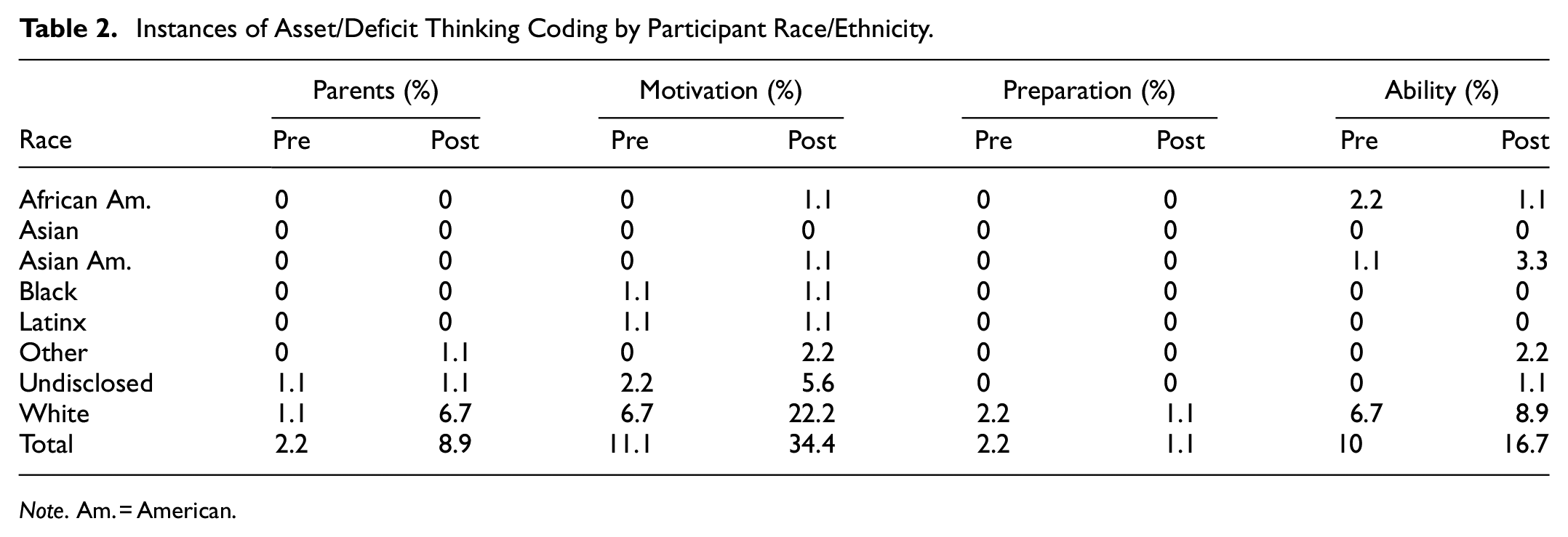
As noted above, we center our analyses on key high-frequency codes, in this instance the deficit/asset code. Comparison of participants’ pre- and post-assessments indicates that their engagements with course content contributed to complicating deficit/asset thinking—chipping away at meritocratic thinking in ways that might undermine the master narrative. Though noticeably challenged by participants by the course’s end, meritocratic thinking remains evident in participants’ responses—albeit in subtler ways. Overall in the pre-assessment, participants endorsed a host of meritocracy-maintaining perspectives, attributing educational success or failure to assets or deficits in nature, character, or familial upbringing. Participants suggested that educational inequalities resulted from (a) parents who do not care about education, (b) individual lack of motivation, (c) individual unpreparedness, and/or (d) individual “natural” or fixed ability—four locations for deficits and assets that sometimes overlapped. These narratives help to naturalize meritocracy by tethering academic attainment to the quality (or qualities) of individual students—in the process, displacing discussion of structural racism, as well as the past and present realities of white supremacist social stratification (Ladson-Billings, 1998; Valencia, 1997). Table 2 presents the number of participants, by race and total, whose responses on pre- or post-assessments involve one of four kinds of asset/deficit thinking about educational outcomes: students’ parents don’t care about education (“Parents”), students lack motivation (“Motivation”), students are unprepared (“Preparation”), and ability as “natural” or fixed (“Ability”).
Instances of Asset/Deficit Thinking Coding by Participant Race/Ethnicity.
Note. Am. = American.
Participants whose responses were coded within asset/deficit frames in the pre-assessment rarely included structural thinking. Of these, no response questioned whether educational standards themselves—or the testing of those standards—were inequitably structured to manufacture success for some and not others. Indeed, across pre-assessment responses, participants tended to place the onus for accessing educational opportunities on students themselves, rather than describing it as something shared by education institutions and educators. It makes sense, then, that the most common tropes for student success were motivation and ability—often coupled together, with ability mentioned as a necessary condition for merit. In these accounts, schools do their part to support student learning through tracking, or providing “cafeteria-style” curricular options (Bailey et al., 2015; Powell et al., 1985) that students can take advantage of—or not.
Here we highlight patterns in the responses that fell within the asset/deficit code, using student responses that exemplify those patterns. These explanations for student success or failure were offered across participant racial identifications. Hence Sabrina, an African American student, describes educational pathways in terms of learning speed, contrasting how “Honors and Advanced Placement options supported my faster learning pace and challenged me to do better” with the “pace” of different tracks, so that: [s]tudents that worked at an average pace were able to take Prep-Classes and students that worked slower than that were able to take a limited number of Remedial or Avid classes that attempted to break the learning down and slow the pace.
Similarly, Jordan, a white student, claims “the design and programming of my high school was very accommodating to support students unlike myself. For example, students who have lower intellectual abilities were able to take different classes or had many tutors available to help them.” Relatedly, Regan, an Asian American student, describes positive past experiences with cafeteria-style curricular choices—opting for courses in which self-propelling motivation was necessary for success. Regan writes, [t]here were multiple levels for different courses, so I could choose which one fit my abilities better. … As self-directed learning was pushed, it was often very college-style where you read the textbook and the teachers expect you to attend class knowing the majority of the material.
Schools, here, afford students fair opportunities by offering multiple pathways, stratified by rigor. In this meritocratic narrative, students rise to the level of their individual assets. Even when seeming to acknowledge that schools failed to serve some students, pre-assessment responses shift the onus for success onto the students themselves, absolving education institutions from responsibility. “I don’t think the design and program of my school supported anyone who had plans other than going to college after high school,” writes Danielle, a white student, before clarifying that student failure stems from student deficits: “I don’t think it supported students who couldn’t convert the competitive environment into motivation to work harder. … I also bet many students didn’t have parents who cared about their education enough to push them to keep going.”
In their post-assessment responses, participants discussed deficits and assets almost twice as often, but this increase was often accompanied by a subtle yet significant shift in the ways that participants configured deficits/assets relative to academic success. While many post-assessment responses emphasized the importance of students’ deficits and assets—primarily in terms of motivation and/or ability—an increased number of participants identified schools as insufficiently supportive of students, shifting responsibility for academic attainment and opportunity solely from students (and parents) to include the education system or educators. For example, in 12 instances (13.3%), participants wrote about schools as “seeing” students of color and students living in poverty through a deficit lens, which resulted, they wrote, in curtailing opportunities to learn.
Nevertheless, responses still tended to endorse tracking as a necessary system for supporting students, and talk of motivation and ability both increased—albeit asymmetrically, with the former increasing more than threefold, and the latter hardly at all. These increases are attributable primarily to the larger number of white students engaging in deficit/asset thinking by the course’s end—but responses fitting this pattern were provided by participants across racial identification. The overall effect of these post-assessment shifts is that participants more regularly described how schools unfairly constrain students’ opportunities, while continuing to write about individual-level deficits, such as devaluing education, as they elaborated structural inequalities.
Jamie, who identified as white, wrote one representative example of this. In the post-assessment, Jamie grappled with the structural injustices of education, while still reinscribing the deficit/asset thinking that explicitly maintains meritocracy and implicitly sustains white supremacy in education: A lot of the time students in low-income areas and of minority races receive a lower quality education than children living in high-income areas. There are a lot of factors that contribute to the creation of a low quality-learning environment including the freedom provided within the curriculum for teachers, motivation, participation, and attendance of students, and the dedication and ability of the teachers employed.
Here, Jamie acknowledges structural racial inequalities in education yet also locates this inequality partly within student motivation. Further, Jamie refers here explicitly to “minority races,” but whiteness itself is elided into the folds of “children living in high-income areas.” Deficit views have less been problematized than proliferated in Jamie’s response, with the blame for “lower quality education” distributed to unmotivated students but also, it seems, less able teachers who work in schools that serve “students … of minority races.”
Maddison, a Latinx student, similarly acknowledges the ways schools structure inequality, suggesting that schools harm students when they “operate on a tracked system where students have little say in their placement. There is little mobility between tracks and students from groups that are generally underachieving are placed disproportionally in lower tracks.” The “groups” referenced here seem to be a coded way to discuss minoritized racial groups and/or subalternized classes—and, tellingly, the groups singled out for inappropriate tracking are “underachieving” groups. No suggestion is made here—or, in fact, in any participant response—that students from “overachieving” groups (or white, high-income students) might be inappropriately sorted into “higher” track courses. Whiteness, in this way, is positioned as an unexamined norm—present only by implication, while groups that “deviate” from that norm are attended to explicitly (Chambers, 1996; Morrison, 1992). Maddison quickly makes clear that this critique of tracking extends only to top-down, mandatory tracking. The cafeteria-style approach to tracking is, in Maddison’s thinking, an unadulterated good: For students like myself who enjoyed challenging coursework and knew that the[y] need to take difficult classes and do well in order to succeed after high school and into college it was beneficial to have this type of system. … However, for students unlike myself who might not have been as motivated or didn’t think they wanted to go to college there were also options that catered to them in watered down courses. Ultimately in this type of system it is completely up to the student to make what they can of the situation.
As the responses of Maddison, Jamie, and Shannon show, deficit/asset thinking transforms to assume a complex, self-contradictory shape—but does not disappear. Many participants recognized structural racism and inequality, while assigning culpability to students for not succeeding in an inequitable system. In messing with the master narrative, meritocracy becomes a messier construct—unraveling, but not undone.
The “Sad Realization” of Privilege
We also coded student responses for whether they acknowledged personal privileges or disadvantages based on identity or background. Acknowledgments of privilege shifted markedly from pre- to post-assessment, in both quantitative and qualitative terms. Quantitatively, acknowledgments of privilege more than quadrupled by the end of the term with much of the increase attributable to acknowledgments of privilege by white students (see Table 3 below), a notable increase, for, as we saw, above, Flynn et al. (2018) have noted the ways that undergraduates’ feelings of resistance and “guilt or anxiety” can often result in undergraduates’ avoidance and silence (p. 244). Qualitatively, responses shifted from participants uncritically framing their privileges as a function of their own ability or hard work, to discussing their privileges in terms of systemic injustice that redounds to their benefit. Acknowledgments of disadvantage, discussed at the end of this section, were few in both pre- and post-assessment responses, but testify to a similar shift. While acknowledgments shifted, many participants discussed their privileges in abstract terms, not committing themselves to an explicit acknowledgment of race (or class) privilege. Additionally, when participants advocate structural changes to redress disparities in privilege, they frame these interventions in terms of uplifting or expanding privilege to those who do not have it; no participant entertains the thought of giving up some of the privileges they acknowledge enjoying.
Privilege/Disadvantage Acknowledged by Participant Race/Ethnicity.

Note. Am. = American.
Responding to the pre-assessment, Melissa—who identifies as white—writes, “My high school very much supported my growth as a learner and individual, which I understand is a great privilege,” but positions this privilege as a function of the school’s willingness to invest in their giftedness: “My high school allowed me to learn at an advanced pace and helped me to find ways to continue learning when they themselves couldn’t specifically teach me what I wanted to learn.” Maggie, who identifies as white, describes her privileges in related terms: “I was fortunate enough to be in [my school’s] Gifted Program, and have numerous opportunities that other students did not. I was able to go to seminars on numerous topics throughout my years in the district.” In accounts of this kind—consonant with the deficit/asset thinking discussed above—privilege is celebrated, not critiqued; school resources are allocated to those best positioned to make use of them. Another white student, Gloria, claims her school provided “support to a wide variety of people,” but notes the possibility that her privileges may have prevented her from noticing inequalities at the school: “Of course, I am part of the majority for all aspects of subgroups, so I could be oblivious to the lack of support that minorities are receiving.”
In post-assessment responses, no acknowledgments of privilege were uncritically celebratory in the manner of Melissa’s and Maggie’s pre-assessment responses. Additionally, post-assessment acknowledgments were often threaded through with the kind of admission Gloria provides above: characterizing privilege as self-obscuring. For example, Delilah, who did not disclose her racial identification, wrote that “[b]ecause I was raised in such a positive school system, I think I was ignorant to the fact that not all schools are like mine. … Over the course of this semester, this has been a sad realization of mine.” Gloria provides a post-assessment response that extends and revises her earlier commentary: “I’m a white, middle-class, upper-track student and have felt heavily supported throughout my entire high school career. I was ignorant to the struggles that minority groups and lower SES groups receive on a daily basis. I especially did not realize that even students in lower tracks suffer from a lack of specialized attention, resources and qualified teachers.” Lacing Gloria’s explicit acknowledgment of white privilege, though, is a residual endorsement of meritocratic tracking; Gloria identifies privilege as something partly allocated to students on the basis of their “track,” without examining whether these tracks are, themselves, a result of systemic privilege. Interestingly, the few non-white students who acknowledged privilege on the post-assessment sometimes configured this privilege in terms of class, but often discussed their privilege in terms of their individual assets. In the words of Raquel, who identifies as Black, such privileges were conferred as a result of “who I was in the school”—thus while meritocratic thinking may be a guarantor of white privilege, it found support in the writings of participants without white privilege.
We get a sense for how much engagements with privilege have shifted and deepened—and how vexed they remain—when we consider Maggie’s post-assessment response. Gone is Maggie’s celebration of her own giftedness, but in its place is a sense that racial diversity is a contributing source for educational failure and disadvantage: I … learned how important of an issue it is to ensure teachers are able to teach to a wide range of students. Coming from a mostly Caucasian community, I was unaware of how diverse some schools are and how difficult it can be for teachers to teach to the wide variety of students.
Maggie’s engagements with course material seem to have left her with the idea that her racial privilege stems from the fact that her school was racially homogenous, therefore requiring less differentiation and easier to teach than would a more racially heterogenous population. Without referencing white racial privilege, Shannon echoes this conclusion, Coming into this class, I did not have much idea of how most schools handle student bodies that are diverse in background and ability level. I went to small, well-funded private schools for my entire education until college, so I have never seen schools struggle for resources or with large class sizes first-hand.
Shannon addresses race less explicitly than Maggie —though the nod to students “diverse in background” seems to provide a color-blind term for discussing racial diversity. Nevertheless, Shannon’s acknowledgment of privilege harmonizes with Maggie’s: both regard decreased diversity in education as a privilege they enjoyed and both construct diversity as a source for the malfunctioning of education in the United States. Both, too, participate in a pattern found throughout responses that acknowledge privilege. As participants begin to reckon with the social configurations that contributed to their successes, they nevertheless treat privilege as a kind of default state, and position disadvantage as abnormal—a departure from how things typically are, or how they ought to be. Implicitly, participants construct privilege as a desirable (even neutral) end state that the disadvantaged should aspire to.
In a small but potentially insightful shift, no participants who identified as white described themselves as disadvantaged in their post-assessment responses. Natalie, who did not disclose a racial identification, provided the only post-assessment acknowledgment of disadvantage. “There is a lack of support for students who are like myself that come from poorly funded schools,” Natalie wrote: Most of my [college] peers I have met on campus come from high schools that perform above the curve…Their goals are often supported by families who also attended college and help them connect with resources outside the academic system.
Natalie’s commentary on disadvantage appears to flip other participants’ talk of assets and deficits on its head, positioning multi-generational college attendance and the networks of influence and resources that accompany them not as neutral goods that “disadvantaged” students lack, but instead as features that contribute to structural injustice. Natalie’s commentary is the exception, rather than the rule. While engagement with course content seems to have contributed to increases in participants’ acknowledgments of privilege, the same cannot be said for talk of disadvantage.
Overriding Socioeconomic Status
Changes in participant pre- to post-assessment responses reveal some of the ways participants have begun this reckoning process, while also exposing the limitations of thinking through school support(iveness) within a meritocratic framework, instead of against it. In pre-assessment responses, participants who considered SES seemed sanguine about the educational support provided to students in poverty, with almost as many participants describing schools as supportive of students in poverty as describing schools as unsupportive (see Table 4 below). Whether their pre-assessment responses cited schools as supportive or unsupportive, participants tended to construct school supports and supportiveness narrowly, with several appearing to employ coded language that approaches—but stops short of—discussing poverty in racialized terms. Table 4 shows the number of participants who describe schools supporting or not supporting students in poverty on pre- or post-assessments, by racial group.
Instances of SES Supported/Not Supported by Participant Race/Ethnicity.

Note. Am. = American.
Participants who discussed school-level supportiveness of students in poverty located this support in financial aid provided by mostly private and/or well-resourced schools to less-wealthy students. Some who responded this way cited free and reduced lunch (FRL) as the mechanism through which schools provided aid for students in poverty—apparently mistaking federal policy for school-level largess. For instance, Juyoung, who identified as Asian, reported that her “school offered free lunch programs and had a plethora of clubs for all different types of ethnicities and cultures.” A few participants acknowledged other possible school-level obstacles, such as transportation, technology access, and social integration, for students living in poverty. The participants who described how schools failed to support students in poverty tended to undercut this acknowledgment by suggesting that schools—both less-resourced schools and small private schools—should not be expected to support a large population of students in poverty, shifting the onus from the system to the individual.
On pre-assessment responses, the line between support and its absence was often a thin one. Within the same response, participants often emphasized that schools are as supportive as possible of students living in poverty, but also that the demography of the school ultimately made integration of marginalized students difficult—even, to a point, impossible. Audrie, who identifies as white, travels this thin line, beginning by remarking on the financial difficulty experienced by “anyone in my high school who was attending the school on tuition. With a yearly tuition of $28,600, the majority was quite wealthy and well-off.” Quickly, though, Audrie credits her school for benevolently opening its doors to those who were not wealthy, noting that her school, also gave a lot of scholarships to inner-city people, and I think it was definitely hard for them to integrate into such a wealthy community, especially if they were coming from very little. Nevertheless, I think the opportunity to be at such an amazing high school—that guarantees each of its students gets into at least one college—could have overridden some of the hardships. My school was also very diverse, with multiple Asian and Indian Americans, but surprisingly they never seemed like a minority on campus. I think the diversity of the school was amazing, and really opened each student up to the ideas of different cultures and religions. I don’t think [my school] ignored any students [sic] needs.
Audrie’s comment demonstrates how she is attempting to acknowledge how her school did and did not support students based on social background while simultaneously shifting the onus onto the individual. By stating, “Asian and Indian Americans…never seemed like a minority on campus” and thus signaling that the “inner-city people” were a minority, even if not numerically, Audrie brings up myths of meritocracy and individuality coupled with myths of the model minority. This rebuttal shifts the onus of integrating onto the students in poverty and not onto the school. This statement further removes the onus from the school by arguing that “the opportunity to be at such an amazing school…could have overridden some of the hardships.” This trajectory of acknowledging a systemic inequity followed by language that then suggests that the inequity is, in fact, an individual obstacle that some overcome and that others do not—thus missing out on the equitable opportunity—is a recurrent theme throughout participants’ reflections.
The data coded for SES by race showed that most white students began the course offering that FRL was a major way that schools support students in poverty. By the end of the course, FRL did not appear in the post-assessment data. What we did note in the post-assessment data was that white students more readily acknowledged that schools catered specifically to white upper class students. They acknowledged the benefit of the intersection of whiteness and wealth as privileged identities in schools. However, only one student argued that schools might be classist and racist. Instead, many students, across race, wrestled in their narratives to acknowledge how schools limit opportunities by class, listing tracking as one of these ways, and then overriding the inequities by arguing for individual accountability over school change. This wrestling, as seen below, was similar to what occurred around deficit/asset thinking where students took up the data from the course on systemic and historic inequities in access by class and yet framed those conversations within a narrative that held views of individual accountability as paramount, questioning whether the system should be responsible for ensuring equitable access to opportunities. Raquel notes in her post-assessment that, schools support students that are in the top percentile of their graduating class more than they support students that do not perform as well as the top ranked students. Students that perform well on standardized tests, and have higher grade point averages are exposed to more opportunities to advance throughout their academic career. The way schools have traditionally been funded allows for the perpetuation of gaps in education across socioeconomic and racial barriers. Schools located in more affluent neighborhoods have lofty property tax funding supporting them and these schools traditionally outperform schools that are based in environments with lower socioeconomic standings.
Here she acknowledges the systemic inequities in schooling as a function of class signaled by those from “more affluent neighborhoods” as well as how more opportunities are given to those who already demonstrate certain markers of “success” such as higher grade point averages and test scores. Raquel continues in the next line to note, Within a school students that are not motivated, and do not come from successful backgrounds are disadvantaged, while students with high grades are pushed to achieved [sic] more through factors other than just their teachers. The tracking system of schools is an example of how students are disadvantaged and advantaged. Students in higher achieving tracks are pushed to learn more, and receive more help and resources than students that they outperform yet students that are being tracked and placed in lower performing tracks get through less content and receive less motivation to move up in their track ranking.
Here Raquel’s reflection shifts from the resources of the school to the individual’s use of those resources, suggesting that the individual may be unmotivated or their background is somehow responsible for their lack of success. The discussion then shifts to “how students are disadvantaged and advantaged” by tracking, holding a meritocratic view in which students “outperform” as well as acknowledging systemic inequities where “students in higher achieving tracks…receive more help.” This post-assessment reflection vacillates as it attempts to hold onto the meritocratic nature of tracking as an education policy while also attending to the fact that tracking perpetuates inequities and that these inequities are in many ways connected to disparities in wealth at the school and individual level.
Overall trends from pre- to post-assessment demonstrate a more nuanced discussion of deficit/asset thinking, privilege, and SES. Participants’ post-assessment narratives include more acknowledgment of specific ways in which schools limit motivation, cater to already privileged populations, and miss opportunities to support students living in poverty. However, we also see a pattern across participants of attempting to explain, negate, and override these systemic inequities within a narrative that holds onto the myth of meritocracy and the belief in individual, internal motivation as equal to success. There is some variance in the ways in which participants discuss these issues by race, but overall, what we see in our sample are narratives that are troubled in their attempt to fit course data on historic and systemic inequities in educational opportunities within a narrative that privileges the individual, downplays the systemic, and holds onto the myth of meritocracy.
Conclusion
Our analysis investigates shifts in participant thinking about systemic inequities in U.S. K-12 public schooling during an undergraduate diversity course. We sought to understand where participants began in relation to their understandings of schooling inequalities as a function of class and race, and the patterns in their thinking in relation to these ideas at the end of a course in which they considered and focused on historic and systemic inequities in schooling. Our sample is from a PWI where the median family income is $154,000, and 66% of undergraduates come from the top 20% and 3.6% come from the bottom 20% in terms of family income. Although this relative economic privilege and lack of racial and ethnic diversity does constrain what we can say, it nevertheless allows us to consider the experiences of white upper and middle class undergraduate students as they interact with and make sense of course material focused on issues of race and class privilege and systemic inequities in schooling, and to be in dialogue with scholarship investigating how undergraduates, and white undergraduates in particular, “mess with the master narratives” as they are supported in a semester-long inquiry into issues of race, racism, and privilege. We see an increased awareness of inequities in schooling from pre- to post-assessment. Our analysis also uncovers that undergraduates spoke about issues of race, racism, and privilege with more frequency. Yet we also note troubling narratives. Many participants came into the course with a belief in the myth of meritocracy and individualism. The course material aims to disrupt and problematize these ideas by highlighting the systems in schools that discriminate and limit access as a function of race and class. Participants take up these ideas in their discussions of the problems of tracking and the lack of quality teachers in lower tracks; however, they stop short of considering ways to dismantle and disrupt these systems. Instead, students explain these inequities within a frame that safeguards the myth of meritocracy; diminishes the culpability of the systemic; and focuses on the merit, ability, and motivation of the individual. Students’ inclusion of inequities within a meritocratic frame reinforces Rolón-Dow et al.’s (2021) findings that undergraduates’ racial literacy develops in ways that are “ongoing and non-linear” and that require “repeated engagement, differentiation, and support” (p. 663). Our work highlights that undergraduates may take up understandings of systemic inequities yet work to make sense of them within their current narratives—with the myth of meritocracy being a familiar one.
Hence what we note is a progression in awareness of the inequities across schools as well as the beginnings of an understanding of the role of systemic classism and racism in these inequities. Participants’ narratives highlight a struggle as they work to synthesize their own experiences in primarily well-resourced schools where the systems were often hidden or unacknowledged and where the idea of a meritocracy was promoted with course material that challenges the normalcy of those experiences. It is not surprising that participants attempt to make sense of the course material through a lens of meritocracy, because talk of “merit” suffuses popular and political discourse about schools. Even more, participants come to the class with decades of successful experiences in schools. They themselves have worked hard to get to where they are, thus their individual experiences themselves overlap with and reinforce the trope of a meritocracy. Some participants came to the class with individual-level understandings of inequalities, but very seldom were those understandings structural. Reconciling their own successes with a course that explores structural inequality was often painful, resulting in the messiness in the texts that they produce and the sort of crisis that Kumashiro (2000) writes about as necessary for disruption.
Although the course material troubles participants’ narratives of schools and schooling, they work to fit this contradictory data into a narrative of meritocracy. It is as if they read the curriculum materials of the class in ways that—overall and on average—raise their consciousness, as they often wrote in ways that attended to socially just views; however, the pull of the myth of meritocracy continues to frame their narratives.
Discussion and Implications
We began by noting that the data on the curriculum for diversity courses is mixed. Our analysis indicates how participants situate data about systemic inequality within their narratives about individualism and meritocracy, problematizing the passive nature in which some scholars have discussed students’ roles in denying the systemic by privileging the individual. We see a movement beyond outright denial of the systemic, and a struggle in participants’ discourse around systemic inequities and their belief in meritocracy and individual responsibility. What we see in the data is an active hedging and troubled explanations of how systemic inequities can occur within a narrative of individualism and meritocracy. Participants’ responses to the dissonance from the course content demonstrates a vacillation, not the outright resistance that other scholars have found, but instead a re-forming of the new information to fit within their strongly held views of U.S. public schooling as meritocratic. Others have looked, in particular, at the ways that undergraduates studying to be teachers fail to imagine an anti-racist English education given the ubiquity of whiteness in public schooling, U.S. culture, and teaching (Toliver & Hadley, 2021). We found that participants do make progress from being unaware or having an undisturbed view of privilege and meritocracy to a troubled, tenuous belief in meritocracy. This is both progress and problematic.
In our analysis, we were attentive to the ways that socioeconomic inequality is an instrument and effect of white supremacy. Talk of economic status and class is sometimes a coded way to talk about race, and socioeconomic stratification is intertwined with racial stratification (Ladson-Billings, 1998; Leonardo, 2009)—not least of which, because the material and economic legacies of de jure white supremacy ramify into the present, and the refusal to acknowledge this history is one way de facto white supremacy reproduces itself (Gillborn, 2005). As Mills (1997) puts it, “global white supremacy” is, in part, “a particular power structure of … socioeconomic privilege, and norms for the differential distribution of material wealth and opportunities” (p. 3). For this reason, critical race scholars have expressed concern over neoliberal creep into education policy and discourse; treating schools as a market—and students as market “winners” and “losers”—reinforces the master narratives of white supremacy and meritocracy, even when “race” is not explicitly invoked (see e.g., Diem & Hawkman, 2019). At a minimum, redressing these inequalities within the context of education requires us to critically inventory the ways schools can support students who are at a socioeconomic disadvantage—and to reckon with how schools have failed to do so.
To do their part, universities must consider not only the work of presenting disconfirming data in the undergraduate curriculum, but also the pedagogical practices and time necessary to support students in dismantling their myths around meritocracy. More work is needed to understand how best to engage students who have benefited from or successfully navigated systemic inequities in reframing their understanding(s), so that they are able to critically consider the structural inequalities of U.S. public schooling and disrupt pervasive narratives that obscure these inequalities.
Footnotes
Declaration of Conflicting Interests
The author(s) declared no potential conflicts of interest with respect to the research, authorship, and/or publication of this article.
Funding
The author(s) received no financial support for the research, authorship, and/or publication of this article.

Data Availability Statement
Data can be made available by the corresponding author upon reasonable request, subject to restrictions on reuse.